
C Programming Language
Mo’meN Ali
C Control Statements: Branching
& Jumping
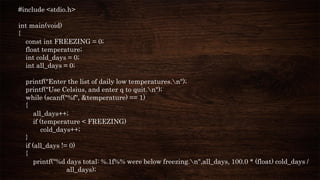
#include <stdio.h>
int main(void)
{
const int FREEZING = 0;
float temperature;
int cold_days = 0;
int all_days = 0;
printf("Enter the list of daily low temperatures.n");
printf("Use Celsius, and enter q to quit.n");
while (scanf("%f", &temperature) == 1)
{
all_days++;
if (temperature < FREEZING)
cold_days++;
}
if (all_days != 0)
{
printf("%d days total: %.1f%% were below freezing.n",all_days, 100.0 * (float) cold_days /
all_days);
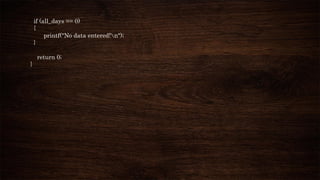
if (all_days == 0)
{
printf("No data entered!n");
}
return 0;
}
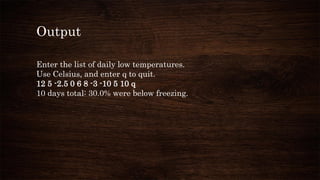
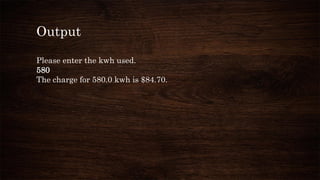
Output
Enter the list of daily low temperatures.
Use Celsius, and enter q to quit.
12 5 -2.5 0 6 8 -3 -10 5 10 q
10 days total: 30.0% were below freezing.
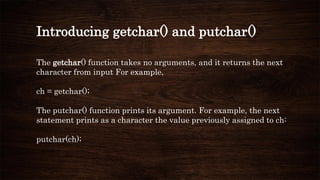
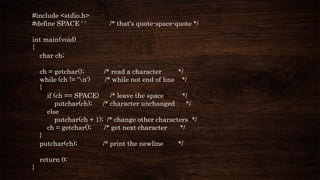
Introducing getchar() and putchar()
The getchar() function takes no arguments, and it returns the next
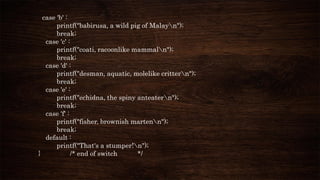
character from input For example,
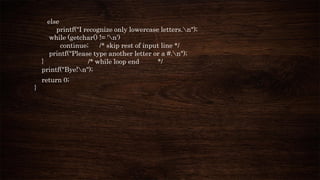
ch = getchar();
The putchar() function prints its argument. For example, the next
statement prints as a character the value previously assigned to ch:
putchar(ch);
#include <stdio.h>
#define SPACE ' ' /* that's quote-space-quote */
int main(void)
{
char ch;
ch = getchar(); /* read a character */
while (ch != 'n') /* while not end of line */
{
if (ch == SPACE) /* leave the space */
putchar(ch); /* character unchanged */
else
putchar(ch + 1); /* change other characters */
ch = getchar(); /* get next character */
}
putchar(ch); /* print the newline */
return 0;
}
Output
CALL ME HAL.
DBMM NF IBM/
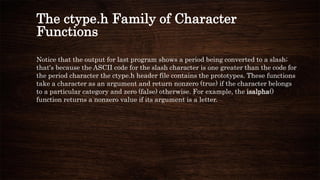
The ctype.h Family of Character
Functions
Notice that the output for last program shows a period being converted to a slash;
that's because the ASCII code for the slash character is one greater than the code for
the period character the ctype.h header file contains the prototypes. These functions
take a character as an argument and return nonzero (true) if the character belongs
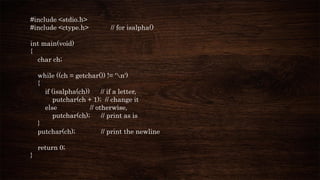
to a particular category and zero (false) otherwise. For example, the isalpha()
function returns a nonzero value if its argument is a letter.
#include <stdio.h>
#include <ctype.h> // for isalpha()
int main(void)
{
char ch;
while ((ch = getchar()) != 'n')
{
if (isalpha(ch)) // if a letter,
putchar(ch + 1); // change it
else // otherwise,
putchar(ch); // print as is
}
putchar(ch); // print the newline
return 0;
}
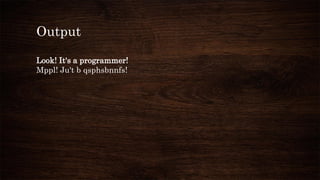
Output
Look! It's a programmer!
Mppl! Ju't b qsphsbnnfs!
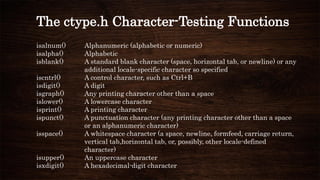
The ctype.h Character-Testing Functions
isalnum() Alphanumeric (alphabetic or numeric)
isalpha() Alphabetic
isblank() A standard blank character (space, horizontal tab, or newline) or any
additional locale-specific character so specified
iscntrl() A control character, such as Ctrl+B
isdigit() A digit
isgraph() Any printing character other than a space
islower() A lowercase character
isprint() A printing character
ispunct() A punctuation character (any printing character other than a space
or an alphanumeric character)
isspace() A whitespace character (a space, newline, formfeed, carriage return,
vertical tab,horizontal tab, or, possibly, other locale-defined
character)
isupper() An uppercase character
isxdigit() A hexadecimal-digit character
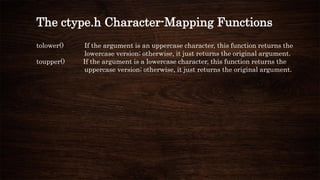
The ctype.h Character-Mapping Functions
tolower() If the argument is an uppercase character, this function returns the
lowercase version; otherwise, it just returns the original argument.
toupper() If the argument is a lowercase character, this function returns the
uppercase version; otherwise, it just returns the original argument.
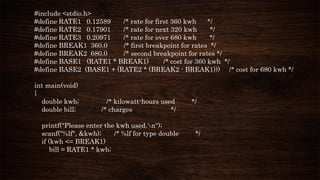
#include <stdio.h>
#define RATE1 0.12589 /* rate for first 360 kwh */
#define RATE2 0.17901 /* rate for next 320 kwh */
#define RATE3 0.20971 /* rate for over 680 kwh */
#define BREAK1 360.0 /* first breakpoint for rates */
#define BREAK2 680.0 /* second breakpoint for rates */
#define BASE1 (RATE1 * BREAK1) /* cost for 360 kwh */
#define BASE2 (BASE1 + (RATE2 * (BREAK2 - BREAK1))) /* cost for 680 kwh */
int main(void)
{
double kwh; /* kilowatt-hours used */
double bill; /* charges */
printf("Please enter the kwh used.n");
scanf("%lf", &kwh); /* %lf for type double */
if (kwh <= BREAK1)
bill = RATE1 * kwh;
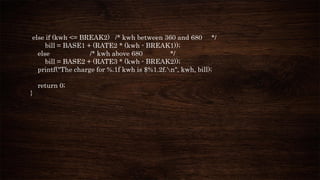
else if (kwh <= BREAK2) /* kwh between 360 and 680 */
bill = BASE1 + (RATE2 * (kwh - BREAK1));
else /* kwh above 680 */
bill = BASE2 + (RATE3 * (kwh - BREAK2));
printf("The charge for %.1f kwh is $%1.2f.n", kwh, bill);
return 0;
}
Output
Please enter the kwh used.
580
The charge for 580.0 kwh is $84.70.
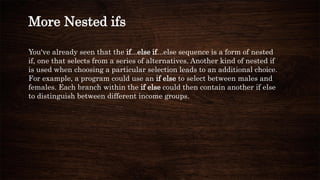
More Nested ifs
You've already seen that the if...else if...else sequence is a form of nested
if, one that selects from a series of alternatives. Another kind of nested if
is used when choosing a particular selection leads to an additional choice.
For example, a program could use an if else to select between males and
females. Each branch within the if else could then contain another if else
to distinguish between different income groups.
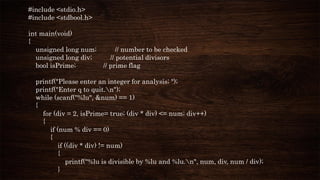
#include <stdio.h>
#include <stdbool.h>
int main(void)
{
unsigned long num; // number to be checked
unsigned long div; // potential divisors
bool isPrime; // prime flag
printf("Please enter an integer for analysis; ");
printf("Enter q to quit.n");
while (scanf("%lu", &num) == 1)
{
for (div = 2, isPrime= true; (div * div) <= num; div++)
{
if (num % div == 0)
{
if ((div * div) != num)
{
printf("%lu is divisible by %lu and %lu.n", num, div, num / div);
}
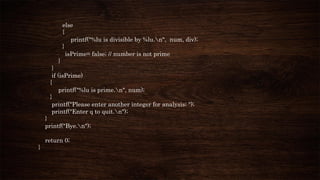
else
{
printf("%lu is divisible by %lu.n", num, div);
}
isPrime= false; // number is not prime
}
}
if (isPrime)
{
printf("%lu is prime.n", num);
}
printf("Please enter another integer for analysis; ");
printf("Enter q to quit.n");
}
printf("Bye.n");
return 0;
}
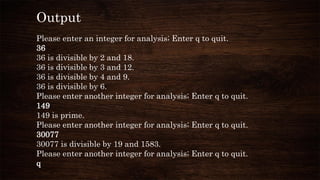
Output
Please enter an integer for analysis; Enter q to quit.
36
36 is divisible by 2 and 18.
36 is divisible by 3 and 12.
36 is divisible by 4 and 9.
36 is divisible by 6.
Please enter another integer for analysis; Enter q to quit.
149
149 is prime.
Please enter another integer for analysis; Enter q to quit.
30077
30077 is divisible by 19 and 1583.
Please enter another integer for analysis; Enter q to quit.
q
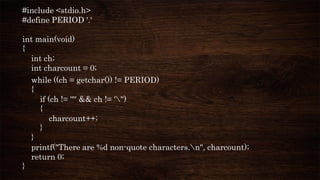
#include <stdio.h>
#define PERIOD '.‘
int main(void)
{
int ch;
int charcount = 0;
while ((ch = getchar()) != PERIOD)
{
if (ch != '"' && ch != ''')
{
charcount++;
}
}
printf("There are %d non-quote characters.n", charcount);
return 0;
}
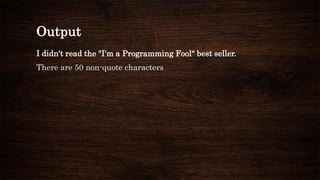
Output
I didn't read the "I'm a Programming Fool" best seller.
There are 50 non-quote characters
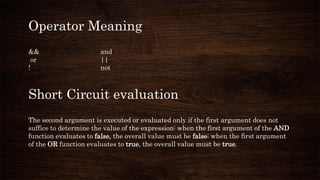
&& and
or ||
! not
Operator Meaning
Short Circuit evaluation
The second argument is executed or evaluated only if the first argument does not
suffice to determine the value of the expression: when the first argument of the AND
function evaluates to false, the overall value must be false; when the first argument
of the OR function evaluates to true, the overall value must be true.
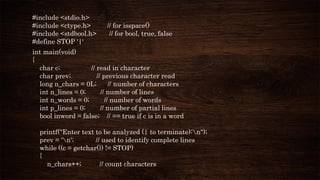
#include <stdio.h>
#include <ctype.h> // for isspace()
#include <stdbool.h> // for bool, true, false
#define STOP '|‘
int main(void)
{
char c; // read in character
char prev; // previous character read
long n_chars = 0L; // number of characters
int n_lines = 0; // number of lines
int n_words = 0; // number of words
int p_lines = 0; // number of partial lines
bool inword = false; // == true if c is in a word
printf("Enter text to be analyzed (| to terminate):n");
prev = 'n'; // used to identify complete lines
while ((c = getchar()) != STOP)
{
n_chars++; // count characters
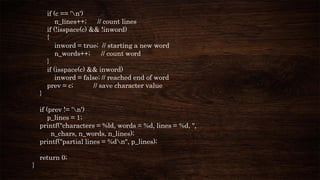
if (c == 'n')
n_lines++; // count lines
if (!isspace(c) && !inword)
{
inword = true; // starting a new word
n_words++; // count word
}
if (isspace(c) && inword)
inword = false; // reached end of word
prev = c; // save character value
}
if (prev != 'n')
p_lines = 1;
printf("characters = %ld, words = %d, lines = %d, ",
n_chars, n_words, n_lines);
printf("partial lines = %dn", p_lines);
return 0;
}
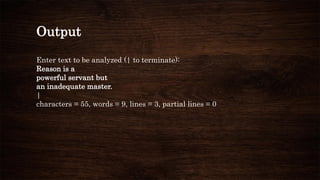
Output
Enter text to be analyzed (| to terminate):
Reason is a
powerful servant but
an inadequate master.
|
characters = 55, words = 9, lines = 3, partial lines = 0
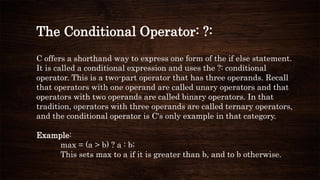
The Conditional Operator: ?:
C offers a shorthand way to express one form of the if else statement.
It is called a conditional expression and uses the ?: conditional
operator. This is a two-part operator that has three operands. Recall
that operators with one operand are called unary operators and that
operators with two operands are called binary operators. In that
tradition, operators with three operands are called ternary operators,
and the conditional operator is C's only example in that category.
Example:
max = (a > b) ? a : b;
This sets max to a if it is greater than b, and to b otherwise.
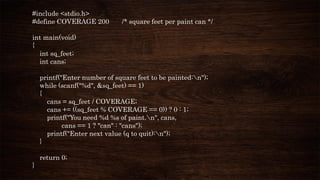
#include <stdio.h>
#define COVERAGE 200 /* square feet per paint can */
int main(void)
{
int sq_feet;
int cans;
printf("Enter number of square feet to be painted:n");
while (scanf("%d", &sq_feet) == 1)
{
cans = sq_feet / COVERAGE;
cans += ((sq_feet % COVERAGE == 0)) ? 0 : 1;
printf("You need %d %s of paint.n", cans,
cans == 1 ? "can" : "cans");
printf("Enter next value (q to quit):n");
}
return 0;
}
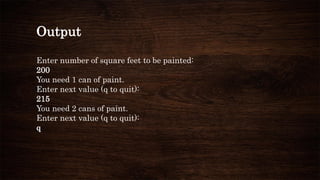
Output
Enter number of square feet to be painted:
200
You need 1 can of paint.
Enter next value (q to quit):
215
You need 2 cans of paint.
Enter next value (q to quit):
q
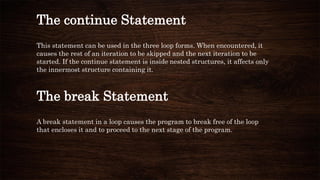
The continue Statement
This statement can be used in the three loop forms. When encountered, it
causes the rest of an iteration to be skipped and the next iteration to be
started. If the continue statement is inside nested structures, it affects only
the innermost structure containing it.
The break Statement
A break statement in a loop causes the program to break free of the loop
that encloses it and to proceed to the next stage of the program.
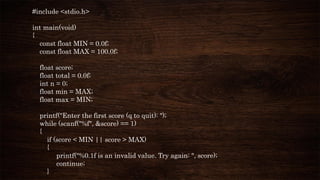
#include <stdio.h>
int main(void)
{
const float MIN = 0.0f;
const float MAX = 100.0f;
float score;
float total = 0.0f;
int n = 0;
float min = MAX;
float max = MIN;
printf("Enter the first score (q to quit): ");
while (scanf("%f", &score) == 1)
{
if (score < MIN || score > MAX)
{
printf("%0.1f is an invalid value. Try again: ", score);
continue;
}
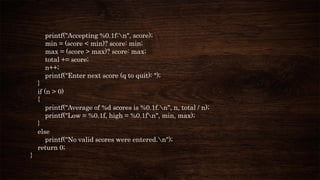
printf("Accepting %0.1f:n", score);
min = (score < min)? score: min;
max = (score > max)? score: max;
total += score;
n++;
printf("Enter next score (q to quit): ");
}
if (n > 0)
{
printf("Average of %d scores is %0.1f.n", n, total / n);
printf("Low = %0.1f, high = %0.1fn", min, max);
}
else
printf("No valid scores were entered.n");
return 0;
}
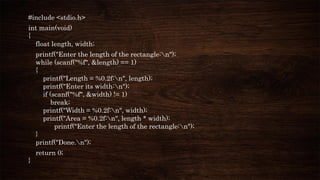
#include <stdio.h>
int main(void)
{
float length, width;
printf("Enter the length of the rectangle:n");
while (scanf("%f", &length) == 1)
{
printf("Length = %0.2f:n", length);
printf("Enter its width:n");
if (scanf("%f", &width) != 1)
break;
printf("Width = %0.2f:n", width);
printf("Area = %0.2f:n", length * width);
printf("Enter the length of the rectangle:n");
}
printf("Done.n");
return 0;
}
Multiple Choice: switch and break
The conditional operator and the if else construction make it easy to write
programs that choose between two alternatives. Sometimes, however, a
program needs to choose one of several alternatives. You can do this by using
if else if...else. However, in many cases, it is more convenient to use the C
switch statement.
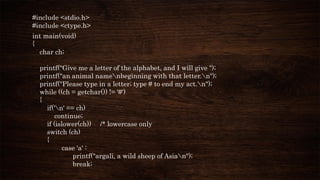
#include <stdio.h>
#include <ctype.h>
int main(void)
{
char ch;
printf("Give me a letter of the alphabet, and I will give ");
printf("an animal namenbeginning with that letter.n");
printf("Please type in a letter; type # to end my act.n");
while ((ch = getchar()) != '#')
{
if('n' == ch)
continue;
if (islower(ch)) /* lowercase only
switch (ch)
{
case 'a' :
printf("argali, a wild sheep of Asian");
break;
case 'b' :
printf("babirusa, a wild pig of Malayn");
break;
case 'c' :
printf("coati, racoonlike mammaln");
break;
case 'd' :
printf("desman, aquatic, molelike crittern");
break;
case 'e' :
printf("echidna, the spiny anteatern");
break;
case 'f' :
printf("fisher, brownish martenn");
break;
default :
printf("That's a stumper!n");
} /* end of switch */
else
printf("I recognize only lowercase letters.n");
while (getchar() != 'n')
continue; /* skip rest of input line */
printf("Please type another letter or a #.n");
} /* while loop end */
printf("Bye!n");
return 0;
}
Output
Give me a letter of the alphabet, and I will give an animal name
beginning with that letter.
Please type in a letter; type # to end my act.
a [enter]
argali, a wild sheep of Asia
Please type another letter or a #.
dab [enter]
desman, aquatic, molelike critter
Please type another letter or a #.
r [enter]
That's a stumper!
Please type another letter or a #.
Q [enter]
I recognize only lowercase letters.
Please type another letter or a #.
# [enter]
Bye!
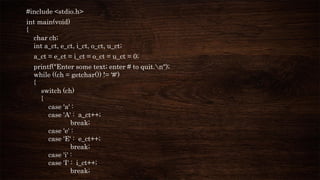
#include <stdio.h>
int main(void)
{
char ch;
int a_ct, e_ct, i_ct, o_ct, u_ct;
a_ct = e_ct = i_ct = o_ct = u_ct = 0;
printf("Enter some text; enter # to quit.n");
while ((ch = getchar()) != '#')
{
switch (ch)
{
case 'a' :
case 'A' : a_ct++;
break;
case 'e' :
case 'E' : e_ct++;
break;
case 'i' :
case 'I' : i_ct++;
break;
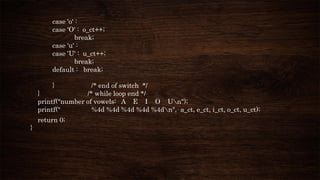
case 'o' :
case 'O' : o_ct++;
break;
case 'u' :
case 'U' : u_ct++;
break;
default : break;
} /* end of switch */
} /* while loop end */
printf("number of vowels: A E I O Un");
printf(" %4d %4d %4d %4d %4dn", a_ct, e_ct, i_ct, o_ct, u_ct);
return 0;
}
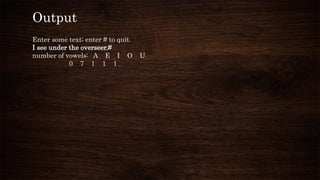
Output
Enter some text; enter # to quit.
I see under the overseer.#
number of vowels: A E I O U
0 7 1 1 1

6 c control statements branching &amp; jumping

  • 1.
  • 2.
    C Control Statements:Branching & Jumping
  • 3.
    #include <stdio.h> int main(void) { constint FREEZING = 0; float temperature; int cold_days = 0; int all_days = 0; printf("Enter the list of daily low temperatures.n"); printf("Use Celsius, and enter q to quit.n"); while (scanf("%f", &temperature) == 1) { all_days++; if (temperature < FREEZING) cold_days++; } if (all_days != 0) { printf("%d days total: %.1f%% were below freezing.n",all_days, 100.0 * (float) cold_days / all_days);
  • 4.
    if (all_days ==0) { printf("No data entered!n"); } return 0; }
  • 5.
    Output Enter the listof daily low temperatures. Use Celsius, and enter q to quit. 12 5 -2.5 0 6 8 -3 -10 5 10 q 10 days total: 30.0% were below freezing.
  • 6.
    Introducing getchar() andputchar() The getchar() function takes no arguments, and it returns the next character from input For example, ch = getchar(); The putchar() function prints its argument. For example, the next statement prints as a character the value previously assigned to ch: putchar(ch);
  • 7.
    #include <stdio.h> #define SPACE' ' /* that's quote-space-quote */ int main(void) { char ch; ch = getchar(); /* read a character */ while (ch != 'n') /* while not end of line */ { if (ch == SPACE) /* leave the space */ putchar(ch); /* character unchanged */ else putchar(ch + 1); /* change other characters */ ch = getchar(); /* get next character */ } putchar(ch); /* print the newline */ return 0; }
  • 8.
  • 9.
    The ctype.h Familyof Character Functions Notice that the output for last program shows a period being converted to a slash; that's because the ASCII code for the slash character is one greater than the code for the period character the ctype.h header file contains the prototypes. These functions take a character as an argument and return nonzero (true) if the character belongs to a particular category and zero (false) otherwise. For example, the isalpha() function returns a nonzero value if its argument is a letter.
  • 10.
    #include <stdio.h> #include <ctype.h>// for isalpha() int main(void) { char ch; while ((ch = getchar()) != 'n') { if (isalpha(ch)) // if a letter, putchar(ch + 1); // change it else // otherwise, putchar(ch); // print as is } putchar(ch); // print the newline return 0; }
  • 11.
    Output Look! It's aprogrammer! Mppl! Ju't b qsphsbnnfs!
  • 12.
    The ctype.h Character-TestingFunctions isalnum() Alphanumeric (alphabetic or numeric) isalpha() Alphabetic isblank() A standard blank character (space, horizontal tab, or newline) or any additional locale-specific character so specified iscntrl() A control character, such as Ctrl+B isdigit() A digit isgraph() Any printing character other than a space islower() A lowercase character isprint() A printing character ispunct() A punctuation character (any printing character other than a space or an alphanumeric character) isspace() A whitespace character (a space, newline, formfeed, carriage return, vertical tab,horizontal tab, or, possibly, other locale-defined character) isupper() An uppercase character isxdigit() A hexadecimal-digit character
  • 13.
    The ctype.h Character-MappingFunctions tolower() If the argument is an uppercase character, this function returns the lowercase version; otherwise, it just returns the original argument. toupper() If the argument is a lowercase character, this function returns the uppercase version; otherwise, it just returns the original argument.
  • 14.
    #include <stdio.h> #define RATE10.12589 /* rate for first 360 kwh */ #define RATE2 0.17901 /* rate for next 320 kwh */ #define RATE3 0.20971 /* rate for over 680 kwh */ #define BREAK1 360.0 /* first breakpoint for rates */ #define BREAK2 680.0 /* second breakpoint for rates */ #define BASE1 (RATE1 * BREAK1) /* cost for 360 kwh */ #define BASE2 (BASE1 + (RATE2 * (BREAK2 - BREAK1))) /* cost for 680 kwh */ int main(void) { double kwh; /* kilowatt-hours used */ double bill; /* charges */ printf("Please enter the kwh used.n"); scanf("%lf", &kwh); /* %lf for type double */ if (kwh <= BREAK1) bill = RATE1 * kwh;
  • 15.
    else if (kwh<= BREAK2) /* kwh between 360 and 680 */ bill = BASE1 + (RATE2 * (kwh - BREAK1)); else /* kwh above 680 */ bill = BASE2 + (RATE3 * (kwh - BREAK2)); printf("The charge for %.1f kwh is $%1.2f.n", kwh, bill); return 0; }
  • 16.
    Output Please enter thekwh used. 580 The charge for 580.0 kwh is $84.70.
  • 17.
    More Nested ifs You'vealready seen that the if...else if...else sequence is a form of nested if, one that selects from a series of alternatives. Another kind of nested if is used when choosing a particular selection leads to an additional choice. For example, a program could use an if else to select between males and females. Each branch within the if else could then contain another if else to distinguish between different income groups.
  • 18.
    #include <stdio.h> #include <stdbool.h> intmain(void) { unsigned long num; // number to be checked unsigned long div; // potential divisors bool isPrime; // prime flag printf("Please enter an integer for analysis; "); printf("Enter q to quit.n"); while (scanf("%lu", &num) == 1) { for (div = 2, isPrime= true; (div * div) <= num; div++) { if (num % div == 0) { if ((div * div) != num) { printf("%lu is divisible by %lu and %lu.n", num, div, num / div); }
  • 19.
    else { printf("%lu is divisibleby %lu.n", num, div); } isPrime= false; // number is not prime } } if (isPrime) { printf("%lu is prime.n", num); } printf("Please enter another integer for analysis; "); printf("Enter q to quit.n"); } printf("Bye.n"); return 0; }
  • 20.
    Output Please enter aninteger for analysis; Enter q to quit. 36 36 is divisible by 2 and 18. 36 is divisible by 3 and 12. 36 is divisible by 4 and 9. 36 is divisible by 6. Please enter another integer for analysis; Enter q to quit. 149 149 is prime. Please enter another integer for analysis; Enter q to quit. 30077 30077 is divisible by 19 and 1583. Please enter another integer for analysis; Enter q to quit. q
  • 21.
    #include <stdio.h> #define PERIOD'.‘ int main(void) { int ch; int charcount = 0; while ((ch = getchar()) != PERIOD) { if (ch != '"' && ch != ''') { charcount++; } } printf("There are %d non-quote characters.n", charcount); return 0; }
  • 22.
    Output I didn't readthe "I'm a Programming Fool" best seller. There are 50 non-quote characters
  • 23.
    && and or || !not Operator Meaning Short Circuit evaluation The second argument is executed or evaluated only if the first argument does not suffice to determine the value of the expression: when the first argument of the AND function evaluates to false, the overall value must be false; when the first argument of the OR function evaluates to true, the overall value must be true.
  • 24.
    #include <stdio.h> #include <ctype.h>// for isspace() #include <stdbool.h> // for bool, true, false #define STOP '|‘ int main(void) { char c; // read in character char prev; // previous character read long n_chars = 0L; // number of characters int n_lines = 0; // number of lines int n_words = 0; // number of words int p_lines = 0; // number of partial lines bool inword = false; // == true if c is in a word printf("Enter text to be analyzed (| to terminate):n"); prev = 'n'; // used to identify complete lines while ((c = getchar()) != STOP) { n_chars++; // count characters
  • 25.
    if (c =='n') n_lines++; // count lines if (!isspace(c) && !inword) { inword = true; // starting a new word n_words++; // count word } if (isspace(c) && inword) inword = false; // reached end of word prev = c; // save character value } if (prev != 'n') p_lines = 1; printf("characters = %ld, words = %d, lines = %d, ", n_chars, n_words, n_lines); printf("partial lines = %dn", p_lines); return 0; }
  • 26.
    Output Enter text tobe analyzed (| to terminate): Reason is a powerful servant but an inadequate master. | characters = 55, words = 9, lines = 3, partial lines = 0
  • 27.
    The Conditional Operator:?: C offers a shorthand way to express one form of the if else statement. It is called a conditional expression and uses the ?: conditional operator. This is a two-part operator that has three operands. Recall that operators with one operand are called unary operators and that operators with two operands are called binary operators. In that tradition, operators with three operands are called ternary operators, and the conditional operator is C's only example in that category. Example: max = (a > b) ? a : b; This sets max to a if it is greater than b, and to b otherwise.
  • 28.
    #include <stdio.h> #define COVERAGE200 /* square feet per paint can */ int main(void) { int sq_feet; int cans; printf("Enter number of square feet to be painted:n"); while (scanf("%d", &sq_feet) == 1) { cans = sq_feet / COVERAGE; cans += ((sq_feet % COVERAGE == 0)) ? 0 : 1; printf("You need %d %s of paint.n", cans, cans == 1 ? "can" : "cans"); printf("Enter next value (q to quit):n"); } return 0; }
  • 29.
    Output Enter number ofsquare feet to be painted: 200 You need 1 can of paint. Enter next value (q to quit): 215 You need 2 cans of paint. Enter next value (q to quit): q
  • 30.
    The continue Statement Thisstatement can be used in the three loop forms. When encountered, it causes the rest of an iteration to be skipped and the next iteration to be started. If the continue statement is inside nested structures, it affects only the innermost structure containing it. The break Statement A break statement in a loop causes the program to break free of the loop that encloses it and to proceed to the next stage of the program.
  • 31.
    #include <stdio.h> int main(void) { constfloat MIN = 0.0f; const float MAX = 100.0f; float score; float total = 0.0f; int n = 0; float min = MAX; float max = MIN; printf("Enter the first score (q to quit): "); while (scanf("%f", &score) == 1) { if (score < MIN || score > MAX) { printf("%0.1f is an invalid value. Try again: ", score); continue; }
  • 32.
    printf("Accepting %0.1f:n", score); min= (score < min)? score: min; max = (score > max)? score: max; total += score; n++; printf("Enter next score (q to quit): "); } if (n > 0) { printf("Average of %d scores is %0.1f.n", n, total / n); printf("Low = %0.1f, high = %0.1fn", min, max); } else printf("No valid scores were entered.n"); return 0; }
  • 33.
    #include <stdio.h> int main(void) { floatlength, width; printf("Enter the length of the rectangle:n"); while (scanf("%f", &length) == 1) { printf("Length = %0.2f:n", length); printf("Enter its width:n"); if (scanf("%f", &width) != 1) break; printf("Width = %0.2f:n", width); printf("Area = %0.2f:n", length * width); printf("Enter the length of the rectangle:n"); } printf("Done.n"); return 0; }
  • 34.
    Multiple Choice: switchand break The conditional operator and the if else construction make it easy to write programs that choose between two alternatives. Sometimes, however, a program needs to choose one of several alternatives. You can do this by using if else if...else. However, in many cases, it is more convenient to use the C switch statement.
  • 35.
    #include <stdio.h> #include <ctype.h> intmain(void) { char ch; printf("Give me a letter of the alphabet, and I will give "); printf("an animal namenbeginning with that letter.n"); printf("Please type in a letter; type # to end my act.n"); while ((ch = getchar()) != '#') { if('n' == ch) continue; if (islower(ch)) /* lowercase only switch (ch) { case 'a' : printf("argali, a wild sheep of Asian"); break;
  • 36.
    case 'b' : printf("babirusa,a wild pig of Malayn"); break; case 'c' : printf("coati, racoonlike mammaln"); break; case 'd' : printf("desman, aquatic, molelike crittern"); break; case 'e' : printf("echidna, the spiny anteatern"); break; case 'f' : printf("fisher, brownish martenn"); break; default : printf("That's a stumper!n"); } /* end of switch */
  • 37.
    else printf("I recognize onlylowercase letters.n"); while (getchar() != 'n') continue; /* skip rest of input line */ printf("Please type another letter or a #.n"); } /* while loop end */ printf("Bye!n"); return 0; }
  • 38.
    Output Give me aletter of the alphabet, and I will give an animal name beginning with that letter. Please type in a letter; type # to end my act. a [enter] argali, a wild sheep of Asia Please type another letter or a #. dab [enter] desman, aquatic, molelike critter Please type another letter or a #. r [enter] That's a stumper! Please type another letter or a #. Q [enter] I recognize only lowercase letters. Please type another letter or a #. # [enter] Bye!
  • 39.
    #include <stdio.h> int main(void) { charch; int a_ct, e_ct, i_ct, o_ct, u_ct; a_ct = e_ct = i_ct = o_ct = u_ct = 0; printf("Enter some text; enter # to quit.n"); while ((ch = getchar()) != '#') { switch (ch) { case 'a' : case 'A' : a_ct++; break; case 'e' : case 'E' : e_ct++; break; case 'i' : case 'I' : i_ct++; break;
  • 40.
    case 'o' : case'O' : o_ct++; break; case 'u' : case 'U' : u_ct++; break; default : break; } /* end of switch */ } /* while loop end */ printf("number of vowels: A E I O Un"); printf(" %4d %4d %4d %4d %4dn", a_ct, e_ct, i_ct, o_ct, u_ct); return 0; }
  • 41.
    Output Enter some text;enter # to quit. I see under the overseer.# number of vowels: A E I O U 0 7 1 1 1