







2139EPS Technology Education Lecture 2
Teachers Teachers Paint their minds And guide their thoughts Share their achievements  and advise their faults Inspire a Love Of knowledge and truth As you light the path Which leads our youth For our future brightens With each lesson you teach Each smile you lengthen Each goal you help reach For the dawn of each poet Each philosopher and king Begins with a Teacher And the wisdom they bring. By Kevin William Huff.


K X C E J O
 
K X C E J O
Z Q E C T B U  T M N R V G  I E Z B T G E
 
Z Q E C T B U  T M N R V G  I E Z B T G E
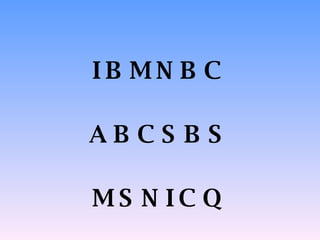
I B M N B C  A B C S B S  M S N I C Q
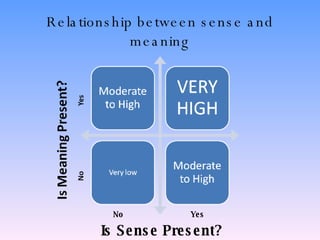
Relationship between sense and meaning Is Sense Present? No   Yes
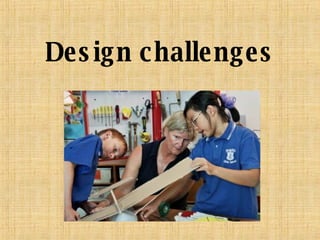
Design challenges
WHAT IS A  DESIGN CHALLENGE? A design challenge is a situation, problem or task that provides a meaningful context in which students can ‘work technologically’ to demonstrate learning outcomes in Technology.
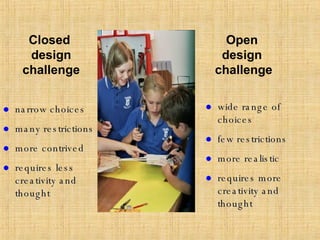
Closed  design challenge Open  design  challenge narrow choices many restrictions more contrived requires less creativity and thought wide range of choices few restrictions more realistic requires more creativity and thought
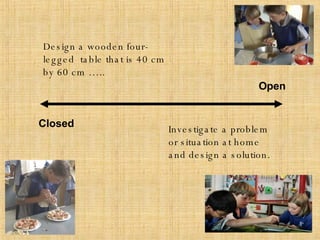
Design a wooden four-legged  table that is 40 cm by 60 cm ….. Investigate a problem or situation at home and design a solution. Closed Open
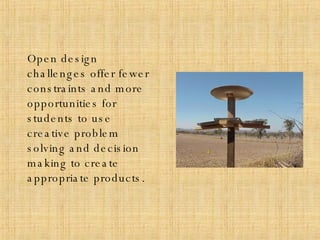
Open design challenges offer fewer constraints and more opportunities for students to use creative problem solving and decision making to create appropriate products.
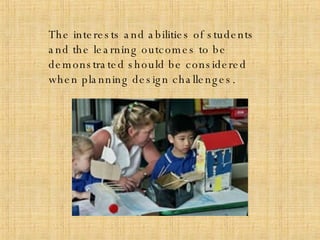
The interests and abilities of students and the learning outcomes to be demonstrated should be considered when planning design challenges.
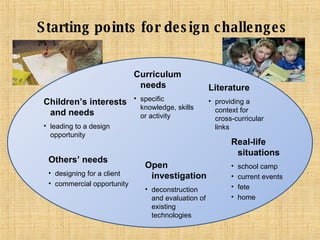
Starting points for design challenges Curriculum needs specific knowledge, skills or activity Literature providing a context for cross-curricular links Real-life situations school camp current events fete home Others’ needs designing for a client  commercial opportunity Children’s interests and needs leading to a design opportunity Open investigation deconstruction and evaluation of existing technologies
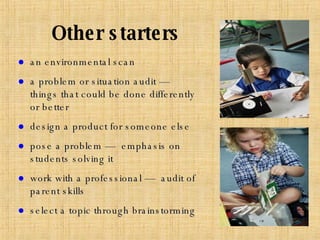
an environmental scan a problem or situation audit —  things that could be done differently or better design a product for someone else pose a problem —  emphasis on students solving it work with a professional —  audit of parent skills select a topic through brainstorming Other starters
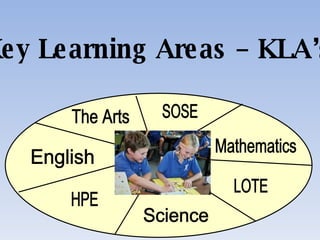
Mathematics English The Arts SOSE HPE LOTE Science Key Learning Areas – KLA’s
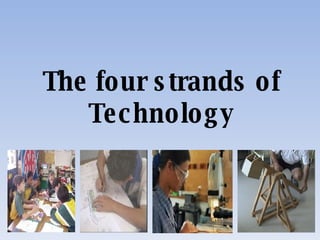
The four strands of Technology
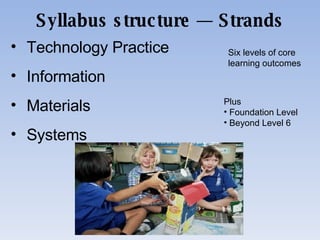
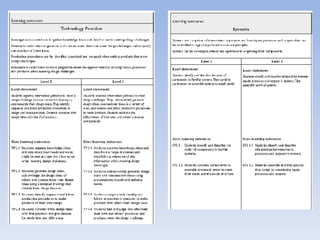
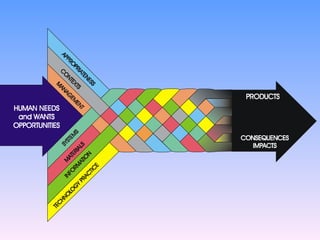
Syllabus structure  —  Strands Technology Practice Information Materials Systems Six levels of core learning outcomes Plus  Foundation Level Beyond Level 6
 
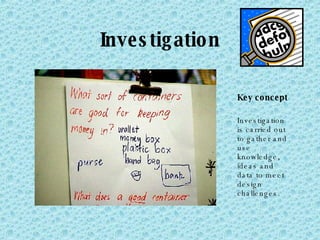
Investigation Key concept Investigation is carried out to gather and use knowledge, ideas and data to meet design challenges.
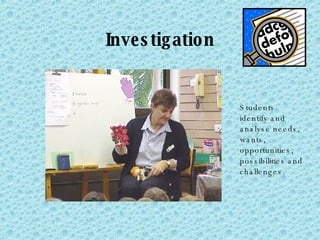
Investigation Students identify and analyse needs, wants, opportunities, possibilities and challenges.
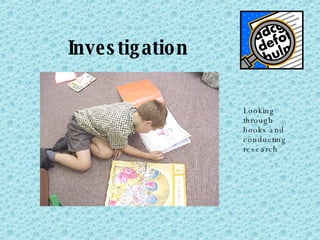
Investigation Looking through books and conducting research
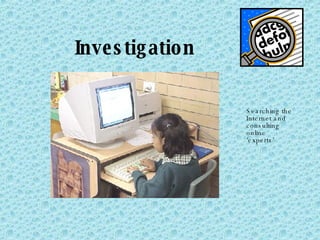
Investigation Searching the Internet and consulting online ‘experts’
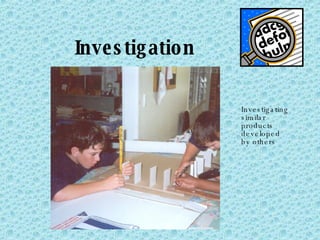
Investigation Investigating similar products developed by others
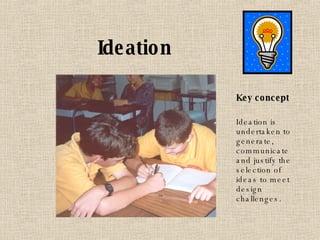
Ideation Key concept Ideation is undertaken to generate, communicate and justify the selection of ideas to meet design challenges.
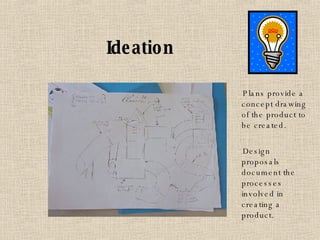
Ideation Plans provide a concept drawing of the product to be created.  Design proposals document the processes involved in creating a product.
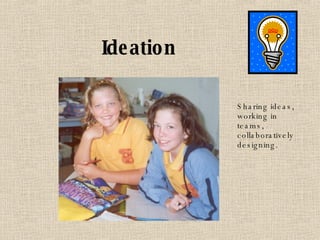
Ideation Sharing ideas, working in teams, collaboratively designing.
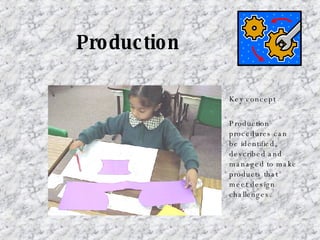
Production Key concept Production procedures can be identified, described and managed to make products that meet design challenges.
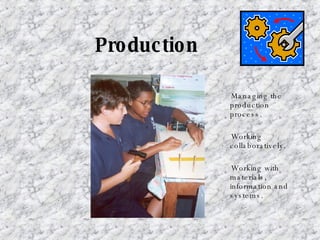
Production Managing the production process. Working collaboratively. Working with materials, information and systems.
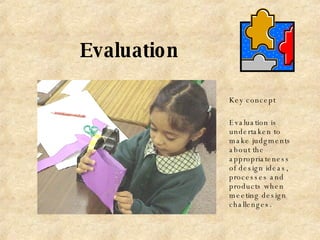
Evaluation Key concept Evaluation is undertaken to make judgments about the appropriateness of design ideas, processes and products when meeting design challenges.
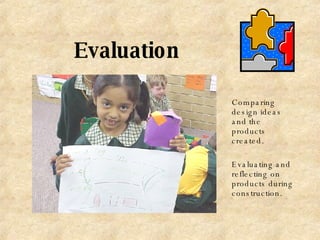
Evaluation Comparing design ideas and the products created. Evaluating and reflecting on products during construction.
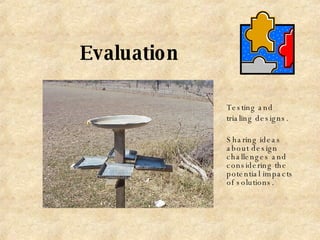
Evaluation Testing and trialing designs. Sharing ideas about design challenges and considering the potential impacts of solutions.
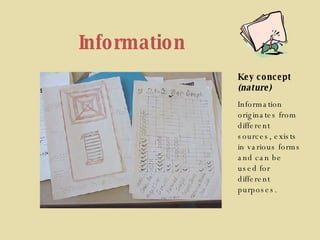
Information Key concept (nature) Information originates from different sources, exists in various forms and can be used for different purposes.
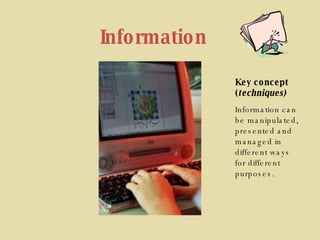
Information Key concept ( techniques) Information can be manipulated, presented and managed in different ways for different purposes.
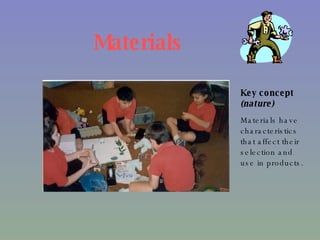
Materials Key concept (nature) Materials have characteristics that affect their selection and use in products.
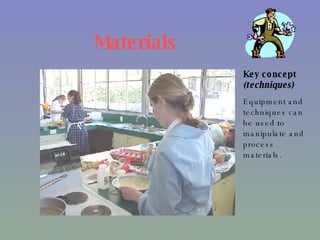
Materials Key concept (techniques) Equipment and techniques can be used to manipulate and process materials.
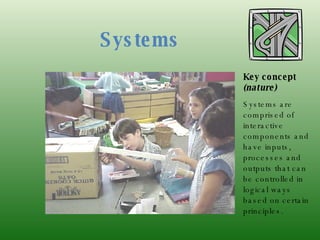
Systems Key concept  (nature) Systems are comprised of interactive components and have inputs, processes and outputs that can be controlled in logical ways based on certain principles.
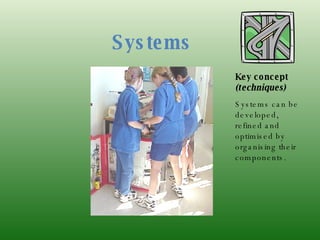
Systems Key concept  (techniques) Systems can be developed, refined and optimised by organising their components.
 
http://www.youtube.com/watch?v=e2TBmZGW3GE

2139EPS Lecture 2

  • 1.
  • 2.
    Teachers Teachers Painttheir minds And guide their thoughts Share their achievements and advise their faults Inspire a Love Of knowledge and truth As you light the path Which leads our youth For our future brightens With each lesson you teach Each smile you lengthen Each goal you help reach For the dawn of each poet Each philosopher and king Begins with a Teacher And the wisdom they bring. By Kevin William Huff.
  • 3.
  • 4.
  • 5.
  • 6.
    K X CE J O
  • 7.
  • 8.
    K X CE J O
  • 9.
    Z Q EC T B U T M N R V G I E Z B T G E
  • 10.
  • 11.
    Z Q EC T B U T M N R V G I E Z B T G E
  • 12.
    I B MN B C A B C S B S M S N I C Q
  • 13.
    Relationship between senseand meaning Is Sense Present? No Yes
  • 14.
  • 15.
    WHAT IS A DESIGN CHALLENGE? A design challenge is a situation, problem or task that provides a meaningful context in which students can ‘work technologically’ to demonstrate learning outcomes in Technology.
  • 16.
    Closed designchallenge Open design challenge narrow choices many restrictions more contrived requires less creativity and thought wide range of choices few restrictions more realistic requires more creativity and thought
  • 17.
    Design a woodenfour-legged table that is 40 cm by 60 cm ….. Investigate a problem or situation at home and design a solution. Closed Open
  • 18.
    Open design challengesoffer fewer constraints and more opportunities for students to use creative problem solving and decision making to create appropriate products.
  • 19.
    The interests andabilities of students and the learning outcomes to be demonstrated should be considered when planning design challenges.
  • 20.
    Starting points fordesign challenges Curriculum needs specific knowledge, skills or activity Literature providing a context for cross-curricular links Real-life situations school camp current events fete home Others’ needs designing for a client commercial opportunity Children’s interests and needs leading to a design opportunity Open investigation deconstruction and evaluation of existing technologies
  • 21.
    an environmental scana problem or situation audit — things that could be done differently or better design a product for someone else pose a problem — emphasis on students solving it work with a professional — audit of parent skills select a topic through brainstorming Other starters
  • 22.
    Mathematics English TheArts SOSE HPE LOTE Science Key Learning Areas – KLA’s
  • 23.
    The four strandsof Technology
  • 24.
    Syllabus structure — Strands Technology Practice Information Materials Systems Six levels of core learning outcomes Plus Foundation Level Beyond Level 6
  • 25.
  • 26.
    Investigation Key conceptInvestigation is carried out to gather and use knowledge, ideas and data to meet design challenges.
  • 27.
    Investigation Students identifyand analyse needs, wants, opportunities, possibilities and challenges.
  • 28.
    Investigation Looking throughbooks and conducting research
  • 29.
    Investigation Searching theInternet and consulting online ‘experts’
  • 30.
    Investigation Investigating similarproducts developed by others
  • 31.
    Ideation Key conceptIdeation is undertaken to generate, communicate and justify the selection of ideas to meet design challenges.
  • 32.
    Ideation Plans providea concept drawing of the product to be created. Design proposals document the processes involved in creating a product.
  • 33.
    Ideation Sharing ideas,working in teams, collaboratively designing.
  • 34.
    Production Key conceptProduction procedures can be identified, described and managed to make products that meet design challenges.
  • 35.
    Production Managing theproduction process. Working collaboratively. Working with materials, information and systems.
  • 36.
    Evaluation Key conceptEvaluation is undertaken to make judgments about the appropriateness of design ideas, processes and products when meeting design challenges.
  • 37.
    Evaluation Comparing designideas and the products created. Evaluating and reflecting on products during construction.
  • 38.
    Evaluation Testing andtrialing designs. Sharing ideas about design challenges and considering the potential impacts of solutions.
  • 39.
    Information Key concept(nature) Information originates from different sources, exists in various forms and can be used for different purposes.
  • 40.
    Information Key concept( techniques) Information can be manipulated, presented and managed in different ways for different purposes.
  • 41.
    Materials Key concept(nature) Materials have characteristics that affect their selection and use in products.
  • 42.
    Materials Key concept(techniques) Equipment and techniques can be used to manipulate and process materials.
  • 43.
    Systems Key concept (nature) Systems are comprised of interactive components and have inputs, processes and outputs that can be controlled in logical ways based on certain principles.
  • 44.
    Systems Key concept (techniques) Systems can be developed, refined and optimised by organising their components.
  • 45.
  • 46.