Wireless & Cellular
Technologies
By- Vaibhav Tayal
CONTENTS
 Introduction to Wireless Technology
 Introduction to Cellular technology
 Generations of Networks
 1G Technology
 2G Technology
 3G Technology
 4G Technology
 5G Technology
 Conclusion
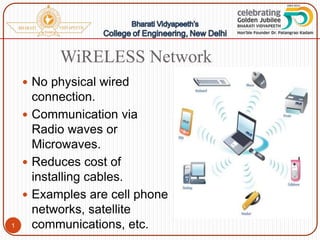
WiRELESS Network
1
 No physical wired
connection.
 Communication via
Radio waves or
Microwaves.
 Reduces cost of
installing cables.
 Examples are cell phone
networks, satellite
communications, etc.
CELLULAR NEtWORK
2
 A type of Radio
Network.
 Base cells are served
with Transceivers
known as Cell Site.
 Last link used is
wireless connection.
 Large coverage area.
 Reduced interference.
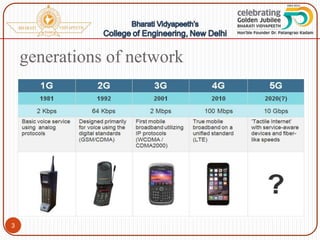
generations of network
3
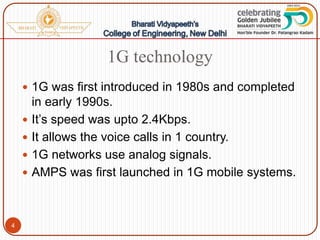
1G technology
 1G was first introduced in 1980s and completed
in early 1990s.
 It’s speed was upto 2.4Kbps.
 It allows the voice calls in 1 country.
 1G networks use analog signals.
 AMPS was first launched in 1G mobile systems.
4
LImitations of 1G
 Poor Voice Quality
 Large Phone Size
 No Security
 Limited Capacity
 Poor Handoff reliability
1G wireless system
5
2G technology
 2G is based on GSM.
 Launched in Finland in 1991.
 2G network use digital signals.
 It’s data speed was upto 64Kbps.
 Enables SMS, picture message and MMS(Multi
Media Message).
 Provides better quality and capacity.
6
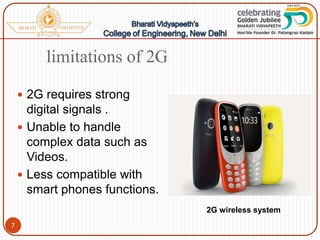
limitations of 2G
 2G requires strong
digital signals .
 Unable to handle
complex data such as
Videos.
 Less compatible with
smart phones functions.
2G wireless system
7
3G technology
 3G technology was introduced in year 2000s.
 Data transmission speed increased from
144Kbps to 2Mbps.
 Increased bandwidth and data transfer rates.
 Compatible with smart phones.
 Provides Web-based applications.
8
Features of 3G technology
 Providing faster communication.
 Send/Receive large E-mail messages.
 High speed web/ More security/ Video
Conferencing/ 3-D Gaming.
 TV streaming/ Mobile TV/ Phone Calls.
 Large Capacities & Broadband Capabilities.
 11 sec-1.5 min time to download a 3 min MP3
song.
9
limitations of 3G
 Expensive fees for 3G
Licenses Services
 It was a challenge to build
the infrastructure of 3G
 High Bandwidth
Requirement
 Expensive 3G Phones
 Large Cell Phones
10
4G technology
 4G was started from late 2000s.
 Capable of providing 100Mbps-1Gbps speed.
 4G can be described using MAGIC:
Mobile Multimedia
Anytime Anywhere
Global Mobility Support
Integrated Wireless Solution
Customized Personal Services
 Also known as LTE (Long Term Evolution)
11
Features of 4G technology
 Higher data rates and expanded multimedia
services
 High QOS and high security
 Large capacities and Broadband capability
 Low cost per bit
 Approximately 10 times faster than 3G
 Supports the global access , the service
portability & scalable mobile services
12
limitations of 4G
 Must buy new devices for
4G.
 Higher data prices for the
services (expensive).
 Needs complex hardware.
 Uses many antennae &
transmitters thus poorer
battery life.
 Requires expensive
infrastructure for operation13
5G technology
 5G was started from late
2010s.
 Complete wireless
communication with almost
no limitations.
 It is highly supportable to
WWWW(Wireless World
Wide Web).
 Aims at higher capacity than
current 4G, allowing a
higher density of mobile14
Features of 5G technology
 High Speed, High Capacity.
 Provides large broadcasting of data in Gbps.
 Multi-Media Newspapers, watch T.V. programs
with high clarity and HD quality.
 Faster data transmission compared to that of
previous generations.
 Large phone memory, dialing speed, clarity in
audio/video.
 Support interactive multimedia, voice, streaming
video, Internet & other.15
conclusion
 All totally the best way to help all users is to use
5G as the next wireless system and in totally it is
safe and secure for public this the need that
demand the solution.
 5G technology is going to give tough
competition to computers and laptops.
 It will be available in the market in 2020 at
affordable cost with more reliability than
previous generations wireless systems.
16
Wireless technologies

Wireless technologies

  • 1.
  • 2.
    CONTENTS  Introduction toWireless Technology  Introduction to Cellular technology  Generations of Networks  1G Technology  2G Technology  3G Technology  4G Technology  5G Technology  Conclusion
  • 3.
    WiRELESS Network 1  Nophysical wired connection.  Communication via Radio waves or Microwaves.  Reduces cost of installing cables.  Examples are cell phone networks, satellite communications, etc.
  • 4.
    CELLULAR NEtWORK 2  Atype of Radio Network.  Base cells are served with Transceivers known as Cell Site.  Last link used is wireless connection.  Large coverage area.  Reduced interference.
  • 5.
  • 6.
    1G technology  1Gwas first introduced in 1980s and completed in early 1990s.  It’s speed was upto 2.4Kbps.  It allows the voice calls in 1 country.  1G networks use analog signals.  AMPS was first launched in 1G mobile systems. 4
  • 7.
    LImitations of 1G Poor Voice Quality  Large Phone Size  No Security  Limited Capacity  Poor Handoff reliability 1G wireless system 5
  • 8.
    2G technology  2Gis based on GSM.  Launched in Finland in 1991.  2G network use digital signals.  It’s data speed was upto 64Kbps.  Enables SMS, picture message and MMS(Multi Media Message).  Provides better quality and capacity. 6
  • 9.
    limitations of 2G 2G requires strong digital signals .  Unable to handle complex data such as Videos.  Less compatible with smart phones functions. 2G wireless system 7
  • 10.
    3G technology  3Gtechnology was introduced in year 2000s.  Data transmission speed increased from 144Kbps to 2Mbps.  Increased bandwidth and data transfer rates.  Compatible with smart phones.  Provides Web-based applications. 8
  • 11.
    Features of 3Gtechnology  Providing faster communication.  Send/Receive large E-mail messages.  High speed web/ More security/ Video Conferencing/ 3-D Gaming.  TV streaming/ Mobile TV/ Phone Calls.  Large Capacities & Broadband Capabilities.  11 sec-1.5 min time to download a 3 min MP3 song. 9
  • 12.
    limitations of 3G Expensive fees for 3G Licenses Services  It was a challenge to build the infrastructure of 3G  High Bandwidth Requirement  Expensive 3G Phones  Large Cell Phones 10
  • 13.
    4G technology  4Gwas started from late 2000s.  Capable of providing 100Mbps-1Gbps speed.  4G can be described using MAGIC: Mobile Multimedia Anytime Anywhere Global Mobility Support Integrated Wireless Solution Customized Personal Services  Also known as LTE (Long Term Evolution) 11
  • 14.
    Features of 4Gtechnology  Higher data rates and expanded multimedia services  High QOS and high security  Large capacities and Broadband capability  Low cost per bit  Approximately 10 times faster than 3G  Supports the global access , the service portability & scalable mobile services 12
  • 15.
    limitations of 4G Must buy new devices for 4G.  Higher data prices for the services (expensive).  Needs complex hardware.  Uses many antennae & transmitters thus poorer battery life.  Requires expensive infrastructure for operation13
  • 16.
    5G technology  5Gwas started from late 2010s.  Complete wireless communication with almost no limitations.  It is highly supportable to WWWW(Wireless World Wide Web).  Aims at higher capacity than current 4G, allowing a higher density of mobile14
  • 17.
    Features of 5Gtechnology  High Speed, High Capacity.  Provides large broadcasting of data in Gbps.  Multi-Media Newspapers, watch T.V. programs with high clarity and HD quality.  Faster data transmission compared to that of previous generations.  Large phone memory, dialing speed, clarity in audio/video.  Support interactive multimedia, voice, streaming video, Internet & other.15
  • 18.
    conclusion  All totallythe best way to help all users is to use 5G as the next wireless system and in totally it is safe and secure for public this the need that demand the solution.  5G technology is going to give tough competition to computers and laptops.  It will be available in the market in 2020 at affordable cost with more reliability than previous generations wireless systems. 16