ZEROETH GENERATION
• Man used his fingers, ropes, beads,
bones, pebbles and other objects for
counting.
•Abacus, Pascaline, Difference &
Anylitical engines
•Electricity was not yet invented
FIRST GENERATION,
1951 – 1958: The Vacuum Tube
• The first generation of computers, characterized
by vacuum tubes, started in 1951 with the
creation of -
UNIVAC (Universal Automatic Computer) – a
tabulating machine which won the contest for the
fastest machine which could count the US 1890
census.
VACUUM TUBES – electronic tubes about the size
of light bulbs.
DISADVANTAGES:
• They generate more heat
causing many problems in
temperature regulation and
climate control.
• Tubes were subject to frequent
burn-out.
SECOND GENERATION,
1959 – 1964: The Transistor
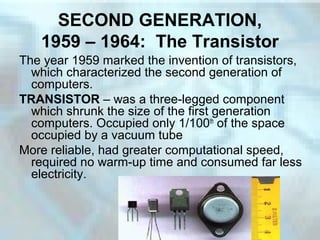
The year 1959 marked the invention of transistors,
which characterized the second generation of
computers.
TRANSISTOR – was a three-legged component
which shrunk the size of the first generation
computers. Occupied only 1/100th
of the space
occupied by a vacuum tube
More reliable, had greater computational speed,
required no warm-up time and consumed far less
electricity.
THIRD GENERATION,
1965 – 1970: The Integrated Circuit
Third generation computers arose in 1965
with the invention of smaller electronic
circuits called integrated circuits (IC’S)
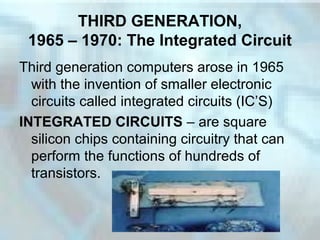
INTEGRATED CIRCUITS – are square
silicon chips containing circuitry that can
perform the functions of hundreds of
transistors.
ADVANTAGES:
• RELIABILITY – Unlike vacuum tubes,
silicon will not break down easily. It is
very seldom that you will have to
replace it.
• LOW COST – Silicon chips are
relatively cheap because of their
small size and availability in the
market. It also consumes less
electricity.
FOURTH GENERATION,
1971 – present: The Microprocessor
• Marked by the use of microprocessor
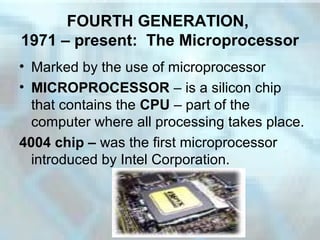
• MICROPROCESSOR – is a silicon chip
that contains the CPU – part of the
computer where all processing takes place.
4004 chip – was the first microprocessor
introduced by Intel Corporation.
TODAY’S COMPUTER
• is classified as fourth generation
computers.
• faster, more powerful, tremendous
data storage and processing capacity
• new brands and models would come
out the market almost every other
month.
• many clones or imitations of the IBM
have become even more powerful
and a lot cheaper.
• computers became more affordable
• computers can now be found in homes,
schools, offices etc.
• there has been a tremendous improvement in
software technology
• different software applications to choose from:
word processing, spreadsheets, database
management, games and entertainment.
• computer subjects are now being offered not
just to college students but even to high school
and elementary.
• computers are now used as an aid in teaching
math, science etc.

5446 the computer generations

  • 2.
    ZEROETH GENERATION • Manused his fingers, ropes, beads, bones, pebbles and other objects for counting. •Abacus, Pascaline, Difference & Anylitical engines •Electricity was not yet invented
  • 3.
    FIRST GENERATION, 1951 –1958: The Vacuum Tube • The first generation of computers, characterized by vacuum tubes, started in 1951 with the creation of - UNIVAC (Universal Automatic Computer) – a tabulating machine which won the contest for the fastest machine which could count the US 1890 census. VACUUM TUBES – electronic tubes about the size of light bulbs.
  • 4.
    DISADVANTAGES: • They generatemore heat causing many problems in temperature regulation and climate control. • Tubes were subject to frequent burn-out.
  • 5.
    SECOND GENERATION, 1959 –1964: The Transistor The year 1959 marked the invention of transistors, which characterized the second generation of computers. TRANSISTOR – was a three-legged component which shrunk the size of the first generation computers. Occupied only 1/100th of the space occupied by a vacuum tube More reliable, had greater computational speed, required no warm-up time and consumed far less electricity.
  • 6.
    THIRD GENERATION, 1965 –1970: The Integrated Circuit Third generation computers arose in 1965 with the invention of smaller electronic circuits called integrated circuits (IC’S) INTEGRATED CIRCUITS – are square silicon chips containing circuitry that can perform the functions of hundreds of transistors.
  • 7.
    ADVANTAGES: • RELIABILITY –Unlike vacuum tubes, silicon will not break down easily. It is very seldom that you will have to replace it. • LOW COST – Silicon chips are relatively cheap because of their small size and availability in the market. It also consumes less electricity.
  • 8.
    FOURTH GENERATION, 1971 –present: The Microprocessor • Marked by the use of microprocessor • MICROPROCESSOR – is a silicon chip that contains the CPU – part of the computer where all processing takes place. 4004 chip – was the first microprocessor introduced by Intel Corporation.
  • 9.
    TODAY’S COMPUTER • isclassified as fourth generation computers. • faster, more powerful, tremendous data storage and processing capacity • new brands and models would come out the market almost every other month. • many clones or imitations of the IBM have become even more powerful and a lot cheaper.
  • 10.
    • computers becamemore affordable • computers can now be found in homes, schools, offices etc. • there has been a tremendous improvement in software technology • different software applications to choose from: word processing, spreadsheets, database management, games and entertainment. • computer subjects are now being offered not just to college students but even to high school and elementary. • computers are now used as an aid in teaching math, science etc.