Feasibility studies
• Feasibilitystudies are detailed analysis of the
project in different dimensions that lead to an
investment decision.
• It provides information required for the project
appraisal.
• It usually includes seven major parts:
1.Market & demand analysis
2.Raw materials & supplies study
3.Location, site & environment impact assessment
4.Production program & plant capacity
Market and DemandAnalysis
• The first step in project analysis is to estimate
the potential size of the market and get an idea
about the market share that is likely to be
captured.
• The key steps involved in market and demand
analysis are organized into seven sections as
follows.
5.
Market and DemandAnalysis
1. Situational analysis and specification of
objectives
2. Collection of secondary information
3. Conducting market survey
4. Characterization of the market
5. Demand forecasting
6. Uncertainties in demand forecasting
7. Market planning.
6.
key steps inmarket & demand analysis
& their inter-relationships
Characterization
of the Market
Conduct of
Market Survey
Collection of
Secondary
Information
Situational Analysis
and Specification of
Objectives
Demand
Forecasting
Market
Planning
7.
Situational Analysis &Specification of
Objectives
• Situational Analysis provides the current status
of the key aspects of the market and is
participants.
• The aspects include:
• Customers: customer’s preferences &
purchasing power
• Competitors: strategies & actions of
competitors, and
• Middlemen: practices of middlemen
8.
Cont…
• A situationanalysis may generate data that will
provide a vague idea of the market and provide a
basis for rough demand and revenue projection.
• If the situation analysis points a promising
picture for the project,
• a formal market study is warranted to provide more
accurate and reliable data that can be used for
investment decision making.
• To carry out such a study it is necessary to
specify the objectives as clearly and as
comprehensive as possible.
9.
Cont…
• A commonapproach to do this is to structure
them in the form of questions.
• Eg. suppose Sony Corporation developed
technology to produce superior plasma
television set; and
• The management wants know where and how
to market the TVs.
• The objectives of the market and demand
analysis may be to answer the following
questions:
10.
Cont…
a) Who arethe buyers of the TVs?
b) What is the current demand of the TVs?
c) How is the demand distributed geographically
and seasonally?
d) What is the component demand of TVs of
various sizes?
e) What prices will the customers be willing to pay
for the superior TVs?
f) What price and warranty will ensure
acceptance?
11.
Cont…..
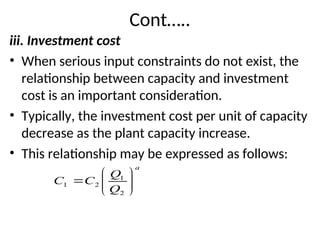
g) What distributionchannels are the most
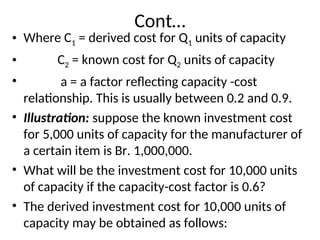
suited for the TVs and what margins will
induce distributors to carry it?
h) What are the prospects for immediate sales?
i) etc
12.
Collection of SecondaryInformation
• Information may be obtained from secondary
and /or primary sources.
• Secondary information is information that has
been gathered in some other context and is
already available.
• Primary information, on the other hand,
represents information that is collected for the
first time to meet the specific purpose on hand.
• Secondary information provides the base and
the starting point for the market and demand
analysis.
13.
Conduct of MarketSurvey
• Secondary information, though useful often,
does not provide a comprehensive basis for
market and demand analysis.
• It needs to be supplemented with primary
information gathered through a market survey,
specific to the project being appraised.
• Consequently primary information is sought
through a market survey.
• The survey could be a census; where the entire
population is covered or a sample survey; only a
proportion of the population is covered.
14.
Cont….
• Information soughtin a market survey may cover
one or more of the following areas:
a) Total demand and rate of demand growth
b) Demand in different segments of the market
c) Income and price elasticity of demand
d) Motives for buying
e) Purchasing plans and intentions
f) Satisfaction with existing products
g) Unsatisfied needs
h) Attitude towards various products
i) Social economic characteristics of buyers
j) Customer preferences etc
15.
Cont…..
• Steps ina sample survey:
• Typically, a sample survey consists of the
following steps.
Select the sampling scheme and sample size.
Develop the questionnaire
Recruit and train the field investigators
Obtain information as per questionnaire from
the sample respondents
Scrutinize the information gathered
Analyze and interpret the information.
16.
Cont….
• The resultsof a market survey depend on the
following:
representativeness of the sample,
precision and adequacy of the questions,
comprehension of the questions by the
respondents,
honesty of the respondents in answering the
questions,
integrity of the investigators and
appropriateness of data analysis methods
17.
Characterization of Market
•Based on the information gathered from the
secondary information survey and the market
survey, the market for a product may be described
in terms of the following:
• Effective Demand; Past and Present: In competitive
markets effective demand is the apparent
consumption which is defined as: production +
imports – exports – changes in stock level.
• Breakdown of Demand: Total / aggregate demand
may be broken in to different segments which may
be defined by: nature of product; consumer groups;
geographical region etc
18.
Cont…..
• Price: Itmay be wise to distinguish between
the following prices: manufacturer’s price;
wholesaler’s price; retail price etc.
• Methods of Distribution and Sales Promotion:
Since methods of distribution and sales
promotion vary among different products, it
will be helpful to describe the foregoing aspects
for the product on hand
• Consumers: Consumers may be characterized
demographically using such attributes as age,
income, sex etc or attitudinally using such
attributes as preferences, habits, intentions etc
19.
Cont…
• Supply andCompetition: The location, present
production, planned expansion, capacity
utilization level of competitors is crucial
information.
• Substitutes and near substitutes should be noted
too.
• Government Policy: The role of the government
in influencing the market and demand of a
product may be significant; as such government
policies and legislations that have an impact on
the product should be spelt out.
20.
Demand Forecasting
• Aftergathering information about the various
aspects of the market and demand from primary
and secondary sources, attempt may be made to
estimate future demand.
• A wide range of forecasting method is available
to the market analyst.
• These methods can be grouped in three
categories
21.
1. Qualitative Methods
i.Jury of executive opinion method: under this
method opinions are sought from a group of
managers on the expected future sales they are
then translated into sales estimates
ii. Delphi method: opinions are sought from a
group of experts who don’t know the identity
of each other, any divergent opinions are then
mailed back to back for further opinion until a
consensus is obtained.
22.
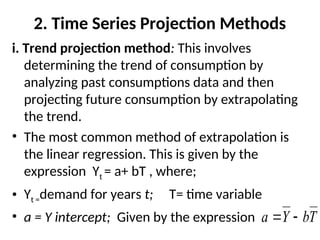
2. Time SeriesProjection Methods
i. Trend projection method: This involves
determining the trend of consumption by
analyzing past consumptions data and then
projecting future consumption by extrapolating
the trend.
• The most common method of extrapolation is
the linear regression. This is given by the
expression Yt = a+ bT , where;
• Yt =demand for years t; T= time variable
• a = Y intercept; Given by the expression T
b
Y
a
23.
Cont….
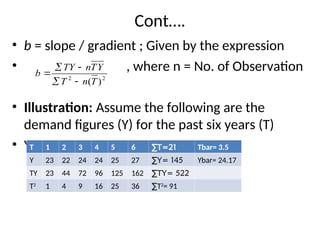
• b =slope / gradient ; Given by the expression
• , where n = No. of Observation
• Illustration: Assume the following are the
demand figures (Y) for the past six years (T)
• Y
2
2
)
(T
n
T
Y
T
n
TY
b
T 1 2 3 4 5 6 ∑T=21 Tbar= 3.5
Y 23 22 24 24 25 27 ∑Y= 145 Ybar= 24.17
TY 23 44 72 96 125 162 ∑TY= 522
T2
1 4 9 16 25 36 ∑T2
= 91
24.
Cont….
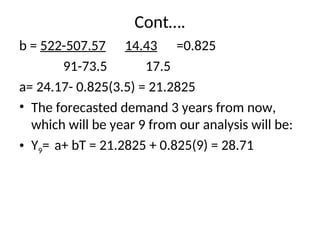
b = 522-507.5714.43 =0.825
91-73.5 17.5
a= 24.17- 0.825(3.5) = 21.2825
• The forecasted demand 3 years from now,
which will be year 9 from our analysis will be:
• Y9= a+ bT = 21.2825 + 0.825(9) = 28.71
25.
Cont….
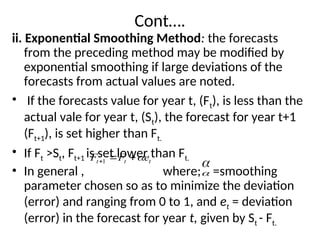
ii. Exponential SmoothingMethod: the forecasts
from the preceding method may be modified by
exponential smoothing if large deviations of the
forecasts from actual values are noted.
• If the forecasts value for year t, (Ft), is less than the
actual vale for year t, (St), the forecast for year t+1
(Ft+1), is set higher than Ft.
• If Ft >St, Ft+1 is set lower than Ft.
• In general , where; =smoothing
parameter chosen so as to minimize the deviation
(error) and ranging from 0 to 1, and et = deviation
(error) in the forecast for year t, given by St - Ft.
t
t
t e
F
F
1
26.
Cont….
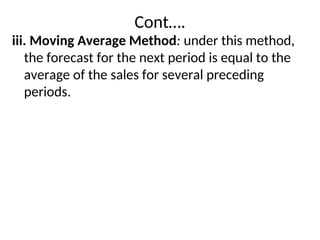
iii. Moving AverageMethod: under this method,
the forecast for the next period is equal to the
average of the sales for several preceding
periods.
27.
3. Casual methods
•Casual methods seek to develop forecasts on the
basis of cause-effect relationship specified in an
explicit quantitative manner examples include:
i. Chain ratio method: potential sales of a product
may be estimated by applying a series of factors
to measure aggregate demand.
• E.g. in estimating the aggregate for a bread
shaver in Ethiopia, one may begin from the
number of adult male population; say 15 million.
28.
Cont….
• this isthen multiplied with the proportion of
males using shavers say 0.3.
• This gives 4.5 million as the male population
using shavers.
• This figure is then multiplied by average number
of shavings market that the firm could capture.
• Say 0.35 to give 1.575 million as the potential
sales for the shavers.
29.
Cont….
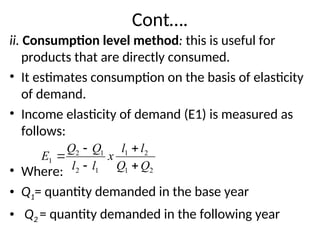
ii. Consumption levelmethod: this is useful for
products that are directly consumed.
• It estimates consumption on the basis of elasticity
of demand.
• Income elasticity of demand (E1) is measured as
follows:
• Where:
• Q1= quantity demanded in the base year
• Q2 = quantity demanded in the following year
2
1
2
1
1
2
1
2
1
Q
Q
l
l
x
l
l
Q
Q
E
30.
Cont….
• I1= incomelevel in the base year
• I2 = income level in the following year
• The projected per capital demand is then given as
= (present per capital demand) * [1+ (per capital
change in income level) * (income elasticity of
demand)]
• Illustration: The following information is available
on quantity demanded for teff and income level of
Ethiopian Q1 = 50, Q2=55, l1=1000, l2= 1020.
31.
Cont….
• The projectedannual per capital income five years from
now is expected to be 5% higher, and
• the present per capital demand for teff is 50 kg.
• If the population is estimated to be 70 million in five
years, what will be the aggregate demand for teff in five
years?
•
• Projected demand = (50) [1+ (0.050) (4.81)] =62.025 kg
• Aggregate demand = Projected demand x Projected
population
• = 62.025×70m = 4341.75 million kg
81
.
4
55
50
1020
1000
1000
1020
50
55
1
E
32.
Cont…..
iii. End usemethod (consumption coefficient
method): This method is suitable for
intermediate products.
• It involves the following steps.
a)Identify the possible uses of the product
b)Define the consumption coefficient for the
product for various uses
c)Project the output levels for the consuming
industries.
33.
Cont…
d) Compute theaggregate demand for the product
by multiplying the consumption coefficient of the
various uses with their respective projected
outputs and then summing up the projected
demands for the various users.
iv. Leading indicator method: leading indicators
are variables which changed ahead of other
variables (the lag variables).
• Hence the changes observed in the lead
variables may be used to predict changes in the
lagging variables
34.
Cont…
• In thismethod, appropriate leading are first
identified then the relationship between the leading
indicators and the lag variables is established.
• For example, the change in the level of urbanization
(a leading indicator) may be used to predict the
change in the demand for air conditioners (a lagging
variable).
v. Econometric method: this involves mathematical
presentation of economic relationships derived from
economic theory.
• It may be in the form of single or simultaneous
equations.
35.
Uncertainties in demandforecasting
• Demand forecasting is subjected to error and
uncertainly that arise from three main sources
i. Data about past and present market lack
standardization, few observations influence
abnormal factors etc.
ii. Methods of forecasting inability to handle
unquantifiable factors, unrealistic assumption
excessive data requirement etc.
iii. Environmental changes, shift in government
policy, international development, discovery of
new sources of raw materials.
36.
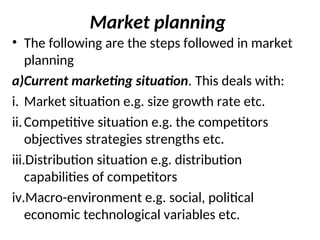
Market planning
• Thefollowing are the steps followed in market
planning
a)Current marketing situation. This deals with:
i. Market situation e.g. size growth rate etc.
ii.Competitive situation e.g. the competitors
objectives strategies strengths etc.
iii.Distribution situation e.g. distribution
capabilities of competitors
iv.Macro-environment e.g. social, political
economic technological variables etc.
37.
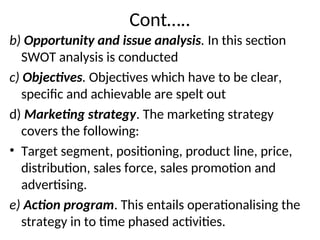
Cont…..
b) Opportunity andissue analysis. In this section
SWOT analysis is conducted
c) Objectives. Objectives which have to be clear,
specific and achievable are spelt out
d) Marketing strategy. The marketing strategy
covers the following:
• Target segment, positioning, product line, price,
distribution, sales force, sales promotion and
advertising.
e) Action program. This entails operationalising the
strategy in to time phased activities.
38.
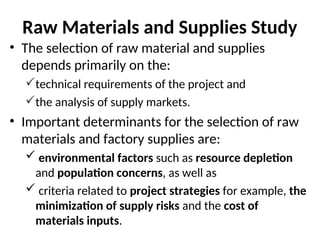
Raw Materials andSupplies Study
• The selection of raw material and supplies
depends primarily on the:
technical requirements of the project and
the analysis of supply markets.
• Important determinants for the selection of raw
materials and factory supplies are:
environmental factors such as resource depletion
and population concerns, as well as
criteria related to project strategies for example, the
minimization of supply risks and the cost of
materials inputs.
39.
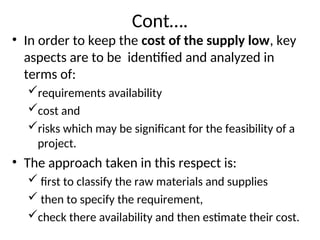
Cont….
• In orderto keep the cost of the supply low, key
aspects are to be identified and analyzed in
terms of:
requirements availability
cost and
risks which may be significant for the feasibility of a
project.
• The approach taken in this respect is:
first to classify the raw materials and supplies
then to specify the requirement,
check there availability and then estimate their cost.
40.
Cont…..
1. Classification ofRaw Materials and Supplies
a) Raw Materials (Unprocessed and Semi
Processed).
i. Agricultural Products
ii. Livestock and Forest product
iii. Marine Product:
Availability of marine products may not only depend
on ecological factors but also on national policy &
bilateral & multilateral arguments
41.
Cont….
iv. Mineral products:
•Detailed information on the proposed exploitable
deposit is essential.
• Unless the reserves are known to be very extensive,
the study should give details of the:
viability open cast or underground mining,
the location,
size,
depth
quality of deposit and
the composition of the ore with other elements i.e.
impurities.
42.
Cont….
• A detailedanalysis of :
physical,
chemical and
other properties of the subject ore be
processed and the results ought to be
incorporate in the feasibility report.
43.
b) Processed IndustrialMaterials and
Components
• Such inputs can be generally classified under:
base metals;
semi processed materials relating to a wide variety of
industries in different sectors and manufactured
parts, components and subassemblies for assembly-
type industries, including a number of durable
consumer goods and engineering goods industry.
In all these cases, it is necessary to define
requirements availability and costs in some
detail to ensure that the specification in the case
of the two latter categories suit the production
programs envisaged for the projects.
44.
c) Factory supplies
i.Auxiliary Materials and Utilities
• A part from basic raw materials and processed
industrial materials and components all
manufacturing projects require various auxiliary
materials and utilities, usually subsumed as
factory supplies.
• A detailed assessment of the utilities required
(electricity, water, steam, compressed air, fuel,
effluent disposal) can only be the made after
analysis and selection of location, technology and
plant capacity, but a general assessment of these
is a necessary part of the input study.
45.
Cont….
ii) Packaging materialsand containers:
• All types of containers and packaging materials
serve in principle the following two purposes:
physical holding and protection of a product (semi-
finished) and
achieving the marketing objectives defined in the
marketing concept.
d) Recycled Waste
• The issue of waste disposal is assuming
increasing importance in developing countries,
depending on the type of production process.
46.
Cont….
• Waste combustionof high-risk waste is technically
feasible provided adequate measures are taken
and appropriate technologies are applied.
• The disposal of effluents is technically feasible
provided the appropriate installations have been
selected.
e) Spare Parts: In spite of regular maintenance all
machinery and equipment will finally break down
after a certain lifetime.
• Various spare parts will be required to keep a
plant in operation.
47.
Cont….
• The importanceof
correctly identifying essential spare parts,
the quantities required and
available suppliers
• cannot be overemphasized because interruption
of production owning to lack of essential spare
parts is often the reason for projects failure.
48.
f) Supplies forSocial and External Needs
• A remote location or some other reason might
require the project (or the company) to provide
and pay for
foodstuffs,
medicine,
clothing,
education and training materials etc.
• for the employees and perhaps also their
families. Sometimes it may be necessary for the
investing company to take responsibility for
maintenance of external infrastructure.
49.
2. Specification ofRequirements
• In order to estimate the requirement of materials
and supplies during the future operation of the
plant, such requirements should be identified,
analyzed and specified in the study both
quantitatively and qualitatively.
• A number of factors could have a strong influence
on the type, quantities, and qualities of the
project inputs in particular the following:
i. Socio- economic factors:
ii. Commercial and financial (business) factors
iii. Technical factors
50.
Availability and Supply
•The source and the constant availability of basic
production materials are crucial to the
determination of the technical and economic
viability as well as the size of most industrial
projects.
• A feasibility study must show how the materials
and inputs required will be provided.
• General availability, data about :
materials potential users, and
supply sources and programs
• will have to b analyzed and described.
51.
Cont….
• A finalassessment of input requirement can be
made on only after the plant capacity as well as
the technology and equipment to be used are
defined.
• If a basic input is available within a country, its
location and the area of supplies, whether
concentrated or dispersed should be determined.
• The alternative uses likely to be made of such
materials and the consequent impact on
availability should be assessed for the project in
question
52.
Cont….
• The questionof transportability and transport
costs should be carefully analyzed.
• When the basic material has to be imported
either in whole or in part, the implication of such
imports should be fully assessed.
First the sources of imported inputs have to be
determined.
Secondly, the uncertainly of inputs should be sated.
Thirdly, the implication of domestic production of
basic materials that was being imported should be
analyzed.
53.
Input Alternatives
• Inmany projects different raw materials can be
used for the same production.
• When this is the case, the raw materials must be
analyzed to determine which is most suitable
taking all relevant factors in to consideration.
• If alternative materials are used, discussion
should be also include an assessment of the
environmental impact of each material.
54.
4. Supply Marketingand Supply
Program
• Supply marketing : The objectives of supply
marketing are basically :
cost minimization,
risk minimization (reliability of supplies) and
the cultivation of relation with supplier.
• Supply Program: The overall purpose of the
outline of a supply program in the feasibility
study is to show how supplies of materials and
inputs will be secured.
55.
Cont…
• Cost estimatesshould be based on the supply
program presented.
• A supply program should deal with the following:
Identification of Supplying Sources and
Suppliers
Agreement and Regulations
Means of Transport
Storage
Risk Assessment
56.
Cont….
• A distinctionshould be made between external
and internal project risks factors, including:
failure of suppliers to meet their obligations,
delayed consignments,
supply shortages,
quality defects,
transport breakdown,
utility malfunctions,
strikes,
climate variations,
changed import regulations and
shortages of foreign exchange for imports.
57.
5. Costs ofRaw Materials and Suppliers
a) Unit Costs
• Not only the availability but also the unit costs
of basic materials and factory supplies have to
be analyzed in detail as this is a critical factor for
determine project economies.
• The cost of alternative means of transport
should also be considered.
58.
Cont….
• For importedmaterials and inputs CIF prices
(including costs, insurance and freight) should be
invariably be adopted together with clearing
charges (including loading and unloading) port
charges, tariffs, local insurance and taxes, and
costs of internal transport to the plant.
b) Annual Costs
• Estimates of annual operating costs for materials
and supplies are to be made.
59.
Cont…..
• It shouldbe made clear whether the cost
estimates refer
to a hypothetical level of production at full capacity
utilization during the operation phase
or to the first year (or some other year) of operation
phase according to the time schedule for project
implementation.
• Some costs vary with the production level the
plant in question, while others are more or less
fixed.
60.
Cont….
• Taking intoconsideration the expected
variations in the proposed plant, it is advisable
to divided cost item into variable and fixed costs.
• In order to arrive at the total operating costs by
product as well as by total costs per year, the
estimated costs per unit are multiplied by the
total number of unit to be produced.
61.
Cont….
c) Overhead Costsof Supplies
• When estimating material and input
requirements of the project, the project planner
has to plan not only for the level of production
cost center but also at the level of service,
administration and sales cost centers.
4.3 Location, Siteand Environmental
Impact Assessment
• Location and site are often used synonymously
but must be distinguished.
• The choice of location should be made from a
fairly wide geographical area, within which
several alternatives sites can be considered.
• For each project alternatives the environmental
impact of erecting and operating the industrial
plant should be assessed.
64.
Cont…..
• The maincriteria or key requirements for selecting
proper locations & sites should always be
identified at an early stage of the study.
• Location Analysis
• Location analysis has to identify a location suitable
for the industrial project under consideration.
• The feasibility study should also indicate on what
grounds alternatives locations have been
identified and give reasons for leaving out other
locations that were suitable but not selected.
65.
Cont….
• Traditional approachto industrial location
focused, on the proximity of raw materials and
marketing’s, mainly with a view to minimizing
transport costs.
• The modern view requires consideration of
commercial, technical and financial factors, but
also of the social and environment impact a
project might have.
• Key Factors in Location Analysis includes:
1. Natural environment, geographical conditions
and project requirements.
66.
Cont….
2. Ecological impactof the project, environmental
impact assessment
3. Socio-economic policies, incentives and
restrictions and government plans and policies
4. Infrastructural service, conditions and
requirements, such as the existing industrial
infrastructure, the economic and social
infrastructure the institutional framework,
urbanization and literacy.
67.
The Natural Environment
•Climatic conditions a part from the direct impact
on project costs of such factors as
dehumanization, air conditioning, refrigeration or
special drainage, the environmental effects may
be significant.
• Information should be collected on temperature,
rainfall, flooding, dust, times and other factors
for different locations.
• Climatic conditions are relevant in different ways;
means of transport may become less reliable for
products to distant markets.
68.
Cont….
• The construction,operation and management of
the plant may be less efficient or more expensive
if adequately skilled labor force is reluctant to
work in areas with extreme climate conditions.
• Climate conditions can be specified in term of air
temperature, humidity, sunshine hours, winds,
precipitation hurricane, risk etc.
• aspects are in general more relevant for the
selection of suitable sites.
69.
Cont….
• There includesoil, water levels, and a number of
special site hazard such as earthquakes and
susceptibility to flooding all of which extend over
grater areas.
• Ecological requirements: some projects may not
have a negative environmental impact
themselves but rather be sensitive to such
effects.
• Management and workers may be reluctant to
work in a factory located in a polluted area with
health risks.
70.
Environment Impact Assessment
•The site environment impact analysis will cover
the impact of the project and the alternatives (in
terms of size, technology etc) on the surrounding
area, including its population, flora and fauna.
• This analysis should be integrative and
interdisciplinary, assessing the overall impact
which taking into account the synergetic effects
of inter-linked systems.
• Environmental benefits or costs of a project are
usually externalities or side effects that affect the
society in whole or in part.
71.
Cont….
• Environment Conflicts
•Environmental conflicts might also lead to:
compensation claims,
substantial costs for purification equipment, and
possibly a risk that the plant will have to be closed
down.
• The potential risks related to the location of
projects that have negative environmental
impact must be seriously considered in the
feasibility study.
72.
Cont…
• Including potentialconflicts with existing and
future neighboring industries, urban settlements
and other elements should be identified and
analyzed in so far as they may affect the
investment decisions.
• Objectives of Environmental Impact Assessment
• The general objective of environmental impact
assessment in project analysis is to ensure that
development projects are environmental sound.
• The specific objectives of environmental impact
assessment are as follows:
73.
Cont….
To promote acomprehensive, interdisciplinary
investigation of environmental consequences of
the project and its alternatives for the affected
natural and cultural human habitat.
To develop an understanding of the scope and
magnitude of incremental environmental
impacts (with and without the project) of the
proposed projects for each of the alternatives
project designs.
To incorporate in the designed any existing
regulatory requirements
74.
Cont…
To identify measuresfor mitigation of adverse
environmental impacts and for possible
enhancement of beneficial impacts.
To identify critical environmental problems
requiring further investigation
To assess environmental impact quantitatively
and qualitatively, as required, for the purpose of
determining the overall environmental merit of
each alternative.
75.
Socio-Economic Policies
• Roleof Public Policies
• Government regulations and restrictions may be
critical for the location of project.
• Project with certain characteristics may be
allowed only in certain regions.
• Investment in export processing zones and other
specified regions are sometimes exempted from
taxes or would benefit from other types of
subsidy
76.
Cont….
• Fiscal andLegal Aspects
• The legal, regulations, and procedures applicable
for alternatives locations should be defined.
• The corporate and individual income taxes,
exercise duties, purchase taxes and other
national or local taxes should be ascertained for
different locations together with the incentives
and concessions available for new industries.
77.
Infrastructural Conditions
a) Infrastructuredependence
Technical infrastructure
Transport and communication
b) Factory supplies
Effluent and Water
Electricity
Fuel
c) Human resources
d) Infrastructural service
e) waste disposal
78.
Resources or MarketOrientation
• Criteria to location selection is the impact on a
particular project of factors such as:
the availability of raw material and inputs
the proximately of centers of consumption and
the existence of basic infrastructure facilities.
• Project based on specific raw materials are for
obviously reasons located at the source.
• The simplest location model is to calculate the
transport, production and distribution costs at
alternative locations determined principled by the
availability of raw materials and principal mkt
79.
Cont….
• For projectsthat are not unduly resources or
market-oriented, optimum location could well
combine reasonable :
proximately to raw material and markets,
favorable environmental condition,
a good pool of labor,
adequately power and fuel at reasonable cost,
equitable taxes,
good transports,
adequate water supply and
facilities for waste disposal.
80.
Assessment of Location
•As far as the financial feasibility of alternative
locations is concerned, the following data, as well
as related financial risks, should be assessed
production costs (including environmental protection
costs)
Marketing costs.
Investment costs (including environmental
protection)
Revenues
Taxes, subsides, grants and allowances
Net cash flows
81.
Site Selection
• Oncethe location is decided upon, a specific
project site and, if available, site alternative
should be defined in the feasibility study.
• The structure of site analysis is basically the same
for location analysis and the key requirement,
identified for the project give guidance also for
site selection.
• For sites available within the selected are the
following requirements and conditions are to be
assessed.
82.
Cont….
Ecological condition onsite (soil, site hazards climate
etc.)
Environmental impact (restrictions, standards,
guidelines,)
Social-economic conditions (restrictions, incentives,
requirements)
Local infrastructure at site location (existing,
industrial, infrastructure economic and social
infrastructure, availability of critical project impact
such as labor and factory supplies)
Strategies aspects (corporate strategies regarding
possible future extension, supply and marketing
policies.
83.
Cont….
Cost of land
Sitepreparation and development, requirement and
costs
• Requirements and Relevant Factors
• Site Requirement
• A project may depend on particular site condition,
which should be identified and described in the
feasibility study.
i. Cost of land
ii.Construction requirements
iii.Local conditions-infrastructure
84.
Cont…..
• The availabilityand cost of electricity is common
for most sites within a given location.
• Transport is very important when comparing
the suitability of different sites.
• Where water is requirement for the
manufacturing processes such assessment is
more important and the source and cost of the
water supply has to be estimated at alternatives
sites.
iv. Effluent and waste disposal
85.
Cont….
• The disposalof effluent may be a problem for
many industries.
• The possibilities for effluent disposal at different
sites should be carefully studied bearing in mind
the type of effluent.
v. Human resources
• Recruitment of managerial staff and labor may
be a critical factor for the viability of a project.
• The study must therefore pay carefully attention
to the question of labor availability, conditions
related to recruitment and facilities for training.
86.
Cont….
• It maybe necessary to develop a social
infrastructure next to the envisaged site like:
housing,
primarily school,
medical and
social centers to attract the requirement staff
and labor force.
87.
Production Program andPlant Capacity
• Production program
• Production program consist of the whole range of
project activities and requirement, including
production levels to be achieved under the
technical, ecological, social and economic
constraints.
• This necessitates identifying the principal products
or products range including by-products,
determining the volume of production, & relating
production capacity, to the flow of materials and
performance of services at the selected site.
88.
Cont……..
• Determination ofthe production program
a)Market requirements and marketing concept
• The range and volume of products to be
produced depends primarily on the market
requirements and the proposed marketing
strategies.
• A production program should define the levels of
output to be achieved during specified period
and from this viewpoint, it should be directly
related to the specific sales forecasts.
89.
Cont…..
• It wouldbe prudent to recognize that full
production may not be practicable for most
projects during the initial production operations.
• Owing to various technological, production
operations, and commercial difficulties most
projects experiences initial problems that can take
the form of :
a gradual growth of sales & market penetration on the
one hand and,
a wide range of production problems such as the
adjustment of labor & equipment to the technology
selected on the other.
90.
Cont……
• Even iffull production were to be achieved in the first
year, marketing and sales might prove to be a
bottleneck.
• Depending on the nature of the industry production
& sales target of 40-50% of overall capacity for the
first year should be considered reasonably.
• Once a production program defines the levels of
outputs in terms of end products & possible of
intermediate products & the interrelation b/n various
production lines & processes, the specific
requirements of materials & labor should be
quantified for each stage.
91.
Cont…
b) Technology andknow-how
• An important factor in determining the
production program and plant capacity is the
technology and know-how to be utilized in the
project.
• Specific processes are often related to certain
levels of production or become technically and
economically feasible only at such levels.
• The nature of technology choice and usage
constitutes a key factor in the determination of
plant capacity.
92.
Cont….
• Each technicallypossible alternative must in
addition consider:
social,
ecological,
economic and
financial conditions,
• because production programs and plant capacity
are functions of various interrelated socio-
economic strategic and technical factors.
93.
Plant capacity
• Plantcapacity (also referred to as production
capacity) refers to the volume or number of
units that can be manufactured during a given
period.
• Plant capacity may be defined in two ways:
feasible normal capacity and
nominal maximum capacity.
• Feasible normal capacity refers to the capacity
attainable under normal working conditions.
94.
Cont….
• This maybe established on the basis of:
the installed capacity,
technical conditions of the plant,
normal stoppages, & downtime for maintenance,
holidays, and
shift patterns.
• The nominal maximum capacity is the capacity
which is technically attainable and this often
corresponds to the installed capacity guaranteed
by the supplier of the plant.
95.
Cont….
• Plant capacityis influenced by the following factors:
i. Technological requirement
• For many industrial projects, particularly in process
type industries, there is a certain minimum
economic size determined by the technological
factor.
• For example, a cement plant should have a capacity
of at least 300 tons per day in order to use to rotary
kiln method: otherwise; it has to employ the vertical
shaft method which is suitable for lower capacity.
96.
Cont….
ii. Input constraints
•In developing countries, there may be constraints
on the availability of certain inputs.
Power supply may be limited,
basic raw materials may be scarce;
foreign exchange available for imports may be
inadequate.
• Constraints of these kinds should be borne in
mind while choosing the plant capacity.
•
97.
Cont…..
iii. Investment cost
•When serious input constraints do not exist, the
relationship between capacity and investment
cost is an important consideration.
• Typically, the investment cost per unit of capacity
decrease as the plant capacity increase.
• This relationship may be expressed as follows:
a
Q
Q
C
C
2
1
2
1
98.
Cont…
• Where C1= derived cost for Q1 units of capacity
• C2 = known cost for Q2 units of capacity
• a = a factor reflecting capacity -cost
relationship. This is usually between 0.2 and 0.9.
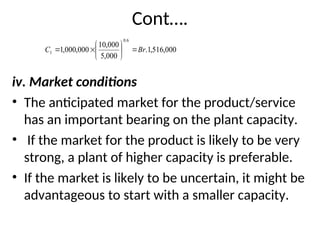
• Illustration: suppose the known investment cost
for 5,000 units of capacity for the manufacturer of
a certain item is Br. 1,000,000.
• What will be the investment cost for 10,000 units
of capacity if the capacity-cost factor is 0.6?
• The derived investment cost for 10,000 units of
capacity may be obtained as follows:
99.
Cont….
iv. Market conditions
•The anticipated market for the product/service
has an important bearing on the plant capacity.
• If the market for the product is likely to be very
strong, a plant of higher capacity is preferable.
• If the market is likely to be uncertain, it might be
advantageous to start with a smaller capacity.
000
,
516
,
1
.
000
,
5
000
,
10
000
,
000
,
1
6
.
0
1 Br
C
100.
Cont…
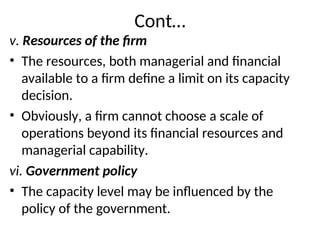
v. Resources ofthe firm
• The resources, both managerial and financial
available to a firm define a limit on its capacity
decision.
• Obviously, a firm cannot choose a scale of
operations beyond its financial resources and
managerial capability.
vi. Government policy
• The capacity level may be influenced by the
policy of the government.
101.
Cont….
• Traditionally, thepolicy of developing countries
was to distribute the additional capacity to be
created in a certain industry among several firms
regardless of economics of scale.
• This policy has been substantially modified in
recent years and the concept of ‘minimum
economic capacity’ has been adopted in several
industries.
102.
Cont…..
vii. Economic ofscale
• While production costs undoubtedly fall with
increasing volumes of production, the economic,
technical and ecological effects vary from
country to country and industry to industry.
• Therefore plant capacity must be related to
economies of scale.
103.
Cont….
viii. Minimum economicsize and equipment
constraints
• The concept of minimum economic size is
applicable to most industries and projects but is
of varying significance for different types of
industries.
• A cement plant of less than 300 tons per day is
for instance not considered economical.
104.
4.5 Technology andEngineering Study
• Definition of technology
• Technology is defined as the application of
scientific knowledge for productive purposes.
• This entails the use of science to produce
products, services or processes.
105.
Assessment of technologyrequired
• The primary goals of technology assessment are
to determine and evaluate the
1. impacts of different technologies on the society
and national economy, such as
cost-benefits analysis,
employment and income effects,
satisfaction of human needs etc,
2. impacts on the environment (environmental
impact assessment) and
3.techno-economic feasibility assessed from the
point of view of the enterprise
106.
Cont….
• To allowthe careful assessment of the suitability
of the technological alternatives a logical
sequence should be followed:
i. Problem identification,
ii. technology description and project layout,
iii. technology market and alternatives,
iv. assessment of availability,
v. technology forecast,
vi. assessment of the local integration,
vii. description of the social economic impact,
viii. environmental impact assessment
107.
Cont….
i. Problem identification
•Problem identification should identify, describe,
and assess the critical elements of the
technology required and,
• special consideration should be given
to existing or possible future constraints on the
acquisition and use of available technologies
to further development needs and to the possibility
of feasible technological alternatives.
108.
Cont…
ii. Technology descriptionand project layout
• The preparation of a plant layout and design is
essential for every project.
• The first initial stage should be the preparation of
a preliminary project plan and layout on the basis
of the production activities and the technologies
alternative envisaged.
• These second stage of project layout and design
can only be drawn when the details relating to
technology plant capacity and machine
specification are finalized.
109.
Cont…
• The preliminaryproject layout should include several
charts and drawings, which need not be according to
scale, but which would define the various physical
features of the plant and their relationship with one
another.
• For most projects, functional charts and layout
drawing at this stage should include the following:
a)General functional layout, defining the principal
physical or location features and flow relationships of
machinery and equipment, civil works and
construction and various ancillary and service
facilities
110.
Cont….
b) Basic characteristicsof the technology
c) Material-flow diagrams, indicating the flow of
materials and utilities
d) Transport layout, indicating roads, railway and
other transport facilities up to their point of
connection with public networks
e) Utility lines for electric power, gas, telephone,
sewage and emissions, both internal and external
up to the point connecting with pubic networks.
f) Areas for extension and expansion
111.
Cont…
iii. Technology marketand alternatives
• The selection of appropriate technology is
undoubtedly one of the key elements of such a
study.
• The study should identify both alternatives
technologies and alternatives sources of
technology.
• The evaluation would then aim at selecting the
technology and the source from which it may be
secured.
112.
Cont…..
• The studyshould also discuss the contractual
terms and conditions which may be of special
significance in relation to the acquisition of a
particular technology.
iv. Assessment of availability
• The market for industrial technology is highly
imperfect with alternatives technologies and
sources available from only one or a few sources
and alternatives production technologies may be
difficult to find.
113.
Cont….
• In thisconnection, the UNIDO Industrial and
Technological Information Bank (INTIB) became
operational in 1980
• Its main objectives being to ensure a quicker, easier and
greater flow of information to people who need to select
technologies.
v. Technology forecast
• Technological forecast provides an assessment and
forecast of technological trends during the project
implementation phase and the project life cycle or the
period limited to the planning horizon for the project.
• A technology forecast is especially important for
investment projects in highly innovative.
114.
Cont….
vi. Assessment ofthe local integration
• An issue of major significance in technology
choice is the level of integration or local value
added that can be achieved with respect to a
particular technological usage.
• The study should define the extent of integration
that should be proven technology that has
already been applied and utilized and which can
be related to local conditions.
• The parameters of the appropriate level of
integration should be indicated.
115.
Cont….
vii. Description ofthe social economic impact
• Public policies with regard to the acquisition of
foreign technologies, technology absorption and
development have to be identified.
• The socio-economic infrastructure, including the
structure of the labor force may have a
significant impact on the feasibility of the
technology to be selected for the project.
viii. Environmental impact assessment
• This issue has been discussed in detain
previously.
116.
Selection of Technology
•The choice of technology is influenced by variety
considerations this are:
plant capacity: To meet a given capacity
requirement perhaps only a certain production
technology may be viable.
principal inputs: For example, the quality of
limestone determines whether the wet or dry
process should be used for a cement plant.
investment outlay and production cost: The effect
of alternative technologies on investment outlay and
production cost over a period of time should be
carefully assessed.
117.
Cont….
use by otherunits: The technology adopted must be
proven by successful use by other units, preferably in
the specific country
product mix: The technology chosen must be judged
in terms of the total product-mix generated by it,
including saleable by-products.
latest developments: The technology adoption must
be based on the latest developments in order to
ensure that the likelihood of technological
obsolescence in the near future at least, is
minimized.
118.
Cont….
ease of absorption:The ease with which a particular
technology can be absorbed can influence the choice
of technology.
• Sometimes a high level technology may be beyond
the absorptive capacity of a developing country
which may lack trained personnel to handle that
technology
ecological and environmental impact
119.
Appropriateness of technology
•Appropriate technology refers to those methods
of production which are suitable to local
economic, social and cultural conditions.
• The advocates of appropriate technology should
be evaluated in terms of the following questions:
i. Whether the technology utilizes local raw materials?
ii. Whether the technology utilizes local man power?
iii. Whether the goods and services produced cater to the
basic needs?
iv. Whether the technology protects ecological balance?
v. Whether the technology is harmonious with social and
cultural conditions?
120.
Means of TechnologyAcquisition
• When technology has to be obtained from some
other enterprises, the means of acquisition have
to be determined.
• These can take the form of:
technology licensing,
outright purchase of technology or
a joint venture involving participation in ownership
by the technology supplier.
• The implications of these methods of acquisition
should be analyzed.
121.
Contract Terms andConditions
• The contractual terms and conditions for
technology acquisition and transfer which are
likely to be of particular significance to the
project need to be highlighted in the feasibility.
• These may differ in emphasis from project to
project, but certain contractual issues should be
of significance in most cases. These are:
122.
Cont….
a) Definition: Thedetails of the technology including
processes and products together with the
technology service required from the technology
supplier should be clearly defined.
• This should include all necessary documentation
such as blue prints, specifications, production
drawings etc.
b) Duration: Since the duration of a technology
agreement must be adequate for affective
technologies absorption, the period required for
such absorption should be defined, together with
the scope for progressive technological upgrading
and renewal.
123.
Cont….
c) Warranty: Theappropriate warranty or
guarantee relating to the technology and know-
how supplied should be indicated.
d) Access to improvements: Provision should be
made for the licensee to have access to
improvements made by the licensor during the
period of agreement.
e) Industrial property rights: Patents and other
industrial rights pertaining to a particular
technology should be identified .
124.
Cont….
f) Payments: Technologypayments can be in the
form of a lump sum payment or continuing
royalties or a combination of the two. The
suggested form and appointed level of payment
should be indicated.
g) Territorial sales rights: The implications of
exclusive and non-exclusive sales rights for the
country where the project is located and
neighboring countries or other geophysical
regions should be examined in the feasibility
study.
125.
Cont…..
h) Training: Forthe absorption of technology
training is essential.
• The study should indicate where and when
training would be required either in the plant of
the licensor or through supply of expert
personnel in the plant of the licensee.
• Civil Works
• Structures and civil works may be divided into
three categories: site preparation and
development, buildings and structures and,
outdoor works.
126.
Site preparation anddevelopment
• This covers the following
(i)grading and leveling of the site,
(ii)demolition and removal of existing structures
(iii) relocation of existing pipelines, cables, roads,
power lines, etc;
(iv) reclamation of swamps and draining and
removal of standing water,
127.
Cont……
(v) connections forthe following utilities from
the site to the site to the public network:
electric power (high tension and low tension),
water for drinking and other purposes,
communications (telephone telex, internet etc,)
roads, railway sidings and
(vi) other site preparation and development
work.
128.
Building and structures
•Buildings and structures may be divided in to :
(i)factory or process buildings,
(ii)ancillary buildings required for stores,
warehouses, laboratories, utility supply centers,
maintenance services, and others
(iii) administrative buildings
(iv) staff welfare buildings cafeteria and medical
service buildings and
(v)residual buildings.
129.
Outdoor works
• Outdoorworks cover
(i)supply and distribution of utilities (water, electric
power, communication, steam, and gas)
(ii)handling and treatment of emission, wastages
and effluents
(iii) transportation and traffic signals;
(iv) outdoor lighting
(v)landscaping and
(vi) enclosure and supervision (boundary wall,
fencing, barriers, gates, doors, security posts etc,)


![Cont….
• I1= income level in the base year
• I2 = income level in the following year
• The projected per capital demand is then given as
= (present per capital demand) * [1+ (per capital
change in income level) * (income elasticity of
demand)]
• Illustration: The following information is available
on quantity demanded for teff and income level of
Ethiopian Q1 = 50, Q2=55, l1=1000, l2= 1020.](https://image.slidesharecdn.com/ppt11-250327141618-2996a4ae/85/Project-management-course-for-first-degree-management-students-30-320.jpg)
![Cont….
• The projected annual per capital income five years from
now is expected to be 5% higher, and
• the present per capital demand for teff is 50 kg.
• If the population is estimated to be 70 million in five
years, what will be the aggregate demand for teff in five
years?
•
• Projected demand = (50) [1+ (0.050) (4.81)] =62.025 kg
• Aggregate demand = Projected demand x Projected
population
• = 62.025×70m = 4341.75 million kg
81
.
4
55
50
1020
1000
1000
1020
50
55
1
E](https://image.slidesharecdn.com/ppt11-250327141618-2996a4ae/85/Project-management-course-for-first-degree-management-students-31-320.jpg)