The Nervous System
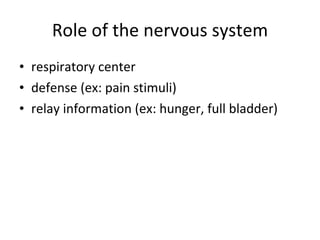
Role of the nervous system respiratory center defense (ex: pain stimuli) relay information (ex: hunger, full bladder)
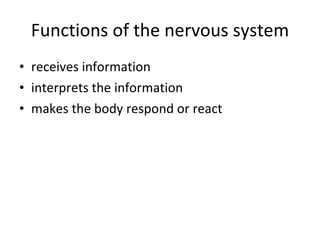
Functions of the nervous system receives information  interprets the information makes the body respond or react
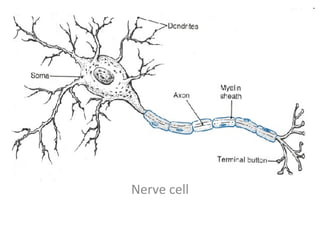
Nerve cell
Structure and Functions –Nerve cell also called neuron scattered throughout the body born with all the neurons that you would need (none grows or regenerates)
Parts of a neuron dendrites axon nucleus cytoplasm interneurons* *HW: 1) What are interneurons?   2) What is a soma/perikaryon?
Axon threadlike structure carries impulses away from the nerve cell body may have a myelin sheath (myelinated)
Dendrites looks like fibers branching out receives impulses or stimuli
Afferent or Efferent? Sensory or Motor? Pick up information, sends it to CNS From CNS, sends out orders
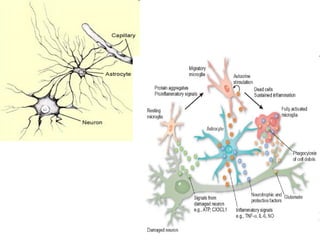
Structure and Functions- Neuroglia Also called glia Does not transmit impulses For protection and nourishment
Kinds of Glia Astrocytes –pass nutrients between blood capillaries and neurons Microglia – engulf foreign materials and bacteria Oligodendroglia, Schwann cells*- insulate axons of neurons *HW: Are oligodendroglia and Schwann cells the same thing?
 
Central nervous system brain spinal cord
Brain cerebrum cerebellum brain stem diencephalon
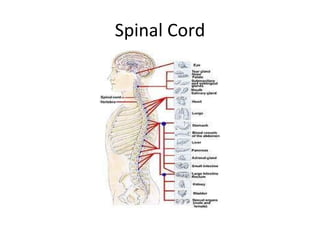
Spinal Cord
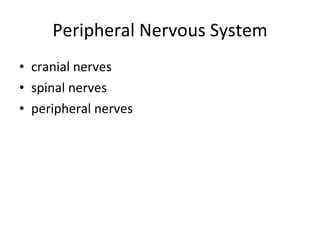
Peripheral Nervous System cranial nerves spinal nerves peripheral nerves
Autonomic Nervous System Sympathetic  Parasympathetic
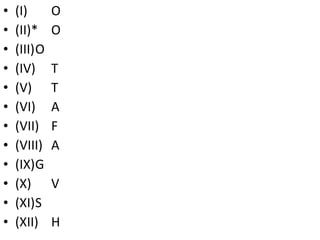
(I)  O (II)* O (III) O (IV) T (V) T (VI) A (VII) F (VIII)  A (IX) G (X) V (XI) S (XII) H
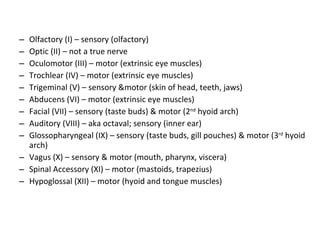
Olfactory (I) – sensory (olfactory) Optic (II) – not a true nerve Oculomotor (III) – motor (extrinsic eye muscles) Trochlear (IV) – motor (extrinsic eye muscles) Trigeminal (V) – sensory &motor (skin of head, teeth, jaws) Abducens (VI) – motor (extrinsic eye muscles) Facial (VII) – sensory (taste buds) & motor (2 nd  hyoid arch) Auditory (VIII) – aka octaval; sensory (inner ear) Glossopharyngeal (IX) – sensory (taste buds, gill pouches) & motor (3 rd  hyoid arch) Vagus (X) – sensory & motor (mouth, pharynx, viscera) Spinal Accessory (XI) – motor (mastoids, trapezius) Hypoglossal (XII) – motor (hyoid and tongue muscles)

5/10 Nervous system revised

  • 1.
  • 2.
    Role of thenervous system respiratory center defense (ex: pain stimuli) relay information (ex: hunger, full bladder)
  • 3.
    Functions of thenervous system receives information interprets the information makes the body respond or react
  • 4.
  • 5.
    Structure and Functions–Nerve cell also called neuron scattered throughout the body born with all the neurons that you would need (none grows or regenerates)
  • 6.
    Parts of aneuron dendrites axon nucleus cytoplasm interneurons* *HW: 1) What are interneurons? 2) What is a soma/perikaryon?
  • 7.
    Axon threadlike structurecarries impulses away from the nerve cell body may have a myelin sheath (myelinated)
  • 8.
    Dendrites looks likefibers branching out receives impulses or stimuli
  • 9.
    Afferent or Efferent?Sensory or Motor? Pick up information, sends it to CNS From CNS, sends out orders
  • 10.
    Structure and Functions-Neuroglia Also called glia Does not transmit impulses For protection and nourishment
  • 11.
    Kinds of GliaAstrocytes –pass nutrients between blood capillaries and neurons Microglia – engulf foreign materials and bacteria Oligodendroglia, Schwann cells*- insulate axons of neurons *HW: Are oligodendroglia and Schwann cells the same thing?
  • 12.
  • 13.
    Central nervous systembrain spinal cord
  • 14.
    Brain cerebrum cerebellumbrain stem diencephalon
  • 15.
  • 16.
    Peripheral Nervous Systemcranial nerves spinal nerves peripheral nerves
  • 17.
    Autonomic Nervous SystemSympathetic Parasympathetic
  • 18.
    (I) O(II)* O (III) O (IV) T (V) T (VI) A (VII) F (VIII) A (IX) G (X) V (XI) S (XII) H
  • 19.
    Olfactory (I) –sensory (olfactory) Optic (II) – not a true nerve Oculomotor (III) – motor (extrinsic eye muscles) Trochlear (IV) – motor (extrinsic eye muscles) Trigeminal (V) – sensory &motor (skin of head, teeth, jaws) Abducens (VI) – motor (extrinsic eye muscles) Facial (VII) – sensory (taste buds) & motor (2 nd hyoid arch) Auditory (VIII) – aka octaval; sensory (inner ear) Glossopharyngeal (IX) – sensory (taste buds, gill pouches) & motor (3 rd hyoid arch) Vagus (X) – sensory & motor (mouth, pharynx, viscera) Spinal Accessory (XI) – motor (mastoids, trapezius) Hypoglossal (XII) – motor (hyoid and tongue muscles)