Surge Protection:
Technical Background & Basics
2
Surge Protection – Agenda
Introduction
AC Power Basics
Power Quality Scope
Voltage Transients &
Disturbances
Power Quality in the
Workplace & the Effects of
Transients
MOV Technology & Surge
Protective Devices
3
Course Objectives
Describe the risk that voltage surges pose for today’s
electronic equipment
Explain the basics of AC power
Explain types of voltage disturbances
Discuss various surge protection devices
4
Progression of Electronic Devices
Use of electronic equipment has increased
Overall size of the equipment has decreased
Smaller more compact electronic devices have become more
susceptible to over-voltage failures
TIME
Electronic
Usage
Overall
Size
5
Microprocessor Electronics
Microprocessor driven devices
can be found in almost every
commercial, industrial and
residential setting, for example:
– Computer Networks, diagnostic
equipment, alarm sensors,
CNC machines, etc…
Integrated circuit chips are
especially sensitive to transient
voltage surges due to their:
– Microscopic size & structure
– Extremely low operating
voltages
– Increased switching speeds
6
A Perspective of Facility Downtime
0 20 40 60
Time (Minutes)
Steel & Aluminum
Chemical
Automotive
Industry
Average Length of Downtime per Incident
0.0 0.5 1.0 1.5 2.0
U.S. Dollars (Million)
Steel & Aluminum
Chemical
Automotive
Industry
Average Cost/Hour
Facility downtime
costs commercial
and industrial
plants nearly $26
billion a year in
lost time,
equipment repair
and replacement
7
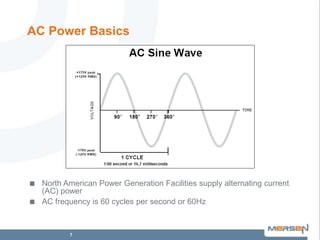
AC Power Basics
North American Power Generation Facilities supply alternating current
(AC) power
AC frequency is 60 cycles per second or 60Hz
8
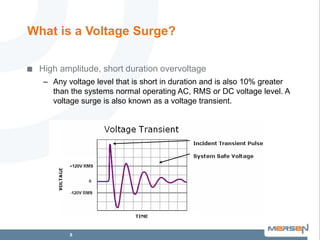
What is a Voltage Surge?
High amplitude, short duration overvoltage
– Any voltage level that is short in duration and is also 10% greater
than the systems normal operating AC, RMS or DC voltage level. A
voltage surge is also known as a voltage transient.
9
Types of Voltage Disturbances
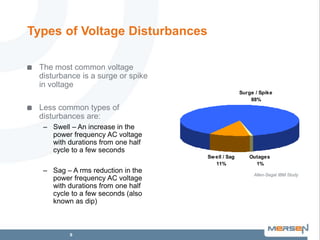
The most common voltage
disturbance is a surge or spike
in voltage
Less common types of
disturbances are:
– Swell – An increase in the
power frequency AC voltage
with durations from one half
cycle to a few seconds
– Sag – A rms reduction in the
power frequency AC voltage
with durations from one half
cycle to a few seconds (also
known as dip)
Outages
1%
Swell / Sag
11%
Surge / Spike
88%
Allen-Segal IBM Study
10
There are two general causes of voltage surge
1. Natural causes (lightning)
2. Other causes due to equipment or switching devices
a. Utility switching
b. Facility equipment due to switching in your facility, your neighbors facility or at the
utility company
Sources of Power Quality Problems in the Business Place
Florida Power Study
Power Quality Problems
11
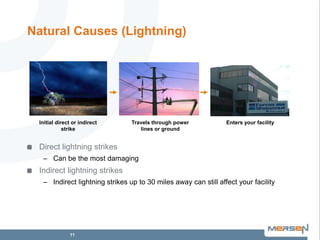
Natural Causes (Lightning)
Direct lightning strikes
– Can be the most damaging
Indirect lightning strikes
– Indirect lightning strikes up to 30 miles away can still affect your facility
Initial direct or indirect
strike
Travels through power
lines or ground
Enters your facility
12
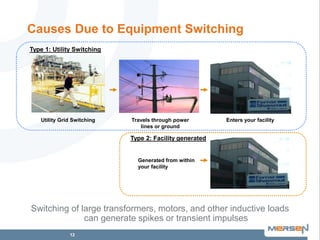
Causes Due to Equipment Switching
Utility Grid Switching Travels through power
lines or ground
Enters your facility
Generated from within
your facility
Switching of large transformers, motors, and other inductive loads
can generate spikes or transient impulses
Type 1: Utility Switching
Type 2: Facility generated
13
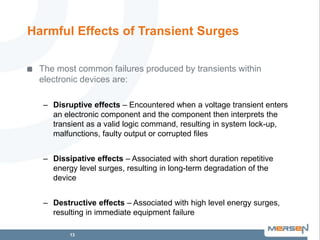
Harmful Effects of Transient Surges
The most common failures produced by transients within
electronic devices are:
– Disruptive effects – Encountered when a voltage transient enters
an electronic component and the component then interprets the
transient as a valid logic command, resulting in system lock-up,
malfunctions, faulty output or corrupted files
– Dissipative effects – Associated with short duration repetitive
energy level surges, resulting in long-term degradation of the
device
– Destructive effects – Associated with high level energy surges,
resulting in immediate equipment failure
14
Surge Protective Device (SPD)
A surge protective device, or SPD, reduces the magnitude of a
voltage transient surge thus protecting equipment from
damaging effects. SPD’s were commonly known in the past as
TVSS (Transient Voltage Surge Suppressor)
A SPD tries to:
– Send surge away (to ground)
– Acts as a momentary ‘short circuit’
• ‘short circuit’ ≈ voltage equalization ≈ no overvoltage ≈ protected load
15
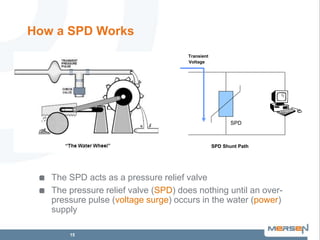
How a SPD Works
The SPD acts as a pressure relief valve
The pressure relief valve (SPD) does nothing until an over-
pressure pulse (voltage surge) occurs in the water (power)
supply
SPD
Transient
Voltage
SPD Shunt Path
16
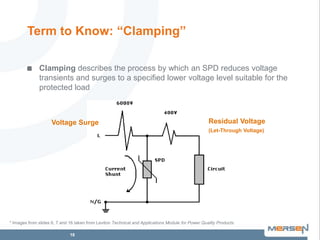
Term to Know: “Clamping”
Clamping describes the process by which an SPD reduces voltage
transients and surges to a specified lower voltage level suitable for the
protected load
Voltage Surge Residual Voltage
(Let-Through Voltage)
* Images from slides 6, 7 and 16 taken from Leviton Technical and Applications Module for Power Quality Products
17
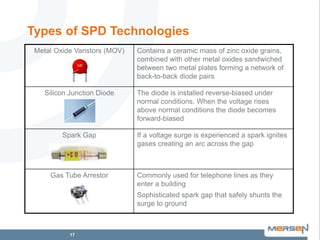
Metal Oxide Varistors (MOV) Contains a ceramic mass of zinc oxide grains,
combined with other metal oxides sandwiched
between two metal plates forming a network of
back-to-back diode pairs
Silicon Junction Diode The diode is installed reverse-biased under
normal conditions. When the voltage rises
above normal conditions the diode becomes
forward-biased
Spark Gap If a voltage surge is experienced a spark ignites
gases creating an arc across the gap
Gas Tube Arrestor Commonly used for telephone lines as they
enter a building
Sophisticated spark gap that safely shunts the
surge to ground
Types of SPD Technologies
18
MOV Technology
Contains a ceramic mass of
zinc oxide grains combined with
small quantities of bismuth,
cobalt and manganese
sandwiched between two metal
plates
The boundary between each
grain and its neighbor forms a
diode junction, allowing current
to only flow in one direction
Equivalent to a mass of back-to-
back diode pairs, each in
parallel
Schematic Symbols
19
MOV Failure Modes
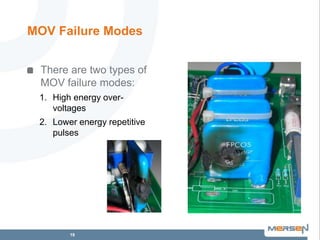
There are two types of
MOV failure modes:
1. High energy over-
voltages
2. Lower energy repetitive
pulses
20
MOV Failure due to High Energy Over Voltages
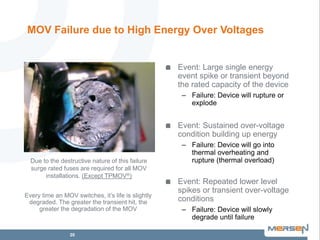
Event: Large single energy
event spike or transient beyond
the rated capacity of the device
– Failure: Device will rupture or
explode
Event: Sustained over-voltage
condition building up energy
– Failure: Device will go into
thermal overheating and
rupture (thermal overload)
Event: Repeated lower level
spikes or transient over-voltage
conditions
– Failure: Device will slowly
degrade until failure
Due to the destructive nature of this failure
surge rated fuses are required for all MOV
installations. (Except TPMOV®)
MOV Failure
Every time an MOV switches, it’s life is slightly
degraded. The greater the transient hit, the
greater the degradation of the MOV
21
Contact Mersen for Surge Protection
Solutions & Products
Email: info.nby@mersen.com
Call: 978-462-6662
Web: ep-us.mersen.com

PPT-Surge-Protection-Technical-Background-and-Basics-Presentation_1 (1).ppt

  • 1.
  • 2.
    2 Surge Protection –Agenda Introduction AC Power Basics Power Quality Scope Voltage Transients & Disturbances Power Quality in the Workplace & the Effects of Transients MOV Technology & Surge Protective Devices
  • 3.
    3 Course Objectives Describe therisk that voltage surges pose for today’s electronic equipment Explain the basics of AC power Explain types of voltage disturbances Discuss various surge protection devices
  • 4.
    4 Progression of ElectronicDevices Use of electronic equipment has increased Overall size of the equipment has decreased Smaller more compact electronic devices have become more susceptible to over-voltage failures TIME Electronic Usage Overall Size
  • 5.
    5 Microprocessor Electronics Microprocessor drivendevices can be found in almost every commercial, industrial and residential setting, for example: – Computer Networks, diagnostic equipment, alarm sensors, CNC machines, etc… Integrated circuit chips are especially sensitive to transient voltage surges due to their: – Microscopic size & structure – Extremely low operating voltages – Increased switching speeds
  • 6.
    6 A Perspective ofFacility Downtime 0 20 40 60 Time (Minutes) Steel & Aluminum Chemical Automotive Industry Average Length of Downtime per Incident 0.0 0.5 1.0 1.5 2.0 U.S. Dollars (Million) Steel & Aluminum Chemical Automotive Industry Average Cost/Hour Facility downtime costs commercial and industrial plants nearly $26 billion a year in lost time, equipment repair and replacement
  • 7.
    7 AC Power Basics NorthAmerican Power Generation Facilities supply alternating current (AC) power AC frequency is 60 cycles per second or 60Hz
  • 8.
    8 What is aVoltage Surge? High amplitude, short duration overvoltage – Any voltage level that is short in duration and is also 10% greater than the systems normal operating AC, RMS or DC voltage level. A voltage surge is also known as a voltage transient.
  • 9.
    9 Types of VoltageDisturbances The most common voltage disturbance is a surge or spike in voltage Less common types of disturbances are: – Swell – An increase in the power frequency AC voltage with durations from one half cycle to a few seconds – Sag – A rms reduction in the power frequency AC voltage with durations from one half cycle to a few seconds (also known as dip) Outages 1% Swell / Sag 11% Surge / Spike 88% Allen-Segal IBM Study
  • 10.
    10 There are twogeneral causes of voltage surge 1. Natural causes (lightning) 2. Other causes due to equipment or switching devices a. Utility switching b. Facility equipment due to switching in your facility, your neighbors facility or at the utility company Sources of Power Quality Problems in the Business Place Florida Power Study Power Quality Problems
  • 11.
    11 Natural Causes (Lightning) Directlightning strikes – Can be the most damaging Indirect lightning strikes – Indirect lightning strikes up to 30 miles away can still affect your facility Initial direct or indirect strike Travels through power lines or ground Enters your facility
  • 12.
    12 Causes Due toEquipment Switching Utility Grid Switching Travels through power lines or ground Enters your facility Generated from within your facility Switching of large transformers, motors, and other inductive loads can generate spikes or transient impulses Type 1: Utility Switching Type 2: Facility generated
  • 13.
    13 Harmful Effects ofTransient Surges The most common failures produced by transients within electronic devices are: – Disruptive effects – Encountered when a voltage transient enters an electronic component and the component then interprets the transient as a valid logic command, resulting in system lock-up, malfunctions, faulty output or corrupted files – Dissipative effects – Associated with short duration repetitive energy level surges, resulting in long-term degradation of the device – Destructive effects – Associated with high level energy surges, resulting in immediate equipment failure
  • 14.
    14 Surge Protective Device(SPD) A surge protective device, or SPD, reduces the magnitude of a voltage transient surge thus protecting equipment from damaging effects. SPD’s were commonly known in the past as TVSS (Transient Voltage Surge Suppressor) A SPD tries to: – Send surge away (to ground) – Acts as a momentary ‘short circuit’ • ‘short circuit’ ≈ voltage equalization ≈ no overvoltage ≈ protected load
  • 15.
    15 How a SPDWorks The SPD acts as a pressure relief valve The pressure relief valve (SPD) does nothing until an over- pressure pulse (voltage surge) occurs in the water (power) supply SPD Transient Voltage SPD Shunt Path
  • 16.
    16 Term to Know:“Clamping” Clamping describes the process by which an SPD reduces voltage transients and surges to a specified lower voltage level suitable for the protected load Voltage Surge Residual Voltage (Let-Through Voltage) * Images from slides 6, 7 and 16 taken from Leviton Technical and Applications Module for Power Quality Products
  • 17.
    17 Metal Oxide Varistors(MOV) Contains a ceramic mass of zinc oxide grains, combined with other metal oxides sandwiched between two metal plates forming a network of back-to-back diode pairs Silicon Junction Diode The diode is installed reverse-biased under normal conditions. When the voltage rises above normal conditions the diode becomes forward-biased Spark Gap If a voltage surge is experienced a spark ignites gases creating an arc across the gap Gas Tube Arrestor Commonly used for telephone lines as they enter a building Sophisticated spark gap that safely shunts the surge to ground Types of SPD Technologies
  • 18.
    18 MOV Technology Contains aceramic mass of zinc oxide grains combined with small quantities of bismuth, cobalt and manganese sandwiched between two metal plates The boundary between each grain and its neighbor forms a diode junction, allowing current to only flow in one direction Equivalent to a mass of back-to- back diode pairs, each in parallel Schematic Symbols
  • 19.
    19 MOV Failure Modes Thereare two types of MOV failure modes: 1. High energy over- voltages 2. Lower energy repetitive pulses
  • 20.
    20 MOV Failure dueto High Energy Over Voltages Event: Large single energy event spike or transient beyond the rated capacity of the device – Failure: Device will rupture or explode Event: Sustained over-voltage condition building up energy – Failure: Device will go into thermal overheating and rupture (thermal overload) Event: Repeated lower level spikes or transient over-voltage conditions – Failure: Device will slowly degrade until failure Due to the destructive nature of this failure surge rated fuses are required for all MOV installations. (Except TPMOV®) MOV Failure Every time an MOV switches, it’s life is slightly degraded. The greater the transient hit, the greater the degradation of the MOV
  • 21.
    21 Contact Mersen forSurge Protection Solutions & Products Email: info.nby@mersen.com Call: 978-462-6662 Web: ep-us.mersen.com