English Course Syllabus (2 CrH)
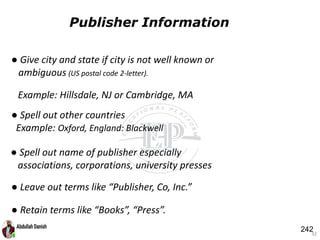
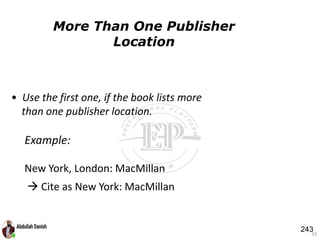
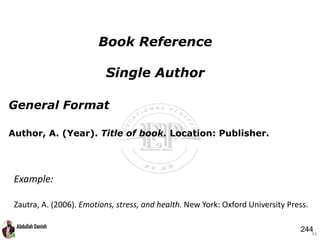
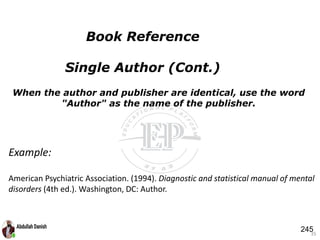
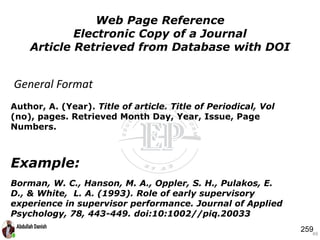
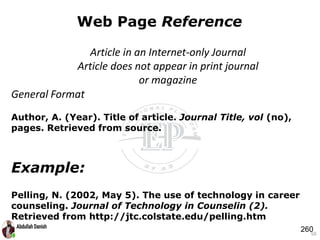
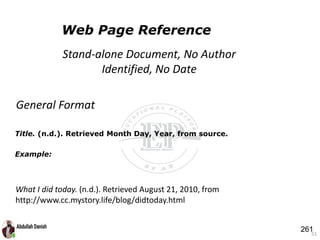
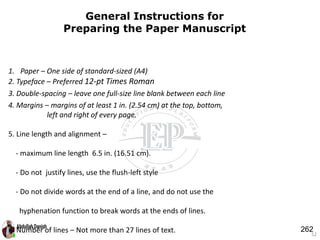
• Unit I : Academic Writing (Page=2-129)
• Unit Descriptions:
• This unit would assist the learners to improve upon their academic
writing,
• with special focus on language used in comparison and contrast, and
• cause and effect.
• Unit Objectives:
• 1. develop unity within ideas presented
• 2. support ideas with evidence
• 3. organize ideas coherently
• 4. use appropriate sentence structure
• 5. use specific transitional words / phrase effectively
• 6. write essays presenting effective arguments
• Unit II : Incident Reports (P=149-153)
• Unit Description:
• The aim of this unit is to enhance the learners language skills to be able to
• detect problems, determine their causes and resolve the issues while
• writing incident reports.
• Unit Objectives:
• 1. Identify the purpose for writing incident report
• 2. Exploit guidelines for incident reports
• 3. Write organized incident report
• 4. Use appropriate language for writing incident reports.
• Unit III: Proof reading & Editing Skills
(P=154-210)
• Unit Description:
• The unit will guide students to realize that academic writing is a
process
• that involves drafting and re-drafting to craft your paper into its final
form.
• The students will review and re-work on texts keeping in mind the
purpose
• of writing and the audience it is being written for.
• Unit Objectives:
• 1. Understand what is involved in editing
• 2. Edit for structure-organization
• 3. Edit for style-tone
• 4. Proof read for spellings, punctuation, grammar
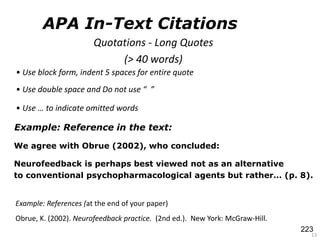
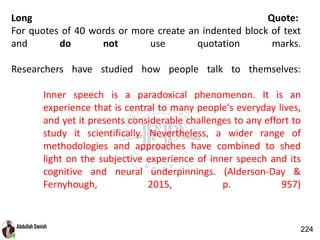
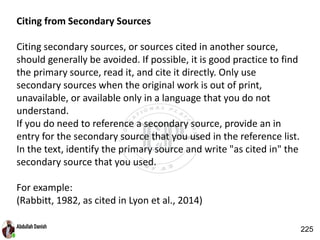
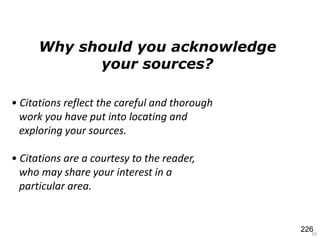
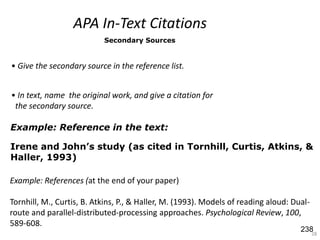
• Unit IV: References & Citations in APA
Style (P=211-262)
• Unit Description:
• The course is designed to enhance the scientific information of the
• learners. In addition the course will also improve the scholarly and
• technical information of the learners.
• Unit Objectives:
• 1. Understand what plagiarism involves
• 2. Cite sources (quotations and paraphrasing)
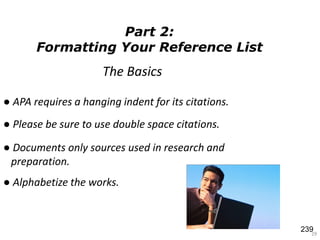
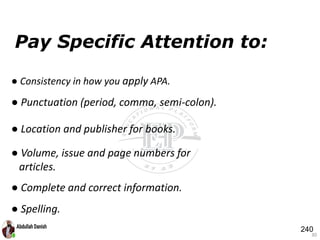
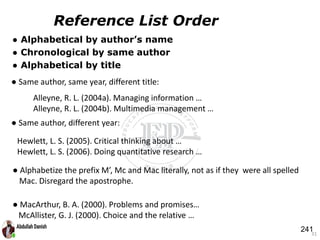
• 3. Compile a reference list
• 4. Use levels of headings
• 5. Use APA style in written assignments.
1
ACADEMIC WRITING. UNIT 1
2
Unit description:
• This unit would assist the learners to improve upon their academic
writing, with special focus on language used in comparison and
contrast, and cause and effect.
3
Unit Objectives
• By the end of this unit, students will be able to:
• 1. develop unity within ideas presented
• 2. support ideas with evidence
• 3. organize ideas coherently
• 4. use appropriate sentence structure
• 5. use specific transitional words / phrase effectively
• 6. write essays presenting effective arguments
4
What is Academic writing?
• Academic writing is the process of breaking down ideas
and using deductive reasoning, formal voice and third
person point-of-view. It is about what you think and
what evidence has contributed to that thinking.
5
Purpose Of Academic Writing
• There are several purposes of academic writing but the main purpose of academic
writing is to provide the information with a clear, appropriate and thoughtful image
of that specific topic. There are so many types of academic writing and each of them
is written to provide for its specific purpose, for example, one type of academic
writing is done for an explanation of the subject, the other is done just to describe
etc. Now, moving toward the overall purpose of academic writing, they are as
follows:
6
Accuracy:
• When you start writing you need to use more accurate and
authentic words. Some students use more unclear word
combinations like “many people say” or “once a person said”
are not considered to feel accurate in academic writing. So one
of the purposes of academic writing is to provide the reader
with correct and accurate information.
7
Density:
• On the daily basis we use very simple language and in a very
clear way but when we write or read academic content it is
complex. In academic writing, we have to use more accurate
language from all points of view which include grammar,
phrases, clauses, subordinates, qualifying adjective etc.
8
Correctness:
• During the academic writing, you should avoid informal
language. The purpose of academic writing is to avoid using
short forms and dialect words in your writing.
9
Detachment:
• While writing academic content, the student has to focus more on the objective
of the topic rather than focusing on what your audience think about that topic.
So whenever we talk about objectivity we talk about the central idea or main
theme of the topic. So, try to write information relevant to the topic without
thinking what your opinion is.
• So above are given some of the purposes of academic writing which reader and
writer both should keep in their mind while reading and writing and academic
content.
• If you face the problem to write their academic writing then you can contact us.
We provide the paper writing services and professional academic writing
services for all academic students. You can get online help from us anytime in a
day or night. Our team of experts is available 24/7 for your help. They always
give 100% unique content.
10
The Principle Of Academic Writing
• Your papers must have a clear purpose. It presents your original point of view.
• • Your writing must have a single focus – all paragraphs have to include relevant
evidence (facts, expert opinions, and quotations, examples) to support your thesis
statement.
• • You must follow a standard organizational pattern. Every academic text must
include the following parts: an introduction, the main body, and a conclusion. Some
papers may require an abstract.
• • As a writer, you need to provide clear, logical, and simple explanations to your
reader.
11
• You should refer to a number of scholarly sources. You need
to integrate source materials into your discussion.
• To ensure academic integrity, all college essays should be
formatted in accordance with the requirements of one of the
specific citation styles – APA, MLA, Harvard, Chicago that
determine the rules for in-text citations, paper sections,
format, reference list.
12
Why Academic Writing Is Important
• Every academic paper is a kind of communication tool that allows students to
convey the acquired knowledge in a certain discipline. For this reason, academic
writing and research always feature a serious tone and present particular theories
and facts that touch upon a given argument. Students learn academic writing to
improve learning development. It is also used by professors to assess course
comprehension.
13
• Writing various types of papers is one of the most dreaded activities which students
face in high school and college. It is quite a complicated task because it includes
lengthy procedures of careful research and requires specific skills. Often, students
either do not have sufficient writing skills or they are afraid of criticism from their
professors. However, they cannot avoid producing academic papers as it is a vital
part of academia.
14
It Improves Critical Thinking Skills
• When you are writing an academic paper, you are not limited to
simply presenting information. The process also involves
conducting careful research and assessing information, identifying
whether it is relevant to your topic or not. Such a process helps
increase intellectual capacity and enables you to think critically on
various issues. Furthermore, it provides you with an opportunity to
look into a topic from different dimensions and come up with
appropriate solutions. When you use some academic writing tips,
you know that the first and most important stage is planning
because a good paper requires a clear structure.
15
• Therefore, you must dedicate enough time to organizing
information, whether it is known or researched, about your
issue into a logical order to ensure the flow of your essay is
consistent. Further, there are drafting and editing stages. At
these stages, you have to use your critical thinking again to
ensure that the paper is the best it could be, that your
thoughts flow smoothly, your language is clear, and there are
no errors in the paper.
16
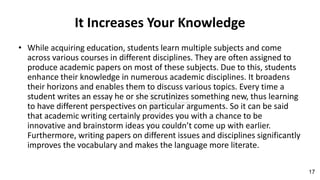
It Increases Your Knowledge
• While acquiring education, students learn multiple subjects and come
across various courses in different disciplines. They are often assigned to
produce academic papers on most of these subjects. Due to this, students
enhance their knowledge in numerous academic disciplines. It broadens
their horizons and enables them to discuss various topics. Every time a
student writes an essay he or she scrutinizes something new, thus learning
to have different perspectives on particular arguments. So it can be said
that academic writing certainly provides you with a chance to be
innovative and brainstorm ideas you couldn’t come up with earlier.
Furthermore, writing papers on different issues and disciplines significantly
improves the vocabulary and makes the language more literate.
17
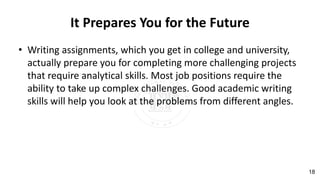
It Prepares You for the Future
• Writing assignments, which you get in college and university,
actually prepare you for completing more challenging projects
that require analytical skills. Most job positions require the
ability to take up complex challenges. Good academic writing
skills will help you look at the problems from different angles.
18
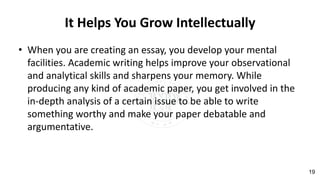
It Helps You Grow Intellectually
• When you are creating an essay, you develop your mental
facilities. Academic writing helps improve your observational
and analytical skills and sharpens your memory. While
producing any kind of academic paper, you get involved in the
in-depth analysis of a certain issue to be able to write
something worthy and make your paper debatable and
argumentative.
19
It Teaches You to Manage Your Time
• Academic papers always come with deadlines for submitting.
You just have no opportunity to complete it anytime you want
as you risk losing grades. So, such assignments make students
manage their time according to the priority, as there are
definitely other important tasks which must be completed.
20
Unity & Coherence in Writing
21
• Each chapter in any printed document is divided
up into sections, the first line of each being
indented slightly to the right.
• Division inside the chapters, essays and other
compositions is called paragraph and the
beginning of a new paragraph marks a change
of topic or step in the development of an
argument
• It is important to know how to divide a
composition into paragraphs to make a
document easy to read
22
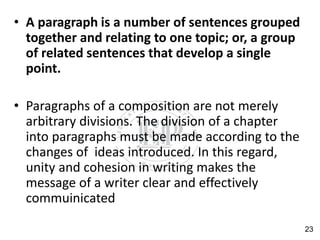
• A paragraph is a number of sentences grouped
together and relating to one topic; or, a group
of related sentences that develop a single
point.
• Paragraphs of a composition are not merely
arbitrary divisions. The division of a chapter
into paragraphs must be made according to the
changes of ideas introduced. In this regard,
unity and cohesion in writing makes the
message of a writer clear and effectively
commuinicated
23
Unity
• The first and most important principle in
constructing a paragraph is unity. Each sentence
deals with one thought, each paragraph must deal
with one topic or idea
• In writing an essay, every head, and every sub-
head, should have its own paragraph to itself. And
every sentence in the paragraph must be closely
connected with the main topic of the paragraph
• The paragraph and every part of it must be the
expression of one theme or topic
24
Unity
• The topic, theme of a paragraph is very often
expressed in one sentence of the paragraph,
generally the first. The sentence is called the
topical sentence, (because it states the topic), or
the key sentence (because it unlocks or opens
the subject to be dealt with in the paragraph).
25
• Writing has unity when the supporting
sentences all work together to support the topic
sentences. Paragraphs that lack unity are
confusing to the reader because some ideas do
not seem to belong.
• Compare the examples below. The first
paragraph has poor unity because there are
sentences that do not support the topic
sentence. The topic sentence is about the
various places in Utah where there are hiking
trails for people to enjoy nature.
26
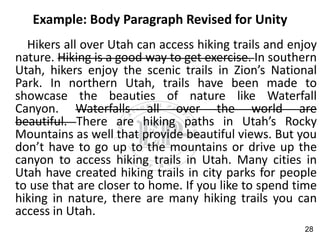
Example: Body Paragraph (Poor Unity)
Hikers all over Utah can access hiking trails and enjoy
nature. Hiking is a good way to get exercise. In southern
Utah, hikers enjoy the scenic trails in Zion’s National
Park. In northern Utah, trails have been made to
showcase the beauties of nature like Waterfall Canyon.
Waterfalls all over the world are beautiful. There are
hiking paths in Utah’s Rocky Mountains as well that
provide beautiful views. But you don’t have to go up to
the mountains or drive up the canyon to access hiking
trails in Utah. Many cities in Utah have created hiking
trails in city parks for people to use that are closer to
home. If you like to spend time hiking in nature, there
are many hiking trails you can access in Utah.
27
Example: Body Paragraph Revised for Unity
Hikers all over Utah can access hiking trails and enjoy
nature. Hiking is a good way to get exercise. In southern
Utah, hikers enjoy the scenic trails in Zion’s National
Park. In northern Utah, trails have been made to
showcase the beauties of nature like Waterfall
Canyon. Waterfalls all over the world are
beautiful. There are hiking paths in Utah’s Rocky
Mountains as well that provide beautiful views. But you
don’t have to go up to the mountains or drive up the
canyon to access hiking trails in Utah. Many cities in
Utah have created hiking trails in city parks for people
to use that are closer to home. If you like to spend time
hiking in nature, there are many hiking trails you can
access in Utah.
28
Order
Order is another element in construction of writing. In
paragraph development the logical sequence of
thought or development of a subject is called order.
Events must be related in the order of their
occurrences, and all ideas should connect with the
leading idea and arranged according to their
importance or order.
29
Variety
• The third important element of developing a
composition is variety in construction of
paragraphs. It means to avoid monotony, the
paragraph of a composition should be of
different lengths, and not always of the same
sentence construction.
• To sum up, the essentials of a good essay are
unity, good topic sentences, logical sequence of
thoughts, variety, full and rounded final sentence
in conclusion, and coherence in writing.
30
Coherence
• Coherence also means “clarity of expression”
and it is created when correct vocabulary and
grammar are used. After all, the goal of writing is
to benefit the readers.
• Without both coherence and cohesion, the
readers may detect choppiness in the text and
feel as if there are gaps in the ideas presented.
31
Examples of Cohesive and Non-
Cohesive Paragraphs
• Paragraph coherence and cohesion results
in paragraph unity. To ensure that your paragraphs
have unity, there are two things to keep in mind: it
must have a single topic (found in the topic
sentence) and sentences provide more detail than
the topic sentence, while maintaining the focus on
the idea presented. The paragraph below shows a
lack of unity:
32
Non-cohesive sample:
Dogs are canines that people domesticated a
long time ago. Wolves are predecessors of dogs
and they help people in a variety of ways. There
are various reasons for owning a dog, and the
most important is companionship.
33
Cohesive sample:
Dogs are canines that people domesticated a
long time ago, primarily for practical reasons.
Even though dogs descended from wolves, they
are tame and can be kept in households. Since
they are tame, people have various reasons for
owning a dog, such as companionship.
34
Notice that the ideas in the non-cohesive sample
are not arranged logically. The sentences are not
connected by transitions and give the readers new
ideas that are not found in the topic sentence. Thus,
the paragraph is hard to read, leaving readers
confused about the topic. On the other hand, the
cohesive sample has ideas arranged logically. All
ideas in this sample flow from the topic sentence. In
addition, they give more details about the topic
while maintaining their focus on the topic sentence.
35
Exercise: Revise for unity#1
Read the paragraphs. Cross out sentences that are
not connected to the topic sentence.
It is dangerous to preserve old buildings.
According to some engineers, every building has a
lifetime, and after the building reaches its lifetime,
it is dangerous to keep those buildings. It also
becomes more expensive. In addition, if the city is
in a seismically active area, the problems that old
buildings create will become worse because those
buildings will not resist an earthquake. Some
people say that old buildings can be used as tourist
places and people enjoy visiting a historic location.
It is clear that old buildings are not very safe.
36
Exercise: Revise for unity#2
There are many varieties of English spoken
today in the world. American English British
English, Indian English, and Australian English
are just a few of these varieties, and they are all
a little distinct. Pronunciation is one obvious
difference, but other things vary as well, like
vocabulary and even grammar. The
word shiela is the Australian word for girl.
English may be a global language, but it isn’t
exactly the same all over the world.
37
Exercise: Revise for unity#3
The environment is something that can affect
students positively or negatively. For example, if
classmates are sleeping or talking during classes,
that environment can make it difficult for students
to concentrate. A noisy, dirty, or distracting
environment can have a similar impact. Some
roommates never help clean the apartment. On the
contrary, an environment that is clean and has no
distractions will make it much easier to focus on
homework. It is important to recognize the impact
that the environment can have on students.
38
Exercise: Revise for unity#4
Students like to listen to music in many
different situations. Students listen to different
types of music. Many students listen to music
while they are studying because it helps them
concentrate. Some people like to be quiet while
they study. Some students listen to music while
they work. Some enjoy listening to music while
they walk to work or school. There are many
different places where students enjoy listening
to music.
39
40
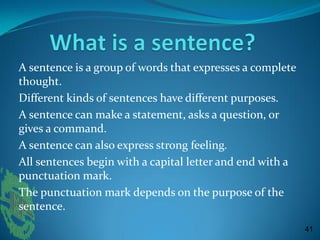
A sentence is a group of words that expresses a complete
thought.
Different kinds of sentences have different purposes.
A sentence can make a statement, asks a question, or
gives a command.
A sentence can also express strong feeling.
All sentences begin with a capital letter and end with a
punctuation mark.
The punctuation mark depends on the purpose of the
sentence.
41
42
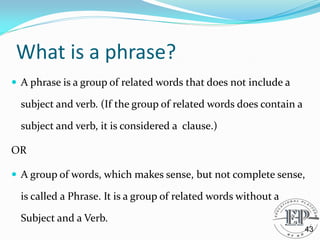
What is a phrase?
 A phrase is a group of related words that does not include a
subject and verb. (If the group of related words does contain a
subject and verb, it is considered a clause.)
OR
 A group of words, which makes sense, but not complete sense,
is called a Phrase. It is a group of related words without a
Subject and a Verb.
43
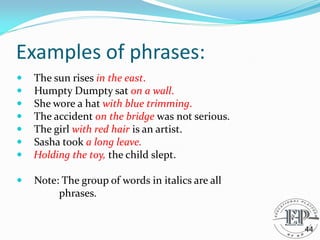
Examples of phrases:
 The sun rises in the east.
 Humpty Dumpty sat on a wall.
 She wore a hat with blue trimming.
 The accident on the bridge was not serious.
 The girl with red hair is an artist.
 Sasha took a long leave.
 Holding the toy, the child slept.
 Note: The group of words in italics are all
phrases.
44
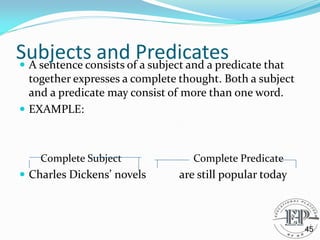
Subjects and Predicates
 A sentence consists of a subject and a predicate that
together expresses a complete thought. Both a subject
and a predicate may consist of more than one word.
 EXAMPLE:
Complete Subject Complete Predicate
 Charles Dickens’ novels are still popular today
45
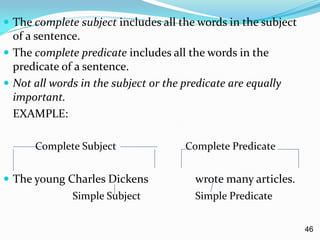
 The complete subject includes all the words in the subject
of a sentence.
 The complete predicate includes all the words in the
predicate of a sentence.
 Not all words in the subject or the predicate are equally
important.
EXAMPLE:
Complete Subject Complete Predicate
 The young Charles Dickens wrote many articles.
Simple Subject Simple Predicate
46
 The simple subject is the main word or word group in
the complete subject.
 The simple subject is usually a noun or a pronoun.
 A noun is a word that names a person, a place, a thing,
or an idea.
 A pronoun is a word that takes the place of one or more
nouns.
47
 The simple predicate is the main word or word group in the
complete predicate.
 The simple predicate is always a verb.
 A verb is a word that expresses action or a state of being.
 Sometimes the simple subject is the same as the complete
subject.
 Sometimes the simple predicate is the same as the
complete predicate.
48
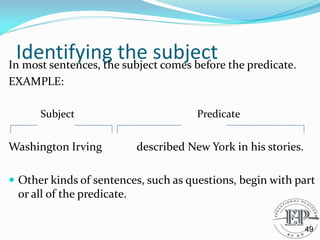
Identifying the subject
In most sentences, the subject comes before the predicate.
EXAMPLE:
Subject Predicate
Washington Irving described New York in his stories.
 Other kinds of sentences, such as questions, begin with part
or all of the predicate.
49
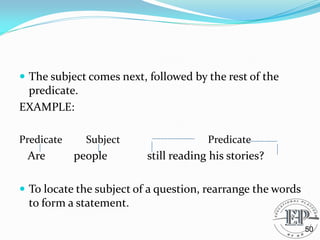
 The subject comes next, followed by the rest of the
predicate.
EXAMPLE:
Predicate Subject Predicate
Are people still reading his stories?
 To locate the subject of a question, rearrange the words
to form a statement.
50
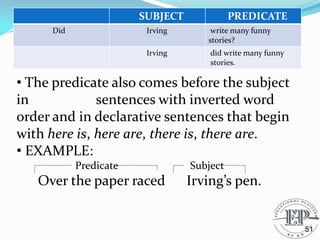
SUBJECT PREDICATE
Did Irving write many funny
stories?
Irving did write many funny
stories.
• The predicate also comes before the subject
in sentences with inverted word
order and in declarative sentences that begin
with here is, here are, there is, there are.
• EXAMPLE:
Predicate Subject
Over the paper raced Irving’s pen.
51
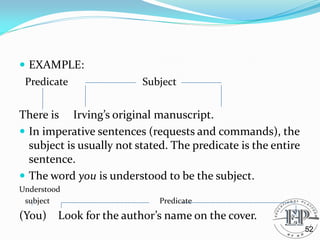
 EXAMPLE:
Predicate Subject
There is Irving’s original manuscript.
 In imperative sentences (requests and commands), the
subject is usually not stated. The predicate is the entire
sentence.
 The word you is understood to be the subject.
Understood
subject Predicate
(You) Look for the author’s name on the cover.
52
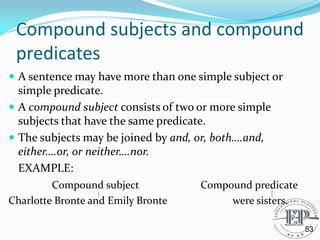
Compound subjects and compound
predicates
 A sentence may have more than one simple subject or
simple predicate.
 A compound subject consists of two or more simple
subjects that have the same predicate.
 The subjects may be joined by and, or, both….and,
either….or, or neither….nor.
EXAMPLE:
Compound subject Compound predicate
Charlotte Bronte and Emily Bronte were sisters.
53
 When the two simple subjects are joined by and or by
both….and, the compound subject is plural. Use the
plural form of the verb to agree with the plural
compound subject.
 When simple subjects are joined by or, either….or, or
neither…. nor, the verb must agree with the nearer
simple subject.
54
EXAMPLES:
 Neither Charlotte nor Emily is my favorite author.
 Neither her sisters nor Charlotte was outgoing.
 Neither Charlotte nor her sisters were outgoing.
55
 In the first sentence, Emily is the nearer subject, so the
singular form of the verb is used.
 In the second sentence, Charlotte is the nearer subject,
so the singular form of the verb is used here too.
 In the third sentence, sisters is the nearer subject, so
the plural form of the verb is used.
56
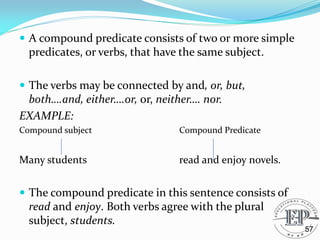
 A compound predicate consists of two or more simple
predicates, or verbs, that have the same subject.
 The verbs may be connected by and, or, but,
both….and, either….or, or, neither…. nor.
EXAMPLE:
Compound subject Compound Predicate
Many students read and enjoy novels.
 The compound predicate in this sentence consists of
read and enjoy. Both verbs agree with the plural
subject, students.
57
What is a clause?
 According to a traditional definition, a clause can be defined
as a grammatical unit at a level between a phrase and a
sentence.
 In other words, a group of words that contains a subject and a
predicate.
 A clause is a part of a sentence, a string of words which
expresses a proposition and typically consists of at least a
subject and a verb, and is joined to the rest of the sentence by
a conjunction. It is not a complete sentence on its own.
58
A clause may be either a sentence (an independent
clause) or a sentence-like construction within another
sentence (a dependent or subordinate clause).
EXAMPLES OF CLAUSES:
 John sings.
 Yesterday we played basketball.
59
Consider the following sentence:
 Mary liked Nora when she was a kid.
 The string Mary liked Nora could be a complete
sentence on its own; the additional string, when she
was a kid, could not be a complete sentence on its own.
It is a clause.
 A clause is therefore a sentence-like construction
contained within a sentence.
60
 The construction when she was a kid is 'sentence-like' in
the sense that we can analyze it in terms of the major
sentence elements (subject, verb, etc. . . .). It has its own
subject (she), and it has a verb (was).
 In addition to these major sentence elements, it has the
subordinating conjunction when, which tells us that the
clause is a subordinate clause.
61
Subordinating conjunctions, also called subordinators,
are conjunctions that join an independent clause and a
dependent clause.
 The most common subordinating conjunctions in the
English language include after, although, as, as far as, as if,
as long as, as soon as, as though, because, before, if, in order
that, since, so, so that, than, though, unless, until, when,
whenever, where, whereas, wherever, and while.
62
A coordinating conjunction is a word used to connect
compound parts of a sentence.
 The most common conjunctions—and, but, nor, for and
or—are called coordinating conjunctions. So and yet
are also sometimes used as coordinating conjunctions.
 Note: Coordinating conjunctions are used to connect
independent clauses in compound sentences.
63
Types of clauses:
MAIN CLAUSE OR INDEPENDENT CLAUSE:
 A main clause has a subject and a predicate and can
stand alone as a sentence.
 Main clauses can be connected by a comma and a
conjunction, by a semicolon, or by a semicolon and a
conjunctive adverb.
 The conjunctive adverb is followed by a comma.
64
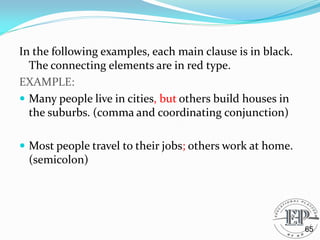
In the following examples, each main clause is in black.
The connecting elements are in red type.
EXAMPLE:
 Many people live in cities, but others build houses in
the suburbs. (comma and coordinating conjunction)
 Most people travel to their jobs; others work at home.
(semicolon)
65
Subordinate clause or dependent
clause:
 A subordinate or dependent clause is a group of words
that has a subject and a predicate but does not express
a complete thought and cannot stand alone as a
sentence. A subordinate clause is always combined
with a main clause in a sentence.
66
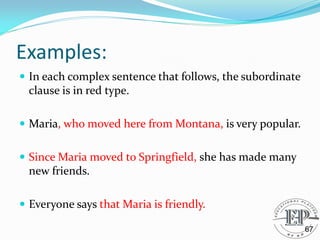
Examples:
 In each complex sentence that follows, the subordinate
clause is in red type.
 Maria, who moved here from Montana, is very popular.
 Since Maria moved to Springfield, she has made many
new friends.
 Everyone says that Maria is friendly.
67
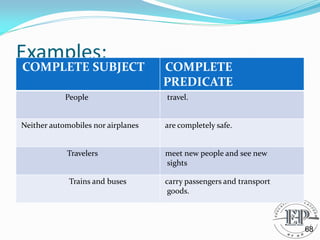
Examples:
COMPLETE SUBJECT COMPLETE
PREDICATE
People travel.
Neither automobiles nor airplanes are completely safe.
Travelers meet new people and see new
sights
Trains and buses carry passengers and transport
goods.
68
Sentence And Its Types:
Sentences are divided into four kinds on the basis of
the purpose they serve.
 The four kinds of sentences are:
 Declarative
 Imperative
 Interrogative
 Exclamatory
69
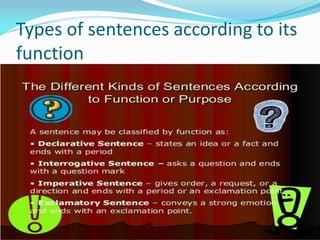
Types of sentences according to its
function
70
Declarative sentence
We also use Declarative Sentences to express an idea or give
information. Some examples of the declarative sentence include:
Examples
 The man has just gone out
 .The class over there is making a noise
 .She is an accomplished writer.
 The food got burnt.
 We ate samosa for lunch.
 The sun is the centre of the Solar System.
71
2. Interrogative Sentence
An interrogative sentence is a
sentence that asks a question.Since it
asks a question, an interrogative
sentence always ends with a question
mark. ?
72
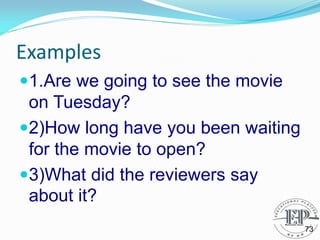
Examples
1.Are we going to see the movie
on Tuesday?
2)How long have you been waiting
for the movie to open?
3)What did the reviewers say
about it?
73
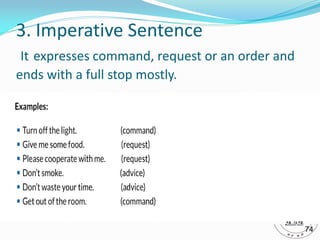
3. Imperative Sentence
It expresses command, request or an order and
ends with a full stop mostly.
74
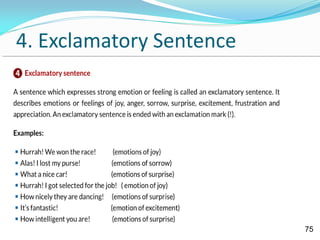
4. Exclamatory Sentence
75
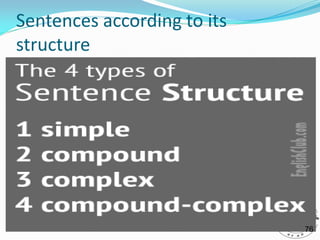
Sentences according to its
structure
76
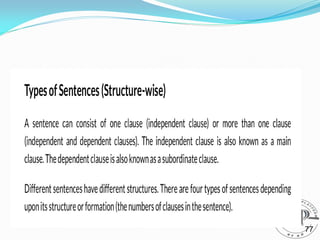
77
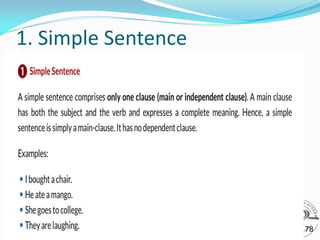
1. Simple Sentence
78
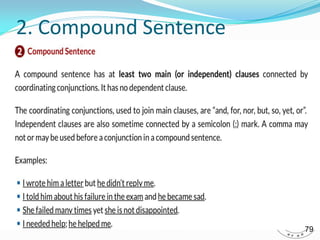
2. Compound Sentence
79
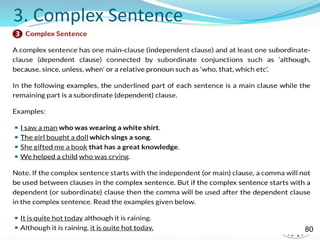
3. Complex Sentence
80
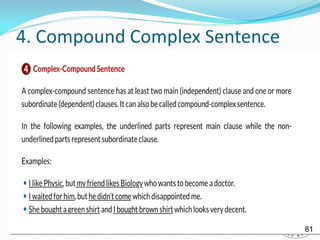
4. Compound Complex Sentence
81
Transition Words
82
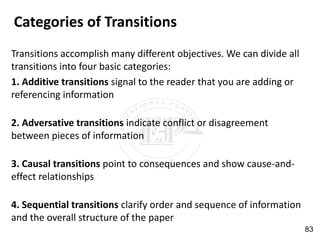
Categories of Transitions
Transitions accomplish many different objectives. We can divide all
transitions into four basic categories:
1. Additive transitions signal to the reader that you are adding or
referencing information
2. Adversative transitions indicate conflict or disagreement
between pieces of information
3. Causal transitions point to consequences and show cause-and-
effect relationships
4. Sequential transitions clarify order and sequence of information
and the overall structure of the paper
83
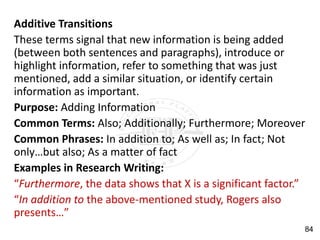
Additive Transitions
These terms signal that new information is being added
(between both sentences and paragraphs), introduce or
highlight information, refer to something that was just
mentioned, add a similar situation, or identify certain
information as important.
Purpose: Adding Information
Common Terms: Also; Additionally; Furthermore; Moreover
Common Phrases: In addition to; As well as; In fact; Not
only…but also; As a matter of fact
Examples in Research Writing:
“Furthermore, the data shows that X is a significant factor.”
“In addition to the above-mentioned study, Rogers also
presents…”
84
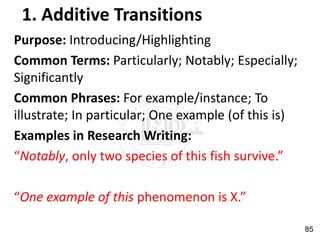
1. Additive Transitions
Purpose: Introducing/Highlighting
Common Terms: Particularly; Notably; Especially;
Significantly
Common Phrases: For example/instance; To
illustrate; In particular; One example (of this is)
Examples in Research Writing:
“Notably, only two species of this fish survive.”
“One example of this phenomenon is X.”
85
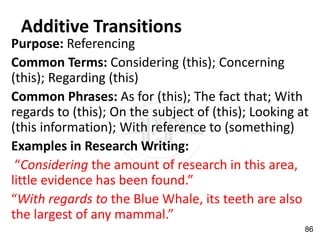
Additive Transitions
Purpose: Referencing
Common Terms: Considering (this); Concerning
(this); Regarding (this)
Common Phrases: As for (this); The fact that; With
regards to (this); On the subject of (this); Looking at
(this information); With reference to (something)
Examples in Research Writing:
“Considering the amount of research in this area,
little evidence has been found.”
“With regards to the Blue Whale, its teeth are also
the largest of any mammal.”
86
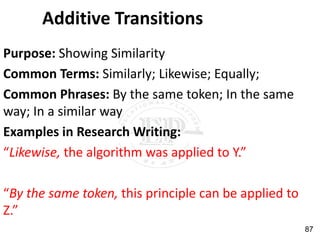
Additive Transitions
Purpose: Showing Similarity
Common Terms: Similarly; Likewise; Equally;
Common Phrases: By the same token; In the same
way; In a similar way
Examples in Research Writing:
“Likewise, the algorithm was applied to Y.”
“By the same token, this principle can be applied to
Z.”
87
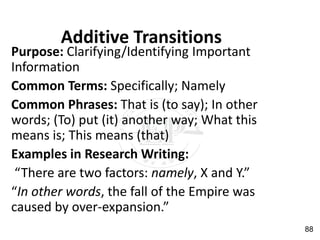
Additive Transitions
Purpose: Clarifying/Identifying Important
Information
Common Terms: Specifically; Namely
Common Phrases: That is (to say); In other
words; (To) put (it) another way; What this
means is; This means (that)
Examples in Research Writing:
“There are two factors: namely, X and Y.”
“In other words, the fall of the Empire was
caused by over-expansion.”
88
2. Adversative Transitions
These terms and phrases distinguish facts,
arguments, and other information, whether by
contrasting and showing differences; by conceding
points or making counterarguments; by dismissing
the importance of a fact or argument; or replacing
and suggesting alternatives.
89
2. Adversative Transitions
Purpose: Contrasting/ Showing conflict
Common Terms: But; Still; However; While;
Whereas; Conversely; (and) yet
Common Phrases: In contrast; On the contrary; On
the other hand; …when in fact; By way of contrast
Examples in Research Writing:
“However, there is still more research needed.”
“On the other hand, the 1997 study does not
recognize these outcomes.”
90
Adversative Transitions
Purpose: Conceding a point
Common Terms: Nevertheless; Nonetheless;
Although; Despite (this); However; Regardless (of
this); Admittedly
Common Phrases: Even so; Even though; In spite of
(this);
Examples in Research Writing:
“Nevertheless, X is still an important factor.”
“In spite of this fact, New York still has a high
standard of living.”
“Although this may be true, there are still other
factors to consider.”
91
Adversative Transitions
Purpose: Dismissing an argument or assertion
Common Terms: Regardless (of)
Common Phrases: Either way; In any case; In any
event; Whatever happens; All the same; At any rate
Examples in Research Writing:
“Regardless of the result, this fact is true.”
“Either way, the effect is the same.”
“In any event, this will not change the public’s view.”
92
Adversative Transitions
Purpose: Replacing/ Indicating an Alternative
Common Terms: Instead (of); (or) rather;
Common Phrases: (or) at least
Examples in Research Writing:
“Instead of using X, the scientists used Z.”
“Or rather, why not implement a brand new policy?”
93
3. Causal Transitions
These terms and phrases signal the reasons, conditions, purposes,
circumstances, and cause-and-effect relationships. These transitions often
come after an important point in the research paper has been established
or to explore hypothetical relationships or circumstances.
Purpose: Showing Cause or Reason
Common Terms: ReasonSince; For; As; Because (of the fact that)
Common Phrases: Due to (the fact that); For the reason that; Owing to
(the fact); Inasmuch as
Examples in Research Writing:
“Since the original sample group was too small, researchers called for
more participants.”
“Due to budgetary demands, funding will be cut in half.”
94
Causal Transitions
Purpose: Explaining the Conditions
Common Terms: If…then; Unless; Granting (that);
Granted (that); Provided (that)
Common Phrases: In the event that; As/So long as;
Only if
Examples in Research Writing:
“Unless these conditions change, more will need to be
done.”
“As long as there is oxygen, there will be oxygenation.”
95
Causal Transitions
Purpose: Showing the Effects/Results
Common Terms: Consequently; Therefore; Thus;
Accordingly; Because (of this)
Common Phrases: As a result (of this); For this reason;
As a consequence
Examples in Research Writing:
“Therefore, we can conclude that this was an
asymmetric catalysis.”
“As a consequence, many consumers began to demand
safer products.”
96
Causal Transitions
Purpose: Showing the Purpose
Common Terms:
Common Phrases: For the purpose(s) of; With (this
fact) in mind; In the hope that; In order that/to; So
as to
Examples in Research Writing:
“For the purpose of following standards, X rule was
observed.”
“With the current state of pandas in mind, this
study focused on preservation.” 97
Causal Transitions
Purpose: Highlighting the Importance of Circumstances
Common Terms: Otherwise
Common Phrases: Under those circumstances; That
being the case; In that case; If so; All else being equal
Examples in Research Writing:
“Otherwise, this effect will continue into the future.”
“All else being equal, the economic impact of this law
seems positive.”
98
4. Sequential Transitions
These transition terms and phrases organize your paper by numerical
sequence; by showing continuation in thought or action; by referring to
previously-mentioned information; by indicating digressions; and, finally,
by concluding and summing up your paper. Sequential transitions are
essential to creating structure and helping the reader understand the
logical development through your paper’s methods, results, and analysis.
Purpose: Organizing by Number
Common Terms: Initially; Secondly; Thirdly; (First/Second/Third); Last
Common Phrases: First of all; To start with; In the (first/second/third) place
Examples in Research Writing:
“Initially, subjects were asked to write their names.”
“First of all, dolphins are the smartest creatures in the sea.”
99
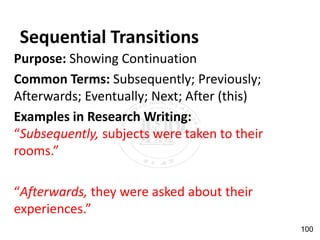
Sequential Transitions
Purpose: Showing Continuation
Common Terms: Subsequently; Previously;
Afterwards; Eventually; Next; After (this)
Examples in Research Writing:
“Subsequently, subjects were taken to their
rooms.”
“Afterwards, they were asked about their
experiences.”
100
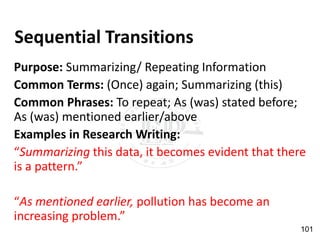
Sequential Transitions
Purpose: Summarizing/ Repeating Information
Common Terms: (Once) again; Summarizing (this)
Common Phrases: To repeat; As (was) stated before;
As (was) mentioned earlier/above
Examples in Research Writing:
“Summarizing this data, it becomes evident that there
is a pattern.”
“As mentioned earlier, pollution has become an
increasing problem.”
101
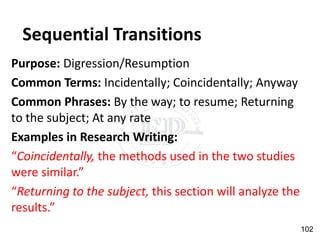
Sequential Transitions
Purpose: Digression/Resumption
Common Terms: Incidentally; Coincidentally; Anyway
Common Phrases: By the way; to resume; Returning
to the subject; At any rate
Examples in Research Writing:
“Coincidentally, the methods used in the two studies
were similar.”
“Returning to the subject, this section will analyze the
results.”
102
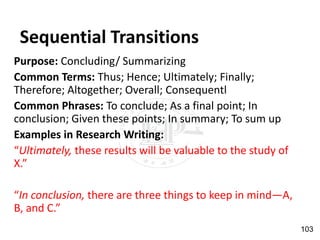
Sequential Transitions
Purpose: Concluding/ Summarizing
Common Terms: Thus; Hence; Ultimately; Finally;
Therefore; Altogether; Overall; Consequentl
Common Phrases: To conclude; As a final point; In
conclusion; Given these points; In summary; To sum up
Examples in Research Writing:
“Ultimately, these results will be valuable to the study of
X.”
“In conclusion, there are three things to keep in mind—A,
B, and C.”
103
Academic Essay Writing
104
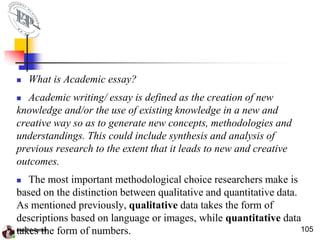
 What is Academic essay?
 Academic writing/ essay is defined as the creation of new
knowledge and/or the use of existing knowledge in a new and
creative way so as to generate new concepts, methodologies and
understandings. This could include synthesis and analysis of
previous research to the extent that it leads to new and creative
outcomes.
 The most important methodological choice researchers make is
based on the distinction between qualitative and quantitative data.
As mentioned previously, qualitative data takes the form of
descriptions based on language or images, while quantitative data
takes the form of numbers. 105
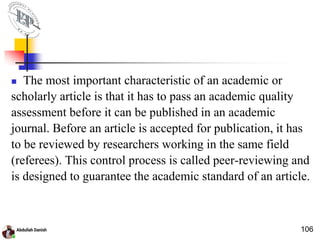
 The most important characteristic of an academic or
scholarly article is that it has to pass an academic quality
assessment before it can be published in an academic
journal. Before an article is accepted for publication, it has
to be reviewed by researchers working in the same field
(referees). This control process is called peer-reviewing and
is designed to guarantee the academic standard of an article.
106
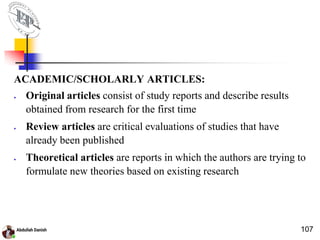
ACADEMIC/SCHOLARLY ARTICLES:
 Original articles consist of study reports and describe results
obtained from research for the first time
 Review articles are critical evaluations of studies that have
already been published
 Theoretical articles are reports in which the authors are trying to
formulate new theories based on existing research
107
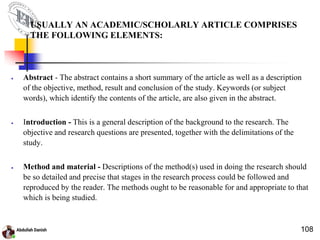
USUALLY AN ACADEMIC/SCHOLARLY ARTICLE COMPRISES
THE FOLLOWING ELEMENTS:
 Abstract - The abstract contains a short summary of the article as well as a description
of the objective, method, result and conclusion of the study. Keywords (or subject
words), which identify the contents of the article, are also given in the abstract.
 Introduction - This is a general description of the background to the research. The
objective and research questions are presented, together with the delimitations of the
study.
 Method and material - Descriptions of the method(s) used in doing the research should
be so detailed and precise that stages in the research process could be followed and
reproduced by the reader. The methods ought to be reasonable for and appropriate to that
which is being studied.
108
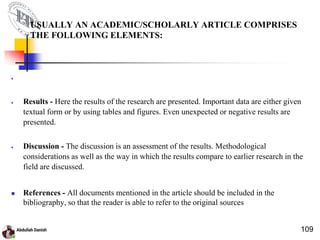
USUALLY AN ACADEMIC/SCHOLARLY ARTICLE COMPRISES
THE FOLLOWING ELEMENTS:

 Results - Here the results of the research are presented. Important data are either given
textual form or by using tables and figures. Even unexpected or negative results are
presented.
 Discussion - The discussion is an assessment of the results. Methodological
considerations as well as the way in which the results compare to earlier research in the
field are discussed.
 References - All documents mentioned in the article should be included in the
bibliography, so that the reader is able to refer to the original sources
109
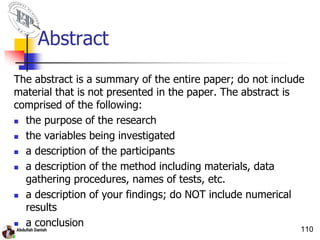
Abstract
The abstract is a summary of the entire paper; do not include
material that is not presented in the paper. The abstract is
comprised of the following:
 the purpose of the research
 the variables being investigated
 a description of the participants
 a description of the method including materials, data
gathering procedures, names of tests, etc.
 a description of your findings; do NOT include numerical
results
 a conclusion
110
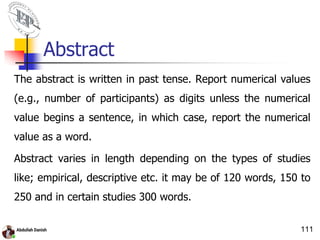
Abstract
The abstract is written in past tense. Report numerical values
(e.g., number of participants) as digits unless the numerical
value begins a sentence, in which case, report the numerical
value as a word.
Abstract varies in length depending on the types of studies
like; empirical, descriptive etc. it may be of 120 words, 150 to
250 and in certain studies 300 words.
111
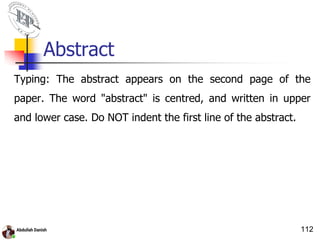
Abstract
Typing: The abstract appears on the second page of the
paper. The word "abstract" is centred, and written in upper
and lower case. Do NOT indent the first line of the abstract.
112
Introduction
 This section introduces the topic being studied, reviews
previous research, and clearly states the hypothesis for the
study.
 Academic journal articles are used to review previous
research; this is referred to as a literature review.
 The literature review is NOT a passive summary of each
academic journal article, but an active, critical discussion of
past research.
113
Introduction
 The active discussion involves integrating and synthesising
the main research trends as well as noting limitations of
past research. Because you are borrowing ideas from
previous research, this section will be filled with citations.
 In addition, APA style rarely uses direct quotes;
paraphrasing (putting it into your own words), with proper
citations, is preferred.
 The literature review should serve as a rationale for the
present study and the hypothesis becomes a logical
extension of the literature review.
114
Introduction
 Following the literature review, the variables used in the
present study are defined and the rationale for the hypothesis
is developed.
 The hypothesis is then stated and predictions are made.
 At the end of the introduction, the reader should have a clear
idea of what was expected to happen in the study and the
reasons for the predictions.
 It is important to emphasise that the introduction section
moves from the general (i.e., the general topic, why it is
important, theory, previous research findings) to the specific
(i.e., the present study).
115
Introduction
 The introduction section begins on the third page of the paper.
 The title of the paper is centred
 The introduction is approximately two to three pages in length.
 Each new paragraph should be indented 5-7 spaces
116
Method
 The method section describes how the study
was conducted and is usually divided into, at
minimum, two subsections: (1) participants,
and (2) procedure.
 The initial sentence of this section
immediately follows the last sentence of the
introduction section.
117
Method
 Participants
 The participants subsection describes the people who
volunteered for the study. This includes information about
the number of participants, their gender and average age
and any other defining characteristics of the group of people
(do not list details of individual participants).
 This subsection is written in past tense. The first line of this
subsection is indented 5-7 spaces. When reporting the
number of participants, present the number as digits if the
numerical value is greater than or equal to 10. If the
number of participants is less than 10, type the numerical
value as a word. 118
Procedure
The procedure subsection provides a description of:
 the sampling procedure – how the participants
were recruited – and sample size;
 the equipment and/or tests that were used; the
research design;
 and a summary of the steps followed during data
collection.
119
 The description of the procedure should be in chronological
order. Provide enough detail to enable the reader to
understand how the data was collected. This description
should include:
 how participants were separated into groups or conditions;
 where the testing took place;
 any verbal instructions given to each group or condition; the
order of presentation of testing material
120
Results
 The main purpose of this section is to convey the
numerical data obtained.
 Begin with a reiteration of the hypothesis.
 Describe the statistic that will be used to evaluate
the results.
 Follow this with a written description of the results
for each group or condition.
 Once all results have been reported, clearly state
whether the results support the hypothesis; do not
draw any conclusions. 121
Results
 Tables are usually included if the results
contain several sets of numbers that
would be difficult to understand in
sentence format. For example, if the
results consisted of several sets of data,
then reporting these values as a list of
digits would detract from the readability
and comprehension of the overall
results. A table, therefore, serves as an
organised presentation of the results.
122
Results
 The title for the table is italicised, left
justified and underneath the table
number.
 The heading for each column should be
clear and concise
123
Results
 Figures are graphs, charts, maps,
drawings, photographs, or diagrams.
 The graph should provide a visual
representation of the over-all results.
Provide a brief description of the graph
in the text of the results section. Unless
otherwise specified, the graph should
be computer generated.
124
Results
 Unless printing from a colour printer,
limit the colours for the bars to black
and white: visually discriminating
between different levels of shading can
be difficult.
125
Discussion
 In the discussion section, the results are examined,
interpreted, and evaluated.
 Inferences may be drawn. The discussion moves from the
specific (e.g., your results described in words) to the general
(e.g., why the results are theoretically important and how
they relate to other findings in psychology).
 The discussion section usually opens by clearly stating
whether the hypothesis was supported by the results.
 The results of the study are then evaluated against previous
research.
126
Discussion
 Discuss the similarities and differences between your results
and past research results; limit your comments to those
journal articles used in your literature review (include
citations).
 Do NOT introduce new journal articles in this section.
 Do NOT repeat points already made or refer back to the
introduction section; each new comment should help bolster
your conclusions.
127
Discussion
 The broader implications of the results should be discussed.
If the results do not support the hypothesis, provide a
plausible explanation; this should NOT be a litany of
excuses.
 Methodological problems should be discussed with the
expectation of suggestions to improve the study.
Suggestions for future research may be provided.
128
 References
129
130
131
132
133
134
135
136
137
138
139
140
141
142
143
144
145
146
147
148
NURSING
PRACTICE &
SKILL
Authors
Tanja Schub, BS
Cinahl Information Systems, Glendale, CA
Mary Woten, RN, BSN
Cinahl Information Systems, Glendale, CA
Reviewers
Rosalyn McFarland, DNP, RN, APNP,
FNP-BC
Darlene Strayer, RN, MBA
Cinahl Information Systems, Glendale, CA
Nursing Executive Practice Council
Glendale Adventist Medical Center,
Glendale, CA
Editor
Diane Pravikoff, RN, PhD, FAAN
Cinahl Information Systems, Glendale, CA
December 25, 2015
Published by Cinahl Information Systems, a division of EBSCO Information Services. Copyright©2015, Cinahl Information Systems. All rights
reserved. No part of this may be reproduced or utilized in any form or by any means, electronic or mechanical, including photocopying, recording, or by
any information storage and retrieval system, without permission in writing from the publisher. Cinahl Information Systems accepts no liability for advice
or information given herein or errors/omissions in the text. It is merely intended as a general informational overview of the subject for the healthcare
professional. Cinahl Information Systems, 1509 Wilson Terrace, Glendale, CA 91206
Incident Report: Writing
What is an Incident Report?
› An incident report (IR; also called accident report and an occurrence report) is a written,
confidential record of the details of an unexpected occurrence (e.g., a patient fall or
administration of the wrong medication) or a sentinel event (i.e., defined by The Joint
Commission [TJC] as an unexpected occurrence involving death or serious physical or
psychological injury, or the risk thereof) involving a patient, employee, or other person
(e.g., a visitor) who is present in the healthcare facility. An IR is used for internal risk
management and quality improvement purposes, and is not part of—nor is it mentioned in
—the permanent patient record if a patient is involved. An IR should be completed each
time an event occurs that deviates from the normal operation of the facility (e.g., a visitor
falls) or deviates from routine patient care (e.g., a medication error)
• What: The purpose for writing an IR is to document the details of an unexpected
occurrence or sentinel event. The written information is analyzed to identity changes that
need to be made in the facility or in facility processes to prevent recurrence of the event
and promote overall safety and quality health care
• How: Writing an IR involves providing an objective, detailed description of what
happened; typically the healthcare facility has a standardized form that is completed by
the person who witnesses the incident or is responsible for the area in which the incident
occurred in the case of an unwitnessed incident. The documented information can vary,
but typically an IR includes details regarding
–who witnessed the incident, which is typically the person reporting the incident
although in some cases there is more than one witness
–who was affected by the incident (e.g., patient, family member, nurse)
–what persons were notified (e.g., treating clinician, fire department)
–what actions or interventions were performed in response to the incident
–the condition of the patient, visitor, or employee who was affected by the incident
• Where: An IR should be completed in all healthcare settings according to facility
protocol
• Who: IRs can be completed by any licensed healthcare professional who participated
in or witnessed an incident. Writing an IR should never be delegated to unlicensed
personnel—although unlicensed personnel should report any witnessed incidents and
provide information that can be included in the IR—and are rarely completed in the
presence of a patient’s family members
What is the Desired Outcome of Writing an Incident Report?
› The desired outcome of writing an IR is to
• document the occurrence of an unexpected event that involves physical or psychological
injury to a patient, visitor or employee or that increases the risk for injury
• identity changes that need to be made in the facility or to facility processes in order to
prevent recurrence of the event and promote overall safety and quality health care
Why is Writing an Incident Report Important?
› Writing an IR is important because it can provide
• documentation of quality of care
149
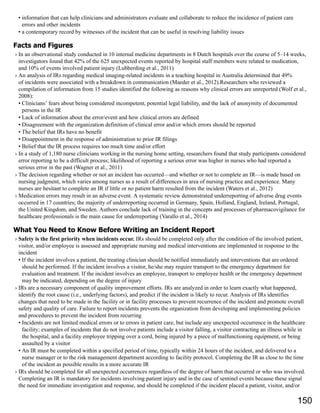
• information that can help clinicians and administrators evaluate and collaborate to reduce the incidence of patient care
errors and other incidents
• a contemporary record by witnesses of the incident that can be useful in resolving liability issues
Facts and Figures
› In an observational study conducted in 10 internal medicine departments in 8 Dutch hospitals over the course of 5–14 weeks,
investigators found that 42% of the 625 unexpected events reported by hospital staff members were related to medication,
and 10% of events involved patient injury (Lubberding et al., 2011)
› An analysis of IRs regarding medical imaging-related incidents in a teaching hospital in Australia determined that 49%
of incidents were associated with a breakdown in communication (Maeder et al., 2012).Researchers who reviewed a
compilation of information from 15 studies identified the following as reasons why clinical errors are unreported (Wolf et al.,
2008):
• Clinicians’ fears about being considered incompetent, potential legal liability, and the lack of anonymity of documented
persons in the IR
• Lack of information about the error/event and how clinical errors are defined
• Disagreement with the organization definition of clinical error and/or which errors should be reported
• The belief that IRs have no benefit
• Disappointment in the response of administration to prior IR filings
• Belief that the IR process requires too much time and/or effort
› In a study of 1,180 nurse clinicians working in the nursing home setting, researchers found that study participants considered
error reporting to be a difficult process; likelihood of reporting a serious error was higher in nurses who had reported a
serious error in the past (Wagner et al., 2011)
› The decision regarding whether or not an incident has occurred—and whether or not to complete an IR—is made based on
nursing judgment, which varies among nurses as a result of differences in area of nursing practice and experience. Many
nurses are hesitant to complete an IR if little or no patient harm resulted from the incident (Waters et al., 2012)
› Medication errors may result in an adverse event. A systematic review demonstrated underreporting of adverse drug events
occurred in 17 countries; the majority of underreporting occurred in Germany, Spain, Holland, England, Ireland, Portugal,
the United Kingdom, and Sweden. Authors conclude lack of training in the concepts and processes of pharmacovigilance for
healthcare professionals is the main cause for underreporting (Varallo et al., 2014)
What You Need to Know Before Writing an Incident Report
› Safety is the first priority when incidents occur. IRs should be completed only after the condition of the involved patient,
visitor, and/or employee is assessed and appropriate nursing and medical interventions are implemented in response to the
incident
• If the incident involves a patient, the treating clinician should be notified immediately and interventions that are ordered
should be performed. If the incident involves a visitor, he/she may require transport to the emergency department for
evaluation and treatment. If the incident involves an employee, transport to employee health or the emergency department
may be indicated, depending on the degree of injury
› IRs are a necessary component of quality improvement efforts. IRs are analyzed in order to learn exactly what happened,
identify the root cause (i.e., underlying factors), and predict if the incident is likely to recur. Analysis of IRs identifies
changes that need to be made in the facility or in facility processes to prevent recurrence of the incident and promote overall
safety and quality of care. Failure to report incidents prevents the organization from developing and implementing policies
and procedures to prevent the incident from recurring
• Incidents are not limited medical errors or to errors in patient care, but include any unexpected occurrence in the healthcare
facility; examples of incidents that do not involve patients include a visitor falling, a visitor contracting an illness while in
the hospital, and a facility employee tripping over a cord, being injured by a piece of malfunctioning equipment, or being
assaulted by a visitor
• An IR must be completed within a specified period of time, typically within 24 hours of the incident, and delivered to a
nurse manager or to the risk management department according to facility protocol. Completing the IR as close to the time
of the incident as possible results in a more accurate IR
› IRs should be completed for all unexpected occurrences regardless of the degree of harm that occurred or who was involved.
Completing an IR is mandatory for incidents involving patient injury and in the case of sentinel events because these signal
the need for immediate investigation and response, and should be completed if the incident placed a patient, visitor, and/or
150
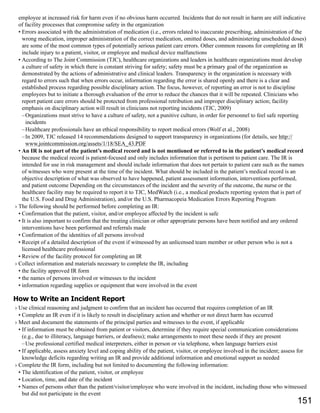
employee at increased risk for harm even if no obvious harm occurred. Incidents that do not result in harm are still indicative
of facility processes that compromise safety in the organization
• Errors associated with the administration of medication (i.e., errors related to inaccurate prescribing, administration of the
wrong medication, improper administration of the correct medication, omitted doses, and administering unscheduled doses)
are some of the most common types of potentially serious patient care errors. Other common reasons for completing an IR
include injury to a patient, visitor, or employee and medical device malfunctions
• According to The Joint Commission (TJC), healthcare organizations and leaders in healthcare organizations must develop
a culture of safety in which there is constant striving for safety; safety must be a primary goal of the organization as
demonstrated by the actions of administrative and clinical leaders. Transparency in the organization is necessary with
regard to errors such that when errors occur, information regarding the error is shared openly and there is a clear and
established process regarding possible disciplinary action. The focus, however, of reporting an error is not to discipline
employees but to initiate a thorough evaluation of the error to reduce the chances that it will be repeated. Clinicians who
report patient care errors should be protected from professional retribution and improper disciplinary action; facility
emphasis on disciplinary action will result in clinicians not reporting incidents (TJC, 2009)
–Organizations must strive to have a culture of safety, not a punitive culture, in order for personnel to feel safe reporting
incidents
–Healthcare professionals have an ethical responsibility to report medical errors (Wolf et al., 2008)
–In 2009, TJC released 14 recommendations designed to support transparency in organizations (for details, see http://
www.jointcommission.org/assets/1/18/SEA_43.PDF
• An IR is not part of the patient’s medical record and is not mentioned or referred to in the patient’s medical record
because the medical record is patient-focused and only includes information that is pertinent to patient care. The IR is
intended for use in risk management and should include information that does not pertain to patient care such as the names
of witnesses who were present at the time of the incident. What should be included in the patient’s medical record is an
objective description of what was observed to have happened, patient assessment information, interventions performed,
and patient outcome Depending on the circumstances of the incident and the severity of the outcome, the nurse or the
healthcare facility may be required to report it to TJC, MedWatch (i.e., a medical products reporting system that is part of
the U.S. Food and Drug Administration), and/or the U.S. Pharmacopeia Medication Errors Reporting Program
› The following should be performed before completing an IR:
• Confirmation that the patient, visitor, and/or employee affected by the incident is safe
• It is also important to confirm that the treating clinician or other appropriate persons have been notified and any ordered
interventions have been performed and referrals made
• Confirmation of the identities of all persons involved
• Receipt of a detailed description of the event if witnessed by an unlicensed team member or other person who is not a
licensed healthcare professional
• Review of the facility protocol for completing an IR
› Collect information and materials necessary to complete the IR, including
• the facility approved IR form
• the names of persons involved or witnesses to the incident
• information regarding supplies or equipment that were involved in the event
How to Write an Incident Report
› Use clinical reasoning and judgment to confirm that an incident has occurred that requires completion of an IR
• Complete an IR even if it is likely to result in disciplinary action and whether or not direct harm has occurred
› Meet and document the statements of the principal parties and witnesses to the event, if applicable
• If information must be obtained from patient or visitors, determine if they require special communication considerations
(e.g., due to illiteracy, language barriers, or deafness); make arrangements to meet these needs if they are present
–Use professional certified medical interpreters, either in person or via telephone, when language barriers exist
• If applicable, assess anxiety level and coping ability of the patient, visitor, or employee involved in the incident; assess for
knowledge deficits regarding writing an IR and provide additional information and emotional support as needed
› Complete the IR form, including but not limited to documenting the following information:
• The identification of the patient, visitor, or employee
• Location, time, and date of the incident
• Names of persons other than the patient/visitor/employee who were involved in the incident, including those who witnessed
but did not participate in the event
151
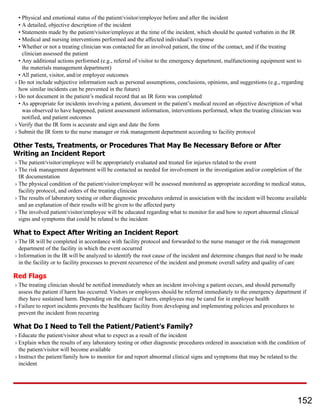
• Physical and emotional status of the patient/visitor/employee before and after the incident
• A detailed, objective description of the incident
• Statements made by the patient/visitor/employee at the time of the incident, which should be quoted verbatim in the IR
• Medical and nursing interventions performed and the affected individual’s response
• Whether or not a treating clinician was contacted for an involved patient, the time of the contact, and if the treating
clinician assessed the patient
• Any additional actions performed (e.g., referral of visitor to the emergency department, malfunctioning equipment sent to
the materials management department)
• All patient, visitor, and/or employee outcomes
› Do not include subjective information such as personal assumptions, conclusions, opinions, and suggestions (e.g., regarding
how similar incidents can be prevented in the future)
› Do not document in the patient’s medical record that an IR form was completed
• As appropriate for incidents involving a patient, document in the patient’s medical record an objective description of what
was observed to have happened, patient assessment information, interventions performed, when the treating clinician was
notified, and patient outcomes
› Verify that the IR form is accurate and sign and date the form
› Submit the IR form to the nurse manager or risk management department according to facility protocol
Other Tests, Treatments, or Procedures That May Be Necessary Before or After
Writing an Incident Report
› The patient/visitor/employee will be appropriately evaluated and treated for injuries related to the event
› The risk management department will be contacted as needed for involvement in the investigation and/or completion of the
IR documentation
› The physical condition of the patient/visitor/employee will be assessed monitored as appropriate according to medical status,
facility protocol, and orders of the treating clinician
› The results of laboratory testing or other diagnostic procedures ordered in association with the incident will become available
and an explanation of their results will be given to the affected party
› The involved patient/visitor/employee will be educated regarding what to monitor for and how to report abnormal clinical
signs and symptoms that could be related to the incident
What to Expect After Writing an Incident Report
› The IR will be completed in accordance with facility protocol and forwarded to the nurse manager or the risk management
department of the facility in which the event occurred
› Information in the IR will be analyzed to identify the root cause of the incident and determine changes that need to be made
in the facility or to facility processes to prevent recurrence of the incident and promote overall safety and quality of care
Red Flags
› The treating clinician should be notified immediately when an incident involving a patient occurs, and should personally
assess the patient if harm has occurred. Visitors or employees should be referred immediately to the emergency department if
they have sustained harm. Depending on the degree of harm, employees may be cared for in employee health
› Failure to report incidents prevents the healthcare facility from developing and implementing policies and procedures to
prevent the incident from recurring
What Do I Need to Tell the Patient/Patient’s Family?
› Educate the patient/visitor about what to expect as a result of the incident
› Explain when the results of any laboratory testing or other diagnostic procedures ordered in association with the condition of
the patient/visitor will become available
› Instruct the patient/family how to monitor for and report abnormal clinical signs and symptoms that may be related to the
incident
152
References
1. Gerhart-Gibson, K. (2014). Safe medication preparation. In A. G. Perry, P. A. Potter, & W. R. Ostendorf (Eds.), Clinical nursing skills and techniques (8th ed., pp. 462-463). St.
Louis, MO: Mosby Elsevier.
2. The Joint Commission. (2009). Leadership committed to safety. Sentinel Event Alert, Issue 43. Retrieved December 10, 2015, from http://www.jointcommission.org/assets/1/18/
SEA_43.PDF
3. Lubberding, S., Zwaan, L., Timmermans, D. R. M., & Wagner, C. (2011). The nature and causes of unintended events reported at 10 internal medicine departments. Journal of
Patient Safety, 7(4), 224-231. doi:10.1097/PTS.0b013e3182388f97
4. Lyerla, F. (2013). Documentation and informatics. In P. A. Potter, A. G. Perry, P. A. Stockert, & A. M. Hall (Eds.), Fundamentals of nursing (8th ed., p. 358). St. Louis, MO:
Mosby Elsevier.
5. Maeder, A. J., Martin-Sanchez, F. J., Stewart, M. J., Georgiou, A., Hordern, A., Dimigen, M., & Westerbrook, J. I. (2012). What do radiology incident reports reveal about
in-hospital communication processes and the use of health information technology? Studies in Health Technology & Informatics, 213-218. doi:10.3233/978-1-61499-078-9-213
6. Smith, S. F., Duell, D. J., & Martin, B. C. (2012). Documentation and delegation. In Clinical nursing skills: Basic to advanced skills (8th ed., pp. 49-51). Upper Saddle River, NJ:
Pearson Prentice Hall.
7. Varallo, F. R., de Oliveira Paim Guimaraes, S., Rodrigues Abjaude, S. A., & de Carvalho Mastroianni, P. (2014). Causes for the underreporting of adverse drug events by
health professionals: A systematic review. Revista da Escola de Enfermagem da USP, 48(4), 739-747. doi:10.1590/S0080-623420140000400023
8. Wagner, L. M., Harkness, K., Hébert, P. C., & Gallagher, T. H. (2012). Nurses' perceptions of error reporting and disclosure in nursing homes. Journal of Nursing Care Quality,
27(1), 63-69.
9. Waters, N. F., Hall, W. A., Brown, H., Espezel, H., & Palmer, L. (2012). Perceptions of Canadian labour and delivery nurses about incident reporting: A qualitative descriptive
focus group study. International Journal of Nursing Studies, 49(7), 811-821. doi:10.1016/j.ijnurstu.2012.01.009
10. Wolf, Z., & Hughes, R. G. (2008). Error reporting and disclosure. Patient safety and quality: An evidence-based handbook for nurses. Retrieved December 10, 2015, from http://
www.ncbi.nlm.nih.gov/books/NBK2652/
153
PROOFREADING AND EDITING
Educational Platform by AD
154
What is Proofreading?
• Proofreading is the process of examining the final draft of a
document or text — after it has been edited — this is to ensure that
there are absolutely no errors. A proofreader will review your
writing for spelling errors, punctuation errors, typos or incorrect
use of regional English (i.e. ensuring that you are using American
English or British English when necessary).
• A professional proofreading service will typically proofread your
work using track changes in Microsoft Word, this is to ensure
transparency so you know exactly what has been changed and can
approve the change.
Educational Platform by AD
155
• Although in the majority of cases proofreading is now done
electronically, proofreading can also be done on a printed version
(also referred to as a ―hard copy‖) or PDF. In such situations you
may need to familiarise yourself with the proofreaders
shorthand's and symbols they use to indicate changes.
Educational Platform by AD
156
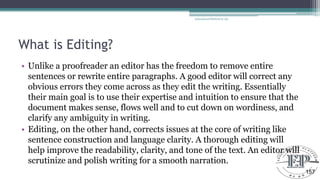
What is Editing?
• Unlike a proofreader an editor has the freedom to remove entire
sentences or rewrite entire paragraphs. A good editor will correct any
obvious errors they come across as they edit the writing. Essentially
their main goal is to use their expertise and intuition to ensure that the
document makes sense, flows well and to cut down on wordiness, and
clarify any ambiguity in writing.
• Editing, on the other hand, corrects issues at the core of writing like
sentence construction and language clarity. A thorough editing will
help improve the readability, clarity, and tone of the text. An editor will
scrutinize and polish writing for a smooth narration.
Educational Platform by AD
157
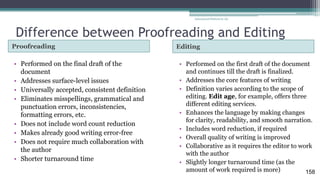
Difference between Proofreading and Editing
Proofreading Editing
• Performed on the final draft of the
document
• Addresses surface-level issues
• Universally accepted, consistent definition
• Eliminates misspellings, grammatical and
punctuation errors, inconsistencies,
formatting errors, etc.
• Does not include word count reduction
• Makes already good writing error-free
• Does not require much collaboration with
the author
• Shorter turnaround time
• Performed on the first draft of the document
and continues till the draft is finalized.
• Addresses the core features of writing
• Definition varies according to the scope of
editing. Edit age, for example, offers three
different editing services.
• Enhances the language by making changes
for clarity, readability, and smooth narration.
• Includes word reduction, if required
• Overall quality of writing is improved
• Collaborative as it requires the editor to work
with the author
• Slightly longer turnaround time (as the
amount of work required is more)
Educational Platform by AD
158
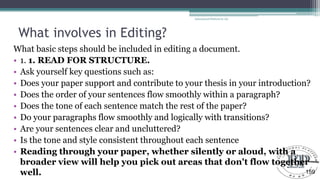
What involves in Editing?
What basic steps should be included in editing a document.
• 1. 1. READ FOR STRUCTURE.
• Ask yourself key questions such as:
• Does your paper support and contribute to your thesis in your introduction?
• Does the order of your sentences flow smoothly within a paragraph?
• Does the tone of each sentence match the rest of the paper?
• Do your paragraphs flow smoothly and logically with transitions?
• Are your sentences clear and uncluttered?
• Is the tone and style consistent throughout each sentence
• Reading through your paper, whether silently or aloud, with a
broader view will help you pick out areas that don't flow together
well.
Educational Platform by AD
159
2. READ FOR GRAMMAR AND PUNCTUATION.
• Next, look into the details of your paper. This is the part of the editing process you
may think of most often—looking at grammar, punctuation, word choice and other
nitty-gritty details.
• In reading through your paper with your focus on the details, ask questions such as:
• Is everything spelled correctly?
• Are all punctuation marks used accurately?
• Are all your citations formatted correctly?
• Does the vocabulary you use appropriate for the topic?
• Do each of the sentences maintain the appropriate verb tense?
• Do you use too many clichés that cloud your argument?
• Do all sentences maintain parallel structure?
• As you write more papers and continue to revisit the editing process, you'll be able
to identify the errors that you tend to make most often. You'll get a better sense of
your tone and style of writing. With practice, this editing process will get easier.
Educational Platform by AD
160
READ ALOUD ONCE MORE.
• If you haven't read your paper aloud yet, do it. Yes, it might feel silly at first,
but reading your paper out loud lets you hear and notice things that you
didn't catch in your first few read thoughts. Whether you read it aloud
yourself or have someone read it to you, hearing your content gives you a
new way of reviewing.
• According to a resource provided by the Writing Center at the University of
North Carolina at Chapel Hill, reading your work aloud has several benefits:
• When you read your draft out loud or listen to someone else read it, your
brain gets the information in a new way, and you may notice things that you
didn't see before... Sometimes sentences aren't grammatically incorrect, but
they are still awkward in some way—too long, too convoluted, too repetitive.
Problems like these are often easily heard.
• So find a quiet room, grab a glass of water and use your ears in this stage of
the editing process.
Educational Platform by AD
161
REVIEW AND RELEASE.
• After you've reviewed the changes suggested by your friend, read
through it one last time. Double check your citations. Be confident
in your word choices and paragraph breaks.
• Once you're done reviewing and making the edits you need to, be
done. Especially if you tend to be a perfectionist in your work, get
to that point with your paper when you've written, reviewed and
edited at your best.
• Sure, you could continue to obsess over that one phrase on the
second page in the third paragraph. Or, you could be confident
that you've worked hard on your assignment and tried your best.
Educational Platform by AD
162
EDIT FOT STRUCTURE ORGANIZATION
• Basically, all the writing pattern will follow the same structure
which is
• 1. Introduction
• 2. Body
• 3. Conclusion
Educational Platform by AD
163
• Introduction: The first paragraph of your essay. It is the first
impression your readers recieve, and explain the main point of your
paper. Your introduction contains your thesis statement.
• Body: The paragraphs in between your introduction and conclusion.
The body of your paper supports the main point of your paper.
• Topic Sentence: The sentence at the beginning of each body paragraph. It
explains the main point that paragraph is going to make.
• Conclusion: The last paragraph of your paper. It closes the paper and
leaves the reader satisfied with what they just read. Summarizes your
paper in an effective way.
Educational Platform by AD
164
EDIT FOR STYLE- TONE
• There are literally dozens of English editing style guides to follow.
Which should you use? And when?
• Here‘s a list of the top editing style guides and when it‘s best to
use them:
Educational Platform by AD
165
• Chicago Style*
• The Chicago Manual of Style—CMoS, or CMS, for short—is the
standard in book publishing. It is also commonly used for history
and the arts. One of the first American English style guides, it was
originally published in 1906 by the University of Chicago Press
and has since released updated editions every seven to ten
years. CMoS is a comprehensive reference guide for grammar,
citation, preparation, and everything in between. It‘s often called
―the editor‘s Bible.‖
Educational Platform by AD
166
• APA Style
• The Publication Manual of the American Psychological
Association—or APA for short—was first developed by the
American Psychological Association in 1929. Originally
established to ensure consistency among papers in the psychology
field, it quickly expanded and now is commonly used in social and
behavioral sciences. APA focuses on simplifying the style, from
tables to citations to abbreviations to the structure of writing.
Educational Platform by AD
167
• AP Style
• Not to be confused with APA, The Associated Press Stylebook and
Briefing on Media Law (a.k.a. the AP Stylebook, or AP) is
published by the Associated Press. This style is used in journalism,
but is also widespread in marketing, PR, broadcasting, and
corporate communications. It was first published in 1953,
although the style has been around for about a century. AP is
notable for its sparse style, including dropping the Oxford comma
and using figures for all numbers above nine. The purpose behind
the brevity of style is to save space in print and on the web.
Educational Platform by AD
168
• MLA Style
• The MLA Style Manual and Guide to Scholarly Publishing is an
academic style guide most commonly used for in the liberal arts
and humanities in academia, particularly in English studies and
literature. The Modern Language Association of America has
published this manual since 1985. MLA style is geared toward
collegiate and graduate students as well as professionals. The
Modern Language Association also publishes a companion style
guide, the MLA Handbook, which is used primarily by secondary
and postsecondary students.
Educational Platform by AD
169
• This general format is the root of the six common writing
structures that can be used for both formal and informal written
communication.
1. Categorical: In a categorical structure, a series of equally
important topics are addressed. A political speech, like a
campaign speech or even The State of the Union Address, is a
good example of categorical writing. You might use a similar
structure in a cover letter for a job application, in which you
describe all of your traits that would make you an ideal candidate
for the position.
Educational Platform by AD
170
• Evaluative: In an evaluative structure, a problem is introduced, and
then pros and cons are weighed. You might employ an evaluative
structure when writing an e-mail to ask a close friend for advice.
Chronological: When your focus is more the actual telling of the story
than the end result, employ a chronological structure. Think of joke
telling. "Three guys walk into a bar…" sets up a sequence of events to
deliver that final punch line. Similarly, most short stories and novels are
written chronologically.
Comparative: This structure is similar to evaluative, but it is used
when there are more layers to the situation at hand that is being
weighed. You might use a comparative structure if you were writing a
speech for a debate team to explain the various reasons why you feel
your point is stronger than your opponent‘s. Or you might use a
comparative structure to write a letter to the editor explaining all the
reasons you disagree with the city council‘s decision to raise local taxes.
Educational Platform by AD
171
• Sequential: This structure is similar to Chronological, but is normally
employed with a how-to voice when a step-by-step process is being
described. If you were going to write about how to make your famous
chocolate layer cake, or how to get to a great bed-and-breakfast you
discovered out in the country, you would write sequentially, using words like,
"First," "Next," "Then," and "Finally" to clarify your instructions.
Causal: This structure might at first glance seem similar to Comparative
structures, but it differs in that it does not involve weighing options against
one another. Instead, it discusses the causes and then the effects regarding a
particular topic or issue in that order. You might use this structure if you
were writing an article on how something has come about, such as the
contributing factors to air pollution. Or you might employ this technique in a
letter explaining why you have decided to resign from your job.
Educational Platform by AD
172
9 TYPES OF TONES IN WRITING
• What is tone when it comes to writing?
• It‘s a simple question, but the answer can be rather complicated. In
basic terms, tone usually refers to how a writer uses certain words in a
specific way to convey non-verbal observations about specific subjects.
Not only does tone help to deliver facts, but it delivers them with an
attitude. Emotion and with a personal perspective.
• Tone is sometimes used interchangeably with the voice of the author.
They are very different. A writer‘s voice is a perspective of their
personality. The tone of a writer conveys their attitude about what is
being writing about. If tone is combined with voice, then this will create
a specific writing style that can be attributed to that writer.
Educational Platform by AD
173
• There Are 9 Basic Types of Tone in Writing
• Any emotion, any attitude, and any perspective can lay the
foundation for a specific tone in writing. If you can come up with
an adjective, then that can be a tone. This means if you look at
tone with specificity, there is an infinite number that can be used.
• That makes it a little difficult to begin developing your personal
tone as a writing skill, so those infinite tones have been
categorized into 9 different types. Let‘s take a look at them in
some detail.
Educational Platform by AD
174
• 1. Joyful: This tone in writing focuses on the positive emotions that
are experienced in the moment of an action. If you eat something you
like, then you feel joy. Writers use this tone to create relationship-
building experiences between their readers and their characters.
• 2. Serious: This tone in writing creates a level of suspense within the
reader. It increases their focus because the concepts being offered are
important.
• 3. Humorous: Being funny does more than make people laugh. It
also makes them begin to think about difficult concepts in a way that
feels safe. This tone in writing is often intended to draw the reader into
a story or narrative so they can engage with certain facts or opinions
the author feels are important to share.
Educational Platform by AD
175
• Sad: Sadness is a very real part of the human condition. In many ways, our
saddest days define who we are as people. When incorporated as a tone in
writing, the reader become sympathetic with the characters or the author and
this empathy will keep them engaged with the narrative.
• 5. Formal: This tone in writing is often seen from an academic standpoint.
It requires structured language, higher reading skills, and presents more facts
that can be proven than the opinions of the writer.
• 6. Informal: The goal of this content is to have an informal tone. It‘s
conversational, but still conveys a certain sense of expertise within the
subject material.
• 7. Optimistic: There‘s a lot of bad stuff going on in the world today. Yet
there is also a belief that the world can and will be a better place one day if
we‘re willing to work for it. This would be an example of an optimistic tone.
Educational Platform by AD
176
• 8. Pessimistic: When there‘s a lot of bad stuff going on in the
world, it can feel like that bad stuff will only get worse. That kind
of tone would be an example of being pessimistic. Pessimism is
not realism. Being pessimistic means having a belief that
something will never get better, even if the facts may seem to
indicate otherwise.
• 9. Horror: This tone of voice is threatening in nature. It speaks
to the core fears that people have and forces them to confront
those fears.
Educational Platform by AD
177
• Here is a listing of some of the more common surface errors, broken down by
category. Either select the link you would like to view or scroll down to the
appropriate topic.
• Spelling
• Punctuation
▫ Commas
▫ Apostrophes
▫ Periods
• Verbs
• Subject-verb agreement
• Pronouns
• Other grammatical errors
▫ Sentence fragments
▫ Misplaced or dangling modifiers
Educational Platform by AD
178
Spelling
• Spelling errors are among the most common surface errors as well
as the most easily corrected. To correct spelling errors, use a spell-
checker, regardless of your spelling skills, along with a dictionary
to help you find the right alternative for a misspelled word.
Remember that the spell-checker won't help with homonyms,
words that sound alike but have different spellings and meanings.
Educational Platform by AD
179
• Some words that can cause trouble are listed below.
• their (possessive form of they)
• there (in that place)
• they're (contraction of they are)
• accept (a verb, meaning to receive or to admit to a group)
• except (usually a preposition, meaning but or only)
• who's (contraction of who is or who has)
• whose (possessive form of who)
• its (possessive form of it)
• it's (contraction of it is or it has)
• your (possessive form of you)
• you're (contraction of you are)
Educational Platform by AD
180
• your (possessive form of you)
• you're (contraction of you are)
• affect (usually a verb, meaning to influence)
• effect (usually a noun, meaning result)
• than (used in comparison)
• then (refers to a time in the past)
• were (form of the verb to be)
• we're (contraction of we are)
• where (related to location or place)
Educational Platform by AD
181
Punctuation
• Commas
• 1. USE A COMMA TO SEPARATE INDEPENDENT CLAUSES. Rule: Use a comma
before a coordinating conjunction (and, but, yet, so, or nor, for) when it joins two complete
ideas (independent clauses).
• 1. He walked down the street, and then he turned the corner.
• 2. You can go shopping with me, or you can go to a movie alone.
• 2. USE A COMMAAFTER AN INTRODUCTORY CLAUSE OR PHRASE. Rule: Use
a comma after an introductory clause or phrase. A comma tells readers that the introductory
clause or phrase has come to a close and that the main part of the sentence is about to begin.
• 1. When Evan was ready to iron, his cat tripped on the cord.
• 2. Near a small stream at the bottom of the canyon, park rangers discovered a gold mine.
Educational Platform by AD
182
• 3. USE A COMMA BETWEEN ALL ITEMS IN A SERIES.
• Rule: Use a comma to separate each item in a series; a series is a group
of three or more items having the same function and form in a
sentence.
• 1. We bought apples, peaches, and bananas today. (series of words)
• 2. Mary promised that she would be a good girl, that she would not bite
her brother, and that she would not climb onto the television. (series of
clauses)
• 3. The instructor looked through his briefcase, through his desk, and
around the office for the lost grade book. (series of phrases)
Educational Platform by AD
183
• USE A COMMA TO INDICATE DIRECT ADDRESS.
• Rule: When a speaker in a sentence names the person to whom he
is speaking, this addressing of his audience is called direct
address. Direct address is indicated by the use of a comma or
commas, depending upon its placement within the sentence.
• 1. I think, John, you‘re wrong.
• 2. John, I think you‘re wrong.
• 3. I think you‘re wrong, John.
Educational Platform by AD
184
• USE COMMA AS TO SET OFF DIRECT QUOTATIONS.
• Rule: A dialogue is a conversation between two or more people. If
the speaker (not the listener) in the conversation is identified, his
name, (or the noun or pronoun used to refer to the speaker), and
the verb that refers to his speaking are enclosed within commas.
• 1. Mary said, ―I dislike concerts because the music is too loud.‖
• 2. ―I dislike concerts because the music is too loud,‖ she said.
• 3. ―I dislike concerts,‖ proclaimed Mary, ―because the music is too
loud.‖
Educational Platform by AD
185
• Apostrophes
• The apostrophe has two functions: it marks possession, and it is used
in contractions to indicate the place where the letters have been
omitted.
• Possession
In singular, possession is marked by ‘s, written immediately after the
possessor.
• (1) John’s car
(2) the boy’s toy
• Important: there is no apostrophe before the possessive –s with
pronouns.
• (1) its, hers, yours, ours
Educational Platform by AD
186
• If the possessor is expressed by more than one word, ’s comes
after the last word.
• (3) my late brother’s wife
(4) Mr. Johnson's house
(5) Charlie and Lola’s new room. (the room belongs to both
Charlie and Lola)
• Use ‘s with singular possessors that end in –s or –z.
• (6) Charles’s books
(7) Sanchez’s horse
Educational Platform by AD
187
• Plural possessors that end in –s take only the apostrophe. Plural
possessors that end in some other letter take ’s.
• (8) the boys’ toy
(9) the Sanchezes’ horse
(10) the children’s bikes
• Importantly, it is the written letter that determines whether to place
just an apostrophe or ’s after a plural. There are a few English nouns
that end in the sound /s/ or /z/ but are written with a final –e: mice
(mouse) dice (die), geese (goose). Such plural nouns take ‘s is the
possessive form.
• (11) the geese’s feathers
(12) mice’s teeth
Educational Platform by AD
188
• In other words, the possessive –s is required after a singular word
ending in -s but not after a plural word ending in –s.
•
•
Singular Plural
Ending in –s, -z ‗s ‗
Not ending in –s, -z ‗s ‗s
Educational Platform by AD
189
• Contraction
The apostrophe is used with contractions and is placed at the spot of
the omitted letter(s). Words that often are written in contracted form
are: be, have (-’ve), has (-’s), had (-’d), will (-’ll), would (-’d), and the
negative particle not (n’t). For a full list of the standard contractions,
follow this link. Some common contractions are shown below.
• (13) I am = I’m
(14) you are = you’re
(15) he is = he’s
(16) she is = she’s
(17) it is = it’s
(18) we are = we’re
(19) they are = they’re
Educational Platform by AD
190
• (20) do not = don’t
(21) does not = doesn’t
(22) cannot = can’t (cannot is written as one word)
(23) should not = shouldn’t
(24) could not = couldn’t
(25) shall not = shan’t
(26) will not = won’t
(27) I have = I’ve
(28) I had, I would, and I should = I’d
(29) I will and I shall = I’ll
Educational Platform by AD
191
• Avoid the apostrophe to mark possession with pronouns
A very common mistake is to place an apostrophe in the
possessive form of pronouns like its, yours, hers, ours, theirs.
Although this makes perfect sense, it is considered wrong.
() The book is old; its pages have turned yellow. [correct]
() The book is old; it’s pages have turned yellow. [incorrect, it’s is
a contraction of it is]
Educational Platform by AD
192
• Periods
• 1. Use a full stop at the end of a statement or command.
• Example
• The government has promised to reduce inflation
• Pick up the lug wrench.
• 2. Use a full stop after some abbreviations.
• Co.
• Dep.
• P.a
• Gen.
Educational Platform by AD
193
Verbs
• Active and Passive Verbs
• 1. Verbs can be in either active or passive voice. In active voice, the
subject of the sentence performs the action of the verb; in passive
voice, the subject receives the action of the verb. Readers typically
find active voice sentences more vigorous and clearer; for these
reasons, writers usually prefer active voice.
Educational Platform by AD
194
• Passive: The ball was kicked by the boy.
Active: The boy kicked the ball.
• Passive: A decision was reached by the committee.
Active: The committee reached a decision.
• Passive: Many arguments are offered against abortion.
Active: Religious leaders offer many arguments against abortion.
Educational Platform by AD
195
• Notice that in the passive voice examples, the doer of the action is
either at the end of the sentence in a prepositional phrase or, in
the third example, is missing entirely from the sentence. In each
active voice example, however, the doer of the action is in the
subject position at the beginning of the sentence.
Educational Platform by AD
196
• 2. On some occasions, however, you might have a good reason for
choosing a passive construction; for example, you might choose
the passive if you want to emphasize the receiver of the action or
minimize the importance of the actor.
Educational Platform by AD
197
• Appropriate passive: The medical records were destroyed in the
fire.
Appropriate passive: The experiment was performed successfully.
• Passive voice verbs always include a form of the verb to be, such
as am, are, was, is being, and so on. To check for active versus
passive voice, look for sentences that contain a form of this verb,
and see whether in these sentences the subject of the sentence
performs the action of the verb.
Educational Platform by AD
198
Shifting Verb Tense
• 1. If you shift verb tense (for example, from past to present tense)
in a sentence or passage without a good reason, you may confuse
your reader.
• Wrong: After he joined the union, Sam appears at a rally
and makes a speech.
Right: After he joined the union, Sam appeared at a rally
and made a speech.
Educational Platform by AD
199
Subject-Verb Agreement
• 1. Make sure that the subject and verb of each clause or sentence
agree—that is, that a singular subject has a singular verb, and a plural
subject a plural verb. When other words come between subject and
verb, you may mistake the noun nearest to the verb—before or after—
for the verb's real subject.
• Wrong: A central part of my life goals have been to go to law school.
Right: A central part of my life goals has been to go to law school.
• Wrong: The profits earned by the cosmetic industry is not high enough.
Right: The profits earned by the cosmetic industry are not high enough.
Educational Platform by AD
200
• . Be particularly careful that your subject and verb agree when
your subject is made up of two or more parts joined by and or or;
when your subject is a word like committee or jury, which can
take either a singular or a plural verb depending on whether it is
treated as a unit or as a group of individuals; or when your subject
is a word like mathematics or measles, which looks plural but is
singular in meaning.
Educational Platform by AD
201
• Wrong: My brother and his friend commutes every day from Louisville.
Right: My brother and his friend commute every day from Louisville.
• Wrong: The committee was taking all the responsibility themselves.
Right: The committee were taking all the responsibility themselves.
(Note that the use of the word themselves shows that committee is
being treated as a group of individuals, not as a unit.)
• Wrong: Measles have become less common in the United States.
Right: Measles has become less common in the United States.
Educational Platform by AD
202
Pronouns
• A pronoun
(like I, it, you, him, her, this, themselves, someone, who, which) is used to
replace another word—its antecedent—so the antecedent does not have to
be repeated. heck each pronoun to make sure that it agrees with
its antecedent in gender and number.
• Wrong: Every one of the puppies thrived in their new home.
Right: Every one of the puppies thrived in its new home.
• Wrong: Neither Jane nor Susan felt that they had been treated fairly.
Right: Neither Jane nor Susan felt that she had been treated fairly.
• Wrong: The team frequently changed its positions to get varied
experience.
Right: The team frequently changed their positions to get varied
experience.
Educational Platform by AD
203
• To proofread for agreement of pronouns and antecedents, circle
each pronoun, identify its antecedent, and make sure that they
agree in gender and number.
Educational Platform by AD
204
• 2. As noted above, most indefinite pronouns
(like each, either, neither, or one) are singular; therefore, they
take singular verbs. A relative pronoun, like who, which, or that,
takes a verb that agrees with the pronoun's antecedent.
• Wrong: Each of the items in these designs coordinate with the
others.
Right: Each of the items in these designs coordinates with the
others.
Educational Platform by AD
205
Other Grammatical Errors
• A: Sentence Fragments
• 1. The sentence fragment is an incomplete sentence punctuated as a sentence.
To make it a complete sentence, join it to the main clause or rewrite it.
• Wrong: She is a good friend. A person whom I trust and admire.
Right: She is a good friend, a person whom I trust and admire.
• Wrong: In the workshop, we learned the value of discipline. Also how to take
good notes.
Right: In the workshop, we learned the value of discipline. We also
learned how to take good notes.
• Wrong: The old aluminum boat sitting on its trailer.
Right: The old aluminum boat was sitting on its trailer.
Educational Platform by AD
206
• To proofread for sentence fragments, check all sentences for a
subject, a verb, and at least one clause that does not begin with a
subordinating word like as, although, if, when, that, since,
or who.
Educational Platform by AD
207
Misplaced or Dangling Modifiers
• 1. Misplaced or dangling modifiers are words, phrases, or clauses not
clearly connected to the word they modify. Move a misplaced modifier
closer to the word it describes, or revise a sentence to give a dangling
modifier a word to modify.
• Wrong: They could see the eagles swooping and diving with binoculars.
Right: With binoculars, they could see the eagles swooping and diving.
• Wrong: Nixon told reporters that he planned to get out of politics after
he lost the 1962 gubernatorial race.
Right: After he lost the 1962 gubernatorial race, Nixon told reporters
that he planned to get out of politics.
Educational Platform by AD
208
• Wrong: As a young boy, his grandmother told stories of her years
as a country schoolteacher.
Right: As a young boy, he heard his grandmother tell stories of her
years as a country schoolteacher.
Educational Platform by AD
209
• To proofread for misplaced or dangling modifiers, circle all
modifiers and draw a line to the word they describe; be sure they
can't mistakenly modify some other word.
Educational Platform by AD
210
Citation & Referencing
211
A citation is a reference to the source of information
used in your research. Any time you directly quote,
paraphrase or summarize the essential elements of
someone else's idea in your work, an in-
text citation should follow, whilst a reference usually
refers to the full bibliographic information at the end.
212
When to Cite
The general rule is to cite the work of individuals whose
ideas, theories, or research have directly influenced your
work. By properly citing your sources you will
avoid plagiarism and demonstrate the amount of
research you did in preparing your paper. Citations are
necessary when quoting directly from another source,
when paraphrasing another author, and when discussing
ideas from others.
213
In-text Citations
Papers written in APA style have brief, in-text citations
that identify the author and year of publication.
Each of these citations must correspond to an entry in
the reference list.
In-text citations have two formats, parenthetical and
narrative:
214
Parenthetical: (End-text/parenthetical citation)
Both the author and the date, separated by a comma,
appear in parentheses.
“Falsely balanced news coverage can distort the public's
perception of expert consensus on an issue” (Koehler,
2016).
Narrative:
The author appears in the running text and the date
appears in parentheses immediately after the author
name.
Koehler (2016) noted the “dangers of falsely balanced
news coverage”.
The reader may then refer to the Reference list to find the
rest of the information about the book or article written
by Koehler and published in 2016.
215
Listing Authors In-text
The author-date method of in-text citation requires the
inclusion of the author's surname and year of publication
in the text at the appropriate place. Use surnames only.
Do not include initials for first or middle names or
suffixes, such as Jr. unless you cite more than one author
with the same last name.
216
Paraphrasing
Paraphrasing allows authors to summarize and focus on
significant information from one or more sources. It is
an effective writing strategy and should be used most of
the time rather than using direct quotes.
Use either the narrative or parenthetical format when
paraphrasing other's work.
217
Page numbers when paraphrasing:
It is not required to provide page or paragraph numbers in the
citations when paraphrasing. You may include one with the author
and year if you feel as though it will help interested readers locate
relevant passage in a long work such as a book.
Webster-Stratton (2016) described a case example of a 4-year-old
girl who showed an insecure attachment to her mother; in working
with the family dyad, the therapist focused on increasing the
mother's empathy for her child (pp. 152-153).
218
Long Paraphrases:
When paraphrasing continues for several sentences, cite
the work being paraphrased on first mention. It is not
necessary to repeat the citation as long as it is clear that
the same work continues to be paraphrased. If the
paraphrasing continues into a new paragraph,
reintroduce the citation.
219
Using Direct Quotes
Use a direct quote rather than paraphrasing when:
reproducing an exact definition
an author has said something memorably or succinctly
you want to respond to exact wording
Direct quotes should be followed by an author-date
citation and the page number or location of the quote.
220
Short Quote:
For quotes of fewer than 40 words, surround with
quotation marks and put the period after the citation.
Effective teams can be difficult to describe because "high
performance along the domain does not translate to high
performance along another" (Erving et al., 2018, p.470).
221
Directly quote - include the author, year of
publication, and the page number.
12
Example: References (at the end of your paper)
Jones, L. (2004). How to research. (2nd ed.). London: Open University
Press.
Quotations - Short Quotes
(< 40 words)
Example: Reference in the text:
According to Jones (2004), "Students often had difficulty using APA style,
especially when it was their first time" (p. 199).
APA In-Text Citations
222
Example: Reference in the text:
We agree with Obrue (2002), who concluded:
Neurofeedback is perhaps best viewed not as an alternative
to conventional psychopharmacological agents but rather… (p. 8).
13
Example: References (at the end of your paper)
Obrue, K. (2002). Neurofeedback practice. (2nd ed.). New York: McGraw-Hill.
Quotations - Long Quotes
(> 40 words)
• Use block form, indent 5 spaces for entire quote
• Use double space and Do not use “ ”
• Use … to indicate omitted words
APA In-Text Citations
223
Long Quote:
For quotes of 40 words or more create an indented block of text
and do not use quotation marks.
Researchers have studied how people talk to themselves:
Inner speech is a paradoxical phenomenon. It is an
experience that is central to many people's everyday lives,
and yet it presents considerable challenges to any effort to
study it scientifically. Nevertheless, a wider range of
methodologies and approaches have combined to shed
light on the subjective experience of inner speech and its
cognitive and neural underpinnings. (Alderson-Day &
Fernyhough, 2015, p. 957)
224
Citing from Secondary Sources
Citing secondary sources, or sources cited in another source,
should generally be avoided. If possible, it is good practice to find
the primary source, read it, and cite it directly. Only use
secondary sources when the original work is out of print,
unavailable, or available only in a language that you do not
understand.
If you do need to reference a secondary source, provide an in
entry for the secondary source that you used in the reference list.
In the text, identify the primary source and write "as cited in" the
secondary source that you used.
For example:
(Rabbitt, 1982, as cited in Lyon et al., 2014)
225
16
• Citations reflect the careful and thorough
work you have put into locating and
exploring your sources.
• Citations are a courtesy to the reader,
who may share your interest in a
particular area.
Why should you acknowledge
your sources?
226
Why should you acknowledge your
sources?
17
• By citing sources, you demonstrate your
integrity and skill as a responsible
participant in the conversation.
• Failure to provide adequate citations
constitutes plagiarism.
227
Why Use APA Style?
18
• This is the most common format for
documenting sources.
• This format is widely used for course
papers and journal articles in Psychology
and also in the social sciences, education,
engineering, and business.
228
What is APA In-Text Citations
19
• Use of a parenthetical reference system in
the text of the paper.
All in-text parenthetical references must correspond to a
source cited in the References list.
• Tied to an alphabetical References list
(located at the end of your paper)
• Use author-date system of citation
229
APA In-Text Citations
One Work by One Author
20
Example: References (at the end of your paper)
Taylor, M. M. (2000). Study of personalities and character. Journal of
Psychology, 93 (1), 257-267.
Example: Reference in the text:
According to Taylor (2000), the personalities of …
OR, you may write like this:
In a study of personalities and character (Taylor, 2000) …
230
One Work by One Author (Cont.)
Cite by author and year only even when
reference includes month or date:
21
Example: References (at the end of your paper)
Mak, J. (2006, October 4). More public holidays for workers. The Star, p.
N6.
Example: Reference in the text:
Mak (2006) found workers are happier …
APA In-Text Citations
231
One Work by Two authors
22
Example: References (at the end of your paper)
Serlin, R. C., & Lapsley, D. K. (1985). Rationality in psychological research: The good-
enough principle. American Psychologist, 40, 73-83.
Example: Reference in the text:
Serlin and Lapsley (1985) discovered the problems …
OR, you may write like this:
• Always cite both names every time the reference occurs in
text.
• Use the word "and" between the authors' names within
the text, Use "&" in the parentheses.
A survey on the problems in … (Serlin & Lapsley, 1985)
APA In-Text Citations
232
One Work by Multiple authors (3-5 authors)
23
Example: References (at the end of your paper - List all authors)
Skinner, M. E., Cornell, R. C., Sun, K. F., & Harlow, R. P. (1993). Small group learning,
Psychological Bulletin, 26,
57-63.
Example: Reference in the text:
Skinner, Cornell, Sun, and Harlow, 1993 found…
(Use as 1st citation in text)
Skinner et al. also found … (Omit year from subsequent citations after 1st citation
within a paragraph)
Skinner et al. (1993) found … (Use as subsequent 1st citation per paragraph
thereafter)
APA In-Text Citations
233
• For works with 6 or more authors, the 1st
citation & subsequent citations use first
author et al. and year.
• et al means “and others”
24
Example: References (at the end of your paper) - *List the first six authors, … and the
last author]
Wolchik, S. A., West, S. G., Sandler, I. N., Tein, J., Coatsworth, D., Lengua, L., … Rubin,
L. H. (2000). An experimental evaluation of theory-based mother and mother-child
programs for children of divorce. Journal of Consulting and Clinical Psychology, 68,
843-856.
Example: Reference in the text:
Wolchik et al. (2000) studied the use of …
6 or More Authors
APA In-Text Citations
234
If group author is easily identified by its abbreviation, you
may abbreviate the name in the second and subsequent
citations:
25
Groups as Authors
Write down corporate author in full every time if the abbreviation is
NOT common.
Examples:
1st citation:
Ministry of Education [MOE], 2001)
Example: (University of Pittsburg, 1998)
Subsequent text citation:
(MOE, 2001)
APA In-Text Citations
235
Works With No Author
26
Example: References (at the end of your paper)
Alcohol and the risk of cancer. (2006, October 10). The Straits Times, p. 32.
• Cite the first few words of the reference list entry
Example: Reference in the text:
Many mentally ill drinkers seek the help from… (“Alcohol and the risk,” 2006).
• Usually the title of the article or newspaper
• And the year
• Use “ ” and italics
APA In-Text Citations
236
Authors With the Same Surname
27
Example: References (at the end of your paper)
Young, J. (1989). The Purification Plan. New York: Rodale Books.
Young, E. (1990). Caring for the Vulnerable. London: Jones and Bartlett.
Example: Reference in the text:
Research by J. Young (1989) revealed that . . .
Survey by E. Young (1990) proved that …
• Use initials with the last names if your reference
list includes two or more authors with the same
last name.
APA In-Text Citations
237
Secondary Sources
Example: Reference in the text:
Irene and John’s study (as cited in Tornhill, Curtis, Atkins, &
Haller, 1993)
28
Example: References (at the end of your paper)
Tornhill, M., Curtis, B. Atkins, P., & Haller, M. (1993). Models of reading aloud: Dual-
route and parallel-distributed-processing approaches. Psychological Review, 100,
589-608.
• Give the secondary source in the reference list.
• In text, name the original work, and give a citation for
the secondary source.
APA In-Text Citations
238
Part 2:
Formatting Your Reference List
29
The Basics
● APA requires a hanging indent for its citations.
● Please be sure to use double space citations.
● Documents only sources used in research and
preparation.
● Alphabetize the works.
239
30
Pay Specific Attention to:
● Consistency in how you apply APA.
● Punctuation (period, comma, semi-colon).
● Location and publisher for books.
● Volume, issue and page numbers for
articles.
● Complete and correct information.
● Spelling.
240
● Alphabetical by author’s name
● Chronological by same author
● Alphabetical by title
31
Reference List Order
● Same author, same year, different title:
Alleyne, R. L. (2004a). Managing information …
Alleyne, R. L. (2004b). Multimedia management …
● Same author, different year:
Hewlett, L. S. (2005). Critical thinking about …
Hewlett, L. S. (2006). Doing quantitative research …
● Alphabetize the prefix M’, Mc and Mac literally, not as if they were all spelled
Mac. Disregard the apostrophe.
● MacArthur, B. A. (2000). Problems and promises…
McAllister, G. J. (2000). Choice and the relative …
241
32
Publisher Information
● Leave out terms like “Publisher, Co, Inc.”
● Give city and state if city is not well known or
ambiguous (US postal code 2-letter).
Example: Hillsdale, NJ or Cambridge, MA
● Spell out other countries
Example: Oxford, England: Blackwell
● Spell out name of publisher especially
associations, corporations, university presses
● Retain terms like “Books”, “Press”.
242
33
More Than One Publisher
Location
• Use the first one, if the book lists more
than one publisher location.
Example:
New York, London: MacMillan
 Cite as New York: MacMillan
243
General Format
Author, A. (Year). Title of book. Location: Publisher.
34
Book Reference
Single Author
Example:
Zautra, A. (2006). Emotions, stress, and health. New York: Oxford University Press.
244
When the author and publisher are identical, use the word
"Author" as the name of the publisher.
35
Book Reference
Single Author (Cont.)
Example:
American Psychiatric Association. (1994). Diagnostic and statistical manual of mental
disorders (4th ed.). Washington, DC: Author.
245
36
Book Reference
Multiple Authors
When a work has 2 or more authors:
Example:
3 Authors
Playfair, J. H., Gardner, M., & Bancroft, G. J. (2004). Infection and immunity. (2nd ed.).
Oxford: Oxford University Press.
246
General Format
37
Book Reference
Corporate Author
Example:
Institute of Banking & Finance. (2006). Managing personal fund. Toronto:
Midwestern.
Corporate Author. (Year). Title of book. Location: Publisher.
247
General Format
Title of book. (Year). Place of publication: Publisher.
38
Book Reference
Unknown or No Author
Example:
Education Handbook. (2005). London: Longman.
Begin with title. Titles of books are italicized.
248
General Format
Editor, A. (Ed.). (Year). Title of book. Location:
Publisher.
Examples:
One editor:
Michael, G. (Ed.). (1988). Psycholinguistics. Beijing: Peking
University Press.
More than one editor:
Grice, H., & Gregory, R. (Eds.). (1968). Early language
development. New York: McGraw-Hill.
39
Edited Book Reference
249
General Format
Author, A. (Year). Title of book (2nd ed.). Location:
Publisher.
Example:
Skinner, E. (2003). Women and the national experience
(2nd ed.). New York: Longman.
40
Later Edition Book Reference
250
General Format
Author, A. (Year). Book title (Name translators). Location:
Publisher. (Original work published 1814)
Example:
Laplace, P.S. (1951). A philosophical essay on
probabilities (F.W. Truscott & F. L. Emory, Trans.). New
York: Dover. (Original work published 1814)
41
English Translation of A Book
251
General Format
Article Author. (Year). Article Title. In Book Editor(s), Book
Title (page numbers). Location: Publisher.
Example:
Blaxter, L. (1996). Thinking about research. In R. A. Lillian
& J. F. Rebecca (Eds.), How to research (pp. 19-25).
Buckingham: Open University Press.
42
Book Chapter Reference
252
General Format
43
Journal Article Reference
One Author
Example:
McGill, K. (2006). Reading the valley: performance as a rhetoric of dimension,
Text and Performance Quarterly, 26(4), 389-404.
Author, A. (Year). Title of article. Journal Title, Vol(no), pages.
253
List all authors with & preceding last
author.
Example:
Racette, A., & Bard, C. (2006). Making non-fluent aphasics
speak. Journal of Logic and Computation, 18, 27-45.
44
Journal Article Reference
Two Authors
254
Example:
Bjokr, R. N. Auerbach, J. S., Piaget, J., Tein, J. Y., Kwok,
O. M., Haine, R. A., … Botros, N. (2003). Classroom
Interaction in Science: Teacherquestioning and feedback
to students' responses. International Journal of Science
Education, 63, 57-60.
45
Journal Article Reference
More Than Seven Authors
255
Example:
Reppel, F. G. (2003, February 13). Conflict and cognitive
control. Natural Science, 33, 969-970.
46
Magazine Article Reference
General Format
Author, A. (Year, Month day). Title of article. Title of Magazine, volume if given,
page-numbers.
256
Author, A. (Year, Month Day). Title of article. Title of
Newspaper, pages.
Example:
Lee, S. (2006, October 3). Malaysia off the priority
watch list for pirated movies, music. New Straits
Times, p. 6.
47
Newspaper Article Reference
General Format
257
Author, A. (Year). Title of thesis. Unpublished level
thesis. University, Place.
Example:
Kondo, T. (1991). The making of a corporate elite
adult targeted comic magazines of Japan. Unpublished
master’s thesis. McGill University, Canada.
48
Unpublished Thesis Reference
General Format
258
Author, A. (Year). Title of article. Title of Periodical, Vol
(no), pages. Retrieved Month Day, Year, Issue, Page
Numbers.
Example:
Borman, W. C., Hanson, M. A., Oppler, S. H., Pulakos, E.
D., & White, L. A. (1993). Role of early supervisory
experience in supervisor performance. Journal of Applied
Psychology, 78, 443-449. doi:10:1002//piq.20033
49
Web Page Reference
Electronic Copy of a Journal
Article Retrieved from Database with DOI
General Format
259
Author, A. (Year). Title of article. Journal Title, vol (no),
pages. Retrieved from source.
Example:
Pelling, N. (2002, May 5). The use of technology in career
counseling. Journal of Technology in Counselin (2).
Retrieved from http://jtc.colstate.edu/pelling.htm
50
Web Page Reference
General Format
Article in an Internet-only Journal
Article does not appear in print journal
or magazine
260
Title. (n.d.). Retrieved Month Day, Year, from source.
Example:
51
Web Page Reference
General Format
Stand-alone Document, No Author
Identified, No Date
What I did today. (n.d.). Retrieved August 21, 2010, from
http://www.cc.mystory.life/blog/didtoday.html
261
52
General Instructions for
Preparing the Paper Manuscript
1. Paper – One side of standard-sized (A4)
2. Typeface – Preferred 12-pt Times Roman
3. Double-spacing – leave one full-size line blank between each line
4. Margins – margins of at least 1 in. (2.54 cm) at the top, bottom,
left and right of every page.
5. Line length and alignment –
- maximum line length 6.5 in. (16.51 cm).
- Do not justify lines, use the flush-left style
- Do not divide words at the end of a line, and do not use the
hyphenation function to break words at the ends of lines.
6. Number of lines – Not more than 27 lines of text. 262

English 6th Semester BSN Notes, Educational Platform-1.pdf

  • 1.
    English Course Syllabus(2 CrH) • Unit I : Academic Writing (Page=2-129) • Unit Descriptions: • This unit would assist the learners to improve upon their academic writing, • with special focus on language used in comparison and contrast, and • cause and effect. • Unit Objectives: • 1. develop unity within ideas presented • 2. support ideas with evidence • 3. organize ideas coherently • 4. use appropriate sentence structure • 5. use specific transitional words / phrase effectively • 6. write essays presenting effective arguments • Unit II : Incident Reports (P=149-153) • Unit Description: • The aim of this unit is to enhance the learners language skills to be able to • detect problems, determine their causes and resolve the issues while • writing incident reports. • Unit Objectives: • 1. Identify the purpose for writing incident report • 2. Exploit guidelines for incident reports • 3. Write organized incident report • 4. Use appropriate language for writing incident reports. • Unit III: Proof reading & Editing Skills (P=154-210) • Unit Description: • The unit will guide students to realize that academic writing is a process • that involves drafting and re-drafting to craft your paper into its final form. • The students will review and re-work on texts keeping in mind the purpose • of writing and the audience it is being written for. • Unit Objectives: • 1. Understand what is involved in editing • 2. Edit for structure-organization • 3. Edit for style-tone • 4. Proof read for spellings, punctuation, grammar • Unit IV: References & Citations in APA Style (P=211-262) • Unit Description: • The course is designed to enhance the scientific information of the • learners. In addition the course will also improve the scholarly and • technical information of the learners. • Unit Objectives: • 1. Understand what plagiarism involves • 2. Cite sources (quotations and paraphrasing) • 3. Compile a reference list • 4. Use levels of headings • 5. Use APA style in written assignments. 1
  • 2.
  • 3.
    Unit description: • Thisunit would assist the learners to improve upon their academic writing, with special focus on language used in comparison and contrast, and cause and effect. 3
  • 4.
    Unit Objectives • Bythe end of this unit, students will be able to: • 1. develop unity within ideas presented • 2. support ideas with evidence • 3. organize ideas coherently • 4. use appropriate sentence structure • 5. use specific transitional words / phrase effectively • 6. write essays presenting effective arguments 4
  • 5.
    What is Academicwriting? • Academic writing is the process of breaking down ideas and using deductive reasoning, formal voice and third person point-of-view. It is about what you think and what evidence has contributed to that thinking. 5
  • 6.
    Purpose Of AcademicWriting • There are several purposes of academic writing but the main purpose of academic writing is to provide the information with a clear, appropriate and thoughtful image of that specific topic. There are so many types of academic writing and each of them is written to provide for its specific purpose, for example, one type of academic writing is done for an explanation of the subject, the other is done just to describe etc. Now, moving toward the overall purpose of academic writing, they are as follows: 6
  • 7.
    Accuracy: • When youstart writing you need to use more accurate and authentic words. Some students use more unclear word combinations like “many people say” or “once a person said” are not considered to feel accurate in academic writing. So one of the purposes of academic writing is to provide the reader with correct and accurate information. 7
  • 8.
    Density: • On thedaily basis we use very simple language and in a very clear way but when we write or read academic content it is complex. In academic writing, we have to use more accurate language from all points of view which include grammar, phrases, clauses, subordinates, qualifying adjective etc. 8
  • 9.
    Correctness: • During theacademic writing, you should avoid informal language. The purpose of academic writing is to avoid using short forms and dialect words in your writing. 9
  • 10.
    Detachment: • While writingacademic content, the student has to focus more on the objective of the topic rather than focusing on what your audience think about that topic. So whenever we talk about objectivity we talk about the central idea or main theme of the topic. So, try to write information relevant to the topic without thinking what your opinion is. • So above are given some of the purposes of academic writing which reader and writer both should keep in their mind while reading and writing and academic content. • If you face the problem to write their academic writing then you can contact us. We provide the paper writing services and professional academic writing services for all academic students. You can get online help from us anytime in a day or night. Our team of experts is available 24/7 for your help. They always give 100% unique content. 10
  • 11.
    The Principle OfAcademic Writing • Your papers must have a clear purpose. It presents your original point of view. • • Your writing must have a single focus – all paragraphs have to include relevant evidence (facts, expert opinions, and quotations, examples) to support your thesis statement. • • You must follow a standard organizational pattern. Every academic text must include the following parts: an introduction, the main body, and a conclusion. Some papers may require an abstract. • • As a writer, you need to provide clear, logical, and simple explanations to your reader. 11
  • 12.
    • You shouldrefer to a number of scholarly sources. You need to integrate source materials into your discussion. • To ensure academic integrity, all college essays should be formatted in accordance with the requirements of one of the specific citation styles – APA, MLA, Harvard, Chicago that determine the rules for in-text citations, paper sections, format, reference list. 12
  • 13.
    Why Academic WritingIs Important • Every academic paper is a kind of communication tool that allows students to convey the acquired knowledge in a certain discipline. For this reason, academic writing and research always feature a serious tone and present particular theories and facts that touch upon a given argument. Students learn academic writing to improve learning development. It is also used by professors to assess course comprehension. 13
  • 14.
    • Writing varioustypes of papers is one of the most dreaded activities which students face in high school and college. It is quite a complicated task because it includes lengthy procedures of careful research and requires specific skills. Often, students either do not have sufficient writing skills or they are afraid of criticism from their professors. However, they cannot avoid producing academic papers as it is a vital part of academia. 14
  • 15.
    It Improves CriticalThinking Skills • When you are writing an academic paper, you are not limited to simply presenting information. The process also involves conducting careful research and assessing information, identifying whether it is relevant to your topic or not. Such a process helps increase intellectual capacity and enables you to think critically on various issues. Furthermore, it provides you with an opportunity to look into a topic from different dimensions and come up with appropriate solutions. When you use some academic writing tips, you know that the first and most important stage is planning because a good paper requires a clear structure. 15
  • 16.
    • Therefore, youmust dedicate enough time to organizing information, whether it is known or researched, about your issue into a logical order to ensure the flow of your essay is consistent. Further, there are drafting and editing stages. At these stages, you have to use your critical thinking again to ensure that the paper is the best it could be, that your thoughts flow smoothly, your language is clear, and there are no errors in the paper. 16
  • 17.
    It Increases YourKnowledge • While acquiring education, students learn multiple subjects and come across various courses in different disciplines. They are often assigned to produce academic papers on most of these subjects. Due to this, students enhance their knowledge in numerous academic disciplines. It broadens their horizons and enables them to discuss various topics. Every time a student writes an essay he or she scrutinizes something new, thus learning to have different perspectives on particular arguments. So it can be said that academic writing certainly provides you with a chance to be innovative and brainstorm ideas you couldn’t come up with earlier. Furthermore, writing papers on different issues and disciplines significantly improves the vocabulary and makes the language more literate. 17
  • 18.
    It Prepares Youfor the Future • Writing assignments, which you get in college and university, actually prepare you for completing more challenging projects that require analytical skills. Most job positions require the ability to take up complex challenges. Good academic writing skills will help you look at the problems from different angles. 18
  • 19.
    It Helps YouGrow Intellectually • When you are creating an essay, you develop your mental facilities. Academic writing helps improve your observational and analytical skills and sharpens your memory. While producing any kind of academic paper, you get involved in the in-depth analysis of a certain issue to be able to write something worthy and make your paper debatable and argumentative. 19
  • 20.
    It Teaches Youto Manage Your Time • Academic papers always come with deadlines for submitting. You just have no opportunity to complete it anytime you want as you risk losing grades. So, such assignments make students manage their time according to the priority, as there are definitely other important tasks which must be completed. 20
  • 21.
    Unity & Coherencein Writing 21
  • 22.
    • Each chapterin any printed document is divided up into sections, the first line of each being indented slightly to the right. • Division inside the chapters, essays and other compositions is called paragraph and the beginning of a new paragraph marks a change of topic or step in the development of an argument • It is important to know how to divide a composition into paragraphs to make a document easy to read 22
  • 23.
    • A paragraphis a number of sentences grouped together and relating to one topic; or, a group of related sentences that develop a single point. • Paragraphs of a composition are not merely arbitrary divisions. The division of a chapter into paragraphs must be made according to the changes of ideas introduced. In this regard, unity and cohesion in writing makes the message of a writer clear and effectively commuinicated 23
  • 24.
    Unity • The firstand most important principle in constructing a paragraph is unity. Each sentence deals with one thought, each paragraph must deal with one topic or idea • In writing an essay, every head, and every sub- head, should have its own paragraph to itself. And every sentence in the paragraph must be closely connected with the main topic of the paragraph • The paragraph and every part of it must be the expression of one theme or topic 24
  • 25.
    Unity • The topic,theme of a paragraph is very often expressed in one sentence of the paragraph, generally the first. The sentence is called the topical sentence, (because it states the topic), or the key sentence (because it unlocks or opens the subject to be dealt with in the paragraph). 25
  • 26.
    • Writing hasunity when the supporting sentences all work together to support the topic sentences. Paragraphs that lack unity are confusing to the reader because some ideas do not seem to belong. • Compare the examples below. The first paragraph has poor unity because there are sentences that do not support the topic sentence. The topic sentence is about the various places in Utah where there are hiking trails for people to enjoy nature. 26
  • 27.
    Example: Body Paragraph(Poor Unity) Hikers all over Utah can access hiking trails and enjoy nature. Hiking is a good way to get exercise. In southern Utah, hikers enjoy the scenic trails in Zion’s National Park. In northern Utah, trails have been made to showcase the beauties of nature like Waterfall Canyon. Waterfalls all over the world are beautiful. There are hiking paths in Utah’s Rocky Mountains as well that provide beautiful views. But you don’t have to go up to the mountains or drive up the canyon to access hiking trails in Utah. Many cities in Utah have created hiking trails in city parks for people to use that are closer to home. If you like to spend time hiking in nature, there are many hiking trails you can access in Utah. 27
  • 28.
    Example: Body ParagraphRevised for Unity Hikers all over Utah can access hiking trails and enjoy nature. Hiking is a good way to get exercise. In southern Utah, hikers enjoy the scenic trails in Zion’s National Park. In northern Utah, trails have been made to showcase the beauties of nature like Waterfall Canyon. Waterfalls all over the world are beautiful. There are hiking paths in Utah’s Rocky Mountains as well that provide beautiful views. But you don’t have to go up to the mountains or drive up the canyon to access hiking trails in Utah. Many cities in Utah have created hiking trails in city parks for people to use that are closer to home. If you like to spend time hiking in nature, there are many hiking trails you can access in Utah. 28
  • 29.
    Order Order is anotherelement in construction of writing. In paragraph development the logical sequence of thought or development of a subject is called order. Events must be related in the order of their occurrences, and all ideas should connect with the leading idea and arranged according to their importance or order. 29
  • 30.
    Variety • The thirdimportant element of developing a composition is variety in construction of paragraphs. It means to avoid monotony, the paragraph of a composition should be of different lengths, and not always of the same sentence construction. • To sum up, the essentials of a good essay are unity, good topic sentences, logical sequence of thoughts, variety, full and rounded final sentence in conclusion, and coherence in writing. 30
  • 31.
    Coherence • Coherence alsomeans “clarity of expression” and it is created when correct vocabulary and grammar are used. After all, the goal of writing is to benefit the readers. • Without both coherence and cohesion, the readers may detect choppiness in the text and feel as if there are gaps in the ideas presented. 31
  • 32.
    Examples of Cohesiveand Non- Cohesive Paragraphs • Paragraph coherence and cohesion results in paragraph unity. To ensure that your paragraphs have unity, there are two things to keep in mind: it must have a single topic (found in the topic sentence) and sentences provide more detail than the topic sentence, while maintaining the focus on the idea presented. The paragraph below shows a lack of unity: 32
  • 33.
    Non-cohesive sample: Dogs arecanines that people domesticated a long time ago. Wolves are predecessors of dogs and they help people in a variety of ways. There are various reasons for owning a dog, and the most important is companionship. 33
  • 34.
    Cohesive sample: Dogs arecanines that people domesticated a long time ago, primarily for practical reasons. Even though dogs descended from wolves, they are tame and can be kept in households. Since they are tame, people have various reasons for owning a dog, such as companionship. 34
  • 35.
    Notice that theideas in the non-cohesive sample are not arranged logically. The sentences are not connected by transitions and give the readers new ideas that are not found in the topic sentence. Thus, the paragraph is hard to read, leaving readers confused about the topic. On the other hand, the cohesive sample has ideas arranged logically. All ideas in this sample flow from the topic sentence. In addition, they give more details about the topic while maintaining their focus on the topic sentence. 35
  • 36.
    Exercise: Revise forunity#1 Read the paragraphs. Cross out sentences that are not connected to the topic sentence. It is dangerous to preserve old buildings. According to some engineers, every building has a lifetime, and after the building reaches its lifetime, it is dangerous to keep those buildings. It also becomes more expensive. In addition, if the city is in a seismically active area, the problems that old buildings create will become worse because those buildings will not resist an earthquake. Some people say that old buildings can be used as tourist places and people enjoy visiting a historic location. It is clear that old buildings are not very safe. 36
  • 37.
    Exercise: Revise forunity#2 There are many varieties of English spoken today in the world. American English British English, Indian English, and Australian English are just a few of these varieties, and they are all a little distinct. Pronunciation is one obvious difference, but other things vary as well, like vocabulary and even grammar. The word shiela is the Australian word for girl. English may be a global language, but it isn’t exactly the same all over the world. 37
  • 38.
    Exercise: Revise forunity#3 The environment is something that can affect students positively or negatively. For example, if classmates are sleeping or talking during classes, that environment can make it difficult for students to concentrate. A noisy, dirty, or distracting environment can have a similar impact. Some roommates never help clean the apartment. On the contrary, an environment that is clean and has no distractions will make it much easier to focus on homework. It is important to recognize the impact that the environment can have on students. 38
  • 39.
    Exercise: Revise forunity#4 Students like to listen to music in many different situations. Students listen to different types of music. Many students listen to music while they are studying because it helps them concentrate. Some people like to be quiet while they study. Some students listen to music while they work. Some enjoy listening to music while they walk to work or school. There are many different places where students enjoy listening to music. 39
  • 40.
  • 41.
    A sentence isa group of words that expresses a complete thought. Different kinds of sentences have different purposes. A sentence can make a statement, asks a question, or gives a command. A sentence can also express strong feeling. All sentences begin with a capital letter and end with a punctuation mark. The punctuation mark depends on the purpose of the sentence. 41
  • 42.
  • 43.
    What is aphrase?  A phrase is a group of related words that does not include a subject and verb. (If the group of related words does contain a subject and verb, it is considered a clause.) OR  A group of words, which makes sense, but not complete sense, is called a Phrase. It is a group of related words without a Subject and a Verb. 43
  • 44.
    Examples of phrases: The sun rises in the east.  Humpty Dumpty sat on a wall.  She wore a hat with blue trimming.  The accident on the bridge was not serious.  The girl with red hair is an artist.  Sasha took a long leave.  Holding the toy, the child slept.  Note: The group of words in italics are all phrases. 44
  • 45.
    Subjects and Predicates A sentence consists of a subject and a predicate that together expresses a complete thought. Both a subject and a predicate may consist of more than one word.  EXAMPLE: Complete Subject Complete Predicate  Charles Dickens’ novels are still popular today 45
  • 46.
     The completesubject includes all the words in the subject of a sentence.  The complete predicate includes all the words in the predicate of a sentence.  Not all words in the subject or the predicate are equally important. EXAMPLE: Complete Subject Complete Predicate  The young Charles Dickens wrote many articles. Simple Subject Simple Predicate 46
  • 47.
     The simplesubject is the main word or word group in the complete subject.  The simple subject is usually a noun or a pronoun.  A noun is a word that names a person, a place, a thing, or an idea.  A pronoun is a word that takes the place of one or more nouns. 47
  • 48.
     The simplepredicate is the main word or word group in the complete predicate.  The simple predicate is always a verb.  A verb is a word that expresses action or a state of being.  Sometimes the simple subject is the same as the complete subject.  Sometimes the simple predicate is the same as the complete predicate. 48
  • 49.
    Identifying the subject Inmost sentences, the subject comes before the predicate. EXAMPLE: Subject Predicate Washington Irving described New York in his stories.  Other kinds of sentences, such as questions, begin with part or all of the predicate. 49
  • 50.
     The subjectcomes next, followed by the rest of the predicate. EXAMPLE: Predicate Subject Predicate Are people still reading his stories?  To locate the subject of a question, rearrange the words to form a statement. 50
  • 51.
    SUBJECT PREDICATE Did Irvingwrite many funny stories? Irving did write many funny stories. • The predicate also comes before the subject in sentences with inverted word order and in declarative sentences that begin with here is, here are, there is, there are. • EXAMPLE: Predicate Subject Over the paper raced Irving’s pen. 51
  • 52.
     EXAMPLE: Predicate Subject Thereis Irving’s original manuscript.  In imperative sentences (requests and commands), the subject is usually not stated. The predicate is the entire sentence.  The word you is understood to be the subject. Understood subject Predicate (You) Look for the author’s name on the cover. 52
  • 53.
    Compound subjects andcompound predicates  A sentence may have more than one simple subject or simple predicate.  A compound subject consists of two or more simple subjects that have the same predicate.  The subjects may be joined by and, or, both….and, either….or, or neither….nor. EXAMPLE: Compound subject Compound predicate Charlotte Bronte and Emily Bronte were sisters. 53
  • 54.
     When thetwo simple subjects are joined by and or by both….and, the compound subject is plural. Use the plural form of the verb to agree with the plural compound subject.  When simple subjects are joined by or, either….or, or neither…. nor, the verb must agree with the nearer simple subject. 54
  • 55.
    EXAMPLES:  Neither Charlottenor Emily is my favorite author.  Neither her sisters nor Charlotte was outgoing.  Neither Charlotte nor her sisters were outgoing. 55
  • 56.
     In thefirst sentence, Emily is the nearer subject, so the singular form of the verb is used.  In the second sentence, Charlotte is the nearer subject, so the singular form of the verb is used here too.  In the third sentence, sisters is the nearer subject, so the plural form of the verb is used. 56
  • 57.
     A compoundpredicate consists of two or more simple predicates, or verbs, that have the same subject.  The verbs may be connected by and, or, but, both….and, either….or, or, neither…. nor. EXAMPLE: Compound subject Compound Predicate Many students read and enjoy novels.  The compound predicate in this sentence consists of read and enjoy. Both verbs agree with the plural subject, students. 57
  • 58.
    What is aclause?  According to a traditional definition, a clause can be defined as a grammatical unit at a level between a phrase and a sentence.  In other words, a group of words that contains a subject and a predicate.  A clause is a part of a sentence, a string of words which expresses a proposition and typically consists of at least a subject and a verb, and is joined to the rest of the sentence by a conjunction. It is not a complete sentence on its own. 58
  • 59.
    A clause maybe either a sentence (an independent clause) or a sentence-like construction within another sentence (a dependent or subordinate clause). EXAMPLES OF CLAUSES:  John sings.  Yesterday we played basketball. 59
  • 60.
    Consider the followingsentence:  Mary liked Nora when she was a kid.  The string Mary liked Nora could be a complete sentence on its own; the additional string, when she was a kid, could not be a complete sentence on its own. It is a clause.  A clause is therefore a sentence-like construction contained within a sentence. 60
  • 61.
     The constructionwhen she was a kid is 'sentence-like' in the sense that we can analyze it in terms of the major sentence elements (subject, verb, etc. . . .). It has its own subject (she), and it has a verb (was).  In addition to these major sentence elements, it has the subordinating conjunction when, which tells us that the clause is a subordinate clause. 61
  • 62.
    Subordinating conjunctions, alsocalled subordinators, are conjunctions that join an independent clause and a dependent clause.  The most common subordinating conjunctions in the English language include after, although, as, as far as, as if, as long as, as soon as, as though, because, before, if, in order that, since, so, so that, than, though, unless, until, when, whenever, where, whereas, wherever, and while. 62
  • 63.
    A coordinating conjunctionis a word used to connect compound parts of a sentence.  The most common conjunctions—and, but, nor, for and or—are called coordinating conjunctions. So and yet are also sometimes used as coordinating conjunctions.  Note: Coordinating conjunctions are used to connect independent clauses in compound sentences. 63
  • 64.
    Types of clauses: MAINCLAUSE OR INDEPENDENT CLAUSE:  A main clause has a subject and a predicate and can stand alone as a sentence.  Main clauses can be connected by a comma and a conjunction, by a semicolon, or by a semicolon and a conjunctive adverb.  The conjunctive adverb is followed by a comma. 64
  • 65.
    In the followingexamples, each main clause is in black. The connecting elements are in red type. EXAMPLE:  Many people live in cities, but others build houses in the suburbs. (comma and coordinating conjunction)  Most people travel to their jobs; others work at home. (semicolon) 65
  • 66.
    Subordinate clause ordependent clause:  A subordinate or dependent clause is a group of words that has a subject and a predicate but does not express a complete thought and cannot stand alone as a sentence. A subordinate clause is always combined with a main clause in a sentence. 66
  • 67.
    Examples:  In eachcomplex sentence that follows, the subordinate clause is in red type.  Maria, who moved here from Montana, is very popular.  Since Maria moved to Springfield, she has made many new friends.  Everyone says that Maria is friendly. 67
  • 68.
    Examples: COMPLETE SUBJECT COMPLETE PREDICATE Peopletravel. Neither automobiles nor airplanes are completely safe. Travelers meet new people and see new sights Trains and buses carry passengers and transport goods. 68
  • 69.
    Sentence And ItsTypes: Sentences are divided into four kinds on the basis of the purpose they serve.  The four kinds of sentences are:  Declarative  Imperative  Interrogative  Exclamatory 69
  • 70.
    Types of sentencesaccording to its function 70
  • 71.
    Declarative sentence We alsouse Declarative Sentences to express an idea or give information. Some examples of the declarative sentence include: Examples  The man has just gone out  .The class over there is making a noise  .She is an accomplished writer.  The food got burnt.  We ate samosa for lunch.  The sun is the centre of the Solar System. 71
  • 72.
    2. Interrogative Sentence Aninterrogative sentence is a sentence that asks a question.Since it asks a question, an interrogative sentence always ends with a question mark. ? 72
  • 73.
    Examples 1.Are we goingto see the movie on Tuesday? 2)How long have you been waiting for the movie to open? 3)What did the reviewers say about it? 73
  • 74.
    3. Imperative Sentence Itexpresses command, request or an order and ends with a full stop mostly. 74
  • 75.
  • 76.
    Sentences according toits structure 76
  • 77.
  • 78.
  • 79.
  • 80.
  • 81.
  • 82.
  • 83.
    Categories of Transitions Transitionsaccomplish many different objectives. We can divide all transitions into four basic categories: 1. Additive transitions signal to the reader that you are adding or referencing information 2. Adversative transitions indicate conflict or disagreement between pieces of information 3. Causal transitions point to consequences and show cause-and- effect relationships 4. Sequential transitions clarify order and sequence of information and the overall structure of the paper 83
  • 84.
    Additive Transitions These termssignal that new information is being added (between both sentences and paragraphs), introduce or highlight information, refer to something that was just mentioned, add a similar situation, or identify certain information as important. Purpose: Adding Information Common Terms: Also; Additionally; Furthermore; Moreover Common Phrases: In addition to; As well as; In fact; Not only…but also; As a matter of fact Examples in Research Writing: “Furthermore, the data shows that X is a significant factor.” “In addition to the above-mentioned study, Rogers also presents…” 84
  • 85.
    1. Additive Transitions Purpose:Introducing/Highlighting Common Terms: Particularly; Notably; Especially; Significantly Common Phrases: For example/instance; To illustrate; In particular; One example (of this is) Examples in Research Writing: “Notably, only two species of this fish survive.” “One example of this phenomenon is X.” 85
  • 86.
    Additive Transitions Purpose: Referencing CommonTerms: Considering (this); Concerning (this); Regarding (this) Common Phrases: As for (this); The fact that; With regards to (this); On the subject of (this); Looking at (this information); With reference to (something) Examples in Research Writing: “Considering the amount of research in this area, little evidence has been found.” “With regards to the Blue Whale, its teeth are also the largest of any mammal.” 86
  • 87.
    Additive Transitions Purpose: ShowingSimilarity Common Terms: Similarly; Likewise; Equally; Common Phrases: By the same token; In the same way; In a similar way Examples in Research Writing: “Likewise, the algorithm was applied to Y.” “By the same token, this principle can be applied to Z.” 87
  • 88.
    Additive Transitions Purpose: Clarifying/IdentifyingImportant Information Common Terms: Specifically; Namely Common Phrases: That is (to say); In other words; (To) put (it) another way; What this means is; This means (that) Examples in Research Writing: “There are two factors: namely, X and Y.” “In other words, the fall of the Empire was caused by over-expansion.” 88
  • 89.
    2. Adversative Transitions Theseterms and phrases distinguish facts, arguments, and other information, whether by contrasting and showing differences; by conceding points or making counterarguments; by dismissing the importance of a fact or argument; or replacing and suggesting alternatives. 89
  • 90.
    2. Adversative Transitions Purpose:Contrasting/ Showing conflict Common Terms: But; Still; However; While; Whereas; Conversely; (and) yet Common Phrases: In contrast; On the contrary; On the other hand; …when in fact; By way of contrast Examples in Research Writing: “However, there is still more research needed.” “On the other hand, the 1997 study does not recognize these outcomes.” 90
  • 91.
    Adversative Transitions Purpose: Concedinga point Common Terms: Nevertheless; Nonetheless; Although; Despite (this); However; Regardless (of this); Admittedly Common Phrases: Even so; Even though; In spite of (this); Examples in Research Writing: “Nevertheless, X is still an important factor.” “In spite of this fact, New York still has a high standard of living.” “Although this may be true, there are still other factors to consider.” 91
  • 92.
    Adversative Transitions Purpose: Dismissingan argument or assertion Common Terms: Regardless (of) Common Phrases: Either way; In any case; In any event; Whatever happens; All the same; At any rate Examples in Research Writing: “Regardless of the result, this fact is true.” “Either way, the effect is the same.” “In any event, this will not change the public’s view.” 92
  • 93.
    Adversative Transitions Purpose: Replacing/Indicating an Alternative Common Terms: Instead (of); (or) rather; Common Phrases: (or) at least Examples in Research Writing: “Instead of using X, the scientists used Z.” “Or rather, why not implement a brand new policy?” 93
  • 94.
    3. Causal Transitions Theseterms and phrases signal the reasons, conditions, purposes, circumstances, and cause-and-effect relationships. These transitions often come after an important point in the research paper has been established or to explore hypothetical relationships or circumstances. Purpose: Showing Cause or Reason Common Terms: ReasonSince; For; As; Because (of the fact that) Common Phrases: Due to (the fact that); For the reason that; Owing to (the fact); Inasmuch as Examples in Research Writing: “Since the original sample group was too small, researchers called for more participants.” “Due to budgetary demands, funding will be cut in half.” 94
  • 95.
    Causal Transitions Purpose: Explainingthe Conditions Common Terms: If…then; Unless; Granting (that); Granted (that); Provided (that) Common Phrases: In the event that; As/So long as; Only if Examples in Research Writing: “Unless these conditions change, more will need to be done.” “As long as there is oxygen, there will be oxygenation.” 95
  • 96.
    Causal Transitions Purpose: Showingthe Effects/Results Common Terms: Consequently; Therefore; Thus; Accordingly; Because (of this) Common Phrases: As a result (of this); For this reason; As a consequence Examples in Research Writing: “Therefore, we can conclude that this was an asymmetric catalysis.” “As a consequence, many consumers began to demand safer products.” 96
  • 97.
    Causal Transitions Purpose: Showingthe Purpose Common Terms: Common Phrases: For the purpose(s) of; With (this fact) in mind; In the hope that; In order that/to; So as to Examples in Research Writing: “For the purpose of following standards, X rule was observed.” “With the current state of pandas in mind, this study focused on preservation.” 97
  • 98.
    Causal Transitions Purpose: Highlightingthe Importance of Circumstances Common Terms: Otherwise Common Phrases: Under those circumstances; That being the case; In that case; If so; All else being equal Examples in Research Writing: “Otherwise, this effect will continue into the future.” “All else being equal, the economic impact of this law seems positive.” 98
  • 99.
    4. Sequential Transitions Thesetransition terms and phrases organize your paper by numerical sequence; by showing continuation in thought or action; by referring to previously-mentioned information; by indicating digressions; and, finally, by concluding and summing up your paper. Sequential transitions are essential to creating structure and helping the reader understand the logical development through your paper’s methods, results, and analysis. Purpose: Organizing by Number Common Terms: Initially; Secondly; Thirdly; (First/Second/Third); Last Common Phrases: First of all; To start with; In the (first/second/third) place Examples in Research Writing: “Initially, subjects were asked to write their names.” “First of all, dolphins are the smartest creatures in the sea.” 99
  • 100.
    Sequential Transitions Purpose: ShowingContinuation Common Terms: Subsequently; Previously; Afterwards; Eventually; Next; After (this) Examples in Research Writing: “Subsequently, subjects were taken to their rooms.” “Afterwards, they were asked about their experiences.” 100
  • 101.
    Sequential Transitions Purpose: Summarizing/Repeating Information Common Terms: (Once) again; Summarizing (this) Common Phrases: To repeat; As (was) stated before; As (was) mentioned earlier/above Examples in Research Writing: “Summarizing this data, it becomes evident that there is a pattern.” “As mentioned earlier, pollution has become an increasing problem.” 101
  • 102.
    Sequential Transitions Purpose: Digression/Resumption CommonTerms: Incidentally; Coincidentally; Anyway Common Phrases: By the way; to resume; Returning to the subject; At any rate Examples in Research Writing: “Coincidentally, the methods used in the two studies were similar.” “Returning to the subject, this section will analyze the results.” 102
  • 103.
    Sequential Transitions Purpose: Concluding/Summarizing Common Terms: Thus; Hence; Ultimately; Finally; Therefore; Altogether; Overall; Consequentl Common Phrases: To conclude; As a final point; In conclusion; Given these points; In summary; To sum up Examples in Research Writing: “Ultimately, these results will be valuable to the study of X.” “In conclusion, there are three things to keep in mind—A, B, and C.” 103
  • 104.
  • 105.
     What isAcademic essay?  Academic writing/ essay is defined as the creation of new knowledge and/or the use of existing knowledge in a new and creative way so as to generate new concepts, methodologies and understandings. This could include synthesis and analysis of previous research to the extent that it leads to new and creative outcomes.  The most important methodological choice researchers make is based on the distinction between qualitative and quantitative data. As mentioned previously, qualitative data takes the form of descriptions based on language or images, while quantitative data takes the form of numbers. 105
  • 106.
     The mostimportant characteristic of an academic or scholarly article is that it has to pass an academic quality assessment before it can be published in an academic journal. Before an article is accepted for publication, it has to be reviewed by researchers working in the same field (referees). This control process is called peer-reviewing and is designed to guarantee the academic standard of an article. 106
  • 107.
    ACADEMIC/SCHOLARLY ARTICLES:  Originalarticles consist of study reports and describe results obtained from research for the first time  Review articles are critical evaluations of studies that have already been published  Theoretical articles are reports in which the authors are trying to formulate new theories based on existing research 107
  • 108.
    USUALLY AN ACADEMIC/SCHOLARLYARTICLE COMPRISES THE FOLLOWING ELEMENTS:  Abstract - The abstract contains a short summary of the article as well as a description of the objective, method, result and conclusion of the study. Keywords (or subject words), which identify the contents of the article, are also given in the abstract.  Introduction - This is a general description of the background to the research. The objective and research questions are presented, together with the delimitations of the study.  Method and material - Descriptions of the method(s) used in doing the research should be so detailed and precise that stages in the research process could be followed and reproduced by the reader. The methods ought to be reasonable for and appropriate to that which is being studied. 108
  • 109.
    USUALLY AN ACADEMIC/SCHOLARLYARTICLE COMPRISES THE FOLLOWING ELEMENTS:   Results - Here the results of the research are presented. Important data are either given textual form or by using tables and figures. Even unexpected or negative results are presented.  Discussion - The discussion is an assessment of the results. Methodological considerations as well as the way in which the results compare to earlier research in the field are discussed.  References - All documents mentioned in the article should be included in the bibliography, so that the reader is able to refer to the original sources 109
  • 110.
    Abstract The abstract isa summary of the entire paper; do not include material that is not presented in the paper. The abstract is comprised of the following:  the purpose of the research  the variables being investigated  a description of the participants  a description of the method including materials, data gathering procedures, names of tests, etc.  a description of your findings; do NOT include numerical results  a conclusion 110
  • 111.
    Abstract The abstract iswritten in past tense. Report numerical values (e.g., number of participants) as digits unless the numerical value begins a sentence, in which case, report the numerical value as a word. Abstract varies in length depending on the types of studies like; empirical, descriptive etc. it may be of 120 words, 150 to 250 and in certain studies 300 words. 111
  • 112.
    Abstract Typing: The abstractappears on the second page of the paper. The word "abstract" is centred, and written in upper and lower case. Do NOT indent the first line of the abstract. 112
  • 113.
    Introduction  This sectionintroduces the topic being studied, reviews previous research, and clearly states the hypothesis for the study.  Academic journal articles are used to review previous research; this is referred to as a literature review.  The literature review is NOT a passive summary of each academic journal article, but an active, critical discussion of past research. 113
  • 114.
    Introduction  The activediscussion involves integrating and synthesising the main research trends as well as noting limitations of past research. Because you are borrowing ideas from previous research, this section will be filled with citations.  In addition, APA style rarely uses direct quotes; paraphrasing (putting it into your own words), with proper citations, is preferred.  The literature review should serve as a rationale for the present study and the hypothesis becomes a logical extension of the literature review. 114
  • 115.
    Introduction  Following theliterature review, the variables used in the present study are defined and the rationale for the hypothesis is developed.  The hypothesis is then stated and predictions are made.  At the end of the introduction, the reader should have a clear idea of what was expected to happen in the study and the reasons for the predictions.  It is important to emphasise that the introduction section moves from the general (i.e., the general topic, why it is important, theory, previous research findings) to the specific (i.e., the present study). 115
  • 116.
    Introduction  The introductionsection begins on the third page of the paper.  The title of the paper is centred  The introduction is approximately two to three pages in length.  Each new paragraph should be indented 5-7 spaces 116
  • 117.
    Method  The methodsection describes how the study was conducted and is usually divided into, at minimum, two subsections: (1) participants, and (2) procedure.  The initial sentence of this section immediately follows the last sentence of the introduction section. 117
  • 118.
    Method  Participants  Theparticipants subsection describes the people who volunteered for the study. This includes information about the number of participants, their gender and average age and any other defining characteristics of the group of people (do not list details of individual participants).  This subsection is written in past tense. The first line of this subsection is indented 5-7 spaces. When reporting the number of participants, present the number as digits if the numerical value is greater than or equal to 10. If the number of participants is less than 10, type the numerical value as a word. 118
  • 119.
    Procedure The procedure subsectionprovides a description of:  the sampling procedure – how the participants were recruited – and sample size;  the equipment and/or tests that were used; the research design;  and a summary of the steps followed during data collection. 119
  • 120.
     The descriptionof the procedure should be in chronological order. Provide enough detail to enable the reader to understand how the data was collected. This description should include:  how participants were separated into groups or conditions;  where the testing took place;  any verbal instructions given to each group or condition; the order of presentation of testing material 120
  • 121.
    Results  The mainpurpose of this section is to convey the numerical data obtained.  Begin with a reiteration of the hypothesis.  Describe the statistic that will be used to evaluate the results.  Follow this with a written description of the results for each group or condition.  Once all results have been reported, clearly state whether the results support the hypothesis; do not draw any conclusions. 121
  • 122.
    Results  Tables areusually included if the results contain several sets of numbers that would be difficult to understand in sentence format. For example, if the results consisted of several sets of data, then reporting these values as a list of digits would detract from the readability and comprehension of the overall results. A table, therefore, serves as an organised presentation of the results. 122
  • 123.
    Results  The titlefor the table is italicised, left justified and underneath the table number.  The heading for each column should be clear and concise 123
  • 124.
    Results  Figures aregraphs, charts, maps, drawings, photographs, or diagrams.  The graph should provide a visual representation of the over-all results. Provide a brief description of the graph in the text of the results section. Unless otherwise specified, the graph should be computer generated. 124
  • 125.
    Results  Unless printingfrom a colour printer, limit the colours for the bars to black and white: visually discriminating between different levels of shading can be difficult. 125
  • 126.
    Discussion  In thediscussion section, the results are examined, interpreted, and evaluated.  Inferences may be drawn. The discussion moves from the specific (e.g., your results described in words) to the general (e.g., why the results are theoretically important and how they relate to other findings in psychology).  The discussion section usually opens by clearly stating whether the hypothesis was supported by the results.  The results of the study are then evaluated against previous research. 126
  • 127.
    Discussion  Discuss thesimilarities and differences between your results and past research results; limit your comments to those journal articles used in your literature review (include citations).  Do NOT introduce new journal articles in this section.  Do NOT repeat points already made or refer back to the introduction section; each new comment should help bolster your conclusions. 127
  • 128.
    Discussion  The broaderimplications of the results should be discussed. If the results do not support the hypothesis, provide a plausible explanation; this should NOT be a litany of excuses.  Methodological problems should be discussed with the expectation of suggestions to improve the study. Suggestions for future research may be provided. 128
  • 129.
  • 130.
  • 131.
  • 132.
  • 133.
  • 134.
  • 135.
  • 136.
  • 137.
  • 138.
  • 139.
  • 140.
  • 141.
  • 142.
  • 143.
  • 144.
  • 145.
  • 146.
  • 147.
  • 148.
  • 149.
    NURSING PRACTICE & SKILL Authors Tanja Schub,BS Cinahl Information Systems, Glendale, CA Mary Woten, RN, BSN Cinahl Information Systems, Glendale, CA Reviewers Rosalyn McFarland, DNP, RN, APNP, FNP-BC Darlene Strayer, RN, MBA Cinahl Information Systems, Glendale, CA Nursing Executive Practice Council Glendale Adventist Medical Center, Glendale, CA Editor Diane Pravikoff, RN, PhD, FAAN Cinahl Information Systems, Glendale, CA December 25, 2015 Published by Cinahl Information Systems, a division of EBSCO Information Services. Copyright©2015, Cinahl Information Systems. All rights reserved. No part of this may be reproduced or utilized in any form or by any means, electronic or mechanical, including photocopying, recording, or by any information storage and retrieval system, without permission in writing from the publisher. Cinahl Information Systems accepts no liability for advice or information given herein or errors/omissions in the text. It is merely intended as a general informational overview of the subject for the healthcare professional. Cinahl Information Systems, 1509 Wilson Terrace, Glendale, CA 91206 Incident Report: Writing What is an Incident Report? › An incident report (IR; also called accident report and an occurrence report) is a written, confidential record of the details of an unexpected occurrence (e.g., a patient fall or administration of the wrong medication) or a sentinel event (i.e., defined by The Joint Commission [TJC] as an unexpected occurrence involving death or serious physical or psychological injury, or the risk thereof) involving a patient, employee, or other person (e.g., a visitor) who is present in the healthcare facility. An IR is used for internal risk management and quality improvement purposes, and is not part of—nor is it mentioned in —the permanent patient record if a patient is involved. An IR should be completed each time an event occurs that deviates from the normal operation of the facility (e.g., a visitor falls) or deviates from routine patient care (e.g., a medication error) • What: The purpose for writing an IR is to document the details of an unexpected occurrence or sentinel event. The written information is analyzed to identity changes that need to be made in the facility or in facility processes to prevent recurrence of the event and promote overall safety and quality health care • How: Writing an IR involves providing an objective, detailed description of what happened; typically the healthcare facility has a standardized form that is completed by the person who witnesses the incident or is responsible for the area in which the incident occurred in the case of an unwitnessed incident. The documented information can vary, but typically an IR includes details regarding –who witnessed the incident, which is typically the person reporting the incident although in some cases there is more than one witness –who was affected by the incident (e.g., patient, family member, nurse) –what persons were notified (e.g., treating clinician, fire department) –what actions or interventions were performed in response to the incident –the condition of the patient, visitor, or employee who was affected by the incident • Where: An IR should be completed in all healthcare settings according to facility protocol • Who: IRs can be completed by any licensed healthcare professional who participated in or witnessed an incident. Writing an IR should never be delegated to unlicensed personnel—although unlicensed personnel should report any witnessed incidents and provide information that can be included in the IR—and are rarely completed in the presence of a patient’s family members What is the Desired Outcome of Writing an Incident Report? › The desired outcome of writing an IR is to • document the occurrence of an unexpected event that involves physical or psychological injury to a patient, visitor or employee or that increases the risk for injury • identity changes that need to be made in the facility or to facility processes in order to prevent recurrence of the event and promote overall safety and quality health care Why is Writing an Incident Report Important? › Writing an IR is important because it can provide • documentation of quality of care 149
  • 150.
    • information thatcan help clinicians and administrators evaluate and collaborate to reduce the incidence of patient care errors and other incidents • a contemporary record by witnesses of the incident that can be useful in resolving liability issues Facts and Figures › In an observational study conducted in 10 internal medicine departments in 8 Dutch hospitals over the course of 5–14 weeks, investigators found that 42% of the 625 unexpected events reported by hospital staff members were related to medication, and 10% of events involved patient injury (Lubberding et al., 2011) › An analysis of IRs regarding medical imaging-related incidents in a teaching hospital in Australia determined that 49% of incidents were associated with a breakdown in communication (Maeder et al., 2012).Researchers who reviewed a compilation of information from 15 studies identified the following as reasons why clinical errors are unreported (Wolf et al., 2008): • Clinicians’ fears about being considered incompetent, potential legal liability, and the lack of anonymity of documented persons in the IR • Lack of information about the error/event and how clinical errors are defined • Disagreement with the organization definition of clinical error and/or which errors should be reported • The belief that IRs have no benefit • Disappointment in the response of administration to prior IR filings • Belief that the IR process requires too much time and/or effort › In a study of 1,180 nurse clinicians working in the nursing home setting, researchers found that study participants considered error reporting to be a difficult process; likelihood of reporting a serious error was higher in nurses who had reported a serious error in the past (Wagner et al., 2011) › The decision regarding whether or not an incident has occurred—and whether or not to complete an IR—is made based on nursing judgment, which varies among nurses as a result of differences in area of nursing practice and experience. Many nurses are hesitant to complete an IR if little or no patient harm resulted from the incident (Waters et al., 2012) › Medication errors may result in an adverse event. A systematic review demonstrated underreporting of adverse drug events occurred in 17 countries; the majority of underreporting occurred in Germany, Spain, Holland, England, Ireland, Portugal, the United Kingdom, and Sweden. Authors conclude lack of training in the concepts and processes of pharmacovigilance for healthcare professionals is the main cause for underreporting (Varallo et al., 2014) What You Need to Know Before Writing an Incident Report › Safety is the first priority when incidents occur. IRs should be completed only after the condition of the involved patient, visitor, and/or employee is assessed and appropriate nursing and medical interventions are implemented in response to the incident • If the incident involves a patient, the treating clinician should be notified immediately and interventions that are ordered should be performed. If the incident involves a visitor, he/she may require transport to the emergency department for evaluation and treatment. If the incident involves an employee, transport to employee health or the emergency department may be indicated, depending on the degree of injury › IRs are a necessary component of quality improvement efforts. IRs are analyzed in order to learn exactly what happened, identify the root cause (i.e., underlying factors), and predict if the incident is likely to recur. Analysis of IRs identifies changes that need to be made in the facility or in facility processes to prevent recurrence of the incident and promote overall safety and quality of care. Failure to report incidents prevents the organization from developing and implementing policies and procedures to prevent the incident from recurring • Incidents are not limited medical errors or to errors in patient care, but include any unexpected occurrence in the healthcare facility; examples of incidents that do not involve patients include a visitor falling, a visitor contracting an illness while in the hospital, and a facility employee tripping over a cord, being injured by a piece of malfunctioning equipment, or being assaulted by a visitor • An IR must be completed within a specified period of time, typically within 24 hours of the incident, and delivered to a nurse manager or to the risk management department according to facility protocol. Completing the IR as close to the time of the incident as possible results in a more accurate IR › IRs should be completed for all unexpected occurrences regardless of the degree of harm that occurred or who was involved. Completing an IR is mandatory for incidents involving patient injury and in the case of sentinel events because these signal the need for immediate investigation and response, and should be completed if the incident placed a patient, visitor, and/or 150
  • 151.
    employee at increasedrisk for harm even if no obvious harm occurred. Incidents that do not result in harm are still indicative of facility processes that compromise safety in the organization • Errors associated with the administration of medication (i.e., errors related to inaccurate prescribing, administration of the wrong medication, improper administration of the correct medication, omitted doses, and administering unscheduled doses) are some of the most common types of potentially serious patient care errors. Other common reasons for completing an IR include injury to a patient, visitor, or employee and medical device malfunctions • According to The Joint Commission (TJC), healthcare organizations and leaders in healthcare organizations must develop a culture of safety in which there is constant striving for safety; safety must be a primary goal of the organization as demonstrated by the actions of administrative and clinical leaders. Transparency in the organization is necessary with regard to errors such that when errors occur, information regarding the error is shared openly and there is a clear and established process regarding possible disciplinary action. The focus, however, of reporting an error is not to discipline employees but to initiate a thorough evaluation of the error to reduce the chances that it will be repeated. Clinicians who report patient care errors should be protected from professional retribution and improper disciplinary action; facility emphasis on disciplinary action will result in clinicians not reporting incidents (TJC, 2009) –Organizations must strive to have a culture of safety, not a punitive culture, in order for personnel to feel safe reporting incidents –Healthcare professionals have an ethical responsibility to report medical errors (Wolf et al., 2008) –In 2009, TJC released 14 recommendations designed to support transparency in organizations (for details, see http:// www.jointcommission.org/assets/1/18/SEA_43.PDF • An IR is not part of the patient’s medical record and is not mentioned or referred to in the patient’s medical record because the medical record is patient-focused and only includes information that is pertinent to patient care. The IR is intended for use in risk management and should include information that does not pertain to patient care such as the names of witnesses who were present at the time of the incident. What should be included in the patient’s medical record is an objective description of what was observed to have happened, patient assessment information, interventions performed, and patient outcome Depending on the circumstances of the incident and the severity of the outcome, the nurse or the healthcare facility may be required to report it to TJC, MedWatch (i.e., a medical products reporting system that is part of the U.S. Food and Drug Administration), and/or the U.S. Pharmacopeia Medication Errors Reporting Program › The following should be performed before completing an IR: • Confirmation that the patient, visitor, and/or employee affected by the incident is safe • It is also important to confirm that the treating clinician or other appropriate persons have been notified and any ordered interventions have been performed and referrals made • Confirmation of the identities of all persons involved • Receipt of a detailed description of the event if witnessed by an unlicensed team member or other person who is not a licensed healthcare professional • Review of the facility protocol for completing an IR › Collect information and materials necessary to complete the IR, including • the facility approved IR form • the names of persons involved or witnesses to the incident • information regarding supplies or equipment that were involved in the event How to Write an Incident Report › Use clinical reasoning and judgment to confirm that an incident has occurred that requires completion of an IR • Complete an IR even if it is likely to result in disciplinary action and whether or not direct harm has occurred › Meet and document the statements of the principal parties and witnesses to the event, if applicable • If information must be obtained from patient or visitors, determine if they require special communication considerations (e.g., due to illiteracy, language barriers, or deafness); make arrangements to meet these needs if they are present –Use professional certified medical interpreters, either in person or via telephone, when language barriers exist • If applicable, assess anxiety level and coping ability of the patient, visitor, or employee involved in the incident; assess for knowledge deficits regarding writing an IR and provide additional information and emotional support as needed › Complete the IR form, including but not limited to documenting the following information: • The identification of the patient, visitor, or employee • Location, time, and date of the incident • Names of persons other than the patient/visitor/employee who were involved in the incident, including those who witnessed but did not participate in the event 151
  • 152.
    • Physical andemotional status of the patient/visitor/employee before and after the incident • A detailed, objective description of the incident • Statements made by the patient/visitor/employee at the time of the incident, which should be quoted verbatim in the IR • Medical and nursing interventions performed and the affected individual’s response • Whether or not a treating clinician was contacted for an involved patient, the time of the contact, and if the treating clinician assessed the patient • Any additional actions performed (e.g., referral of visitor to the emergency department, malfunctioning equipment sent to the materials management department) • All patient, visitor, and/or employee outcomes › Do not include subjective information such as personal assumptions, conclusions, opinions, and suggestions (e.g., regarding how similar incidents can be prevented in the future) › Do not document in the patient’s medical record that an IR form was completed • As appropriate for incidents involving a patient, document in the patient’s medical record an objective description of what was observed to have happened, patient assessment information, interventions performed, when the treating clinician was notified, and patient outcomes › Verify that the IR form is accurate and sign and date the form › Submit the IR form to the nurse manager or risk management department according to facility protocol Other Tests, Treatments, or Procedures That May Be Necessary Before or After Writing an Incident Report › The patient/visitor/employee will be appropriately evaluated and treated for injuries related to the event › The risk management department will be contacted as needed for involvement in the investigation and/or completion of the IR documentation › The physical condition of the patient/visitor/employee will be assessed monitored as appropriate according to medical status, facility protocol, and orders of the treating clinician › The results of laboratory testing or other diagnostic procedures ordered in association with the incident will become available and an explanation of their results will be given to the affected party › The involved patient/visitor/employee will be educated regarding what to monitor for and how to report abnormal clinical signs and symptoms that could be related to the incident What to Expect After Writing an Incident Report › The IR will be completed in accordance with facility protocol and forwarded to the nurse manager or the risk management department of the facility in which the event occurred › Information in the IR will be analyzed to identify the root cause of the incident and determine changes that need to be made in the facility or to facility processes to prevent recurrence of the incident and promote overall safety and quality of care Red Flags › The treating clinician should be notified immediately when an incident involving a patient occurs, and should personally assess the patient if harm has occurred. Visitors or employees should be referred immediately to the emergency department if they have sustained harm. Depending on the degree of harm, employees may be cared for in employee health › Failure to report incidents prevents the healthcare facility from developing and implementing policies and procedures to prevent the incident from recurring What Do I Need to Tell the Patient/Patient’s Family? › Educate the patient/visitor about what to expect as a result of the incident › Explain when the results of any laboratory testing or other diagnostic procedures ordered in association with the condition of the patient/visitor will become available › Instruct the patient/family how to monitor for and report abnormal clinical signs and symptoms that may be related to the incident 152
  • 153.
    References 1. Gerhart-Gibson, K.(2014). Safe medication preparation. In A. G. Perry, P. A. Potter, & W. R. Ostendorf (Eds.), Clinical nursing skills and techniques (8th ed., pp. 462-463). St. Louis, MO: Mosby Elsevier. 2. The Joint Commission. (2009). Leadership committed to safety. Sentinel Event Alert, Issue 43. Retrieved December 10, 2015, from http://www.jointcommission.org/assets/1/18/ SEA_43.PDF 3. Lubberding, S., Zwaan, L., Timmermans, D. R. M., & Wagner, C. (2011). The nature and causes of unintended events reported at 10 internal medicine departments. Journal of Patient Safety, 7(4), 224-231. doi:10.1097/PTS.0b013e3182388f97 4. Lyerla, F. (2013). Documentation and informatics. In P. A. Potter, A. G. Perry, P. A. Stockert, & A. M. Hall (Eds.), Fundamentals of nursing (8th ed., p. 358). St. Louis, MO: Mosby Elsevier. 5. Maeder, A. J., Martin-Sanchez, F. J., Stewart, M. J., Georgiou, A., Hordern, A., Dimigen, M., & Westerbrook, J. I. (2012). What do radiology incident reports reveal about in-hospital communication processes and the use of health information technology? Studies in Health Technology & Informatics, 213-218. doi:10.3233/978-1-61499-078-9-213 6. Smith, S. F., Duell, D. J., & Martin, B. C. (2012). Documentation and delegation. In Clinical nursing skills: Basic to advanced skills (8th ed., pp. 49-51). Upper Saddle River, NJ: Pearson Prentice Hall. 7. Varallo, F. R., de Oliveira Paim Guimaraes, S., Rodrigues Abjaude, S. A., & de Carvalho Mastroianni, P. (2014). Causes for the underreporting of adverse drug events by health professionals: A systematic review. Revista da Escola de Enfermagem da USP, 48(4), 739-747. doi:10.1590/S0080-623420140000400023 8. Wagner, L. M., Harkness, K., Hébert, P. C., & Gallagher, T. H. (2012). Nurses' perceptions of error reporting and disclosure in nursing homes. Journal of Nursing Care Quality, 27(1), 63-69. 9. Waters, N. F., Hall, W. A., Brown, H., Espezel, H., & Palmer, L. (2012). Perceptions of Canadian labour and delivery nurses about incident reporting: A qualitative descriptive focus group study. International Journal of Nursing Studies, 49(7), 811-821. doi:10.1016/j.ijnurstu.2012.01.009 10. Wolf, Z., & Hughes, R. G. (2008). Error reporting and disclosure. Patient safety and quality: An evidence-based handbook for nurses. Retrieved December 10, 2015, from http:// www.ncbi.nlm.nih.gov/books/NBK2652/ 153
  • 154.
  • 155.
    What is Proofreading? •Proofreading is the process of examining the final draft of a document or text — after it has been edited — this is to ensure that there are absolutely no errors. A proofreader will review your writing for spelling errors, punctuation errors, typos or incorrect use of regional English (i.e. ensuring that you are using American English or British English when necessary). • A professional proofreading service will typically proofread your work using track changes in Microsoft Word, this is to ensure transparency so you know exactly what has been changed and can approve the change. Educational Platform by AD 155
  • 156.
    • Although inthe majority of cases proofreading is now done electronically, proofreading can also be done on a printed version (also referred to as a ―hard copy‖) or PDF. In such situations you may need to familiarise yourself with the proofreaders shorthand's and symbols they use to indicate changes. Educational Platform by AD 156
  • 157.
    What is Editing? •Unlike a proofreader an editor has the freedom to remove entire sentences or rewrite entire paragraphs. A good editor will correct any obvious errors they come across as they edit the writing. Essentially their main goal is to use their expertise and intuition to ensure that the document makes sense, flows well and to cut down on wordiness, and clarify any ambiguity in writing. • Editing, on the other hand, corrects issues at the core of writing like sentence construction and language clarity. A thorough editing will help improve the readability, clarity, and tone of the text. An editor will scrutinize and polish writing for a smooth narration. Educational Platform by AD 157
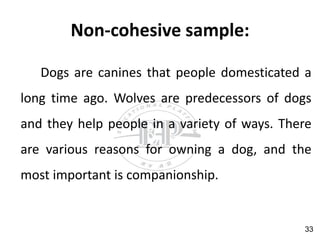
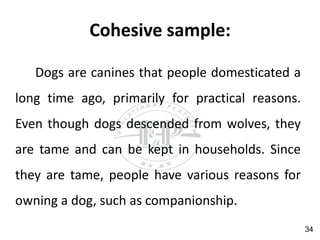
  • 158.
    Difference between Proofreadingand Editing Proofreading Editing • Performed on the final draft of the document • Addresses surface-level issues • Universally accepted, consistent definition • Eliminates misspellings, grammatical and punctuation errors, inconsistencies, formatting errors, etc. • Does not include word count reduction • Makes already good writing error-free • Does not require much collaboration with the author • Shorter turnaround time • Performed on the first draft of the document and continues till the draft is finalized. • Addresses the core features of writing • Definition varies according to the scope of editing. Edit age, for example, offers three different editing services. • Enhances the language by making changes for clarity, readability, and smooth narration. • Includes word reduction, if required • Overall quality of writing is improved • Collaborative as it requires the editor to work with the author • Slightly longer turnaround time (as the amount of work required is more) Educational Platform by AD 158
  • 159.
    What involves inEditing? What basic steps should be included in editing a document. • 1. 1. READ FOR STRUCTURE. • Ask yourself key questions such as: • Does your paper support and contribute to your thesis in your introduction? • Does the order of your sentences flow smoothly within a paragraph? • Does the tone of each sentence match the rest of the paper? • Do your paragraphs flow smoothly and logically with transitions? • Are your sentences clear and uncluttered? • Is the tone and style consistent throughout each sentence • Reading through your paper, whether silently or aloud, with a broader view will help you pick out areas that don't flow together well. Educational Platform by AD 159
  • 160.
    2. READ FORGRAMMAR AND PUNCTUATION. • Next, look into the details of your paper. This is the part of the editing process you may think of most often—looking at grammar, punctuation, word choice and other nitty-gritty details. • In reading through your paper with your focus on the details, ask questions such as: • Is everything spelled correctly? • Are all punctuation marks used accurately? • Are all your citations formatted correctly? • Does the vocabulary you use appropriate for the topic? • Do each of the sentences maintain the appropriate verb tense? • Do you use too many clichés that cloud your argument? • Do all sentences maintain parallel structure? • As you write more papers and continue to revisit the editing process, you'll be able to identify the errors that you tend to make most often. You'll get a better sense of your tone and style of writing. With practice, this editing process will get easier. Educational Platform by AD 160
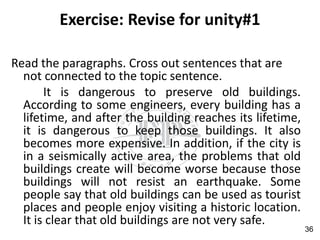
  • 161.
    READ ALOUD ONCEMORE. • If you haven't read your paper aloud yet, do it. Yes, it might feel silly at first, but reading your paper out loud lets you hear and notice things that you didn't catch in your first few read thoughts. Whether you read it aloud yourself or have someone read it to you, hearing your content gives you a new way of reviewing. • According to a resource provided by the Writing Center at the University of North Carolina at Chapel Hill, reading your work aloud has several benefits: • When you read your draft out loud or listen to someone else read it, your brain gets the information in a new way, and you may notice things that you didn't see before... Sometimes sentences aren't grammatically incorrect, but they are still awkward in some way—too long, too convoluted, too repetitive. Problems like these are often easily heard. • So find a quiet room, grab a glass of water and use your ears in this stage of the editing process. Educational Platform by AD 161
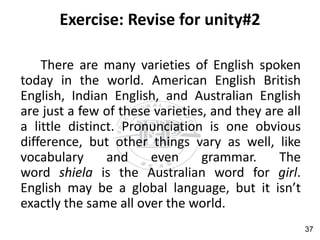
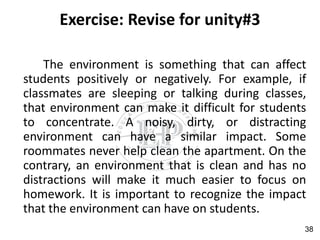
  • 162.
    REVIEW AND RELEASE. •After you've reviewed the changes suggested by your friend, read through it one last time. Double check your citations. Be confident in your word choices and paragraph breaks. • Once you're done reviewing and making the edits you need to, be done. Especially if you tend to be a perfectionist in your work, get to that point with your paper when you've written, reviewed and edited at your best. • Sure, you could continue to obsess over that one phrase on the second page in the third paragraph. Or, you could be confident that you've worked hard on your assignment and tried your best. Educational Platform by AD 162
  • 163.
    EDIT FOT STRUCTUREORGANIZATION • Basically, all the writing pattern will follow the same structure which is • 1. Introduction • 2. Body • 3. Conclusion Educational Platform by AD 163
  • 164.
    • Introduction: Thefirst paragraph of your essay. It is the first impression your readers recieve, and explain the main point of your paper. Your introduction contains your thesis statement. • Body: The paragraphs in between your introduction and conclusion. The body of your paper supports the main point of your paper. • Topic Sentence: The sentence at the beginning of each body paragraph. It explains the main point that paragraph is going to make. • Conclusion: The last paragraph of your paper. It closes the paper and leaves the reader satisfied with what they just read. Summarizes your paper in an effective way. Educational Platform by AD 164
  • 165.
    EDIT FOR STYLE-TONE • There are literally dozens of English editing style guides to follow. Which should you use? And when? • Here‘s a list of the top editing style guides and when it‘s best to use them: Educational Platform by AD 165
  • 166.
    • Chicago Style* •The Chicago Manual of Style—CMoS, or CMS, for short—is the standard in book publishing. It is also commonly used for history and the arts. One of the first American English style guides, it was originally published in 1906 by the University of Chicago Press and has since released updated editions every seven to ten years. CMoS is a comprehensive reference guide for grammar, citation, preparation, and everything in between. It‘s often called ―the editor‘s Bible.‖ Educational Platform by AD 166
  • 167.
    • APA Style •The Publication Manual of the American Psychological Association—or APA for short—was first developed by the American Psychological Association in 1929. Originally established to ensure consistency among papers in the psychology field, it quickly expanded and now is commonly used in social and behavioral sciences. APA focuses on simplifying the style, from tables to citations to abbreviations to the structure of writing. Educational Platform by AD 167
  • 168.
    • AP Style •Not to be confused with APA, The Associated Press Stylebook and Briefing on Media Law (a.k.a. the AP Stylebook, or AP) is published by the Associated Press. This style is used in journalism, but is also widespread in marketing, PR, broadcasting, and corporate communications. It was first published in 1953, although the style has been around for about a century. AP is notable for its sparse style, including dropping the Oxford comma and using figures for all numbers above nine. The purpose behind the brevity of style is to save space in print and on the web. Educational Platform by AD 168
  • 169.
    • MLA Style •The MLA Style Manual and Guide to Scholarly Publishing is an academic style guide most commonly used for in the liberal arts and humanities in academia, particularly in English studies and literature. The Modern Language Association of America has published this manual since 1985. MLA style is geared toward collegiate and graduate students as well as professionals. The Modern Language Association also publishes a companion style guide, the MLA Handbook, which is used primarily by secondary and postsecondary students. Educational Platform by AD 169
  • 170.
    • This generalformat is the root of the six common writing structures that can be used for both formal and informal written communication. 1. Categorical: In a categorical structure, a series of equally important topics are addressed. A political speech, like a campaign speech or even The State of the Union Address, is a good example of categorical writing. You might use a similar structure in a cover letter for a job application, in which you describe all of your traits that would make you an ideal candidate for the position. Educational Platform by AD 170
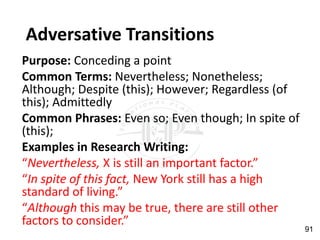
  • 171.
    • Evaluative: Inan evaluative structure, a problem is introduced, and then pros and cons are weighed. You might employ an evaluative structure when writing an e-mail to ask a close friend for advice. Chronological: When your focus is more the actual telling of the story than the end result, employ a chronological structure. Think of joke telling. "Three guys walk into a bar…" sets up a sequence of events to deliver that final punch line. Similarly, most short stories and novels are written chronologically. Comparative: This structure is similar to evaluative, but it is used when there are more layers to the situation at hand that is being weighed. You might use a comparative structure if you were writing a speech for a debate team to explain the various reasons why you feel your point is stronger than your opponent‘s. Or you might use a comparative structure to write a letter to the editor explaining all the reasons you disagree with the city council‘s decision to raise local taxes. Educational Platform by AD 171
  • 172.
    • Sequential: Thisstructure is similar to Chronological, but is normally employed with a how-to voice when a step-by-step process is being described. If you were going to write about how to make your famous chocolate layer cake, or how to get to a great bed-and-breakfast you discovered out in the country, you would write sequentially, using words like, "First," "Next," "Then," and "Finally" to clarify your instructions. Causal: This structure might at first glance seem similar to Comparative structures, but it differs in that it does not involve weighing options against one another. Instead, it discusses the causes and then the effects regarding a particular topic or issue in that order. You might use this structure if you were writing an article on how something has come about, such as the contributing factors to air pollution. Or you might employ this technique in a letter explaining why you have decided to resign from your job. Educational Platform by AD 172
  • 173.
    9 TYPES OFTONES IN WRITING • What is tone when it comes to writing? • It‘s a simple question, but the answer can be rather complicated. In basic terms, tone usually refers to how a writer uses certain words in a specific way to convey non-verbal observations about specific subjects. Not only does tone help to deliver facts, but it delivers them with an attitude. Emotion and with a personal perspective. • Tone is sometimes used interchangeably with the voice of the author. They are very different. A writer‘s voice is a perspective of their personality. The tone of a writer conveys their attitude about what is being writing about. If tone is combined with voice, then this will create a specific writing style that can be attributed to that writer. Educational Platform by AD 173
  • 174.
    • There Are9 Basic Types of Tone in Writing • Any emotion, any attitude, and any perspective can lay the foundation for a specific tone in writing. If you can come up with an adjective, then that can be a tone. This means if you look at tone with specificity, there is an infinite number that can be used. • That makes it a little difficult to begin developing your personal tone as a writing skill, so those infinite tones have been categorized into 9 different types. Let‘s take a look at them in some detail. Educational Platform by AD 174
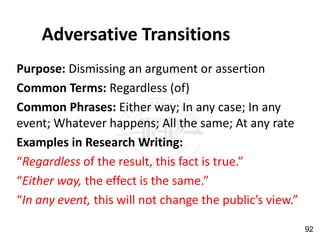
  • 175.
    • 1. Joyful:This tone in writing focuses on the positive emotions that are experienced in the moment of an action. If you eat something you like, then you feel joy. Writers use this tone to create relationship- building experiences between their readers and their characters. • 2. Serious: This tone in writing creates a level of suspense within the reader. It increases their focus because the concepts being offered are important. • 3. Humorous: Being funny does more than make people laugh. It also makes them begin to think about difficult concepts in a way that feels safe. This tone in writing is often intended to draw the reader into a story or narrative so they can engage with certain facts or opinions the author feels are important to share. Educational Platform by AD 175
  • 176.
    • Sad: Sadnessis a very real part of the human condition. In many ways, our saddest days define who we are as people. When incorporated as a tone in writing, the reader become sympathetic with the characters or the author and this empathy will keep them engaged with the narrative. • 5. Formal: This tone in writing is often seen from an academic standpoint. It requires structured language, higher reading skills, and presents more facts that can be proven than the opinions of the writer. • 6. Informal: The goal of this content is to have an informal tone. It‘s conversational, but still conveys a certain sense of expertise within the subject material. • 7. Optimistic: There‘s a lot of bad stuff going on in the world today. Yet there is also a belief that the world can and will be a better place one day if we‘re willing to work for it. This would be an example of an optimistic tone. Educational Platform by AD 176
  • 177.
    • 8. Pessimistic:When there‘s a lot of bad stuff going on in the world, it can feel like that bad stuff will only get worse. That kind of tone would be an example of being pessimistic. Pessimism is not realism. Being pessimistic means having a belief that something will never get better, even if the facts may seem to indicate otherwise. • 9. Horror: This tone of voice is threatening in nature. It speaks to the core fears that people have and forces them to confront those fears. Educational Platform by AD 177
  • 178.
    • Here isa listing of some of the more common surface errors, broken down by category. Either select the link you would like to view or scroll down to the appropriate topic. • Spelling • Punctuation ▫ Commas ▫ Apostrophes ▫ Periods • Verbs • Subject-verb agreement • Pronouns • Other grammatical errors ▫ Sentence fragments ▫ Misplaced or dangling modifiers Educational Platform by AD 178
  • 179.
    Spelling • Spelling errorsare among the most common surface errors as well as the most easily corrected. To correct spelling errors, use a spell- checker, regardless of your spelling skills, along with a dictionary to help you find the right alternative for a misspelled word. Remember that the spell-checker won't help with homonyms, words that sound alike but have different spellings and meanings. Educational Platform by AD 179
  • 180.
    • Some wordsthat can cause trouble are listed below. • their (possessive form of they) • there (in that place) • they're (contraction of they are) • accept (a verb, meaning to receive or to admit to a group) • except (usually a preposition, meaning but or only) • who's (contraction of who is or who has) • whose (possessive form of who) • its (possessive form of it) • it's (contraction of it is or it has) • your (possessive form of you) • you're (contraction of you are) Educational Platform by AD 180
  • 181.
    • your (possessiveform of you) • you're (contraction of you are) • affect (usually a verb, meaning to influence) • effect (usually a noun, meaning result) • than (used in comparison) • then (refers to a time in the past) • were (form of the verb to be) • we're (contraction of we are) • where (related to location or place) Educational Platform by AD 181
  • 182.
    Punctuation • Commas • 1.USE A COMMA TO SEPARATE INDEPENDENT CLAUSES. Rule: Use a comma before a coordinating conjunction (and, but, yet, so, or nor, for) when it joins two complete ideas (independent clauses). • 1. He walked down the street, and then he turned the corner. • 2. You can go shopping with me, or you can go to a movie alone. • 2. USE A COMMAAFTER AN INTRODUCTORY CLAUSE OR PHRASE. Rule: Use a comma after an introductory clause or phrase. A comma tells readers that the introductory clause or phrase has come to a close and that the main part of the sentence is about to begin. • 1. When Evan was ready to iron, his cat tripped on the cord. • 2. Near a small stream at the bottom of the canyon, park rangers discovered a gold mine. Educational Platform by AD 182
  • 183.
    • 3. USEA COMMA BETWEEN ALL ITEMS IN A SERIES. • Rule: Use a comma to separate each item in a series; a series is a group of three or more items having the same function and form in a sentence. • 1. We bought apples, peaches, and bananas today. (series of words) • 2. Mary promised that she would be a good girl, that she would not bite her brother, and that she would not climb onto the television. (series of clauses) • 3. The instructor looked through his briefcase, through his desk, and around the office for the lost grade book. (series of phrases) Educational Platform by AD 183
  • 184.
    • USE ACOMMA TO INDICATE DIRECT ADDRESS. • Rule: When a speaker in a sentence names the person to whom he is speaking, this addressing of his audience is called direct address. Direct address is indicated by the use of a comma or commas, depending upon its placement within the sentence. • 1. I think, John, you‘re wrong. • 2. John, I think you‘re wrong. • 3. I think you‘re wrong, John. Educational Platform by AD 184
  • 185.
    • USE COMMAAS TO SET OFF DIRECT QUOTATIONS. • Rule: A dialogue is a conversation between two or more people. If the speaker (not the listener) in the conversation is identified, his name, (or the noun or pronoun used to refer to the speaker), and the verb that refers to his speaking are enclosed within commas. • 1. Mary said, ―I dislike concerts because the music is too loud.‖ • 2. ―I dislike concerts because the music is too loud,‖ she said. • 3. ―I dislike concerts,‖ proclaimed Mary, ―because the music is too loud.‖ Educational Platform by AD 185
  • 186.
    • Apostrophes • Theapostrophe has two functions: it marks possession, and it is used in contractions to indicate the place where the letters have been omitted. • Possession In singular, possession is marked by ‘s, written immediately after the possessor. • (1) John’s car (2) the boy’s toy • Important: there is no apostrophe before the possessive –s with pronouns. • (1) its, hers, yours, ours Educational Platform by AD 186
  • 187.
    • If thepossessor is expressed by more than one word, ’s comes after the last word. • (3) my late brother’s wife (4) Mr. Johnson's house (5) Charlie and Lola’s new room. (the room belongs to both Charlie and Lola) • Use ‘s with singular possessors that end in –s or –z. • (6) Charles’s books (7) Sanchez’s horse Educational Platform by AD 187
  • 188.
    • Plural possessorsthat end in –s take only the apostrophe. Plural possessors that end in some other letter take ’s. • (8) the boys’ toy (9) the Sanchezes’ horse (10) the children’s bikes • Importantly, it is the written letter that determines whether to place just an apostrophe or ’s after a plural. There are a few English nouns that end in the sound /s/ or /z/ but are written with a final –e: mice (mouse) dice (die), geese (goose). Such plural nouns take ‘s is the possessive form. • (11) the geese’s feathers (12) mice’s teeth Educational Platform by AD 188
  • 189.
    • In otherwords, the possessive –s is required after a singular word ending in -s but not after a plural word ending in –s. • • Singular Plural Ending in –s, -z ‗s ‗ Not ending in –s, -z ‗s ‗s Educational Platform by AD 189
  • 190.
    • Contraction The apostropheis used with contractions and is placed at the spot of the omitted letter(s). Words that often are written in contracted form are: be, have (-’ve), has (-’s), had (-’d), will (-’ll), would (-’d), and the negative particle not (n’t). For a full list of the standard contractions, follow this link. Some common contractions are shown below. • (13) I am = I’m (14) you are = you’re (15) he is = he’s (16) she is = she’s (17) it is = it’s (18) we are = we’re (19) they are = they’re Educational Platform by AD 190
  • 191.
    • (20) donot = don’t (21) does not = doesn’t (22) cannot = can’t (cannot is written as one word) (23) should not = shouldn’t (24) could not = couldn’t (25) shall not = shan’t (26) will not = won’t (27) I have = I’ve (28) I had, I would, and I should = I’d (29) I will and I shall = I’ll Educational Platform by AD 191
  • 192.
    • Avoid theapostrophe to mark possession with pronouns A very common mistake is to place an apostrophe in the possessive form of pronouns like its, yours, hers, ours, theirs. Although this makes perfect sense, it is considered wrong. () The book is old; its pages have turned yellow. [correct] () The book is old; it’s pages have turned yellow. [incorrect, it’s is a contraction of it is] Educational Platform by AD 192
  • 193.
    • Periods • 1.Use a full stop at the end of a statement or command. • Example • The government has promised to reduce inflation • Pick up the lug wrench. • 2. Use a full stop after some abbreviations. • Co. • Dep. • P.a • Gen. Educational Platform by AD 193
  • 194.
    Verbs • Active andPassive Verbs • 1. Verbs can be in either active or passive voice. In active voice, the subject of the sentence performs the action of the verb; in passive voice, the subject receives the action of the verb. Readers typically find active voice sentences more vigorous and clearer; for these reasons, writers usually prefer active voice. Educational Platform by AD 194
  • 195.
    • Passive: Theball was kicked by the boy. Active: The boy kicked the ball. • Passive: A decision was reached by the committee. Active: The committee reached a decision. • Passive: Many arguments are offered against abortion. Active: Religious leaders offer many arguments against abortion. Educational Platform by AD 195
  • 196.
    • Notice thatin the passive voice examples, the doer of the action is either at the end of the sentence in a prepositional phrase or, in the third example, is missing entirely from the sentence. In each active voice example, however, the doer of the action is in the subject position at the beginning of the sentence. Educational Platform by AD 196
  • 197.
    • 2. Onsome occasions, however, you might have a good reason for choosing a passive construction; for example, you might choose the passive if you want to emphasize the receiver of the action or minimize the importance of the actor. Educational Platform by AD 197
  • 198.
    • Appropriate passive:The medical records were destroyed in the fire. Appropriate passive: The experiment was performed successfully. • Passive voice verbs always include a form of the verb to be, such as am, are, was, is being, and so on. To check for active versus passive voice, look for sentences that contain a form of this verb, and see whether in these sentences the subject of the sentence performs the action of the verb. Educational Platform by AD 198
  • 199.
    Shifting Verb Tense •1. If you shift verb tense (for example, from past to present tense) in a sentence or passage without a good reason, you may confuse your reader. • Wrong: After he joined the union, Sam appears at a rally and makes a speech. Right: After he joined the union, Sam appeared at a rally and made a speech. Educational Platform by AD 199
  • 200.
    Subject-Verb Agreement • 1.Make sure that the subject and verb of each clause or sentence agree—that is, that a singular subject has a singular verb, and a plural subject a plural verb. When other words come between subject and verb, you may mistake the noun nearest to the verb—before or after— for the verb's real subject. • Wrong: A central part of my life goals have been to go to law school. Right: A central part of my life goals has been to go to law school. • Wrong: The profits earned by the cosmetic industry is not high enough. Right: The profits earned by the cosmetic industry are not high enough. Educational Platform by AD 200
  • 201.
    • . Beparticularly careful that your subject and verb agree when your subject is made up of two or more parts joined by and or or; when your subject is a word like committee or jury, which can take either a singular or a plural verb depending on whether it is treated as a unit or as a group of individuals; or when your subject is a word like mathematics or measles, which looks plural but is singular in meaning. Educational Platform by AD 201
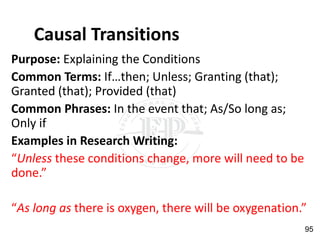
  • 202.
    • Wrong: Mybrother and his friend commutes every day from Louisville. Right: My brother and his friend commute every day from Louisville. • Wrong: The committee was taking all the responsibility themselves. Right: The committee were taking all the responsibility themselves. (Note that the use of the word themselves shows that committee is being treated as a group of individuals, not as a unit.) • Wrong: Measles have become less common in the United States. Right: Measles has become less common in the United States. Educational Platform by AD 202
  • 203.
    Pronouns • A pronoun (likeI, it, you, him, her, this, themselves, someone, who, which) is used to replace another word—its antecedent—so the antecedent does not have to be repeated. heck each pronoun to make sure that it agrees with its antecedent in gender and number. • Wrong: Every one of the puppies thrived in their new home. Right: Every one of the puppies thrived in its new home. • Wrong: Neither Jane nor Susan felt that they had been treated fairly. Right: Neither Jane nor Susan felt that she had been treated fairly. • Wrong: The team frequently changed its positions to get varied experience. Right: The team frequently changed their positions to get varied experience. Educational Platform by AD 203
  • 204.
    • To proofreadfor agreement of pronouns and antecedents, circle each pronoun, identify its antecedent, and make sure that they agree in gender and number. Educational Platform by AD 204
  • 205.
    • 2. Asnoted above, most indefinite pronouns (like each, either, neither, or one) are singular; therefore, they take singular verbs. A relative pronoun, like who, which, or that, takes a verb that agrees with the pronoun's antecedent. • Wrong: Each of the items in these designs coordinate with the others. Right: Each of the items in these designs coordinates with the others. Educational Platform by AD 205
  • 206.
    Other Grammatical Errors •A: Sentence Fragments • 1. The sentence fragment is an incomplete sentence punctuated as a sentence. To make it a complete sentence, join it to the main clause or rewrite it. • Wrong: She is a good friend. A person whom I trust and admire. Right: She is a good friend, a person whom I trust and admire. • Wrong: In the workshop, we learned the value of discipline. Also how to take good notes. Right: In the workshop, we learned the value of discipline. We also learned how to take good notes. • Wrong: The old aluminum boat sitting on its trailer. Right: The old aluminum boat was sitting on its trailer. Educational Platform by AD 206
  • 207.
    • To proofreadfor sentence fragments, check all sentences for a subject, a verb, and at least one clause that does not begin with a subordinating word like as, although, if, when, that, since, or who. Educational Platform by AD 207
  • 208.
    Misplaced or DanglingModifiers • 1. Misplaced or dangling modifiers are words, phrases, or clauses not clearly connected to the word they modify. Move a misplaced modifier closer to the word it describes, or revise a sentence to give a dangling modifier a word to modify. • Wrong: They could see the eagles swooping and diving with binoculars. Right: With binoculars, they could see the eagles swooping and diving. • Wrong: Nixon told reporters that he planned to get out of politics after he lost the 1962 gubernatorial race. Right: After he lost the 1962 gubernatorial race, Nixon told reporters that he planned to get out of politics. Educational Platform by AD 208
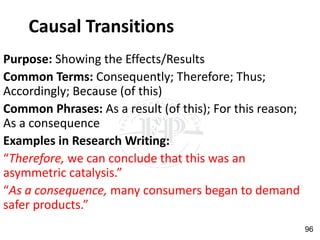
  • 209.
    • Wrong: Asa young boy, his grandmother told stories of her years as a country schoolteacher. Right: As a young boy, he heard his grandmother tell stories of her years as a country schoolteacher. Educational Platform by AD 209
  • 210.
    • To proofreadfor misplaced or dangling modifiers, circle all modifiers and draw a line to the word they describe; be sure they can't mistakenly modify some other word. Educational Platform by AD 210
  • 211.
  • 212.
    A citation isa reference to the source of information used in your research. Any time you directly quote, paraphrase or summarize the essential elements of someone else's idea in your work, an in- text citation should follow, whilst a reference usually refers to the full bibliographic information at the end. 212
  • 213.
    When to Cite Thegeneral rule is to cite the work of individuals whose ideas, theories, or research have directly influenced your work. By properly citing your sources you will avoid plagiarism and demonstrate the amount of research you did in preparing your paper. Citations are necessary when quoting directly from another source, when paraphrasing another author, and when discussing ideas from others. 213
  • 214.
    In-text Citations Papers writtenin APA style have brief, in-text citations that identify the author and year of publication. Each of these citations must correspond to an entry in the reference list. In-text citations have two formats, parenthetical and narrative: 214
  • 215.
    Parenthetical: (End-text/parenthetical citation) Boththe author and the date, separated by a comma, appear in parentheses. “Falsely balanced news coverage can distort the public's perception of expert consensus on an issue” (Koehler, 2016). Narrative: The author appears in the running text and the date appears in parentheses immediately after the author name. Koehler (2016) noted the “dangers of falsely balanced news coverage”. The reader may then refer to the Reference list to find the rest of the information about the book or article written by Koehler and published in 2016. 215
  • 216.
    Listing Authors In-text Theauthor-date method of in-text citation requires the inclusion of the author's surname and year of publication in the text at the appropriate place. Use surnames only. Do not include initials for first or middle names or suffixes, such as Jr. unless you cite more than one author with the same last name. 216
  • 217.
    Paraphrasing Paraphrasing allows authorsto summarize and focus on significant information from one or more sources. It is an effective writing strategy and should be used most of the time rather than using direct quotes. Use either the narrative or parenthetical format when paraphrasing other's work. 217
  • 218.
    Page numbers whenparaphrasing: It is not required to provide page or paragraph numbers in the citations when paraphrasing. You may include one with the author and year if you feel as though it will help interested readers locate relevant passage in a long work such as a book. Webster-Stratton (2016) described a case example of a 4-year-old girl who showed an insecure attachment to her mother; in working with the family dyad, the therapist focused on increasing the mother's empathy for her child (pp. 152-153). 218
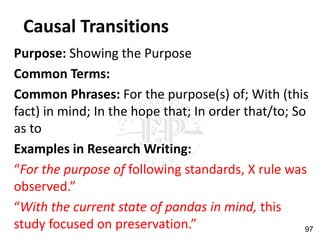
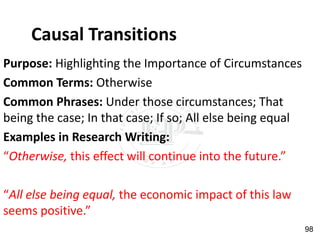
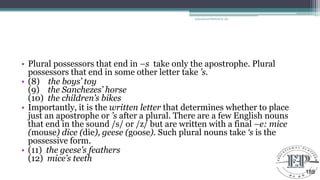
  • 219.
    Long Paraphrases: When paraphrasingcontinues for several sentences, cite the work being paraphrased on first mention. It is not necessary to repeat the citation as long as it is clear that the same work continues to be paraphrased. If the paraphrasing continues into a new paragraph, reintroduce the citation. 219
  • 220.
    Using Direct Quotes Usea direct quote rather than paraphrasing when: reproducing an exact definition an author has said something memorably or succinctly you want to respond to exact wording Direct quotes should be followed by an author-date citation and the page number or location of the quote. 220
  • 221.
    Short Quote: For quotesof fewer than 40 words, surround with quotation marks and put the period after the citation. Effective teams can be difficult to describe because "high performance along the domain does not translate to high performance along another" (Erving et al., 2018, p.470). 221
  • 222.
    Directly quote -include the author, year of publication, and the page number. 12 Example: References (at the end of your paper) Jones, L. (2004). How to research. (2nd ed.). London: Open University Press. Quotations - Short Quotes (< 40 words) Example: Reference in the text: According to Jones (2004), "Students often had difficulty using APA style, especially when it was their first time" (p. 199). APA In-Text Citations 222
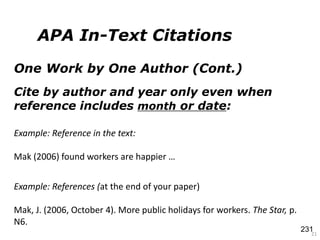
  • 223.
    Example: Reference inthe text: We agree with Obrue (2002), who concluded: Neurofeedback is perhaps best viewed not as an alternative to conventional psychopharmacological agents but rather… (p. 8). 13 Example: References (at the end of your paper) Obrue, K. (2002). Neurofeedback practice. (2nd ed.). New York: McGraw-Hill. Quotations - Long Quotes (> 40 words) • Use block form, indent 5 spaces for entire quote • Use double space and Do not use “ ” • Use … to indicate omitted words APA In-Text Citations 223
  • 224.
    Long Quote: For quotesof 40 words or more create an indented block of text and do not use quotation marks. Researchers have studied how people talk to themselves: Inner speech is a paradoxical phenomenon. It is an experience that is central to many people's everyday lives, and yet it presents considerable challenges to any effort to study it scientifically. Nevertheless, a wider range of methodologies and approaches have combined to shed light on the subjective experience of inner speech and its cognitive and neural underpinnings. (Alderson-Day & Fernyhough, 2015, p. 957) 224
  • 225.
    Citing from SecondarySources Citing secondary sources, or sources cited in another source, should generally be avoided. If possible, it is good practice to find the primary source, read it, and cite it directly. Only use secondary sources when the original work is out of print, unavailable, or available only in a language that you do not understand. If you do need to reference a secondary source, provide an in entry for the secondary source that you used in the reference list. In the text, identify the primary source and write "as cited in" the secondary source that you used. For example: (Rabbitt, 1982, as cited in Lyon et al., 2014) 225
  • 226.
    16 • Citations reflectthe careful and thorough work you have put into locating and exploring your sources. • Citations are a courtesy to the reader, who may share your interest in a particular area. Why should you acknowledge your sources? 226
  • 227.
    Why should youacknowledge your sources? 17 • By citing sources, you demonstrate your integrity and skill as a responsible participant in the conversation. • Failure to provide adequate citations constitutes plagiarism. 227
  • 228.
    Why Use APAStyle? 18 • This is the most common format for documenting sources. • This format is widely used for course papers and journal articles in Psychology and also in the social sciences, education, engineering, and business. 228
  • 229.
    What is APAIn-Text Citations 19 • Use of a parenthetical reference system in the text of the paper. All in-text parenthetical references must correspond to a source cited in the References list. • Tied to an alphabetical References list (located at the end of your paper) • Use author-date system of citation 229
  • 230.
    APA In-Text Citations OneWork by One Author 20 Example: References (at the end of your paper) Taylor, M. M. (2000). Study of personalities and character. Journal of Psychology, 93 (1), 257-267. Example: Reference in the text: According to Taylor (2000), the personalities of … OR, you may write like this: In a study of personalities and character (Taylor, 2000) … 230
  • 231.
    One Work byOne Author (Cont.) Cite by author and year only even when reference includes month or date: 21 Example: References (at the end of your paper) Mak, J. (2006, October 4). More public holidays for workers. The Star, p. N6. Example: Reference in the text: Mak (2006) found workers are happier … APA In-Text Citations 231
  • 232.
    One Work byTwo authors 22 Example: References (at the end of your paper) Serlin, R. C., & Lapsley, D. K. (1985). Rationality in psychological research: The good- enough principle. American Psychologist, 40, 73-83. Example: Reference in the text: Serlin and Lapsley (1985) discovered the problems … OR, you may write like this: • Always cite both names every time the reference occurs in text. • Use the word "and" between the authors' names within the text, Use "&" in the parentheses. A survey on the problems in … (Serlin & Lapsley, 1985) APA In-Text Citations 232
  • 233.
    One Work byMultiple authors (3-5 authors) 23 Example: References (at the end of your paper - List all authors) Skinner, M. E., Cornell, R. C., Sun, K. F., & Harlow, R. P. (1993). Small group learning, Psychological Bulletin, 26, 57-63. Example: Reference in the text: Skinner, Cornell, Sun, and Harlow, 1993 found… (Use as 1st citation in text) Skinner et al. also found … (Omit year from subsequent citations after 1st citation within a paragraph) Skinner et al. (1993) found … (Use as subsequent 1st citation per paragraph thereafter) APA In-Text Citations 233
  • 234.
    • For workswith 6 or more authors, the 1st citation & subsequent citations use first author et al. and year. • et al means “and others” 24 Example: References (at the end of your paper) - *List the first six authors, … and the last author] Wolchik, S. A., West, S. G., Sandler, I. N., Tein, J., Coatsworth, D., Lengua, L., … Rubin, L. H. (2000). An experimental evaluation of theory-based mother and mother-child programs for children of divorce. Journal of Consulting and Clinical Psychology, 68, 843-856. Example: Reference in the text: Wolchik et al. (2000) studied the use of … 6 or More Authors APA In-Text Citations 234
  • 235.
    If group authoris easily identified by its abbreviation, you may abbreviate the name in the second and subsequent citations: 25 Groups as Authors Write down corporate author in full every time if the abbreviation is NOT common. Examples: 1st citation: Ministry of Education [MOE], 2001) Example: (University of Pittsburg, 1998) Subsequent text citation: (MOE, 2001) APA In-Text Citations 235
  • 236.
    Works With NoAuthor 26 Example: References (at the end of your paper) Alcohol and the risk of cancer. (2006, October 10). The Straits Times, p. 32. • Cite the first few words of the reference list entry Example: Reference in the text: Many mentally ill drinkers seek the help from… (“Alcohol and the risk,” 2006). • Usually the title of the article or newspaper • And the year • Use “ ” and italics APA In-Text Citations 236
  • 237.
    Authors With theSame Surname 27 Example: References (at the end of your paper) Young, J. (1989). The Purification Plan. New York: Rodale Books. Young, E. (1990). Caring for the Vulnerable. London: Jones and Bartlett. Example: Reference in the text: Research by J. Young (1989) revealed that . . . Survey by E. Young (1990) proved that … • Use initials with the last names if your reference list includes two or more authors with the same last name. APA In-Text Citations 237
  • 238.
    Secondary Sources Example: Referencein the text: Irene and John’s study (as cited in Tornhill, Curtis, Atkins, & Haller, 1993) 28 Example: References (at the end of your paper) Tornhill, M., Curtis, B. Atkins, P., & Haller, M. (1993). Models of reading aloud: Dual- route and parallel-distributed-processing approaches. Psychological Review, 100, 589-608. • Give the secondary source in the reference list. • In text, name the original work, and give a citation for the secondary source. APA In-Text Citations 238
  • 239.
    Part 2: Formatting YourReference List 29 The Basics ● APA requires a hanging indent for its citations. ● Please be sure to use double space citations. ● Documents only sources used in research and preparation. ● Alphabetize the works. 239
  • 240.
    30 Pay Specific Attentionto: ● Consistency in how you apply APA. ● Punctuation (period, comma, semi-colon). ● Location and publisher for books. ● Volume, issue and page numbers for articles. ● Complete and correct information. ● Spelling. 240
  • 241.
    ● Alphabetical byauthor’s name ● Chronological by same author ● Alphabetical by title 31 Reference List Order ● Same author, same year, different title: Alleyne, R. L. (2004a). Managing information … Alleyne, R. L. (2004b). Multimedia management … ● Same author, different year: Hewlett, L. S. (2005). Critical thinking about … Hewlett, L. S. (2006). Doing quantitative research … ● Alphabetize the prefix M’, Mc and Mac literally, not as if they were all spelled Mac. Disregard the apostrophe. ● MacArthur, B. A. (2000). Problems and promises… McAllister, G. J. (2000). Choice and the relative … 241
  • 242.
    32 Publisher Information ● Leaveout terms like “Publisher, Co, Inc.” ● Give city and state if city is not well known or ambiguous (US postal code 2-letter). Example: Hillsdale, NJ or Cambridge, MA ● Spell out other countries Example: Oxford, England: Blackwell ● Spell out name of publisher especially associations, corporations, university presses ● Retain terms like “Books”, “Press”. 242
  • 243.
    33 More Than OnePublisher Location • Use the first one, if the book lists more than one publisher location. Example: New York, London: MacMillan  Cite as New York: MacMillan 243
  • 244.
    General Format Author, A.(Year). Title of book. Location: Publisher. 34 Book Reference Single Author Example: Zautra, A. (2006). Emotions, stress, and health. New York: Oxford University Press. 244
  • 245.
    When the authorand publisher are identical, use the word "Author" as the name of the publisher. 35 Book Reference Single Author (Cont.) Example: American Psychiatric Association. (1994). Diagnostic and statistical manual of mental disorders (4th ed.). Washington, DC: Author. 245
  • 246.
    36 Book Reference Multiple Authors Whena work has 2 or more authors: Example: 3 Authors Playfair, J. H., Gardner, M., & Bancroft, G. J. (2004). Infection and immunity. (2nd ed.). Oxford: Oxford University Press. 246
  • 247.
    General Format 37 Book Reference CorporateAuthor Example: Institute of Banking & Finance. (2006). Managing personal fund. Toronto: Midwestern. Corporate Author. (Year). Title of book. Location: Publisher. 247
  • 248.
    General Format Title ofbook. (Year). Place of publication: Publisher. 38 Book Reference Unknown or No Author Example: Education Handbook. (2005). London: Longman. Begin with title. Titles of books are italicized. 248
  • 249.
    General Format Editor, A.(Ed.). (Year). Title of book. Location: Publisher. Examples: One editor: Michael, G. (Ed.). (1988). Psycholinguistics. Beijing: Peking University Press. More than one editor: Grice, H., & Gregory, R. (Eds.). (1968). Early language development. New York: McGraw-Hill. 39 Edited Book Reference 249
  • 250.
    General Format Author, A.(Year). Title of book (2nd ed.). Location: Publisher. Example: Skinner, E. (2003). Women and the national experience (2nd ed.). New York: Longman. 40 Later Edition Book Reference 250
  • 251.
    General Format Author, A.(Year). Book title (Name translators). Location: Publisher. (Original work published 1814) Example: Laplace, P.S. (1951). A philosophical essay on probabilities (F.W. Truscott & F. L. Emory, Trans.). New York: Dover. (Original work published 1814) 41 English Translation of A Book 251
  • 252.
    General Format Article Author.(Year). Article Title. In Book Editor(s), Book Title (page numbers). Location: Publisher. Example: Blaxter, L. (1996). Thinking about research. In R. A. Lillian & J. F. Rebecca (Eds.), How to research (pp. 19-25). Buckingham: Open University Press. 42 Book Chapter Reference 252
  • 253.
    General Format 43 Journal ArticleReference One Author Example: McGill, K. (2006). Reading the valley: performance as a rhetoric of dimension, Text and Performance Quarterly, 26(4), 389-404. Author, A. (Year). Title of article. Journal Title, Vol(no), pages. 253
  • 254.
    List all authorswith & preceding last author. Example: Racette, A., & Bard, C. (2006). Making non-fluent aphasics speak. Journal of Logic and Computation, 18, 27-45. 44 Journal Article Reference Two Authors 254
  • 255.
    Example: Bjokr, R. N.Auerbach, J. S., Piaget, J., Tein, J. Y., Kwok, O. M., Haine, R. A., … Botros, N. (2003). Classroom Interaction in Science: Teacherquestioning and feedback to students' responses. International Journal of Science Education, 63, 57-60. 45 Journal Article Reference More Than Seven Authors 255
  • 256.
    Example: Reppel, F. G.(2003, February 13). Conflict and cognitive control. Natural Science, 33, 969-970. 46 Magazine Article Reference General Format Author, A. (Year, Month day). Title of article. Title of Magazine, volume if given, page-numbers. 256
  • 257.
    Author, A. (Year,Month Day). Title of article. Title of Newspaper, pages. Example: Lee, S. (2006, October 3). Malaysia off the priority watch list for pirated movies, music. New Straits Times, p. 6. 47 Newspaper Article Reference General Format 257
  • 258.
    Author, A. (Year).Title of thesis. Unpublished level thesis. University, Place. Example: Kondo, T. (1991). The making of a corporate elite adult targeted comic magazines of Japan. Unpublished master’s thesis. McGill University, Canada. 48 Unpublished Thesis Reference General Format 258
  • 259.
    Author, A. (Year).Title of article. Title of Periodical, Vol (no), pages. Retrieved Month Day, Year, Issue, Page Numbers. Example: Borman, W. C., Hanson, M. A., Oppler, S. H., Pulakos, E. D., & White, L. A. (1993). Role of early supervisory experience in supervisor performance. Journal of Applied Psychology, 78, 443-449. doi:10:1002//piq.20033 49 Web Page Reference Electronic Copy of a Journal Article Retrieved from Database with DOI General Format 259
  • 260.
    Author, A. (Year).Title of article. Journal Title, vol (no), pages. Retrieved from source. Example: Pelling, N. (2002, May 5). The use of technology in career counseling. Journal of Technology in Counselin (2). Retrieved from http://jtc.colstate.edu/pelling.htm 50 Web Page Reference General Format Article in an Internet-only Journal Article does not appear in print journal or magazine 260
  • 261.
    Title. (n.d.). RetrievedMonth Day, Year, from source. Example: 51 Web Page Reference General Format Stand-alone Document, No Author Identified, No Date What I did today. (n.d.). Retrieved August 21, 2010, from http://www.cc.mystory.life/blog/didtoday.html 261
  • 262.
    52 General Instructions for Preparingthe Paper Manuscript 1. Paper – One side of standard-sized (A4) 2. Typeface – Preferred 12-pt Times Roman 3. Double-spacing – leave one full-size line blank between each line 4. Margins – margins of at least 1 in. (2.54 cm) at the top, bottom, left and right of every page. 5. Line length and alignment – - maximum line length 6.5 in. (16.51 cm). - Do not justify lines, use the flush-left style - Do not divide words at the end of a line, and do not use the hyphenation function to break words at the ends of lines. 6. Number of lines – Not more than 27 lines of text. 262