PRESENTED BY-
Farkhan Wasil BEEE-3252
Safeer Hayat BEEE-3262
Asif Sardar BEEE-3399
Introduction
Different types of conductor
, Insulators and Poles
 Conclusion
The important factor taken into account in the
selection of a conductor for a particular lines
are conductivity, tensile strength, corona loss,
local condition and cost.
 The two most common conductor materials are
Hard drawn copper and aluminium.
Aluminium has the following advantages over
copper:
Lower cost
Lesser weight
Larger diameter
However ,the tensile strength of aluminium is
lower than copper.
1).Hard drawn copper conductor
2).Cadmium copper conductor
3).Steel core copper conductor
4).Copper welded conductor
5).All aluminium conductor(AAC)
6).Aluminium conductor steel reinforced(ACSR)
7).Smooth bodyACSR
8).ExpandedACSR
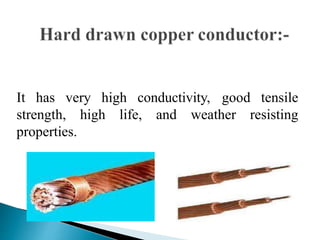
It has very high conductivity, good tensile
high life, and weather resisting
strength,
properties.
With addition of cadmium there is increase in the
tensile strength of copper at the cost of decrease
in the conductivity. Thus these conductors can be
used for longer spans. As tensile strength is
increased, longer spans with same sag is
possible.
The steel cored copper conductors are made by
surrounding a steel core with on or more layers
of copper strands. Due to addition of steel core
tensile strength of conductor is increased.
In this ,copper is welded on the steel wire to
make copper welded conductor.
The conductivity of copper weld conductor
varies from 30 to 60% of that a solid copper
conductor with same diameter.
It is used for longer span such as river crossing.
Due to increasing cost of copper, aluminium is
used in transmission system.
For a specific resistance, cross sectional area of
aluminium condcutor is greater than that of
copper while its weight is about 50% of that of
copper conductor. This makes transportation and
erection of such conductors economical. Corona
effect is reduced due to increased diameter of
conductor.
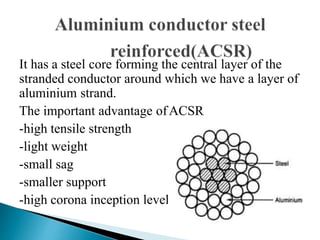
It has a steel core forming the central layer of the
stranded conductor around which we have a layer of
aluminium strand.
The important advantage ofACSR
-high tensile strength
-light weight
-small sag
-smaller support
-high corona inception level
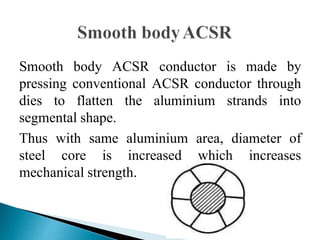
Smooth body ACSR conductor is made by
pressing conventional ACSR conductor through
dies to flatten the aluminium strands into
segmental shape.
Thus with same aluminium area, diameter of
steel core is increased which increases
mechanical strength.
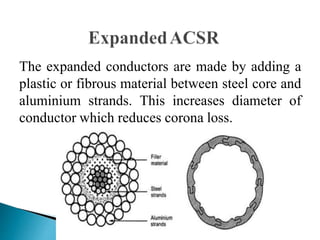
The expanded conductors are made by adding a
plastic or fibrous material between steel core and
aluminium strands. This increases diameter of
conductor which reduces corona loss.
 An electrical insulator is a material whose internal
electric charges do not flow freely, and which
therefore does not conduct an electric current,
under the influence of an electric field.
 A perfect insulator does not exist, but some
materials such as glass, paper and Teflon, which
have high resistivity, are very good electrical
insulators.
 Insulators are used in electrical equipment to
support and separate electrical conductors without
allowing current through themselves.
 There are several types of insulators but the
most commonly used are :
1) Pin Insulator
2) Suspension Insulator
3) Strain Insulator and
4) Shackle insulator.
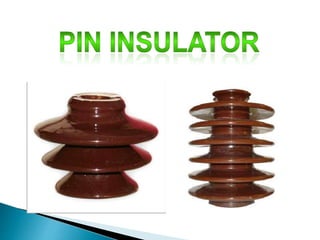
 A pin insulator consists of a non-conducting material such as
porcelain, glass, plastic, polymer, or wood.
 As the name suggests, the pin type insulator is secured to the
cross-arm on the pole.
 There is a groove on the upper end of the insulator for
housing the conductor.
 The conductor passes through this groove and is bound by
the annealed wire of the same material as the conductor.
 Pin type insulators are used for transmission and distribution
of electric power at voltages upto 33 kV.
 Beyond operating voltage of 33 kV, the pin type insulators
become too bulky and hence uneconomical
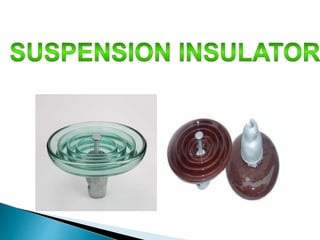
 For high voltages (>33 kV), it is a usual practice to use suspension type
insulators consist of a number of porcelain discs connected in series by metal
links in the form of a string.
 The conductor is suspended at the bottom end of this string while the other
end of the string is secured to the cross-arm of the tower.
 Each unit or disc is designed for low voltage, say 11 kV.
 The number of discs in series would obviously depend
upon the working voltage.
 For instance, if the working voltage is 66 kV, then six discs in series will be
provided on the string.
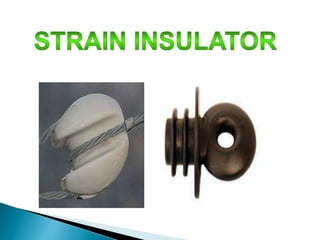
 When there is a dead end of the line or there is corner or
sharp curve, the line is subjected to greater tension.
 In order to relieve the line of excessive tension, strain
 insulators are used.
 For low voltage lines (< 11 kV), shackle insulators are
used as strain insulators.
 However, for high voltage transmission lines, strain insulator
consists of an assembly of suspension insulators as shown in
Figure.
 The discs of strain insulators are used in the vertical plane.
 When the tension in lines is exceedingly high, at long river
 spans, two or more strings are used in parallel.
 In early days, the shackle insulators were used
as strain insulators.
 But now a days, they are frequently used for low
 voltage distribution lines.
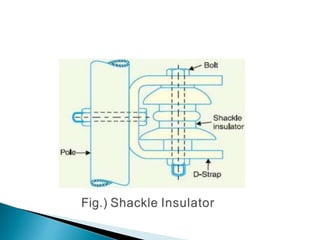
 Such insulators can be used either in a
horizontal position or in a vertical position.
 They can be directly fixed to the pole with a bolt
 or to the cross arm.
typesofconductorshantanu-170307193908.pptx

typesofconductorshantanu-170307193908.pptx

  • 1.
    PRESENTED BY- Farkhan WasilBEEE-3252 Safeer Hayat BEEE-3262 Asif Sardar BEEE-3399
  • 2.
    Introduction Different types ofconductor , Insulators and Poles  Conclusion
  • 3.
    The important factortaken into account in the selection of a conductor for a particular lines are conductivity, tensile strength, corona loss, local condition and cost.  The two most common conductor materials are Hard drawn copper and aluminium.
  • 4.
    Aluminium has thefollowing advantages over copper: Lower cost Lesser weight Larger diameter However ,the tensile strength of aluminium is lower than copper.
  • 5.
    1).Hard drawn copperconductor 2).Cadmium copper conductor 3).Steel core copper conductor 4).Copper welded conductor 5).All aluminium conductor(AAC) 6).Aluminium conductor steel reinforced(ACSR) 7).Smooth bodyACSR 8).ExpandedACSR
  • 6.
    It has veryhigh conductivity, good tensile high life, and weather resisting strength, properties.
  • 7.
    With addition ofcadmium there is increase in the tensile strength of copper at the cost of decrease in the conductivity. Thus these conductors can be used for longer spans. As tensile strength is increased, longer spans with same sag is possible.
  • 8.
    The steel coredcopper conductors are made by surrounding a steel core with on or more layers of copper strands. Due to addition of steel core tensile strength of conductor is increased.
  • 9.
    In this ,copperis welded on the steel wire to make copper welded conductor. The conductivity of copper weld conductor varies from 30 to 60% of that a solid copper conductor with same diameter. It is used for longer span such as river crossing.
  • 10.
    Due to increasingcost of copper, aluminium is used in transmission system. For a specific resistance, cross sectional area of aluminium condcutor is greater than that of copper while its weight is about 50% of that of copper conductor. This makes transportation and erection of such conductors economical. Corona effect is reduced due to increased diameter of conductor.
  • 11.
    It has asteel core forming the central layer of the stranded conductor around which we have a layer of aluminium strand. The important advantage ofACSR -high tensile strength -light weight -small sag -smaller support -high corona inception level
  • 12.
    Smooth body ACSRconductor is made by pressing conventional ACSR conductor through dies to flatten the aluminium strands into segmental shape. Thus with same aluminium area, diameter of steel core is increased which increases mechanical strength.
  • 13.
    The expanded conductorsare made by adding a plastic or fibrous material between steel core and aluminium strands. This increases diameter of conductor which reduces corona loss.
  • 14.
     An electricalinsulator is a material whose internal electric charges do not flow freely, and which therefore does not conduct an electric current, under the influence of an electric field.  A perfect insulator does not exist, but some materials such as glass, paper and Teflon, which have high resistivity, are very good electrical insulators.  Insulators are used in electrical equipment to support and separate electrical conductors without allowing current through themselves.
  • 15.
     There areseveral types of insulators but the most commonly used are : 1) Pin Insulator 2) Suspension Insulator 3) Strain Insulator and 4) Shackle insulator.
  • 17.
     A pininsulator consists of a non-conducting material such as porcelain, glass, plastic, polymer, or wood.  As the name suggests, the pin type insulator is secured to the cross-arm on the pole.  There is a groove on the upper end of the insulator for housing the conductor.  The conductor passes through this groove and is bound by the annealed wire of the same material as the conductor.  Pin type insulators are used for transmission and distribution of electric power at voltages upto 33 kV.  Beyond operating voltage of 33 kV, the pin type insulators become too bulky and hence uneconomical
  • 18.
     For highvoltages (>33 kV), it is a usual practice to use suspension type insulators consist of a number of porcelain discs connected in series by metal links in the form of a string.  The conductor is suspended at the bottom end of this string while the other end of the string is secured to the cross-arm of the tower.  Each unit or disc is designed for low voltage, say 11 kV.  The number of discs in series would obviously depend upon the working voltage.  For instance, if the working voltage is 66 kV, then six discs in series will be provided on the string.
  • 20.
     When thereis a dead end of the line or there is corner or sharp curve, the line is subjected to greater tension.  In order to relieve the line of excessive tension, strain  insulators are used.  For low voltage lines (< 11 kV), shackle insulators are used as strain insulators.  However, for high voltage transmission lines, strain insulator consists of an assembly of suspension insulators as shown in Figure.  The discs of strain insulators are used in the vertical plane.  When the tension in lines is exceedingly high, at long river  spans, two or more strings are used in parallel.
  • 22.
     In earlydays, the shackle insulators were used as strain insulators.  But now a days, they are frequently used for low  voltage distribution lines.  Such insulators can be used either in a horizontal position or in a vertical position.  They can be directly fixed to the pole with a bolt  or to the cross arm.