CRUISE
ITINERARY
PLANNING
Module 5
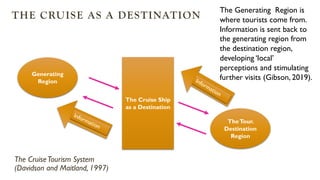
THE CRUISE AS A DESTINATION
The CruiseTourism System
(Davidson and Maitland, 1997)
TheTour.
Destination
Region
The Cruise Ship
as a Destination
Generating
Region Information
Information
The Generating Region is
where tourists come from.
Information is sent back to
the generating region from
the destination region,
developing ‘local’
perceptions and stimulating
further visits (Gibson, 2019).
HOW IS CRUISE ITINERARY
PLANNING CONDUCTED?
• A group consists of the captain, captains, and guests (feedback)
makes up the team of cruise itinerary planning specialists.
• Generally, the itinerary needs to be recognized by guests as a
logical concept with a balance and variety of destinations.
• These destinations should then sit well together in a sequential
manner to ensure that the voyage is presented in narrative
format.
(Gibson, 2019)
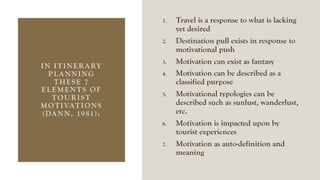
IN ITINERARY
PLANNING
THESE 7
ELEMENT S OF
TOURIST
MOTIVATIONS
(DANN, 1981):
1. Travel is a response to what is lacking
yet desired
2. Destination pull exists in response to
motivational push
3. Motivation can exist as fantasy
4. Motivation can be described as a
classified purpose
5. Motivational typologies can be
described such as sunlust, wanderlust,
etc.
6. Motivation is impacted upon by
tourist experiences
7. Motivation as auto-definition and
meaning
I T I S I M P E R A T I V E T H A T Y O U U N D E R S T A N D T H E G E O G R A P H Y !
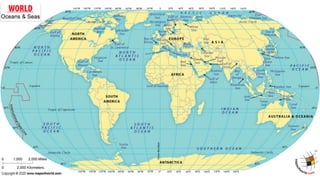
Practically, cruise companies regard the world as a combination of various sectors that
meet market demands. For the largest cruise brands, this creates opportunities to configure
operations to take account of the following:
• Seasonality, weather patterns and optimum conditions for cruising
• Sales and marketing
• Supply and servicing of ships
The safety and comfort of the people onboard are critical that is why the above factors are
imperative to consider. Changes in season, climate, and sea conditions including
geography could possibly create discomfort for passengers if itinerary is not well-planned
(Burton, 1995)
MAP
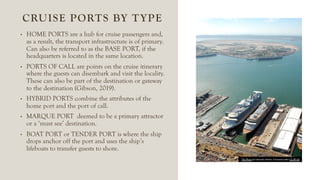
CRUISE PORTS BY TYPE
• HOME PORTS are a hub for cruise passengers and,
as a result, the transport infrastructure is of primary.
Can also be referred to as the BASE PORT, if the
headquarters is located in the same location.
• PORTS OF CALL are points on the cruise itinerary
where the guests can disembark and visit the locality.
These can also be part of the destination or gateway
to the destination (Gibson, 2019).
• HYBRID PORTS combine the attributes of the
home port and the port of call.
• MARQUE PORT deemed to be a primary attractor
or a ‘must see’ destination.
• BOAT PORT or TENDER PORT is where the ship
drops anchor off the port and uses the ship’s
lifeboats to transfer guests to shore.
This Photo by Unknown Author is licensed under CC BY-SA
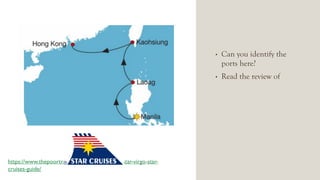
• Can you identify the
ports here?
• Read the review of
https://www.thepoortraveler.net/2017/04/superstar-virgo-star-
cruises-guide/
• The cruise operator avails the services of a a local port agent to act on the
cruise ship’s behalf: to be the shore-based facilitator and deal with a range
of matters, including official and immigration requirements, supply, onward
travel, shore excursions, technical support and specialized services.
• The local port agents are familiar and knowledgeable about the local ports
conditions and what to expect when they proceed ashore.
• In the Philippines, here are some of the local port agents:
BEN LINE AGENCIES
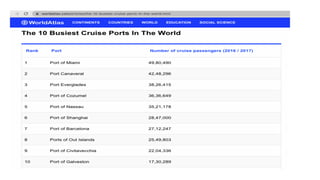
WORLDS BUSIEST PORTS
TOOLS USED IN PLANNING
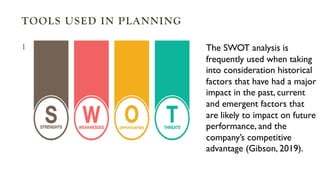
1. The SWOT analysis is
frequently used when taking
into consideration historical
factors that have had a major
impact in the past, current
and emergent factors that
are likely to impact on future
performance, and the
company’s competitive
advantage (Gibson, 2019).
TOOLS USED IN PLANNING
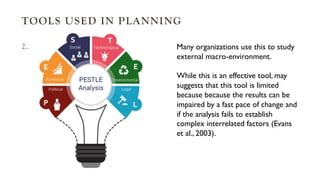
2.. Many organizations use this to study
external macro-environment.
While this is an effective tool, may
suggests that this tool is limited
because because the results can be
impaired by a fast pace of change and
if the analysis fails to establish
complex interrelated factors (Evans
et al., 2003).
TOOLS USED IN PLANNING
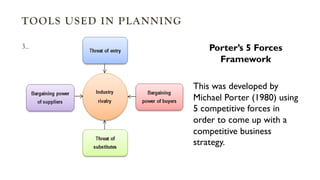
3.. Porter’s 5 Forces
Framework
This was developed by
Michael Porter (1980) using
5 competitive forces in
order to come up with a
competitive business
strategy.
TOOLS USED IN PLANNING
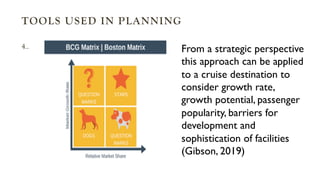
4.. From a strategic perspective
this approach can be applied
to a cruise destination to
consider growth rate,
growth potential, passenger
popularity, barriers for
development and
sophistication of facilities
(Gibson, 2019)
TOOLS USED IN PLANNING
5..
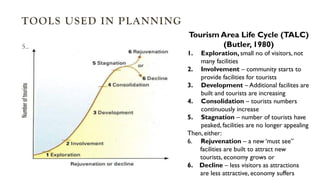
Tourism Area Life Cycle (TALC)
(Butler, 1980)
1. Exploration, small no of visitors, not
many facilities
2. Involvement – community starts to
provide facilities for tourists
3. Development – Additional facilites are
built and tourists are increasing
4. Consolidation – tourists numbers
continuously increase
5. Stagnation – number of tourists have
peaked, facilities are no longer appealing
Then, either:
6. Rejuvenation – a new ‘must see”
facilities are built to attract new
tourists, economy grows or
6. Decline – less visitors as attractions
are less attractive, economy suffers
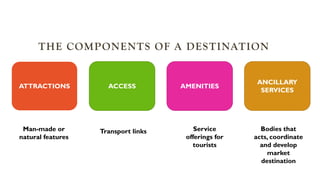
THE COMPONENTS OF A DESTINATION
ATTRACTIONS ACCESS AMENITIES
ANCILLARY
SERVICES
Man-made or
natural features
Transport links Service
offerings for
tourists
Bodies that
acts, coordinate
and develop
market
destination

5 - Planning the Itinerary.pdf

  • 1.
  • 2.
    THE CRUISE ASA DESTINATION The CruiseTourism System (Davidson and Maitland, 1997) TheTour. Destination Region The Cruise Ship as a Destination Generating Region Information Information The Generating Region is where tourists come from. Information is sent back to the generating region from the destination region, developing ‘local’ perceptions and stimulating further visits (Gibson, 2019).
  • 3.
    HOW IS CRUISEITINERARY PLANNING CONDUCTED? • A group consists of the captain, captains, and guests (feedback) makes up the team of cruise itinerary planning specialists. • Generally, the itinerary needs to be recognized by guests as a logical concept with a balance and variety of destinations. • These destinations should then sit well together in a sequential manner to ensure that the voyage is presented in narrative format. (Gibson, 2019)
  • 4.
    IN ITINERARY PLANNING THESE 7 ELEMENTS OF TOURIST MOTIVATIONS (DANN, 1981): 1. Travel is a response to what is lacking yet desired 2. Destination pull exists in response to motivational push 3. Motivation can exist as fantasy 4. Motivation can be described as a classified purpose 5. Motivational typologies can be described such as sunlust, wanderlust, etc. 6. Motivation is impacted upon by tourist experiences 7. Motivation as auto-definition and meaning
  • 5.
    I T IS I M P E R A T I V E T H A T Y O U U N D E R S T A N D T H E G E O G R A P H Y ! Practically, cruise companies regard the world as a combination of various sectors that meet market demands. For the largest cruise brands, this creates opportunities to configure operations to take account of the following: • Seasonality, weather patterns and optimum conditions for cruising • Sales and marketing • Supply and servicing of ships The safety and comfort of the people onboard are critical that is why the above factors are imperative to consider. Changes in season, climate, and sea conditions including geography could possibly create discomfort for passengers if itinerary is not well-planned (Burton, 1995)
  • 6.
  • 7.
    CRUISE PORTS BYTYPE • HOME PORTS are a hub for cruise passengers and, as a result, the transport infrastructure is of primary. Can also be referred to as the BASE PORT, if the headquarters is located in the same location. • PORTS OF CALL are points on the cruise itinerary where the guests can disembark and visit the locality. These can also be part of the destination or gateway to the destination (Gibson, 2019). • HYBRID PORTS combine the attributes of the home port and the port of call. • MARQUE PORT deemed to be a primary attractor or a ‘must see’ destination. • BOAT PORT or TENDER PORT is where the ship drops anchor off the port and uses the ship’s lifeboats to transfer guests to shore. This Photo by Unknown Author is licensed under CC BY-SA
  • 8.
    • Can youidentify the ports here? • Read the review of https://www.thepoortraveler.net/2017/04/superstar-virgo-star- cruises-guide/
  • 9.
    • The cruiseoperator avails the services of a a local port agent to act on the cruise ship’s behalf: to be the shore-based facilitator and deal with a range of matters, including official and immigration requirements, supply, onward travel, shore excursions, technical support and specialized services. • The local port agents are familiar and knowledgeable about the local ports conditions and what to expect when they proceed ashore. • In the Philippines, here are some of the local port agents: BEN LINE AGENCIES
  • 10.
  • 11.
    TOOLS USED INPLANNING 1. The SWOT analysis is frequently used when taking into consideration historical factors that have had a major impact in the past, current and emergent factors that are likely to impact on future performance, and the company’s competitive advantage (Gibson, 2019).
  • 12.
    TOOLS USED INPLANNING 2.. Many organizations use this to study external macro-environment. While this is an effective tool, may suggests that this tool is limited because because the results can be impaired by a fast pace of change and if the analysis fails to establish complex interrelated factors (Evans et al., 2003).
  • 13.
    TOOLS USED INPLANNING 3.. Porter’s 5 Forces Framework This was developed by Michael Porter (1980) using 5 competitive forces in order to come up with a competitive business strategy.
  • 14.
    TOOLS USED INPLANNING 4.. From a strategic perspective this approach can be applied to a cruise destination to consider growth rate, growth potential, passenger popularity, barriers for development and sophistication of facilities (Gibson, 2019)
  • 15.
    TOOLS USED INPLANNING 5.. Tourism Area Life Cycle (TALC) (Butler, 1980) 1. Exploration, small no of visitors, not many facilities 2. Involvement – community starts to provide facilities for tourists 3. Development – Additional facilites are built and tourists are increasing 4. Consolidation – tourists numbers continuously increase 5. Stagnation – number of tourists have peaked, facilities are no longer appealing Then, either: 6. Rejuvenation – a new ‘must see” facilities are built to attract new tourists, economy grows or 6. Decline – less visitors as attractions are less attractive, economy suffers
  • 16.
    THE COMPONENTS OFA DESTINATION ATTRACTIONS ACCESS AMENITIES ANCILLARY SERVICES Man-made or natural features Transport links Service offerings for tourists Bodies that acts, coordinate and develop market destination