


Hotel Industry
Hospitality industry is a part of service industry
HOTEL
HOSPITAL
HOSTEL
Tour & Travels – Airways, Rail ways, Roadways. Water ways.
Hospitality industry works on Hotels & Tour & travels.
REASONS FOR TRAVELLING
There are 3 major categories for travelers:
Business travelers
Pleasure travelers
Group travelers
06/08/14 www.sumitmanwal.blogspot.com
Business travel
Regular business travelers, is that segment of the
business travel market related to meetings and
convention.
06/08/14 www.sumitmanwal.blogspot.com
Pleasure travel
The specific segmentation of the pleasure travel
market often depends on the attractions, products,
and services offered by the destination area of
lodging property.
Typical market segments include specialized resort
travel, family pleasure travel, travel by the elderly,
and travel by singles and couples. They are generally
price-sensitive.
06/08/14 www.sumitmanwal.blogspot.com
Group travel
Group travel is considered different from business
travel because some groups, such as organized tours,
travel for pleasure.
Business travel related to meetings and conventions is
commonly classified into 2 markets; institutional and
corporate/government. Gatherings held by the
institutional market are usually open to the public.
(National conventions held by trade associations.)
Gatherings held by the corporate/government market
are usually closed to the public. (Professional and
technical meetings, training seminars.)
06/08/14 www.sumitmanwal.blogspot.com
Classification of hotels
Size
Location
Target market
Level of service
Ownership & affiliation
06/08/14 www.sumitmanwal.blogspot.com
1) SIZE – No of rooms
 There are generally four size categories for hotels;
 Under 150 rooms
 150 to 299 rooms
 300 to 600 rooms
 More than 600 rooms
06/08/14 www.sumitmanwal.blogspot.com
2) Location
Downtown hotels
Sub-urban hotels
Resort hotels
Airport Hotels
Motels
06/08/14 www.sumitmanwal.blogspot.com
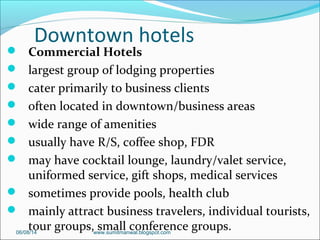
Downtown hotels
 Commercial Hotels
 largest group of lodging properties
 cater primarily to business clients
 often located in downtown/business areas
 wide range of amenities
 usually have R/S, coffee shop, FDR
 may have cocktail lounge, laundry/valet service,
uniformed service, gift shops, medical services
 sometimes provide pools, health club
 mainly attract business travelers, individual tourists,
tour groups, small conference groups.06/08/14 www.sumitmanwal.blogspot.com
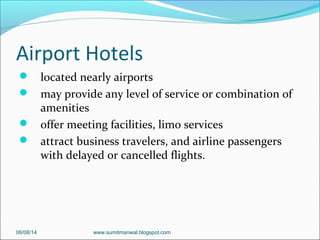
Airport Hotels
 located nearly airports
 may provide any level of service or combination of
amenities
 offer meeting facilities, limo services
 attract business travelers, and airline passengers
with delayed or cancelled flights.
06/08/14 www.sumitmanwal.blogspot.com
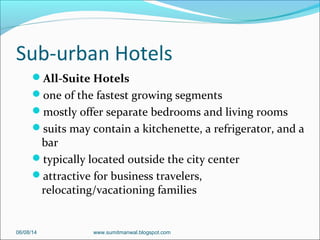
Sub-urban Hotels
All-Suite Hotels
one of the fastest growing segments
mostly offer separate bedrooms and living rooms
suits may contain a kitchenette, a refrigerator, and a
bar
typically located outside the city center
attractive for business travelers,
relocating/vacationing families
06/08/14 www.sumitmanwal.blogspot.com
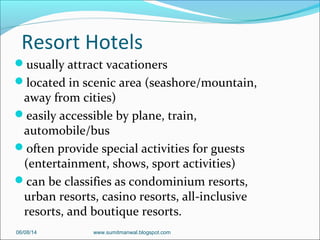
Resort Hotels
usually attract vacationers
located in scenic area (seashore/mountain,
away from cities)
easily accessible by plane, train,
automobile/bus
often provide special activities for guests
(entertainment, shows, sport activities)
can be classifies as condominium resorts,
urban resorts, casino resorts, all-inclusive
resorts, and boutique resorts.
06/08/14 www.sumitmanwal.blogspot.com
Motels
B&B Hotels
provide accommodations and breakfast to guests
breakfast may range from a continental breakfast to a
rich buffet
06/08/14 www.sumitmanwal.blogspot.com
Residential Hotels
offer principally long-term accommodations
usually offer housekeeping service, dining room,
R/S,
rooms are similar to suites in design
small F&B units
outside catering firms may provide food service
range from luxurious to moderate.
06/08/14 www.sumitmanwal.blogspot.com
Casino Hotels
rooms and F&B operations support gambling facilities
frequently offer entertainment, shows, specialty
restaurants
offer flights/limo services in order to attract guests
06/08/14 www.sumitmanwal.blogspot.com
Conference Centers
 are designed specifically to handle group meetings
 provide all the services/equipment for handling
meetings
 mostly offer overnight accommodations as well as
meeting facilities.
06/08/14 www.sumitmanwal.blogspot.com
Convention Hotels
offer extensive meeting space that attracts
meeting/convention groups
cater both commercial and meeting travelers
require specialized management expertise
06/08/14 www.sumitmanwal.blogspot.com
4) LEVEL OF SERVICES
Service level is a measure of the benefits provided to
the guest. The level of service is usually reflected in
a guest’s room rate.
World-Class Service
Mid-Range Service
Economy/Limited Service
06/08/14 www.sumitmanwal.blogspot.com
WORLD-CLASS SERVICE
Targets top business executives, entertainment
celebrities, high-ranking political figures, and
wealthy clientele as their primary markets.
World-class hotel stresses personalized guest
services and maintain a relatively high ratio of staff
members to guests.
In some hotels, certain floors are designated to
provide some of the hotel’s guests with world-class
attention.
06/08/14 www.sumitmanwal.blogspot.com
MID-RANGE SERVICE
Appeals to the largest segment of the traveling public
including business people, individual travelers and
families.
Often modest but sufficient.
May offer uniformed guest services, airport limousine
service and food and beverage room service, as well as
a specialty restaurant, coffee shop, and lounge that
cater to visitors and hotel guests.
People planning small conferences, group meetings,
and conventions may also find mid-range hotels
attractive.
06/08/14 www.sumitmanwal.blogspot.com
ECONOMY/LIMITED SERVICE
Provides clean, comfortable, inexpensive rooms and
meet the basic needs of guests.
Appeals to budget-minded travelers, including families
with children, bus tour groups, traveling business
people, vacationers, retirees, and group of
conventioneers.
Most may offer cable or satellite television, swimming
pools, limited F&B service, playgrounds, small meeting
rooms, and other special features.
They do not provide full F&B service.
06/08/14 www.sumitmanwal.blogspot.com
5) OWNERSHIP AND AFFILIATION
Independent Hotels
Chain Hotels
Management contracts
Franchising
Referral groups
06/08/14 www.sumitmanwal.blogspot.com
Independent Hotels
They have no relationship to other hotels regarding
policies, procedures, marketing, or financial
obligations. A typical example of an independent
property is a family-owned-and-operated hotel.
The unique advantage of an independent hotel is its
autonomy. An independent hotel, however, may not
enjoy broad advertising exposure or management
insight and consultancy of an affiliated property,
and is unable to take advantage of the volume
purchasing power of a chain hotel.
06/08/14 www.sumitmanwal.blogspot.com
Chain Hotels
Chain ownership usually imposes certain minimum
standards, rules, policies, and procedures to restrict
affiliate activities. In general, the more centralized the
organization, the stronger the control over the
individual property.
A chain is usually classified as operating under a
management contract or as a franchise or referral
group.
06/08/14 www.sumitmanwal.blogspot.com
Management contracts
Management companies are organizations that
operate properties owned by other entities.
Under this type of contract, the owner or developer
usually retains the financial and legal responsibility
for the property.
The Management Company usually operates the
hotel, pays its expenses and in turn, receives an
agreed-upon fee from the owner to developer.
06/08/14 www.sumitmanwal.blogspot.com
Franchising
Franchising is simply a method of distribution
whereby one entity that has developed a particular
pattern or format for doing business-the franchisor-
grants to other entities-franchisees-the right to
conduct such a business provided the franchisee
follows the established pattern.
06/08/14 www.sumitmanwal.blogspot.com
Referral groups
Referral groups consist of independent hotels, which
have banded together for some common purpose.
While each property in a referral system is not an
exact replica of the others, there is sufficient
consistency in the quality of service to satisfy guest
expectations. Best Western Int. Hotel is an example of
a referral group.
06/08/14 www.sumitmanwal.blogspot.com
THANKS
-
Sumit Manwal
Kindly visit & follow :-
www.sumitmanwal.blogspot.com
06/08/14 www.sumitmanwal.blogspot.com

Chapter 1.1 the lodging industry

  • 1.
  • 2.
    Hospitality industry isa part of service industry HOTEL HOSPITAL HOSTEL Tour & Travels – Airways, Rail ways, Roadways. Water ways. Hospitality industry works on Hotels & Tour & travels.
  • 3.
    REASONS FOR TRAVELLING Thereare 3 major categories for travelers: Business travelers Pleasure travelers Group travelers 06/08/14 www.sumitmanwal.blogspot.com
  • 4.
    Business travel Regular businesstravelers, is that segment of the business travel market related to meetings and convention. 06/08/14 www.sumitmanwal.blogspot.com
  • 5.
    Pleasure travel The specificsegmentation of the pleasure travel market often depends on the attractions, products, and services offered by the destination area of lodging property. Typical market segments include specialized resort travel, family pleasure travel, travel by the elderly, and travel by singles and couples. They are generally price-sensitive. 06/08/14 www.sumitmanwal.blogspot.com
  • 6.
    Group travel Group travelis considered different from business travel because some groups, such as organized tours, travel for pleasure. Business travel related to meetings and conventions is commonly classified into 2 markets; institutional and corporate/government. Gatherings held by the institutional market are usually open to the public. (National conventions held by trade associations.) Gatherings held by the corporate/government market are usually closed to the public. (Professional and technical meetings, training seminars.) 06/08/14 www.sumitmanwal.blogspot.com
  • 7.
    Classification of hotels Size Location Targetmarket Level of service Ownership & affiliation 06/08/14 www.sumitmanwal.blogspot.com
  • 8.
    1) SIZE –No of rooms  There are generally four size categories for hotels;  Under 150 rooms  150 to 299 rooms  300 to 600 rooms  More than 600 rooms 06/08/14 www.sumitmanwal.blogspot.com
  • 9.
    2) Location Downtown hotels Sub-urbanhotels Resort hotels Airport Hotels Motels 06/08/14 www.sumitmanwal.blogspot.com
  • 10.
    Downtown hotels  CommercialHotels  largest group of lodging properties  cater primarily to business clients  often located in downtown/business areas  wide range of amenities  usually have R/S, coffee shop, FDR  may have cocktail lounge, laundry/valet service, uniformed service, gift shops, medical services  sometimes provide pools, health club  mainly attract business travelers, individual tourists, tour groups, small conference groups.06/08/14 www.sumitmanwal.blogspot.com
  • 11.
    Airport Hotels  locatednearly airports  may provide any level of service or combination of amenities  offer meeting facilities, limo services  attract business travelers, and airline passengers with delayed or cancelled flights. 06/08/14 www.sumitmanwal.blogspot.com
  • 12.
    Sub-urban Hotels All-Suite Hotels oneof the fastest growing segments mostly offer separate bedrooms and living rooms suits may contain a kitchenette, a refrigerator, and a bar typically located outside the city center attractive for business travelers, relocating/vacationing families 06/08/14 www.sumitmanwal.blogspot.com
  • 13.
    Resort Hotels usually attractvacationers located in scenic area (seashore/mountain, away from cities) easily accessible by plane, train, automobile/bus often provide special activities for guests (entertainment, shows, sport activities) can be classifies as condominium resorts, urban resorts, casino resorts, all-inclusive resorts, and boutique resorts. 06/08/14 www.sumitmanwal.blogspot.com
  • 14.
    Motels B&B Hotels provide accommodationsand breakfast to guests breakfast may range from a continental breakfast to a rich buffet 06/08/14 www.sumitmanwal.blogspot.com
  • 15.
    Residential Hotels offer principallylong-term accommodations usually offer housekeeping service, dining room, R/S, rooms are similar to suites in design small F&B units outside catering firms may provide food service range from luxurious to moderate. 06/08/14 www.sumitmanwal.blogspot.com
  • 16.
    Casino Hotels rooms andF&B operations support gambling facilities frequently offer entertainment, shows, specialty restaurants offer flights/limo services in order to attract guests 06/08/14 www.sumitmanwal.blogspot.com
  • 17.
    Conference Centers  aredesigned specifically to handle group meetings  provide all the services/equipment for handling meetings  mostly offer overnight accommodations as well as meeting facilities. 06/08/14 www.sumitmanwal.blogspot.com
  • 18.
    Convention Hotels offer extensivemeeting space that attracts meeting/convention groups cater both commercial and meeting travelers require specialized management expertise 06/08/14 www.sumitmanwal.blogspot.com
  • 19.
    4) LEVEL OFSERVICES Service level is a measure of the benefits provided to the guest. The level of service is usually reflected in a guest’s room rate. World-Class Service Mid-Range Service Economy/Limited Service 06/08/14 www.sumitmanwal.blogspot.com
  • 20.
    WORLD-CLASS SERVICE Targets topbusiness executives, entertainment celebrities, high-ranking political figures, and wealthy clientele as their primary markets. World-class hotel stresses personalized guest services and maintain a relatively high ratio of staff members to guests. In some hotels, certain floors are designated to provide some of the hotel’s guests with world-class attention. 06/08/14 www.sumitmanwal.blogspot.com
  • 21.
    MID-RANGE SERVICE Appeals tothe largest segment of the traveling public including business people, individual travelers and families. Often modest but sufficient. May offer uniformed guest services, airport limousine service and food and beverage room service, as well as a specialty restaurant, coffee shop, and lounge that cater to visitors and hotel guests. People planning small conferences, group meetings, and conventions may also find mid-range hotels attractive. 06/08/14 www.sumitmanwal.blogspot.com
  • 22.
    ECONOMY/LIMITED SERVICE Provides clean,comfortable, inexpensive rooms and meet the basic needs of guests. Appeals to budget-minded travelers, including families with children, bus tour groups, traveling business people, vacationers, retirees, and group of conventioneers. Most may offer cable or satellite television, swimming pools, limited F&B service, playgrounds, small meeting rooms, and other special features. They do not provide full F&B service. 06/08/14 www.sumitmanwal.blogspot.com
  • 23.
    5) OWNERSHIP ANDAFFILIATION Independent Hotels Chain Hotels Management contracts Franchising Referral groups 06/08/14 www.sumitmanwal.blogspot.com
  • 24.
    Independent Hotels They haveno relationship to other hotels regarding policies, procedures, marketing, or financial obligations. A typical example of an independent property is a family-owned-and-operated hotel. The unique advantage of an independent hotel is its autonomy. An independent hotel, however, may not enjoy broad advertising exposure or management insight and consultancy of an affiliated property, and is unable to take advantage of the volume purchasing power of a chain hotel. 06/08/14 www.sumitmanwal.blogspot.com
  • 25.
    Chain Hotels Chain ownershipusually imposes certain minimum standards, rules, policies, and procedures to restrict affiliate activities. In general, the more centralized the organization, the stronger the control over the individual property. A chain is usually classified as operating under a management contract or as a franchise or referral group. 06/08/14 www.sumitmanwal.blogspot.com
  • 26.
    Management contracts Management companiesare organizations that operate properties owned by other entities. Under this type of contract, the owner or developer usually retains the financial and legal responsibility for the property. The Management Company usually operates the hotel, pays its expenses and in turn, receives an agreed-upon fee from the owner to developer. 06/08/14 www.sumitmanwal.blogspot.com
  • 27.
    Franchising Franchising is simplya method of distribution whereby one entity that has developed a particular pattern or format for doing business-the franchisor- grants to other entities-franchisees-the right to conduct such a business provided the franchisee follows the established pattern. 06/08/14 www.sumitmanwal.blogspot.com
  • 28.
    Referral groups Referral groupsconsist of independent hotels, which have banded together for some common purpose. While each property in a referral system is not an exact replica of the others, there is sufficient consistency in the quality of service to satisfy guest expectations. Best Western Int. Hotel is an example of a referral group. 06/08/14 www.sumitmanwal.blogspot.com
  • 29.
    THANKS - Sumit Manwal Kindly visit& follow :- www.sumitmanwal.blogspot.com 06/08/14 www.sumitmanwal.blogspot.com