The Beginnings of Industrialization
Learning Outcomes
1. Analyze how new improvements in
agriculture led to the growth of cities
and industry in England.
2. Compose a visual that shows how new
methods of transportation impacted life
during the Industrial Revolution.
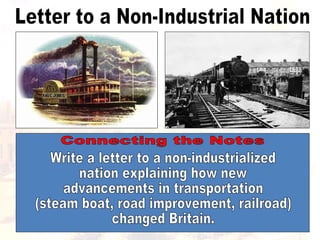
3. Write a letter to a non industrial nation
explaining how new advancements and
technologies changed life in Britain.
Kickoff Question: The Beginnings of Industrialization
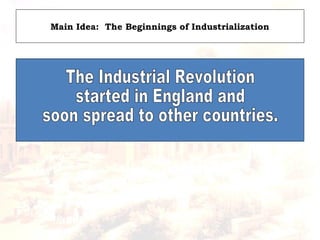
Main Idea: The Beginnings of Industrialization
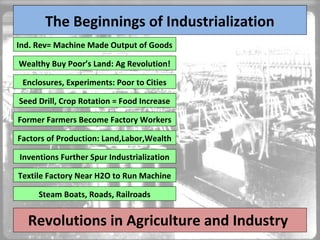
Ind. Rev= Machine Made Output of Goods
Former Farmers Become Factory Workers
Wealthy Buy Poor’s Land: Ag Revolution!
Enclosures, Experiments: Poor to Cities
Seed Drill, Crop Rotation = Food Increase
Steam Boats, Roads, Railroads
Textile Factory Near H2O to Run Machine
Inventions Further Spur Industrialization
Factors of Production: Land,Labor,Wealth
Revolutions in Agriculture and Industry
The Beginnings of Industrialization
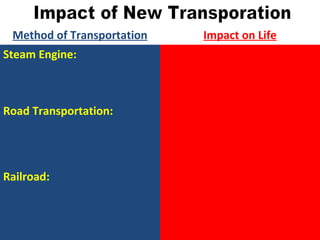
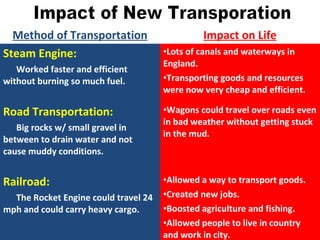
Method of Transportation Impact on Life
Steam Engine:
Road Transportation:
Railroad:
Method of Transportation Impact on Life
Steam Engine:
Worked faster and efficient
without burning so much fuel.
•Lots of canals and waterways in
England.
•Transporting goods and resources
were now very cheap and efficient.
Road Transportation:
Big rocks w/ small gravel in
between to drain water and not
cause muddy conditions.
•Wagons could travel over roads even
in bad weather without getting stuck
in the mud.
Railroad:
The Rocket Engine could travel 24
mph and could carry heavy cargo.
•Allowed a way to transport goods.
•Created new jobs.
•Boosted agriculture and fishing.
•Allowed people to live in country
and work in city.
Exit Slip: The Beginnings of Industrialization
Kickoff Question: Factory Simulation
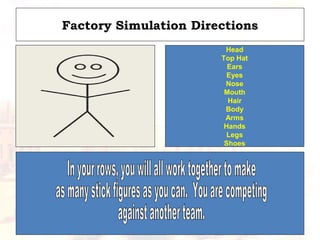
Factory Simulation Directions
Head
Top Hat
Ears
Eyes
Nose
Mouth
Hair
Body
Arms
Hands
Legs
Shoes
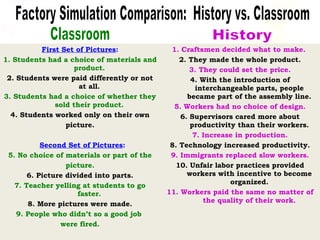
First Set of Pictures:
1. Students had a choice of materials and
product.
2. Students were paid differently or not
at all.
3. Students had a choice of whether they
sold their product.
4. Students worked only on their own
picture.
Second Set of Pictures:
5. No choice of materials or part of the
picture.
6. Picture divided into parts.
7. Teacher yelling at students to go
faster.
8. More pictures were made.
9. People who didn’t so a good job
were fired.
1. Craftsmen decided what to make.
2. They made the whole product.
3. They could set the price.
4. With the introduction of
interchangeable parts, people
became part of the assembly line.
5. Workers had no choice of design.
6. Supervisors cared more about
productivity than their workers.
7. Increase in production.
8. Technology increased productivity.
9. Immigrants replaced slow workers.
10. Unfair labor practices provided
workers with incentive to become
organized.
11. Workers paid the same no matter of
the quality of their work.
Industrialization Changes Life
Learning Outcomes
1. Explore how the Industrial Revolution
impacted specific cities by examining a case
study of Manchester.
2. Build a two column t-chart that shows how
both the positive and negative aspects of
industrialization and urbanization of cities.
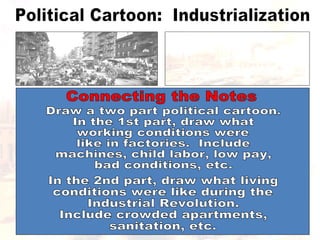
3. Sketch a Political cartoon that identifies
key problems with industrialization both at
home and in the factories.
Kickoff Question: Industrialization Changes Life
Main Idea: Industrialization Changes Life
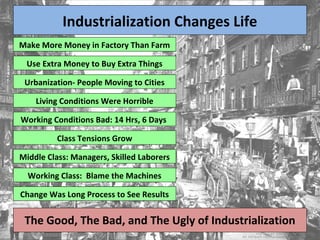
Make More Money in Factory Than Farm
Working Conditions Bad: 14 Hrs, 6 Days
Use Extra Money to Buy Extra Things
Urbanization- People Moving to Cities
Living Conditions Were Horrible
Change Was Long Process to See Results
Working Class: Blame the Machines
Middle Class: Managers, Skilled Laborers
Class Tensions Grow
The Good, The Bad, and The Ugly of Industrialization
Industrialization Changes Life
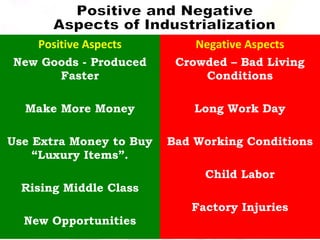
Positive Aspects Negative Aspects
New Goods - Produced
Faster
Make More Money
Use Extra Money to Buy
“Luxury Items”.
Rising Middle Class
New Opportunities
Crowded – Bad Living
Conditions
Long Work Day
Bad Working Conditions
Child Labor
Factory Injuries
Exit Slip: Industrialization Changes Life
Industrialization Spreads
Learning Outcomes
1. Explain how other countries were able
to industrialize by implementing Great
Britain’s factors of production.
Evaluate their successes and failures.
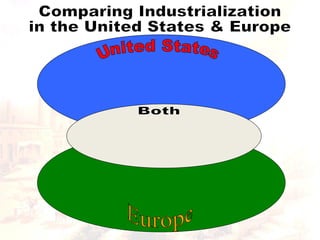
2. Prepare a circle diagram comparing and
contrasting industrialization in Europe
and the United States.
3. Predict what life would be like now
without industrialization, and sketch
your predictions in your notebook.
Kickoff Question: Industrialization Spreads
Main Idea: Industrialization Spreads
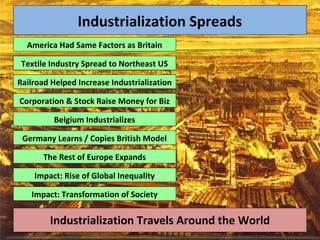
America Had Same Factors as Britain
Belgium Industrializes
Textile Industry Spread to Northeast US
Railroad Helped Increase Industrialization
Corporation & Stock Raise Money for Biz
Impact: Transformation of Society
Impact: Rise of Global Inequality
The Rest of Europe Expands
Germany Learns / Copies British Model
Industrialization Travels Around the World
Industrialization Spreads
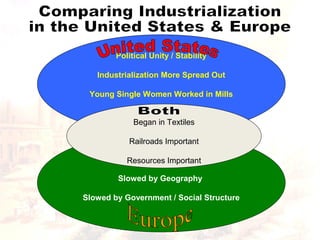
Political Unity / Stability
Industrialization More Spread Out
Young Single Women Worked in Mills
Slowed by Geography
Slowed by Government / Social Structure
Began in Textiles
Railroads Important
Resources Important
Exit Slip: Industrialization Spreads
Reforming the Industrial World
Learning Outcomes
1. Discuss how the Industrial Revolution
led to economic, political, and social
reforms.
2. Differentiate between capitalism and
socialism by creating a t-chart that
compares the two economic systems.
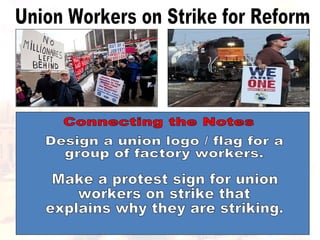
3. Design a union logo or flag for a group
of workers on strike. In addition, make
a protest sign that explains reasons
why a worker might strike.
Kickoff Question: Reforming the Industrial World
Main Idea: Reforming the Industrial World
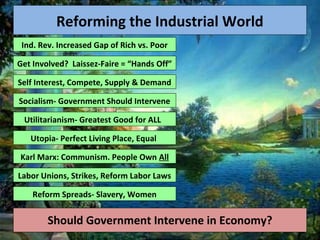
Ind. Rev. Increased Gap of Rich vs. Poor
Utilitarianism- Greatest Good for ALL
Get Involved? Laissez-Faire = “Hands Off”
Self Interest, Compete, Supply & Demand
Socialism- Government Should Intervene
Reform Spreads- Slavery, Women
Labor Unions, Strikes, Reform Labor Laws
Karl Marx: Communism. People Own All
Utopia- Perfect Living Place, Equal
Should Government Intervene in Economy?
Reforming the Industrial World
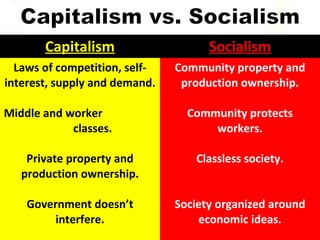
Capitalism Socialism
Laws of competition, self-
interest, supply and demand.
Community property and
production ownership.
Middle and worker
classes.
Community protects
workers.
Private property and
production ownership.
Classless society.
Government doesn’t
interfere.
Society organized around
economic ideas.
Exit Slip: Reforming the Industrial World
# 5 Industrial Revolution

# 5 Industrial Revolution

  • 3.
    The Beginnings ofIndustrialization Learning Outcomes 1. Analyze how new improvements in agriculture led to the growth of cities and industry in England. 2. Compose a visual that shows how new methods of transportation impacted life during the Industrial Revolution. 3. Write a letter to a non industrial nation explaining how new advancements and technologies changed life in Britain.
  • 4.
    Kickoff Question: TheBeginnings of Industrialization
  • 5.
    Main Idea: TheBeginnings of Industrialization
  • 6.
    Ind. Rev= MachineMade Output of Goods Former Farmers Become Factory Workers Wealthy Buy Poor’s Land: Ag Revolution! Enclosures, Experiments: Poor to Cities Seed Drill, Crop Rotation = Food Increase Steam Boats, Roads, Railroads Textile Factory Near H2O to Run Machine Inventions Further Spur Industrialization Factors of Production: Land,Labor,Wealth Revolutions in Agriculture and Industry The Beginnings of Industrialization
  • 7.
    Method of TransportationImpact on Life Steam Engine: Road Transportation: Railroad:
  • 8.
    Method of TransportationImpact on Life Steam Engine: Worked faster and efficient without burning so much fuel. •Lots of canals and waterways in England. •Transporting goods and resources were now very cheap and efficient. Road Transportation: Big rocks w/ small gravel in between to drain water and not cause muddy conditions. •Wagons could travel over roads even in bad weather without getting stuck in the mud. Railroad: The Rocket Engine could travel 24 mph and could carry heavy cargo. •Allowed a way to transport goods. •Created new jobs. •Boosted agriculture and fishing. •Allowed people to live in country and work in city.
  • 10.
    Exit Slip: TheBeginnings of Industrialization
  • 15.
  • 16.
    Factory Simulation Directions Head TopHat Ears Eyes Nose Mouth Hair Body Arms Hands Legs Shoes
  • 18.
    First Set ofPictures: 1. Students had a choice of materials and product. 2. Students were paid differently or not at all. 3. Students had a choice of whether they sold their product. 4. Students worked only on their own picture. Second Set of Pictures: 5. No choice of materials or part of the picture. 6. Picture divided into parts. 7. Teacher yelling at students to go faster. 8. More pictures were made. 9. People who didn’t so a good job were fired. 1. Craftsmen decided what to make. 2. They made the whole product. 3. They could set the price. 4. With the introduction of interchangeable parts, people became part of the assembly line. 5. Workers had no choice of design. 6. Supervisors cared more about productivity than their workers. 7. Increase in production. 8. Technology increased productivity. 9. Immigrants replaced slow workers. 10. Unfair labor practices provided workers with incentive to become organized. 11. Workers paid the same no matter of the quality of their work.
  • 20.
    Industrialization Changes Life LearningOutcomes 1. Explore how the Industrial Revolution impacted specific cities by examining a case study of Manchester. 2. Build a two column t-chart that shows how both the positive and negative aspects of industrialization and urbanization of cities. 3. Sketch a Political cartoon that identifies key problems with industrialization both at home and in the factories.
  • 21.
  • 22.
  • 23.
    Make More Moneyin Factory Than Farm Working Conditions Bad: 14 Hrs, 6 Days Use Extra Money to Buy Extra Things Urbanization- People Moving to Cities Living Conditions Were Horrible Change Was Long Process to See Results Working Class: Blame the Machines Middle Class: Managers, Skilled Laborers Class Tensions Grow The Good, The Bad, and The Ugly of Industrialization Industrialization Changes Life
  • 24.
  • 25.
    Positive Aspects NegativeAspects New Goods - Produced Faster Make More Money Use Extra Money to Buy “Luxury Items”. Rising Middle Class New Opportunities Crowded – Bad Living Conditions Long Work Day Bad Working Conditions Child Labor Factory Injuries
  • 27.
  • 31.
    Industrialization Spreads Learning Outcomes 1.Explain how other countries were able to industrialize by implementing Great Britain’s factors of production. Evaluate their successes and failures. 2. Prepare a circle diagram comparing and contrasting industrialization in Europe and the United States. 3. Predict what life would be like now without industrialization, and sketch your predictions in your notebook.
  • 32.
  • 33.
  • 34.
    America Had SameFactors as Britain Belgium Industrializes Textile Industry Spread to Northeast US Railroad Helped Increase Industrialization Corporation & Stock Raise Money for Biz Impact: Transformation of Society Impact: Rise of Global Inequality The Rest of Europe Expands Germany Learns / Copies British Model Industrialization Travels Around the World Industrialization Spreads
  • 36.
    Political Unity /Stability Industrialization More Spread Out Young Single Women Worked in Mills Slowed by Geography Slowed by Government / Social Structure Began in Textiles Railroads Important Resources Important
  • 38.
  • 43.
    Reforming the IndustrialWorld Learning Outcomes 1. Discuss how the Industrial Revolution led to economic, political, and social reforms. 2. Differentiate between capitalism and socialism by creating a t-chart that compares the two economic systems. 3. Design a union logo or flag for a group of workers on strike. In addition, make a protest sign that explains reasons why a worker might strike.
  • 44.
    Kickoff Question: Reformingthe Industrial World
  • 45.
    Main Idea: Reformingthe Industrial World
  • 46.
    Ind. Rev. IncreasedGap of Rich vs. Poor Utilitarianism- Greatest Good for ALL Get Involved? Laissez-Faire = “Hands Off” Self Interest, Compete, Supply & Demand Socialism- Government Should Intervene Reform Spreads- Slavery, Women Labor Unions, Strikes, Reform Labor Laws Karl Marx: Communism. People Own All Utopia- Perfect Living Place, Equal Should Government Intervene in Economy? Reforming the Industrial World
  • 47.
  • 48.
    Capitalism Socialism Laws ofcompetition, self- interest, supply and demand. Community property and production ownership. Middle and worker classes. Community protects workers. Private property and production ownership. Classless society. Government doesn’t interfere. Society organized around economic ideas.
  • 50.
    Exit Slip: Reformingthe Industrial World