International Conference on Healthy Lifestyles and Non
          Communicable Diseases (NCD)
     In the Arab World and the Middle-East
    (Riyadh, KSA, 9-12 September 2012)


         NCD Prevention and
            Control
     Experience in North Africa
                            Pr Habiba Ben Romdhane

                   Cardiovascular Epidemiology &
                   Prevention Resarch Laboratory
                              Tunisia
   This presentation examines the
    preparedness of three of the Northern
    Africa countries (Algeria, Morocco and
    Tunisia) to manage the challenge posed
    by the increase of NCDs.
   The choice of these countries is motivated
    by their similarity in culture and
    lifestyle , and health sector organization ,
    heritage of the French colonisation .
   Their total population is almost 25% of
    the Arab population .
Burden of NCDs
   NCD are the causes of deaths: 56%
    in Morocco, 58% in Algeria and
    62% in Tunisia
   Tunisia has the highest prevalence
    of tobacco and obesity
   There is a gender specificity on
    risk factors prevalence : highest
    prevalence of tobacco smoking on
    men and obesity on women
NCDs Management
   MoH is the key strategic and delivery
    institution, overseeing the planning and
    provision of the bulk of health services.
   Within the MoH, NCDs responsibility lies
    with the Department of Primary Health Care
    where are established NCDs Unit
    /Department
   Steering committees are established in the
    MoH
   A growing private sector exists in the main
    urban centres, offering diagnostic services
NCDs Management
   Early in the 1990’s , national programs on
    hypertension and diabetes were
    implemented;
   In Tunisia CVDs strategy document was
    elaborted since 1999.
   During the 2000’s were elaborated :
        Plans on Cancer,on Mental Health and
         on Tobacco
   Ariana Healthy Urbanization Project
    (Tunisia). This project was based on
    multisectorial approach .
2008-2013 Action Plan: what
      has it achieved ?

     Plans of action for the period
    (2008-2013) are elaborated.
    However, in the three countries,
    the plans are not really
    implemented . They are not
    endorsed by the different
    departments and stakeholders.
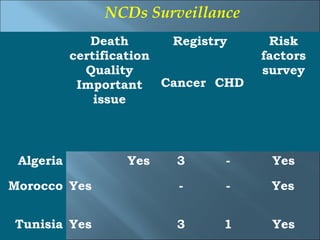
NCDs Surveillance
              Death      Registry    Risk
           certification            factors
             Quality                survey
            Important Cancer CHD
               issue


 Algeria          Yes   3     -      Yes

Morocco Yes             -     -      Yes


Tunisia Yes             3     1      Yes
   Health information systems
    are fragmented and ill-
    suited to the task of
    monitoring patient
    treatment, at either an
    individual or a population
    level, or resources .
Health care
   Integration in PHC (Hypertension
    and diabetes)
   Absence of coherent – indeed any –
    referral pathways between primary
    and secondary health services
   inadequate access to essential
    health technologies and medicines
   Inequalities
Reduction of risk factors

  Gaps in implementing “best
  buys” :
   FCTC and tobacco control
    measures
   salt reduction
   programmes marketing of
    foods
   physical activities
    programmes
Multisectorial Actions
   A lack of coordination within the
    health sector is perceived to be
    worsening with the growth of a
    private sector .
   The need to be tackling such a
    major public health concern
    through collaboration outside the
    health sector is subordinated to the
    more pressing issue of collaboration
    within the health sector itself.
Financing
   The economic implications of rising
    NCD levels is an adding urgency to the
    search for alternative financial models
    of health care
   The private sector is seen as almost a
    parallel health economy, NCDs are “an
    abyss of money”
   Out-of-pocket and catastrophic
    expenditure due to NCDs are source of
    inequality
   Epidemiological Transition And
    Health Impact In North Africa
    (TAHINA)
   MEDiterranean studies of
    Cardiovascular disease and
    Hyperglycaemia: Analytical
    Modelling of Population Socio-
    economic transitions
    (MedCHAMPS)
   NCDs & their social determinants
    in Mediterranean : building
    sustainable RESearch CAPacity
    for effective policy intervention
    (RESCAP-MED)
Key Outcomes
   Determinants , trend and impact of the
    Epidemiological transition in North
    Africa
   Epidemiological modelling (IMPACT
    CHD mortality model)
   Diabetes projection and policy
    modelling tool
   Stroke modelling
Key Outcomes
   Health system analysis : how is it
    organised to manage the care of those
    with CVD or diabetes and what are key
    concerns about the institutional
    capability to address these challenges.
   A ‘policy effectiveness-feasibility loop’
    designed to foster collaboration
    between researchers and policy makers.
Key Outcomes
   Cost effectiveness analysis of salt
    reduction policies to reduce coronary
    heart disease

   Policy options beyond salt reduction

   Building research capacity in several
    disciplines which must work together to
    improve health care policies for NCDs .
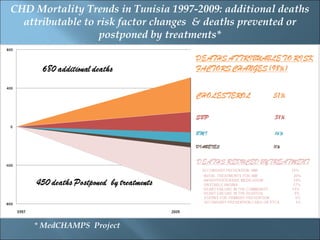
CHD Mortality Trends in Tunisia 1997-2009: additional deaths
  attributable to risk factor changes & deaths prevented or
                  postponed by treatments*


    * MedCHAMPS Project
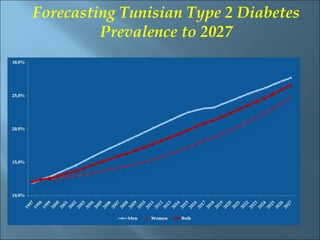
Forecasting Tunisian Type 2 Diabetes
         Prevalence to 2027
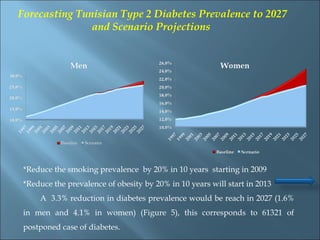
Forecasting Tunisian Type 2 Diabetes Prevalence to 2027
               and Scenario Projections


 *Reduce the smoking prevalence by 20% in 10 years starting in 2009
 *Reduce the prevalence of obesity by 20% in 10 years will start in 2013
     A 3.3% reduction in diabetes prevalence would be reach in 2027 (1.6%
 in men and 4.1% in women) (Figure 5), this corresponds to 61321 of
 postponed case of diabetes.
What is the way forward in NA
   Northern Africa countries are facing
    many challenges to achieve the
    objectives of Global Action Plan for
    the Prevention and Control of
    NCDs
   Regional partnership for capacity
    building is one of the strategic
    areas to bridge the gap
Thank you for your
    attention

5 habiba ben romdhane

  • 1.
    International Conference onHealthy Lifestyles and Non Communicable Diseases (NCD) In the Arab World and the Middle-East (Riyadh, KSA, 9-12 September 2012) NCD Prevention and Control Experience in North Africa Pr Habiba Ben Romdhane Cardiovascular Epidemiology & Prevention Resarch Laboratory Tunisia
  • 2.
    This presentation examines the preparedness of three of the Northern Africa countries (Algeria, Morocco and Tunisia) to manage the challenge posed by the increase of NCDs.  The choice of these countries is motivated by their similarity in culture and lifestyle , and health sector organization , heritage of the French colonisation .  Their total population is almost 25% of the Arab population .
  • 3.
    Burden of NCDs  NCD are the causes of deaths: 56% in Morocco, 58% in Algeria and 62% in Tunisia  Tunisia has the highest prevalence of tobacco and obesity  There is a gender specificity on risk factors prevalence : highest prevalence of tobacco smoking on men and obesity on women
  • 4.
    NCDs Management  MoH is the key strategic and delivery institution, overseeing the planning and provision of the bulk of health services.  Within the MoH, NCDs responsibility lies with the Department of Primary Health Care where are established NCDs Unit /Department  Steering committees are established in the MoH  A growing private sector exists in the main urban centres, offering diagnostic services
  • 5.
    NCDs Management  Early in the 1990’s , national programs on hypertension and diabetes were implemented;  In Tunisia CVDs strategy document was elaborted since 1999.  During the 2000’s were elaborated :  Plans on Cancer,on Mental Health and on Tobacco  Ariana Healthy Urbanization Project (Tunisia). This project was based on multisectorial approach .
  • 6.
    2008-2013 Action Plan:what has it achieved ?
  • 7.
    Plans of action for the period (2008-2013) are elaborated. However, in the three countries, the plans are not really implemented . They are not endorsed by the different departments and stakeholders.
  • 8.
    NCDs Surveillance Death Registry Risk certification factors Quality survey Important Cancer CHD issue Algeria Yes 3 - Yes Morocco Yes - - Yes Tunisia Yes 3 1 Yes
  • 9.
    Health information systems are fragmented and ill- suited to the task of monitoring patient treatment, at either an individual or a population level, or resources .
  • 10.
    Health care  Integration in PHC (Hypertension and diabetes)  Absence of coherent – indeed any – referral pathways between primary and secondary health services  inadequate access to essential health technologies and medicines  Inequalities
  • 11.
    Reduction of riskfactors Gaps in implementing “best buys” : FCTC and tobacco control measures salt reduction programmes marketing of foods physical activities programmes
  • 12.
    Multisectorial Actions  A lack of coordination within the health sector is perceived to be worsening with the growth of a private sector .  The need to be tackling such a major public health concern through collaboration outside the health sector is subordinated to the more pressing issue of collaboration within the health sector itself.
  • 13.
    Financing  The economic implications of rising NCD levels is an adding urgency to the search for alternative financial models of health care  The private sector is seen as almost a parallel health economy, NCDs are “an abyss of money”  Out-of-pocket and catastrophic expenditure due to NCDs are source of inequality
  • 14.
    Epidemiological Transition And Health Impact In North Africa (TAHINA)  MEDiterranean studies of Cardiovascular disease and Hyperglycaemia: Analytical Modelling of Population Socio- economic transitions (MedCHAMPS)  NCDs & their social determinants in Mediterranean : building sustainable RESearch CAPacity for effective policy intervention (RESCAP-MED)
  • 15.
    Key Outcomes  Determinants , trend and impact of the Epidemiological transition in North Africa  Epidemiological modelling (IMPACT CHD mortality model)  Diabetes projection and policy modelling tool  Stroke modelling
  • 16.
    Key Outcomes  Health system analysis : how is it organised to manage the care of those with CVD or diabetes and what are key concerns about the institutional capability to address these challenges.  A ‘policy effectiveness-feasibility loop’ designed to foster collaboration between researchers and policy makers.
  • 17.
    Key Outcomes  Cost effectiveness analysis of salt reduction policies to reduce coronary heart disease  Policy options beyond salt reduction  Building research capacity in several disciplines which must work together to improve health care policies for NCDs .
  • 18.
    CHD Mortality Trendsin Tunisia 1997-2009: additional deaths attributable to risk factor changes & deaths prevented or postponed by treatments* * MedCHAMPS Project
  • 19.
    Forecasting Tunisian Type2 Diabetes Prevalence to 2027
  • 20.
    Forecasting Tunisian Type2 Diabetes Prevalence to 2027 and Scenario Projections *Reduce the smoking prevalence by 20% in 10 years starting in 2009 *Reduce the prevalence of obesity by 20% in 10 years will start in 2013 A 3.3% reduction in diabetes prevalence would be reach in 2027 (1.6% in men and 4.1% in women) (Figure 5), this corresponds to 61321 of postponed case of diabetes.
  • 21.
    What is theway forward in NA  Northern Africa countries are facing many challenges to achieve the objectives of Global Action Plan for the Prevention and Control of NCDs  Regional partnership for capacity building is one of the strategic areas to bridge the gap
  • 22.
    Thank you foryour attention

Editor's Notes

  • #6 Few data on local initiatives targeting NCDs are available. A successful examples come from Tunisia : Ariana Healthy Urbanization Project