2
Indian health system
Overview, issues & challenges
Prashanth N S MBBS, MPH, PhD
Institute of Public Health, Bengaluru
Outline
• Part 1: Introduction, human resources in health in India, health
(in)equity patterns in India and social determinants of health
• Part 2: Structure and functioning of the health system and services
in India with respect to
– Health Services
– The disease burden
– Human resources
– Medicines
– Governance
– Financing of Indian health services
• Part 3: Bringing it together – health system frameworks
4
India
• India is a
– Sovereign
– Socialist
– Secular
– Democratic
– Republic
• Promote
– Justice
– Liberty
– Equality
– Fraternity
5
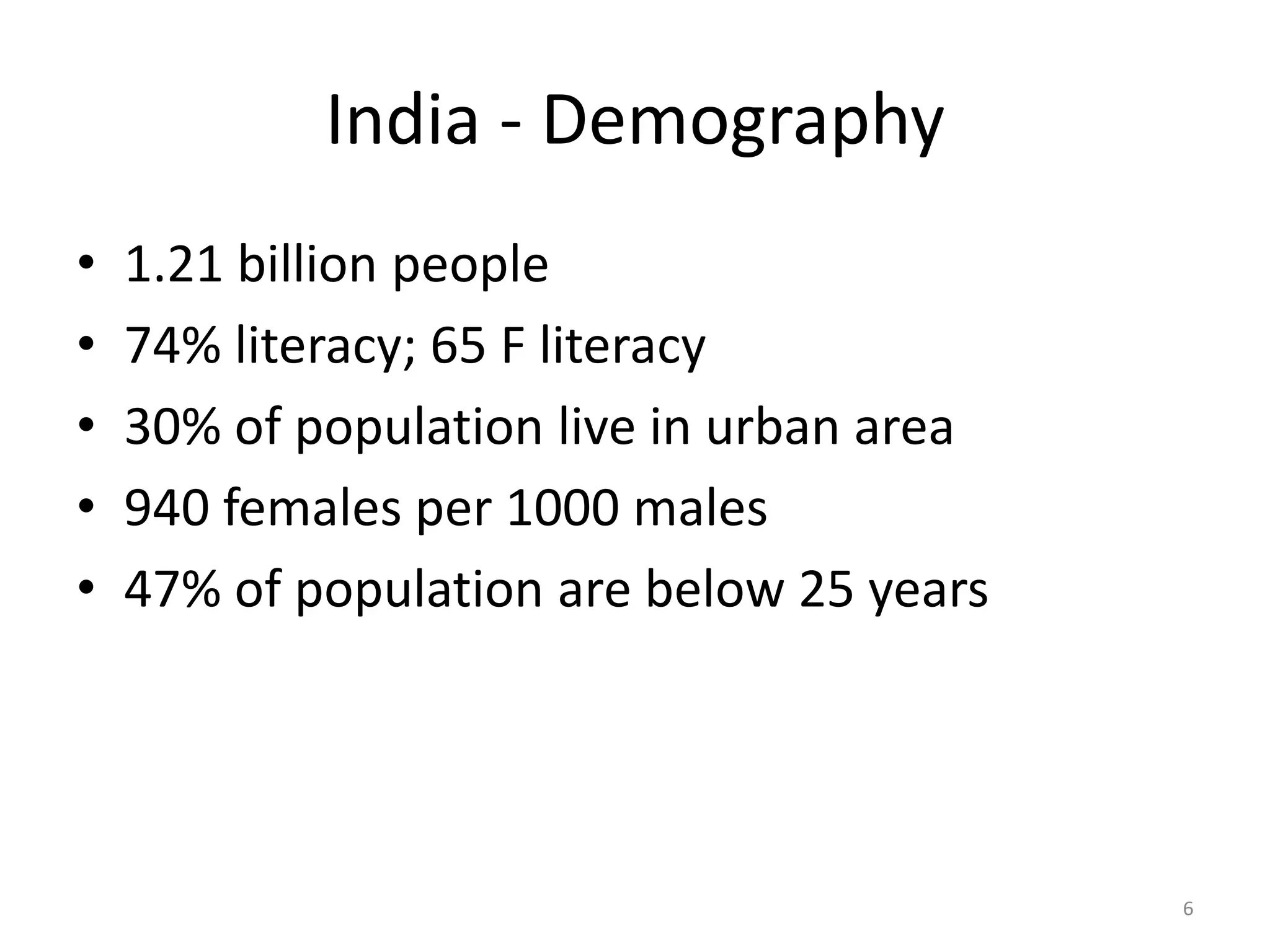
India - Demography
• 1.21 billion people
• 74% literacy; 65 F literacy
• 30% of population live in urban area
• 940 females per 1000 males
• 47% of population are below 25 years
6
India - Social
• Secular – Hindus (83%), Muslims (13%),
Christians (2%), Others (2%)
• Social stratification along caste lines though
the system is abolished
• 38% of population classified as socially
vulnerable
7
Do health workers save lives? More
health workers, more health. True?
Do health workers save lives?
• Doctor
anomaly
• Cardiologists’
holiday
paradox
WHR 2006
WHR 2006
WHR 2006
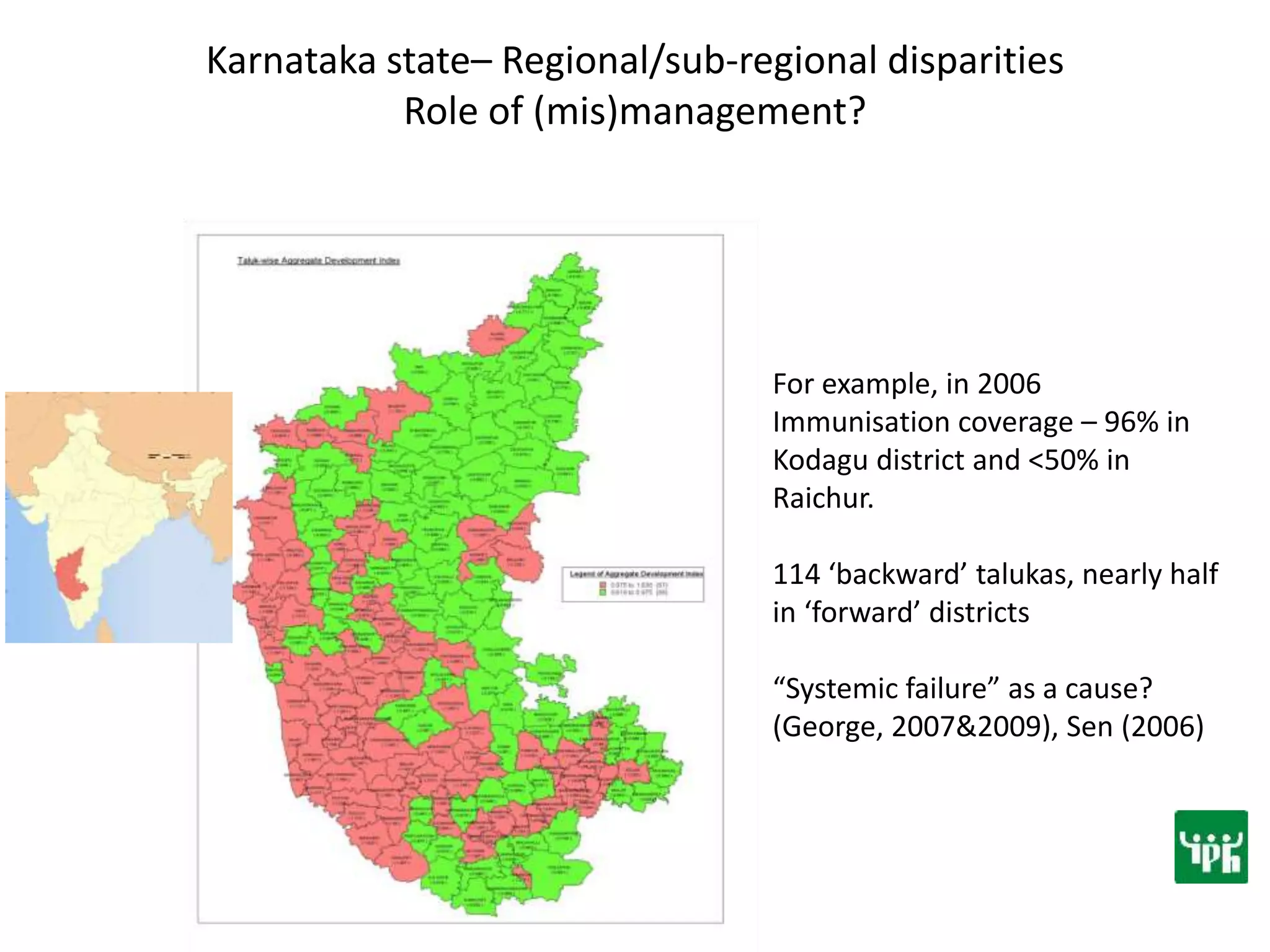
Karnataka state– Regional/sub-regional disparities
Role of (mis)management?
For example, in 2006
Immunisation coverage – 96% in
Kodagu district and <50% in
Raichur.
114 ‘backward’ talukas, nearly half
in ‘forward’ districts
“Systemic failure” as a cause?
(George, 2007&2009), Sen (2006)
What is capacity?
Brown, L., LaFond, A., & Macintyre, K. (2001). Measuring capacity
building. Chapel Hill: MEASURE Evaluation.
06/12/13
NS Prashanth, PhD Committee meeting,
UCL
14
A few characteristics of HR/health
systems
So, then what is a system? Is it called a
system because it works
“systematically”?
-> Systems thinking
Complexity
• Simple, complicated and complex problems
• Health service versus a health system
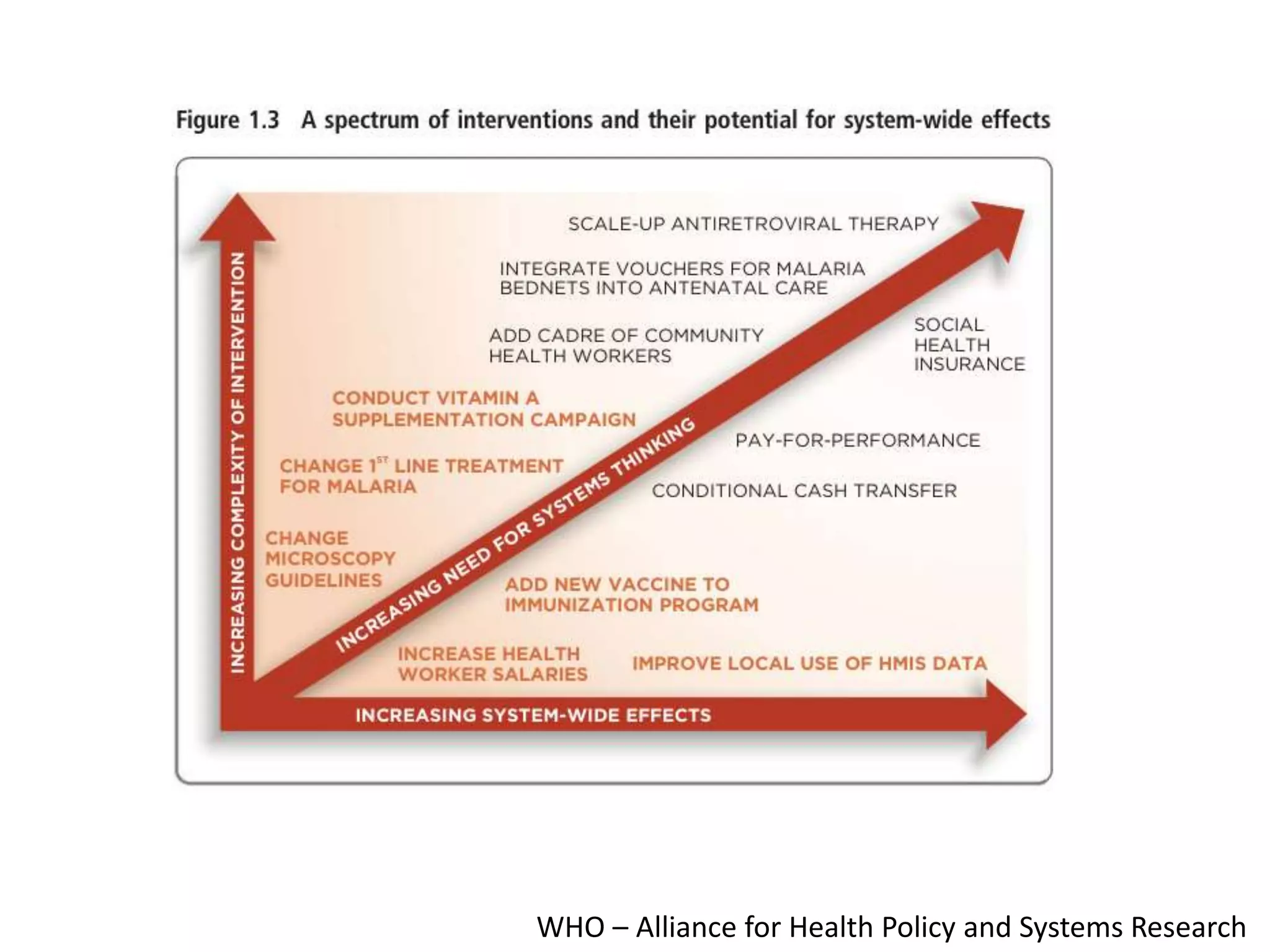
…& HR (& health) systems are complex…
WHO – Alliance for Health Policy and Systems Research
Layered dimensions of HRM in a
system
• Individual
• Institutional (workplace)
• Meso/Macro policy level factors
• Environmental, societal, socio-political
Inequities
20
India – a land of
contrasts
21
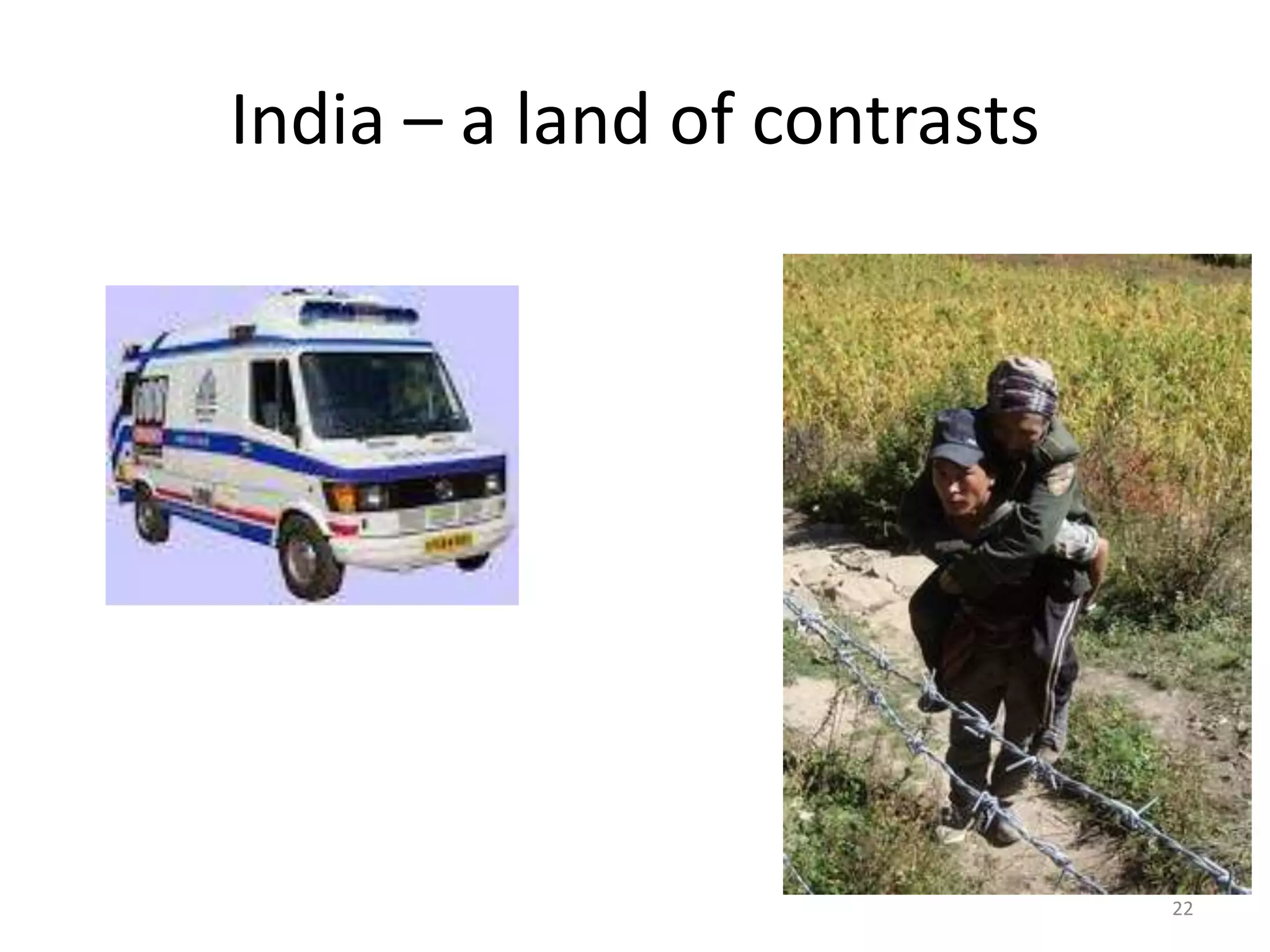
India – a land of contrasts
22
India – a land of contrasts
23
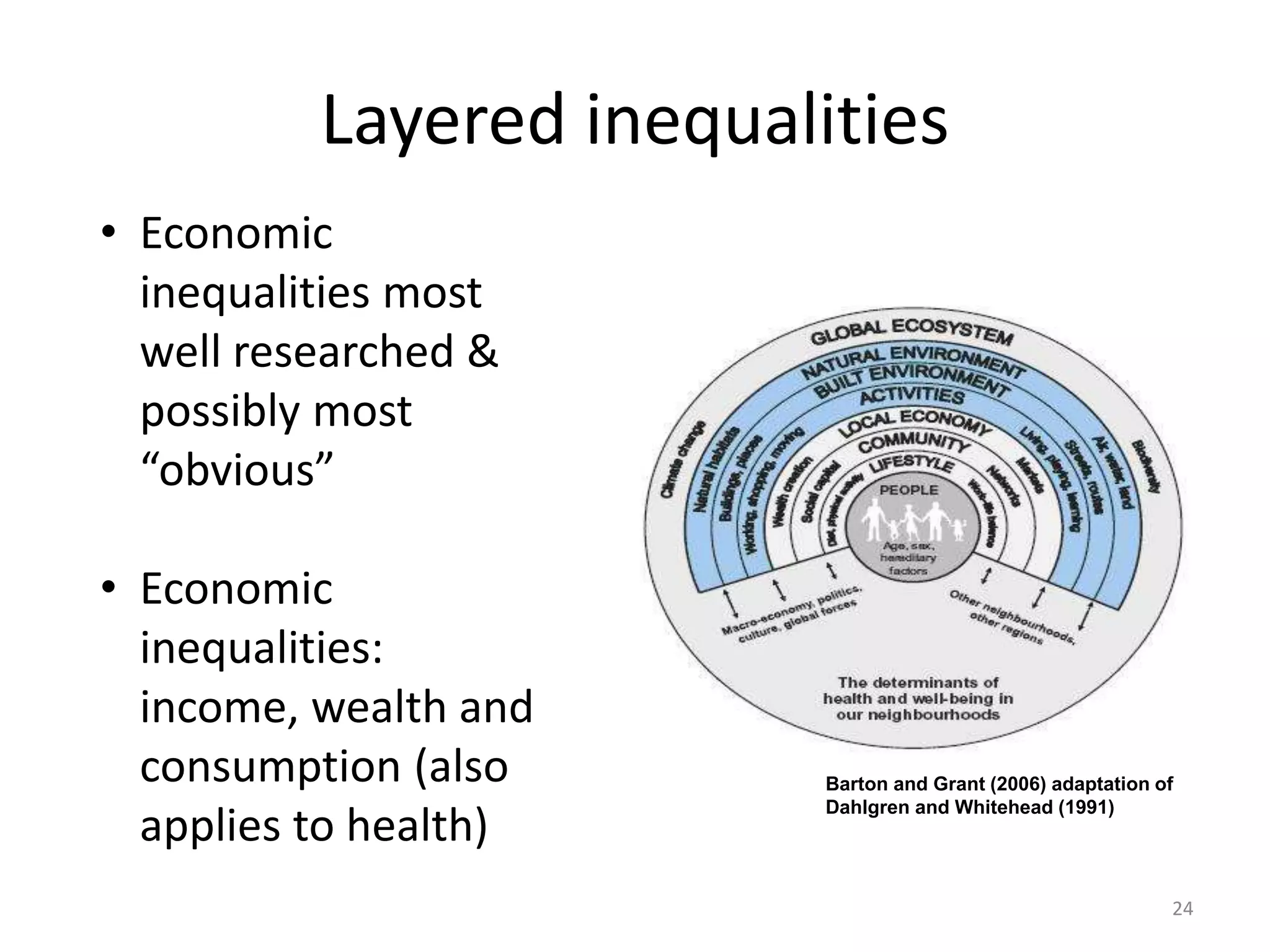
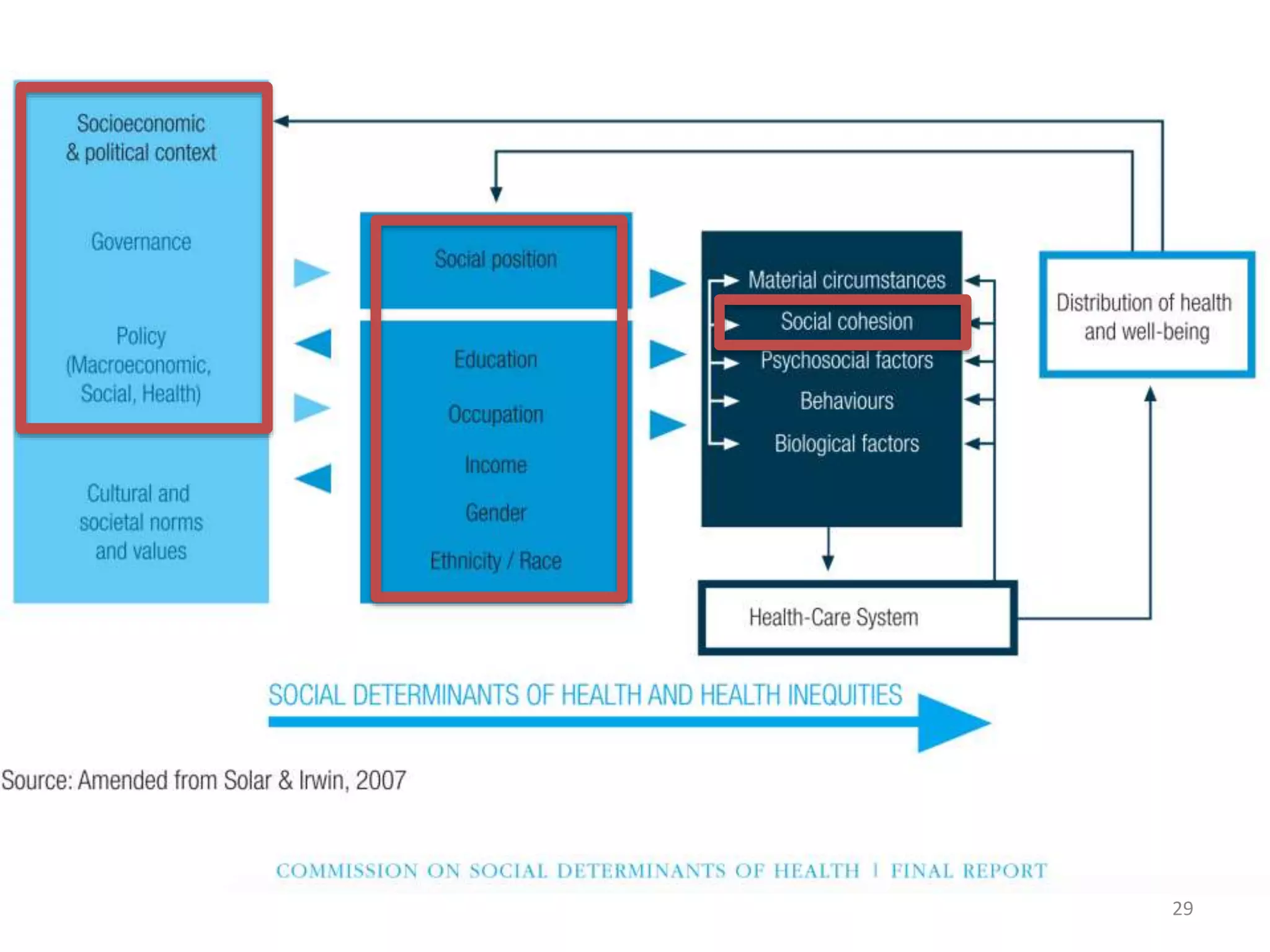
Layered inequalities
• Economic
inequalities most
well researched &
possibly most
“obvious”
• Economic
inequalities:
income, wealth and
consumption (also
applies to health)
Barton and Grant (2006) adaptation of
Dahlgren and Whitehead (1991)
24
Indian health system worsens income/class inequity
• Healthcare expenditure financed by people out of pocket, at the
point of service delivery (high OOPs)
• Poor social protection: Neither universal nor well targeted
Oxfam
25
Class/income inequalities
• Income positively
correlated with health
outcomes globally
• Income as one of the
drivers of health
• The poor cannot buy
into health
26
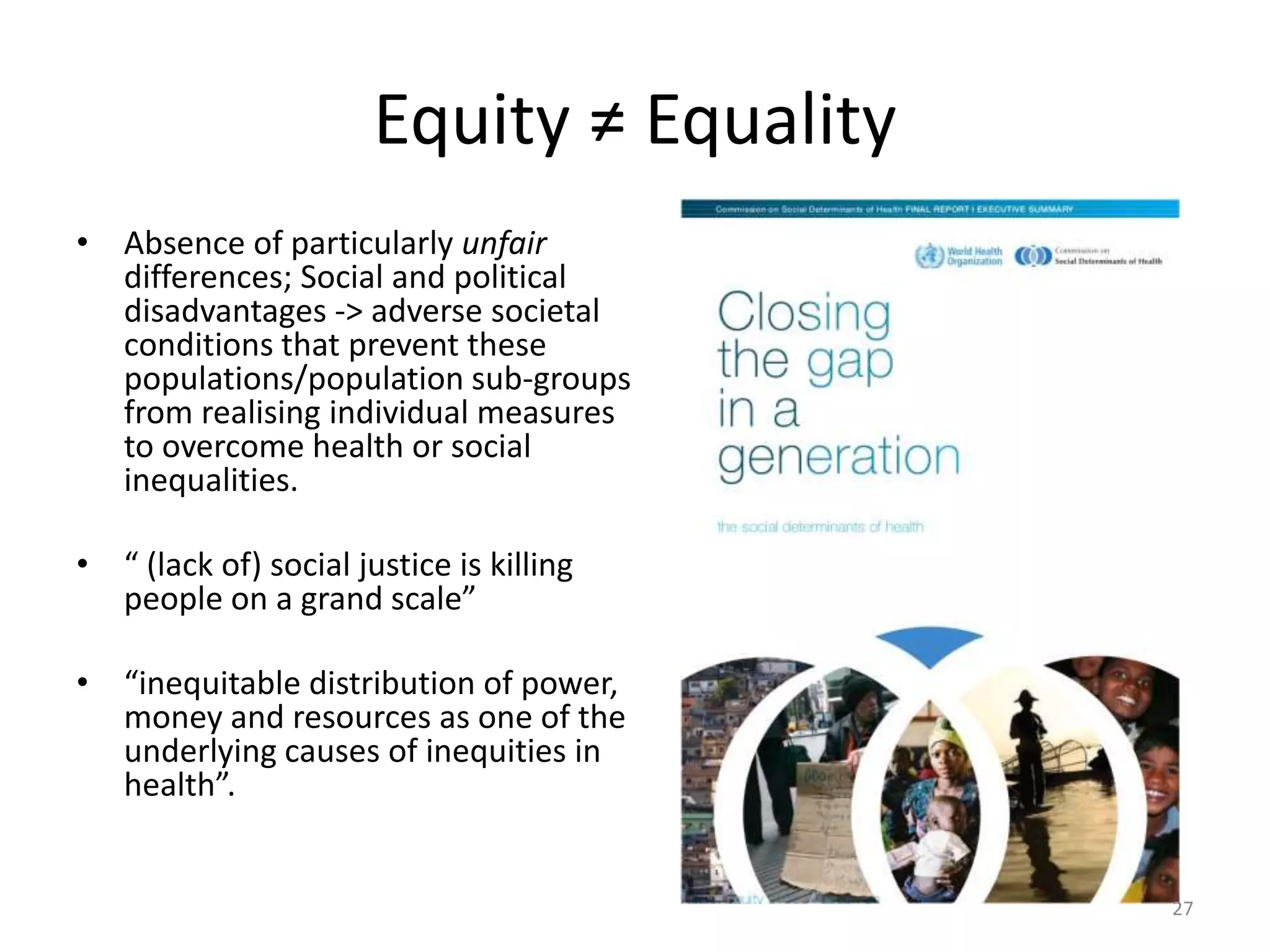
Equity ≠ Equality
• Absence of particularly unfair
differences; Social and political
disadvantages -> adverse societal
conditions that prevent these
populations/population sub-groups
from realising individual measures
to overcome health or social
inequalities.
• “ (lack of) social justice is killing
people on a grand scale”
• “inequitable distribution of power,
money and resources as one of the
underlying causes of inequities in
health”.
27
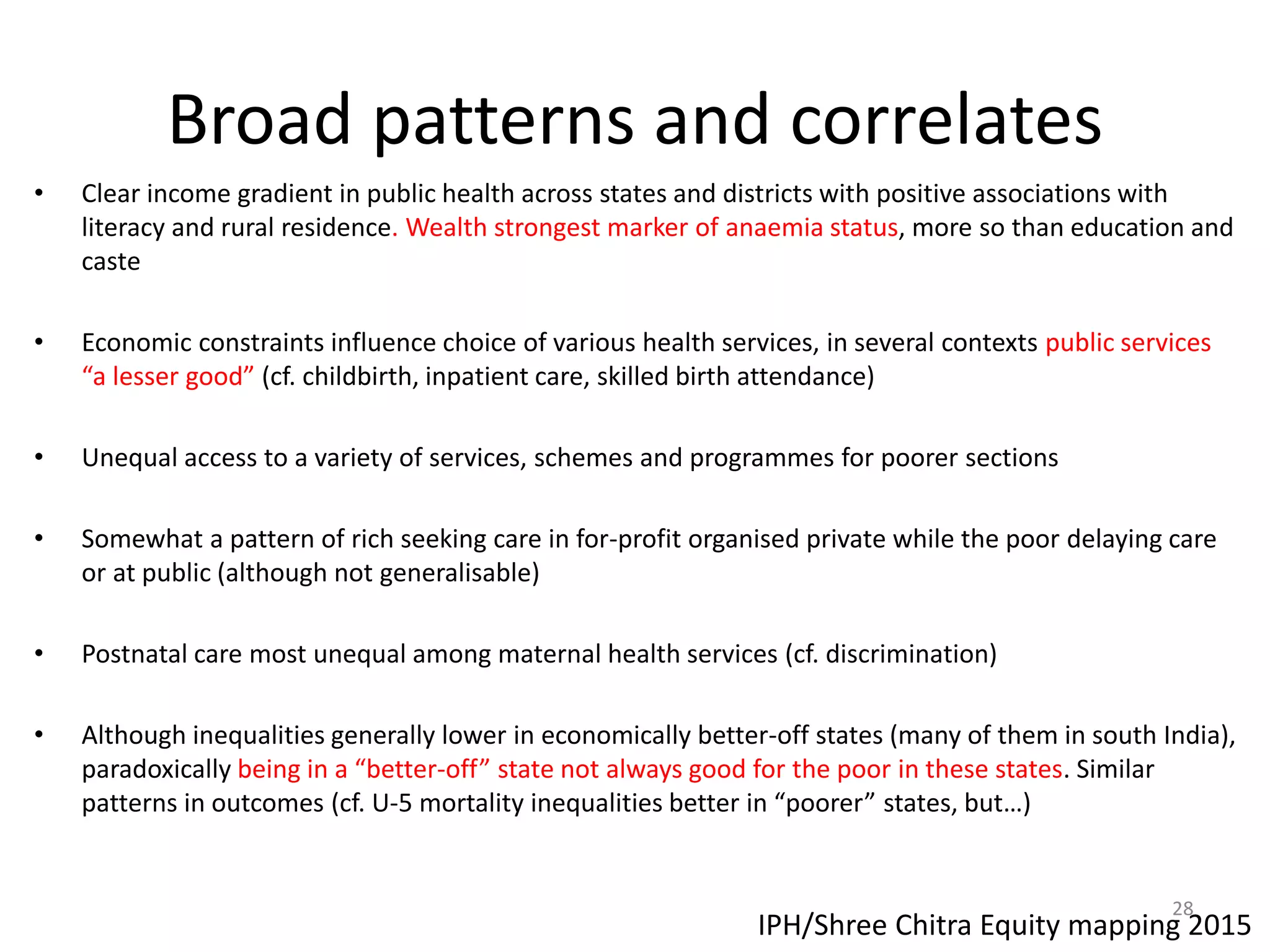
Broad patterns and correlates
• Clear income gradient in public health across states and districts with positive associations with
literacy and rural residence. Wealth strongest marker of anaemia status, more so than education and
caste
• Economic constraints influence choice of various health services, in several contexts public services
“a lesser good” (cf. childbirth, inpatient care, skilled birth attendance)
• Unequal access to a variety of services, schemes and programmes for poorer sections
• Somewhat a pattern of rich seeking care in for-profit organised private while the poor delaying care
or at public (although not generalisable)
• Postnatal care most unequal among maternal health services (cf. discrimination)
• Although inequalities generally lower in economically better-off states (many of them in south India),
paradoxically being in a “better-off” state not always good for the poor in these states. Similar
patterns in outcomes (cf. U-5 mortality inequalities better in “poorer” states, but…)
IPH/Shree Chitra Equity mapping 2015
28
29
Part 2: System vs services
• What is Indian health services like?
• How is it perceived and utilised by different
sections of the population?
• What is the disease burden and how is it
financed?
• How does the Indian health system perform
with respect to enabling health and social
protection?
30
Health services - Multiple systems of medicine
Allopathy
Ayurveda
Yoga
Homeopathy
Unani
Siddha
31
Health services – multiple providers
• Certified / Uncertified
• Government / Private /
Private not-for-profit
32
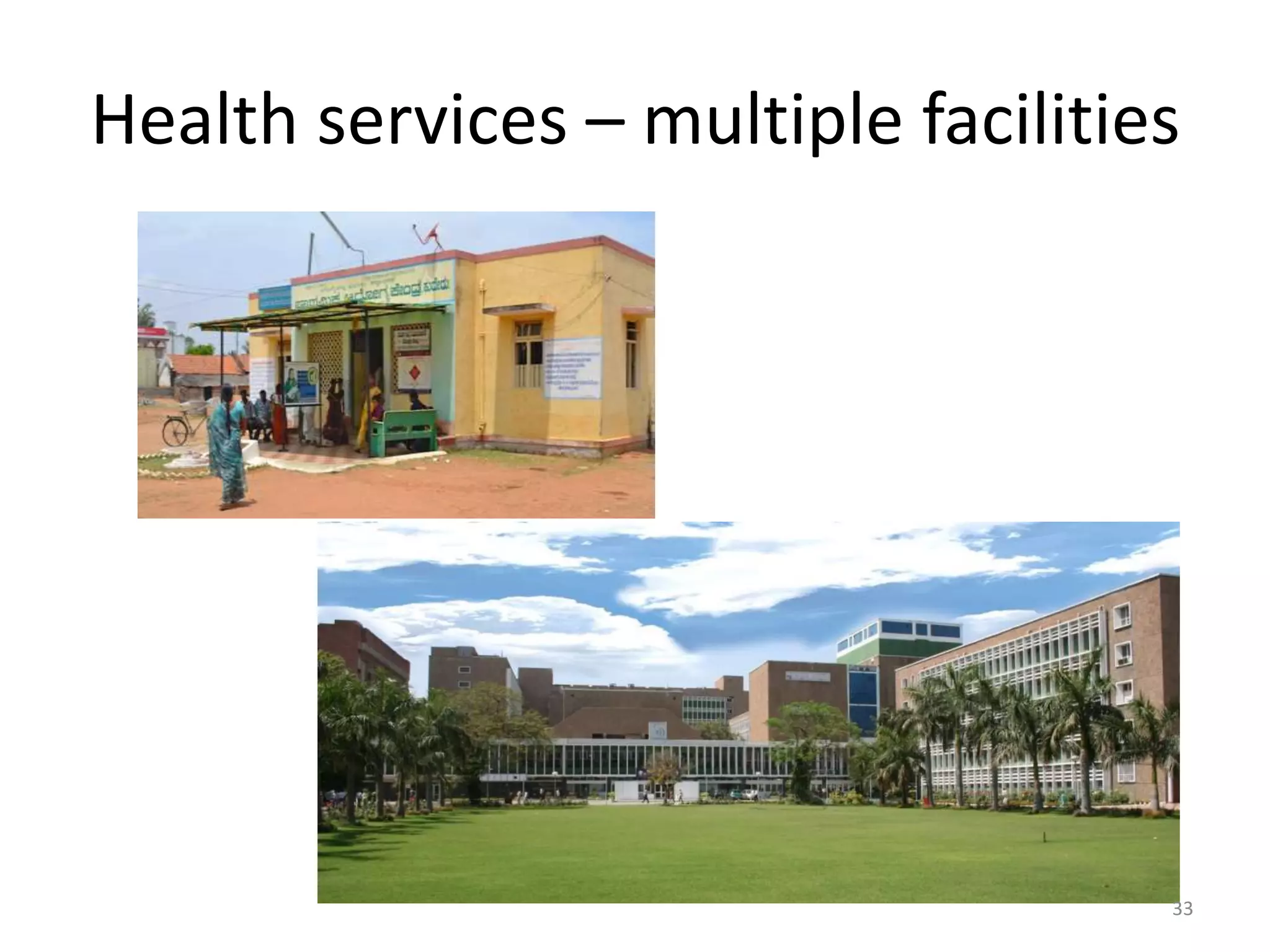
Health services – multiple facilities
33
34
35
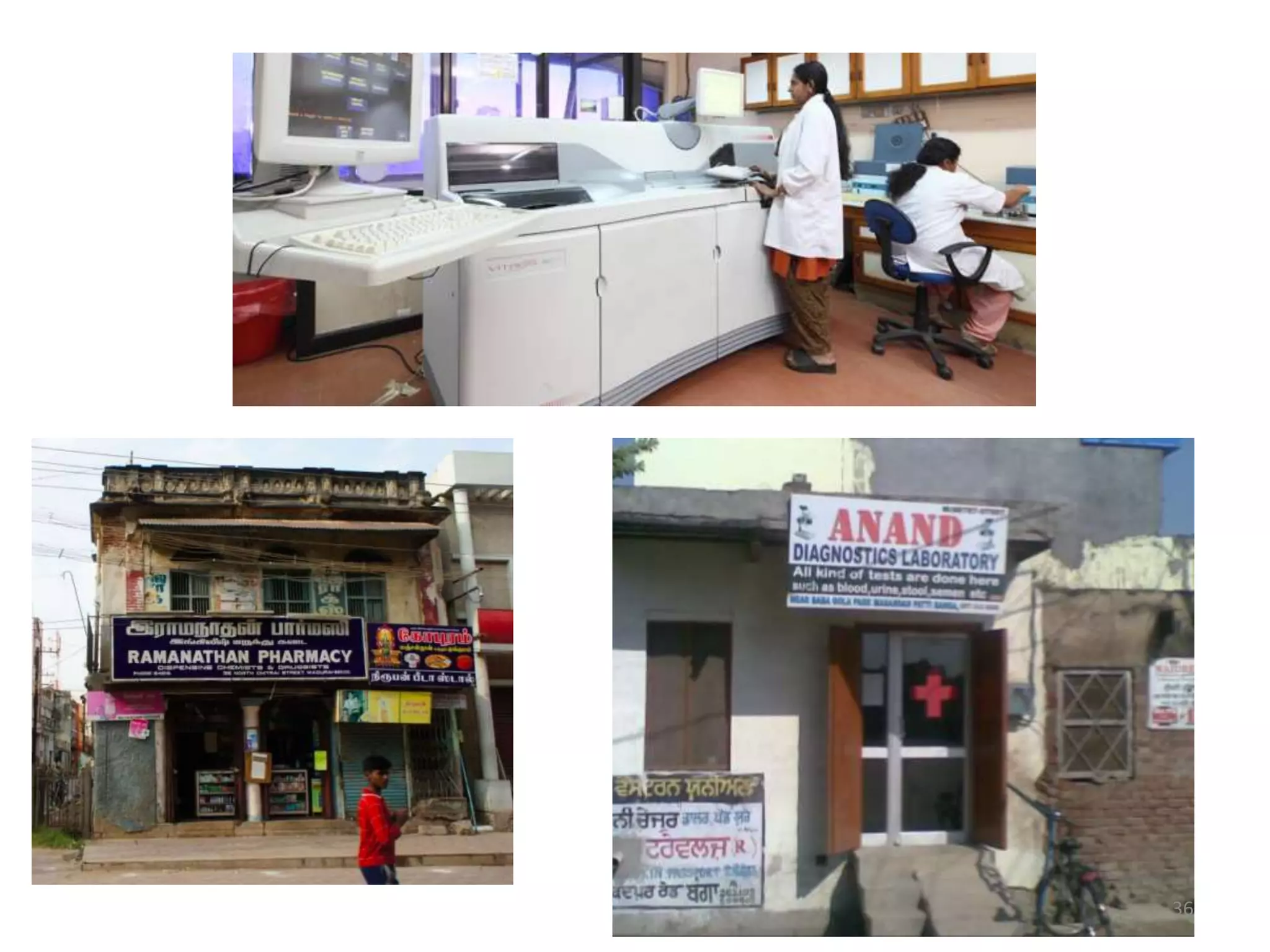
36
Organisation
of Health
services
37
Health services – Govt. & Private
G - U
G - R
P -U
P -R
NSSO
38
Provision of health services
22%
42%
Government,
52%
Private ,
78%
58%
38%
0%
10%
20%
30%
40%
50%
60%
70%
80%
90%
100%
Outpatient care Inpatient care Deliveries
39
NSSO data
India – disease burden
IHME
2010
India40
Medicines
• Under Ministry of Chemicals
• Largest producer of generics in the world
• Multi billion dollar industry
• Regulatory policies exist, but not implemented
• Medicines freely available – over the counter
• Government spends just € 0.10 cents per
person on medicine
41
Financing of health care
Mostly through out of pocket payments by
individual patients at the time of illness
42
Sources of financing for health
State Govt, 12%
Federal Govt,
7%
Local Govt, 1%
OOP, 71%
Firms
6%
Insurance
1%
External aid
2%
43
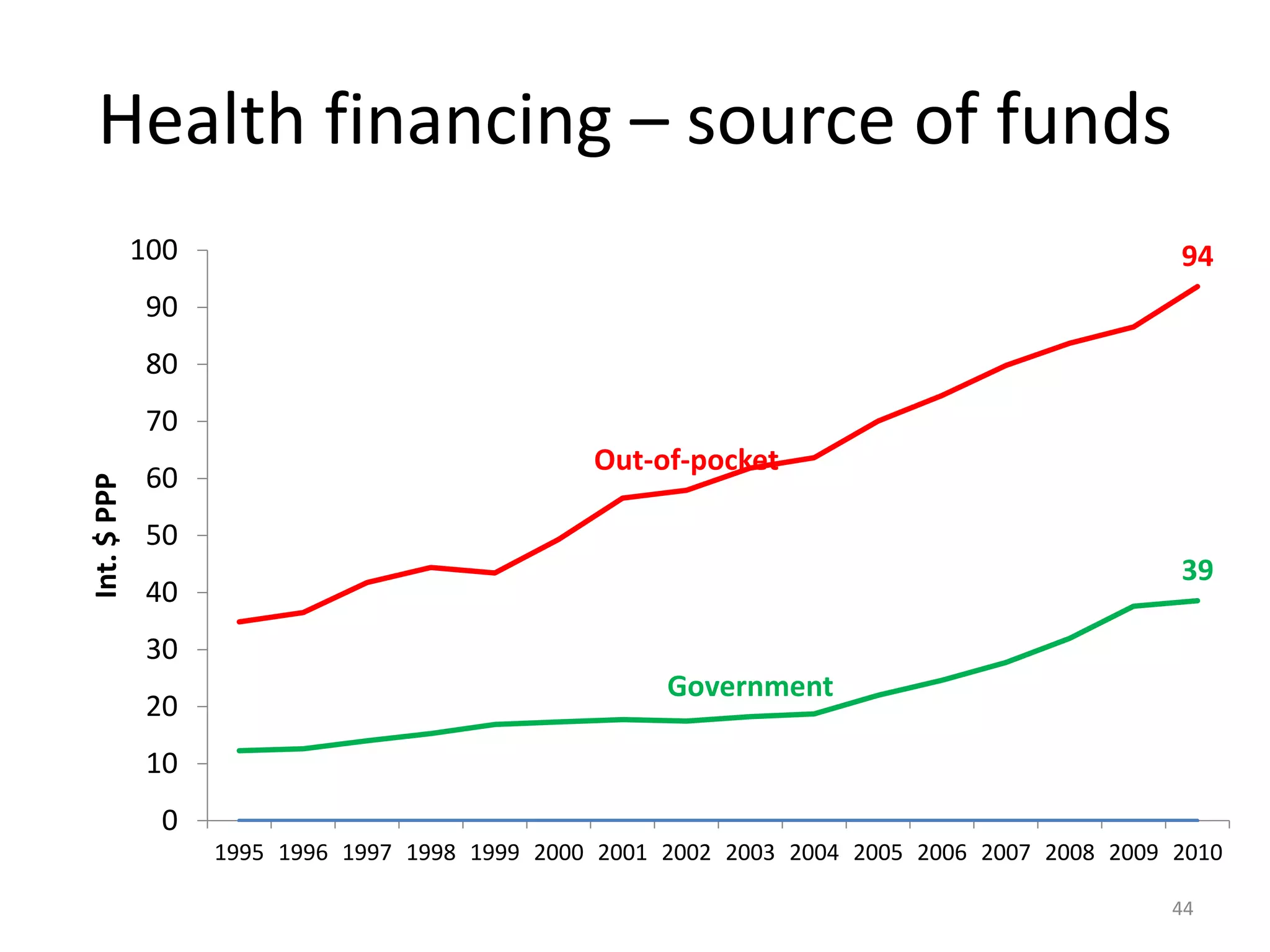
Health financing – source of funds
Government
39
Out-of-pocket
94
0
10
20
30
40
50
60
70
80
90
100
1995 1996 1997 1998 1999 2000 2001 2002 2003 2004 2005 2006 2007 2008 2009 2010
Int.$PPP
44
Health insurance in India
Number of people
covered (millions)
Social health
insurance*
Private health
insurance #
Government health
insurance ^
Outpatient 58
Secondary care 58 55 130
Tertiary care 58 117
TOTAL 58 55 147
* - Civil servants
# - Mostly the formal sector high & middle-
income groups
^ - Those below the poverty line
45
Effect of this
• Inadequate health staff in the government
sector
– 0.6 doctors per 1000 population
– 1 doctor to 1.3 nurses
• Inadequate medicines in the government
sector
46
Effect of this ….
Financial barrier
Do not seek
care
Seek sub
standard care
Seek care
Manage
with savings
Borrow Sell Asset
Labour
substitution
47
Effect of this …
63 Million Indians are impoverished every year
because of medical expenses
48
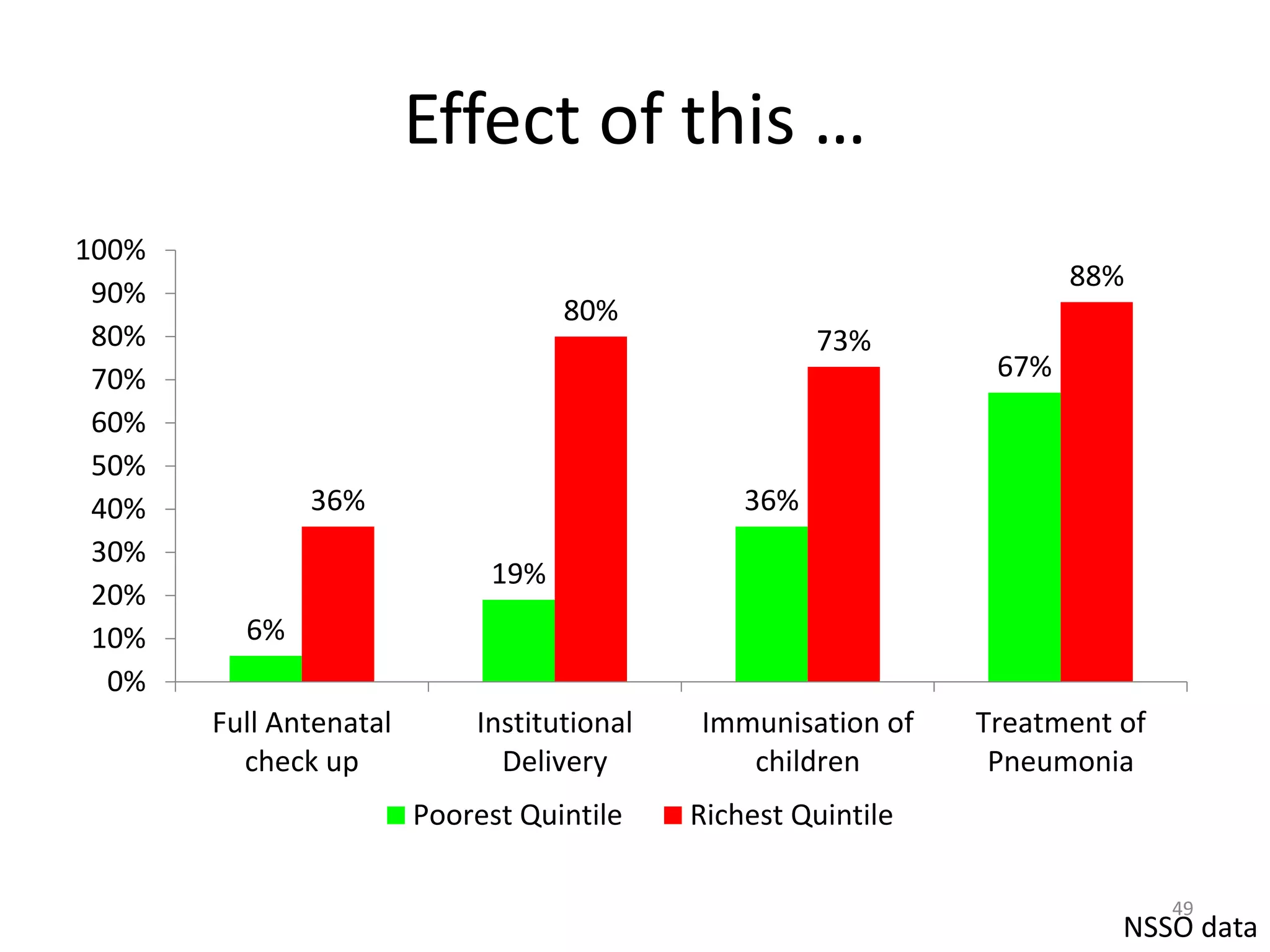
Effect of this …
6%
19%
36%
67%
36%
80%
73%
88%
0%
10%
20%
30%
40%
50%
60%
70%
80%
90%
100%
Full Antenatal
check up
Institutional
Delivery
Immunisation of
children
Treatment of
Pneumonia
Poorest Quintile Richest Quintile
NSSO data
49
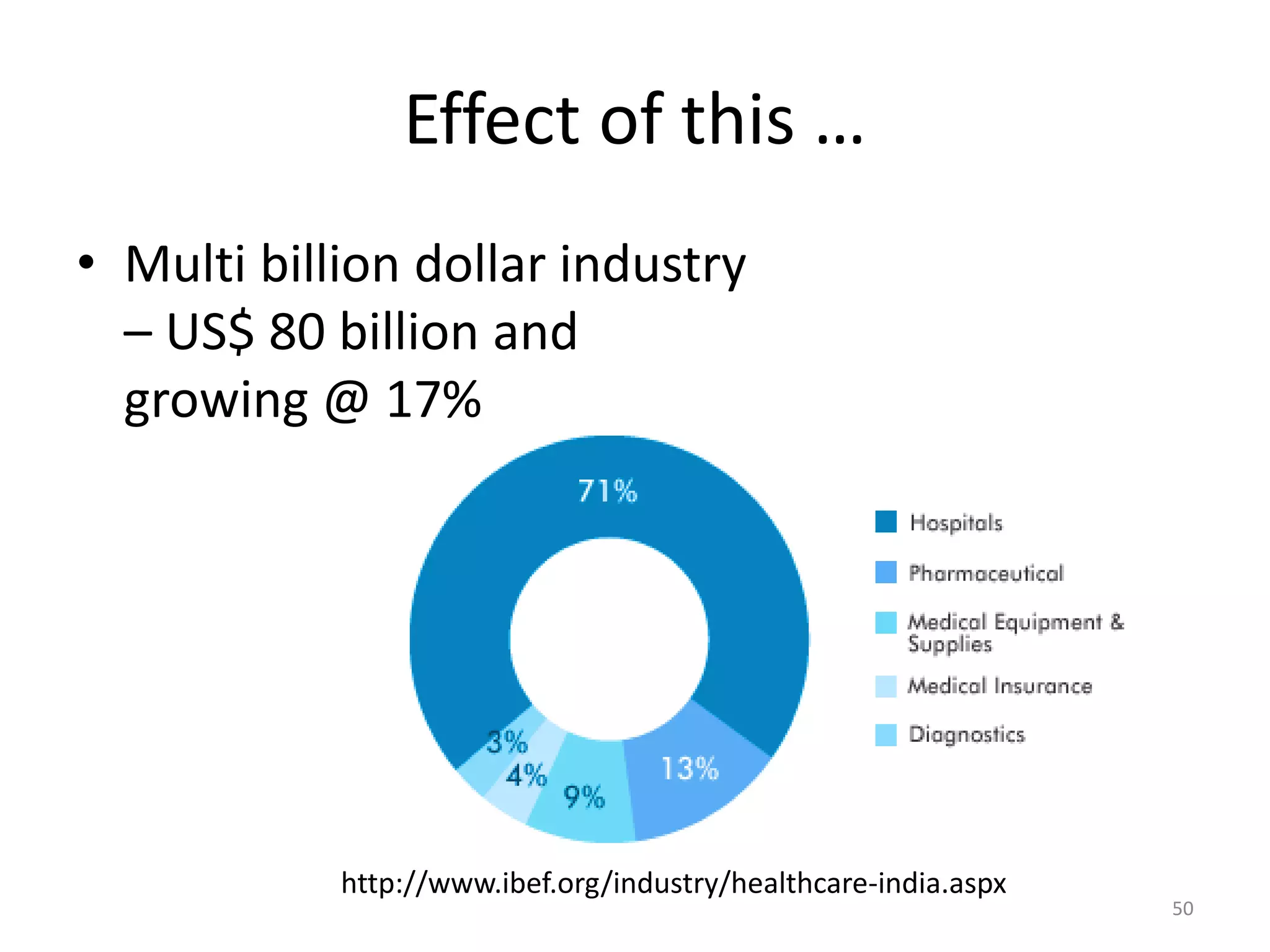
Effect of this …
• Multi billion dollar industry
– US$ 80 billion and
growing @ 17%
http://www.ibef.org/industry/healthcare-india.aspx
50
Government response
• 2005 – National Rural Health Mission
• 2008 – National Health Insurance Scheme
• 2015 – Subsidised medicines to all
But Government health expenditure still
remains at 1.1% of GDP
51
Governance
• Many regulations
– Drugs
– Medical practice
– Infrastructure
– Certification of health staff
– Medical negligence
– Food safety
– Pollution control
• Many ministries – Health, Medical education,
Chemicals, Environment, Food and Civil Supplies,
Water and Sanitation, Women and Child Welfare, etc.
But poorly
implemented
52
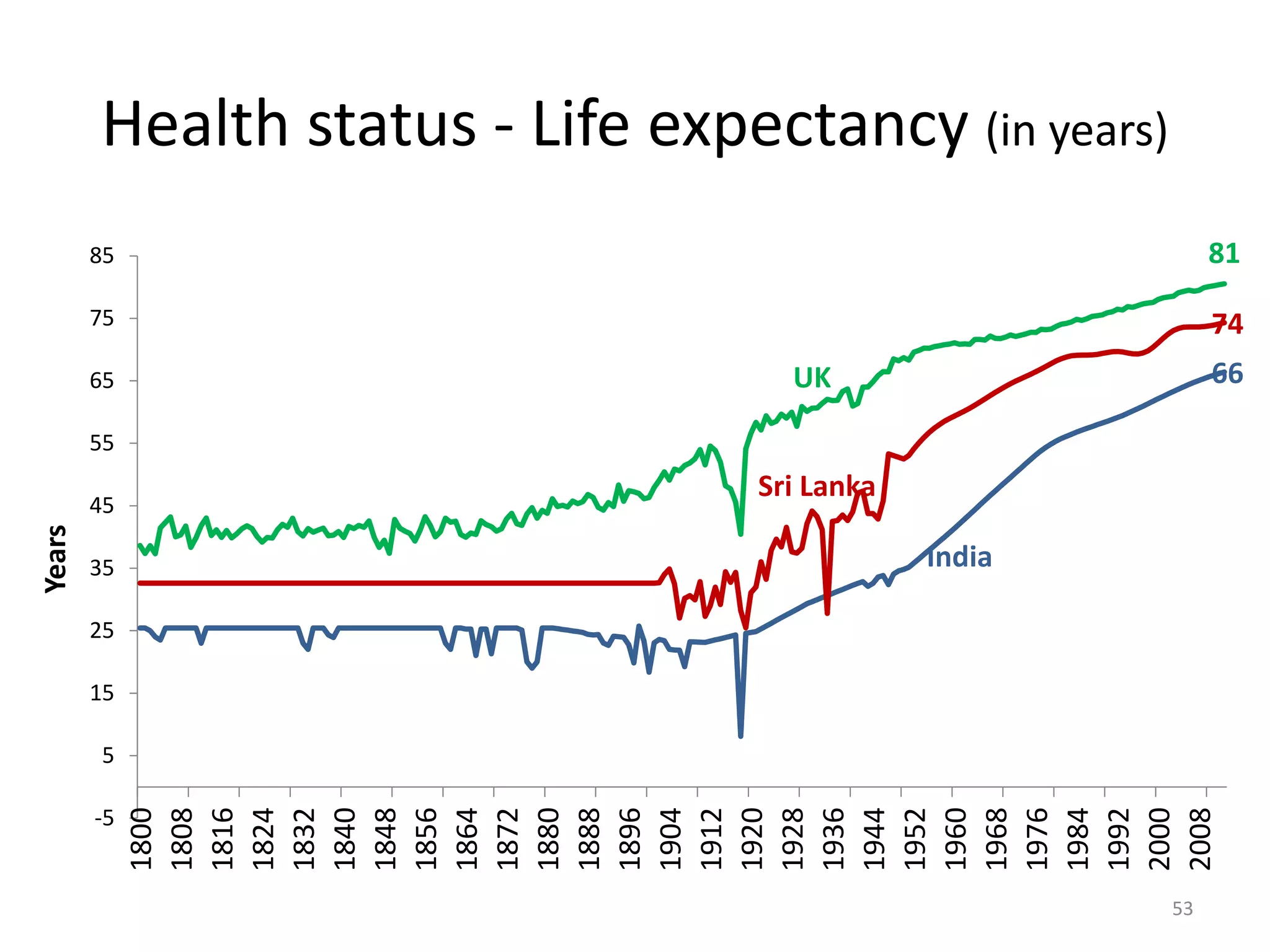
Health status - Life expectancy (in years)
India
66
Sri Lanka
74
UK
81
-5
5
15
25
35
45
55
65
75
85
1800
1808
1816
1824
1832
1840
1848
1856
1864
1872
1880
1888
1896
1904
1912
1920
1928
1936
1944
1952
1960
1968
1976
1984
1992
2000
2008
Years
53
Health status – under nutrition
54
Part 3
• Assessing a health system: frameworks
55
Eg framework:
Building Blocks & Systems Thinking
WHO 2007, WHO 2009
56
Eg: Reform/Control Knobs framework
Roberts et al, 2004
57
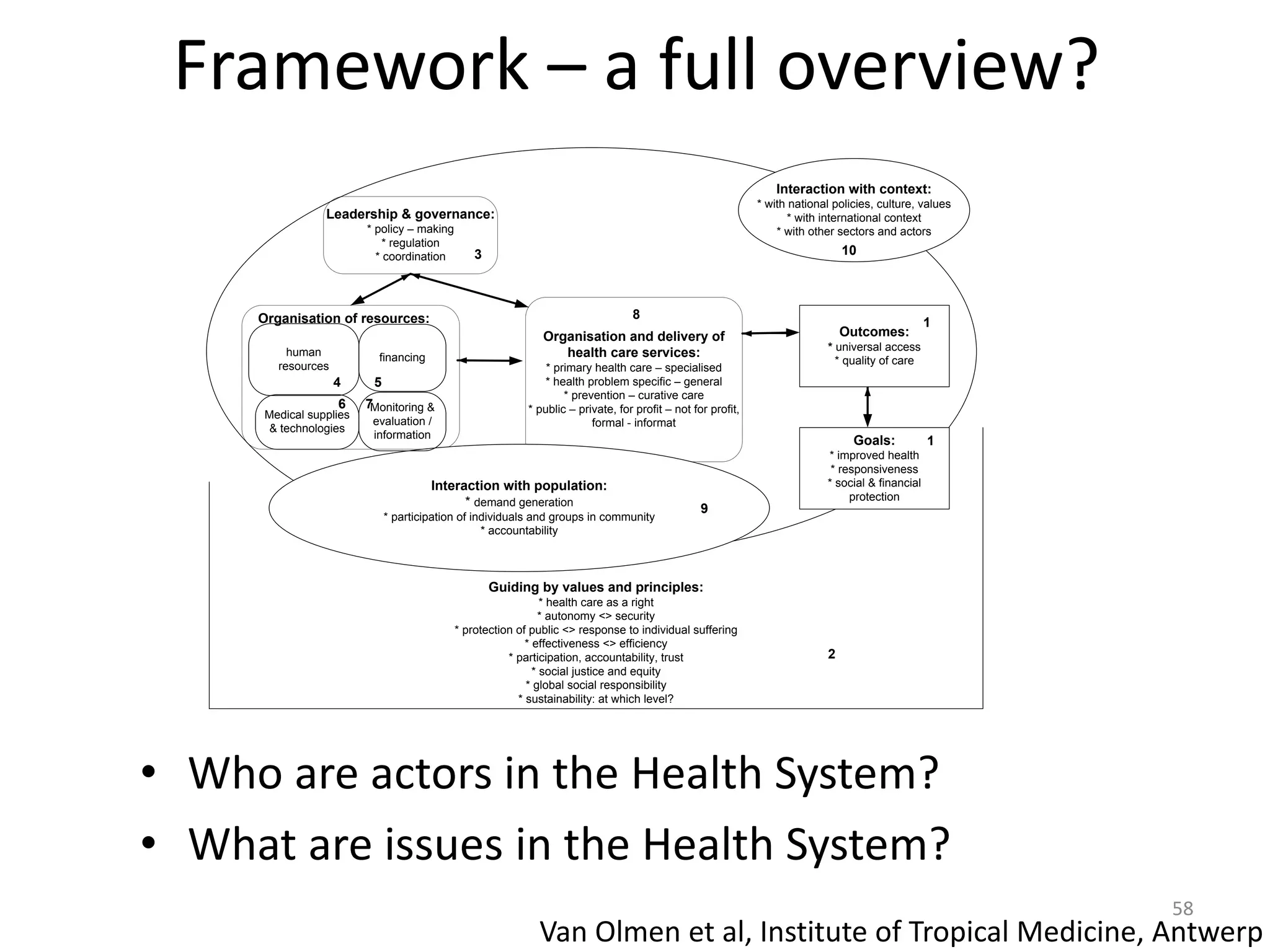
Framework – a full overview?
• Who are actors in the Health System?
• What are issues in the Health System?
Leadership & governance:
* policy – making
* regulation
* coordination
Organisation and delivery of
health care services:
* primary health care – specialised
* health problem specific – general
* prevention – curative care
* public – private, for profit – not for profit,
formal - informat
Guiding by values and principles:
* health care as a right
* autonomy <> security
* protection of public <> response to individual suffering
* effectiveness <> efficiency
* participation, accountability, trust
* social justice and equity
* global social responsibility
* sustainability: at which level?
Outcomes:
* universal access
* quality of care
Goals:
* improved health
* responsiveness
* social & financial
protection
Interaction with context:
* with national policies, culture, values
* with international context
* with other sectors and actors
Interaction with population:
* demand generation
* participation of individuals and groups in community
* accountability
human
resources
Organisation of resources:
financing
Medical supplies
& technologies
Monitoring &
evaluation /
information
1
2
3
4 5
6 7
8
9
10
1
Van Olmen et al, Institute of Tropical Medicine, Antwerp
58
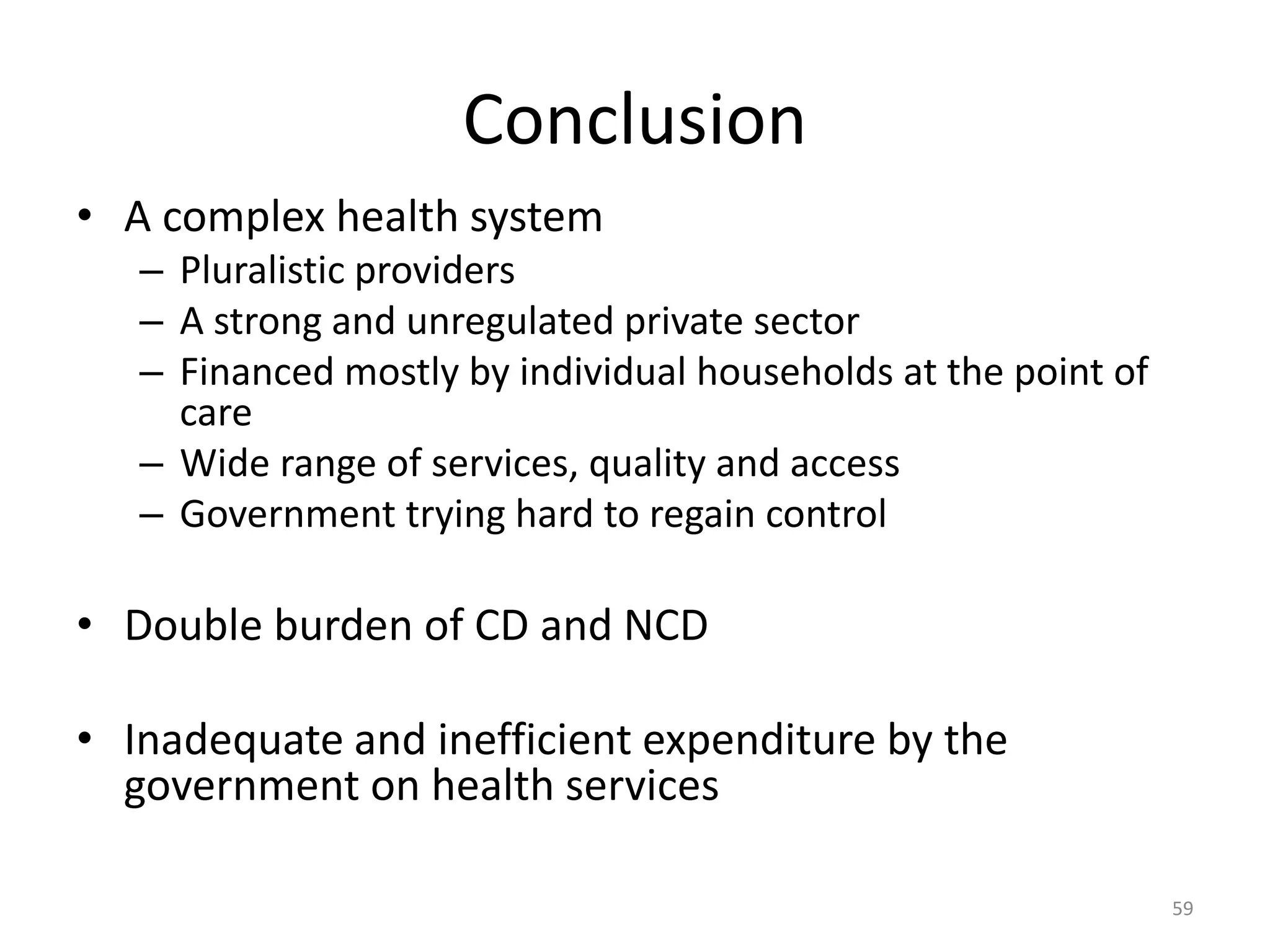
Conclusion
• A complex health system
– Pluralistic providers
– A strong and unregulated private sector
– Financed mostly by individual households at the point of
care
– Wide range of services, quality and access
– Government trying hard to regain control
• Double burden of CD and NCD
• Inadequate and inefficient expenditure by the
government on health services
59
Conclusions
Has
money?
YES NO
Reasonable to high
quality of care in
private health sector
Reasonable to poor
quality of care in
government / private
health sector
60
With inputs of Dr. Devadasan, IPH
Assistant Director (Research), IPH
Chairperson, Emerging Voices for Global Health
web @daktre.com
edits @Wikipedia/User:Prashanthns
Researchgate ORCID Goodreads Scholar

Indian health system: Overview and challenges

  • 1.
  • 2.
    Indian health system Overview,issues & challenges Prashanth N S MBBS, MPH, PhD Institute of Public Health, Bengaluru
  • 3.
    Outline • Part 1:Introduction, human resources in health in India, health (in)equity patterns in India and social determinants of health • Part 2: Structure and functioning of the health system and services in India with respect to – Health Services – The disease burden – Human resources – Medicines – Governance – Financing of Indian health services • Part 3: Bringing it together – health system frameworks 4
  • 4.
    India • India isa – Sovereign – Socialist – Secular – Democratic – Republic • Promote – Justice – Liberty – Equality – Fraternity 5
  • 5.
    India - Demography •1.21 billion people • 74% literacy; 65 F literacy • 30% of population live in urban area • 940 females per 1000 males • 47% of population are below 25 years 6
  • 6.
    India - Social •Secular – Hindus (83%), Muslims (13%), Christians (2%), Others (2%) • Social stratification along caste lines though the system is abolished • 38% of population classified as socially vulnerable 7
  • 7.
    Do health workerssave lives? More health workers, more health. True?
  • 8.
    Do health workerssave lives? • Doctor anomaly • Cardiologists’ holiday paradox
  • 9.
  • 10.
  • 11.
  • 12.
    Karnataka state– Regional/sub-regionaldisparities Role of (mis)management? For example, in 2006 Immunisation coverage – 96% in Kodagu district and <50% in Raichur. 114 ‘backward’ talukas, nearly half in ‘forward’ districts “Systemic failure” as a cause? (George, 2007&2009), Sen (2006)
  • 13.
    What is capacity? Brown,L., LaFond, A., & Macintyre, K. (2001). Measuring capacity building. Chapel Hill: MEASURE Evaluation. 06/12/13 NS Prashanth, PhD Committee meeting, UCL 14
  • 14.
    A few characteristicsof HR/health systems
  • 15.
    So, then whatis a system? Is it called a system because it works “systematically”? -> Systems thinking
  • 16.
    Complexity • Simple, complicatedand complex problems • Health service versus a health system …& HR (& health) systems are complex…
  • 17.
    WHO – Alliancefor Health Policy and Systems Research
  • 18.
    Layered dimensions ofHRM in a system • Individual • Institutional (workplace) • Meso/Macro policy level factors • Environmental, societal, socio-political
  • 19.
  • 20.
    India – aland of contrasts 21
  • 21.
    India – aland of contrasts 22
  • 22.
    India – aland of contrasts 23
  • 23.
    Layered inequalities • Economic inequalitiesmost well researched & possibly most “obvious” • Economic inequalities: income, wealth and consumption (also applies to health) Barton and Grant (2006) adaptation of Dahlgren and Whitehead (1991) 24
  • 24.
    Indian health systemworsens income/class inequity • Healthcare expenditure financed by people out of pocket, at the point of service delivery (high OOPs) • Poor social protection: Neither universal nor well targeted Oxfam 25
  • 25.
    Class/income inequalities • Incomepositively correlated with health outcomes globally • Income as one of the drivers of health • The poor cannot buy into health 26
  • 26.
    Equity ≠ Equality •Absence of particularly unfair differences; Social and political disadvantages -> adverse societal conditions that prevent these populations/population sub-groups from realising individual measures to overcome health or social inequalities. • “ (lack of) social justice is killing people on a grand scale” • “inequitable distribution of power, money and resources as one of the underlying causes of inequities in health”. 27
  • 27.
    Broad patterns andcorrelates • Clear income gradient in public health across states and districts with positive associations with literacy and rural residence. Wealth strongest marker of anaemia status, more so than education and caste • Economic constraints influence choice of various health services, in several contexts public services “a lesser good” (cf. childbirth, inpatient care, skilled birth attendance) • Unequal access to a variety of services, schemes and programmes for poorer sections • Somewhat a pattern of rich seeking care in for-profit organised private while the poor delaying care or at public (although not generalisable) • Postnatal care most unequal among maternal health services (cf. discrimination) • Although inequalities generally lower in economically better-off states (many of them in south India), paradoxically being in a “better-off” state not always good for the poor in these states. Similar patterns in outcomes (cf. U-5 mortality inequalities better in “poorer” states, but…) IPH/Shree Chitra Equity mapping 2015 28
  • 28.
  • 29.
    Part 2: Systemvs services • What is Indian health services like? • How is it perceived and utilised by different sections of the population? • What is the disease burden and how is it financed? • How does the Indian health system perform with respect to enabling health and social protection? 30
  • 30.
    Health services -Multiple systems of medicine Allopathy Ayurveda Yoga Homeopathy Unani Siddha 31
  • 31.
    Health services –multiple providers • Certified / Uncertified • Government / Private / Private not-for-profit 32
  • 32.
    Health services –multiple facilities 33
  • 33.
  • 34.
  • 35.
  • 36.
  • 37.
    Health services –Govt. & Private G - U G - R P -U P -R NSSO 38
  • 38.
    Provision of healthservices 22% 42% Government, 52% Private , 78% 58% 38% 0% 10% 20% 30% 40% 50% 60% 70% 80% 90% 100% Outpatient care Inpatient care Deliveries 39 NSSO data
  • 39.
    India – diseaseburden IHME 2010 India40
  • 40.
    Medicines • Under Ministryof Chemicals • Largest producer of generics in the world • Multi billion dollar industry • Regulatory policies exist, but not implemented • Medicines freely available – over the counter • Government spends just € 0.10 cents per person on medicine 41
  • 41.
    Financing of healthcare Mostly through out of pocket payments by individual patients at the time of illness 42
  • 42.
    Sources of financingfor health State Govt, 12% Federal Govt, 7% Local Govt, 1% OOP, 71% Firms 6% Insurance 1% External aid 2% 43
  • 43.
    Health financing –source of funds Government 39 Out-of-pocket 94 0 10 20 30 40 50 60 70 80 90 100 1995 1996 1997 1998 1999 2000 2001 2002 2003 2004 2005 2006 2007 2008 2009 2010 Int.$PPP 44
  • 44.
    Health insurance inIndia Number of people covered (millions) Social health insurance* Private health insurance # Government health insurance ^ Outpatient 58 Secondary care 58 55 130 Tertiary care 58 117 TOTAL 58 55 147 * - Civil servants # - Mostly the formal sector high & middle- income groups ^ - Those below the poverty line 45
  • 45.
    Effect of this •Inadequate health staff in the government sector – 0.6 doctors per 1000 population – 1 doctor to 1.3 nurses • Inadequate medicines in the government sector 46
  • 46.
    Effect of this…. Financial barrier Do not seek care Seek sub standard care Seek care Manage with savings Borrow Sell Asset Labour substitution 47
  • 47.
    Effect of this… 63 Million Indians are impoverished every year because of medical expenses 48
  • 48.
    Effect of this… 6% 19% 36% 67% 36% 80% 73% 88% 0% 10% 20% 30% 40% 50% 60% 70% 80% 90% 100% Full Antenatal check up Institutional Delivery Immunisation of children Treatment of Pneumonia Poorest Quintile Richest Quintile NSSO data 49
  • 49.
    Effect of this… • Multi billion dollar industry – US$ 80 billion and growing @ 17% http://www.ibef.org/industry/healthcare-india.aspx 50
  • 50.
    Government response • 2005– National Rural Health Mission • 2008 – National Health Insurance Scheme • 2015 – Subsidised medicines to all But Government health expenditure still remains at 1.1% of GDP 51
  • 51.
    Governance • Many regulations –Drugs – Medical practice – Infrastructure – Certification of health staff – Medical negligence – Food safety – Pollution control • Many ministries – Health, Medical education, Chemicals, Environment, Food and Civil Supplies, Water and Sanitation, Women and Child Welfare, etc. But poorly implemented 52
  • 52.
    Health status -Life expectancy (in years) India 66 Sri Lanka 74 UK 81 -5 5 15 25 35 45 55 65 75 85 1800 1808 1816 1824 1832 1840 1848 1856 1864 1872 1880 1888 1896 1904 1912 1920 1928 1936 1944 1952 1960 1968 1976 1984 1992 2000 2008 Years 53
  • 53.
    Health status –under nutrition 54
  • 54.
    Part 3 • Assessinga health system: frameworks 55
  • 55.
    Eg framework: Building Blocks& Systems Thinking WHO 2007, WHO 2009 56
  • 56.
    Eg: Reform/Control Knobsframework Roberts et al, 2004 57
  • 57.
    Framework – afull overview? • Who are actors in the Health System? • What are issues in the Health System? Leadership & governance: * policy – making * regulation * coordination Organisation and delivery of health care services: * primary health care – specialised * health problem specific – general * prevention – curative care * public – private, for profit – not for profit, formal - informat Guiding by values and principles: * health care as a right * autonomy <> security * protection of public <> response to individual suffering * effectiveness <> efficiency * participation, accountability, trust * social justice and equity * global social responsibility * sustainability: at which level? Outcomes: * universal access * quality of care Goals: * improved health * responsiveness * social & financial protection Interaction with context: * with national policies, culture, values * with international context * with other sectors and actors Interaction with population: * demand generation * participation of individuals and groups in community * accountability human resources Organisation of resources: financing Medical supplies & technologies Monitoring & evaluation / information 1 2 3 4 5 6 7 8 9 10 1 Van Olmen et al, Institute of Tropical Medicine, Antwerp 58
  • 58.
    Conclusion • A complexhealth system – Pluralistic providers – A strong and unregulated private sector – Financed mostly by individual households at the point of care – Wide range of services, quality and access – Government trying hard to regain control • Double burden of CD and NCD • Inadequate and inefficient expenditure by the government on health services 59
  • 59.
    Conclusions Has money? YES NO Reasonable tohigh quality of care in private health sector Reasonable to poor quality of care in government / private health sector 60
  • 60.
    With inputs ofDr. Devadasan, IPH Assistant Director (Research), IPH Chairperson, Emerging Voices for Global Health web @daktre.com edits @Wikipedia/User:Prashanthns Researchgate ORCID Goodreads Scholar