County of Fairfax, Virginia

Fairfax County
Countywide Transit
Network Study

Fairfax County Board of Supervisors
Transportation Committee
September 17, 2013
Department of Transportation

1
Presentation Context

County of Fairfax, Virginia

This presentation summarizes
materials presented at the
July 10, 2013 public workshop
held at the Fairfax County
Government Center.
It also incorporates
subsequent changes made in
response to stakeholder
comment to clarify the
relationship between the
Proposed High Quality Transit
Network Concept and
corridors under current study.
Department of Transportation

2
Study Purpose

County of Fairfax, Virginia

Establish most effective way
to serve the County’s needs to
accommodate planned growth
over the long term by
improving public transit
usage.
Update Enhanced Public
Transportation Corridors
(EPTC) with High Quality
Transit Network (HQTN) and
further define modes, right-ofway, and station locations.
Department of Transportation

3
Study Process

County of Fairfax, Virginia

We are at the third of our four stages of public
involvement and review:
• Goals/Objectives (July 2012)
• Functions (November 2012)
• Proposed High Quality Transit Network
Concept (July 2013)
• Final Concept (Spring/Summer 2014)
Our next steps are to:
• Continue stakeholder engagement
• Consider refinements
• Develop additional details on
alignments, stations, and costs
• Finalize recommendations
Department of Transportation

4
Land Use Concept

County of Fairfax, Virginia

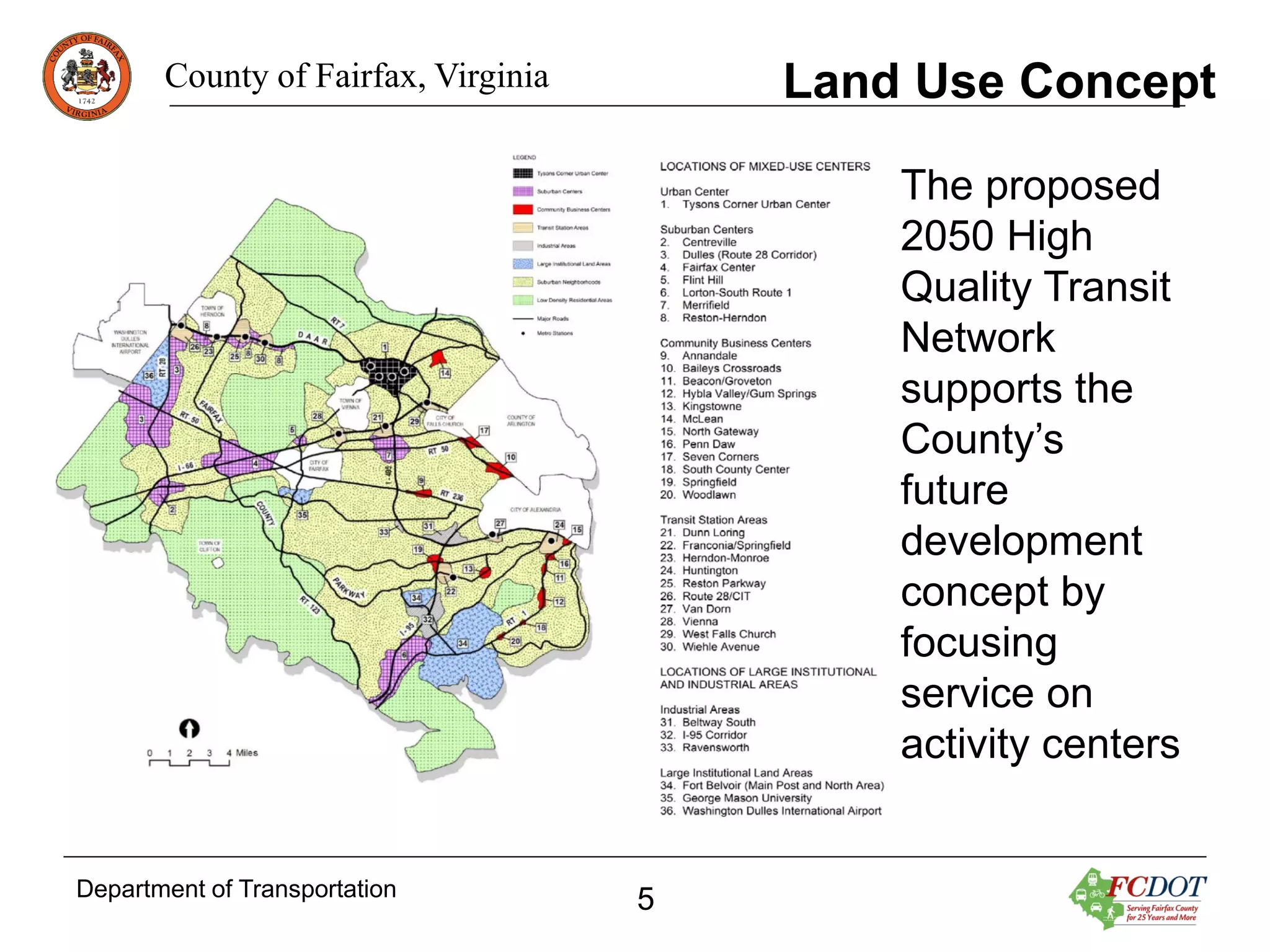
The proposed
2050 High
Quality Transit
Network
supports the
County’s
future
development
concept by
focusing
service on
activity centers

Department of Transportation

5
High Quality Transit

County of Fairfax, Virginia

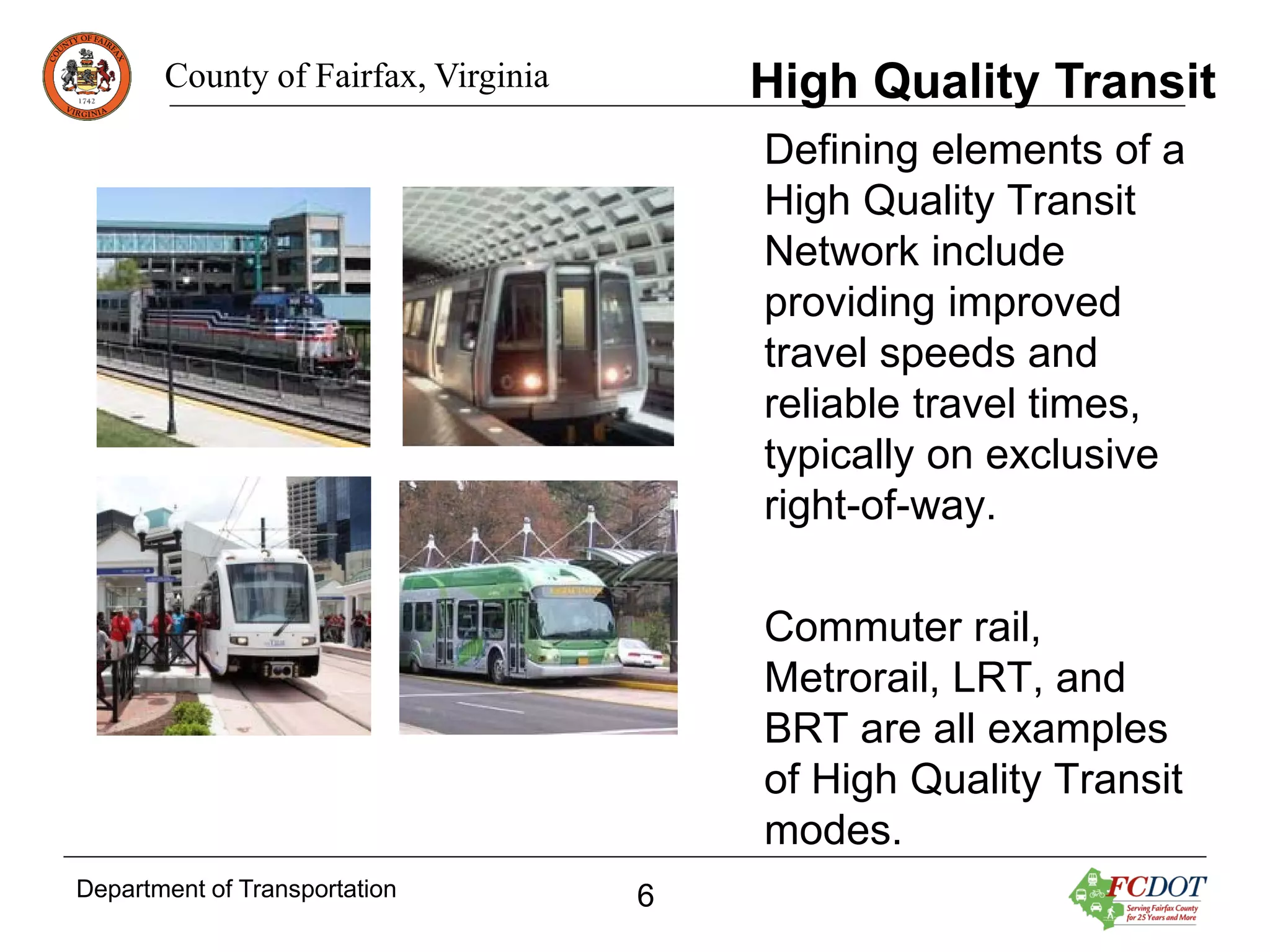
Defining elements of a
High Quality Transit
Network include
providing improved
travel speeds and
reliable travel times,
typically on exclusive
right-of-way.
Commuter rail,
Metrorail, LRT, and
BRT are all examples
of High Quality Transit
modes.
Department of Transportation

6
Transit Corridor Function

County of Fairfax, Virginia

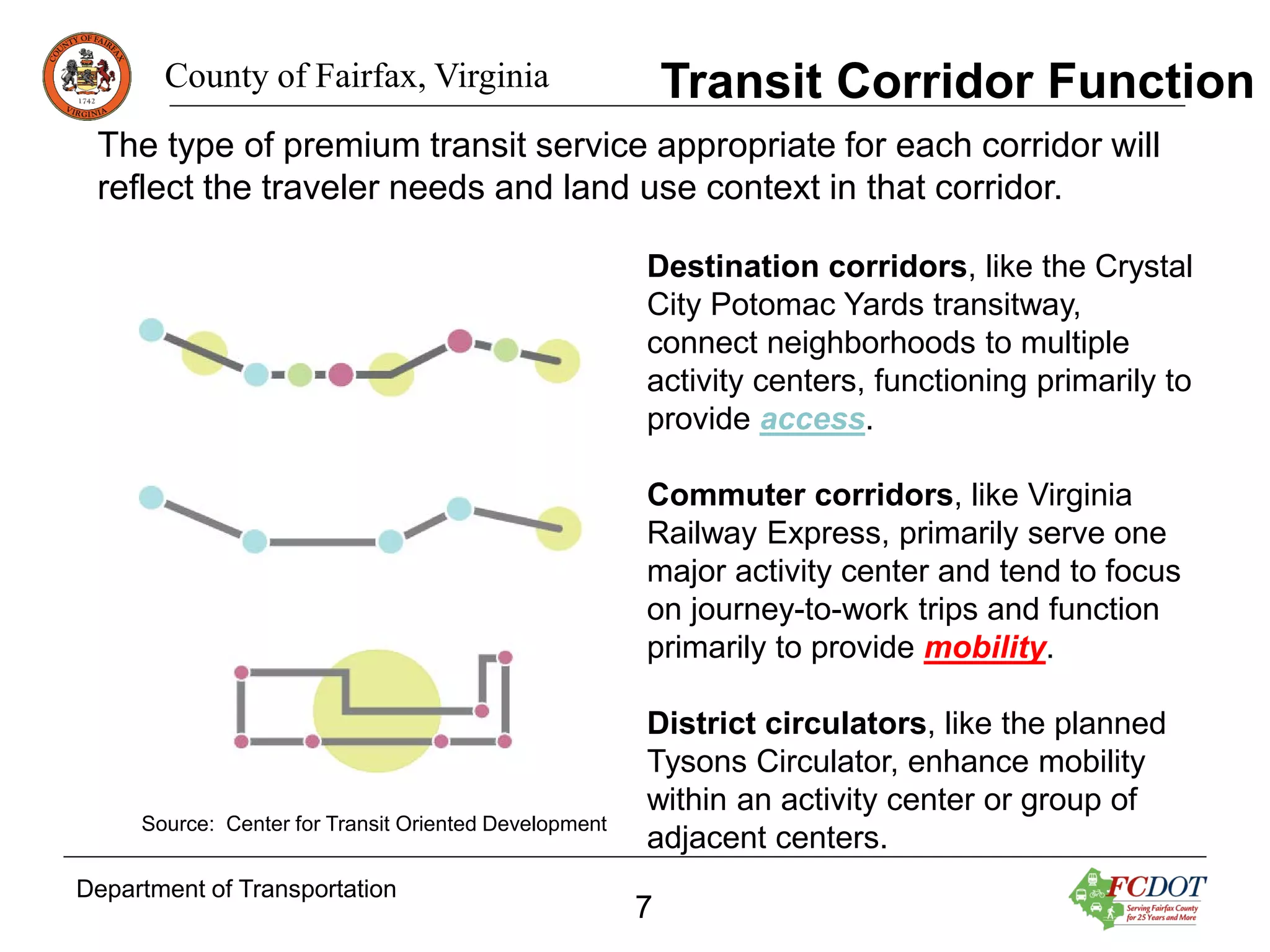
The type of premium transit service appropriate for each corridor will
reflect the traveler needs and land use context in that corridor.
Destination corridors, like the Crystal
City Potomac Yards transitway,
connect neighborhoods to multiple
activity centers, functioning primarily to
provide access.
Commuter corridors, like Virginia
Railway Express, primarily serve one
major activity center and tend to focus
on journey-to-work trips and function
primarily to provide mobility.

Source: Center for Transit Oriented Development

Department of Transportation

District circulators, like the planned
Tysons Circulator, enhance mobility
within an activity center or group of
adjacent centers.
7
Functional Concepts

County of Fairfax, Virginia

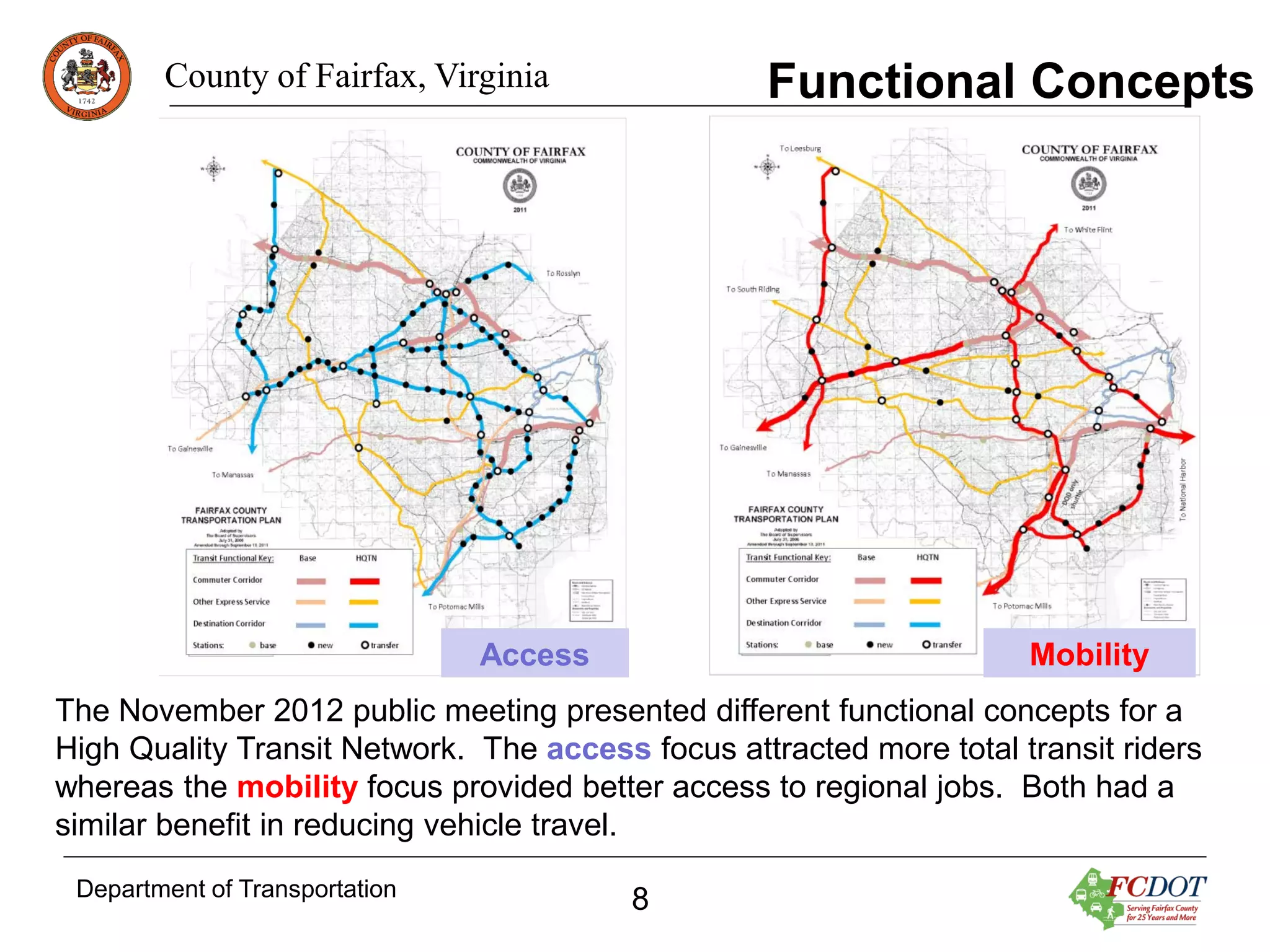
Mobility

Access

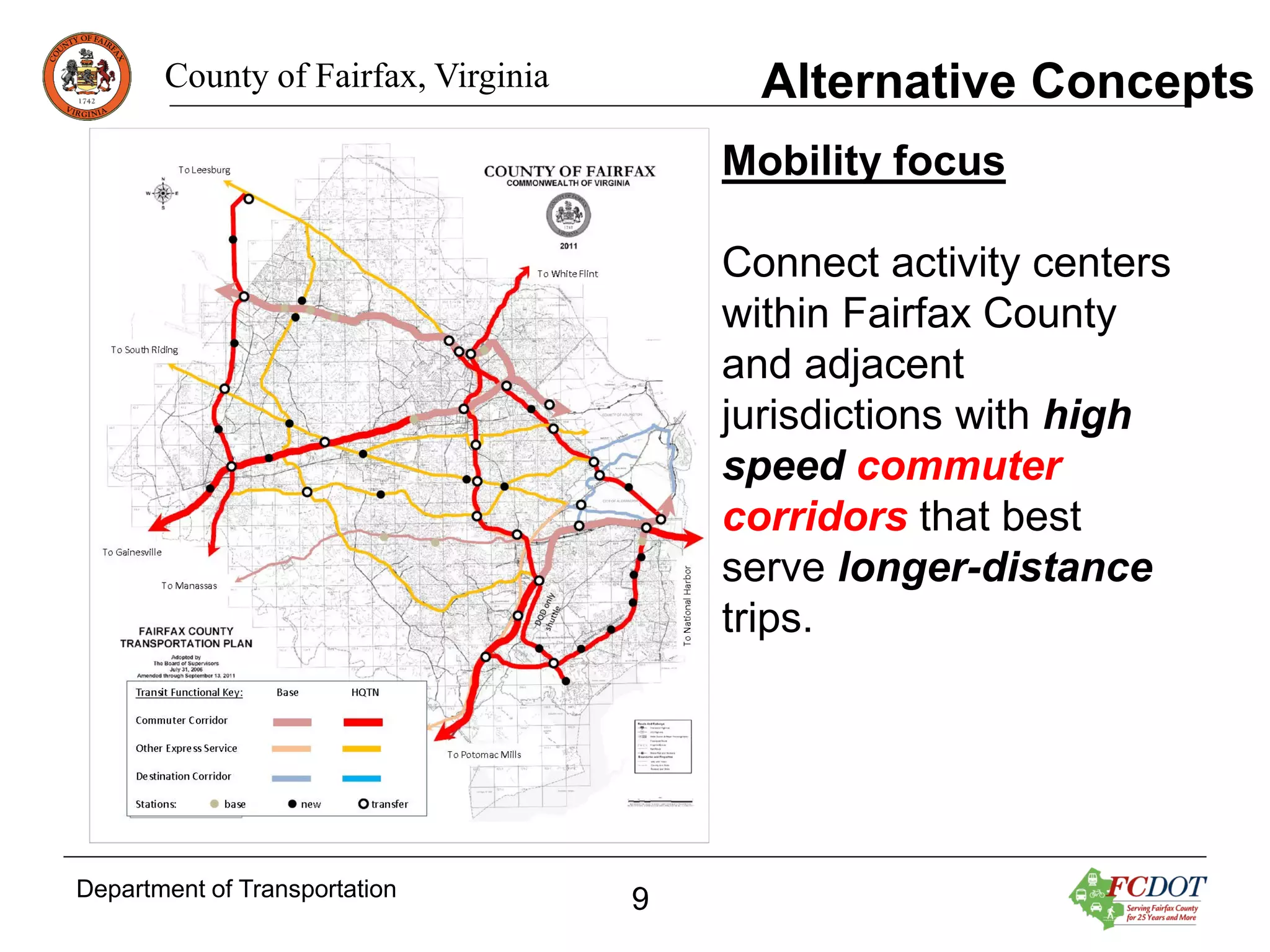
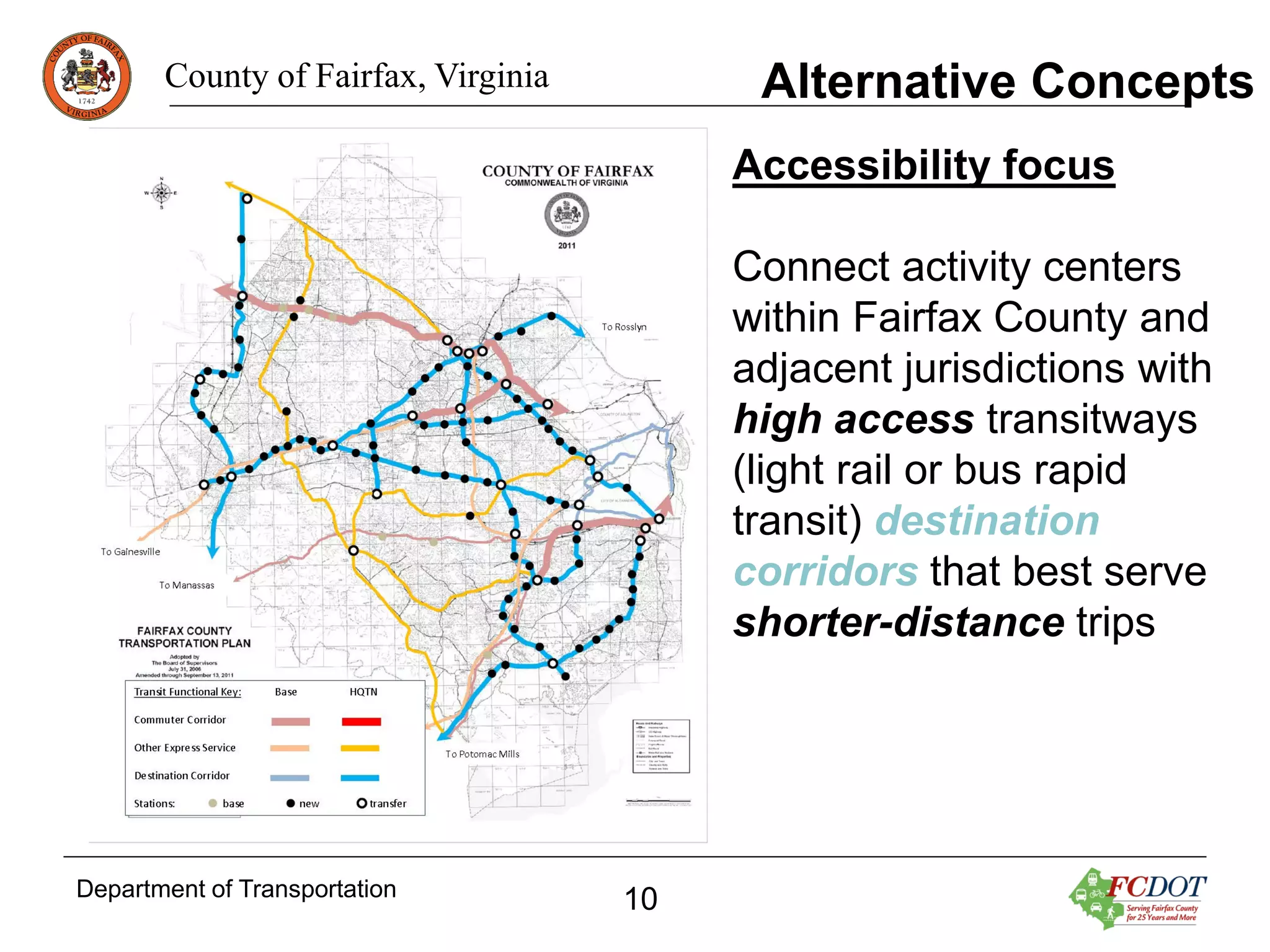
The November 2012 public meeting presented different functional concepts for a
High Quality Transit Network. The access focus attracted more total transit riders
whereas the mobility focus provided better access to regional jobs. Both had a
similar benefit in reducing vehicle travel.
Department of Transportation

8
Alternative Concepts

County of Fairfax, Virginia

Mobility focus
Connect activity centers
within Fairfax County
and adjacent
jurisdictions with high
speed commuter
corridors that best
serve longer-distance
trips.

Department of Transportation

9
Alternative Concepts

County of Fairfax, Virginia

Accessibility focus
Connect activity centers
within Fairfax County and
adjacent jurisdictions with
high access transitways
(light rail or bus rapid
transit) destination
corridors that best serve
shorter-distance trips

Department of Transportation

10
Alternative Concepts

County of Fairfax, Virginia

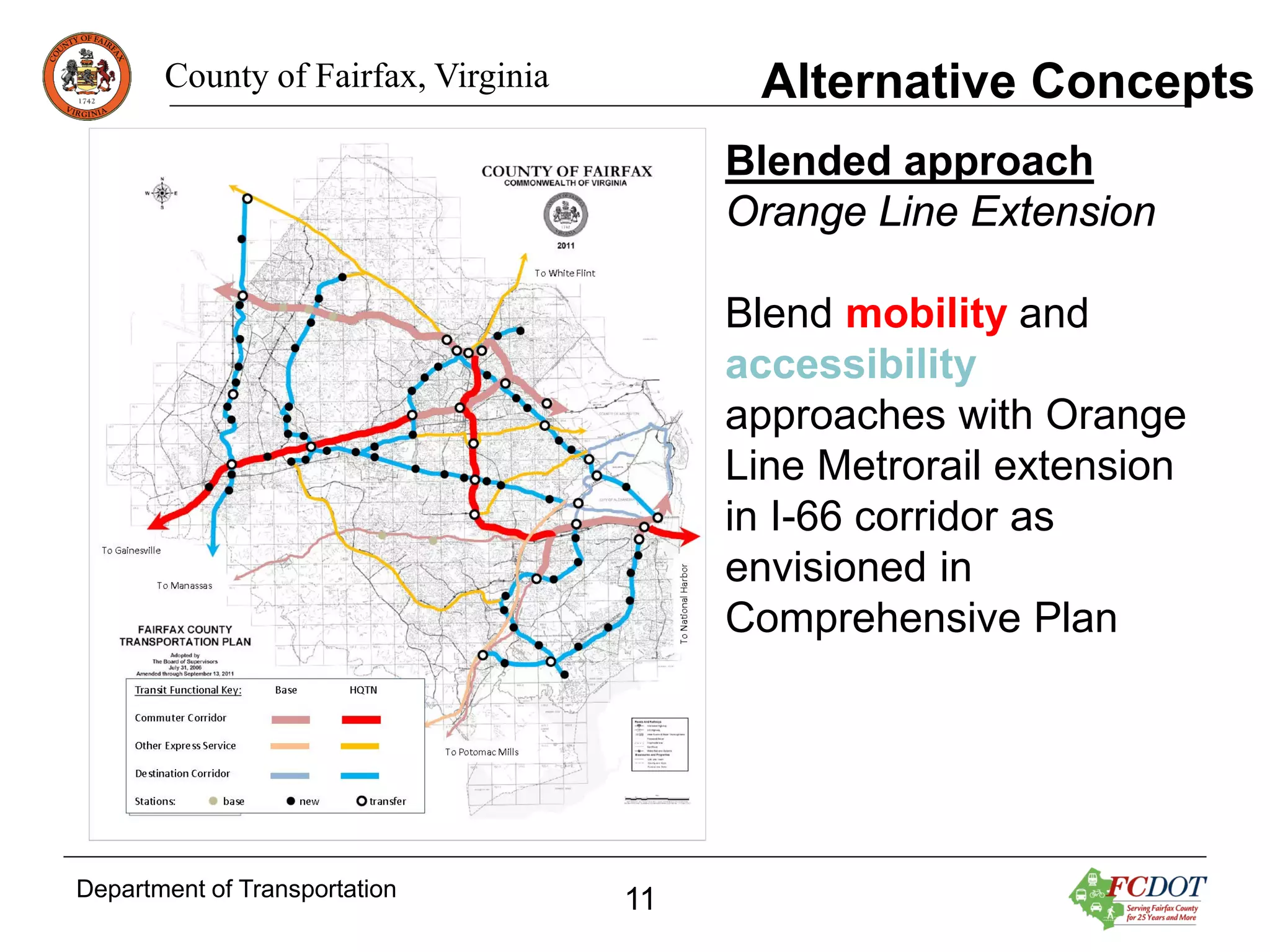
Blended approach
Orange Line Extension
Blend mobility and
accessibility
approaches with Orange
Line Metrorail extension
in I-66 corridor as
envisioned in
Comprehensive Plan

Department of Transportation

11
Alternative Concepts

County of Fairfax, Virginia

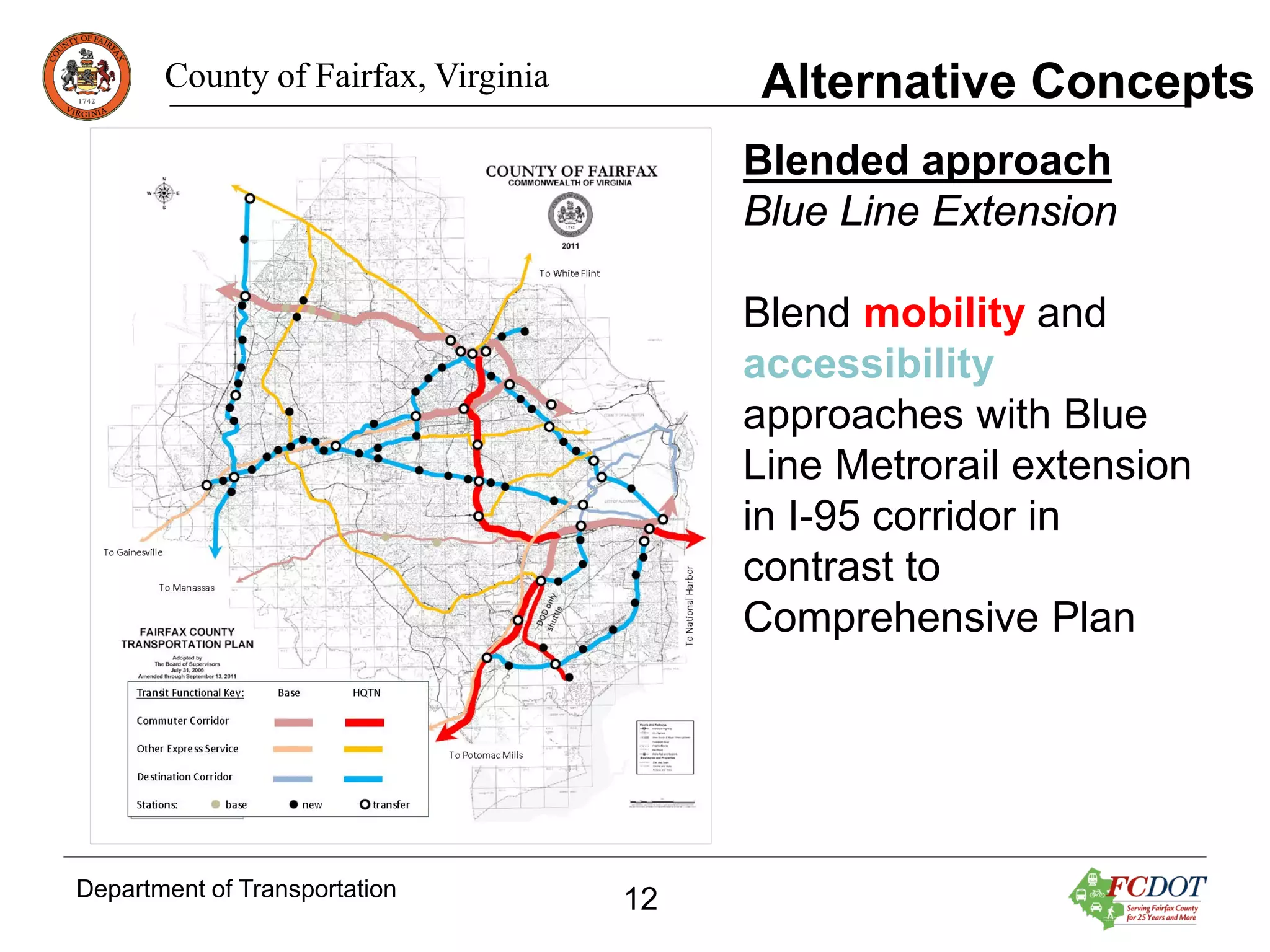
Blended approach
Blue Line Extension
Blend mobility and
accessibility
approaches with Blue
Line Metrorail extension
in I-95 corridor in
contrast to
Comprehensive Plan

Department of Transportation

12
Alternative Concepts

County of Fairfax, Virginia

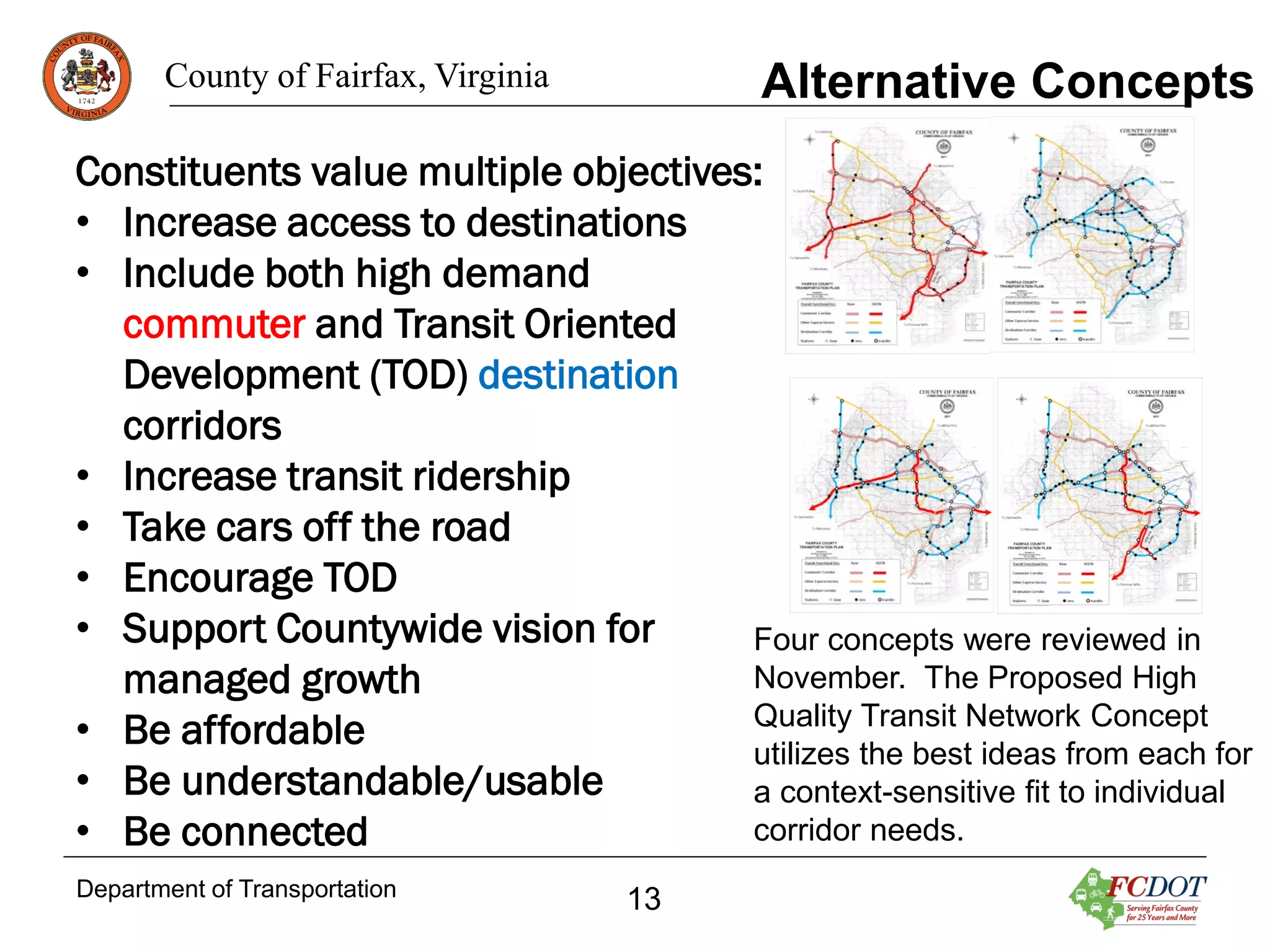
Constituents value multiple objectives:
• Increase access to destinations
• Include both high demand
commuter and Transit Oriented
Development (TOD) destination
corridors
• Increase transit ridership
• Take cars off the road
• Encourage TOD
• Support Countywide vision for
Four concepts were reviewed in
November. The Proposed High
managed growth
Quality Transit Network Concept
• Be affordable
utilizes the best ideas from each for
• Be understandable/usable
a context-sensitive fit to individual
corridor needs.
• Be connected
Department of Transportation

13
County of Fairfax, Virginia

Proposed Network Concept
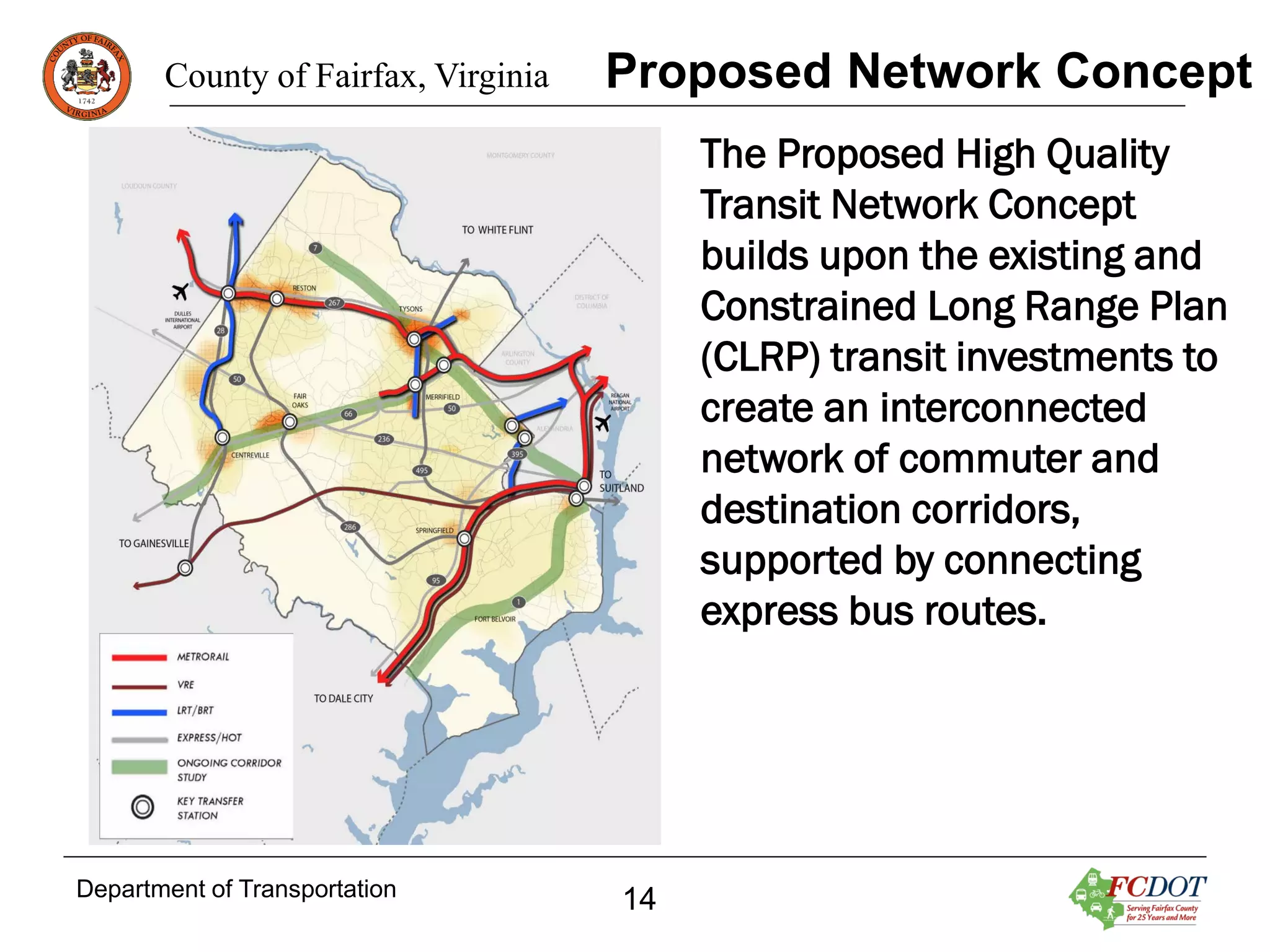
The Proposed High Quality
Transit Network Concept
builds upon the existing and
Constrained Long Range Plan
(CLRP) transit investments to
create an interconnected
network of commuter and
destination corridors,
supported by connecting
express bus routes.

Department of Transportation

14
County of Fairfax, Virginia

Proposed Concept Elements
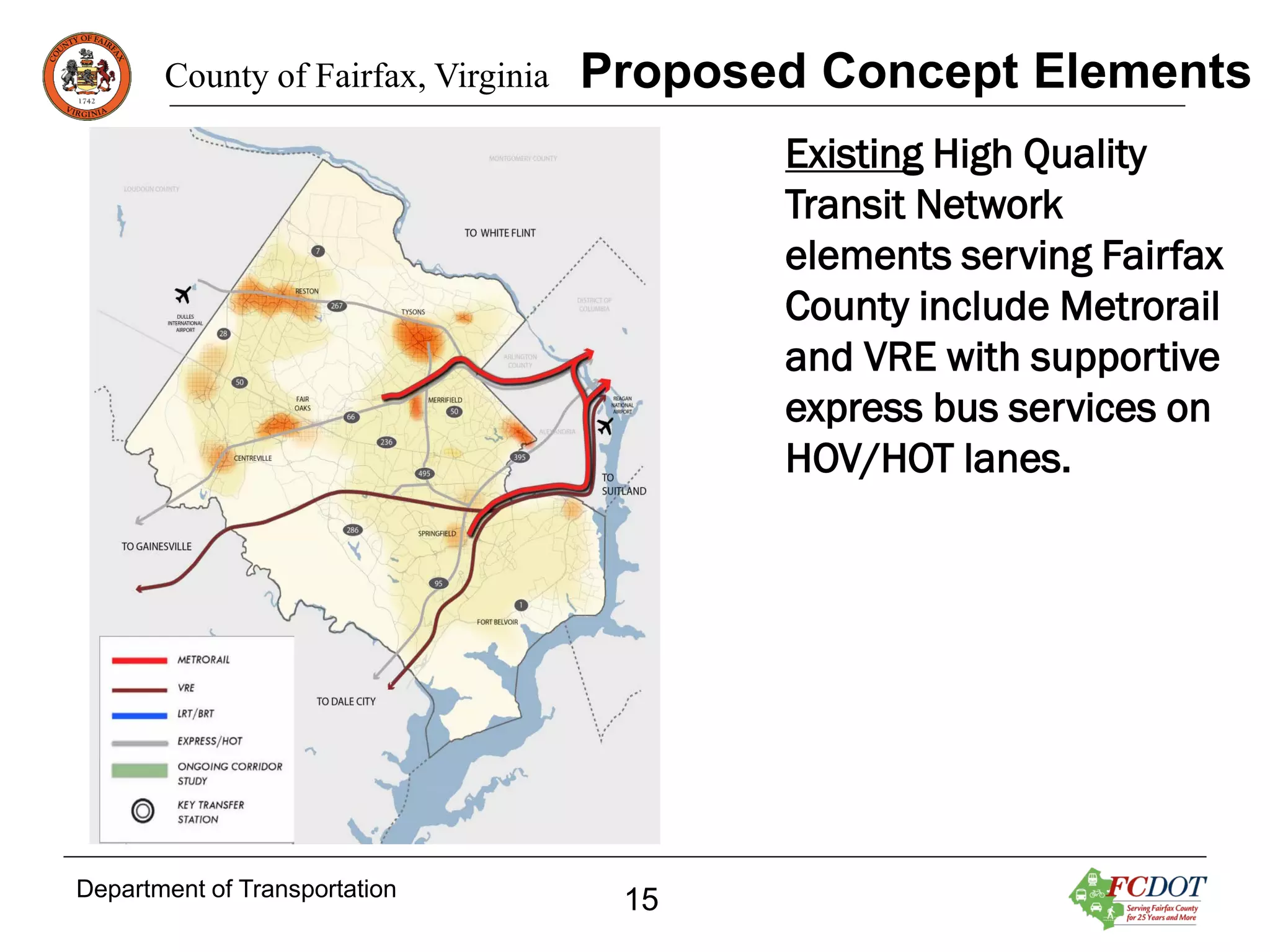
Existing High Quality
Transit Network
elements serving Fairfax
County include Metrorail
and VRE with supportive
express bus services on
HOV/HOT lanes.

Department of Transportation

15
County of Fairfax, Virginia

Proposed Concept Elements
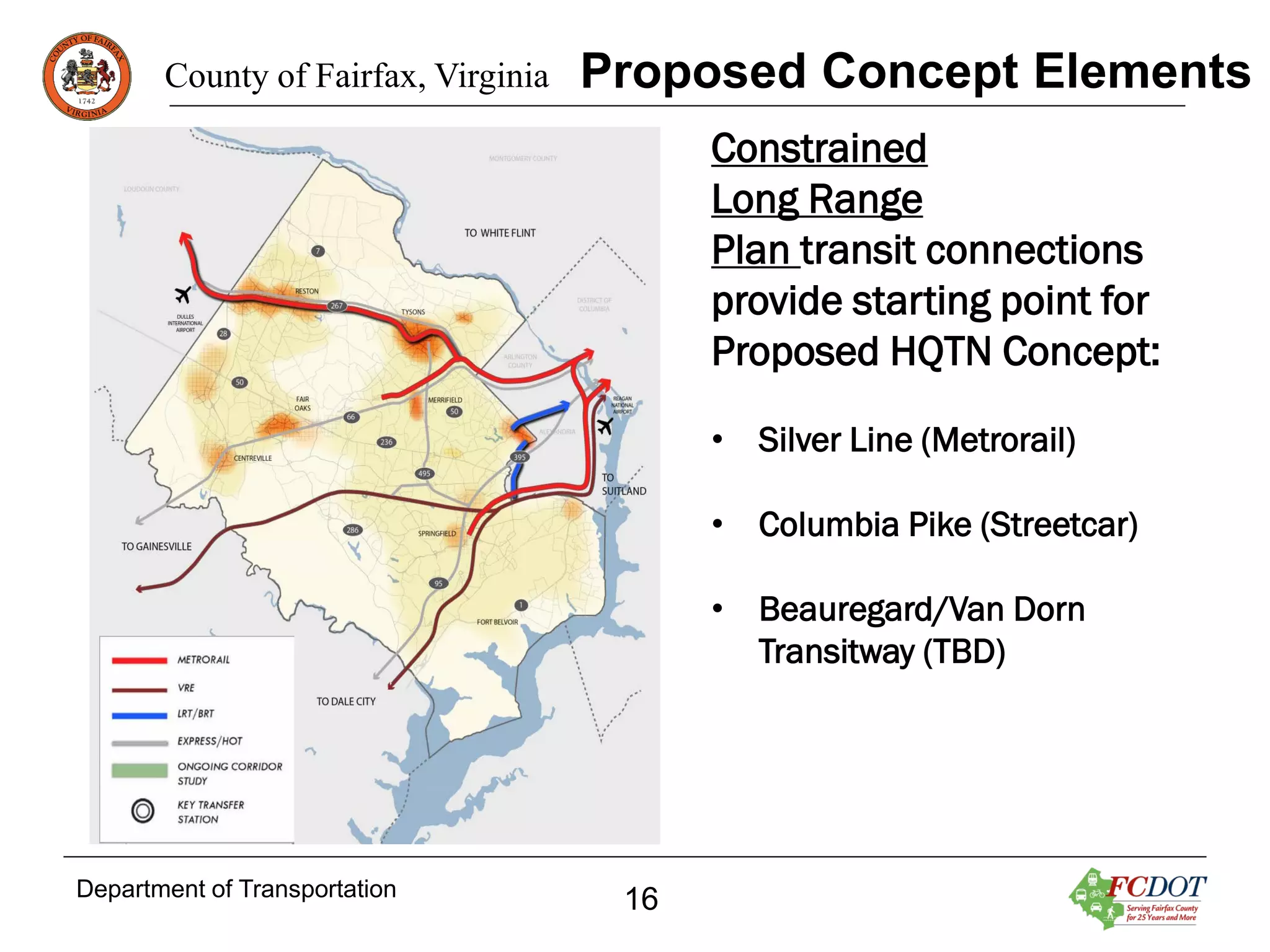
Constrained
Long Range
Plan transit connections
provide starting point for
Proposed HQTN Concept:
• Silver Line (Metrorail)
• Columbia Pike (Streetcar)
• Beauregard/Van Dorn
Transitway (TBD)

Department of Transportation

16
County of Fairfax, Virginia

Proposed Concept Elements
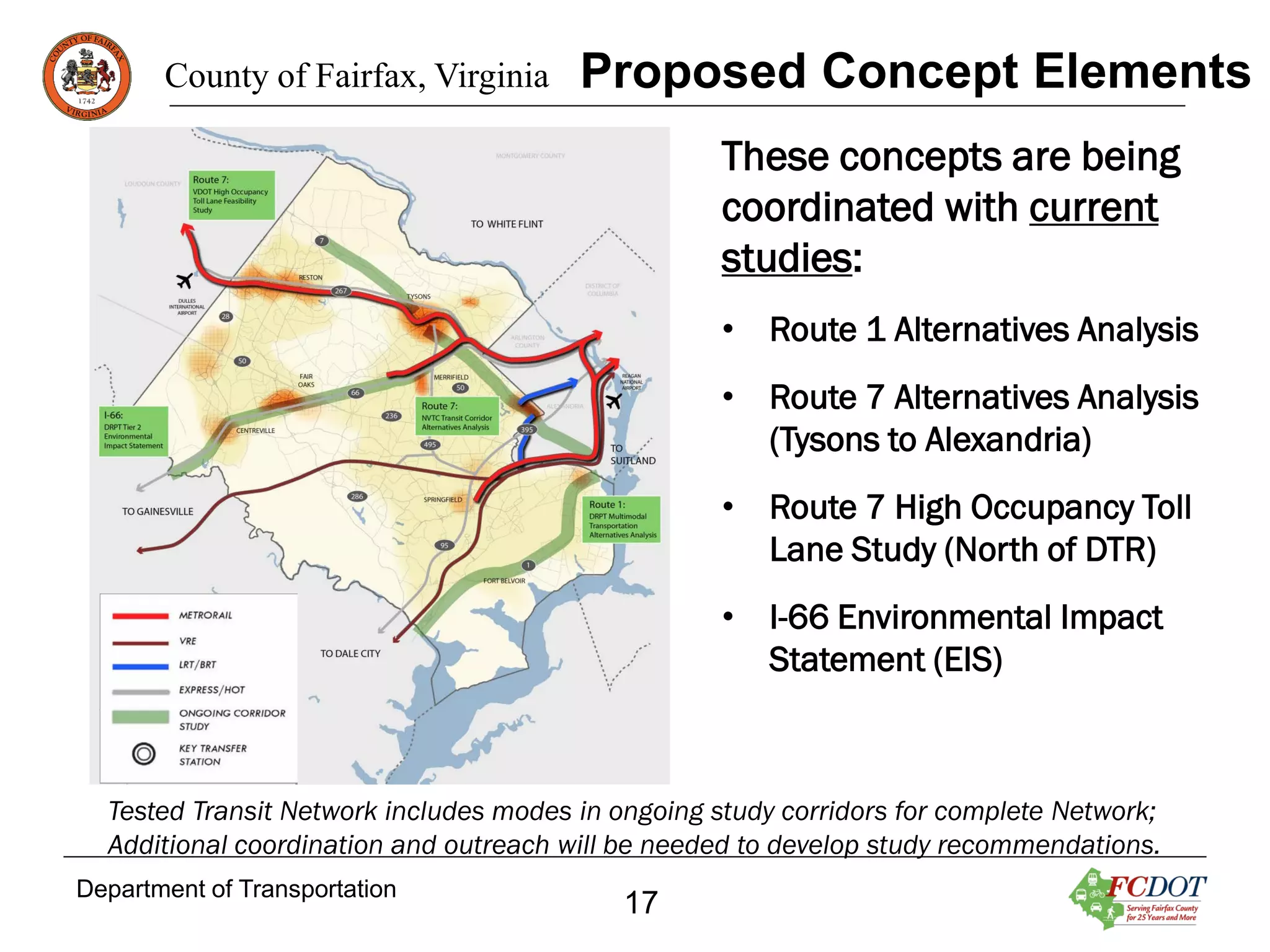
These concepts are being
coordinated with current
studies:
• Route 1 Alternatives Analysis
• Route 7 Alternatives Analysis
(Tysons to Alexandria)
• Route 7 High Occupancy Toll
Lane Study (North of DTR)
• I-66 Environmental Impact
Statement (EIS)

Tested Transit Network includes modes in ongoing study corridors for complete Network;
Additional coordination and outreach will be needed to develop study recommendations.
Department of Transportation

17
County of Fairfax, Virginia

Proposed Concept Elements
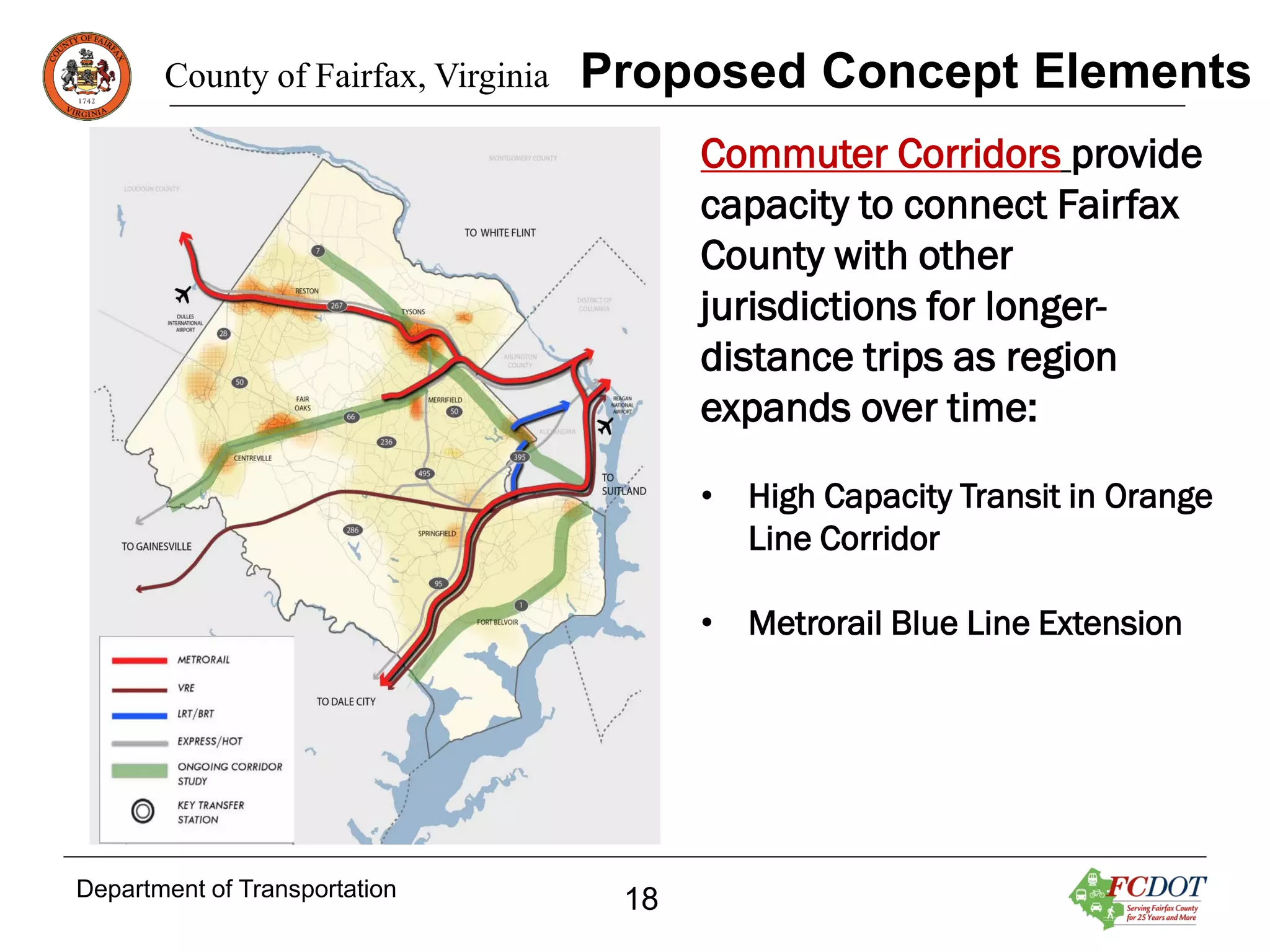
Commuter Corridors provide
capacity to connect Fairfax
County with other
jurisdictions for longerdistance trips as region
expands over time:
• High Capacity Transit in Orange
Line Corridor
• Metrorail Blue Line Extension

Department of Transportation

18
County of Fairfax, Virginia

Proposed Concept Elements
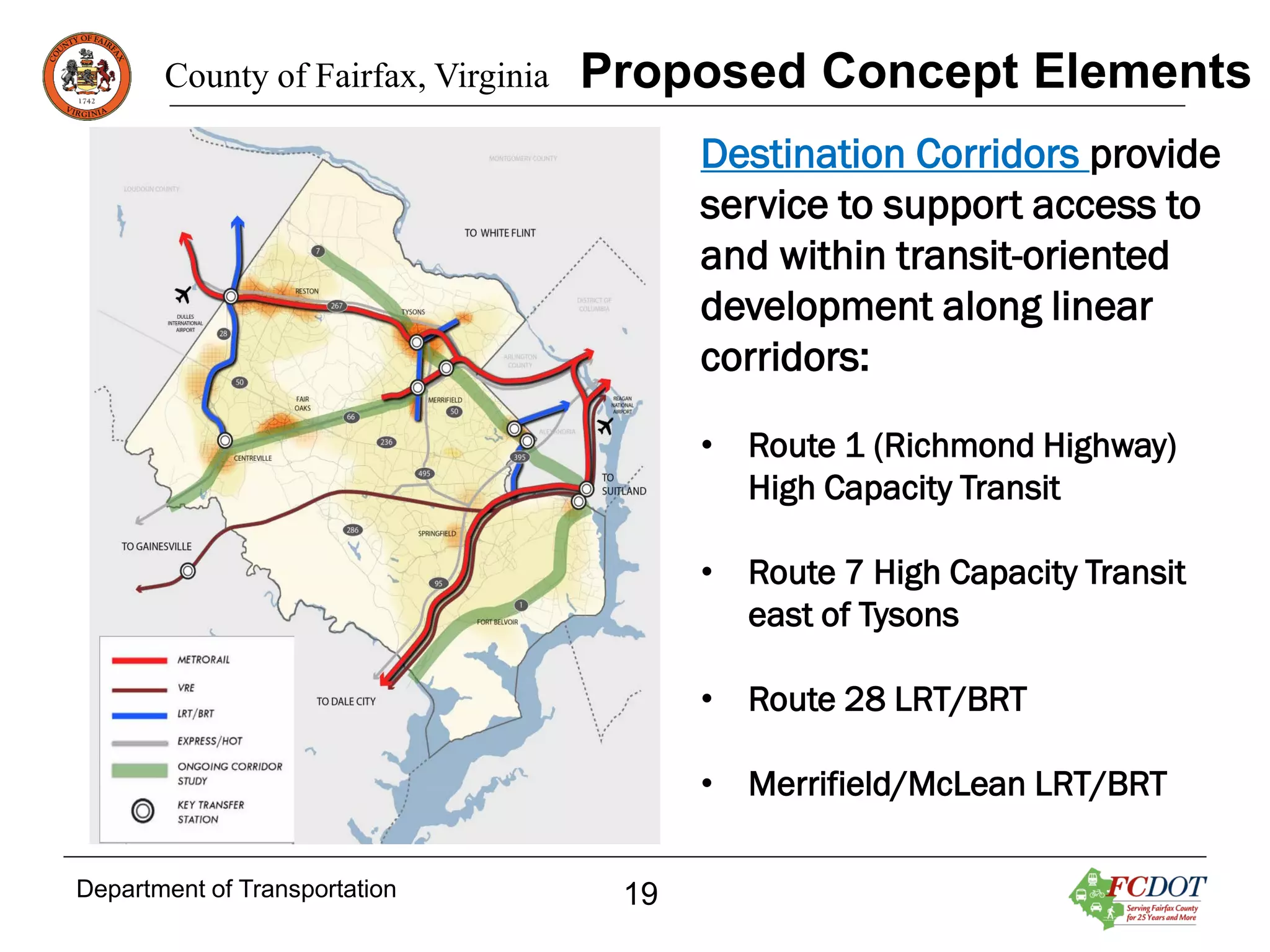
Destination Corridors provide
service to support access to
and within transit-oriented
development along linear
corridors:
• Route 1 (Richmond Highway)
High Capacity Transit
• Route 7 High Capacity Transit
east of Tysons
• Route 28 LRT/BRT
• Merrifield/McLean LRT/BRT

Department of Transportation

19
County of Fairfax, Virginia

Proposed Concept Elements
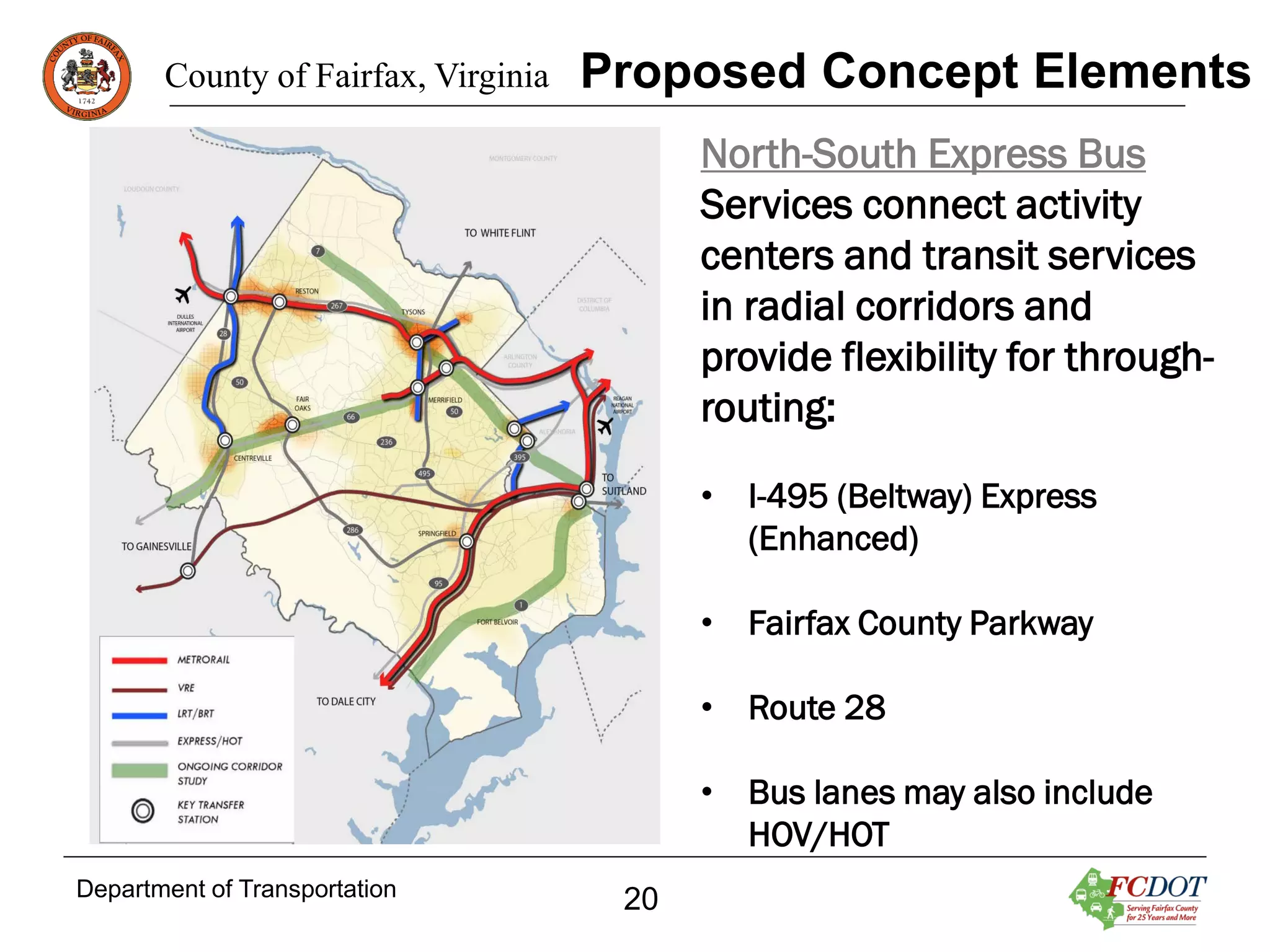
North-South Express Bus
Services connect activity
centers and transit services
in radial corridors and
provide flexibility for throughrouting:
• I-495 (Beltway) Express
(Enhanced)
• Fairfax County Parkway
• Route 28
• Bus lanes may also include
HOV/HOT

Department of Transportation

20
County of Fairfax, Virginia

Proposed Concept Elements
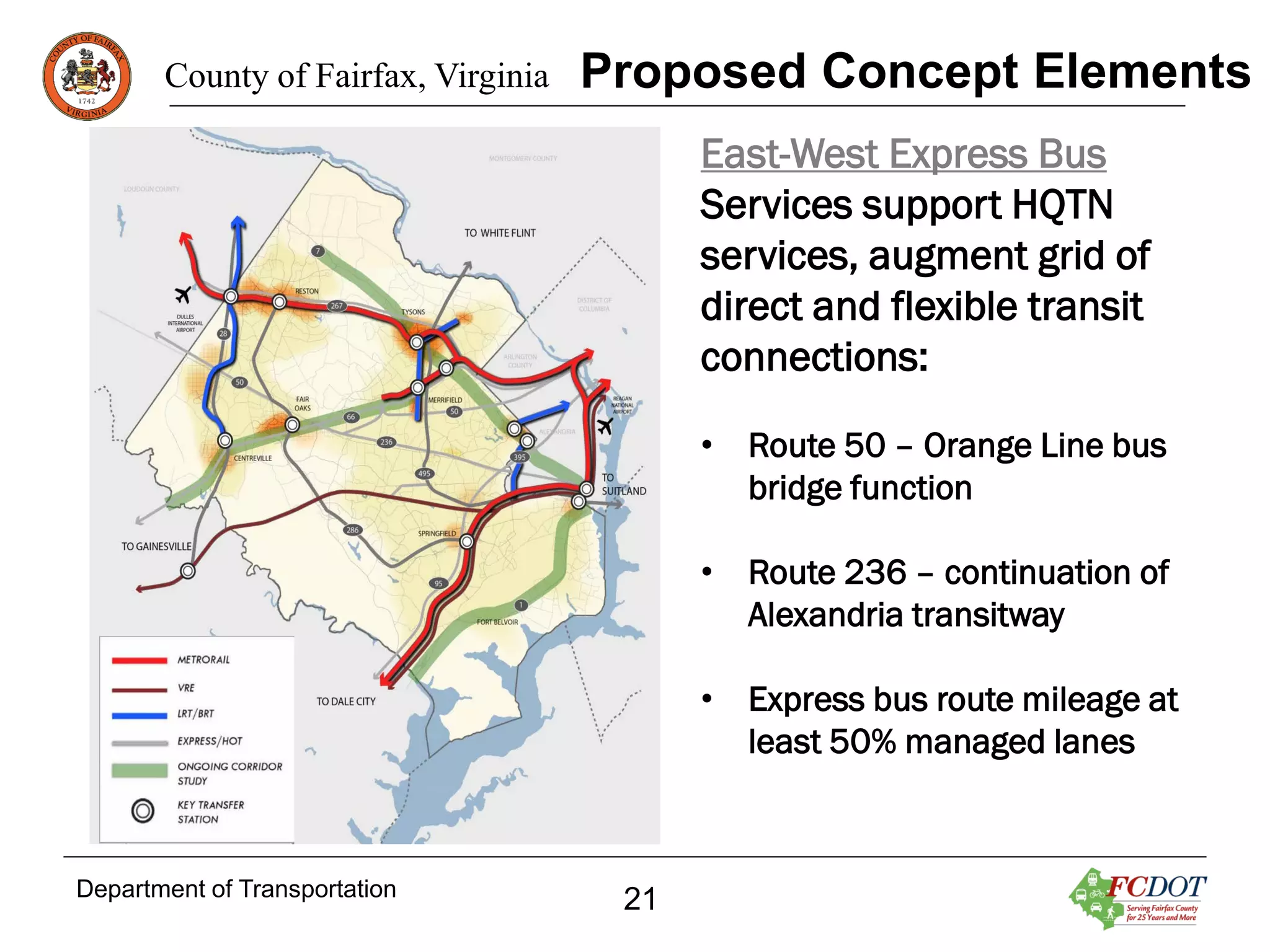
East-West Express Bus
Services support HQTN
services, augment grid of
direct and flexible transit
connections:
• Route 50 – Orange Line bus
bridge function
• Route 236 – continuation of
Alexandria transitway
• Express bus route mileage at
least 50% managed lanes

Department of Transportation

21
County of Fairfax, Virginia

Tested Network Elements
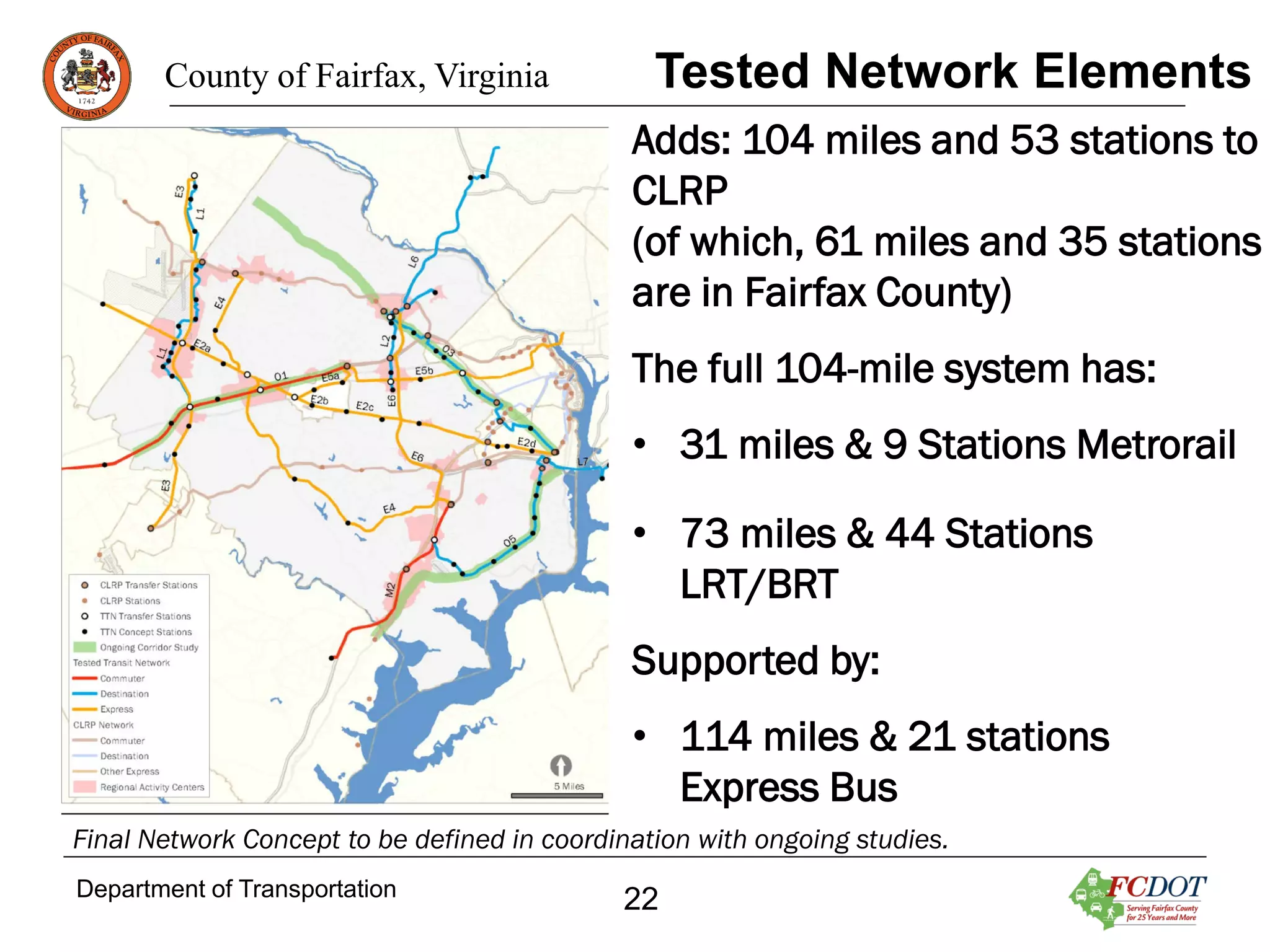
Adds: 104 miles and 53 stations to
CLRP
(of which, 61 miles and 35 stations
are in Fairfax County)
The full 104-mile system has:
• 31 miles & 9 Stations Metrorail
• 73 miles & 44 Stations
LRT/BRT
Supported by:
• 114 miles & 21 stations
Express Bus

Final Network Concept to be defined in coordination with ongoing studies.
Department of Transportation

22
County of Fairfax, Virginia

Department of Transportation

Measures of Effectiveness

23
County of Fairfax, Virginia

Measures of Effectiveness
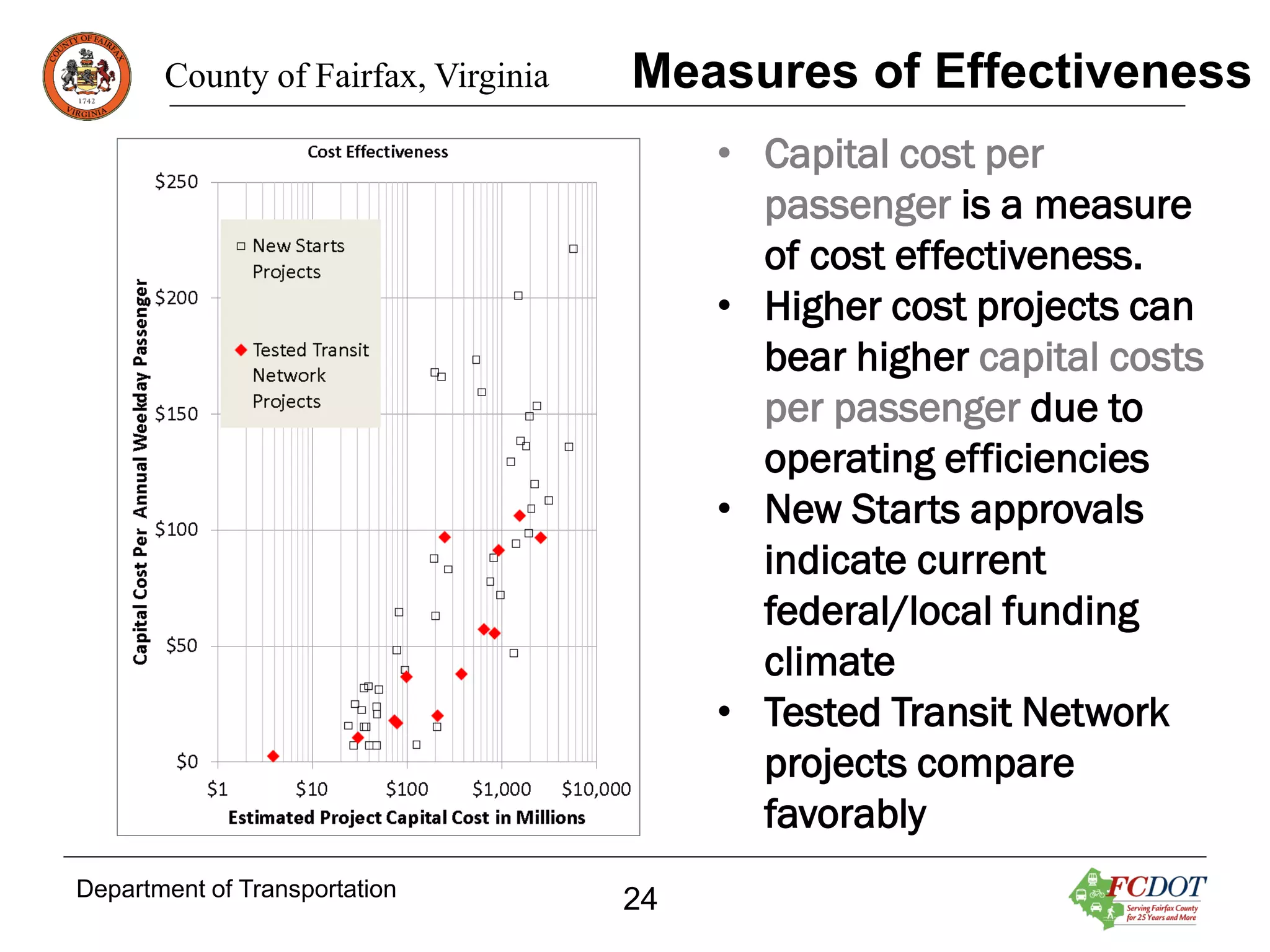
• Capital cost per
passenger is a measure
of cost effectiveness.
• Higher cost projects can
bear higher capital costs
per passenger due to
operating efficiencies
• New Starts approvals
indicate current
federal/local funding
climate
• Tested Transit Network
projects compare
favorably

Department of Transportation

24
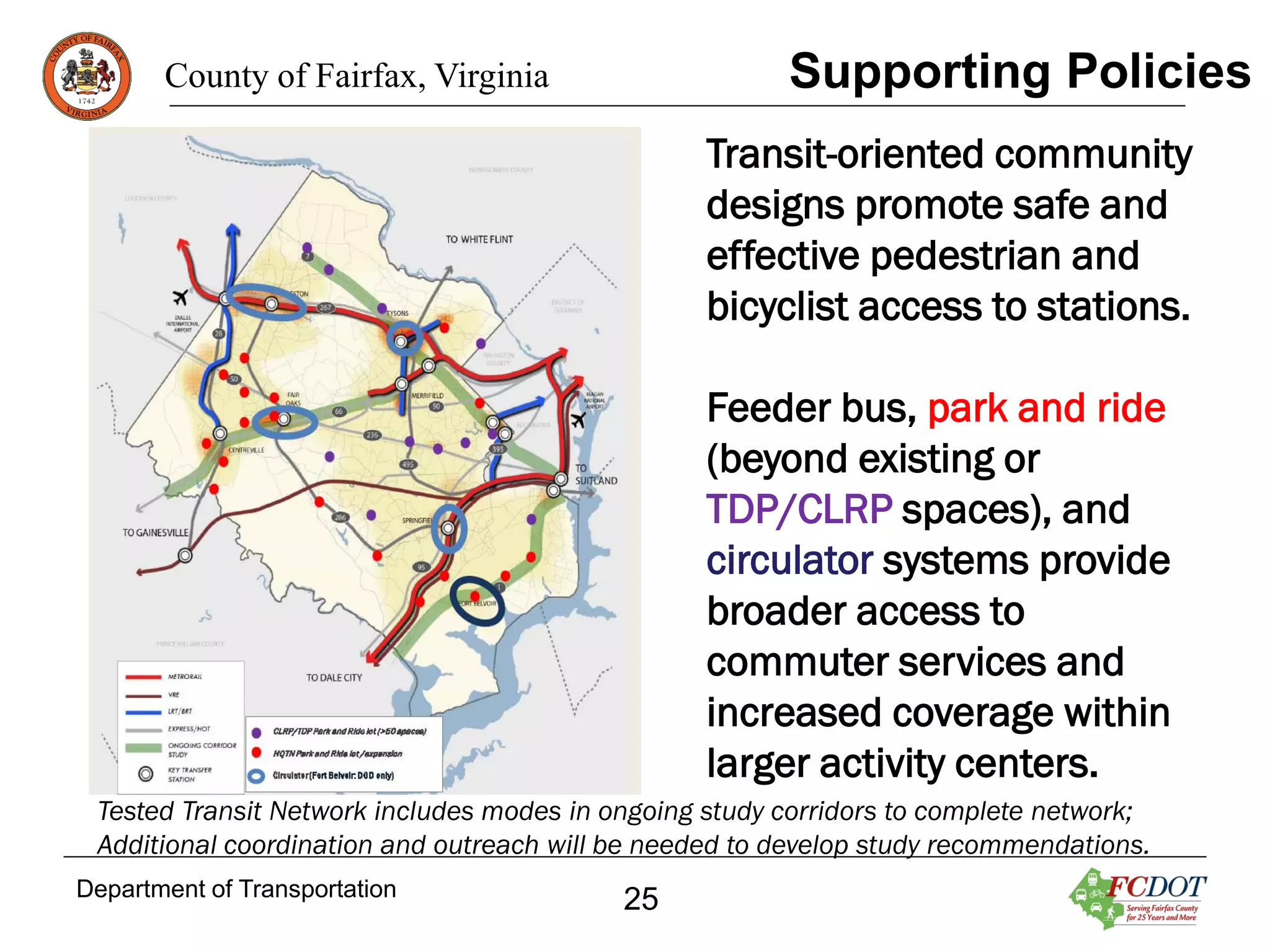
Supporting Policies

County of Fairfax, Virginia

Transit-oriented community
designs promote safe and
effective pedestrian and
bicyclist access to stations.
Feeder bus, park and ride
(beyond existing or
TDP/CLRP spaces), and
circulator systems provide
broader access to
commuter services and
increased coverage within
larger activity centers.
Tested Transit Network includes modes in ongoing study corridors to complete network;
Additional coordination and outreach will be needed to develop study recommendations.
Department of Transportation

25
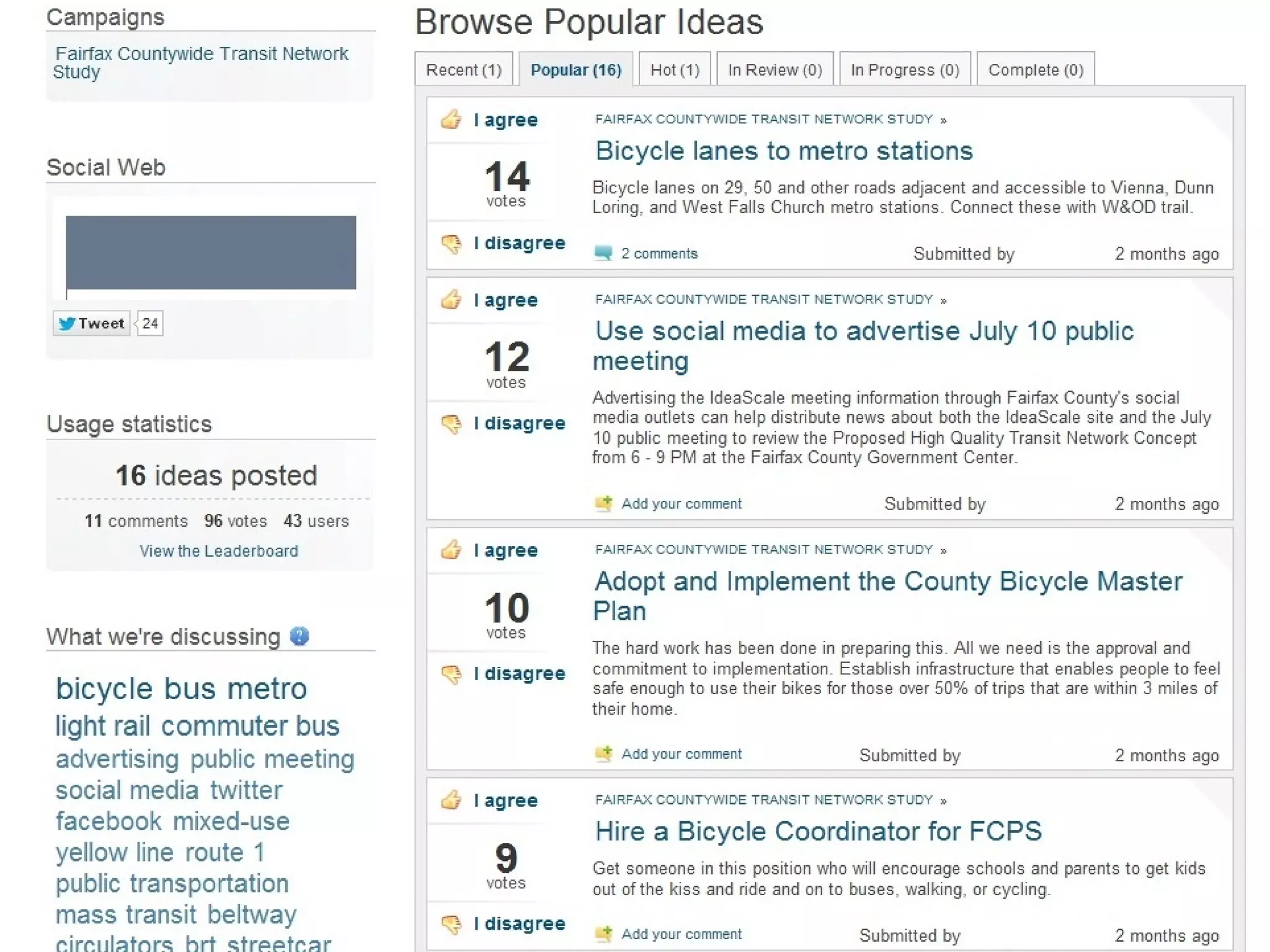
Public outreach

County of Fairfax, Virginia

Department of Transportation

26
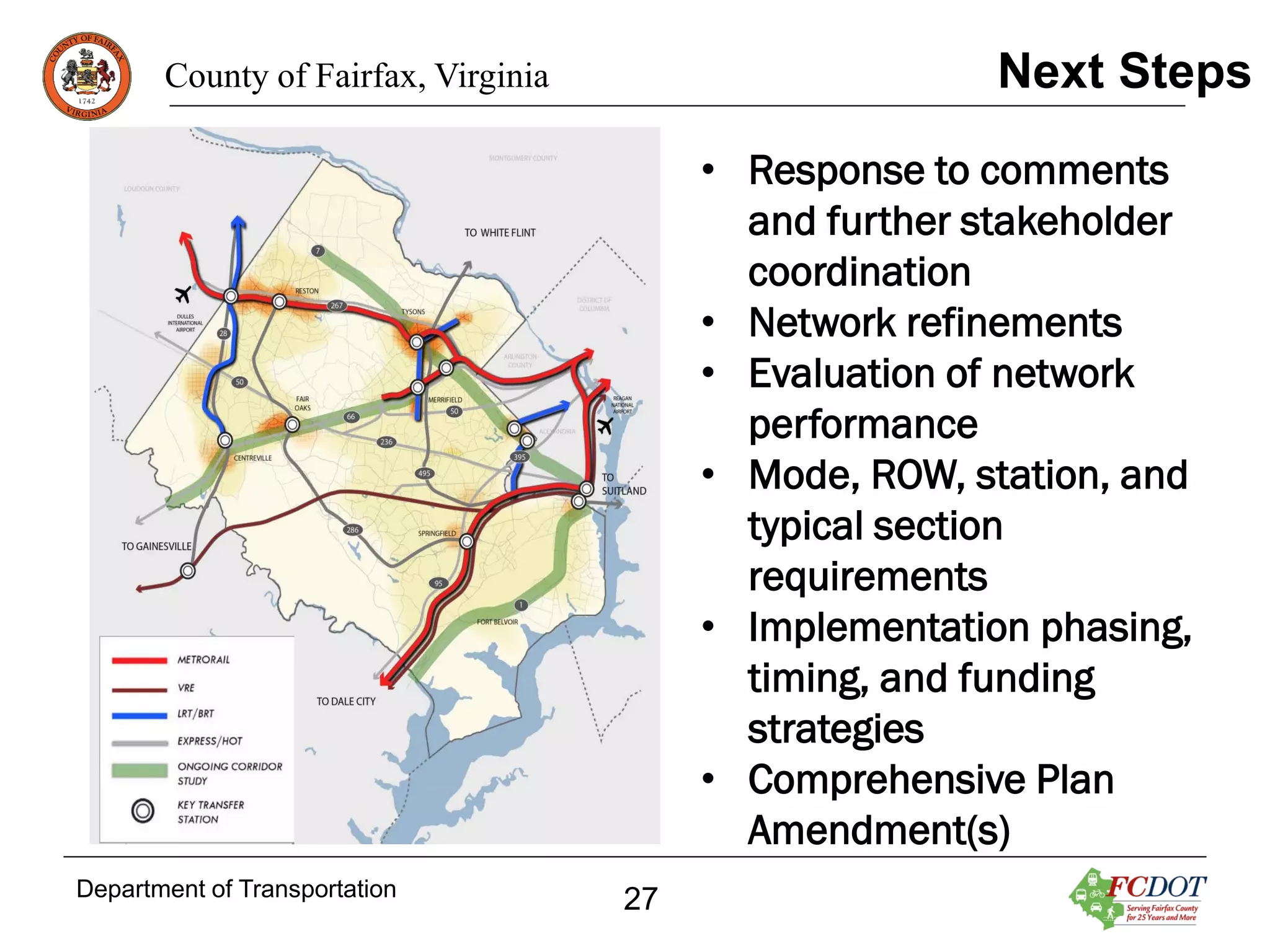
Next Steps

County of Fairfax, Virginia

• Response to comments
and further stakeholder
coordination
• Network refinements
• Evaluation of network
performance
• Mode, ROW, station, and
typical section
requirements
• Implementation phasing,
timing, and funding
strategies
• Comprehensive Plan
Amendment(s)
Department of Transportation

27
Questions?

County of Fairfax, Virginia

Thomas Burke (Fairfax County DOT)
thomas.burke@fairfaxcounty.gov
703-877-5600
http://www.fairfaxcounty.gov/fcdot/2050transitstudy/
http://www.fairfaxcountydot.ideascale.com/

Department of Transportation

28

Fairfax County Countywide Transit Network Study: Sept. 17, 2013

  • 1.
    County of Fairfax,Virginia Fairfax County Countywide Transit Network Study Fairfax County Board of Supervisors Transportation Committee September 17, 2013 Department of Transportation 1
  • 2.
    Presentation Context County ofFairfax, Virginia This presentation summarizes materials presented at the July 10, 2013 public workshop held at the Fairfax County Government Center. It also incorporates subsequent changes made in response to stakeholder comment to clarify the relationship between the Proposed High Quality Transit Network Concept and corridors under current study. Department of Transportation 2
  • 3.
    Study Purpose County ofFairfax, Virginia Establish most effective way to serve the County’s needs to accommodate planned growth over the long term by improving public transit usage. Update Enhanced Public Transportation Corridors (EPTC) with High Quality Transit Network (HQTN) and further define modes, right-ofway, and station locations. Department of Transportation 3
  • 4.
    Study Process County ofFairfax, Virginia We are at the third of our four stages of public involvement and review: • Goals/Objectives (July 2012) • Functions (November 2012) • Proposed High Quality Transit Network Concept (July 2013) • Final Concept (Spring/Summer 2014) Our next steps are to: • Continue stakeholder engagement • Consider refinements • Develop additional details on alignments, stations, and costs • Finalize recommendations Department of Transportation 4
  • 5.
    Land Use Concept Countyof Fairfax, Virginia The proposed 2050 High Quality Transit Network supports the County’s future development concept by focusing service on activity centers Department of Transportation 5
  • 6.
    High Quality Transit Countyof Fairfax, Virginia Defining elements of a High Quality Transit Network include providing improved travel speeds and reliable travel times, typically on exclusive right-of-way. Commuter rail, Metrorail, LRT, and BRT are all examples of High Quality Transit modes. Department of Transportation 6
  • 7.
    Transit Corridor Function Countyof Fairfax, Virginia The type of premium transit service appropriate for each corridor will reflect the traveler needs and land use context in that corridor. Destination corridors, like the Crystal City Potomac Yards transitway, connect neighborhoods to multiple activity centers, functioning primarily to provide access. Commuter corridors, like Virginia Railway Express, primarily serve one major activity center and tend to focus on journey-to-work trips and function primarily to provide mobility. Source: Center for Transit Oriented Development Department of Transportation District circulators, like the planned Tysons Circulator, enhance mobility within an activity center or group of adjacent centers. 7
  • 8.
    Functional Concepts County ofFairfax, Virginia Mobility Access The November 2012 public meeting presented different functional concepts for a High Quality Transit Network. The access focus attracted more total transit riders whereas the mobility focus provided better access to regional jobs. Both had a similar benefit in reducing vehicle travel. Department of Transportation 8
  • 9.
    Alternative Concepts County ofFairfax, Virginia Mobility focus Connect activity centers within Fairfax County and adjacent jurisdictions with high speed commuter corridors that best serve longer-distance trips. Department of Transportation 9
  • 10.
    Alternative Concepts County ofFairfax, Virginia Accessibility focus Connect activity centers within Fairfax County and adjacent jurisdictions with high access transitways (light rail or bus rapid transit) destination corridors that best serve shorter-distance trips Department of Transportation 10
  • 11.
    Alternative Concepts County ofFairfax, Virginia Blended approach Orange Line Extension Blend mobility and accessibility approaches with Orange Line Metrorail extension in I-66 corridor as envisioned in Comprehensive Plan Department of Transportation 11
  • 12.
    Alternative Concepts County ofFairfax, Virginia Blended approach Blue Line Extension Blend mobility and accessibility approaches with Blue Line Metrorail extension in I-95 corridor in contrast to Comprehensive Plan Department of Transportation 12
  • 13.
    Alternative Concepts County ofFairfax, Virginia Constituents value multiple objectives: • Increase access to destinations • Include both high demand commuter and Transit Oriented Development (TOD) destination corridors • Increase transit ridership • Take cars off the road • Encourage TOD • Support Countywide vision for Four concepts were reviewed in November. The Proposed High managed growth Quality Transit Network Concept • Be affordable utilizes the best ideas from each for • Be understandable/usable a context-sensitive fit to individual corridor needs. • Be connected Department of Transportation 13
  • 14.
    County of Fairfax,Virginia Proposed Network Concept The Proposed High Quality Transit Network Concept builds upon the existing and Constrained Long Range Plan (CLRP) transit investments to create an interconnected network of commuter and destination corridors, supported by connecting express bus routes. Department of Transportation 14
  • 15.
    County of Fairfax,Virginia Proposed Concept Elements Existing High Quality Transit Network elements serving Fairfax County include Metrorail and VRE with supportive express bus services on HOV/HOT lanes. Department of Transportation 15
  • 16.
    County of Fairfax,Virginia Proposed Concept Elements Constrained Long Range Plan transit connections provide starting point for Proposed HQTN Concept: • Silver Line (Metrorail) • Columbia Pike (Streetcar) • Beauregard/Van Dorn Transitway (TBD) Department of Transportation 16
  • 17.
    County of Fairfax,Virginia Proposed Concept Elements These concepts are being coordinated with current studies: • Route 1 Alternatives Analysis • Route 7 Alternatives Analysis (Tysons to Alexandria) • Route 7 High Occupancy Toll Lane Study (North of DTR) • I-66 Environmental Impact Statement (EIS) Tested Transit Network includes modes in ongoing study corridors for complete Network; Additional coordination and outreach will be needed to develop study recommendations. Department of Transportation 17
  • 18.
    County of Fairfax,Virginia Proposed Concept Elements Commuter Corridors provide capacity to connect Fairfax County with other jurisdictions for longerdistance trips as region expands over time: • High Capacity Transit in Orange Line Corridor • Metrorail Blue Line Extension Department of Transportation 18
  • 19.
    County of Fairfax,Virginia Proposed Concept Elements Destination Corridors provide service to support access to and within transit-oriented development along linear corridors: • Route 1 (Richmond Highway) High Capacity Transit • Route 7 High Capacity Transit east of Tysons • Route 28 LRT/BRT • Merrifield/McLean LRT/BRT Department of Transportation 19
  • 20.
    County of Fairfax,Virginia Proposed Concept Elements North-South Express Bus Services connect activity centers and transit services in radial corridors and provide flexibility for throughrouting: • I-495 (Beltway) Express (Enhanced) • Fairfax County Parkway • Route 28 • Bus lanes may also include HOV/HOT Department of Transportation 20
  • 21.
    County of Fairfax,Virginia Proposed Concept Elements East-West Express Bus Services support HQTN services, augment grid of direct and flexible transit connections: • Route 50 – Orange Line bus bridge function • Route 236 – continuation of Alexandria transitway • Express bus route mileage at least 50% managed lanes Department of Transportation 21
  • 22.
    County of Fairfax,Virginia Tested Network Elements Adds: 104 miles and 53 stations to CLRP (of which, 61 miles and 35 stations are in Fairfax County) The full 104-mile system has: • 31 miles & 9 Stations Metrorail • 73 miles & 44 Stations LRT/BRT Supported by: • 114 miles & 21 stations Express Bus Final Network Concept to be defined in coordination with ongoing studies. Department of Transportation 22
  • 23.
    County of Fairfax,Virginia Department of Transportation Measures of Effectiveness 23
  • 24.
    County of Fairfax,Virginia Measures of Effectiveness • Capital cost per passenger is a measure of cost effectiveness. • Higher cost projects can bear higher capital costs per passenger due to operating efficiencies • New Starts approvals indicate current federal/local funding climate • Tested Transit Network projects compare favorably Department of Transportation 24
  • 25.
    Supporting Policies County ofFairfax, Virginia Transit-oriented community designs promote safe and effective pedestrian and bicyclist access to stations. Feeder bus, park and ride (beyond existing or TDP/CLRP spaces), and circulator systems provide broader access to commuter services and increased coverage within larger activity centers. Tested Transit Network includes modes in ongoing study corridors to complete network; Additional coordination and outreach will be needed to develop study recommendations. Department of Transportation 25
  • 26.
    Public outreach County ofFairfax, Virginia Department of Transportation 26
  • 27.
    Next Steps County ofFairfax, Virginia • Response to comments and further stakeholder coordination • Network refinements • Evaluation of network performance • Mode, ROW, station, and typical section requirements • Implementation phasing, timing, and funding strategies • Comprehensive Plan Amendment(s) Department of Transportation 27
  • 28.
    Questions? County of Fairfax,Virginia Thomas Burke (Fairfax County DOT) thomas.burke@fairfaxcounty.gov 703-877-5600 http://www.fairfaxcounty.gov/fcdot/2050transitstudy/ http://www.fairfaxcountydot.ideascale.com/ Department of Transportation 28