Acute Gastroenteritis,fluid
and electrolytes
management
Supervisor: Dr Laili
Presenter: Dr Aida Batrisyia Binti Zam Beri, Dr Muhammad Shazwan Bin Safiee, Dr
Muhammad Syahrul Anwar, Dr Tan Chen Liang
Acute
Gastroenteritis
Definitions
● Acute Gastroenteritis (AGE):
○ Diarrhoeal disease of rapid onset, with or without accompanying
symptoms, signs, such as nausea, vomiting, fever, or abdominal pain.
● Diarrhoea:
○ The frequent passage of unformed liquid stools (3 or more
loose,watery stool per day)
● Dysentery:
○ Blood or mucus in stools
Type of diarrhea
● Acute:
○ short in duration of < 7 days
● Persistent diarrhea:
○ starts acutely and lasts longer than 1 week
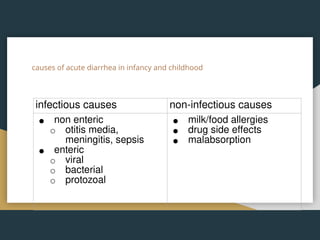
causes of acute diarrhea in infancy and childhood
infectious causes non-infectious causes
● non enteric
○ otitis media,
meningitis, sepsis
● enteric
○ viral
○ bacterial
○ protozoal
● milk/food allergies
● drug side effects
● malabsorption
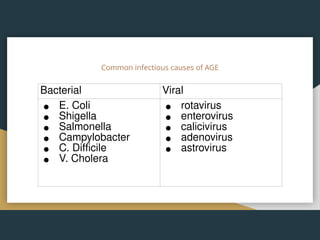
Common infectious causes of AGE
Bacterial Viral
● E. Coli
● Shigella
● Salmonella
● Campylobacter
● C. Difficile
● V. Cholera
● rotavirus
● enterovirus
● calicivirus
● adenovirus
● astrovirus
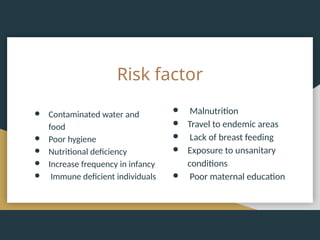
Risk factor
● Contaminated water and
food
● Poor hygiene
● Nutritional deficiency
● Increase frequency in infancy
● Immune deficient individuals
● Malnutrition
● Travel to endemic areas
● Lack of breast feeding
● Exposure to unsanitary
conditions
● Poor maternal education
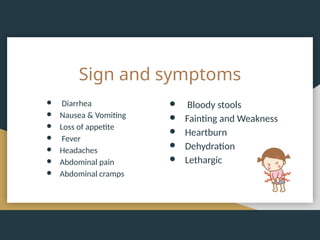
Sign and symptoms
● Diarrhea
● Nausea & Vomiting
● Loss of appetite
● Fever
● Headaches
● Abdominal pain
● Abdominal cramps
● Bloody stools
● Fainting and Weakness
● Heartburn
● Dehydration
● Lethargic
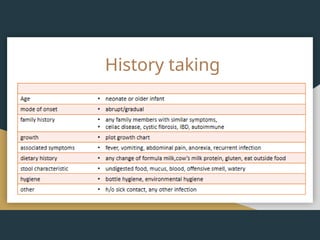
History taking
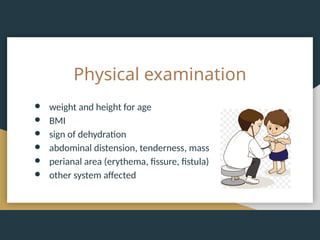
Physical examination
● weight and height for age
● BMI
● sign of dehydration
● abdominal distension, tenderness, mass
● perianal area (erythema, fissure, fistula)
● other system affected
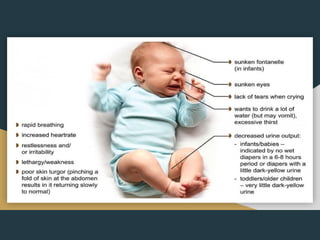
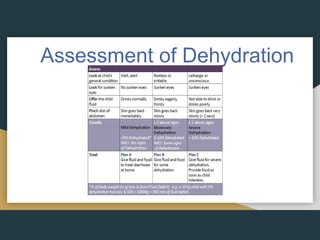
Assessment of Dehydration
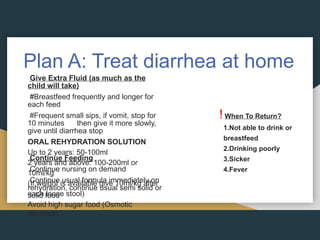
Plan A: Treat diarrhea at home
Give Extra Fluid (as much as the
child will take)
#Breastfeed frequently and longer for
each feed
#Frequent small sips, if vomit, stop for
10 minutes then give it more slowly,
give until diarrhea stop
ORAL REHYDRATION SOLUTION
Up to 2 years: 50-100ml
2 years and above: 100-200ml or
10ml/kg
(If weight is available give 10ml/kg after
each loose stool)
Continue Feeding
Continue nursing on demand
Continue usual formula immediately on
rehydration, continue usual semi solid or
solid food
Avoid high sugar food (Osmotic
diarrhea)
! When To Return?
1.Not able to drink or
breastfeed
2.Drinking poorly
3.Sicker
4.Fever
5.Blood in stool
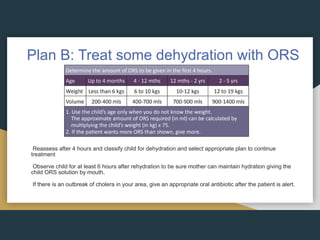
Plan B: Treat some dehydration with ORS
Reassess after 4 hours and classify child for dehydration and select appropriate plan to continue
treatment
Observe child for at least 6 hours after rehydration to be sure mother can maintain hydration giving the
child ORS solution by mouth.
If there is an outbreak of cholera in your area, give an appropriate oral antibiotic after the patient is alert.
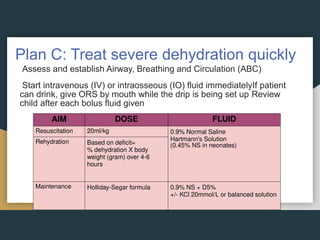
Plan C: Treat severe dehydration quickly
Assess and establish Airway, Breathing and Circulation (ABC)
Start intravenous (IV) or intraosseous (IO) fluid immediatelyIf patient
can drink, give ORS by mouth while the drip is being set up Review
child after each bolus fluid given
AIM DOSE FLUID
Resuscitation 20ml/kg 0.9% Normal Saline
Hartmann’s Solution
(0.45% NS in neonates)
Rehydration Based on deficit=
% dehydration X body
weight (gram) over 4-6
hours
Maintenance Holliday-Segar formula 0.9% NS + D5%
+/- KCl 20mmol/L or balanced solution
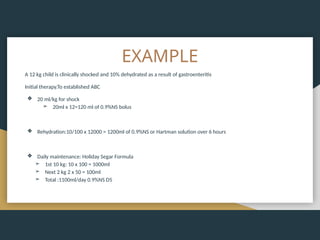
EXAMPLE
A 12 kg child is clinically shocked and 10% dehydrated as a result of gastroenteritis
Initial therapy.To established ABC
❖ 20 ml/kg for shock
➢ 20ml x 12=120 ml of 0.9%NS bolus
❖ Rehydration:10/100 x 12000 = 1200ml of 0.9%NS or Hartman solution over 6 hours
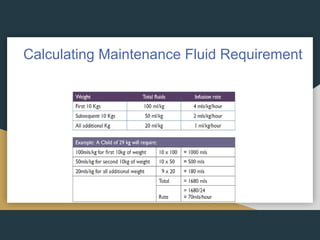
❖ Daily maintenance: Holiday Segar Formula
➢ 1st 10 kg: 10 x 100 = 1000ml
➢ Next 2 kg 2 x 50 = 100ml
➢ Total :1100ml/day 0.9%NS D5
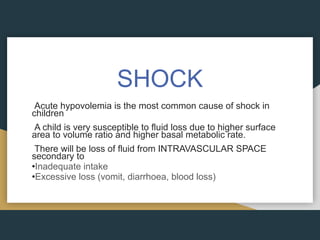
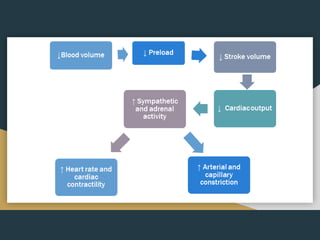
SHOCK
Acute hypovolemia is the most common cause of shock in
children
A child is very susceptible to fluid loss due to higher surface
area to volume ratio and higher basal metabolic rate.
There will be loss of fluid from INTRAVASCULAR SPACE
secondary to
•Inadequate intake
•Excessive loss (vomit, diarrhoea, blood loss)
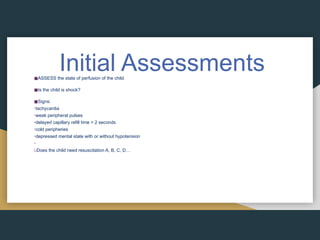
Initial Assessments
◼ASSESS the state of perfusion of the child
◼Is the child is shock?
◼Signs:
•tachycardia
•weak peripheral pulses
•delayed capillary refill time > 2 seconds
•cold peripheries
•depressed mental state with or without hypotension
•
üDoes the child need resuscitation A, B, C, D…
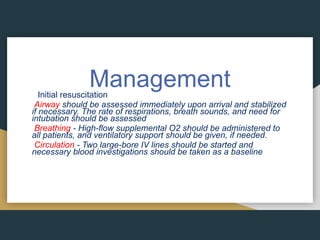
Management
Initial resuscitation
Airway should be assessed immediately upon arrival and stabilized
if necessary. The rate of respirations, breath sounds, and need for
intubation should be assessed
Breathing - High-flow supplemental O2 should be administered to
all patients, and ventilatory support should be given, if needed.
Circulation - Two large-bore IV lines should be started and
necessary blood investigations should be taken as a baseline
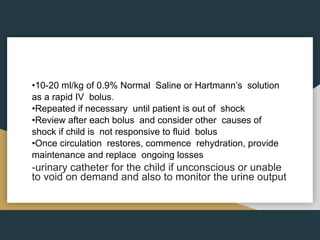
•10-20 ml/kg of 0.9% Normal Saline or Hartmann’s solution
as a rapid IV bolus.
•Repeated if necessary until patient is out of shock
•Review after each bolus and consider other causes of
shock if child is not responsive to fluid bolus
•Once circulation restores, commence rehydration, provide
maintenance and replace ongoing losses
-urinary catheter for the child if unconscious or unable
to void on demand and also to monitor the urine output
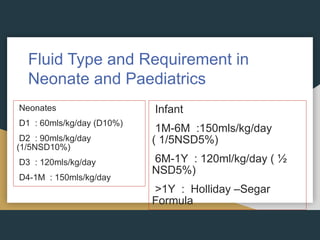
Fluid Type and Requirement in
Neonate and Paediatrics
Neonates
D1 : 60mls/kg/day (D10%)
D2 : 90mls/kg/day
(1/5NSD10%)
D3 : 120mls/kg/day
D4-1M : 150mls/kg/day
Infant
1M-6M :150mls/kg/day
( 1/5NSD5%)
6M-1Y : 120ml/kg/day ( ½
NSD5%)
>1Y : Holliday –Segar
Formula
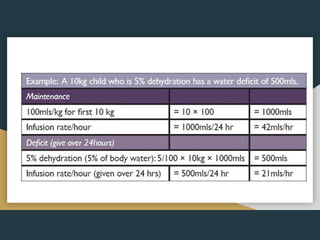
Calculating Maintenance Fluid Requirement
Electrolytes imbalance
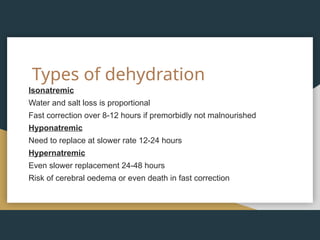
Types of dehydration
Isonatremic
Water and salt loss is proportional
Fast correction over 8-12 hours if premorbidly not malnourished
Hyponatremic
Need to replace at slower rate 12-24 hours
Hypernatremic
Even slower replacement 24-48 hours
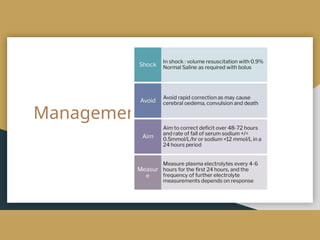
Risk of cerebral oedema or even death in fast correction
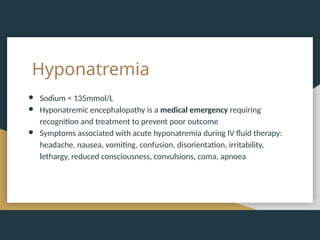
Hyponatremia
● Sodium < 135mmol/L
● Hyponatremic encephalopathy is a medical emergency requiring
recognition and treatment to prevent poor outcome
● Symptoms associated with acute hyponatremia during IV fluid therapy:
headache, nausea, vomiting, confusion, disorientation, irritability,
lethargy, reduced consciousness, convulsions, coma, apnoea
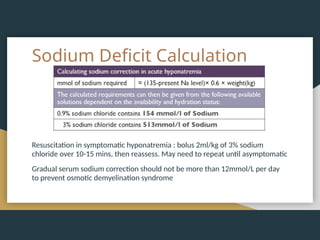
Sodium Deficit Calculation
Resuscitation in symptomatic hyponatremia : bolus 2ml/kg of 3% sodium
chloride over 10-15 mins, then reassess. May need to repeat until asymptomatic
Gradual serum sodium correction should not be more than 12mmol/L per day
to prevent osmotic demyelination syndrome
HYPERNATREMIA
● Sodium > 150mmol/L
● It can be due to :
- water loss in excess of sodium( eg diarrhoea)
- water deficit (eg diabetes insipidus)
- sodium gain( eg large amount of NaHCO3 infusion or salt poisoning)
● Clinical signs: irritability, skin feels “doughy”, ataxia, tremor,
hyperreflexia, seizure, reduced awareness, coma
Management
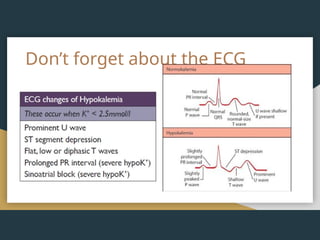
Hypokalemia
● Serum potassium <3.4mmol/L
● Treat if potassium <3mmol/L or clinically symptomatic with potassium <3.4mmol/L
● Causes :
- Sepsis
- Gastrointestinal losses
- Iatrogenic(eg diuretic therapy, salbutamol, amphothericin B)
- DKA
- Renal tubular acidosis
Don’t forget about the ECG
Hypokalemia - Potassium
requirement
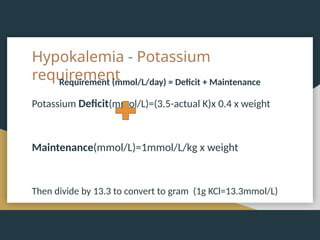
Requirement (mmol/L/day) = Deficit + Maintenance
Potassium Deficit(mmol/L)=(3.5-actual K)x 0.4 x weight
Maintenance(mmol/L)=1mmol/L/kg x weight
Then divide by 13.3 to convert to gram (1g KCl=13.3mmol/L)
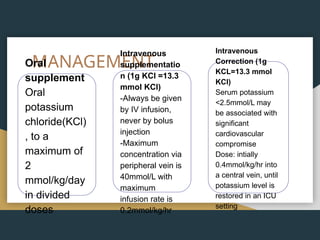
MANAGEMENT
Oral
supplement
Oral
potassium
chloride(KCl)
, to a
maximum of
2
mmol/kg/day
in divided
doses
Intravenous
supplementatio
n (1g KCl =13.3
mmol KCl)
-Always be given
by IV infusion,
never by bolus
injection
-Maximum
concentration via
peripheral vein is
40mmol/L with
maximum
infusion rate is
0.2mmol/kg/hr
Intravenous
Correction (1g
KCL=13.3 mmol
KCl)
Serum potassium
<2.5mmol/L may
be associated with
significant
cardiovascular
compromise
Dose: intially
0.4mmol/kg/hr into
a central vein, until
potassium level is
restored in an ICU
setting
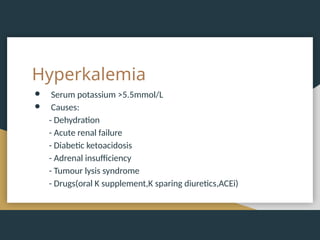
Hyperkalemia
● Serum potassium >5.5mmol/L
● Causes:
- Dehydration
- Acute renal failure
- Diabetic ketoacidosis
- Adrenal insufficiency
- Tumour lysis syndrome
- Drugs(oral K supplement,K sparing diuretics,ACEi)
Hyperkalemia
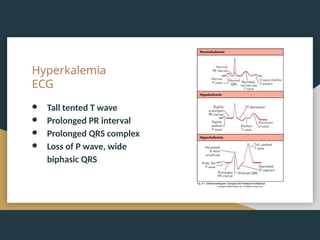
ECG
● Tall tented T wave
● Prolonged PR interval
● Prolonged QRS complex
● Loss of P wave, wide
biphasic QRS
Management
● Stop all K supplement
● Stop medication causing hyperkalemia
● Cardiac monitoring
● Exclude pseudohyperkalemia
Stable? Unstable? Symptomatic?
Asymptomatic?
● If unstable, symptomatic, abnormal
ECG, K> 7mmol/L
○ Discuss for dialysis
○ IV Calcium
○ Nebulised Salbutamol
○ IV Insulin with glucose
○ IV Bicarbonate
○ +/- PR/PO Resonium(Potassium binder)
● If stable, asymptomatic,normal ECG, K>6,
< 7mmol/L
○ Nebulised Salbutamol
○ IV Insulin with glucose
○ +/- IV Bicarbonate if acidosis
○ +/- PR/PO Resonium
● If stable, asymptomatic,normal
ECG, 5.5 <K< 6 mmol/l
○ Consider treatment if necessary
○ +/- Nebulised Salbutamol
○ +/- IV Bicarbonate if acidosis
○ +/- PR/PO Resonium

5. Acute gastroenteritis for pediatric.pptx

  • 1.
    Acute Gastroenteritis,fluid and electrolytes management Supervisor:Dr Laili Presenter: Dr Aida Batrisyia Binti Zam Beri, Dr Muhammad Shazwan Bin Safiee, Dr Muhammad Syahrul Anwar, Dr Tan Chen Liang
  • 2.
  • 3.
    Definitions ● Acute Gastroenteritis(AGE): ○ Diarrhoeal disease of rapid onset, with or without accompanying symptoms, signs, such as nausea, vomiting, fever, or abdominal pain. ● Diarrhoea: ○ The frequent passage of unformed liquid stools (3 or more loose,watery stool per day) ● Dysentery: ○ Blood or mucus in stools
  • 4.
    Type of diarrhea ●Acute: ○ short in duration of < 7 days ● Persistent diarrhea: ○ starts acutely and lasts longer than 1 week
  • 5.
    causes of acutediarrhea in infancy and childhood infectious causes non-infectious causes ● non enteric ○ otitis media, meningitis, sepsis ● enteric ○ viral ○ bacterial ○ protozoal ● milk/food allergies ● drug side effects ● malabsorption
  • 6.
    Common infectious causesof AGE Bacterial Viral ● E. Coli ● Shigella ● Salmonella ● Campylobacter ● C. Difficile ● V. Cholera ● rotavirus ● enterovirus ● calicivirus ● adenovirus ● astrovirus
  • 7.
    Risk factor ● Contaminatedwater and food ● Poor hygiene ● Nutritional deficiency ● Increase frequency in infancy ● Immune deficient individuals ● Malnutrition ● Travel to endemic areas ● Lack of breast feeding ● Exposure to unsanitary conditions ● Poor maternal education
  • 8.
    Sign and symptoms ●Diarrhea ● Nausea & Vomiting ● Loss of appetite ● Fever ● Headaches ● Abdominal pain ● Abdominal cramps ● Bloody stools ● Fainting and Weakness ● Heartburn ● Dehydration ● Lethargic
  • 9.
  • 11.
    Physical examination ● weightand height for age ● BMI ● sign of dehydration ● abdominal distension, tenderness, mass ● perianal area (erythema, fissure, fistula) ● other system affected
  • 13.
  • 14.
    Plan A: Treatdiarrhea at home Give Extra Fluid (as much as the child will take) #Breastfeed frequently and longer for each feed #Frequent small sips, if vomit, stop for 10 minutes then give it more slowly, give until diarrhea stop ORAL REHYDRATION SOLUTION Up to 2 years: 50-100ml 2 years and above: 100-200ml or 10ml/kg (If weight is available give 10ml/kg after each loose stool) Continue Feeding Continue nursing on demand Continue usual formula immediately on rehydration, continue usual semi solid or solid food Avoid high sugar food (Osmotic diarrhea) ! When To Return? 1.Not able to drink or breastfeed 2.Drinking poorly 3.Sicker 4.Fever 5.Blood in stool
  • 15.
    Plan B: Treatsome dehydration with ORS Reassess after 4 hours and classify child for dehydration and select appropriate plan to continue treatment Observe child for at least 6 hours after rehydration to be sure mother can maintain hydration giving the child ORS solution by mouth. If there is an outbreak of cholera in your area, give an appropriate oral antibiotic after the patient is alert.
  • 16.
    Plan C: Treatsevere dehydration quickly Assess and establish Airway, Breathing and Circulation (ABC) Start intravenous (IV) or intraosseous (IO) fluid immediatelyIf patient can drink, give ORS by mouth while the drip is being set up Review child after each bolus fluid given AIM DOSE FLUID Resuscitation 20ml/kg 0.9% Normal Saline Hartmann’s Solution (0.45% NS in neonates) Rehydration Based on deficit= % dehydration X body weight (gram) over 4-6 hours Maintenance Holliday-Segar formula 0.9% NS + D5% +/- KCl 20mmol/L or balanced solution
  • 17.
    EXAMPLE A 12 kgchild is clinically shocked and 10% dehydrated as a result of gastroenteritis Initial therapy.To established ABC ❖ 20 ml/kg for shock ➢ 20ml x 12=120 ml of 0.9%NS bolus ❖ Rehydration:10/100 x 12000 = 1200ml of 0.9%NS or Hartman solution over 6 hours ❖ Daily maintenance: Holiday Segar Formula ➢ 1st 10 kg: 10 x 100 = 1000ml ➢ Next 2 kg 2 x 50 = 100ml ➢ Total :1100ml/day 0.9%NS D5
  • 18.
    SHOCK Acute hypovolemia isthe most common cause of shock in children A child is very susceptible to fluid loss due to higher surface area to volume ratio and higher basal metabolic rate. There will be loss of fluid from INTRAVASCULAR SPACE secondary to •Inadequate intake •Excessive loss (vomit, diarrhoea, blood loss)
  • 20.
    Initial Assessments ◼ASSESS thestate of perfusion of the child ◼Is the child is shock? ◼Signs: •tachycardia •weak peripheral pulses •delayed capillary refill time > 2 seconds •cold peripheries •depressed mental state with or without hypotension • üDoes the child need resuscitation A, B, C, D…
  • 21.
    Management Initial resuscitation Airway shouldbe assessed immediately upon arrival and stabilized if necessary. The rate of respirations, breath sounds, and need for intubation should be assessed Breathing - High-flow supplemental O2 should be administered to all patients, and ventilatory support should be given, if needed. Circulation - Two large-bore IV lines should be started and necessary blood investigations should be taken as a baseline
  • 22.
    •10-20 ml/kg of0.9% Normal Saline or Hartmann’s solution as a rapid IV bolus. •Repeated if necessary until patient is out of shock •Review after each bolus and consider other causes of shock if child is not responsive to fluid bolus •Once circulation restores, commence rehydration, provide maintenance and replace ongoing losses -urinary catheter for the child if unconscious or unable to void on demand and also to monitor the urine output
  • 24.
    Fluid Type andRequirement in Neonate and Paediatrics Neonates D1 : 60mls/kg/day (D10%) D2 : 90mls/kg/day (1/5NSD10%) D3 : 120mls/kg/day D4-1M : 150mls/kg/day Infant 1M-6M :150mls/kg/day ( 1/5NSD5%) 6M-1Y : 120ml/kg/day ( ½ NSD5%) >1Y : Holliday –Segar Formula
  • 25.
  • 26.
  • 27.
    Types of dehydration Isonatremic Waterand salt loss is proportional Fast correction over 8-12 hours if premorbidly not malnourished Hyponatremic Need to replace at slower rate 12-24 hours Hypernatremic Even slower replacement 24-48 hours Risk of cerebral oedema or even death in fast correction
  • 28.
    Hyponatremia ● Sodium <135mmol/L ● Hyponatremic encephalopathy is a medical emergency requiring recognition and treatment to prevent poor outcome ● Symptoms associated with acute hyponatremia during IV fluid therapy: headache, nausea, vomiting, confusion, disorientation, irritability, lethargy, reduced consciousness, convulsions, coma, apnoea
  • 29.
    Sodium Deficit Calculation Resuscitationin symptomatic hyponatremia : bolus 2ml/kg of 3% sodium chloride over 10-15 mins, then reassess. May need to repeat until asymptomatic Gradual serum sodium correction should not be more than 12mmol/L per day to prevent osmotic demyelination syndrome
  • 30.
    HYPERNATREMIA ● Sodium >150mmol/L ● It can be due to : - water loss in excess of sodium( eg diarrhoea) - water deficit (eg diabetes insipidus) - sodium gain( eg large amount of NaHCO3 infusion or salt poisoning) ● Clinical signs: irritability, skin feels “doughy”, ataxia, tremor, hyperreflexia, seizure, reduced awareness, coma
  • 31.
  • 32.
    Hypokalemia ● Serum potassium<3.4mmol/L ● Treat if potassium <3mmol/L or clinically symptomatic with potassium <3.4mmol/L ● Causes : - Sepsis - Gastrointestinal losses - Iatrogenic(eg diuretic therapy, salbutamol, amphothericin B) - DKA - Renal tubular acidosis
  • 33.
  • 34.
    Hypokalemia - Potassium requirement Requirement(mmol/L/day) = Deficit + Maintenance Potassium Deficit(mmol/L)=(3.5-actual K)x 0.4 x weight Maintenance(mmol/L)=1mmol/L/kg x weight Then divide by 13.3 to convert to gram (1g KCl=13.3mmol/L)
  • 35.
    MANAGEMENT Oral supplement Oral potassium chloride(KCl) , to a maximumof 2 mmol/kg/day in divided doses Intravenous supplementatio n (1g KCl =13.3 mmol KCl) -Always be given by IV infusion, never by bolus injection -Maximum concentration via peripheral vein is 40mmol/L with maximum infusion rate is 0.2mmol/kg/hr Intravenous Correction (1g KCL=13.3 mmol KCl) Serum potassium <2.5mmol/L may be associated with significant cardiovascular compromise Dose: intially 0.4mmol/kg/hr into a central vein, until potassium level is restored in an ICU setting
  • 36.
    Hyperkalemia ● Serum potassium>5.5mmol/L ● Causes: - Dehydration - Acute renal failure - Diabetic ketoacidosis - Adrenal insufficiency - Tumour lysis syndrome - Drugs(oral K supplement,K sparing diuretics,ACEi)
  • 37.
    Hyperkalemia ECG ● Tall tentedT wave ● Prolonged PR interval ● Prolonged QRS complex ● Loss of P wave, wide biphasic QRS
  • 38.
    Management ● Stop allK supplement ● Stop medication causing hyperkalemia ● Cardiac monitoring ● Exclude pseudohyperkalemia
  • 39.
    Stable? Unstable? Symptomatic? Asymptomatic? ●If unstable, symptomatic, abnormal ECG, K> 7mmol/L ○ Discuss for dialysis ○ IV Calcium ○ Nebulised Salbutamol ○ IV Insulin with glucose ○ IV Bicarbonate ○ +/- PR/PO Resonium(Potassium binder) ● If stable, asymptomatic,normal ECG, K>6, < 7mmol/L ○ Nebulised Salbutamol ○ IV Insulin with glucose ○ +/- IV Bicarbonate if acidosis ○ +/- PR/PO Resonium ● If stable, asymptomatic,normal ECG, 5.5 <K< 6 mmol/l ○ Consider treatment if necessary ○ +/- Nebulised Salbutamol ○ +/- IV Bicarbonate if acidosis ○ +/- PR/PO Resonium

Editor's Notes

  • #36 Birth - 2 weeks 3.7-6 2 weeks -3 months 3.7-5.7