







How do consumers
make purchasing
decisions?
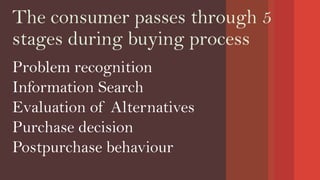
The consumer passes through 5
stages during buying process
Problem recognition
Information Search
Evaluation of Alternatives
Purchase decision
Postpurchase behaviour
Problem recognition
A problem or need is triggered by internal
or external stimuli
Internal stimuli- Hunger, thirst.
External stimuli – your friend’s new car!
Marketers need to identify the circumstances
that trigger a need
Information Search
Sources of information can be commercial,
public, personal or experiential
Consumers receive highest amount of info. from
commercial sources,
But most effective info. is from personal sources
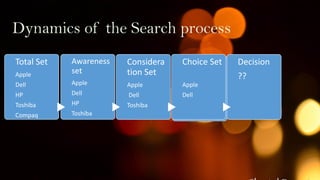
Dynamics of the Search process
Total Set
Apple
Dell
HP
Toshiba
Compaq
Awareness
set
Apple
Dell
HP
Toshiba
Considera
tion Set
Apple
Dell
Toshiba
Choice Set
Apple
Dell
Decision
??
Evaluation of Alternatives
Our Belief and Attitudes determine
behaviour towards products
and services
Companies tend to fit their products
into the existing attitude of consumers
Evaluation of Alternatives
Expectancy Value Model of attitude formation
posits that
Consumers evaluate products by combining their brand
beliefs
Say you buy a laptop,
you give 50% importance to memory capacity,
30% to graphics,
20% to price.
Then you rate alternatives based on these factors
Purchase Decision
During purchase , consumers make 5 subdecisions-
Brand
Dealer
Quantity
Timing
Payment Method
Purchase Decision
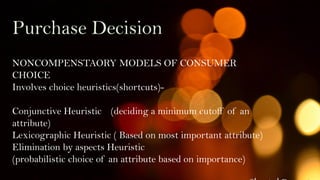
NONCOMPENSTAORY MODELS OF CONSUMER
CHOICE
Involves choice heuristics(shortcuts)-
Conjunctive Heuristic (deciding a minimum cutoff of an
attribute)
Lexicographic Heuristic ( Based on most important attribute)
Elimination by aspects Heuristic
(probabilistic choice of an attribute based on importance)
Purchase Decision
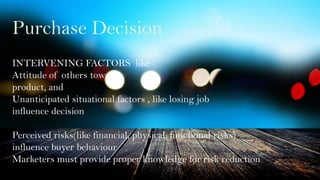
INTERVENING FACTORS like
Attitude of others towards
product, and
Unanticipated situational factors , like losing job
influence decision
Perceived risks(like financial, physical, functional risks)
influence buyer behaviour
Marketers must provide proper knowledge for risk reduction
Postpurchase behaviour
Marketing communications should supply beliefs that reinforce
the consumer’s choice
Postpurchase satisfaction , actions , use and disposal
must be monitored
Thank you for watching!!
UPLOADED BY SHREYANS DAGA,
MNIT JAIPUR
DURING AN INTERNSHIP BY
PROF. SAMEER MATHUR,IIM LUCKNOW
Visit www.iiminternship.com
Disclaimer

5-(III) how to consumers make purchasing decisions

  • 1.
    How do consumers makepurchasing decisions?
  • 2.
    The consumer passesthrough 5 stages during buying process Problem recognition Information Search Evaluation of Alternatives Purchase decision Postpurchase behaviour
  • 3.
    Problem recognition A problemor need is triggered by internal or external stimuli Internal stimuli- Hunger, thirst. External stimuli – your friend’s new car! Marketers need to identify the circumstances that trigger a need
  • 4.
    Information Search Sources ofinformation can be commercial, public, personal or experiential Consumers receive highest amount of info. from commercial sources, But most effective info. is from personal sources
  • 5.
    Dynamics of theSearch process Total Set Apple Dell HP Toshiba Compaq Awareness set Apple Dell HP Toshiba Considera tion Set Apple Dell Toshiba Choice Set Apple Dell Decision ??
  • 6.
    Evaluation of Alternatives OurBelief and Attitudes determine behaviour towards products and services Companies tend to fit their products into the existing attitude of consumers
  • 7.
    Evaluation of Alternatives ExpectancyValue Model of attitude formation posits that Consumers evaluate products by combining their brand beliefs Say you buy a laptop, you give 50% importance to memory capacity, 30% to graphics, 20% to price. Then you rate alternatives based on these factors
  • 8.
    Purchase Decision During purchase, consumers make 5 subdecisions- Brand Dealer Quantity Timing Payment Method
  • 9.
    Purchase Decision NONCOMPENSTAORY MODELSOF CONSUMER CHOICE Involves choice heuristics(shortcuts)- Conjunctive Heuristic (deciding a minimum cutoff of an attribute) Lexicographic Heuristic ( Based on most important attribute) Elimination by aspects Heuristic (probabilistic choice of an attribute based on importance)
  • 10.
    Purchase Decision INTERVENING FACTORSlike Attitude of others towards product, and Unanticipated situational factors , like losing job influence decision Perceived risks(like financial, physical, functional risks) influence buyer behaviour Marketers must provide proper knowledge for risk reduction
  • 11.
    Postpurchase behaviour Marketing communicationsshould supply beliefs that reinforce the consumer’s choice Postpurchase satisfaction , actions , use and disposal must be monitored
  • 12.
    Thank you forwatching!!
  • 13.
    UPLOADED BY SHREYANSDAGA, MNIT JAIPUR DURING AN INTERNSHIP BY PROF. SAMEER MATHUR,IIM LUCKNOW Visit www.iiminternship.com Disclaimer