Antipsychotics
Department- P’ceutical chemistry
Karishma Waghmre
(M.pharm)
Asst. professor
S.D.D VISPUTE OLLEGE OF
PHARMACY AND RC
NEW PANVEL
1
• Antipsychotic drugs (also called neuroleptics or major
tranquilizers) are used primarily to treat schizophrenia
(a biologic illness), but they are also effective in other
psychotic states, including manic states with psychotic
symptoms such as grandiosity, paranoia, and
hallucinations, and delusions.
• Antipsychotic drugs are not curative and do not
eliminate the chronic thought disorder, but they often
decrease the intensity of hallucinations and
delusions and permit the person with schizophrenia to
function in a supportive environment.
2
• CHEMICAL CLASSIFICATION
1.Phenothiazines
• Aliphatic side chain: Chlorpromazine,
triflupromazine
• Piperidine side chain: Thioridazine
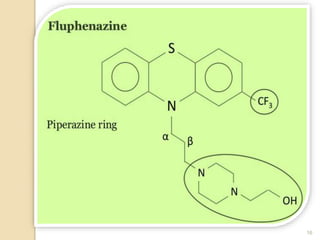
• Piperazine side chain: Trifluoperazine,
fluphenazine
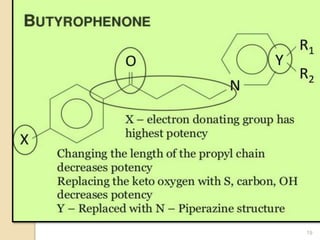
2.Butyrophenones: Haloperidol, Trifluperidol,
Penfluridol
3.Thioxanthenes: Flupenthixol
4.Other heterocyclics: Pimozide, Loxapine
5.Atypical antipsychotics: Clozapine,
risperidone, olanzapine,
quetiapine, aripiprazole, ziprasidone
3
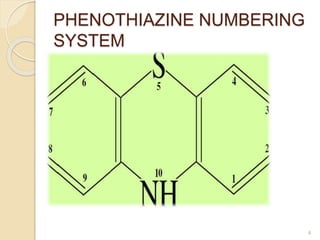
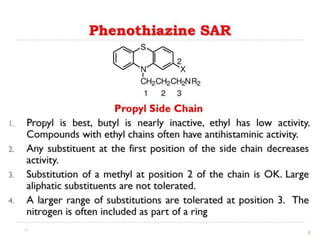
PHENOTHIAZINE NUMBERING
SYSTEM
4
5
6
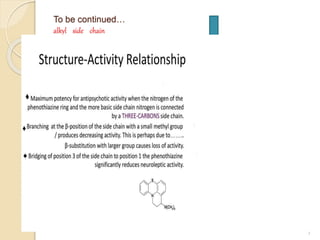
To be continued…
alkyl side chain
7
8
9
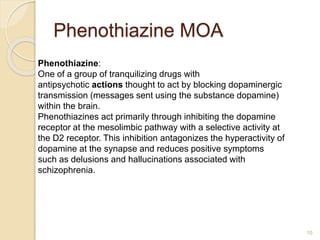
Phenothiazine:
One of a group of tranquilizing drugs with
antipsychotic actions thought to act by blocking dopaminergic
transmission (messages sent using the substance dopamine)
within the brain.
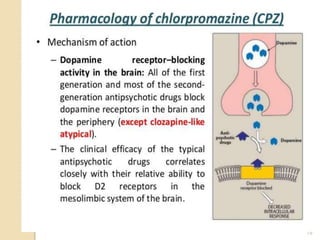
Phenothiazines act primarily through inhibiting the dopamine
receptor at the mesolimbic pathway with a selective activity at
the D2 receptor. This inhibition antagonizes the hyperactivity of
dopamine at the synapse and reduces positive symptoms
such as delusions and hallucinations associated with
schizophrenia.
Phenothiazine MOA
10
11
12
13
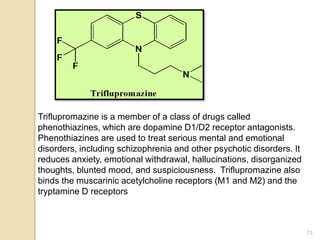
Triflupromazine is a member of a class of drugs called
phenothiazines, which are dopamine D1/D2 receptor antagonists.
Phenothiazines are used to treat serious mental and emotional
disorders, including schizophrenia and other psychotic disorders. It
reduces anxiety, emotional withdrawal, hallucinations, disorganized
thoughts, blunted mood, and suspiciousness. Triflupromazine also
binds the muscarinic acetylcholine receptors (M1 and M2) and the
tryptamine D receptors
14
Phenothiazine having a
trifluoromethyl substituent at the 2-
position and a 3-(4-methylpiperazin-
1-yl)propyl group at the N-10
methylsulfanyl subsitituent
at the 2-position and a (1-
methylpiperidin-2-yl)ethyl]
group at the N-10 position.
15
16
17
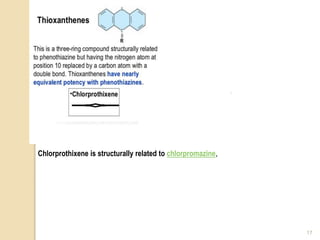
Chlorprothixene is structurally related to chlorpromazine,
18
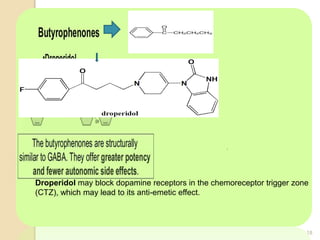
Droperidol may block dopamine receptors in the chemoreceptor trigger zone
(CTZ), which may lead to its anti-emetic effect.
19
20
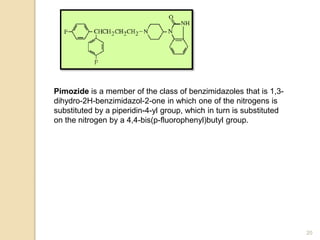
Pimozide is a member of the class of benzimidazoles that is 1,3-
dihydro-2H-benzimidazol-2-one in which one of the nitrogens is
substituted by a piperidin-4-yl group, which in turn is substituted
on the nitrogen by a 4,4-bis(p-fluorophenyl)butyl group.
21
22
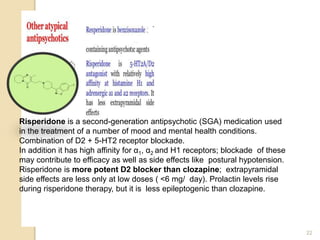
Risperidone is a second-generation antipsychotic (SGA) medication used
in the treatment of a number of mood and mental health conditions.
Combination of D2 + 5-HT2 receptor blockade.
In addition it has high affinity for α1, α2 and H1 receptors; blockade of these
may contribute to efficacy as well as side effects like postural hypotension.
Risperidone is more potent D2 blocker than clozapine; extrapyramidal
side effects are less only at low doses ( <6 mg/ day). Prolactin levels rise
during risperidone therapy, but it is less epileptogenic than clozapine.
23
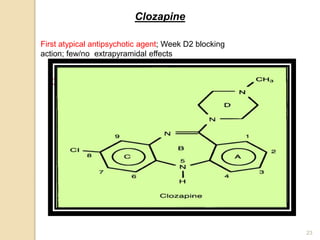
Clozapine
First atypical antipsychotic agent; Week D2 blocking
action; few/no extrapyramidal effects
SAR Clozapine
24
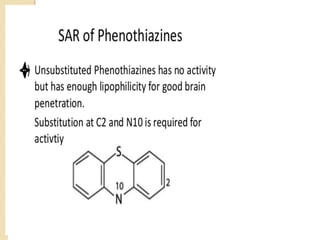
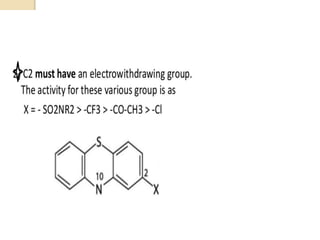
•Optimal neuroleptic activity occurs when the ring A substituent is in the 2nd-position.
A trifluoromethyl substituent provides a greater number of favorable Van der Waal’s
contacts with the side chain than the chlorine substituent. Thus, phenothiazne with
trifluoromethyl substituents are more potent than those with chlorine substituent.
A piperazine side chain provides more Van der Waal’s contacts with 2-substituent
than the alkylamino side chain. Thus, piperizine phenothiazine are more potent in
antischizophrenic effects than alkylamino phenothiazines.
Hydroxyethylpiperazine side chain phenothiazines displays more favorable Van der
Waal’s interactions with ring A than simple piperazines.
In the thioxanthene and xanthenes containing ring systems, the cis forms are more
potent neuroleptics than the trans isomers.
Phenothiazine analogues having the presence of exolytic double bond are more
potent than the corresponding compounds lacking the exolytic double bonds
25
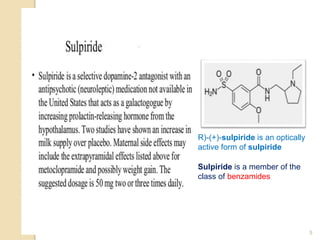
R)-(+)-sulpiride is an optically
active form of sulpiride
Sulpiride is a member of the
class of benzamides