21ST CENTURY LITERATURE
FROM THE PHILIPPINES
AND THE WORLD
4TH QUARTER I LESSON 1
Prepared by: Ms. Jaelou Andrea P. Belina
4TH QUARTER I LITERARY CRITICISM
1. Identify the literary criticism that can be used in analysis and
critical interpretation.
LEARNING OBJECTIVES
2. Critique a story with different types of literary criticism through
group activity.
4TH QUARTER I LITERARY CRITICISM
❏ is the comparison, analysis, interpretation, and/or evaluation of
works of literature.
❏ is essentially an opinion, supported by evidence, relating to
theme, style, setting or historical or political context.
❏ Although criticism may include some of the following elements
in order to support an idea, literary criticism is NOT a plot
summary, a biography of the author, or simply finding fault with
the literature.
LITERARY CRITICISM
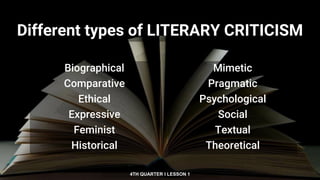
Different types of LITERARY CRITICISM
4TH QUARTER I LESSON 1
Biographical
Comparative
Ethical
Expressive
Feminist
Historical
Mimetic
Pragmatic
Psychological
Social
Textual
Theoretical
4TH QUARTER I TYPES OF LITERARY CRITICISM
BIOGRAPHICAL criticism analyzes a writer's biography to show the
relationship between the author's life and their works of literature.
(EXAMPLE)
Kafka’s father was abusive and had a violent temper, much like Mr.
Samsa in Kafka’s own "The Metamorphosis." In his own letter to his
father, Kafka writes, "Your extremely effective rhetorical methods in
bringing me up, which never failed to work with me, were abuse,
threats, irony, spiteful laughter, and—oddly enough—self-pity." This
new insight shows how "The Metamorphosis" is a reflection of
Kafka’s own painful relationship with his own father.
COMPARATIVE criticism is an academic field dealing with the study
of literature and cultural expression across linguistic, national,
geographic, and disciplinary boundaries.
(EXAMPLE)
There are so many ways on how to interpret marriages. Marriages
go all the way back to around 2350 B.C. in Mesopotamia. While both
authors address modern marriage and past marriages, Stephanie
Coontz focuses on what went into marriages, while Andrew Cherlin
emphasizes how marriages evolved and what their roles are.
4TH QUARTER I TYPES OF LITERARY CRITICISM
In ETHICAL criticism, there were two opposing philosophical
positions taken with respect to the legitimacy of the ethical
evaluation of art: ‘moralism’ and ‘autonomism’, where MORALISM is
the view that the aesthetic value of art should be determined by, or
reduced to, its moral value, while AUTONOMISM holds that it is
inappropriate to apply moral categories to art; they should be
evaluated by ‘aesthetic’ standards alone.
4TH QUARTER I TYPES OF LITERARY CRITICISM
(EXAMPLE)
"The play Romeo and Juliet may be considered an epic love story,
but considering today's indispensable needs, the play brought up
some ethical issues. Marriage is not something that people do
lightly; it is something that everyone involved should be prepared for
before entering. In the play, Romeo was only 16 and Juliet was only
13 when they plotted the marriage. Though at that time, marriage at
a young age was widely accepted and considered lawful, if the
critics analyze the play in modern times, particularly today, their
marriage would not be considered practical.”
4TH QUARTER I TYPES OF LITERARY CRITICISM
EXPRESSIVE criticism describes poetry as an expression, as an
overflow of a poet’s feelings. Unlike many other forms of criticism in
that it does not focus on the style of writing, or grammar, or diction;
it focuses on what is being said by the author.
(EXAMPLE)
Wordsworth’s poem beginning with the line, One evening, walking in
a public way.
“It is a very characteristic piece of work. No one else could have
written it - perhaps no one else could have wished to write it.”
4TH QUARTER I TYPES OF LITERARY CRITICISM
FEMINIST criticism is concerned with "the ways in which literature
(and other cultural productions) reinforce or undermine the
economic, political, social, and psychological oppression of women"
(Tyson 83).
(EXAMPLE)
In 'The Wife of Bath', the narrator, Alison, is portrayed as a strong-
willed woman who subverts traditional expectations of femininity.
4TH QUARTER I TYPES OF LITERARY CRITICISM
HISTORICAL criticism also known as the historical-critical
method or higher criticism, is a branch of criticism that investigates
the origins of ancient texts in order to understand "the world behind
the text"
(EXAMPLE)
Mark Twain was a writer who both reflected the prejudices of his
time through the dialogue of the characters, and challenged the
attitude of an 1800’s America that in many ways accepted (or even
promoted) racist attitudes.
4TH QUARTER I TYPES OF LITERARY CRITICISM
MIMETIC criticism is a method of interpreting texts in relation to
their literary or cultural models.
(EXAMPLE)
In the study of May (2019), she believed that “Little Women” is a
piece of women’s history or, perhaps more important, a piece of
women’s autobiography that depicts female aspirations, family life,
and women’s career choices. Thus, Little Women tells the history of
gender roles and is therefore, an interesting narrative for literary
research in the field of feminist literature.
4TH QUARTER I TYPES OF LITERARY CRITICISM
PRAGMATIC criticism concerned, first and foremost, with the ethical
impact any literary text has upon an audience. Regardless of art's
other merits or failings, the primary responsibility or function of art
is social in nature.
(EXAMPLE)
In An Apology for Poetry, Renaissance poet and critic Sir Philip
Sidney characterized poetry as “a speaking picture, with this end —
to teach and delight”... they “delight to move men to take that
goodness in hand … and teach to make them know that goodness
whereunto they are moved.”
4TH QUARTER I TYPES OF LITERARY CRITICISM
PSYCHOLOGICAL criticism also known as Psychoanalytical
Criticism, is the analysis of an author’s unintended message. The
main goal is to analyze the unconscious elements within a literary
text based on the background of the author.
(EXAMPLE)
“A Rose for Emily” by William Faulkner is a short story with the main
character Emily who has psychological issues with the loss of her
father. The story eventually reveals that she secretly murders her
lover, so that she will never lose him. She sleeps by his skeletal
corpse until her own death.”
4TH QUARTER I TYPES OF LITERARY CRITICISM
SOCIAL criticism is a form of academic or
journalistic criticism focusing on sociological issues in
contemporary society, in particular with respect to
perceived injustices and power relations in general.
(EXAMPLE)
Animal Farm, written in 1944, is a book that tells the animal fable of
a farm in which the farm animals revolt against their human
masters. It is an example of social criticism in literature in which
Orwell satirized the events in Russia after the Bolshevik Revolution.
4TH QUARTER I TYPES OF LITERARY CRITICISM
TEXTUAL is a branch of textual scholarship, philology, and of literary
criticism that is concerned with the identification of textual variants,
or different versions, of either manuscripts or of printed books. Such
texts may range in dates from the earliest writing in cuneiform,
impressed on clay, for example, to multiple unpublished versions of
a 21st-century author's work.
(EXAMPLE)
A second edition of a Shakespeare play may include an addition
alluding to an event known to have happened between the two
editions. Although nearly all subsequent manuscripts may have
included the addition, textual critics may reconstruct the original
without the addition.
4TH QUARTER I TYPES OF LITERARY CRITICISM
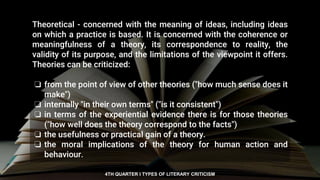
Theoretical - concerned with the meaning of ideas, including ideas
on which a practice is based. It is concerned with the coherence or
meaningfulness of a theory, its correspondence to reality, the
validity of its purpose, and the limitations of the viewpoint it offers.
Theories can be criticized:
❏ from the point of view of other theories ("how much sense does it
make")
❏ internally "in their own terms" ("is it consistent")
❏ in terms of the experiential evidence there is for those theories
("how well does the theory correspond to the facts")
❏ the usefulness or practical gain of a theory.
❏ the moral implications of the theory for human action and
behaviour.
4TH QUARTER I TYPES OF LITERARY CRITICISM
Do you have any questions
or clarifications?
4TH QUARTER I LESSON 1
REVIEW OF FACTS
4TH QUARTER I LESSON 1
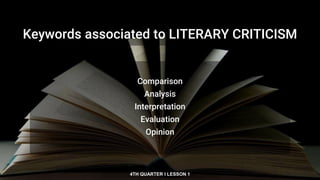
Keywords associated to LITERARY CRITICISM
4TH QUARTER I LESSON 1
Comparison
Analysis
Interpretation
Evaluation
Opinion
Different types of LITERARY CRITICISM
4TH QUARTER I LESSON 1
Biographical
Comparative
Ethical
Expressive
Feminist
Historical
Mimetic
Pragmatic
Psychological
Social
Textual
Theoretical
ASSIGNMENT
4TH QUARTER I LESSON 1
Read the story “The Gift of the Magi” in preparation for a group
activity next meeting.

4Q LESSON 1.pptx

  • 1.
    21ST CENTURY LITERATURE FROMTHE PHILIPPINES AND THE WORLD 4TH QUARTER I LESSON 1 Prepared by: Ms. Jaelou Andrea P. Belina
  • 2.
    4TH QUARTER ILITERARY CRITICISM 1. Identify the literary criticism that can be used in analysis and critical interpretation. LEARNING OBJECTIVES 2. Critique a story with different types of literary criticism through group activity.
  • 3.
    4TH QUARTER ILITERARY CRITICISM ❏ is the comparison, analysis, interpretation, and/or evaluation of works of literature. ❏ is essentially an opinion, supported by evidence, relating to theme, style, setting or historical or political context. ❏ Although criticism may include some of the following elements in order to support an idea, literary criticism is NOT a plot summary, a biography of the author, or simply finding fault with the literature. LITERARY CRITICISM
  • 4.
    Different types ofLITERARY CRITICISM 4TH QUARTER I LESSON 1 Biographical Comparative Ethical Expressive Feminist Historical Mimetic Pragmatic Psychological Social Textual Theoretical
  • 5.
    4TH QUARTER ITYPES OF LITERARY CRITICISM BIOGRAPHICAL criticism analyzes a writer's biography to show the relationship between the author's life and their works of literature. (EXAMPLE) Kafka’s father was abusive and had a violent temper, much like Mr. Samsa in Kafka’s own "The Metamorphosis." In his own letter to his father, Kafka writes, "Your extremely effective rhetorical methods in bringing me up, which never failed to work with me, were abuse, threats, irony, spiteful laughter, and—oddly enough—self-pity." This new insight shows how "The Metamorphosis" is a reflection of Kafka’s own painful relationship with his own father.
  • 6.
    COMPARATIVE criticism isan academic field dealing with the study of literature and cultural expression across linguistic, national, geographic, and disciplinary boundaries. (EXAMPLE) There are so many ways on how to interpret marriages. Marriages go all the way back to around 2350 B.C. in Mesopotamia. While both authors address modern marriage and past marriages, Stephanie Coontz focuses on what went into marriages, while Andrew Cherlin emphasizes how marriages evolved and what their roles are. 4TH QUARTER I TYPES OF LITERARY CRITICISM
  • 7.
    In ETHICAL criticism,there were two opposing philosophical positions taken with respect to the legitimacy of the ethical evaluation of art: ‘moralism’ and ‘autonomism’, where MORALISM is the view that the aesthetic value of art should be determined by, or reduced to, its moral value, while AUTONOMISM holds that it is inappropriate to apply moral categories to art; they should be evaluated by ‘aesthetic’ standards alone. 4TH QUARTER I TYPES OF LITERARY CRITICISM
  • 8.
    (EXAMPLE) "The play Romeoand Juliet may be considered an epic love story, but considering today's indispensable needs, the play brought up some ethical issues. Marriage is not something that people do lightly; it is something that everyone involved should be prepared for before entering. In the play, Romeo was only 16 and Juliet was only 13 when they plotted the marriage. Though at that time, marriage at a young age was widely accepted and considered lawful, if the critics analyze the play in modern times, particularly today, their marriage would not be considered practical.” 4TH QUARTER I TYPES OF LITERARY CRITICISM
  • 9.
    EXPRESSIVE criticism describespoetry as an expression, as an overflow of a poet’s feelings. Unlike many other forms of criticism in that it does not focus on the style of writing, or grammar, or diction; it focuses on what is being said by the author. (EXAMPLE) Wordsworth’s poem beginning with the line, One evening, walking in a public way. “It is a very characteristic piece of work. No one else could have written it - perhaps no one else could have wished to write it.” 4TH QUARTER I TYPES OF LITERARY CRITICISM
  • 10.
    FEMINIST criticism isconcerned with "the ways in which literature (and other cultural productions) reinforce or undermine the economic, political, social, and psychological oppression of women" (Tyson 83). (EXAMPLE) In 'The Wife of Bath', the narrator, Alison, is portrayed as a strong- willed woman who subverts traditional expectations of femininity. 4TH QUARTER I TYPES OF LITERARY CRITICISM
  • 11.
    HISTORICAL criticism alsoknown as the historical-critical method or higher criticism, is a branch of criticism that investigates the origins of ancient texts in order to understand "the world behind the text" (EXAMPLE) Mark Twain was a writer who both reflected the prejudices of his time through the dialogue of the characters, and challenged the attitude of an 1800’s America that in many ways accepted (or even promoted) racist attitudes. 4TH QUARTER I TYPES OF LITERARY CRITICISM
  • 12.
    MIMETIC criticism isa method of interpreting texts in relation to their literary or cultural models. (EXAMPLE) In the study of May (2019), she believed that “Little Women” is a piece of women’s history or, perhaps more important, a piece of women’s autobiography that depicts female aspirations, family life, and women’s career choices. Thus, Little Women tells the history of gender roles and is therefore, an interesting narrative for literary research in the field of feminist literature. 4TH QUARTER I TYPES OF LITERARY CRITICISM
  • 13.
    PRAGMATIC criticism concerned,first and foremost, with the ethical impact any literary text has upon an audience. Regardless of art's other merits or failings, the primary responsibility or function of art is social in nature. (EXAMPLE) In An Apology for Poetry, Renaissance poet and critic Sir Philip Sidney characterized poetry as “a speaking picture, with this end — to teach and delight”... they “delight to move men to take that goodness in hand … and teach to make them know that goodness whereunto they are moved.” 4TH QUARTER I TYPES OF LITERARY CRITICISM
  • 14.
    PSYCHOLOGICAL criticism alsoknown as Psychoanalytical Criticism, is the analysis of an author’s unintended message. The main goal is to analyze the unconscious elements within a literary text based on the background of the author. (EXAMPLE) “A Rose for Emily” by William Faulkner is a short story with the main character Emily who has psychological issues with the loss of her father. The story eventually reveals that she secretly murders her lover, so that she will never lose him. She sleeps by his skeletal corpse until her own death.” 4TH QUARTER I TYPES OF LITERARY CRITICISM
  • 15.
    SOCIAL criticism isa form of academic or journalistic criticism focusing on sociological issues in contemporary society, in particular with respect to perceived injustices and power relations in general. (EXAMPLE) Animal Farm, written in 1944, is a book that tells the animal fable of a farm in which the farm animals revolt against their human masters. It is an example of social criticism in literature in which Orwell satirized the events in Russia after the Bolshevik Revolution. 4TH QUARTER I TYPES OF LITERARY CRITICISM
  • 16.
    TEXTUAL is abranch of textual scholarship, philology, and of literary criticism that is concerned with the identification of textual variants, or different versions, of either manuscripts or of printed books. Such texts may range in dates from the earliest writing in cuneiform, impressed on clay, for example, to multiple unpublished versions of a 21st-century author's work. (EXAMPLE) A second edition of a Shakespeare play may include an addition alluding to an event known to have happened between the two editions. Although nearly all subsequent manuscripts may have included the addition, textual critics may reconstruct the original without the addition. 4TH QUARTER I TYPES OF LITERARY CRITICISM
  • 17.
    Theoretical - concernedwith the meaning of ideas, including ideas on which a practice is based. It is concerned with the coherence or meaningfulness of a theory, its correspondence to reality, the validity of its purpose, and the limitations of the viewpoint it offers. Theories can be criticized: ❏ from the point of view of other theories ("how much sense does it make") ❏ internally "in their own terms" ("is it consistent") ❏ in terms of the experiential evidence there is for those theories ("how well does the theory correspond to the facts") ❏ the usefulness or practical gain of a theory. ❏ the moral implications of the theory for human action and behaviour. 4TH QUARTER I TYPES OF LITERARY CRITICISM
  • 18.
    Do you haveany questions or clarifications? 4TH QUARTER I LESSON 1
  • 19.
    REVIEW OF FACTS 4THQUARTER I LESSON 1
  • 20.
    Keywords associated toLITERARY CRITICISM 4TH QUARTER I LESSON 1 Comparison Analysis Interpretation Evaluation Opinion
  • 21.
    Different types ofLITERARY CRITICISM 4TH QUARTER I LESSON 1 Biographical Comparative Ethical Expressive Feminist Historical Mimetic Pragmatic Psychological Social Textual Theoretical
  • 22.
    ASSIGNMENT 4TH QUARTER ILESSON 1 Read the story “The Gift of the Magi” in preparation for a group activity next meeting.