THE CONDITIONS OF 4P’S BENEFICIARIES IN
PEDRO “OLOY” N. ROA SR. HIGH SCHOOL
Angel Marie Cahanap
Angelica Shane Cahanap
Carmela Jenn Balili
Jerelyn S. Dacula
Jolina T. Querol
Jun Mark S. Palad
FEBRUARY 2020
CHAPTER 1
I. Introduction
President Rodrigo Duterte signed the Republic Act No. 11310 or the Pantawid
Pamilyang Pilipino Program Act and it is now a permanent program of the
government. Pantawid Pamilyang Pilipino Program is cash assistance for poor
families. The assistance is intended for the education, health, and nutrition of the
family members. The funding is sourced out from the budget of the Department of
Social Welfare and Development (DSWD). Beneficiaries of the 4p’s include children
ages 0-18 years old for a maximum the educational assistance every month each
beneficiary will receive ₱300.00 for those enrolled in daycare ₱500.00 for those
enrolled in junior high school ₱700.00, enrolled in senior high school ₱750.00 for
health and nutrition. The government aims to lessen poverty and to educate and to
give health care for families who are beneficiaries of 3 for every family assistance.
The financial is given be- monthly or every two months. The Government provides
financial assistance to families who are identified to be living below to poverty line. In
return for the financial assistance given to them, all beneficiaries are given guidelines
and conditions to follow and fulfill. Department of Social Welfare and Development
(DSWD) has issued Administrative Order No.16 stimulating the guidelines and
conditions for all the 4ps beneficiaries. The guidelines stimulated for the student are
the following. a. Aged 0-5 must receive regular preventive health check-ups and
vaccines. b. Aged 6-14 must receive deworming pills twice a year. c. Aged 3-18 must
enroll in school, and maintain an attendance of at least 85% of class days every
month. In Pedro ''Oloy'' N. Roa Sr. High School 860 students are 4ps beneficiaries.
The researchers aim to determine if the 4ps beneficiaries fulfill the conditions of the
guidelines of the government.
II. Background of the Study
Pedro ''Oloy'' N. Roa Sr. High School (PONRSHS), monitors the condition of
each 4ps beneficiaries and Ms. Ligaya Gonzales, one of PONRSHS's teachers was
assigned to it. Due to lack of time to do her tasks as the 4ps coordinator, she can't
keep an eye to the beneficiary's condition because she has a lot of paper works to do
and she also teachers the Grade 7 level as a Filipino and English teachers. It's one
of the problems of the school that the researchers have seen/notice and like to help
the school to give the exact condition of the 4ps beneficiaries. 4ps is very known as
one of the government programs for the less fortunate family and the researchers
want to know/determine the improvement of the beneficiary's lives for having such
gratitude and if do they follow their responsibility as beneficiaries. If the school and
researchers, will not monitor the condition of 4ps beneficiaries. Their basic needs in
the home or school right not be provided by their parents or guardian so it is so
important to conduct this study.
III. Significance of the Study
The study focus and highlights the conditions of 4p's beneficiaries in Pedro
''Oloy'' N. Roa Sr. High School. Some of our respondents answered sometimes their
parents/ guardian are not giving their allowance, some of them their parents are not
giving paying the school contribution, their parents are not giving money for the
school project. It is important to monitor the 4ps beneficiaries so that the government
will know if they are using the money in the right way. If the government will not
monitor the conditions of the 4P's beneficiaries. there are possibilities that the 4P's
beneficiaries are not fulfilling their responsibilities.
The results of the study will benefit the following:
STUDENTS: Theresults will provide the students with some knowledgeoftheir conditionin
havingorbeinga beneficiaryand howithelpsthemintheir studies. It will give the studentsa
realizationthat 4p’sishelpful to boththeir studies andintheirdailyneeds.
Teachers: the given data would help the teachers on what is the conditions of every
4p's beneficiaries. The teachers would be able to understand why other beneficiaries
don't have enough or complete things in school, allowance, and food.
Parents: Like theteachers, the parentstoowill understandthesignificance of the 4p’s or
PantawidPamilyangPilipinoProgramintheirlives.The givendatawould help themknowand
enlightenthethings thattheir childrenneed and to help their sonsfrombeingabsentsin school.
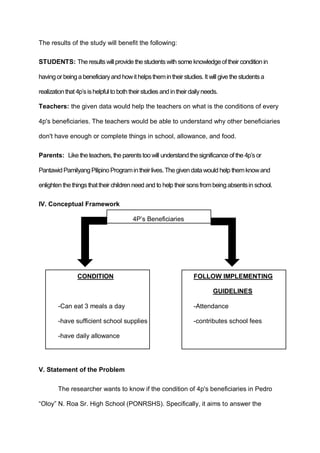
IV. Conceptual Framework
4P’s Beneficiaries
CONDITION FOLLOW IMPLEMENTING
GUIDELINES
-Can eat 3 meals a day -Attendance
-have sufficient school supplies -contributes school fees
-have daily allowance
V. Statement of the Problem
The researcher wants to know if the condition of 4p's beneficiaries in Pedro
“Oloy” N. Roa Sr. High School (PONRSHS). Specifically, it aims to answer the
following questions:
1. What is the condition of 4p's beneficiaries in terms of:
1.1 No. Of meals eaten per day
1.2 availability of school supplies
1.3 availability if uniform
1.4 daily allowance
2. How far do 4p's beneficiaries follow the guidelines and conditions set the footer for
them in terms of:
2.1 attendance
2.2 contribution of school fees
2.3 involvement in school projects
Hypothesis: Ho¹: The 4p's beneficiaries are not in good condition.
Ho²: The beneficiaries do not follow the guidelines and conditions.
Vl. Scope and Delimitation
The researchers study the condition of the 4p's beneficiaries in PONRSHS
and there are 860 beneficiaries. The researchers get the sample size by using
Slovin's formula which is and N=N/1+Ne² came up to 27 but only 107 students
beneficiary respond in our conducted survey due to busy practicing dance that time
preparing for incoming Competition Even those 107 students answer the survey, the
researchers can't assure the honesty of each 4p's beneficiaries students.
VII. Definition of Terms
* Condition of 4p's beneficiaries - refers to the provision of each 4p's beneficiaries
and the improvement of their health, nutrition, and education.
* 3 meals a day - refers to breakfast, dinner, and lunch.
* Sufficient school supplies and complete uniform - refers to the things that the
beneficiary’s needs in school.
* Daily allowance - money need for the beneficiary’s fare and snacks.
* Attendance - number of days that the student goes to school in a month.
* School fees - school contribution to be paid off.
CHAPTER II
Related Literature
According to Cecchini and Madariaga (2011), 4Ps is a social program that
entails to monetary and non-monetary transfers to the poor or poorest families who
have school-aged children on the condition that they meet the program's terms that
are aimed at improving their capacities. Conditional cash transfers (CCT) are
essentially providing financial incentives or resources to poor families in exchange
for their compliances to a set of conditions aimed at improving their capacities. The
early CCTs were implemented by Mexico and Brazil in the 1990s; currently, there
are more than 20 countries that have CCT programs in some form as part of their
anti-poverty strategies Fiszbein, 2009). Conditionalities can also be fine-tuned to
target other social issues cutting across poverty, for instance, gender-based
discrimination and violence and social exclusion of indigenous peoples. In a 10-year
longitudinal study, it was found out that children enrolled in the program displayed
better psychosocial functioning than children of the same profile but were not
enrolled in the CCT (Fernald, Gertler, and Neufeld, 2009). Furthermore, delayed
childbearing, as with higher education attainment, is linked to increased prospects of
escaping poverty (Darney et al. 2013).
There were also significant improvements in the school enrolment and access
to health services of girl children when this is part of the CCT conditionalities. In the
long-term, these changes result in delayed pregnancies or marriages, better
economic opportunities for females (Nanda, P., Datta, N. and Das, N., 2014;
Sadooulet, E., Finan, F., de Janvry, A. and Vakis, R., 2004). Still in another study of
the effects of CCT on maternal and newborn health, Glassman et al. (2013) point to
a "learning effect" whereby the longer the mother is exposed to the CCT health
interventions and conditionalities, the greater her utilization of health services, even
beyond what is required by the program. Gender equality is also another area of
inquiry in several CCT researches as most CCTs also identify women as the
recipient and manager of the cash grants. The results are encouraging i.e., making
women managers of cash grants is more likely to result in better nutrition and
education of children in the household, compared to when men are the recipients of
the cash grant (Yoong, J., Rabinovich, L., and Diepeveen, S., 2012). According to
Francis Mark Dioscoro R. FELLIZAR, Dhino B. Geges, Chrislyn Faulmino, Michelle
Q. Pangilinan, Geronima Abigail B. Ilagan, Chynna Sandra J. Palis (2017) that This
conditional cash transfer program under the Department of Social Welfare and
Development (DSWD) helps in fulfilling the country's commitment to meet the
Millennium Development Goals, namely: (1) to eradicate poverty and hunger; (2)
achieve universal primary education; (3) promote gender equality; (4) reduce child
mortality; and (5) improve maternal health; and aims to target the "poorest of the
poor".
According to Molyneux (2013) a feature of CCTs is micro-targeting poverty:
rooting poverty in the low levels of human capital investments, its interventions focus
on ensuring that children have access to nutrition, education and health care --
sometimes to the neglect of women, another vulnerable group in households.
According to Basset (2008), some studies show CCTs can change simple health-
related behaviors' (e.g. direct accomplishment such as going to health-centers) but
have little effect on complex behaviors (e.g. as exclusive breastfeeding, pregnancy
rest and hand washing after using the toilet) which are more difficult to monitor, and
therefore incentivize. However, it is influencing these complex behaviors which are
more beneficial in terms of health outcomes. According to Axel Weber (2010), that
Conditional programs normally request beneficiaries to show certain behavioral
patterns, mostly related to their children, such as making sure the child must attend
school, that the child gets regular check-ups, vaccinations, etc. The idea behind this
concept is not just to hand out money, but to achieve certain goals by doing so. The
goal of the program is to help poor residents to improve their health, nutrition, and
education especially children from 0-18 years by providing cash grants (Social
Assistance) and invest human capital (Social Development) (Defensor) (Montilla,
Delavin, Villanueva, & Turco (2015). According to Ronaldo F. Frufonga (2015), that
the Pantawid Pamilyang Pilipino Program (4P's) as a poverty-reduction strategy of
the government designed for the poorest among the poor households which have
serious implications to the quality of life especially in the aspects of education and
health and nutrition of every individual. According to Rommel P. Tabilog, Michelle
Mae B. Mapola, Celyn D. Cantillano, Michelle C. Cabrera and Renelina D. Mañabo
(2017) that the beneficiaries should comply with the conditions of the program with
specific verifiable behavior such as pregnant women undergoing preventive health
check-ups, children 0-5 years old undergoing growth monitoring and receiving
vaccinations, and the children aged 3-14 years old enrolled in Day Care,
kindergarten, primary and secondary and alternative delivery modes of education
maintaining at least an 85% attendance. The parents should also attend the Family
Development Sessions.
According to Kervyn de Lettenhove, M. (2012), that today, conditional cash
transfers (CCTs) constitute the new fashionable tool in poverty-reduction policy (as
were micro-credits a few years back). However various the policy design of the
different CCT programs that have been implemented in Latin America (LA) (but also
in Africa, Asia and even in the USA) since the mid-90s, they all share at least three
common features: (1) a cash transfer is involved (as opposed to in-kind assistance),
(2) it is targeted at the very poor (however variously defined) and (3) it requires that
households fulfill pre-defined conditions, usually sending children to school or
attending regular medical check-ups. What distinguishes CCTs from traditional social
assistance programs is the conditional feature that enables them to "address
demand-side constraints for structural poverty reduction, through an incentive
scheme which combines the short-term objective of safety-nets with the long term
goals of building human capital and breaking the vicious intergenerational circle of
poverty traps" (Britto, 2005:1).
According to Norbert Schady. (2006), that the impact of the Bono de
Desarrollo Humano (BDH), a cash transfer program, on enrollment and child work
among poor children in Ecuador. There are two main results. First, the BDH program
had a large, positive impact on school enrollment, about 10 percentage points, and a
large, negative impact on child work, about 17 percentage points. Second, the fact
that some households believed that there was a school enrollment requirement
attached to the transfers, even though such a requirement was never enforced or
monitored in Ecuador, helps explain the magnitude of program effects
CHAPTER III
Methodology
A system of method that will be used in a particular area of the research
study. Research Method
The researchers conducted quantitative research that utilized the survey
method. The researchers collect some data through survey and the answer to our
question will either be always, often, sometimes, rarely or never. The researchers
made use of a descriptive approach in analyzing data. Descriptive research is
defined as a research method that describes the population or phenomenon that is
being studied. This methodology focuses more on the "what" of the research subject
rather than the "why" of the research subject.
Research Location
Pedro " Oloy" N. Roa Sr. High School is one of a public school in barangay
Canitoan. It is located in PN. Roa Subd. within the area of Cagayan de Oro City,
where 2000 students are studying. The lot area donated by late Mayor Roa, student
most of are living in the relocation site means in the said school. Research
participants of this study are the 4p's beneficiaries of PONRSHS. There are forty-ix
(46) in grade 7, forty-five (45) in grade 8, two (2) in grade 11 and 12 is fourteen (14).
Population
Sampling procedure; There are 860 4P’s beneficiaries in Pedro ‘Oloy’ N. Roa
Sr. High School (PONRSHS). The researchers used the slovin’s formula which is
n=N÷1+Ne² to compute for the sample size. The computation resulted in 273
participants but due to lack of time conducting this study only 107 student's
beneficiaries answered the research questionnaire. The number of participants is
broken down to the following:
Grade 7: 46
Grade 8: 45
Grade 9: none
Grade 10: none
Grade 11: 2
Grade 12: 14
Data Gathering
Steps that the researchers did to have a successful data collection or data gathering:
 In the first step, the researchers made a letter to have the teacher's
permission to survey their 4p's student beneficiaries.
 Determine the number of sample students to be conducted by the study.
 After getting the sample data, the researchers divided it into 6 since there are
6-year levels and to have a fair number of student beneficiaries every year
level to be conducted by the study.
 The researchers select the random students in every year level at least 45
students per year level.
 Observe the physical condition ask some concerns to the participants, get the
list of the beneficiaries who paid school fees and then interview the
classmates of the beneficiaries if they have school supplies to prove their
answers.
 Make chapter 4 where the researchers made a graph and discuss answers
and the possible reasons for every concern for those who had the unsatisfying
answer.
Chapter IV
PRESENTATION ANALYSIS AND INTERPRETATION OF DATA
In this chapter, the researchers made a table to show the participant's
answers to the question that is related to the researcher's study and their possible
reasons.
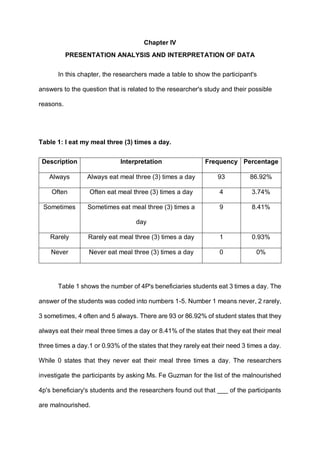
Table 1: I eat my meal three (3) times a day.
Description Interpretation Frequency Percentage
Always Always eat meal three (3) times a day 93 86.92%
Often Often eat meal three (3) times a day 4 3.74%
Sometimes Sometimes eat meal three (3) times a
day
9 8.41%
Rarely Rarely eat meal three (3) times a day 1 0.93%
Never Never eat meal three (3) times a day 0 0%
Table 1 shows the number of 4P's beneficiaries students eat 3 times a day. The
answer of the students was coded into numbers 1-5. Number 1 means never, 2 rarely,
3 sometimes, 4 often and 5 always. There are 93 or 86.92% of student states that they
always eat their meal three times a day or 8.41% of the states that they eat their meal
three times a day.1 or 0.93% of the states that they rarely eat their need 3 times a day.
While 0 states that they never eat their meal three times a day. The researchers
investigate the participants by asking Ms. Fe Guzman for the list of the malnourished
4p's beneficiary's students and the researchers found out that ___ of the participants
are malnourished.
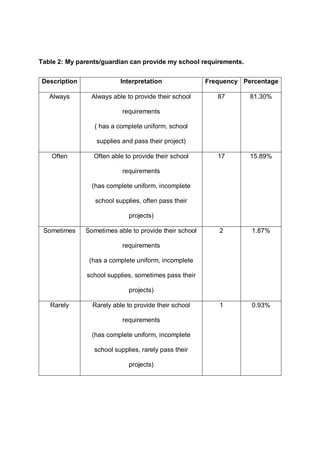
Table 2: My parents/guardian can provide my school requirements.
Description Interpretation Frequency Percentage
Always Always able to provide their school
requirements
( has a complete uniform, school
supplies and pass their project)
87 81.30%
Often Often able to provide their school
requirements
(has complete uniform, incomplete
school supplies, often pass their
projects)
17 15.89%
Sometimes Sometimes able to provide their school
requirements
(has a complete uniform, incomplete
school supplies, sometimes pass their
projects)
2 1.87%
Rarely Rarely able to provide their school
requirements
(has complete uniform, incomplete
school supplies, rarely pass their
projects)
1 0.93%
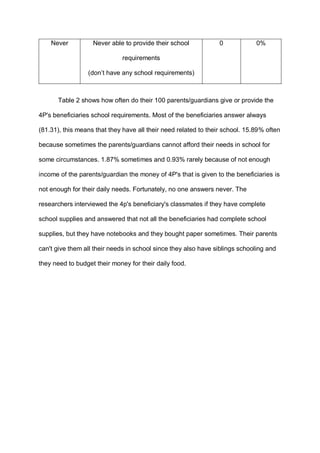
Never Never able to provide their school
requirements
(don’t have any school requirements)
0 0%
Table 2 shows how often do their 100 parents/guardians give or provide the
4P's beneficiaries school requirements. Most of the beneficiaries answer always
(81.31), this means that they have all their need related to their school. 15.89% often
because sometimes the parents/guardians cannot afford their needs in school for
some circumstances. 1.87% sometimes and 0.93% rarely because of not enough
income of the parents/guardian the money of 4P's that is given to the beneficiaries is
not enough for their daily needs. Fortunately, no one answers never. The
researchers interviewed the 4p's beneficiary's classmates if they have complete
school supplies and answered that not all the beneficiaries had complete school
supplies, but they have notebooks and they bought paper sometimes. Their parents
can't give them all their needs in school since they also have siblings schooling and
they need to budget their money for their daily food.
.
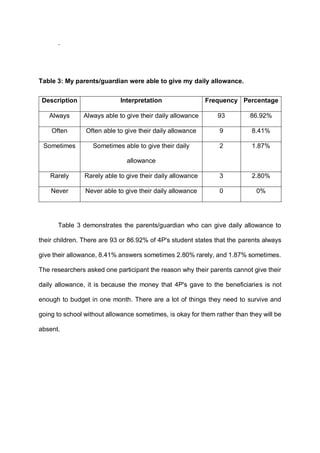
Table 3: My parents/guardian were able to give my daily allowance.
Description Interpretation Frequency Percentage
Always Always able to give their daily allowance 93 86.92%
Often Often able to give their daily allowance 9 8.41%
Sometimes Sometimes able to give their daily
allowance
2 1.87%
Rarely Rarely able to give their daily allowance 3 2.80%
Never Never able to give their daily allowance 0 0%
Table 3 demonstrates the parents/guardian who can give daily allowance to
their children. There are 93 or 86.92% of 4P's student states that the parents always
give their allowance, 8.41% answers sometimes 2.80% rarely, and 1.87% sometimes.
The researchers asked one participant the reason why their parents cannot give their
daily allowance, it is because the money that 4P's gave to the beneficiaries is not
enough to budget in one month. There are a lot of things they need to survive and
going to school without allowance sometimes, is okay for them rather than they will be
absent.
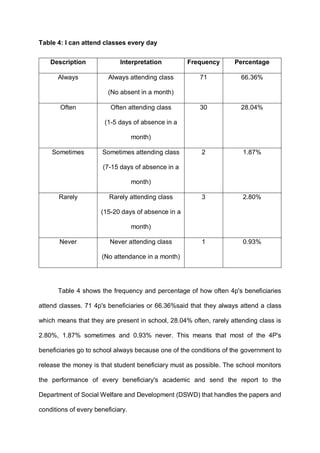
Table 4: I can attend classes every day
Description Interpretation Frequency Percentage
Always Always attending class
(No absent in a month)
71 66.36%
Often Often attending class
(1-5 days of absence in a
month)
30 28.04%
Sometimes Sometimes attending class
(7-15 days of absence in a
month)
2 1.87%
Rarely Rarely attending class
(15-20 days of absence in a
month)
3 2.80%
Never Never attending class
(No attendance in a month)
1 0.93%
Table 4 shows the frequency and percentage of how often 4p's beneficiaries
attend classes. 71 4p's beneficiaries or 66.36%said that they always attend a class
which means that they are present in school, 28.04% often, rarely attending class is
2.80%, 1.87% sometimes and 0.93% never. This means that most of the 4P's
beneficiaries go to school always because one of the conditions of the government to
release the money is that student beneficiary must as possible. The school monitors
the performance of every beneficiary's academic and send the report to the
Department of Social Welfare and Development (DSWD) that handles the papers and
conditions of every beneficiary.
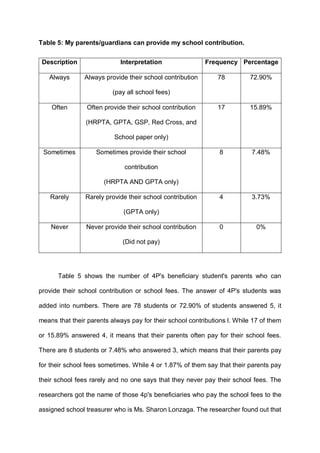
Table 5: My parents/guardians can provide my school contribution.
Description Interpretation Frequency Percentage
Always Always provide their school contribution
(pay all school fees)
78 72.90%
Often Often provide their school contribution
(HRPTA, GPTA, GSP, Red Cross, and
School paper only)
17 15.89%
Sometimes Sometimes provide their school
contribution
(HRPTA AND GPTA only)
8 7.48%
Rarely Rarely provide their school contribution
(GPTA only)
4 3.73%
Never Never provide their school contribution
(Did not pay)
0 0%
Table 5 shows the number of 4P's beneficiary student's parents who can
provide their school contribution or school fees. The answer of 4P's students was
added into numbers. There are 78 students or 72.90% of students answered 5, it
means that their parents always pay for their school contributions l. While 17 of them
or 15.89% answered 4, it means that their parents often pay for their school fees.
There are 8 students or 7.48% who answered 3, which means that their parents pay
for their school fees sometimes. While 4 or 1.87% of them say that their parents pay
their school fees rarely and no one says that they never pay their school fees. The
researchers got the name of those 4p's beneficiaries who pay the school fees to the
assigned school treasurer who is Ms. Sharon Lonzaga. The researcher found out that
___ out of 107 participants pay their school fees, as a researcher, we cannot assure
the honesty of our participants.
Chapter V
Summary
President Rodrigo Duterte signed the Republic Act No. 11310 or the Pantawid
Pamilyang Pilipino Program Act and it is now a permanent program of the
government. Pantawid Pamilyang Pilipino Program is cash assistance for poor
families. The assistance is intended for the education, health, and nutrition of the
family members. The funding is sourced out from the budget of the Department of
Social Welfare and Development (DSWD). Beneficiaries of the 4ps include children
ages 0-18 years old for a maximum the educational assistance every month.
Pedro ''Oloy'' N. Roa Sr. High School (PONRSHS), monitors the condition of
each 4ps beneficiaries and Ms. Ligaya Gonzales, one of PONRSHS's teachers was
assigned to it. Due to lack of time to do her tasks as the 4ps coordinator, she can't
keep an eye to the beneficiary's condition.
The students, parents, and teachers will benefit from this study. The condition
that the researchers intend to convey is the daily allowance of the student's
beneficiaries, their attendance in school, the number of meals per day, do they pay
their school fees, and if they can pass their subject and has a complete uniform and
school supplies.
The researchers must have at least 273 participants but due to lack of time
conducting the study we only gather 107 4p’s beneficiaries but the answers of the
participants are enough to finish this study.
Based on our study, 4p's helps the beneficiaries in their needs in school and
for their living. It may not enough for them but they can go to school even they don't
have their allowance. The researchers found out that 4p's has a big help to each
beneficiary since there is an improvement in the way of their living. The researchers
believe that by budgeting, parents must have work, and the perseverance of the
student's beneficiary to go to school will make their lives better with the help of the
government program (4p's).
Conclusion
Pantawid Pamilyang Pilipino Program or 4p's helps a lot to its beneficiaries,
many of them provide their need even not all of it. The beneficiaries can go to school
because of the said program but may beneficiaries are not able to buy and eat
properly because their parents don't have a work and only rely on the money that
they will receive from 4p's for their daily needs. They are others who have work but
they have many children that's why the money they receive from the program is not
enough for their monthly budget. The researchers found out that that was the very
reason why do the other parents can't give and provide the needs of the children or
the students beneficiary in school and for themselves even if it is the focus and
purpose of the program.
Recommendation
The following are the researcher’s recommendations to the people concern:
STUDENTS: 4P’s student beneficiaries must have a knowledge about the condition
in being a beneficiary and do their responsibilities such as attending classes.
TEACHER: must monitor 4P's beneficiaries on their attendance, school contribution,
school supplies, health & nutrition and report in the Department of Social Welfare
Development (DSWD)
PARENTS: Parents must do their responsibilities in their child such as feed them
three (3) times a day, contribute school fees, give them a daily allowance, sent them
in school and provide their school supplies.
Reference
VALEÑA, L. D. (2015). Academic Achievement of Pantawid Pamilyang Pilipino Program
(4Ps) Beneficiaries in Public Secondary Schools in Laguna. Unpublished Paper,
Polytechnic University of the Philippines.
Fiszbein, (2009). CONDITIONAL CASH TRANSFERS REDUCING PRESENT AND
FUTURE. The International Bank for Reconstruction and Development / The World
Bank 1818 H Street NW
Fernald, Gertler, and Neudfeld, (2009). 10-year effect of Oportunidades, Mexico's
conditional cash transfer program, on child growth, cognition, language, and behavior: a
longitudinal follow-up study. Community Health and Human Development, School of
Public Health, University of California, Berkeley, CA 94720-7360, USA.
fernald@berkeley.
Darney et al. 2013) The Oportunidades Conditional Cash Transfer Program: Effects on
Pregnancy and Contraceptive Use among Young Rural Women in Mexico.
Nanda, P., Datta, N. and Das, N., (2014); Sadooulet, E., Finan, F., de Janvry, A. and
Vakis, R. (2004). Beyond Compliance a Look into the Behavioral and Social Outcomes
of the Pantawid Pilipinong Pamilya Program. Institute of Family Life and Children’s
Studies - Philippine Women’s University Taft Avenue, Malate, Manila
Yoong, J., Rabinovich, L., and Diepeveen, S., (2012). The impact of economic resource
transfers to women versus men. A systematic review. Technical report. London: EPPI-
Centre, Social Science Research Unit, Institute of Education, University of London
Molyneux (2013). Neglected tropical diseases. An Open Access article distributed under
the Creative Commons Attribution Non-Commercial License.
Kervyn de Lettenhove, M. (2012). Conditional Cash Transfers in Latin America: Impact,
scope and limitations. Reflets et perspectives de la vie économique, tome li (2), 5-18.
doi:10.3917/rpve.512.0005.
WEB SOURCES
https://scholar.google.com/scholar?hl=en&as_sdt=0%2C5&q=the+condition+of+4p%27s+beneficiaries+
related+litreture&btnG=#d=gs_cit&u=%2Fscholar%3Fq%3Dinfo%3AWMTktNgFjWwJ%3Ascholar.google.
com%2F%26output%3Dcite%26scirp%3D0%26hl%3Den
https://siteresources.worldbank.org/INTCCT/Resources/5757608-1234228266004/PRR-
CCT_web_noembargo.pdf
https://www.ncbi.nlm.nih.gov/pubmed/19892392
https://www.ncbi.nlm.nih.gov/pmc/articles/PMC4096692/
https://pantawid.dswd.gov.ph/wp-content/uploads/2018/08/Behavioral-and-Social-Outcomes-
Study_Full-Report.pdf
https://eppi.ioe.ac.uk/cms/Portals/0/PDF%20reviews%20and%20summaries/Economic%20transfers%2
02012Yoong.pdf?ver=2012-01-13-101615-493
https://www.ncbi.nlm.nih.gov/pmc/articles/PMC3756642/
https://www.cairn.info/revue-reflets-et-perspectives-de-la-vie-economique-2012-2-page-5.htm#
https://elibrary.worldbank.org/do3930i/abs/10.1596/1813-9450-
https://books.google.com.ph/books?hl=en&lr=&id=gxw_CQAAQBAJ&oi=fnd&pg=PT87&dq=cash+assista
nce+program+in+philippines+conditions&ots=29suNO1nnq&sig=CJ5fn8eCiGszg52KlNJ9hn-
aF74&redir_esc=y#v=onepage&q=cash%20assistance%20program%20in%20philippines%20conditions&f
=false
https://s3.amazonaws.com/academia.edu.documents/52176313/1710-1440094900_2.pdf?response-
content-disposition=inline%3B%20filename%3DPantawid_Pamilyang_Pilipino_Program_4Ps.pdf&X-
Amz-Algorithm=AWS4-HMAC-SHA256&X-Amz-
Credential=AKIAIWOWYYGZ2Y53UL3A%2F20200210%2Fus-east-1%2Fs3%2Faws4_request&X-Amz-
Date=20200210T063325Z&X-Amz-Expires=3600&X-Amz-SignedHeaders=host&X-Amz-
Signature=4b2d9792a9711ece66e0ef95d95a0bbe0f52a92c4946dc0448f1fe605fa4910f
https://s3.amazonaws.com/academia.edu.documents/56816161/research_in_quanti_2..pdf?response-
content-disposition=inline%3B%20filename%3DThe_Pantawid_Pamilyang_Pilipino_Program.pdf&X-
Amz-Algorithm=AWS4-HMAC-SHA256&X-Amz-
Credential=AKIAIWOWYYGZ2Y53UL3A%2F20200210%2Fus-east-1%2Fs3%2Faws4_request&X-Amz-
Date=20200210T063403Z&X-Amz-Expires=3600&X-Amz-SignedHeaders=host&X-Amz-
Signature=1fd1e72116629c898bb90d21fa64cbd10ca637db530bb8ca207e08acf32ff126
https://uruae.org/siteadmin/upload/ED1217106.pdf
https://core.ac.uk/reader/76064340

4P'S cONDITIOON.PDF

  • 1.
    THE CONDITIONS OF4P’S BENEFICIARIES IN PEDRO “OLOY” N. ROA SR. HIGH SCHOOL Angel Marie Cahanap Angelica Shane Cahanap Carmela Jenn Balili Jerelyn S. Dacula Jolina T. Querol Jun Mark S. Palad FEBRUARY 2020
  • 2.
    CHAPTER 1 I. Introduction PresidentRodrigo Duterte signed the Republic Act No. 11310 or the Pantawid Pamilyang Pilipino Program Act and it is now a permanent program of the government. Pantawid Pamilyang Pilipino Program is cash assistance for poor families. The assistance is intended for the education, health, and nutrition of the family members. The funding is sourced out from the budget of the Department of Social Welfare and Development (DSWD). Beneficiaries of the 4p’s include children ages 0-18 years old for a maximum the educational assistance every month each beneficiary will receive ₱300.00 for those enrolled in daycare ₱500.00 for those enrolled in junior high school ₱700.00, enrolled in senior high school ₱750.00 for health and nutrition. The government aims to lessen poverty and to educate and to give health care for families who are beneficiaries of 3 for every family assistance. The financial is given be- monthly or every two months. The Government provides financial assistance to families who are identified to be living below to poverty line. In return for the financial assistance given to them, all beneficiaries are given guidelines and conditions to follow and fulfill. Department of Social Welfare and Development (DSWD) has issued Administrative Order No.16 stimulating the guidelines and conditions for all the 4ps beneficiaries. The guidelines stimulated for the student are the following. a. Aged 0-5 must receive regular preventive health check-ups and vaccines. b. Aged 6-14 must receive deworming pills twice a year. c. Aged 3-18 must enroll in school, and maintain an attendance of at least 85% of class days every month. In Pedro ''Oloy'' N. Roa Sr. High School 860 students are 4ps beneficiaries. The researchers aim to determine if the 4ps beneficiaries fulfill the conditions of the guidelines of the government.
  • 3.
    II. Background ofthe Study Pedro ''Oloy'' N. Roa Sr. High School (PONRSHS), monitors the condition of each 4ps beneficiaries and Ms. Ligaya Gonzales, one of PONRSHS's teachers was assigned to it. Due to lack of time to do her tasks as the 4ps coordinator, she can't keep an eye to the beneficiary's condition because she has a lot of paper works to do and she also teachers the Grade 7 level as a Filipino and English teachers. It's one of the problems of the school that the researchers have seen/notice and like to help the school to give the exact condition of the 4ps beneficiaries. 4ps is very known as one of the government programs for the less fortunate family and the researchers want to know/determine the improvement of the beneficiary's lives for having such gratitude and if do they follow their responsibility as beneficiaries. If the school and researchers, will not monitor the condition of 4ps beneficiaries. Their basic needs in the home or school right not be provided by their parents or guardian so it is so important to conduct this study. III. Significance of the Study The study focus and highlights the conditions of 4p's beneficiaries in Pedro ''Oloy'' N. Roa Sr. High School. Some of our respondents answered sometimes their parents/ guardian are not giving their allowance, some of them their parents are not giving paying the school contribution, their parents are not giving money for the school project. It is important to monitor the 4ps beneficiaries so that the government will know if they are using the money in the right way. If the government will not monitor the conditions of the 4P's beneficiaries. there are possibilities that the 4P's beneficiaries are not fulfilling their responsibilities.
  • 4.
    The results ofthe study will benefit the following: STUDENTS: Theresults will provide the students with some knowledgeoftheir conditionin havingorbeinga beneficiaryand howithelpsthemintheir studies. It will give the studentsa realizationthat 4p’sishelpful to boththeir studies andintheirdailyneeds. Teachers: the given data would help the teachers on what is the conditions of every 4p's beneficiaries. The teachers would be able to understand why other beneficiaries don't have enough or complete things in school, allowance, and food. Parents: Like theteachers, the parentstoowill understandthesignificance of the 4p’s or PantawidPamilyangPilipinoProgramintheirlives.The givendatawould help themknowand enlightenthethings thattheir childrenneed and to help their sonsfrombeingabsentsin school. IV. Conceptual Framework 4P’s Beneficiaries CONDITION FOLLOW IMPLEMENTING GUIDELINES -Can eat 3 meals a day -Attendance -have sufficient school supplies -contributes school fees -have daily allowance V. Statement of the Problem The researcher wants to know if the condition of 4p's beneficiaries in Pedro “Oloy” N. Roa Sr. High School (PONRSHS). Specifically, it aims to answer the
  • 5.
    following questions: 1. Whatis the condition of 4p's beneficiaries in terms of: 1.1 No. Of meals eaten per day 1.2 availability of school supplies 1.3 availability if uniform 1.4 daily allowance 2. How far do 4p's beneficiaries follow the guidelines and conditions set the footer for them in terms of: 2.1 attendance 2.2 contribution of school fees 2.3 involvement in school projects Hypothesis: Ho¹: The 4p's beneficiaries are not in good condition. Ho²: The beneficiaries do not follow the guidelines and conditions. Vl. Scope and Delimitation The researchers study the condition of the 4p's beneficiaries in PONRSHS and there are 860 beneficiaries. The researchers get the sample size by using Slovin's formula which is and N=N/1+Ne² came up to 27 but only 107 students beneficiary respond in our conducted survey due to busy practicing dance that time preparing for incoming Competition Even those 107 students answer the survey, the researchers can't assure the honesty of each 4p's beneficiaries students.
  • 6.
    VII. Definition ofTerms * Condition of 4p's beneficiaries - refers to the provision of each 4p's beneficiaries and the improvement of their health, nutrition, and education. * 3 meals a day - refers to breakfast, dinner, and lunch. * Sufficient school supplies and complete uniform - refers to the things that the beneficiary’s needs in school. * Daily allowance - money need for the beneficiary’s fare and snacks. * Attendance - number of days that the student goes to school in a month. * School fees - school contribution to be paid off.
  • 7.
    CHAPTER II Related Literature Accordingto Cecchini and Madariaga (2011), 4Ps is a social program that entails to monetary and non-monetary transfers to the poor or poorest families who have school-aged children on the condition that they meet the program's terms that are aimed at improving their capacities. Conditional cash transfers (CCT) are essentially providing financial incentives or resources to poor families in exchange for their compliances to a set of conditions aimed at improving their capacities. The early CCTs were implemented by Mexico and Brazil in the 1990s; currently, there are more than 20 countries that have CCT programs in some form as part of their anti-poverty strategies Fiszbein, 2009). Conditionalities can also be fine-tuned to target other social issues cutting across poverty, for instance, gender-based discrimination and violence and social exclusion of indigenous peoples. In a 10-year longitudinal study, it was found out that children enrolled in the program displayed better psychosocial functioning than children of the same profile but were not enrolled in the CCT (Fernald, Gertler, and Neufeld, 2009). Furthermore, delayed childbearing, as with higher education attainment, is linked to increased prospects of escaping poverty (Darney et al. 2013). There were also significant improvements in the school enrolment and access to health services of girl children when this is part of the CCT conditionalities. In the long-term, these changes result in delayed pregnancies or marriages, better economic opportunities for females (Nanda, P., Datta, N. and Das, N., 2014; Sadooulet, E., Finan, F., de Janvry, A. and Vakis, R., 2004). Still in another study of the effects of CCT on maternal and newborn health, Glassman et al. (2013) point to
  • 8.
    a "learning effect"whereby the longer the mother is exposed to the CCT health interventions and conditionalities, the greater her utilization of health services, even beyond what is required by the program. Gender equality is also another area of inquiry in several CCT researches as most CCTs also identify women as the recipient and manager of the cash grants. The results are encouraging i.e., making women managers of cash grants is more likely to result in better nutrition and education of children in the household, compared to when men are the recipients of the cash grant (Yoong, J., Rabinovich, L., and Diepeveen, S., 2012). According to Francis Mark Dioscoro R. FELLIZAR, Dhino B. Geges, Chrislyn Faulmino, Michelle Q. Pangilinan, Geronima Abigail B. Ilagan, Chynna Sandra J. Palis (2017) that This conditional cash transfer program under the Department of Social Welfare and Development (DSWD) helps in fulfilling the country's commitment to meet the Millennium Development Goals, namely: (1) to eradicate poverty and hunger; (2) achieve universal primary education; (3) promote gender equality; (4) reduce child mortality; and (5) improve maternal health; and aims to target the "poorest of the poor". According to Molyneux (2013) a feature of CCTs is micro-targeting poverty: rooting poverty in the low levels of human capital investments, its interventions focus on ensuring that children have access to nutrition, education and health care -- sometimes to the neglect of women, another vulnerable group in households. According to Basset (2008), some studies show CCTs can change simple health- related behaviors' (e.g. direct accomplishment such as going to health-centers) but have little effect on complex behaviors (e.g. as exclusive breastfeeding, pregnancy rest and hand washing after using the toilet) which are more difficult to monitor, and therefore incentivize. However, it is influencing these complex behaviors which are
  • 9.
    more beneficial interms of health outcomes. According to Axel Weber (2010), that Conditional programs normally request beneficiaries to show certain behavioral patterns, mostly related to their children, such as making sure the child must attend school, that the child gets regular check-ups, vaccinations, etc. The idea behind this concept is not just to hand out money, but to achieve certain goals by doing so. The goal of the program is to help poor residents to improve their health, nutrition, and education especially children from 0-18 years by providing cash grants (Social Assistance) and invest human capital (Social Development) (Defensor) (Montilla, Delavin, Villanueva, & Turco (2015). According to Ronaldo F. Frufonga (2015), that the Pantawid Pamilyang Pilipino Program (4P's) as a poverty-reduction strategy of the government designed for the poorest among the poor households which have serious implications to the quality of life especially in the aspects of education and health and nutrition of every individual. According to Rommel P. Tabilog, Michelle Mae B. Mapola, Celyn D. Cantillano, Michelle C. Cabrera and Renelina D. Mañabo (2017) that the beneficiaries should comply with the conditions of the program with specific verifiable behavior such as pregnant women undergoing preventive health check-ups, children 0-5 years old undergoing growth monitoring and receiving vaccinations, and the children aged 3-14 years old enrolled in Day Care, kindergarten, primary and secondary and alternative delivery modes of education maintaining at least an 85% attendance. The parents should also attend the Family Development Sessions. According to Kervyn de Lettenhove, M. (2012), that today, conditional cash transfers (CCTs) constitute the new fashionable tool in poverty-reduction policy (as were micro-credits a few years back). However various the policy design of the different CCT programs that have been implemented in Latin America (LA) (but also
  • 10.
    in Africa, Asiaand even in the USA) since the mid-90s, they all share at least three common features: (1) a cash transfer is involved (as opposed to in-kind assistance), (2) it is targeted at the very poor (however variously defined) and (3) it requires that households fulfill pre-defined conditions, usually sending children to school or attending regular medical check-ups. What distinguishes CCTs from traditional social assistance programs is the conditional feature that enables them to "address demand-side constraints for structural poverty reduction, through an incentive scheme which combines the short-term objective of safety-nets with the long term goals of building human capital and breaking the vicious intergenerational circle of poverty traps" (Britto, 2005:1). According to Norbert Schady. (2006), that the impact of the Bono de Desarrollo Humano (BDH), a cash transfer program, on enrollment and child work among poor children in Ecuador. There are two main results. First, the BDH program had a large, positive impact on school enrollment, about 10 percentage points, and a large, negative impact on child work, about 17 percentage points. Second, the fact that some households believed that there was a school enrollment requirement attached to the transfers, even though such a requirement was never enforced or monitored in Ecuador, helps explain the magnitude of program effects
  • 11.
    CHAPTER III Methodology A systemof method that will be used in a particular area of the research study. Research Method The researchers conducted quantitative research that utilized the survey method. The researchers collect some data through survey and the answer to our question will either be always, often, sometimes, rarely or never. The researchers made use of a descriptive approach in analyzing data. Descriptive research is defined as a research method that describes the population or phenomenon that is being studied. This methodology focuses more on the "what" of the research subject rather than the "why" of the research subject. Research Location Pedro " Oloy" N. Roa Sr. High School is one of a public school in barangay Canitoan. It is located in PN. Roa Subd. within the area of Cagayan de Oro City, where 2000 students are studying. The lot area donated by late Mayor Roa, student most of are living in the relocation site means in the said school. Research participants of this study are the 4p's beneficiaries of PONRSHS. There are forty-ix (46) in grade 7, forty-five (45) in grade 8, two (2) in grade 11 and 12 is fourteen (14). Population Sampling procedure; There are 860 4P’s beneficiaries in Pedro ‘Oloy’ N. Roa Sr. High School (PONRSHS). The researchers used the slovin’s formula which is n=N÷1+Ne² to compute for the sample size. The computation resulted in 273 participants but due to lack of time conducting this study only 107 student's
  • 12.
    beneficiaries answered theresearch questionnaire. The number of participants is broken down to the following: Grade 7: 46 Grade 8: 45 Grade 9: none Grade 10: none Grade 11: 2 Grade 12: 14 Data Gathering Steps that the researchers did to have a successful data collection or data gathering:  In the first step, the researchers made a letter to have the teacher's permission to survey their 4p's student beneficiaries.  Determine the number of sample students to be conducted by the study.  After getting the sample data, the researchers divided it into 6 since there are 6-year levels and to have a fair number of student beneficiaries every year level to be conducted by the study.  The researchers select the random students in every year level at least 45 students per year level.  Observe the physical condition ask some concerns to the participants, get the list of the beneficiaries who paid school fees and then interview the classmates of the beneficiaries if they have school supplies to prove their answers.
  • 13.
     Make chapter4 where the researchers made a graph and discuss answers and the possible reasons for every concern for those who had the unsatisfying answer.
  • 14.
    Chapter IV PRESENTATION ANALYSISAND INTERPRETATION OF DATA In this chapter, the researchers made a table to show the participant's answers to the question that is related to the researcher's study and their possible reasons. Table 1: I eat my meal three (3) times a day. Description Interpretation Frequency Percentage Always Always eat meal three (3) times a day 93 86.92% Often Often eat meal three (3) times a day 4 3.74% Sometimes Sometimes eat meal three (3) times a day 9 8.41% Rarely Rarely eat meal three (3) times a day 1 0.93% Never Never eat meal three (3) times a day 0 0% Table 1 shows the number of 4P's beneficiaries students eat 3 times a day. The answer of the students was coded into numbers 1-5. Number 1 means never, 2 rarely, 3 sometimes, 4 often and 5 always. There are 93 or 86.92% of student states that they always eat their meal three times a day or 8.41% of the states that they eat their meal three times a day.1 or 0.93% of the states that they rarely eat their need 3 times a day. While 0 states that they never eat their meal three times a day. The researchers investigate the participants by asking Ms. Fe Guzman for the list of the malnourished 4p's beneficiary's students and the researchers found out that ___ of the participants are malnourished.
  • 15.
    Table 2: Myparents/guardian can provide my school requirements. Description Interpretation Frequency Percentage Always Always able to provide their school requirements ( has a complete uniform, school supplies and pass their project) 87 81.30% Often Often able to provide their school requirements (has complete uniform, incomplete school supplies, often pass their projects) 17 15.89% Sometimes Sometimes able to provide their school requirements (has a complete uniform, incomplete school supplies, sometimes pass their projects) 2 1.87% Rarely Rarely able to provide their school requirements (has complete uniform, incomplete school supplies, rarely pass their projects) 1 0.93%
  • 16.
    Never Never ableto provide their school requirements (don’t have any school requirements) 0 0% Table 2 shows how often do their 100 parents/guardians give or provide the 4P's beneficiaries school requirements. Most of the beneficiaries answer always (81.31), this means that they have all their need related to their school. 15.89% often because sometimes the parents/guardians cannot afford their needs in school for some circumstances. 1.87% sometimes and 0.93% rarely because of not enough income of the parents/guardian the money of 4P's that is given to the beneficiaries is not enough for their daily needs. Fortunately, no one answers never. The researchers interviewed the 4p's beneficiary's classmates if they have complete school supplies and answered that not all the beneficiaries had complete school supplies, but they have notebooks and they bought paper sometimes. Their parents can't give them all their needs in school since they also have siblings schooling and they need to budget their money for their daily food.
  • 18.
    . Table 3: Myparents/guardian were able to give my daily allowance. Description Interpretation Frequency Percentage Always Always able to give their daily allowance 93 86.92% Often Often able to give their daily allowance 9 8.41% Sometimes Sometimes able to give their daily allowance 2 1.87% Rarely Rarely able to give their daily allowance 3 2.80% Never Never able to give their daily allowance 0 0% Table 3 demonstrates the parents/guardian who can give daily allowance to their children. There are 93 or 86.92% of 4P's student states that the parents always give their allowance, 8.41% answers sometimes 2.80% rarely, and 1.87% sometimes. The researchers asked one participant the reason why their parents cannot give their daily allowance, it is because the money that 4P's gave to the beneficiaries is not enough to budget in one month. There are a lot of things they need to survive and going to school without allowance sometimes, is okay for them rather than they will be absent.
  • 19.
    Table 4: Ican attend classes every day Description Interpretation Frequency Percentage Always Always attending class (No absent in a month) 71 66.36% Often Often attending class (1-5 days of absence in a month) 30 28.04% Sometimes Sometimes attending class (7-15 days of absence in a month) 2 1.87% Rarely Rarely attending class (15-20 days of absence in a month) 3 2.80% Never Never attending class (No attendance in a month) 1 0.93% Table 4 shows the frequency and percentage of how often 4p's beneficiaries attend classes. 71 4p's beneficiaries or 66.36%said that they always attend a class which means that they are present in school, 28.04% often, rarely attending class is 2.80%, 1.87% sometimes and 0.93% never. This means that most of the 4P's beneficiaries go to school always because one of the conditions of the government to release the money is that student beneficiary must as possible. The school monitors the performance of every beneficiary's academic and send the report to the Department of Social Welfare and Development (DSWD) that handles the papers and conditions of every beneficiary.
  • 20.
    Table 5: Myparents/guardians can provide my school contribution. Description Interpretation Frequency Percentage Always Always provide their school contribution (pay all school fees) 78 72.90% Often Often provide their school contribution (HRPTA, GPTA, GSP, Red Cross, and School paper only) 17 15.89% Sometimes Sometimes provide their school contribution (HRPTA AND GPTA only) 8 7.48% Rarely Rarely provide their school contribution (GPTA only) 4 3.73% Never Never provide their school contribution (Did not pay) 0 0% Table 5 shows the number of 4P's beneficiary student's parents who can provide their school contribution or school fees. The answer of 4P's students was added into numbers. There are 78 students or 72.90% of students answered 5, it means that their parents always pay for their school contributions l. While 17 of them or 15.89% answered 4, it means that their parents often pay for their school fees. There are 8 students or 7.48% who answered 3, which means that their parents pay for their school fees sometimes. While 4 or 1.87% of them say that their parents pay their school fees rarely and no one says that they never pay their school fees. The researchers got the name of those 4p's beneficiaries who pay the school fees to the assigned school treasurer who is Ms. Sharon Lonzaga. The researcher found out that
  • 21.
    ___ out of107 participants pay their school fees, as a researcher, we cannot assure the honesty of our participants.
  • 22.
    Chapter V Summary President RodrigoDuterte signed the Republic Act No. 11310 or the Pantawid Pamilyang Pilipino Program Act and it is now a permanent program of the government. Pantawid Pamilyang Pilipino Program is cash assistance for poor families. The assistance is intended for the education, health, and nutrition of the family members. The funding is sourced out from the budget of the Department of Social Welfare and Development (DSWD). Beneficiaries of the 4ps include children ages 0-18 years old for a maximum the educational assistance every month. Pedro ''Oloy'' N. Roa Sr. High School (PONRSHS), monitors the condition of each 4ps beneficiaries and Ms. Ligaya Gonzales, one of PONRSHS's teachers was assigned to it. Due to lack of time to do her tasks as the 4ps coordinator, she can't keep an eye to the beneficiary's condition. The students, parents, and teachers will benefit from this study. The condition that the researchers intend to convey is the daily allowance of the student's beneficiaries, their attendance in school, the number of meals per day, do they pay their school fees, and if they can pass their subject and has a complete uniform and school supplies. The researchers must have at least 273 participants but due to lack of time conducting the study we only gather 107 4p’s beneficiaries but the answers of the participants are enough to finish this study. Based on our study, 4p's helps the beneficiaries in their needs in school and for their living. It may not enough for them but they can go to school even they don't have their allowance. The researchers found out that 4p's has a big help to each
  • 23.
    beneficiary since thereis an improvement in the way of their living. The researchers believe that by budgeting, parents must have work, and the perseverance of the student's beneficiary to go to school will make their lives better with the help of the government program (4p's). Conclusion Pantawid Pamilyang Pilipino Program or 4p's helps a lot to its beneficiaries, many of them provide their need even not all of it. The beneficiaries can go to school because of the said program but may beneficiaries are not able to buy and eat properly because their parents don't have a work and only rely on the money that they will receive from 4p's for their daily needs. They are others who have work but they have many children that's why the money they receive from the program is not enough for their monthly budget. The researchers found out that that was the very reason why do the other parents can't give and provide the needs of the children or the students beneficiary in school and for themselves even if it is the focus and purpose of the program. Recommendation The following are the researcher’s recommendations to the people concern: STUDENTS: 4P’s student beneficiaries must have a knowledge about the condition in being a beneficiary and do their responsibilities such as attending classes.
  • 24.
    TEACHER: must monitor4P's beneficiaries on their attendance, school contribution, school supplies, health & nutrition and report in the Department of Social Welfare Development (DSWD) PARENTS: Parents must do their responsibilities in their child such as feed them three (3) times a day, contribute school fees, give them a daily allowance, sent them in school and provide their school supplies.
  • 25.
    Reference VALEÑA, L. D.(2015). Academic Achievement of Pantawid Pamilyang Pilipino Program (4Ps) Beneficiaries in Public Secondary Schools in Laguna. Unpublished Paper, Polytechnic University of the Philippines. Fiszbein, (2009). CONDITIONAL CASH TRANSFERS REDUCING PRESENT AND FUTURE. The International Bank for Reconstruction and Development / The World Bank 1818 H Street NW Fernald, Gertler, and Neudfeld, (2009). 10-year effect of Oportunidades, Mexico's conditional cash transfer program, on child growth, cognition, language, and behavior: a longitudinal follow-up study. Community Health and Human Development, School of Public Health, University of California, Berkeley, CA 94720-7360, USA. fernald@berkeley. Darney et al. 2013) The Oportunidades Conditional Cash Transfer Program: Effects on Pregnancy and Contraceptive Use among Young Rural Women in Mexico. Nanda, P., Datta, N. and Das, N., (2014); Sadooulet, E., Finan, F., de Janvry, A. and Vakis, R. (2004). Beyond Compliance a Look into the Behavioral and Social Outcomes of the Pantawid Pilipinong Pamilya Program. Institute of Family Life and Children’s Studies - Philippine Women’s University Taft Avenue, Malate, Manila Yoong, J., Rabinovich, L., and Diepeveen, S., (2012). The impact of economic resource transfers to women versus men. A systematic review. Technical report. London: EPPI- Centre, Social Science Research Unit, Institute of Education, University of London Molyneux (2013). Neglected tropical diseases. An Open Access article distributed under the Creative Commons Attribution Non-Commercial License. Kervyn de Lettenhove, M. (2012). Conditional Cash Transfers in Latin America: Impact, scope and limitations. Reflets et perspectives de la vie économique, tome li (2), 5-18. doi:10.3917/rpve.512.0005.
  • 26.
    WEB SOURCES https://scholar.google.com/scholar?hl=en&as_sdt=0%2C5&q=the+condition+of+4p%27s+beneficiaries+ related+litreture&btnG=#d=gs_cit&u=%2Fscholar%3Fq%3Dinfo%3AWMTktNgFjWwJ%3Ascholar.google. com%2F%26output%3Dcite%26scirp%3D0%26hl%3Den https://siteresources.worldbank.org/INTCCT/Resources/5757608-1234228266004/PRR- CCT_web_noembargo.pdf https://www.ncbi.nlm.nih.gov/pubmed/19892392 https://www.ncbi.nlm.nih.gov/pmc/articles/PMC4096692/ https://pantawid.dswd.gov.ph/wp-content/uploads/2018/08/Behavioral-and-Social-Outcomes- Study_Full-Report.pdf https://eppi.ioe.ac.uk/cms/Portals/0/PDF%20reviews%20and%20summaries/Economic%20transfers%2 02012Yoong.pdf?ver=2012-01-13-101615-493 https://www.ncbi.nlm.nih.gov/pmc/articles/PMC3756642/ https://www.cairn.info/revue-reflets-et-perspectives-de-la-vie-economique-2012-2-page-5.htm# https://elibrary.worldbank.org/do3930i/abs/10.1596/1813-9450- https://books.google.com.ph/books?hl=en&lr=&id=gxw_CQAAQBAJ&oi=fnd&pg=PT87&dq=cash+assista nce+program+in+philippines+conditions&ots=29suNO1nnq&sig=CJ5fn8eCiGszg52KlNJ9hn- aF74&redir_esc=y#v=onepage&q=cash%20assistance%20program%20in%20philippines%20conditions&f =false
  • 27.
    https://s3.amazonaws.com/academia.edu.documents/52176313/1710-1440094900_2.pdf?response- content-disposition=inline%3B%20filename%3DPantawid_Pamilyang_Pilipino_Program_4Ps.pdf&X- Amz-Algorithm=AWS4-HMAC-SHA256&X-Amz- Credential=AKIAIWOWYYGZ2Y53UL3A%2F20200210%2Fus-east-1%2Fs3%2Faws4_request&X-Amz- Date=20200210T063325Z&X-Amz-Expires=3600&X-Amz-SignedHeaders=host&X-Amz- Signature=4b2d9792a9711ece66e0ef95d95a0bbe0f52a92c4946dc0448f1fe605fa4910f https://s3.amazonaws.com/academia.edu.documents/56816161/research_in_quanti_2..pdf?response- content-disposition=inline%3B%20filename%3DThe_Pantawid_Pamilyang_Pilipino_Program.pdf&X- Amz-Algorithm=AWS4-HMAC-SHA256&X-Amz- Credential=AKIAIWOWYYGZ2Y53UL3A%2F20200210%2Fus-east-1%2Fs3%2Faws4_request&X-Amz- Date=20200210T063403Z&X-Amz-Expires=3600&X-Amz-SignedHeaders=host&X-Amz- Signature=1fd1e72116629c898bb90d21fa64cbd10ca637db530bb8ca207e08acf32ff126 https://uruae.org/siteadmin/upload/ED1217106.pdf https://core.ac.uk/reader/76064340