______________________________________________________________________________________ 2
___________________________________________________________________________
Sapienza: International Journal of Interdisciplinary Studies | Vol. 2 | n. 1 | jan-mar | 2021 | e-ISSN: 2675-9780
https://doi.org/10.51798/sijis.v2i1.16
Recebido: 29/01/2021
Aceito: 10/02/2021
Disponível: 13/03/2021
Effects of Pantawid Pamilyang Pilipino Program (4Ps) and other Conditional Cash Transfer
(CCT) Programs of Low and Middle – Income Countries on Human Development
Efeitos do Programa Pantawid Pamilyang Pilipino (4Ps) e de outros programas de transferência condicional de renda
(TCR) de países de baixa e média renda sobre o desenvolvimento humano
Efectos del Programa Pantawid Pamilyang Pilipino (4Ps) y otros programas de transferencias monetarias condicionadas
(TMC) de países de ingresos bajos y medios en el desarrollo humano
Ronald A. Diaz
rdhardcore@gmail.com ronald.diaz@deped.gov.ph
Sta. Cruz National High School, Sta. Cruz, Davao del Sur, Philippines
https://orcid.org/0000-0002-2982-9002
ABSTRACT
Despite the economic growth experienced by the Philippines in the recent years in terms of high GDP, poverty in the
country still prevails. Prevalence of many poor families and individuals in the country prompted the Philippine
government to implement the Pantawid Pamilyang Pilipino Program (Bridging Program for the Filipino Family) also
known as 4Ps, the country’s conditional cash transfer (CCT) program that aims to provide conditional cash grants to the
poorest of the poor. This paper aims to examine the effect of 4Ps on the country’s Human Development Index (HDI). It
also seeks to find out if conditional cash transfer program provides significant effect on the HDIs of low and middle-
income countries worldwide. The mean Human Development Index (HDI) of the Philippines before and throughout the
implementation of 4Ps was compared. The difference between the HDIs of selected countries (low and middle-income)
implementing and non-implementing the conditional cash transfer programs was determined. The findings of this study
show that the Philippines has a significantly higher mean HDI during the implementation of 4Ps since 2008 to 2018
compared to its years when there was no 4Ps. The results further indicate that low and middle–income countries with
CCT programs have significantly higher HDIs in comparison to their counterparts. A thorough evaluation of the CCT
programs in terms of issues such as dependency and reviewing the conditionalities of the program to provide more
significant and promising effect on HDI needs to be undertaken.
Keywords: Pantawid Pamilyang Pilipino Program (4Ps); conditional cash transfer (CCT); Human Development Index
(HDI).
RESUMEN
A pesar del crecimiento económico experimentado por Filipinas en los últimos años en términos de alto PIB, la pobreza
en el país aún prevalece. La prevalencia de muchas familias e individuos pobres en el país llevó al gobierno filipino a
implementar el Programa Pantawid Pamilyang Pilipino (Bridging Program for the Filipino Family), también conocido
como 4P, el programa de transferencias monetarias condicionadas (TMC) del país que tiene como objetivo proporcionar
subvenciones monetarias condicionadas a los más pobres de los pobres. Este documento tiene como objetivo examinar
el efecto de las 4P en el Índice de Desarrollo Humano (IDH) del país. También busca averiguar si el programa de
transferencias monetarias condicionadas tiene un efecto significativo en el IDH de los países de ingresos bajos y
medianos en todo el mundo. Se comparó el índice de desarrollo humano (IDH) medio de Filipinas antes y durante la
implementación de las 4P. Se determinó la diferencia entre los IDH de países seleccionados (de ingresos bajos y
medios) que implementan y no implementan los programas de transferencias monetarias condicionadas. Los hallazgos
de este estudio muestran que Filipinas tiene un IDH medio significativamente más alto durante la implementación de las
4P desde 2008 a 2018 en comparación con los años en que no había 4P. Los resultados indican además que los países de
ingresos bajos y medianos con programas de TMC tienen IDH significativamente más altos en comparación con sus
contrapartes. Es necesario realizar una evaluación exhaustiva de los programas de TMC en términos de cuestiones como
la dependencia y la revisión de las condicionalidades del programa para proporcionar un efecto más significativo y
prometedor en el IDH.
Palabras clave: Programa Pantawid Pamilyang Pilipino (4P); transferencia monetaria condicionada (TMC); Índice de
Desarrollo Humano (IDH).
RESUMO
______________________________________________________________________________________ 3
___________________________________________________________________________
Sapienza: International Journal of Interdisciplinary Studies | Vol. 2 | n. 1 | jan-mar | 2021 | e-ISSN: 2675-9780
https://doi.org/10.51798/sijis.v2i1.16
Recebido: 29/01/2021
Aceito: 10/02/2021
Disponível: 13/03/2021
Apesar do crescimento econômico experimentado pelas Filipinas nos últimos anos em termos de elevado PIB, a pobreza
no país ainda prevalece. A prevalência de muitas famílias e indivíduos pobres no país levou o governo filipino a
implementar o Pantawid Pamilyang Pilipino Program (Bridging Program for the Filipino Family), também conhecido
como 4Ps, o programa de transferência de renda condicionada (TRC) do país que visa fornecer subsídios condicionais
em dinheiro para os mais pobres dos pobres. Este artigo tem como objetivo examinar o efeito dos 4Ps no Índice de
Desenvolvimento Humano (IDH) do país. Também procura descobrir se o programa de transferência condicional de
renda tem efeito significativo sobre o IDH de países de baixa e média renda em todo o mundo. O Índice de
Desenvolvimento Humano (IDH) médio das Filipinas antes e durante a implementação dos 4Ps foi comparado. Foi
determinada a diferença entre os IDH de países selecionados (baixa e média renda) que implementaram e não
implementaram os programas de transferência condicionada de renda. Os resultados deste estudo mostram que as
Filipinas têm um IDH médio significativamente mais alto durante a implementação dos 4Ps desde 2008 a 2018 em
comparação com os anos em que não havia 4Ps. Os resultados indicam ainda que os países de renda baixa e média com
programas de TRC têm IDHs significativamente mais altos em comparação com seus homólogos. Uma avaliação
completa dos programas de TRC em termos de questões como dependência e revisão das condicionalidades do
programa para fornecer um efeito mais significativo e promissor sobre o IDH precisa ser realizada.
Palavras-chave: Programa Pantawid Pamilyang Pilipino (4Ps), transferência de renda condicionada (TRC), Índice de
Desenvolvimento Humano (IDH)
1 INTRODUCTION
The Philippines is one of Asia-Pacific's most competitive economies. The Philippine
economy remains strong until 2021, amid global uncertainties (Philippines Economic Update,
2019). The Philippine economy is expected to be 5th in Asia and 16th in the world by 2050.
(Martin, 2017).
Despite the country's positive economic growth, Philippines still faces many challenges.
Among the country's greatest problems today is poverty. A quarter of the 105 million Philippines
population lived in poverty in 2018, i.e. over 26 million people (Opportunity International, 2018).
Poverty incidence among the population in 2018, or the proportion of poor Filipinos whose per
capita income is inadequate to meet their basic food and non-food needs, was estimated at 16.6
percent. This translates to 17.6 million Filipinos living below the poverty level estimated at PhP
10,727 on average for a family of five in 2018. On the other hand, subsistence incidence among
Filipinos, or the proportion of Filipinos whose income is not sufficient to meet even basic food
needs, was reported at 5.2% in 2018. The monthly food threshold for a 5-family was calculated at
PhP 7,528.00 (Mapa, 2019).
According to Albert (2015), the poorest 20 percent of Filipinos own just less than 5 percent
of the country's total income while the poorest 20 percent should own 20 percent of total national
income in a perfectly equitable society. Moreover, this degree of inequality was unchanged as
shown by various inequality measures such as the Palma ratio and Gini coefficient. This means that
income disparity among Philippine regions has widened.
The country's prevalence of impoverished families and individuals prompted the Philippine
government to launch efforts to reduce its poverty incidence. Various anti-poverty initiatives were
created to suppress poverty and enhance the lives of the country's poorest population. Among these
are the Among of these are the Comprehensive Agrarian Reform, Lingap Para sa Mahirap, Social
Reform Agenda, and the most recent is the conditional cash transfer (CCT) program locally known
as Pantawid Pamilyang Pilipino Program (Bridging Program for the Filipino Family) also known
as 4Ps. 4Ps is a key social initiative to alleviate poverty, allowing children to access education and
health services (Luo, 2018).
The Pantawid Pamilya Pilipino Program, or 4Ps, is a government program that provides
conditional cash grants to the poorest of the poor in the Philippines. The program aims to break the
cycle of poverty by keeping children aged 0-18 healthy and in school, so they can have a better
______________________________________________________________________________________ 4
___________________________________________________________________________
Sapienza: International Journal of Interdisciplinary Studies | Vol. 2 | n. 1 | jan-mar | 2021 | e-ISSN: 2675-9780
https://doi.org/10.51798/sijis.v2i1.16
Recebido: 29/01/2021
Aceito: 10/02/2021
Disponível: 13/03/2021
future. The program is implemented by the Department of Social Welfare and Development
(DSWD), with the Department of Health (DOH), the Department of Education (DepEd), and the
National Economic and Development Authority (NEDA) as partners. Households receive cash
grants if children stay in school and get regular health check-ups, have their growth monitored, and
receive vaccines (World Bank, 2017).
Different research indicates the beneficial impact of conditional cash transfer schemes on
people's education, health, and monetary aspects in certain countries around the world. Empirical
evidence shows that conditional cash transfer schemes promise to counter poverty and inequality.
Different researches reported similar outcomes impacts of cash transfer systems. However, limited
literature indicates the effect of cash transfer programs on a country's overall human development
index.
This paper aims to analyze the impact on the human development index (HDI) of the
Philippine conditional cash transfer program locally known as the Pantawid Pamilya Pilipino
Program or 4Ps (HDI). It also aims to assess whether conditional cash transfer policy has a major
impact on low- and middle-income countries' HDIs worldwide.
The findings of this investigation would provide insights to the Philippine government if the
implementation of the policy on conditional cash transfer program or 4Ps need to be intensified to
achieve inclusive and sustainable economic development. This paper would also encourage policy
makers of other low- and middle-income countries to adopt policies on conditional cash transfer
program which is already implemented by countries such as the Philippines for them to also obtain
significant impact on economic outcomes and most importantly uplift the lives of their citizens.
This study adds literature to the existing body of knowledge about the impact of this program to the
Philippines and to other countries where poverty is still persistent.
Statement of the Problem:
This paper aims to examine the effect on the human development index of the Philippine
conditional cash transfer program locally known as Pantawid Pamilya Pilipino Program or 4Ps
(HDI). It also aims to assess whether Conditional Cash Transfer (CCT) schemes have a meaningful
impact on low- and middle-income countries' HDIs worldwide. Specifically, it seeks to answer the
following questions:
1. What is the level of the Philippines' Human Development Index (HDI) before
implementing the Pantawid Pamilya Pilipino Program or 4Ps?
2. What is the level of the Philippines' Human Development Index (HDI) throughout the
implementation of the Pantawid Pamilya Pilipino Program or 4Ps?
3. Is there a significant difference on the Philippines’ Human Development Index (HDI)
before and throughout the implementation of the Pantawid Pamilya Pilipino Program or 4Ps?
4. Is there a significant difference between countries (low and middle-income) implementing
and non-implementing the Conditional Cash Transfer (CCT) programs in terms of Human
Development Index (HDI)?
______________________________________________________________________________________ 5
___________________________________________________________________________
Sapienza: International Journal of Interdisciplinary Studies | Vol. 2 | n. 1 | jan-mar | 2021 | e-ISSN: 2675-9780
https://doi.org/10.51798/sijis.v2i1.16
Recebido: 29/01/2021
Aceito: 10/02/2021
Disponível: 13/03/2021
2 METHODOLOGY
This section presents the research design, data collection procedure, and the data analysis.
2.1 Research Design
This research utilized quantitative descriptive-comparative research design in which
the Human Development Index (HDI) of the Philippines before and throughout the implementation
of its Conditional Cash Transfer (CCT) program was compared. Implementing and non-
implementing countries of CCT programs were also compared in terms of their HDIs.
2.2 Data Collection Procedure
The Human Development Index (HDI) data of the Philippines (Appendix A) and other low-
and middle-income countries were obtained from the United Nations Development Program Human
Development Report 2019. The list of countries (Appendix B) classified as low-income, lower-
middle-income, upper-middle-income was obtained from World Bank (2020).
The mean HDI of the Philippines 10 years before the implementation of the Pantawid
Pamilya Pilipino Program or 4Ps was determined. The HDI of the Philippines from 2008 to 2018
or throughout the implementation of the 4Ps was also determined.
The HDIs during 2018 among selected countries implementing and non-implementing the
conditional cash transfer programs were obtained and compared.
2.3 Data Analysis
The data analysis of this paper was undertaken using descriptive and inferential statistics.
The mean and standard deviation were used to descriptively analyze the HDI data of the Philippines
before and throughout the implementation of 4Ps and the low- and middle- income countries
implementing the CCT programs.
Dependent sample T-test and independent sample T-test were used for the inferential
analysis of the data. The test of normality was done using Shapiro-Wilk statistic. The data was
tabulated and analyzed using the Microsoft Excel and SPSS.
3 RESULTS
3.1 The Philippine Human Development Index (HDI) Before and Throughout the
Implementation of 4Ps
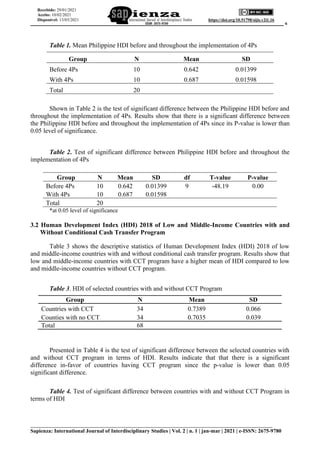
The descriptive statistics in Table 1 shows the means of the Philippines’s Human
Development Index (HDI) before and throughout the implementation of 4Ps. Results show that 10
years before the implementation of 4Ps, the Philippines obtained a mean HDI of 0.642
(SD=0.01399). The Philippines obtained a mean HDI of 0.687 (SD=0.01598) during its 10-year
implementation of 4Ps which is higher before its implementation.
______________________________________________________________________________________ 6
___________________________________________________________________________
Sapienza: International Journal of Interdisciplinary Studies | Vol. 2 | n. 1 | jan-mar | 2021 | e-ISSN: 2675-9780
https://doi.org/10.51798/sijis.v2i1.16
Recebido: 29/01/2021
Aceito: 10/02/2021
Disponível: 13/03/2021
Table 1. Mean Philippine HDI before and throughout the implementation of 4Ps
Group N Mean SD
Before 4Ps 10 0.642 0.01399
With 4Ps 10 0.687 0.01598
Total 20
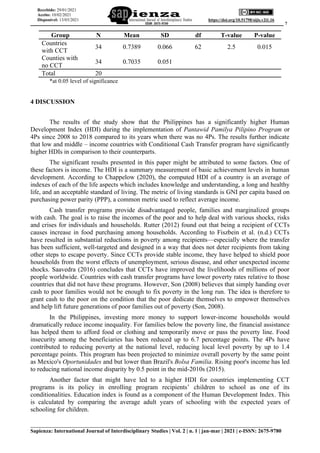
Shown in Table 2 is the test of significant difference between the Philippine HDI before and
throughout the implementation of 4Ps. Results show that there is a significant difference between
the Philippine HDI before and throughout the implementation of 4Ps since its P-value is lower than
0.05 level of significance.
Table 2. Test of significant difference between Philippine HDI before and throughout the
implementation of 4Ps
Group N Mean SD df T-value P-value
Before 4Ps 10 0.642 0.01399 9 -48.19 0.00
With 4Ps 10 0.687 0.01598
Total 20
*at 0.05 level of significance
3.2 Human Development Index (HDI) 2018 of Low and Middle-Income Countries with and
Without Conditional Cash Transfer Program
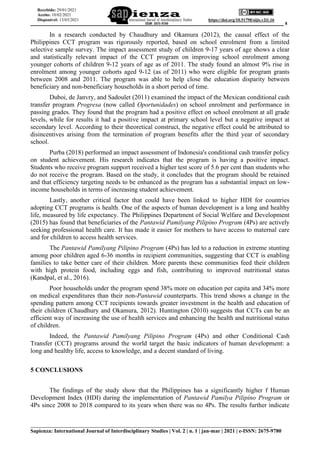
Table 3 shows the descriptive statistics of Human Development Index (HDI) 2018 of low
and middle-income countries with and without conditional cash transfer program. Results show that
low and middle-income countries with CCT program have a higher mean of HDI compared to low
and middle-income countries without CCT program.
Table 3. HDI of selected countries with and without CCT Program
Group N Mean SD
Countries with CCT 34 0.7389 0.066
Counties with no CCT 34 0.7035 0.039
Total 68
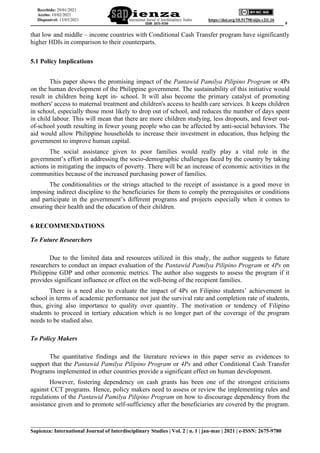
Presented in Table 4 is the test of significant difference between the selected countries with
and without CCT program in terms of HDI. Results indicate that that there is a significant
difference in-favor of countries having CCT program since the p-value is lower than 0.05
significant difference.
Table 4. Test of significant difference between countries with and without CCT Program in
terms of HDI
______________________________________________________________________________________ 7
___________________________________________________________________________
Sapienza: International Journal of Interdisciplinary Studies | Vol. 2 | n. 1 | jan-mar | 2021 | e-ISSN: 2675-9780
https://doi.org/10.51798/sijis.v2i1.16
Recebido: 29/01/2021
Aceito: 10/02/2021
Disponível: 13/03/2021
Group N Mean SD df T-value P-value
Countries
with CCT
34 0.7389 0.066 62 2.5 0.015
Counties with
no CCT
34 0.7035 0.051
Total 20
*at 0.05 level of significance
4 DISCUSSION
The results of the study show that the Philippines has a significantly higher Human
Development Index (HDI) during the implementation of Pantawid Pamilya Pilipino Program or
4Ps since 2008 to 2018 compared to its years when there was no 4Ps. The results further indicate
that low and middle – income countries with Conditional Cash Transfer program have significantly
higher HDIs in comparison to their counterparts.
The significant results presented in this paper might be attributed to some factors. One of
these factors is income. The HDI is a summary measurement of basic achievement levels in human
development. According to Chappelow (2020), the computed HDI of a country is an average of
indexes of each of the life aspects which includes knowledge and understanding, a long and healthy
life, and an acceptable standard of living. The metric of living standards is GNI per capita based on
purchasing power parity (PPP), a common metric used to reflect average income.
Cash transfer programs provide disadvantaged people, families and marginalized groups
with cash. The goal is to raise the incomes of the poor and to help deal with various shocks, risks
and crises for individuals and households. Rutter (2012) found out that being a recipient of CCTs
causes increase in food purchasing among households. According to Fiszbein et al. (n.d.) CCTs
have resulted in substantial reductions in poverty among recipients—especially where the transfer
has been sufficient, well-targeted and designed in a way that does not deter recipients from taking
other steps to escape poverty. Since CCTs provide stable income, they have helped to shield poor
households from the worst effects of unemployment, serious disease, and other unexpected income
shocks. Saavedra (2016) concludes that CCTs have improved the livelihoods of millions of poor
people worldwide. Countries with cash transfer programs have lower poverty rates relative to those
countries that did not have these programs. However, Son (2008) believes that simply handing over
cash to poor families would not be enough to fix poverty in the long run. The idea is therefore to
grant cash to the poor on the condition that the poor dedicate themselves to empower themselves
and help lift future generations of poor families out of poverty (Son, 2008).
In the Philippines, investing more money to support lower-income households would
dramatically reduce income inequality. For families below the poverty line, the financial assistance
has helped them to afford food or clothing and temporarily move or pass the poverty line. Food
insecurity among the beneficiaries has been reduced up to 6.7 percentage points. The 4Ps have
contributed to reducing poverty at the national level, reducing local level poverty by up to 1.4
percentage points. This program has been projected to minimize overall poverty by the same point
as Mexico's Oportunidades and but lower than Brazil's Bolsa Familia. Rising poor's income has led
to reducing national income disparity by 0.5 point in the mid-2010s (2015).
Another factor that might have led to a higher HDI for countries implementing CCT
programs is its policy in enrolling program recipients’ children to school as one of its
conditionalities. Education index is found as a component of the Human Development Index. This
is calculated by comparing the average adult years of schooling with the expected years of
schooling for children.
______________________________________________________________________________________ 8
___________________________________________________________________________
Sapienza: International Journal of Interdisciplinary Studies | Vol. 2 | n. 1 | jan-mar | 2021 | e-ISSN: 2675-9780
https://doi.org/10.51798/sijis.v2i1.16
Recebido: 29/01/2021
Aceito: 10/02/2021
Disponível: 13/03/2021
In a research conducted by Chaudhury and Okamura (2012), the causal effect of the
Philippines CCT program was rigorously reported, based on school enrolment from a limited
selective sample survey. The impact assessment study of children 9-17 years of age shows a clear
and statistically relevant impact of the CCT program on improving school enrolment among
younger cohorts of children 9-12 years of age as of 2011. The study found an almost 9% rise in
enrolment among younger cohorts aged 9-12 (as of 2011) who were eligible for program grants
between 2008 and 2011. The program was able to help close the education disparity between
beneficiary and non-beneficiary households in a short period of time.
Duboi, de Janvry, and Sadoulet (2011) examined the impact of the Mexican conditional cash
transfer program Progresa (now called Oportunidades) on school enrolment and performance in
passing grades. They found that the program had a positive effect on school enrolment at all grade
levels, while for results it had a positive impact at primary school level but a negative impact at
secondary level. According to their theoretical construct, the negative effect could be attributed to
disincentives arising from the termination of program benefits after the third year of secondary
school.
Purba (2018) performed an impact assessment of Indonesia's conditional cash transfer policy
on student achievement. His research indicates that the program is having a positive impact.
Students who receive program support received a higher test score of 5.6 per cent than students who
do not receive the program. Based on the study, it concludes that the program should be retained
and that efficiency targeting needs to be enhanced as the program has a substantial impact on low-
income households in terms of increasing student achievement.
Lastly, another critical factor that could have been linked to higher HDI for countries
adopting CCT programs is health. One of the aspects of human development is a long and healthy
life, measured by life expectancy. The Philippines Department of Social Welfare and Development
(2015) has found that beneficiaries of the Pantawid Pamilyang Pilipino Program (4Ps) are actively
seeking professional health care. It has made it easier for mothers to have access to maternal care
and for children to access health services.
The Pantawid Pamilyang Pilipino Program (4Ps) has led to a reduction in extreme stunting
among poor children aged 6-36 months in recipient communities, suggesting that CCT is enabling
families to take better care of their children. More parents these communities feed their children
with high protein food, including eggs and fish, contributing to improved nutritional status
(Kandpal, et al., 2016).
Poor households under the program spend 38% more on education per capita and 34% more
on medical expenditures than their non-Pantawid counterparts. This trend shows a change in the
spending pattern among CCT recipients towards greater investment in the health and education of
their children (Chaudhury and Okamura, 2012). Huntington (2010) suggests that CCTs can be an
efficient way of increasing the use of health services and enhancing the health and nutritional status
of children.
Indeed, the Pantawid Pamilyang Pilipino Program (4Ps) and other Conditional Cash
Transfer (CCT) programs around the world target the basic indicators of human development: a
long and healthy life, access to knowledge, and a decent standard of living.
5 CONCLUSIONS
The findings of the study show that the Philippines has a significantly higher f Human
Development Index (HDI) during the implementation of Pantawid Pamilya Pilipino Program or
4Ps since 2008 to 2018 compared to its years when there was no 4Ps. The results further indicate
______________________________________________________________________________________ 9
___________________________________________________________________________
Sapienza: International Journal of Interdisciplinary Studies | Vol. 2 | n. 1 | jan-mar | 2021 | e-ISSN: 2675-9780
https://doi.org/10.51798/sijis.v2i1.16
Recebido: 29/01/2021
Aceito: 10/02/2021
Disponível: 13/03/2021
that low and middle – income countries with Conditional Cash Transfer program have significantly
higher HDIs in comparison to their counterparts.
5.1 Policy Implications
This paper shows the promising impact of the Pantawid Pamilya Pilipino Program or 4Ps
on the human development of the Philippine government. The sustainability of this initiative would
result in children being kept in- school. It will also become the primary catalyst of promoting
mothers' access to maternal treatment and children's access to health care services. It keeps children
in school, especially those most likely to drop out of school, and reduces the number of days spent
in child labour. This will mean that there are more children studying, less dropouts, and fewer out-
of-school youth resulting in fewer young people who can be affected by anti-social behaviors. The
aid would allow Philippine households to increase their investment in education, thus helping the
government to improve human capital.
The social assistance given to poor families would really play a vital role in the
government’s effort in addressing the socio-demographic challenges faced by the country by taking
actions in mitigating the impacts of poverty. There will be an increase of economic activities in the
communities because of the increased purchasing power of families.
The conditionalities or the strings attached to the receipt of assistance is a good move in
imposing indirect discipline to the beneficiaries for them to comply the prerequisites or conditions
and participate in the government’s different programs and projects especially when it comes to
ensuring their health and the education of their children.
6 RECOMMENDATIONS
To Future Researchers
Due to the limited data and resources utilized in this study, the author suggests to future
researchers to conduct an impact evaluation of the Pantawid Pamilya Pilipino Program or 4Ps on
Philippine GDP and other economic metrics. The author also suggests to assess the program if it
provides significant influence or effect on the well-being of the recipient families.
There is a need also to evaluate the impact of 4Ps on Filipino students’ achievement in
school in terms of academic performance not just the survival rate and completion rate of students,
thus, giving also importance to quality over quantity. The motivation or tendency of Filipino
students to proceed in tertiary education which is no longer part of the coverage of the program
needs to be studied also.
To Policy Makers
The quantitative findings and the literature reviews in this paper serve as evidences to
support that the Pantawid Pamilya Pilipino Program or 4Ps and other Conditional Cash Transfer
Programs implemented in other countries provide a significant effect on human development.
However, fostering dependency on cash grants has been one of the strongest criticisms
against CCT programs. Hence, policy makers need to assess or review the implementing rules and
regulations of the Pantawid Pamilya Pilipino Program on how to discourage dependency from the
assistance given and to promote self-sufficiency after the beneficiaries are covered by the program.
______________________________________________________________________________________ 10
___________________________________________________________________________
Sapienza: International Journal of Interdisciplinary Studies | Vol. 2 | n. 1 | jan-mar | 2021 | e-ISSN: 2675-9780
https://doi.org/10.51798/sijis.v2i1.16
Recebido: 29/01/2021
Aceito: 10/02/2021
Disponível: 13/03/2021
The author suggests to policy makers to incorporate the concept of cash-for-work program to 4Ps.
In this idea, the beneficiaries will become more productive and useful citizens of the country.
It has been noted in this study that the implementation of 4Ps resulted to an increase in
enrolment of students in schools which is also an indicator of HDI. The sustained implementation
of the program will have a promising result in achieving a higher HDI. The current policy of 4Ps
only covers the beneficiaries’ schooling of their children only in basic education, that is, from
kinder to grade 12. Hence, policy makers need to review the 4Ps policy and decide if it is necessary
to include the tertiary education as part of the coverage of the program.
The monitoring and evaluation of the conditionalities enforced in the Pantawid Pamilya
Pilipino Program should go beyond access to health care services and education. Based on reviews,
empowerment and community participation are not monitored as part of the program conditions.
Thus, program evaluators need to assess or evaluate the aspects on empowerment and participation
of 4Ps beneficiaries in the community.
REFERENCES
Acosta, P.A.; Velarde, R. B. (2015). An update of the
Philippine conditional cash transfer’s
implementation performance (English). Social
Protection Policy note; no. 8. Washington,
D.C. : World Bank Group.
http://documents.worldbank.org/curated/en/32
2971468178773885/An-update-of-the-
Philippine-conditional-cash-transfer-s-
implementation-performance
Albert, J. R. & Martinez, A. (2015). "Are poverty and
inequality changing? Retrieved from:
https://www.rappler.com/thought-
leaders/84833-poverty-inequality-data
Chappelow, J. (2020). Human Development Index
(HDI). Investopedia. Behavioral Economics.
Retrieved from:
https://www.investopedia.com/terms/h/human
-development-index-hdi.asp
Chaudhury N. and Okamura, Y. (2012). Conditional
Cash Transfers and School Enrollment:
Impact of the Conditional Cash Transfer
Program in the Philippines. The Philippine
Social Protection Note. The World Bank
Group. Retrieved from:
https://www.socialprotection.org/discover/pub
lications/conditional-cash-transfers-and-
school-enrollment-impact-conditional-cash
DSWD (2014). Keeping children healthy and in
school: Evaluating the Pantawid Pamilya
Using Regression Discontinuity Design,
Second Wave Impact Evaluation Results.
Retrieved from:
https://pantawid.dswd.gov.ph/wp-
content/uploads/2018/07/Pantawid-Pamilya-
Impact-Evaluation-2014-Report-Final.pdf
Dubois, P, de Janvry, A. and Sadoulet, E. (2011).
Effects on School Enrollment and
Performance of a Conditional Cash Transfers
Program in Mexico. Journal of Labor
Economics, 30(3): 555-90.
Fernandez, L. and Olfindo, R. (2011). Overview of the
Philippines’ Conditional Cash Transfer
Program: The Pantawid Pamilyang Pilipino
Program (Pantawid Pamilya. Philippine Social
Protection Note. The World Bank Group.
Retrieved from:
http://documents.worldbank.org/curated/en/31
3851468092968987/pdf/628790BRI0Phil0me
0abstract0as0no010.pdf
Fiszbein, A.; Schady, N.; Ferreira, F; Grosh, M.;
Kelleher, N; Olinto, P.; Skoufias, E.
(n.d.)Conditional Cash Transfers Reducing
Present And Future Poverty. World Bank.
http://siteresources.worldbank.org/INTCCT/R
esources/5757608-1234228266004/PRR-
CCT_web_noembargo.pdf
Huntington, D. (2010). The impact of conditional cash
transfers on health outcomes and the use of
health services in low- and middle-income
countries. World Health Organization.
Retrieved from:
https://www.who.int/elena/titles/commentary/
cash-transfers/en/
Kandpal, E., Alderman, H., Friedman J., Filmer,
D.,Onishi, J. and Avalos, J. (2016). A
Conditional Cash Transfer Program in the
Philippines Reduces Severe Stunting. The
______________________________________________________________________________________ 11
___________________________________________________________________________
Sapienza: International Journal of Interdisciplinary Studies | Vol. 2 | n. 1 | jan-mar | 2021 | e-ISSN: 2675-9780
https://doi.org/10.51798/sijis.v2i1.16
Recebido: 29/01/2021
Aceito: 10/02/2021
Disponível: 13/03/2021
Journal of Nutrition. Community and
International Nutrition. 2016;146:1793–800.
Luo, X. (2018). Overcoming poverty in the Philippines.
Business World. Retrieved:
https://www.bworldonline.com/overcoming-
poverty-in-the-philippines/
Martin, W. (2017). RANKED: These will be the 32
most powerful economies in the world by
2050. Retrieved from:
https://www.businessinsider.com/pwc-
ranking-of-biggest-economies-ppp-2050-
2017-2
Mapa, C. D. (2019). Proportion of Poor Filipinos was
Estimated at 16.6 Percent in 2018. Philippine
Statistics Authority. Retrieved from:
https://psa.gov.ph/poverty-press-
releases/nid/144752
Pantawid Pamilyang Pilipino Program. (2019).
Pantawid Pamilya. DSWD. Retrieved from
https://pantawid.dswd.gov.ph/about/
Philippines Economic Update (2019). World Bank.
2019. Philippines Economic Update :
Resuming Public Investment, Fast Tracking
Implementation (English). Washington, D.C. :
World Bank Group.
http://documents.worldbank.org/curated/en/22
4501570715185892/Philippines-Economic-
Update-Resuming-Public-Investment-Fast-
Tracking-Implementation
Opportunity International (2018). Where we work:
Philippines. Retrieved from:
https://opportunity.org/what-we-do/where-we-
work/philippines-facts-about-poverty
Purba, R. (2018). Impact Evaluation of Indonesia
Conditional Cash Transfer Program (BSM) on
Student Achievement. European Journal of
Economics and Business Studies. ISSN 2411-
4073 (online). Vol. 4. No. 1. Retrieved from:
http://archive.sciendo.com/EJES/ejes.2018.4.i
ssue-1/ejes-2018-0010/ejes-2018-0010.pdf
Rawling, Laura. 2004. A new approach to social
assistance: Latin America’s experience with
conditional cash transfer programs. Working
Paper No. 30165. Washington, D.C.: World
Bank.
Rivas, R. (May 30, 2019). IN CHARTS: Rich
Philippine regions get richer, poor ones barely
improve. Rappler. Retrieved from:
https://www.rappler.com/business/231871-
charts-regions-get-richer-poor-ones-barely-
improve-philippines
Rutter, J. (February 16, 2012). Making the case for
rigorous, evidence-based policymaking. The
Guardian. Retrieved from:
https://www.povertyactionlab.org/evaluation/e
xperiment-incentive-based-welfare-impact-
progesa-health-mexico
Saavedra, J.E. (2016). The effects of conditional cash
transfer programs on poverty reduction ,
human capital accumulation and wellbeing.
Semantic Scholar. Retrieved from:
https://www.semanticscholar.org/paper/The-
effects-of-conditional-cash-transfer-programs-
%2C-
Saavedra/26293e9f993a8eb99a37983d4e7b6d
d18ecfb36b
Son, H. (2008). Conditional Cash Transfer Programs:
An Effective Tool for Poverty Alleviation?.
Asian Development Bank. Economics and
Research Department. ERD Policy Brief
Series No. 51
United Nations Development Programme. (2010). The
Human Development Concept. Retrieved
from:
https://web.archive.org/web/20120415134936/
http://hdr.undp.org/en/humandev/
United Nations Development Programme. (2009).
Human Development Reports. 22 October
Retrieved from:
https://web.archive.org/web/20120415134936/
http://hdr.undp.org/en/humandev/
United Nations Development Programme (1997).
Human Development Report 1997. Human
Development Report. p. 15. ISBN 978-0-19-
511996-1.
World Bank (2017). FAQs about the Pantawid
Pamilyang Pilipino Program (4Ps). Retrieved
from:
https://www.worldbank.org/en/country/philipp
ines/brief/faqs-about-the-pantawid-pamilyang-
pilipino-program
Word Bank (2020). World Bank Country and Lending
Groups. The World Bank. Retrieved from:
https://datahelpdesk.worldbank.org/knowledge
base/articles/906519-world-bank-country-and-
lending-groups

Effects_of_Pantawid_Pamilyang_Pilipino_Program_4Ps.pdf

  • 1.
    ______________________________________________________________________________________ 2 ___________________________________________________________________________ Sapienza: InternationalJournal of Interdisciplinary Studies | Vol. 2 | n. 1 | jan-mar | 2021 | e-ISSN: 2675-9780 https://doi.org/10.51798/sijis.v2i1.16 Recebido: 29/01/2021 Aceito: 10/02/2021 Disponível: 13/03/2021 Effects of Pantawid Pamilyang Pilipino Program (4Ps) and other Conditional Cash Transfer (CCT) Programs of Low and Middle – Income Countries on Human Development Efeitos do Programa Pantawid Pamilyang Pilipino (4Ps) e de outros programas de transferência condicional de renda (TCR) de países de baixa e média renda sobre o desenvolvimento humano Efectos del Programa Pantawid Pamilyang Pilipino (4Ps) y otros programas de transferencias monetarias condicionadas (TMC) de países de ingresos bajos y medios en el desarrollo humano Ronald A. Diaz rdhardcore@gmail.com ronald.diaz@deped.gov.ph Sta. Cruz National High School, Sta. Cruz, Davao del Sur, Philippines https://orcid.org/0000-0002-2982-9002 ABSTRACT Despite the economic growth experienced by the Philippines in the recent years in terms of high GDP, poverty in the country still prevails. Prevalence of many poor families and individuals in the country prompted the Philippine government to implement the Pantawid Pamilyang Pilipino Program (Bridging Program for the Filipino Family) also known as 4Ps, the country’s conditional cash transfer (CCT) program that aims to provide conditional cash grants to the poorest of the poor. This paper aims to examine the effect of 4Ps on the country’s Human Development Index (HDI). It also seeks to find out if conditional cash transfer program provides significant effect on the HDIs of low and middle- income countries worldwide. The mean Human Development Index (HDI) of the Philippines before and throughout the implementation of 4Ps was compared. The difference between the HDIs of selected countries (low and middle-income) implementing and non-implementing the conditional cash transfer programs was determined. The findings of this study show that the Philippines has a significantly higher mean HDI during the implementation of 4Ps since 2008 to 2018 compared to its years when there was no 4Ps. The results further indicate that low and middle–income countries with CCT programs have significantly higher HDIs in comparison to their counterparts. A thorough evaluation of the CCT programs in terms of issues such as dependency and reviewing the conditionalities of the program to provide more significant and promising effect on HDI needs to be undertaken. Keywords: Pantawid Pamilyang Pilipino Program (4Ps); conditional cash transfer (CCT); Human Development Index (HDI). RESUMEN A pesar del crecimiento económico experimentado por Filipinas en los últimos años en términos de alto PIB, la pobreza en el país aún prevalece. La prevalencia de muchas familias e individuos pobres en el país llevó al gobierno filipino a implementar el Programa Pantawid Pamilyang Pilipino (Bridging Program for the Filipino Family), también conocido como 4P, el programa de transferencias monetarias condicionadas (TMC) del país que tiene como objetivo proporcionar subvenciones monetarias condicionadas a los más pobres de los pobres. Este documento tiene como objetivo examinar el efecto de las 4P en el Índice de Desarrollo Humano (IDH) del país. También busca averiguar si el programa de transferencias monetarias condicionadas tiene un efecto significativo en el IDH de los países de ingresos bajos y medianos en todo el mundo. Se comparó el índice de desarrollo humano (IDH) medio de Filipinas antes y durante la implementación de las 4P. Se determinó la diferencia entre los IDH de países seleccionados (de ingresos bajos y medios) que implementan y no implementan los programas de transferencias monetarias condicionadas. Los hallazgos de este estudio muestran que Filipinas tiene un IDH medio significativamente más alto durante la implementación de las 4P desde 2008 a 2018 en comparación con los años en que no había 4P. Los resultados indican además que los países de ingresos bajos y medianos con programas de TMC tienen IDH significativamente más altos en comparación con sus contrapartes. Es necesario realizar una evaluación exhaustiva de los programas de TMC en términos de cuestiones como la dependencia y la revisión de las condicionalidades del programa para proporcionar un efecto más significativo y prometedor en el IDH. Palabras clave: Programa Pantawid Pamilyang Pilipino (4P); transferencia monetaria condicionada (TMC); Índice de Desarrollo Humano (IDH). RESUMO
  • 2.
    ______________________________________________________________________________________ 3 ___________________________________________________________________________ Sapienza: InternationalJournal of Interdisciplinary Studies | Vol. 2 | n. 1 | jan-mar | 2021 | e-ISSN: 2675-9780 https://doi.org/10.51798/sijis.v2i1.16 Recebido: 29/01/2021 Aceito: 10/02/2021 Disponível: 13/03/2021 Apesar do crescimento econômico experimentado pelas Filipinas nos últimos anos em termos de elevado PIB, a pobreza no país ainda prevalece. A prevalência de muitas famílias e indivíduos pobres no país levou o governo filipino a implementar o Pantawid Pamilyang Pilipino Program (Bridging Program for the Filipino Family), também conhecido como 4Ps, o programa de transferência de renda condicionada (TRC) do país que visa fornecer subsídios condicionais em dinheiro para os mais pobres dos pobres. Este artigo tem como objetivo examinar o efeito dos 4Ps no Índice de Desenvolvimento Humano (IDH) do país. Também procura descobrir se o programa de transferência condicional de renda tem efeito significativo sobre o IDH de países de baixa e média renda em todo o mundo. O Índice de Desenvolvimento Humano (IDH) médio das Filipinas antes e durante a implementação dos 4Ps foi comparado. Foi determinada a diferença entre os IDH de países selecionados (baixa e média renda) que implementaram e não implementaram os programas de transferência condicionada de renda. Os resultados deste estudo mostram que as Filipinas têm um IDH médio significativamente mais alto durante a implementação dos 4Ps desde 2008 a 2018 em comparação com os anos em que não havia 4Ps. Os resultados indicam ainda que os países de renda baixa e média com programas de TRC têm IDHs significativamente mais altos em comparação com seus homólogos. Uma avaliação completa dos programas de TRC em termos de questões como dependência e revisão das condicionalidades do programa para fornecer um efeito mais significativo e promissor sobre o IDH precisa ser realizada. Palavras-chave: Programa Pantawid Pamilyang Pilipino (4Ps), transferência de renda condicionada (TRC), Índice de Desenvolvimento Humano (IDH) 1 INTRODUCTION The Philippines is one of Asia-Pacific's most competitive economies. The Philippine economy remains strong until 2021, amid global uncertainties (Philippines Economic Update, 2019). The Philippine economy is expected to be 5th in Asia and 16th in the world by 2050. (Martin, 2017). Despite the country's positive economic growth, Philippines still faces many challenges. Among the country's greatest problems today is poverty. A quarter of the 105 million Philippines population lived in poverty in 2018, i.e. over 26 million people (Opportunity International, 2018). Poverty incidence among the population in 2018, or the proportion of poor Filipinos whose per capita income is inadequate to meet their basic food and non-food needs, was estimated at 16.6 percent. This translates to 17.6 million Filipinos living below the poverty level estimated at PhP 10,727 on average for a family of five in 2018. On the other hand, subsistence incidence among Filipinos, or the proportion of Filipinos whose income is not sufficient to meet even basic food needs, was reported at 5.2% in 2018. The monthly food threshold for a 5-family was calculated at PhP 7,528.00 (Mapa, 2019). According to Albert (2015), the poorest 20 percent of Filipinos own just less than 5 percent of the country's total income while the poorest 20 percent should own 20 percent of total national income in a perfectly equitable society. Moreover, this degree of inequality was unchanged as shown by various inequality measures such as the Palma ratio and Gini coefficient. This means that income disparity among Philippine regions has widened. The country's prevalence of impoverished families and individuals prompted the Philippine government to launch efforts to reduce its poverty incidence. Various anti-poverty initiatives were created to suppress poverty and enhance the lives of the country's poorest population. Among these are the Among of these are the Comprehensive Agrarian Reform, Lingap Para sa Mahirap, Social Reform Agenda, and the most recent is the conditional cash transfer (CCT) program locally known as Pantawid Pamilyang Pilipino Program (Bridging Program for the Filipino Family) also known as 4Ps. 4Ps is a key social initiative to alleviate poverty, allowing children to access education and health services (Luo, 2018). The Pantawid Pamilya Pilipino Program, or 4Ps, is a government program that provides conditional cash grants to the poorest of the poor in the Philippines. The program aims to break the cycle of poverty by keeping children aged 0-18 healthy and in school, so they can have a better
  • 3.
    ______________________________________________________________________________________ 4 ___________________________________________________________________________ Sapienza: InternationalJournal of Interdisciplinary Studies | Vol. 2 | n. 1 | jan-mar | 2021 | e-ISSN: 2675-9780 https://doi.org/10.51798/sijis.v2i1.16 Recebido: 29/01/2021 Aceito: 10/02/2021 Disponível: 13/03/2021 future. The program is implemented by the Department of Social Welfare and Development (DSWD), with the Department of Health (DOH), the Department of Education (DepEd), and the National Economic and Development Authority (NEDA) as partners. Households receive cash grants if children stay in school and get regular health check-ups, have their growth monitored, and receive vaccines (World Bank, 2017). Different research indicates the beneficial impact of conditional cash transfer schemes on people's education, health, and monetary aspects in certain countries around the world. Empirical evidence shows that conditional cash transfer schemes promise to counter poverty and inequality. Different researches reported similar outcomes impacts of cash transfer systems. However, limited literature indicates the effect of cash transfer programs on a country's overall human development index. This paper aims to analyze the impact on the human development index (HDI) of the Philippine conditional cash transfer program locally known as the Pantawid Pamilya Pilipino Program or 4Ps (HDI). It also aims to assess whether conditional cash transfer policy has a major impact on low- and middle-income countries' HDIs worldwide. The findings of this investigation would provide insights to the Philippine government if the implementation of the policy on conditional cash transfer program or 4Ps need to be intensified to achieve inclusive and sustainable economic development. This paper would also encourage policy makers of other low- and middle-income countries to adopt policies on conditional cash transfer program which is already implemented by countries such as the Philippines for them to also obtain significant impact on economic outcomes and most importantly uplift the lives of their citizens. This study adds literature to the existing body of knowledge about the impact of this program to the Philippines and to other countries where poverty is still persistent. Statement of the Problem: This paper aims to examine the effect on the human development index of the Philippine conditional cash transfer program locally known as Pantawid Pamilya Pilipino Program or 4Ps (HDI). It also aims to assess whether Conditional Cash Transfer (CCT) schemes have a meaningful impact on low- and middle-income countries' HDIs worldwide. Specifically, it seeks to answer the following questions: 1. What is the level of the Philippines' Human Development Index (HDI) before implementing the Pantawid Pamilya Pilipino Program or 4Ps? 2. What is the level of the Philippines' Human Development Index (HDI) throughout the implementation of the Pantawid Pamilya Pilipino Program or 4Ps? 3. Is there a significant difference on the Philippines’ Human Development Index (HDI) before and throughout the implementation of the Pantawid Pamilya Pilipino Program or 4Ps? 4. Is there a significant difference between countries (low and middle-income) implementing and non-implementing the Conditional Cash Transfer (CCT) programs in terms of Human Development Index (HDI)?
  • 4.
    ______________________________________________________________________________________ 5 ___________________________________________________________________________ Sapienza: InternationalJournal of Interdisciplinary Studies | Vol. 2 | n. 1 | jan-mar | 2021 | e-ISSN: 2675-9780 https://doi.org/10.51798/sijis.v2i1.16 Recebido: 29/01/2021 Aceito: 10/02/2021 Disponível: 13/03/2021 2 METHODOLOGY This section presents the research design, data collection procedure, and the data analysis. 2.1 Research Design This research utilized quantitative descriptive-comparative research design in which the Human Development Index (HDI) of the Philippines before and throughout the implementation of its Conditional Cash Transfer (CCT) program was compared. Implementing and non- implementing countries of CCT programs were also compared in terms of their HDIs. 2.2 Data Collection Procedure The Human Development Index (HDI) data of the Philippines (Appendix A) and other low- and middle-income countries were obtained from the United Nations Development Program Human Development Report 2019. The list of countries (Appendix B) classified as low-income, lower- middle-income, upper-middle-income was obtained from World Bank (2020). The mean HDI of the Philippines 10 years before the implementation of the Pantawid Pamilya Pilipino Program or 4Ps was determined. The HDI of the Philippines from 2008 to 2018 or throughout the implementation of the 4Ps was also determined. The HDIs during 2018 among selected countries implementing and non-implementing the conditional cash transfer programs were obtained and compared. 2.3 Data Analysis The data analysis of this paper was undertaken using descriptive and inferential statistics. The mean and standard deviation were used to descriptively analyze the HDI data of the Philippines before and throughout the implementation of 4Ps and the low- and middle- income countries implementing the CCT programs. Dependent sample T-test and independent sample T-test were used for the inferential analysis of the data. The test of normality was done using Shapiro-Wilk statistic. The data was tabulated and analyzed using the Microsoft Excel and SPSS. 3 RESULTS 3.1 The Philippine Human Development Index (HDI) Before and Throughout the Implementation of 4Ps The descriptive statistics in Table 1 shows the means of the Philippines’s Human Development Index (HDI) before and throughout the implementation of 4Ps. Results show that 10 years before the implementation of 4Ps, the Philippines obtained a mean HDI of 0.642 (SD=0.01399). The Philippines obtained a mean HDI of 0.687 (SD=0.01598) during its 10-year implementation of 4Ps which is higher before its implementation.
  • 5.
    ______________________________________________________________________________________ 6 ___________________________________________________________________________ Sapienza: InternationalJournal of Interdisciplinary Studies | Vol. 2 | n. 1 | jan-mar | 2021 | e-ISSN: 2675-9780 https://doi.org/10.51798/sijis.v2i1.16 Recebido: 29/01/2021 Aceito: 10/02/2021 Disponível: 13/03/2021 Table 1. Mean Philippine HDI before and throughout the implementation of 4Ps Group N Mean SD Before 4Ps 10 0.642 0.01399 With 4Ps 10 0.687 0.01598 Total 20 Shown in Table 2 is the test of significant difference between the Philippine HDI before and throughout the implementation of 4Ps. Results show that there is a significant difference between the Philippine HDI before and throughout the implementation of 4Ps since its P-value is lower than 0.05 level of significance. Table 2. Test of significant difference between Philippine HDI before and throughout the implementation of 4Ps Group N Mean SD df T-value P-value Before 4Ps 10 0.642 0.01399 9 -48.19 0.00 With 4Ps 10 0.687 0.01598 Total 20 *at 0.05 level of significance 3.2 Human Development Index (HDI) 2018 of Low and Middle-Income Countries with and Without Conditional Cash Transfer Program Table 3 shows the descriptive statistics of Human Development Index (HDI) 2018 of low and middle-income countries with and without conditional cash transfer program. Results show that low and middle-income countries with CCT program have a higher mean of HDI compared to low and middle-income countries without CCT program. Table 3. HDI of selected countries with and without CCT Program Group N Mean SD Countries with CCT 34 0.7389 0.066 Counties with no CCT 34 0.7035 0.039 Total 68 Presented in Table 4 is the test of significant difference between the selected countries with and without CCT program in terms of HDI. Results indicate that that there is a significant difference in-favor of countries having CCT program since the p-value is lower than 0.05 significant difference. Table 4. Test of significant difference between countries with and without CCT Program in terms of HDI
  • 6.
    ______________________________________________________________________________________ 7 ___________________________________________________________________________ Sapienza: InternationalJournal of Interdisciplinary Studies | Vol. 2 | n. 1 | jan-mar | 2021 | e-ISSN: 2675-9780 https://doi.org/10.51798/sijis.v2i1.16 Recebido: 29/01/2021 Aceito: 10/02/2021 Disponível: 13/03/2021 Group N Mean SD df T-value P-value Countries with CCT 34 0.7389 0.066 62 2.5 0.015 Counties with no CCT 34 0.7035 0.051 Total 20 *at 0.05 level of significance 4 DISCUSSION The results of the study show that the Philippines has a significantly higher Human Development Index (HDI) during the implementation of Pantawid Pamilya Pilipino Program or 4Ps since 2008 to 2018 compared to its years when there was no 4Ps. The results further indicate that low and middle – income countries with Conditional Cash Transfer program have significantly higher HDIs in comparison to their counterparts. The significant results presented in this paper might be attributed to some factors. One of these factors is income. The HDI is a summary measurement of basic achievement levels in human development. According to Chappelow (2020), the computed HDI of a country is an average of indexes of each of the life aspects which includes knowledge and understanding, a long and healthy life, and an acceptable standard of living. The metric of living standards is GNI per capita based on purchasing power parity (PPP), a common metric used to reflect average income. Cash transfer programs provide disadvantaged people, families and marginalized groups with cash. The goal is to raise the incomes of the poor and to help deal with various shocks, risks and crises for individuals and households. Rutter (2012) found out that being a recipient of CCTs causes increase in food purchasing among households. According to Fiszbein et al. (n.d.) CCTs have resulted in substantial reductions in poverty among recipients—especially where the transfer has been sufficient, well-targeted and designed in a way that does not deter recipients from taking other steps to escape poverty. Since CCTs provide stable income, they have helped to shield poor households from the worst effects of unemployment, serious disease, and other unexpected income shocks. Saavedra (2016) concludes that CCTs have improved the livelihoods of millions of poor people worldwide. Countries with cash transfer programs have lower poverty rates relative to those countries that did not have these programs. However, Son (2008) believes that simply handing over cash to poor families would not be enough to fix poverty in the long run. The idea is therefore to grant cash to the poor on the condition that the poor dedicate themselves to empower themselves and help lift future generations of poor families out of poverty (Son, 2008). In the Philippines, investing more money to support lower-income households would dramatically reduce income inequality. For families below the poverty line, the financial assistance has helped them to afford food or clothing and temporarily move or pass the poverty line. Food insecurity among the beneficiaries has been reduced up to 6.7 percentage points. The 4Ps have contributed to reducing poverty at the national level, reducing local level poverty by up to 1.4 percentage points. This program has been projected to minimize overall poverty by the same point as Mexico's Oportunidades and but lower than Brazil's Bolsa Familia. Rising poor's income has led to reducing national income disparity by 0.5 point in the mid-2010s (2015). Another factor that might have led to a higher HDI for countries implementing CCT programs is its policy in enrolling program recipients’ children to school as one of its conditionalities. Education index is found as a component of the Human Development Index. This is calculated by comparing the average adult years of schooling with the expected years of schooling for children.
  • 7.
    ______________________________________________________________________________________ 8 ___________________________________________________________________________ Sapienza: InternationalJournal of Interdisciplinary Studies | Vol. 2 | n. 1 | jan-mar | 2021 | e-ISSN: 2675-9780 https://doi.org/10.51798/sijis.v2i1.16 Recebido: 29/01/2021 Aceito: 10/02/2021 Disponível: 13/03/2021 In a research conducted by Chaudhury and Okamura (2012), the causal effect of the Philippines CCT program was rigorously reported, based on school enrolment from a limited selective sample survey. The impact assessment study of children 9-17 years of age shows a clear and statistically relevant impact of the CCT program on improving school enrolment among younger cohorts of children 9-12 years of age as of 2011. The study found an almost 9% rise in enrolment among younger cohorts aged 9-12 (as of 2011) who were eligible for program grants between 2008 and 2011. The program was able to help close the education disparity between beneficiary and non-beneficiary households in a short period of time. Duboi, de Janvry, and Sadoulet (2011) examined the impact of the Mexican conditional cash transfer program Progresa (now called Oportunidades) on school enrolment and performance in passing grades. They found that the program had a positive effect on school enrolment at all grade levels, while for results it had a positive impact at primary school level but a negative impact at secondary level. According to their theoretical construct, the negative effect could be attributed to disincentives arising from the termination of program benefits after the third year of secondary school. Purba (2018) performed an impact assessment of Indonesia's conditional cash transfer policy on student achievement. His research indicates that the program is having a positive impact. Students who receive program support received a higher test score of 5.6 per cent than students who do not receive the program. Based on the study, it concludes that the program should be retained and that efficiency targeting needs to be enhanced as the program has a substantial impact on low- income households in terms of increasing student achievement. Lastly, another critical factor that could have been linked to higher HDI for countries adopting CCT programs is health. One of the aspects of human development is a long and healthy life, measured by life expectancy. The Philippines Department of Social Welfare and Development (2015) has found that beneficiaries of the Pantawid Pamilyang Pilipino Program (4Ps) are actively seeking professional health care. It has made it easier for mothers to have access to maternal care and for children to access health services. The Pantawid Pamilyang Pilipino Program (4Ps) has led to a reduction in extreme stunting among poor children aged 6-36 months in recipient communities, suggesting that CCT is enabling families to take better care of their children. More parents these communities feed their children with high protein food, including eggs and fish, contributing to improved nutritional status (Kandpal, et al., 2016). Poor households under the program spend 38% more on education per capita and 34% more on medical expenditures than their non-Pantawid counterparts. This trend shows a change in the spending pattern among CCT recipients towards greater investment in the health and education of their children (Chaudhury and Okamura, 2012). Huntington (2010) suggests that CCTs can be an efficient way of increasing the use of health services and enhancing the health and nutritional status of children. Indeed, the Pantawid Pamilyang Pilipino Program (4Ps) and other Conditional Cash Transfer (CCT) programs around the world target the basic indicators of human development: a long and healthy life, access to knowledge, and a decent standard of living. 5 CONCLUSIONS The findings of the study show that the Philippines has a significantly higher f Human Development Index (HDI) during the implementation of Pantawid Pamilya Pilipino Program or 4Ps since 2008 to 2018 compared to its years when there was no 4Ps. The results further indicate
  • 8.
    ______________________________________________________________________________________ 9 ___________________________________________________________________________ Sapienza: InternationalJournal of Interdisciplinary Studies | Vol. 2 | n. 1 | jan-mar | 2021 | e-ISSN: 2675-9780 https://doi.org/10.51798/sijis.v2i1.16 Recebido: 29/01/2021 Aceito: 10/02/2021 Disponível: 13/03/2021 that low and middle – income countries with Conditional Cash Transfer program have significantly higher HDIs in comparison to their counterparts. 5.1 Policy Implications This paper shows the promising impact of the Pantawid Pamilya Pilipino Program or 4Ps on the human development of the Philippine government. The sustainability of this initiative would result in children being kept in- school. It will also become the primary catalyst of promoting mothers' access to maternal treatment and children's access to health care services. It keeps children in school, especially those most likely to drop out of school, and reduces the number of days spent in child labour. This will mean that there are more children studying, less dropouts, and fewer out- of-school youth resulting in fewer young people who can be affected by anti-social behaviors. The aid would allow Philippine households to increase their investment in education, thus helping the government to improve human capital. The social assistance given to poor families would really play a vital role in the government’s effort in addressing the socio-demographic challenges faced by the country by taking actions in mitigating the impacts of poverty. There will be an increase of economic activities in the communities because of the increased purchasing power of families. The conditionalities or the strings attached to the receipt of assistance is a good move in imposing indirect discipline to the beneficiaries for them to comply the prerequisites or conditions and participate in the government’s different programs and projects especially when it comes to ensuring their health and the education of their children. 6 RECOMMENDATIONS To Future Researchers Due to the limited data and resources utilized in this study, the author suggests to future researchers to conduct an impact evaluation of the Pantawid Pamilya Pilipino Program or 4Ps on Philippine GDP and other economic metrics. The author also suggests to assess the program if it provides significant influence or effect on the well-being of the recipient families. There is a need also to evaluate the impact of 4Ps on Filipino students’ achievement in school in terms of academic performance not just the survival rate and completion rate of students, thus, giving also importance to quality over quantity. The motivation or tendency of Filipino students to proceed in tertiary education which is no longer part of the coverage of the program needs to be studied also. To Policy Makers The quantitative findings and the literature reviews in this paper serve as evidences to support that the Pantawid Pamilya Pilipino Program or 4Ps and other Conditional Cash Transfer Programs implemented in other countries provide a significant effect on human development. However, fostering dependency on cash grants has been one of the strongest criticisms against CCT programs. Hence, policy makers need to assess or review the implementing rules and regulations of the Pantawid Pamilya Pilipino Program on how to discourage dependency from the assistance given and to promote self-sufficiency after the beneficiaries are covered by the program.
  • 9.
    ______________________________________________________________________________________ 10 ___________________________________________________________________________ Sapienza: InternationalJournal of Interdisciplinary Studies | Vol. 2 | n. 1 | jan-mar | 2021 | e-ISSN: 2675-9780 https://doi.org/10.51798/sijis.v2i1.16 Recebido: 29/01/2021 Aceito: 10/02/2021 Disponível: 13/03/2021 The author suggests to policy makers to incorporate the concept of cash-for-work program to 4Ps. In this idea, the beneficiaries will become more productive and useful citizens of the country. It has been noted in this study that the implementation of 4Ps resulted to an increase in enrolment of students in schools which is also an indicator of HDI. The sustained implementation of the program will have a promising result in achieving a higher HDI. The current policy of 4Ps only covers the beneficiaries’ schooling of their children only in basic education, that is, from kinder to grade 12. Hence, policy makers need to review the 4Ps policy and decide if it is necessary to include the tertiary education as part of the coverage of the program. The monitoring and evaluation of the conditionalities enforced in the Pantawid Pamilya Pilipino Program should go beyond access to health care services and education. Based on reviews, empowerment and community participation are not monitored as part of the program conditions. Thus, program evaluators need to assess or evaluate the aspects on empowerment and participation of 4Ps beneficiaries in the community. REFERENCES Acosta, P.A.; Velarde, R. B. (2015). An update of the Philippine conditional cash transfer’s implementation performance (English). Social Protection Policy note; no. 8. Washington, D.C. : World Bank Group. http://documents.worldbank.org/curated/en/32 2971468178773885/An-update-of-the- Philippine-conditional-cash-transfer-s- implementation-performance Albert, J. R. & Martinez, A. (2015). "Are poverty and inequality changing? Retrieved from: https://www.rappler.com/thought- leaders/84833-poverty-inequality-data Chappelow, J. (2020). Human Development Index (HDI). Investopedia. Behavioral Economics. Retrieved from: https://www.investopedia.com/terms/h/human -development-index-hdi.asp Chaudhury N. and Okamura, Y. (2012). Conditional Cash Transfers and School Enrollment: Impact of the Conditional Cash Transfer Program in the Philippines. The Philippine Social Protection Note. The World Bank Group. Retrieved from: https://www.socialprotection.org/discover/pub lications/conditional-cash-transfers-and- school-enrollment-impact-conditional-cash DSWD (2014). Keeping children healthy and in school: Evaluating the Pantawid Pamilya Using Regression Discontinuity Design, Second Wave Impact Evaluation Results. Retrieved from: https://pantawid.dswd.gov.ph/wp- content/uploads/2018/07/Pantawid-Pamilya- Impact-Evaluation-2014-Report-Final.pdf Dubois, P, de Janvry, A. and Sadoulet, E. (2011). Effects on School Enrollment and Performance of a Conditional Cash Transfers Program in Mexico. Journal of Labor Economics, 30(3): 555-90. Fernandez, L. and Olfindo, R. (2011). Overview of the Philippines’ Conditional Cash Transfer Program: The Pantawid Pamilyang Pilipino Program (Pantawid Pamilya. Philippine Social Protection Note. The World Bank Group. Retrieved from: http://documents.worldbank.org/curated/en/31 3851468092968987/pdf/628790BRI0Phil0me 0abstract0as0no010.pdf Fiszbein, A.; Schady, N.; Ferreira, F; Grosh, M.; Kelleher, N; Olinto, P.; Skoufias, E. (n.d.)Conditional Cash Transfers Reducing Present And Future Poverty. World Bank. http://siteresources.worldbank.org/INTCCT/R esources/5757608-1234228266004/PRR- CCT_web_noembargo.pdf Huntington, D. (2010). The impact of conditional cash transfers on health outcomes and the use of health services in low- and middle-income countries. World Health Organization. Retrieved from: https://www.who.int/elena/titles/commentary/ cash-transfers/en/ Kandpal, E., Alderman, H., Friedman J., Filmer, D.,Onishi, J. and Avalos, J. (2016). A Conditional Cash Transfer Program in the Philippines Reduces Severe Stunting. The
  • 10.
    ______________________________________________________________________________________ 11 ___________________________________________________________________________ Sapienza: InternationalJournal of Interdisciplinary Studies | Vol. 2 | n. 1 | jan-mar | 2021 | e-ISSN: 2675-9780 https://doi.org/10.51798/sijis.v2i1.16 Recebido: 29/01/2021 Aceito: 10/02/2021 Disponível: 13/03/2021 Journal of Nutrition. Community and International Nutrition. 2016;146:1793–800. Luo, X. (2018). Overcoming poverty in the Philippines. Business World. Retrieved: https://www.bworldonline.com/overcoming- poverty-in-the-philippines/ Martin, W. (2017). RANKED: These will be the 32 most powerful economies in the world by 2050. Retrieved from: https://www.businessinsider.com/pwc- ranking-of-biggest-economies-ppp-2050- 2017-2 Mapa, C. D. (2019). Proportion of Poor Filipinos was Estimated at 16.6 Percent in 2018. Philippine Statistics Authority. Retrieved from: https://psa.gov.ph/poverty-press- releases/nid/144752 Pantawid Pamilyang Pilipino Program. (2019). Pantawid Pamilya. DSWD. Retrieved from https://pantawid.dswd.gov.ph/about/ Philippines Economic Update (2019). World Bank. 2019. Philippines Economic Update : Resuming Public Investment, Fast Tracking Implementation (English). Washington, D.C. : World Bank Group. http://documents.worldbank.org/curated/en/22 4501570715185892/Philippines-Economic- Update-Resuming-Public-Investment-Fast- Tracking-Implementation Opportunity International (2018). Where we work: Philippines. Retrieved from: https://opportunity.org/what-we-do/where-we- work/philippines-facts-about-poverty Purba, R. (2018). Impact Evaluation of Indonesia Conditional Cash Transfer Program (BSM) on Student Achievement. European Journal of Economics and Business Studies. ISSN 2411- 4073 (online). Vol. 4. No. 1. Retrieved from: http://archive.sciendo.com/EJES/ejes.2018.4.i ssue-1/ejes-2018-0010/ejes-2018-0010.pdf Rawling, Laura. 2004. A new approach to social assistance: Latin America’s experience with conditional cash transfer programs. Working Paper No. 30165. Washington, D.C.: World Bank. Rivas, R. (May 30, 2019). IN CHARTS: Rich Philippine regions get richer, poor ones barely improve. Rappler. Retrieved from: https://www.rappler.com/business/231871- charts-regions-get-richer-poor-ones-barely- improve-philippines Rutter, J. (February 16, 2012). Making the case for rigorous, evidence-based policymaking. The Guardian. Retrieved from: https://www.povertyactionlab.org/evaluation/e xperiment-incentive-based-welfare-impact- progesa-health-mexico Saavedra, J.E. (2016). The effects of conditional cash transfer programs on poverty reduction , human capital accumulation and wellbeing. Semantic Scholar. Retrieved from: https://www.semanticscholar.org/paper/The- effects-of-conditional-cash-transfer-programs- %2C- Saavedra/26293e9f993a8eb99a37983d4e7b6d d18ecfb36b Son, H. (2008). Conditional Cash Transfer Programs: An Effective Tool for Poverty Alleviation?. Asian Development Bank. Economics and Research Department. ERD Policy Brief Series No. 51 United Nations Development Programme. (2010). The Human Development Concept. Retrieved from: https://web.archive.org/web/20120415134936/ http://hdr.undp.org/en/humandev/ United Nations Development Programme. (2009). Human Development Reports. 22 October Retrieved from: https://web.archive.org/web/20120415134936/ http://hdr.undp.org/en/humandev/ United Nations Development Programme (1997). Human Development Report 1997. Human Development Report. p. 15. ISBN 978-0-19- 511996-1. World Bank (2017). FAQs about the Pantawid Pamilyang Pilipino Program (4Ps). Retrieved from: https://www.worldbank.org/en/country/philipp ines/brief/faqs-about-the-pantawid-pamilyang- pilipino-program Word Bank (2020). World Bank Country and Lending Groups. The World Bank. Retrieved from: https://datahelpdesk.worldbank.org/knowledge base/articles/906519-world-bank-country-and- lending-groups