The Implementation of 4P’s Program and Its Relation to
Academic Performance of the
4P’s Benefeciaries
___________________________________________________________________________
A Research
presented to The Faculty of Lingig National High School
Surigao Del Sur
_____________________________________________________________
In Partial Fulfillment
Of the Requirements in Inquiries, Investigations, and
Immersion
BY:
Ismael Rongcalia
Gerwin Lyle C. Crespo
Rusdy D. Pamo
Dee em Consuegra
Carl Meliton Masandag
Rianne C. Soriano
Rejean Beal T. Platino
Claris A. Dollesin
2025
1
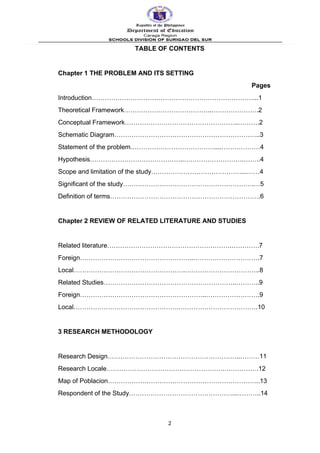
TABLE OF CONTENTS
Chapter 1 THE PROBLEM AND ITS SETTING
Pages
Introduction…………………………………………………………………...1
Theoretical Framework…………………………………..………………….2
Conceptual Framework……………………………………………..……….2
Schematic Diagram…………………………………………………………..3
Statement of the problem…………………………………....………………4
Hypothesis……………………………………..……………………….……..4
Scope and limitation of the study……………………………………...……4
Significant of the study…………………………………………………….…5
Definition of terms…………………………………………………………….6
Chapter 2 REVIEW OF RELATED LITERATURE AND STUDIES
Related literature………………………………………………….………….7
Foreign……………………………………………..………………………….7
Local…………………………………………….……………………………..8
Related Studies……………………………………………………..………..9
Foreign…………………………………………………..…………………….9
Local………………………………………….……………………………….10
3 RESEARCH METHODOLOGY
Research Design……………………………………………………..………11
Research Locale……………………………………………….…………….12
Map of Poblacion……………………………………………………………..13
Respondent of the Study…………………………………………...………..14
2
Sampling Procedure…………………………………………………..…….14
Research Instruments………………………………………………..……..14
Statistical Treatment……………………………………………..………….15
Survey Questionnaire…………………………………………….…………15-16
Reference……………………………………………….……………………17
Chapter I
3
The Problem and Its Setting
Introduction
In today’s generation there are a program called 4’PS and it comes
from government, this program helps to assist the family, and help students in
their school to support their needs like school requirements, uniforms, needs
etc., In this case the parents are being supported for a small help of the
government. The 4’PS goals or the Pantawid Pamilyang Pilipilino Program
and this program help to reduce poverty and empowering the poor, by
providing cash assistance among the poorest households. This study
measured and evaluated the effect of the Pantawid Pamilyang Pilipino
Program (4’PS) to the academic performance of the students.
According to the Federal Deposit Insurance Corporation (FDIC (2014),
28 percent of household with income below $15,000 have no bank account
but also rely on alternative financial services such as check cashing and
paydays lending. Government cash assistance programs disproportionately
serve low-come households that face barriers to credit access, yet little
research exist on these programs affect household’s financial outcomes.
These programs might affect the extent to which recipients can access and
use credit. On one hand, government cash assistance provides stable and
reliable income relative to earned income (Edin and Lein (1997) Desppande
(2018), and may thereby increase credit worthiness.
The program’s primary objectives are to reduce poverty, improve
health and nutrition, and enhance education. By providing cash grants, the
programs aim to alleviate the immediate financial burdens of poor to poorest
families, allowing them to meet basic needs and invest in their children’s
education and health. The program also requires beneficiaries to comply with
health and nutrition conditions, ensuring that the children receive necessary
health care. To encourage school enrollment and attention or attendance, the
programs provide cash grants contingent on children’s attendance, aiming to
break, the cycle of poverty by investing in human capital.
4
Due to different status in the lives of people in the Philippines. Where
there are some of family have to membered of 4P’s program. There are some
parents who do not spend the money in a good way or to support their
children. This study will serve as an awareness toward the students, parents,
teachers because they can control their attendance and identify those
beneficiaries that not active in school by the monitoring and to be aware. This
study can help those parents to know what would the right thing about the
cash assistance given by the government.
THEORETICAL FRAMEWORK
The 4P’s program operates on the principle that providing financial
support to families can incentives them to invest in their children’s education
and health this kind of aligns with several theoretical frameworks, including,
Human Capital Theory proposed by Gary Becker stated that investment in
education and health need to increased producing and learning potential. The
Social Contract Theory proposed by Jean Jacques Rousseau’s the theory
stated that the Pantawid Pamilyang Pilipino Program (4P’s) because the said
program is great example of a social contract where in the state provides cash
grants to poor household in order to meet their basic immediate needs.
CONCEPTUAL FRAMEWORK
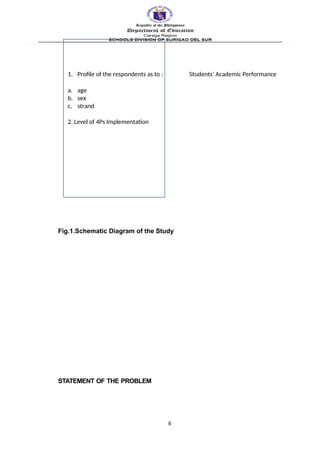
INDEPENDENT VARIABLE DEPENDENT VARIABLE
5
1. Profile of the respondents as to : Students’ Academic Performance
a. age
b. sex
c. strand
2. Level of 4Ps Implementation
Fig.1.Schematic Diagram of the Study
STATEMENT OF THE PROBLEM
6
This study aims to investigate whether 4’PS program can alleviate the academic
performance of the 4’PS beneficiaries, specially it will answer the questions below:
1. The profile of the participants of the chosen strand.
2. What is the level of the implementation of 4’PS program?
3. What is the academic performance of 4’PS beneficiaries?
4. Is there a significant relationship between students and me
performances and for his implementation?
HYPOTHESIS
There is no significant difference to the academic performance of non-4P’s
and 4P’s beneficiaries.
SCOPE AND LIMITATION OF THE STUDY
The study focuses specifically on the academic strands students who
are beneficiaries of Pantawid Pamilyang Pilipino Program (4P’s) in the
selected strand such as Lingig National High School. The total of respondents
will be utilized as the main source of data the study will be only focuses on the
academic strand and non-academic strand will not be included. This study will
last for 3months. From August to October.
DEFINITION OF TERMS
Academic Performance – The level of achievement’s a student’s
reaches in school, usually measured though grades, fewer scores, and
classroom participation.
7
Beneficiaries – Individuals or families who receive financial and education
assistance from the 4’PS program.
Behavior Control – The ability to regulated actions and behaviors in order
a focus on academic tasks and meet school expectations.
Conditional Cash Transfers – A type of financial and given under
specific conditions, such as ensuring that children attend school or
receive health check-ups.
Educational Resources – Materials, foods, or programs like books,
scholarship, or tutoring services that within academic achievements.
Environment Factors – External influence’s such as family environment,
school condition and community support that affect academic success.
Financial Resistance- Money support provided by the 4’Ps program to
help families with education and basic needs.
Learning environment- The physical art social setting in which students
including factors life classroom atmosphere, teachers support, and peer
interaction.
Parental Involvement- The participation of parents in their child’s
education, including providing support of lobe and engage with teachers and
school activities.
Personal Factors- Characteristic such as motivation, self-esteem and
attitude that affect a student approach to learning and education.
Social Pressure- The influence exerted by peers, family or society on a
student’s behavior, choices, or academic performance.
8
Socio-economic Status – The economic and social standing of a person
or family, which may influence access.
School Participation - Students environment in academic and
extracurricular activities, including attendance and classmate engagement.
4’PS – The Pantawid Pamilyang Pilipilino Program a government initiative
providing financial and to low income families to support health, education,
and social development.
9
CHAPTER 2
REVIEW OF RELATED LITERATURE AND STUDIES
This chapter presents a review of concepts and researches that have
direct bearing on this research. Considering essential studies and
information would make someone better understands of this study. This
information was taken from different journals, online references.
Related Literature
FOREIGN
RONALD V MENDUZA, DAVID BARVA YAP, IVYROSE BAYSIC
POBRE, MONICA MELCHAN Journal of Asian Public 8(2), 191-214, 2015
The cash assistance is one of the projects subsumed within the Philippine
social protection agenda. The MCCT- HSF, (Modified conditional cash
transfer for homeless), viewed as an extension of the 4Ps intends to provide
immediate relief, support and services to homeless families. This study serves
as a review of social protection programs that are similar to the MCCT-HSF
and as Preliminary analysis of the data Gleaned from the plot implementation
of MCCFHSK.
Rosario G. Manasan
Pins Discussion Paper Series, performing social Protection Policy:
Responding to the global financial crisis and beyond. This study review’s and
evaluates the major contribute any and noncontributory social protection
programs that are currently in place as part of the governments. Portfolio
place as part of the governments. The social protection interventions,
including social insurance (SSS, GSIS, PHILHEALTH) Social Welfare
Programs (e.g. Pantawid Pamilyang Pilipino Program or 4P’s Food for School
Program).
M Ramesh
10
Journal of southeast Asain Economics, 40-56,2014
The paper examines social protection programs for the poor aged and
site in Indonesia and Philippines with the purpose of assessing their
performance in effectively protecting the population. This comparative review
indicates that both countries have made major advances in improving health
coverage and maintaining income for the chronic poor in recent years, after
decades of neglect moreover the benefit levels for chronic poor. The
programs target population are too low to provide effective protection.
Paul B Spiegel Jama 314(5),445-446,2015
The number of displaced persons compelled to leave their homes or
countries because of threats to their live, security or freedom has increased
by 8.3million to 59.5m from 2013 to 2014 the highest level of forced
displacement since world war 2.
Leah Camphell the cash learning partnership 2014
Between February and October 2013, Following three months point
project the cross sector cash assistance for Syrian refuges and host
communities in Lebanon. For time limited period of 4-6 months the program
provided monthly cash assistance via ATM to 700 syrian refuges and 425
were able Lebanese household. Beneficiaries were improved to make their
own decisions about how to spend their funds in order to meet the needs of
their families.
LOCAL RELATED LITERATURE
Marc Jon S Flores, Cristine Alaine B Espinoza Harold C Erico,
Rosemarie B Casimino Journal of republic Administration and governance
9(2), 193-208,2019 this study measured and evaluated the academic
performace of Pantawid Pamilyang Pilipino Program (4Ps) on the academic
performace of the student beneficiaries of calaba National High School
student, Calaba, San Isidro, Neuva Ecija in the Philippines. Analysis of all
called data revealed the significant effect of the program to the performance
of students beneficiaries especially in motivating students to attend classes.
11
MCA Aranas, Marilyn G Barbaso, Generiene Q Bermudez, Joan Abigail N
Pelpinosas E deuene A international journal of trend in scientific research and
development 5(3), 175-1 194,2021 this study aimed to assess the significant
relationship between the factors affecting the academic performance and the
academic and final grade in previous grade level of Pantawid Pamilyang
Pilipino Progam (4P’s) beneficiaries.
Reynalissa L. Taguian, the study investigates impact of this Pantawid
Pamilyang Pilipino Program (4P’s) on school performance and activity of life.
This study aims to assess the extent of implementation of program in terms of
nutrition, health and education identify the extent of contribution of the 4P’s
program to the different indication of school performance such as enrollment
rate, survival cohort rate and NAT performance survival rates while reducing
drop-out rates. Its effect on quality effective implementation.
Brian O. Dela tore, this study endeavored to find out the strengths,
weaknesses, opportunities and threatens of the Pantawid Pamilyang Pilipino
Program (4P’s), the conditional cash transfer (CCT) Program of government.
The republic of the Philippines from the viewpoint of its beneficiaries and to
recognize the changes it bought forth to education. Respondents, selected
thought purpose were asked through researcher made questionnaire of their
perception and suggestions for the 4P’s, and the strength, weakness,
opportunities and threats of 4P’s.
Thriuz S. De Jesus, Romel R. Riura, this study aims to determine where the
4P’s beneficiaries. Allocate the cash grants they receive from the government
on their daily payout in term or educational rood transportation clothing
entertainment and other bills.
FOREIGN
INCREASED SCHOOL- Enrollment and attendance, studies in Latin America
have shown that CCT programs. Significantly increases school enrollment
and attendance rates among eligible children. This is attributed to the financial
12
incentive proceeded the program which helps alleviate the financial burden on
families and encourages them to prioritize education.
IMPROVED HEALTH AND NUTRITION- CCT programs often include health-
related condition alities such as prenatal care and regular checkups for
children. This has resulted in improved health and nutritional status among
beneficiaries which in turn has a positive impact on their cognitive
development and school performance.
BREAKING THE CYCLE OF POVERTY- The CCT are designed to break the
intergenerational cycle of poverty by investing the human. By providing
financial assistance and promoting education these programs aim to equip
children with the skills the knowledge necessary to improve their future
prospects and improve poverty.
ADDRESING SICOECONOMIC FACTORS- Research on CCT programs has
lighted the importance of addressing socioeconomic factors that contributed to
educational disparities these programs aim to provide a safety net for law-
income families reducing the financial consentrate that often handle children
educational opportunities.
POSITIVE IMPACTS ON THE MAN DEVELOPMENT- CCT programs have
been loaded for their positive impact on human development they have
contributed to improvements in health education and overall well-being among
beneficiaries leading to long term societal benefits.
LOCAL
IMPROVE SCHOOL ATTENDANCE- several studies have found that 4Ps
program has significantly increased school attendance rates among its
beneficiaries. The financial incentive provided by the program motivates
families to ensure their children attend school regularly leading to reduced
absenteeism and drop out students.
13
LIMITED IMPACT ON ACADEMIC PERFORMANCE- while the 4Ps program
has shown positive effects on school attendance, its impact on academic
performance is more announce. Some studies have found that the program
alone is not sufficient to significantly improve academic achievements other
factors, as potential involvement access to quality education and socio
economic success.
NEED FOR COMPREHENSIVE SUPPORT- researchers emphasize the need
for a comprehensive approach to address the educational needs of 4Ps
beneficiaries. This includes providing support beyond financial assistance
such as access to quality education teacher training and community based
interventions
ADDOSING CHALLENGES AND ENHANTING EFFECTIVENESS- local
studies have identified challenges in the implementation of the 4Ps program
such as inadequate fending logs issues and need for better monitoring and
evaluation researchers recommended, addressing these to enhance the
program effectiveness in promoting educational attainment.
14
CHAPTER 3
RESEARCH METHODOLOGY
This chapter discuss the data gathering process, research instruments, and
strategies that will be utilized to further the study’s aims.
RESERCH DESIGN
The researcher will use 3 kinds of research design namely, descriptive
research design, survey research design and correlational research design.
The aforementioned design to ensure valid and reliable result that address the
research aims and objectives.
This study adopts a descriptive research to investigate the relationship
between the academic performance and the 4P’s (Pantawid Pamilyang
Pilipino Programs) support received by Grade 11 students within the TVL
strand. A descriptive approach is suitable as it enables the researcher to
observe and document existing conditions without manipulating variables.
This design will help in identifying trends and patterns that may emerge
between the academic success of 4Ps beneficiaries and their socioeconomic
support.
RESEARCH LOCALE
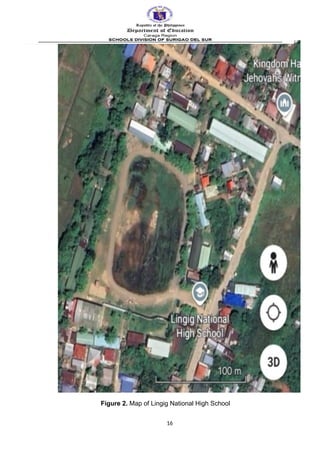
This study is conducted at Lingig National High School, home to a
significant number of Grade 11 student’s under 4P’s program. This setting
was selected based on accessibility of respondents who meet the research
criteria and the relevance of the location to the study’s focus on the students.
15
Figure 2. Map of Lingig National High School
16
RESPONDENT OF THE STUDY
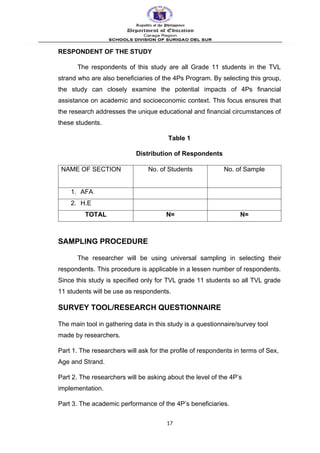
The respondents of this study are all Grade 11 students in the TVL
strand who are also beneficiaries of the 4Ps Program. By selecting this group,
the study can closely examine the potential impacts of 4Ps financial
assistance on academic and socioeconomic context. This focus ensures that
the research addresses the unique educational and financial circumstances of
these students.
Table 1
Distribution of Respondents
NAME OF SECTION No. of Students No. of Sample
1. AFA
2. H.E
TOTAL N= N=
SAMPLING PROCEDURE
The researcher will be using universal sampling in selecting their
respondents. This procedure is applicable in a lessen number of respondents.
Since this study is specified only for TVL grade 11 students so all TVL grade
11 students will be use as respondents.
SURVEY TOOL/RESEARCH QUESTIONNAIRE
The main tool in gathering data in this study is a questionnaire/survey tool
made by researchers.
Part 1. The researchers will ask for the profile of respondents in terms of Sex,
Age and Strand.
Part 2. The researchers will be asking about the level of the 4P’s
implementation.
Part 3. The academic performance of the 4P’s beneficiaries.
17
RESEARCH INSTRUMENT
In this study, the instrument that was used by the researchers in gathering
data is survey questionnaire. The instrument was made by the researchers in
which the following responses are categorized as:
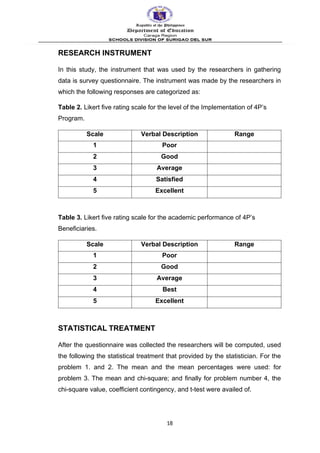
Table 2. Likert five rating scale for the level of the Implementation of 4P’s
Program.
Scale Verbal Description Range
1 Poor
2 Good
3 Average
4 Satisfied
5 Excellent
Table 3. Likert five rating scale for the academic performance of 4P’s
Beneficiaries.
Scale Verbal Description Range
1 Poor
2 Good
3 Average
4 Best
5 Excellent
STATISTICAL TREATMENT
After the questionnaire was collected the researchers will be computed, used
the following the statistical treatment that provided by the statistician. For the
problem 1. and 2. The mean and the mean percentages were used: for
problem 3. The mean and chi-square; and finally for problem number 4, the
chi-square value, coefficient contingency, and t-test were availed of.
18
DATA GATHERING PROCEDURE
The study will be conducted during the year 2024 to 2025 at Lingig National
High School, Poblacion Lingig Surigao Del Sur. The researchers will first
submit a letter of permission to the School Principal and School Guidance
Counselor, before the researchers began to conduct the study and collect
data. The researchers will also send a letter of permission to the Class
Advisers of the selected strands.
The questionnaire that serve as an instrument to gather the data that needed
in their study. The questionnaire is distributed to Grade 11 AFA and H.E, the
selected strand will be the respondents of the study.
19
REFERENCES
Human capital theory
https://www.scribe.com/doc/28783615/Human-Capital-Theory
Expectancy Theory
http://en.wikipedia.org/wiki/Expectancy_theory
APPENDIX A
QUESTIONNAIRE
THE LEVEL OF 4P’S EMPLEMENTATION AND THEIR
ACADEMIC PERFORMANCE
Name: _____________________________ Sex: ___
Grade & Strand: _____________________ Age:
___p
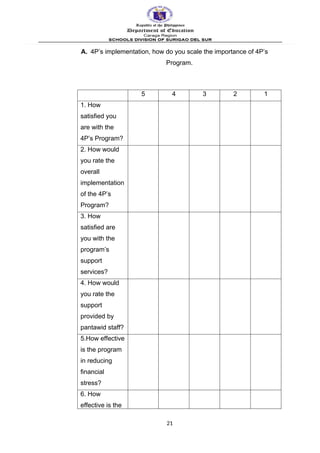
DIRECTION: In a scale of 1-5 rate the statement below on how the 4P’s
implementation help your academic performance put a check mark on the
number 1 if you are very dissatisfied and put check on number 2 if you are
dissatisfied, put check on number 3 if neutral, put check on number 4 if you
are satisfied, put check on number 5 if you are very satisfied:
20
A. 4P’s implementation, how do you scale the importance of 4P’s
Program.
5 4 3 2 1
1. How
satisfied you
are with the
4P’s Program?
2. How would
you rate the
overall
implementation
of the 4P’s
Program?
3. How
satisfied are
you with the
program’s
support
services?
4. How would
you rate the
support
provided by
pantawid staff?
5.How effective
is the program
in reducing
financial
stress?
6. How
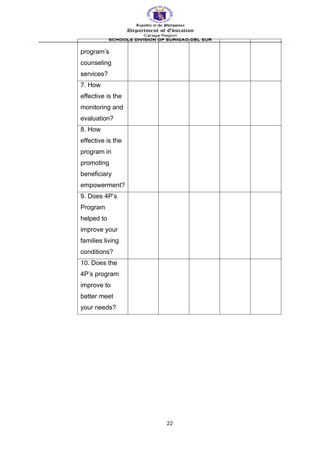
effective is the
21
program’s
counseling
services?
7. How
effective is the
monitoring and
evaluation?
8. How
effective is the
program in
promoting
beneficiary
empowerment?
9. Does 4P’s
Program
helped to
improve your
families living
conditions?
10. Does the
4P’s program
improve to
better meet
your needs?
22
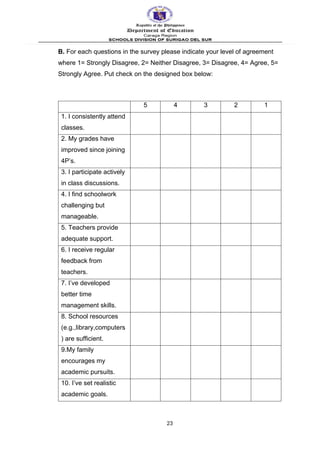
B. For each questions in the survey please indicate your level of agreement
where 1= Strongly Disagree, 2= Neither Disagree, 3= Disagree, 4= Agree, 5=
Strongly Agree. Put check on the designed box below:
5 4 3 2 1
1. I consistently attend
classes.
2. My grades have
improved since joining
4P’s.
3. I participate actively
in class discussions.
4. I find schoolwork
challenging but
manageable.
5. Teachers provide
adequate support.
6. I receive regular
feedback from
teachers.
7. I’ve developed
better time
management skills.
8. School resources
(e.g.,library,computers
) are sufficient.
9.My family
encourages my
academic pursuits.
10. I’ve set realistic
academic goals.
23

The Implementation of 4ps program in the philippines

  • 1.
    The Implementation of4P’s Program and Its Relation to Academic Performance of the 4P’s Benefeciaries ___________________________________________________________________________ A Research presented to The Faculty of Lingig National High School Surigao Del Sur _____________________________________________________________ In Partial Fulfillment Of the Requirements in Inquiries, Investigations, and Immersion BY: Ismael Rongcalia Gerwin Lyle C. Crespo Rusdy D. Pamo Dee em Consuegra Carl Meliton Masandag Rianne C. Soriano Rejean Beal T. Platino Claris A. Dollesin 2025 1
  • 2.
    TABLE OF CONTENTS Chapter1 THE PROBLEM AND ITS SETTING Pages Introduction…………………………………………………………………...1 Theoretical Framework…………………………………..………………….2 Conceptual Framework……………………………………………..……….2 Schematic Diagram…………………………………………………………..3 Statement of the problem…………………………………....………………4 Hypothesis……………………………………..……………………….……..4 Scope and limitation of the study……………………………………...……4 Significant of the study…………………………………………………….…5 Definition of terms…………………………………………………………….6 Chapter 2 REVIEW OF RELATED LITERATURE AND STUDIES Related literature………………………………………………….………….7 Foreign……………………………………………..………………………….7 Local…………………………………………….……………………………..8 Related Studies……………………………………………………..………..9 Foreign…………………………………………………..…………………….9 Local………………………………………….……………………………….10 3 RESEARCH METHODOLOGY Research Design……………………………………………………..………11 Research Locale……………………………………………….…………….12 Map of Poblacion……………………………………………………………..13 Respondent of the Study…………………………………………...………..14 2
  • 3.
    Sampling Procedure…………………………………………………..…….14 Research Instruments………………………………………………..……..14 StatisticalTreatment……………………………………………..………….15 Survey Questionnaire…………………………………………….…………15-16 Reference……………………………………………….……………………17 Chapter I 3
  • 4.
    The Problem andIts Setting Introduction In today’s generation there are a program called 4’PS and it comes from government, this program helps to assist the family, and help students in their school to support their needs like school requirements, uniforms, needs etc., In this case the parents are being supported for a small help of the government. The 4’PS goals or the Pantawid Pamilyang Pilipilino Program and this program help to reduce poverty and empowering the poor, by providing cash assistance among the poorest households. This study measured and evaluated the effect of the Pantawid Pamilyang Pilipino Program (4’PS) to the academic performance of the students. According to the Federal Deposit Insurance Corporation (FDIC (2014), 28 percent of household with income below $15,000 have no bank account but also rely on alternative financial services such as check cashing and paydays lending. Government cash assistance programs disproportionately serve low-come households that face barriers to credit access, yet little research exist on these programs affect household’s financial outcomes. These programs might affect the extent to which recipients can access and use credit. On one hand, government cash assistance provides stable and reliable income relative to earned income (Edin and Lein (1997) Desppande (2018), and may thereby increase credit worthiness. The program’s primary objectives are to reduce poverty, improve health and nutrition, and enhance education. By providing cash grants, the programs aim to alleviate the immediate financial burdens of poor to poorest families, allowing them to meet basic needs and invest in their children’s education and health. The program also requires beneficiaries to comply with health and nutrition conditions, ensuring that the children receive necessary health care. To encourage school enrollment and attention or attendance, the programs provide cash grants contingent on children’s attendance, aiming to break, the cycle of poverty by investing in human capital. 4
  • 5.
    Due to differentstatus in the lives of people in the Philippines. Where there are some of family have to membered of 4P’s program. There are some parents who do not spend the money in a good way or to support their children. This study will serve as an awareness toward the students, parents, teachers because they can control their attendance and identify those beneficiaries that not active in school by the monitoring and to be aware. This study can help those parents to know what would the right thing about the cash assistance given by the government. THEORETICAL FRAMEWORK The 4P’s program operates on the principle that providing financial support to families can incentives them to invest in their children’s education and health this kind of aligns with several theoretical frameworks, including, Human Capital Theory proposed by Gary Becker stated that investment in education and health need to increased producing and learning potential. The Social Contract Theory proposed by Jean Jacques Rousseau’s the theory stated that the Pantawid Pamilyang Pilipino Program (4P’s) because the said program is great example of a social contract where in the state provides cash grants to poor household in order to meet their basic immediate needs. CONCEPTUAL FRAMEWORK INDEPENDENT VARIABLE DEPENDENT VARIABLE 5
  • 6.
    1. Profile ofthe respondents as to : Students’ Academic Performance a. age b. sex c. strand 2. Level of 4Ps Implementation Fig.1.Schematic Diagram of the Study STATEMENT OF THE PROBLEM 6
  • 7.
    This study aimsto investigate whether 4’PS program can alleviate the academic performance of the 4’PS beneficiaries, specially it will answer the questions below: 1. The profile of the participants of the chosen strand. 2. What is the level of the implementation of 4’PS program? 3. What is the academic performance of 4’PS beneficiaries? 4. Is there a significant relationship between students and me performances and for his implementation? HYPOTHESIS There is no significant difference to the academic performance of non-4P’s and 4P’s beneficiaries. SCOPE AND LIMITATION OF THE STUDY The study focuses specifically on the academic strands students who are beneficiaries of Pantawid Pamilyang Pilipino Program (4P’s) in the selected strand such as Lingig National High School. The total of respondents will be utilized as the main source of data the study will be only focuses on the academic strand and non-academic strand will not be included. This study will last for 3months. From August to October. DEFINITION OF TERMS Academic Performance – The level of achievement’s a student’s reaches in school, usually measured though grades, fewer scores, and classroom participation. 7
  • 8.
    Beneficiaries – Individualsor families who receive financial and education assistance from the 4’PS program. Behavior Control – The ability to regulated actions and behaviors in order a focus on academic tasks and meet school expectations. Conditional Cash Transfers – A type of financial and given under specific conditions, such as ensuring that children attend school or receive health check-ups. Educational Resources – Materials, foods, or programs like books, scholarship, or tutoring services that within academic achievements. Environment Factors – External influence’s such as family environment, school condition and community support that affect academic success. Financial Resistance- Money support provided by the 4’Ps program to help families with education and basic needs. Learning environment- The physical art social setting in which students including factors life classroom atmosphere, teachers support, and peer interaction. Parental Involvement- The participation of parents in their child’s education, including providing support of lobe and engage with teachers and school activities. Personal Factors- Characteristic such as motivation, self-esteem and attitude that affect a student approach to learning and education. Social Pressure- The influence exerted by peers, family or society on a student’s behavior, choices, or academic performance. 8
  • 9.
    Socio-economic Status –The economic and social standing of a person or family, which may influence access. School Participation - Students environment in academic and extracurricular activities, including attendance and classmate engagement. 4’PS – The Pantawid Pamilyang Pilipilino Program a government initiative providing financial and to low income families to support health, education, and social development. 9
  • 10.
    CHAPTER 2 REVIEW OFRELATED LITERATURE AND STUDIES This chapter presents a review of concepts and researches that have direct bearing on this research. Considering essential studies and information would make someone better understands of this study. This information was taken from different journals, online references. Related Literature FOREIGN RONALD V MENDUZA, DAVID BARVA YAP, IVYROSE BAYSIC POBRE, MONICA MELCHAN Journal of Asian Public 8(2), 191-214, 2015 The cash assistance is one of the projects subsumed within the Philippine social protection agenda. The MCCT- HSF, (Modified conditional cash transfer for homeless), viewed as an extension of the 4Ps intends to provide immediate relief, support and services to homeless families. This study serves as a review of social protection programs that are similar to the MCCT-HSF and as Preliminary analysis of the data Gleaned from the plot implementation of MCCFHSK. Rosario G. Manasan Pins Discussion Paper Series, performing social Protection Policy: Responding to the global financial crisis and beyond. This study review’s and evaluates the major contribute any and noncontributory social protection programs that are currently in place as part of the governments. Portfolio place as part of the governments. The social protection interventions, including social insurance (SSS, GSIS, PHILHEALTH) Social Welfare Programs (e.g. Pantawid Pamilyang Pilipino Program or 4P’s Food for School Program). M Ramesh 10
  • 11.
    Journal of southeastAsain Economics, 40-56,2014 The paper examines social protection programs for the poor aged and site in Indonesia and Philippines with the purpose of assessing their performance in effectively protecting the population. This comparative review indicates that both countries have made major advances in improving health coverage and maintaining income for the chronic poor in recent years, after decades of neglect moreover the benefit levels for chronic poor. The programs target population are too low to provide effective protection. Paul B Spiegel Jama 314(5),445-446,2015 The number of displaced persons compelled to leave their homes or countries because of threats to their live, security or freedom has increased by 8.3million to 59.5m from 2013 to 2014 the highest level of forced displacement since world war 2. Leah Camphell the cash learning partnership 2014 Between February and October 2013, Following three months point project the cross sector cash assistance for Syrian refuges and host communities in Lebanon. For time limited period of 4-6 months the program provided monthly cash assistance via ATM to 700 syrian refuges and 425 were able Lebanese household. Beneficiaries were improved to make their own decisions about how to spend their funds in order to meet the needs of their families. LOCAL RELATED LITERATURE Marc Jon S Flores, Cristine Alaine B Espinoza Harold C Erico, Rosemarie B Casimino Journal of republic Administration and governance 9(2), 193-208,2019 this study measured and evaluated the academic performace of Pantawid Pamilyang Pilipino Program (4Ps) on the academic performace of the student beneficiaries of calaba National High School student, Calaba, San Isidro, Neuva Ecija in the Philippines. Analysis of all called data revealed the significant effect of the program to the performance of students beneficiaries especially in motivating students to attend classes. 11
  • 12.
    MCA Aranas, MarilynG Barbaso, Generiene Q Bermudez, Joan Abigail N Pelpinosas E deuene A international journal of trend in scientific research and development 5(3), 175-1 194,2021 this study aimed to assess the significant relationship between the factors affecting the academic performance and the academic and final grade in previous grade level of Pantawid Pamilyang Pilipino Progam (4P’s) beneficiaries. Reynalissa L. Taguian, the study investigates impact of this Pantawid Pamilyang Pilipino Program (4P’s) on school performance and activity of life. This study aims to assess the extent of implementation of program in terms of nutrition, health and education identify the extent of contribution of the 4P’s program to the different indication of school performance such as enrollment rate, survival cohort rate and NAT performance survival rates while reducing drop-out rates. Its effect on quality effective implementation. Brian O. Dela tore, this study endeavored to find out the strengths, weaknesses, opportunities and threatens of the Pantawid Pamilyang Pilipino Program (4P’s), the conditional cash transfer (CCT) Program of government. The republic of the Philippines from the viewpoint of its beneficiaries and to recognize the changes it bought forth to education. Respondents, selected thought purpose were asked through researcher made questionnaire of their perception and suggestions for the 4P’s, and the strength, weakness, opportunities and threats of 4P’s. Thriuz S. De Jesus, Romel R. Riura, this study aims to determine where the 4P’s beneficiaries. Allocate the cash grants they receive from the government on their daily payout in term or educational rood transportation clothing entertainment and other bills. FOREIGN INCREASED SCHOOL- Enrollment and attendance, studies in Latin America have shown that CCT programs. Significantly increases school enrollment and attendance rates among eligible children. This is attributed to the financial 12
  • 13.
    incentive proceeded theprogram which helps alleviate the financial burden on families and encourages them to prioritize education. IMPROVED HEALTH AND NUTRITION- CCT programs often include health- related condition alities such as prenatal care and regular checkups for children. This has resulted in improved health and nutritional status among beneficiaries which in turn has a positive impact on their cognitive development and school performance. BREAKING THE CYCLE OF POVERTY- The CCT are designed to break the intergenerational cycle of poverty by investing the human. By providing financial assistance and promoting education these programs aim to equip children with the skills the knowledge necessary to improve their future prospects and improve poverty. ADDRESING SICOECONOMIC FACTORS- Research on CCT programs has lighted the importance of addressing socioeconomic factors that contributed to educational disparities these programs aim to provide a safety net for law- income families reducing the financial consentrate that often handle children educational opportunities. POSITIVE IMPACTS ON THE MAN DEVELOPMENT- CCT programs have been loaded for their positive impact on human development they have contributed to improvements in health education and overall well-being among beneficiaries leading to long term societal benefits. LOCAL IMPROVE SCHOOL ATTENDANCE- several studies have found that 4Ps program has significantly increased school attendance rates among its beneficiaries. The financial incentive provided by the program motivates families to ensure their children attend school regularly leading to reduced absenteeism and drop out students. 13
  • 14.
    LIMITED IMPACT ONACADEMIC PERFORMANCE- while the 4Ps program has shown positive effects on school attendance, its impact on academic performance is more announce. Some studies have found that the program alone is not sufficient to significantly improve academic achievements other factors, as potential involvement access to quality education and socio economic success. NEED FOR COMPREHENSIVE SUPPORT- researchers emphasize the need for a comprehensive approach to address the educational needs of 4Ps beneficiaries. This includes providing support beyond financial assistance such as access to quality education teacher training and community based interventions ADDOSING CHALLENGES AND ENHANTING EFFECTIVENESS- local studies have identified challenges in the implementation of the 4Ps program such as inadequate fending logs issues and need for better monitoring and evaluation researchers recommended, addressing these to enhance the program effectiveness in promoting educational attainment. 14
  • 15.
    CHAPTER 3 RESEARCH METHODOLOGY Thischapter discuss the data gathering process, research instruments, and strategies that will be utilized to further the study’s aims. RESERCH DESIGN The researcher will use 3 kinds of research design namely, descriptive research design, survey research design and correlational research design. The aforementioned design to ensure valid and reliable result that address the research aims and objectives. This study adopts a descriptive research to investigate the relationship between the academic performance and the 4P’s (Pantawid Pamilyang Pilipino Programs) support received by Grade 11 students within the TVL strand. A descriptive approach is suitable as it enables the researcher to observe and document existing conditions without manipulating variables. This design will help in identifying trends and patterns that may emerge between the academic success of 4Ps beneficiaries and their socioeconomic support. RESEARCH LOCALE This study is conducted at Lingig National High School, home to a significant number of Grade 11 student’s under 4P’s program. This setting was selected based on accessibility of respondents who meet the research criteria and the relevance of the location to the study’s focus on the students. 15
  • 16.
    Figure 2. Mapof Lingig National High School 16
  • 17.
    RESPONDENT OF THESTUDY The respondents of this study are all Grade 11 students in the TVL strand who are also beneficiaries of the 4Ps Program. By selecting this group, the study can closely examine the potential impacts of 4Ps financial assistance on academic and socioeconomic context. This focus ensures that the research addresses the unique educational and financial circumstances of these students. Table 1 Distribution of Respondents NAME OF SECTION No. of Students No. of Sample 1. AFA 2. H.E TOTAL N= N= SAMPLING PROCEDURE The researcher will be using universal sampling in selecting their respondents. This procedure is applicable in a lessen number of respondents. Since this study is specified only for TVL grade 11 students so all TVL grade 11 students will be use as respondents. SURVEY TOOL/RESEARCH QUESTIONNAIRE The main tool in gathering data in this study is a questionnaire/survey tool made by researchers. Part 1. The researchers will ask for the profile of respondents in terms of Sex, Age and Strand. Part 2. The researchers will be asking about the level of the 4P’s implementation. Part 3. The academic performance of the 4P’s beneficiaries. 17
  • 18.
    RESEARCH INSTRUMENT In thisstudy, the instrument that was used by the researchers in gathering data is survey questionnaire. The instrument was made by the researchers in which the following responses are categorized as: Table 2. Likert five rating scale for the level of the Implementation of 4P’s Program. Scale Verbal Description Range 1 Poor 2 Good 3 Average 4 Satisfied 5 Excellent Table 3. Likert five rating scale for the academic performance of 4P’s Beneficiaries. Scale Verbal Description Range 1 Poor 2 Good 3 Average 4 Best 5 Excellent STATISTICAL TREATMENT After the questionnaire was collected the researchers will be computed, used the following the statistical treatment that provided by the statistician. For the problem 1. and 2. The mean and the mean percentages were used: for problem 3. The mean and chi-square; and finally for problem number 4, the chi-square value, coefficient contingency, and t-test were availed of. 18
  • 19.
    DATA GATHERING PROCEDURE Thestudy will be conducted during the year 2024 to 2025 at Lingig National High School, Poblacion Lingig Surigao Del Sur. The researchers will first submit a letter of permission to the School Principal and School Guidance Counselor, before the researchers began to conduct the study and collect data. The researchers will also send a letter of permission to the Class Advisers of the selected strands. The questionnaire that serve as an instrument to gather the data that needed in their study. The questionnaire is distributed to Grade 11 AFA and H.E, the selected strand will be the respondents of the study. 19
  • 20.
    REFERENCES Human capital theory https://www.scribe.com/doc/28783615/Human-Capital-Theory ExpectancyTheory http://en.wikipedia.org/wiki/Expectancy_theory APPENDIX A QUESTIONNAIRE THE LEVEL OF 4P’S EMPLEMENTATION AND THEIR ACADEMIC PERFORMANCE Name: _____________________________ Sex: ___ Grade & Strand: _____________________ Age: ___p DIRECTION: In a scale of 1-5 rate the statement below on how the 4P’s implementation help your academic performance put a check mark on the number 1 if you are very dissatisfied and put check on number 2 if you are dissatisfied, put check on number 3 if neutral, put check on number 4 if you are satisfied, put check on number 5 if you are very satisfied: 20
  • 21.
    A. 4P’s implementation,how do you scale the importance of 4P’s Program. 5 4 3 2 1 1. How satisfied you are with the 4P’s Program? 2. How would you rate the overall implementation of the 4P’s Program? 3. How satisfied are you with the program’s support services? 4. How would you rate the support provided by pantawid staff? 5.How effective is the program in reducing financial stress? 6. How effective is the 21
  • 22.
    program’s counseling services? 7. How effective isthe monitoring and evaluation? 8. How effective is the program in promoting beneficiary empowerment? 9. Does 4P’s Program helped to improve your families living conditions? 10. Does the 4P’s program improve to better meet your needs? 22
  • 23.
    B. For eachquestions in the survey please indicate your level of agreement where 1= Strongly Disagree, 2= Neither Disagree, 3= Disagree, 4= Agree, 5= Strongly Agree. Put check on the designed box below: 5 4 3 2 1 1. I consistently attend classes. 2. My grades have improved since joining 4P’s. 3. I participate actively in class discussions. 4. I find schoolwork challenging but manageable. 5. Teachers provide adequate support. 6. I receive regular feedback from teachers. 7. I’ve developed better time management skills. 8. School resources (e.g.,library,computers ) are sufficient. 9.My family encourages my academic pursuits. 10. I’ve set realistic academic goals. 23