Measurements of Health and disease
Probability & probability distributions
1/3/2023 Probability & probability distributions 1
Emiru Merdassa(MSc, Assistant professor)
2
Definition
Probability: the chance that an uncertain event
will occur (always between 0 and 1)
0 ≤ P(A) ≤ 1 For any event A
Certain
Impossible
0.5
1
0
1/3/2023
Example:
• Physician may say that a patient has a 50-50 chance of
surviving a certain operation.
• 95% certain that a patient has a particular disease.
➢ Most people express probabilities in terms of
percentages.
Probability & probability distributions
Probability terms
• Outcomes: results of each trial
• Sample space: set of all possible outcome
• Sample points: elements of the sample space of
outcome
• Event: subset of the sample space
3
1/3/2023
(continued)
Probability & probability distributions
4
Important terms
• Intersection of Events – If A and B are two events in a sample
space S, then the intersection, A ∩ B, is the set of all outcomes in
S that belong to both A and B
(continued)
A B
AB
S
1/3/2023 Probability & probability distributions
5
Important terms
• Two events A and B are mutually exclusive if they cannot both
happen at the same time
• P (A ∩ B) = 0
(continued)
A B
S
1/3/2023 Probability & probability distributions
6
Important terms
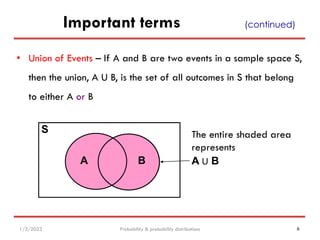
• Union of Events – If A and B are two events in a sample space S,
then the union, A U B, is the set of all outcomes in S that belong
to either A or B
(continued)
A B
The entire shaded area
represents
A U B
S
1/3/2023 Probability & probability distributions
7
Important terms
• Events E1, E2, … Ek are Collectively Exhaustive events if E1 U E2 U
. . . U Ek = S
– i.e., the events completely cover the sample space
• The Complement of an event A is the set of all basic outcomes in
the sample space that do not belong to A. The complement is
denoted as ഥ
A
(continued)
A
S
A
1/3/2023 Probability & probability distributions
8
Example
Let the Sample Space be the collection of all possible
outcomes of rolling one die:
S = [1, 2, 3, 4, 5, 6]
Let A be the event “Number rolled is even”
Let B be the event “Number rolled is at least 4”
Then
A = [2, 4, 6] and B = [4, 5, 6]
1/3/2023 Probability & probability distributions
9
(continued)
Example
S = [1, 2, 3, 4, 5, 6] A = [2, 4, 6] B = [4, 5, 6]
5]
3,
[1,
A =
6]
[4,
B
A =

6]
5,
4,
[2,
B
A =

S
6]
5,
4,
3,
2,
[1,
A
A =
=

Complements:
Intersections:
Unions:
[5]
B
A =

3]
2,
[1,
B =
1/3/2023 Probability & probability distributions
10
Mutually exclusive:
o A and B are not mutually exclusive
• The outcomes 4 and 6 are common to both
Collectively exhaustive:
o A and B are not collectively exhaustive
• A U B does not contain 1 or 3
(continued)
Example
S = [1, 2, 3, 4, 5, 6] A = [2, 4, 6] B = [4, 5, 6]
1/3/2023 Probability & probability distributions
Independent Events
• Two events A and B are independent if the probability of
the first one happening is the same no matter how the
second one turns out or
• The outcome of one event has no effect on the occurrence
or non-occurrence of the other.
P(A∩B) = P(A) x P(B) (Independent events)
P(A∩B) ≠ P(A) x P(B) (Dependent events)
Example:
O The outcomes on the first and second coin tosses are
independent
11
1/3/2023 Probability & probability distributions
Continued…
Two categories of probability
1. Objective probability and
2. Subjective probability
1) Objective probability
a) Classical probability &
b) Relative frequency probability.
12
1/3/2023 Probability & probability distributions
A) Classical Probability
• Is based on gambling ideas
• Example : Rolling a die
• There are 6 possible outcomes:
• Sample space = {1, 2, 3, 4, 5, 6}.
• Each is equally likely
• P(i) = 1/6, i=1,2,...,6.
→ P(1) = 1/6
→ P(2) = 1/6
…
→ P(6) = 1/6
SUM = 1
13
1/3/2023 Probability & probability distributions
B) Relative Frequency Probability
• In the long run process.
• The proportion of times the event A occurs —in a large number
of trials repeated under essentially identical conditions
Definition:
• If a process is repeated a large number of times (n), and if an
event with the characteristic E occurs m times, the relative
frequency of E,
Probability of E = P(E) = m/n.
14
1/3/2023 Probability & probability distributions
Example
• If you toss a coin 100 times and head comes up 40 times,
P(H) = 40/100 = 0.4.
• If we toss a coin 10,000 times and the head comes up 5562,
P(H) = 0.5562.
• Therefore, the longer the series and the longer sample size,
the closer the estimate to the true value.
15
1/3/2023 Probability & probability distributions
Relative probability
• Since trials cannot be repeated an infinite number of
times, theoretical probabilities are often estimated by
empirical probabilities based on a finite amount of
data
Example:
➢ Of 158 people who attended a dinner party, 99 were ill.
➢ P (Illness) = 99/158 = 0.63 = 63%.
1/3/2023 16
(continued)
Probability & probability distributions
2. Subjective Probability
– Personalistic (represents one’s degree of belief in the occurrence
of an event).
– E.g., If someone says that he is 95% certain that a cure for AIDS
will be discovered within 5 years, then he means that:
– P(discovery of cure for AIDS within 5 years) = 95% = 0.95
– Although the subjective view of probability has enjoyed
increased attention over the years, it has not fully accepted by
scientists.
17
1/3/2023 Probability & probability distributions
Properties of Probability
1. The numerical value of a probability always lies between 0 and 1,
inclusive(0  P(E)  1)
2. The sum of the probabilities of all mutually exclusive outcomes is
equal to 1.
P(E1) + P(E2 ) + .... + P(En ) = 1.
3. For two mutually exclusive events A and B,
P(A or B ) = P(AUB)= P(A) + P(B).
If not mutually exclusive:
P(A or B) = P(A) + P(B) - P(A and B)
1/3/2023 18
Probability & probability distributions
Properties of Probability
4. The complement of an event A, denoted by Ā or Ac, is the
event that A does not occur
• Consists of all the outcomes in which event A does NOT
occur: P(Ā) = P(not A) = 1 – P(A)
• Where Ā occurs only when A does not occur.
1/3/2023 19
Probability & probability distributions
Basic probability rules
1. Addition rule
➢ If events A and B are mutually exclusive:
P(A or B) = P(A) + P(B)
P(A and B) = 0
➢ More generally:
P(A or B) = P(A) + P(B) - P(A and B)
P(event A or event B occurs or they both occur)
20
1/3/2023 Probability & probability distributions
Example
The probabilities representing years of schooling
completed by mothers of newborn infants
21
Mother’s education level Probability
≤ 8 years 0.056
9 to 11 years 0.159
12 years 0.321
13 to 15 years 0.218
≥16 years 0.230
Not reported 0.016
1/3/2023 Probability & probability distributions
Continued
• What is the probability that a mother has
completed < 12 years of schooling?
P( 8 years) = 0.056 and
P(9-11 years) = 0.159
• Since these two events are mutually exclusive,
P( 8 or 9-11) = P( 8 U 9-11)
= P( 8) + P(9-11)
= 0.056+0.159
= 0.215
22
1/3/2023 Probability & probability distributions
Exercise
i. Suppose two doctors, A and B, test all patients coming into a clinic for
syphilis. Let events A+ = {doctor A makes a positive diagnosis} and B+ =
{doctor B makes a positive diagnosis}.
ii. Suppose doctor A diagnoses 10% of all patients as positive, doctor B
diagnoses 17% of all patients as positive, and both doctors diagnose 8%
of all patients as positive.
➢ Suppose a patient is referred for further lab tests if either doctor A or B
makes a positive diagnosis.
 What is the probability that a patient will be referred for further lab
tests(P(Α+
∪ 𝐵+
)?
1/3/2023 23
Probability & probability distributions
Normal distributions
1/3/2023 24
Probability & probability distributions
The Normal distribution
• Normal distributions are recognized by their bell shape.
• A large percentage of the curve’s area is located near
its center and that its tails approach the horizontal axis
as asymptotes.
25
1/3/2023 Probability & probability distributions
Normal distribution
1/3/2023 26
 Normal distributions are defined by:
, - < x < .
 where μ represents the mean of the distribution
and σ represents its standard deviation.
f(x) =
1
2
e
x-
2
 


−






1
2
Probability & probability distributions
 There are many different Normal distributions, each with
its own μ and σ, let X ~ N(μ, σ) represent a specific
member of the Normal distribution family.
 The symbol “~” is read as “distributed as.”
For example,
X ~ N(100, 15) is read as “X is a Normal random
variable with mean 100 and standard deviation 15.
1/3/2023 27
Probability & probability distributions
1. The mean µ tells you about location -
– Increase µ - Location shifts right
– Decrease µ – Location shifts left
– Shape is unchanged
2. The variance σ2 tells you about narrowness or flatness of the bell -
– Increase σ2 - Bell flattens. Extreme values are more likely
– Decrease σ2 - Bell narrows. Extreme values are less likely
– Location is unchanged
28
1/3/2023 Probability & probability distributions
The normal distribution
Mean changes Variance changes
1/3/2023 29
Probability & probability distributions
30
1/3/2023 Probability & probability distributions
Properties of the Normal Distribution
1. It is symmetrical about its mean, .
2. The mean, the median and mode are almost equal. It is
unimodal.
3. The total area under the curve about the x-axis is 1
square unit.
4. The curve never touches the x-axis.
5. As the value of  increases, the curve becomes more and
more flat and vice versa.
31
1/3/2023 Probability & probability distributions
6. Perpendiculars of:
± 1SD contain about 68%;
±2 SD contain about 95%;
±3 SD contain about 99.7% of the area under the
curve.
7. The distribution is completely determined by the
parameters  and .
32
1/3/2023 Probability & probability distributions
33
1/3/2023 Probability & probability distributions
Standard Normal Distribution
It is a normal distribution that has a mean equal to 0 and a
SD equal to 1, and is denoted by N(0, 1).
The main idea is to standardize all the data that is given by
using Z-scores.
These Z-scores can then be used to find the area
(probability) under the normal curve.
34
1/3/2023 Probability & probability distributions
Z - transformation
• If a random variable X~N(,) then we can transform
it to a SND with the help of Z-transformation
Z =
𝑿−

• Z represents the Z-score for a given x value
35
1/3/2023 Probability & probability distributions
Continued
– Consider redefining the scale to be in terms of how many SDs
away from mean for normal distribution, μ=110 and σ = 15.
– SDs from mean using
𝒙−𝟏𝟏𝟎
𝟏𝟓
=
𝒙−

1/3/2023 36
Value x
50 65 80 95 110 125 140 155 171
-4 -3 -2 -1 0 1 2 3 4
Probability & probability distributions
Continued
– This process is known as standardization and gives the
position on a normal curve with μ=0 and σ=1, i.e., the
SND, Z.
– A Z-score is the number of standard deviations that a
given x value is above or below the mean.
1/3/2023 Probability & probability distributions 37
Finding areas under the standard normal distribution curve
 The two steps are
Step 1 :
– Draw the normal distribution curve and shade the area.
Step 2:
– Find the appropriate figure in the Procedure Table and
follow the directions given.
1/3/2023 38
Probability & probability distributions
Procedure table
1/3/2023 39
Probability & probability distributions
Rules in computing probabilities
P[Z = a] = 0
P[Z ≤ a] obtained directly from the Z-table
P[Z ≥ a] = 1 – P[Z ≤ a]
P[Z ≥ -a] = P[Z ≤ +a]
P[Z ≤ -a] = P[Z ≥ +a]
P[a1 ≤ Z ≤ a2] = P[Z ≤ a2] – P[Z ≤ a1]
1/3/2023 Probability & probability distributions 40
Example 1
Find the area to the left of z = 2.06.
Solution
Step 1:
Draw the figure.
Step 2:
We are looking for the area under the standard normal distribution
to the left of z =2.06. look up the area in the table. It is 0.9803.
Hence, 98.03% of the area is less than z =2.06.
1/3/2023 41
Probability & probability distributions
Example 2
Find the area to the right of z = -1.19
Solution
Step 1: Draw the figure.
Step 2 : We are looking for the area to the right of z = -1.19.
Look up the area for z = -1.19. It is 0.1170. Subtract it from one.
1- 0.1170 = 0.8830. Hence, 88.30% of the area under the
standard normal distribution curve is to the right of z = -1.19.
1/3/2023 42
Probability & probability distributions
Continued
Example 3:
What is the probability that a z picked at random from the
population of z’s will have a value between -2.55 and +2.55 ?
 Answer : P (-2.55 < z < +2.55)
= 0.9946 – 0.0054
= 0.9892
Example 4:
What proportion of z value are between -2.47 and 1.53?
 Answer : P (-2.47 ≤ z ≤ 1.53)
= 0.9370 – 0.0068
= 0.9302
1/3/2023 Probability & probability distributions 43
Exercises
1. Find the area between z =1.68 and z =-1.37. Ans = 0.8682
2. Find the probability for each.
a) P(0 < z <2.32) = 0.4898
b) P(z < 1.65) = 0.9505
c) P(z >1.91)= 0.0281
3. Find two z values so that 48% of the middle area is bounded
by them?
1/3/2023 44
Probability & probability distributions
Thank you.
1/3/2023 45
Probability & probability distributions

4Probability and probability distributions.pdf

  • 1.
    Measurements of Healthand disease Probability & probability distributions 1/3/2023 Probability & probability distributions 1 Emiru Merdassa(MSc, Assistant professor)
  • 2.
    2 Definition Probability: the chancethat an uncertain event will occur (always between 0 and 1) 0 ≤ P(A) ≤ 1 For any event A Certain Impossible 0.5 1 0 1/3/2023 Example: • Physician may say that a patient has a 50-50 chance of surviving a certain operation. • 95% certain that a patient has a particular disease. ➢ Most people express probabilities in terms of percentages. Probability & probability distributions
  • 3.
    Probability terms • Outcomes:results of each trial • Sample space: set of all possible outcome • Sample points: elements of the sample space of outcome • Event: subset of the sample space 3 1/3/2023 (continued) Probability & probability distributions
  • 4.
    4 Important terms • Intersectionof Events – If A and B are two events in a sample space S, then the intersection, A ∩ B, is the set of all outcomes in S that belong to both A and B (continued) A B AB S 1/3/2023 Probability & probability distributions
  • 5.
    5 Important terms • Twoevents A and B are mutually exclusive if they cannot both happen at the same time • P (A ∩ B) = 0 (continued) A B S 1/3/2023 Probability & probability distributions
  • 6.
    6 Important terms • Unionof Events – If A and B are two events in a sample space S, then the union, A U B, is the set of all outcomes in S that belong to either A or B (continued) A B The entire shaded area represents A U B S 1/3/2023 Probability & probability distributions
  • 7.
    7 Important terms • EventsE1, E2, … Ek are Collectively Exhaustive events if E1 U E2 U . . . U Ek = S – i.e., the events completely cover the sample space • The Complement of an event A is the set of all basic outcomes in the sample space that do not belong to A. The complement is denoted as ഥ A (continued) A S A 1/3/2023 Probability & probability distributions
  • 8.
    8 Example Let the SampleSpace be the collection of all possible outcomes of rolling one die: S = [1, 2, 3, 4, 5, 6] Let A be the event “Number rolled is even” Let B be the event “Number rolled is at least 4” Then A = [2, 4, 6] and B = [4, 5, 6] 1/3/2023 Probability & probability distributions
  • 9.
    9 (continued) Example S = [1,2, 3, 4, 5, 6] A = [2, 4, 6] B = [4, 5, 6] 5] 3, [1, A = 6] [4, B A =  6] 5, 4, [2, B A =  S 6] 5, 4, 3, 2, [1, A A = =  Complements: Intersections: Unions: [5] B A =  3] 2, [1, B = 1/3/2023 Probability & probability distributions
  • 10.
    10 Mutually exclusive: o Aand B are not mutually exclusive • The outcomes 4 and 6 are common to both Collectively exhaustive: o A and B are not collectively exhaustive • A U B does not contain 1 or 3 (continued) Example S = [1, 2, 3, 4, 5, 6] A = [2, 4, 6] B = [4, 5, 6] 1/3/2023 Probability & probability distributions
  • 11.
    Independent Events • Twoevents A and B are independent if the probability of the first one happening is the same no matter how the second one turns out or • The outcome of one event has no effect on the occurrence or non-occurrence of the other. P(A∩B) = P(A) x P(B) (Independent events) P(A∩B) ≠ P(A) x P(B) (Dependent events) Example: O The outcomes on the first and second coin tosses are independent 11 1/3/2023 Probability & probability distributions
  • 12.
    Continued… Two categories ofprobability 1. Objective probability and 2. Subjective probability 1) Objective probability a) Classical probability & b) Relative frequency probability. 12 1/3/2023 Probability & probability distributions
  • 13.
    A) Classical Probability •Is based on gambling ideas • Example : Rolling a die • There are 6 possible outcomes: • Sample space = {1, 2, 3, 4, 5, 6}. • Each is equally likely • P(i) = 1/6, i=1,2,...,6. → P(1) = 1/6 → P(2) = 1/6 … → P(6) = 1/6 SUM = 1 13 1/3/2023 Probability & probability distributions
  • 14.
    B) Relative FrequencyProbability • In the long run process. • The proportion of times the event A occurs —in a large number of trials repeated under essentially identical conditions Definition: • If a process is repeated a large number of times (n), and if an event with the characteristic E occurs m times, the relative frequency of E, Probability of E = P(E) = m/n. 14 1/3/2023 Probability & probability distributions
  • 15.
    Example • If youtoss a coin 100 times and head comes up 40 times, P(H) = 40/100 = 0.4. • If we toss a coin 10,000 times and the head comes up 5562, P(H) = 0.5562. • Therefore, the longer the series and the longer sample size, the closer the estimate to the true value. 15 1/3/2023 Probability & probability distributions
  • 16.
    Relative probability • Sincetrials cannot be repeated an infinite number of times, theoretical probabilities are often estimated by empirical probabilities based on a finite amount of data Example: ➢ Of 158 people who attended a dinner party, 99 were ill. ➢ P (Illness) = 99/158 = 0.63 = 63%. 1/3/2023 16 (continued) Probability & probability distributions
  • 17.
    2. Subjective Probability –Personalistic (represents one’s degree of belief in the occurrence of an event). – E.g., If someone says that he is 95% certain that a cure for AIDS will be discovered within 5 years, then he means that: – P(discovery of cure for AIDS within 5 years) = 95% = 0.95 – Although the subjective view of probability has enjoyed increased attention over the years, it has not fully accepted by scientists. 17 1/3/2023 Probability & probability distributions
  • 18.
    Properties of Probability 1.The numerical value of a probability always lies between 0 and 1, inclusive(0  P(E)  1) 2. The sum of the probabilities of all mutually exclusive outcomes is equal to 1. P(E1) + P(E2 ) + .... + P(En ) = 1. 3. For two mutually exclusive events A and B, P(A or B ) = P(AUB)= P(A) + P(B). If not mutually exclusive: P(A or B) = P(A) + P(B) - P(A and B) 1/3/2023 18 Probability & probability distributions
  • 19.
    Properties of Probability 4.The complement of an event A, denoted by Ā or Ac, is the event that A does not occur • Consists of all the outcomes in which event A does NOT occur: P(Ā) = P(not A) = 1 – P(A) • Where Ā occurs only when A does not occur. 1/3/2023 19 Probability & probability distributions
  • 20.
    Basic probability rules 1.Addition rule ➢ If events A and B are mutually exclusive: P(A or B) = P(A) + P(B) P(A and B) = 0 ➢ More generally: P(A or B) = P(A) + P(B) - P(A and B) P(event A or event B occurs or they both occur) 20 1/3/2023 Probability & probability distributions
  • 21.
    Example The probabilities representingyears of schooling completed by mothers of newborn infants 21 Mother’s education level Probability ≤ 8 years 0.056 9 to 11 years 0.159 12 years 0.321 13 to 15 years 0.218 ≥16 years 0.230 Not reported 0.016 1/3/2023 Probability & probability distributions
  • 22.
    Continued • What isthe probability that a mother has completed < 12 years of schooling? P( 8 years) = 0.056 and P(9-11 years) = 0.159 • Since these two events are mutually exclusive, P( 8 or 9-11) = P( 8 U 9-11) = P( 8) + P(9-11) = 0.056+0.159 = 0.215 22 1/3/2023 Probability & probability distributions
  • 23.
    Exercise i. Suppose twodoctors, A and B, test all patients coming into a clinic for syphilis. Let events A+ = {doctor A makes a positive diagnosis} and B+ = {doctor B makes a positive diagnosis}. ii. Suppose doctor A diagnoses 10% of all patients as positive, doctor B diagnoses 17% of all patients as positive, and both doctors diagnose 8% of all patients as positive. ➢ Suppose a patient is referred for further lab tests if either doctor A or B makes a positive diagnosis.  What is the probability that a patient will be referred for further lab tests(P(Α+ ∪ 𝐵+ )? 1/3/2023 23 Probability & probability distributions
  • 24.
  • 25.
    The Normal distribution •Normal distributions are recognized by their bell shape. • A large percentage of the curve’s area is located near its center and that its tails approach the horizontal axis as asymptotes. 25 1/3/2023 Probability & probability distributions
  • 26.
    Normal distribution 1/3/2023 26 Normal distributions are defined by: , - < x < .  where μ represents the mean of the distribution and σ represents its standard deviation. f(x) = 1 2 e x- 2     −       1 2 Probability & probability distributions
  • 27.
     There aremany different Normal distributions, each with its own μ and σ, let X ~ N(μ, σ) represent a specific member of the Normal distribution family.  The symbol “~” is read as “distributed as.” For example, X ~ N(100, 15) is read as “X is a Normal random variable with mean 100 and standard deviation 15. 1/3/2023 27 Probability & probability distributions
  • 28.
    1. The meanµ tells you about location - – Increase µ - Location shifts right – Decrease µ – Location shifts left – Shape is unchanged 2. The variance σ2 tells you about narrowness or flatness of the bell - – Increase σ2 - Bell flattens. Extreme values are more likely – Decrease σ2 - Bell narrows. Extreme values are less likely – Location is unchanged 28 1/3/2023 Probability & probability distributions
  • 29.
    The normal distribution Meanchanges Variance changes 1/3/2023 29 Probability & probability distributions
  • 30.
    30 1/3/2023 Probability &probability distributions
  • 31.
    Properties of theNormal Distribution 1. It is symmetrical about its mean, . 2. The mean, the median and mode are almost equal. It is unimodal. 3. The total area under the curve about the x-axis is 1 square unit. 4. The curve never touches the x-axis. 5. As the value of  increases, the curve becomes more and more flat and vice versa. 31 1/3/2023 Probability & probability distributions
  • 32.
    6. Perpendiculars of: ±1SD contain about 68%; ±2 SD contain about 95%; ±3 SD contain about 99.7% of the area under the curve. 7. The distribution is completely determined by the parameters  and . 32 1/3/2023 Probability & probability distributions
  • 33.
    33 1/3/2023 Probability &probability distributions
  • 34.
    Standard Normal Distribution Itis a normal distribution that has a mean equal to 0 and a SD equal to 1, and is denoted by N(0, 1). The main idea is to standardize all the data that is given by using Z-scores. These Z-scores can then be used to find the area (probability) under the normal curve. 34 1/3/2023 Probability & probability distributions
  • 35.
    Z - transformation •If a random variable X~N(,) then we can transform it to a SND with the help of Z-transformation Z = 𝑿−  • Z represents the Z-score for a given x value 35 1/3/2023 Probability & probability distributions
  • 36.
    Continued – Consider redefiningthe scale to be in terms of how many SDs away from mean for normal distribution, μ=110 and σ = 15. – SDs from mean using 𝒙−𝟏𝟏𝟎 𝟏𝟓 = 𝒙−  1/3/2023 36 Value x 50 65 80 95 110 125 140 155 171 -4 -3 -2 -1 0 1 2 3 4 Probability & probability distributions
  • 37.
    Continued – This processis known as standardization and gives the position on a normal curve with μ=0 and σ=1, i.e., the SND, Z. – A Z-score is the number of standard deviations that a given x value is above or below the mean. 1/3/2023 Probability & probability distributions 37
  • 38.
    Finding areas underthe standard normal distribution curve  The two steps are Step 1 : – Draw the normal distribution curve and shade the area. Step 2: – Find the appropriate figure in the Procedure Table and follow the directions given. 1/3/2023 38 Probability & probability distributions
  • 39.
    Procedure table 1/3/2023 39 Probability& probability distributions
  • 40.
    Rules in computingprobabilities P[Z = a] = 0 P[Z ≤ a] obtained directly from the Z-table P[Z ≥ a] = 1 – P[Z ≤ a] P[Z ≥ -a] = P[Z ≤ +a] P[Z ≤ -a] = P[Z ≥ +a] P[a1 ≤ Z ≤ a2] = P[Z ≤ a2] – P[Z ≤ a1] 1/3/2023 Probability & probability distributions 40
  • 41.
    Example 1 Find thearea to the left of z = 2.06. Solution Step 1: Draw the figure. Step 2: We are looking for the area under the standard normal distribution to the left of z =2.06. look up the area in the table. It is 0.9803. Hence, 98.03% of the area is less than z =2.06. 1/3/2023 41 Probability & probability distributions
  • 42.
    Example 2 Find thearea to the right of z = -1.19 Solution Step 1: Draw the figure. Step 2 : We are looking for the area to the right of z = -1.19. Look up the area for z = -1.19. It is 0.1170. Subtract it from one. 1- 0.1170 = 0.8830. Hence, 88.30% of the area under the standard normal distribution curve is to the right of z = -1.19. 1/3/2023 42 Probability & probability distributions
  • 43.
    Continued Example 3: What isthe probability that a z picked at random from the population of z’s will have a value between -2.55 and +2.55 ?  Answer : P (-2.55 < z < +2.55) = 0.9946 – 0.0054 = 0.9892 Example 4: What proportion of z value are between -2.47 and 1.53?  Answer : P (-2.47 ≤ z ≤ 1.53) = 0.9370 – 0.0068 = 0.9302 1/3/2023 Probability & probability distributions 43
  • 44.
    Exercises 1. Find thearea between z =1.68 and z =-1.37. Ans = 0.8682 2. Find the probability for each. a) P(0 < z <2.32) = 0.4898 b) P(z < 1.65) = 0.9505 c) P(z >1.91)= 0.0281 3. Find two z values so that 48% of the middle area is bounded by them? 1/3/2023 44 Probability & probability distributions
  • 45.
    Thank you. 1/3/2023 45 Probability& probability distributions