2020-2021
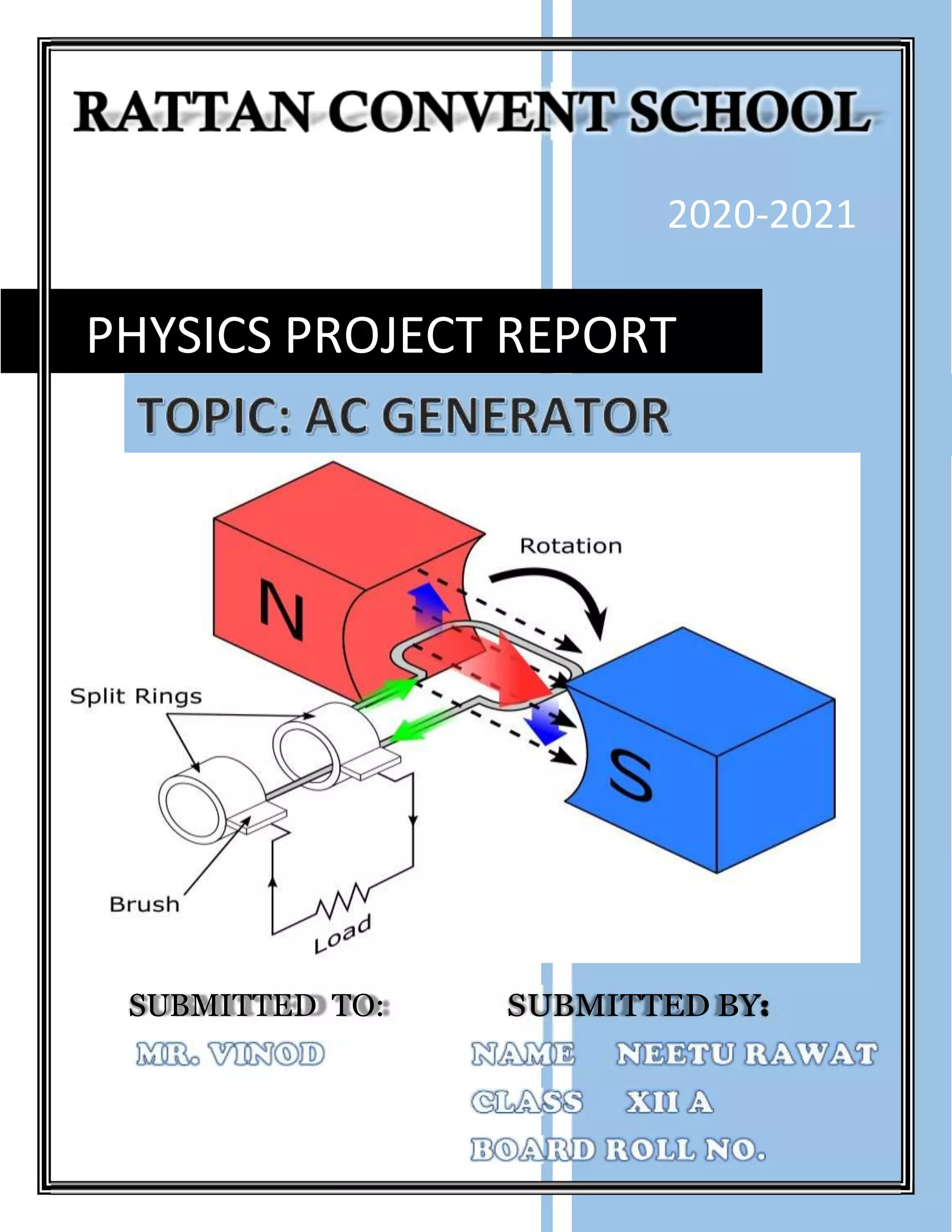
PHYSICS PROJECT REPORT
SUBMITTED TO: SUBMITTED BY:
It is to certify that
I certify that her project is upto my
expectations as per the guidelines
issued by C.B.S.E.
of
class XII-A, RATTAN CONVENT
SCHOOL has completed her project
file under my supervision. She has
taken proper care and shown utmost
sincerity in completion of this
project.
I would like to express my
special thanks of gratitude to
my teacher who gave
me the golden opportunity to do
this wonderful project on the
topic , while
working on this project I came
to know about so many new
things.
Secondly, I would also like to
thank my parents and friends
who helped me a lot in finalizing
this project within the limited
time frame.







INTRODUCTION
THEORY
CONSTRUCTION
WORKING
EFFICIENCY
USES
BIBLIOGRAPHY
INTRODUCTION
An electric generator is a
device that converts mechanical
energy to electrical energy. A
generator forces electric
current to flow through an
external circuit. The source of
mechanical energy may be a
reciprocating or turbine steam
engine, water falling through a
turbine or waterwheel, an
internal combustion engine, a
wind turbine, a hand crank,
compressed air, or any other
source of mechanical energy.
Generators provide nearly all of
the power for electric power
grids.
.
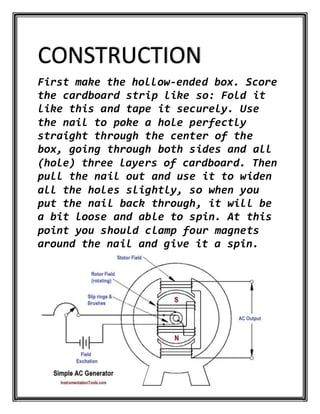
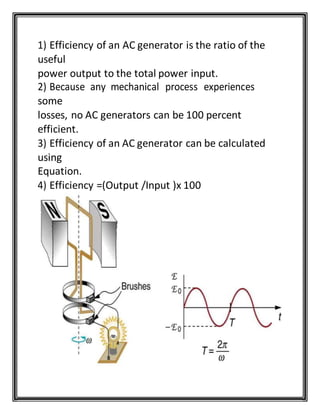
1. The strong magnetic field is produced by a
current flow through the field coil of the rotor.
2. The field coil in the rotor receives excitation
through the use of slip rings and brushes.
3. Two brushes are spring-held in contact with the
slip rings to provide the continuous connection
between the field coil and the external excitation
circuit.
4. The armature is contained within the windings
of the stator and is connected to the output.
5. Each time the rotor makes one complete
revolution, one complete cycle of AC is developed.
6. A generator has many turns of wire wound into
the slots of the rotor.
7. The magnitude of AC voltage generated by an
AC generator is dependent on the field strength
and speed of the rotor.
8. Most generators are operated at a constant
speed; therefore, the generated voltage depends
on field excitation, or strength.
THEORY
CONSTRUCTION
First make the hollow-ended box. Score
the cardboard strip like so: Fold it
like this and tape it securely. Use
the nail to poke a hole perfectly
straight through the center of the
box, going through both sides and all
(hole) three layers of cardboard. Then
pull the nail out and use it to widen
all the holes slightly, so when you
put the nail back through, it will be
a bit loose and able to spin. At this
point you should clamp four magnets
around the nail and give it a spin.
This makes sure the box is large
enough. The nail and magnets should
spin freely. The corners of the
magnets should NOT bump the inside of
the box as they spin. If the box is a
bit too small, start over and make it
a little bigger. Either that, or try a
thinner nail. Pick the spool of
number-30 magnet wire From the kit of
spools. This is the thinnest.
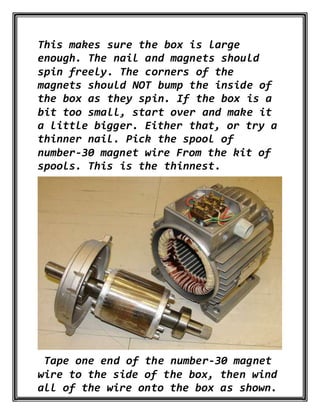
Tape one end of the number-30 magnet
wire to the side of the box, then wind
all of the wire onto the box as shown.
It's OK to cover up the nail hole.
Pull the taped end of the wire out,
then tape down both of the wires so
the coil doesn't unwind. You should
have about 10cm of wire left sticking
out. Use sandpaper or the edge of a
knife to scrape the thin plastic
coating off 2cm of the wire ends.
Remove every bit of red coating, so
the wire ends are coppery. Spread the
wire away from the nail hole and tape
it in place. Stick the nail back
through the holes and make sure it can
spin. Take your four magnets, stick
them face to face in two pairs, Then
stick the two pairs inside the box and
on either side of the nail so they
grab the nail. Push them around until
they are somewhat balanced and even,
then spin the nail and see if they
turn freely. If you wish, you can
stick 2cm squares of cardboard between
the magnets to straighten them, and
tape the magnets so they don't move
around on the nail Make sure that each
end of the generator's wires are
totally cleared of red plastic
coating. If there is a bit of plastic
left, it can act as an insulator which
turns off your light bulb circuit.
Twist the scraped end of each
generator wire securely around the
silver tip of each wire from the small
light bulb. (If necessary, use a knife
to strip more plastic from the ends of
the light bulb wires.) One generator
wire goes to one light bulb wire, the
other generator wire goes to the other
light bulb wire, and the two twisted
wire connections should not touch
together. In the twisted wires, metal
must touch metal with no plastic in
between.
The working of the transformer is explained All
metals contain a movable substance called "electric
charge". Even uncharged wires are full of charge!
After all, the atoms of the metal are made half of
positive protons and half of negative electrons.
Metals are special because their electrons don't stay
connected to the metal atoms, instead they fly
around inside the metal and form a type of electric
"liquid" inside the wires. All wires are full of electric
fluid. Modern scientists call this the "electron sea" or
"electron gas." It is not invisible, it actually gives
metals their silvery shine. The electron gas is like a
silvery fluid. When a circle of wire surrounds a
magnetic field, and the magnetic field then changes,
a circular "pressure" called Voltage appears. This
circular voltage trys to force the movable charges in
the wire to rotate around the circle. In other words,
moving magnets create electric currents in closed
circles of wire. A moving magnet causes a pumping
action. If the circuit is not complete, if there is a
break, then the pumping force will cause no charge
WORKING
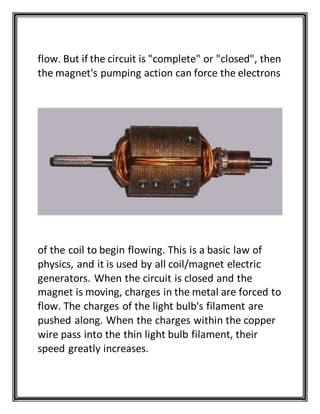
flow. But if the circuit is "complete" or "closed", then
the magnet's pumping action can force the electrons
of the coil to begin flowing. This is a basic law of
physics, and it is used by all coil/magnet electric
generators. When the circuit is closed and the
magnet is moving, charges in the metal are forced to
flow. The charges of the light bulb's filament are
pushed along. When the charges within the copper
wire pass into the thin light bulb filament, their
speed greatly increases.
USES OF AC GENERATOR
1. Aircraftauxiliarypower generation, wind
generators,
high speed gas turbine generators.
2. Hybrid electric vehicle (HEV) drive
systems,
automotivestartergenerators.
3. An ac generator, or 'alternator', is used to
produce
ac voltages for transmissionvia the grid
system or,
locally, as portable generators.
4. All of our household appliances runs on ac
current.
Ex: Refrigerator, washingmachines, oven,
lights, fan
etc.
EFFICIENCY
Expression for Instantaneous e.m.f. Produced:
Let position of the coil at any time t. It make angle q
with
vertical. If w is uniform angular speed of the coil.
Then q = wt
B be the strength of magnetic field n be the
number of turns
in the coil and A area of the coil then magnetic flux
with the
coil in this position is given by:
f = nBA Cos q = nBA Cos wt.
Differentiate w.r.t. time
= nBA (-Sin wt) w
= -nBA w Sin wt
e = - (-nBA w Sin wt)
maximum value of e.m.f. say E0
e = E0 Sin wt.
1) Efficiency of an AC generator is the ratio of the
useful
power output to the total power input.
2) Because any mechanical process experiences
some
losses, no AC generators can be 100 percent
efficient.
3) Efficiency of an AC generator can be calculated
using
Equation.
4) Efficiency =(Output /Input )x 100
BIBLIOGRAPHY
i. www.wikipedia.com
ii. www.vedantu.com
iii. www.byjuys.com
iv. www.brainly.com
v. www.meritnation.com
vi. www.quora.com
vii. www.jagaranjosh.com
viii. www.sciencehub.com
ix. www.sciencevilla.com
x. www.phy12.com

498639006-PHYsics-class12-project-report-cbse-2020-2021-on-topic-ac-generator (1).docx

  • 1.
  • 2.
    It is tocertify that I certify that her project is upto my expectations as per the guidelines issued by C.B.S.E. of class XII-A, RATTAN CONVENT SCHOOL has completed her project file under my supervision. She has taken proper care and shown utmost sincerity in completion of this project.
  • 3.
    I would liketo express my special thanks of gratitude to my teacher who gave me the golden opportunity to do this wonderful project on the topic , while working on this project I came to know about so many new things. Secondly, I would also like to thank my parents and friends who helped me a lot in finalizing this project within the limited time frame.
  • 4.
  • 5.
    INTRODUCTION An electric generatoris a device that converts mechanical energy to electrical energy. A generator forces electric current to flow through an external circuit. The source of mechanical energy may be a reciprocating or turbine steam engine, water falling through a turbine or waterwheel, an internal combustion engine, a wind turbine, a hand crank, compressed air, or any other source of mechanical energy. Generators provide nearly all of the power for electric power grids.
  • 6.
    . 1. The strongmagnetic field is produced by a current flow through the field coil of the rotor. 2. The field coil in the rotor receives excitation through the use of slip rings and brushes. 3. Two brushes are spring-held in contact with the slip rings to provide the continuous connection between the field coil and the external excitation circuit. 4. The armature is contained within the windings of the stator and is connected to the output. 5. Each time the rotor makes one complete revolution, one complete cycle of AC is developed. 6. A generator has many turns of wire wound into the slots of the rotor. 7. The magnitude of AC voltage generated by an AC generator is dependent on the field strength and speed of the rotor. 8. Most generators are operated at a constant speed; therefore, the generated voltage depends on field excitation, or strength. THEORY
  • 7.
    CONSTRUCTION First make thehollow-ended box. Score the cardboard strip like so: Fold it like this and tape it securely. Use the nail to poke a hole perfectly straight through the center of the box, going through both sides and all (hole) three layers of cardboard. Then pull the nail out and use it to widen all the holes slightly, so when you put the nail back through, it will be a bit loose and able to spin. At this point you should clamp four magnets around the nail and give it a spin.
  • 8.
    This makes surethe box is large enough. The nail and magnets should spin freely. The corners of the magnets should NOT bump the inside of the box as they spin. If the box is a bit too small, start over and make it a little bigger. Either that, or try a thinner nail. Pick the spool of number-30 magnet wire From the kit of spools. This is the thinnest. Tape one end of the number-30 magnet wire to the side of the box, then wind all of the wire onto the box as shown.
  • 9.
    It's OK tocover up the nail hole. Pull the taped end of the wire out, then tape down both of the wires so the coil doesn't unwind. You should have about 10cm of wire left sticking out. Use sandpaper or the edge of a knife to scrape the thin plastic coating off 2cm of the wire ends. Remove every bit of red coating, so the wire ends are coppery. Spread the wire away from the nail hole and tape it in place. Stick the nail back through the holes and make sure it can spin. Take your four magnets, stick them face to face in two pairs, Then stick the two pairs inside the box and on either side of the nail so they grab the nail. Push them around until they are somewhat balanced and even, then spin the nail and see if they turn freely. If you wish, you can stick 2cm squares of cardboard between the magnets to straighten them, and tape the magnets so they don't move around on the nail Make sure that each end of the generator's wires are
  • 10.
    totally cleared ofred plastic coating. If there is a bit of plastic left, it can act as an insulator which turns off your light bulb circuit. Twist the scraped end of each generator wire securely around the silver tip of each wire from the small light bulb. (If necessary, use a knife to strip more plastic from the ends of the light bulb wires.) One generator wire goes to one light bulb wire, the other generator wire goes to the other light bulb wire, and the two twisted wire connections should not touch together. In the twisted wires, metal must touch metal with no plastic in between.
  • 11.
    The working ofthe transformer is explained All metals contain a movable substance called "electric charge". Even uncharged wires are full of charge! After all, the atoms of the metal are made half of positive protons and half of negative electrons. Metals are special because their electrons don't stay connected to the metal atoms, instead they fly around inside the metal and form a type of electric "liquid" inside the wires. All wires are full of electric fluid. Modern scientists call this the "electron sea" or "electron gas." It is not invisible, it actually gives metals their silvery shine. The electron gas is like a silvery fluid. When a circle of wire surrounds a magnetic field, and the magnetic field then changes, a circular "pressure" called Voltage appears. This circular voltage trys to force the movable charges in the wire to rotate around the circle. In other words, moving magnets create electric currents in closed circles of wire. A moving magnet causes a pumping action. If the circuit is not complete, if there is a break, then the pumping force will cause no charge WORKING
  • 12.
    flow. But ifthe circuit is "complete" or "closed", then the magnet's pumping action can force the electrons of the coil to begin flowing. This is a basic law of physics, and it is used by all coil/magnet electric generators. When the circuit is closed and the magnet is moving, charges in the metal are forced to flow. The charges of the light bulb's filament are pushed along. When the charges within the copper wire pass into the thin light bulb filament, their speed greatly increases.
  • 13.
    USES OF ACGENERATOR 1. Aircraftauxiliarypower generation, wind generators, high speed gas turbine generators. 2. Hybrid electric vehicle (HEV) drive systems, automotivestartergenerators. 3. An ac generator, or 'alternator', is used to produce ac voltages for transmissionvia the grid system or, locally, as portable generators. 4. All of our household appliances runs on ac current. Ex: Refrigerator, washingmachines, oven, lights, fan etc.
  • 14.
    EFFICIENCY Expression for Instantaneouse.m.f. Produced: Let position of the coil at any time t. It make angle q with vertical. If w is uniform angular speed of the coil. Then q = wt B be the strength of magnetic field n be the number of turns in the coil and A area of the coil then magnetic flux with the coil in this position is given by: f = nBA Cos q = nBA Cos wt. Differentiate w.r.t. time = nBA (-Sin wt) w = -nBA w Sin wt e = - (-nBA w Sin wt) maximum value of e.m.f. say E0 e = E0 Sin wt.
  • 15.
    1) Efficiency ofan AC generator is the ratio of the useful power output to the total power input. 2) Because any mechanical process experiences some losses, no AC generators can be 100 percent efficient. 3) Efficiency of an AC generator can be calculated using Equation. 4) Efficiency =(Output /Input )x 100
  • 16.
    BIBLIOGRAPHY i. www.wikipedia.com ii. www.vedantu.com iii.www.byjuys.com iv. www.brainly.com v. www.meritnation.com vi. www.quora.com vii. www.jagaranjosh.com viii. www.sciencehub.com ix. www.sciencevilla.com x. www.phy12.com