KAUSHIK DEBINA SRIRUPA MADHUMITA SOUMYASUBHRA SOUMYAJYOTI DEBAYAN SOURAV SANJANA TANISTHA RAUNAK  STUDENTS INCLUDED IN THE GROUP ARE :-
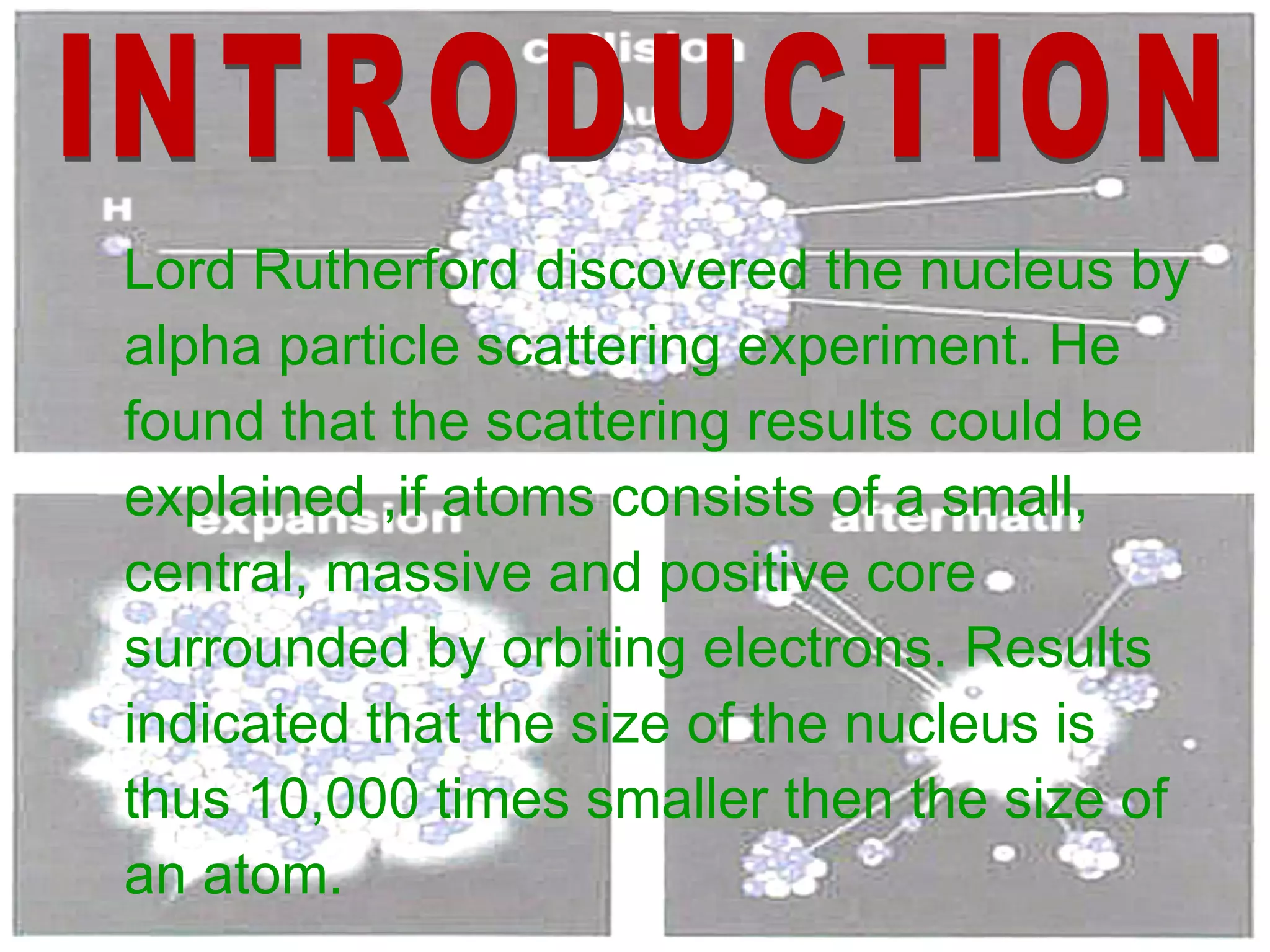
Lord Rutherford discovered the nucleus by alpha particle scattering experiment. He found that the scattering results could be explained ,if atoms consists of a small, central, massive and positive core surrounded by orbiting electrons. Results indicated that the size of the nucleus is thus 10,000 times smaller then the size of an atom. INTRODUCTION
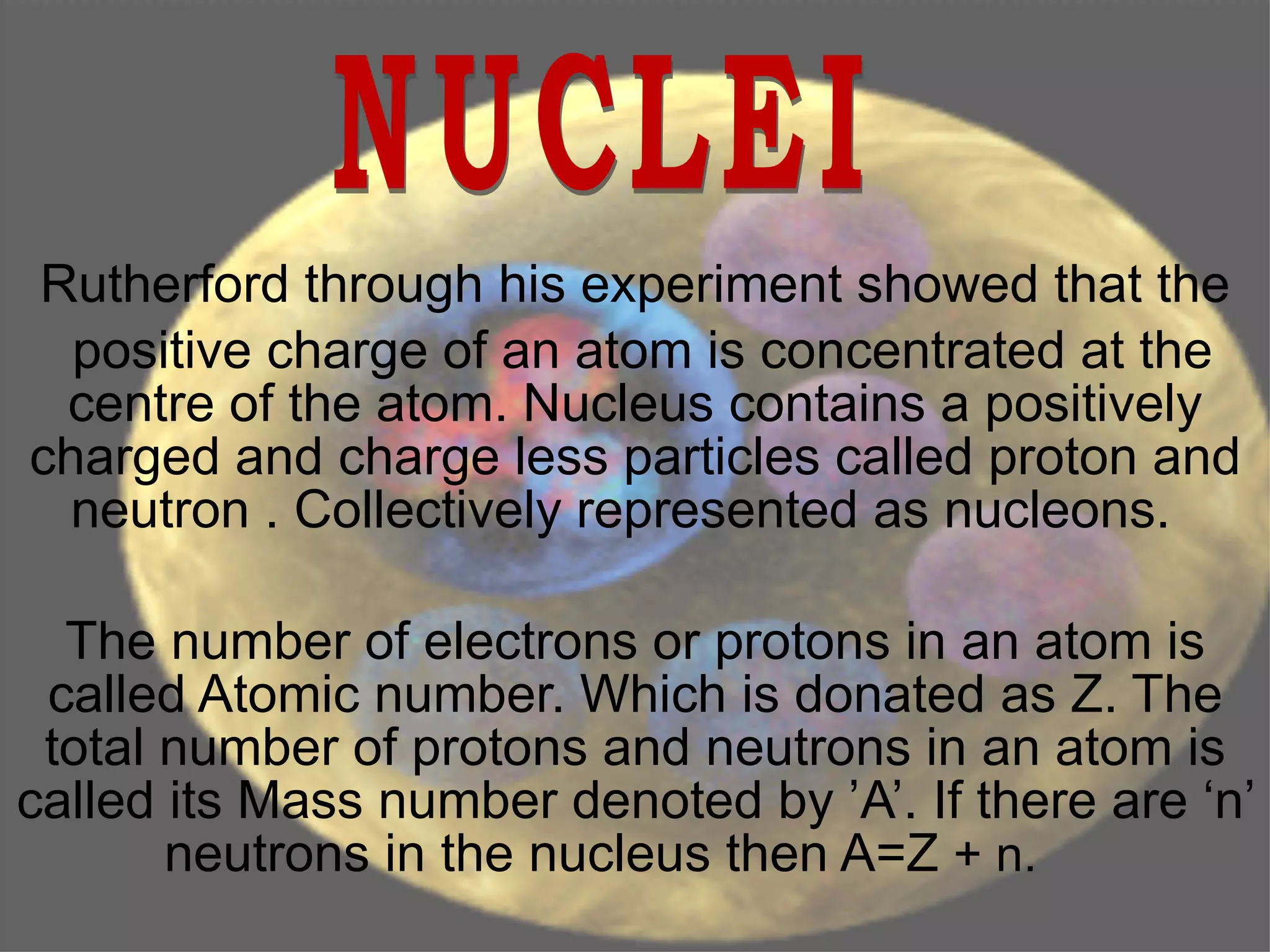
Rutherford through his experiment showed that the positive charge of an atom is concentrated at the centre of the atom. Nucleus contains a positively charged and charge less particles called proton and neutron . Collectively represented as nucleons.  The number of electrons or protons in an atom is called Atomic number. Which is donated as Z. The total number of protons and neutrons in an atom is called its Mass number denoted by ’A’. If there are ‘n’ neutrons in the nucleus then A=Z  + n.  NUCLEI
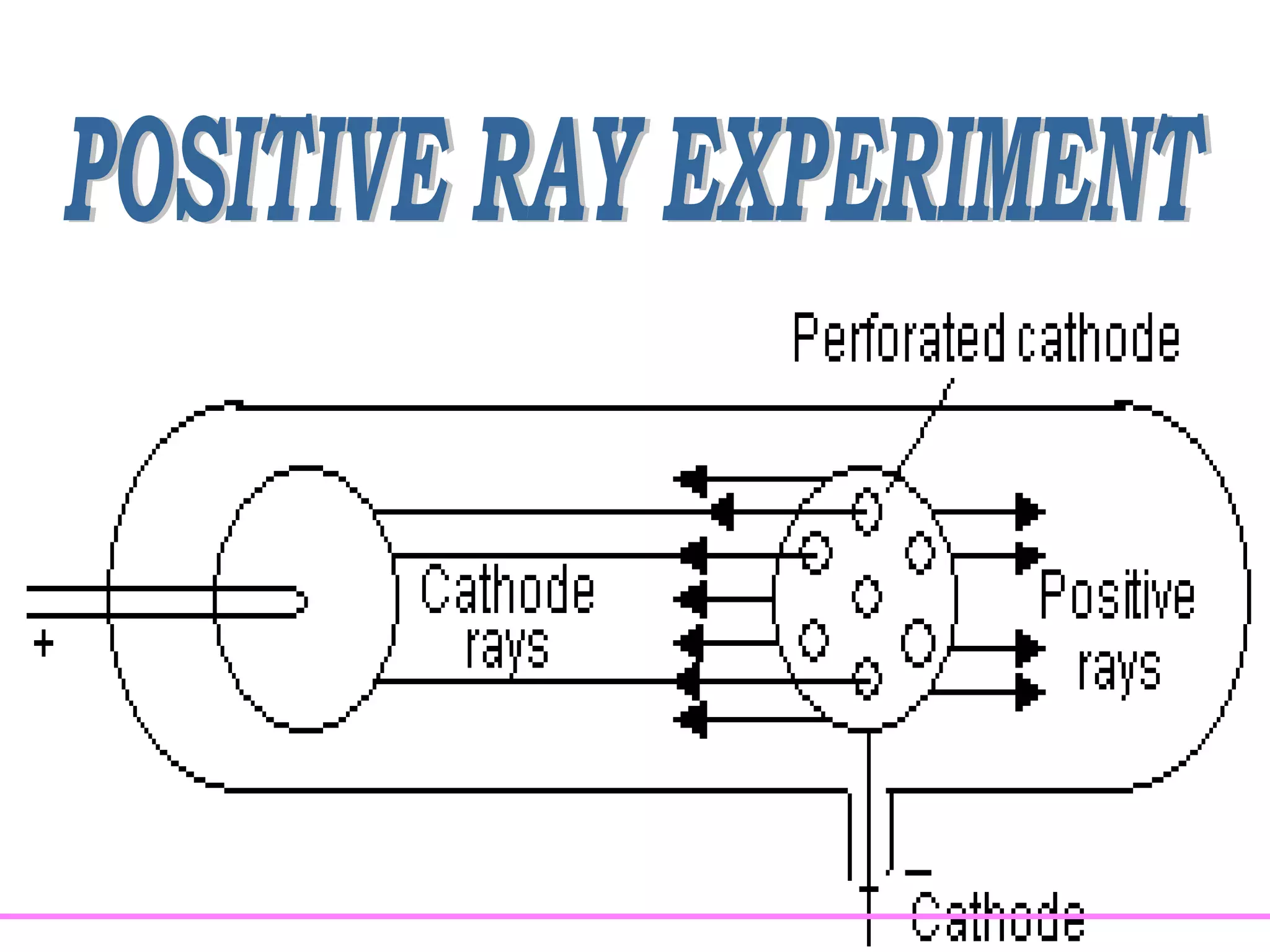
Goldstein modified the discharge tube & used a perforated cathode to discover a new kind of rays called ‘canal rays’. the rays were travelling in straight lines opposite to the direction of motion of the electron. They emerged the cathode through a hole or canal in it. So they are called canal rays. When a deflected beam of canal rays are found they were positively charged particles & hence they are called POSITIVE RAYS .   POSITIVE RAYS
POSITIVE RAY EXPERIMENT
 
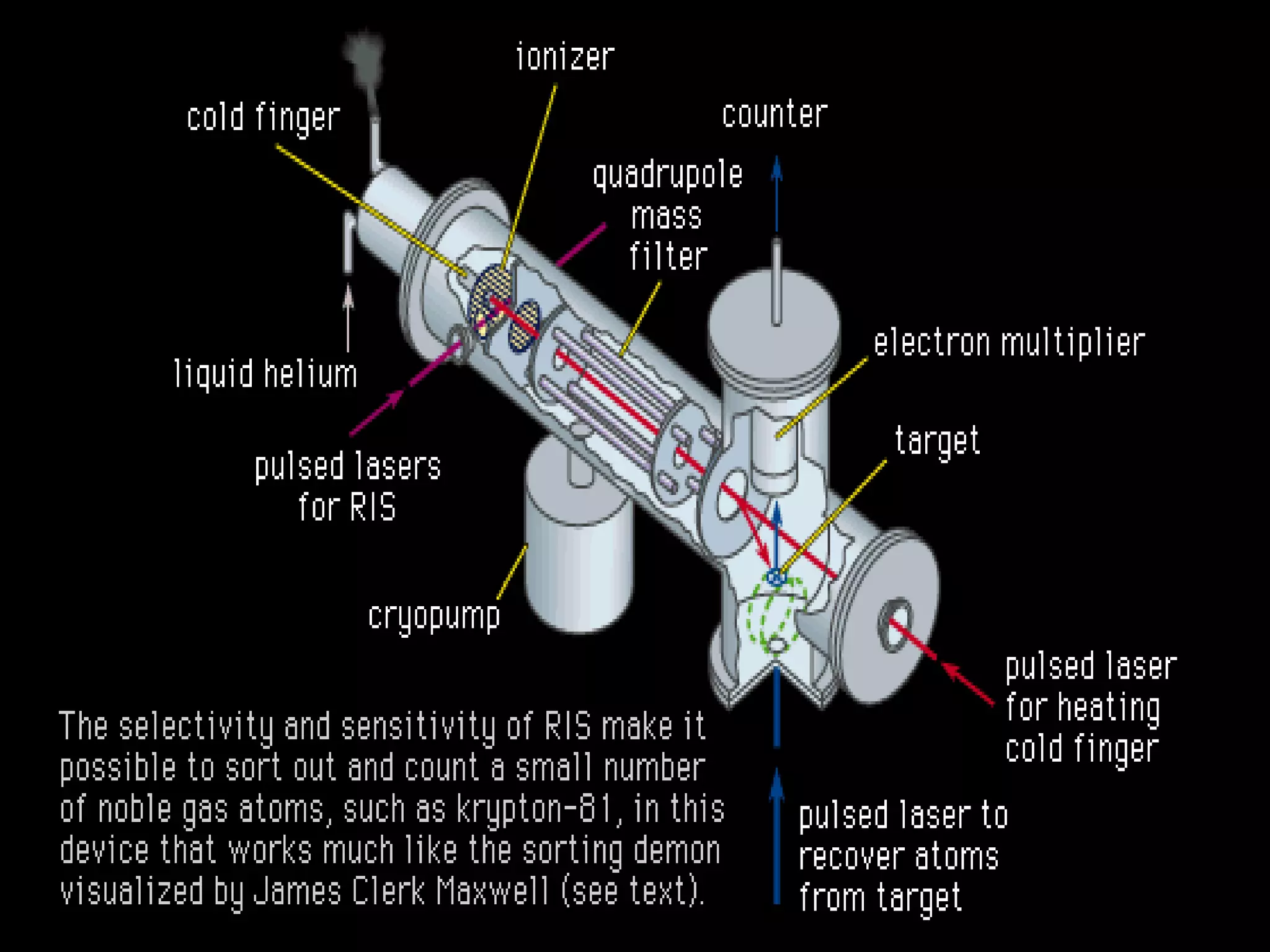
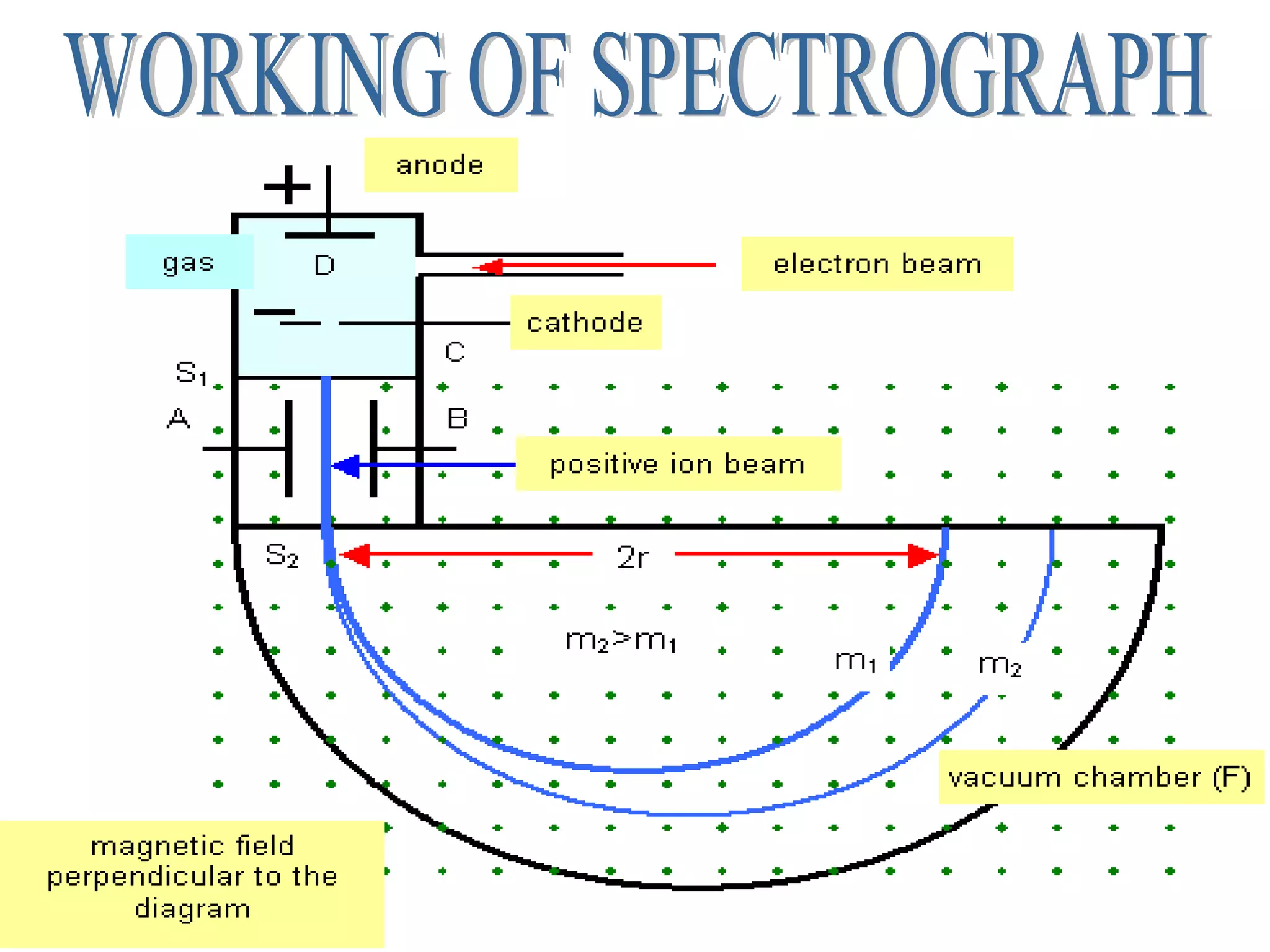
The Bainbridge mass spectrograph is used to find the specific charge and hence the mass of positive ions. This instrument sorts out a mixed stream of ions according to their atomic weight .
As positive ions are deflected in electric and magnetic fields so they are subjected to a crossed electric and magnetic fields simultaneously These positive- ions are subjected to an uniform magnetic field. They move in a circular path of radius (R) which depends upon the mass of the charged particle hence there masses can be measured.  PRINCIPLE OF BAINBRIDGE MASS SPECTROGRAPH
WORKING OF SPECTROGRAPH
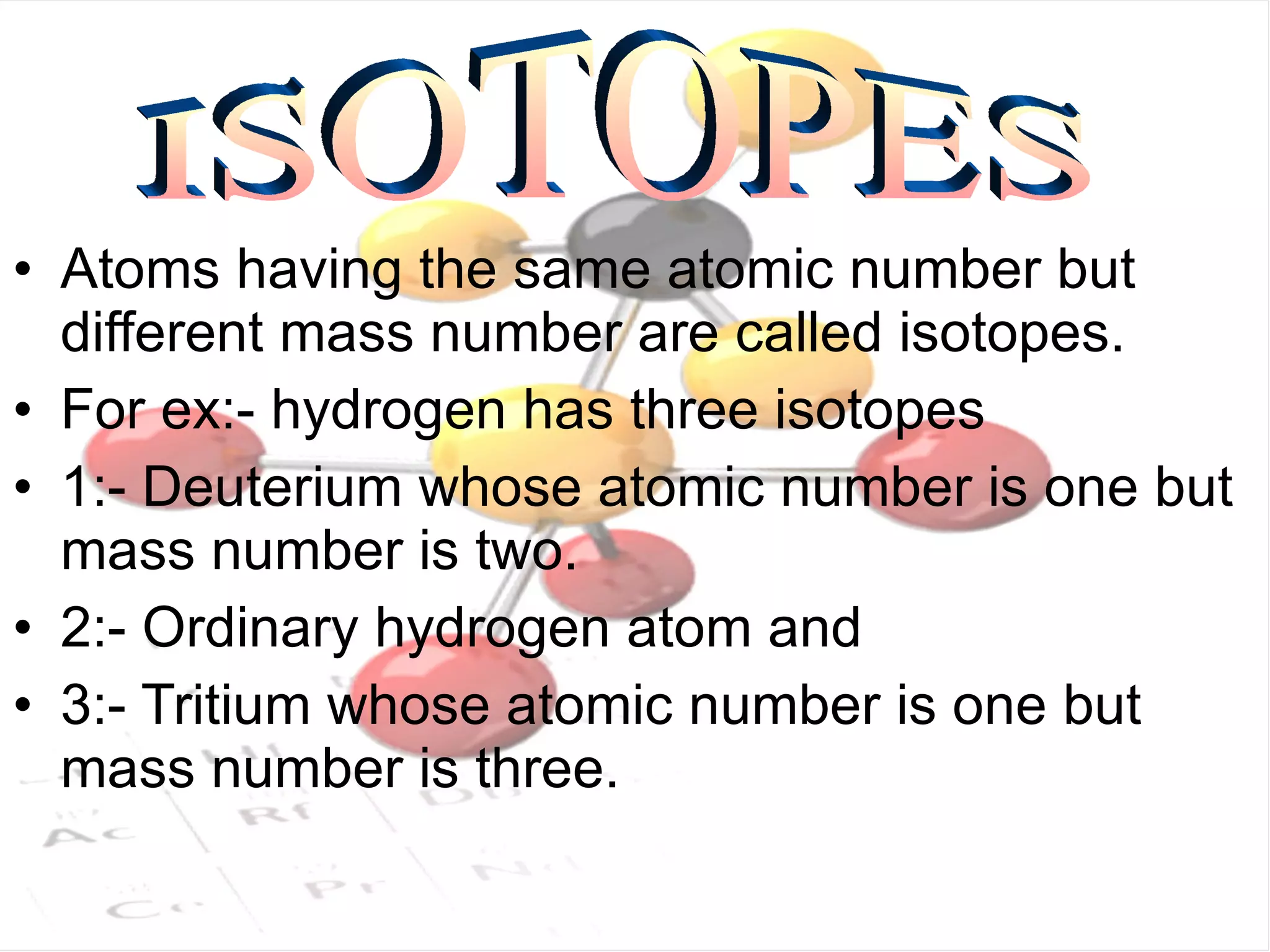
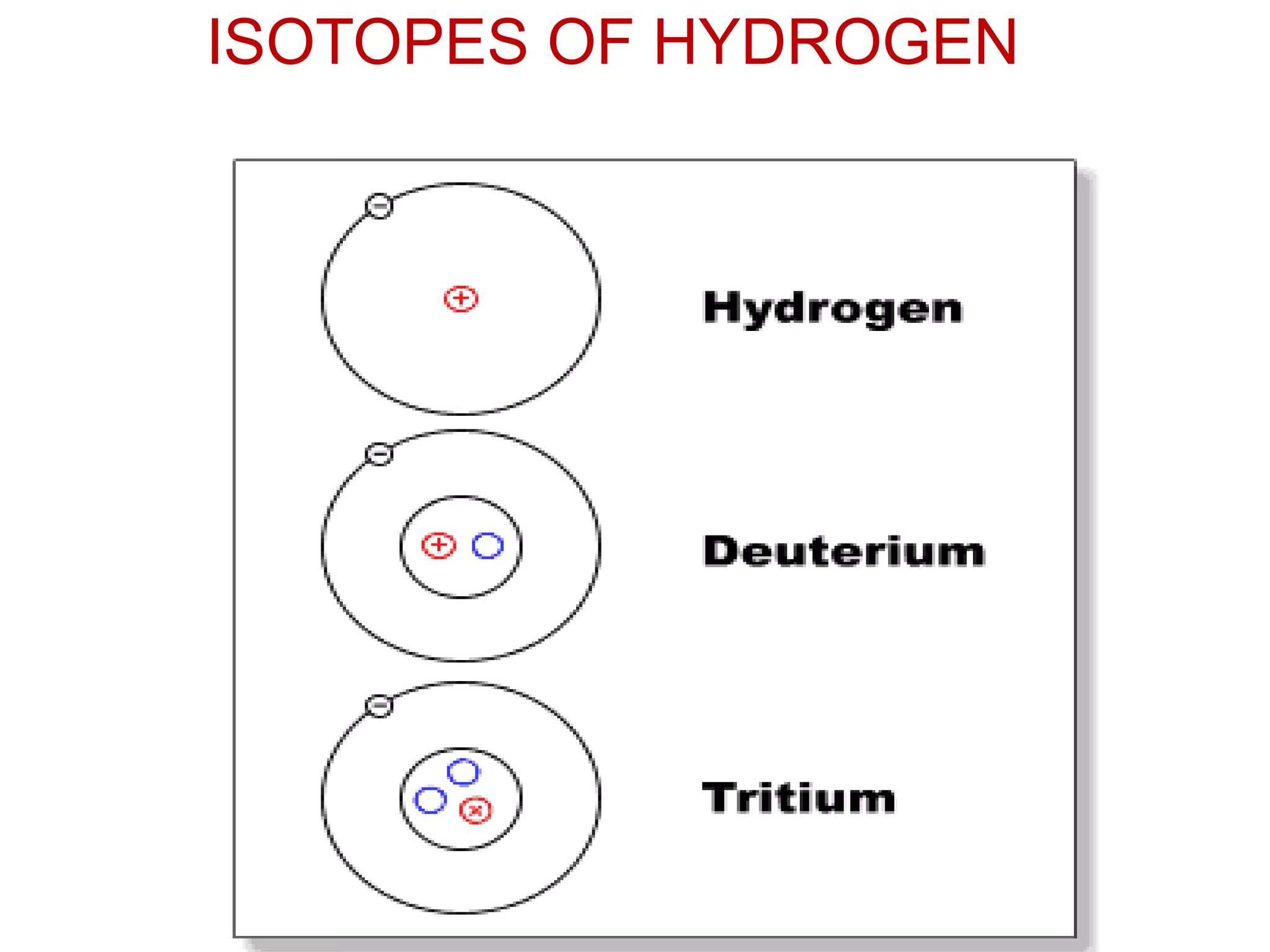
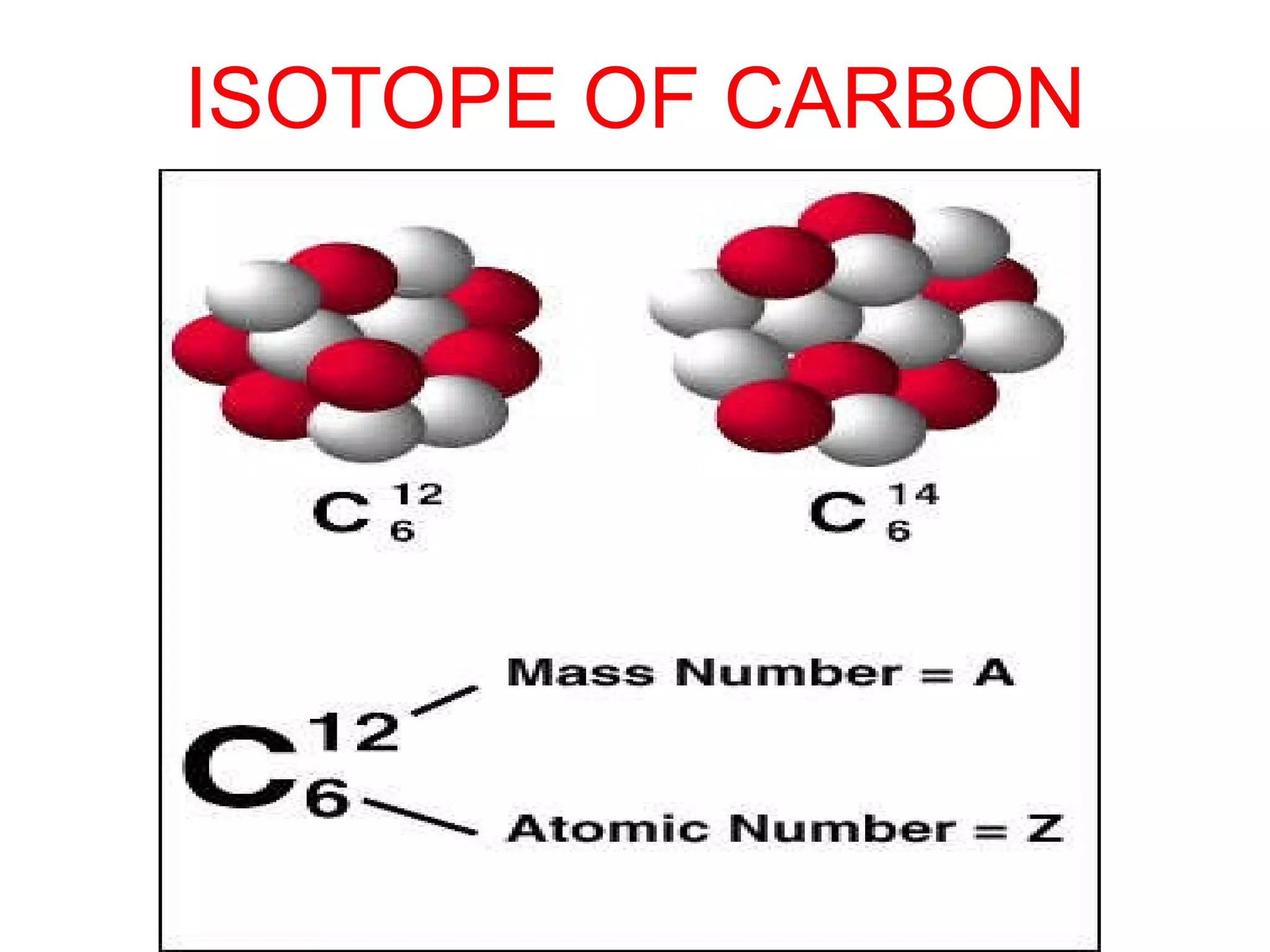
Atoms having the same atomic number but different mass number are called isotopes. For ex:- hydrogen has three isotopes  1:- Deuterium whose atomic number is one but mass number is two. 2:- Ordinary hydrogen atom and  3:- Tritium whose atomic number is one but mass number is three. ISOTOPES
ISOTOPES OF HYDROGEN
ISOTOPE OF CARBON
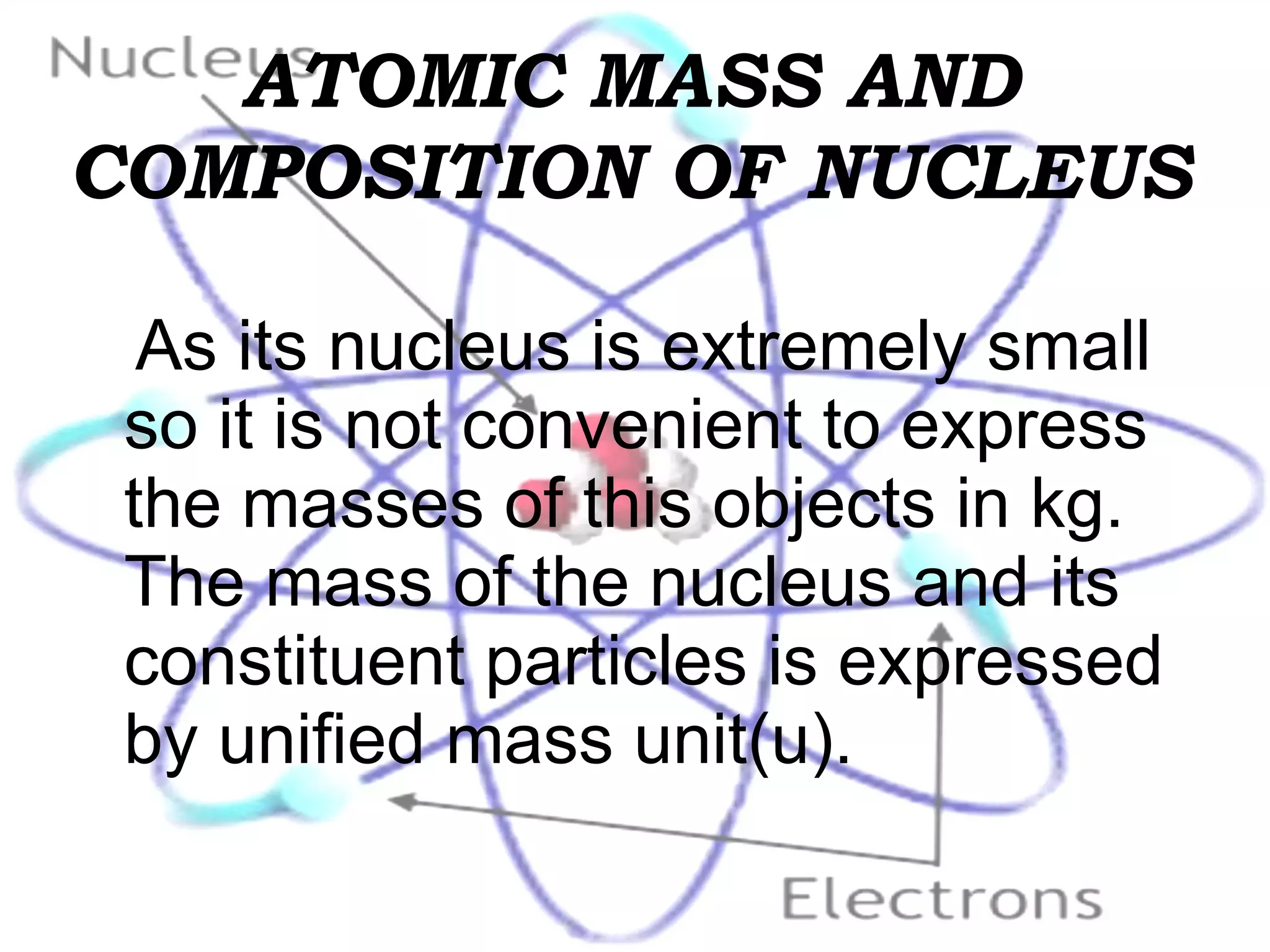
ATOMIC MASS AND COMPOSITION OF NUCLEUS As its nucleus is extremely small so it is not convenient to express the masses of this objects in kg. The mass of the nucleus and its constituent particles is expressed by unified mass unit(u).
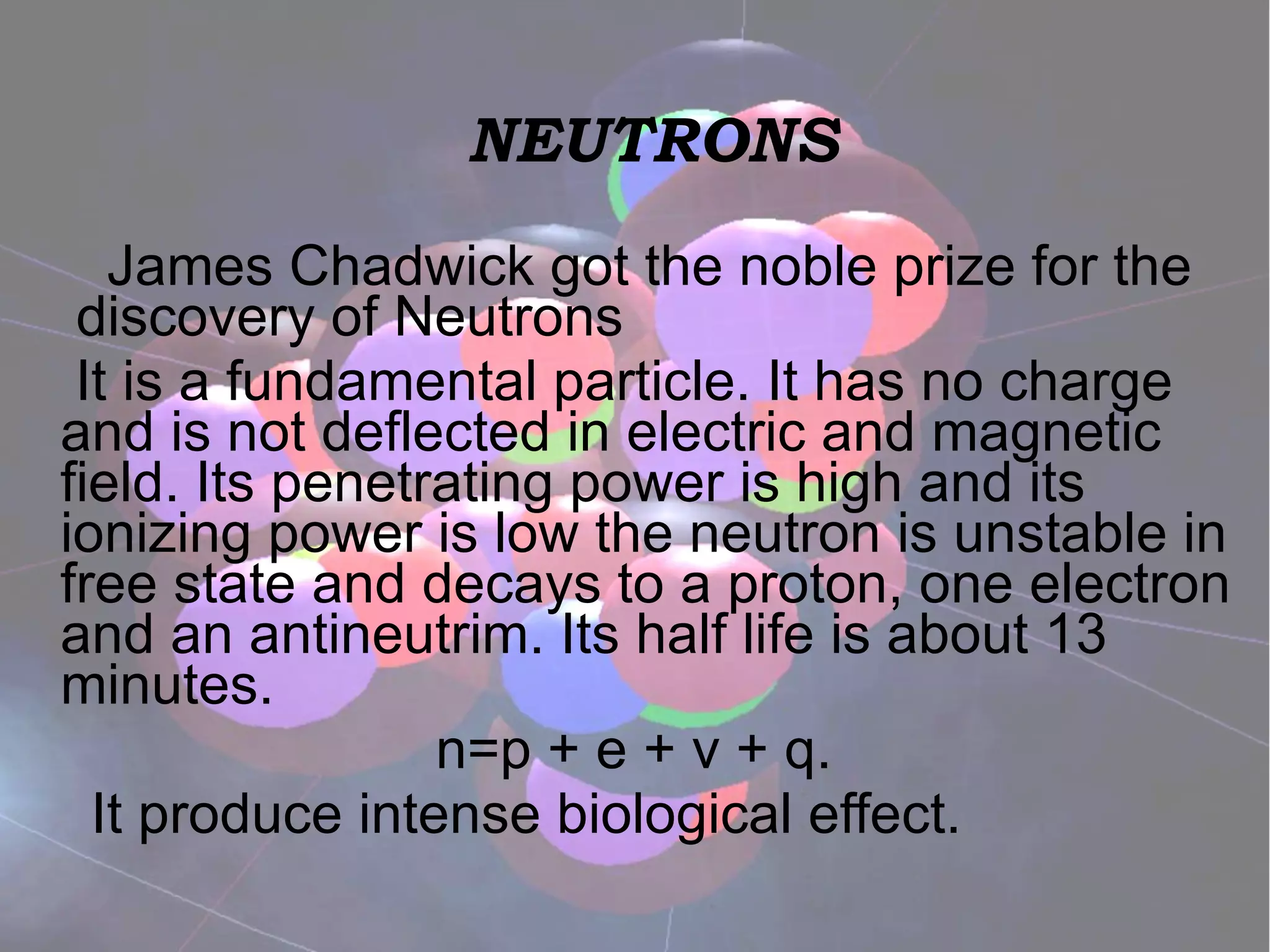
NEUTRONS James Chadwick got the noble prize for the  discovery of Neutrons It is a fundamental particle. It has no charge and is not deflected in electric and magnetic field. Its penetrating power is high and its ionizing power is low the neutron is unstable in free state and decays to a proton, one electron and an antineutrim. Its half life is about 13 minutes.  n=p + e + v + q. It produce intense biological effect.
PROPERTIES 1:- Neutron is a fundamental particle , except hydrogen all other elements contains neutron 2:- Neutron has no charge and hence is not deflected in electric and magnetic fields. 3:- Its penetrating power is high and its ionizing power is low. 4:- In free state neutron is unstable. 5:- Neutron produce intense biological effect.
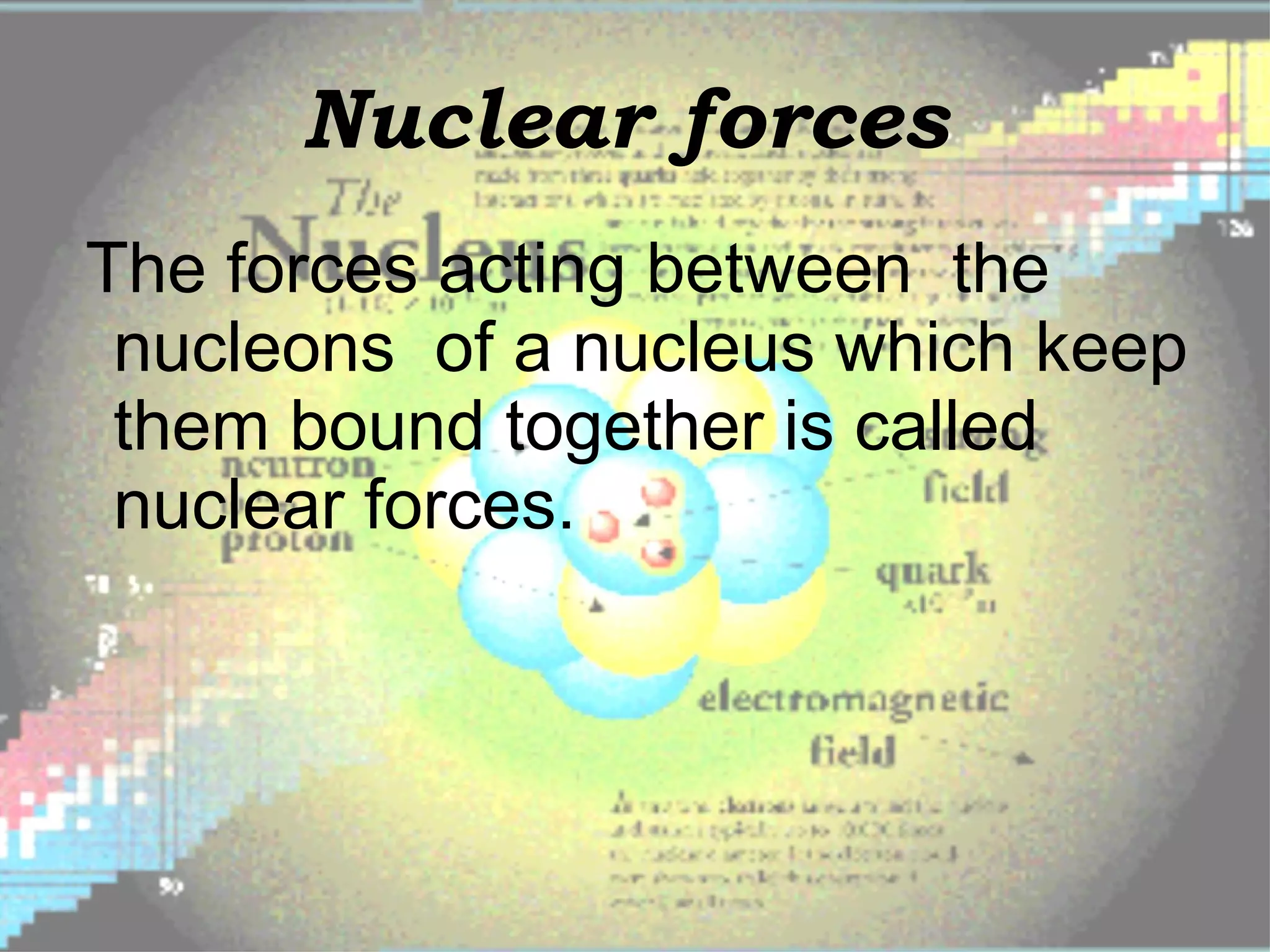
Nuclear forces   The forces acting between  the nucleons  of a nucleus which keep them bound together is called nuclear forces.
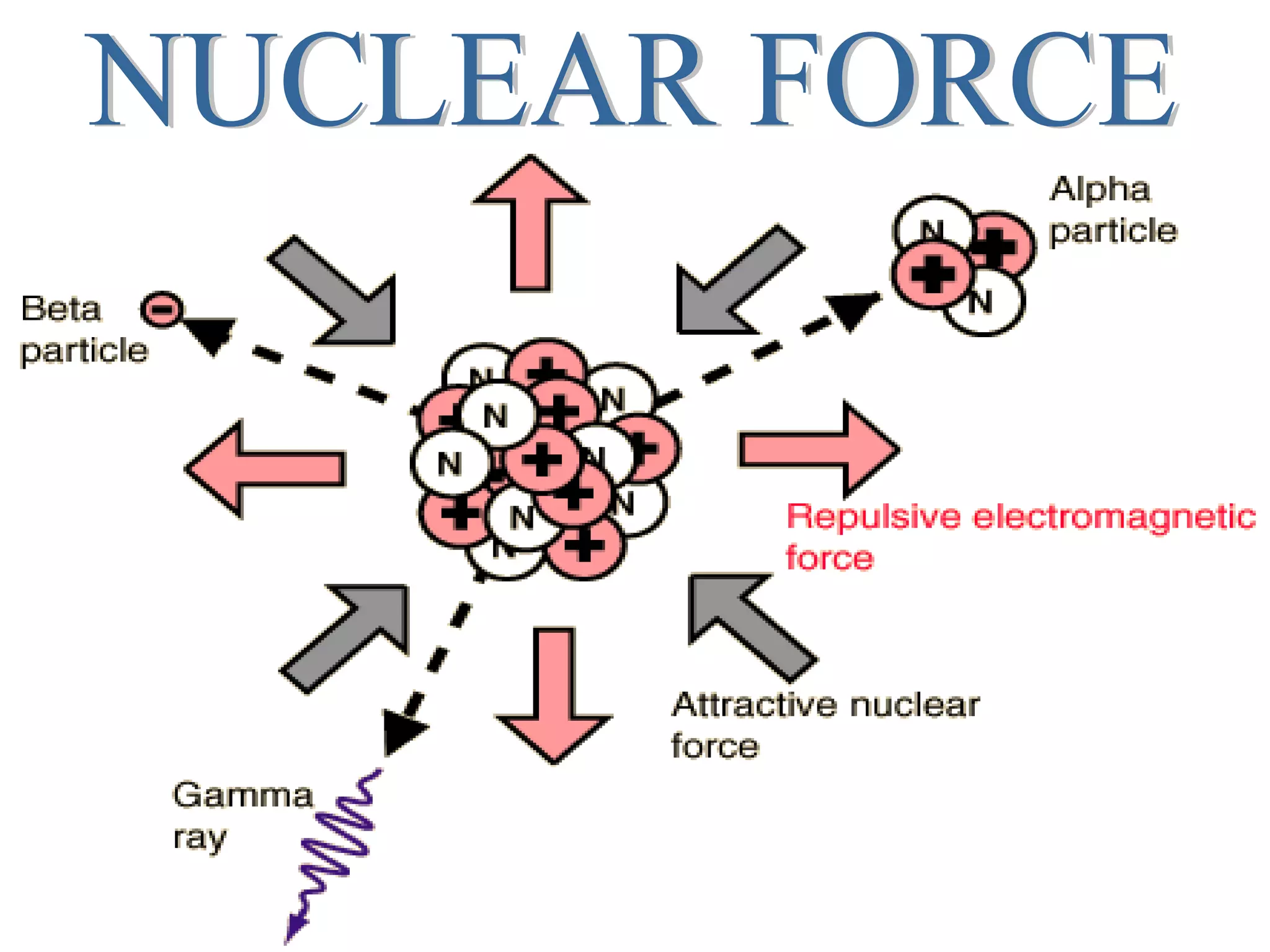
NUCLEAR FORCE
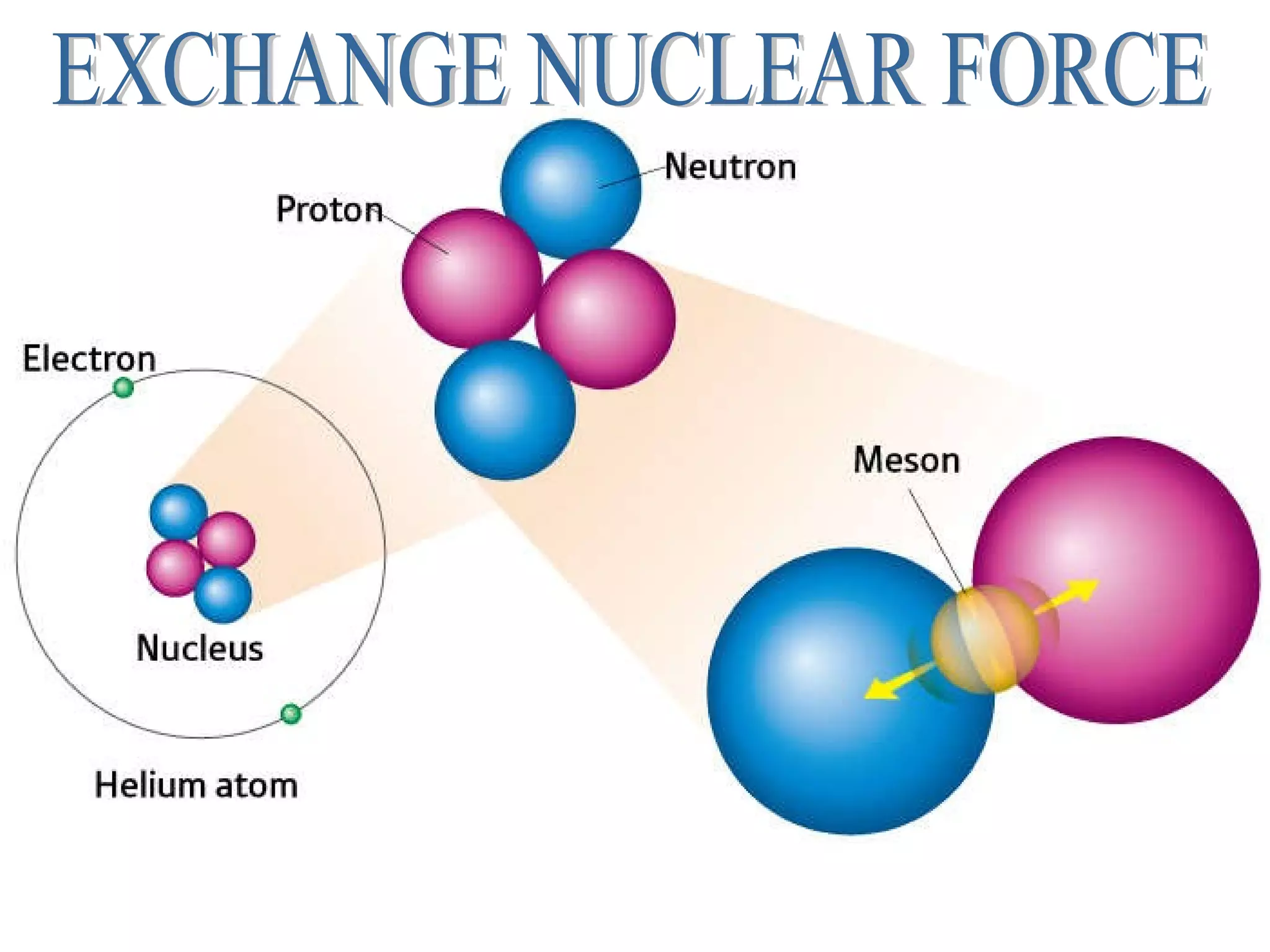
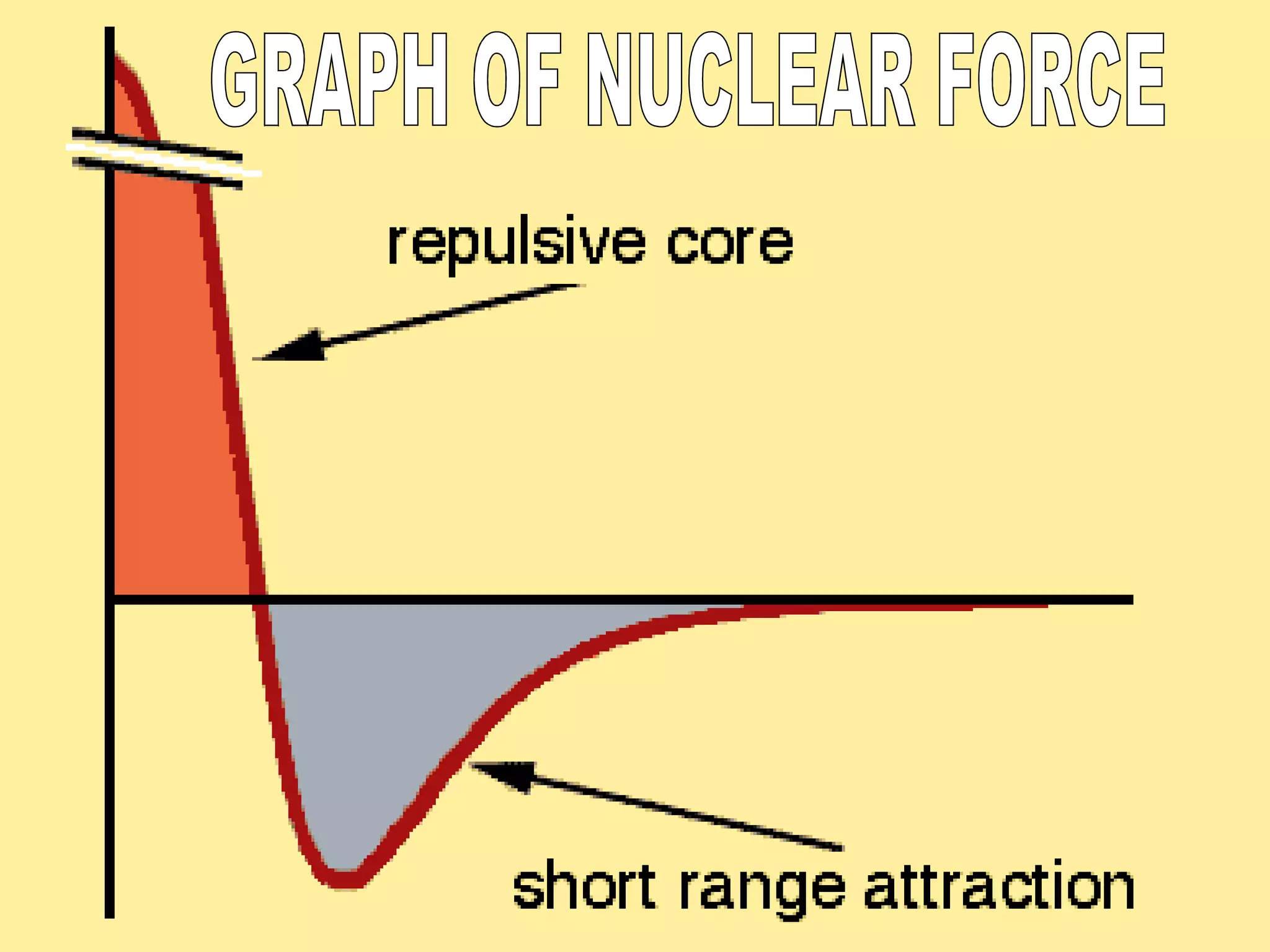
They are the strong attractive forces in nature.  They are very short range force  Each nucleon can interact with only a limited number of nucleons very close to it.  This forces are also called exchange forces  Nuclear force depends on the relative orientation of the spins of the interacting nucleons.  Nuclear forces are non-central forces, because the force between two nucleons does not act along the line joining the centres . PROPERTIES OF NUCLEAR FORCE
EXCHANGE NUCLEAR FORCE
GRAPH OF NUCLEAR FORCE
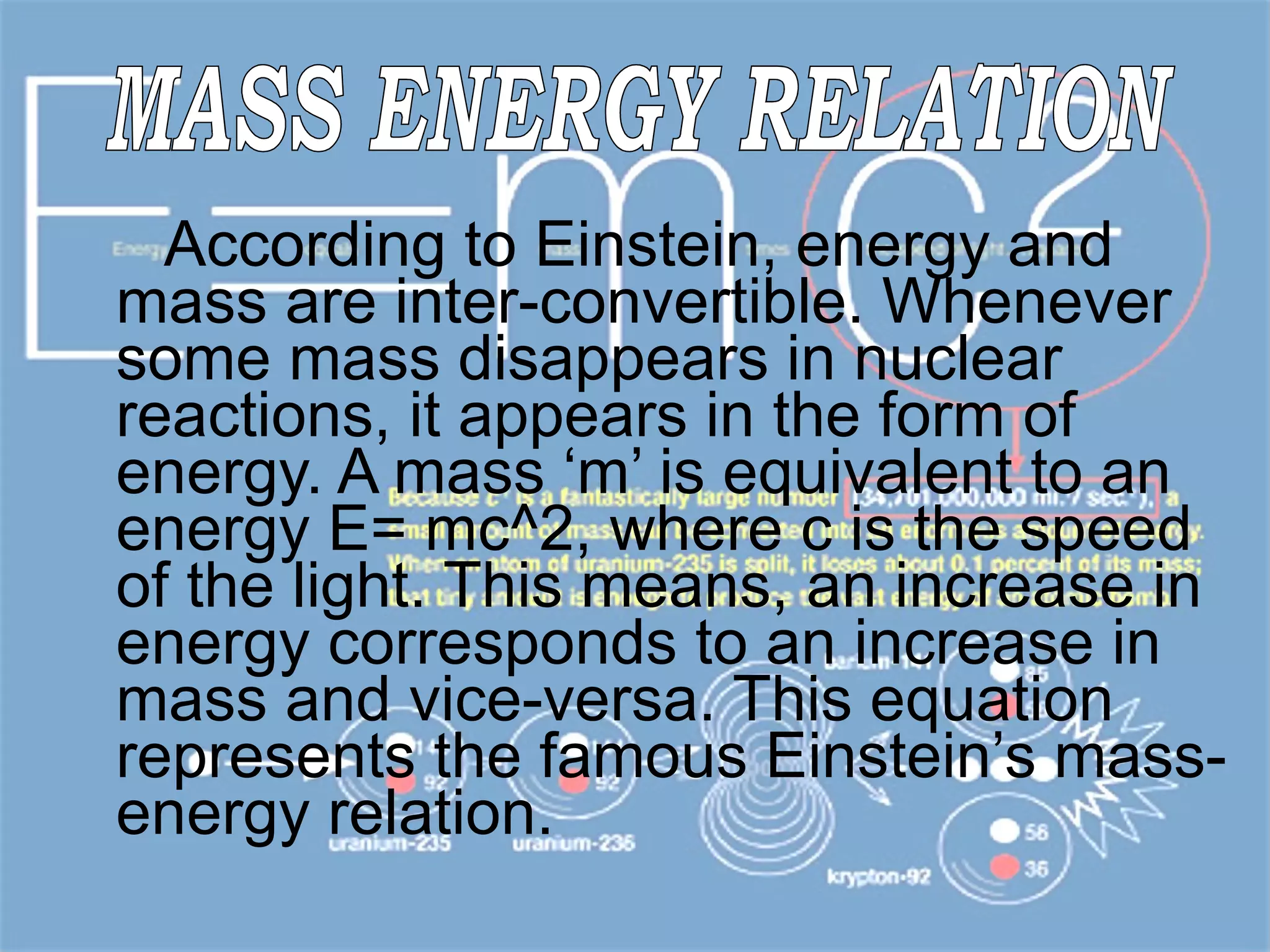
According to Einstein, energy and mass are inter-convertible. Whenever some mass disappears in nuclear reactions, it appears in the form of energy. A mass ‘m’ is equivalent to an energy E= mc^2, where c is the speed of the light. This means, an increase in energy corresponds to an increase in mass and vice-versa. This equation represents the famous Einstein’s mass-energy relation.  MASS ENERGY RELATION
 
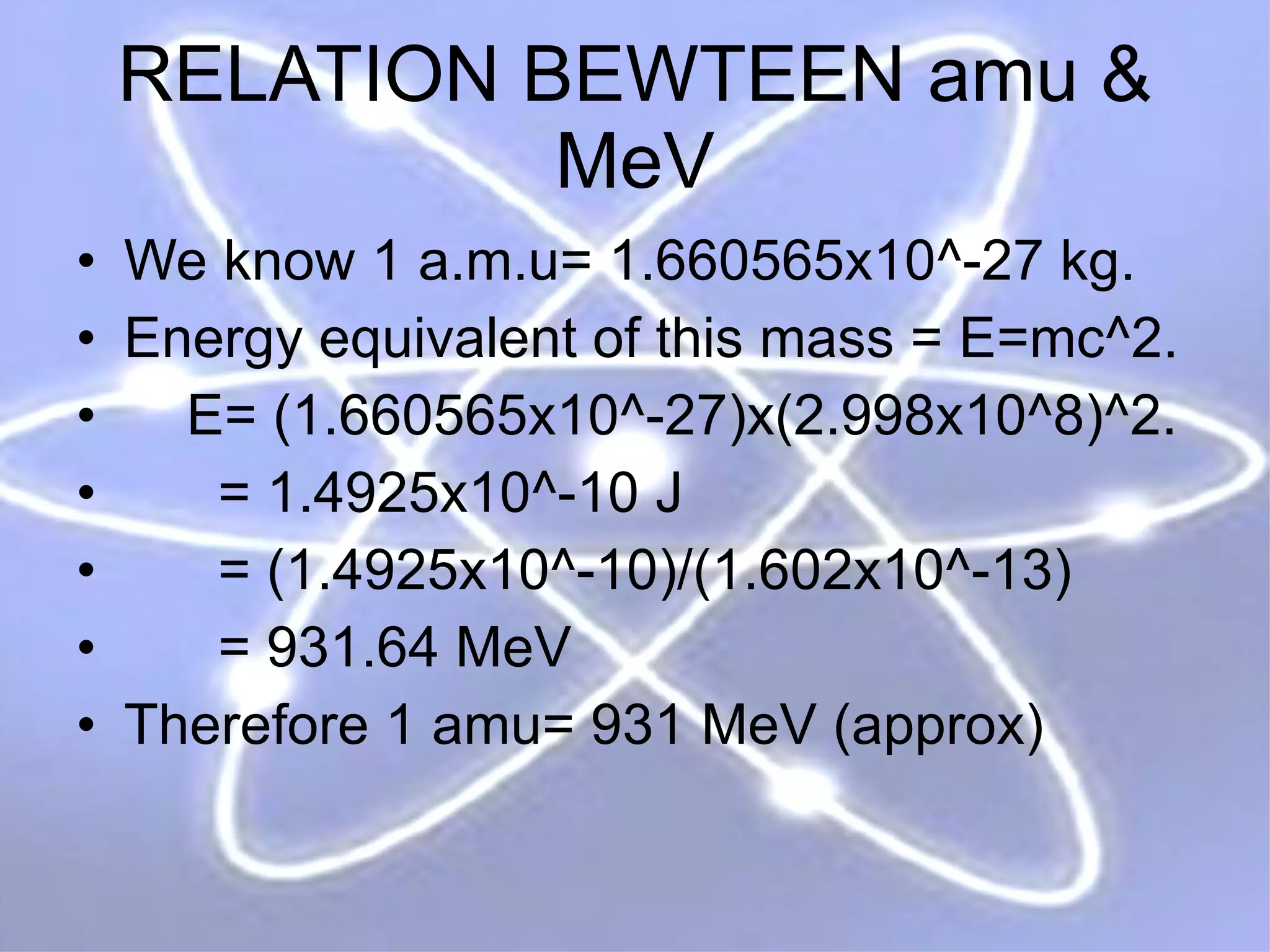
RELATION BEWTEEN amu & MeV We know 1 a.m.u= 1.660565x10^-27 kg.  Energy equivalent of this mass = E=mc^2. E= (1.660565x10^-27)x(2.998x10^8)^2. = 1.4925x10^-10 J = (1.4925x10^-10)/(1.602x10^-13) = 931.64 MeV Therefore 1 amu= 931 MeV (approx)
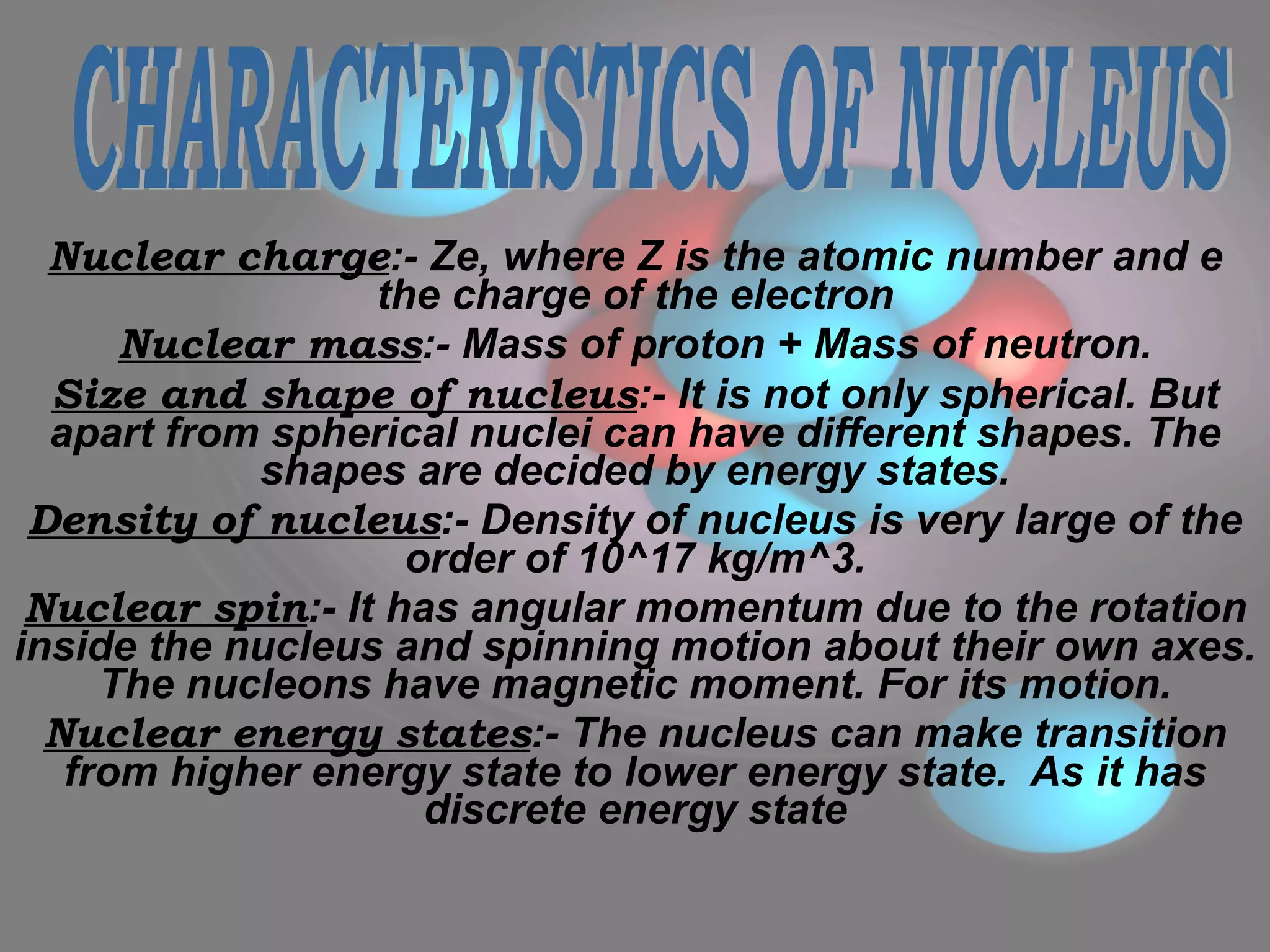
Nuclear charge :- Ze, where Z is the atomic number and e the charge of the electron Nuclear mass :- Mass of proton + Mass of neutron. Size and shape of nucleus :- It is not only spherical. But apart from spherical nuclei can have different shapes. The shapes are decided by energy states. Density of nucleus :- Density of nucleus is very large of the order of 10^17 kg/m^3. Nuclear spin :- It has angular momentum due to the rotation inside the nucleus and spinning motion about their own axes. The nucleons have magnetic moment. For its motion. Nuclear energy states :- The nucleus can make transition from higher energy state to lower energy state.  As it has discrete energy state CHARACTERISTICS OF NUCLEUS
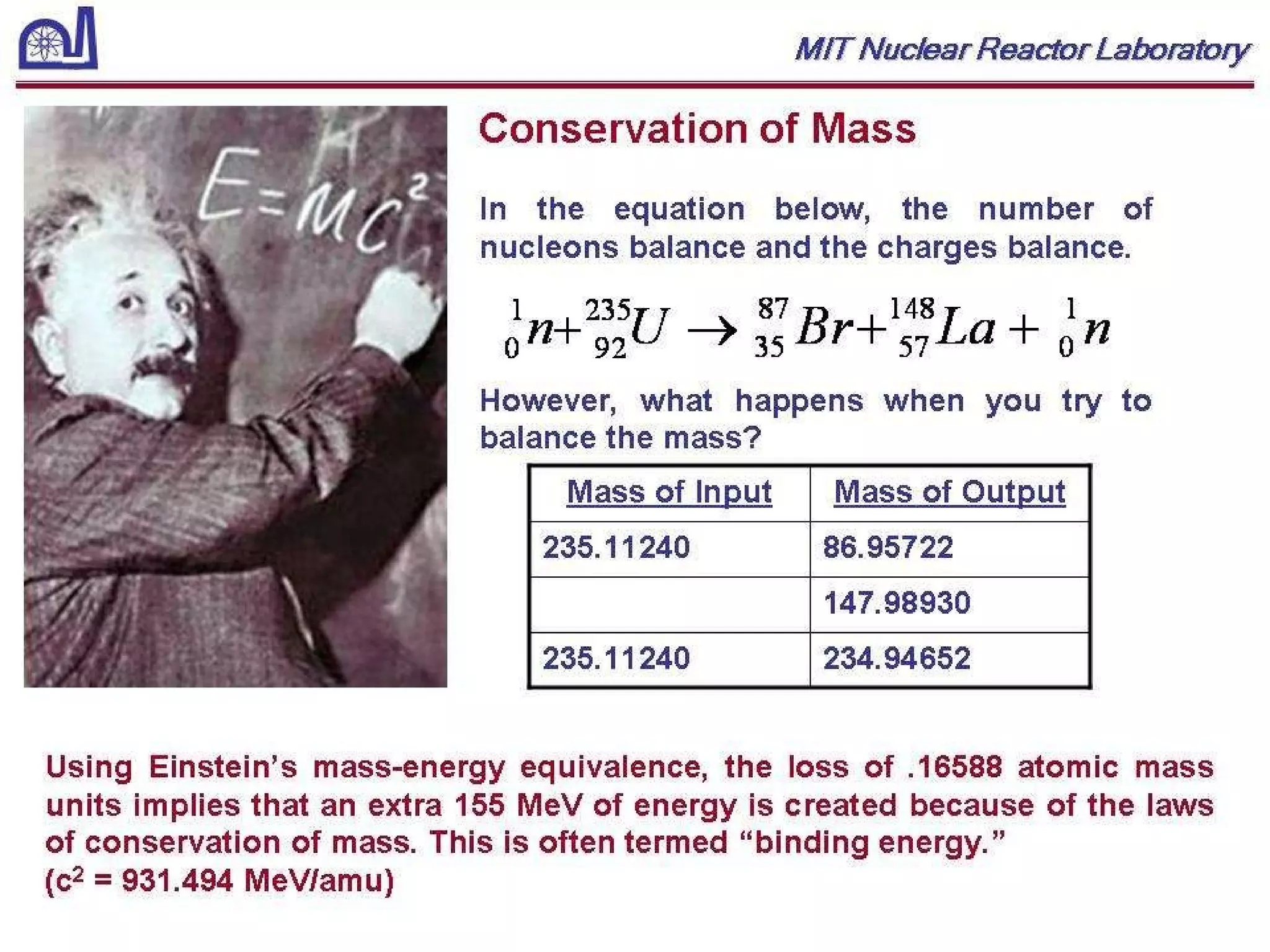
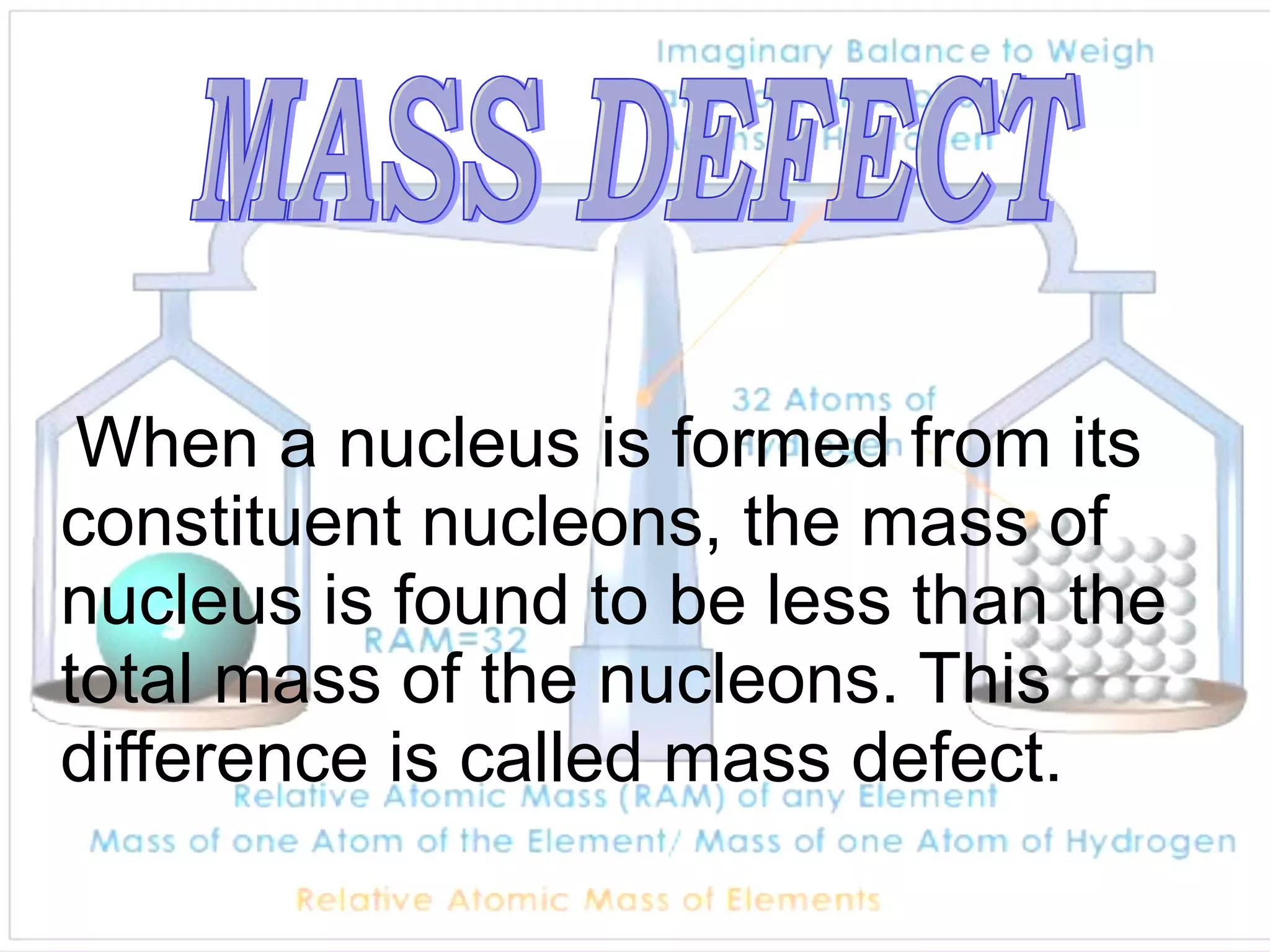
When a nucleus is formed from its constituent nucleons, the mass of nucleus is found to be less than the total mass of the nucleons. This difference is called mass defect.  MASS DEFECT
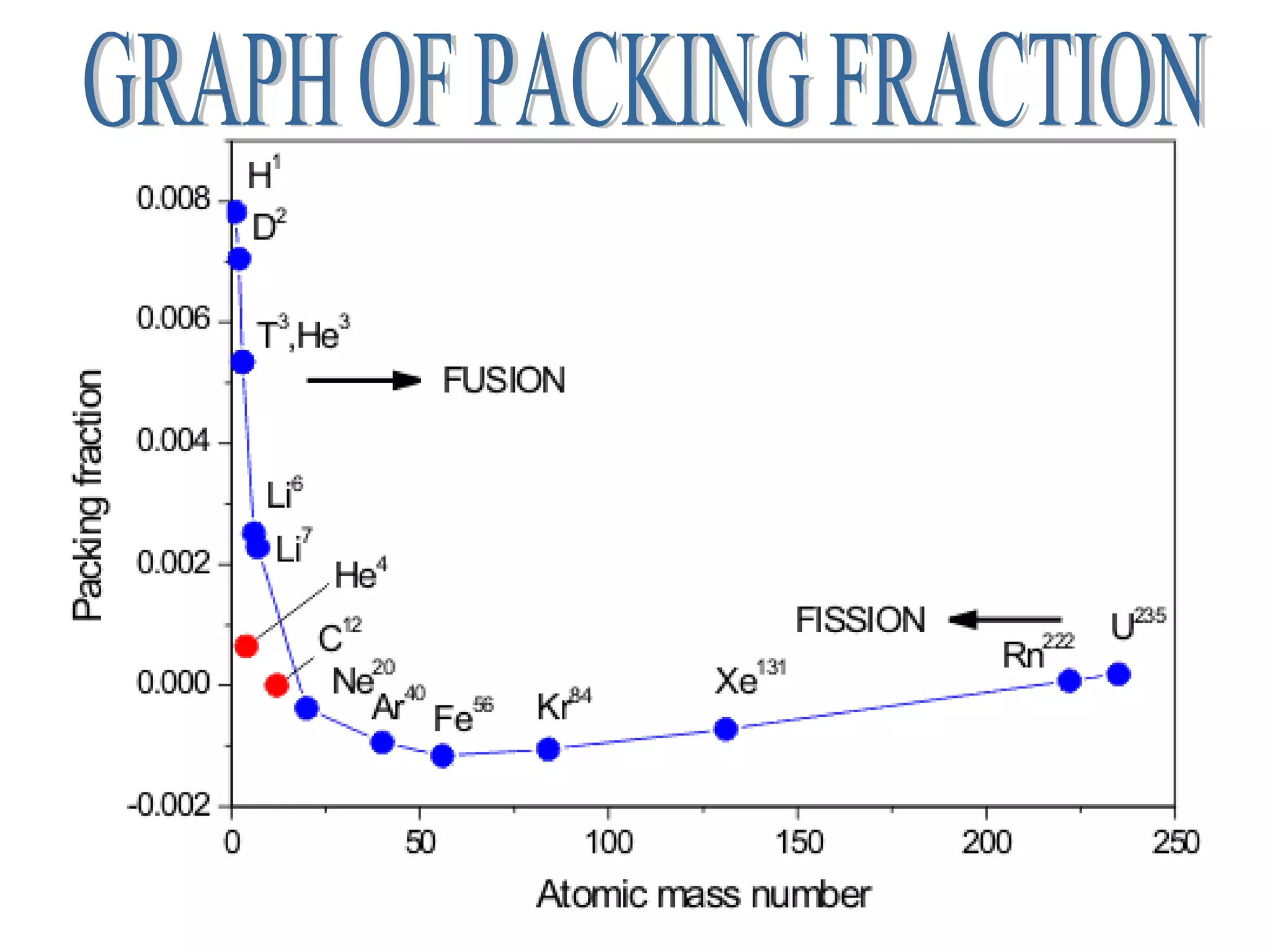
It is the ratio of mass defect to the mass number. Packing fraction may be positive or negative. If packing fraction is negative, the isotopic mass is less than the mass number. As a part of the mass is converted into energy during the formation of the nucleus. These nuclei are more stable. If p is positive then the nucleus is not stable but this is not applicable to elements of low atomic mass. We assume the packing fraction to be zero for oxygen, even though it cannot be zero. Light elements have positive packing fraction with respect to oxygen.  PACKING FRACTION
GRAPH OF PACKING FRACTION
The mass of the nucleons is found to be less than the total mass of the constituent nucleons. This decrease in mass appears in the form of energy, called the binding energy. Binding energy is equal to the energy, required to split the nucleus into its constituent nucleons, such that the nucleons are at infinite distance apart and there is no interaction between the nucleons, it is the energy equivalent of mass defect. BINDING ENERGY
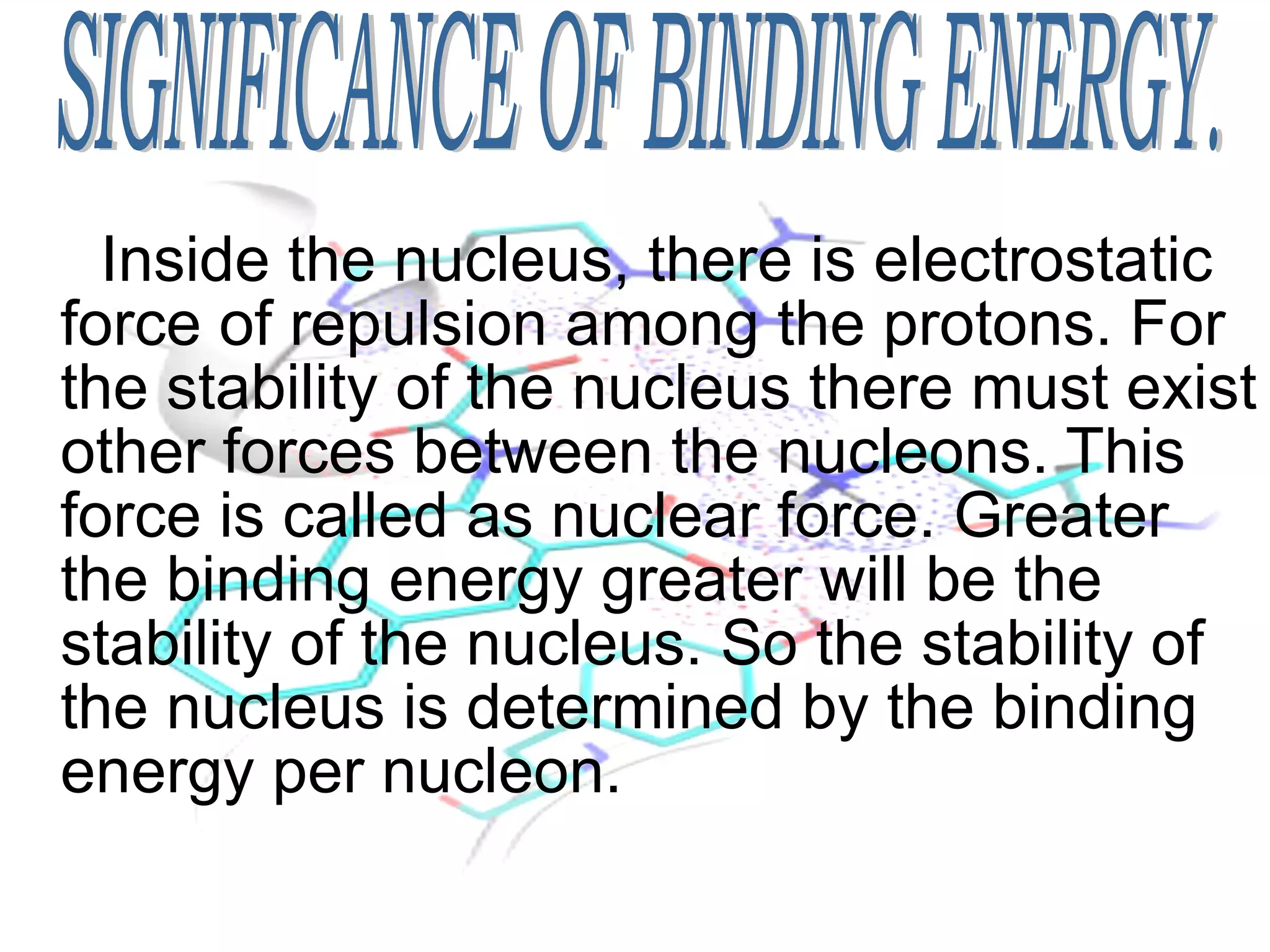
Inside the nucleus, there is electrostatic force of repulsion among the protons. For the stability of the nucleus there must exist other forces between the nucleons. This force is called as nuclear force. Greater the binding energy greater will be the stability of the nucleus. So the stability of the nucleus is determined by the binding energy per nucleon. SIGNIFICANCE OF BINDING ENERGY.
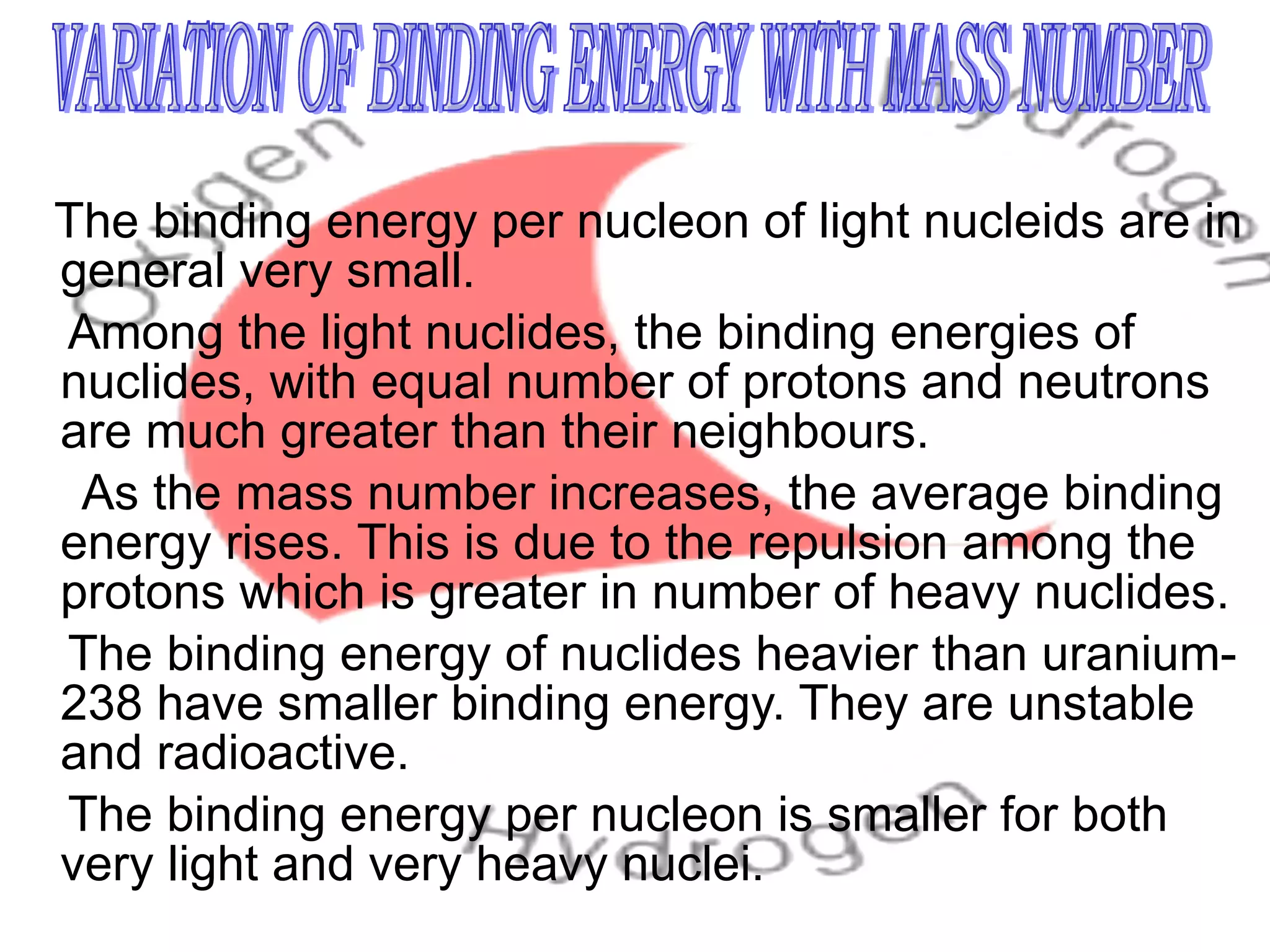
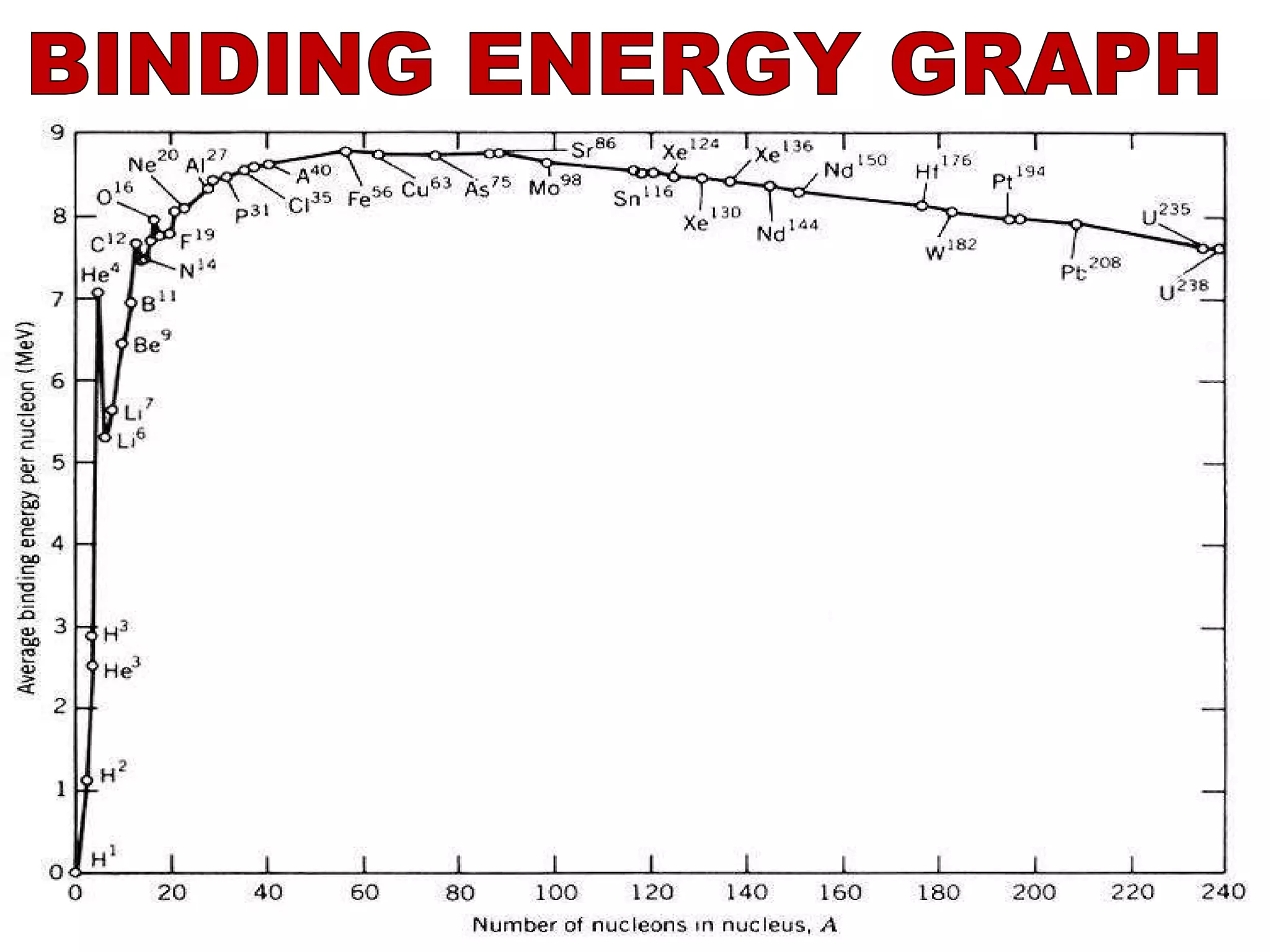
The binding energy per nucleon of light nucleids are in general very small. Among the light nuclides, the binding energies of nuclides, with equal number of protons and neutrons are much greater than their neighbours.  As the mass number increases, the average binding energy rises. This is due to the repulsion among the protons which is greater in number of heavy nuclides. The binding energy of nuclides heavier than uranium- 238 have smaller binding energy. They are unstable and radioactive. The binding energy per nucleon is smaller for both very light and very heavy nuclei. VARIATION OF BINDING ENERGY WITH MASS NUMBER
BINDING ENERGY GRAPH
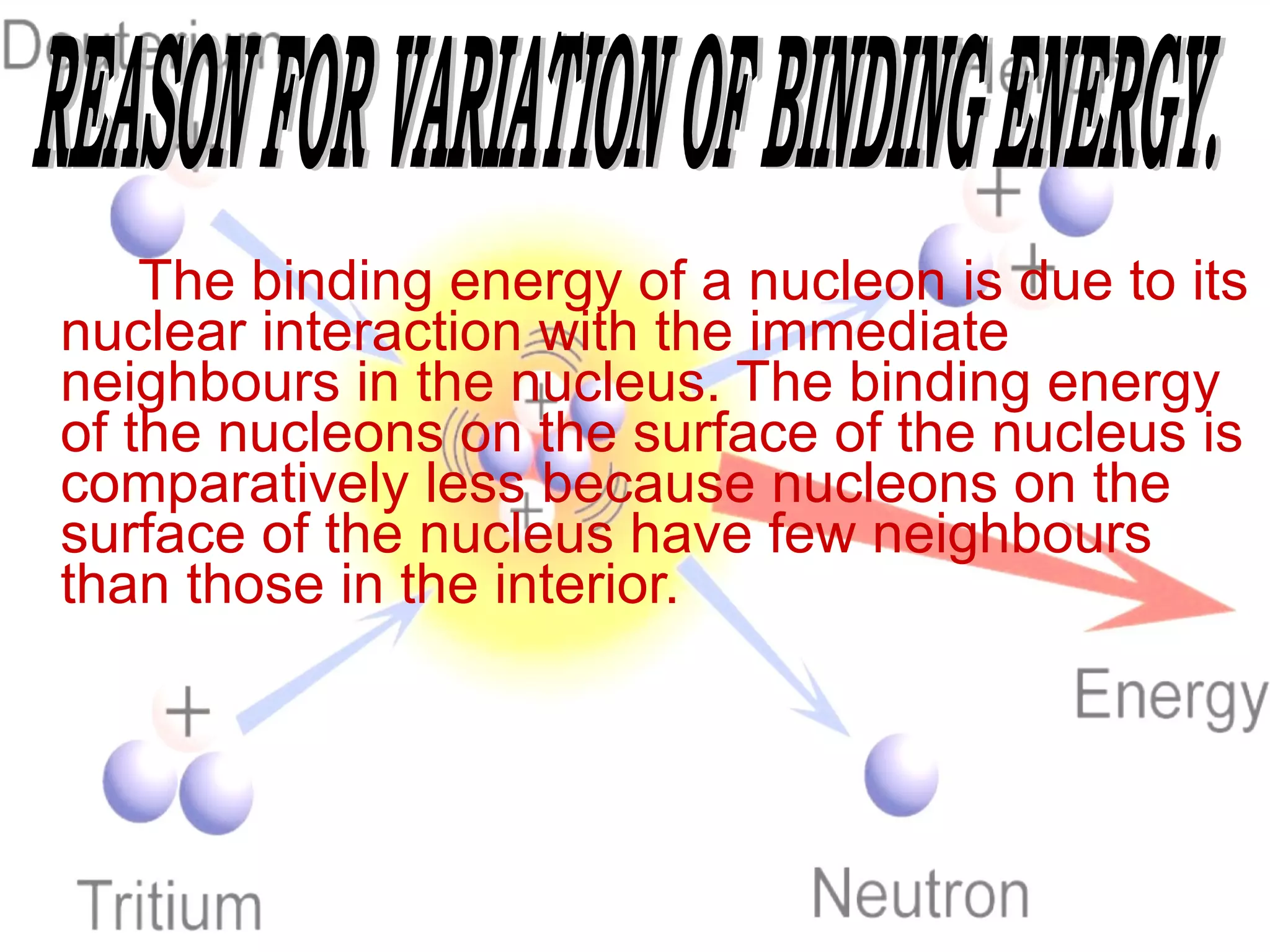
The binding energy of a nucleon is due to its nuclear interaction with the immediate neighbours in the nucleus. The binding energy of the nucleons on the surface of the nucleus is comparatively less because nucleons on the surface of the nucleus have few neighbours than those in the interior.  REASON FOR VARIATION OF BINDING ENERGY.
The surface to volume ratio is greater for light nuclei with smaller radii than for the heavy nuclei. This means the number of surface particle is greater in the case of light nuclei and their binding energies per nucleon are smaller. With increase in mass number we have to take into consideration the electrostatic repulsion between protons which gives a negative binding energy. This negative binding energy increases and hence decreases the binding energy per particle in the case of heavier nuclide.
Conclusion Deep within the nucleus lies the nucleus, occupying only 10^-15 of the volume of the atom but proving most of its mass as well as the force that holds it together. Our task what made easier by the many similarities between the study of atoms and the study of nuclei. Both systems are governed by the laws of quantum mechanics. Like atoms, nuclei have excited states that can decay to the ground state through the emission of photon. In certain circumstances,  as we have seen, nuclei can exhibit shell effects that are similar to those of atoms. We have also seen that there are differences between the study of atoms and the study of nuclei that keep us from achieving as complete an understanding of nuclei as we have of atoms.
We the members of this group are very much privileged to Sir Pius, for getting the opportunity of presenting & sharing this assignment with all my kin & classmates. Last but not the least we would like to thank our dearest friend without whom we would be failing in all our obligations, the Almighty.

Nuclei

  • 1.
  • 2.
    KAUSHIK DEBINA SRIRUPAMADHUMITA SOUMYASUBHRA SOUMYAJYOTI DEBAYAN SOURAV SANJANA TANISTHA RAUNAK STUDENTS INCLUDED IN THE GROUP ARE :-
  • 3.
    Lord Rutherford discoveredthe nucleus by alpha particle scattering experiment. He found that the scattering results could be explained ,if atoms consists of a small, central, massive and positive core surrounded by orbiting electrons. Results indicated that the size of the nucleus is thus 10,000 times smaller then the size of an atom. INTRODUCTION
  • 4.
    Rutherford through hisexperiment showed that the positive charge of an atom is concentrated at the centre of the atom. Nucleus contains a positively charged and charge less particles called proton and neutron . Collectively represented as nucleons. The number of electrons or protons in an atom is called Atomic number. Which is donated as Z. The total number of protons and neutrons in an atom is called its Mass number denoted by ’A’. If there are ‘n’ neutrons in the nucleus then A=Z + n. NUCLEI
  • 5.
    Goldstein modified thedischarge tube & used a perforated cathode to discover a new kind of rays called ‘canal rays’. the rays were travelling in straight lines opposite to the direction of motion of the electron. They emerged the cathode through a hole or canal in it. So they are called canal rays. When a deflected beam of canal rays are found they were positively charged particles & hence they are called POSITIVE RAYS . POSITIVE RAYS
  • 6.
  • 7.
  • 8.
    The Bainbridge massspectrograph is used to find the specific charge and hence the mass of positive ions. This instrument sorts out a mixed stream of ions according to their atomic weight .
  • 9.
    As positive ionsare deflected in electric and magnetic fields so they are subjected to a crossed electric and magnetic fields simultaneously These positive- ions are subjected to an uniform magnetic field. They move in a circular path of radius (R) which depends upon the mass of the charged particle hence there masses can be measured. PRINCIPLE OF BAINBRIDGE MASS SPECTROGRAPH
  • 10.
  • 11.
    Atoms having thesame atomic number but different mass number are called isotopes. For ex:- hydrogen has three isotopes 1:- Deuterium whose atomic number is one but mass number is two. 2:- Ordinary hydrogen atom and 3:- Tritium whose atomic number is one but mass number is three. ISOTOPES
  • 12.
  • 13.
  • 14.
    ATOMIC MASS ANDCOMPOSITION OF NUCLEUS As its nucleus is extremely small so it is not convenient to express the masses of this objects in kg. The mass of the nucleus and its constituent particles is expressed by unified mass unit(u).
  • 15.
    NEUTRONS James Chadwickgot the noble prize for the discovery of Neutrons It is a fundamental particle. It has no charge and is not deflected in electric and magnetic field. Its penetrating power is high and its ionizing power is low the neutron is unstable in free state and decays to a proton, one electron and an antineutrim. Its half life is about 13 minutes. n=p + e + v + q. It produce intense biological effect.
  • 16.
    PROPERTIES 1:- Neutronis a fundamental particle , except hydrogen all other elements contains neutron 2:- Neutron has no charge and hence is not deflected in electric and magnetic fields. 3:- Its penetrating power is high and its ionizing power is low. 4:- In free state neutron is unstable. 5:- Neutron produce intense biological effect.
  • 17.
    Nuclear forces The forces acting between the nucleons of a nucleus which keep them bound together is called nuclear forces.
  • 18.
  • 19.
    They are thestrong attractive forces in nature. They are very short range force Each nucleon can interact with only a limited number of nucleons very close to it. This forces are also called exchange forces Nuclear force depends on the relative orientation of the spins of the interacting nucleons. Nuclear forces are non-central forces, because the force between two nucleons does not act along the line joining the centres . PROPERTIES OF NUCLEAR FORCE
  • 20.
  • 21.
  • 22.
    According to Einstein,energy and mass are inter-convertible. Whenever some mass disappears in nuclear reactions, it appears in the form of energy. A mass ‘m’ is equivalent to an energy E= mc^2, where c is the speed of the light. This means, an increase in energy corresponds to an increase in mass and vice-versa. This equation represents the famous Einstein’s mass-energy relation. MASS ENERGY RELATION
  • 23.
  • 24.
    RELATION BEWTEEN amu& MeV We know 1 a.m.u= 1.660565x10^-27 kg. Energy equivalent of this mass = E=mc^2. E= (1.660565x10^-27)x(2.998x10^8)^2. = 1.4925x10^-10 J = (1.4925x10^-10)/(1.602x10^-13) = 931.64 MeV Therefore 1 amu= 931 MeV (approx)
  • 25.
    Nuclear charge :-Ze, where Z is the atomic number and e the charge of the electron Nuclear mass :- Mass of proton + Mass of neutron. Size and shape of nucleus :- It is not only spherical. But apart from spherical nuclei can have different shapes. The shapes are decided by energy states. Density of nucleus :- Density of nucleus is very large of the order of 10^17 kg/m^3. Nuclear spin :- It has angular momentum due to the rotation inside the nucleus and spinning motion about their own axes. The nucleons have magnetic moment. For its motion. Nuclear energy states :- The nucleus can make transition from higher energy state to lower energy state. As it has discrete energy state CHARACTERISTICS OF NUCLEUS
  • 26.
    When a nucleusis formed from its constituent nucleons, the mass of nucleus is found to be less than the total mass of the nucleons. This difference is called mass defect. MASS DEFECT
  • 27.
    It is theratio of mass defect to the mass number. Packing fraction may be positive or negative. If packing fraction is negative, the isotopic mass is less than the mass number. As a part of the mass is converted into energy during the formation of the nucleus. These nuclei are more stable. If p is positive then the nucleus is not stable but this is not applicable to elements of low atomic mass. We assume the packing fraction to be zero for oxygen, even though it cannot be zero. Light elements have positive packing fraction with respect to oxygen. PACKING FRACTION
  • 28.
  • 29.
    The mass ofthe nucleons is found to be less than the total mass of the constituent nucleons. This decrease in mass appears in the form of energy, called the binding energy. Binding energy is equal to the energy, required to split the nucleus into its constituent nucleons, such that the nucleons are at infinite distance apart and there is no interaction between the nucleons, it is the energy equivalent of mass defect. BINDING ENERGY
  • 30.
    Inside the nucleus,there is electrostatic force of repulsion among the protons. For the stability of the nucleus there must exist other forces between the nucleons. This force is called as nuclear force. Greater the binding energy greater will be the stability of the nucleus. So the stability of the nucleus is determined by the binding energy per nucleon. SIGNIFICANCE OF BINDING ENERGY.
  • 31.
    The binding energyper nucleon of light nucleids are in general very small. Among the light nuclides, the binding energies of nuclides, with equal number of protons and neutrons are much greater than their neighbours. As the mass number increases, the average binding energy rises. This is due to the repulsion among the protons which is greater in number of heavy nuclides. The binding energy of nuclides heavier than uranium- 238 have smaller binding energy. They are unstable and radioactive. The binding energy per nucleon is smaller for both very light and very heavy nuclei. VARIATION OF BINDING ENERGY WITH MASS NUMBER
  • 32.
  • 33.
    The binding energyof a nucleon is due to its nuclear interaction with the immediate neighbours in the nucleus. The binding energy of the nucleons on the surface of the nucleus is comparatively less because nucleons on the surface of the nucleus have few neighbours than those in the interior. REASON FOR VARIATION OF BINDING ENERGY.
  • 34.
    The surface tovolume ratio is greater for light nuclei with smaller radii than for the heavy nuclei. This means the number of surface particle is greater in the case of light nuclei and their binding energies per nucleon are smaller. With increase in mass number we have to take into consideration the electrostatic repulsion between protons which gives a negative binding energy. This negative binding energy increases and hence decreases the binding energy per particle in the case of heavier nuclide.
  • 35.
    Conclusion Deep withinthe nucleus lies the nucleus, occupying only 10^-15 of the volume of the atom but proving most of its mass as well as the force that holds it together. Our task what made easier by the many similarities between the study of atoms and the study of nuclei. Both systems are governed by the laws of quantum mechanics. Like atoms, nuclei have excited states that can decay to the ground state through the emission of photon. In certain circumstances, as we have seen, nuclei can exhibit shell effects that are similar to those of atoms. We have also seen that there are differences between the study of atoms and the study of nuclei that keep us from achieving as complete an understanding of nuclei as we have of atoms.
  • 36.
    We the membersof this group are very much privileged to Sir Pius, for getting the opportunity of presenting & sharing this assignment with all my kin & classmates. Last but not the least we would like to thank our dearest friend without whom we would be failing in all our obligations, the Almighty.