Transportation Engineering
Department of Civil Engineering
Maulana Azad National Institute of Technology
Presented By :
C Noor Mohammed Parvez
202111513
Submitted To :
Dr. Pritikana Das
Department of Civil Engineering
STRENGTHENING
FLEXIBLE PAVEMENT
USING FWD
TECHNIQUE
Contents :
1. Introduction
2. Principle of Pavement Evaluation Using FWD
3. Specification of FWD
4. Calibration of FWD
5. Pavement Evaluation Survey and Data Collection
6. Analysis of Field Data
7. Overlay Design
8. Conclusion
9. References
INTRODUCTION :
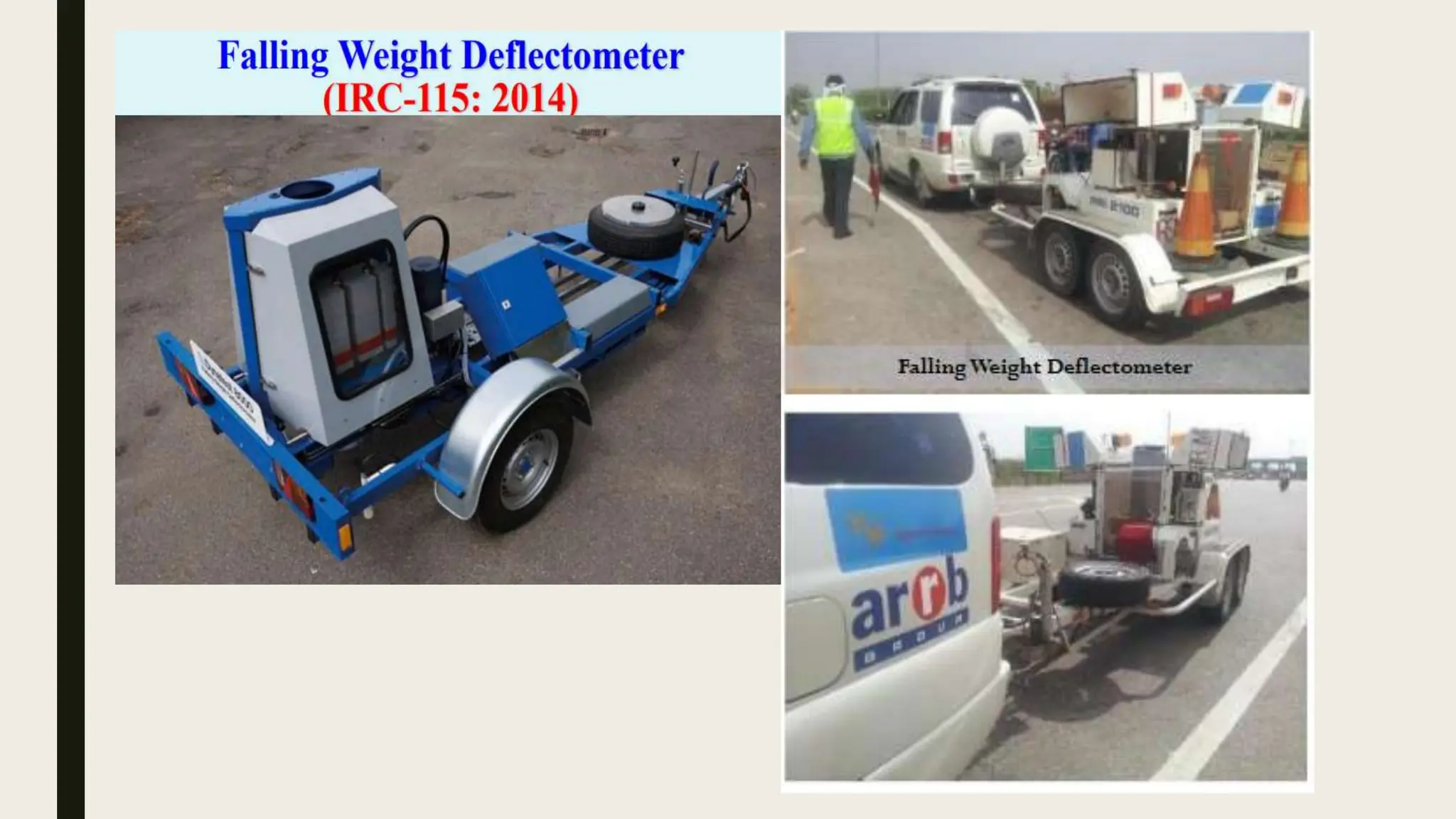
What is FWD?
■ Falling Weight Deflectometer (FWD) is an Non Destructive Impulse-
loading device in which a transient load is applied to the pavement and the
deflected shape of the pavement surface is measured.
■ It is used to evaluate structural condition of pavement and estimating the
overlay thickness to be provided.
Why FWD is preferred over BBD?
 FWD closely simulates the duration and amplitude of the load
pulses produced by moving wheel loads.
 Quick and accurate testing.
 Entire test can be run from a laptop inside car.
PRINCIPLE OF PAVEMENT EVALUATION USING FWD
:
 The working principle of the FWD is a mass of weights is dropped
from a pre-determined height onto a series of springs placed on
top of a loading plate. The corresponding peak load and peak
vertical surface deflections at different radial locations are
measured.
S.No FWD Components IRC recommended Specification for FWD
1 Plate Diameter 300mm/450mm
2 Mass Density Single Mass
3 Falling Weight Mass 50 to 350Kg
4 Height of fall 100 to 600mm
5 Target Peak Load 40KN
6 Load Pulse Time 15-50ms
7 Load Cell Accuracy + 2%
8 Number of deflection Transducers 6 to 9
9 Deflection Sensor Types Geophones
10 Reading of resolution of deflection
transducers
Min 1um
11 Deflection transducers accuracy + 2%
Specifications :
■ Deflection sensors are placed on the surface of
pavement at different radial direction aligned in the
longitudinal direction :-
i. 7 sensors at 0, 300, 600, 900, 1200, 1500 and 1800 mm radial
distances
ii. 7 sensors at 0, 200, 300, 450, 600, 900, 1500 mm radial
distances
iii. 6 sensors at 0, 300, 600, 900, 1200 and 1500 mm radial
distances and
iv. 6 sensors at 0, 200, 300, 600, 900, 1200 mm radial distances.
Calibration of FWD :
1. Static Calibration :
■ The date of calibration of the load cell should not be earlier than 365
days from the date of structural evaluation of pavements using FWD.
2. Load Repeatability :
■ Peak deflection 250 to 600 μm
■ Standard Deviation for min. of 12 load drops <5% of the mean peak
load.
3. Absolute calibration of deflection transducers :
■ Should be accurate to 2%
Pavement Evaluation Survey and Data
Collection
1. Historical data about pavement :
 Historical data can be useful in identifying the reasons for
different distresses.
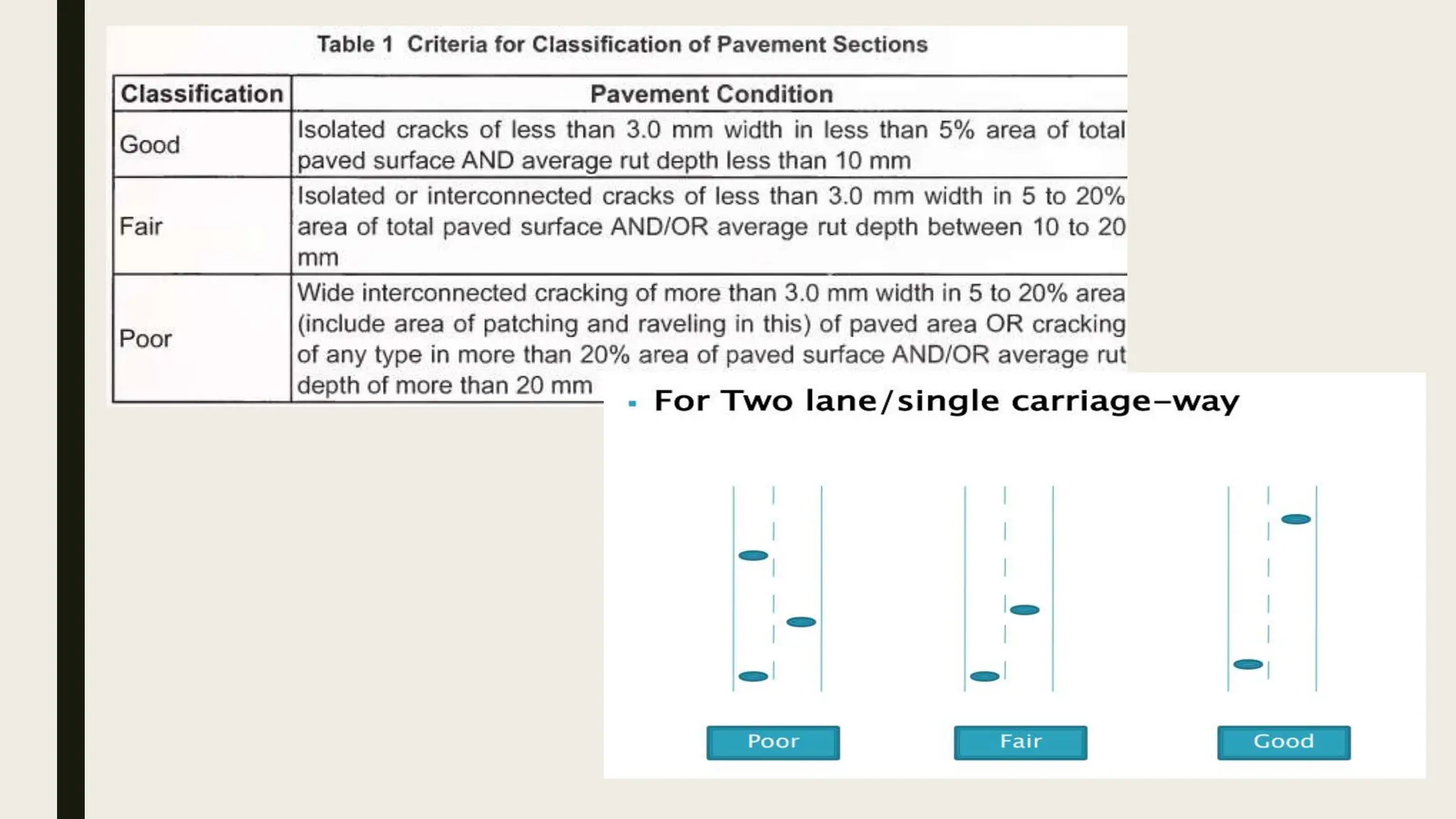
2. Pavement condition survey :
 Pavement condition survey is primarily of visual observations
supplemented by measurements for estimation of cracking,
rutting and other distresses in the pavement.
3. Deflection Measurement :
■ Estimation of sample size
■ Cv- coefficient of variation for Good, fair and poor as 15%, 30%
and 45% respectively.
Steps for measuring deflection :
1. Mark the test point and center the load plate over the test point
on pavement.
2. The longitudinal and transverse slope of the pavement should
not exceed 10 percent at the test location for accurate
measurement of deflection.
3. Lower the frame holding the displacement transducers
(geophones) so that the transducers are in contact with
pavement surface.
4. Raise the mass to a pre-determined height required for
producing a target load of 40 kN
5. Raise the mass and drop. Record load and deflection data into
the computer through data acquisition system.
6. Record air & Pavement temperature at hourly interval.
7. Raise the geophone frame and load plate and move to the next
test location.
8. Measure pavement temperature by drilling holes of 40mm depth
into the pavement surface layer by using glycerol.
9. Deflection measurements should not be made when the
pavement temperature is more than 45°C.
Determination of Pavement Layer
Thicknesses
■ Pavement layer thickness is essential inputs :
 To the process of backcalculation of layer moduli
 To the estimation of remaining life and
 Overlay requirements of the in-service pavement.
Determined Using :
 Historical Data
 By excavating test Pits
 Ground Penetrating Radar Survey
Note:
It is generally difficult to excavate test pits in the inner lanes, it is
suggested that cores be taken in the bituminous layers at 2.0 km interval
on the inner lanes and at 1.0 km interval on the outer lanes (in the case
of multi-lane divided or undivided carriageways).
Dynamic Cone Penetration test :
■ Conducted to obtain the Dynamic Cone Penetrometer value for in-situ
subgrade.
Analysis of Data :
1. Processing of load and deflection data
2. Identification of Homogeneous Sub-sections
 A statistical technique popularly used for identification of
homogeneous sections is the "Cumulative Difference" approach.
 It compares the sequence of actual cumulative sums in a
measurement series with the sums that would have resulted from
adding averages.
 The difference between these values is termed as cumulative
difference.
■ According to AASHTO (1986), a section border is indicated
whenever the “trend” in the series of cumulative differences
changes from positive to negative or vice versa.
■ No sub-section should be shorter than 1.0 km in length and each
subsection should have at least twelve deflection test locations.
3. Back Calculation of Layer Moduli
■ Inputs : Surface deflections, layer thicknesses, Poisson's ratio
values of different layers, applied peak load and loading plate
radius.
■ Outputs : The elastic moduli of different layers of the existing
pavement.
■ IRC 115-2014 recommends KGPBACK software for back calculation
of pavement layer moduli.
■ Correction for Temperature and Seasonal Variation to be done for
layer moduli as per IRC 115-2014
Overlay Design :
■ Data Required :
 Design Traffic
 Elastic Moduli
 Critical strain in the layers ( calculated using IITPAVE
software)
 Performance Criteria
Performance Criteria :
 The following are the steps to be followed for design of overlays for
Indian highways based on FWD evaluation:
1) Measurement of surface deflections of homogeneous section of the
in-service pavement using FWD
2) Normalization of the deflections correspond to a standard load of
40 KN
3) Collection of information about layer type and layer thicknesses of
pavement layer moduli using an appropriate backcalculation
software. Backcalculation will be done by considering the
pavement to be a three layer system.
4) Correction for Temperature and Seasonal Variation to be done for
layer moduli as per IRC 115-2014.
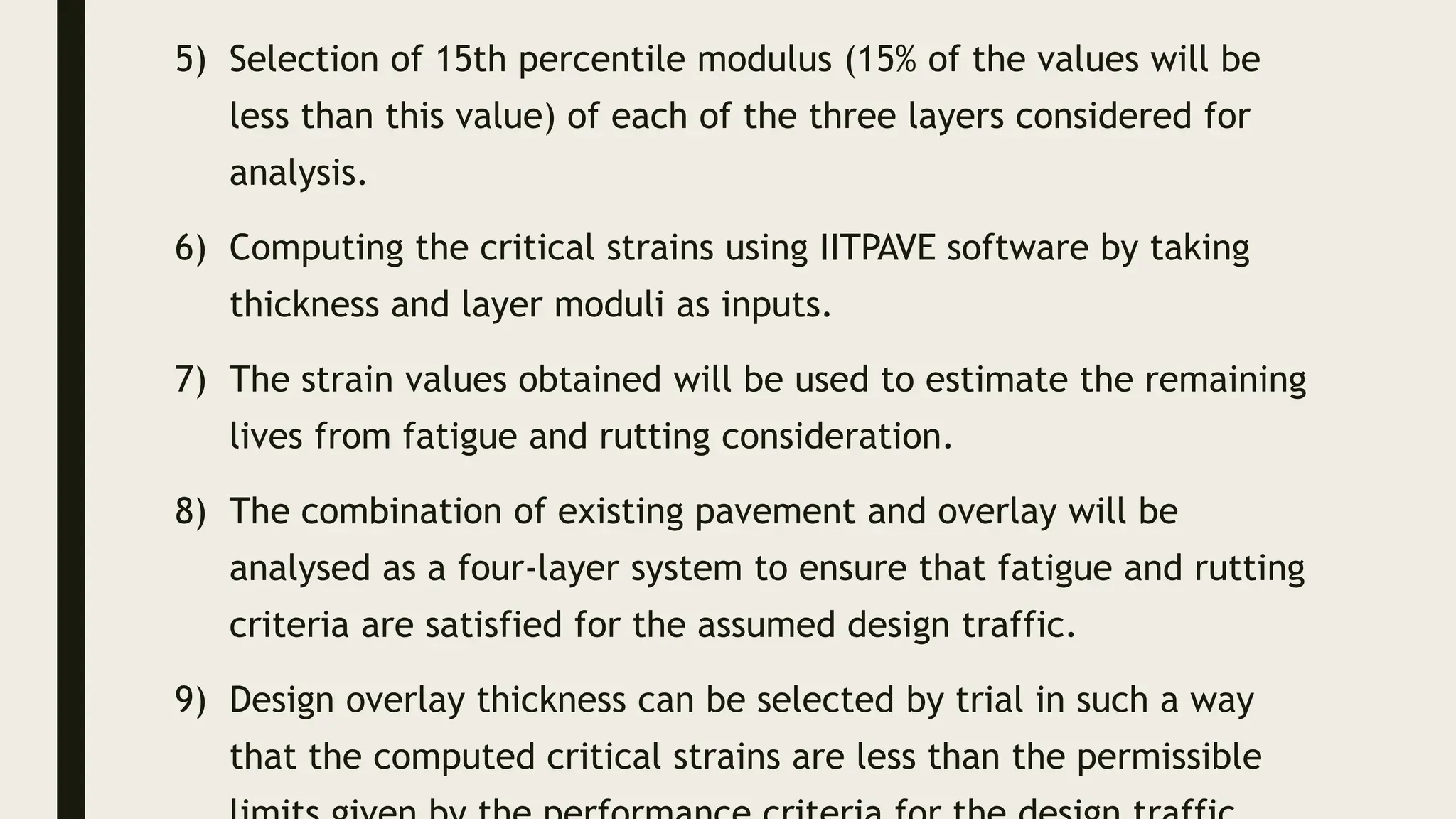
5) Selection of 15th percentile modulus (15% of the values will be
less than this value) of each of the three layers considered for
analysis.
6) Computing the critical strains using IITPAVE software by taking
thickness and layer moduli as inputs.
7) The strain values obtained will be used to estimate the remaining
lives from fatigue and rutting consideration.
8) The combination of existing pavement and overlay will be
analysed as a four-layer system to ensure that fatigue and rutting
criteria are satisfied for the assumed design traffic.
9) Design overlay thickness can be selected by trial in such a way
that the computed critical strains are less than the permissible
Conclusion :
We concluded that the FWD is more better than the BBD and we can
handle easily. By using this FWD we can determining the elastic
moduli of pavement layers, and using these moduli as inputs to a
pavement design model for overlay requirement. And we can also
estimate the residual life of an existing pavement and overlay
requirement.
References :
■ Guidelines for structural evaluation and strengthening of flexible
road pavements using falling weight deflectometer (FWD)
technique IRC:115-2014.
■ Guidelines for design of flexible pavement IRC 37-2014
■ Dr. Pritikana Das, Department of Civil Engineering
■ www.slideshare.net
■ Flexible Pavement Overlay Design Using Cumulative Difference
Approach of Homogeneous Section, International Journal of
Technical Innovation in Modern Engineering & Science (IJTIMES).
487665348-PPT-on-FALLING-WEIGHT-DEFLECTOMETER.pptx

487665348-PPT-on-FALLING-WEIGHT-DEFLECTOMETER.pptx

  • 1.
    Transportation Engineering Department ofCivil Engineering Maulana Azad National Institute of Technology Presented By : C Noor Mohammed Parvez 202111513 Submitted To : Dr. Pritikana Das Department of Civil Engineering
  • 2.
  • 3.
    Contents : 1. Introduction 2.Principle of Pavement Evaluation Using FWD 3. Specification of FWD 4. Calibration of FWD 5. Pavement Evaluation Survey and Data Collection 6. Analysis of Field Data 7. Overlay Design 8. Conclusion 9. References
  • 4.
    INTRODUCTION : What isFWD? ■ Falling Weight Deflectometer (FWD) is an Non Destructive Impulse- loading device in which a transient load is applied to the pavement and the deflected shape of the pavement surface is measured. ■ It is used to evaluate structural condition of pavement and estimating the overlay thickness to be provided.
  • 5.
    Why FWD ispreferred over BBD?  FWD closely simulates the duration and amplitude of the load pulses produced by moving wheel loads.  Quick and accurate testing.  Entire test can be run from a laptop inside car.
  • 7.
    PRINCIPLE OF PAVEMENTEVALUATION USING FWD :  The working principle of the FWD is a mass of weights is dropped from a pre-determined height onto a series of springs placed on top of a loading plate. The corresponding peak load and peak vertical surface deflections at different radial locations are measured.
  • 8.
    S.No FWD ComponentsIRC recommended Specification for FWD 1 Plate Diameter 300mm/450mm 2 Mass Density Single Mass 3 Falling Weight Mass 50 to 350Kg 4 Height of fall 100 to 600mm 5 Target Peak Load 40KN 6 Load Pulse Time 15-50ms 7 Load Cell Accuracy + 2% 8 Number of deflection Transducers 6 to 9 9 Deflection Sensor Types Geophones 10 Reading of resolution of deflection transducers Min 1um 11 Deflection transducers accuracy + 2% Specifications :
  • 9.
    ■ Deflection sensorsare placed on the surface of pavement at different radial direction aligned in the longitudinal direction :- i. 7 sensors at 0, 300, 600, 900, 1200, 1500 and 1800 mm radial distances ii. 7 sensors at 0, 200, 300, 450, 600, 900, 1500 mm radial distances iii. 6 sensors at 0, 300, 600, 900, 1200 and 1500 mm radial distances and iv. 6 sensors at 0, 200, 300, 600, 900, 1200 mm radial distances.
  • 11.
    Calibration of FWD: 1. Static Calibration : ■ The date of calibration of the load cell should not be earlier than 365 days from the date of structural evaluation of pavements using FWD. 2. Load Repeatability : ■ Peak deflection 250 to 600 μm ■ Standard Deviation for min. of 12 load drops <5% of the mean peak load. 3. Absolute calibration of deflection transducers : ■ Should be accurate to 2%
  • 12.
    Pavement Evaluation Surveyand Data Collection 1. Historical data about pavement :  Historical data can be useful in identifying the reasons for different distresses. 2. Pavement condition survey :  Pavement condition survey is primarily of visual observations supplemented by measurements for estimation of cracking, rutting and other distresses in the pavement.
  • 14.
    3. Deflection Measurement: ■ Estimation of sample size ■ Cv- coefficient of variation for Good, fair and poor as 15%, 30% and 45% respectively.
  • 16.
    Steps for measuringdeflection : 1. Mark the test point and center the load plate over the test point on pavement. 2. The longitudinal and transverse slope of the pavement should not exceed 10 percent at the test location for accurate measurement of deflection. 3. Lower the frame holding the displacement transducers (geophones) so that the transducers are in contact with pavement surface. 4. Raise the mass to a pre-determined height required for producing a target load of 40 kN
  • 17.
    5. Raise themass and drop. Record load and deflection data into the computer through data acquisition system. 6. Record air & Pavement temperature at hourly interval. 7. Raise the geophone frame and load plate and move to the next test location. 8. Measure pavement temperature by drilling holes of 40mm depth into the pavement surface layer by using glycerol. 9. Deflection measurements should not be made when the pavement temperature is more than 45°C.
  • 19.
    Determination of PavementLayer Thicknesses ■ Pavement layer thickness is essential inputs :  To the process of backcalculation of layer moduli  To the estimation of remaining life and  Overlay requirements of the in-service pavement. Determined Using :  Historical Data  By excavating test Pits  Ground Penetrating Radar Survey
  • 20.
    Note: It is generallydifficult to excavate test pits in the inner lanes, it is suggested that cores be taken in the bituminous layers at 2.0 km interval on the inner lanes and at 1.0 km interval on the outer lanes (in the case of multi-lane divided or undivided carriageways). Dynamic Cone Penetration test : ■ Conducted to obtain the Dynamic Cone Penetrometer value for in-situ subgrade.
  • 21.
    Analysis of Data: 1. Processing of load and deflection data 2. Identification of Homogeneous Sub-sections  A statistical technique popularly used for identification of homogeneous sections is the "Cumulative Difference" approach.  It compares the sequence of actual cumulative sums in a measurement series with the sums that would have resulted from adding averages.  The difference between these values is termed as cumulative difference.
  • 22.
    ■ According toAASHTO (1986), a section border is indicated whenever the “trend” in the series of cumulative differences changes from positive to negative or vice versa. ■ No sub-section should be shorter than 1.0 km in length and each subsection should have at least twelve deflection test locations.
  • 23.
    3. Back Calculationof Layer Moduli ■ Inputs : Surface deflections, layer thicknesses, Poisson's ratio values of different layers, applied peak load and loading plate radius. ■ Outputs : The elastic moduli of different layers of the existing pavement. ■ IRC 115-2014 recommends KGPBACK software for back calculation of pavement layer moduli. ■ Correction for Temperature and Seasonal Variation to be done for layer moduli as per IRC 115-2014
  • 24.
    Overlay Design : ■Data Required :  Design Traffic  Elastic Moduli  Critical strain in the layers ( calculated using IITPAVE software)  Performance Criteria
  • 25.
  • 26.
     The followingare the steps to be followed for design of overlays for Indian highways based on FWD evaluation: 1) Measurement of surface deflections of homogeneous section of the in-service pavement using FWD 2) Normalization of the deflections correspond to a standard load of 40 KN 3) Collection of information about layer type and layer thicknesses of pavement layer moduli using an appropriate backcalculation software. Backcalculation will be done by considering the pavement to be a three layer system. 4) Correction for Temperature and Seasonal Variation to be done for layer moduli as per IRC 115-2014.
  • 27.
    5) Selection of15th percentile modulus (15% of the values will be less than this value) of each of the three layers considered for analysis. 6) Computing the critical strains using IITPAVE software by taking thickness and layer moduli as inputs. 7) The strain values obtained will be used to estimate the remaining lives from fatigue and rutting consideration. 8) The combination of existing pavement and overlay will be analysed as a four-layer system to ensure that fatigue and rutting criteria are satisfied for the assumed design traffic. 9) Design overlay thickness can be selected by trial in such a way that the computed critical strains are less than the permissible
  • 28.
    Conclusion : We concludedthat the FWD is more better than the BBD and we can handle easily. By using this FWD we can determining the elastic moduli of pavement layers, and using these moduli as inputs to a pavement design model for overlay requirement. And we can also estimate the residual life of an existing pavement and overlay requirement.
  • 29.
    References : ■ Guidelinesfor structural evaluation and strengthening of flexible road pavements using falling weight deflectometer (FWD) technique IRC:115-2014. ■ Guidelines for design of flexible pavement IRC 37-2014 ■ Dr. Pritikana Das, Department of Civil Engineering ■ www.slideshare.net ■ Flexible Pavement Overlay Design Using Cumulative Difference Approach of Homogeneous Section, International Journal of Technical Innovation in Modern Engineering & Science (IJTIMES).