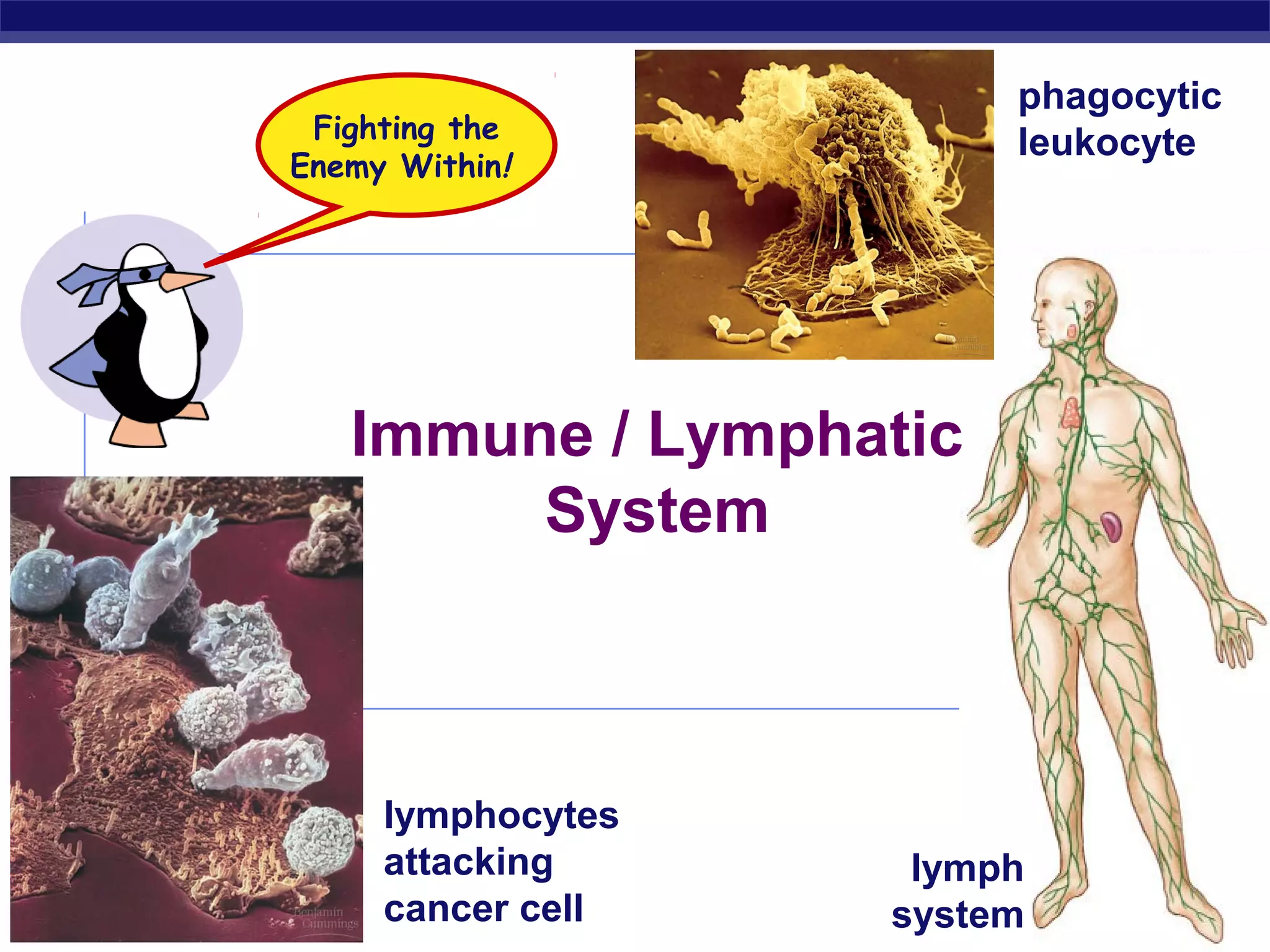
phagocytic
              Fighting the
                                     leukocyte
             Enemy Within!


                Immune / Lymphatic
                     System


                  lymphocytes
                  attacking      lymph
AP Biology        cancer cell   system   2007-2008
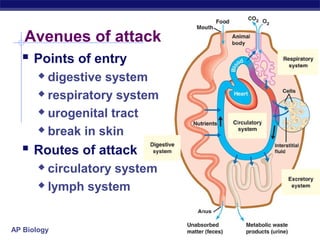
Avenues of attack
   Points of entry
        digestive system
        respiratory system

        urogenital tract

        break in skin

   Routes of attack
        circulatory system
        lymph system


AP Biology
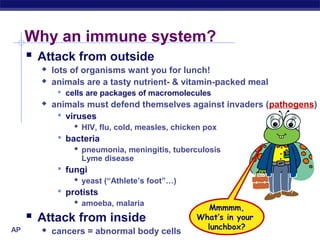
Why an immune system?
    Attack from outside
            lots of organisms want you for lunch!
            animals are a tasty nutrient- & vitamin-packed meal
               cells are packages of macromolecules
            animals must defend themselves against invaders (pathogens)
               viruses
                   HIV, flu, cold, measles, chicken pox
               bacteria
                   pneumonia, meningitis, tuberculosis
                    Lyme disease
               fungi
                   yeast (“Athlete’s foot”…)
               protists
                   amoeba, malaria
                                                  Mmmmm,
    Attack from inside                         What’s in your
AP Biology                                        lunchbox?
            cancers = abnormal body cells
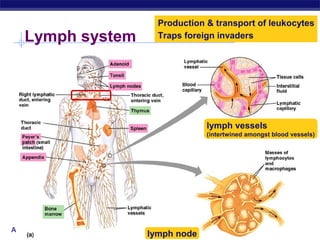
Production & transport of leukocytes
   Lymph system     Traps foreign invaders


                               lymph vessels
                               (intertwined amongst blood vessels)


AP Biology
                  lymph node
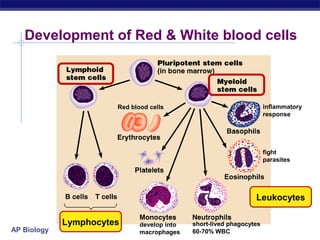
Development of Red & White blood cells


                       Red blood cells                                inflammatory
                                                                      response


                                                                      fight
                                                                      parasites


                                                                 Leukocytes

             Lymphocytes      develop into   short-lived phagocytes
AP Biology                    macrophages    60-70% WBC
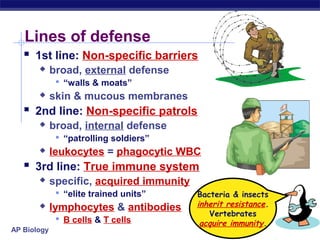
Lines of defense
    1st line: Non-specific barriers
            broad, external defense
               “walls & moats”
            skin & mucous membranes
    2nd line: Non-specific patrols
            broad, internal defense
               “patrolling soldiers”
            leukocytes = phagocytic WBC
    3rd line: True immune system
            specific, acquired immunity
               “elite trained units”      Bacteria & insects
            lymphocytes & antibodies      inherit resistance.
                                              Vertebrates
               B cells & T cells           acquire immunity.
AP Biology
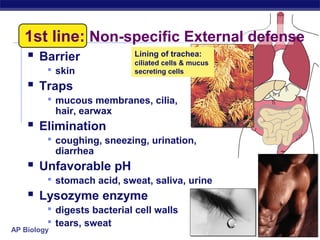
1st line: Non-specific External defense
     Barrier               Lining of trachea:
                            ciliated cells & mucus
          skin             secreting cells

     Traps
          mucous membranes, cilia,
             hair, earwax
     Elimination
          coughing, sneezing, urination,
             diarrhea
     Unfavorable pH
          stomach acid, sweat, saliva, urine
     Lysozyme enzyme
          digests bacterial cell walls
          tears, sweat
AP Biology
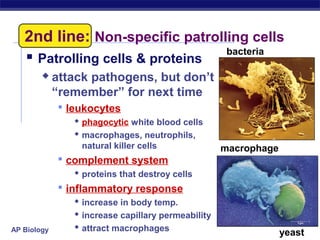
2nd line: Non-specific patrolling cells
                                 bacteria
    Patrolling cells & proteins
            attack pathogens, but don’t
             “remember” for next time
               leukocytes
                   phagocytic white blood cells
                   macrophages, neutrophils,
                   natural killer cells               macrophage
               complement system
                   proteins that destroy cells
               inflammatory response
                   increase in body temp.
                   increase capillary permeability
AP Biology         attract macrophages
                                                                   yeast
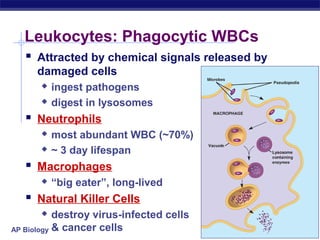
Leukocytes: Phagocytic WBCs
    Attracted by chemical signals released by
     damaged cells
         ingest pathogens
         digest in lysosomes
    Neutrophils
         most abundant WBC (~70%)
         ~ 3 day lifespan
    Macrophages
         “big eater”, long-lived
    Natural Killer Cells
          destroy virus-infected cells
AP Biology & cancer cells
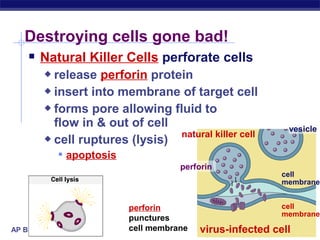
Destroying cells gone bad!
    Natural Killer Cells perforate cells
         release perforin protein
         insert into membrane of target cell

         forms pore allowing fluid to

          flow in & out of cell                              vesicle
         cell ruptures (lysis)
                                natural killer cell

              apoptosis
                                      perforin
                                                            cell
                                                            membrane


                           perforin                         cell
                                                            membrane
                           punctures
AP Biology                 cell membrane   virus-infected cell
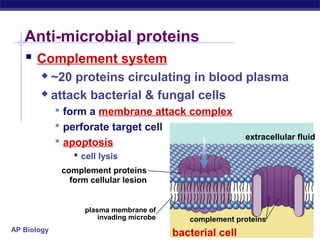
Anti-microbial proteins
    Complement system
        ~20 proteins circulating in blood plasma
        attack bacterial & fungal cells

              form a membrane attack complex
              perforate target cell
                                                            extracellular fluid
              apoptosis
                  cell lysis
              complement proteins
                form cellular lesion


                    plasma membrane of
                        invading microbe      complement proteins
AP Biology
                                           bacterial cell
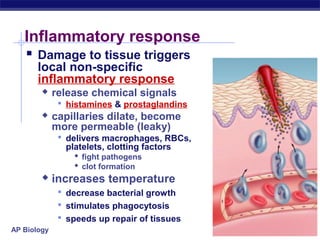
Inflammatory response
    Damage to tissue triggers
       local non-specific
       inflammatory response
            release chemical signals
               histamines & prostaglandins
            capillaries dilate, become
             more permeable (leaky)
               delivers macrophages, RBCs,
               platelets, clotting factors
                  fight pathogens
                  clot formation
            increases temperature
               decrease bacterial growth
               stimulates phagocytosis
               speeds up repair of tissues
AP Biology
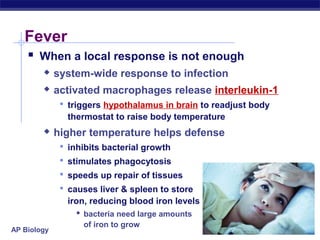
Fever
     When a local response is not enough
            system-wide response to infection
            activated macrophages release interleukin-1
               triggers hypothalamus in brain to readjust body
               thermostat to raise body temperature
            higher temperature helps defense
               inhibits bacterial growth
               stimulates phagocytosis
               speeds up repair of tissues
               causes liver & spleen to store
               iron, reducing blood iron levels
                  bacteria need large amounts
                   of iron to grow
AP Biology
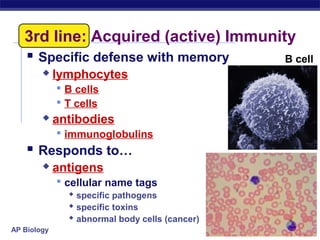
3rd line: Acquired (active) Immunity
    Specific defense with memory     B cell
            lymphocytes
              B cells
              T cells
            antibodies
              immunoglobulins
     Responds to…
            antigens
              cellular name tags
                 specific pathogens
                 specific toxins
                 abnormal body cells (cancer)
AP Biology
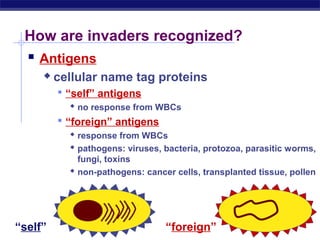
How are invaders recognized?
     Antigens
            cellular name tag proteins
              “self” antigens
                 no response from WBCs
              “foreign” antigens
                 response from WBCs
                 pathogens: viruses, bacteria, protozoa, parasitic worms,
                 fungi, toxins
                non-pathogens: cancer cells, transplanted tissue, pollen


 “self”
AP Biology                            “foreign”
bone marrow

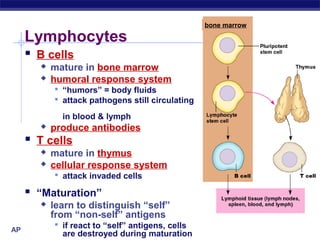
   Lymphocytes
    B cells
            mature in bone marrow
            humoral response system
              “humors” = body fluids
              attack pathogens still circulating

               in blood & lymph
            produce antibodies
    T cells
            mature in thymus
            cellular response system
              attack invaded cells

    “Maturation”
            learn to distinguish “self”
             from “non-self” antigens
              if react to “self” antigens, cells
AP Biology
               are destroyed during maturation
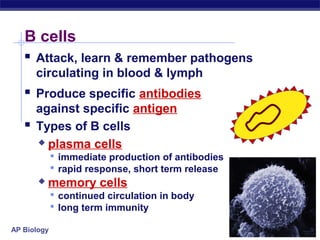
B cells
    Attack, learn & remember pathogens
       circulating in blood & lymph
    Produce specific antibodies
       against specific antigen
      Types of B cells
        plasma cells
              immediate production of antibodies
              rapid response, short term release
          memory cells
              continued circulation in body
              long term immunity

AP Biology
Y            YY
                                                           Y                  YY          Y


                                                                YY
                                                                     YY


                                                                                      Y
                                                                           YY
   Antibodies


                                                           Y


                                                                                  YY
                                                                                        Y
                                                               Y
                                                                 Y


                                                                          Y
                                                                              Y
                                                                                   YY
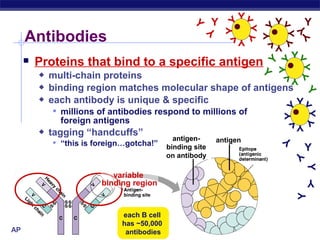
      Proteins that bind to a specific antigen


                                                                            Y
                                                                           YY
                                                                          Y


                                                                                       YY
           multi-chain proteins


                                                                          Y
                                                                                  Y
          binding region matches molecular shape of antigens Y
          each antibody is unique & specific                YY


                                                                                 YY
              millions of antibodies respond to millions of


                                                                                          YY
               foreign antigens


                                                                                Y
                                                                                      Y
          tagging “handcuffs”
                                              antigen-     antigen


                                                                                  Y
              “this is foreign…gotcha!”
                                            binding site                                  Y
                                            on antibody


                                                                                      Y
                                                                                          Y
                            variable                                                      Y
                         binding region


                                                                                      Y
                              each B cell
                              has ~50,000
AP Biology                     antibodies
YY
    Structure of antibodies


                                                                                                                                         YY
                                                                                                                                          Y

                                                                                                                                                  YY
                                                                                                                                        Y
                                                                                                                                              Y
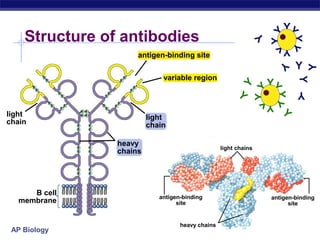
                                                                                              antigen-binding site
                                                                                                                                                   Y


                                                                                                                                              Y

                                                                                                                                                       Y
                s                                                                 s                  variable region


                                                                                                                                                   Y
                    s                                                         s
                                                                                                                                         YY


                                                                                                                                  Y
        s                                                                                 s
                                                                                                                               Y


                                                                                                                                YY
            s                                                                         s                                                            Y


                                                                                                                                             YY
                                s                                 s
                                    s                         s


                                                                                                                               Y
                        s                                                 s                                                              Y
                            s           s                 s           s

light
                                s
                                                s s
                                                s s
                                                              s
                                                                                                                                              Y
                                                                                                light
chain                                       s         s                                         chain
                                            s         s


                                                                          heavy
                                            s         s                                                                  light chains
                                            s         s                   chains

                                            s         s
                                            s         s


      B cell
                                                                                                   antigen-binding                       antigen-binding
   membrane                                                                                              site                                  site


                                                                                                          heavy chains
 AP Biology
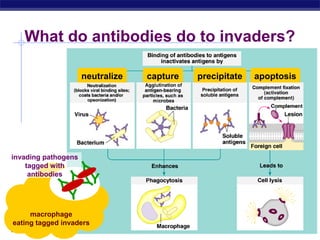
What do antibodies do to invaders?

                     neutralize   capture   precipitate   apoptosis


invading pathogens   Y
    tagged withY
     antibodies
                         Y
             Y

                   Y


                Y
     macrophage
eating tagged invaders
AP Biology
invading pathogens
                                                              Exposure
                                                                 to
                                                                 tagged with
                                                               antigen
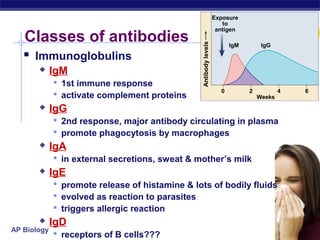
   Classes of antibodies                                          antibodies


                                                Antibody levels
                                                                      IgM       Y    IgG
                                                                                           macrophage
    Immunoglobulins                                                        Y
                                                                                           eating tagged
                                                                                    Y


                                                                       Y
             IgM                                                                             invaders


                                                                                Y
       

              1st immune response                                          Y
                                                                  0             2           4       6
              activate complement proteins                                         Weeks
            IgG
              2nd response, major antibody circulating in plasma
              promote phagocytosis by macrophages
            IgA
              in external secretions, sweat & mother’s milk
            IgE
              promote release of histamine & lots of bodily fluids
              evolved as reaction to parasites
              triggers allergic reaction
            IgD
AP Biology
              receptors of B cells???
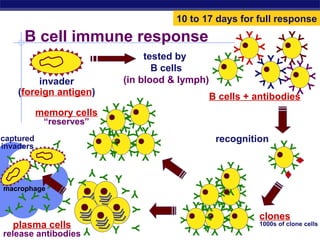
10 to 17 days for full response

      B cell immune response                                             YY              YY


                                                                   YY


                                                                                   YY
                                                                             YY


                                                                                             YY
                                         tested by             YY


                                                                  Y


                                                                                  Y
                                                                                YY
                                                                         Y               Y
                                                                                             YY


                                                           YY
                                           B cells


                                                                             YY
                                                                   YY


                                                                                    YY
                                                                                      YY
                                                                                                 YY
                                                          Y
          invader                   (in blood & lymph)


                                                                            Y
                                                               Y                Y


                                                                                     Y
                                                                                             Y
     (foreign antigen)                                    B cells + antibodies
                                        YY
                               YY
                               Y
           memory cells


                                            YY
                             Y

                      Y Y YY
            “reserves”             YY
                      Y Y YY
                                        Y
                           YY YY         YY
                               Y
captured                                                      recognition
                      YY


                                                                                     YY
                               YY
                                    YY

                                             YY
               Y
invaders
                     Y
                     Y
                     Y


                                                                                Y Y
                           Y    Y        Y


                                                                                         YY
 Y


                                                                                Y
         Y Y           Y                                        YY                   Y
        Y


                                                        YYYY
                                Y
                           Y


                                                                    YY YY
          Y  Y                                           YY     YY
                   Y
     Y


                                                   YY Y Y
macrophage                                                      Y
      Y                                                   Y
                                   Y


                                     Y
               Y


                                                             YY
  Y Y Y                                            Y Y YY
               Y
    Y

           Y


                                                     YY YY          YY
                                                         Y      Y
               Y


                                     Y


                                                   YY

                                                                              clones
Y


                                                         YY
                                                              YY

                                                                        YY
    plasma cells                                                              1000s of clone cells
                                                  Y
                                                  Y
                               Y                  Y
                                     Y


  AP Biology
                     Y                               Y    Y         Y
release antibodies
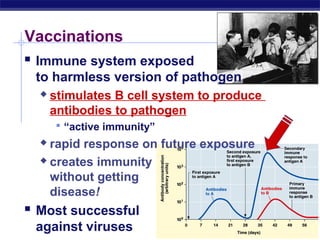
Vaccinations
    Immune system exposed
      to harmless version of pathogen
            stimulates B cell system to produce
             antibodies to pathogen
              “active immunity”
        rapid response on future exposure
        creates immunity

         without getting
         disease!
    Most successful
      against viruses
AP Biology
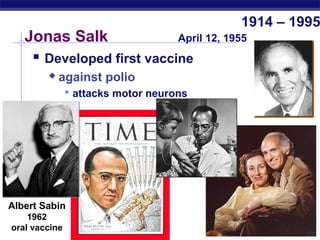
1914 – 1995
   Jonas Salk              April 12, 1955
     Developed first vaccine
           against polio
                attacks motor neurons


Albert Sabin
    1962
oral vaccine
AP Biology
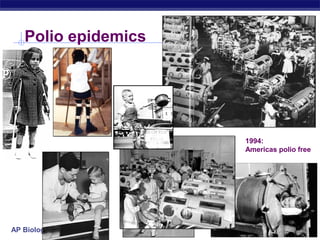
Polio epidemics


                     1994:
                     Americas polio free


AP Biology
Passive immunity
    Obtaining antibodies from another
       individual
            maternal immunity
              antibodies pass from mother to baby across
               placenta or in mother’s milk
              critical role of breastfeeding in infant health
                 mother is creating antibodies against pathogens baby
                  is being exposed to

     Injection
         injection of antibodies
         short-term immunity

AP Biology
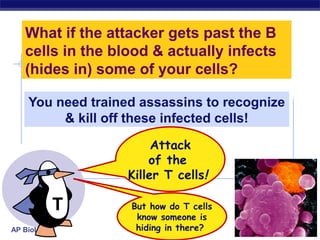
What if the attacker gets past the B
   cells in the blood & actually infects
   (hides in) some of your cells?

    You need trained assassins to recognize
         & kill off these infected cells!

                        Attack
                       of the
                   Killer T cells!

             T     But how do T cells
                    know someone is
AP Biology          hiding in there?    2007-2008
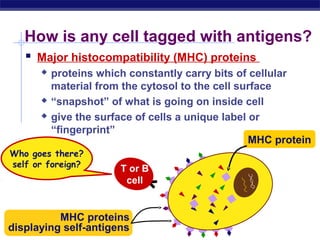
How is any cell tagged with antigens?
    Major histocompatibility (MHC) proteins
         proteins which constantly carry bits of cellular
          material from the cytosol to the cell surface
         “snapshot” of what is going on inside cell
         give the surface of cells a unique label or
          “fingerprint”
                                                   MHC protein
Who goes there?
self or foreign?
                       T or B
                        cell


           MHC proteins
displaying self-antigens
AP Biology
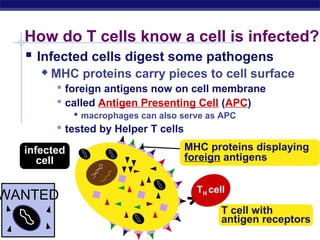
How do T cells know a cell is infected?
     Infected cells digest some pathogens
             MHC proteins carry pieces to cell surface
                foreign antigens now on cell membrane
                called Antigen Presenting Cell (APC)
                    macrophages can also serve as APC
                tested by Helper T cells

    infected                          MHC proteins displaying
       cell                           foreign antigens


                                         TH cell
WANTED
                                               T cell with
                                               antigen receptors
 AP Biology
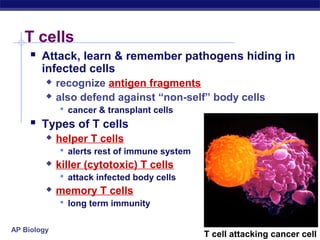
T cells
     Attack, learn & remember pathogens hiding in
        infected cells
            recognize antigen fragments
            also defend against “non-self” body cells
              cancer & transplant cells
     Types of T cells
            helper T cells
              alerts rest of immune system
            killer (cytotoxic) T cells
              attack infected body cells
            memory T cells
              long term immunity


AP Biology
                                              T cell attacking cancer cell
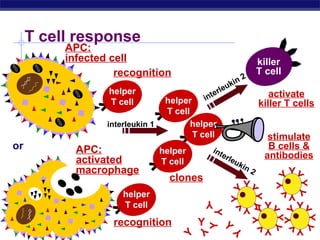
T cell response
             APC:
             infected cell                                                       killer
                       recognition                                               T cell
                                                                        2
                                                            u kin
                     helper                              rle                        activate
                                      helper      i   nte
                     T cell                                                      killer T cells
                                      T cell
                     interleukin 1           helper
                                             T cell                                 stimulate
or             APC:                  helper            i nt                         B cells &
               activated
                                                              erl
                                                                  eu               antibodies
                                     T cell                            kin
               macrophage                                                    2              YY
                                       clones


                                                                                        YY
                                                                        YY


                                                                                                YY
                                                                                       Y
                                                                 YY
                         helper                                                             Y


                                                                             YY
                                                  Y
                         T cell                                                    YY           YY


                                                                Y
                                                                        Y
                                                       Y


                                                                              YY


                                                                                           YY
                                                                                       YY

                                                                                                    YY
                      recognition             Y               Y
                                                      Y


                                                                             Y


                                                                                          Y
AP Biology
                                                                                   Y            Y
                                               Y


                                                                  Y
                                         Y
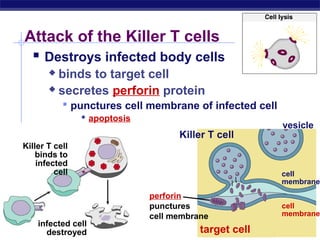
Attack of the Killer T cells
     Destroys infected body cells
          binds to target cell
          secretes perforin protein

              punctures cell membrane of infected cell
                  apoptosis
                                                          vesicle
                                   Killer T cell
  Killer T cell
      binds to
      infected
           cell                                           cell
                                                          membrane
                             perforin
                             punctures                    cell
                             cell membrane                membrane
      infected cell
AP Biology
         destroyed                      target cell
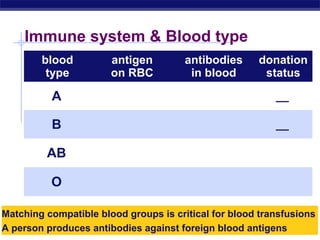
Immune system & Blood type
        blood           antigen             antibodies          donation
         type           on RBC               in blood            status
                      type A antigens
          A          on surface of RBC
                                            anti-B antibodies      __
                      type B antigens
          B          on surface of RBC
                                            anti-A antibodies      __
                    both type A & type B
                                                                universal
         AB        antigens on surface of
                            RBC
                                             no antibodies
                                                                recipient
                        no antigens          anti-A & anti-B    universal
          O          on surface of RBC         antibodies        donor

Matching compatible blood groups is critical for blood transfusions
A AP Biology
  person produces antibodies against foreign blood antigens
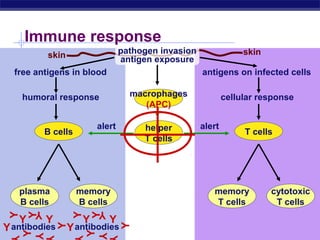
Immune response
             skin                    pathogen invasion                skin
                                     antigen exposure
  free antigens in blood                                 antigens on infected cells

     humoral response                  macrophages               cellular response
                                          (APC)

                             alert        helper         alert
             B cells                                                  T cells
                                          T cells


   plasma              memory                               memory           cytotoxic
   B cells             B cells                              T cells           T cells
         Y                   Y
 Y
       Y


                     Y
                            Y


   Y         Y          Y        Y
Y antibodies        Y antibodies
                 Y


                                     Y


  AP Biology
     Y


                         Y
         Y


                             Y
 Y


         Y

                       Y


                             Y
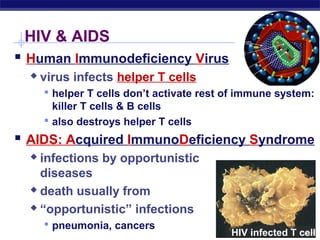
HIV & AIDS
 Human Immunodeficiency Virus
        virus infects helper T cells
          helper T cells don’t activate rest of immune system:
           killer T cells & B cells
          also destroys helper T cells
 AIDS: Acquired ImmunoDeficiency Syndrome
      infections by opportunistic
       diseases
      death usually from

      “opportunistic” infections

          pneumonia, cancers
AP Biology
                                              HIV infected T cell
How to protect yourself…


AP Biology
Immune system malfunctions
      Auto-immune diseases
            immune system attacks own molecules & cells
               lupus
                   antibodies against many molecules released by normal
                    breakdown of cells
               rheumatoid arthritis
                   antibodies causing damage to cartilage & bone
               diabetes
                   beta-islet cells of pancreas attacked & destroyed
               multiple sclerosis
                   T cells attack myelin sheath of brain & spinal cord nerves
      Allergies
            over-reaction to environmental antigens
               allergens = proteins on pollen, dust mites, in animal
                saliva
AP Biology     stimulates release of histamine
It’s safe
             to Ask Questions!


AP Biology                   2009-2010

45 ch48immunity2009

  • 1.
    phagocytic Fighting the leukocyte Enemy Within! Immune / Lymphatic System lymphocytes attacking lymph AP Biology cancer cell system 2007-2008
  • 2.
    Avenues of attack  Points of entry  digestive system  respiratory system  urogenital tract  break in skin  Routes of attack  circulatory system  lymph system AP Biology
  • 3.
    Why an immunesystem?  Attack from outside  lots of organisms want you for lunch!  animals are a tasty nutrient- & vitamin-packed meal  cells are packages of macromolecules  animals must defend themselves against invaders (pathogens)  viruses  HIV, flu, cold, measles, chicken pox  bacteria  pneumonia, meningitis, tuberculosis Lyme disease  fungi  yeast (“Athlete’s foot”…)  protists  amoeba, malaria Mmmmm,  Attack from inside What’s in your AP Biology lunchbox?  cancers = abnormal body cells
  • 4.
    Production & transportof leukocytes Lymph system Traps foreign invaders lymph vessels (intertwined amongst blood vessels) AP Biology lymph node
  • 5.
    Development of Red& White blood cells Red blood cells inflammatory response fight parasites Leukocytes Lymphocytes develop into short-lived phagocytes AP Biology macrophages 60-70% WBC
  • 6.
    Lines of defense  1st line: Non-specific barriers  broad, external defense  “walls & moats”  skin & mucous membranes  2nd line: Non-specific patrols  broad, internal defense  “patrolling soldiers”  leukocytes = phagocytic WBC  3rd line: True immune system  specific, acquired immunity  “elite trained units” Bacteria & insects  lymphocytes & antibodies inherit resistance. Vertebrates  B cells & T cells acquire immunity. AP Biology
  • 7.
    1st line: Non-specificExternal defense  Barrier Lining of trachea: ciliated cells & mucus  skin secreting cells  Traps  mucous membranes, cilia, hair, earwax  Elimination  coughing, sneezing, urination, diarrhea  Unfavorable pH  stomach acid, sweat, saliva, urine  Lysozyme enzyme  digests bacterial cell walls  tears, sweat AP Biology
  • 8.
    2nd line: Non-specificpatrolling cells bacteria  Patrolling cells & proteins  attack pathogens, but don’t “remember” for next time  leukocytes  phagocytic white blood cells  macrophages, neutrophils, natural killer cells macrophage  complement system  proteins that destroy cells  inflammatory response  increase in body temp.  increase capillary permeability AP Biology  attract macrophages yeast
  • 9.
    Leukocytes: Phagocytic WBCs  Attracted by chemical signals released by damaged cells  ingest pathogens  digest in lysosomes  Neutrophils  most abundant WBC (~70%)  ~ 3 day lifespan  Macrophages  “big eater”, long-lived  Natural Killer Cells  destroy virus-infected cells AP Biology & cancer cells
  • 10.
    Destroying cells gonebad!  Natural Killer Cells perforate cells  release perforin protein  insert into membrane of target cell  forms pore allowing fluid to flow in & out of cell vesicle  cell ruptures (lysis) natural killer cell  apoptosis perforin cell membrane perforin cell membrane punctures AP Biology cell membrane virus-infected cell
  • 11.
    Anti-microbial proteins  Complement system  ~20 proteins circulating in blood plasma  attack bacterial & fungal cells  form a membrane attack complex  perforate target cell extracellular fluid  apoptosis  cell lysis complement proteins form cellular lesion plasma membrane of invading microbe complement proteins AP Biology bacterial cell
  • 12.
    Inflammatory response  Damage to tissue triggers local non-specific inflammatory response  release chemical signals  histamines & prostaglandins  capillaries dilate, become more permeable (leaky)  delivers macrophages, RBCs, platelets, clotting factors  fight pathogens  clot formation  increases temperature  decrease bacterial growth  stimulates phagocytosis  speeds up repair of tissues AP Biology
  • 13.
    Fever  When a local response is not enough  system-wide response to infection  activated macrophages release interleukin-1  triggers hypothalamus in brain to readjust body thermostat to raise body temperature  higher temperature helps defense  inhibits bacterial growth  stimulates phagocytosis  speeds up repair of tissues  causes liver & spleen to store iron, reducing blood iron levels  bacteria need large amounts of iron to grow AP Biology
  • 14.
    3rd line: Acquired(active) Immunity  Specific defense with memory B cell  lymphocytes  B cells  T cells  antibodies  immunoglobulins  Responds to…  antigens  cellular name tags  specific pathogens  specific toxins  abnormal body cells (cancer) AP Biology
  • 15.
    How are invadersrecognized?  Antigens  cellular name tag proteins  “self” antigens  no response from WBCs  “foreign” antigens  response from WBCs  pathogens: viruses, bacteria, protozoa, parasitic worms, fungi, toxins  non-pathogens: cancer cells, transplanted tissue, pollen “self” AP Biology “foreign”
  • 16.
    bone marrow Lymphocytes  B cells  mature in bone marrow  humoral response system  “humors” = body fluids  attack pathogens still circulating in blood & lymph  produce antibodies  T cells  mature in thymus  cellular response system  attack invaded cells  “Maturation”  learn to distinguish “self” from “non-self” antigens  if react to “self” antigens, cells AP Biology are destroyed during maturation
  • 17.
    B cells  Attack, learn & remember pathogens circulating in blood & lymph  Produce specific antibodies against specific antigen  Types of B cells  plasma cells  immediate production of antibodies  rapid response, short term release  memory cells  continued circulation in body  long term immunity AP Biology
  • 18.
    Y YY Y YY Y YY YY Y YY Antibodies Y YY Y Y Y Y Y YY  Proteins that bind to a specific antigen Y YY Y YY multi-chain proteins Y  Y  binding region matches molecular shape of antigens Y  each antibody is unique & specific YY YY  millions of antibodies respond to millions of YY foreign antigens Y Y  tagging “handcuffs” antigen- antigen Y  “this is foreign…gotcha!” binding site Y on antibody Y Y variable Y binding region Y each B cell has ~50,000 AP Biology antibodies
  • 19.
    YY Structure of antibodies YY Y YY Y Y antigen-binding site Y Y Y s s variable region Y s s YY Y s s Y YY s s Y YY s s s s Y s s Y s s s s light s s s s s s Y light chain s s chain s s heavy s s light chains s s chains s s s s B cell antigen-binding antigen-binding membrane site site heavy chains AP Biology
  • 20.
    What do antibodiesdo to invaders? neutralize capture precipitate apoptosis invading pathogens Y tagged withY antibodies Y Y Y Y macrophage eating tagged invaders AP Biology
  • 21.
    invading pathogens Exposure to tagged with antigen Classes of antibodies antibodies Antibody levels IgM Y IgG macrophage  Immunoglobulins Y eating tagged Y Y IgM invaders Y   1st immune response Y 0 2 4 6  activate complement proteins Weeks  IgG  2nd response, major antibody circulating in plasma  promote phagocytosis by macrophages  IgA  in external secretions, sweat & mother’s milk  IgE  promote release of histamine & lots of bodily fluids  evolved as reaction to parasites  triggers allergic reaction  IgD AP Biology  receptors of B cells???
  • 22.
    10 to 17days for full response B cell immune response YY YY YY YY YY YY tested by YY Y Y YY Y Y YY YY B cells YY YY YY YY YY Y invader (in blood & lymph) Y Y Y Y Y (foreign antigen) B cells + antibodies YY YY Y memory cells YY Y Y Y YY “reserves” YY Y Y YY Y YY YY YY Y captured recognition YY YY YY YY YY Y invaders Y Y Y Y Y Y Y Y YY Y Y Y Y Y YY Y Y YYYY Y Y YY YY Y Y YY YY Y Y YY Y Y macrophage Y Y Y Y Y Y YY Y Y Y Y Y YY Y Y Y YY YY YY Y Y Y Y YY clones Y YY YY YY plasma cells 1000s of clone cells Y Y Y Y Y AP Biology Y Y Y Y release antibodies
  • 23.
    Vaccinations  Immune system exposed to harmless version of pathogen  stimulates B cell system to produce antibodies to pathogen  “active immunity”  rapid response on future exposure  creates immunity without getting disease!  Most successful against viruses AP Biology
  • 24.
    1914 – 1995 Jonas Salk April 12, 1955  Developed first vaccine  against polio  attacks motor neurons Albert Sabin 1962 oral vaccine AP Biology
  • 25.
    Polio epidemics 1994: Americas polio free AP Biology
  • 26.
    Passive immunity  Obtaining antibodies from another individual  maternal immunity  antibodies pass from mother to baby across placenta or in mother’s milk  critical role of breastfeeding in infant health  mother is creating antibodies against pathogens baby is being exposed to  Injection  injection of antibodies  short-term immunity AP Biology
  • 27.
    What if theattacker gets past the B cells in the blood & actually infects (hides in) some of your cells? You need trained assassins to recognize & kill off these infected cells! Attack of the Killer T cells! T But how do T cells know someone is AP Biology hiding in there? 2007-2008
  • 28.
    How is anycell tagged with antigens?  Major histocompatibility (MHC) proteins  proteins which constantly carry bits of cellular material from the cytosol to the cell surface  “snapshot” of what is going on inside cell  give the surface of cells a unique label or “fingerprint” MHC protein Who goes there? self or foreign? T or B cell MHC proteins displaying self-antigens AP Biology
  • 29.
    How do Tcells know a cell is infected?  Infected cells digest some pathogens  MHC proteins carry pieces to cell surface  foreign antigens now on cell membrane  called Antigen Presenting Cell (APC)  macrophages can also serve as APC  tested by Helper T cells infected MHC proteins displaying cell foreign antigens TH cell WANTED T cell with antigen receptors AP Biology
  • 30.
    T cells  Attack, learn & remember pathogens hiding in infected cells  recognize antigen fragments  also defend against “non-self” body cells  cancer & transplant cells  Types of T cells  helper T cells  alerts rest of immune system  killer (cytotoxic) T cells  attack infected body cells  memory T cells  long term immunity AP Biology T cell attacking cancer cell
  • 31.
    T cell response APC: infected cell killer recognition T cell 2 u kin helper rle activate helper i nte T cell killer T cells T cell interleukin 1 helper T cell stimulate or APC: helper i nt B cells & activated erl eu antibodies T cell kin macrophage 2 YY clones YY YY YY Y YY helper Y YY Y T cell YY YY Y Y Y YY YY YY YY recognition Y Y Y Y Y AP Biology Y Y Y Y Y
  • 32.
    Attack of theKiller T cells  Destroys infected body cells  binds to target cell  secretes perforin protein  punctures cell membrane of infected cell  apoptosis vesicle Killer T cell Killer T cell binds to infected cell cell membrane perforin punctures cell cell membrane membrane infected cell AP Biology destroyed target cell
  • 33.
    Immune system &Blood type blood antigen antibodies donation type on RBC in blood status type A antigens A on surface of RBC anti-B antibodies __ type B antigens B on surface of RBC anti-A antibodies __ both type A & type B universal AB antigens on surface of RBC no antibodies recipient no antigens anti-A & anti-B universal O on surface of RBC antibodies donor Matching compatible blood groups is critical for blood transfusions A AP Biology person produces antibodies against foreign blood antigens
  • 34.
    Immune response skin pathogen invasion skin antigen exposure free antigens in blood antigens on infected cells humoral response macrophages cellular response (APC) alert helper alert B cells T cells T cells plasma memory memory cytotoxic B cells B cells T cells T cells Y Y Y Y Y Y Y Y Y Y Y antibodies Y antibodies Y Y AP Biology Y Y Y Y Y Y Y Y
  • 35.
    HIV & AIDS Human Immunodeficiency Virus  virus infects helper T cells  helper T cells don’t activate rest of immune system: killer T cells & B cells  also destroys helper T cells  AIDS: Acquired ImmunoDeficiency Syndrome  infections by opportunistic diseases  death usually from  “opportunistic” infections  pneumonia, cancers AP Biology HIV infected T cell
  • 36.
    How to protectyourself… AP Biology
  • 37.
    Immune system malfunctions  Auto-immune diseases  immune system attacks own molecules & cells  lupus  antibodies against many molecules released by normal breakdown of cells  rheumatoid arthritis  antibodies causing damage to cartilage & bone  diabetes  beta-islet cells of pancreas attacked & destroyed  multiple sclerosis  T cells attack myelin sheath of brain & spinal cord nerves  Allergies  over-reaction to environmental antigens  allergens = proteins on pollen, dust mites, in animal saliva AP Biology  stimulates release of histamine
  • 38.
    It’s safe to Ask Questions! AP Biology 2009-2010

Editor's Notes

  • #14 Certain bacterial infections can induce an overwhelming systemic inflammatory response leading to a condition known as septic shock . Characterized by high fever and low blood pressure, septic shock is the most common cause of death in U.S. critical care units. Clearly, while local inflammation is an essential step toward healing, widespread inflammation can be devastating.
  • #17 Tens of millions of different T cells are produced, each one specializing in the recognition of oen particar antigen.
  • #25 Poliomyelitis (polio) is caused by a virus that enters the body through the mouth. The virus multiplies in the intestine and invades the nervous system. It can cause total paralysis in a matter of hours. One in 200 infections leads to irreversible paralysis. Among those paralyzed, 5-10 percent die when their breathing muscles are immobilized. Polio mainly affects children under age 5. Salk vaccine = inactivated poliovirus vaccine (IPV), based on poliovirus grown in a type of monkey kidney tissue culture, which is chemically inactivated with formalin Sabin vaccine = oral polio vaccine (OPV) using live but weakened (attenuated) virus, produced by the repeated passage of the virus through non-human cells at sub-physiological temperatures
  • #26 1916 The first major polio epidemic strikes in the United States; 27,000 people suffer paralysis and 6,000 die. Increasing numbers of outbreaks occur each year. 1921 Franklin D. Roosevelt is diagnosed with polio. 1928 Iron lungs are introduced to help patients with acute polio breathe. 1932 Franklin D. Roosevelt is elected President of the United States 1949 Dr. John Enders, Dr. Frederick Robbins and Dr. Thomas Weller develop a way to grow poliovirus in tissue culture, a breakthrough that aided in the creation of the polio vaccine. Their work earned the three scientists the Nobel Prize in physiology and medicine in 1954. 1952 The United States reports 57,628 polio cases -- the worst U.S. epidemic on record. 1979 The last U.S. case of polio caused by wild poliovirus is reported. 1988 Worldwide, polio continues to affect some 350,000 people in 125 countries. 1994 The Americas are certified polio-free. 2000 The Western Pacific region is certified polio-free. 2002 Europe is certified polio-free.