Demultiplexer, Encoder, Decoder, ALU
What is a Demultiplexer
(DEMUX)?
• A DEMUX is a digital switch
with a single input (source)
and a multiple outputs
(destinations).
• The select lines determine
which output the input is
connected to.
• DEMUX Types
 1-to-2 (1 select line)
 1-to-4 (2 select lines)
 1-to-8 (3 select lines)
 1-to-16 (4 select lines)
Demultiplexer
Block Diagram
Select
Lines
Input
(source)
Outputs
(destinations)
2N
1
N
DEMUX
Demultiplexers

A demultiplexer has
 N control inputs
 1 data input
 2N
outputs

A demultiplexer routes (or connects) the data input
to the selected output.
 The value of the control inputs determines the
output that is selected.

A demultiplexer performs the opposite function of a
multiplexer.
1 to 4 channel Demux
Demultiplexers: Implemtation
Out0
G
S
Out1
1:2 demux
1-to-4 De-Multiplexer (DEMUX)
B A D0 D1 D2 D3
0 0 X 0 0 0
0 1 0 X 0 0
1 0 0 0 X 0
1 1 0 0 0 X
D0
D1
D2
D3
X
B A
DEMUX
Demux Tree
Encoders
• An encoder is a combinational logic circuit that
generate n output lines from 2n (or less) inputs.
It has the reverse function of the decoder
• An encoder accepts digit on its inputs, such as a
decimal or octal digit, and converts it to a coded
output, such as a binary or BCD. Encoder can
also be devised to encode various symbol and
alphabetic characters. This process of
converting from familiar symbols or numbers to a
coded format is called encoding.
Encoders
Binary Encoders
 Binary encoders convert its 2n
inputs to an n-bit output.
 Only one high value is
presented as input. The result is
a binary-encoded output of size
n.
 Binary encoders are useful for
compressing data.
2n
inputs
I0
I2n 1
–
O0
On 1
–
n
outputs
Binary Encoder
Lecture Digital Systems
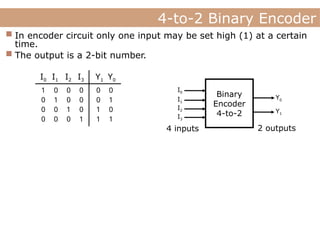
4-to-2 Binary Encoder
Lecture Digital Systems
 In encoder circuit only one input may be set high (1) at a certain
time.
 The output is a 2-bit number.
0
0
1
1
1
0
1
0
0
0
0
1
1
0
0
0
0
1
0
0
0
0
1
0
I0 I1 I2 I3 Y1 Y0
Binary
Encoder
4-to-2
2 outputs
4 inputs
I0
I1
I2
I3
Y0
Y1
Octal to Binary (8 to 3) Encoder
Lecture Digital Systems
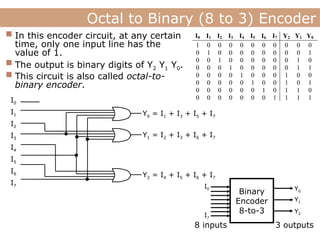
 In this encoder circuit, at any certain
time, only one input line has the
value of 1.
 The output is binary digits of Y2 Y1 Y0.
 This circuit is also called octal-to-
binary encoder.
Binary
Encoder
8-to-3
8 inputs 3 outputs
I0
I7
Y0
Y1
Y2
I0 I1 I2 I3 I4 I5 I6 I7 Y2 Y1 Y0
1 0 0 0 0 0 0 0 0 0 0
0 1 0 0 0 0 0 0 0 0 1
0 0 1 0 0 0 0 0 0 1 0
0 0 0 1 0 0 0 0 0 1 1
0 0 0 0 1 0 0 0 1 0 0
0 0 0 0 0 1 0 0 1 0 1
0 0 0 0 0 0 1 0 1 1 0
0 0 0 0 0 0 0 1 1 1 1
I0
I1
I2
I3
I4
I5
I6
I7
Y2 = I4 + I5 + I6 + I7
Y1 = I2 + I3 + I6 + I7
Y0 = I1 + I3 + I5 + I7
Priority Encoder
• The Priority Encoder solves the problems
mentioned above by allocating a priority level to
each input. The priority encoders output
corresponds to the currently active input which
has the highest priority. So when an input with a
higher priority is present, all other inputs with a
lower priority will be ignored.
0
0
1
1
1
0
1
0
X
X
X
1
1
X
X
0
0
1
X
0
0
0
1
0
D0 D1
D2
D3
A1 A0
4-to-2 Priority Encoder
 For some application, there can be more than one input line that
have a value of 1.
 One way to handle these inputs is to ignore the lower inputs and
only process the highest input (‘priority input’).
 This encoder has 4 input lines:
D0 to D3.
 D3 has the highest priority, D0 has
the lowest priority.
Lecture Digital Systems
8-to-3 Priority Encoder
Lecture Digital Systems
 The following is the truth table of an 8-to-3 priority encoder.
 X indicates don’t cares.
I0 I1 I2 I3 I4 I5 I6 I7 Y2 Y1 Y0 Idle
0 0 0 0 0 0 0 0 X X X 1
1 0 0 0 0 0 0 0 0 0 0 0
X 1 0 0 0 0 0 0 0 0 1 0
X X 1 0 0 0 0 0 0 1 0 0
X X X 1 0 0 0 0 0 1 1 0
X X X X 1 0 0 0 1 0 0 0
X X X X X 1 0 0 1 0 1 0
X X X X X X 1 0 1 1 0 0
X X X X X X X 1 1 1 1 0
8-to-3 Priority Encoder
Lecture Digital Systems
 As one alternative solution, we can use a priority circuit that
implements the following logic functions:
H0 = I7’·I6’·I5’·I4’·I3’·I2’·I1’·I0
H1 = I7’·I6’·I5’·I4’·I3’·I2’·I1
H2 = I7’.I6’·I5’·I4’·I3’·I2
H3 = I7’.I6’·I5’·I4’·I3
H4 = I7’·I6’·I5’·I4
H5 = I7’·I6’·I5
H6 = I7’·I6
H7 = I7 (Highest Priority)
Decoder
• A circuit that coverts binary information from n
input lines to a maximum of 2n unique output
lines
• May have fewer than 2n outputs
• For each possible input combination, there is
only one output that is equal to 1
Binary Decoders
 A binary decoder can be
considered as a black box
with n input lines and 2n
output lines.
 Only one output line is set to
1 for a given input.
In 1
–
n
inputs
E
Enable
2n
outputs
O0
O2n 1
–
I0
Binary Decoder
Lecture Digital Systems
Binary Decoders
Lecture Digital Systems
 Binary decoders convert an n-bit input to a single output. It uses
its n-bit input to determine which of the 2n
outputs will be
uniquely activated.
 Binary decoders can be developed using AND or OR Gates.
 Later on, binary decoders can be implemented in logic circuits.
 The outputs of a decoder are minterms. That is why decoders are
sometimes called as minterm generators.
 We can easily use a decoder to implement any sum of minterms
expression.
 Note: A minterm is a Boolean expression resulting in 1 only for
the output of a single row (in a truth table) or a single cell (in a
Karnaugh map), and 0s for all other row or cells, respectively.
2-to-4 Binary Decoder
Lecture Digital Systems
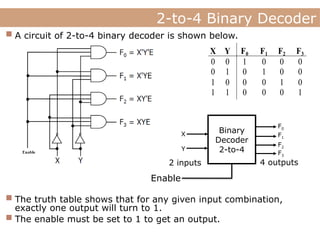
 A circuit of 2-to-4 binary decoder is shown below.
Binary
Decoder
2-to-4
2 inputs 4 outputs
Enable
Y
X
F0
F1
F2
F3
 The truth table shows that for any given input combination,
exactly one output will turn to 1.
 The enable must be set to 1 to get an output.
3-to-8 Decoder
Lecture Digital Systems
X Y Z F0 F1 F2 F3 F4 F5 F6 F7
0 0 0 1 0 0 0 0 0 0 0
0 0 1 0 1 0 0 0 0 0 0
0 1 0 0 0 1 0 0 0 0 0
0 1 1 0 0 0 1 0 0 0 0
1 0 0 0 0 0 0 1 0 0 0
1 0 1 0 0 0 0 0 1 0 0
1 1 0 0 0 0 0 0 0 1 0
1 1 1 0 0 0 0 0 0 0 1
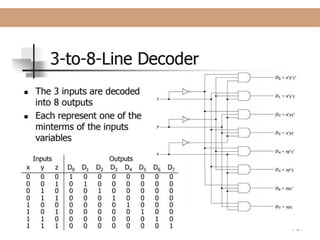
 Try to understand the logic circuit of
3-to-8 binary decoder below.
Decoder
3-to-8
3 inputs 8 outputs
Enable
X
Y
Z
F0
F7
ALU (Arithmetic Logic Unit )
• The IC 74181 is a 4-bit Arithmetic Logic Unit
(ALU) which can perform all the possible 16
logic operations on two variables and a variety of
arithmetic operations.
• Features
– ■ Provides 16 arithmetic operations: add, subtract,
compare, double, plus twelve other arithmetic
operations
– ■ Provides all 16 logic operations of two variables:
exclusive-OR, compare, AND, NAND, OR, NOR, plus
ten other logic operations
– ■ Full lookahead for high speed arithmetic operation
on long words
IC 74181 ALU
432978589-Demux-Encoder-Decoder-ALU.pptx

432978589-Demux-Encoder-Decoder-ALU.pptx

  • 1.
  • 2.
    What is aDemultiplexer (DEMUX)? • A DEMUX is a digital switch with a single input (source) and a multiple outputs (destinations). • The select lines determine which output the input is connected to. • DEMUX Types  1-to-2 (1 select line)  1-to-4 (2 select lines)  1-to-8 (3 select lines)  1-to-16 (4 select lines) Demultiplexer Block Diagram Select Lines Input (source) Outputs (destinations) 2N 1 N DEMUX
  • 3.
    Demultiplexers  A demultiplexer has N control inputs  1 data input  2N outputs  A demultiplexer routes (or connects) the data input to the selected output.  The value of the control inputs determines the output that is selected.  A demultiplexer performs the opposite function of a multiplexer.
  • 4.
    1 to 4channel Demux
  • 5.
  • 6.
    1-to-4 De-Multiplexer (DEMUX) BA D0 D1 D2 D3 0 0 X 0 0 0 0 1 0 X 0 0 1 0 0 0 X 0 1 1 0 0 0 X D0 D1 D2 D3 X B A DEMUX
  • 7.
  • 8.
    Encoders • An encoderis a combinational logic circuit that generate n output lines from 2n (or less) inputs. It has the reverse function of the decoder • An encoder accepts digit on its inputs, such as a decimal or octal digit, and converts it to a coded output, such as a binary or BCD. Encoder can also be devised to encode various symbol and alphabetic characters. This process of converting from familiar symbols or numbers to a coded format is called encoding.
  • 9.
  • 10.
    Binary Encoders  Binaryencoders convert its 2n inputs to an n-bit output.  Only one high value is presented as input. The result is a binary-encoded output of size n.  Binary encoders are useful for compressing data. 2n inputs I0 I2n 1 – O0 On 1 – n outputs Binary Encoder Lecture Digital Systems
  • 11.
    4-to-2 Binary Encoder LectureDigital Systems  In encoder circuit only one input may be set high (1) at a certain time.  The output is a 2-bit number. 0 0 1 1 1 0 1 0 0 0 0 1 1 0 0 0 0 1 0 0 0 0 1 0 I0 I1 I2 I3 Y1 Y0 Binary Encoder 4-to-2 2 outputs 4 inputs I0 I1 I2 I3 Y0 Y1
  • 12.
    Octal to Binary(8 to 3) Encoder Lecture Digital Systems  In this encoder circuit, at any certain time, only one input line has the value of 1.  The output is binary digits of Y2 Y1 Y0.  This circuit is also called octal-to- binary encoder. Binary Encoder 8-to-3 8 inputs 3 outputs I0 I7 Y0 Y1 Y2 I0 I1 I2 I3 I4 I5 I6 I7 Y2 Y1 Y0 1 0 0 0 0 0 0 0 0 0 0 0 1 0 0 0 0 0 0 0 0 1 0 0 1 0 0 0 0 0 0 1 0 0 0 0 1 0 0 0 0 0 1 1 0 0 0 0 1 0 0 0 1 0 0 0 0 0 0 0 1 0 0 1 0 1 0 0 0 0 0 0 1 0 1 1 0 0 0 0 0 0 0 0 1 1 1 1 I0 I1 I2 I3 I4 I5 I6 I7 Y2 = I4 + I5 + I6 + I7 Y1 = I2 + I3 + I6 + I7 Y0 = I1 + I3 + I5 + I7
  • 13.
    Priority Encoder • ThePriority Encoder solves the problems mentioned above by allocating a priority level to each input. The priority encoders output corresponds to the currently active input which has the highest priority. So when an input with a higher priority is present, all other inputs with a lower priority will be ignored.
  • 14.
    0 0 1 1 1 0 1 0 X X X 1 1 X X 0 0 1 X 0 0 0 1 0 D0 D1 D2 D3 A1 A0 4-to-2Priority Encoder  For some application, there can be more than one input line that have a value of 1.  One way to handle these inputs is to ignore the lower inputs and only process the highest input (‘priority input’).  This encoder has 4 input lines: D0 to D3.  D3 has the highest priority, D0 has the lowest priority. Lecture Digital Systems
  • 15.
    8-to-3 Priority Encoder LectureDigital Systems  The following is the truth table of an 8-to-3 priority encoder.  X indicates don’t cares. I0 I1 I2 I3 I4 I5 I6 I7 Y2 Y1 Y0 Idle 0 0 0 0 0 0 0 0 X X X 1 1 0 0 0 0 0 0 0 0 0 0 0 X 1 0 0 0 0 0 0 0 0 1 0 X X 1 0 0 0 0 0 0 1 0 0 X X X 1 0 0 0 0 0 1 1 0 X X X X 1 0 0 0 1 0 0 0 X X X X X 1 0 0 1 0 1 0 X X X X X X 1 0 1 1 0 0 X X X X X X X 1 1 1 1 0
  • 16.
    8-to-3 Priority Encoder LectureDigital Systems  As one alternative solution, we can use a priority circuit that implements the following logic functions: H0 = I7’·I6’·I5’·I4’·I3’·I2’·I1’·I0 H1 = I7’·I6’·I5’·I4’·I3’·I2’·I1 H2 = I7’.I6’·I5’·I4’·I3’·I2 H3 = I7’.I6’·I5’·I4’·I3 H4 = I7’·I6’·I5’·I4 H5 = I7’·I6’·I5 H6 = I7’·I6 H7 = I7 (Highest Priority)
  • 17.
    Decoder • A circuitthat coverts binary information from n input lines to a maximum of 2n unique output lines • May have fewer than 2n outputs • For each possible input combination, there is only one output that is equal to 1
  • 18.
    Binary Decoders  Abinary decoder can be considered as a black box with n input lines and 2n output lines.  Only one output line is set to 1 for a given input. In 1 – n inputs E Enable 2n outputs O0 O2n 1 – I0 Binary Decoder Lecture Digital Systems
  • 19.
    Binary Decoders Lecture DigitalSystems  Binary decoders convert an n-bit input to a single output. It uses its n-bit input to determine which of the 2n outputs will be uniquely activated.  Binary decoders can be developed using AND or OR Gates.  Later on, binary decoders can be implemented in logic circuits.  The outputs of a decoder are minterms. That is why decoders are sometimes called as minterm generators.  We can easily use a decoder to implement any sum of minterms expression.  Note: A minterm is a Boolean expression resulting in 1 only for the output of a single row (in a truth table) or a single cell (in a Karnaugh map), and 0s for all other row or cells, respectively.
  • 20.
    2-to-4 Binary Decoder LectureDigital Systems  A circuit of 2-to-4 binary decoder is shown below. Binary Decoder 2-to-4 2 inputs 4 outputs Enable Y X F0 F1 F2 F3  The truth table shows that for any given input combination, exactly one output will turn to 1.  The enable must be set to 1 to get an output.
  • 22.
    3-to-8 Decoder Lecture DigitalSystems X Y Z F0 F1 F2 F3 F4 F5 F6 F7 0 0 0 1 0 0 0 0 0 0 0 0 0 1 0 1 0 0 0 0 0 0 0 1 0 0 0 1 0 0 0 0 0 0 1 1 0 0 0 1 0 0 0 0 1 0 0 0 0 0 0 1 0 0 0 1 0 1 0 0 0 0 0 1 0 0 1 1 0 0 0 0 0 0 0 1 0 1 1 1 0 0 0 0 0 0 0 1  Try to understand the logic circuit of 3-to-8 binary decoder below. Decoder 3-to-8 3 inputs 8 outputs Enable X Y Z F0 F7
  • 23.
    ALU (Arithmetic LogicUnit ) • The IC 74181 is a 4-bit Arithmetic Logic Unit (ALU) which can perform all the possible 16 logic operations on two variables and a variety of arithmetic operations. • Features – ■ Provides 16 arithmetic operations: add, subtract, compare, double, plus twelve other arithmetic operations – ■ Provides all 16 logic operations of two variables: exclusive-OR, compare, AND, NAND, OR, NOR, plus ten other logic operations – ■ Full lookahead for high speed arithmetic operation on long words
  • 24.

Editor's Notes

  • #2 This slide explains the function of a demultiplexer.
  • #6 SSI logic diagram, block diagram, and truth table for a 1-to-4 De-MUX