Ultrasound
for
Parasitic
Diseases
Prof. Dr. Ibrahim A. Aboul Asaad
MD Lecture
Main Parasitology
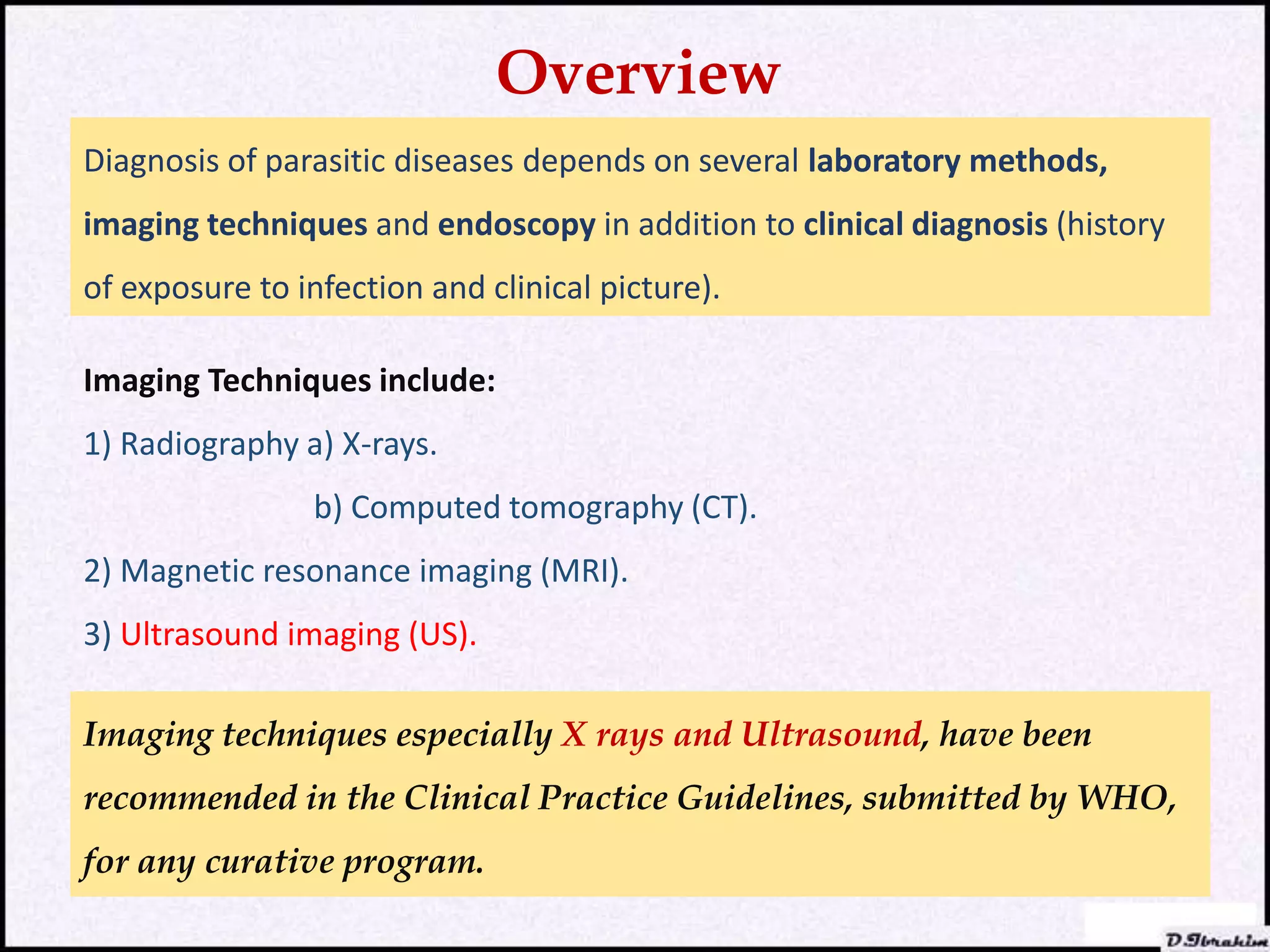
Imaging Techniques include:
1) Radiography a) X-rays.
b) Computed tomography (CT).
2) Magnetic resonance imaging (MRI).
3) Ultrasound imaging (US).
Imaging techniques especially X rays and Ultrasound, have been
recommended in the Clinical Practice Guidelines, submitted by WHO,
for any curative program.
Overview
Diagnosis of parasitic diseases depends on several laboratory methods,
imaging techniques and endoscopy in addition to clinical diagnosis (history
of exposure to infection and clinical picture).
Ultrasound machines are becoming more widely distributed and are fairly
cheap. Portable devices allow field use for population studies and individual
diagnosis of tropical diseases.
Ultrasound is a rapidly developing imaging technology. It is very popular
with operators, patients and communities because it is non-invasive and
painless. A large number of people can be screened in a short period of time
with instant results.
Ultrasonography (US)
Ultrasonic examinations are accessible to all body regions which are not
situated behind bones. Many parasitic diseases have particular
ultrasonography features that help in diagnosis. In addition, US is now
recognized as a valuable tool for the assessment of morbidity due to
parasitic infections.
Ultrasound images are available today, with higher resolutions, allowing
physicians to see much clearer definition. During the last 20 years, newer
technologies are set to improve the practical uses of ultrasound as,
o Color Doppler US for imaging blood vessels and blood flow.
o Echocardiogram used to examine the heart.
o Endoscopic US for imaging through intestinal lumen.
o Ultrasound Elastography (FibroScan): measures the stiffness of the
liver to quantify liver fibrosis.
Approach to
Diagnosis
Grading of
Morbidity
Assessment
of therapy
Epidemiological
studies
Ultrasound Applications
Applications Parasitic Infections
1) Approach to Diagnosis:
a) Characteristic US features
of parasites images
Ascariasis, Hydatid cyst & Lymphatic Filariasis.
b) Characteristic US features
of the pathology
Schistosomiasis & Amoebic liver abscess
c) Guidance for needle
biopsy and aspirate
Liver biopsies for hepato-biliary parasitic infections
Aspirates from liver abscess and cysts.
Amniocentesis for congenital parasitic infections.
3) Grading of Morbidity. By Assessment of pathology & complications, as
Schistosomiasis & Hydatid disease.
3) Assessment of therapy. Regression of the pathological changes before and
after treatment of hepato-biliary parasitic infections,
Lymphatic Filariasis & Hydatid disease.
4) Epidemiological studies. Portable devices allow field use for population
studies, as for schistosomiasis
Applications of Ultrasound in parasitic diseases
Site of parasitic infection Parasitic disease
1) Abdominal & Pelvic parasitic
infections
Schistosomiasis
Hydatid disease
Amoebiasis
Congenital Toxoplasmosis
Fascioliasis
Ascariasis
2) Thoracic parasitic Infections Chagas disease
Hydatid disease
3) Soft Tissue parasitic infections Lymphatic Filariasis
Cysticercosis
Hydatid disease
Onchocerciasis
Ultrasonography has valuable applications in the following
parasitic infections:
Schistosomiasis
Schistosomiasis mansoni
Us scanning can demonstrate liver lesions typical of
Schistosoma infection as;
• The characteristic induced periportal fibrosis, and
• Hypertrophy of the left hepatic lobe and atrophy
of the right hepatic lobe.
US applications in schistosomiasis mansoni:
By measurement of regression of the pathological
changes before and after treatment.
Availability of portable US equipment can aid will
trained examiner to screen a large number of people
in a short period of time with reliable results.
Grading of periportal fibrosis by ultrasonography and
elastography has been shown to correlate with clinical
conditions and risks for complications.
In addition, measurements of portal perfusion by
Doppler US have been correlated with the degree of
oesophageal varices, and probability of gastrointestinal
bleeding.
Schistosomiasis mansoni
Grading of the severity of periportal fibrosis by
ultrasonography in schistosomiasis mansoni
According to Niamey Criteria
Hepatic parenchyma patterns according to Niamey classification.
Pattern Sonographic image
A  Normal
B  Starry sky (diffuse echogenic foci)
C  Ring echoes and pipe-stems.
D  Echogenic ruff around portal bifurcation.
E  Highly echogenic patches extending from the portal vessels into
the parenchyma.
F  Highly echogenic bands extending towards the liver periphery
and retracting the subjacent parenchyma.
Source: Niamey Working Group, 2000.
Periportal Fibrosis
B – pattern: Starry sky (diffuse echogenic foci of fibrosis)
C – pattern: Ring echoes (transverse view of vessels) and pipe-
stems (longitudinal view of vessels).
Periportal Fibrosis
D-pattern: Fibrosis bands around portal vein and its main branches.
E-pattern: Fibrosis patches extending from the portal vessels
into the parenchyma without reaching the hepatic surface.
F-pattern, Bird’s claw pattern: Highly echogenic bands of fibrosis extending
towards the liver periphery with retraction of the subjacent parenchyma.
Periportal Fibrosis
Doppler sonographic demonstrates
increase in the diameter of portal vein
(1.4 cm) indicating Portal
hypertension.
Oblique cut ultrasonography of the
hepatic hilum to measure the caliber of
the portal vein (1.4 cm indicate portal
hypertension).
Portal hypertension
Abdominal US for case of advanced
schistosomiasis mansoni demonstrates
partially portal thrombosis, with
echogenic material inside the portal
vein
Abdominal US for case of
advanced schistosomiasis
mansoni demonstrates ascites.
Portal Thrombosis
Ascites
(A) Splenomegaly in schistosomiasis due to portal hypertension. The inferior splenic
margin is blunted, descending below and medial to the left kidney.
(B) Splenic vein dilatations, which result from portal hypertension are present around
the hilum.
Splenomegaly
Ultrasound elastography (Fibro-scan): Blue-green-red elastic images were formed. The
more advanced the stage of liver fibrosis, the stiffer the liver parenchyma and the larger
the blue area. The degree of fibrosis correlates with ratio of blue area (% AREA)
Elastography
Schistosomiasis haematobium
The value of ultrasound in diagnosing urinary
schistosomiasis is generally accepted.
Detectable alterations include;
o The fibrotic bladder wall and
o Dilatation of the upper urinary tract
However, US is mostly applied for:
US applications:
Thickening and heavy calcification
of the bladder wall
Longitudinal transabdominal ultrasound
shows mucosal irregularity with bladder
pseudopolyp granulomas on the base
(arrows)
Urinary Schistosomiasis
(A) Hydronephrosis RK and (B) Hydroureter RU, complicating S. haematobium
Calculi in (A) renal pelvis and (B) bladder, complicating S. haematobium.
Urinary Schistosomiasis
• Urinary bladder
malignancy ( confirmed by
histopathology), possibly
following schistosomiasis.
Carcinoma
Sonographic classification of Hydatid cyst :
o WHO classification (2001).
o Gharbi’s classification (1981).
In both classifications, the cyst can be classified into five different types on
bases of its morphology and stage.
o WHO classification  CE1 to CE5
o Gharbi classified the cysts  Type I to Type V.
There are interactions between both classifications
Hydatid cyst
WHO classification (2001)
CE1 (Type I): Unilocular, simple cysts with liquid content
CE2 (Type III): Multivesicular, multiseptated cysts
CE3a (Type II): Cysts with liquid content and specific detached endocyst
CE3b (Type III): Unilocular cysts with daughter cysts inside a mucinous or solid cyst matrix
CE4 (Type IV): Heterogenous solid cysts with degenerative content
CE5 (Type V): Cysts with degenerative content and heavily calcified wall.
Comparative description of the WHO and Gharbi
ultrasound classifications of hydatid cysts
WHO Gharbi Description Stage
CE1 Type I Unilocular, simple cysts with liquid content
and double line sign
Active
CE2 Type III Multivesicular, multiseptated cysts
(honeycomb or rosette- like)
Active
CE3a Type II Cysts with liquid content and specific
detached endocyst (Water-lily sign)
Transitional
CE3b Type III Unilocular cysts with mucinous or solid
content and daughter cysts inside
Transitional
CE4 Type IV Heterogenous solid cysts with degenerative
content. No daughter cyst.
Inactive
CE5 Type V Solid cyst with heavily calcified wall. Inactive
Hydatid Cyst
Ultrasound scan of the liver show
intact Hydatid cyst with with double
line sign and intramural nodules (CE1-
Type I).
Liver hydatid cysts, CE2 (Type III):
multivesicular, multiseptated, or
multiloculated cysts. May appear
honeycomb like with daughter
cysts completely fill the unilocular
mother cyst.
Hydatid Cyst
Liver hydatid cysts, (CE3a -Type II): Detachment of the laminated
membrane (endocyst) from the pericyst (Water lily sign).
Large retroperitoneal hydatid with
daughter cyst seen on longitudinal
sonogram in the pelvis, (CE3b -Type
III).
Sonogram shows Renal Hydatid cyst
with daughter cysts, (CE3b -Type III).
Hydatid cyst
Ultrasound of the abdomen showing
splenic hydatid cysts with multiple
daughter cysts (CE3b, Type III).
Ruptured splenic hydatid cyst due to
blunt abdominal trauma, which
manifested in the form of
anaphylactic reaction and shock due
to fluid from the ruptured cyst.
Hydatid cyst
Ultrasound scan of the liver shows
Heterogenous solid cysts with
degenerative content and partial
calcification, (CE4-Type IV).
Ultrasound of the abdomen showing
Old hydatid cyst in the liver with a
calcified mass
(CE5 ,Type V).
Hydatid cyst
(CE1, Type I): Pulmonary hydatid cyst in a child of 11 years detected by Transthoracic
ultrasound. The cyst with double layered wall (the specific sonographic sign for pulmonary
hydatid).
Hydatid cyst
Pulmonary hydatid cyst
A: Needle inside the cyst. B: After aspiration. C: After injection of Scolicide hyperosmolar
saline solution. D: After re-aspiration
Liver Hydatid cyst treated by Ultrasound-Guided PAIR
Ascariasis
 When there are abdominal symptoms of intestinal obstruction in
association with a vague abdominal mass. The routine
ultrasound scan can provide characteristic US signs leading to
suspension of ascariasis.
 When there are biliary manifestations due to migration of adult
worms to biliary system. In this case, the ultrasound scanning is a
specific diagnostic tool.
In ascariasis, abdominal ultrasound is beneficial in case of:
US showing longitudinal three line and
railway track appearance of Ascaris
worms in dilated intestine.
US showing both transverse (target
sign) and longitudinal scans (railway
track ) of Ascaris worms
Ascariasis
Abdominal ultrasound revealed a distended and thickened-wall gall bladder
and, inside it, a long linear structure showed spontaneous wave movements.
A hyperechoic double rim layer material was noted in
the extrahepatic bile duct (arrow). It was initially
thought as ascariasis.
Biliary Ascariasis
A 35-year-old female with acute pain in the right hypochondrium.
(a) Ascaris seen in the left dilated intrahepatic duct (red arrow) and,
(b) Magnified view of the Ascaris in the dilated left intrahepatic duct, triple
line seen (white arrow)
Biliary Ascariasis
Findings were confirmed at the time
of surgery, with drainage of frank
pus containing dead Ascaris worms
from the abscess cavities.
Liver abscess containing coiled tubular
structures
Ascariasis of the liver
Parenchymal phase of fascioliasis.
US shows a parenchymal focal lesion with a
halo around (a "wheel spoke" appearance)
in the liver. (arrow).
F. hepatica worms. US demonstrates a
linear echogenic material (arrow) within
the dilated common hepatic duct
representing dead F. hepatica worm.
Fascioliasis
Ultrasound scan of the gallbladder shows sludge and vermiform non-shadowing
images of Fasciola hepatica flukes (arrows), which showed active motility.
Differentiate from gall stone ???
Fascioliasis
Gall stone
Mild dilatation of the central
intrahepatic bile ducts in the liver of a
cured 60-year-old man.
US scan of the gallbladder of a heavily
infected Chinese man with several
floating echogenic foci (arrows), which
probably indicate worms
Clonorchiasis
• Cholangiocarcinoma in
the right hepatic lobe, with
clonorchiasis, in a 63-year-
old man. There is diffuse
dilatation of peripheral
intrahepatic bile ducts
(arrowheads) is attributed to
changes of a C. sinensis
infection, and segmental and
more severe dilatation
around the tumor is caused
by obstruction by the tumor
(arrows)
Transverse ultrasound images of the bilateral inguinal regions
show dilated lymphatic channels as multiple cystic spaces.
Lymphatic
Filariasis
Soft Tissues parasitic infections
Filarial dance sign: The pathognomonic sign on ultrasound.
Constant movements of the worms in chylus fluid during US of enlarged
inguinal lymph node.
Lymphatic Filariasis
Filarial Dance Sign: Pathognomonic sign on ultrasound of active
scrotal filariasis
Lymphatic Filariasis
Sonography of Onchocerca nodule: Showing a verminous nodule on the palmaro-
lateral aspect of the right forelimb. The parasite appears as a coiled hyperechoic
line within a hypoechoic nodule.
Onchocerciasis
Transverse scan of the patient's left knee. A large cystic onchocercoma can be seen.
Movements of a conglomerate of coiled adult filariae are displayed in the cystic fluid of the
nodule. Static fragments of the worms are visible in the lower left part of the video image
Onchocercoma
US of the arm shows Cysticercus cellulosa (arrow) with a scolex (arrowhead) and
surrounding abscess (curved arrow)
Cysticercosis
2-year-old male presented with pain in calf and feeling of a mass in the region.
Ultrasonography shows thick-walled cystic lesion with mural echogenic nodule
(Cysticercosis) in the medial head of gastrocnemius muscle
Cysticercosis
• Transverse scan of the liver
showing multiple elliptical calcified
cysticercus cysts.
Hepatic Cysticercosis
Endoscopic ultrasonography shows 3-cm- × 2.5-cm-sized heterogeneous
submucosal mass on greater curvature of gastric midbody (arrow)
Biopsy and histopathological examination showed severe inflammatory cell infiltration, and abscess formation
with a submucosal eosinophilic granuloma around the larvae, which are findings consistent with gastric anisakiasis
Anisakiasis
Endoscopic ultrasonography
Endoscopic Ultrasonography showing an actively motile tubular structure in
the bile duct. Endoscopic appearance of Fasciola hepatica showing a leaf-like
trematode extracted by using a balloon catheter.
Biliary Fascioliasis
Endoscopic ultrasonography
4) Ultrasoubd for parasitic diseases.pptx

4) Ultrasoubd for parasitic diseases.pptx

  • 1.
    Ultrasound for Parasitic Diseases Prof. Dr. IbrahimA. Aboul Asaad MD Lecture Main Parasitology
  • 2.
    Imaging Techniques include: 1)Radiography a) X-rays. b) Computed tomography (CT). 2) Magnetic resonance imaging (MRI). 3) Ultrasound imaging (US). Imaging techniques especially X rays and Ultrasound, have been recommended in the Clinical Practice Guidelines, submitted by WHO, for any curative program. Overview Diagnosis of parasitic diseases depends on several laboratory methods, imaging techniques and endoscopy in addition to clinical diagnosis (history of exposure to infection and clinical picture).
  • 3.
    Ultrasound machines arebecoming more widely distributed and are fairly cheap. Portable devices allow field use for population studies and individual diagnosis of tropical diseases. Ultrasound is a rapidly developing imaging technology. It is very popular with operators, patients and communities because it is non-invasive and painless. A large number of people can be screened in a short period of time with instant results. Ultrasonography (US) Ultrasonic examinations are accessible to all body regions which are not situated behind bones. Many parasitic diseases have particular ultrasonography features that help in diagnosis. In addition, US is now recognized as a valuable tool for the assessment of morbidity due to parasitic infections.
  • 4.
    Ultrasound images areavailable today, with higher resolutions, allowing physicians to see much clearer definition. During the last 20 years, newer technologies are set to improve the practical uses of ultrasound as, o Color Doppler US for imaging blood vessels and blood flow. o Echocardiogram used to examine the heart. o Endoscopic US for imaging through intestinal lumen. o Ultrasound Elastography (FibroScan): measures the stiffness of the liver to quantify liver fibrosis.
  • 5.
    Approach to Diagnosis Grading of Morbidity Assessment oftherapy Epidemiological studies Ultrasound Applications
  • 6.
    Applications Parasitic Infections 1)Approach to Diagnosis: a) Characteristic US features of parasites images Ascariasis, Hydatid cyst & Lymphatic Filariasis. b) Characteristic US features of the pathology Schistosomiasis & Amoebic liver abscess c) Guidance for needle biopsy and aspirate Liver biopsies for hepato-biliary parasitic infections Aspirates from liver abscess and cysts. Amniocentesis for congenital parasitic infections. 3) Grading of Morbidity. By Assessment of pathology & complications, as Schistosomiasis & Hydatid disease. 3) Assessment of therapy. Regression of the pathological changes before and after treatment of hepato-biliary parasitic infections, Lymphatic Filariasis & Hydatid disease. 4) Epidemiological studies. Portable devices allow field use for population studies, as for schistosomiasis Applications of Ultrasound in parasitic diseases
  • 7.
    Site of parasiticinfection Parasitic disease 1) Abdominal & Pelvic parasitic infections Schistosomiasis Hydatid disease Amoebiasis Congenital Toxoplasmosis Fascioliasis Ascariasis 2) Thoracic parasitic Infections Chagas disease Hydatid disease 3) Soft Tissue parasitic infections Lymphatic Filariasis Cysticercosis Hydatid disease Onchocerciasis Ultrasonography has valuable applications in the following parasitic infections:
  • 8.
    Schistosomiasis Schistosomiasis mansoni Us scanningcan demonstrate liver lesions typical of Schistosoma infection as; • The characteristic induced periportal fibrosis, and • Hypertrophy of the left hepatic lobe and atrophy of the right hepatic lobe. US applications in schistosomiasis mansoni: By measurement of regression of the pathological changes before and after treatment.
  • 9.
    Availability of portableUS equipment can aid will trained examiner to screen a large number of people in a short period of time with reliable results. Grading of periportal fibrosis by ultrasonography and elastography has been shown to correlate with clinical conditions and risks for complications. In addition, measurements of portal perfusion by Doppler US have been correlated with the degree of oesophageal varices, and probability of gastrointestinal bleeding. Schistosomiasis mansoni
  • 10.
    Grading of theseverity of periportal fibrosis by ultrasonography in schistosomiasis mansoni According to Niamey Criteria Hepatic parenchyma patterns according to Niamey classification. Pattern Sonographic image A  Normal B  Starry sky (diffuse echogenic foci) C  Ring echoes and pipe-stems. D  Echogenic ruff around portal bifurcation. E  Highly echogenic patches extending from the portal vessels into the parenchyma. F  Highly echogenic bands extending towards the liver periphery and retracting the subjacent parenchyma. Source: Niamey Working Group, 2000.
  • 11.
    Periportal Fibrosis B –pattern: Starry sky (diffuse echogenic foci of fibrosis) C – pattern: Ring echoes (transverse view of vessels) and pipe- stems (longitudinal view of vessels).
  • 12.
    Periportal Fibrosis D-pattern: Fibrosisbands around portal vein and its main branches. E-pattern: Fibrosis patches extending from the portal vessels into the parenchyma without reaching the hepatic surface.
  • 13.
    F-pattern, Bird’s clawpattern: Highly echogenic bands of fibrosis extending towards the liver periphery with retraction of the subjacent parenchyma. Periportal Fibrosis
  • 14.
    Doppler sonographic demonstrates increasein the diameter of portal vein (1.4 cm) indicating Portal hypertension. Oblique cut ultrasonography of the hepatic hilum to measure the caliber of the portal vein (1.4 cm indicate portal hypertension). Portal hypertension
  • 15.
    Abdominal US forcase of advanced schistosomiasis mansoni demonstrates partially portal thrombosis, with echogenic material inside the portal vein Abdominal US for case of advanced schistosomiasis mansoni demonstrates ascites. Portal Thrombosis Ascites
  • 16.
    (A) Splenomegaly inschistosomiasis due to portal hypertension. The inferior splenic margin is blunted, descending below and medial to the left kidney. (B) Splenic vein dilatations, which result from portal hypertension are present around the hilum. Splenomegaly
  • 17.
    Ultrasound elastography (Fibro-scan):Blue-green-red elastic images were formed. The more advanced the stage of liver fibrosis, the stiffer the liver parenchyma and the larger the blue area. The degree of fibrosis correlates with ratio of blue area (% AREA) Elastography
  • 18.
    Schistosomiasis haematobium The valueof ultrasound in diagnosing urinary schistosomiasis is generally accepted. Detectable alterations include; o The fibrotic bladder wall and o Dilatation of the upper urinary tract However, US is mostly applied for: US applications:
  • 19.
    Thickening and heavycalcification of the bladder wall Longitudinal transabdominal ultrasound shows mucosal irregularity with bladder pseudopolyp granulomas on the base (arrows) Urinary Schistosomiasis
  • 20.
    (A) Hydronephrosis RKand (B) Hydroureter RU, complicating S. haematobium Calculi in (A) renal pelvis and (B) bladder, complicating S. haematobium. Urinary Schistosomiasis
  • 21.
    • Urinary bladder malignancy( confirmed by histopathology), possibly following schistosomiasis. Carcinoma
  • 22.
    Sonographic classification ofHydatid cyst : o WHO classification (2001). o Gharbi’s classification (1981). In both classifications, the cyst can be classified into five different types on bases of its morphology and stage. o WHO classification  CE1 to CE5 o Gharbi classified the cysts  Type I to Type V. There are interactions between both classifications Hydatid cyst
  • 24.
    WHO classification (2001) CE1(Type I): Unilocular, simple cysts with liquid content CE2 (Type III): Multivesicular, multiseptated cysts CE3a (Type II): Cysts with liquid content and specific detached endocyst CE3b (Type III): Unilocular cysts with daughter cysts inside a mucinous or solid cyst matrix CE4 (Type IV): Heterogenous solid cysts with degenerative content CE5 (Type V): Cysts with degenerative content and heavily calcified wall.
  • 25.
    Comparative description ofthe WHO and Gharbi ultrasound classifications of hydatid cysts WHO Gharbi Description Stage CE1 Type I Unilocular, simple cysts with liquid content and double line sign Active CE2 Type III Multivesicular, multiseptated cysts (honeycomb or rosette- like) Active CE3a Type II Cysts with liquid content and specific detached endocyst (Water-lily sign) Transitional CE3b Type III Unilocular cysts with mucinous or solid content and daughter cysts inside Transitional CE4 Type IV Heterogenous solid cysts with degenerative content. No daughter cyst. Inactive CE5 Type V Solid cyst with heavily calcified wall. Inactive
  • 26.
    Hydatid Cyst Ultrasound scanof the liver show intact Hydatid cyst with with double line sign and intramural nodules (CE1- Type I). Liver hydatid cysts, CE2 (Type III): multivesicular, multiseptated, or multiloculated cysts. May appear honeycomb like with daughter cysts completely fill the unilocular mother cyst.
  • 27.
    Hydatid Cyst Liver hydatidcysts, (CE3a -Type II): Detachment of the laminated membrane (endocyst) from the pericyst (Water lily sign).
  • 28.
    Large retroperitoneal hydatidwith daughter cyst seen on longitudinal sonogram in the pelvis, (CE3b -Type III). Sonogram shows Renal Hydatid cyst with daughter cysts, (CE3b -Type III). Hydatid cyst
  • 29.
    Ultrasound of theabdomen showing splenic hydatid cysts with multiple daughter cysts (CE3b, Type III). Ruptured splenic hydatid cyst due to blunt abdominal trauma, which manifested in the form of anaphylactic reaction and shock due to fluid from the ruptured cyst. Hydatid cyst
  • 30.
    Ultrasound scan ofthe liver shows Heterogenous solid cysts with degenerative content and partial calcification, (CE4-Type IV). Ultrasound of the abdomen showing Old hydatid cyst in the liver with a calcified mass (CE5 ,Type V). Hydatid cyst
  • 31.
    (CE1, Type I):Pulmonary hydatid cyst in a child of 11 years detected by Transthoracic ultrasound. The cyst with double layered wall (the specific sonographic sign for pulmonary hydatid). Hydatid cyst Pulmonary hydatid cyst
  • 32.
    A: Needle insidethe cyst. B: After aspiration. C: After injection of Scolicide hyperosmolar saline solution. D: After re-aspiration Liver Hydatid cyst treated by Ultrasound-Guided PAIR
  • 33.
    Ascariasis  When thereare abdominal symptoms of intestinal obstruction in association with a vague abdominal mass. The routine ultrasound scan can provide characteristic US signs leading to suspension of ascariasis.  When there are biliary manifestations due to migration of adult worms to biliary system. In this case, the ultrasound scanning is a specific diagnostic tool. In ascariasis, abdominal ultrasound is beneficial in case of:
  • 34.
    US showing longitudinalthree line and railway track appearance of Ascaris worms in dilated intestine. US showing both transverse (target sign) and longitudinal scans (railway track ) of Ascaris worms Ascariasis
  • 35.
    Abdominal ultrasound revealeda distended and thickened-wall gall bladder and, inside it, a long linear structure showed spontaneous wave movements. A hyperechoic double rim layer material was noted in the extrahepatic bile duct (arrow). It was initially thought as ascariasis. Biliary Ascariasis
  • 36.
    A 35-year-old femalewith acute pain in the right hypochondrium. (a) Ascaris seen in the left dilated intrahepatic duct (red arrow) and, (b) Magnified view of the Ascaris in the dilated left intrahepatic duct, triple line seen (white arrow) Biliary Ascariasis
  • 37.
    Findings were confirmedat the time of surgery, with drainage of frank pus containing dead Ascaris worms from the abscess cavities. Liver abscess containing coiled tubular structures Ascariasis of the liver
  • 38.
    Parenchymal phase offascioliasis. US shows a parenchymal focal lesion with a halo around (a "wheel spoke" appearance) in the liver. (arrow). F. hepatica worms. US demonstrates a linear echogenic material (arrow) within the dilated common hepatic duct representing dead F. hepatica worm. Fascioliasis
  • 39.
    Ultrasound scan ofthe gallbladder shows sludge and vermiform non-shadowing images of Fasciola hepatica flukes (arrows), which showed active motility. Differentiate from gall stone ??? Fascioliasis Gall stone
  • 40.
    Mild dilatation ofthe central intrahepatic bile ducts in the liver of a cured 60-year-old man. US scan of the gallbladder of a heavily infected Chinese man with several floating echogenic foci (arrows), which probably indicate worms Clonorchiasis
  • 41.
    • Cholangiocarcinoma in theright hepatic lobe, with clonorchiasis, in a 63-year- old man. There is diffuse dilatation of peripheral intrahepatic bile ducts (arrowheads) is attributed to changes of a C. sinensis infection, and segmental and more severe dilatation around the tumor is caused by obstruction by the tumor (arrows)
  • 42.
    Transverse ultrasound imagesof the bilateral inguinal regions show dilated lymphatic channels as multiple cystic spaces. Lymphatic Filariasis Soft Tissues parasitic infections
  • 43.
    Filarial dance sign:The pathognomonic sign on ultrasound. Constant movements of the worms in chylus fluid during US of enlarged inguinal lymph node. Lymphatic Filariasis
  • 44.
    Filarial Dance Sign:Pathognomonic sign on ultrasound of active scrotal filariasis Lymphatic Filariasis
  • 45.
    Sonography of Onchocercanodule: Showing a verminous nodule on the palmaro- lateral aspect of the right forelimb. The parasite appears as a coiled hyperechoic line within a hypoechoic nodule. Onchocerciasis
  • 46.
    Transverse scan ofthe patient's left knee. A large cystic onchocercoma can be seen. Movements of a conglomerate of coiled adult filariae are displayed in the cystic fluid of the nodule. Static fragments of the worms are visible in the lower left part of the video image Onchocercoma
  • 47.
    US of thearm shows Cysticercus cellulosa (arrow) with a scolex (arrowhead) and surrounding abscess (curved arrow) Cysticercosis
  • 48.
    2-year-old male presentedwith pain in calf and feeling of a mass in the region. Ultrasonography shows thick-walled cystic lesion with mural echogenic nodule (Cysticercosis) in the medial head of gastrocnemius muscle Cysticercosis
  • 49.
    • Transverse scanof the liver showing multiple elliptical calcified cysticercus cysts. Hepatic Cysticercosis
  • 50.
    Endoscopic ultrasonography shows3-cm- × 2.5-cm-sized heterogeneous submucosal mass on greater curvature of gastric midbody (arrow) Biopsy and histopathological examination showed severe inflammatory cell infiltration, and abscess formation with a submucosal eosinophilic granuloma around the larvae, which are findings consistent with gastric anisakiasis Anisakiasis Endoscopic ultrasonography
  • 51.
    Endoscopic Ultrasonography showingan actively motile tubular structure in the bile duct. Endoscopic appearance of Fasciola hepatica showing a leaf-like trematode extracted by using a balloon catheter. Biliary Fascioliasis Endoscopic ultrasonography