Lecture 4 – Slag in steelmaking
Production of Steel
MT350 - PRODUCTION OF STEEL
Contents
• Preamble
• The role of slag in steelmaking
• Structure of pure oxides
• Structure of pure silica
• Network former and breaker oxides
• Structure of slag
• Key words: Steelmaking, synthetic slag, Electric steelmaking, BOF
steelmaking
MT350 - PRODUCTION OF STEEL
Preamble
• Slag plays a very important role in steelmaking
• “make a slag and slag makes steel”
• Slag is a generic name
• In steelmaking - a solution of oxides and sulfides in the molten state
and the multi-crystalline phases in the solid state
MT350 - PRODUCTION OF STEEL
Slag – a separate phase
• It is lighter than molten steel and
• It is immiscible in steel
• Slag is formed during refining of hot metal in which Si oxidizes to SiO2,
Mn to MnO, Fe to FeO, and P to P2O5, and addition of oxides such as
CaO, MgO, iron oxide, and others.
• The addition of oxides is done to obtain desired physico-chemical
properties of slag like melting point, basicity, viscosity etc.
• All these oxides float on the surface of the molten steel.
• Synthetic slag is also used to absorb inclusions to produce clean steel
for certain applications.
MT350 - PRODUCTION OF STEEL
Role of slag in steelmaking
• It acts as a sink for impurities during refining of steel
• It controls oxidizing and reducing potential during refining through
FeO content. Higher FeO makes the slag oxidizing and lower FeO
reducing
• It prevents passage of nitrogen and hydrogen from atmosphere to the
molten steel
• It absorbs oxide/sulfide inclusions
MT350 - PRODUCTION OF STEEL
Role of slag in steelmaking
• It acts as a thermal barrier to prevent heat transfer from molten steel
to the surrounding
• It protects steel against re-oxidation
• It emulsifies hot metal and promotes carbon oxidation.
• In electric steelmaking slag prevents the radiation of heat of arc to the
walls of the furnace and roof
MT350 - PRODUCTION OF STEEL
Role of slag in steelmaking
• The above functions require that slag should possess certain physical
(density, melting point, viscosity) and chemical properties (basicity,
oxidation potential).
• Both physical and chemical properties are controlled by composition
and structure of slag.
• In steelmaking slag is predominantly a mixture of oxides with small
amounts of sulfides and phosphides.
• The oxides are either acidic or basic in nature.
• We will first consider the structure of pure oxides and then we discuss
what happens on addition of one type of oxide to the other.
MT350 - PRODUCTION OF STEEL
Structure of pure oxides
• Metallic cations are surrounded by oxygen ions in a three
dimensional crystalline network
• Each cation is surrounded by the maximum number of anions in a
closed packed structure, and this number is called coordination
number
• Cations of basic oxides such as CaO, MgO, FeO (Ca2+, Mg2+, Fe2+) etc.
have radii smaller than that of cations of SiO2, Al2O3
• Structure of an oxide depends on the ratio of radii of cations/anions
as shown in the following table
MT350 - PRODUCTION OF STEEL
Structure of pure oxides
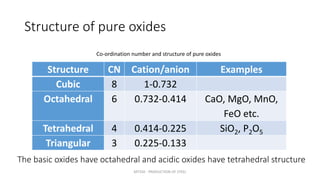
Structure CN Cation/anion Examples
Cubic 8 1-0.732
Octahedral 6 0.732-0.414 CaO, MgO, MnO,
FeO etc.
Tetrahedral 4 0.414-0.225 SiO2, P2O5
Triangular 3 0.225-0.133
MT350 - PRODUCTION OF STEEL
Co-ordination number and structure of pure oxides
The basic oxides have octahedral and acidic oxides have tetrahedral structure
Structure of pure silica
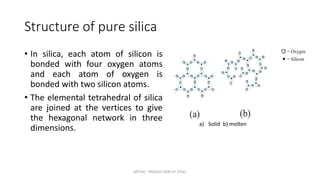
• In silica, each atom of silicon is
bonded with four oxygen atoms
and each atom of oxygen is
bonded with two silicon atoms.
• The elemental tetrahedral of silica
are joined at the vertices to give
the hexagonal network in three
dimensions.
MT350 - PRODUCTION OF STEEL
a) Solid b) molten
Structure of pure silica
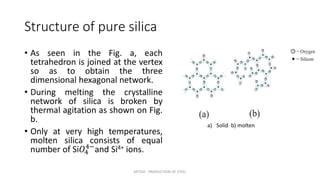
• As seen in the Fig. a, each
tetrahedron is joined at the vertex
so as to obtain the three
dimensional hexagonal network.
• During melting the crystalline
network of silica is broken by
thermal agitation as shown on Fig.
b.
• Only at very high temperatures,
molten silica consists of equal
number of Si𝑂4
4−
and Si4+ ions.
MT350 - PRODUCTION OF STEEL
a) Solid b) molten
Network former and breaker oxides
• Bonding between cations and anions in acidic oxides like SiO2 and
P2O5 is strong
• These simple ions group to form complex ions as (SiO4)4− and (PO4)3−
• In slags, these tend to form hexagonal network
• These oxides are, therefore, called network formers or acids
• These acidic oxides can accept one or several oxygen ions
MT350 - PRODUCTION OF STEEL
Network former and breaker oxides
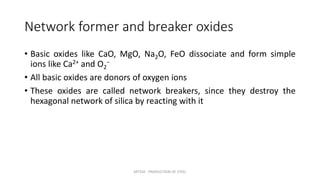
• Basic oxides like CaO, MgO, Na2O, FeO dissociate and form simple
ions like Ca2+ and O2
−
• All basic oxides are donors of oxygen ions
• These oxides are called network breakers, since they destroy the
hexagonal network of silica by reacting with it
MT350 - PRODUCTION OF STEEL
Structure of slag
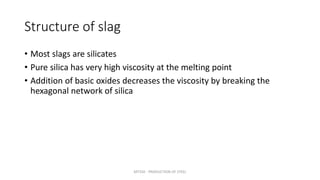
• Most slags are silicates
• Pure silica has very high viscosity at the melting point
• Addition of basic oxides decreases the viscosity by breaking the
hexagonal network of silica
MT350 - PRODUCTION OF STEEL
Structure of slag
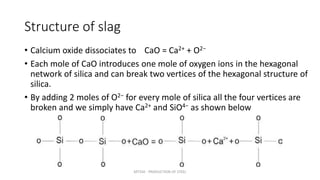
• Calcium oxide dissociates to CaO = Ca2+ + O2−
• Each mole of CaO introduces one mole of oxygen ions in the hexagonal
network of silica and can break two vertices of the hexagonal structure of
silica.
• By adding 2 moles of O2− for every mole of silica all the four vertices are
broken and we simply have Ca2+ and SiO4− as shown below
MT350 - PRODUCTION OF STEEL
Structure of slag
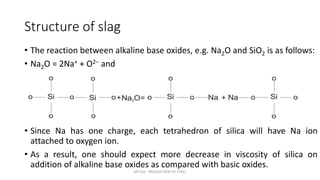
• The reaction between alkaline base oxides, e.g. Na2O and SiO2 is as follows:
• Na2O = 2Na+ + O2− and
• Since Na has one charge, each tetrahedron of silica will have Na ion
attached to oxygen ion.
• As a result, one should expect more decrease in viscosity of silica on
addition of alkaline base oxides as compared with basic oxides.
MT350 - PRODUCTION OF STEEL
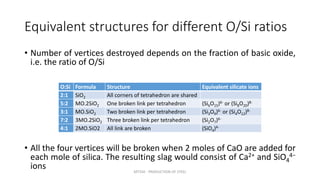
Equivalent structures for different O/Si ratios
• Number of vertices destroyed depends on the fraction of basic oxide,
i.e. the ratio of O/Si
• All the four vertices will be broken when 2 moles of CaO are added for
each mole of silica. The resulting slag would consist of Ca2+ and SiO4
4−
ions MT350 - PRODUCTION OF STEEL
O:Si Formula Structure Equivalent silicate ions
2:1 SiO2 All corners of tetrahedron are shared
5:2 MO.2SiO2 One broken link per tetrahedron (Si6O15)6- or (Si8O20)8-
3:1 MO.SiO2 Two broken link per tetrahedron (Si3O9)6- or (Si4O12)8-
7:2 3MO.2SiO2 Three broken link per tetrahedron (Si2O7)6-
4:1 2MO.SiO2 All link are broken (SiO4)4-
References
• L. Coudurier, D. W. Hopkins and I. Wilkomirsky: Fundamentals of
metallurgical processes
MT350 - PRODUCTION OF STEEL

4. Slag in steelmaking.pptx

  • 1.
    Lecture 4 –Slag in steelmaking Production of Steel MT350 - PRODUCTION OF STEEL
  • 2.
    Contents • Preamble • Therole of slag in steelmaking • Structure of pure oxides • Structure of pure silica • Network former and breaker oxides • Structure of slag • Key words: Steelmaking, synthetic slag, Electric steelmaking, BOF steelmaking MT350 - PRODUCTION OF STEEL
  • 3.
    Preamble • Slag playsa very important role in steelmaking • “make a slag and slag makes steel” • Slag is a generic name • In steelmaking - a solution of oxides and sulfides in the molten state and the multi-crystalline phases in the solid state MT350 - PRODUCTION OF STEEL
  • 4.
    Slag – aseparate phase • It is lighter than molten steel and • It is immiscible in steel • Slag is formed during refining of hot metal in which Si oxidizes to SiO2, Mn to MnO, Fe to FeO, and P to P2O5, and addition of oxides such as CaO, MgO, iron oxide, and others. • The addition of oxides is done to obtain desired physico-chemical properties of slag like melting point, basicity, viscosity etc. • All these oxides float on the surface of the molten steel. • Synthetic slag is also used to absorb inclusions to produce clean steel for certain applications. MT350 - PRODUCTION OF STEEL
  • 5.
    Role of slagin steelmaking • It acts as a sink for impurities during refining of steel • It controls oxidizing and reducing potential during refining through FeO content. Higher FeO makes the slag oxidizing and lower FeO reducing • It prevents passage of nitrogen and hydrogen from atmosphere to the molten steel • It absorbs oxide/sulfide inclusions MT350 - PRODUCTION OF STEEL
  • 6.
    Role of slagin steelmaking • It acts as a thermal barrier to prevent heat transfer from molten steel to the surrounding • It protects steel against re-oxidation • It emulsifies hot metal and promotes carbon oxidation. • In electric steelmaking slag prevents the radiation of heat of arc to the walls of the furnace and roof MT350 - PRODUCTION OF STEEL
  • 7.
    Role of slagin steelmaking • The above functions require that slag should possess certain physical (density, melting point, viscosity) and chemical properties (basicity, oxidation potential). • Both physical and chemical properties are controlled by composition and structure of slag. • In steelmaking slag is predominantly a mixture of oxides with small amounts of sulfides and phosphides. • The oxides are either acidic or basic in nature. • We will first consider the structure of pure oxides and then we discuss what happens on addition of one type of oxide to the other. MT350 - PRODUCTION OF STEEL
  • 8.
    Structure of pureoxides • Metallic cations are surrounded by oxygen ions in a three dimensional crystalline network • Each cation is surrounded by the maximum number of anions in a closed packed structure, and this number is called coordination number • Cations of basic oxides such as CaO, MgO, FeO (Ca2+, Mg2+, Fe2+) etc. have radii smaller than that of cations of SiO2, Al2O3 • Structure of an oxide depends on the ratio of radii of cations/anions as shown in the following table MT350 - PRODUCTION OF STEEL
  • 9.
    Structure of pureoxides Structure CN Cation/anion Examples Cubic 8 1-0.732 Octahedral 6 0.732-0.414 CaO, MgO, MnO, FeO etc. Tetrahedral 4 0.414-0.225 SiO2, P2O5 Triangular 3 0.225-0.133 MT350 - PRODUCTION OF STEEL Co-ordination number and structure of pure oxides The basic oxides have octahedral and acidic oxides have tetrahedral structure
  • 10.
    Structure of puresilica • In silica, each atom of silicon is bonded with four oxygen atoms and each atom of oxygen is bonded with two silicon atoms. • The elemental tetrahedral of silica are joined at the vertices to give the hexagonal network in three dimensions. MT350 - PRODUCTION OF STEEL a) Solid b) molten
  • 11.
    Structure of puresilica • As seen in the Fig. a, each tetrahedron is joined at the vertex so as to obtain the three dimensional hexagonal network. • During melting the crystalline network of silica is broken by thermal agitation as shown on Fig. b. • Only at very high temperatures, molten silica consists of equal number of Si𝑂4 4− and Si4+ ions. MT350 - PRODUCTION OF STEEL a) Solid b) molten
  • 12.
    Network former andbreaker oxides • Bonding between cations and anions in acidic oxides like SiO2 and P2O5 is strong • These simple ions group to form complex ions as (SiO4)4− and (PO4)3− • In slags, these tend to form hexagonal network • These oxides are, therefore, called network formers or acids • These acidic oxides can accept one or several oxygen ions MT350 - PRODUCTION OF STEEL
  • 13.
    Network former andbreaker oxides • Basic oxides like CaO, MgO, Na2O, FeO dissociate and form simple ions like Ca2+ and O2 − • All basic oxides are donors of oxygen ions • These oxides are called network breakers, since they destroy the hexagonal network of silica by reacting with it MT350 - PRODUCTION OF STEEL
  • 14.
    Structure of slag •Most slags are silicates • Pure silica has very high viscosity at the melting point • Addition of basic oxides decreases the viscosity by breaking the hexagonal network of silica MT350 - PRODUCTION OF STEEL
  • 15.
    Structure of slag •Calcium oxide dissociates to CaO = Ca2+ + O2− • Each mole of CaO introduces one mole of oxygen ions in the hexagonal network of silica and can break two vertices of the hexagonal structure of silica. • By adding 2 moles of O2− for every mole of silica all the four vertices are broken and we simply have Ca2+ and SiO4− as shown below MT350 - PRODUCTION OF STEEL
  • 16.
    Structure of slag •The reaction between alkaline base oxides, e.g. Na2O and SiO2 is as follows: • Na2O = 2Na+ + O2− and • Since Na has one charge, each tetrahedron of silica will have Na ion attached to oxygen ion. • As a result, one should expect more decrease in viscosity of silica on addition of alkaline base oxides as compared with basic oxides. MT350 - PRODUCTION OF STEEL
  • 17.
    Equivalent structures fordifferent O/Si ratios • Number of vertices destroyed depends on the fraction of basic oxide, i.e. the ratio of O/Si • All the four vertices will be broken when 2 moles of CaO are added for each mole of silica. The resulting slag would consist of Ca2+ and SiO4 4− ions MT350 - PRODUCTION OF STEEL O:Si Formula Structure Equivalent silicate ions 2:1 SiO2 All corners of tetrahedron are shared 5:2 MO.2SiO2 One broken link per tetrahedron (Si6O15)6- or (Si8O20)8- 3:1 MO.SiO2 Two broken link per tetrahedron (Si3O9)6- or (Si4O12)8- 7:2 3MO.2SiO2 Three broken link per tetrahedron (Si2O7)6- 4:1 2MO.SiO2 All link are broken (SiO4)4-
  • 18.
    References • L. Coudurier,D. W. Hopkins and I. Wilkomirsky: Fundamentals of metallurgical processes MT350 - PRODUCTION OF STEEL

Editor's Notes

  • #16 Note that Ca2+ can combine with two tetrahedrons
  • #17 Note that Ca2+ can combine with two tetrahedrons