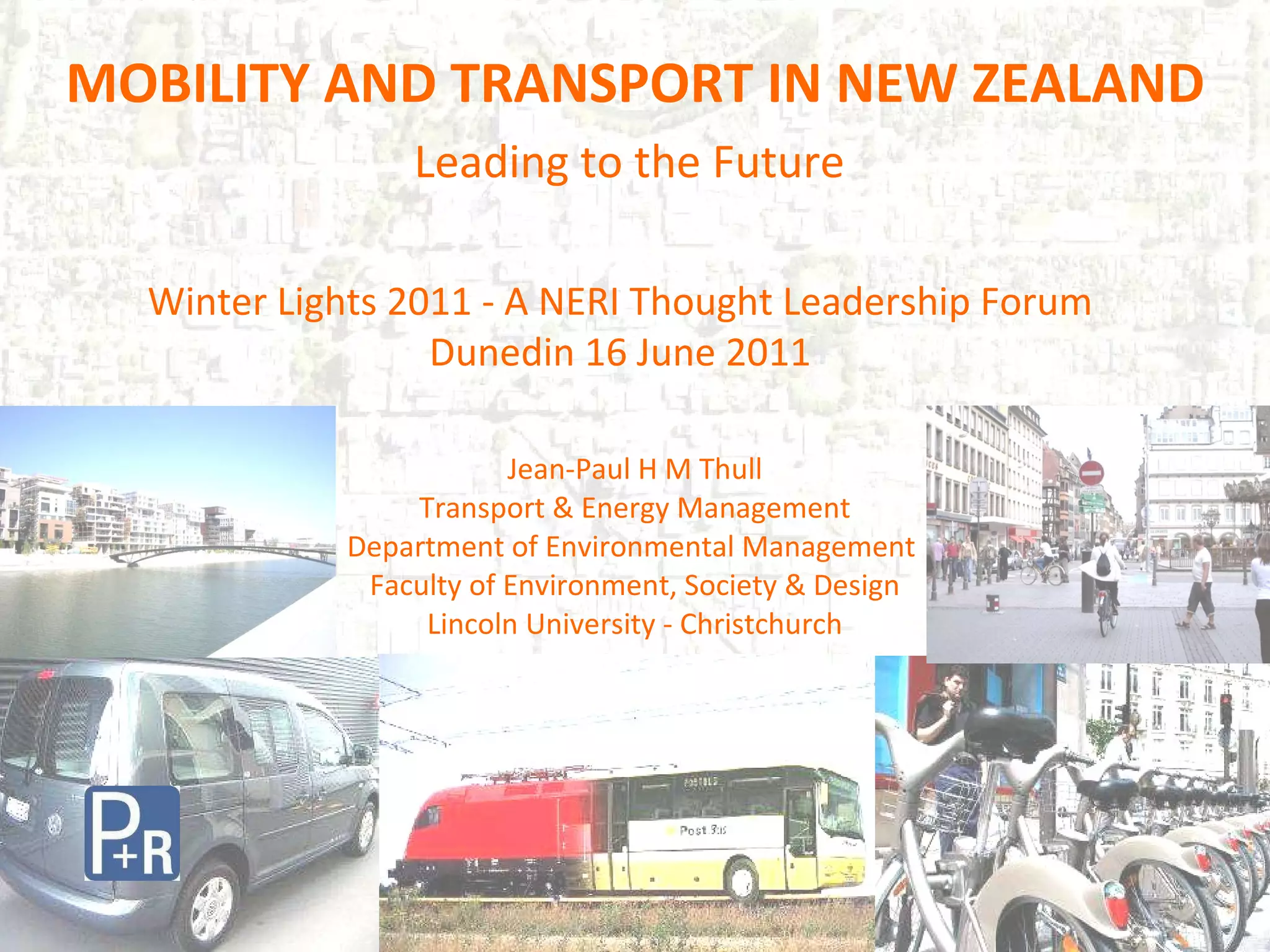
Jean-Paul H M Thull Transport & Energy Management Department of Environmental Management  Faculty of Environment, Society & Design Lincoln University - Christchurch MOBILITY AND TRANSPORT IN NEW ZEALAND Leading to the Future  Winter Lights 2011 - A NERI Thought Leadership Forum Dunedin 16 June 2011
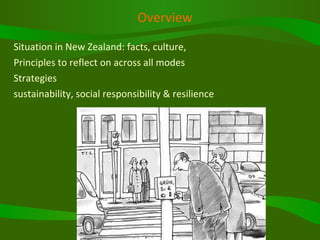
Overview Situation in New Zealand: facts, culture,  Principles to reflect on across all modes Strategies sustainability, social responsibility & resilience
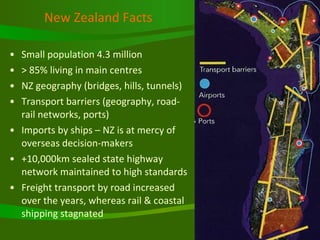
New Zealand Facts Small population 4.3 million > 85% living in main centres NZ geography (bridges, hills, tunnels) Transport barriers (geography, road-rail networks, ports) Imports by ships – NZ is at mercy of overseas decision-makers +10,000km sealed state highway network maintained to high standards Freight transport by road increased over the years, whereas rail & coastal shipping stagnated
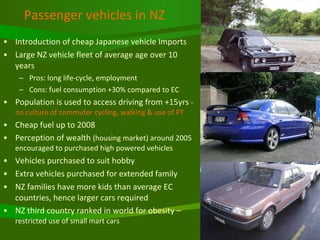
Passenger vehicles in NZ Introduction of cheap Japanese vehicle Imports Large NZ vehicle fleet of average age over 10 years Pros: long life-cycle, employment Cons: fuel consumption +30% compared to EC Population is used to access driving from +15yrs  -  no culture of commuter cycling, walking & use of PT Cheap fuel up to 2008 Perception of wealth  (housing market) around 2005 encouraged to purchased high powered vehicles Vehicles purchased to suit hobby Extra vehicles purchased for extended family NZ families have more kids than average EC countries, hence larger cars required NZ third country ranked in world for obesity –  restricted use of small mart cars
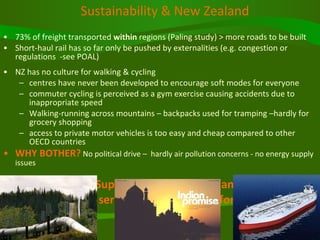
Sustainability & New Zealand 73% of freight transported  within  regions (Paling study) > more roads to be built Short-haul rail has so far only be pushed by externalities (e.g. congestion or regulations  -see POAL)  NZ has no culture for walking & cycling  centres have never been developed to encourage soft modes for everyone commuter cycling is perceived as a gym exercise causing accidents due to inappropriate speed Walking-running across mountains – backpacks used for tramping –hardly for grocery shopping access to private motor vehicles is too easy and cheap compared to other OECD countries WHY BOTHER?  No political drive –  hardly air pollution concerns - no energy supply issues UNLESS Energy Supply or Costs become an issue!!!!  Or Having to be serious about planning for resilience
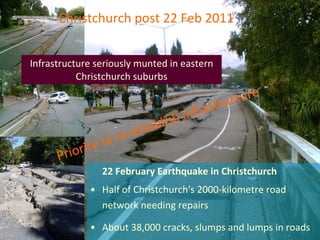
22 February Earthquake in Christchurch Half of Christchurch's 2000-kilometre road network needing repairs About 38,000 cracks, slumps and lumps in roads Photographs by A. Hansbury Infrastructure seriously munted in eastern Christchurch suburbs Priority to re-establish infrastructure Christchurch post 22 Feb 2011
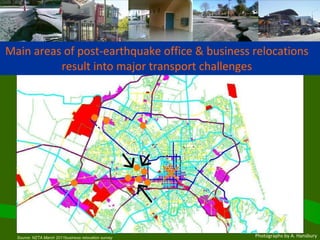
Main areas of post-earthquake office & business relocations result into major transport challenges Source: NZTA March 2011business relocation survey Photographs by A. Hansbury
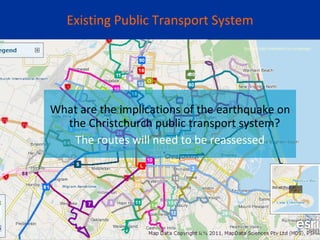
Existing Public Transport System What are the implications of the earthquake on the Christchurch public transport system?  The routes will need to be reassessed Source: http://metroinfo.co.nz/eqmap/
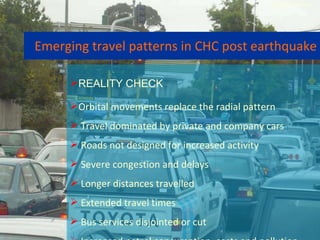
Emerging travel patterns in CHC post earthquake REALITY CHECK  Orbital movements replace the radial pattern Travel dominated by private and company cars Roads not designed for increased activity Severe congestion and delays Longer distances travelled Extended travel times  Bus services disjointed or cut Increased petrol consumption, costs and pollution Photo: NZ in Tranzit
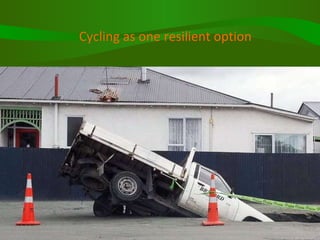
Cycling as one resilient option
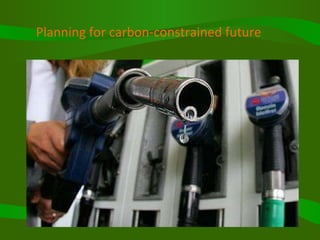
Planning for carbon-constrained future
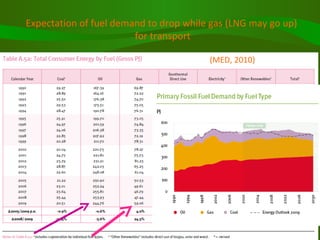
(MED, 2010) Expectation of fuel demand to drop while gas (LNG may go up) for transport
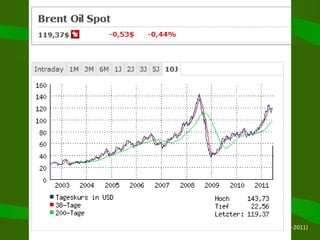
Source: Managermagazin.de (5-4-2011)
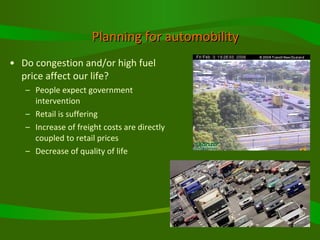
Planning for automobility Do congestion and/or high fuel price affect our life? People expect government intervention Retail is suffering Increase of freight costs are directly coupled to retail prices  Decrease of quality of life
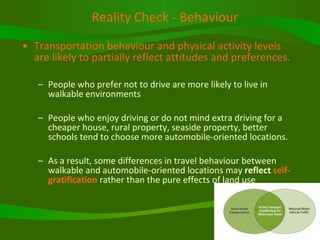
Reality Check - Behaviour Transportation behaviour and physical activity levels are likely to partially reflect attitudes and preferences.   People who prefer not to drive are more likely to live in walkable environments People who enjoy driving or do not mind extra driving for a cheaper house, rural property, seaside property, better schools tend to choose more automobile-oriented locations.  As a result, some differences in travel behaviour between walkable and automobile-oriented locations may  reflect  self-gratification  rather than the pure effects of land use
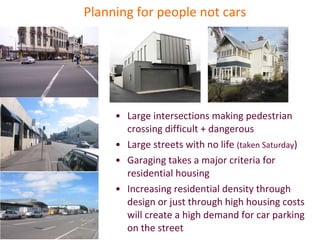
Planning for people not cars Large intersections making pedestrian crossing difficult + dangerous Large streets with no life  (taken Saturday ) Garaging takes a major criteria for residential housing Increasing residential density through design or just through high housing costs will create a high demand for car parking on the street
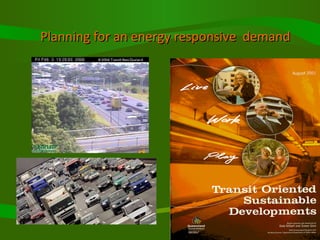
Planning for an energy responsive  demand
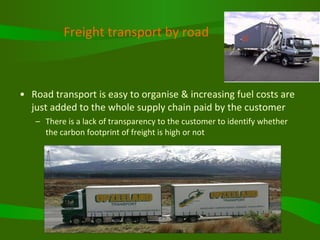
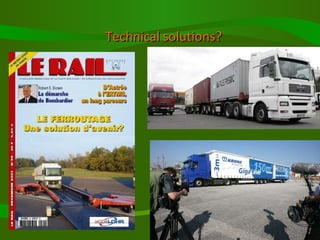
Freight transport by road Road transport is easy to organise & increasing fuel costs are just added to the whole supply chain paid by the customer There is a lack of transparency to the customer to identify whether the carbon footprint of freight is high or not
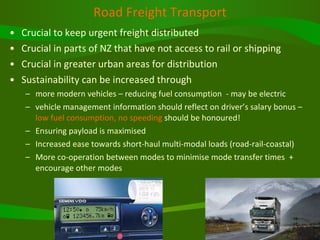
Road Freight Transport Crucial to keep urgent freight distributed Crucial in parts of NZ that have not access to rail or shipping Crucial in greater urban areas for distribution Sustainability can be increased through  more modern vehicles – reducing fuel consumption  - may be electric vehicle management information should reflect on driver’s salary bonus –  low fuel consumption, no speeding  should be honoured! Ensuring payload is maximised Increased ease towards short-haul multi-modal loads (road-rail-coastal) More co-operation between modes to minimise mode transfer times  + encourage other modes
Technical solutions?
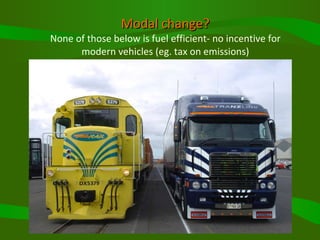
Modal change? None of those below is fuel efficient- no incentive for modern vehicles (eg. tax on emissions)
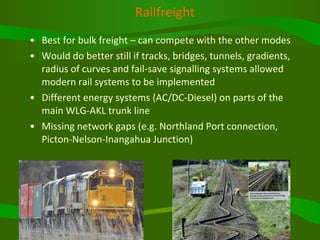
Railfreight Best for bulk freight – can compete with the other modes Would do better still if tracks, bridges, tunnels, gradients, radius of curves and fail-save signalling systems allowed modern rail systems to be implemented Different energy systems (AC/DC-Diesel) on parts of the main WLG-AKL trunk line Missing network gaps (e.g. Northland Port connection, Picton-Nelson-Inangahua Junction)
Rail Passenger Long-haul Too expensive  Too slow Too uncomfortable Urban commuting Missing links and poor CBD connections Lack of airport connections (relevant to reliability) Not sympathetic to multi-modal integration (limitation of 3 bikes per train/carriage in Wellington) Keeping to time schedules highly problematic due to old gear & track work No tram-trains
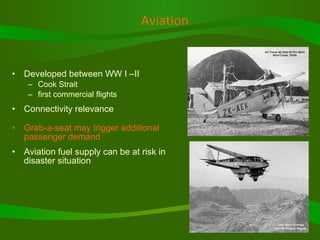
Aviation Developed between WW I –II Cook Strait  first commercial flights Connectivity relevance Grab-a-seat may trigger additional passenger demand Aviation fuel supply can be at risk in disaster situation
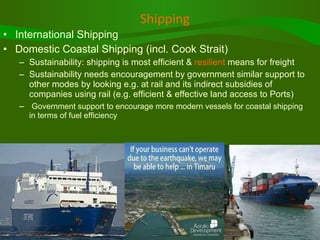
Shipping International Shipping Domestic Coastal Shipping (incl. Cook Strait) Sustainability: shipping is most efficient &  resilient  means for freight Sustainability needs encouragement by government similar support to other modes by looking e.g. at rail and its indirect subsidies of companies using rail (e.g. efficient & effective land access to Ports) Government support to encourage more modern vessels for coastal shipping in terms of fuel efficiency
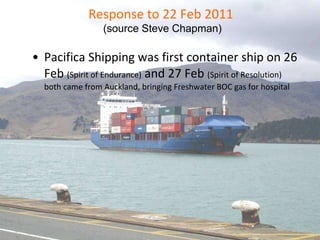
Response to 22 Feb 2011   (source Steve Chapman) Pacifica Shipping was first container ship on 26 Feb  (Spirit of Endurance)  and 27 Feb  (Spirit of Resolution) both came from Auckland, bringing Freshwater BOC gas for hospital
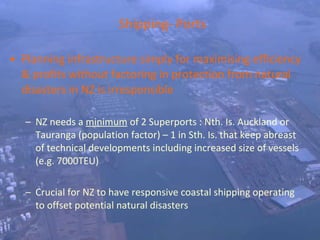
Shipping- Ports Planning infrastructure simply for maximising efficiency & profits without factoring in protection from natural disasters in NZ is irresponsible NZ needs a  minimum  of 2 Superports : Nth. Is. Auckland or Tauranga (population factor) – 1 in Sth. Is. that keep abreast of technical developments including increased size of vessels (e.g. 7000TEU) Crucial for NZ to have responsive coastal shipping operating  to offset potential natural disasters
 
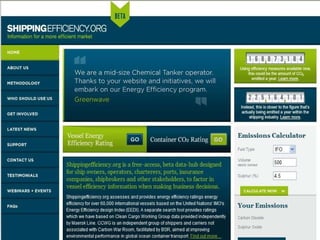
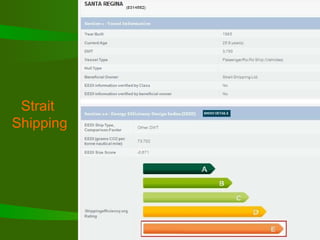
Strait  Shipping
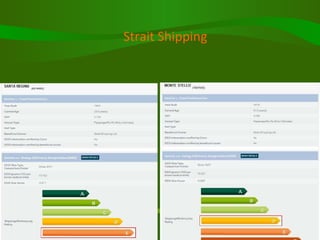
Strait Shipping
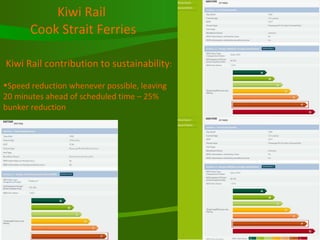
Kiwi Rail  Cook Strait Ferries Kiwi Rail contribution to sustainability : Speed reduction whenever possible, leaving 20 minutes ahead of scheduled time – 25% bunker reduction
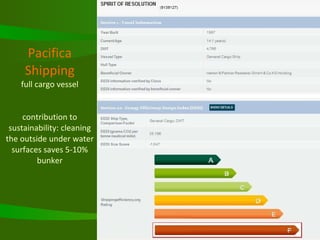
Pacifica Shipping full cargo vessel contribution to sustainability: cleaning the outside under water surfaces saves 5-10% bunker
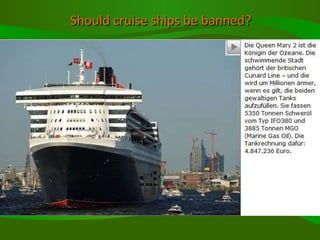
Should cruise ships be banned?
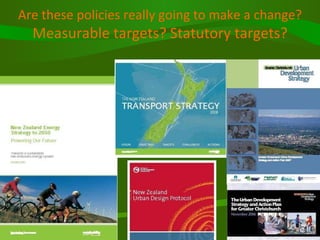
Are these policies really going to make a change?  Measurable targets? Statutory targets?
New Zealand Transport Strategy, 2008   National target – increase PT modal share to 7% by 2040 many good intentions.... National Land Transport Programme (NLTP) 2009-2012 - Primary focus is on roads - 21% fund increase for public transport Photo:  www.turbophoto.com   What do the strategies say?
Metropolitan Christchurch Transport Statement (MCTS) substantial funding to public transport (other than roads) including bus priority lanes, faster ticketing, park and ride  facilities, dynamic information systems, interchanges,  high quality buses What about quality of bus drivers? Canterbury Regional Land Transport Strategy (RLTS) Canterbury Regional Passenger Transport Plan (RPTP) - Primary focus is on strategic roads - 21% fund increase for public transport - For Christchurch – new Bus Exchange identified for funding What do the strategies say ?
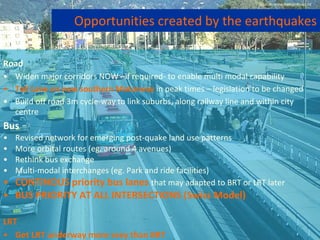
Road Widen major corridors NOW –if required- to enable multi modal capability Toll Lane on new southern Motorway  in peak times – legislation to be changed Build off road 3m cycle-way to link suburbs, along railway line and within city centre Bus Revised network for emerging post-quake land use patterns More orbital routes (eg. around 4 avenues) Rethink bus exchange  Multi-modal interchanges (eg. Park and ride facilities) CONTINOUS priority bus lanes   that may adapted to BRT or LRT later BUS PRIORITY AT ALL INTERSECTIONS (Swiss Model) LRT Get LRT underway more sexy than BRT Opportunities created by the earthquakes Source: www.metroinfo.co.nz
Alcatel-Lucent advertisement “ How Fast Will Trains Run In The Future?  In Gibabits/s Please
Environmental challenges in transport sector (high on the agenda)   Differentiation by urban forms High density urban environments (e.g. Europe, Japan) Congestion  noise pollution air pollution – PM10, NOX, CO Population health issues (pollution exposure, community cohesion, physical fitness) traffic safety impacts Carbon footprint awareness Topic raised by media Political environment – strong green political parties
Mitigation strategies High density urban environment Congestion (noise & air pollution) Noise mitigation walls along highway and railway corridors Air pollution mitigation Catalytic converters from 1980s onward (California, Japan, followed by EC) EUR 1 to EUR 5 heading to EUR 6 to minimise PM 10  & NO X ) Banning of polluting vehicles in some German cities (min EUR3) Land-use planning - congestion tolls – lane tolling, toll roads e.g. Singapore, China, Australia (Sydney), Japan…..
Environmental challenges in transport sector   Low density environment  (e.g. New Zealand) Run-off roads into waterways (e.g. effluent, tyres) Ballast water from vessels  (especially after Japan nuclear disaster) Prevention  of oil spills in waterways Building roads through national parks Distribution of plants & organims by transport (Didymo) ……… ??? Congestion in Auckland  (not perceived as environmental issue, more of a commercial impact) Energy supply is not seen as an environmental challenge
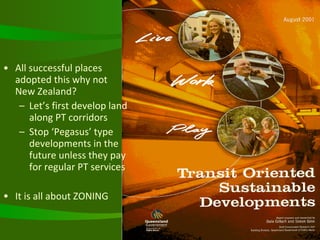
All successful places adopted this why not  New Zealand? Let’s first develop land along PT corridors Stop ‘Pegasus’ type developments in the future unless they pay for regular PT services  It is all about ZONING
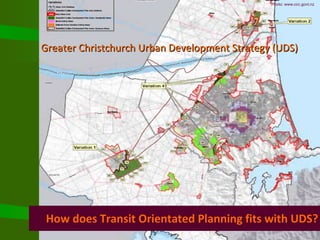
Greater Christchurch Urban Development Strategy (UDS) How does Transit Orientated Planning fits with UDS? Photo: www.ccc.govt.nz
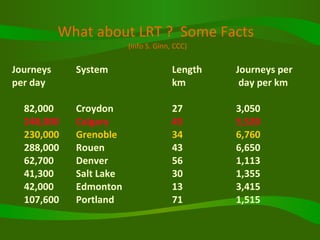
What about LRT ?  Some Facts  (info S. Ginn, CCC) Journeys System Length Journeys per per day km  day per km 82,000 Croydon 27  3,050 248,000  Calgary  45  5,520   230,000 Grenoble 34  6,760   288,000 Rouen 43   6,650  62,700 Denver 56   1,113  41,300 Salt Lake  30   1,355  42,000 Edmonton  13   3,415  107,600 Portland 71   1,515
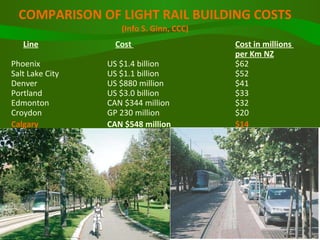
COMPARISON OF LIGHT RAIL BUILDING COSTS (Info S. Ginn, CCC) Line   Cost    Cost in millions  per Km NZ Phoenix US $1.4 billion $62 Salt Lake City US $1.1 billion  $52 Denver  US $880 million  $41 Portland US $3.0 billion  $33 Edmonton CAN $344 million    $32 Croydon GP 230 million  $20 Calgary CAN $548 million   $14
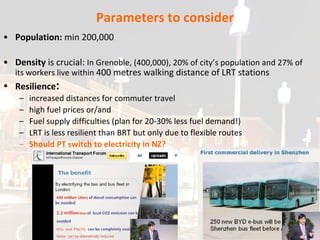
Parameters to consider Population:  min 200,000 Density  is crucial:  In Grenoble, (400,000), 20% of city’s population and 27% of its workers live within  400 metres walking distance of LRT stations Resilience :  increased distances for commuter travel high fuel prices or/and Fuel supply difficulties (plan for 20-30% less fuel demand!) LRT is less resilient than BRT but only due to flexible routes Should PT switch to electricity in NZ?
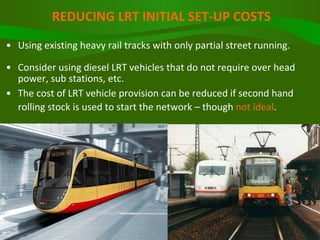
REDUCING LRT INITIAL SET-UP COSTS Using existing heavy rail tracks with only partial street running. Consider using diesel LRT vehicles that do not require over head power, sub stations, etc.  The cost of LRT vehicle provision can be reduced if second hand rolling stock is used to start the network – though  not ideal .
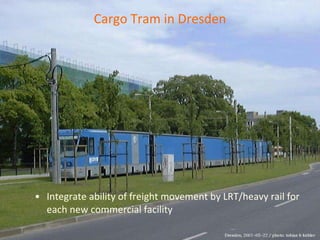
Cargo Tram in Dresden Integrate ability of freight movement by LRT/heavy rail for each new commercial facility
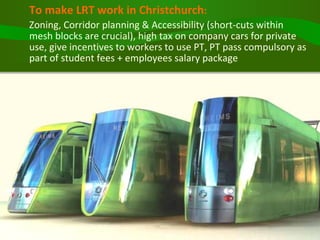
To make LRT work in Christchurch :   Zoning, Corridor planning & Accessibility (short-cuts within mesh blocks are crucial), high tax on company cars for private use, give incentives to workers to use PT, PT pass compulsory as part of student fees + employees salary package
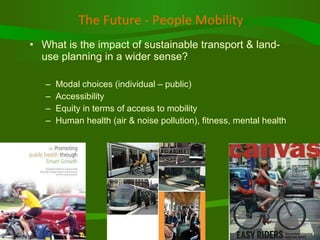
The Future - People Mobility   What is the impact of sustainable transport & land-use planning in a wider sense? Modal choices (individual – public) Accessibility  Equity in terms of access to mobility Human health (air & noise pollution), fitness, mental health
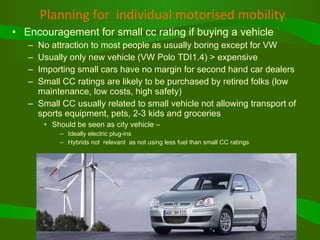
Planning for  individual motorised mobility Encouragement for small cc rating if buying a vehicle No attraction to most people as usually boring except for VW Usually only new vehicle (VW Polo TDI1.4) > expensive Importing small cars have no margin for second hand car dealers Small CC ratings are likely to be purchased by retired folks (low maintenance, low costs, high safety) Small CC usually related to small vehicle not allowing transport of sports equipment, pets, 2-3 kids and groceries Should be seen as city vehicle –  Ideally electric plug-ins Hybrids not  relevant  as not using less fuel than small CC ratings
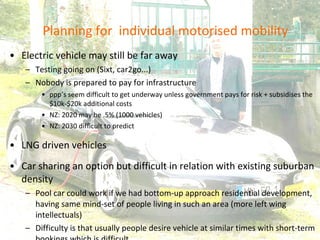
Planning for  individual motorised mobility Electric vehicle may still be far away  Testing going on (Sixt, car2go...) Nobody is prepared to pay for infrastructure ppp’s seem difficult to get underway unless government pays for risk + subsidises the $10k-$20k additional costs NZ: 2020 may be .5% (1000 vehicles) NZ: 2030 difficult to predict LNG driven vehicles  Car sharing an option but difficult in relation with existing suburban density Pool car could work if we had bottom-up approach residential development, having same mind-set of people living in such an area (more left wing intellectuals) Difficulty is that usually people desire vehicle at similar times with short-term bookings which is difficult
Changing decision-making system for mobility A shift in cultural thinking is required associated with incentives or costs long-term cars should be seen as a liability and not an asset New residential areas should have a common covered car parking area away from the house to make people think that there are other modes with having a wooden shed at the entrance for rubbish bins and bikes High quality PT is expensive to install but it is a long-term investment that will keep population mobile if fuel supply was interrupted – there is no escape for government to get out of it – it will need to be associated with corridor planning
Urban & Transport Planning   Future of Christchurch residential relocations No need to mention the challenge…… in regard to energy demand Energy demand for commuting may rise up to 200-300% depending on the relocation area –  will technology solve the energy demand problem? Opportunity to integrate Light Rail as part of the package and create walkable new residential areas 500m on each side of Light rail system  Satellite towns should not be increased unless a LR is constructed
Fun & Mobility in NZ Changing that existing culture is not easy and requires offering a new environment to encourage soft modes  (e.g. Harbour Bridge crossing for bikes & pedestrians is one example! Increasing urban recreation  Example right may not apply for S.I.
 
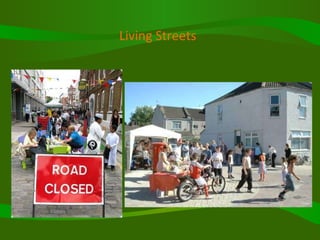
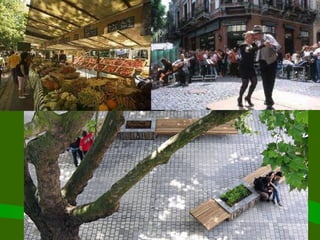
Living Streets
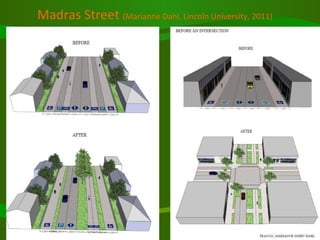
Madras Street  (Marianne Dahl, Lincoln University, 2011)
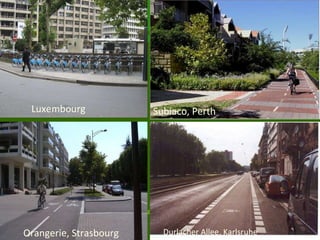
Durlacher Allee, Karlsruhe Orangerie, Strasbourg Subiaco, Perth Luxembourg


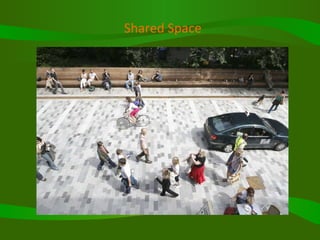
Shared Space
 
Outlook Planning for reduced energy demand Encouragement of reducing VKT Corridor planning associated with zoning  Keeping options open in terms of PT modes PT needs to be attractive (WIFI, workspace)with appropriate staff Funding of PT should be sourced from everyone in education & workplaces Rates should reflect connectivity demand (high density residential paying less) Vehicle registration should be associated to CO2 emissions ACC levy in vehicle registration should  reflect number of times vehicles caught in traffic fines + every traffic fine should be doubled to go towards ACC
VW Caddy 1200cc Dr-Ing Jean-Paul Thull (MCILT, NZIA) Senior lecturer in transport, logistics, urban planning,  energy and waste management Department of Environmental Management Faculty of Environment, Society & Design Lincoln University Ph: 03-3253838 ext 8779 Email:  [email_address]   [email_address]

Mobility and transport in New Zealand - Leading to the Future

  • 1.
    Jean-Paul H MThull Transport & Energy Management Department of Environmental Management Faculty of Environment, Society & Design Lincoln University - Christchurch MOBILITY AND TRANSPORT IN NEW ZEALAND Leading to the Future Winter Lights 2011 - A NERI Thought Leadership Forum Dunedin 16 June 2011
  • 2.
    Overview Situation inNew Zealand: facts, culture, Principles to reflect on across all modes Strategies sustainability, social responsibility & resilience
  • 3.
    New Zealand FactsSmall population 4.3 million > 85% living in main centres NZ geography (bridges, hills, tunnels) Transport barriers (geography, road-rail networks, ports) Imports by ships – NZ is at mercy of overseas decision-makers +10,000km sealed state highway network maintained to high standards Freight transport by road increased over the years, whereas rail & coastal shipping stagnated
  • 4.
    Passenger vehicles inNZ Introduction of cheap Japanese vehicle Imports Large NZ vehicle fleet of average age over 10 years Pros: long life-cycle, employment Cons: fuel consumption +30% compared to EC Population is used to access driving from +15yrs - no culture of commuter cycling, walking & use of PT Cheap fuel up to 2008 Perception of wealth (housing market) around 2005 encouraged to purchased high powered vehicles Vehicles purchased to suit hobby Extra vehicles purchased for extended family NZ families have more kids than average EC countries, hence larger cars required NZ third country ranked in world for obesity – restricted use of small mart cars
  • 5.
    Sustainability & NewZealand 73% of freight transported within regions (Paling study) > more roads to be built Short-haul rail has so far only be pushed by externalities (e.g. congestion or regulations -see POAL) NZ has no culture for walking & cycling centres have never been developed to encourage soft modes for everyone commuter cycling is perceived as a gym exercise causing accidents due to inappropriate speed Walking-running across mountains – backpacks used for tramping –hardly for grocery shopping access to private motor vehicles is too easy and cheap compared to other OECD countries WHY BOTHER? No political drive – hardly air pollution concerns - no energy supply issues UNLESS Energy Supply or Costs become an issue!!!! Or Having to be serious about planning for resilience
  • 6.
    22 February Earthquakein Christchurch Half of Christchurch's 2000-kilometre road network needing repairs About 38,000 cracks, slumps and lumps in roads Photographs by A. Hansbury Infrastructure seriously munted in eastern Christchurch suburbs Priority to re-establish infrastructure Christchurch post 22 Feb 2011
  • 7.
    Main areas ofpost-earthquake office & business relocations result into major transport challenges Source: NZTA March 2011business relocation survey Photographs by A. Hansbury
  • 8.
    Existing Public TransportSystem What are the implications of the earthquake on the Christchurch public transport system? The routes will need to be reassessed Source: http://metroinfo.co.nz/eqmap/
  • 9.
    Emerging travel patternsin CHC post earthquake REALITY CHECK Orbital movements replace the radial pattern Travel dominated by private and company cars Roads not designed for increased activity Severe congestion and delays Longer distances travelled Extended travel times Bus services disjointed or cut Increased petrol consumption, costs and pollution Photo: NZ in Tranzit
  • 10.
    Cycling as oneresilient option
  • 11.
  • 12.
    (MED, 2010) Expectationof fuel demand to drop while gas (LNG may go up) for transport
  • 13.
  • 14.
    Planning for automobilityDo congestion and/or high fuel price affect our life? People expect government intervention Retail is suffering Increase of freight costs are directly coupled to retail prices Decrease of quality of life
  • 15.
    Reality Check -Behaviour Transportation behaviour and physical activity levels are likely to partially reflect attitudes and preferences. People who prefer not to drive are more likely to live in walkable environments People who enjoy driving or do not mind extra driving for a cheaper house, rural property, seaside property, better schools tend to choose more automobile-oriented locations. As a result, some differences in travel behaviour between walkable and automobile-oriented locations may reflect self-gratification rather than the pure effects of land use
  • 16.
    Planning for peoplenot cars Large intersections making pedestrian crossing difficult + dangerous Large streets with no life (taken Saturday ) Garaging takes a major criteria for residential housing Increasing residential density through design or just through high housing costs will create a high demand for car parking on the street
  • 17.
    Planning for anenergy responsive demand
  • 18.
    Freight transport byroad Road transport is easy to organise & increasing fuel costs are just added to the whole supply chain paid by the customer There is a lack of transparency to the customer to identify whether the carbon footprint of freight is high or not
  • 19.
    Road Freight TransportCrucial to keep urgent freight distributed Crucial in parts of NZ that have not access to rail or shipping Crucial in greater urban areas for distribution Sustainability can be increased through more modern vehicles – reducing fuel consumption - may be electric vehicle management information should reflect on driver’s salary bonus – low fuel consumption, no speeding should be honoured! Ensuring payload is maximised Increased ease towards short-haul multi-modal loads (road-rail-coastal) More co-operation between modes to minimise mode transfer times + encourage other modes
  • 20.
  • 21.
    Modal change? Noneof those below is fuel efficient- no incentive for modern vehicles (eg. tax on emissions)
  • 22.
    Railfreight Best forbulk freight – can compete with the other modes Would do better still if tracks, bridges, tunnels, gradients, radius of curves and fail-save signalling systems allowed modern rail systems to be implemented Different energy systems (AC/DC-Diesel) on parts of the main WLG-AKL trunk line Missing network gaps (e.g. Northland Port connection, Picton-Nelson-Inangahua Junction)
  • 23.
    Rail Passenger Long-haulToo expensive Too slow Too uncomfortable Urban commuting Missing links and poor CBD connections Lack of airport connections (relevant to reliability) Not sympathetic to multi-modal integration (limitation of 3 bikes per train/carriage in Wellington) Keeping to time schedules highly problematic due to old gear & track work No tram-trains
  • 24.
    Aviation Developed betweenWW I –II Cook Strait first commercial flights Connectivity relevance Grab-a-seat may trigger additional passenger demand Aviation fuel supply can be at risk in disaster situation
  • 25.
    Shipping International ShippingDomestic Coastal Shipping (incl. Cook Strait) Sustainability: shipping is most efficient & resilient means for freight Sustainability needs encouragement by government similar support to other modes by looking e.g. at rail and its indirect subsidies of companies using rail (e.g. efficient & effective land access to Ports) Government support to encourage more modern vessels for coastal shipping in terms of fuel efficiency
  • 26.
    Response to 22Feb 2011 (source Steve Chapman) Pacifica Shipping was first container ship on 26 Feb (Spirit of Endurance) and 27 Feb (Spirit of Resolution) both came from Auckland, bringing Freshwater BOC gas for hospital
  • 27.
    Shipping- Ports Planninginfrastructure simply for maximising efficiency & profits without factoring in protection from natural disasters in NZ is irresponsible NZ needs a minimum of 2 Superports : Nth. Is. Auckland or Tauranga (population factor) – 1 in Sth. Is. that keep abreast of technical developments including increased size of vessels (e.g. 7000TEU) Crucial for NZ to have responsive coastal shipping operating to offset potential natural disasters
  • 28.
  • 29.
  • 30.
  • 31.
    Kiwi Rail Cook Strait Ferries Kiwi Rail contribution to sustainability : Speed reduction whenever possible, leaving 20 minutes ahead of scheduled time – 25% bunker reduction
  • 32.
    Pacifica Shipping fullcargo vessel contribution to sustainability: cleaning the outside under water surfaces saves 5-10% bunker
  • 33.
  • 34.
    Are these policiesreally going to make a change? Measurable targets? Statutory targets?
  • 35.
    New Zealand TransportStrategy, 2008 National target – increase PT modal share to 7% by 2040 many good intentions.... National Land Transport Programme (NLTP) 2009-2012 - Primary focus is on roads - 21% fund increase for public transport Photo: www.turbophoto.com What do the strategies say?
  • 36.
    Metropolitan Christchurch TransportStatement (MCTS) substantial funding to public transport (other than roads) including bus priority lanes, faster ticketing, park and ride facilities, dynamic information systems, interchanges, high quality buses What about quality of bus drivers? Canterbury Regional Land Transport Strategy (RLTS) Canterbury Regional Passenger Transport Plan (RPTP) - Primary focus is on strategic roads - 21% fund increase for public transport - For Christchurch – new Bus Exchange identified for funding What do the strategies say ?
  • 37.
    Road Widen majorcorridors NOW –if required- to enable multi modal capability Toll Lane on new southern Motorway in peak times – legislation to be changed Build off road 3m cycle-way to link suburbs, along railway line and within city centre Bus Revised network for emerging post-quake land use patterns More orbital routes (eg. around 4 avenues) Rethink bus exchange Multi-modal interchanges (eg. Park and ride facilities) CONTINOUS priority bus lanes that may adapted to BRT or LRT later BUS PRIORITY AT ALL INTERSECTIONS (Swiss Model) LRT Get LRT underway more sexy than BRT Opportunities created by the earthquakes Source: www.metroinfo.co.nz
  • 38.
    Alcatel-Lucent advertisement “How Fast Will Trains Run In The Future? In Gibabits/s Please
  • 39.
    Environmental challenges intransport sector (high on the agenda) Differentiation by urban forms High density urban environments (e.g. Europe, Japan) Congestion noise pollution air pollution – PM10, NOX, CO Population health issues (pollution exposure, community cohesion, physical fitness) traffic safety impacts Carbon footprint awareness Topic raised by media Political environment – strong green political parties
  • 40.
    Mitigation strategies Highdensity urban environment Congestion (noise & air pollution) Noise mitigation walls along highway and railway corridors Air pollution mitigation Catalytic converters from 1980s onward (California, Japan, followed by EC) EUR 1 to EUR 5 heading to EUR 6 to minimise PM 10 & NO X ) Banning of polluting vehicles in some German cities (min EUR3) Land-use planning - congestion tolls – lane tolling, toll roads e.g. Singapore, China, Australia (Sydney), Japan…..
  • 41.
    Environmental challenges intransport sector Low density environment (e.g. New Zealand) Run-off roads into waterways (e.g. effluent, tyres) Ballast water from vessels (especially after Japan nuclear disaster) Prevention of oil spills in waterways Building roads through national parks Distribution of plants & organims by transport (Didymo) ……… ??? Congestion in Auckland (not perceived as environmental issue, more of a commercial impact) Energy supply is not seen as an environmental challenge
  • 42.
    All successful placesadopted this why not New Zealand? Let’s first develop land along PT corridors Stop ‘Pegasus’ type developments in the future unless they pay for regular PT services It is all about ZONING
  • 43.
    Greater Christchurch UrbanDevelopment Strategy (UDS) How does Transit Orientated Planning fits with UDS? Photo: www.ccc.govt.nz
  • 44.
    What about LRT? Some Facts (info S. Ginn, CCC) Journeys System Length Journeys per per day km day per km 82,000 Croydon 27 3,050 248,000 Calgary 45 5,520 230,000 Grenoble 34 6,760 288,000 Rouen 43 6,650 62,700 Denver 56 1,113 41,300 Salt Lake 30 1,355 42,000 Edmonton 13 3,415 107,600 Portland 71 1,515
  • 45.
    COMPARISON OF LIGHTRAIL BUILDING COSTS (Info S. Ginn, CCC) Line Cost Cost in millions per Km NZ Phoenix US $1.4 billion $62 Salt Lake City US $1.1 billion $52 Denver US $880 million $41 Portland US $3.0 billion $33 Edmonton CAN $344 million $32 Croydon GP 230 million $20 Calgary CAN $548 million $14
  • 46.
    Parameters to considerPopulation: min 200,000 Density is crucial: In Grenoble, (400,000), 20% of city’s population and 27% of its workers live within 400 metres walking distance of LRT stations Resilience : increased distances for commuter travel high fuel prices or/and Fuel supply difficulties (plan for 20-30% less fuel demand!) LRT is less resilient than BRT but only due to flexible routes Should PT switch to electricity in NZ?
  • 47.
    REDUCING LRT INITIALSET-UP COSTS Using existing heavy rail tracks with only partial street running. Consider using diesel LRT vehicles that do not require over head power, sub stations, etc. The cost of LRT vehicle provision can be reduced if second hand rolling stock is used to start the network – though not ideal .
  • 48.
    Cargo Tram inDresden Integrate ability of freight movement by LRT/heavy rail for each new commercial facility
  • 49.
    To make LRTwork in Christchurch : Zoning, Corridor planning & Accessibility (short-cuts within mesh blocks are crucial), high tax on company cars for private use, give incentives to workers to use PT, PT pass compulsory as part of student fees + employees salary package
  • 50.
    The Future -People Mobility What is the impact of sustainable transport & land-use planning in a wider sense? Modal choices (individual – public) Accessibility Equity in terms of access to mobility Human health (air & noise pollution), fitness, mental health
  • 51.
    Planning for individual motorised mobility Encouragement for small cc rating if buying a vehicle No attraction to most people as usually boring except for VW Usually only new vehicle (VW Polo TDI1.4) > expensive Importing small cars have no margin for second hand car dealers Small CC ratings are likely to be purchased by retired folks (low maintenance, low costs, high safety) Small CC usually related to small vehicle not allowing transport of sports equipment, pets, 2-3 kids and groceries Should be seen as city vehicle – Ideally electric plug-ins Hybrids not relevant as not using less fuel than small CC ratings
  • 52.
    Planning for individual motorised mobility Electric vehicle may still be far away Testing going on (Sixt, car2go...) Nobody is prepared to pay for infrastructure ppp’s seem difficult to get underway unless government pays for risk + subsidises the $10k-$20k additional costs NZ: 2020 may be .5% (1000 vehicles) NZ: 2030 difficult to predict LNG driven vehicles Car sharing an option but difficult in relation with existing suburban density Pool car could work if we had bottom-up approach residential development, having same mind-set of people living in such an area (more left wing intellectuals) Difficulty is that usually people desire vehicle at similar times with short-term bookings which is difficult
  • 53.
    Changing decision-making systemfor mobility A shift in cultural thinking is required associated with incentives or costs long-term cars should be seen as a liability and not an asset New residential areas should have a common covered car parking area away from the house to make people think that there are other modes with having a wooden shed at the entrance for rubbish bins and bikes High quality PT is expensive to install but it is a long-term investment that will keep population mobile if fuel supply was interrupted – there is no escape for government to get out of it – it will need to be associated with corridor planning
  • 54.
    Urban & TransportPlanning Future of Christchurch residential relocations No need to mention the challenge…… in regard to energy demand Energy demand for commuting may rise up to 200-300% depending on the relocation area – will technology solve the energy demand problem? Opportunity to integrate Light Rail as part of the package and create walkable new residential areas 500m on each side of Light rail system Satellite towns should not be increased unless a LR is constructed
  • 55.
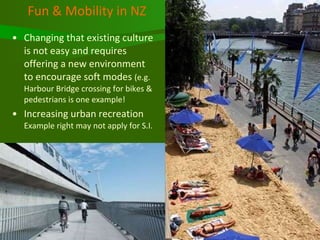
    Fun & Mobilityin NZ Changing that existing culture is not easy and requires offering a new environment to encourage soft modes (e.g. Harbour Bridge crossing for bikes & pedestrians is one example! Increasing urban recreation Example right may not apply for S.I.
  • 56.
  • 57.
  • 58.
    Madras Street (Marianne Dahl, Lincoln University, 2011)
  • 59.
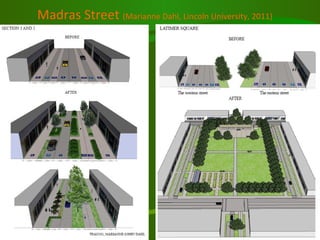
    Madras Street (Marianne Dahl, Lincoln University, 2011)
  • 60.
    Durlacher Allee, KarlsruheOrangerie, Strasbourg Subiaco, Perth Luxembourg
  • 61.
  • 62.
  • 63.
  • 64.
  • 65.
  • 66.
    Outlook Planning forreduced energy demand Encouragement of reducing VKT Corridor planning associated with zoning Keeping options open in terms of PT modes PT needs to be attractive (WIFI, workspace)with appropriate staff Funding of PT should be sourced from everyone in education & workplaces Rates should reflect connectivity demand (high density residential paying less) Vehicle registration should be associated to CO2 emissions ACC levy in vehicle registration should reflect number of times vehicles caught in traffic fines + every traffic fine should be doubled to go towards ACC
  • 67.
    VW Caddy 1200ccDr-Ing Jean-Paul Thull (MCILT, NZIA) Senior lecturer in transport, logistics, urban planning, energy and waste management Department of Environmental Management Faculty of Environment, Society & Design Lincoln University Ph: 03-3253838 ext 8779 Email: [email_address] [email_address]

Editor's Notes

  • #10 Travel dominated by private and company cars – companies often supply their vehicles to workers to compensate for longer distances travelled to new business locations Orbital movements replace the radial pattern – business have moved out of the central city to outer suburbs. Workers travel between suburbs rather than from suburbs to central city. With CBD cordoned off and inaccessible many through routes are not available Roads not designed for increased activity – with so many key arterial roads damaged, out of action or narrowed down to one/two lanes, other local roads had to take over. They are not designed for it. The result is severe congestion. Longer distances travelled Extended travel times – longer routes and congestion Severe congestion and delays (roads not suitable for the amount of traffic, more people have been pushed onto the few available roads, traffic signals are not set appropriately) Bus services disjointed or cut – radial movements upset, no bus exchange, routes cannot run through the CBD and run to the four avenues, bus stock reduced through earthquake damage ALL THIS ADDS TO INCREASED PETROL CONSUMPTION AND POLLUTION
  • #44 Strategic direction for the next 35 years: 71% of growth in Christchurch, 16% Selwyn, 13% Waimakariri Metropolitan Urban Limit Specific targets for households numbers Specified greenfield growth areas Integrating development with commercial, cultural, employment areas and transport networks Increase densities along main transport corridors