CO2 for Enhanced Oil
Recovery
Outline
 Introduction
 Methods
 Models
 Steam-CO2 Injection
 Chemical gas absorption by
monoethanolamines (MEA)
 Conclusion
Introduction
 High oil prices and concerns about future oil supply
 Enhanced oil recovery (EOR) is a group of
technologies that can increase recovery from
existing oil reservoirs
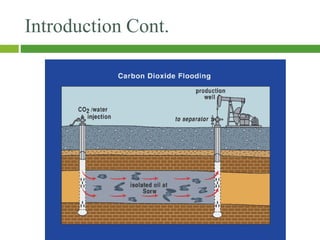
 CO2 is a good flooding agent
 The CO2 is currently discharged into the
atmosphere and could be a major contributor to the
greenhouse effect, which may lead to global
warming
Introduction Cont.
Methods
 Thermal method
 Chemical method
 Miscible method
Thermal method
 Injection of high temperature fluids into fractured
reservoirs to recover matrix oil
 The major recovery mechanisms ( thermal method)
include capillary imbibition, thermal expansion, gas
generation, gravity drainage, in situ steam generation,
distillation, solution gas drive, and pressure depletion
 Imbibition is defined as the displacement of one fluid
by another immiscible fluid
Thermal method Cont.
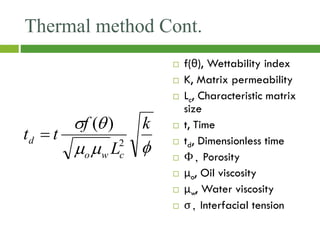
 f(θ), Wettability index
 K, Matrix permeability
 Lc, Characteristic matrix
size
 t, Time
 td, Dimensionless time
 Φ, Porosity
 μo, Oil viscosity
 μw, Water viscosity
 σ, Interfacial tension




 k
L
f
t
t
c
w
o
d 2
)
(

Thermal method Cont.
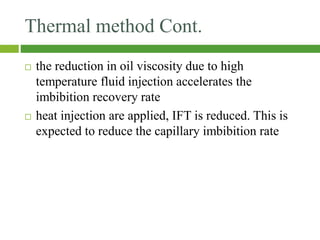
 the reduction in oil viscosity due to high
temperature fluid injection accelerates the
imbibition recovery rate
 heat injection are applied, IFT is reduced. This is
expected to reduce the capillary imbibition rate
Chemical method
 Surfactant
The idea of injecting surfactant solution to
improve imbibition recovery
In general, the positive effect of lowered IFT
on the ultimate recovery due to surfactant
addition (heavy oil)
A negative effect of lowered IFT (surfactant
solution) on the recovery rate (light oil)
Chemical method Cont.
 Polymer
Injection of polymer solution as aqueous
phase for matrix recovery
This can be attributed to the stronger
capillary imbibition drive by increasing
aqueous phase viscosity
Miscible method
 Gas can also be injected in order for it to
penetrate into matrix and expel the oil out. As
gaseous phase is normally the nonwetting
phase, the oil is recovered by the process
called gas oil gravity drainage (GOGD), which
occurs due to gravity difference between the
fluid in fracture and matrix
Miscible method Cont.
 Nitrogen is a commonly injected gas into
naturally fractured reservoirs for pressure
maintenance due to availability and lower cost
 Carbon Dioxide (CO2) has been recognized as
a preferred miscible solvent for Enhanced Oil
Recovery (EOR) methods
 Miscible flooding by CO2 has proven its
positive effectiveness through numerous
laboratory and field projects
Miscible method Cont.
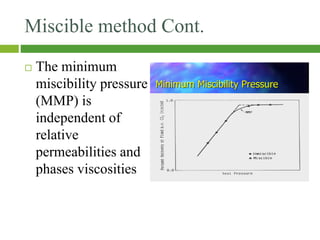
 The minimum
miscibility pressure
(MMP) is
independent of
relative
permeabilities and
phases viscosities
Miscible method Cont.
 Miscible flooding is a drive process by mixing
injection fluid (solvent) and oil. Its main
mechanism is to decrease the residual oil
saturation by eliminating interfacial tension
between phases
Miscible Flood Numerical Models
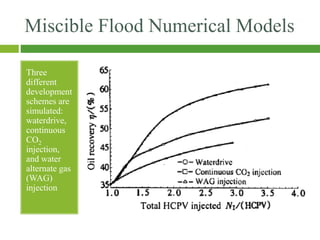
Three
different
development
schemes are
simulated:
waterdrive,
continuous
CO2
injection,
and water
alternate gas
(WAG)
injection
Miscible Flood Numerical Models Cont.
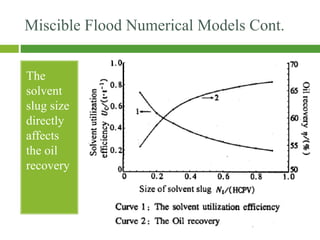
The
solvent
slug size
directly
affects
the oil
recovery
Steam-CO2 Injection
 Steam-CO2 injection schemes are based on
simple concepts and produce good results
 Currently the cost of capturing and
transporting CO2 for EOR applications is quite
high
 One method of overcoming this economic
challenge is to produce CO2 on site for
immediate injection into an oil reservoir
Steam-CO2 Injection Cont.
 The procedure
 the injection of liquid CO2 into the reservoir through
the deepest wellbore
 After some time has passed, steam is injected into the
reservoir via the same deep wellbore
 When the CO2 is contacted by the steam it heats up and
expands into a gaseous state
 The pressure from the steam injection causes the CO2
gas to dissolve into the oil and the steam to condense
into water
Steam-CO2 Injection Cont.
 The procedure Cont.
 The resulting mixture of oil and CO2 is less viscous
and less dense than oil alone and the mixture flows
upward with greater ease
 A second horizontal wellbore above this action
receives the less viscous mixture and channels it to the
surface
 At the surface the CO2 and water are separated from
the petroleum, which is then processed and sent for
sale
Chemical gas absorption by
monoethanolamines (MEA)
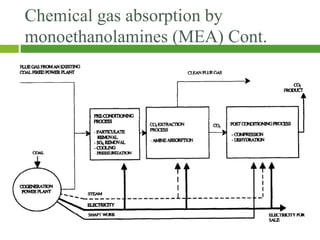
 The absorption process using
monoethanolamines (MEA) as the scrubbing
solvent is used
 The MEA solvent is a proven technology for
CO2 separation and has been selected because
of its high reactivity with CO2 under low
pressure conditions
Chemical gas absorption by
monoethanolamines (MEA) Cont.
Conclusion
 Carbon dioxide production from coal-fired power
plants was modeled. It was found that the
production of CO2 can become technically feasible,
economically feasible and environmentally friendly
 Need optimization techniques were used to search
for optimal design and operating criteria for the
CO2 extraction plant, more economic feasible
CO2 EOR  Presentation - SKILLUP Trainning

CO2 EOR Presentation - SKILLUP Trainning

  • 1.
    CO2 for EnhancedOil Recovery
  • 2.
    Outline  Introduction  Methods Models  Steam-CO2 Injection  Chemical gas absorption by monoethanolamines (MEA)  Conclusion
  • 3.
    Introduction  High oilprices and concerns about future oil supply  Enhanced oil recovery (EOR) is a group of technologies that can increase recovery from existing oil reservoirs  CO2 is a good flooding agent  The CO2 is currently discharged into the atmosphere and could be a major contributor to the greenhouse effect, which may lead to global warming
  • 4.
  • 5.
    Methods  Thermal method Chemical method  Miscible method
  • 6.
    Thermal method  Injectionof high temperature fluids into fractured reservoirs to recover matrix oil  The major recovery mechanisms ( thermal method) include capillary imbibition, thermal expansion, gas generation, gravity drainage, in situ steam generation, distillation, solution gas drive, and pressure depletion  Imbibition is defined as the displacement of one fluid by another immiscible fluid
  • 7.
    Thermal method Cont. f(θ), Wettability index  K, Matrix permeability  Lc, Characteristic matrix size  t, Time  td, Dimensionless time  Φ, Porosity  μo, Oil viscosity  μw, Water viscosity  σ, Interfacial tension      k L f t t c w o d 2 ) ( 
  • 8.
    Thermal method Cont. the reduction in oil viscosity due to high temperature fluid injection accelerates the imbibition recovery rate  heat injection are applied, IFT is reduced. This is expected to reduce the capillary imbibition rate
  • 9.
    Chemical method  Surfactant Theidea of injecting surfactant solution to improve imbibition recovery In general, the positive effect of lowered IFT on the ultimate recovery due to surfactant addition (heavy oil) A negative effect of lowered IFT (surfactant solution) on the recovery rate (light oil)
  • 10.
    Chemical method Cont. Polymer Injection of polymer solution as aqueous phase for matrix recovery This can be attributed to the stronger capillary imbibition drive by increasing aqueous phase viscosity
  • 11.
    Miscible method  Gascan also be injected in order for it to penetrate into matrix and expel the oil out. As gaseous phase is normally the nonwetting phase, the oil is recovered by the process called gas oil gravity drainage (GOGD), which occurs due to gravity difference between the fluid in fracture and matrix
  • 12.
    Miscible method Cont. Nitrogen is a commonly injected gas into naturally fractured reservoirs for pressure maintenance due to availability and lower cost  Carbon Dioxide (CO2) has been recognized as a preferred miscible solvent for Enhanced Oil Recovery (EOR) methods  Miscible flooding by CO2 has proven its positive effectiveness through numerous laboratory and field projects
  • 13.
    Miscible method Cont. The minimum miscibility pressure (MMP) is independent of relative permeabilities and phases viscosities
  • 14.
    Miscible method Cont. Miscible flooding is a drive process by mixing injection fluid (solvent) and oil. Its main mechanism is to decrease the residual oil saturation by eliminating interfacial tension between phases
  • 15.
    Miscible Flood NumericalModels Three different development schemes are simulated: waterdrive, continuous CO2 injection, and water alternate gas (WAG) injection
  • 16.
    Miscible Flood NumericalModels Cont. The solvent slug size directly affects the oil recovery
  • 17.
    Steam-CO2 Injection  Steam-CO2injection schemes are based on simple concepts and produce good results  Currently the cost of capturing and transporting CO2 for EOR applications is quite high  One method of overcoming this economic challenge is to produce CO2 on site for immediate injection into an oil reservoir
  • 18.
    Steam-CO2 Injection Cont. The procedure  the injection of liquid CO2 into the reservoir through the deepest wellbore  After some time has passed, steam is injected into the reservoir via the same deep wellbore  When the CO2 is contacted by the steam it heats up and expands into a gaseous state  The pressure from the steam injection causes the CO2 gas to dissolve into the oil and the steam to condense into water
  • 19.
    Steam-CO2 Injection Cont. The procedure Cont.  The resulting mixture of oil and CO2 is less viscous and less dense than oil alone and the mixture flows upward with greater ease  A second horizontal wellbore above this action receives the less viscous mixture and channels it to the surface  At the surface the CO2 and water are separated from the petroleum, which is then processed and sent for sale
  • 20.
    Chemical gas absorptionby monoethanolamines (MEA)  The absorption process using monoethanolamines (MEA) as the scrubbing solvent is used  The MEA solvent is a proven technology for CO2 separation and has been selected because of its high reactivity with CO2 under low pressure conditions
  • 21.
    Chemical gas absorptionby monoethanolamines (MEA) Cont.
  • 22.
    Conclusion  Carbon dioxideproduction from coal-fired power plants was modeled. It was found that the production of CO2 can become technically feasible, economically feasible and environmentally friendly  Need optimization techniques were used to search for optimal design and operating criteria for the CO2 extraction plant, more economic feasible