©2013 Deloitte Türkiye. Member of Deloitte Touche Tohmatsu Limited 
Investment Support and Promotion Agency of Turkey 
The Energy Sector: A Quick Tour for the Investor 
November 2013
©2013 Deloitte Türkiye. Member of Deloitte Touche Tohmatsu Limited 
Investment Support and Promotion Agency of Turkey 
1 
Disclaimer 
Republic of Turkey Prime Ministry Investment Support and Promotion Agency (ISPAT) submits the information provided by third parties in good faith. ISPAT has no obligation to check and examine this information and takes no responsibility for any misstatement or false declaration. ISPAT does not guarantee the accuracy, currency, reliability, correctness or legality of any information provided by third parties. ISPAT accepts no responsibility for the content of any information, news or article in the document and cannot be considered as approving any opinion declared by third parties. ISPAT explicitly states that; it is not liable for any loss, negligence, tort or other damages caused by actions and agreements based on the information provided by third parties. 
Deloitte accepts no liability to any party who is shown or gains access to this document. The opinions expressed in this report are based on Deloitte Consulting’s judgment and analysis of key factors. However, the actual operation and results of the analyzed sector may differ from those projected herein. Deloitte does not warrant that actual results will be the same as the projected results. Neither Deloitte nor any individuals signing or associated with this report shall be required by reason of this report to give further consultation, to provide testimony or appear in court or other legal proceedings, unless specific arrangements thereof have been made. All opinions and estimates included in this report constitute our judgment as of this date and are subject to change without notice and may become outdated.
©2013 Deloitte Türkiye. Member of Deloitte Touche Tohmatsu Limited 
Investment Support and Promotion Agency of Turkey 
A. Executive Summary 
B. General Overview of the Energy Sector 
i. Overview of the Global Energy Sector 
ii. Investment Enablers of the Turkish Energy Market 
iii. Market Information 
C. A Closer Look at the Sub-sectors 
i. Electricity 
ii. Petroleum 
iii. Natural Gas & LNG 
iv. Coal 
D. Opportunities and Investment Areas 
Table of Contents 
2
©2013 Deloitte Türkiye. Member of Deloitte Touche Tohmatsu Limited 
Investment Support and Promotion Agency of Turkey 
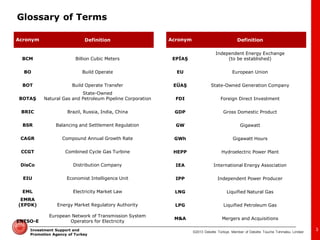
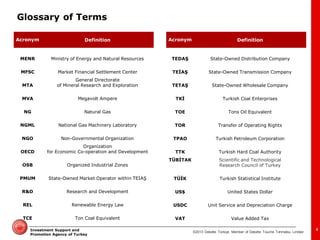
Glossary of Terms 
Acronym 
Definition 
BCM 
Billion Cubic Meters 
BO 
Build Operate 
BOT 
Build Operate Transfer 
BOTAŞ 
State-Owned 
Natural Gas and Petroleum Pipeline Corporation 
BRIC 
Brazil, Russia, India, China 
BSR 
Balancing and Settlement Regulation 
CAGR 
Compound Annual Growth Rate 
CCGT 
Combined Cycle Gas Turbine 
DisCo 
Distribution Company 
EIU 
Economist Intelligence Unit 
EML 
Electricity Market Law 
EMRA (EPDK) 
Energy Market Regulatory Authority 
ENTSO-E 
European Network of Transmission System Operators for Electricity 
Acronym 
Definition 
EPİAŞ 
Independent Energy Exchange 
(to be established) 
EU 
European Union 
EÜAŞ 
State-Owned Generation Company 
FDI 
Foreign Direct Investment 
GDP 
Gross Domestic Product 
GW 
Gigawatt 
GWh 
Gigawatt Hours 
HEPP 
Hydroelectric Power Plant 
IEA 
International Energy Association 
IPP 
Independent Power Producer 
LNG 
Liquified Natural Gas 
LPG 
Liquified Petroleum Gas 
M&A 
Mergers and Acquisitions 
3
©2013 Deloitte Türkiye. Member of Deloitte Touche Tohmatsu Limited 
Investment Support and Promotion Agency of Turkey 
Glossary of Terms 
Acronym 
Definition 
MENR 
Ministry of Energy and Natural Resources 
MFSC 
Market Financial Settlement Center 
MTA 
General Directorate 
of Mineral Research and Exploration 
MVA 
Megavolt Ampere 
NG 
Natural Gas 
NGML 
National Gas Machinery Laboratory 
NGO 
Non-Governmental Organization 
OECD 
Organization 
for Economic Co-operation and Development 
OSB 
Organized Industrial Zones 
PMUM 
State-Owned Market Operator within TEİAŞ 
R&D 
Research and Development 
REL 
Renewable Energy Law 
TCE 
Ton Coal Equivalent 
Acronym 
Definition 
TEDAŞ 
State-Owned Distribution Company 
TEİAŞ 
State-Owned Transmission Company 
TETAŞ 
State-Owned Wholesale Company 
TKİ 
Turkish Coal Enterprises 
TOE 
Tons Oil Equivalent 
TOR 
Transfer of Operating Rights 
TPAO 
Turkish Petroleum Corporation 
TTK 
Turkish Hard Coal Authority 
TÜBİTAK 
Scientific and Technological 
Research Council of Turkey 
TÜİK 
Turkish Statistical Institute 
US$ 
United States Dollar 
USDC 
Unit Service and Depreciation Charge 
VAT 
Value Added Tax 
4
©2013 Deloitte Türkiye. Member of Deloitte Touche Tohmatsu Limited 
Investment Support and Promotion Agency of Turkey 
Executive Summary 
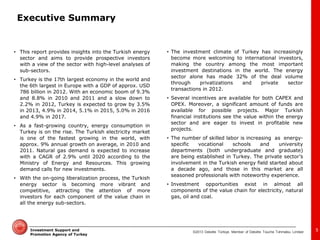
•This report provides insights into the Turkish energy sector and aims to provide prospective investors with a view of the sector with high-level analyses of sub-sectors. 
•Turkey is the 17th largest economy in the world and the 6th largest in Europe with a GDP of approx. USD 786 billion in 2012. With an economic boom of 9.3% and 8.8% in 2010 and 2011 and a slow down to 2.2% in 2012, Turkey is expected to grow by 3.5% in 2013, 4.9% in 2014, 5.1% in 2015, 5.0% in 2016 and 4.9% in 2017. 
•As a fast-growing country, energy consumption in Turkey is on the rise. The Turkish electricity market is one of the fastest growing in the world, with approx. 9% annual growth on average, in 2010 and 2011. Natural gas demand is expected to increase with a CAGR of 2.9% until 2020 according to the Ministry of Energy and Resources. This growing demand calls for new investments. 
•With the on-going liberalization process, the Turkish energy sector is becoming more vibrant and competitive, attracting the attention of more investors for each component of the value chain in all the energy sub-sectors. 
•The investment climate of Turkey has increasingly become more welcoming to international investors, making the country among the most important investment destinations in the world. The energy sector alone has made 32% of the deal volume through privatizations and private sector transactions in 2012. 
•Several incentives are available for both CAPEX and OPEX. Moreover, a significant amount of funds are available for possible projects. Major Turkish financial institutions see the value within the energy sector and are eager to invest in profitable new projects. 
•The number of skilled labor is increasing as energy- specific vocational schools and university departments (both undergraduate and graduate) are being established in Turkey. The private sector’s involvement in the Turkish energy field started about a decade ago, and those in this market are all seasoned professionals with noteworthy experience. 
•Investment opportunities exist in almost all components of the value chain for electricity, natural gas, oil and coal. 
5
Investment Support and Promotion Agency of Turkey 
B. General Overview 
i. Overview of the Global Energy Sector 
ii. Investment Enablers of the Turkish Energy Market 
iii. Market Information
©2013 Deloitte Türkiye. Member of Deloitte Touche Tohmatsu Limited 
Investment Support and Promotion Agency of Turkey 
0 
2,000 
4,000 
6,000 
8,000 
10,000 
12,000 
2011 
2015 
2020 
2025 
2030 
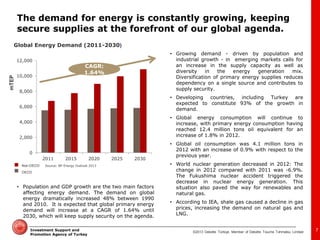
The demand for energy is constantly growing, keeping secure supplies at the forefront of our global agenda. 
mTEP 
CAGR: 1.64% 
Source: BP Energy Outlook 2013 
Global Energy Demand (2011-2030) 
Non-OECD 
OECD 
7 
•Population and GDP growth are the two main factors affecting energy demand. The demand on global energy dramatically increased 48% between 1990 and 2010. It is expected that global primary energy demand will increase at a CAGR of 1.64% until 2030, which will keep supply security on the agenda. 
•Growing demand - driven by population and industrial growth - in emerging markets calls for an increase in the supply capacity as well as diversity in the energy generation mix. Diversification of primary energy supplies reduces dependency on a single source and contributes to supply security. 
•Developing countries, including Turkey are expected to constitute 93% of the growth in demand. 
•Global energy consumption will continue to increase, with primary energy consumption having reached 12.4 million tons oil equivalent for an increase of 1.8% in 2012. 
•Global oil consumption was 4.1 million tons in 2012 with an increase of 0.9% with respect to the previous year. 
•World nuclear generation decreased in 2012: The change in 2012 compared with 2011 was -6.9%. The Fukushima nuclear accident triggered the decrease in nuclear energy generation. This situation also paved the way for renewables and natural gas. 
•According to IEA, shale gas caused a decline in gas prices, increasing the demand on natural gas and LNG.
©2013 Deloitte Türkiye. Member of Deloitte Touche Tohmatsu Limited 
Investment Support and Promotion Agency of Turkey 
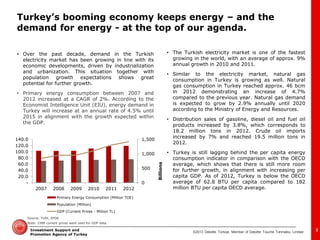
•Over the past decade, demand in the Turkish electricity market has been growing in line with its economic developments, driven by industrialization and urbanization. This situation together with population growth expectations shows great potential for further growth. 
•Primary energy consumption between 2007 and 2012 increased at a CAGR of 2%. According to the Economist Intelligence Unit (EIU), energy demand in Turkey will increase at an annual rate of 4.5% until 2015 in alignment with the growth expected within the GDP. 
•The Turkish electricity market is one of the fastest growing in the world, with an average of approx. 9% annual growth in 2010 and 2011. 
•Similar to the electricity market, natural gas consumption in Turkey is growing as well. Natural gas consumption in Turkey reached approx. 46 bcm in 2012 demonstrating an increase of 4.7% compared to the previous year. Natural gas demand is expected to grow by 2.9% annually until 2020 according to the Ministry of Energy and Resources. 
•Distribution sales of gasoline, diesel oil and fuel oil products increased by 3.8%, which corresponds to 18.2 million tons in 2012. Crude oil imports increased by 7% and reached 19.5 million tons in 2012. 
•Turkey is still lagging behind the per capita energy consumption indicator in comparison with the OECD average, which shows that there is still more room for further growth, in alignment with increasing per capita GDP. As of 2012, Turkey is below the OECD average of 62.8 BTU per capita compared to 182 million BTU per capita OECD average. 
Source: TUİK, EPDK 
Note: 1998 current prices were used for GDP data. 
8 
Turkey’s booming economy keeps energy – and the demand for energy - at the top of our agenda. 
0 
500 
1,000 
1,500 
- 
20.0 
40.0 
60.0 
80.0 
100.0 
120.0 
140.0 
2007 
2008 
2009 
2010 
2011 
2012 
Billions 
Primary Energy Consumption (Million TOE) 
Population (Million) 
GDP (Current Prices - Million TL)
©2013 Deloitte Türkiye. Member of Deloitte Touche Tohmatsu Limited 
Investment Support and Promotion Agency of Turkey 
Petroleum Production 
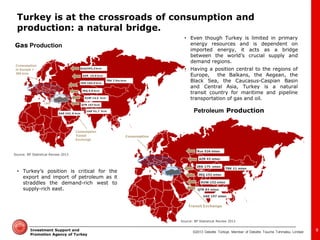
•Even though Turkey is limited in primary energy resources and is dependent on imported energy, it acts as a bridge between the world’s crucial supply and demand regions. 
•Having a position central to the regions of Europe, the Balkans, the Aegean, the Black Sea, the Caucasus-Caspian Basin and Central Asia, Turkey is a natural transit country for maritime and pipeline transportation of gas and oil. 
Gas Production 
Source: BP Statistical Review 2013 
9 
RUS 
•Turkey’s position is critical for the export and import of petroleum as it straddles the demand-rich west to supply-rich east. 
Source: BP Statistical Review 2013 
Turkey is at the crossroads of consumption and production: a natural bridge.
©2013 Deloitte Türkiye. Member of Deloitte Touche Tohmatsu Limited 
Investment Support and Promotion Agency of Turkey 
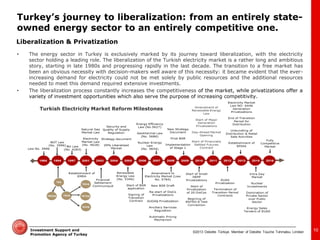
•The energy sector in Turkey is exclusively marked by its journey toward liberalization, with the electricity sector holding a leading role. The liberalization of the Turkish electricity market is a rather long and ambitious story, starting in late 1980s and progressing rapidly in the last decade. The transition to a free market has been an obvious necessity with decision-makers well aware of this necessity: it became evident that the ever- increasing demand for electricity could not be met solely by public resources and the additional resources needed to meet this demand required extensive investments. 
•The liberalization process constantly increases the competitiveness of the market, while privatizations offer a variety of investment opportunities which also serve the purpose of increasing competitivity. 
Liberalization & Privatization 
10 
Turkish Electricity Market Reform Milestones 
Turkey’s journey to liberalization: from an entirely state- owned energy sector to an entirely competitive one.
©2013 Deloitte Türkiye. Member of Deloitte Touche Tohmatsu Limited 
Investment Support and Promotion Agency of Turkey 
0 
1000 
2000 
3000 
4000 
5000 
2008 
2009 
2010 
2011 
2012 
USD Million - Current Prices - Year-on-Year Exchange 
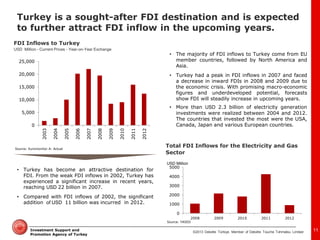
•Turkey has become an attractive destination for FDI. From the weak FDI inflows in 2002, Turkey has experienced a significant increase in recent years, reaching USD 22 billion in 2007. 
•Compared with FDI inflows of 2002, the significant addition of USD 11 billion was incurred in 2012. 
Source: Euromonitor A: Actual 
FDI Inflows to Turkey 
•The majority of FDI inflows to Turkey come from EU member countries, followed by North America and Asia. 
•Turkey had a peak in FDI inflows in 2007 and faced a decrease in inward FDIs in 2008 and 2009 due to the economic crisis. With promising macro-economic figures and underdeveloped potential, forecasts show FDI will steadily increase in upcoming years. 
•More than USD 2.3 billion of electricity generation investments were realized between 2004 and 2012. The countries that invested the most were the USA, Canada, Japan and various European countries. 
Source: YASED 
USD Million 
Total FDI Inflows for the Electricity and Gas Sector 
11 
Turkey is a sought-after FDI destination and is expected to further attract FDI inflow in the upcoming years. 
0 
5,000 
10,000 
15,000 
20,000 
25,000 
2003 
2004 
2005 
2006 
2007 
2008 
2009 
2010 
2011 
2012
©2013 Deloitte Türkiye. Member of Deloitte Touche Tohmatsu Limited 
Investment Support and Promotion Agency of Turkey 
258 
66 
100 
136 
142 
169 
171 
286 
436 
669 
1,907 
4,302 
6,674 
6,820 
0 
1000 
2000 
3000 
4000 
5000 
6000 
7000 
8000 
Other 
E-Commerce 
Healthcare 
Construction 
Services 
Petrochemicals 
Retail 
Mining 
Manufacturing 
Pharmaceuticals 
Food & Beverage 
Financial Services 
Infrastructure 
Energy 
Deal Value in 2012 (Disclosed: USD Million) 
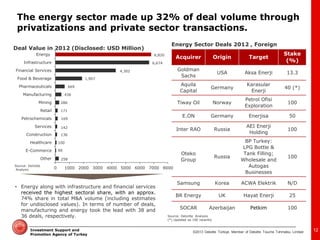
•Energy along with infrastructure and financial services received the highest sectoral share, with an approx. 74% share in total M&A volume (including estimates for undisclosed values). In terms of number of deals, manufacturing and energy took the lead with 38 and 36 deals, respectively. 
Source: Deloitte Analysis 
Energy Sector Deals 2012 , Foreign 
Acquirer 
Origin 
Target 
Stake (%) 
Goldman Sachs 
USA 
Aksa Enerji 
13.3 
Aquila Capital 
Germany 
Karasular Enerji 
40 (*) 
Tiway Oil 
Norway 
Petrol Ofisi Exploration 
100 
E.ON 
Germany 
Enerjisa 
50 
Inter RAO 
Russia 
AEI Enerji Holding 
100 
Oteko Group 
Russia 
BP Turkey: LPG Bottle & Tank Filling; Wholesale and Autogas Businesses 
100 
Samsung 
Korea 
ACWA Elektrik 
N/D 
BR Energy 
UK 
Hayat Enerji 
25 
SOCAR 
Azerbaijan 
Petkim 
100 
Source: Deloitte Analysis 
(*) Updated as 100 recently 
12 
The energy sector made up 32% of deal volume through privatizations and private sector transactions.
©2013 Deloitte Türkiye. Member of Deloitte Touche Tohmatsu Limited 
Investment Support and Promotion Agency of Turkey 
13 
Macro Outlook 
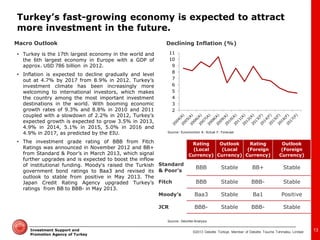
•Turkey is the 17th largest economy in the world and the 6th largest economy in Europe with a GDP of approx. USD 786 billion in 2012. 
•Inflation is expected to decline gradually and level out at 4.7% by 2017 from 8.9% in 2012. Turkey’s investment climate has been increasingly more welcoming to international investors, which makes the country among the most important investment destinations in the world. With booming economic growth rates of 9.3% and 8.8% in 2010 and 2011 coupled with a slowdown of 2.2% in 2012, Turkey’s expected growth is expected to grow 3.5% in 2013, 4.9% in 2014, 5.1% in 2015, 5.0% in 2016 and 4.9% in 2017, as predicted by the EIU. 
•The investment grade rating of BBB from Fitch Ratings was announced in November 2012 and BB+ from Standard & Poor’s in March 2013, which signal further upgrades and is expected to boost the inflow of institutional funding. Moody's raised the Turkish government bond ratings to Baa3 and revised its outlook to stable from positive in May 2013. The Japan Credit Rating Agency upgraded Turkey’s ratings from BB to BBB- in May 2013. 
Rating (Local Currency) 
Outlook (Local Currency) 
Rating (Foreign Currency) 
Outlook (Foreign Currency) 
Standard & Poor’s 
BBB 
Stable 
BB+ 
Stable 
Fitch 
BBB 
Stable 
BBB- 
Stable 
Moody’s 
Baa3 
Stable 
Ba1 
Positive 
JCR 
BBB- 
Stable 
BBB- 
Stable 
Declining Inflation (%) 
Source: Euromonitor A: Actual F: Forecast 
2 
3 
4 
5 
6 
7 
8 
9 
10 
11 
Source: Deloitte Analysis 
Turkey’s fast-growing economy is expected to attract more investment in the future.
©2013 Deloitte Türkiye. Member of Deloitte Touche Tohmatsu Limited 
Investment Support and Promotion Agency of Turkey 
0 
10 
20 
30 
40 
50 
60 
2012 
2013 
2014 
2015 
2016 
2017 
2018 
2019 
2020 
Natural Gas 
0 
50 
100 
150 
200 
250 
300 
350 
400 
450 
500 
2012 
2013 
2014 
2015 
2016 
2017 
2018 
2019 
2020 
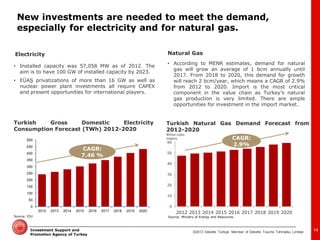
•Installed capacity was 57,058 MW as of 2012. The aim is to have 100 GW of installed capacity by 2023. 
•EÜAŞ privatizations of more than 16 GW as well as nuclear power plant investments all require CAPEX and present opportunities for international players. 
•According to MENR estimates, demand for natural gas will grow an average of 1 bcm annually until 2017. From 2018 to 2020, this demand for growth will reach 2 bcm/year, which means a CAGR of 2.9% from 2012 to 2020. Import is the most critical component in the value chain as Turkey’s natural gas production is very limited. There are ample opportunities for investment in the import market. 
Turkish Natural Gas Demand Forecast from 2012-2020 
Electricity 
Source: EIU 
Source: Ministry of Energy and Resources 
Turkish Gross Domestic Electricity Consumption Forecast (TWh) 2012-2020 
CAGR: 2.9% 
Billion cubic meters 
CAGR: 7.46 % 
14 
New investments are needed to meet the demand, especially for electricity and for natural gas.
©2013 Deloitte Türkiye. Member of Deloitte Touche Tohmatsu Limited 
Investment Support and Promotion Agency of Turkey 
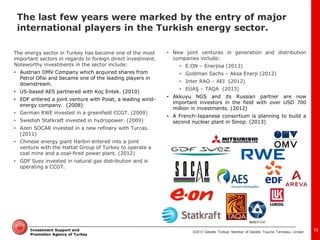
The energy sector in Turkey has become one of the most important sectors in regards to foreign direct investment. Noteworthy investments in the sector include: 
•Austrian OMV Company which acquired shares from Petrol Ofisi and became one of the leading players in downstream. 
•US-based AES partnered with Koç Entek. (2010) 
•EDF entered a joint venture with Polat, a leading wind- energy company. (2008) 
•German RWE invested in a greenfield CCGT. (2009) 
•Swedish Statkraft invested in hydropower. (2009) 
•Azeri SOCAR invested in a new refinery with Turcas. (2011) 
•Chinese energy giant Harbin entered into a joint venture with the Hattat Group of Turkey to operate a coal mine and a coal-fired power plant. (2012) 
•GDF Suez invested in natural gas distribution and is operating a CCGT. 
•New joint ventures in generation and distribution companies include: 
•E.ON – Enerjisa (2013) 
•Goldman Sachs – Aksa Enerji (2012) 
•Inter RAO – AEI (2012) 
•EÜAŞ – TAQA (2013) 
•Akkuyu NGS and its Russian partner are now important investors in the field with over USD 700 million in investments. (2012) 
•A French-Japanese consortium is planning to build a second nuclear plant in Sinop. (2013) 
15 
The last few years were marked by the entry of major international players in the Turkish energy sector.
©2013 Deloitte Türkiye. Member of Deloitte Touche Tohmatsu Limited 
Investment Support and Promotion Agency of Turkey 
Skilled Labor 
2,233 
930 
1,303 
0 
500 
1000 
1500 
2000 
2500 
Total 
Vocational School 
University 
Energy-Specific Departments in 2012 
Source: ÖSYM 
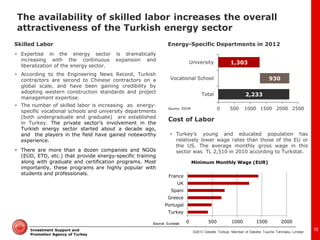
•Expertise in the energy sector is dramatically increasing with the continuous expansion and liberalization of the energy sector. 
•According to the Engineering News Record, Turkish contractors are second to Chinese contractors on a global scale, and have been gaining credibility by adopting western construction standards and project management expertise. 
•The number of skilled labor is increasing as energy- specific vocational schools and university departments (both undergraduate and graduate) are established in Turkey. The private sector’s involvement in the Turkish energy sector started about a decade ago, and the players in the field have gained noteworthy experience. 
•There are more than a dozen companies and NGOs (EÜD, ETD, etc.) that provide energy-specific training along with graduate and certification programs. Most importantly, these programs are highly popular with students and professionals. 
•Turkey’s young and educated population has relatively lower wage rates than those of the EU or the US. The average monthly gross wage in this sector was TL 2,510 in 2010 according to Turkstat. 
Cost of Labor 
0 
500 
1000 
1500 
2000 
Turkey 
Portugal 
Greece 
Spain 
UK 
France 
Minimum Monthly Wage (EUR) 
Source: Eurostat 
The availability of skilled labor increases the overall attractiveness of the Turkish energy sector 
16
©2013 Deloitte Türkiye. Member of Deloitte Touche Tohmatsu Limited 
Investment Support and Promotion Agency of Turkey 
0 
5 
10 
15 
20 
25 
2006(A) 
2007(A) 
2008(A) 
2009(A) 
2010(A) 
2011(A) 
2012(A) 
CBRT O/N Interest Rates Lending Rate 
CBRT O/N Interest Rates Borrowing Rate 
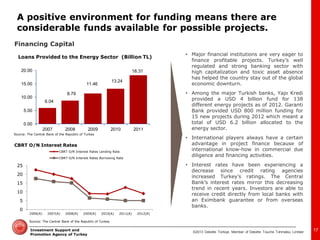
•Major financial institutions are very eager to finance profitable projects. Turkey’s well regulated and strong banking sector with high capitalization and toxic asset absence has helped the country stay out of the global economic downturn. 
•Among the major Turkish banks, Yapı Kredi provided a USD 4 billion fund for 138 different energy projects as of 2012. Garanti Bank provided USD 800 million funding for 15 new projects during 2012 which meant a total of USD 6.2 billion allocated to the energy sector. 
•International players always have a certain advantage in project finance because of international know-how in commercial due diligence and financing activities. 
•Interest rates have been experiencing a decrease since credit rating agencies increased Turkey’s ratings. The Central Bank’s interest rates mirror this decreasing trend in recent years. Investors are able to receive credit directly from local banks with an Eximbank guarantee or from overseas banks. 
Financing Capital 
6.04 
8.79 
11.46 
13.24 
18.31 
0.00 
5.00 
10.00 
15.00 
20.00 
2007 
2008 
2009 
2010 
2011 
Source: The Central Bank of the Republic of Turkey 
Loans Provided to the Energy Sector (Billion TL) 
Source: The Central Bank of the Republic of Turkey 
CBRT O/N Interest Rates 
17 
A positive environment for funding means there are considerable funds available for possible projects.
©2013 Deloitte Türkiye. Member of Deloitte Touche Tohmatsu Limited 
Investment Support and Promotion Agency of Turkey 
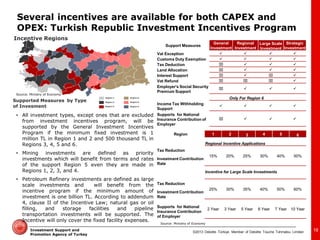
•All investment types, except ones that are excluded from investment incentives program, will be supported by the General Investment Incentives Program if the minimum fixed investment is 1 million TL in Region 1 and 2 and 500 thousand TL in Regions 3, 4, 5 and 6. 
•Mining investments are defined as priority investments which will benefit from terms and rates of the support Region 5 even they are made in Regions 1, 2, 3, and 4. 
•Petroleum Refinery investments are defined as large scale investments and will benefit from the incentive program if the minimum amount of investment is one billion TL. According to addendum 4, clause II of the Incentive Law; natural gas or oil filling, and storage facilities and pipeline transportation investments will be supported. The Incentive will only cover the fixed facility expenses. 
Incentive Regions 
Supported Measures by Type of Invesment 
Region 
1 
2 
3 
4 
5 
6 
Regional Incentive Applications 
Tax Reduction 
15% 
20% 
25% 
30% 
40% 
50% 
Investment Contribution Rate 
Incentive for Large Scale Investments 
Tax Reduction 
25% 
30% 
35% 
40% 
50% 
60% 
Investment Contribution Rate 
Supports for National Insurance Contribution of Employer 
2 Year 
3 Year 
5 Year 
6 Year 
7 Year 
10 Year 
Support Measures 
General Investment 
Regional Investment 
Large Scale Investment 
Strategic Investment 
Vat Exception 
 
 
 
 
Customs Duty Exemption 
 
 
 
 
Tax Deduction 
x 
 
 
 
Land Allocation 
x 
 
 
 
Interest Support 
x 
 
x 
 
Vat Refund 
x 
x 
x 
 
Employer's Social Security Premium Support 
x 
 
 
 
Only For Region 6 
Income Tax Withholding Support 
 
 
 
 
Supports for National Insurance Contribution of Employer 
x 
 
 
 
18 
Source: Ministry of Economy 
Several incentives are available for both CAPEX and OPEX: Turkish Republic Investment Incentives Program
©2013 Deloitte Türkiye. Member of Deloitte Touche Tohmatsu Limited 
Investment Support and Promotion Agency of Turkey 
Source: Ministry of Economy 
Number of Incentive Documents (Indicative of Number of Incentive Applications) 
Amount of Incentives Provided (Billion TL) 
137 
112 
162 
212 
197 
0 
50 
100 
150 
200 
250 
2008 
2009 
2010 
2011 
2012 
11 
10 
9 
16 
13 
0 
5 
10 
15 
20 
2008 
2009 
2010 
2011 
2012 
Source: Ministry of Economy 
Further advantages can be achieved in Free Zones & Organized Industrial Zones 
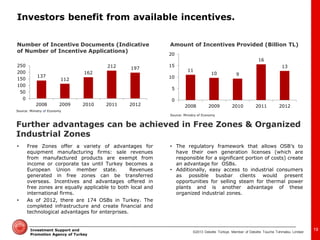
•Free Zones offer a variety of advantages for equipment manufacturing firms: sale revenues from manufactured products are exempt from income or corporate tax until Turkey becomes a European Union member state. Revenues generated in free zones can be transferred overseas. Incentives and advantages offered in free zones are equally applicable to both local and international firms. 
•As of 2012, there are 174 OSBs in Turkey. The completed infrastructure and create financial and technological advantages for enterprises. 
•The regulatory framework that allows OSB’s to have their own generation licenses (which are responsible for a significant portion of costs) create an advantage for OSBs. 
•Additionally, easy access to industrial consumers as possible busbar clients would present opportunities for selling steam for thermal power plants and is another advantage of these organized industrial zones. 
Investors benefit from available incentives. 
19
©2013 Deloitte Türkiye. Member of Deloitte Touche Tohmatsu Limited 
Investment Support and Promotion Agency of Turkey 
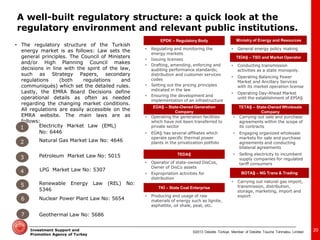
•The regulatory structure of the Turkish energy market is as follows: Law sets the general principles. The Council of Ministers and/or High Planning Council makes decisions in line with the spirit of the law, such as Strategy Papers, secondary regulations (both regulations and communiqués) which set the detailed rules. Lastly, the EMRA Board Decisions define operational details as often as needed regarding the changing market conditions. All regulations are easily accessible on the EMRA website. The main laws are as follows: 
1 
Electricity Market Law (EML) No: 6446 
2 
Natural Gas Market Law No: 4646 
3 
Petroleum Market Law No: 5015 
4 
LPG Market Law No: 5307 
5 
Renewable Energy Law (REL) No: 5346 
6 
Nuclear Power Plant Law No: 5654 
7 
Geothermal Law No: 5686 
20 
TEİAŞ – TSO and Market Operator 
•Conducting transmission activities as a state monopoly. 
•Operating Balancing Power Market and Ancillary Services with its market operation license 
•Operating Day-Ahead Market until the establishment of EPİAŞ 
EÜAŞ – State-Owned Generation Company 
•Operating the generation facilities which have not been transferred to private sector 
•EÜAŞ has several affiliates which operate specific thermal power plants in the privatization potfolio 
EPDK – Regulatory Body 
•Regulating and monitoring the energy markets 
•Issuing licenses 
•Drafting, amending, enforcing and auditing performance standards; distribution and customer services codes 
•Setting out the pricing principles indicated in the law 
•Ensuring the development and implementation of an infrastructure 
Ministry of Energy and Resources 
•General energy policy making 
TETAŞ – State-Owned Wholesale Company 
•Carrying out sale and purchase agreements within the scope of its contracts 
•Engaging organized wholesale markets for sale and purchase agreements and conducting bilateral agreements 
•Selling electricity to incumbent supply companies for regulated tariff consumers 
BOTAŞ – NG Trans & Trading 
•Carrying out natural gas import, transmission, distribution, storage, marketing, import and export 
TKİ – State Coal Enterprise 
•Producing and usage of raw materials of energy such as lignite, asphaltite, oil shale, peat, etc. 
TEDAŞ 
•Operator of state-owned DisCos, Owner of DisCo assets 
•Expropriation activities for distribution 
A well-built regulatory structure: a quick look at the regulatory environment and relevant public institutions.
©2013 Deloitte Türkiye. Member of Deloitte Touche Tohmatsu Limited 
Investment Support and Promotion Agency of Turkey 
A growing economy that drives energy consumption and thus, demand 
Strong political focus on liberalization and for establishing a competitive and transparent market 
Competitive incentive packages 
Availability of skilled human resources at cost- competitive rates 
Availability of various trading opportunities (especially for electricity) 
Location as a natural bridge between consuming west and generating east 
High potential to tap all the components of the value chain, in all segments 
Strong political focus on promoting investments 
Transparent market rules and structure with well functioning government agencies 
Availability of interconnections with neighboring countries 
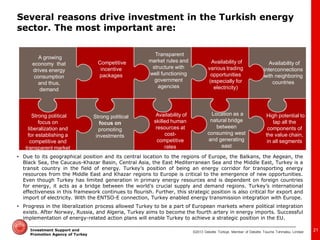
•Due to its geographical position and its central location to the regions of Europe, the Balkans, the Aegean, the Black Sea, the Caucaus-Khazar Basin, Central Asia, the East Mediterranean Sea and the Middle East, Turkey is a transit country in the field of energy. Turkey’s position of being an energy corridor for transporting energy resources from the Middle East and Khazar regions to Europe is critical to the emergence of new opportunities. Even though Turkey has limited generation in primary energy resources and is dependent on foreign countries for energy, it acts as a bridge between the world’s crucial supply and demand regions. Turkey’s international effectiveness in this framework continues to flourish. Further, this strategic position is also critical for export and import of electricity. With the ENTSO-E connection, Turkey enabled energy transmission integration with Europe. 
•Progress in the liberalization process allowed Turkey to be a part of European markets where political integration exists. After Norway, Russia, and Algeria, Turkey aims to become the fourth artery in energy imports. Successful implementation of energy-related action plans will enable Turkey to achieve a strategic position in the EU. 
21 
Several reasons drive investment in the Turkish energy sector. The most important are:
Investment Support and Promotion Agency of Turkey 
C. Sub-Sectors 
i. Electricity 
ii. Petroleum 
iii. Natural Gas & LNG 
iv. Coal
©2013 Deloitte Türkiye. Member of Deloitte Touche Tohmatsu Limited 
Investment Support and Promotion Agency of Turkey 
Growth in Electricity Demand in Turkey 
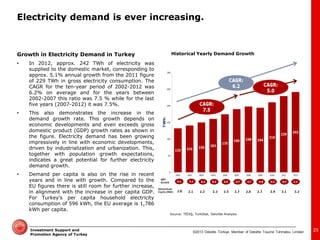
•In 2012, approx. 242 TWh of electricity was supplied to the domestic market, corresponding to approx. 5.1% annual growth from the 2011 figure of 229 TWh in gross electricity consumption. The CAGR for the ten-year period of 2002-2012 was 6.2% on average and for the years between 2002-2007 this ratio was 7.5 % while for the last five years (2007-2012) it was 7.5%. 
•This also demonstrates the increase in the demand growth rate. This growth depends on economic developments and even exceeds gross domestic product (GDP) growth rates as shown in the figure. Electricity demand has been growing impressively in line with economic developments, driven by industrialization and urbanization. This, together with population growth expectations, indicates a great potential for further electricity demand growth. 
•Demand per capita is also on the rise in recent years and in line with growth. Compared to the EU figures there is still room for further increase, in alignment with the increase in per capita GDP. For Turkey’s per capita household electricity consumption of 596 kWh, the EU average is 1,786 kWh per capita. 
Source: TEİAŞ, TurkStat, Deloitte Analysis 
Historical Yearly Demand Growth 
23 
Electricity demand is ever increasing.
©2013 Deloitte Türkiye. Member of Deloitte Touche Tohmatsu Limited 
Investment Support and 
Promotion Agency of Turkey 
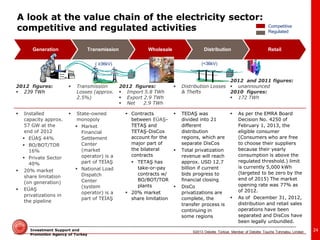
2012 figures: 
 239 TWh 
 Transmission 
Losses (approx. 
2.5%) 
2012 figures: 
 Import 5.8 TWh 
 Export 2.9 TWh 
 Net 2.9 TWh 
 Distribution Losses 
& Thefts 
2012 and 2011 figures: 
 unannounced 
2010 figures: 
 172 TWh 
 Installed 
capacity approx. 
57 GW at the 
end of 2012 
 EÜAŞ 44% 
 BO/BOT/TOR 
16% 
 Private Sector 
40% 
 20% market 
share limitation 
(on generation) 
 EÜAŞ 
privatizations in 
the pipeline 
 State-owned 
monopoly 
 Market 
Financial 
Settlement 
Center 
(market 
operator) is a 
part of TEİAŞ 
 National Load 
Dispatch 
Center 
(system 
operator) is a 
part of TEİAŞ 
 Contracts 
between EÜAŞ- 
TETAŞ and 
TETAŞ-DisCos 
account for the 
major part of 
the bilateral 
contracts 
 TETAŞ has 
take-or-pay 
contracts w/ 
BO/BOT/TOR 
plants 
 20% market 
share limitation 
 TEDAŞ was 
divided into 21 
different 
distribution 
regions, which are 
separate DisCos 
 Total privatization 
revenue will reach 
approx. USD 12.7 
billion if current 
bids progress to 
financial closing 
 DisCo 
privatizations are 
complete, the 
transfer process is 
continuing in 
some regions 
 As per the EMRA Board 
Decision No. 4250 of 
February 1, 2013, the 
eligible consumer 
(Consumers who are free 
to choose their suppliers 
because their yearly 
consumption is above the 
regulated threshold.) limit 
is currently 5,000 kWh 
(targeted to be zero by the 
end of 2015) The market 
opening rate was 77% as 
of 2012. 
 As of December 31, 2012, 
distribution and retail sales 
operations have been 
separated and DisCos have 
been legally unbundled. 
Generation Transmission Wholesale Distribution Retail 
( ≥36kV) 
(<36kV) 
Competitive 
Regulated 
24 
A look at the value chain of the electricity sector: 
competitive and regulated activities
©2013 Deloitte Türkiye. Member of Deloitte Touche Tohmatsu Limited 
Investment Support and Promotion Agency of Turkey 
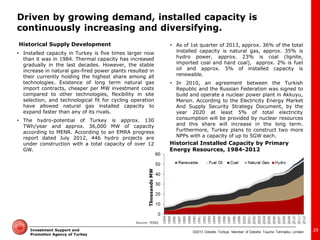
Historical Supply Development 
•Installed capacity in Turkey is five times larger now than it was in 1984. Thermal capacity has increased gradually in the last decades. However, the stable increase in natural gas-fired power plants resulted in their currently holding the highest share among all technologies. Existence of long term natural gas import contracts, cheaper per MW investment costs compared to other technologies, flexibility in site selection, and technological fit for cycling operation have allowed natural gas installed capacity to expand faster than any of its rivals. 
•The hydro-potential of Turkey is approx. 130 TWh/year and approx. 36,000 MW of capacity according to MENR. According to an EMRA progress report dated July 2012, 446 hydro projects are under construction with a total capacity of over 12 GW. 
•As of 1st quarter of 2013, approx. 36% of the total installed capacity is natural gas, approx. 35% is hydro power, approx. 23% is coal (lignite, imported coal and hard coal), approx. 2% is fuel oil and approx. 5% of installed capacity is renewable. 
•In 2010, an agreement between the Turkish Republic and the Russian Federation was signed to build and operate a nuclear power plant in Akkuyu, Mersin. According to the Electricity Energy Market And Supply Security Strategy Document, by the year 2020 at least 5% of total electricity consumption will be provided by nuclear resources and this share will increase in the long term. Furthermore, Turkey plans to construct two more NPPs with a capacity of up to 5GW each. 
25 
Historical Installed Capacity by Primary Energy Resources, 1984-2012 
Driven by growing demand, installed capacity is continuously increasing and diversifying.
©2013 Deloitte Türkiye. Member of Deloitte Touche Tohmatsu Limited 
Investment Support and Promotion Agency of Turkey 
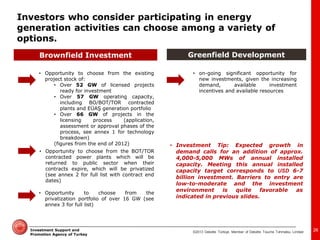
Greenfield Development 
Brownfield Investment 
•on-going significant opportunity for new investments, given the increasing demand, available investment incentives and available resources 
•Opportunity to choose from the existing project stock of: 
•Over 52 GW of licensed projects ready for investment 
•Over 57 GW operating capacity, including BO/BOT/TOR contracted plants and EÜAŞ generation portfolio 
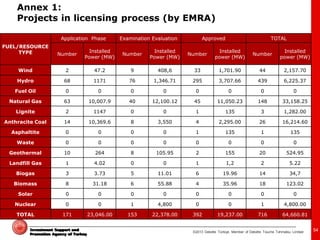
•Over 66 GW of projects in the licensing process (application, assessment or approval phases of the process, see annex 1 for technology breakdown) (figures from the end of 2012) 
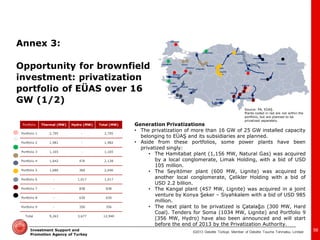
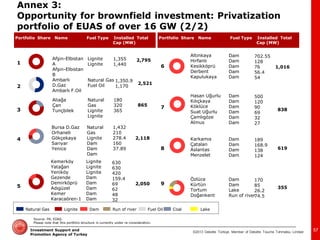
•Opportunity to choose from the privatization portfolio of over 16 GW (see annex 3 for full list) 
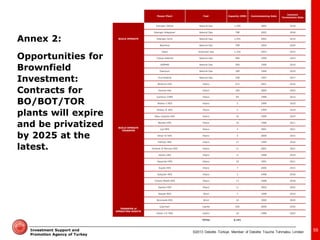
•Opportunity to choose from the BOT/TOR contracted power plants which will be returned to public sector when their contracts expire, which will be privatized (see annex 2 for full list with contract end dates) 
•Investment Tip: Expected growth in demand calls for an addition of approx. 4,000-5,000 MWs of annual installed capacity. Meeting this annual installed capacity target corresponds to USD 6-7 billion investment. Barriers to entry are low-to-moderate and the investment environment is quite favorable as indicated in previous slides. 
26 
Investors who consider participating in energy generation activities can choose among a variety of options.
©2013 Deloitte Türkiye. Member of Deloitte Touche Tohmatsu Limited 
Investment Support and Promotion Agency of Turkey 
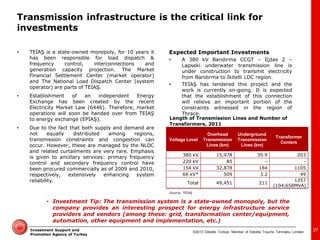
•TEİAŞ is a state-owned monopoly, for 10 years it has been responsible for load dispatch & frequency control, interconnections and generation capacity projection. The Market Financial Settlement Center (market operator) and The National Load Dispatch Center (system operator) are parts of TEİAŞ. 
•Establishment of an independent Energy Exchange has been created by the recent Electricity Market Law (6446). Therefore, market operations will soon be handed over from TEİAŞ to energy exchange (EPİAŞ). 
•Due to the fact that both supply and demand are not equally distributed among regions, transmission constraints and congestion can occur. However, these are managed by the NLDC and related curtailments are very rare. Emphasis is given to ancillary services: primary frequency control and secondary frequency control have been procured commercially as of 2009 and 2010, respectively, extensively enhancing system reliability. 
Expected Important Investments 
•A 380 kV Bandırma CCGT – İçdas 2 – Lapseki underwater transmission line is under construction to transmit electricity from Bandırma to İkitelli LDC region. 
•TEİAŞ has tendered this project and the work is currently on-going. It is expected that the establishment of this connection will relieve an important portion of the constraints witnessed in the region of Thrace. 
Source: TEİAŞ 
Voltage Level 
Overhead Transmission Lines (km) 
Underground Transmission Lines (km) 
Transformer Centers 
380 kV 
15,978 
35.9 
203 
220 kV 
85 
- 
- 
154 kV 
32,878 
184 
1105 
66 kV* 
509 
3.2 
49 
Total 
49,451 
211 
1357 (104,658MVA) 
Length of Transmission Lines and Number of 
Transformers, 2011 
27 
•Investment Tip: The transmission system is a state-owned monopoly, but the company provides an interesting prospect for energy infrastructure service providers and vendors (among these: grid, transformation center/equipment, automation, other equipment and implementation, etc.) 
Transmission infrastructure is the critical link for investments
©2013 Deloitte Türkiye. Member of Deloitte Touche Tohmatsu Limited 
Investment Support and Promotion Agency of Turkey 
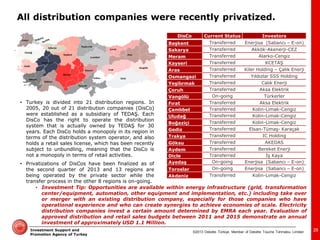
•Turkey is divided into 21 distribution regions. In 2005, 20 out of 21 distribution companies (DisCo) were established as a subsidiary of TEDAŞ. Each DisCo has the right to operate the distribution system that is actually owned by TEDAŞ for 30 years. Each DisCo holds a monopoly in its region in terms of the distribution system operator, and also holds a retail sales license, which has been recently subject to unbundling, meaning that the DisCo is not a monopoly in terms of retail activities. 
•Privatizations of DisCos have been finalized as of the second quarter of 2013 and 13 regions are being operated by the private sector while the transfer process in the other 8 regions is on-going. 
28 
•Investment Tip: Opportunities are available within energy infrastructure (grid, transformation center/equipment, automation, other equipment and implementation, etc.) including take over or merger with an existing distribution company, especially for those companies who have operational experience and who can create synergies to achieve economies of scale. Electricity distribution companies invest a certain amount determined by EMRA each year. Evaluation of approved distribution and retail sales budgets between 2011 and 2015 demonstrate an annual investment of approximately USD 1.1 Million. 
DisCo 
Current Status 
Investors 
Başkent 
Transferred 
Enerjisa (Sabancı – E-on) 
Sakarya 
Transferred 
Akkök-Akenerji-CEZ 
Meram 
Transferred 
Alarko-Cengiz 
Kayseri 
Transferred 
KCETAŞ 
Aras 
Transferred 
Kiler Holding – Çalık Enerji 
Osmangazi 
Transferred 
Yıldızlar SSS Holding 
Yeşilırmak 
Transferred 
Calık Enerji 
Çoruh 
Transferred 
Aksa Elektrik 
Vangölü 
On-going 
Türkerler 
Fırat 
Transferred 
Aksa Elektrik 
Çamlıbel 
Transferred 
Kolin-Limak-Cengiz 
Uludağ 
Transferred 
Kolin-Limak-Cengiz 
Boğaziçi 
Transferred 
Kolin-Limak-Cengiz 
Gediz 
Transferred 
Elsan-Tümaş- Karaçak 
Trakya 
Transferred 
IC Holding 
Göksu 
Transferred 
AKEDAS 
Aydem 
Transferred 
Bereket Enerji 
Dicle 
Transferred 
İş Kaya 
Ayedaş 
On-going 
Enerjisa (Sabancı – E-on) 
Toroslar 
On-going 
Enerjisa (Sabancı – E-on) 
Akdeniz 
Transferred 
Kolin-Limak-Cengiz 
All distribution companies were recently privatized.
©2013 Deloitte Türkiye. Member of Deloitte Touche Tohmatsu Limited 
Investment Support and Promotion Agency of Turkey 
5 
15 
19 
23 
26 
27 
40 
75 
141 
160 
161* 
9000 
7800 
7800 
6000 
3000 
1200 
480 
100 
30 
25 
5 
0 
1000 
2000 
3000 
4000 
5000 
6000 
7000 
8000 
9000 
10000 
0 
20 
40 
60 
80 
100 
120 
140 
2003 
2004 
2005 
2006 
2007 
2008 
2009 
2010 
2011 
2012 
2013 
Eligibility Threshold 
MWh/year 
Number of Private Wholesale Licensees 
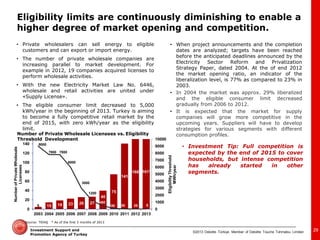
•Private wholesalers can sell energy to eligible customers and can export or import energy. 
•The number of private wholesale companies are increasing parallel to market development. For example in 2012, 19 companies acquired licenses to perform wholesale activities. 
•With the new Electricity Market Law No. 6446, wholesale and retail activities are united under «Supply License». 
•The eligible consumer limit decreased to 5,000 kWh/year in the beginning of 2013. Turkey is aiming to become a fully competitive retail market by the end of 2015, with zero kWh/year as the eligibility limit. 
•When project announcements and the completion dates are analyzed; targets have been reached before the anticipated deadlines announced by the Electricity Sector Reform and Privatization Strategy Paper, dated 2004. At the of end 2012 the market opening ratio, an indicator of the liberalization level, is 77% as compared to 23% in 2003. 
•In 2004 the market was approx. 29% liberalized and the eligible consumer limit decreased gradually from 2006 to 2012. 
•It is expected that the market for supply companies will grow more competitive in the upcoming years. Suppliers will have to develop strategies for various segments with different consumption profiles. 
Source: TEİAŞ * As of the first 3 months of 2013 
Number of Private Wholesale Licensees vs. Eligibility Threshold Development 
29 
•Investment Tip: Full competition is expected by the end of 2015 to cover households, but intense competition has already started in other segments. 
Eligibility limits are continuously diminishing to enable a higher degree of market opening and competition.
©2013 Deloitte Türkiye. Member of Deloitte Touche Tohmatsu Limited 
Investment Support and Promotion Agency of Turkey 
30 
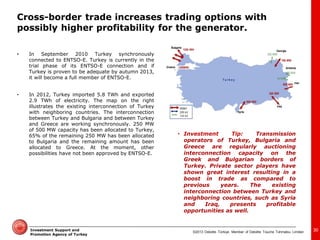
•In September 2010 Turkey synchronously connected to ENTSO-E. Turkey is currently in the trial phase of its ENTSO-E connection and if Turkey is proven to be adequate by autumn 2013, it will become a full member of ENTSO-E. 
•In 2012, Turkey imported 5.8 TWh and exported 2.9 TWh of electricity. The map on the right illustrates the existing interconnection of Turkey with neighboring countries. The interconnection between Turkey and Bulgaria and between Turkey and Greece are working synchronously. 250 MW of 500 MW capacity has been allocated to Turkey, 65% of the remaining 250 MW has been allocated to Bulgaria and the remaining amount has been allocated to Greece. At the moment, other possibilities have not been approved by ENTSO-E. 
•Investment Tip: Transmission operators of Turkey, Bulgaria and Greece are regularly auctioning interconnection capacity on the Greek and Bulgarian borders of Turkey. Private sector players have shown great interest resulting in a boost in trade as compared to previous years. The existing interconnection between Turkey and neighboring countries, such as Syria and Iraq, presents profitable opportunities as well. 
Cross-border trade increases trading options with possibly higher profitability for the generator.
©2013 Deloitte Türkiye. Member of Deloitte Touche Tohmatsu Limited 
Investment Support and Promotion Agency of Turkey 
* Companies with installed capacity over 600 MWh and/or having a distribution region 
31 
Some Major Players
Investment Support and Promotion Agency of Turkey 
C. Sub-Sectors 
i. Electricity 
ii. Petroleum 
iii. Natural Gas & LNG 
iv. Coal
©2013 Deloitte Türkiye. Member of Deloitte Touche Tohmatsu Limited 
Investment Support and Promotion Agency of Turkey 
•Oil consumption in 2012 was approx. 31.5 million tons and is expected to increase in upcoming years. Given the very limited amount of oil production, which was 2.3 million tons (less than 0.8% of total demand) in Turkey in 2012, this demand is being met by imported oil to a great extent. Difference between supply and demand demonstrates potential growth and this difference is expected to decrease. 
•It is expected that demand for oil will grow in alignment with GDP Growth at a rate somewhere between 2%-3%. 
26 
28 
30 
32 
34 
36 
38 
Source: BP Statistical Review (Actual), EIU (Forecast) A: Actual F: Forecast 
Oil Consumption Million Tons 
33 
-10 
-8 
-6 
-4 
-2 
0 
2 
4 
6 
8 
10 
2000 
2001 
2002 
2003 
2004 
2005 
2006 
2007 
2008 
2009 
2010 
2011 
2012f 
2013f 
2014f 
2015f 
2016f 
2017f 
GDP Growth Rate (a) 
Gross Domestic Petroleum Products Consumption % Change (b) 
Trendline (a) 
Trendline (b) 
Source: EIU 
Turkey has limited oil production so it relies on imported oil to meet demand.
©2013 Deloitte Türkiye. Member of Deloitte Touche Tohmatsu Limited 
Investment Support and Promotion Agency of Turkey 
•Currently, the Turkish Petroleum Company (TPAO) is a major player in the oil exploration process. The liberalization of the petroleum sector is continuing. In line with liberalization, the Petroleum Market Law has just been accepted in the Parliament which introduces several incentives for oil exploration as well as for distribution and retail. The new law is expected to liberalize especially upstream by limiting the dominant market position of the Turkish Petroleum Co. Exploration activities are currently taking place in the regions of Southeastern Anatolia, the Black Sea and the Mediterranean. Exploration is led by the Turkish Petroleum Co. and joint ventures with international companies. 
•Oil exploration in the seas has been underway in Turkey for over 50 years. These activities have accelerated even further by business partnerships under the leadership of TPAO. 
34 
•Investment Tip: Even though Turkey has limited reserves compared to its neighbors, there are many planned and also on-going exploration activities that will allow Turkey to utilize its reserves more effectively. This potential will be evaluated through the business models of global energy companies and national oil companies. 
•The limit in the number of licenses per region has been diminished by the new law in order to increase private sector investments in the sector. There has been global interest by experienced international exploration firms. These firms are expected to sign contracts for new joint projects with firms in Turkey that also have experience in exploration. In line with economic stabilization, opportunities exist for international investors. 
•SE Anatolia is ranked number one with respect to oil production wells and has 92% of the shares. Most of the exploration activities in the Southeastern Anatolia region is carried out in the city of Diyarbakır. 
Petroleum exploration activities are limited, though promising.
©2013 Deloitte Türkiye. Member of Deloitte Touche Tohmatsu Limited 
Investment Support and Promotion Agency of Turkey 
Protection of existing and potential investors is ensured with the new Petroleum Market Law. 
•The objective of this Law regulates and allows for guidance, surveillance and supervision in order to ensure the transparent, non-discriminatory and stable performance of market activities pertaining to the delivery of petroleum supplied from domestic and foreign resources to consumers, directly or after processing, in a reliable, cost-effective manner within a competitive environment. 
•18 petroleum regions that are recognized by the former law will be simplified by being divided into land and sea. 
•License durations are arranged as 5+2+2 years on land and 8+3+3 years on sea. The applicant has to give 2% of the investment amount of the business model that he or she proposes in the license application or petition to extend the timetable. This ratio shall be 1% on the sea. It is obligatory to have a sound business plan for obtaining a license with the New Turkish Petroleum Act. These new regulations are meant to protect existing and potential investors in the sector. 
•The stimulus concerning drilling activities will be designed by the cabinet. The sum of taxes that rightful owners of the petroleum have to pay over their net profit and of the income tax deduction they make on behalf of the stakeholders cannot exceed 55%. An inflation accountancy system will be brought in when the new law makes it easier to transfer capital and profit. Offshore investors can transfer their net profits to offshore accounts every three months. 
•According to the old system concerning tax, the rightful owners of the petroleum have the right to choose whether they want to bookkeep exploration expenses, drilling expenses and the expenses of covering/uncovering oil wells that are not economically feasible. The title holders can either activate or write off these expenses as direct operating expenses. 
Purpose & Major Changes
©2013 Deloitte Türkiye. Member of Deloitte Touche Tohmatsu Limited 
Investment Support and Promotion Agency of Turkey 
36 
•Turkey mainly imports from Iran and Russia for raw refinery materials. TÜPRAŞ, the market leader in the refinery business currently has four different refineries in Izmit, Izmir, Kırıkkale and Batman. The refineries in Izmit and Izmir are the largest according to generation capacity. A private investment, SOCAR Star Refinery, will produce diesel, jet fuel, LPG and petroleum products. The refinery is expected to be commissioned in 2017. 
•The aggregated capacity utilization ratio of the refineries increased from 74.7% in 2011 to 78.7 % in 2012, which indicates the importance of refinery capacity in the coming years. 
City 
Status 
STAR Refinery 
İzmir 
Under Construction 
Doğu Akdeniz Petrochemicals and Refinery 
Adana 
Under Construction 
TÜPRAŞ 
Batman 
Active 
TÜPRAŞ 
Kırıkkale 
Active 
TÜPRAŞ 
İzmir 
Active 
TÜPRAŞ 
Kocaeli 
Active 
TÜPRAŞ Refinery Production – 2012 (Thousand Tons) 
LPG 
783 
Gasoline & Naphtha 
4,826 
Jet fuel/Kerosene 
3,329 
Gasoil 
388 
Diesel 
5,173 
Fuel Oil 
3,477 
Bitumen 
2,810 
Lubricating Oil 
266 
Other 
815 
Total 
21,867 
Source: TÜPRAŞ 
•Investment Tip: Given that 60% of the total oil demand is refined in Turkey and that demand is growing, there is ample room for refinery investments, although the market entry barriers are highin light of the very high CAPEX requirements. A similar situation applies for opportunities in importing finished petroleum products. 
60% of the total oil demand is imported as crude oil and refined in Turkey.
©2013 Deloitte Türkiye. Member of Deloitte Touche Tohmatsu Limited 
Investment Support and Promotion Agency of Turkey 
•EMRA, as the regulatory authority, has been actively involved in creating precautions to ensure a competitive and fair oil sector, e.g. taking important action in order to mitigate oil theft and increase oil quality. The Competition Authority has also taken action in order to increase competition in the distribution and retail sector of the oil and gas industry. 
•Distribution activity is licensed by EMRA. With 58 licensees at the end of 2012, the distribution market is highly fragmented dominated by 5 top players, namely BP, Shell, Opet, Total and OMW-POAS. According to EMRA at the end of 2012, the top 10 companies made 83% of the total distributed volume. 
•In the Turkish market, the 3 main products of the players in the field are LPG, diesel and gasoline; diesel being the most consumed product with the increase of diesel vehicles and the regulation that were applied in 2011. With this regulation, diesel fuel is standardized according to EU criteria. Currently, diesel fuel is subsidized and is preferred by the consumers due to its price advantage over gasoline. As the number of diesel fuel passenger cars increase, the demand for diesel fuel increases as well and more investment is expected in this field. 
37 
Total Vehicles (Million) 
Population (Million) 
Source:: EGM, TUİK, PETDER Report 2011, EPDK and EIU 
64 
66 
68 
70 
72 
74 
76 
6 
8 
10 
12 
14 
16 
18 
Total Vehicle 
Population 
Total Vehicles (Million) 
Total Vehicle Fuel Consumption 
(Million Ton) 
7 
9 
11 
13 
15 
17 
19 
7 
9 
11 
13 
15 
17 
19 
Total Vehicle 
Total Vehicle Fuel Consumption 
•Investment Tip: According to EMRA, approx. 86% of oil is used in transportation. The total number of vehicles has steadily increased since 2000 along with population growth. Expansion in domestic production and the discount of the special consumption tax also affected the growth in number of vehicles. Parallel to the vehicle increase, fuel consumption has also significantly increased in recent years. 
Source:: EGM, TUİK, PETDER Report 2011, EPDK and EIU 
Petroleum distribution and their retail components experience intense competition.
©2013 Deloitte Türkiye. Member of Deloitte Touche Tohmatsu Limited 
Investment Support and Promotion Agency of Turkey 
38 
Source::PETDER 
AKPET + LUKOIL 
Market Share: 3.3% 
ALPET Market Share: 2.5% 
AYTEMİZ Market Share: 1.9% 
BALPET 
Market Share: 1.5% 
KADOIL 
Market Share: 1.5% 
M OIL 
Market Share: 2.2% 
OPET Market Share:18.4% 
BP 
Market Share: 9.1% 
POAŞ 
Market Share: 26.5% 
TOTAL Market Share: 5.4% 
TURKUAZ Market Share: 1.2% 
Shell & Turcas 
Market Share: 17.2% 
Major Players
Investment Support and Promotion Agency of Turkey 
C. Sub-Sectors 
i. Electricity 
ii. Petroleum 
iii. Natural Gas & LNG 
iv. Coal
©2013 Deloitte Türkiye. Member of Deloitte Touche Tohmatsu Limited 
Investment Support and Promotion Agency of Turkey 
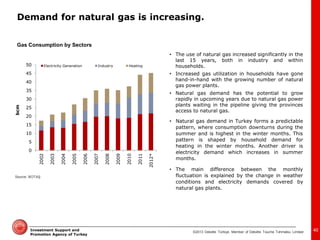
Gas Consumption by Sectors 
•The use of natural gas increased significantly in the last 15 years, both in industry and within households. 
•Increased gas utilization in households have gone hand-in-hand with the growing number of natural gas power plants. 
•Natural gas demand has the potential to grow rapidly in upcoming years due to natural gas power plants waiting in the pipeline giving the provinces access to natural gas. 
•Natural gas demand in Turkey forms a predictable pattern, where consumption downturns during the summer and is highest in the winter months. This pattern is shaped by household demand for heating in the winter months. Another driver is electricity demand which increases in summer months. 
•The main difference between the monthly fluctuation is explained by the change in weather conditions and electricity demands covered by natural gas plants. 
Source: BOTAŞ 
0 
5 
10 
15 
20 
25 
30 
35 
40 
45 
50 
2002 
2003 
2004 
2005 
2006 
2007 
2008 
2009 
2010 
2011 
2012* 
bcm 
Electricity Generation 
Industry 
Heating 
40 
Demand for natural gas is increasing.
©2013 Deloitte Türkiye. Member of Deloitte Touche Tohmatsu Limited 
Investment Support and Promotion Agency of Turkey 
Local Production 
Private Sector Wholesale Companies 
BOTAŞ – Balancing & Own Use Gas 
NG Distribution Companies 
Eligible Customers 
Exploration & Production, Import 
Transmission 
Wholesale 
Distribution & Retail 
Storage 
BOTAŞ – Trade 
Private Sector NG Import Companies 
Private Sector LNG Import Companies 
Storage Companies 
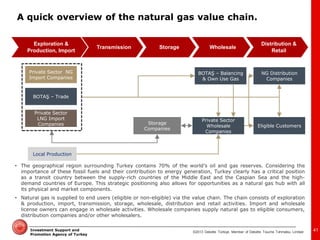
•The geographical region surrounding Turkey contains 70% of the world’s oil and gas reserves. Considering the importance of these fossil fuels and their contribution to energy generation, Turkey clearly has a critical position as a transit country between the supply-rich countries of the Middle East and the Caspian Sea and the high- demand countries of Europe. This strategic positioning also allows for opportunities as a natural gas hub with all its physical and market components. 
•Natural gas is supplied to end users (eligible or non-eligible) via the value chain. The chain consists of exploration & production, import, transmission, storage, wholesale, distribution and retail activities. Import and wholesale license owners can engage in wholesale activities. Wholesale companies supply natural gas to eligible consumers, distribution companies and/or other wholesalers. 
41 
A quick overview of the natural gas value chain.
©2013 Deloitte Türkiye. Member of Deloitte Touche Tohmatsu Limited 
Investment Support and Promotion Agency of Turkey 
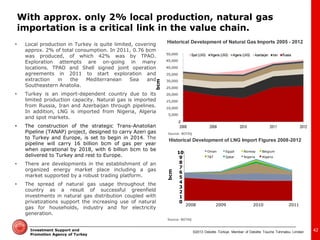
Historical Development of Natural Gas Imports 2005 - 2012 
•Local production in Turkey is quite limited, covering approx. 2% of total consumption. In 2011, 0.76 bcm was produced, of which 42% was by TPAO. Exploration attempts are on-going in many locations. TPAO and Shell signed joint operation agreements in 2011 to start exploration and extraction in the Mediterranean Sea and Southeastern Anatolia. 
•Turkey is an import-dependent country due to its limited production capacity. Natural gas is imported from Russia, Iran and Azerbaijan through pipelines. In addition, LNG is imported from Nigeria, Algeria and spot markets. 
•The construction of the strategic Trans-Anatolian Pipeline (TANAP) project, designed to carry Azeri gas to Turkey and Europe, is set to begin in 2014. The pipeline will carry 16 billion bcm of gas per year when operational by 2018, with 6 billion bcm to be delivered to Turkey and rest to Europe. 
•There are developments in the establishment of an organized energy market place including a gas market supported by a robust trading platform. 
•The spread of natural gas usage throughout the country as a result of successful greenfield investments in natural gas distribution coupled with privatizations support the increasing use of natural gas for households, industry and for electricity generation. 
Source: BOTAŞ 
42 
0 
1 
2 
3 
4 
5 
6 
7 
8 
9 
10 
2008 
2009 
2010 
2011 
bcm 
Oman 
Egypt 
Norway 
Belgium 
T&T 
Qatar 
Nigeria 
Algeria 
Historical Development of LNG Import Figures 2008-2012 
Source: BOTAŞ 
bcm 
With approx. only 2% local production, natural gas importation is a critical link in the value chain.
©2013 Deloitte Türkiye. Member of Deloitte Touche Tohmatsu Limited 
Investment Support and Promotion Agency of Turkey 
43 
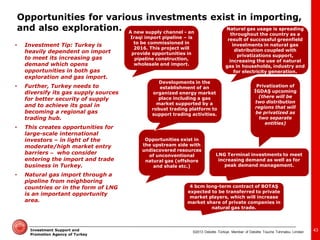
•Investment Tip: Turkey is heavily dependent on import to meet its increasing gas demand which opens opportunities in both gas exploration and gas import. 
•Further, Turkey needs to diversify its gas supply sources for better security of supply and to achieve its goal in becoming a regional gas trading hub. 
•This creates opportunities for large-scale international investors – in light of the moderate/high market entry barriers – who consider entering the import and trade business in Turkey. 
•Natural gas import through a pipeline from neighboring countries or in the form of LNG is an important opportunity area. 
Opportunities exist in the upstream side with undiscovered resources of unconventional natural gas (offshore and shale etc.) 
A new supply channel - an Iraqi import pipeline – is to be commissioned in 2016. This project will provide opportunities in pipeline construction, wholesale and import. 
4 bcm long-term contract of BOTAŞ expected to be transferred to private market players, which will increase market share of private companies in natural gas trade. 
Privatization of İGDAŞ upcoming (there will be two distribution regions that will be privatized as two separate entities) 
Natural gas usage is spreading throughout the country as a result of successful greenfield investments in natural gas distribution coupled with privatizations support, increasing the use of natural gas in households, industry and for electricity generation. 
Developments in the establishment of an organized energy market place including a gas market supported by a robust trading platform to support trading activities. 
LNG Terminal investments to meet increasing demand as well as for peak demand management. 
Opportunities for various investments exist in importing, and also exploration.
©2013 Deloitte Türkiye. Member of Deloitte Touche Tohmatsu Limited 
Investment Support and Promotion Agency of Turkey 
BOTAŞ Natural Gas Transmission System 
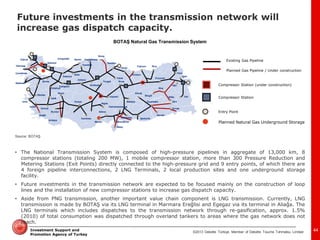
•The National Transmission System is composed of high-pressure pipelines in aggregate of 13,000 km, 8 compressor stations (totaling 200 MW), 1 mobile compressor station, more than 300 Pressure Reduction and Metering Stations (Exit Points) directly connected to the high-pressure grid and 9 entry points, of which there are 4 foreign pipeline interconnections, 2 LNG Terminals, 2 local production sites and one underground storage facility. 
•Future investments in the transmission network are expected to be focused mainly on the construction of loop lines and the installation of new compressor stations to increase gas dispatch capacity. 
•Aside from PNG transmission, another important value chain component is LNG transmission. Currently, LNG transmission is made by BOTAŞ via its LNG terminal in Marmara Ereğlisi and Egegaz via its terminal in Aliağa. The LNG terminals which includes dispatches to the transmission network through re-gasification, approx. 1.5% (2010) of total consumption was dispatched through overland tankers to areas where the gas network does not reach. 
Source: BOTAŞ 
Compressor Station (under construction) 
Compressor Station 
Entry Point 
Existing Gas Pipeline 
Planned Gas Pipeline / Under construction 
Planned Natural Gas Underground Storage 
44 
Future investments in the transmission network will increase gas dispatch capacity.
©2013 Deloitte Türkiye. Member of Deloitte Touche Tohmatsu Limited 
Investment Support and Promotion Agency of Turkey 
0% 
20% 
40% 
60% 
80% 
- 
5 
10 
15 
20 
25 
30 
35 
bcm 
Natural Gas Storage Capacity 
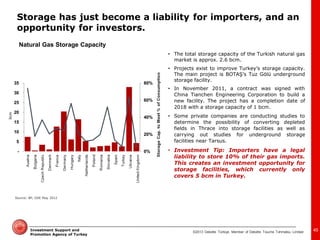
•The total storage capacity of the Turkish natural gas market is approx. 2.6 bcm. 
•Projects exist to improve Turkey’s storage capacity. The main project is BOTAŞ’s Tuz Gölü underground storage facility. 
•In November 2011, a contract was signed with China Tianchen Engineering Corporation to build a new facility. The project has a completion date of 2018 with a storage capacity of 1 bcm. 
•Some private companies are conducting studies to determine the possibility of converting depleted fields in Thrace into storage facilities as well as carrying out studies for underground storage facilities near Tarsus. 
•Investment Tip: Importers have a legal liability to store 10% of their gas imports. This creates an investment opportunity for storage facilities, which currently only covers 5 bcm in Turkey. 
Source: BP, GSE May 2012 
45 
Storage has just become a liability for importers, and an opportunity for investors.
©2013 Deloitte Türkiye. Member of Deloitte Touche Tohmatsu Limited 
Investment Support and Promotion Agency of Turkey 
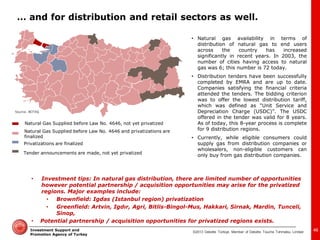
•Natural gas availability in terms of distribution of natural gas to end users across the country has increased significantly in recent years. In 2003, the number of cities having access to natural gas was 6; this number is 72 today. 
•Distribution tenders have been successfully completed by EMRA and are up to date. Companies satisfying the financial criteria attended the tenders. The bidding criterion was to offer the lowest distribution tariff, which was defined as “Unit Service and Depreciation Charge (USDC)”. The USDC offered in the tender was valid for 8 years. As of today, this 8-year process is complete for 9 distribution regions. 
•Currently, while eligible consumers could supply gas from distribution companies or wholesalers, non-eligible customers can only buy from gas distribution companies. 
Source: BOTAŞ 
Natural Gas Supplied before Law No. 4646, not yet privatized 
Privatizations are finalized 
Tender announcements are made, not yet privatized 
Natural Gas Supplied before Law No. 4646 and privatizations are finalized 
46 
•Investment tips: In natural gas distribution, there are limited number of opportunities however potential partnership / acquisition opportunities may arise for the privatized regions. Major examples include: 
•Brownfield: Igdas (Istanbul region) privatization 
•Greenfield: Artvin, Igdır, Agri, Bitlis-Bingol-Mus, Hakkari, Sirnak, Mardin, Tunceli, Sinop, 
•Potential partnership / acquisition opportunities for privatized regions exists. 
… and for distribution and retail sectors as well.
©2013 Deloitte Türkiye. Member of Deloitte Touche Tohmatsu Limited 
Investment Support and Promotion Agency of Turkey 
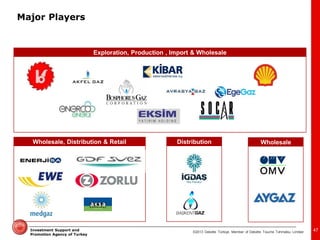
Exploration, Production , Import & Wholesale 
Wholesale, Distribution & Retail 
Distribution 
Wholesale 
47 
Major Players
Investment Support and Promotion Agency of Turkey 
C. Sub-Sectors 
i. Electricity 
ii. Petroleum 
iii. Natural Gas & LNG 
iv. Coal
©2013 Deloitte Türkiye. Member of Deloitte Touche Tohmatsu Limited 
Investment Support and Promotion Agency of Turkey 
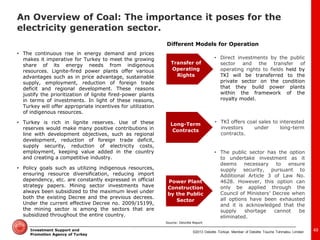
•The continuous rise in energy demand and prices makes it imperative for Turkey to meet the growing share of its energy needs from indigenous resources. Lignite-fired power plants offer various advantages such as in price advantage, sustainable supply, employment, reduction of foreign trade deficit and regional development. These reasons justify the prioritization of lignite fired-power plants in terms of investments. In light of these reasons, Turkey will offer appropriate incentives for utilization of indigenous resources. 
•Turkey is rich in lignite reserves. Use of these reserves would make many positive contributions in line with development objectives, such as regional development, reduction of foreign trade deficit, supply security, reduction of electricity costs, employment, keeping value added in the country and creating a competitive industry. 
•Policy goals such as utilizing indigenous resources, ensuring resource diversification, reducing import dependency, etc. are constantly expressed in official strategy papers. Mining sector investments have always been subsidized to the maximum level under both the existing Decree and the previous decrees. Under the current effective Decree no. 2009/15199, the mining sector is among the sectors that are subsidized throughout the entire country. 
Different Models for Operation 
Transfer of Operating Rights 
Long-Term Contracts 
Power Plant Construction by the Public Sector 
•Direct investments by the public sector and the transfer of operating rights to fields held by TKİ will be transferred to the private sector on the condition that they build power plants within the framework of the royalty model. 
•The public sector has the option to undertake investment as it deems necessary to ensure supply security, pursuant to Additional Article 3 of Law No. 4628. However, this option can only be applied through the Council of Ministers’ Decree when all options have been exhausted and it is acknowledged that the supply shortage cannot be eliminated. 
•TKİ offers coal sales to interested investors under long-term contracts. 
Source: Deloitte Report 
49 
An Overview of Coal: The importance it poses for the electricity generation sector.
©2013 Deloitte Türkiye. Member of Deloitte Touche Tohmatsu Limited 
Investment Support and Promotion Agency of Turkey 
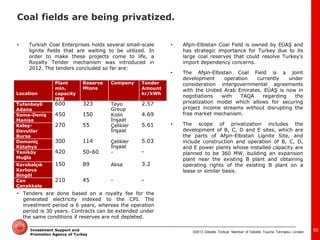
•Turkish Coal Enterprises holds several small-scale lignite fields that are waiting to be utilized. In order to make these projects come to life, a Royalty Tender mechanism was introduced in 2012. The tenders concluded so far are: 
Location 
Plant min. capacity MW 
Reserve Mtons 
Company 
Tender Amount kr/kWh 
Tufanbeyli Adana 
600 
323 
Teyo Group 
2.57 
Soma-Deniş Manisa 
450 
150 
Kolin İnşaat 
4.69 
Keleş- Davutlar Bursa 
270 
55 
Çelikler İnşaat 
5.61 
Domaniç Kütahya 
300 
114 
Çelikler İnşaat 
5.03 
Yeniköy Muğla 
420 
50-60 
- 
- 
Karabalçık Karlıova Bingöl 
150 
89 
Aksa 
3.2 
Can Çanakkale 
210 
45 
- 
- 
•Tenders are done based on a royalty fee for the generated electricity indexed to the CPI. The investment period is 6 years, whereas the operation period is 30 years. Contracts can be extended under the same conditions if reserves are not depleted. 
•Afşin-Elbistan Coal Field is owned by EÜAŞ and has strategic importance for Turkey due to its large coal reserves that could resolve Turkey’s import dependency concerns. 
•The Afşin-Elbistan Coal Field is a joint development operation currently under consideration intergovernmental agreements with the United Arab Emirates. EÜAŞ is now in negotiations with TAQA regarding the privatization model which allows for securing project income streams without disrupting the free market mechanism. 
•The scope of privatization includes the development of B, C, D and E sites, which are the parts of Afşin-Elbistan Lignite Site, and include construction and operation of B, C, D, and E power plants whose installed capacity are planned to be 360 MW, building an expansion plant near the existing B plant and obtaining operating rights of the existing B plant on a lease or similar basis. 
50 
Coal fields are being privatized.
©2013 Deloitte Türkiye. Member of Deloitte Touche Tohmatsu Limited 
Investment Support and Promotion Agency of Turkey 
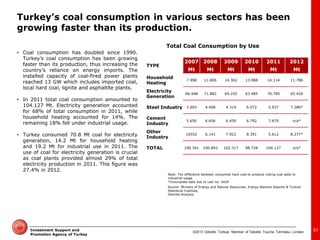
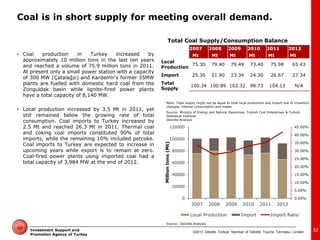
Total Coal Consumption by Use 
Source: Ministry of Energy and Natural Resources, Energy Balance Reports & Turkish Statistical Institute, Deloitte Analysis 
TYPE 
2007 
2008 
2009 
2010 
2011 
2012 
Mt 
Mt 
Mt 
Mt 
Mt 
Mt 
Household Heating 
7.998 
11.806 
14.362 
13.988 
14.114 
11.786 
Electricity Generation 
66.448 
71.882 
69.255 
63.485 
70.785 
65.420 
Steel Industry 
3.693 
4.408 
4.319 
6.072 
5.937 
7.286* 
Cement Industry 
5.650 
6.656 
6.459 
6.792 
7.679 
n/a* 
Other Industry 
16552 
6.141 
7.922 
8.391 
5.612 
8.277* 
TOTAL 
100.341 
100.893 
102.317 
98.728 
104.127 
n/a* 
Note: The difference between consumed hard coal to produce coking coal adds to industrial usage *Incomplete data due to Law no: 5429 
•Coal consumption has doubled since 1990. Turkey’s coal consumption has been growing faster than its production, thus increasing the country’s reliance on energy imports. The installed capacity of coal-fired power plants reached 13 GW which includes imported coal, local hard coal, lignite and asphaltite plants. 
•In 2011 total coal consumption amounted to 104.127 Mt. Electricity generation accounted for 68% of total consumption in 2011, while household heating accounted for 14%. The remaining 18% fell under industrial usage. 
•Turkey consumed 70.8 Mt coal for electricity generation, 14.2 Mt for household heating and 19.2 Mt for industrial use in 2011. The use of coal for electricity generation is crucial as coal plants provided almost 29% of total electricity production in 2011. This figure was 27.4% in 2012. 
51 
Turkey’s coal consumption in various sectors has been growing faster than its production.
©2013 Deloitte Türkiye. Member of Deloitte Touche Tohmatsu Limited 
Investment Support and Promotion Agency of Turkey 
•Coal production in Turkey increased by approximately 10 million tons in the last ten years and reached a volume of 75.9 million tons in 2011. At present only a small power station with a capacity of 300 MW (Çatalağzı) and Kardemir’s former 35MW plants are fuelled with domestic hard coal from the Zonguldak basin while lignite-fired power plants have a total capacity of 8,140 MW. 
•Local production increased by 3.5 Mt in 2011, yet still remained below the growing rate of total consumption. Coal imports to Turkey increased by 2.5 Mt and reached 26.3 Mt in 2011. Thermal coal and coking coal imports constituted 90% of total imports, while the remaining 10% included petcoke. Coal imports to Turkey are expected to increase in upcoming years while export is to remain at zero. Coal-fired power plants using imported coal had a total capacity of 3,984 MW at the end of 2012. 
Total Coal Supply/Consumption Balance 
Source: Ministry of Energy and Natural Resources, Turkish Coal Enterprises & Turkish Statistical Institute 
Deloitte Analysis 
0.00% 
5.00% 
10.00% 
15.00% 
20.00% 
25.00% 
30.00% 
35.00% 
40.00% 
45.00% 
0 
20000 
40000 
60000 
80000 
100000 
120000 
2007 
2008 
2009 
2010 
2011 
2012 
Local Production 
Import 
Import Ratio 
Million tons (Mt) 
Note: Total supply might not be equal to total local production and import due to inventory changes, internal consumption and losses 
2007 
2008 
2009 
2010 
2011 
2012 
Mt 
Mt 
Mt 
Mt 
Mt 
Mt 
Local Production 
75.30 
79.40 
79.49 
73.40 
75.98 
65.43 
Import 
25.30 
21.90 
23.34 
24.30 
26.67 
27.34 
Total Supply 
100.34 
100.89 
102.32 
98.73 
104.13 
N/A 
Source: Deloitte Analysis 
52 
Coal is in short supply for meeting overall demand.
©2013 Deloitte Türkiye. Member of Deloitte Touche Tohmatsu Limited 
Investment Support and Promotion Agency of Turkey 
•Turkey has around 11.7 billion tons of lignite reserves and 1.3 billion tons of hard coal reserves of which 9.8 billion tons and 0.5 billion tons respectively are in the proven category. 
•Major lignite producers are the state-owned General Directorate of Turkish Coal Enterprises (TKİ), which produced 33.4 Mt of lignite in 2011 and the state- owned Electricity Generation Co. Inc. (EÜAS), which produced 31.6 Mt of lignite in 2011. 
•The most prominent hard coal producer is the state- owned Turkish Hard Coal Enterprises (TTK) which operates five underground mines in the Zonguldak coal basin in the Black Sea region. TTK produced approximately 1.6 Mt of hard coal in 2011. 
•In 2011, local lignite and hard coal production totaled 76.9 million tons. Nearly 90% of total coal production was from state-owned enterprises in 2011. However, about 35% of coal production reported by the state enterprises was mined by private companies under subcontracts. 
Name of Enterprise 
2007 
Mt 
2008 
Mt 
2009 
Mt 
2010 
Mt 
2011 
Mt 
TKİ 
29.8 
35.9 
32.5 
29.8 
33.4 
EÜAŞ 
23.4 
31.9 
33.5 
32.1 
31.6 
TTK 
1.6 
1.59 
1.88 
1.71 
1.59 
Private Companies* 
20.5 
10.01 
11.61 
9.79 
9.39 
Total Local Production 
75.3 
79.4 
79.49 
73.4 
75.98 
Major Local Coal Supply by Enterprise 
Source: Turkish Coal Enterprises & Turkish Hard Coal Institute, 2011 Annual Report, Turkish Statistical Institute, Deloitte Analysis 
* Since public data for all private sector players is limited, the figures are formed from the difference between the announced values of total production and production of TKİ, EÜAŞ, TTK 
53 
Production is under the control of public institutions.
©2013 Deloitte Türkiye. Member of Deloitte Touche Tohmatsu Limited 
Investment Support and Promotion Agency of Turkey 
Investment Support and 
Promotion Agency of Turkey 
54 
FUEL/RESOURCE TYPE 
Application Phase 
Examination Evaluation 
Approved 
TOTAL 
Number 
Installed Power (MW) 
Number 
Installed Power (MW) 
Number 
Installed power (MW) 
Number 
Installed power (MW) 
Wind 
2 
47.2 
9 
408,6 
33 
1,701.90 
44 
2,157.70 
Hydro 
68 
1171 
76 
1,346.71 
295 
3,707.66 
439 
6,225.37 
Fuel Oil 
0 
0 
0 
0 
0 
0 
0 
0 
Natural Gas 
63 
10,007.9 
40 
12,100.12 
45 
11,050.23 
148 
33,158.25 
Lignite 
2 
1147 
0 
0 
1 
135 
3 
1,282.00 
Anthracite Coal 
14 
10,369.6 
8 
3,550 
4 
2,295.00 
26 
16,214.60 
Asphaltite 
0 
0 
0 
0 
1 
135 
1 
135 
Waste 
0 
0 
0 
0 
0 
0 
0 
0 
Geothermal 
10 
264 
8 
105.95 
2 
155 
20 
524.95 
Landfill Gas 
1 
4.02 
0 
0 
1 
1,2 
2 
5.22 
Biogas 
3 
3.73 
5 
11.01 
6 
19.96 
14 
34,7 
Biomass 
8 
31.18 
6 
55.88 
4 
35.96 
18 
123.02 
Solar 
0 
0 
0 
0 
0 
0 
0 
0 
Nuclear 
0 
0 
1 
4,800 
0 
0 
1 
4,800.00 
TOTAL 
171 
23,046.00 
153 
22,378.00 
392 
19,237.00 
716 
64,660.81 
Annex 1: Projects in licensing process (by EMRA)
©2013 Deloitte Türkiye. Member of Deloitte Touche Tohmatsu Limited 
Investment Support and Promotion Agency of Turkey 
Annex 2: 
Opportunities for Brownfield Investment: Contracts for BO/BOT/TOR plants will expire and be privatized by 2025 at the latest. 
55 
Power Plant 
Fuel 
Capacity (MW) 
Commissioning Date 
Contract Termination Date 
BUILD OPERATE 
Intergen Gebze 
Natural Gas 
1,595 
2002 
2018 
Intergen Adapazarı 
Natural Gas 
798 
2002 
2018 
Intergen Izmir 
Natural Gas 
1,591 
2003 
2019 
Baymina 
Natural Gas 
798 
2004 
2020 
Isken 
Imported Gas 
1,320 
2003 
2019 
BUILD OPERATE TRANSFER 
Trakya Elektrik 
Natural Gas 
499 
1999 
2019 
UNIMAR 
Natural Gas 
504 
1999 
2019 
Esenyurt 
Natural Gas 
189 
1999 
2019 
Ova Elektrik 
Natural Gas 
258 
1997 
2017 
Bireecik HES 
Hdyro 
672 
2001 
2016 
Yamula Hes 
Hdyro 
100 
2005 
2025 
Çamlıca-I HES 
Hdyro 
84 
1998 
2013 
Ahiköy-I HES 
Hdyro 
2 
1999 
2019 
Ahiköy-II HES 
Hdyro 
2 
1999 
2019 
Aksu-Çayköy HES 
Hdyro 
16 
1999 
2019 
Berdan HES 
Hdyro 
10 
1996 
2011 
Çal HES 
Hdyro 
3 
2001 
2021 
Dinar-II HES 
Hdyro 
3 
2000 
2015 
Fethiye HES 
Hdyro 
17 
1999 
2014 
Girlevik-II Mercan HES 
Hdyro 
11 
2001 
2021 
Gönen HES 
Hdyro 
11 
1998 
2019 
Hasanlar HES 
Hdyro 
10 
1991 
2011 
Suçatı HES 
Hdyro 
7 
2000 
2015 
Sütçüler HES 
Hdyro 
2 
1998 
2018 
Tohma-Medik HES 
Hdyro 
13 
1998 
2018 
Gaziler HES 
Hdyro 
11 
2002 
2022 
Alaçatı RES 
Wind 
7 
1998 
2019 
Bozcaada RES 
Wind 
10 
2000 
2020 
TRANSFER of OPERATING RIGHTS 
Çayırhan 
Lignite 
620 
2000 
2020 
Hazar I-II HES 
Hydro 
30 
1996 
2022 
TOTAL 
9,191
©2013 Deloitte Türkiye. Member of Deloitte Touche Tohmatsu Limited 
Investment Support and Promotion Agency of Turkey 
Annex 3: Opportunity for brownfield investment: privatization portfolio of EÜAS over 16 GW (1/2) 
Generation Privatizations 
•The privatization of more than 16 GW of 25 GW installed capacity belonging to EÜAŞ and its subsidiaries are planned. 
•Aside from these portfolios, some power plants have been privatized singly: 
•The Hamitabat plant (1,156 MW, Natural Gas) was acquired by a local conglomerate, Limak Holding, with a bid of USD 105 million. 
•The Seyitömer plant (600 MW, Lignite) was acquired by another local conglomerate, Çelikler Holding with a bid of USD 2.2 billion. 
•The Kangal plant (457 MW, Lignite) was acquired in a joint venture by Konya Şeker – Siyahkalem with a bid of USD 985 million. 
•The next plant to be privatized is Çatalağzı (300 MW, Hard Coal). Tenders for Soma (1034 MW, Lignite) and Portfolio 9 (356 MW, Hydro) have also been announced and will start before the end of 2013 by the Privatization Authority. 
Source: PA, EÜAŞ. 
Plants coded in red are not within the portfolio, but are planned to be privatized separately. 
Portfolio 
Thermal (MW) 
Hydro (MW) 
Total (MW) 
Portfolio 1 
2,795 
- 
2,795 
Portfolio 2 
1,981 
- 
1,982 
Portfolio 3 
1,165 
- 
1,165 
Portfolio 4 
1,642 
476 
2,128 
Portfolio 5 
1,680 
360 
2,040 
Portfolio 6 
- 
1,017 
1,017 
Portfolio 7 
- 
838 
838 
Portfolio 8 
- 
630 
630 
Portfolio 9 
- 
356 
356 
Total 
9,263 
3,677 
12,940 
56
©2013 Deloitte Türkiye. Member of Deloitte Touche Tohmatsu Limited 
Investment Support and Promotion Agency of Turkey 
Annex 3: Opportunity for brownfield investment: Privatization portfolio of EUAS of over 16 GW (2/2) 
Afşin-Elbistan A 
Afşin-Elbistan B 
Ambarlı D.Gaz 
Ambarlı F.Oil 
Aliağa 
Çan 
Tunçbilek 
Portfolio Share Name Fuel Type Installed Total Cap (MW) 
Lignite 
Lignite 
Natural Gas 
Fuel Oil 
1,355 
1,440 
1,350.9 
1,170 
Natural Gas 
Lignite 
Lignite 
180 
320 
365 
Bursa D.Gaz 
Orhaneli 
Gökçekaya 
Sarıyar 
Yenice 
Natural Gas 
Lignite 
Dam 
Dam 
Dam 
1,432 
210 
278.4 
160 
37.89 
Kemerköy 
Yatağan 
Yeniköy 
Gezende 
Demirköprü 
Adıgüzel 
Kemer 
Karacaören-1 
Lignite 
Lignite 
Lignite 
Dam 
Dam 
Dam 
Dam 
Dam 
630 
630 
420 
159.4 
69 
62 
48 
32 
Altınkaya 
Hirfanlı 
Kesikköprü 
Derbent 
Kapulukaya 
Dam 
Dam 
Dam 
Dam 
Dam 
702.55 
128 
76 
56.4 
54 
Hasan Uğurlu 
Kılıçkaya 
Köklüce 
Suat Uğurlu 
Çamlıgöze 
Almus 
Dam 
Dam 
Dam 
Dam 
Dam 
Dam 
500 
120 
90 
69 
32 
27 
1 
2 
3 
4 
5 
Karkamıs 
Çatalan 
Aslantas 
Menzelet 
Dam 
Dam 
Dam 
Dam 
189 
168.9 
138 
124 
Özlüce 
Kürtün 
Tortum 
Doğankent 
Dam 
Dam 
Lake 
Run of river 
170 
85 
26.2 
74.5 
6 
7 
8 
9 
Fuel Oil 
Natural Gas 
Lignite 
Dam 
Run of river 
Coal 
Lake 
2,795 
2,521 
865 
2,118 
2,050 
1,016 
838 
619 
355 
Source: PA, EÜAŞ. 
Please note that this portfolio structure is currently under re-consideration. 
57 
Portfolio Share Name Fuel Type Installed Total Cap (MW)
©2013 Deloitte Türkiye. Member of Deloitte Touche Tohmatsu Limited 
Investment Support and Promotion Agency of Turkey 
For comments on the report and additional information please contact: 
info@invest.gov.tr 
www.invest.gov.tr 
Head Office 
Address: Kavaklıdere Mahallesi Akay Caddesi No:5 Çankaya/ANKARA 06640 
Phone: (+90 312) 413 89 00 
Office 
Address: Dünya Ticaret Merkezi A1 Blok Kat:8 No:296 Yeşilköy/İSTANBUL 34149 
Phone: (+90 212) 468 69 00 
USA 
Öner AYAN 
ayan.oner@invest.gov.tr 
Olivia CURRAN 
curran.olivia@invest.gov.tr 
GERMANY 
Kemal KAFADAR 
kkafadar@invest.gov.tr 
Ole Von BEUST 
Rezzo SCHLAUCH 
Wolf Ruthart BORN 
CHINA 
Hui ZHAO 
zhao.hui@invest.gov.tr 
FRANCE 
Utku BAYRAMOĞLU 
bayramoglu.utku@invest.gov.tr 
Selçuk ÖNDER 
onder.selcuk@invest.gov.tr 
INDIA 
Sanjeev KATHPALIA 
kathpalia.sanjeev@invest.gov.tr 
Fariha ANSARİ 
ansari.fariha@invest.gov.tr 
UK 
Ahmet İPLİKÇİ 
iplikci.ahmet@invest.gov.tr 
Muhammed AKDAĞ 
akdag.muhammed@invest.gov.tr 
JAPAN 
Hitoshi SEKI 
seki.hitoshi@invest.gov.tr 
Saya ASHIBE 
ashibe.saya@invest.gov.tr 
CANADA 
Murat ÖZDEMİR 
ozdemir.murat@invest.gov.tr 
SAUDI ARABIA 
Mustafa GÖKSU 
goksu.mustafa@invest.gov.tr 
RUSSIA 
Eduard ZUBAIROV 
zubairov.eduard@invest.gov.tr 
SOUTH KOREA 
Veyis TOPRAK 
toprak.veyis@invest.gov.tr 
SPAIN 
Yasemen KORUKÇU 
korukcu.yasemen@invest.gov.tr 
ISPAT Worldwide

4 enerji-sektoru

  • 1.
    ©2013 Deloitte Türkiye.Member of Deloitte Touche Tohmatsu Limited Investment Support and Promotion Agency of Turkey The Energy Sector: A Quick Tour for the Investor November 2013
  • 2.
    ©2013 Deloitte Türkiye.Member of Deloitte Touche Tohmatsu Limited Investment Support and Promotion Agency of Turkey 1 Disclaimer Republic of Turkey Prime Ministry Investment Support and Promotion Agency (ISPAT) submits the information provided by third parties in good faith. ISPAT has no obligation to check and examine this information and takes no responsibility for any misstatement or false declaration. ISPAT does not guarantee the accuracy, currency, reliability, correctness or legality of any information provided by third parties. ISPAT accepts no responsibility for the content of any information, news or article in the document and cannot be considered as approving any opinion declared by third parties. ISPAT explicitly states that; it is not liable for any loss, negligence, tort or other damages caused by actions and agreements based on the information provided by third parties. Deloitte accepts no liability to any party who is shown or gains access to this document. The opinions expressed in this report are based on Deloitte Consulting’s judgment and analysis of key factors. However, the actual operation and results of the analyzed sector may differ from those projected herein. Deloitte does not warrant that actual results will be the same as the projected results. Neither Deloitte nor any individuals signing or associated with this report shall be required by reason of this report to give further consultation, to provide testimony or appear in court or other legal proceedings, unless specific arrangements thereof have been made. All opinions and estimates included in this report constitute our judgment as of this date and are subject to change without notice and may become outdated.
  • 3.
    ©2013 Deloitte Türkiye.Member of Deloitte Touche Tohmatsu Limited Investment Support and Promotion Agency of Turkey A. Executive Summary B. General Overview of the Energy Sector i. Overview of the Global Energy Sector ii. Investment Enablers of the Turkish Energy Market iii. Market Information C. A Closer Look at the Sub-sectors i. Electricity ii. Petroleum iii. Natural Gas & LNG iv. Coal D. Opportunities and Investment Areas Table of Contents 2
  • 4.
    ©2013 Deloitte Türkiye.Member of Deloitte Touche Tohmatsu Limited Investment Support and Promotion Agency of Turkey Glossary of Terms Acronym Definition BCM Billion Cubic Meters BO Build Operate BOT Build Operate Transfer BOTAŞ State-Owned Natural Gas and Petroleum Pipeline Corporation BRIC Brazil, Russia, India, China BSR Balancing and Settlement Regulation CAGR Compound Annual Growth Rate CCGT Combined Cycle Gas Turbine DisCo Distribution Company EIU Economist Intelligence Unit EML Electricity Market Law EMRA (EPDK) Energy Market Regulatory Authority ENTSO-E European Network of Transmission System Operators for Electricity Acronym Definition EPİAŞ Independent Energy Exchange (to be established) EU European Union EÜAŞ State-Owned Generation Company FDI Foreign Direct Investment GDP Gross Domestic Product GW Gigawatt GWh Gigawatt Hours HEPP Hydroelectric Power Plant IEA International Energy Association IPP Independent Power Producer LNG Liquified Natural Gas LPG Liquified Petroleum Gas M&A Mergers and Acquisitions 3
  • 5.
    ©2013 Deloitte Türkiye.Member of Deloitte Touche Tohmatsu Limited Investment Support and Promotion Agency of Turkey Glossary of Terms Acronym Definition MENR Ministry of Energy and Natural Resources MFSC Market Financial Settlement Center MTA General Directorate of Mineral Research and Exploration MVA Megavolt Ampere NG Natural Gas NGML National Gas Machinery Laboratory NGO Non-Governmental Organization OECD Organization for Economic Co-operation and Development OSB Organized Industrial Zones PMUM State-Owned Market Operator within TEİAŞ R&D Research and Development REL Renewable Energy Law TCE Ton Coal Equivalent Acronym Definition TEDAŞ State-Owned Distribution Company TEİAŞ State-Owned Transmission Company TETAŞ State-Owned Wholesale Company TKİ Turkish Coal Enterprises TOE Tons Oil Equivalent TOR Transfer of Operating Rights TPAO Turkish Petroleum Corporation TTK Turkish Hard Coal Authority TÜBİTAK Scientific and Technological Research Council of Turkey TÜİK Turkish Statistical Institute US$ United States Dollar USDC Unit Service and Depreciation Charge VAT Value Added Tax 4
  • 6.
    ©2013 Deloitte Türkiye.Member of Deloitte Touche Tohmatsu Limited Investment Support and Promotion Agency of Turkey Executive Summary •This report provides insights into the Turkish energy sector and aims to provide prospective investors with a view of the sector with high-level analyses of sub-sectors. •Turkey is the 17th largest economy in the world and the 6th largest in Europe with a GDP of approx. USD 786 billion in 2012. With an economic boom of 9.3% and 8.8% in 2010 and 2011 and a slow down to 2.2% in 2012, Turkey is expected to grow by 3.5% in 2013, 4.9% in 2014, 5.1% in 2015, 5.0% in 2016 and 4.9% in 2017. •As a fast-growing country, energy consumption in Turkey is on the rise. The Turkish electricity market is one of the fastest growing in the world, with approx. 9% annual growth on average, in 2010 and 2011. Natural gas demand is expected to increase with a CAGR of 2.9% until 2020 according to the Ministry of Energy and Resources. This growing demand calls for new investments. •With the on-going liberalization process, the Turkish energy sector is becoming more vibrant and competitive, attracting the attention of more investors for each component of the value chain in all the energy sub-sectors. •The investment climate of Turkey has increasingly become more welcoming to international investors, making the country among the most important investment destinations in the world. The energy sector alone has made 32% of the deal volume through privatizations and private sector transactions in 2012. •Several incentives are available for both CAPEX and OPEX. Moreover, a significant amount of funds are available for possible projects. Major Turkish financial institutions see the value within the energy sector and are eager to invest in profitable new projects. •The number of skilled labor is increasing as energy- specific vocational schools and university departments (both undergraduate and graduate) are being established in Turkey. The private sector’s involvement in the Turkish energy field started about a decade ago, and those in this market are all seasoned professionals with noteworthy experience. •Investment opportunities exist in almost all components of the value chain for electricity, natural gas, oil and coal. 5
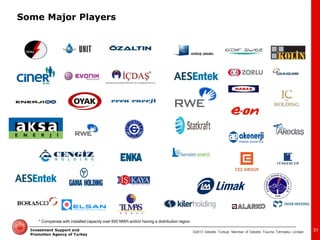
  • 7.
    Investment Support andPromotion Agency of Turkey B. General Overview i. Overview of the Global Energy Sector ii. Investment Enablers of the Turkish Energy Market iii. Market Information
  • 8.
    ©2013 Deloitte Türkiye.Member of Deloitte Touche Tohmatsu Limited Investment Support and Promotion Agency of Turkey 0 2,000 4,000 6,000 8,000 10,000 12,000 2011 2015 2020 2025 2030 The demand for energy is constantly growing, keeping secure supplies at the forefront of our global agenda. mTEP CAGR: 1.64% Source: BP Energy Outlook 2013 Global Energy Demand (2011-2030) Non-OECD OECD 7 •Population and GDP growth are the two main factors affecting energy demand. The demand on global energy dramatically increased 48% between 1990 and 2010. It is expected that global primary energy demand will increase at a CAGR of 1.64% until 2030, which will keep supply security on the agenda. •Growing demand - driven by population and industrial growth - in emerging markets calls for an increase in the supply capacity as well as diversity in the energy generation mix. Diversification of primary energy supplies reduces dependency on a single source and contributes to supply security. •Developing countries, including Turkey are expected to constitute 93% of the growth in demand. •Global energy consumption will continue to increase, with primary energy consumption having reached 12.4 million tons oil equivalent for an increase of 1.8% in 2012. •Global oil consumption was 4.1 million tons in 2012 with an increase of 0.9% with respect to the previous year. •World nuclear generation decreased in 2012: The change in 2012 compared with 2011 was -6.9%. The Fukushima nuclear accident triggered the decrease in nuclear energy generation. This situation also paved the way for renewables and natural gas. •According to IEA, shale gas caused a decline in gas prices, increasing the demand on natural gas and LNG.
  • 9.
    ©2013 Deloitte Türkiye.Member of Deloitte Touche Tohmatsu Limited Investment Support and Promotion Agency of Turkey •Over the past decade, demand in the Turkish electricity market has been growing in line with its economic developments, driven by industrialization and urbanization. This situation together with population growth expectations shows great potential for further growth. •Primary energy consumption between 2007 and 2012 increased at a CAGR of 2%. According to the Economist Intelligence Unit (EIU), energy demand in Turkey will increase at an annual rate of 4.5% until 2015 in alignment with the growth expected within the GDP. •The Turkish electricity market is one of the fastest growing in the world, with an average of approx. 9% annual growth in 2010 and 2011. •Similar to the electricity market, natural gas consumption in Turkey is growing as well. Natural gas consumption in Turkey reached approx. 46 bcm in 2012 demonstrating an increase of 4.7% compared to the previous year. Natural gas demand is expected to grow by 2.9% annually until 2020 according to the Ministry of Energy and Resources. •Distribution sales of gasoline, diesel oil and fuel oil products increased by 3.8%, which corresponds to 18.2 million tons in 2012. Crude oil imports increased by 7% and reached 19.5 million tons in 2012. •Turkey is still lagging behind the per capita energy consumption indicator in comparison with the OECD average, which shows that there is still more room for further growth, in alignment with increasing per capita GDP. As of 2012, Turkey is below the OECD average of 62.8 BTU per capita compared to 182 million BTU per capita OECD average. Source: TUİK, EPDK Note: 1998 current prices were used for GDP data. 8 Turkey’s booming economy keeps energy – and the demand for energy - at the top of our agenda. 0 500 1,000 1,500 - 20.0 40.0 60.0 80.0 100.0 120.0 140.0 2007 2008 2009 2010 2011 2012 Billions Primary Energy Consumption (Million TOE) Population (Million) GDP (Current Prices - Million TL)
  • 10.
    ©2013 Deloitte Türkiye.Member of Deloitte Touche Tohmatsu Limited Investment Support and Promotion Agency of Turkey Petroleum Production •Even though Turkey is limited in primary energy resources and is dependent on imported energy, it acts as a bridge between the world’s crucial supply and demand regions. •Having a position central to the regions of Europe, the Balkans, the Aegean, the Black Sea, the Caucasus-Caspian Basin and Central Asia, Turkey is a natural transit country for maritime and pipeline transportation of gas and oil. Gas Production Source: BP Statistical Review 2013 9 RUS •Turkey’s position is critical for the export and import of petroleum as it straddles the demand-rich west to supply-rich east. Source: BP Statistical Review 2013 Turkey is at the crossroads of consumption and production: a natural bridge.
  • 11.
    ©2013 Deloitte Türkiye.Member of Deloitte Touche Tohmatsu Limited Investment Support and Promotion Agency of Turkey •The energy sector in Turkey is exclusively marked by its journey toward liberalization, with the electricity sector holding a leading role. The liberalization of the Turkish electricity market is a rather long and ambitious story, starting in late 1980s and progressing rapidly in the last decade. The transition to a free market has been an obvious necessity with decision-makers well aware of this necessity: it became evident that the ever- increasing demand for electricity could not be met solely by public resources and the additional resources needed to meet this demand required extensive investments. •The liberalization process constantly increases the competitiveness of the market, while privatizations offer a variety of investment opportunities which also serve the purpose of increasing competitivity. Liberalization & Privatization 10 Turkish Electricity Market Reform Milestones Turkey’s journey to liberalization: from an entirely state- owned energy sector to an entirely competitive one.
  • 12.
    ©2013 Deloitte Türkiye.Member of Deloitte Touche Tohmatsu Limited Investment Support and Promotion Agency of Turkey 0 1000 2000 3000 4000 5000 2008 2009 2010 2011 2012 USD Million - Current Prices - Year-on-Year Exchange •Turkey has become an attractive destination for FDI. From the weak FDI inflows in 2002, Turkey has experienced a significant increase in recent years, reaching USD 22 billion in 2007. •Compared with FDI inflows of 2002, the significant addition of USD 11 billion was incurred in 2012. Source: Euromonitor A: Actual FDI Inflows to Turkey •The majority of FDI inflows to Turkey come from EU member countries, followed by North America and Asia. •Turkey had a peak in FDI inflows in 2007 and faced a decrease in inward FDIs in 2008 and 2009 due to the economic crisis. With promising macro-economic figures and underdeveloped potential, forecasts show FDI will steadily increase in upcoming years. •More than USD 2.3 billion of electricity generation investments were realized between 2004 and 2012. The countries that invested the most were the USA, Canada, Japan and various European countries. Source: YASED USD Million Total FDI Inflows for the Electricity and Gas Sector 11 Turkey is a sought-after FDI destination and is expected to further attract FDI inflow in the upcoming years. 0 5,000 10,000 15,000 20,000 25,000 2003 2004 2005 2006 2007 2008 2009 2010 2011 2012
  • 13.
    ©2013 Deloitte Türkiye.Member of Deloitte Touche Tohmatsu Limited Investment Support and Promotion Agency of Turkey 258 66 100 136 142 169 171 286 436 669 1,907 4,302 6,674 6,820 0 1000 2000 3000 4000 5000 6000 7000 8000 Other E-Commerce Healthcare Construction Services Petrochemicals Retail Mining Manufacturing Pharmaceuticals Food & Beverage Financial Services Infrastructure Energy Deal Value in 2012 (Disclosed: USD Million) •Energy along with infrastructure and financial services received the highest sectoral share, with an approx. 74% share in total M&A volume (including estimates for undisclosed values). In terms of number of deals, manufacturing and energy took the lead with 38 and 36 deals, respectively. Source: Deloitte Analysis Energy Sector Deals 2012 , Foreign Acquirer Origin Target Stake (%) Goldman Sachs USA Aksa Enerji 13.3 Aquila Capital Germany Karasular Enerji 40 (*) Tiway Oil Norway Petrol Ofisi Exploration 100 E.ON Germany Enerjisa 50 Inter RAO Russia AEI Enerji Holding 100 Oteko Group Russia BP Turkey: LPG Bottle & Tank Filling; Wholesale and Autogas Businesses 100 Samsung Korea ACWA Elektrik N/D BR Energy UK Hayat Enerji 25 SOCAR Azerbaijan Petkim 100 Source: Deloitte Analysis (*) Updated as 100 recently 12 The energy sector made up 32% of deal volume through privatizations and private sector transactions.
  • 14.
    ©2013 Deloitte Türkiye.Member of Deloitte Touche Tohmatsu Limited Investment Support and Promotion Agency of Turkey 13 Macro Outlook •Turkey is the 17th largest economy in the world and the 6th largest economy in Europe with a GDP of approx. USD 786 billion in 2012. •Inflation is expected to decline gradually and level out at 4.7% by 2017 from 8.9% in 2012. Turkey’s investment climate has been increasingly more welcoming to international investors, which makes the country among the most important investment destinations in the world. With booming economic growth rates of 9.3% and 8.8% in 2010 and 2011 coupled with a slowdown of 2.2% in 2012, Turkey’s expected growth is expected to grow 3.5% in 2013, 4.9% in 2014, 5.1% in 2015, 5.0% in 2016 and 4.9% in 2017, as predicted by the EIU. •The investment grade rating of BBB from Fitch Ratings was announced in November 2012 and BB+ from Standard & Poor’s in March 2013, which signal further upgrades and is expected to boost the inflow of institutional funding. Moody's raised the Turkish government bond ratings to Baa3 and revised its outlook to stable from positive in May 2013. The Japan Credit Rating Agency upgraded Turkey’s ratings from BB to BBB- in May 2013. Rating (Local Currency) Outlook (Local Currency) Rating (Foreign Currency) Outlook (Foreign Currency) Standard & Poor’s BBB Stable BB+ Stable Fitch BBB Stable BBB- Stable Moody’s Baa3 Stable Ba1 Positive JCR BBB- Stable BBB- Stable Declining Inflation (%) Source: Euromonitor A: Actual F: Forecast 2 3 4 5 6 7 8 9 10 11 Source: Deloitte Analysis Turkey’s fast-growing economy is expected to attract more investment in the future.
  • 15.
    ©2013 Deloitte Türkiye.Member of Deloitte Touche Tohmatsu Limited Investment Support and Promotion Agency of Turkey 0 10 20 30 40 50 60 2012 2013 2014 2015 2016 2017 2018 2019 2020 Natural Gas 0 50 100 150 200 250 300 350 400 450 500 2012 2013 2014 2015 2016 2017 2018 2019 2020 •Installed capacity was 57,058 MW as of 2012. The aim is to have 100 GW of installed capacity by 2023. •EÜAŞ privatizations of more than 16 GW as well as nuclear power plant investments all require CAPEX and present opportunities for international players. •According to MENR estimates, demand for natural gas will grow an average of 1 bcm annually until 2017. From 2018 to 2020, this demand for growth will reach 2 bcm/year, which means a CAGR of 2.9% from 2012 to 2020. Import is the most critical component in the value chain as Turkey’s natural gas production is very limited. There are ample opportunities for investment in the import market. Turkish Natural Gas Demand Forecast from 2012-2020 Electricity Source: EIU Source: Ministry of Energy and Resources Turkish Gross Domestic Electricity Consumption Forecast (TWh) 2012-2020 CAGR: 2.9% Billion cubic meters CAGR: 7.46 % 14 New investments are needed to meet the demand, especially for electricity and for natural gas.
  • 16.
    ©2013 Deloitte Türkiye.Member of Deloitte Touche Tohmatsu Limited Investment Support and Promotion Agency of Turkey The energy sector in Turkey has become one of the most important sectors in regards to foreign direct investment. Noteworthy investments in the sector include: •Austrian OMV Company which acquired shares from Petrol Ofisi and became one of the leading players in downstream. •US-based AES partnered with Koç Entek. (2010) •EDF entered a joint venture with Polat, a leading wind- energy company. (2008) •German RWE invested in a greenfield CCGT. (2009) •Swedish Statkraft invested in hydropower. (2009) •Azeri SOCAR invested in a new refinery with Turcas. (2011) •Chinese energy giant Harbin entered into a joint venture with the Hattat Group of Turkey to operate a coal mine and a coal-fired power plant. (2012) •GDF Suez invested in natural gas distribution and is operating a CCGT. •New joint ventures in generation and distribution companies include: •E.ON – Enerjisa (2013) •Goldman Sachs – Aksa Enerji (2012) •Inter RAO – AEI (2012) •EÜAŞ – TAQA (2013) •Akkuyu NGS and its Russian partner are now important investors in the field with over USD 700 million in investments. (2012) •A French-Japanese consortium is planning to build a second nuclear plant in Sinop. (2013) 15 The last few years were marked by the entry of major international players in the Turkish energy sector.
  • 17.
    ©2013 Deloitte Türkiye.Member of Deloitte Touche Tohmatsu Limited Investment Support and Promotion Agency of Turkey Skilled Labor 2,233 930 1,303 0 500 1000 1500 2000 2500 Total Vocational School University Energy-Specific Departments in 2012 Source: ÖSYM •Expertise in the energy sector is dramatically increasing with the continuous expansion and liberalization of the energy sector. •According to the Engineering News Record, Turkish contractors are second to Chinese contractors on a global scale, and have been gaining credibility by adopting western construction standards and project management expertise. •The number of skilled labor is increasing as energy- specific vocational schools and university departments (both undergraduate and graduate) are established in Turkey. The private sector’s involvement in the Turkish energy sector started about a decade ago, and the players in the field have gained noteworthy experience. •There are more than a dozen companies and NGOs (EÜD, ETD, etc.) that provide energy-specific training along with graduate and certification programs. Most importantly, these programs are highly popular with students and professionals. •Turkey’s young and educated population has relatively lower wage rates than those of the EU or the US. The average monthly gross wage in this sector was TL 2,510 in 2010 according to Turkstat. Cost of Labor 0 500 1000 1500 2000 Turkey Portugal Greece Spain UK France Minimum Monthly Wage (EUR) Source: Eurostat The availability of skilled labor increases the overall attractiveness of the Turkish energy sector 16
  • 18.
    ©2013 Deloitte Türkiye.Member of Deloitte Touche Tohmatsu Limited Investment Support and Promotion Agency of Turkey 0 5 10 15 20 25 2006(A) 2007(A) 2008(A) 2009(A) 2010(A) 2011(A) 2012(A) CBRT O/N Interest Rates Lending Rate CBRT O/N Interest Rates Borrowing Rate •Major financial institutions are very eager to finance profitable projects. Turkey’s well regulated and strong banking sector with high capitalization and toxic asset absence has helped the country stay out of the global economic downturn. •Among the major Turkish banks, Yapı Kredi provided a USD 4 billion fund for 138 different energy projects as of 2012. Garanti Bank provided USD 800 million funding for 15 new projects during 2012 which meant a total of USD 6.2 billion allocated to the energy sector. •International players always have a certain advantage in project finance because of international know-how in commercial due diligence and financing activities. •Interest rates have been experiencing a decrease since credit rating agencies increased Turkey’s ratings. The Central Bank’s interest rates mirror this decreasing trend in recent years. Investors are able to receive credit directly from local banks with an Eximbank guarantee or from overseas banks. Financing Capital 6.04 8.79 11.46 13.24 18.31 0.00 5.00 10.00 15.00 20.00 2007 2008 2009 2010 2011 Source: The Central Bank of the Republic of Turkey Loans Provided to the Energy Sector (Billion TL) Source: The Central Bank of the Republic of Turkey CBRT O/N Interest Rates 17 A positive environment for funding means there are considerable funds available for possible projects.
  • 19.
    ©2013 Deloitte Türkiye.Member of Deloitte Touche Tohmatsu Limited Investment Support and Promotion Agency of Turkey •All investment types, except ones that are excluded from investment incentives program, will be supported by the General Investment Incentives Program if the minimum fixed investment is 1 million TL in Region 1 and 2 and 500 thousand TL in Regions 3, 4, 5 and 6. •Mining investments are defined as priority investments which will benefit from terms and rates of the support Region 5 even they are made in Regions 1, 2, 3, and 4. •Petroleum Refinery investments are defined as large scale investments and will benefit from the incentive program if the minimum amount of investment is one billion TL. According to addendum 4, clause II of the Incentive Law; natural gas or oil filling, and storage facilities and pipeline transportation investments will be supported. The Incentive will only cover the fixed facility expenses. Incentive Regions Supported Measures by Type of Invesment Region 1 2 3 4 5 6 Regional Incentive Applications Tax Reduction 15% 20% 25% 30% 40% 50% Investment Contribution Rate Incentive for Large Scale Investments Tax Reduction 25% 30% 35% 40% 50% 60% Investment Contribution Rate Supports for National Insurance Contribution of Employer 2 Year 3 Year 5 Year 6 Year 7 Year 10 Year Support Measures General Investment Regional Investment Large Scale Investment Strategic Investment Vat Exception     Customs Duty Exemption     Tax Deduction x    Land Allocation x    Interest Support x  x  Vat Refund x x x  Employer's Social Security Premium Support x    Only For Region 6 Income Tax Withholding Support     Supports for National Insurance Contribution of Employer x    18 Source: Ministry of Economy Source: Ministry of Economy Several incentives are available for both CAPEX and OPEX: Turkish Republic Investment Incentives Program
  • 20.
    ©2013 Deloitte Türkiye.Member of Deloitte Touche Tohmatsu Limited Investment Support and Promotion Agency of Turkey Source: Ministry of Economy Number of Incentive Documents (Indicative of Number of Incentive Applications) Amount of Incentives Provided (Billion TL) 137 112 162 212 197 0 50 100 150 200 250 2008 2009 2010 2011 2012 11 10 9 16 13 0 5 10 15 20 2008 2009 2010 2011 2012 Source: Ministry of Economy Further advantages can be achieved in Free Zones & Organized Industrial Zones •Free Zones offer a variety of advantages for equipment manufacturing firms: sale revenues from manufactured products are exempt from income or corporate tax until Turkey becomes a European Union member state. Revenues generated in free zones can be transferred overseas. Incentives and advantages offered in free zones are equally applicable to both local and international firms. •As of 2012, there are 174 OSBs in Turkey. The completed infrastructure and create financial and technological advantages for enterprises. •The regulatory framework that allows OSB’s to have their own generation licenses (which are responsible for a significant portion of costs) create an advantage for OSBs. •Additionally, easy access to industrial consumers as possible busbar clients would present opportunities for selling steam for thermal power plants and is another advantage of these organized industrial zones. Investors benefit from available incentives. 19
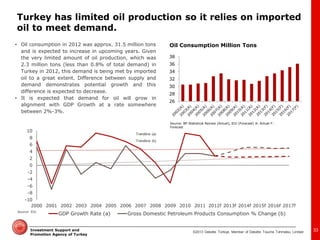
  • 21.
    ©2013 Deloitte Türkiye.Member of Deloitte Touche Tohmatsu Limited Investment Support and Promotion Agency of Turkey •The regulatory structure of the Turkish energy market is as follows: Law sets the general principles. The Council of Ministers and/or High Planning Council makes decisions in line with the spirit of the law, such as Strategy Papers, secondary regulations (both regulations and communiqués) which set the detailed rules. Lastly, the EMRA Board Decisions define operational details as often as needed regarding the changing market conditions. All regulations are easily accessible on the EMRA website. The main laws are as follows: 1 Electricity Market Law (EML) No: 6446 2 Natural Gas Market Law No: 4646 3 Petroleum Market Law No: 5015 4 LPG Market Law No: 5307 5 Renewable Energy Law (REL) No: 5346 6 Nuclear Power Plant Law No: 5654 7 Geothermal Law No: 5686 20 TEİAŞ – TSO and Market Operator •Conducting transmission activities as a state monopoly. •Operating Balancing Power Market and Ancillary Services with its market operation license •Operating Day-Ahead Market until the establishment of EPİAŞ EÜAŞ – State-Owned Generation Company •Operating the generation facilities which have not been transferred to private sector •EÜAŞ has several affiliates which operate specific thermal power plants in the privatization potfolio EPDK – Regulatory Body •Regulating and monitoring the energy markets •Issuing licenses •Drafting, amending, enforcing and auditing performance standards; distribution and customer services codes •Setting out the pricing principles indicated in the law •Ensuring the development and implementation of an infrastructure Ministry of Energy and Resources •General energy policy making TETAŞ – State-Owned Wholesale Company •Carrying out sale and purchase agreements within the scope of its contracts •Engaging organized wholesale markets for sale and purchase agreements and conducting bilateral agreements •Selling electricity to incumbent supply companies for regulated tariff consumers BOTAŞ – NG Trans & Trading •Carrying out natural gas import, transmission, distribution, storage, marketing, import and export TKİ – State Coal Enterprise •Producing and usage of raw materials of energy such as lignite, asphaltite, oil shale, peat, etc. TEDAŞ •Operator of state-owned DisCos, Owner of DisCo assets •Expropriation activities for distribution A well-built regulatory structure: a quick look at the regulatory environment and relevant public institutions.
  • 22.
    ©2013 Deloitte Türkiye.Member of Deloitte Touche Tohmatsu Limited Investment Support and Promotion Agency of Turkey A growing economy that drives energy consumption and thus, demand Strong political focus on liberalization and for establishing a competitive and transparent market Competitive incentive packages Availability of skilled human resources at cost- competitive rates Availability of various trading opportunities (especially for electricity) Location as a natural bridge between consuming west and generating east High potential to tap all the components of the value chain, in all segments Strong political focus on promoting investments Transparent market rules and structure with well functioning government agencies Availability of interconnections with neighboring countries •Due to its geographical position and its central location to the regions of Europe, the Balkans, the Aegean, the Black Sea, the Caucaus-Khazar Basin, Central Asia, the East Mediterranean Sea and the Middle East, Turkey is a transit country in the field of energy. Turkey’s position of being an energy corridor for transporting energy resources from the Middle East and Khazar regions to Europe is critical to the emergence of new opportunities. Even though Turkey has limited generation in primary energy resources and is dependent on foreign countries for energy, it acts as a bridge between the world’s crucial supply and demand regions. Turkey’s international effectiveness in this framework continues to flourish. Further, this strategic position is also critical for export and import of electricity. With the ENTSO-E connection, Turkey enabled energy transmission integration with Europe. •Progress in the liberalization process allowed Turkey to be a part of European markets where political integration exists. After Norway, Russia, and Algeria, Turkey aims to become the fourth artery in energy imports. Successful implementation of energy-related action plans will enable Turkey to achieve a strategic position in the EU. 21 Several reasons drive investment in the Turkish energy sector. The most important are:
  • 23.
    Investment Support andPromotion Agency of Turkey C. Sub-Sectors i. Electricity ii. Petroleum iii. Natural Gas & LNG iv. Coal
  • 24.
    ©2013 Deloitte Türkiye.Member of Deloitte Touche Tohmatsu Limited Investment Support and Promotion Agency of Turkey Growth in Electricity Demand in Turkey •In 2012, approx. 242 TWh of electricity was supplied to the domestic market, corresponding to approx. 5.1% annual growth from the 2011 figure of 229 TWh in gross electricity consumption. The CAGR for the ten-year period of 2002-2012 was 6.2% on average and for the years between 2002-2007 this ratio was 7.5 % while for the last five years (2007-2012) it was 7.5%. •This also demonstrates the increase in the demand growth rate. This growth depends on economic developments and even exceeds gross domestic product (GDP) growth rates as shown in the figure. Electricity demand has been growing impressively in line with economic developments, driven by industrialization and urbanization. This, together with population growth expectations, indicates a great potential for further electricity demand growth. •Demand per capita is also on the rise in recent years and in line with growth. Compared to the EU figures there is still room for further increase, in alignment with the increase in per capita GDP. For Turkey’s per capita household electricity consumption of 596 kWh, the EU average is 1,786 kWh per capita. Source: TEİAŞ, TurkStat, Deloitte Analysis Historical Yearly Demand Growth 23 Electricity demand is ever increasing.
  • 25.
    ©2013 Deloitte Türkiye.Member of Deloitte Touche Tohmatsu Limited Investment Support and Promotion Agency of Turkey 2012 figures:  239 TWh  Transmission Losses (approx. 2.5%) 2012 figures:  Import 5.8 TWh  Export 2.9 TWh  Net 2.9 TWh  Distribution Losses & Thefts 2012 and 2011 figures:  unannounced 2010 figures:  172 TWh  Installed capacity approx. 57 GW at the end of 2012  EÜAŞ 44%  BO/BOT/TOR 16%  Private Sector 40%  20% market share limitation (on generation)  EÜAŞ privatizations in the pipeline  State-owned monopoly  Market Financial Settlement Center (market operator) is a part of TEİAŞ  National Load Dispatch Center (system operator) is a part of TEİAŞ  Contracts between EÜAŞ- TETAŞ and TETAŞ-DisCos account for the major part of the bilateral contracts  TETAŞ has take-or-pay contracts w/ BO/BOT/TOR plants  20% market share limitation  TEDAŞ was divided into 21 different distribution regions, which are separate DisCos  Total privatization revenue will reach approx. USD 12.7 billion if current bids progress to financial closing  DisCo privatizations are complete, the transfer process is continuing in some regions  As per the EMRA Board Decision No. 4250 of February 1, 2013, the eligible consumer (Consumers who are free to choose their suppliers because their yearly consumption is above the regulated threshold.) limit is currently 5,000 kWh (targeted to be zero by the end of 2015) The market opening rate was 77% as of 2012.  As of December 31, 2012, distribution and retail sales operations have been separated and DisCos have been legally unbundled. Generation Transmission Wholesale Distribution Retail ( ≥36kV) (<36kV) Competitive Regulated 24 A look at the value chain of the electricity sector: competitive and regulated activities
  • 26.
    ©2013 Deloitte Türkiye.Member of Deloitte Touche Tohmatsu Limited Investment Support and Promotion Agency of Turkey Historical Supply Development •Installed capacity in Turkey is five times larger now than it was in 1984. Thermal capacity has increased gradually in the last decades. However, the stable increase in natural gas-fired power plants resulted in their currently holding the highest share among all technologies. Existence of long term natural gas import contracts, cheaper per MW investment costs compared to other technologies, flexibility in site selection, and technological fit for cycling operation have allowed natural gas installed capacity to expand faster than any of its rivals. •The hydro-potential of Turkey is approx. 130 TWh/year and approx. 36,000 MW of capacity according to MENR. According to an EMRA progress report dated July 2012, 446 hydro projects are under construction with a total capacity of over 12 GW. •As of 1st quarter of 2013, approx. 36% of the total installed capacity is natural gas, approx. 35% is hydro power, approx. 23% is coal (lignite, imported coal and hard coal), approx. 2% is fuel oil and approx. 5% of installed capacity is renewable. •In 2010, an agreement between the Turkish Republic and the Russian Federation was signed to build and operate a nuclear power plant in Akkuyu, Mersin. According to the Electricity Energy Market And Supply Security Strategy Document, by the year 2020 at least 5% of total electricity consumption will be provided by nuclear resources and this share will increase in the long term. Furthermore, Turkey plans to construct two more NPPs with a capacity of up to 5GW each. 25 Historical Installed Capacity by Primary Energy Resources, 1984-2012 Driven by growing demand, installed capacity is continuously increasing and diversifying.
  • 27.
    ©2013 Deloitte Türkiye.Member of Deloitte Touche Tohmatsu Limited Investment Support and Promotion Agency of Turkey Greenfield Development Brownfield Investment •on-going significant opportunity for new investments, given the increasing demand, available investment incentives and available resources •Opportunity to choose from the existing project stock of: •Over 52 GW of licensed projects ready for investment •Over 57 GW operating capacity, including BO/BOT/TOR contracted plants and EÜAŞ generation portfolio •Over 66 GW of projects in the licensing process (application, assessment or approval phases of the process, see annex 1 for technology breakdown) (figures from the end of 2012) •Opportunity to choose from the privatization portfolio of over 16 GW (see annex 3 for full list) •Opportunity to choose from the BOT/TOR contracted power plants which will be returned to public sector when their contracts expire, which will be privatized (see annex 2 for full list with contract end dates) •Investment Tip: Expected growth in demand calls for an addition of approx. 4,000-5,000 MWs of annual installed capacity. Meeting this annual installed capacity target corresponds to USD 6-7 billion investment. Barriers to entry are low-to-moderate and the investment environment is quite favorable as indicated in previous slides. 26 Investors who consider participating in energy generation activities can choose among a variety of options.
  • 28.
    ©2013 Deloitte Türkiye.Member of Deloitte Touche Tohmatsu Limited Investment Support and Promotion Agency of Turkey •TEİAŞ is a state-owned monopoly, for 10 years it has been responsible for load dispatch & frequency control, interconnections and generation capacity projection. The Market Financial Settlement Center (market operator) and The National Load Dispatch Center (system operator) are parts of TEİAŞ. •Establishment of an independent Energy Exchange has been created by the recent Electricity Market Law (6446). Therefore, market operations will soon be handed over from TEİAŞ to energy exchange (EPİAŞ). •Due to the fact that both supply and demand are not equally distributed among regions, transmission constraints and congestion can occur. However, these are managed by the NLDC and related curtailments are very rare. Emphasis is given to ancillary services: primary frequency control and secondary frequency control have been procured commercially as of 2009 and 2010, respectively, extensively enhancing system reliability. Expected Important Investments •A 380 kV Bandırma CCGT – İçdas 2 – Lapseki underwater transmission line is under construction to transmit electricity from Bandırma to İkitelli LDC region. •TEİAŞ has tendered this project and the work is currently on-going. It is expected that the establishment of this connection will relieve an important portion of the constraints witnessed in the region of Thrace. Source: TEİAŞ Voltage Level Overhead Transmission Lines (km) Underground Transmission Lines (km) Transformer Centers 380 kV 15,978 35.9 203 220 kV 85 - - 154 kV 32,878 184 1105 66 kV* 509 3.2 49 Total 49,451 211 1357 (104,658MVA) Length of Transmission Lines and Number of Transformers, 2011 27 •Investment Tip: The transmission system is a state-owned monopoly, but the company provides an interesting prospect for energy infrastructure service providers and vendors (among these: grid, transformation center/equipment, automation, other equipment and implementation, etc.) Transmission infrastructure is the critical link for investments
  • 29.
    ©2013 Deloitte Türkiye.Member of Deloitte Touche Tohmatsu Limited Investment Support and Promotion Agency of Turkey •Turkey is divided into 21 distribution regions. In 2005, 20 out of 21 distribution companies (DisCo) were established as a subsidiary of TEDAŞ. Each DisCo has the right to operate the distribution system that is actually owned by TEDAŞ for 30 years. Each DisCo holds a monopoly in its region in terms of the distribution system operator, and also holds a retail sales license, which has been recently subject to unbundling, meaning that the DisCo is not a monopoly in terms of retail activities. •Privatizations of DisCos have been finalized as of the second quarter of 2013 and 13 regions are being operated by the private sector while the transfer process in the other 8 regions is on-going. 28 •Investment Tip: Opportunities are available within energy infrastructure (grid, transformation center/equipment, automation, other equipment and implementation, etc.) including take over or merger with an existing distribution company, especially for those companies who have operational experience and who can create synergies to achieve economies of scale. Electricity distribution companies invest a certain amount determined by EMRA each year. Evaluation of approved distribution and retail sales budgets between 2011 and 2015 demonstrate an annual investment of approximately USD 1.1 Million. DisCo Current Status Investors Başkent Transferred Enerjisa (Sabancı – E-on) Sakarya Transferred Akkök-Akenerji-CEZ Meram Transferred Alarko-Cengiz Kayseri Transferred KCETAŞ Aras Transferred Kiler Holding – Çalık Enerji Osmangazi Transferred Yıldızlar SSS Holding Yeşilırmak Transferred Calık Enerji Çoruh Transferred Aksa Elektrik Vangölü On-going Türkerler Fırat Transferred Aksa Elektrik Çamlıbel Transferred Kolin-Limak-Cengiz Uludağ Transferred Kolin-Limak-Cengiz Boğaziçi Transferred Kolin-Limak-Cengiz Gediz Transferred Elsan-Tümaş- Karaçak Trakya Transferred IC Holding Göksu Transferred AKEDAS Aydem Transferred Bereket Enerji Dicle Transferred İş Kaya Ayedaş On-going Enerjisa (Sabancı – E-on) Toroslar On-going Enerjisa (Sabancı – E-on) Akdeniz Transferred Kolin-Limak-Cengiz All distribution companies were recently privatized.
  • 30.
    ©2013 Deloitte Türkiye.Member of Deloitte Touche Tohmatsu Limited Investment Support and Promotion Agency of Turkey 5 15 19 23 26 27 40 75 141 160 161* 9000 7800 7800 6000 3000 1200 480 100 30 25 5 0 1000 2000 3000 4000 5000 6000 7000 8000 9000 10000 0 20 40 60 80 100 120 140 2003 2004 2005 2006 2007 2008 2009 2010 2011 2012 2013 Eligibility Threshold MWh/year Number of Private Wholesale Licensees •Private wholesalers can sell energy to eligible customers and can export or import energy. •The number of private wholesale companies are increasing parallel to market development. For example in 2012, 19 companies acquired licenses to perform wholesale activities. •With the new Electricity Market Law No. 6446, wholesale and retail activities are united under «Supply License». •The eligible consumer limit decreased to 5,000 kWh/year in the beginning of 2013. Turkey is aiming to become a fully competitive retail market by the end of 2015, with zero kWh/year as the eligibility limit. •When project announcements and the completion dates are analyzed; targets have been reached before the anticipated deadlines announced by the Electricity Sector Reform and Privatization Strategy Paper, dated 2004. At the of end 2012 the market opening ratio, an indicator of the liberalization level, is 77% as compared to 23% in 2003. •In 2004 the market was approx. 29% liberalized and the eligible consumer limit decreased gradually from 2006 to 2012. •It is expected that the market for supply companies will grow more competitive in the upcoming years. Suppliers will have to develop strategies for various segments with different consumption profiles. Source: TEİAŞ * As of the first 3 months of 2013 Number of Private Wholesale Licensees vs. Eligibility Threshold Development 29 •Investment Tip: Full competition is expected by the end of 2015 to cover households, but intense competition has already started in other segments. Eligibility limits are continuously diminishing to enable a higher degree of market opening and competition.
  • 31.
    ©2013 Deloitte Türkiye.Member of Deloitte Touche Tohmatsu Limited Investment Support and Promotion Agency of Turkey 30 •In September 2010 Turkey synchronously connected to ENTSO-E. Turkey is currently in the trial phase of its ENTSO-E connection and if Turkey is proven to be adequate by autumn 2013, it will become a full member of ENTSO-E. •In 2012, Turkey imported 5.8 TWh and exported 2.9 TWh of electricity. The map on the right illustrates the existing interconnection of Turkey with neighboring countries. The interconnection between Turkey and Bulgaria and between Turkey and Greece are working synchronously. 250 MW of 500 MW capacity has been allocated to Turkey, 65% of the remaining 250 MW has been allocated to Bulgaria and the remaining amount has been allocated to Greece. At the moment, other possibilities have not been approved by ENTSO-E. •Investment Tip: Transmission operators of Turkey, Bulgaria and Greece are regularly auctioning interconnection capacity on the Greek and Bulgarian borders of Turkey. Private sector players have shown great interest resulting in a boost in trade as compared to previous years. The existing interconnection between Turkey and neighboring countries, such as Syria and Iraq, presents profitable opportunities as well. Cross-border trade increases trading options with possibly higher profitability for the generator.
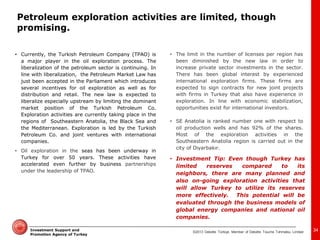
  • 32.
    ©2013 Deloitte Türkiye.Member of Deloitte Touche Tohmatsu Limited Investment Support and Promotion Agency of Turkey * Companies with installed capacity over 600 MWh and/or having a distribution region 31 Some Major Players
  • 33.
    Investment Support andPromotion Agency of Turkey C. Sub-Sectors i. Electricity ii. Petroleum iii. Natural Gas & LNG iv. Coal
  • 34.
    ©2013 Deloitte Türkiye.Member of Deloitte Touche Tohmatsu Limited Investment Support and Promotion Agency of Turkey •Oil consumption in 2012 was approx. 31.5 million tons and is expected to increase in upcoming years. Given the very limited amount of oil production, which was 2.3 million tons (less than 0.8% of total demand) in Turkey in 2012, this demand is being met by imported oil to a great extent. Difference between supply and demand demonstrates potential growth and this difference is expected to decrease. •It is expected that demand for oil will grow in alignment with GDP Growth at a rate somewhere between 2%-3%. 26 28 30 32 34 36 38 Source: BP Statistical Review (Actual), EIU (Forecast) A: Actual F: Forecast Oil Consumption Million Tons 33 -10 -8 -6 -4 -2 0 2 4 6 8 10 2000 2001 2002 2003 2004 2005 2006 2007 2008 2009 2010 2011 2012f 2013f 2014f 2015f 2016f 2017f GDP Growth Rate (a) Gross Domestic Petroleum Products Consumption % Change (b) Trendline (a) Trendline (b) Source: EIU Turkey has limited oil production so it relies on imported oil to meet demand.
  • 35.
    ©2013 Deloitte Türkiye.Member of Deloitte Touche Tohmatsu Limited Investment Support and Promotion Agency of Turkey •Currently, the Turkish Petroleum Company (TPAO) is a major player in the oil exploration process. The liberalization of the petroleum sector is continuing. In line with liberalization, the Petroleum Market Law has just been accepted in the Parliament which introduces several incentives for oil exploration as well as for distribution and retail. The new law is expected to liberalize especially upstream by limiting the dominant market position of the Turkish Petroleum Co. Exploration activities are currently taking place in the regions of Southeastern Anatolia, the Black Sea and the Mediterranean. Exploration is led by the Turkish Petroleum Co. and joint ventures with international companies. •Oil exploration in the seas has been underway in Turkey for over 50 years. These activities have accelerated even further by business partnerships under the leadership of TPAO. 34 •Investment Tip: Even though Turkey has limited reserves compared to its neighbors, there are many planned and also on-going exploration activities that will allow Turkey to utilize its reserves more effectively. This potential will be evaluated through the business models of global energy companies and national oil companies. •The limit in the number of licenses per region has been diminished by the new law in order to increase private sector investments in the sector. There has been global interest by experienced international exploration firms. These firms are expected to sign contracts for new joint projects with firms in Turkey that also have experience in exploration. In line with economic stabilization, opportunities exist for international investors. •SE Anatolia is ranked number one with respect to oil production wells and has 92% of the shares. Most of the exploration activities in the Southeastern Anatolia region is carried out in the city of Diyarbakır. Petroleum exploration activities are limited, though promising.
  • 36.
    ©2013 Deloitte Türkiye.Member of Deloitte Touche Tohmatsu Limited Investment Support and Promotion Agency of Turkey Protection of existing and potential investors is ensured with the new Petroleum Market Law. •The objective of this Law regulates and allows for guidance, surveillance and supervision in order to ensure the transparent, non-discriminatory and stable performance of market activities pertaining to the delivery of petroleum supplied from domestic and foreign resources to consumers, directly or after processing, in a reliable, cost-effective manner within a competitive environment. •18 petroleum regions that are recognized by the former law will be simplified by being divided into land and sea. •License durations are arranged as 5+2+2 years on land and 8+3+3 years on sea. The applicant has to give 2% of the investment amount of the business model that he or she proposes in the license application or petition to extend the timetable. This ratio shall be 1% on the sea. It is obligatory to have a sound business plan for obtaining a license with the New Turkish Petroleum Act. These new regulations are meant to protect existing and potential investors in the sector. •The stimulus concerning drilling activities will be designed by the cabinet. The sum of taxes that rightful owners of the petroleum have to pay over their net profit and of the income tax deduction they make on behalf of the stakeholders cannot exceed 55%. An inflation accountancy system will be brought in when the new law makes it easier to transfer capital and profit. Offshore investors can transfer their net profits to offshore accounts every three months. •According to the old system concerning tax, the rightful owners of the petroleum have the right to choose whether they want to bookkeep exploration expenses, drilling expenses and the expenses of covering/uncovering oil wells that are not economically feasible. The title holders can either activate or write off these expenses as direct operating expenses. Purpose & Major Changes
  • 37.
    ©2013 Deloitte Türkiye.Member of Deloitte Touche Tohmatsu Limited Investment Support and Promotion Agency of Turkey 36 •Turkey mainly imports from Iran and Russia for raw refinery materials. TÜPRAŞ, the market leader in the refinery business currently has four different refineries in Izmit, Izmir, Kırıkkale and Batman. The refineries in Izmit and Izmir are the largest according to generation capacity. A private investment, SOCAR Star Refinery, will produce diesel, jet fuel, LPG and petroleum products. The refinery is expected to be commissioned in 2017. •The aggregated capacity utilization ratio of the refineries increased from 74.7% in 2011 to 78.7 % in 2012, which indicates the importance of refinery capacity in the coming years. City Status STAR Refinery İzmir Under Construction Doğu Akdeniz Petrochemicals and Refinery Adana Under Construction TÜPRAŞ Batman Active TÜPRAŞ Kırıkkale Active TÜPRAŞ İzmir Active TÜPRAŞ Kocaeli Active TÜPRAŞ Refinery Production – 2012 (Thousand Tons) LPG 783 Gasoline & Naphtha 4,826 Jet fuel/Kerosene 3,329 Gasoil 388 Diesel 5,173 Fuel Oil 3,477 Bitumen 2,810 Lubricating Oil 266 Other 815 Total 21,867 Source: TÜPRAŞ •Investment Tip: Given that 60% of the total oil demand is refined in Turkey and that demand is growing, there is ample room for refinery investments, although the market entry barriers are highin light of the very high CAPEX requirements. A similar situation applies for opportunities in importing finished petroleum products. 60% of the total oil demand is imported as crude oil and refined in Turkey.
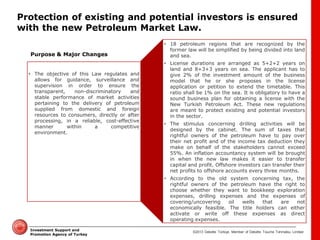
  • 38.
    ©2013 Deloitte Türkiye.Member of Deloitte Touche Tohmatsu Limited Investment Support and Promotion Agency of Turkey •EMRA, as the regulatory authority, has been actively involved in creating precautions to ensure a competitive and fair oil sector, e.g. taking important action in order to mitigate oil theft and increase oil quality. The Competition Authority has also taken action in order to increase competition in the distribution and retail sector of the oil and gas industry. •Distribution activity is licensed by EMRA. With 58 licensees at the end of 2012, the distribution market is highly fragmented dominated by 5 top players, namely BP, Shell, Opet, Total and OMW-POAS. According to EMRA at the end of 2012, the top 10 companies made 83% of the total distributed volume. •In the Turkish market, the 3 main products of the players in the field are LPG, diesel and gasoline; diesel being the most consumed product with the increase of diesel vehicles and the regulation that were applied in 2011. With this regulation, diesel fuel is standardized according to EU criteria. Currently, diesel fuel is subsidized and is preferred by the consumers due to its price advantage over gasoline. As the number of diesel fuel passenger cars increase, the demand for diesel fuel increases as well and more investment is expected in this field. 37 Total Vehicles (Million) Population (Million) Source:: EGM, TUİK, PETDER Report 2011, EPDK and EIU 64 66 68 70 72 74 76 6 8 10 12 14 16 18 Total Vehicle Population Total Vehicles (Million) Total Vehicle Fuel Consumption (Million Ton) 7 9 11 13 15 17 19 7 9 11 13 15 17 19 Total Vehicle Total Vehicle Fuel Consumption •Investment Tip: According to EMRA, approx. 86% of oil is used in transportation. The total number of vehicles has steadily increased since 2000 along with population growth. Expansion in domestic production and the discount of the special consumption tax also affected the growth in number of vehicles. Parallel to the vehicle increase, fuel consumption has also significantly increased in recent years. Source:: EGM, TUİK, PETDER Report 2011, EPDK and EIU Petroleum distribution and their retail components experience intense competition.
  • 39.
    ©2013 Deloitte Türkiye.Member of Deloitte Touche Tohmatsu Limited Investment Support and Promotion Agency of Turkey 38 Source::PETDER AKPET + LUKOIL Market Share: 3.3% ALPET Market Share: 2.5% AYTEMİZ Market Share: 1.9% BALPET Market Share: 1.5% KADOIL Market Share: 1.5% M OIL Market Share: 2.2% OPET Market Share:18.4% BP Market Share: 9.1% POAŞ Market Share: 26.5% TOTAL Market Share: 5.4% TURKUAZ Market Share: 1.2% Shell & Turcas Market Share: 17.2% Major Players
  • 40.
    Investment Support andPromotion Agency of Turkey C. Sub-Sectors i. Electricity ii. Petroleum iii. Natural Gas & LNG iv. Coal
  • 41.
    ©2013 Deloitte Türkiye.Member of Deloitte Touche Tohmatsu Limited Investment Support and Promotion Agency of Turkey Gas Consumption by Sectors •The use of natural gas increased significantly in the last 15 years, both in industry and within households. •Increased gas utilization in households have gone hand-in-hand with the growing number of natural gas power plants. •Natural gas demand has the potential to grow rapidly in upcoming years due to natural gas power plants waiting in the pipeline giving the provinces access to natural gas. •Natural gas demand in Turkey forms a predictable pattern, where consumption downturns during the summer and is highest in the winter months. This pattern is shaped by household demand for heating in the winter months. Another driver is electricity demand which increases in summer months. •The main difference between the monthly fluctuation is explained by the change in weather conditions and electricity demands covered by natural gas plants. Source: BOTAŞ 0 5 10 15 20 25 30 35 40 45 50 2002 2003 2004 2005 2006 2007 2008 2009 2010 2011 2012* bcm Electricity Generation Industry Heating 40 Demand for natural gas is increasing.
  • 42.
    ©2013 Deloitte Türkiye.Member of Deloitte Touche Tohmatsu Limited Investment Support and Promotion Agency of Turkey Local Production Private Sector Wholesale Companies BOTAŞ – Balancing & Own Use Gas NG Distribution Companies Eligible Customers Exploration & Production, Import Transmission Wholesale Distribution & Retail Storage BOTAŞ – Trade Private Sector NG Import Companies Private Sector LNG Import Companies Storage Companies •The geographical region surrounding Turkey contains 70% of the world’s oil and gas reserves. Considering the importance of these fossil fuels and their contribution to energy generation, Turkey clearly has a critical position as a transit country between the supply-rich countries of the Middle East and the Caspian Sea and the high- demand countries of Europe. This strategic positioning also allows for opportunities as a natural gas hub with all its physical and market components. •Natural gas is supplied to end users (eligible or non-eligible) via the value chain. The chain consists of exploration & production, import, transmission, storage, wholesale, distribution and retail activities. Import and wholesale license owners can engage in wholesale activities. Wholesale companies supply natural gas to eligible consumers, distribution companies and/or other wholesalers. 41 A quick overview of the natural gas value chain.
  • 43.
    ©2013 Deloitte Türkiye.Member of Deloitte Touche Tohmatsu Limited Investment Support and Promotion Agency of Turkey Historical Development of Natural Gas Imports 2005 - 2012 •Local production in Turkey is quite limited, covering approx. 2% of total consumption. In 2011, 0.76 bcm was produced, of which 42% was by TPAO. Exploration attempts are on-going in many locations. TPAO and Shell signed joint operation agreements in 2011 to start exploration and extraction in the Mediterranean Sea and Southeastern Anatolia. •Turkey is an import-dependent country due to its limited production capacity. Natural gas is imported from Russia, Iran and Azerbaijan through pipelines. In addition, LNG is imported from Nigeria, Algeria and spot markets. •The construction of the strategic Trans-Anatolian Pipeline (TANAP) project, designed to carry Azeri gas to Turkey and Europe, is set to begin in 2014. The pipeline will carry 16 billion bcm of gas per year when operational by 2018, with 6 billion bcm to be delivered to Turkey and rest to Europe. •There are developments in the establishment of an organized energy market place including a gas market supported by a robust trading platform. •The spread of natural gas usage throughout the country as a result of successful greenfield investments in natural gas distribution coupled with privatizations support the increasing use of natural gas for households, industry and for electricity generation. Source: BOTAŞ 42 0 1 2 3 4 5 6 7 8 9 10 2008 2009 2010 2011 bcm Oman Egypt Norway Belgium T&T Qatar Nigeria Algeria Historical Development of LNG Import Figures 2008-2012 Source: BOTAŞ bcm With approx. only 2% local production, natural gas importation is a critical link in the value chain.
  • 44.
    ©2013 Deloitte Türkiye.Member of Deloitte Touche Tohmatsu Limited Investment Support and Promotion Agency of Turkey 43 •Investment Tip: Turkey is heavily dependent on import to meet its increasing gas demand which opens opportunities in both gas exploration and gas import. •Further, Turkey needs to diversify its gas supply sources for better security of supply and to achieve its goal in becoming a regional gas trading hub. •This creates opportunities for large-scale international investors – in light of the moderate/high market entry barriers – who consider entering the import and trade business in Turkey. •Natural gas import through a pipeline from neighboring countries or in the form of LNG is an important opportunity area. Opportunities exist in the upstream side with undiscovered resources of unconventional natural gas (offshore and shale etc.) A new supply channel - an Iraqi import pipeline – is to be commissioned in 2016. This project will provide opportunities in pipeline construction, wholesale and import. 4 bcm long-term contract of BOTAŞ expected to be transferred to private market players, which will increase market share of private companies in natural gas trade. Privatization of İGDAŞ upcoming (there will be two distribution regions that will be privatized as two separate entities) Natural gas usage is spreading throughout the country as a result of successful greenfield investments in natural gas distribution coupled with privatizations support, increasing the use of natural gas in households, industry and for electricity generation. Developments in the establishment of an organized energy market place including a gas market supported by a robust trading platform to support trading activities. LNG Terminal investments to meet increasing demand as well as for peak demand management. Opportunities for various investments exist in importing, and also exploration.
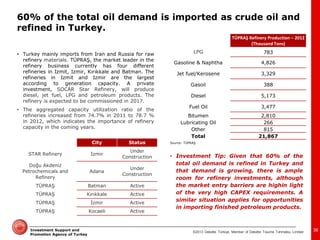
  • 45.
    ©2013 Deloitte Türkiye.Member of Deloitte Touche Tohmatsu Limited Investment Support and Promotion Agency of Turkey BOTAŞ Natural Gas Transmission System •The National Transmission System is composed of high-pressure pipelines in aggregate of 13,000 km, 8 compressor stations (totaling 200 MW), 1 mobile compressor station, more than 300 Pressure Reduction and Metering Stations (Exit Points) directly connected to the high-pressure grid and 9 entry points, of which there are 4 foreign pipeline interconnections, 2 LNG Terminals, 2 local production sites and one underground storage facility. •Future investments in the transmission network are expected to be focused mainly on the construction of loop lines and the installation of new compressor stations to increase gas dispatch capacity. •Aside from PNG transmission, another important value chain component is LNG transmission. Currently, LNG transmission is made by BOTAŞ via its LNG terminal in Marmara Ereğlisi and Egegaz via its terminal in Aliağa. The LNG terminals which includes dispatches to the transmission network through re-gasification, approx. 1.5% (2010) of total consumption was dispatched through overland tankers to areas where the gas network does not reach. Source: BOTAŞ Compressor Station (under construction) Compressor Station Entry Point Existing Gas Pipeline Planned Gas Pipeline / Under construction Planned Natural Gas Underground Storage 44 Future investments in the transmission network will increase gas dispatch capacity.
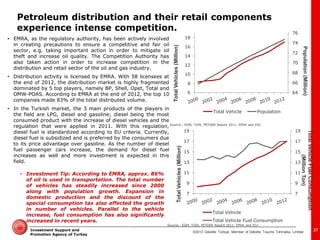
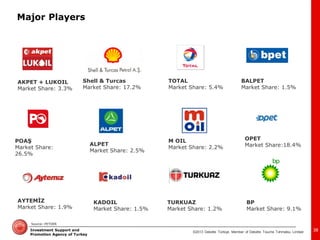
  • 46.
    ©2013 Deloitte Türkiye.Member of Deloitte Touche Tohmatsu Limited Investment Support and Promotion Agency of Turkey 0% 20% 40% 60% 80% - 5 10 15 20 25 30 35 bcm Natural Gas Storage Capacity •The total storage capacity of the Turkish natural gas market is approx. 2.6 bcm. •Projects exist to improve Turkey’s storage capacity. The main project is BOTAŞ’s Tuz Gölü underground storage facility. •In November 2011, a contract was signed with China Tianchen Engineering Corporation to build a new facility. The project has a completion date of 2018 with a storage capacity of 1 bcm. •Some private companies are conducting studies to determine the possibility of converting depleted fields in Thrace into storage facilities as well as carrying out studies for underground storage facilities near Tarsus. •Investment Tip: Importers have a legal liability to store 10% of their gas imports. This creates an investment opportunity for storage facilities, which currently only covers 5 bcm in Turkey. Source: BP, GSE May 2012 45 Storage has just become a liability for importers, and an opportunity for investors.
  • 47.
    ©2013 Deloitte Türkiye.Member of Deloitte Touche Tohmatsu Limited Investment Support and Promotion Agency of Turkey •Natural gas availability in terms of distribution of natural gas to end users across the country has increased significantly in recent years. In 2003, the number of cities having access to natural gas was 6; this number is 72 today. •Distribution tenders have been successfully completed by EMRA and are up to date. Companies satisfying the financial criteria attended the tenders. The bidding criterion was to offer the lowest distribution tariff, which was defined as “Unit Service and Depreciation Charge (USDC)”. The USDC offered in the tender was valid for 8 years. As of today, this 8-year process is complete for 9 distribution regions. •Currently, while eligible consumers could supply gas from distribution companies or wholesalers, non-eligible customers can only buy from gas distribution companies. Source: BOTAŞ Natural Gas Supplied before Law No. 4646, not yet privatized Privatizations are finalized Tender announcements are made, not yet privatized Natural Gas Supplied before Law No. 4646 and privatizations are finalized 46 •Investment tips: In natural gas distribution, there are limited number of opportunities however potential partnership / acquisition opportunities may arise for the privatized regions. Major examples include: •Brownfield: Igdas (Istanbul region) privatization •Greenfield: Artvin, Igdır, Agri, Bitlis-Bingol-Mus, Hakkari, Sirnak, Mardin, Tunceli, Sinop, •Potential partnership / acquisition opportunities for privatized regions exists. … and for distribution and retail sectors as well.
  • 48.
    ©2013 Deloitte Türkiye.Member of Deloitte Touche Tohmatsu Limited Investment Support and Promotion Agency of Turkey Exploration, Production , Import & Wholesale Wholesale, Distribution & Retail Distribution Wholesale 47 Major Players
  • 49.
    Investment Support andPromotion Agency of Turkey C. Sub-Sectors i. Electricity ii. Petroleum iii. Natural Gas & LNG iv. Coal
  • 50.
    ©2013 Deloitte Türkiye.Member of Deloitte Touche Tohmatsu Limited Investment Support and Promotion Agency of Turkey •The continuous rise in energy demand and prices makes it imperative for Turkey to meet the growing share of its energy needs from indigenous resources. Lignite-fired power plants offer various advantages such as in price advantage, sustainable supply, employment, reduction of foreign trade deficit and regional development. These reasons justify the prioritization of lignite fired-power plants in terms of investments. In light of these reasons, Turkey will offer appropriate incentives for utilization of indigenous resources. •Turkey is rich in lignite reserves. Use of these reserves would make many positive contributions in line with development objectives, such as regional development, reduction of foreign trade deficit, supply security, reduction of electricity costs, employment, keeping value added in the country and creating a competitive industry. •Policy goals such as utilizing indigenous resources, ensuring resource diversification, reducing import dependency, etc. are constantly expressed in official strategy papers. Mining sector investments have always been subsidized to the maximum level under both the existing Decree and the previous decrees. Under the current effective Decree no. 2009/15199, the mining sector is among the sectors that are subsidized throughout the entire country. Different Models for Operation Transfer of Operating Rights Long-Term Contracts Power Plant Construction by the Public Sector •Direct investments by the public sector and the transfer of operating rights to fields held by TKİ will be transferred to the private sector on the condition that they build power plants within the framework of the royalty model. •The public sector has the option to undertake investment as it deems necessary to ensure supply security, pursuant to Additional Article 3 of Law No. 4628. However, this option can only be applied through the Council of Ministers’ Decree when all options have been exhausted and it is acknowledged that the supply shortage cannot be eliminated. •TKİ offers coal sales to interested investors under long-term contracts. Source: Deloitte Report 49 An Overview of Coal: The importance it poses for the electricity generation sector.
  • 51.
    ©2013 Deloitte Türkiye.Member of Deloitte Touche Tohmatsu Limited Investment Support and Promotion Agency of Turkey •Turkish Coal Enterprises holds several small-scale lignite fields that are waiting to be utilized. In order to make these projects come to life, a Royalty Tender mechanism was introduced in 2012. The tenders concluded so far are: Location Plant min. capacity MW Reserve Mtons Company Tender Amount kr/kWh Tufanbeyli Adana 600 323 Teyo Group 2.57 Soma-Deniş Manisa 450 150 Kolin İnşaat 4.69 Keleş- Davutlar Bursa 270 55 Çelikler İnşaat 5.61 Domaniç Kütahya 300 114 Çelikler İnşaat 5.03 Yeniköy Muğla 420 50-60 - - Karabalçık Karlıova Bingöl 150 89 Aksa 3.2 Can Çanakkale 210 45 - - •Tenders are done based on a royalty fee for the generated electricity indexed to the CPI. The investment period is 6 years, whereas the operation period is 30 years. Contracts can be extended under the same conditions if reserves are not depleted. •Afşin-Elbistan Coal Field is owned by EÜAŞ and has strategic importance for Turkey due to its large coal reserves that could resolve Turkey’s import dependency concerns. •The Afşin-Elbistan Coal Field is a joint development operation currently under consideration intergovernmental agreements with the United Arab Emirates. EÜAŞ is now in negotiations with TAQA regarding the privatization model which allows for securing project income streams without disrupting the free market mechanism. •The scope of privatization includes the development of B, C, D and E sites, which are the parts of Afşin-Elbistan Lignite Site, and include construction and operation of B, C, D, and E power plants whose installed capacity are planned to be 360 MW, building an expansion plant near the existing B plant and obtaining operating rights of the existing B plant on a lease or similar basis. 50 Coal fields are being privatized.
  • 52.
    ©2013 Deloitte Türkiye.Member of Deloitte Touche Tohmatsu Limited Investment Support and Promotion Agency of Turkey Total Coal Consumption by Use Source: Ministry of Energy and Natural Resources, Energy Balance Reports & Turkish Statistical Institute, Deloitte Analysis TYPE 2007 2008 2009 2010 2011 2012 Mt Mt Mt Mt Mt Mt Household Heating 7.998 11.806 14.362 13.988 14.114 11.786 Electricity Generation 66.448 71.882 69.255 63.485 70.785 65.420 Steel Industry 3.693 4.408 4.319 6.072 5.937 7.286* Cement Industry 5.650 6.656 6.459 6.792 7.679 n/a* Other Industry 16552 6.141 7.922 8.391 5.612 8.277* TOTAL 100.341 100.893 102.317 98.728 104.127 n/a* Note: The difference between consumed hard coal to produce coking coal adds to industrial usage *Incomplete data due to Law no: 5429 •Coal consumption has doubled since 1990. Turkey’s coal consumption has been growing faster than its production, thus increasing the country’s reliance on energy imports. The installed capacity of coal-fired power plants reached 13 GW which includes imported coal, local hard coal, lignite and asphaltite plants. •In 2011 total coal consumption amounted to 104.127 Mt. Electricity generation accounted for 68% of total consumption in 2011, while household heating accounted for 14%. The remaining 18% fell under industrial usage. •Turkey consumed 70.8 Mt coal for electricity generation, 14.2 Mt for household heating and 19.2 Mt for industrial use in 2011. The use of coal for electricity generation is crucial as coal plants provided almost 29% of total electricity production in 2011. This figure was 27.4% in 2012. 51 Turkey’s coal consumption in various sectors has been growing faster than its production.
  • 53.
    ©2013 Deloitte Türkiye.Member of Deloitte Touche Tohmatsu Limited Investment Support and Promotion Agency of Turkey •Coal production in Turkey increased by approximately 10 million tons in the last ten years and reached a volume of 75.9 million tons in 2011. At present only a small power station with a capacity of 300 MW (Çatalağzı) and Kardemir’s former 35MW plants are fuelled with domestic hard coal from the Zonguldak basin while lignite-fired power plants have a total capacity of 8,140 MW. •Local production increased by 3.5 Mt in 2011, yet still remained below the growing rate of total consumption. Coal imports to Turkey increased by 2.5 Mt and reached 26.3 Mt in 2011. Thermal coal and coking coal imports constituted 90% of total imports, while the remaining 10% included petcoke. Coal imports to Turkey are expected to increase in upcoming years while export is to remain at zero. Coal-fired power plants using imported coal had a total capacity of 3,984 MW at the end of 2012. Total Coal Supply/Consumption Balance Source: Ministry of Energy and Natural Resources, Turkish Coal Enterprises & Turkish Statistical Institute Deloitte Analysis 0.00% 5.00% 10.00% 15.00% 20.00% 25.00% 30.00% 35.00% 40.00% 45.00% 0 20000 40000 60000 80000 100000 120000 2007 2008 2009 2010 2011 2012 Local Production Import Import Ratio Million tons (Mt) Note: Total supply might not be equal to total local production and import due to inventory changes, internal consumption and losses 2007 2008 2009 2010 2011 2012 Mt Mt Mt Mt Mt Mt Local Production 75.30 79.40 79.49 73.40 75.98 65.43 Import 25.30 21.90 23.34 24.30 26.67 27.34 Total Supply 100.34 100.89 102.32 98.73 104.13 N/A Source: Deloitte Analysis 52 Coal is in short supply for meeting overall demand.
  • 54.
    ©2013 Deloitte Türkiye.Member of Deloitte Touche Tohmatsu Limited Investment Support and Promotion Agency of Turkey •Turkey has around 11.7 billion tons of lignite reserves and 1.3 billion tons of hard coal reserves of which 9.8 billion tons and 0.5 billion tons respectively are in the proven category. •Major lignite producers are the state-owned General Directorate of Turkish Coal Enterprises (TKİ), which produced 33.4 Mt of lignite in 2011 and the state- owned Electricity Generation Co. Inc. (EÜAS), which produced 31.6 Mt of lignite in 2011. •The most prominent hard coal producer is the state- owned Turkish Hard Coal Enterprises (TTK) which operates five underground mines in the Zonguldak coal basin in the Black Sea region. TTK produced approximately 1.6 Mt of hard coal in 2011. •In 2011, local lignite and hard coal production totaled 76.9 million tons. Nearly 90% of total coal production was from state-owned enterprises in 2011. However, about 35% of coal production reported by the state enterprises was mined by private companies under subcontracts. Name of Enterprise 2007 Mt 2008 Mt 2009 Mt 2010 Mt 2011 Mt TKİ 29.8 35.9 32.5 29.8 33.4 EÜAŞ 23.4 31.9 33.5 32.1 31.6 TTK 1.6 1.59 1.88 1.71 1.59 Private Companies* 20.5 10.01 11.61 9.79 9.39 Total Local Production 75.3 79.4 79.49 73.4 75.98 Major Local Coal Supply by Enterprise Source: Turkish Coal Enterprises & Turkish Hard Coal Institute, 2011 Annual Report, Turkish Statistical Institute, Deloitte Analysis * Since public data for all private sector players is limited, the figures are formed from the difference between the announced values of total production and production of TKİ, EÜAŞ, TTK 53 Production is under the control of public institutions.
  • 55.
    ©2013 Deloitte Türkiye.Member of Deloitte Touche Tohmatsu Limited Investment Support and Promotion Agency of Turkey Investment Support and Promotion Agency of Turkey 54 FUEL/RESOURCE TYPE Application Phase Examination Evaluation Approved TOTAL Number Installed Power (MW) Number Installed Power (MW) Number Installed power (MW) Number Installed power (MW) Wind 2 47.2 9 408,6 33 1,701.90 44 2,157.70 Hydro 68 1171 76 1,346.71 295 3,707.66 439 6,225.37 Fuel Oil 0 0 0 0 0 0 0 0 Natural Gas 63 10,007.9 40 12,100.12 45 11,050.23 148 33,158.25 Lignite 2 1147 0 0 1 135 3 1,282.00 Anthracite Coal 14 10,369.6 8 3,550 4 2,295.00 26 16,214.60 Asphaltite 0 0 0 0 1 135 1 135 Waste 0 0 0 0 0 0 0 0 Geothermal 10 264 8 105.95 2 155 20 524.95 Landfill Gas 1 4.02 0 0 1 1,2 2 5.22 Biogas 3 3.73 5 11.01 6 19.96 14 34,7 Biomass 8 31.18 6 55.88 4 35.96 18 123.02 Solar 0 0 0 0 0 0 0 0 Nuclear 0 0 1 4,800 0 0 1 4,800.00 TOTAL 171 23,046.00 153 22,378.00 392 19,237.00 716 64,660.81 Annex 1: Projects in licensing process (by EMRA)
  • 56.
    ©2013 Deloitte Türkiye.Member of Deloitte Touche Tohmatsu Limited Investment Support and Promotion Agency of Turkey Annex 2: Opportunities for Brownfield Investment: Contracts for BO/BOT/TOR plants will expire and be privatized by 2025 at the latest. 55 Power Plant Fuel Capacity (MW) Commissioning Date Contract Termination Date BUILD OPERATE Intergen Gebze Natural Gas 1,595 2002 2018 Intergen Adapazarı Natural Gas 798 2002 2018 Intergen Izmir Natural Gas 1,591 2003 2019 Baymina Natural Gas 798 2004 2020 Isken Imported Gas 1,320 2003 2019 BUILD OPERATE TRANSFER Trakya Elektrik Natural Gas 499 1999 2019 UNIMAR Natural Gas 504 1999 2019 Esenyurt Natural Gas 189 1999 2019 Ova Elektrik Natural Gas 258 1997 2017 Bireecik HES Hdyro 672 2001 2016 Yamula Hes Hdyro 100 2005 2025 Çamlıca-I HES Hdyro 84 1998 2013 Ahiköy-I HES Hdyro 2 1999 2019 Ahiköy-II HES Hdyro 2 1999 2019 Aksu-Çayköy HES Hdyro 16 1999 2019 Berdan HES Hdyro 10 1996 2011 Çal HES Hdyro 3 2001 2021 Dinar-II HES Hdyro 3 2000 2015 Fethiye HES Hdyro 17 1999 2014 Girlevik-II Mercan HES Hdyro 11 2001 2021 Gönen HES Hdyro 11 1998 2019 Hasanlar HES Hdyro 10 1991 2011 Suçatı HES Hdyro 7 2000 2015 Sütçüler HES Hdyro 2 1998 2018 Tohma-Medik HES Hdyro 13 1998 2018 Gaziler HES Hdyro 11 2002 2022 Alaçatı RES Wind 7 1998 2019 Bozcaada RES Wind 10 2000 2020 TRANSFER of OPERATING RIGHTS Çayırhan Lignite 620 2000 2020 Hazar I-II HES Hydro 30 1996 2022 TOTAL 9,191
  • 57.
    ©2013 Deloitte Türkiye.Member of Deloitte Touche Tohmatsu Limited Investment Support and Promotion Agency of Turkey Annex 3: Opportunity for brownfield investment: privatization portfolio of EÜAS over 16 GW (1/2) Generation Privatizations •The privatization of more than 16 GW of 25 GW installed capacity belonging to EÜAŞ and its subsidiaries are planned. •Aside from these portfolios, some power plants have been privatized singly: •The Hamitabat plant (1,156 MW, Natural Gas) was acquired by a local conglomerate, Limak Holding, with a bid of USD 105 million. •The Seyitömer plant (600 MW, Lignite) was acquired by another local conglomerate, Çelikler Holding with a bid of USD 2.2 billion. •The Kangal plant (457 MW, Lignite) was acquired in a joint venture by Konya Şeker – Siyahkalem with a bid of USD 985 million. •The next plant to be privatized is Çatalağzı (300 MW, Hard Coal). Tenders for Soma (1034 MW, Lignite) and Portfolio 9 (356 MW, Hydro) have also been announced and will start before the end of 2013 by the Privatization Authority. Source: PA, EÜAŞ. Plants coded in red are not within the portfolio, but are planned to be privatized separately. Portfolio Thermal (MW) Hydro (MW) Total (MW) Portfolio 1 2,795 - 2,795 Portfolio 2 1,981 - 1,982 Portfolio 3 1,165 - 1,165 Portfolio 4 1,642 476 2,128 Portfolio 5 1,680 360 2,040 Portfolio 6 - 1,017 1,017 Portfolio 7 - 838 838 Portfolio 8 - 630 630 Portfolio 9 - 356 356 Total 9,263 3,677 12,940 56
  • 58.
    ©2013 Deloitte Türkiye.Member of Deloitte Touche Tohmatsu Limited Investment Support and Promotion Agency of Turkey Annex 3: Opportunity for brownfield investment: Privatization portfolio of EUAS of over 16 GW (2/2) Afşin-Elbistan A Afşin-Elbistan B Ambarlı D.Gaz Ambarlı F.Oil Aliağa Çan Tunçbilek Portfolio Share Name Fuel Type Installed Total Cap (MW) Lignite Lignite Natural Gas Fuel Oil 1,355 1,440 1,350.9 1,170 Natural Gas Lignite Lignite 180 320 365 Bursa D.Gaz Orhaneli Gökçekaya Sarıyar Yenice Natural Gas Lignite Dam Dam Dam 1,432 210 278.4 160 37.89 Kemerköy Yatağan Yeniköy Gezende Demirköprü Adıgüzel Kemer Karacaören-1 Lignite Lignite Lignite Dam Dam Dam Dam Dam 630 630 420 159.4 69 62 48 32 Altınkaya Hirfanlı Kesikköprü Derbent Kapulukaya Dam Dam Dam Dam Dam 702.55 128 76 56.4 54 Hasan Uğurlu Kılıçkaya Köklüce Suat Uğurlu Çamlıgöze Almus Dam Dam Dam Dam Dam Dam 500 120 90 69 32 27 1 2 3 4 5 Karkamıs Çatalan Aslantas Menzelet Dam Dam Dam Dam 189 168.9 138 124 Özlüce Kürtün Tortum Doğankent Dam Dam Lake Run of river 170 85 26.2 74.5 6 7 8 9 Fuel Oil Natural Gas Lignite Dam Run of river Coal Lake 2,795 2,521 865 2,118 2,050 1,016 838 619 355 Source: PA, EÜAŞ. Please note that this portfolio structure is currently under re-consideration. 57 Portfolio Share Name Fuel Type Installed Total Cap (MW)
  • 59.
    ©2013 Deloitte Türkiye.Member of Deloitte Touche Tohmatsu Limited Investment Support and Promotion Agency of Turkey For comments on the report and additional information please contact: info@invest.gov.tr www.invest.gov.tr Head Office Address: Kavaklıdere Mahallesi Akay Caddesi No:5 Çankaya/ANKARA 06640 Phone: (+90 312) 413 89 00 Office Address: Dünya Ticaret Merkezi A1 Blok Kat:8 No:296 Yeşilköy/İSTANBUL 34149 Phone: (+90 212) 468 69 00 USA Öner AYAN ayan.oner@invest.gov.tr Olivia CURRAN curran.olivia@invest.gov.tr GERMANY Kemal KAFADAR kkafadar@invest.gov.tr Ole Von BEUST Rezzo SCHLAUCH Wolf Ruthart BORN CHINA Hui ZHAO zhao.hui@invest.gov.tr FRANCE Utku BAYRAMOĞLU bayramoglu.utku@invest.gov.tr Selçuk ÖNDER onder.selcuk@invest.gov.tr INDIA Sanjeev KATHPALIA kathpalia.sanjeev@invest.gov.tr Fariha ANSARİ ansari.fariha@invest.gov.tr UK Ahmet İPLİKÇİ iplikci.ahmet@invest.gov.tr Muhammed AKDAĞ akdag.muhammed@invest.gov.tr JAPAN Hitoshi SEKI seki.hitoshi@invest.gov.tr Saya ASHIBE ashibe.saya@invest.gov.tr CANADA Murat ÖZDEMİR ozdemir.murat@invest.gov.tr SAUDI ARABIA Mustafa GÖKSU goksu.mustafa@invest.gov.tr RUSSIA Eduard ZUBAIROV zubairov.eduard@invest.gov.tr SOUTH KOREA Veyis TOPRAK toprak.veyis@invest.gov.tr SPAIN Yasemen KORUKÇU korukcu.yasemen@invest.gov.tr ISPAT Worldwide