PublicPower.org / @APPAnews	1
PUBLIC
POWER
NUCLEAR
still deliverspage 14
SMART START
for public powerpage 20
POWER
in numberspage 26
American Public Power Association • January/February 2015
Hoping for the Best,
Preparing for the Worst
Getting ready for EPA’s new CO2
plan
©2014Thomas&BettsCorporation.AllRightsReserved.
BE CALM AFTER
THE STORM.
S TO R M H A R D E N I N G G R I D R E S I L I E N C Y
©2014 Thomas & Betts Corporation. All Rights Reserved.
There’s a feeling of confidence that comes with installing Thomas & Betts’ solutions that
withstand and allow fast recovery from extreme weather events. We enable a hardened and
resilient grid with distribution equipment that is underground, submersible, watertight,
corrosion resistant, and safe. You’ll find that our 24/7 response service is just as dependable
as our broad selection of in-stock storm products. So be calm before and after the storm.
Visit www.tnb.com/stormhardening to learn more. Or see your Thomas & Betts representative.
NECA & IBEW Your Quality Connection
For more information:
www.nlmcc.org
Online video magazine:
www.electrictv.net
Do you need
something
done up here?
We’re the ones
that will do it.
who employ skilled, safe
electrical linemen.
We at NECA & IBEW have
eased the
number of apprentices in
lineman training.
When you need help,
we’re the answer.
Find us at the sites below.
PublicPower.org / @APPAnews	3
Web
PublicPower.org
Twitter
@APPANews	
Facebook
facebook.com/americanpublicpower
EDITORIAL TEAM
Joe Nipper
Senior Vice President
Regulatory Affairs and
Communications
Meena Dayak
Vice President
Integrated Media & Communications
Paul Ciampoli
News Director
Jeannine Anderson
News Editor
Laura D’Alessandro
Integrated Media & Communications
Editor
Robert Thomas
Art Director
INQUIRIES
Editorial
News@PublicPower.org
202-467-2900
Subscriptions
subscriptions@PublicPower.org
202-467-2900
Advertising
EHenson@Naylor.com
800-369-6220
Advertising for APPA publications is
managed by Naylor, LLC.
Public Power (ISSN 0033-3654)
is published six times a year by the
American Public Power Association,
2451 Crystal Drive, Suite 1000,
Arlington,VA 22202-4804.
©
Copyright, 2014, American Public
Power Association. Opinions expressed
in articles are not necessarily policies
of the association. Periodical postage
paid in Arlington,Va., and additional
mailing offices.
For permission to reprint articles,
contact News@publicpower.org.
COLUMNS
4 	 Public Power Lines
30 	Washington Report
31 	Engineering
32 	Security
33 	Innovation
34 	Hometown Connections
36 	100 Years of Pride in Public Power
6 	 Hoping for the Best,
Preparing for the Worst
Utilities continue to prepare to
implement the EPA’s most sweeping
carbon-dioxide rule to date.
14 Nuclear Still Delivers
Some public power utilities continue
to invest in nuclear power plants as
CO2
-free, diversified energy sources.
20 Smart Start for Public
Power
Utilities modernize the grid with
smart meters.
26 Power in Numbers
New Jersey public power utilities are
trying to secure state legislation that
would allow them to work together
through a joint action agency and
harness economies of scale.
FEATURES
CONT ENT S
Cover illustration by Scott Roberts
PhotobyDennisBrack
Making Forward Progress on 111(d)
By Sue Kelly • President & CEO, American Public Power Association
Public Power Lines
@CEOPublicPower • blog.publicpower.org
	4	Public Power / Jan.-Feb. 2015
On Dec. 1, APPA filed our comments with the Environmental Protec-
tion Agency on its proposal to limit CO2
emissions from existing power
plants under Section 111(d) of the Clean Air Act. APPA staff labored long
and mightily to produce these comments, and I am justly proud of the
cross-departmental team we assembled to do this work: Joe Nipper, Theresa
Pugh, Desmarie Waterhouse, Alex Hofmann, Tanzina Islam, Randy
Elliott, Elise Caplan, Jim Cater, John Godfrey, Nathan Mitchell and
Paul Libus.
But equally important to this effort was APPA’s CEO Cli-
mate Change and Generation Task Force, which has been
led since 2006 by Bill Gallagher, former APPA board chair
and past CEO of the Vermont Public Power Supply Au-
thority. The task force is composed of APPA member CEOs
representing a broad cross-section of APPA’s member-
ship, and is supported by a member employee group that
worked closely with APPA staff in developing APPA’s com-
ments. The task force represents the broad diversity of APPA
members’ views on the very important issues EPA’s proposed
rule raises. The task force helped APPA staff find the “middle
ground” legal and policy positions that formed the cor-
nerstone of our comments. I for one am very
grateful to the task force for its assistance.
In APPA’s comments, we raised the
legal shortcomings with EPA’s proposed
rule and said the agency should therefore
withdraw and re-propose the rule. But
given the low probability that EPA will
do that, we spent the bulk of our pages
on suggestions to EPA as to how it can
modify its proposed rule to make it
more workable. Among the changes
APPA requested:
• Allow states to choose a base-
line that accurately reflects their
unique circumstances, as opposed
to the proposed 2012 baseline.
• Provide full credit for in-
vestments APPA members have al-
ready made that reduce or offset CO2
emissions.
• Fix the errors and revise the as-
sumptions in the computations of the
four “building blocks” that EPA used to de-
velop the states’ specific goals, to reflect what
the states can realistically accomplish and en-
sure more equity among the states.
• Remove nuclear units under construc-
tion from the relevant state baselines.
• Allow all generating resources that emit no CO2
to be used for
compliance.
• Provide states with more time to develop state compliance plans.
• Eliminate the interim reduction requirement and allow states to de-
termine their own emissions reduction trajectories, or “glide paths,” to
reach their final reduction goals.
• Allow a state’s final reduction goal, the year to achieve that
goal, and/or the glide path to be adjusted if a state can demon-
strate that circumstances have materially changed.
• Include mechanisms to ensure that entities with a compli-
ance obligation under a state plan have the maximum degree
of flexibility to comply at reasonable cost, including through
reduction or avoidance measures from non-electricity por-
tions of the broader energy sector.
• Provide for a reliability “safety valve” to ensure that com-
pliance with mandated emission reduction requirements does
not inadvertently impair system reliability or conflict with the
North American Electric Reliability Corporation’s reliability
standards.
While APPA’s filing marks an important
milestone in our advocacy efforts on this is-
sue, it really only marks the end of the be-
ginning. We will continue to advocate in
all available forums: the 114th Congress,
EPA itself, and other federal agencies
with a stake in these issues, such as the
Federal Energy Regulatory Commis-
sion, and the Office of Management
and Budget. We will work in coalition
with other like-minded organiza-
tions as much as we can, and will
look in particular for the unholy al-
liances that often have maximum
impact here inside the Beltway.
Our goal is to get to final CO2
regulations that all of our members
can live with, providing meaningful
emissions reductions without strand-
ing assets, endangering reliability or
incurring unreasonable compliance
costs. While this might sound like a
modest goal, in fact it is going to be a
very heavy lift, given the highly polarized
politics surrounding this issue. So we will
be asking you, our members, to help us help
you in this effort. It will take all of us working
together to make forward progress.
SCOTT ROBERTS
PublicPower.org / @APPAnews	7
Hoping for the Best,
Preparing for the Worst
The EPA proposed the Carbon
Pollution Emission Guidelines for
Existing Stationary Sources: Electric
Utility Generating Units rule under the
Clean Air Act’s Section 111(d). Unlike
its typical proposals through Section
111, the rule is not proposed for new
sources, but existing ones, making
it an Existing Source Performance
Standard. The agency named the
rule the Clean Power Plan, but it’s
known among experts as ESPS.
In a proposed order, the Environmental
ProtectionAgencyhasdirectedstatestoreduce
carbon-dioxide emissions by 30 percent by
2030 through measures such as investing in
natural gas infrastructure and hitting higher
renewable energy targets while keeping rates
lowforcustomers.Atleastoneexpertsaysthe
rule could see intervention from the Supreme
Court, but short of judicial action, utilities can
and should continue to prepare to implement
its tenets.
By Laura D’Alessandro
W h at ’ s i n a n a m e ?
The Regional Greenhouse Gas Initiative is a
mandatory regional carbon dioxide emissions
program launched in January 2009. It was the first
market-based regulatory program in the United
States to reduce greenhouse gas emissions. The
cooperative effort is mandatory in the participating
states of Connecticut, Delaware, Maine, Maryland,
Massachusetts, New Hampshire, New York, Rhode
Island and Vermont.
Maryland Public Service Commissioner Kelly
Speakes-Backman chairs the RGGI, Inc. board of
directors. Speakes-Backman gave testimony before a
congressional energy committee in September about
the EPA’s proposed CO2
emissions reduction rule
and how states could use RGGI’s model to reach the
plan’s goals successfully, once the EPA institutes some
changes in technical requirements stipulated in the
plan.
Speakes-Backman
answered some
questions for APPA
about how utilities can
work within their regions
on the EPA’s proposal.
	8	Public Power / Jan.-Feb. 2015
What are the key lessons learned from
the Regional Greenhouse Gas Initiative
that can be applied to implementing EPA’s
proposed Clean Power Plan?
Our biggest lesson learned was that it is possible to
achieve pollution reduction while supporting economic
goals. This is a fear I hear from my colleagues and
those in the electric industry, that it’s going to be an
impossible task to meet these environmental goals
and keep rates low. If you work within the existing
market it is actually possible.
Another part of that lesson that we’ve learned is that
each state can still keep control over their individual
state circumstances and priorities, which is really
helpful for those who say, “My state is different.” We’re
all different. Maryland is at 44 percent coal. I don’t
think Massachusetts is the same. That 44 percent
generation has gone down from 56 to 44 [under
RGGI]. We’re pretty happy about that.
How have you applied these lessons as
a state regulator reviewing the EPA’s
proposal?
We’re really excited that EPA has expressly allowed
our regional market-based approach as a compliance
pathway. That means we can work within the construct
of what we’ve already done. That is some credit for
early action; we don’t have to change our game plan.
RGGI is going to be that compliance pathway. That
makes it a heck of a lot easier, not only because we
don’t have to reinvent the wheel, but other states
don’t either. We have a model on our website and it
serves as a little bit of a map or a guide. The other
The U.S. Environmental Protection Agen-
cy’s most recent climate change directive is a
complex proposed rule that has even climate
policy and energy market experts puzzling.
From its name down to the technical require-
ments, electric industry players have been
scrambling to dissect the agency’s sweeping
directive.
The proposed rule aims to slash emissions
from fossil-fueled power plants by 30 per-
cent by 2030 through state-specific plans to
achieve state-specific reduction levels. EPA has
prescribed adding a hefty dose of natural gas
generation and upping renewable generation
capacity, as well as switching dispatch priority
from coal to natural gas — actions that many
utilities expect will make continued coal plant
operation uneconomic.
States would have about a year to work out
compliance plans with generators under the
proposed framework and generators would
need to implement much of the reductions
as early as 2018, a quick ramp-up that the
industry might not be ready for.
While the EPA has already set proposed re-
duction goals for each state, it is up to states to
decide how they will reach these goals, which
the agency said gives states and affected enti-
ties flexibility. As a guide, the EPA proposed
four “building blocks” that it says are the best
system for reducing CO2
emissions.
But the building blocks, and the proposal as
a whole, have caused much concern within the
Q&A
Lessons Learned from the Regional Greenhouse Gas Initiative
thing is that the implementation of the Clean Power
Plan for us by looking at it at a regional mass-based
way is going to be a lot easier. The planning to set
something up like this is definitely the heavy lift.
We’ve had 25 auctions that have gone off without
a hitch. We’ve used that money to reinvest in our
energy infrastructure. As it applies to the Clean
Power Plan, this [carbon dioxide] limit that we have,
which is this year 91 million tons for the region, we
adjusted that back in the beginning of this year. It
decreases 2.5 percent per year. That is the mechanism
we’re using. We don’t have to go through and submit
our individual state energy efficiency plans or our
individual renewable portfolio standards, or our
individual state revisions to integrated resource plans,
because quite frankly we don’t have it in many of our
states. I think that’s what makes this work so well for
us. We’re working within a construct that’s already
been set up.
The market sets the price signal across our region for
[carbon dioxide emissions] and the limitation is that
it decreases 2.5 percent per year, and that’s verifiable
and transparent and it makes it awfully easy for the
market to decide what that cost of compliance is and
then that market can choose the least cost solution.
What does this mean for utilities in the region?
From our perspective, our electric utilities in Maryland
are simply the load serving entities. They are simply
paying the generators to provide electricity to their
consumers. In restructured states, they’re not really
doing anything with the exception of looking at that
price of what the power is. I know I’ve heard from
utilities as I’ve been talking to others that they’re
looking for clarity and risk reduction and to me it
seems like the most clear and straightforward and
visible way to understand what your market risk is
going to be is to understand how a market works and
have a clear signal of what that cost will be, and that’s
what RGGI offers.
And what about that risk to consumers,
which for public power utilities is a primary
concern?
We did an analysis of the impacts of RGGI on our
region and there have also been independent analyses
done and we actually have a good story to tell there as
well. From RGGI’s perspective, in the first three years
alone of the implementation, we produced $1.6 billion
in net economic benefits for our region. We have in
the state of Maryland really made a difference in the
lives of our consumers by having more than 4,300
homes weatherized, we’ve given 104,000 low-income
homes and apartments direct help with their bills, we
have helped hundreds of Maryland-specific consumers
offset the cost in implementing energy efficiency and
renewables, and all with a less than 1 percent impact
on consumers’ bills.
So for consumers I would say compliance doesn’t have
to be costly, especially if you’re careful with how you
spend the proceeds of a regional auction, for example.
In fact, it can be advantageous.
	 PublicPower.org / @APPAnews	9
electric industry and among expert onlookers.
Public power utilities — who, as part of their
communities, put their customers first — fear
most for the impact on the consumer. EPA may
have underestimated the likelihood that early
retirement of coal plants will create stranded
costs, the volume of natural gas infrastructure
necessary to facilitate fuel switching, and bar-
riers to new resource development, APPA said
in its comments filed with EPA in December.
“It is more likely that costs and consum-
ers’ bills will increase for years to come unless
EPA modifies its proposed rule,” APPA’s com-
ments said.
The EPA released the proposal in June 2014
with an initial comment deadline of October.
But the brief comment period was met with
such protest that the deadline was pushed
back to December. And while many members
of the electric utility industry, APPA included,
have asked that the rule simply be withdrawn
and other emissions reduction action be pur-
sued, it is clear that EPA plans to issue a final
rule in June 2015.
.
Keep Talking
In the meantime, however, utilities can take
steps toward a workable outcome in their
respective states. Just because the comment
deadline has passed does not mean the
conversation ends. Industry members,
regulators and experts on the rule say talks
should continue with state regulators, and
10	 Public Power / Jan.-Feb. 2015
APPA Action
In addition to at least 10 in-person meetings at the Environmental Protection agency between APPA staff, members and EPA
administrators, the association has worked on the EPA 111(d) proposed rule at several other events.
July 29, 2014: APPA submitted
a statement for the record at the
House Subcommittee on Energy
and Power’s hearing on FERC’s
perspective on the proposed rule
June 18, 2014: APPA
monitored the Senate Clean
Air and Nuclear Safety
Subcommittee’s hearing on
climate change
May 14, 2014:
Discussed at a meeting
of the CEO Climate
Change and Generation
Policy Task Force
Nov. 13, 2013: Discussed at
a meeting of the CEO Climate
Change and Generation Policy
Task Force attended by EPA
Administrator Gina McCarthy
Member Spotlight: 		
JEA Community Forum
JEA in September hosted a community forum on EPA’s proposed CO2
emissions
rule that was attended by more than 120 people. The Jacksonville, Florida, utility
plans to host a second forum after the rule is finalized in mid-2015.
“Our vision for the symposium was to create a forum where we could all learn
more about this very complex rule,” said Mike Hightower, JEA board chair. “There
are many facets to the EPA’s proposed rule and varying perspectives. The real
challenge is to bring our community together to understand the rule holistically
so that we can attain a reasonable balance between the environmental benefits
we all want and our ability to absorb the cost impacts — both as a utility and as
individual customers — in a reasonable and appropriate way.”
The meeting was attended by Special Assistant to the Director of EPA’s Region 4
Clean Air Program Kenneth Mitchell, former EPA Assistant Administrator of Air
and Radiation Jeff Holmstead, APPA Director of Environmental Services Theresa
Pugh, and JEA CEO Paul McElroy.
Since the forum, the utility has met with individual members of the Florida Public
Service Commission, the secretary of the Florida Department of Environmental
Protection, the commissioner of the Department of Agriculture and Consumer
Services, and legislators from the utility’s district, said Bud Para, chief public
affairs officer at the utility.
“We’ve actively encouraged them to comment and told them what our issues
were,” Para said.
Outside of that, Para said, the utility is looking at how it should prepare to create
a state plan the following year and continue to meet with the state’s public service
commission and environmental protection department.
even with EPA. It’s a good time for everyone —
utilities, state regulators, legislators, regional
transmission organizations, independent
system operators, and others — to come to
the table.
“It’s important for people to continue their
advocacy efforts with EPA,” said Jeff Holm-
stead, an environmental and natural resources
attorney with Bracewell & Giuliani and for-
mer assistant administrator of air and radia-
tion at EPA. “Even though the comment dead-
line was Dec. 1, EPA is certainly allowed to
and normally does continue to listen to peo-
ple. There’s nothing that prevents a company
from submitting additional information after
the end of the comment period.”
Communicating the potential impacts of
the rule to the community is an important av-
enue, too. Some public power utilities have al-
ready hosted community forums that included
customers, council members, state environ-
mental officials and even national experts who
discussed how the proposed rule could change
things for public power communities.
“In some cases, if this rule is actually up-
held and implemented, it will have a signifi-
cant impact on people’s rates and I think it is
important for public power to be educating
their stakeholders,” Holmstead said.
Crossing State Lines
Both within and outside their states, utilities
shouldthinkaboutresources,saidBobWyman,
an attorney who chairs environmental, air
quality and climate practices with Latham &
Watkins. Wyman said the proposed rule has
left a lot of loose ends for utilities to tie up. If,
for example, a utility needs access to low-CO2
PublicPower.org / @APPAnews	11
generation in other states, now is the time to
secure those resources, he said. That, as well
as energy efficiency or demand reductions
that occur in one state, but should apply to
reduction targets in the utility’s home state, are
the first orders of business.
“Those utilities really should be talking to
their respective states now and developing pro-
tocols for allowing them to monetize the value
of those investments,” Wyman said.
Much of the framework laid out by EPA not
only requires utilities to work together with-
in their state, but could best be executed by
states working together within their regions,
according to some experts and a statement by
the chairman of the Federal Energy Regulatory
Commission made in October.
Kelly Speakes-Backman, a public service
commissioner in Maryland and chairman of
the Regional Greenhouse Gas Initiative, said
the regional cap-and-trade program instituted
in the Mid-Atlantic can serve as a model for
other regions.
But without a mechanism like cap and
CEO Roundtable
Arizona Biltmore
Phoenix, Ariz.
March 1–3, 2015
APPA’s premier meeting exclusively for senior public
power executives to meet and exchange ideas and
information with their peers.
www.PublicPower.org/CEORoundtable
91 2015 CEO Roundtable Small Ad.indd 1 12/9/14 12:04 PM
Nov. 5, 2014: Discussed at a meeting of
the CEO Climate Change and Generation
Policy Task Force attended by Janet
McCabe, acting assistant administrator
of the office of air and radiation at EPA
Sept. 17, 2014: Briefing
hosted by APPA and
NRECA, “EPA’s Proposed
Rule on Reducing CO2
Emissions from Existing
Power Plants”
July 30, 2014: APPA
monitored the House
Science Committee’s
hearing on the
proposed rule
July 30, 2014: Briefing
hosted by APPA, NRECA
and FTI on Potential for
Stranded Costs Under
EPA’s Proposed Clean
Power Plan Rule
FROM THE COMPANY THAT BROUGHT
YOU SMART GRID AS A SERVICE
POWER OF PURPLE 2.0
PLANYOURVISITTO
LEIDOSBOOTH#1206
AT LEIDOS.COM/DISTRIBUTECH
PLANYOURVISITTO
LEIDOSBOOTH#1206
AT LEIDOS.COM/DISTRIBUTECH
722965_Leidos.indd 1 11/12/14 5:06 PM
12	 Public Power / Jan.-Feb. 2015
What APPA
Proposed
APPA urged EPA to make
several modifications to
the proposed rule in its
comments filed with the
agency in December 2014.
• Allow states to choose their
own baseline
• Provide full credit for
investments already made
to reduce emissions
• Fix errors and revise
assumptions in formulas
behind the building blocks
to reflect what the states
can realistically accomplish
and ensure more equity
among the states
• Provide a streamlined
process for new source
review determinations
• Remove nuclear units
under construction
from the relevant state
baselines
• Allow all generating
resources that emit no CO2
to be used to comply
• Give states more time to
develop their plans
• Give more guidance on
developing multi-state
plans and interstate
agreements
• Eliminate the interim
reduction requirement
• Allow a state’s final
reduction goal, the year
to achieve that goal, and/
or the glide path to be
adjusted
• Provide for the
establishment of a
reliability “safety valve”
See APPA’s full comments
at publicpower.org
trade in place, Wyman said there is not much
incentive for states to work together regionally,
because the plans are so state-specific.
“This is one of those classic examples
where the collective interest may be better
but it’s like herding cats to get there,” he said.
“I do think expanding the regions of perfor-
mance would allow access to lower cost re-
ductions, to people who might otherwise only
take really expensive paths in their own juris-
dictions. But the problem is many states have
very permissive targets while others have very
stringent targets.”
Mooting the Point
In a best-case scenario, Wyman said, the 2030
reduction targets would be preserved but
states would be given the greater flexibility
necessary with both timing and method that
would enable long-term planning.
orrick, herrington & sutcliffe llp
los angeles new york orange county portland
sacramento san francisco seattle washington dc
www.orrick.com
For more information, please contact any
member of our public finance group listed under
the associate member section of this directory,
e-mail publicfinance@orrick.com or visit
www.orrick.com/public_finance.
providing our clients with innovative
approaches for public power
• System Finance
• Project Finance
• Public/Private
Partnerships
• Public Finance Tax
• Federal and State Tax
• Environmental, Energy
and Water Resources
717602_Orrick.indd 1 01/11/14 12:56 AM
PublicPower.org / @APPAnews	13
Plant-side efficiency:
Improving heat rate at
coal-fired plants by 6
percent
1
Fuel priority: Changing
dispatch order to
emissions-based rather
than economic-based to
favor natural gas over
coal
2
Low/no-emission
sources: Increasing
nuclear and renewable
capacity
3
Demand-side
efficiency:
Increasing energy
efficiency and demand
response efforts to
reach a 1.5 percent
annual incremental
electric savings between
2020 and 2029
4
But Holmstead has his hopes set even
higher, and he said his track record has been
good for predicting when the Supreme Court
will step in.
“I think the best case is likely what will
happen and that is the D.C. Circuit or the
Supreme Court or both will say the EPA has
gone way beyond its statutory authority,” he
said. “There’s a chance the court may say,
‘EPA, you can’t regulate existing power plants
under Section 111(d), because you already
regulate them under Section 112 [of the Clean
Air Act].’ It’s pretty likely that it will be struck
down in court.”
Holmstead is not alone — 17 attorneys
general filed comments with EPA in Novem-
ber saying the plan had numerous legal de-
fects that serve to invalidate the rule. But that
doesn’t mean utilities should not prepare,
Holmstead added. “Even if there’s only a 10
percent chance the rule will stick, there’s still
a chance.” n
BUILDING BLOCKS
717604_Sterling.indd 1 22/10/14 2:07 PM
Nuclear
Still Delivers
Years ago, public power utilities
invested in nuclear power plants as
CO2
-free, diversified energy sources.
Some continue to do so.
By Alice Clamp
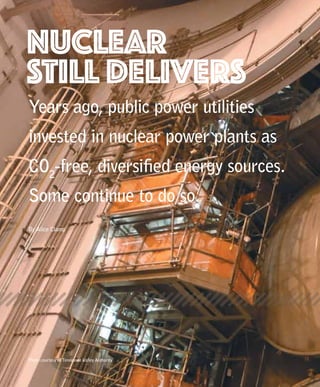
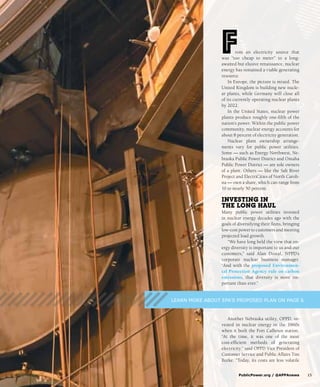
Photo courtesy of Tennessee Valley Authority
From an electricity source that
was “too cheap to meter” to a long-
awaited but elusive renaissance, nuclear
energy has remained a viable generating
resource.
In Europe, the picture is mixed. The
United Kingdom is building new nucle-
ar plants, while Germany will close all
of its currently operating nuclear plants
by 2022.
In the United States, nuclear power
plants produce roughly one-fifth of the
nation’s power. Within the public power
community, nuclear energy accounts for
about 8 percent of electricity generation.
Nuclear plant ownership arrange-
ments vary for public power utilities.
Some — such as Energy Northwest, Ne-
braska Public Power District and Omaha
Public Power District — are sole owners
of a plant. Others — like the Salt River
Project and ElectriCities of North Caroli-
na — own a share, which can range from
10 to nearly 50 percent.
Investing in
the Long Haul
Many public power utilities invested
in nuclear energy decades ago with the
goals of diversifying their fleets, bringing
low-cost power to customers and meeting
projected load growth.
“We have long held the view that en-
ergy diversity is important to us and our
customers,” said Alan Dostal, NPPD’s
corporate nuclear business manager.
“And with the proposed Environmen-
tal Protection Agency rule on carbon
emissions, that diversity is more im-
portant than ever.”
Another Nebraska utility, OPPD, in-
vested in nuclear energy in the 1960s
when it built the Fort Calhoun station.
“At the time, it was one of the most
cost-efficient methods of generating
electricity,” said OPPD Vice President of
Customer Service and Public Affairs Tim
Burke. “Today, its costs are less volatile
	 PublicPower.org / @APPAnews	15
LEARN MORE ABOUT EPA’S PROPOSED PLAN ON PAGE 6
16	 Public Power / Jan.-Feb. 2015
As a provider, you face increasing
technical, financial and regulatory risk.
We tailor a solution to your challenges
that measurably improves performance,
cost and compliance.
Respected. Responsive.
Results-Driven.
717598_NAES.indd 1 22/10/14 8:10 PM
PublicPower.org / @APPAnews	17
than fuels such as natural gas and coal.”
Shortly thereafter, several public power
utilities on the East Coast also invested in
nuclear power plants. MEAG Power in Geor-
gia is a co-owner of four nuclear units: Hatch
1 and 2 and Vogtle 1 and 2. “We wanted fuel
diversity in the ‘70s,” explained Jim Fuller,
senior vice president and CFO. “And those
units have helped us meet our obligation to
provide safe, reliable and economic power to
the community.”
With carbon dioxide regulations on the
horizon even then, nuclear was simply a pop-
ular choice in the 1970s, said Mollie Gore,
public relations director at Santee Cooper in
South Carolina. The utility’s portfolio when it
invested in nuclear was about 80 percent coal.
“So we decided to partner with SCANA
Corp. in building the first unit of the V.C.
Summer plant in South Carolina,” Gore said.
Two power agencies that were newly
formed at the time, the North Carolina East-
ern Municipal Power Agency and the North
Carolina Municipal Power Agency 1, also in-
vested in nuclear generation. NCEMPA pur-
chased a share of the Brunswick and Shearon
Harris nuclear plants. NCMPA1 bought a 75
percent share of Catawba Nuclear Station
Unit 2.
The Los Angeles Department of Water
and Power in California was also seeking fuel
diversity, said LADWP Manager of Advertis-
ing, Communication Services and Education
Outreach Walter Zeisl, when it invested in
the 3,875-MW Palo Verde nuclear plant in
Arizona. “Nuclear energy was one of only two
fuels available to us in the late ‘70s because of
air quality issues and supply shortages.” The
Salt River Project is also a part-owner at Palo
Verde.
Two Texas public power utilities have an
ownership share in the South Texas Project, a
2,700-MW nuclear plant. CPS Energy in San
Antonio invested in the South Texas Project
to diversify its portfolio, said Cris Eugster,
the utility’s executive vice president and chief
generation and strategy officer. “In the ‘70s,
we relied on natural gas for all of our genera-
tion. That exposure wasn’t a good thing from
a supply and price volatility standpoint.”
Nuclear development continued into the
next decade as well. Energy Northwest, a
Washington state consortium with 93 mem-
bers that include public utility districts and
municipalities, owns and operates the Co-
lumbia Generating Station. The nuclear pow-
er plant, which began operating in 1984, was
TVA’s Nuclear Fleet
The Tennessee Valley Authority has approximately 6,600 megawatts
of nuclear capacity in its resource portfolio. That makes it the largest
producer of nuclear-generated electricity in the public power world.
“Back in the ’60s, we recognized the benefits of a carbon-free, low-
cost energy source,” said Jim Hopson, a TVA nuclear communications
consultant.
Today, the agency operates three nuclear power plants: the three-unit
Browns Ferry, the two-unit Sequoyah and the one-unit Watts Bar — with a
second unit expected to come on line by the end of 2015.
“Those plants are our primary source of carbon-free baseload power at
the lowest achievable cost,” he said. “They supply about 30 percent of our
electricity.”
Looking ahead, TVA expects only single-digit growth in demand over the
next two decades, Hopson said. That’s because the agency’s industrial and
commercial customers sought ways of reducing their electricity use during
the economic downturn. “We’re seeing a lot of investment in energy-
efficient processes in manufacturing operations.”
There could be more nuclear energy in TVA’s future, however. And it may
well come from small modular reactors. “SMRs would allow us to add
smaller increments of capacity — 75 to 300 megawatts,” said Hopson.
“That would be a better match for the demand increases we expect.”
American Public Power Association President and CEO Sue Kelly toured TVA’s Watts Bar Unit 2 in
October. The unit is the nation’s first new nuclear generator in the 21st century. Photo courtesy
of Tennessee Valley Authority.
18	 Public Power / Jan.-Feb. 2015
Cons
Upfront Cost
“For us, the primary drawback was the
initial investment in the plants. The cost
overruns that led to increasing debt have
kept us from being as competitive as we
hoped to be.” – Roy Jones, ElectriCities of
North Carolina
“Nuclear energy has a very high
capital cost and a long planning
horizon associated with it. As a result,
development of new nuclear facilities
requires an energy policy and regulatory
environment that will provide some level
of certainty that the facility will have a
long economic life.” – Mike Hummel, Salt
River Project
Post-Fukushima Regulations
“We expect to incur additional expenses
from capital additions to adapt to new
industry standards.” – Roy Jones,
ElectriCities of North Carolina
Used Fuel Disposal
“The public needs to know that [spent
fuel] will be stored safely.” – Kathy
Vaughn, executive board member, Energy
Northwest
Pros
Non-carbon-dioxide-emitting
“Our customers want us to be as emission-
free as economically possible.” – Tim Burke,
vice president of customer service and public
affairs, Omaha Public Power District
“As carbon legislation becomes imminent, we
see our nuclear generation becoming more
valuable.” – Roy Jones, COO, ElectriCities of
North Carolina
Diversification
“Even hydro is considered intermittent,
because fish requirements push dam capacity
up and down.” – Brent Ridge, vice president,
corporate services and chief financial and risk
officer, Energy Northwest
Stability
“That allows us to prepare budgets with
confidence.” – Jim Fuller, senior vice
president and CFO, MEAG Power
“Nuclear energy provides a low-cost
baseload energy product that few other
resources can.” – Mike Hummel, associate
general manager and chief power system
executive, Salt River Project
PublicPower.org / @APPAnews	19
seen as the most economical way to help meet an expected shortfall
in power supply, said Kathy Vaughn, Energy Northwest’s executive
board member and a commissioner with the consortium member Sno-
homish County Public Utility District.
Doing It Again
Though new nuclear construction slowed considerably in the 1990s
and early 2000s, a resurgence of interest in nuclear led Santee Cooper
and MEAG Power to invest in nuclear units that are currently under
construction.
“We’ve had a very positive experience with nuclear energy over the
past 40 years,” said MEAG Power’s Fuller. “So when an expansion of the
Vogtle facility was discussed, we had the option to participate.”
Santee Cooper, too, has enjoyed a good relationship with SCANA
Corp., which operates the V.C. Summer plant. “We decided about a de-
cade ago to invest again,” said the utility’s Gore. “That good experience
in our back pocket made it viable to consider investing again.”
And, added Gore, “nuclear power plants are the only baseload gen-
erating source that is emission-free.”
In assessing investment in Vogtle Units 3 and 4, MEAG Power looked
forward at its baseload power needs. “We understood that Hatch Units 1
and 2 — in which we have an ownership share — would reach the end
of their operating lives in the 2030s,” said Fuller. Owning 22.7 percent of
the Vogtle units would allow the agency to fill that baseload need.
Public power utilities with existing stakes in nuclear plants said they
would invest in nuclear again in the future, pending two conditions.
One is the need for additional baseload generation. That will be deter-
mined by projected load growth and demand, said Energy Northwest’s
Ridge. “Another driver is what happens with greenhouse gas regula-
tions and the retirement of coal plants.” n
Does the Shoe Fit?
Most public power utilities that have invested in a nuclear
power plant say that nuclear energy is a good fit for public
power.
“Given the nature of our business, we tend to have long-term
planning horizons and make decisions based on community
owners,” said Elaina Ball, Austin Energy’s vice president of
power production. “As a carbon-free energy source, it’s a
long-term environmental hedge for us.”
But one size doesn’t fit all. OPPD’s Burke noted that every
utility must gauge its situation and decide for itself if nuclear
energy is a good fit. Regional resources also are a factor, said
CPS Energy’s Eugster. “In Texas, we have a lot of natural gas
and renewables. That’s not the case in the Southeast.”
A lot depends on the value of nuclear energy in the
marketplace, said NPPD’s Dostal. “If it’s properly valued as
a carbon-free generating source, its use may expand. Without
that economic recognition, investment will be limited.”
717730_Cantega.indd 1 10/23/14 12:56 AM
20	 Public Power / Jan.-Feb. 2015
By Laurel Lundstrom
	 PublicPower.org / @APPAnews	21
22	 Public Power / Jan.-Feb. 2015
Like the smart phone, the smart meter
has become a ubiquitous part of living in
the digital age. Some public power utilities
that just five years ago were thinking about
the smart meter as a thing of the future have
now modernized their infrastructure in a
way that not only includes smart meters and
the communications systems that go with
them, but also upgrades that have affected
their entire way of doing business. Making
utilities smarter has contributed to a greener
environment, resulted in happier customers
and, for some, has already provided lucrative
returns on their multimillion-dollar smart
grid investments.
Many of the public power utilities that were
able to undertake comprehensive smart grid
deployments were recipients of Smart Grid
Investment Grants from the U.S. Department
of Energy. Collectively, public power utilities
are expected to spend $1.18 billion under the
grant program. About half of that amount is
federally funded and about half is matched by
the utilities themselves — conveying public
power’s commitment to adapting to and lever-
aging a smarter world.
Public power deployments have included
an extensive array of upgrades. Utilities have
employed technologies such as advanced me-
tering infrastructure, automatic disconnec-
tion and restoration and voltage monitoring in
real time. Advanced metering infrastructure,
known as AMI, are smart meters plus the
supporting infrastructure that enables two-
way, utility-customer
communications.
Such massive,
utility-wide mod-
ernizations have
resulted in bet-
ter and faster
information on
system perfor-
mance, united
d e p a r t m e n t s
across utilities,
and enhanced cus-
tomer service.
Smart Start
Any utility looking to deploy
these new technologies needs to look first
at the “core value of the smart grid,” Burbank
Water and Power’s Smart Grid Manager Bruce
Hamer said. Any smart-grid deployment, when
looking at the assortment of new technologies
and overhauls required, will seem overwhelm-
ing, and maybe impossible, particularly to
smaller utilities. The first thing utilities need to
plan for is the fiber-optic and wireless commu-
nication systems that will support things like
AMI, distribution automation, and mobile data,
Hamer said.
A strong communications backbone en-
ables utilities to fully integrate the many dif-
ferent smart-grid components and provides
real-time, accurate and reliable information
on customer consumption, power quality, and
system performance.
With an exist-
ing fiber-optic
network reach-
ing across Bur-
bank, the util-
ity invested in a
wireless “mesh”
system. In ad-
dition to auto-
mation and real-
time monitoring
capacities, the new
system expands fi-
ber’s reach and provides
a wide area network for all
electric and water meters; al-
lows staff anywhere in Burbank to ac-
cess utility networks and information systems
through mobile devices; and provides high-
quality, high-speed, and secure communica-
tions to equipment and systems including
distributed generation and energy storage.
The communications system also improves
cybersecurity and the physical security of
power plants.
For what Hamer said was a relatively nom-
inal extra cost, Burbank also invested in sur-
plus communications capacity that allows the
utility to sell telecom services to commercial
customers citywide at reasonable rates. The
service, called One Burbank, includes high-
speed data and Internet services to the city
agencies, schools and businesses. “Net rev-
Smart Start for Public Power
Utilities
Modernize
the Grid
Smart grid: intelligent
devices supported by a
robust communications
system that allows a
utility to quickly capture
and analyze information
to optimize use of the
electric grid.
By Laurel Lunstrom
PublicPower.org / @APPAnews	23
enues have offset costs for smart-grid projects
and helped avoid rate increases,” Hamer said.
Smart Investment
A strong communications backbone supports
the build-out of AMI, which utilities
mentioned in this article have fully deployed
and describe as one of the most lucrative
smart-grid investments. Like other utilities,
Central Lincoln People’s Utility District in
Oregon expects to receive a quick payback
of two to three years on its AMI investment.
Remote meter reading for monthly bills, meter
checks and meter connects and disconnects
“have reduced meter costs by over $1 million
a year,” said Bruce Lovelin, Central Lincoln
PUD’s chief engineer.
AMI has also paid off. “Prior to AMI, we
drove about 200,000 miles annually related
to meter operations,” said Lovelin. “Now we
drive about 40,000 annually and expect fu-
ture reductions.”
Likewise, at the Sacramento Municipal
Utility District, smart meters have reduced the
number of truck rolls by more than 400,000
per year, said Jim Parks, SMUD’s program
manager for energy research and development.
SMUD managed more than 40 smart-grid
projects as part of its deployment. Of those
40, however, the AMI has provided the util-
ity with the most benefits, Parks said. “This
was also the most expensive project,” he said.
SMUD spent more than $140 million of its
$308 million smart-grid budget on AMI.
The ability to monitor voltage and detect
outages in near real-time has also lowered the
costs of upgrading and adding new equip-
ment, allowing utilities to make incremental
improvements instead of expensive invest-
ments in replacing damaged infrastructure.
Content Customers
New energy management Web portals, mobile
apps, in-home displays, programmable
communicating thermostats and load-control
switches provide customers with information
about their energy use and can be used to
empower customers to save energy and money
on their energy bills. While these technologies
ultimately benefit the customer, the utility
and the environment, they can be a hard
sell, particularly for their association with
customers having to relinquish some control
over their energy use and privacy.
“I would recommend developing a com-
munication plan for any AMI project and com-
municating with customers before purchasing
equipment,” said SMUD’s Parks. “Working
with your community and customers in ad-
vance will pay big dividends.”
Utilities’ customer communication initia-
tives have included reaching out to the com-
munity, using simple language to describe
complex projects, developing Web content
and easily accessible materials to make the
case for a smarter grid, and, in some instanc-
es, paying visits to residents.
“In our communications, we preferred the
Stewarding the Environment
Through the Smart Grid
Utilities are keeping their trucks in the garage, cutting peak power and educating
their customers about energy efficiency through their grid-modernization
programs. Many are in the initial stages of exploring dynamic pricing for
residential customers, specifically time-of-use rates, which allow the utility to send
price signals to consumers, in turn giving consumers the choice to use power when
it is least expensive (and the cleanest). Environmental benefits like these translate
directly into economic benefits both for the customer and the utility.
“[Reducing peak power use] helps reduce the need for new and expensive
infrastructure such as power plants, and distribution and transmission
infrastructure,” said Jim Parks, program manager for energy research and
development at the Sacramento Municipal Utility District. SMUD’s smart-grid
deployment has included multiple environmentally beneficial components such
as retrofitting commercial customers with efficient light sources, installing
programmable communicating thermostats and an automatic demand-response
program.
AMI can be set up to allow customers interested in going a step further with their
environmental stewardship to plug in renewable resources to the grid. Central
Lincoln People’s Utility District’s AMI, for example, was explicitly set up to
support net metering for customer-generated solar power.
SMUD and Burbank Water and Power have tested pilot projects for adding
energy storage systems to the grid. Burbank’s thermal energy storage pilot shifts
approximately 1,400 kWh per day from on-peak to off-peak. In terms of energy
used to cool buildings, Burbank’s pilot reduced peak energy use by 164 kW and
saved a total of 44,370 kWh during fiscal year 2013-2014. Both utilities have
added electric vehicle charging stations to their deployments — 11 at different
locations throughout Burbank and 80 at residences and on college campuses in
SMUD’s service territory.
“We believe there is much more potential for expanding the smart grid to allow
optimal management of distributed energy resources such as renewable resources,
microgrids, demand response, electric vehicles, and energy storage,” Parks said.
Continued on page 25
24	 Public Power / Jan.-Feb. 2015
Burbank:
Empowering California Customers to Conserve Water
For the third year in a row, California has faced a prolonged drought, putting constant pressure on residents to
conserve water. Pamela Elles of Burbank, California, was able to do her part in preventing excess water waste
through a remote water leak detection mechanism that is supported by Burbank Water and Power’s smart grid.
Through the installation of Itron Save Source AMI capability to all 27,000 water customers, the utility collects and
stores hourly water meter reads, which allowed them to detect Elles’ water leak.
“[The utility] probably saved me at least a couple of thousand dollars,” said Elles. “Even though the hole in the pipe
was only a quarter inch, there probably would have been more damage to my house.”
Although Elles did hear something suspicious, she has compromised hearing and could not discern the leak herself.
Once the utility was able to reach her about the leak, they helped Elles call a plumber.
“It showed me they were very conscientious and on it,” she said.
The water leak detection capability is among the suite of new smart-grid technologies that has enabled Burbank to
improve its customer service.
The utility assigns staff to review meter data and notify customers of potential water leaks. According to the utility,
they usually identify 10 to 20 customers with possible water leaks during each query.
Since the program began in 2012, more than 250 leaks were corrected, saving approximately 16 million gallons of
water, or enough water to fill 25 Olympic-size swimming pools.
710491_Alber.indd 1 21/11/14 5:31 pm
PublicPower.org / @APPAnews	25
use of the term ‘modernization’ instead of ‘smart grid’ as a more accurate
depiction of the investments the utility was making, and we focused on the
science and community benefits,” said Jeanette Meyer, Burbank Water and
Power’s marketing manager.
Customers at Burbank have benefited from reduced outage times, and
through their smart meters, can see their electric usage broken down in
15-minute intervals. “This service allowed households to intimately un-
derstand how they use energy and to make informed energy usage and
efficiency decisions,” said Meyer. In December, Burbank offered residents
the opportunity to request alert messages if their energy usage is on track
to increase by 30 percent or more compared to the same time period of the
previous year.
“Since the smart-grid technologies are new, we decided not to over-
promise benefits to our customers,” said Central Lincoln PUD’s Lovelin.
Central Lincoln PUD allowed customers to ‘opt out’ of a smart meter, but
only about 130 out of 38,000 customers have done so.
Uniting the Utility
A smart-grid deployment is a utility-wide project that affects every aspect of
operations. In some utilities, the deployment necessitated the recruitment
of new staff, such as Burbank’s Hamer, who was hired to specifically
manage its smart-grid program. But in most utilities, it brought together
multiple departments to work as efficiently as possible toward time-bound
goals under the DOE grant program.
“Over half of all SMUD employees charged time to this project,” said
Parks. “From the perspective of working cooperatively, getting to know
new people, understanding new processes, and getting a lot of new infra-
structure installed and operational, it was worth it.”
While all departments were affected, Parks said that the information
technology department was naturally the most impacted. “There are so
many integration and software components to smart grid that many of the
IT staff worked full time on smart grid implementation. The projects that
IT was planning pre-SGIG were put on hold in many cases to ensure the
SGIG project could be completed on time.”
At Central Lincoln PUD, all 130 employees were involved in some part
of the smart-grid rollout. “Beyond being interested, our employees are the
first line of contact with our customers.”
In addition to the full engagement of utility employees, Lovelin recom-
mends selecting good vendors to work on the deployment. “Check the track
record of how the AMI vendor supports its system during installation and
later during operation,” he said.
Big Data and the Future
Rapid advancement in building out a smarter grid brings a tsunami of
data that utilities are still learning how to apply.
“We need to figure out the uses for all of the new data that is coming
in from meters, SCADA and other sources,” said SMUD’s Parks. SMUD is
working on a roadmap that will use the data to tell the utility which new
projects to expand, abandon or delay until technologies are improved or
costs come down.
While SMUD has completed some projects, like rolling out smart meters
to all of its customers, it is still working on others. “Looking ahead, I see
a day where every component on the grid is automatically controlled to
optimize the system and provide reliable energy, energy savings, customer
benefits, reduced need for new infrastructure and environmental benefits,”
Parks said. n
Continued from page 23
Nothing can prevent catastrophic weather events,
but you can be prepared. Before the storm, Asplundh can help you
manage the unexpected with our pre-planning services
and ready-to-respond storm agreements.
When the storm hits, Asplundh’s unparalleled resources
are at your fingertips. From one crew to hundreds,
you can count on our specially-trained staff and fleet of
standard and specialized equipment to safely and efficiently
help you restore service.
Asplundh’s innovative Automated Vehicle Management System
and Truck-as-a-Hub technology give you real-time connectivity
to our crews, allowing for more efficient response coordination.
Mother Nature’s worst – Asplundh is ready.
721536_Asplundh.indd 1 12/17/14 12:37 AM
1
Power in
Numbers
2
5
6
3
4
7
8
9
Joint action agencies give public power utilities the best of both worlds: small, community-owned
power that bands together to harness economies of scale with the big players. But the road to the
joint action promised land can be long, as public power utilities have experienced thus far.
Jim Jablonski has been leading the fight as executive director of the Public Power Association of
New Jersey. Under existing statutes, municipal utilities in New Jersey cannot engage in group pur-
chasing, though doing so could save them millions of dollars.
A bill in the state Legislature is on its third round, having failed twice before because of many con-
cerns from other entities, investor-owned utilities included. The bill would not only allow public power
utilities to band together, but co-operatives as well. Jablonski said all the kinks have been worked out.
The bill has been heavily amended to accommodate every concern and there are no objections. The
2014-2015 session could be the final round for the bill.
“We certainly want to get this done in this session so we don’t have to start all over again,” Jablon-
ski said. “We’ve been through that a couple of times and there’s no one else out there that we’re
aware of that has concerns. In just about every public venue that this legislation has been discussed,
even those who have had concerns were supportive.”
Model Behavior
New Jersey is modeling its joint action agency after a neighboring state’s, the Delaware Municipal
Electric Corporation. DEMEC has been in business since 1979.
In Delaware, the newly formed joint action agency did not immediately begin supplying power to
its members upon founding. As an organization staffed predominantly by volunteers, it functioned
mostly as an advocacy group before the state Legislature and the Federal Energy Regulatory Commis-
sion. Later in the 1990s DEMEC began serving Delaware’s nine municipal electric utilities as a power
supply agency, eight of which receive 100 percent of their power from DEMEC.
In 2013, DEMEC’s utility members had a
combined peak demand of about 450 mega-
watts. The agency in 2002 commissioned the
construction of a $35 million, 50-MW plant in
Smyrna, Delaware, as a joint owner with seven
of its members. DEMEC in 2012 commissioned
the construction of a second 50-MW unit at the
plant.
When it comes to generating power, though,
New Jersey public utilities have a role model in
their home state. The city of Vineland has oper-
ated its own generation facility for more than
100 years and recently finished a new 64-MW
natural gas unit with a second on the way.
Benefits of Scale
Vineland has reaped the benefits in the
market, bidding its unit into the capacity
Utilities in New Jersey are
trying to secure state legislation
that would allow them to work
together through a joint action
agency and harness economies
of scale.
History Lesson
The joint action movement began in the 1960s
when public power utilities saw power in numbers
as a remedy to the competitive disadvantage with
investor-owned utilities. APPA promoted joint action
with its members in the late ‘60s and early ‘70s. As
a result, the 1970s and ‘80s were formative years.
By Laura D’Alessandro
28	 Public Power / Jan.-Feb. 2015
auction at $167 per MW-day, while the cost has run at about $100 per
MW- day.
“That’s the benefit to our customer and it’s because we can finance
cheaper using instruments available to us and we don’t have to pay profit
to our shareholders,” said Joe Isabella, director of the electric utility in
Vineland. “At the present time we have the lowest rates in New Jersey.”
Vineland would continue to benefit once joint action takes off in
the state as economies of scale will help them, too. Joining with other
utilities would in effect double the utility’s size as a market player and
power supplier.
“Wholesale power and generation are economies of scale businesses,”
Isabella said. “You double your size, you have twice as many people in-
terested in supplying you. We also have plans to pretty much have our
own generation supplying all our needs. As our load grows, we would
participate as partial owners for others to build with.”
Pure Prudence
At the present time, Vineland is an anomaly — the only public utility in the
state to own generation. Like many utilities with diesel generation, New
Jersey public utility South River has abandoned the generation it made
power with in the 1930s and ‘40s and receives wholesale for its 6,500
mostly residential customers.
“The residents are very positive and very supportive of South River hav-
ing their own utility,” said Frederic Carr, South River borough administra-
tor. “There are 565 municipalities in New Jersey and only 10 have their own
electric utilities. We’re a small, select group.”
The 2.5-square-mile service territory on the south branch of the Rari-
tan River is formerly a garment district, but those factories have long since
closed. Without an industrial base left, the town has become a place where
people live, work and play. Despite build-out making future load growth
unlikely, co-owning generation in the future could still be a possibility for
South River, Carr said, especially if it could save the utility money.
Already the utility pays about 25 percent of the town’s bills, Carr said.
The utility puts about $3.5 million into the town’s general fund annually.
Being part-owner in generating assets or banding together with other utili-
ties to purchase large, wholesale power blocks could make that contribu-
tion larger or at least put less of the burden on the town’s residents.
“It’s only prudent if you could save millions of dollars,” Carr said.
“Whether you’re paying electric rates or property taxes, its all the same
pocket. We could save a lot of that money and make rates cheaper.” n
Save $100when you attendmore than onecourse or registerwith a colleague!
Featuring 16 in-depth courses on the following topics:
n Utility Accounting
n Cost of Service and Retail Rate Design
n Performing a Utility Financial Check-up
n Underground Distribution Systems
n New OSHA Regulations for Public Power Utilities
And two week-long certificate programs*:
n Customer Service Management Certificate Program (5 courses)
n Public Power Manager Certificate Program (3 courses)
*Courses can be taken individually or as part of the certificate program.
Visit www.APPAAcademy.org for more information.
APPA Winter Education Institute
Feb. 2–6, 2015 n Anaheim, Calif.
NEW!
The American Public Power Association
90 2015 Winter Institute Ad.indd 1 12/9/14 11:58 AM
More Online: View an interactive timeline of joint action and comb through APPA’s directory of joint action agencies at
publicpower.org/jointaction.
What is Joint Action
Joint action agencies
are consortia that
allow small utilities
to join forces and
finance and build large
generating stations or
purchase large blocks
of wholesale power at
lower cost.
The city of Vineland
has operated its own
generation facility for
more than 100 years
and recently finished
a new 64-MW natural
gas unit with a second
on the way.
Photo courtesy of Vineland Municipal Electric Utility
30	 Public Power / Jan.-Feb. 2015
Leaders of the House Energy and Commerce Committee will
largely remain the same in the 114th Congress (2015-2016),
including Chairman Fred Upton (R-Mich.), Energy and Power
Subcommittee Chairman Ed Whitfield (R-Ky.), Environment and
the Economy Subcommittee Chairman John Shimkus (R-Ill.),
and Oversight and Investigations Subcommittee Chairman Tim
Murphy (R-Pa.). One exception is Commerce, Manufacturing and
Trade Subcommittee Chairman Lee Terry (R-Neb.), who lost his
re-election bid and will be replaced as subcommittee chairman by
Michael Burgess (R-Texas).
Rep. Frank Pallone (D-N.J.) won a vote 100-90, in a secret
ballot, over Rep. Anna Eshoo (D-Calif.) to become the ranking
member of the House Energy and Commerce Committee. Pallone,
the most senior Democrat on the committee following the
retirement of current ranking member Henry Waxman (D-Calif.),
would normally be expected to ascend to the top spot on the
committee without a competitive race. However, Eshoo, the third
most senior Democrat on the panel, jumped into the race and was
backed by a fellow Californian, House Minority Leader Nancy
Pelosi.
Rep. Michael Conaway (R-Texas) has been selected to be
chairman of the House Committee on Agriculture. Conaway
is one of the early co-sponsors of H.R.1038, the Public Power
Risk Management Act — a measure backed by the American
Public Power Association. He previously was chairman of
the Subcommittee on General Farm Commodities and Risk
Management. His counterpart in the Senate will be Senator Pat
Roberts (R-Kan.), who has been vocal in his criticism of the
Commodity Futures Trading Commission regarding the needs of
commodity end-users, including public power utilities.
Ryan to head Ways and Means
Rep. Paul Ryan (R-Wis.) has stepped down as chairman of the
Committee on the Budget, which now will be led by Rep. Tom
Price (R-Ga.). Ryan will become chairman of the Committee on
Ways and Means. Kevin Brady (R-Texas), another member of the
committee, had intended to compete with Ryan for the Ways and
Means chairmanship, but stepped out of the running earlier this
month.
Ryan has not specifically endorsed a draft tax reform plan
released earlier this year by departing Ways and Means Chairman
David Camp (R-Mich.), but he has said he would continue to
pursue tax reform. The proposal released by Camp would have
raised tens of billions of dollars from municipal bonds to offset
the cost of personal and corporate income tax rate cuts.
New Republican members of the House committees on
Appropriations, Energy and Commerce, Financial Services, and
Ways and Means were announced in November:
Leadership Takes Shape for 114th Congress
By Jeannine Anderson
WASHINGTON REPORT
House
Appropriations
Committee:
Evan Jenkins (W. Va.)
David Jolly (Fla.)
Scott Rigell (Va.)
David Young (Iowa)
 
Energy and
Commerce
Committee:
Susan Brooks (Ind.)
Larry Buchson (Ind.)
Chris Collins (N.Y.)
Kevin Cramer (N.D.)
Bill Flores (Texas)
Richard Hudson (N.C.)
Markwayne Mullin (Okla.)
 
Financial Services
Committee:
Bob Dold (Ill.)
Frank Guinta (N.H.)
French Hill (Ark.)
Mia Love (Utah)
Bruce Poliquin (Maine)
David Schweikert (Ariz.)
Scott Tipton (Colo.)
Roger Williams (Texas)
 
Ways and Means
Committee:
George Holding (N.C.)
Patrick Meehan (Pa.)
Kristi Noem (S.D.)
Jason Smith (Mo.)
GOP names House committee
chairmanships
House committee chairmanships, as chosen by
the House Republican Steering Committee, are
as follows:
Administration – Candice Miller (R-Mich.)
Agriculture – Mike Conaway (R-Texas)
Appropriations – Hal Rogers (R-Ky.)
Armed Services – Mac Thornberry (R-Texas)
Budget – Tom Price (R-Ga.)
Education and the Workforce – John Kline
(R-Minn.)
Energy and Commerce – Fred Upton (R-Mich.)
Ethics – Charlie Dent (R-Pa.)
Financial Services – Jeb Hensarling (R-Texas)
Foreign Affairs – Ed Royce (R-Calif.)
Homeland Security – Michael McCaul (R-Texas)
Intelligence – Devin Nunes (R-Calif.)
Judiciary – Bob Goodlatte (R-Va.)
Natural Resources – Rob Bishop (R-Utah)
Oversight and Government Reform – Jason
Chaffetz (R-Utah)
Rules – Pete Sessions (R-Texas)
Science, Space, and Technology – Lamar Smith
(R-Texas)
Small Business – Steve Chabot (R-Ohio)
Transportation and Infrastructure – Bill Shuster
(R-Pa.)
Veterans’ Affairs – Jeff Miller (R-Fla.)
Ways and Means – Paul Ryan (R-Wis.)
PublicPower.org / @APPAnews	31
A new “Match.com” type of service helps electric utilities in North
America identify and connect with other utilities by voltage class to share
transformers and related equipment during emergencies. The program,
SpareConnect, was launched in September 2014 by the American Public
Power Association, Edison Electric Institute, National Rural Electric Co-
operative Association, Large Public Power Council, Canadian Electricity
Association and Electric Power Supply Association.
SpareConnect allows bulk power system asset owners and operators to
network with other SpareConnect participants about possible sharing of
transmission and generation step-up transformers and related equipment,
including bushings, fans and auxiliary components. SpareConnect is a
confidential, unified platform for the entire electric industry to communi-
cate equipment needs in the event of an emergency or other non-routine
failure.
SpareConnect complements existing programs, such as the NERC
Spare Equipment Database and mutual aid programs. SpareConnect does
not create or manage a central database of spare equipment. Instead,
SpareConnect provides decentralized access to points of contact at power
companies so that, in an emergency, SpareConnect participants are able to
SpareConnect: A ‘Match.com’ for
Transformers and Equipment in Emergencies
By Puesh Kumar
ENGINEERING
connect quickly with other participants in affected voltage classes.
SpareConnect does not impose any obligation on participants to
provide information or to make any particular piece of equipment
available. Once connected, those SpareConnect participants who are
interested in providing additional information or sharing equipment
work directly and privately with each other on the specific terms and
conditions of any potential equipment sale or other transaction.
Public Power utilities that own transmission or generation are
invited to enroll in SpareConnect. Encourage your member utilities to
participate, too. n
Learn More
What: New OSHA
Regulations for Public Power
Utilities Course
Where: APPA’s Winter
Institute, Anaheim, CA
When: Feb. 2, 8 a.m.
Register: PublicPower.org/
WinterInstitute
Info: publicpower.org/
safety
The Occupational Safety and Health Administration is
expected to begin enforcing much delayed updates to its
construction and general industry standards for electric
power generation, transmission, distribution and protec-
tive equipment in 2015.
The agency established a temporary enforcement policy
on the compliance date for most elements of the new rule
in June after releasing the rule in the Federal Register on
April 11.
Elements due in July were delayed. The majority of
enforcements are expected to take effect in April, such
as host/contractor provisions, fall protection, maximum
approach distance and arc protection, though those areas
are not the only significant changes to the rule.
APPA is scheduled to host a course on implementing
changes to this rule at its Winter Institute in Anaheim,
California, in February.
Visit publicpower.org/safety for more information on the rule. n
Delayed OSHA Rule to Hit in 2015
By Mike Hyland
Learn & Join
To learn more and join,
email spareconnect@publicpower.org
or call 202/467-2994.
32	 Public Power / Jan.-Feb. 2015
Live Video Surveillance
with Intrusion Deterrents
Live video surveillance, with secu-
rity staff remotely monitoring sub-
stations via IP cameras, enables
24/7 security. Coupled with onsite
theft deterrents like sirens and
strobe lights that agents activate
remotely, live video surveillance
stops malicious intrusions and
delivers accurate assessments of
all substation conditions.
Smart Locks and Access
Cards
Access control for authorized us-
ers can be challenging without the
right technologies. Explore smart
locks and smart access cards that
can communicate with activity
tracking databases so it’s clear
who has had access to substa-
tions and for how long. With the
appropriate technologies, access
rights for authorized users can be
determined for each location.
Securing Your Substation
Against Theft: Best Practices
By Nathan Mitchell
SECURITY
Employee Screening
Employees pose the greatest
threat of theft as they know the
value of materials at a substation
and are most familiar with se-
curity vulnerabilities. Be sure to
extensively screen employees and
to do business only with contrac-
tors who also follow stringent
screening procedures.
Security Fencing
Fencing is a vital layer of your
security program. If the critical
nature of the substation requires
it, consider installing higher-than-
normal fences, secondary perim-
eter fencing, a concrete footing
around the base of the fences, and
even a solid wall.
Locks
Powerful locking technologies are
a worthwhile investment. Remote
open locks require activation
across the internet in order to
open. Non-reproducible keys
resist thieves’ traditional methods.
Vehicle Barriers
Depending on the physical
layout and proximity to roads, a
substation could be at great risk
to a malicious attack by a vehicle.
Crash-rated vehicle barriers can
protect against such attacks.
Adequate Security
Lighting
Complete elimination of shadows
can go a long way toward prevent-
ing intruders. Bright white light
that doesn’t create a glare to out-
side viewers provides the greatest
security advantage. Lighting en-
ables neighbors to identify threats,
and helps to identify intruders on
surveillance cameras.
Motion and Sound
Detection
Motion and sound detectors can
send alerts to security agents
monitoring your substation at the
first sign of intrusion. However,
false alarms can be frequent
given the open environment of
most substations. Detectors are
best paired with security cameras
through which security personnel
can identify the potential threat.
Security Signage
Install security signage in multiple
languages to let potential intrud-
ers know that their theft efforts
will meet with strong opposition.
Letting them know a security
team is watching them remotely
through surveillance cameras can
be a powerful deterrent. Com-
munication, backed by one or two
forceful interventions, will keep
thieves away.
Prohibited Non-Critical
Storage and Staging
Substations should never be
used to stage or store non-critical
materials. Storage of materials
can create an even greater lure for
thieves and incite intrusions that
otherwise would not happen.
When possible, stored critical
replacement parts should be
camouflaged.
Routine Security Review
Conduct regular reviews of your
substation and check for new
vulnerabilities. Are all the substa-
tion’s security lights operational?
Have any trees or brush grown
nearby that could allow intruders
cover or even a means to climb
over the fence? Do electronic
records match written records of
contractor visitation?
Security Guards
Onsite security guards may be
necessary for substations with
high vulnerability and high intru-
sion rates as well as for substa-
tions that are staging construction
materials, located close to special
events, or have received specific
threats. For less intensive situa-
tions, security guards can provide
routine nighttime security checks.
Neighbor Awareness
Security Program
Neighbors can provide an excel-
lent line of proactive defense. Go
door to door to meet the closest
neighbors and request that they
keep an eye on the nearby substa-
tion and report any suspicious
nighttime activity, can build the
necessary bond to have them act
as an additional security precau-
tion. Think about a neighborhood
watch program. n
At the American Public Power
Association National Conference in June
2014, Brian Harrell, director of ES-
ISAC operations for the North American
Electric Reliability Corporation, shared
tips and best practices on how to secure
substations against physical intrusions.
Review this checklist and see what you
need to do to shore up security.
PublicPower.org / @APPAnews	33
Cooling applications consume nearly 10 percent of all power in the resi-
dential sector in the U.S. Azusa Light and Water in California is tackling
the issue with a novel thermal energy storage solution.
Azusa has helped reduce summer peak capacity requirements set by
refrigerant-based air conditioning in commercial facilities since 2005.
Thanks to a Demonstration of Energy & Efficiency Developments (DEED)
program grant from the American Public Power Association, Azusa has
partnered with Ice Energy to expand to residential usage with its new
home energy storage system, “IceCub.”
Water is frozen into ice to replace the cooling power of air conditioning
units during peak times—with 100 percent efficiency. The ice freezes at
night when demand is low. During the day, the units use the ice, rather
than the air conditioning unit’s compressor, to cool the hot refrigerant,
cutting cooling costs substantially and saving 10 tons of carbon dioxide
emissions per year. The technology is being used in almost 1,000 units
nationwide — by utilities and commercial enterprises.
The utility’s peak demand of approximately 65 megawatts usually oc-
curs in the early evening during the late summer, making Azusa a perfect
candidate for ice-based distributed thermal energy storage technologies.
Frozen!
Ice Melts Cooling Costs for Homes
By Michele Suddleson
INNOVATION
Azusa already uses thermal energy storage units at major city facilities,
including the city’s public library, event center and gymnasium, police
station headquarters, the city’s critical data centers, Azusa Light and Water
main offices, and Azusa Pacific University, the utility’s largest customer.
In September 2014, Azusa completed deployment of two smaller
design variants of the commercial thermal energy storage system at two
Azusa homes.
“We are excited to explore the tremendous potential of residential
thermal energy storage cooling applications on behalf of our citizens
and the more than 2,000 members of the APPA who helped fund this
technology research project, said the utility’s General Manager George
Morrow. “The future savings for individual residential customers could
be significant and even more importantly, when deployed at scale, resi-
dential thermal energy storage systems in cooling applications could cut
untold millions from the peak power expenses of municipalities across
the country,” he said.
Azusa’s project will be completed next year. Quarterly updates will be
posted to the DEED project database at www.PublicPower.org/DEED. n
Owners of older homes looking to save on their energy bills are often
confounded by too much choice and too little reliable information. Should
they replace windows, the refrigerator, or the water heater? Should they
add insulation to their attic or walls? What’s environmentally responsible?
Will it really save money? Aging homes are also a drain on public power
resources.
Piedmont Municipal Power Agency, a joint action agency comprised
of 10 municipal utilities in Greer, South Carolina, is coming to the rescue
of homeowners with the True Green House Project, a software funded
by the American Public Power Association’s Demonstration of Energy &
Efficiency Developments (DEED) program.
Piedmont’s True Green House Project will consist of Web-based
tools to help homeowners prioritize renovations for maximum savings.
The tools will offer links and resources on the environmental impact of
planned renovations. The agency will use the tools’ recommendations to
carry out renovations on older homes and gauge financial and environ-
mental savings.
True Green will also be used to educate students at Presbyterian Col-
lege, who are involved in building the tool, about environmental factors,
household efficiency, and the science behind appliances used in a home.
Renovation Advice Helps Homeowners
Save Money and Save the Earth
By Michele Suddleson
True Green will consist of a refrigerator tool, solar panel tool, water
heater tool, light bulb tool, and household heat flow tool. Each of these
tools will compare two systems — usually, the current system and the
one the homeowner is planning to switch to. The tools will measure the
energy consumption of various appliances or the output of solar panels
— and the related financial impact of the renovation/replacement —
factoring in local weather and environment, home temperatures and con-
ditions, etc. Based on True Green recommendations, new refrigerators,
solar panels, and water heaters were installed in various homes, revealing
the accuracy of the tools’ calculations. Users will also be given unbiased
resources to help them rate the importance of environmental factors in
energy decisions.
Piedmont notes that although the tools are based on math, physics,
and chemistry, the homeowners will need to collect a significant amount
of household information. This tool will only be as accurate as the user
is in collecting the data. True Green tools will not be a quick fix, but are
being designed for the do-it-yourself homeowner who wants to renovate
wisely.
Piedmont plans to make the tools available next year. APPA’s DEED
program will let members know when the software is available for use. n
R
34	 Public Power / Jan.-Feb. 2015
Cyber attacks against utili-
ties are clearly on the rise. As of
November, the U.S. Department
of Homeland Security Com-
puter Emergency Readiness Team
reported 79 known cyber attacks
against utilities in 2014.
The good news from this
report was that no equipment was
damaged nor outages reported.
The bad news was that DHS
found imbedded malware in
electric turbine control system
software at one utility. Based on
these recent, repeated attempts
to penetrate utilities, more cyber
attacks against the electric grid are
certain.
While a layered approach to
security is the traditional defense,
a proactive, offensive strategy is
needed as well. And while peri-
odic risk assessments can help
establish these legacy defensive
impediments, they provide little
insight into risks that are hap-
pening in real time.
Hackers continually evolve the
types of attacks launched at utili-
ties. Therefore, utilities need to be
ready to evolve their defenses and
remain vigilant. A proactive plan
to monitor and alert for threats
24/ 7 is essential. When utilities
know immediately about the types
of threats hitting their networks,
they have the opportunity to take
action before damage occurs.
“As utilities modernize,
the interoperability between
network systems increases risk,
causing utilities to realize they
need better protection. In the
same way smart grid projects are
modernizing utilities, utilities
also need to modernize their ap-
proach to security,” said PJ Rehm,
distribution services coordinator
Are We in the Dark When it Comes to Cybersecurity?
By Tom Ayers
HOMETOWN CONNECTIONS
at ElectriCities of North Carolina.
“Real time alerting to possible
attacks and the information to
know how to defend against
them provides the most value to
utilities.”
There are some basic steps uti-
lites can take to ensure network
infrastructure, distributed assets
and data remain safe from cyber
attacks. Continuous monitoring
is an essential element of an over-
all layered cybersecurity archi-
tecture. Continuous monitoring
provides visibility into potential
risks — before they become a
threat and cause damage.
“Cybersecurity is so dy-
namic that we find we need to
outsource security services to
experts. This ensures the infor-
mation is correct and ultimately
is less expensive,” Rehm said.
For utilities to establish a
comprehensive approach to
cybersecurity, a commitment
to a dual strategy of a strong,
proactive offense and traditional
defense is essential.
Tom Ayers is President & CEO of
N-Dimension Solutions. Through
its marketing partnership with
Hometown Connections, N-
Dimension provides cybersecurity
products and services to public
power utilities. n
Key elements of a continuous
risk monitoring solution
Non-intrusive monitoring of network traffic at key
points into and between networks
Real-time alerts about possible threats
Detailed information about threats including
seriousness
Remediation recommendations from security experts
enabling IT to take defensive steps to protect against
the threat
Ad Index
Alber.................................................................24.........................................www.battcon.com
Asplundh Tree Expert Co...................................25.......................................www.asplundh.com
Black & Veatch Management
Consulting Division..............................Inside Front Cover..................................... www.bv.com
Cantega Technologies Inc.................................19........................................ www.cantega.com
Leidos Corporation............................................ 11........................www.leidos.com/distributech
Milsoft Utility Solutions......................................5...........................................www.milsoft.com
NAES Corporation.............................................16............................................. www.naes.com
NLMCC/NECA-IBEW..........................................2..............................................www.nlmcc.org
Orrick, Herrington & Sutcliffe LLP.....................12............................................www.orrick.com
SEL......................................................Outside Back Cover............www.selinc.com/mspsc-pp1
Sterling Security Systems.................................13........................... www.sterlingpadlocks.com
Thomas & Betts.................................................1.......................www.tnb.com/stormhardening
Conferences
Legislative Rally
March 9–11, 2015
Grand Hyatt Washington
Washington, D.C.
Engineering & Operations
Technical Conference
May 17–20, 2015
Sacramento Convention Center
Sacramento, Calif.
National Conference
June 5–10, 2015
Minneapolis Convention Center
Minneapolis, Minn.
Business & Financial
Conference
Sept. 13–16, 2015
Hyatt Regency New Orleans
New Orleans, La.
Legal Seminar
Oct. 11–14, 2015
Casa Marina Resort
Key West, Fla.
Customer Connections
Conference
Oct. 25–28, 2015
Sheraton Austin at Capitol
Austin, Texas
Let the APPA Academy provide you with the knowledge
you need to perform your job at the highest level.
Register for these events at www.APPAAcademy.org
Education Courses
& Workshops
Winter Education Institute
Feb. 2–6, 2015
Sheraton Anaheim Resort
Anaheim, Calif.
CEO Roundtable
March 1–3, 2015
Arizona Biltmore
Phoenix, Ariz.
General Accounting, Finance
& Audit Spring Meeting
April 23–24, 2015
APPA Offices
Arlington, Va.
Spring Education Institute
May 4–8, 2015
Antlers Hilton
Colorado Springs, Colo.
Fall Education Institute and
Public Power Leadership
Workshop
Oct. 5–9, 2015
Hyatt Regency Savannah
Savannah, Ga.
Webinar Series
Top-notch instructors and APPA mem-
bers cover the latest industry issues
in a format that’s both convenient and
affordable. A phone and a computer with
Internet access are all that’s needed for
everyone at the utility to participate, for
one low price. For an updated list of up-
coming webinars, visit www.APPAAcad-
emy.org.
In-House Training
Program
If it’s difficult for your staff and governing
board to attend education courses out-
side of the office, let the APPA Academy
come to you. We can bring any exist-
ing course to your facility or customize
an agenda based on your needs. For
detailed course descriptions and pricing
information, contact Heidi Lambert
at 202/467-2921 or HLambert@
PublicPower.org
American Public Power Association
36	 Public Power / Jan.-Feb. 2015
Manitowoc
100 YEARS OF PRIDE IN PUBLIC POWER
At the beginning of the 20th century, Manitowoc,
Wisconsin, was an urban riverside working community
with no city hall and a sluggish economy. But when
growth occurred shortly thereafter, the need for utilities
arose. The city took over the operation of an electric
plant in 1914 and the tradition of not only owning its
own utility, but also its own generation has continued
since then. Manitowoc is the only public power utility
in Wisconsin to operate its own baseload generation.
Obstacles
For Manitowoc, maintaining low rates has been the big-
gest challenge over 100 years of business. While being
a small utility has its advantages, power supply is not
one. Owning generation, too, has put pressure on rates
simply from the cost of doing business.
“This is why we are always vigilant in looking for
efficiencies in our day-to-day operations, and look to
developing strategic partnerships with other utilities
through joint action agencies and associations.”
Looking toward the future, the utility grapples
with planning strategically in an uncertain regulatory
landscape.
Continuing the Fight
“Simply put, we’re still here because we bring value
to the community. Over the past 100 years MPU has
demonstrated that we are a valuable asset through
delivering reliable and low cost utility service, creating
jobs and opportunities for its residents, and acting as a
catalyst for economic development.”
In 100 years, Manitowoc has learned that every-
thing revolves around relationships — it is paramount
to earn and maintain the trust and confidence of
stakeholders. n
- Nilaksh Kothari P.E., General Manager, Manitowoc
Public Utilities
APPA Awards
Nominate Your Utility
& Leaders for Public Power’s
Highest Honors
American Public Power Association
members are invited to submit online
nominations for the most sought-after
awards and honors in the national
public power community. Winning an APPA
award raises your credibility with local
press, policymakers, elected officials, and
customers.
Recognize accomplishments and
milestones by nominating your APPA
member colleagues and organizations for
our 2015 Individual Leadership and Utility
Awards by Friday, Jan. 30, 2015.
Utility Awards
n E.F. Scattergood System Achievement
n Community Service
Individual Leadership Awards
n Alex Radin Distinguished Service
n James D. Donovan Individual Achievement
n Alan H. Richardson Statesmanship
n Larry Hobart Seven Hats
n Harold Kramer-John Preston Personal
Service
n Public Service
n Spence Vanderlinden Public Official
n Robert Roundtree Rising Star
n NEW Mark Crisson Leadership and
Managerial Excellence
n Research & Innovation Awards (DEED)
n DEED Award of Continued Excellence
n DEED Energy Innovator
Safety
n Safety Awards of Excellence (due Jan. 31)
Submit all award nominations via the APPA website at www.PublicPower.org/Awards.
Email your questions to Awards@PublicPower.org or call 202/467-2958.
Join the discussion. Be part of the solutions.
What is driving our industry to improve performance? How
do we, as an industry, make sure we are performing to our
customers’ expectations? The 2015 Modern Solutions Power
Systems Conference (MSPSC) explores how improving power
system performance through technology, data, education, and
more will benefit the customers of electric power, all the way to
the end user.
MSPSC is one of the most compelling conferences for today’s
power system professionals. By taking a comprehensive
look at different viewpoints, technologies, and practices, the
conference provides opportunities to discover interdisciplinary
solutions to the important issues affecting utility and industrial
power systems.
Learn more and register at www.selinc.com/mspsc-pp1.
Register by April 15, 2015, to save $250 on your registration.
“Hearing the different perspectives from the
different people from the different industries…
brings a broader level of thought and creativity.”
Senior VP of T&D System Operations &
Measurement Services
“The topics that were discussed really hit
home…and are something we can integrate into
our operation.”
Plant Electrical Engineer and Senior Project Manager
June 3–5, 2015 | The Drake Hotel, Chicago

Public Power Magazine - January/February 2015

  • 1.
    PublicPower.org / @APPAnews 1 PUBLIC POWER NUCLEAR stilldeliverspage 14 SMART START for public powerpage 20 POWER in numberspage 26 American Public Power Association • January/February 2015 Hoping for the Best, Preparing for the Worst Getting ready for EPA’s new CO2 plan
  • 3.
    ©2014Thomas&BettsCorporation.AllRightsReserved. BE CALM AFTER THESTORM. S TO R M H A R D E N I N G G R I D R E S I L I E N C Y ©2014 Thomas & Betts Corporation. All Rights Reserved. There’s a feeling of confidence that comes with installing Thomas & Betts’ solutions that withstand and allow fast recovery from extreme weather events. We enable a hardened and resilient grid with distribution equipment that is underground, submersible, watertight, corrosion resistant, and safe. You’ll find that our 24/7 response service is just as dependable as our broad selection of in-stock storm products. So be calm before and after the storm. Visit www.tnb.com/stormhardening to learn more. Or see your Thomas & Betts representative.
  • 4.
    NECA & IBEWYour Quality Connection For more information: www.nlmcc.org Online video magazine: www.electrictv.net Do you need something done up here? We’re the ones that will do it. who employ skilled, safe electrical linemen. We at NECA & IBEW have eased the number of apprentices in lineman training. When you need help, we’re the answer. Find us at the sites below.
  • 5.
    PublicPower.org / @APPAnews 3 Web PublicPower.org Twitter @APPANews Facebook facebook.com/americanpublicpower EDITORIALTEAM Joe Nipper Senior Vice President Regulatory Affairs and Communications Meena Dayak Vice President Integrated Media & Communications Paul Ciampoli News Director Jeannine Anderson News Editor Laura D’Alessandro Integrated Media & Communications Editor Robert Thomas Art Director INQUIRIES Editorial News@PublicPower.org 202-467-2900 Subscriptions subscriptions@PublicPower.org 202-467-2900 Advertising EHenson@Naylor.com 800-369-6220 Advertising for APPA publications is managed by Naylor, LLC. Public Power (ISSN 0033-3654) is published six times a year by the American Public Power Association, 2451 Crystal Drive, Suite 1000, Arlington,VA 22202-4804. © Copyright, 2014, American Public Power Association. Opinions expressed in articles are not necessarily policies of the association. Periodical postage paid in Arlington,Va., and additional mailing offices. For permission to reprint articles, contact News@publicpower.org. COLUMNS 4 Public Power Lines 30 Washington Report 31 Engineering 32 Security 33 Innovation 34 Hometown Connections 36 100 Years of Pride in Public Power 6 Hoping for the Best, Preparing for the Worst Utilities continue to prepare to implement the EPA’s most sweeping carbon-dioxide rule to date. 14 Nuclear Still Delivers Some public power utilities continue to invest in nuclear power plants as CO2 -free, diversified energy sources. 20 Smart Start for Public Power Utilities modernize the grid with smart meters. 26 Power in Numbers New Jersey public power utilities are trying to secure state legislation that would allow them to work together through a joint action agency and harness economies of scale. FEATURES CONT ENT S Cover illustration by Scott Roberts
  • 6.
    PhotobyDennisBrack Making Forward Progresson 111(d) By Sue Kelly • President & CEO, American Public Power Association Public Power Lines @CEOPublicPower • blog.publicpower.org 4 Public Power / Jan.-Feb. 2015 On Dec. 1, APPA filed our comments with the Environmental Protec- tion Agency on its proposal to limit CO2 emissions from existing power plants under Section 111(d) of the Clean Air Act. APPA staff labored long and mightily to produce these comments, and I am justly proud of the cross-departmental team we assembled to do this work: Joe Nipper, Theresa Pugh, Desmarie Waterhouse, Alex Hofmann, Tanzina Islam, Randy Elliott, Elise Caplan, Jim Cater, John Godfrey, Nathan Mitchell and Paul Libus. But equally important to this effort was APPA’s CEO Cli- mate Change and Generation Task Force, which has been led since 2006 by Bill Gallagher, former APPA board chair and past CEO of the Vermont Public Power Supply Au- thority. The task force is composed of APPA member CEOs representing a broad cross-section of APPA’s member- ship, and is supported by a member employee group that worked closely with APPA staff in developing APPA’s com- ments. The task force represents the broad diversity of APPA members’ views on the very important issues EPA’s proposed rule raises. The task force helped APPA staff find the “middle ground” legal and policy positions that formed the cor- nerstone of our comments. I for one am very grateful to the task force for its assistance. In APPA’s comments, we raised the legal shortcomings with EPA’s proposed rule and said the agency should therefore withdraw and re-propose the rule. But given the low probability that EPA will do that, we spent the bulk of our pages on suggestions to EPA as to how it can modify its proposed rule to make it more workable. Among the changes APPA requested: • Allow states to choose a base- line that accurately reflects their unique circumstances, as opposed to the proposed 2012 baseline. • Provide full credit for in- vestments APPA members have al- ready made that reduce or offset CO2 emissions. • Fix the errors and revise the as- sumptions in the computations of the four “building blocks” that EPA used to de- velop the states’ specific goals, to reflect what the states can realistically accomplish and en- sure more equity among the states. • Remove nuclear units under construc- tion from the relevant state baselines. • Allow all generating resources that emit no CO2 to be used for compliance. • Provide states with more time to develop state compliance plans. • Eliminate the interim reduction requirement and allow states to de- termine their own emissions reduction trajectories, or “glide paths,” to reach their final reduction goals. • Allow a state’s final reduction goal, the year to achieve that goal, and/or the glide path to be adjusted if a state can demon- strate that circumstances have materially changed. • Include mechanisms to ensure that entities with a compli- ance obligation under a state plan have the maximum degree of flexibility to comply at reasonable cost, including through reduction or avoidance measures from non-electricity por- tions of the broader energy sector. • Provide for a reliability “safety valve” to ensure that com- pliance with mandated emission reduction requirements does not inadvertently impair system reliability or conflict with the North American Electric Reliability Corporation’s reliability standards. While APPA’s filing marks an important milestone in our advocacy efforts on this is- sue, it really only marks the end of the be- ginning. We will continue to advocate in all available forums: the 114th Congress, EPA itself, and other federal agencies with a stake in these issues, such as the Federal Energy Regulatory Commis- sion, and the Office of Management and Budget. We will work in coalition with other like-minded organiza- tions as much as we can, and will look in particular for the unholy al- liances that often have maximum impact here inside the Beltway. Our goal is to get to final CO2 regulations that all of our members can live with, providing meaningful emissions reductions without strand- ing assets, endangering reliability or incurring unreasonable compliance costs. While this might sound like a modest goal, in fact it is going to be a very heavy lift, given the highly polarized politics surrounding this issue. So we will be asking you, our members, to help us help you in this effort. It will take all of us working together to make forward progress.
  • 8.
  • 9.
    PublicPower.org / @APPAnews 7 Hopingfor the Best, Preparing for the Worst The EPA proposed the Carbon Pollution Emission Guidelines for Existing Stationary Sources: Electric Utility Generating Units rule under the Clean Air Act’s Section 111(d). Unlike its typical proposals through Section 111, the rule is not proposed for new sources, but existing ones, making it an Existing Source Performance Standard. The agency named the rule the Clean Power Plan, but it’s known among experts as ESPS. In a proposed order, the Environmental ProtectionAgencyhasdirectedstatestoreduce carbon-dioxide emissions by 30 percent by 2030 through measures such as investing in natural gas infrastructure and hitting higher renewable energy targets while keeping rates lowforcustomers.Atleastoneexpertsaysthe rule could see intervention from the Supreme Court, but short of judicial action, utilities can and should continue to prepare to implement its tenets. By Laura D’Alessandro W h at ’ s i n a n a m e ?
  • 10.
    The Regional GreenhouseGas Initiative is a mandatory regional carbon dioxide emissions program launched in January 2009. It was the first market-based regulatory program in the United States to reduce greenhouse gas emissions. The cooperative effort is mandatory in the participating states of Connecticut, Delaware, Maine, Maryland, Massachusetts, New Hampshire, New York, Rhode Island and Vermont. Maryland Public Service Commissioner Kelly Speakes-Backman chairs the RGGI, Inc. board of directors. Speakes-Backman gave testimony before a congressional energy committee in September about the EPA’s proposed CO2 emissions reduction rule and how states could use RGGI’s model to reach the plan’s goals successfully, once the EPA institutes some changes in technical requirements stipulated in the plan. Speakes-Backman answered some questions for APPA about how utilities can work within their regions on the EPA’s proposal. 8 Public Power / Jan.-Feb. 2015 What are the key lessons learned from the Regional Greenhouse Gas Initiative that can be applied to implementing EPA’s proposed Clean Power Plan? Our biggest lesson learned was that it is possible to achieve pollution reduction while supporting economic goals. This is a fear I hear from my colleagues and those in the electric industry, that it’s going to be an impossible task to meet these environmental goals and keep rates low. If you work within the existing market it is actually possible. Another part of that lesson that we’ve learned is that each state can still keep control over their individual state circumstances and priorities, which is really helpful for those who say, “My state is different.” We’re all different. Maryland is at 44 percent coal. I don’t think Massachusetts is the same. That 44 percent generation has gone down from 56 to 44 [under RGGI]. We’re pretty happy about that. How have you applied these lessons as a state regulator reviewing the EPA’s proposal? We’re really excited that EPA has expressly allowed our regional market-based approach as a compliance pathway. That means we can work within the construct of what we’ve already done. That is some credit for early action; we don’t have to change our game plan. RGGI is going to be that compliance pathway. That makes it a heck of a lot easier, not only because we don’t have to reinvent the wheel, but other states don’t either. We have a model on our website and it serves as a little bit of a map or a guide. The other The U.S. Environmental Protection Agen- cy’s most recent climate change directive is a complex proposed rule that has even climate policy and energy market experts puzzling. From its name down to the technical require- ments, electric industry players have been scrambling to dissect the agency’s sweeping directive. The proposed rule aims to slash emissions from fossil-fueled power plants by 30 per- cent by 2030 through state-specific plans to achieve state-specific reduction levels. EPA has prescribed adding a hefty dose of natural gas generation and upping renewable generation capacity, as well as switching dispatch priority from coal to natural gas — actions that many utilities expect will make continued coal plant operation uneconomic. States would have about a year to work out compliance plans with generators under the proposed framework and generators would need to implement much of the reductions as early as 2018, a quick ramp-up that the industry might not be ready for. While the EPA has already set proposed re- duction goals for each state, it is up to states to decide how they will reach these goals, which the agency said gives states and affected enti- ties flexibility. As a guide, the EPA proposed four “building blocks” that it says are the best system for reducing CO2 emissions. But the building blocks, and the proposal as a whole, have caused much concern within the Q&A Lessons Learned from the Regional Greenhouse Gas Initiative
  • 11.
    thing is thatthe implementation of the Clean Power Plan for us by looking at it at a regional mass-based way is going to be a lot easier. The planning to set something up like this is definitely the heavy lift. We’ve had 25 auctions that have gone off without a hitch. We’ve used that money to reinvest in our energy infrastructure. As it applies to the Clean Power Plan, this [carbon dioxide] limit that we have, which is this year 91 million tons for the region, we adjusted that back in the beginning of this year. It decreases 2.5 percent per year. That is the mechanism we’re using. We don’t have to go through and submit our individual state energy efficiency plans or our individual renewable portfolio standards, or our individual state revisions to integrated resource plans, because quite frankly we don’t have it in many of our states. I think that’s what makes this work so well for us. We’re working within a construct that’s already been set up. The market sets the price signal across our region for [carbon dioxide emissions] and the limitation is that it decreases 2.5 percent per year, and that’s verifiable and transparent and it makes it awfully easy for the market to decide what that cost of compliance is and then that market can choose the least cost solution. What does this mean for utilities in the region? From our perspective, our electric utilities in Maryland are simply the load serving entities. They are simply paying the generators to provide electricity to their consumers. In restructured states, they’re not really doing anything with the exception of looking at that price of what the power is. I know I’ve heard from utilities as I’ve been talking to others that they’re looking for clarity and risk reduction and to me it seems like the most clear and straightforward and visible way to understand what your market risk is going to be is to understand how a market works and have a clear signal of what that cost will be, and that’s what RGGI offers. And what about that risk to consumers, which for public power utilities is a primary concern? We did an analysis of the impacts of RGGI on our region and there have also been independent analyses done and we actually have a good story to tell there as well. From RGGI’s perspective, in the first three years alone of the implementation, we produced $1.6 billion in net economic benefits for our region. We have in the state of Maryland really made a difference in the lives of our consumers by having more than 4,300 homes weatherized, we’ve given 104,000 low-income homes and apartments direct help with their bills, we have helped hundreds of Maryland-specific consumers offset the cost in implementing energy efficiency and renewables, and all with a less than 1 percent impact on consumers’ bills. So for consumers I would say compliance doesn’t have to be costly, especially if you’re careful with how you spend the proceeds of a regional auction, for example. In fact, it can be advantageous. PublicPower.org / @APPAnews 9 electric industry and among expert onlookers. Public power utilities — who, as part of their communities, put their customers first — fear most for the impact on the consumer. EPA may have underestimated the likelihood that early retirement of coal plants will create stranded costs, the volume of natural gas infrastructure necessary to facilitate fuel switching, and bar- riers to new resource development, APPA said in its comments filed with EPA in December. “It is more likely that costs and consum- ers’ bills will increase for years to come unless EPA modifies its proposed rule,” APPA’s com- ments said. The EPA released the proposal in June 2014 with an initial comment deadline of October. But the brief comment period was met with such protest that the deadline was pushed back to December. And while many members of the electric utility industry, APPA included, have asked that the rule simply be withdrawn and other emissions reduction action be pur- sued, it is clear that EPA plans to issue a final rule in June 2015. . Keep Talking In the meantime, however, utilities can take steps toward a workable outcome in their respective states. Just because the comment deadline has passed does not mean the conversation ends. Industry members, regulators and experts on the rule say talks should continue with state regulators, and
  • 12.
    10 Public Power/ Jan.-Feb. 2015 APPA Action In addition to at least 10 in-person meetings at the Environmental Protection agency between APPA staff, members and EPA administrators, the association has worked on the EPA 111(d) proposed rule at several other events. July 29, 2014: APPA submitted a statement for the record at the House Subcommittee on Energy and Power’s hearing on FERC’s perspective on the proposed rule June 18, 2014: APPA monitored the Senate Clean Air and Nuclear Safety Subcommittee’s hearing on climate change May 14, 2014: Discussed at a meeting of the CEO Climate Change and Generation Policy Task Force Nov. 13, 2013: Discussed at a meeting of the CEO Climate Change and Generation Policy Task Force attended by EPA Administrator Gina McCarthy Member Spotlight: JEA Community Forum JEA in September hosted a community forum on EPA’s proposed CO2 emissions rule that was attended by more than 120 people. The Jacksonville, Florida, utility plans to host a second forum after the rule is finalized in mid-2015. “Our vision for the symposium was to create a forum where we could all learn more about this very complex rule,” said Mike Hightower, JEA board chair. “There are many facets to the EPA’s proposed rule and varying perspectives. The real challenge is to bring our community together to understand the rule holistically so that we can attain a reasonable balance between the environmental benefits we all want and our ability to absorb the cost impacts — both as a utility and as individual customers — in a reasonable and appropriate way.” The meeting was attended by Special Assistant to the Director of EPA’s Region 4 Clean Air Program Kenneth Mitchell, former EPA Assistant Administrator of Air and Radiation Jeff Holmstead, APPA Director of Environmental Services Theresa Pugh, and JEA CEO Paul McElroy. Since the forum, the utility has met with individual members of the Florida Public Service Commission, the secretary of the Florida Department of Environmental Protection, the commissioner of the Department of Agriculture and Consumer Services, and legislators from the utility’s district, said Bud Para, chief public affairs officer at the utility. “We’ve actively encouraged them to comment and told them what our issues were,” Para said. Outside of that, Para said, the utility is looking at how it should prepare to create a state plan the following year and continue to meet with the state’s public service commission and environmental protection department. even with EPA. It’s a good time for everyone — utilities, state regulators, legislators, regional transmission organizations, independent system operators, and others — to come to the table. “It’s important for people to continue their advocacy efforts with EPA,” said Jeff Holm- stead, an environmental and natural resources attorney with Bracewell & Giuliani and for- mer assistant administrator of air and radia- tion at EPA. “Even though the comment dead- line was Dec. 1, EPA is certainly allowed to and normally does continue to listen to peo- ple. There’s nothing that prevents a company from submitting additional information after the end of the comment period.” Communicating the potential impacts of the rule to the community is an important av- enue, too. Some public power utilities have al- ready hosted community forums that included customers, council members, state environ- mental officials and even national experts who discussed how the proposed rule could change things for public power communities. “In some cases, if this rule is actually up- held and implemented, it will have a signifi- cant impact on people’s rates and I think it is important for public power to be educating their stakeholders,” Holmstead said. Crossing State Lines Both within and outside their states, utilities shouldthinkaboutresources,saidBobWyman, an attorney who chairs environmental, air quality and climate practices with Latham & Watkins. Wyman said the proposed rule has left a lot of loose ends for utilities to tie up. If, for example, a utility needs access to low-CO2
  • 13.
    PublicPower.org / @APPAnews 11 generationin other states, now is the time to secure those resources, he said. That, as well as energy efficiency or demand reductions that occur in one state, but should apply to reduction targets in the utility’s home state, are the first orders of business. “Those utilities really should be talking to their respective states now and developing pro- tocols for allowing them to monetize the value of those investments,” Wyman said. Much of the framework laid out by EPA not only requires utilities to work together with- in their state, but could best be executed by states working together within their regions, according to some experts and a statement by the chairman of the Federal Energy Regulatory Commission made in October. Kelly Speakes-Backman, a public service commissioner in Maryland and chairman of the Regional Greenhouse Gas Initiative, said the regional cap-and-trade program instituted in the Mid-Atlantic can serve as a model for other regions. But without a mechanism like cap and CEO Roundtable Arizona Biltmore Phoenix, Ariz. March 1–3, 2015 APPA’s premier meeting exclusively for senior public power executives to meet and exchange ideas and information with their peers. www.PublicPower.org/CEORoundtable 91 2015 CEO Roundtable Small Ad.indd 1 12/9/14 12:04 PM Nov. 5, 2014: Discussed at a meeting of the CEO Climate Change and Generation Policy Task Force attended by Janet McCabe, acting assistant administrator of the office of air and radiation at EPA Sept. 17, 2014: Briefing hosted by APPA and NRECA, “EPA’s Proposed Rule on Reducing CO2 Emissions from Existing Power Plants” July 30, 2014: APPA monitored the House Science Committee’s hearing on the proposed rule July 30, 2014: Briefing hosted by APPA, NRECA and FTI on Potential for Stranded Costs Under EPA’s Proposed Clean Power Plan Rule FROM THE COMPANY THAT BROUGHT YOU SMART GRID AS A SERVICE POWER OF PURPLE 2.0 PLANYOURVISITTO LEIDOSBOOTH#1206 AT LEIDOS.COM/DISTRIBUTECH PLANYOURVISITTO LEIDOSBOOTH#1206 AT LEIDOS.COM/DISTRIBUTECH 722965_Leidos.indd 1 11/12/14 5:06 PM
  • 14.
    12 Public Power/ Jan.-Feb. 2015 What APPA Proposed APPA urged EPA to make several modifications to the proposed rule in its comments filed with the agency in December 2014. • Allow states to choose their own baseline • Provide full credit for investments already made to reduce emissions • Fix errors and revise assumptions in formulas behind the building blocks to reflect what the states can realistically accomplish and ensure more equity among the states • Provide a streamlined process for new source review determinations • Remove nuclear units under construction from the relevant state baselines • Allow all generating resources that emit no CO2 to be used to comply • Give states more time to develop their plans • Give more guidance on developing multi-state plans and interstate agreements • Eliminate the interim reduction requirement • Allow a state’s final reduction goal, the year to achieve that goal, and/ or the glide path to be adjusted • Provide for the establishment of a reliability “safety valve” See APPA’s full comments at publicpower.org trade in place, Wyman said there is not much incentive for states to work together regionally, because the plans are so state-specific. “This is one of those classic examples where the collective interest may be better but it’s like herding cats to get there,” he said. “I do think expanding the regions of perfor- mance would allow access to lower cost re- ductions, to people who might otherwise only take really expensive paths in their own juris- dictions. But the problem is many states have very permissive targets while others have very stringent targets.” Mooting the Point In a best-case scenario, Wyman said, the 2030 reduction targets would be preserved but states would be given the greater flexibility necessary with both timing and method that would enable long-term planning. orrick, herrington & sutcliffe llp los angeles new york orange county portland sacramento san francisco seattle washington dc www.orrick.com For more information, please contact any member of our public finance group listed under the associate member section of this directory, e-mail publicfinance@orrick.com or visit www.orrick.com/public_finance. providing our clients with innovative approaches for public power • System Finance • Project Finance • Public/Private Partnerships • Public Finance Tax • Federal and State Tax • Environmental, Energy and Water Resources 717602_Orrick.indd 1 01/11/14 12:56 AM
  • 15.
    PublicPower.org / @APPAnews 13 Plant-sideefficiency: Improving heat rate at coal-fired plants by 6 percent 1 Fuel priority: Changing dispatch order to emissions-based rather than economic-based to favor natural gas over coal 2 Low/no-emission sources: Increasing nuclear and renewable capacity 3 Demand-side efficiency: Increasing energy efficiency and demand response efforts to reach a 1.5 percent annual incremental electric savings between 2020 and 2029 4 But Holmstead has his hopes set even higher, and he said his track record has been good for predicting when the Supreme Court will step in. “I think the best case is likely what will happen and that is the D.C. Circuit or the Supreme Court or both will say the EPA has gone way beyond its statutory authority,” he said. “There’s a chance the court may say, ‘EPA, you can’t regulate existing power plants under Section 111(d), because you already regulate them under Section 112 [of the Clean Air Act].’ It’s pretty likely that it will be struck down in court.” Holmstead is not alone — 17 attorneys general filed comments with EPA in Novem- ber saying the plan had numerous legal de- fects that serve to invalidate the rule. But that doesn’t mean utilities should not prepare, Holmstead added. “Even if there’s only a 10 percent chance the rule will stick, there’s still a chance.” n BUILDING BLOCKS 717604_Sterling.indd 1 22/10/14 2:07 PM
  • 16.
    Nuclear Still Delivers Years ago,public power utilities invested in nuclear power plants as CO2 -free, diversified energy sources. Some continue to do so. By Alice Clamp Photo courtesy of Tennessee Valley Authority
  • 17.
    From an electricitysource that was “too cheap to meter” to a long- awaited but elusive renaissance, nuclear energy has remained a viable generating resource. In Europe, the picture is mixed. The United Kingdom is building new nucle- ar plants, while Germany will close all of its currently operating nuclear plants by 2022. In the United States, nuclear power plants produce roughly one-fifth of the nation’s power. Within the public power community, nuclear energy accounts for about 8 percent of electricity generation. Nuclear plant ownership arrange- ments vary for public power utilities. Some — such as Energy Northwest, Ne- braska Public Power District and Omaha Public Power District — are sole owners of a plant. Others — like the Salt River Project and ElectriCities of North Caroli- na — own a share, which can range from 10 to nearly 50 percent. Investing in the Long Haul Many public power utilities invested in nuclear energy decades ago with the goals of diversifying their fleets, bringing low-cost power to customers and meeting projected load growth. “We have long held the view that en- ergy diversity is important to us and our customers,” said Alan Dostal, NPPD’s corporate nuclear business manager. “And with the proposed Environmen- tal Protection Agency rule on carbon emissions, that diversity is more im- portant than ever.” Another Nebraska utility, OPPD, in- vested in nuclear energy in the 1960s when it built the Fort Calhoun station. “At the time, it was one of the most cost-efficient methods of generating electricity,” said OPPD Vice President of Customer Service and Public Affairs Tim Burke. “Today, its costs are less volatile PublicPower.org / @APPAnews 15 LEARN MORE ABOUT EPA’S PROPOSED PLAN ON PAGE 6
  • 18.
    16 Public Power/ Jan.-Feb. 2015 As a provider, you face increasing technical, financial and regulatory risk. We tailor a solution to your challenges that measurably improves performance, cost and compliance. Respected. Responsive. Results-Driven. 717598_NAES.indd 1 22/10/14 8:10 PM
  • 19.
    PublicPower.org / @APPAnews 17 thanfuels such as natural gas and coal.” Shortly thereafter, several public power utilities on the East Coast also invested in nuclear power plants. MEAG Power in Geor- gia is a co-owner of four nuclear units: Hatch 1 and 2 and Vogtle 1 and 2. “We wanted fuel diversity in the ‘70s,” explained Jim Fuller, senior vice president and CFO. “And those units have helped us meet our obligation to provide safe, reliable and economic power to the community.” With carbon dioxide regulations on the horizon even then, nuclear was simply a pop- ular choice in the 1970s, said Mollie Gore, public relations director at Santee Cooper in South Carolina. The utility’s portfolio when it invested in nuclear was about 80 percent coal. “So we decided to partner with SCANA Corp. in building the first unit of the V.C. Summer plant in South Carolina,” Gore said. Two power agencies that were newly formed at the time, the North Carolina East- ern Municipal Power Agency and the North Carolina Municipal Power Agency 1, also in- vested in nuclear generation. NCEMPA pur- chased a share of the Brunswick and Shearon Harris nuclear plants. NCMPA1 bought a 75 percent share of Catawba Nuclear Station Unit 2. The Los Angeles Department of Water and Power in California was also seeking fuel diversity, said LADWP Manager of Advertis- ing, Communication Services and Education Outreach Walter Zeisl, when it invested in the 3,875-MW Palo Verde nuclear plant in Arizona. “Nuclear energy was one of only two fuels available to us in the late ‘70s because of air quality issues and supply shortages.” The Salt River Project is also a part-owner at Palo Verde. Two Texas public power utilities have an ownership share in the South Texas Project, a 2,700-MW nuclear plant. CPS Energy in San Antonio invested in the South Texas Project to diversify its portfolio, said Cris Eugster, the utility’s executive vice president and chief generation and strategy officer. “In the ‘70s, we relied on natural gas for all of our genera- tion. That exposure wasn’t a good thing from a supply and price volatility standpoint.” Nuclear development continued into the next decade as well. Energy Northwest, a Washington state consortium with 93 mem- bers that include public utility districts and municipalities, owns and operates the Co- lumbia Generating Station. The nuclear pow- er plant, which began operating in 1984, was TVA’s Nuclear Fleet The Tennessee Valley Authority has approximately 6,600 megawatts of nuclear capacity in its resource portfolio. That makes it the largest producer of nuclear-generated electricity in the public power world. “Back in the ’60s, we recognized the benefits of a carbon-free, low- cost energy source,” said Jim Hopson, a TVA nuclear communications consultant. Today, the agency operates three nuclear power plants: the three-unit Browns Ferry, the two-unit Sequoyah and the one-unit Watts Bar — with a second unit expected to come on line by the end of 2015. “Those plants are our primary source of carbon-free baseload power at the lowest achievable cost,” he said. “They supply about 30 percent of our electricity.” Looking ahead, TVA expects only single-digit growth in demand over the next two decades, Hopson said. That’s because the agency’s industrial and commercial customers sought ways of reducing their electricity use during the economic downturn. “We’re seeing a lot of investment in energy- efficient processes in manufacturing operations.” There could be more nuclear energy in TVA’s future, however. And it may well come from small modular reactors. “SMRs would allow us to add smaller increments of capacity — 75 to 300 megawatts,” said Hopson. “That would be a better match for the demand increases we expect.” American Public Power Association President and CEO Sue Kelly toured TVA’s Watts Bar Unit 2 in October. The unit is the nation’s first new nuclear generator in the 21st century. Photo courtesy of Tennessee Valley Authority.
  • 20.
    18 Public Power/ Jan.-Feb. 2015 Cons Upfront Cost “For us, the primary drawback was the initial investment in the plants. The cost overruns that led to increasing debt have kept us from being as competitive as we hoped to be.” – Roy Jones, ElectriCities of North Carolina “Nuclear energy has a very high capital cost and a long planning horizon associated with it. As a result, development of new nuclear facilities requires an energy policy and regulatory environment that will provide some level of certainty that the facility will have a long economic life.” – Mike Hummel, Salt River Project Post-Fukushima Regulations “We expect to incur additional expenses from capital additions to adapt to new industry standards.” – Roy Jones, ElectriCities of North Carolina Used Fuel Disposal “The public needs to know that [spent fuel] will be stored safely.” – Kathy Vaughn, executive board member, Energy Northwest Pros Non-carbon-dioxide-emitting “Our customers want us to be as emission- free as economically possible.” – Tim Burke, vice president of customer service and public affairs, Omaha Public Power District “As carbon legislation becomes imminent, we see our nuclear generation becoming more valuable.” – Roy Jones, COO, ElectriCities of North Carolina Diversification “Even hydro is considered intermittent, because fish requirements push dam capacity up and down.” – Brent Ridge, vice president, corporate services and chief financial and risk officer, Energy Northwest Stability “That allows us to prepare budgets with confidence.” – Jim Fuller, senior vice president and CFO, MEAG Power “Nuclear energy provides a low-cost baseload energy product that few other resources can.” – Mike Hummel, associate general manager and chief power system executive, Salt River Project
  • 21.
    PublicPower.org / @APPAnews 19 seenas the most economical way to help meet an expected shortfall in power supply, said Kathy Vaughn, Energy Northwest’s executive board member and a commissioner with the consortium member Sno- homish County Public Utility District. Doing It Again Though new nuclear construction slowed considerably in the 1990s and early 2000s, a resurgence of interest in nuclear led Santee Cooper and MEAG Power to invest in nuclear units that are currently under construction. “We’ve had a very positive experience with nuclear energy over the past 40 years,” said MEAG Power’s Fuller. “So when an expansion of the Vogtle facility was discussed, we had the option to participate.” Santee Cooper, too, has enjoyed a good relationship with SCANA Corp., which operates the V.C. Summer plant. “We decided about a de- cade ago to invest again,” said the utility’s Gore. “That good experience in our back pocket made it viable to consider investing again.” And, added Gore, “nuclear power plants are the only baseload gen- erating source that is emission-free.” In assessing investment in Vogtle Units 3 and 4, MEAG Power looked forward at its baseload power needs. “We understood that Hatch Units 1 and 2 — in which we have an ownership share — would reach the end of their operating lives in the 2030s,” said Fuller. Owning 22.7 percent of the Vogtle units would allow the agency to fill that baseload need. Public power utilities with existing stakes in nuclear plants said they would invest in nuclear again in the future, pending two conditions. One is the need for additional baseload generation. That will be deter- mined by projected load growth and demand, said Energy Northwest’s Ridge. “Another driver is what happens with greenhouse gas regula- tions and the retirement of coal plants.” n Does the Shoe Fit? Most public power utilities that have invested in a nuclear power plant say that nuclear energy is a good fit for public power. “Given the nature of our business, we tend to have long-term planning horizons and make decisions based on community owners,” said Elaina Ball, Austin Energy’s vice president of power production. “As a carbon-free energy source, it’s a long-term environmental hedge for us.” But one size doesn’t fit all. OPPD’s Burke noted that every utility must gauge its situation and decide for itself if nuclear energy is a good fit. Regional resources also are a factor, said CPS Energy’s Eugster. “In Texas, we have a lot of natural gas and renewables. That’s not the case in the Southeast.” A lot depends on the value of nuclear energy in the marketplace, said NPPD’s Dostal. “If it’s properly valued as a carbon-free generating source, its use may expand. Without that economic recognition, investment will be limited.” 717730_Cantega.indd 1 10/23/14 12:56 AM
  • 22.
    20 Public Power/ Jan.-Feb. 2015
  • 23.
    By Laurel Lundstrom PublicPower.org / @APPAnews 21
  • 24.
    22 Public Power/ Jan.-Feb. 2015 Like the smart phone, the smart meter has become a ubiquitous part of living in the digital age. Some public power utilities that just five years ago were thinking about the smart meter as a thing of the future have now modernized their infrastructure in a way that not only includes smart meters and the communications systems that go with them, but also upgrades that have affected their entire way of doing business. Making utilities smarter has contributed to a greener environment, resulted in happier customers and, for some, has already provided lucrative returns on their multimillion-dollar smart grid investments. Many of the public power utilities that were able to undertake comprehensive smart grid deployments were recipients of Smart Grid Investment Grants from the U.S. Department of Energy. Collectively, public power utilities are expected to spend $1.18 billion under the grant program. About half of that amount is federally funded and about half is matched by the utilities themselves — conveying public power’s commitment to adapting to and lever- aging a smarter world. Public power deployments have included an extensive array of upgrades. Utilities have employed technologies such as advanced me- tering infrastructure, automatic disconnec- tion and restoration and voltage monitoring in real time. Advanced metering infrastructure, known as AMI, are smart meters plus the supporting infrastructure that enables two- way, utility-customer communications. Such massive, utility-wide mod- ernizations have resulted in bet- ter and faster information on system perfor- mance, united d e p a r t m e n t s across utilities, and enhanced cus- tomer service. Smart Start Any utility looking to deploy these new technologies needs to look first at the “core value of the smart grid,” Burbank Water and Power’s Smart Grid Manager Bruce Hamer said. Any smart-grid deployment, when looking at the assortment of new technologies and overhauls required, will seem overwhelm- ing, and maybe impossible, particularly to smaller utilities. The first thing utilities need to plan for is the fiber-optic and wireless commu- nication systems that will support things like AMI, distribution automation, and mobile data, Hamer said. A strong communications backbone en- ables utilities to fully integrate the many dif- ferent smart-grid components and provides real-time, accurate and reliable information on customer consumption, power quality, and system performance. With an exist- ing fiber-optic network reach- ing across Bur- bank, the util- ity invested in a wireless “mesh” system. In ad- dition to auto- mation and real- time monitoring capacities, the new system expands fi- ber’s reach and provides a wide area network for all electric and water meters; al- lows staff anywhere in Burbank to ac- cess utility networks and information systems through mobile devices; and provides high- quality, high-speed, and secure communica- tions to equipment and systems including distributed generation and energy storage. The communications system also improves cybersecurity and the physical security of power plants. For what Hamer said was a relatively nom- inal extra cost, Burbank also invested in sur- plus communications capacity that allows the utility to sell telecom services to commercial customers citywide at reasonable rates. The service, called One Burbank, includes high- speed data and Internet services to the city agencies, schools and businesses. “Net rev- Smart Start for Public Power Utilities Modernize the Grid Smart grid: intelligent devices supported by a robust communications system that allows a utility to quickly capture and analyze information to optimize use of the electric grid. By Laurel Lunstrom
  • 25.
    PublicPower.org / @APPAnews 23 enueshave offset costs for smart-grid projects and helped avoid rate increases,” Hamer said. Smart Investment A strong communications backbone supports the build-out of AMI, which utilities mentioned in this article have fully deployed and describe as one of the most lucrative smart-grid investments. Like other utilities, Central Lincoln People’s Utility District in Oregon expects to receive a quick payback of two to three years on its AMI investment. Remote meter reading for monthly bills, meter checks and meter connects and disconnects “have reduced meter costs by over $1 million a year,” said Bruce Lovelin, Central Lincoln PUD’s chief engineer. AMI has also paid off. “Prior to AMI, we drove about 200,000 miles annually related to meter operations,” said Lovelin. “Now we drive about 40,000 annually and expect fu- ture reductions.” Likewise, at the Sacramento Municipal Utility District, smart meters have reduced the number of truck rolls by more than 400,000 per year, said Jim Parks, SMUD’s program manager for energy research and development. SMUD managed more than 40 smart-grid projects as part of its deployment. Of those 40, however, the AMI has provided the util- ity with the most benefits, Parks said. “This was also the most expensive project,” he said. SMUD spent more than $140 million of its $308 million smart-grid budget on AMI. The ability to monitor voltage and detect outages in near real-time has also lowered the costs of upgrading and adding new equip- ment, allowing utilities to make incremental improvements instead of expensive invest- ments in replacing damaged infrastructure. Content Customers New energy management Web portals, mobile apps, in-home displays, programmable communicating thermostats and load-control switches provide customers with information about their energy use and can be used to empower customers to save energy and money on their energy bills. While these technologies ultimately benefit the customer, the utility and the environment, they can be a hard sell, particularly for their association with customers having to relinquish some control over their energy use and privacy. “I would recommend developing a com- munication plan for any AMI project and com- municating with customers before purchasing equipment,” said SMUD’s Parks. “Working with your community and customers in ad- vance will pay big dividends.” Utilities’ customer communication initia- tives have included reaching out to the com- munity, using simple language to describe complex projects, developing Web content and easily accessible materials to make the case for a smarter grid, and, in some instanc- es, paying visits to residents. “In our communications, we preferred the Stewarding the Environment Through the Smart Grid Utilities are keeping their trucks in the garage, cutting peak power and educating their customers about energy efficiency through their grid-modernization programs. Many are in the initial stages of exploring dynamic pricing for residential customers, specifically time-of-use rates, which allow the utility to send price signals to consumers, in turn giving consumers the choice to use power when it is least expensive (and the cleanest). Environmental benefits like these translate directly into economic benefits both for the customer and the utility. “[Reducing peak power use] helps reduce the need for new and expensive infrastructure such as power plants, and distribution and transmission infrastructure,” said Jim Parks, program manager for energy research and development at the Sacramento Municipal Utility District. SMUD’s smart-grid deployment has included multiple environmentally beneficial components such as retrofitting commercial customers with efficient light sources, installing programmable communicating thermostats and an automatic demand-response program. AMI can be set up to allow customers interested in going a step further with their environmental stewardship to plug in renewable resources to the grid. Central Lincoln People’s Utility District’s AMI, for example, was explicitly set up to support net metering for customer-generated solar power. SMUD and Burbank Water and Power have tested pilot projects for adding energy storage systems to the grid. Burbank’s thermal energy storage pilot shifts approximately 1,400 kWh per day from on-peak to off-peak. In terms of energy used to cool buildings, Burbank’s pilot reduced peak energy use by 164 kW and saved a total of 44,370 kWh during fiscal year 2013-2014. Both utilities have added electric vehicle charging stations to their deployments — 11 at different locations throughout Burbank and 80 at residences and on college campuses in SMUD’s service territory. “We believe there is much more potential for expanding the smart grid to allow optimal management of distributed energy resources such as renewable resources, microgrids, demand response, electric vehicles, and energy storage,” Parks said. Continued on page 25
  • 26.
    24 Public Power/ Jan.-Feb. 2015 Burbank: Empowering California Customers to Conserve Water For the third year in a row, California has faced a prolonged drought, putting constant pressure on residents to conserve water. Pamela Elles of Burbank, California, was able to do her part in preventing excess water waste through a remote water leak detection mechanism that is supported by Burbank Water and Power’s smart grid. Through the installation of Itron Save Source AMI capability to all 27,000 water customers, the utility collects and stores hourly water meter reads, which allowed them to detect Elles’ water leak. “[The utility] probably saved me at least a couple of thousand dollars,” said Elles. “Even though the hole in the pipe was only a quarter inch, there probably would have been more damage to my house.” Although Elles did hear something suspicious, she has compromised hearing and could not discern the leak herself. Once the utility was able to reach her about the leak, they helped Elles call a plumber. “It showed me they were very conscientious and on it,” she said. The water leak detection capability is among the suite of new smart-grid technologies that has enabled Burbank to improve its customer service. The utility assigns staff to review meter data and notify customers of potential water leaks. According to the utility, they usually identify 10 to 20 customers with possible water leaks during each query. Since the program began in 2012, more than 250 leaks were corrected, saving approximately 16 million gallons of water, or enough water to fill 25 Olympic-size swimming pools. 710491_Alber.indd 1 21/11/14 5:31 pm
  • 27.
    PublicPower.org / @APPAnews 25 useof the term ‘modernization’ instead of ‘smart grid’ as a more accurate depiction of the investments the utility was making, and we focused on the science and community benefits,” said Jeanette Meyer, Burbank Water and Power’s marketing manager. Customers at Burbank have benefited from reduced outage times, and through their smart meters, can see their electric usage broken down in 15-minute intervals. “This service allowed households to intimately un- derstand how they use energy and to make informed energy usage and efficiency decisions,” said Meyer. In December, Burbank offered residents the opportunity to request alert messages if their energy usage is on track to increase by 30 percent or more compared to the same time period of the previous year. “Since the smart-grid technologies are new, we decided not to over- promise benefits to our customers,” said Central Lincoln PUD’s Lovelin. Central Lincoln PUD allowed customers to ‘opt out’ of a smart meter, but only about 130 out of 38,000 customers have done so. Uniting the Utility A smart-grid deployment is a utility-wide project that affects every aspect of operations. In some utilities, the deployment necessitated the recruitment of new staff, such as Burbank’s Hamer, who was hired to specifically manage its smart-grid program. But in most utilities, it brought together multiple departments to work as efficiently as possible toward time-bound goals under the DOE grant program. “Over half of all SMUD employees charged time to this project,” said Parks. “From the perspective of working cooperatively, getting to know new people, understanding new processes, and getting a lot of new infra- structure installed and operational, it was worth it.” While all departments were affected, Parks said that the information technology department was naturally the most impacted. “There are so many integration and software components to smart grid that many of the IT staff worked full time on smart grid implementation. The projects that IT was planning pre-SGIG were put on hold in many cases to ensure the SGIG project could be completed on time.” At Central Lincoln PUD, all 130 employees were involved in some part of the smart-grid rollout. “Beyond being interested, our employees are the first line of contact with our customers.” In addition to the full engagement of utility employees, Lovelin recom- mends selecting good vendors to work on the deployment. “Check the track record of how the AMI vendor supports its system during installation and later during operation,” he said. Big Data and the Future Rapid advancement in building out a smarter grid brings a tsunami of data that utilities are still learning how to apply. “We need to figure out the uses for all of the new data that is coming in from meters, SCADA and other sources,” said SMUD’s Parks. SMUD is working on a roadmap that will use the data to tell the utility which new projects to expand, abandon or delay until technologies are improved or costs come down. While SMUD has completed some projects, like rolling out smart meters to all of its customers, it is still working on others. “Looking ahead, I see a day where every component on the grid is automatically controlled to optimize the system and provide reliable energy, energy savings, customer benefits, reduced need for new infrastructure and environmental benefits,” Parks said. n Continued from page 23 Nothing can prevent catastrophic weather events, but you can be prepared. Before the storm, Asplundh can help you manage the unexpected with our pre-planning services and ready-to-respond storm agreements. When the storm hits, Asplundh’s unparalleled resources are at your fingertips. From one crew to hundreds, you can count on our specially-trained staff and fleet of standard and specialized equipment to safely and efficiently help you restore service. Asplundh’s innovative Automated Vehicle Management System and Truck-as-a-Hub technology give you real-time connectivity to our crews, allowing for more efficient response coordination. Mother Nature’s worst – Asplundh is ready. 721536_Asplundh.indd 1 12/17/14 12:37 AM
  • 28.
  • 29.
    Joint action agenciesgive public power utilities the best of both worlds: small, community-owned power that bands together to harness economies of scale with the big players. But the road to the joint action promised land can be long, as public power utilities have experienced thus far. Jim Jablonski has been leading the fight as executive director of the Public Power Association of New Jersey. Under existing statutes, municipal utilities in New Jersey cannot engage in group pur- chasing, though doing so could save them millions of dollars. A bill in the state Legislature is on its third round, having failed twice before because of many con- cerns from other entities, investor-owned utilities included. The bill would not only allow public power utilities to band together, but co-operatives as well. Jablonski said all the kinks have been worked out. The bill has been heavily amended to accommodate every concern and there are no objections. The 2014-2015 session could be the final round for the bill. “We certainly want to get this done in this session so we don’t have to start all over again,” Jablon- ski said. “We’ve been through that a couple of times and there’s no one else out there that we’re aware of that has concerns. In just about every public venue that this legislation has been discussed, even those who have had concerns were supportive.” Model Behavior New Jersey is modeling its joint action agency after a neighboring state’s, the Delaware Municipal Electric Corporation. DEMEC has been in business since 1979. In Delaware, the newly formed joint action agency did not immediately begin supplying power to its members upon founding. As an organization staffed predominantly by volunteers, it functioned mostly as an advocacy group before the state Legislature and the Federal Energy Regulatory Commis- sion. Later in the 1990s DEMEC began serving Delaware’s nine municipal electric utilities as a power supply agency, eight of which receive 100 percent of their power from DEMEC. In 2013, DEMEC’s utility members had a combined peak demand of about 450 mega- watts. The agency in 2002 commissioned the construction of a $35 million, 50-MW plant in Smyrna, Delaware, as a joint owner with seven of its members. DEMEC in 2012 commissioned the construction of a second 50-MW unit at the plant. When it comes to generating power, though, New Jersey public utilities have a role model in their home state. The city of Vineland has oper- ated its own generation facility for more than 100 years and recently finished a new 64-MW natural gas unit with a second on the way. Benefits of Scale Vineland has reaped the benefits in the market, bidding its unit into the capacity Utilities in New Jersey are trying to secure state legislation that would allow them to work together through a joint action agency and harness economies of scale. History Lesson The joint action movement began in the 1960s when public power utilities saw power in numbers as a remedy to the competitive disadvantage with investor-owned utilities. APPA promoted joint action with its members in the late ‘60s and early ‘70s. As a result, the 1970s and ‘80s were formative years. By Laura D’Alessandro
  • 30.
    28 Public Power/ Jan.-Feb. 2015 auction at $167 per MW-day, while the cost has run at about $100 per MW- day. “That’s the benefit to our customer and it’s because we can finance cheaper using instruments available to us and we don’t have to pay profit to our shareholders,” said Joe Isabella, director of the electric utility in Vineland. “At the present time we have the lowest rates in New Jersey.” Vineland would continue to benefit once joint action takes off in the state as economies of scale will help them, too. Joining with other utilities would in effect double the utility’s size as a market player and power supplier. “Wholesale power and generation are economies of scale businesses,” Isabella said. “You double your size, you have twice as many people in- terested in supplying you. We also have plans to pretty much have our own generation supplying all our needs. As our load grows, we would participate as partial owners for others to build with.” Pure Prudence At the present time, Vineland is an anomaly — the only public utility in the state to own generation. Like many utilities with diesel generation, New Jersey public utility South River has abandoned the generation it made power with in the 1930s and ‘40s and receives wholesale for its 6,500 mostly residential customers. “The residents are very positive and very supportive of South River hav- ing their own utility,” said Frederic Carr, South River borough administra- tor. “There are 565 municipalities in New Jersey and only 10 have their own electric utilities. We’re a small, select group.” The 2.5-square-mile service territory on the south branch of the Rari- tan River is formerly a garment district, but those factories have long since closed. Without an industrial base left, the town has become a place where people live, work and play. Despite build-out making future load growth unlikely, co-owning generation in the future could still be a possibility for South River, Carr said, especially if it could save the utility money. Already the utility pays about 25 percent of the town’s bills, Carr said. The utility puts about $3.5 million into the town’s general fund annually. Being part-owner in generating assets or banding together with other utili- ties to purchase large, wholesale power blocks could make that contribu- tion larger or at least put less of the burden on the town’s residents. “It’s only prudent if you could save millions of dollars,” Carr said. “Whether you’re paying electric rates or property taxes, its all the same pocket. We could save a lot of that money and make rates cheaper.” n Save $100when you attendmore than onecourse or registerwith a colleague! Featuring 16 in-depth courses on the following topics: n Utility Accounting n Cost of Service and Retail Rate Design n Performing a Utility Financial Check-up n Underground Distribution Systems n New OSHA Regulations for Public Power Utilities And two week-long certificate programs*: n Customer Service Management Certificate Program (5 courses) n Public Power Manager Certificate Program (3 courses) *Courses can be taken individually or as part of the certificate program. Visit www.APPAAcademy.org for more information. APPA Winter Education Institute Feb. 2–6, 2015 n Anaheim, Calif. NEW! The American Public Power Association 90 2015 Winter Institute Ad.indd 1 12/9/14 11:58 AM More Online: View an interactive timeline of joint action and comb through APPA’s directory of joint action agencies at publicpower.org/jointaction.
  • 31.
    What is JointAction Joint action agencies are consortia that allow small utilities to join forces and finance and build large generating stations or purchase large blocks of wholesale power at lower cost. The city of Vineland has operated its own generation facility for more than 100 years and recently finished a new 64-MW natural gas unit with a second on the way. Photo courtesy of Vineland Municipal Electric Utility
  • 32.
    30 Public Power/ Jan.-Feb. 2015 Leaders of the House Energy and Commerce Committee will largely remain the same in the 114th Congress (2015-2016), including Chairman Fred Upton (R-Mich.), Energy and Power Subcommittee Chairman Ed Whitfield (R-Ky.), Environment and the Economy Subcommittee Chairman John Shimkus (R-Ill.), and Oversight and Investigations Subcommittee Chairman Tim Murphy (R-Pa.). One exception is Commerce, Manufacturing and Trade Subcommittee Chairman Lee Terry (R-Neb.), who lost his re-election bid and will be replaced as subcommittee chairman by Michael Burgess (R-Texas). Rep. Frank Pallone (D-N.J.) won a vote 100-90, in a secret ballot, over Rep. Anna Eshoo (D-Calif.) to become the ranking member of the House Energy and Commerce Committee. Pallone, the most senior Democrat on the committee following the retirement of current ranking member Henry Waxman (D-Calif.), would normally be expected to ascend to the top spot on the committee without a competitive race. However, Eshoo, the third most senior Democrat on the panel, jumped into the race and was backed by a fellow Californian, House Minority Leader Nancy Pelosi. Rep. Michael Conaway (R-Texas) has been selected to be chairman of the House Committee on Agriculture. Conaway is one of the early co-sponsors of H.R.1038, the Public Power Risk Management Act — a measure backed by the American Public Power Association. He previously was chairman of the Subcommittee on General Farm Commodities and Risk Management. His counterpart in the Senate will be Senator Pat Roberts (R-Kan.), who has been vocal in his criticism of the Commodity Futures Trading Commission regarding the needs of commodity end-users, including public power utilities. Ryan to head Ways and Means Rep. Paul Ryan (R-Wis.) has stepped down as chairman of the Committee on the Budget, which now will be led by Rep. Tom Price (R-Ga.). Ryan will become chairman of the Committee on Ways and Means. Kevin Brady (R-Texas), another member of the committee, had intended to compete with Ryan for the Ways and Means chairmanship, but stepped out of the running earlier this month. Ryan has not specifically endorsed a draft tax reform plan released earlier this year by departing Ways and Means Chairman David Camp (R-Mich.), but he has said he would continue to pursue tax reform. The proposal released by Camp would have raised tens of billions of dollars from municipal bonds to offset the cost of personal and corporate income tax rate cuts. New Republican members of the House committees on Appropriations, Energy and Commerce, Financial Services, and Ways and Means were announced in November: Leadership Takes Shape for 114th Congress By Jeannine Anderson WASHINGTON REPORT House Appropriations Committee: Evan Jenkins (W. Va.) David Jolly (Fla.) Scott Rigell (Va.) David Young (Iowa)   Energy and Commerce Committee: Susan Brooks (Ind.) Larry Buchson (Ind.) Chris Collins (N.Y.) Kevin Cramer (N.D.) Bill Flores (Texas) Richard Hudson (N.C.) Markwayne Mullin (Okla.)   Financial Services Committee: Bob Dold (Ill.) Frank Guinta (N.H.) French Hill (Ark.) Mia Love (Utah) Bruce Poliquin (Maine) David Schweikert (Ariz.) Scott Tipton (Colo.) Roger Williams (Texas)   Ways and Means Committee: George Holding (N.C.) Patrick Meehan (Pa.) Kristi Noem (S.D.) Jason Smith (Mo.) GOP names House committee chairmanships House committee chairmanships, as chosen by the House Republican Steering Committee, are as follows: Administration – Candice Miller (R-Mich.) Agriculture – Mike Conaway (R-Texas) Appropriations – Hal Rogers (R-Ky.) Armed Services – Mac Thornberry (R-Texas) Budget – Tom Price (R-Ga.) Education and the Workforce – John Kline (R-Minn.) Energy and Commerce – Fred Upton (R-Mich.) Ethics – Charlie Dent (R-Pa.) Financial Services – Jeb Hensarling (R-Texas) Foreign Affairs – Ed Royce (R-Calif.) Homeland Security – Michael McCaul (R-Texas) Intelligence – Devin Nunes (R-Calif.) Judiciary – Bob Goodlatte (R-Va.) Natural Resources – Rob Bishop (R-Utah) Oversight and Government Reform – Jason Chaffetz (R-Utah) Rules – Pete Sessions (R-Texas) Science, Space, and Technology – Lamar Smith (R-Texas) Small Business – Steve Chabot (R-Ohio) Transportation and Infrastructure – Bill Shuster (R-Pa.) Veterans’ Affairs – Jeff Miller (R-Fla.) Ways and Means – Paul Ryan (R-Wis.)
  • 33.
    PublicPower.org / @APPAnews 31 Anew “Match.com” type of service helps electric utilities in North America identify and connect with other utilities by voltage class to share transformers and related equipment during emergencies. The program, SpareConnect, was launched in September 2014 by the American Public Power Association, Edison Electric Institute, National Rural Electric Co- operative Association, Large Public Power Council, Canadian Electricity Association and Electric Power Supply Association. SpareConnect allows bulk power system asset owners and operators to network with other SpareConnect participants about possible sharing of transmission and generation step-up transformers and related equipment, including bushings, fans and auxiliary components. SpareConnect is a confidential, unified platform for the entire electric industry to communi- cate equipment needs in the event of an emergency or other non-routine failure. SpareConnect complements existing programs, such as the NERC Spare Equipment Database and mutual aid programs. SpareConnect does not create or manage a central database of spare equipment. Instead, SpareConnect provides decentralized access to points of contact at power companies so that, in an emergency, SpareConnect participants are able to SpareConnect: A ‘Match.com’ for Transformers and Equipment in Emergencies By Puesh Kumar ENGINEERING connect quickly with other participants in affected voltage classes. SpareConnect does not impose any obligation on participants to provide information or to make any particular piece of equipment available. Once connected, those SpareConnect participants who are interested in providing additional information or sharing equipment work directly and privately with each other on the specific terms and conditions of any potential equipment sale or other transaction. Public Power utilities that own transmission or generation are invited to enroll in SpareConnect. Encourage your member utilities to participate, too. n Learn More What: New OSHA Regulations for Public Power Utilities Course Where: APPA’s Winter Institute, Anaheim, CA When: Feb. 2, 8 a.m. Register: PublicPower.org/ WinterInstitute Info: publicpower.org/ safety The Occupational Safety and Health Administration is expected to begin enforcing much delayed updates to its construction and general industry standards for electric power generation, transmission, distribution and protec- tive equipment in 2015. The agency established a temporary enforcement policy on the compliance date for most elements of the new rule in June after releasing the rule in the Federal Register on April 11. Elements due in July were delayed. The majority of enforcements are expected to take effect in April, such as host/contractor provisions, fall protection, maximum approach distance and arc protection, though those areas are not the only significant changes to the rule. APPA is scheduled to host a course on implementing changes to this rule at its Winter Institute in Anaheim, California, in February. Visit publicpower.org/safety for more information on the rule. n Delayed OSHA Rule to Hit in 2015 By Mike Hyland Learn & Join To learn more and join, email spareconnect@publicpower.org or call 202/467-2994.
  • 34.
    32 Public Power/ Jan.-Feb. 2015 Live Video Surveillance with Intrusion Deterrents Live video surveillance, with secu- rity staff remotely monitoring sub- stations via IP cameras, enables 24/7 security. Coupled with onsite theft deterrents like sirens and strobe lights that agents activate remotely, live video surveillance stops malicious intrusions and delivers accurate assessments of all substation conditions. Smart Locks and Access Cards Access control for authorized us- ers can be challenging without the right technologies. Explore smart locks and smart access cards that can communicate with activity tracking databases so it’s clear who has had access to substa- tions and for how long. With the appropriate technologies, access rights for authorized users can be determined for each location. Securing Your Substation Against Theft: Best Practices By Nathan Mitchell SECURITY Employee Screening Employees pose the greatest threat of theft as they know the value of materials at a substation and are most familiar with se- curity vulnerabilities. Be sure to extensively screen employees and to do business only with contrac- tors who also follow stringent screening procedures. Security Fencing Fencing is a vital layer of your security program. If the critical nature of the substation requires it, consider installing higher-than- normal fences, secondary perim- eter fencing, a concrete footing around the base of the fences, and even a solid wall. Locks Powerful locking technologies are a worthwhile investment. Remote open locks require activation across the internet in order to open. Non-reproducible keys resist thieves’ traditional methods. Vehicle Barriers Depending on the physical layout and proximity to roads, a substation could be at great risk to a malicious attack by a vehicle. Crash-rated vehicle barriers can protect against such attacks. Adequate Security Lighting Complete elimination of shadows can go a long way toward prevent- ing intruders. Bright white light that doesn’t create a glare to out- side viewers provides the greatest security advantage. Lighting en- ables neighbors to identify threats, and helps to identify intruders on surveillance cameras. Motion and Sound Detection Motion and sound detectors can send alerts to security agents monitoring your substation at the first sign of intrusion. However, false alarms can be frequent given the open environment of most substations. Detectors are best paired with security cameras through which security personnel can identify the potential threat. Security Signage Install security signage in multiple languages to let potential intrud- ers know that their theft efforts will meet with strong opposition. Letting them know a security team is watching them remotely through surveillance cameras can be a powerful deterrent. Com- munication, backed by one or two forceful interventions, will keep thieves away. Prohibited Non-Critical Storage and Staging Substations should never be used to stage or store non-critical materials. Storage of materials can create an even greater lure for thieves and incite intrusions that otherwise would not happen. When possible, stored critical replacement parts should be camouflaged. Routine Security Review Conduct regular reviews of your substation and check for new vulnerabilities. Are all the substa- tion’s security lights operational? Have any trees or brush grown nearby that could allow intruders cover or even a means to climb over the fence? Do electronic records match written records of contractor visitation? Security Guards Onsite security guards may be necessary for substations with high vulnerability and high intru- sion rates as well as for substa- tions that are staging construction materials, located close to special events, or have received specific threats. For less intensive situa- tions, security guards can provide routine nighttime security checks. Neighbor Awareness Security Program Neighbors can provide an excel- lent line of proactive defense. Go door to door to meet the closest neighbors and request that they keep an eye on the nearby substa- tion and report any suspicious nighttime activity, can build the necessary bond to have them act as an additional security precau- tion. Think about a neighborhood watch program. n At the American Public Power Association National Conference in June 2014, Brian Harrell, director of ES- ISAC operations for the North American Electric Reliability Corporation, shared tips and best practices on how to secure substations against physical intrusions. Review this checklist and see what you need to do to shore up security.
  • 35.
    PublicPower.org / @APPAnews 33 Coolingapplications consume nearly 10 percent of all power in the resi- dential sector in the U.S. Azusa Light and Water in California is tackling the issue with a novel thermal energy storage solution. Azusa has helped reduce summer peak capacity requirements set by refrigerant-based air conditioning in commercial facilities since 2005. Thanks to a Demonstration of Energy & Efficiency Developments (DEED) program grant from the American Public Power Association, Azusa has partnered with Ice Energy to expand to residential usage with its new home energy storage system, “IceCub.” Water is frozen into ice to replace the cooling power of air conditioning units during peak times—with 100 percent efficiency. The ice freezes at night when demand is low. During the day, the units use the ice, rather than the air conditioning unit’s compressor, to cool the hot refrigerant, cutting cooling costs substantially and saving 10 tons of carbon dioxide emissions per year. The technology is being used in almost 1,000 units nationwide — by utilities and commercial enterprises. The utility’s peak demand of approximately 65 megawatts usually oc- curs in the early evening during the late summer, making Azusa a perfect candidate for ice-based distributed thermal energy storage technologies. Frozen! Ice Melts Cooling Costs for Homes By Michele Suddleson INNOVATION Azusa already uses thermal energy storage units at major city facilities, including the city’s public library, event center and gymnasium, police station headquarters, the city’s critical data centers, Azusa Light and Water main offices, and Azusa Pacific University, the utility’s largest customer. In September 2014, Azusa completed deployment of two smaller design variants of the commercial thermal energy storage system at two Azusa homes. “We are excited to explore the tremendous potential of residential thermal energy storage cooling applications on behalf of our citizens and the more than 2,000 members of the APPA who helped fund this technology research project, said the utility’s General Manager George Morrow. “The future savings for individual residential customers could be significant and even more importantly, when deployed at scale, resi- dential thermal energy storage systems in cooling applications could cut untold millions from the peak power expenses of municipalities across the country,” he said. Azusa’s project will be completed next year. Quarterly updates will be posted to the DEED project database at www.PublicPower.org/DEED. n Owners of older homes looking to save on their energy bills are often confounded by too much choice and too little reliable information. Should they replace windows, the refrigerator, or the water heater? Should they add insulation to their attic or walls? What’s environmentally responsible? Will it really save money? Aging homes are also a drain on public power resources. Piedmont Municipal Power Agency, a joint action agency comprised of 10 municipal utilities in Greer, South Carolina, is coming to the rescue of homeowners with the True Green House Project, a software funded by the American Public Power Association’s Demonstration of Energy & Efficiency Developments (DEED) program. Piedmont’s True Green House Project will consist of Web-based tools to help homeowners prioritize renovations for maximum savings. The tools will offer links and resources on the environmental impact of planned renovations. The agency will use the tools’ recommendations to carry out renovations on older homes and gauge financial and environ- mental savings. True Green will also be used to educate students at Presbyterian Col- lege, who are involved in building the tool, about environmental factors, household efficiency, and the science behind appliances used in a home. Renovation Advice Helps Homeowners Save Money and Save the Earth By Michele Suddleson True Green will consist of a refrigerator tool, solar panel tool, water heater tool, light bulb tool, and household heat flow tool. Each of these tools will compare two systems — usually, the current system and the one the homeowner is planning to switch to. The tools will measure the energy consumption of various appliances or the output of solar panels — and the related financial impact of the renovation/replacement — factoring in local weather and environment, home temperatures and con- ditions, etc. Based on True Green recommendations, new refrigerators, solar panels, and water heaters were installed in various homes, revealing the accuracy of the tools’ calculations. Users will also be given unbiased resources to help them rate the importance of environmental factors in energy decisions. Piedmont notes that although the tools are based on math, physics, and chemistry, the homeowners will need to collect a significant amount of household information. This tool will only be as accurate as the user is in collecting the data. True Green tools will not be a quick fix, but are being designed for the do-it-yourself homeowner who wants to renovate wisely. Piedmont plans to make the tools available next year. APPA’s DEED program will let members know when the software is available for use. n R
  • 36.
    34 Public Power/ Jan.-Feb. 2015 Cyber attacks against utili- ties are clearly on the rise. As of November, the U.S. Department of Homeland Security Com- puter Emergency Readiness Team reported 79 known cyber attacks against utilities in 2014. The good news from this report was that no equipment was damaged nor outages reported. The bad news was that DHS found imbedded malware in electric turbine control system software at one utility. Based on these recent, repeated attempts to penetrate utilities, more cyber attacks against the electric grid are certain. While a layered approach to security is the traditional defense, a proactive, offensive strategy is needed as well. And while peri- odic risk assessments can help establish these legacy defensive impediments, they provide little insight into risks that are hap- pening in real time. Hackers continually evolve the types of attacks launched at utili- ties. Therefore, utilities need to be ready to evolve their defenses and remain vigilant. A proactive plan to monitor and alert for threats 24/ 7 is essential. When utilities know immediately about the types of threats hitting their networks, they have the opportunity to take action before damage occurs. “As utilities modernize, the interoperability between network systems increases risk, causing utilities to realize they need better protection. In the same way smart grid projects are modernizing utilities, utilities also need to modernize their ap- proach to security,” said PJ Rehm, distribution services coordinator Are We in the Dark When it Comes to Cybersecurity? By Tom Ayers HOMETOWN CONNECTIONS at ElectriCities of North Carolina. “Real time alerting to possible attacks and the information to know how to defend against them provides the most value to utilities.” There are some basic steps uti- lites can take to ensure network infrastructure, distributed assets and data remain safe from cyber attacks. Continuous monitoring is an essential element of an over- all layered cybersecurity archi- tecture. Continuous monitoring provides visibility into potential risks — before they become a threat and cause damage. “Cybersecurity is so dy- namic that we find we need to outsource security services to experts. This ensures the infor- mation is correct and ultimately is less expensive,” Rehm said. For utilities to establish a comprehensive approach to cybersecurity, a commitment to a dual strategy of a strong, proactive offense and traditional defense is essential. Tom Ayers is President & CEO of N-Dimension Solutions. Through its marketing partnership with Hometown Connections, N- Dimension provides cybersecurity products and services to public power utilities. n Key elements of a continuous risk monitoring solution Non-intrusive monitoring of network traffic at key points into and between networks Real-time alerts about possible threats Detailed information about threats including seriousness Remediation recommendations from security experts enabling IT to take defensive steps to protect against the threat Ad Index Alber.................................................................24.........................................www.battcon.com Asplundh Tree Expert Co...................................25.......................................www.asplundh.com Black & Veatch Management Consulting Division..............................Inside Front Cover..................................... www.bv.com Cantega Technologies Inc.................................19........................................ www.cantega.com Leidos Corporation............................................ 11........................www.leidos.com/distributech Milsoft Utility Solutions......................................5...........................................www.milsoft.com NAES Corporation.............................................16............................................. www.naes.com NLMCC/NECA-IBEW..........................................2..............................................www.nlmcc.org Orrick, Herrington & Sutcliffe LLP.....................12............................................www.orrick.com SEL......................................................Outside Back Cover............www.selinc.com/mspsc-pp1 Sterling Security Systems.................................13........................... www.sterlingpadlocks.com Thomas & Betts.................................................1.......................www.tnb.com/stormhardening
  • 37.
    Conferences Legislative Rally March 9–11,2015 Grand Hyatt Washington Washington, D.C. Engineering & Operations Technical Conference May 17–20, 2015 Sacramento Convention Center Sacramento, Calif. National Conference June 5–10, 2015 Minneapolis Convention Center Minneapolis, Minn. Business & Financial Conference Sept. 13–16, 2015 Hyatt Regency New Orleans New Orleans, La. Legal Seminar Oct. 11–14, 2015 Casa Marina Resort Key West, Fla. Customer Connections Conference Oct. 25–28, 2015 Sheraton Austin at Capitol Austin, Texas Let the APPA Academy provide you with the knowledge you need to perform your job at the highest level. Register for these events at www.APPAAcademy.org Education Courses & Workshops Winter Education Institute Feb. 2–6, 2015 Sheraton Anaheim Resort Anaheim, Calif. CEO Roundtable March 1–3, 2015 Arizona Biltmore Phoenix, Ariz. General Accounting, Finance & Audit Spring Meeting April 23–24, 2015 APPA Offices Arlington, Va. Spring Education Institute May 4–8, 2015 Antlers Hilton Colorado Springs, Colo. Fall Education Institute and Public Power Leadership Workshop Oct. 5–9, 2015 Hyatt Regency Savannah Savannah, Ga. Webinar Series Top-notch instructors and APPA mem- bers cover the latest industry issues in a format that’s both convenient and affordable. A phone and a computer with Internet access are all that’s needed for everyone at the utility to participate, for one low price. For an updated list of up- coming webinars, visit www.APPAAcad- emy.org. In-House Training Program If it’s difficult for your staff and governing board to attend education courses out- side of the office, let the APPA Academy come to you. We can bring any exist- ing course to your facility or customize an agenda based on your needs. For detailed course descriptions and pricing information, contact Heidi Lambert at 202/467-2921 or HLambert@ PublicPower.org American Public Power Association
  • 38.
    36 Public Power/ Jan.-Feb. 2015 Manitowoc 100 YEARS OF PRIDE IN PUBLIC POWER At the beginning of the 20th century, Manitowoc, Wisconsin, was an urban riverside working community with no city hall and a sluggish economy. But when growth occurred shortly thereafter, the need for utilities arose. The city took over the operation of an electric plant in 1914 and the tradition of not only owning its own utility, but also its own generation has continued since then. Manitowoc is the only public power utility in Wisconsin to operate its own baseload generation. Obstacles For Manitowoc, maintaining low rates has been the big- gest challenge over 100 years of business. While being a small utility has its advantages, power supply is not one. Owning generation, too, has put pressure on rates simply from the cost of doing business. “This is why we are always vigilant in looking for efficiencies in our day-to-day operations, and look to developing strategic partnerships with other utilities through joint action agencies and associations.” Looking toward the future, the utility grapples with planning strategically in an uncertain regulatory landscape. Continuing the Fight “Simply put, we’re still here because we bring value to the community. Over the past 100 years MPU has demonstrated that we are a valuable asset through delivering reliable and low cost utility service, creating jobs and opportunities for its residents, and acting as a catalyst for economic development.” In 100 years, Manitowoc has learned that every- thing revolves around relationships — it is paramount to earn and maintain the trust and confidence of stakeholders. n - Nilaksh Kothari P.E., General Manager, Manitowoc Public Utilities
  • 39.
    APPA Awards Nominate YourUtility & Leaders for Public Power’s Highest Honors American Public Power Association members are invited to submit online nominations for the most sought-after awards and honors in the national public power community. Winning an APPA award raises your credibility with local press, policymakers, elected officials, and customers. Recognize accomplishments and milestones by nominating your APPA member colleagues and organizations for our 2015 Individual Leadership and Utility Awards by Friday, Jan. 30, 2015. Utility Awards n E.F. Scattergood System Achievement n Community Service Individual Leadership Awards n Alex Radin Distinguished Service n James D. Donovan Individual Achievement n Alan H. Richardson Statesmanship n Larry Hobart Seven Hats n Harold Kramer-John Preston Personal Service n Public Service n Spence Vanderlinden Public Official n Robert Roundtree Rising Star n NEW Mark Crisson Leadership and Managerial Excellence n Research & Innovation Awards (DEED) n DEED Award of Continued Excellence n DEED Energy Innovator Safety n Safety Awards of Excellence (due Jan. 31) Submit all award nominations via the APPA website at www.PublicPower.org/Awards. Email your questions to Awards@PublicPower.org or call 202/467-2958.
  • 40.
    Join the discussion.Be part of the solutions. What is driving our industry to improve performance? How do we, as an industry, make sure we are performing to our customers’ expectations? The 2015 Modern Solutions Power Systems Conference (MSPSC) explores how improving power system performance through technology, data, education, and more will benefit the customers of electric power, all the way to the end user. MSPSC is one of the most compelling conferences for today’s power system professionals. By taking a comprehensive look at different viewpoints, technologies, and practices, the conference provides opportunities to discover interdisciplinary solutions to the important issues affecting utility and industrial power systems. Learn more and register at www.selinc.com/mspsc-pp1. Register by April 15, 2015, to save $250 on your registration. “Hearing the different perspectives from the different people from the different industries… brings a broader level of thought and creativity.” Senior VP of T&D System Operations & Measurement Services “The topics that were discussed really hit home…and are something we can integrate into our operation.” Plant Electrical Engineer and Senior Project Manager June 3–5, 2015 | The Drake Hotel, Chicago