||||||||||||||||||||||||||||||||||||||||||||||||||||||||||||||||||||||||||||||||||||||||||||||||||||||||||||||||||||||||||||||||||||||||||||||||||||
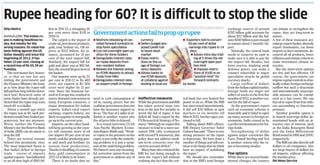
Governmentactionsfailtopropuprupee
||||||||||||||||||||||||||||||||||||||||||||||||||||||||||||||||||||||||||||||||||||||||||||||||||||||||||||||||||||||||||||||||||||||||||||||||||||
Restricts rebooking of can-
celled forward contracts to
stop forex speculation
Cuts net overnight open po-
sition for forex holders
Deregulates interest rates
on rupee deposits from
non-resident Indians
Relaxes the interest ceiling
on FCNR deposits to attract
funds from NRIs
Deregulates interest rates
on export credit in foreign
currency
Defers budget-pro-
posed GAAR rule
to boost stock
market
Eases restric-
tions on the us-
age of foreign cur-
rency deposits
Allows banks to
use FCNR deposits
at collateral against
lending to local cos
Exporters told to convert
50 per cent of dollar
earnings into rupee in 14
days
Allows intra-day trad-
ing at 5 times the net
overnight open posi-
tion limit
Imposes restric-
tions of $100 m on
“position limit” for
forward contracts
by banks
Dilip Maitra
BANGALORE: The Indian ru-
pee is making headlines to-
day, but mostly for the
wrong reasons. Its value has
been falling against the US
dollar steadily and since the
beginning of 2012, it has
fallen 23 per cent, closing at
a record low of Rs 55.39 on
Tuesday.
Theworrisomefact,howev-
er, is that no one has any
inkling, the government and
theFinanceMinistrytheleast,
as to how deep the rupee will
fallandhowlongwillthedown-
turn last? Research units of
some banks have already pre-
dictedthattherupeemaysoon
touch 60 to a dollar.
About a month ago when
the rupee was at 48, such pre-
dictionswouldhavelookedpre-
posterous, but not anymore.
Worst, neither the Finance
MinistrynortheReserveBank
of India (RBI) can do much to
stop the fall.
There are several reasons
behind this pessimistic view.
The most important factor is
that India’s deficit in foreign
trade – excess of imports
againstexports–hasballooned
to an all time high of $185 bil-
lion in 2011-12, a whopping 56
per cent more than $119 in
2010-11.
The culprit is the import of
crudeoil,petroleumproducts,
gold, coal, fetiliser etc. Oil im-
ports at $152 billion, for in-
stance, accounted for 31 per
cent of the total import bill.
Similarly, the import bill for
gold and silver was at $60 bil-
lion,thesecondlargestitemin
the basket.
Our imports went up by 32
per cent in 2011-12 to Rs 489
crore, our exports at Rs 304
crore were higher by 21 per
cent. Since the financial tur-
moil in Europe has resulted in
severedemandcontractionsin
many European countries, a
major destination for Indian
exports, India’s total export
earnings, experts believe, are
likelytostagnateormarginally
go up in the current year.
Imports, on the other hand,
will keep growing as the coun-
try will consume more of oil
(we import 80 per cent of our
need),coal(forproducingpow-
er and steel) and fertiliser (to
sustain food production).
Thankstodoublingofcustoms
duty, gold consumption in
2012-13 is likely to be lower.
There is no doubt that we
need to curb consumption of
oil by raising prices, but the
coalitiongovernmentdoesnot
have the necessary support to
do so. The fear of a spike in in-
flation is another reason why
the oil price hike is delayed.
In a recent interview, CLSA
Asia-Pacific Markets Econo-
mistRajeevMaliksaid,“Weak-
errupeeorthepressureonthe
rupeeisnotreallytheunderly-
ing problem; it is just a symp-
tomoftheunderlyingproblem.
Wehaven’tseenanymeaning-
ful corrective action from the
government to address any of
this.”
Ineffective measures
WhilethegovernmentandRBI
has taken several steps (see
box) in the last five months to
arrest the fall of rupee, it has
defied all. Said a report by the
FXResearch&StrategyofNo-
mura:“Althoughweexpectthis
measuretoleadtoamoresus-
tained INR rally (compared
withrecentFXmeasures),this
policy does not address medi-
um-term concerns over the
current account deficit.”
Manyhavealsocriticisedthe
RBI for not doing enough to
stem the rupee’s fall without
realising the fact that the cen-
tral bank has very limited fire
power to do so. While the RBI
has intervened intermittently,
it did sell $20 billion in spot
markets in six months till
March2012,buttherupeecon-
tinued to fall.
Talking about RBI’s efforts,
RBI Deputy Governor Subir
Gokarnhassaid:“Thereisvery
strong pressure on the rupee
to depreciate. We have done a
numberofthingsandwillcon-
tinuetodothingsthatwethink
have an impact of stabilising
the rupee.”
We should also remember
that in the RBI’s total foreign
exchange reserve of around
$292 billion gold accounts for
about $32 billion and the bal-
ance$260billionisjustenough
to sustain about 7 months’im-
port.
Naturally, the central bank
needs to conserve its cash to
make sure it is able to pay for
the import bill. Besides, low
forex reserve, implying weak
defence power, can make a
country vulnerable to major
speculative attacks by global
currency sharks.
Large outflow of dollars
fromtheIndiancapitalmarket,
foreign funds are major net
sellers of stocks in the first five
monthsof2012,isanotherrea-
son for the fall of rupee.
As the government’s report
card on economic reforms is
miserable and it failed to open
up many sectors to foreign in-
vestments, India ceased to be
apreferreddestinationforfor-
eign funds.
Strengthening of dollar
against major currencies like
Euro, Pound Sterling and Yen
is another reason why the ru-
pee is becoming weaker.
Few options
While there are several funda-
mental changes the country
Rupee heading for 60? It is difficult to stop the slide
can initiate to strengthen the
rupee, they are long-term in
nature.
A few of these measures are:
enlargeexportbasket,diversify
export destination, cut down
importstobareminimum,de-
control all oil products, lower
inflationandinitiatereformto
make investment climate at-
tractive.
But the short-term options
are few and less effective. Of
course, the government can
imposecapitalcontrolstodras-
ticallyreduceforeignexchange
outflow but such a draconian
and internationally unaccept-
able measure can be consid-
ered as a last resort. We can
buyoilinrupeefromIranwith-
out succumbing to American
pressure.
Another possible option is
to launch sovereign dollar de-
nominated bonds with an at-
tractive rate of interest, such
as the India Resurgent Bond
and the India Millennium
Bondissuedin1988and2000,
respectively.
TheRBIcanalsodirectlysell
dollars to oil companies, who
are large buyers of dollars for
oil imports, without affecting
the market price.
DH News Service

Inr sliding down for rs. 60

  • 1.
    |||||||||||||||||||||||||||||||||||||||||||||||||||||||||||||||||||||||||||||||||||||||||||||||||||||||||||||||||||||||||||||||||||||||||||||||||||| Governmentactionsfailtopropuprupee |||||||||||||||||||||||||||||||||||||||||||||||||||||||||||||||||||||||||||||||||||||||||||||||||||||||||||||||||||||||||||||||||||||||||||||||||||| Restricts rebooking ofcan- celled forward contracts to stop forex speculation Cuts net overnight open po- sition for forex holders Deregulates interest rates on rupee deposits from non-resident Indians Relaxes the interest ceiling on FCNR deposits to attract funds from NRIs Deregulates interest rates on export credit in foreign currency Defers budget-pro- posed GAAR rule to boost stock market Eases restric- tions on the us- age of foreign cur- rency deposits Allows banks to use FCNR deposits at collateral against lending to local cos Exporters told to convert 50 per cent of dollar earnings into rupee in 14 days Allows intra-day trad- ing at 5 times the net overnight open posi- tion limit Imposes restric- tions of $100 m on “position limit” for forward contracts by banks Dilip Maitra BANGALORE: The Indian ru- pee is making headlines to- day, but mostly for the wrong reasons. Its value has been falling against the US dollar steadily and since the beginning of 2012, it has fallen 23 per cent, closing at a record low of Rs 55.39 on Tuesday. Theworrisomefact,howev- er, is that no one has any inkling, the government and theFinanceMinistrytheleast, as to how deep the rupee will fallandhowlongwillthedown- turn last? Research units of some banks have already pre- dictedthattherupeemaysoon touch 60 to a dollar. About a month ago when the rupee was at 48, such pre- dictionswouldhavelookedpre- posterous, but not anymore. Worst, neither the Finance MinistrynortheReserveBank of India (RBI) can do much to stop the fall. There are several reasons behind this pessimistic view. The most important factor is that India’s deficit in foreign trade – excess of imports againstexports–hasballooned to an all time high of $185 bil- lion in 2011-12, a whopping 56 per cent more than $119 in 2010-11. The culprit is the import of crudeoil,petroleumproducts, gold, coal, fetiliser etc. Oil im- ports at $152 billion, for in- stance, accounted for 31 per cent of the total import bill. Similarly, the import bill for gold and silver was at $60 bil- lion,thesecondlargestitemin the basket. Our imports went up by 32 per cent in 2011-12 to Rs 489 crore, our exports at Rs 304 crore were higher by 21 per cent. Since the financial tur- moil in Europe has resulted in severedemandcontractionsin many European countries, a major destination for Indian exports, India’s total export earnings, experts believe, are likelytostagnateormarginally go up in the current year. Imports, on the other hand, will keep growing as the coun- try will consume more of oil (we import 80 per cent of our need),coal(forproducingpow- er and steel) and fertiliser (to sustain food production). Thankstodoublingofcustoms duty, gold consumption in 2012-13 is likely to be lower. There is no doubt that we need to curb consumption of oil by raising prices, but the coalitiongovernmentdoesnot have the necessary support to do so. The fear of a spike in in- flation is another reason why the oil price hike is delayed. In a recent interview, CLSA Asia-Pacific Markets Econo- mistRajeevMaliksaid,“Weak- errupeeorthepressureonthe rupeeisnotreallytheunderly- ing problem; it is just a symp- tomoftheunderlyingproblem. Wehaven’tseenanymeaning- ful corrective action from the government to address any of this.” Ineffective measures WhilethegovernmentandRBI has taken several steps (see box) in the last five months to arrest the fall of rupee, it has defied all. Said a report by the FXResearch&StrategyofNo- mura:“Althoughweexpectthis measuretoleadtoamoresus- tained INR rally (compared withrecentFXmeasures),this policy does not address medi- um-term concerns over the current account deficit.” Manyhavealsocriticisedthe RBI for not doing enough to stem the rupee’s fall without realising the fact that the cen- tral bank has very limited fire power to do so. While the RBI has intervened intermittently, it did sell $20 billion in spot markets in six months till March2012,buttherupeecon- tinued to fall. Talking about RBI’s efforts, RBI Deputy Governor Subir Gokarnhassaid:“Thereisvery strong pressure on the rupee to depreciate. We have done a numberofthingsandwillcon- tinuetodothingsthatwethink have an impact of stabilising the rupee.” We should also remember that in the RBI’s total foreign exchange reserve of around $292 billion gold accounts for about $32 billion and the bal- ance$260billionisjustenough to sustain about 7 months’im- port. Naturally, the central bank needs to conserve its cash to make sure it is able to pay for the import bill. Besides, low forex reserve, implying weak defence power, can make a country vulnerable to major speculative attacks by global currency sharks. Large outflow of dollars fromtheIndiancapitalmarket, foreign funds are major net sellers of stocks in the first five monthsof2012,isanotherrea- son for the fall of rupee. As the government’s report card on economic reforms is miserable and it failed to open up many sectors to foreign in- vestments, India ceased to be apreferreddestinationforfor- eign funds. Strengthening of dollar against major currencies like Euro, Pound Sterling and Yen is another reason why the ru- pee is becoming weaker. Few options While there are several funda- mental changes the country Rupee heading for 60? It is difficult to stop the slide can initiate to strengthen the rupee, they are long-term in nature. A few of these measures are: enlargeexportbasket,diversify export destination, cut down importstobareminimum,de- control all oil products, lower inflationandinitiatereformto make investment climate at- tractive. But the short-term options are few and less effective. Of course, the government can imposecapitalcontrolstodras- ticallyreduceforeignexchange outflow but such a draconian and internationally unaccept- able measure can be consid- ered as a last resort. We can buyoilinrupeefromIranwith- out succumbing to American pressure. Another possible option is to launch sovereign dollar de- nominated bonds with an at- tractive rate of interest, such as the India Resurgent Bond and the India Millennium Bondissuedin1988and2000, respectively. TheRBIcanalsodirectlysell dollars to oil companies, who are large buyers of dollars for oil imports, without affecting the market price. DH News Service