Literary terms
By Emily Weber
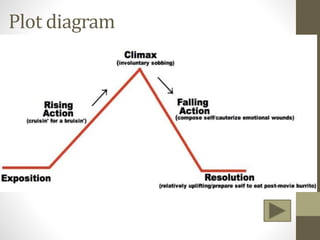
Plot
• Is the framework of a story—the
arrangement of related events that makes
the story hang together.
• The action in the story.
https://www.youtube.com/watch?v=WH5jlk
K4aUI
Exposition
• Introduces the basic situation of
the story and any information
the reader needs (setting,
background, characters) to get
oriented to the story.
Rising action
•Is the dramatic events that
move the plot along to its
point of greatest emotional
intensity.
complication
•Is the point in the
story the main
character
encounters an
obstacle.
Internal conflict
• Occurs when a character struggles
with a personal trait.
External conflict
• Occurs when a character struggles with forces outside of him
or herself.
Climax
• Is the point of most emotional intensity in a
story and often the turning point.
• The point at which the action in a story or play reaches its
emotional peak.
• the moment in the story or play at which a crisis reaches its
highest intensity and a decisive turning point.
Conflict
• Conflict:
The elements that create a plot. Traditionally, every plot
is build from the most basic elements of a conflict and an
eventual resolution. The conflict can be internal (within
one character) or external (among or between
characters, society, and/or nature).
Falling action
• Is the resolution of dramatic action after the
climax
Resolution
• Is the part of the plot in which
the problems are settled and
everything is made clear or
explained.
Suspense
• Is a technique used to hold the reader’s
interest.
Foreshadowing
• Is the technique of providing the readers wit hints, clues, or
indications about future action.
• A technique in which an author gives clues about something
that will happen later in the story.
• a device in which the author drops hints or otherwise
prepared the reader for an event to come later
• https://www.youtube.com/watch?v=Tooj33VgjaA
flashback
• Is the technique of going to a previous time, not within the
time frame of the story to provide the reader with back
ground information or to relate the story as if it is being
remembered.
Indirect characterization
• Occurs when the writer reveals the nature of his characters
through their appearance, speech, actions, thoughts, and
responses of other characters
protagonist
• Is a story’s main character
• Is the good guy in the story
• Is the hero of the story
antagonist
• Is the character or force that comes into conflict with the
main character.
• Is the bad guy or villain in the story
• A major character who opposes the protagonist in a story or
play.
• the major character in opposition to the hero or protagonist of
a narrative or drama
Characters
• The people, animals, or creatures in a story.
Dynamic character
• Change significantly during the course of a story.
Static character
• Characters remain the same throughout a story.
Flat characters
• Have only one or two key personality traits
Round character
• Are three-dimensional characters
Stock characters
• Fit a preconceived notion about a specific type, much like a
stereotype.
Omniscient
• Is a narrator that is godlike observer who knows everything
thing that is going on and who can see into every character’s
heart and mind
First-person
• Is a narrator that relates events of the story, and takes part
in the action using “I.”
• The point of view of writing which the narrator refers to
himself as “I.”
• narrator is a character in the story; uses “I,” “we,” etc.
Third Person
• narrator outside the story; uses “he,” “she,” “they”
Limited third-person
• Is a narrator that speaks form the vantage point of a single
character.
• narrator tells only what one character perceives
Third-person objective.
• Is when the narrator is not a character in the story and
reports only what can be seen and heard. Unspoken
thoughts and feelings are not revealed.
Figurative language
• Is a language that goes beyond its usual literal meaning to achieve emphasis or to
express a relationship between unlike things. A figurative expression usually
contains a stated or implied comparison.
• Examples: The redcoats are coming!,
• Language that does not mean exactly what it says. For example, you can call
someone who is very angry “steaming.” Unless steam was actually coming out of
your ears, you were using figurative language.
Simile
• Is a figure of speech in which two essentially unlike things are directly compared, usually with
words like or as.
• Examples: As busy as a bee, As cold as ice, Our soldiers are as brave as lions, Her cheeks are red
like a rose, She swims like a fish, The world is like a stage, The night was as black as coal, “Do
you ever feel like a plastic bag?”, as busy as a bee, as snug as a bug in a rug, as black as coal, as
blind as a bat, as smooth as glass, as gentle as a lamb, as clear as a crystal, as hard as rock, as
flat as a pancake, as white as snow, as clean as a whistle, as free as a bird, as hot as hell, as mad
as a hatter, as pretty as a picture, as sharp as a knife, as wise as an owl, as fat as a pig, as brave
as a lion, as gentle as a lamb,
Metaphor
• Is an implied comparison between things essentially
• A comparison that doesn’t use “like” or “as”—such as “He’s a rock” or “I am an island.” unlike.
• Examples: Her voice is music to his ears, you are my sunshine, she froze with fear, I’m the king of
the world, love is a battlefield, food for thought,
Extended metaphor
• Is a metaphor, an implied comparison that runs through an entire work or portion of a work.
Most often found in poetry.
personification
• Is a figure of speech in which human characteristics are assigned to non-human things, or life is
attributed to inanimate objects.
• Giving inanimate object human characteristics. For example, “The flames reached for the child
hovering in the corner.”
• Examples: The flowers danced in the gentle breeze, Time creeps up on you, The news took me by
surprise, The fire ran wild, this city never sleeps, the city that never sleeps, the grease jumped
out of the pan,
onomatopoeia
• Is use of words having sounds that suggest their meaning or which imitate the sound associated
with them.
• A word that makes a sound
• The use of words that sound like what they mean such as “buzz.”
• Examples: the buzzing bee flew away, The sack fell into the river with a splash, bang, hop, pluck,
clap, crack, meow, honk, crunch, pop,
hyperbole
• Is a figure of speech involving great exaggeration. The effect may be satirical, sentimental, or
comic.
• For entertainment or amusement.
• Examples: I have a ton of homework, I’m so hungry, I could eat a horse, Hit the lights, My mom
is going to kill me, I’ve told a million times, It was so cold, I saw polar bears wearing jackets, I
can smell pizza from a mile away, The lesson was taking forever, I could listen to that song on
repeat forever,
imagery
• Is language that appeals to what can be seen, heard, touch, taste, smell, as well as what can be
felt internally (to senses) in order to re-create the experience being communicated and the
emotional response appropriate to the experience.
• The use of description that helps the reader imagine how something looks, sounds, feels, smells,
or taste. Most of the time, it refers to appearance. For example, “The young bird’s white,
feathered wings flutter as he made his way across the nighttime sky.”
• https://www.youtube.com/watch?v=M0ymDfJge8c&index=4&list=PLndfEMRm03EVKXV5FsHw
mH6-fDs1J_fkB
irony
• Is a figure of speech in which the author implies what is meant, or what has occurred, is
different from what was thought or expected.
• Examples: “Oh great! Now you have broken my new camera.”
Language that conveys a certain ideas by saying just he opposite.
• Can be verbal, situational, or dramatic and has the result of the meaning, situation or action
being one thing but meaning something different.
• https://www.youtube.com/watch?v=YgV4Bj8U0Mo&index=5&list=PLndfEMRm03EVKXV5FsHw
mH6-fDs1J_fkB
tone
• Is a writer’s attitude and what he or she wants the reader to feel.
theme
• Is the main idea or underlying of a literary work. A theme may be directly stated, but more often
it is implied by the author.
• https://www.youtube.com/watch?v=kN6Ug_HYZYc
inference
• Is a reasonable guess based on evidence found in the text.
stanza
• Is a group of lines in a poem.
prose
• Is any non-metrical language, novels, short stories, letters, emails, ect. In other words, all
writing except poetry and drama (scripted plays).
symbol
• Something concrete that means to represent an abstract idea or notion. For example, the heart
shape which is concrete represents the abstract notion of love.
Suspense
• A sense of excitement, tension, dread or fear about what will
happen next
Narrator
• Character who tells the story; can be the author or a fictional
character.
Dramatic Irony
• When the reader or viewer knows something the character
does not know
Situational Irony
• Contrast between what a reader or character expects and
what actually exists or happens.
Verbal Irony
• When someone knowingly exaggerates or says one thing and
means another
Dialect
• The form of language spoken in a particular area by particular
people.
Word choice
• Can make a work sound formal or informal, serious, or
humorous; words must be chosen carefully depending on the
goal of the piece of writing
Third-person Limited Point of View
• Tells only what one character thinks, feels, and observes
Third-person Omniscient Point of
View
• also called "all knowing point of view"; the narrator sees into
the mind of all of the characters
Allusion
• A reference to another literary figure or time period.
Prologue
• The opening line od a drama that gives background
information
Pun
• A play on words when a word has more than one meaning.
• Examples: I find this humerus, Hurray for math puns,
Foil Character
• Created to highlight traits of other characters.
Types of conflict.
• Man vs. Man
• Man vs. Inner self.
• Man vs. Outside force
Plot diagram
Conflict Videos
• https://www.youtube.com/watch?v=rM5cp_YL77k
• https://www.youtube.com/watch?v=r4JxmGe1iGI
• https://www.youtube.com/watch?v=rg_10OfdEss
Videos
• https://www.youtube.com/watch?v=p50_yNQLj5c
• https://www.youtube.com/watch?v=vMSLgxj2dxk
• https://www.youtube.com/watch?v=A9uKwQ4VzHM
Alliteration
• https://www.youtube.com/watch?v=tbClrV6Ifgs
Symbolism
• Symbolism is the use of symbols to signify ideas and qualities
by giving them symbolic meanings that are different from
their literal sense.
• https://www.youtube.com/watch?v=26-Q_QUG6bA
Analogy
• An analogy is a literary device that helps to establish a relationship based on similarities between
two concepts or ideas. By using an analogy we can convey a new idea by using the blueprint of an
old one as a basis for understanding. With a mental linkage between the two, one can create
understanding regarding the new concept in a simple and succinct manner.
Biography
• A biography is simply a bio that gives an account or detailed description about the life
of a person. It entails basic facts such as childhood, education, career, relationships,
family and death. Biography is a literary genre that portrays the experiences of all
these events occurred in the life of a person mostly in a chronological order. Unlike a
resume or profile, biography
Flashback
• Flashbacks are interruptions that writers do to insert past events in order to provide
background or context to the current events of a narrative. By using flashbacks,
writers allow their readers to gain insight into a character’s motivation and provide a
background to a current conflict. Dream sequences and memories are methods used
to present flashbacks.
• Is a literary device that allows writers to show their audience specific events that
happened before the current action of the story.
Inference
• Flashbacks are interruptions that writers do to insert past events in order to provide
background or context to the current events of a narrative. By using flashbacks,
writers allow their readers to gain insight into a character’s motivation and provide a
background to a current conflict. Dream sequences and memories are methods used
to present flashbacks.
Genre
• Is a category system that literature falls into based on specific
conventions that develop to characterize the differences.
Parody
• a satirical imitation of the style of another written work.
Satire
• the literary art of belittling a subject by making it seem
ridiculous and evoking towards it attitudes of amusement,
contempt, or scorn; satire frequently attempts to correct
human vices and follies.
• Any form of literature that blends ironic humor with criticism
for the purpose of ridiculing vice and stupidity in individuals
and institutions.
Setting
sonnet
Subplot
symbol
tone
• the attitude of the writer toward his subject and his audience,
revealed through his diction and his choice of emphasis; the
tone of a work might be formal, or intimate, solemn or
playful, serious, ironic, humorous.
mood
• the atmosphere or feeling developed in a literary work; light-
hearted, romantic, eerie, somber, tragic.
theme
• the central idea or thesis of a literary work.
narrator
climax
allusion
foreshadowing
onomatopoeia
metaphor
personification
refrain
imagery
• language that evokes one or all of the five senses: seeing,
hearing, tasting, smelling, touching

Freshman literary terms

  • 1.
  • 2.
    Plot • Is theframework of a story—the arrangement of related events that makes the story hang together. • The action in the story. https://www.youtube.com/watch?v=WH5jlk K4aUI
  • 3.
    Exposition • Introduces thebasic situation of the story and any information the reader needs (setting, background, characters) to get oriented to the story.
  • 4.
    Rising action •Is thedramatic events that move the plot along to its point of greatest emotional intensity.
  • 5.
    complication •Is the pointin the story the main character encounters an obstacle.
  • 6.
    Internal conflict • Occurswhen a character struggles with a personal trait.
  • 7.
    External conflict • Occurswhen a character struggles with forces outside of him or herself.
  • 8.
    Climax • Is thepoint of most emotional intensity in a story and often the turning point. • The point at which the action in a story or play reaches its emotional peak. • the moment in the story or play at which a crisis reaches its highest intensity and a decisive turning point.
  • 9.
    Conflict • Conflict: The elementsthat create a plot. Traditionally, every plot is build from the most basic elements of a conflict and an eventual resolution. The conflict can be internal (within one character) or external (among or between characters, society, and/or nature).
  • 10.
    Falling action • Isthe resolution of dramatic action after the climax
  • 11.
    Resolution • Is thepart of the plot in which the problems are settled and everything is made clear or explained.
  • 12.
    Suspense • Is atechnique used to hold the reader’s interest.
  • 13.
    Foreshadowing • Is thetechnique of providing the readers wit hints, clues, or indications about future action. • A technique in which an author gives clues about something that will happen later in the story. • a device in which the author drops hints or otherwise prepared the reader for an event to come later • https://www.youtube.com/watch?v=Tooj33VgjaA
  • 14.
    flashback • Is thetechnique of going to a previous time, not within the time frame of the story to provide the reader with back ground information or to relate the story as if it is being remembered.
  • 15.
    Indirect characterization • Occurswhen the writer reveals the nature of his characters through their appearance, speech, actions, thoughts, and responses of other characters
  • 16.
    protagonist • Is astory’s main character • Is the good guy in the story • Is the hero of the story
  • 17.
    antagonist • Is thecharacter or force that comes into conflict with the main character. • Is the bad guy or villain in the story • A major character who opposes the protagonist in a story or play. • the major character in opposition to the hero or protagonist of a narrative or drama
  • 18.
    Characters • The people,animals, or creatures in a story.
  • 19.
    Dynamic character • Changesignificantly during the course of a story.
  • 20.
    Static character • Charactersremain the same throughout a story.
  • 21.
    Flat characters • Haveonly one or two key personality traits
  • 22.
    Round character • Arethree-dimensional characters
  • 23.
    Stock characters • Fita preconceived notion about a specific type, much like a stereotype.
  • 24.
    Omniscient • Is anarrator that is godlike observer who knows everything thing that is going on and who can see into every character’s heart and mind
  • 25.
    First-person • Is anarrator that relates events of the story, and takes part in the action using “I.” • The point of view of writing which the narrator refers to himself as “I.” • narrator is a character in the story; uses “I,” “we,” etc.
  • 26.
    Third Person • narratoroutside the story; uses “he,” “she,” “they”
  • 27.
    Limited third-person • Isa narrator that speaks form the vantage point of a single character. • narrator tells only what one character perceives
  • 28.
    Third-person objective. • Iswhen the narrator is not a character in the story and reports only what can be seen and heard. Unspoken thoughts and feelings are not revealed.
  • 29.
    Figurative language • Isa language that goes beyond its usual literal meaning to achieve emphasis or to express a relationship between unlike things. A figurative expression usually contains a stated or implied comparison. • Examples: The redcoats are coming!, • Language that does not mean exactly what it says. For example, you can call someone who is very angry “steaming.” Unless steam was actually coming out of your ears, you were using figurative language.
  • 30.
    Simile • Is afigure of speech in which two essentially unlike things are directly compared, usually with words like or as. • Examples: As busy as a bee, As cold as ice, Our soldiers are as brave as lions, Her cheeks are red like a rose, She swims like a fish, The world is like a stage, The night was as black as coal, “Do you ever feel like a plastic bag?”, as busy as a bee, as snug as a bug in a rug, as black as coal, as blind as a bat, as smooth as glass, as gentle as a lamb, as clear as a crystal, as hard as rock, as flat as a pancake, as white as snow, as clean as a whistle, as free as a bird, as hot as hell, as mad as a hatter, as pretty as a picture, as sharp as a knife, as wise as an owl, as fat as a pig, as brave as a lion, as gentle as a lamb,
  • 31.
    Metaphor • Is animplied comparison between things essentially • A comparison that doesn’t use “like” or “as”—such as “He’s a rock” or “I am an island.” unlike. • Examples: Her voice is music to his ears, you are my sunshine, she froze with fear, I’m the king of the world, love is a battlefield, food for thought,
  • 32.
    Extended metaphor • Isa metaphor, an implied comparison that runs through an entire work or portion of a work. Most often found in poetry.
  • 33.
    personification • Is afigure of speech in which human characteristics are assigned to non-human things, or life is attributed to inanimate objects. • Giving inanimate object human characteristics. For example, “The flames reached for the child hovering in the corner.” • Examples: The flowers danced in the gentle breeze, Time creeps up on you, The news took me by surprise, The fire ran wild, this city never sleeps, the city that never sleeps, the grease jumped out of the pan,
  • 34.
    onomatopoeia • Is useof words having sounds that suggest their meaning or which imitate the sound associated with them. • A word that makes a sound • The use of words that sound like what they mean such as “buzz.” • Examples: the buzzing bee flew away, The sack fell into the river with a splash, bang, hop, pluck, clap, crack, meow, honk, crunch, pop,
  • 35.
    hyperbole • Is afigure of speech involving great exaggeration. The effect may be satirical, sentimental, or comic. • For entertainment or amusement. • Examples: I have a ton of homework, I’m so hungry, I could eat a horse, Hit the lights, My mom is going to kill me, I’ve told a million times, It was so cold, I saw polar bears wearing jackets, I can smell pizza from a mile away, The lesson was taking forever, I could listen to that song on repeat forever,
  • 36.
    imagery • Is languagethat appeals to what can be seen, heard, touch, taste, smell, as well as what can be felt internally (to senses) in order to re-create the experience being communicated and the emotional response appropriate to the experience. • The use of description that helps the reader imagine how something looks, sounds, feels, smells, or taste. Most of the time, it refers to appearance. For example, “The young bird’s white, feathered wings flutter as he made his way across the nighttime sky.” • https://www.youtube.com/watch?v=M0ymDfJge8c&index=4&list=PLndfEMRm03EVKXV5FsHw mH6-fDs1J_fkB
  • 37.
    irony • Is afigure of speech in which the author implies what is meant, or what has occurred, is different from what was thought or expected. • Examples: “Oh great! Now you have broken my new camera.” Language that conveys a certain ideas by saying just he opposite. • Can be verbal, situational, or dramatic and has the result of the meaning, situation or action being one thing but meaning something different. • https://www.youtube.com/watch?v=YgV4Bj8U0Mo&index=5&list=PLndfEMRm03EVKXV5FsHw mH6-fDs1J_fkB
  • 38.
    tone • Is awriter’s attitude and what he or she wants the reader to feel.
  • 39.
    theme • Is themain idea or underlying of a literary work. A theme may be directly stated, but more often it is implied by the author. • https://www.youtube.com/watch?v=kN6Ug_HYZYc
  • 40.
    inference • Is areasonable guess based on evidence found in the text.
  • 41.
    stanza • Is agroup of lines in a poem.
  • 42.
    prose • Is anynon-metrical language, novels, short stories, letters, emails, ect. In other words, all writing except poetry and drama (scripted plays).
  • 43.
    symbol • Something concretethat means to represent an abstract idea or notion. For example, the heart shape which is concrete represents the abstract notion of love.
  • 44.
    Suspense • A senseof excitement, tension, dread or fear about what will happen next
  • 45.
    Narrator • Character whotells the story; can be the author or a fictional character.
  • 46.
    Dramatic Irony • Whenthe reader or viewer knows something the character does not know
  • 47.
    Situational Irony • Contrastbetween what a reader or character expects and what actually exists or happens.
  • 48.
    Verbal Irony • Whensomeone knowingly exaggerates or says one thing and means another
  • 49.
    Dialect • The formof language spoken in a particular area by particular people.
  • 50.
    Word choice • Canmake a work sound formal or informal, serious, or humorous; words must be chosen carefully depending on the goal of the piece of writing
  • 51.
    Third-person Limited Pointof View • Tells only what one character thinks, feels, and observes
  • 52.
    Third-person Omniscient Pointof View • also called "all knowing point of view"; the narrator sees into the mind of all of the characters
  • 53.
    Allusion • A referenceto another literary figure or time period.
  • 54.
    Prologue • The openingline od a drama that gives background information
  • 55.
    Pun • A playon words when a word has more than one meaning. • Examples: I find this humerus, Hurray for math puns,
  • 56.
    Foil Character • Createdto highlight traits of other characters.
  • 57.
    Types of conflict. •Man vs. Man • Man vs. Inner self. • Man vs. Outside force
  • 58.
  • 59.
    Conflict Videos • https://www.youtube.com/watch?v=rM5cp_YL77k •https://www.youtube.com/watch?v=r4JxmGe1iGI • https://www.youtube.com/watch?v=rg_10OfdEss
  • 60.
  • 61.
  • 62.
    Symbolism • Symbolism isthe use of symbols to signify ideas and qualities by giving them symbolic meanings that are different from their literal sense. • https://www.youtube.com/watch?v=26-Q_QUG6bA
  • 63.
    Analogy • An analogyis a literary device that helps to establish a relationship based on similarities between two concepts or ideas. By using an analogy we can convey a new idea by using the blueprint of an old one as a basis for understanding. With a mental linkage between the two, one can create understanding regarding the new concept in a simple and succinct manner.
  • 64.
    Biography • A biographyis simply a bio that gives an account or detailed description about the life of a person. It entails basic facts such as childhood, education, career, relationships, family and death. Biography is a literary genre that portrays the experiences of all these events occurred in the life of a person mostly in a chronological order. Unlike a resume or profile, biography
  • 65.
    Flashback • Flashbacks areinterruptions that writers do to insert past events in order to provide background or context to the current events of a narrative. By using flashbacks, writers allow their readers to gain insight into a character’s motivation and provide a background to a current conflict. Dream sequences and memories are methods used to present flashbacks. • Is a literary device that allows writers to show their audience specific events that happened before the current action of the story.
  • 66.
    Inference • Flashbacks areinterruptions that writers do to insert past events in order to provide background or context to the current events of a narrative. By using flashbacks, writers allow their readers to gain insight into a character’s motivation and provide a background to a current conflict. Dream sequences and memories are methods used to present flashbacks.
  • 67.
    Genre • Is acategory system that literature falls into based on specific conventions that develop to characterize the differences.
  • 68.
    Parody • a satiricalimitation of the style of another written work.
  • 69.
    Satire • the literaryart of belittling a subject by making it seem ridiculous and evoking towards it attitudes of amusement, contempt, or scorn; satire frequently attempts to correct human vices and follies. • Any form of literature that blends ironic humor with criticism for the purpose of ridiculing vice and stupidity in individuals and institutions.
  • 70.
  • 71.
  • 72.
  • 73.
  • 74.
    tone • the attitudeof the writer toward his subject and his audience, revealed through his diction and his choice of emphasis; the tone of a work might be formal, or intimate, solemn or playful, serious, ironic, humorous.
  • 75.
    mood • the atmosphereor feeling developed in a literary work; light- hearted, romantic, eerie, somber, tragic.
  • 76.
    theme • the centralidea or thesis of a literary work.
  • 77.
  • 78.
  • 79.
  • 80.
  • 81.
  • 82.
  • 83.
  • 84.
  • 85.
    imagery • language thatevokes one or all of the five senses: seeing, hearing, tasting, smelling, touching