CH A P T E R                   4
               Configuring BTS Components

Bulk Provisioning
               To use information on one BTS server to configure another BTS server:
               1.   use the bulk_export command to generate a CLI file from the first BTS server
               2.   use the bulk_import command to load that generated CLI file on the other BTS server; it uses SSL
                    to transfer the file from the EPOM server to the BTS server
               bts_export looks like the following:
               root@cyber229:opt 21> /opt/CSCOepom/bin/bts_export

               NAME

                    bts_export - BTS Config Export

               SYNOPSIS

                    bts_export -h hostname -v BTSver of hostname -o outfile [-l login -p password

               ]

               DESCRIPTION

                    Export a BTS Configuration.

               OPTIONS

                    -h     Hostname

                    -v     BTSversion of hostname (3.5,4.1,4.2,4.4.0,4.4.1. 4.5.0)

                    -o     Output file

                    -l     Login

                    -p     Password

                    -s     Site ID

               EXAMPLES

                    1. bts_export -h bts_host -v host_bts_ver -o config.cli

                    2. bts_export -h bts_host -v host_bts_ver -l login -p passwd -s                          siteid -o con

                         fig.cli

               bts_import looks like the following:
               root@cyber229:opt 22> /opt/CSCOepom/bin/bts_import


                                                            Cisco BTS 10200 Softswitch EPOM Getting Started Guide
 OL-14433-01                                                                                                         4-1
Chapter 4   Configuring BTS Components
  Bulk Data Export


                       NAME

                             bts_import - BTS Config Import

                       SYNOPSIS

                             bts_import -h hostname -u username       -f inputfile

                       DESCRIPTION

                             Import a BTS Configuration.

                       OPTIONS

                             -h    Hostname

                             -f    Input file

                             -u    User name

                       EXAMPLES

                             1. bts_import -h bts_host -u usrname -f config.cli


Bulk Data Export
                       Using the export.xml (input) file in /opt/CSCOepom/bin/, you can export all data in a BTS release from
                       the EPOM to the BTS.
                       Each noun has an entry in the export.xml file. For example:
                       <itemlist>
                             <item noun="call_agent"/>
                             <item noun="domain2route"/>
                             ...
                       </itemlist>
                       When you enter bts_export the EPOM sequentially selects each noun and verb from export.xml. (Verbs
                       distinguish between add or change commands). For each noun and verb the following occurs:
                        1.   The bts_export module picks a noun or verb from export.xml.
                        2.   The bts_export module generates the show command.
                        3.   EPOM sends the request as “show <noun>” to the BTS.
                        4.   The BTS sends a response to EPOM containing all of that noun's or verb’s attributes in the BTS.
                        5.   EPOM parses the response.
                        6.   EPOM generates an add or change command, based on the noun's attributes and value. Some nouns
                             do not support the add command; they use change instead.
                        7.   EPOM writes these add/change commands to the text output file you specify in
                             /opt/CSCOepom/bin/.


Exporting Data from EPOM to BTS
             Step 1    Go to /opt/CSCOepom/bin/.


             Cisco BTS 10200 Softswitch EPOM Getting Started Guide
 4-2                                                                                                                   OL-14433-01
Chapter 4     Configuring BTS Components
                                                                                                                  Connecting EMS Servers


                Step 2     Enter bts_export -h hostname -v BTSver of hostname -o outfile [-l login
                           -p password.
                           The text output file you specify containing all data in a BTS release appears in /opt/CSCOepom/bin/


Connecting EMS Servers

Before Adding EMS Servers
                           Before adding an EMS server complete the tasks in this checklist.

                           Tasks
                                      Ensure you have the hostname and IP address of the EMS server.

                                      Ensure you have the login and password of the EMS server.

                                      Ensure you have the Site ID of the EMS server:
                                      1. Log in to the EMS server as the root user.
                                      2. Enter:
                                      grep SITEID /etc/opticall.cfg
                                      SITEID=rtpvtc2


Adding EMS Servers
                           Add an EMS server to the “all” domain and set up the initial configuration.


                Step 1     Start EPOM.
                           EPOM opens to the Domain Management window.
                Step 2     In the Domain pane, in the all domain row, click Edit.
                           The Modify component, Domain window opens.


                  Tip      Because you are viewing the “all” domain, the Inventory and Groups items are also preceded by “all”
                           (all Inventory and all Groups).

                Step 3     In the all Inventory pane, click Add.
                           The Add component window opens.
                Step 4     Enter:
                            •   Hostname: hostname or IP address of EMS server
                            •   Type: BTS 10200
                            •   Login: EMS server login
                            •   Password: EMS server password


                                                                         Cisco BTS 10200 Softswitch EPOM Getting Started Guide
 OL-14433-01                                                                                                                         4-3
Chapter 4   Configuring BTS Components
  Connecting EMS Servers


                           •   Site ID: site ID for EMS server
            Step 5     Click OK.


Configuring EMS Servers
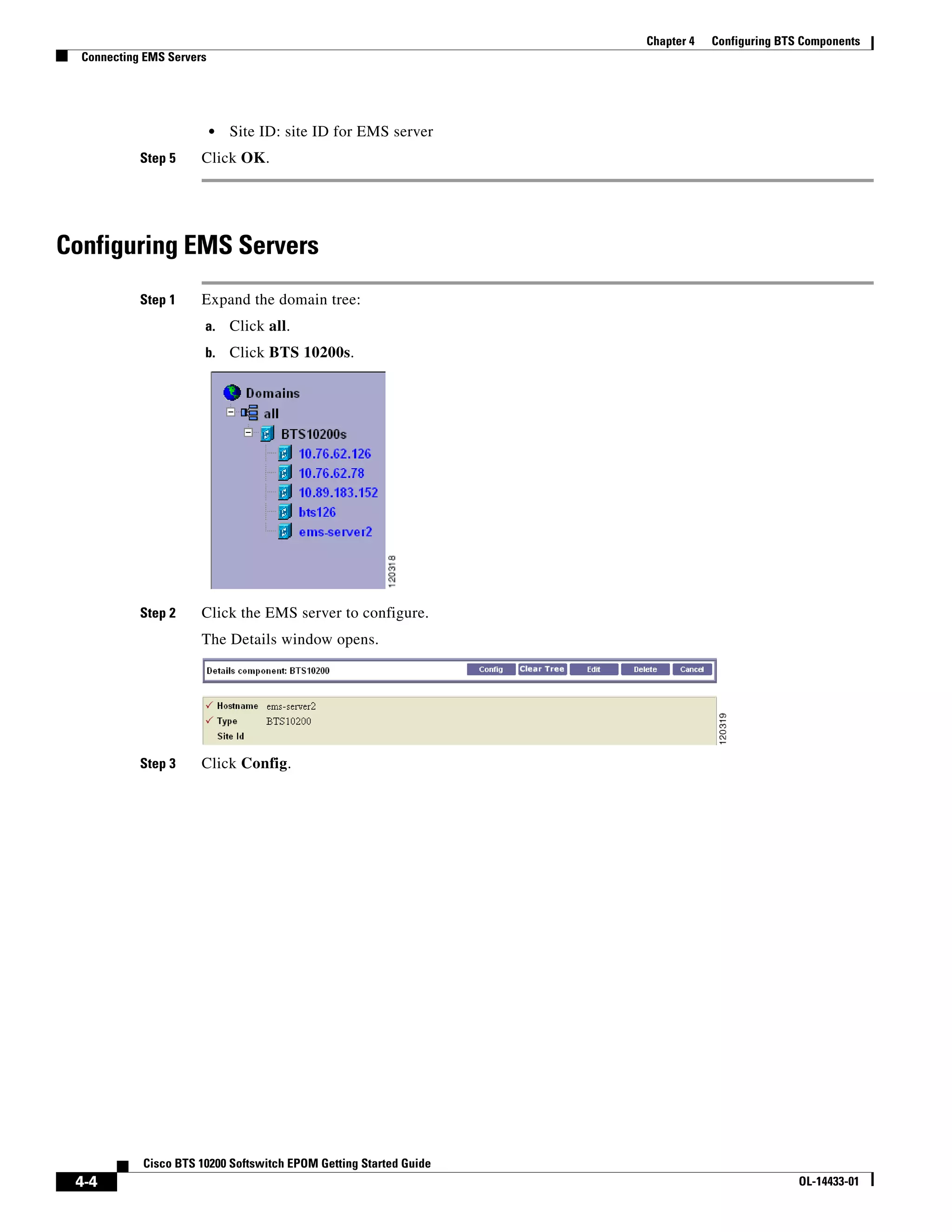
            Step 1     Expand the domain tree:
                       a.      Click all.
                       b.      Click BTS 10200s.


            Step 2     Click the EMS server to configure.
                       The Details window opens.


            Step 3     Click Config.


            Cisco BTS 10200 Softswitch EPOM Getting Started Guide
 4-4                                                                                           OL-14433-01
Chapter 4     Configuring BTS Components
                                                                                                                Managing BTS Components


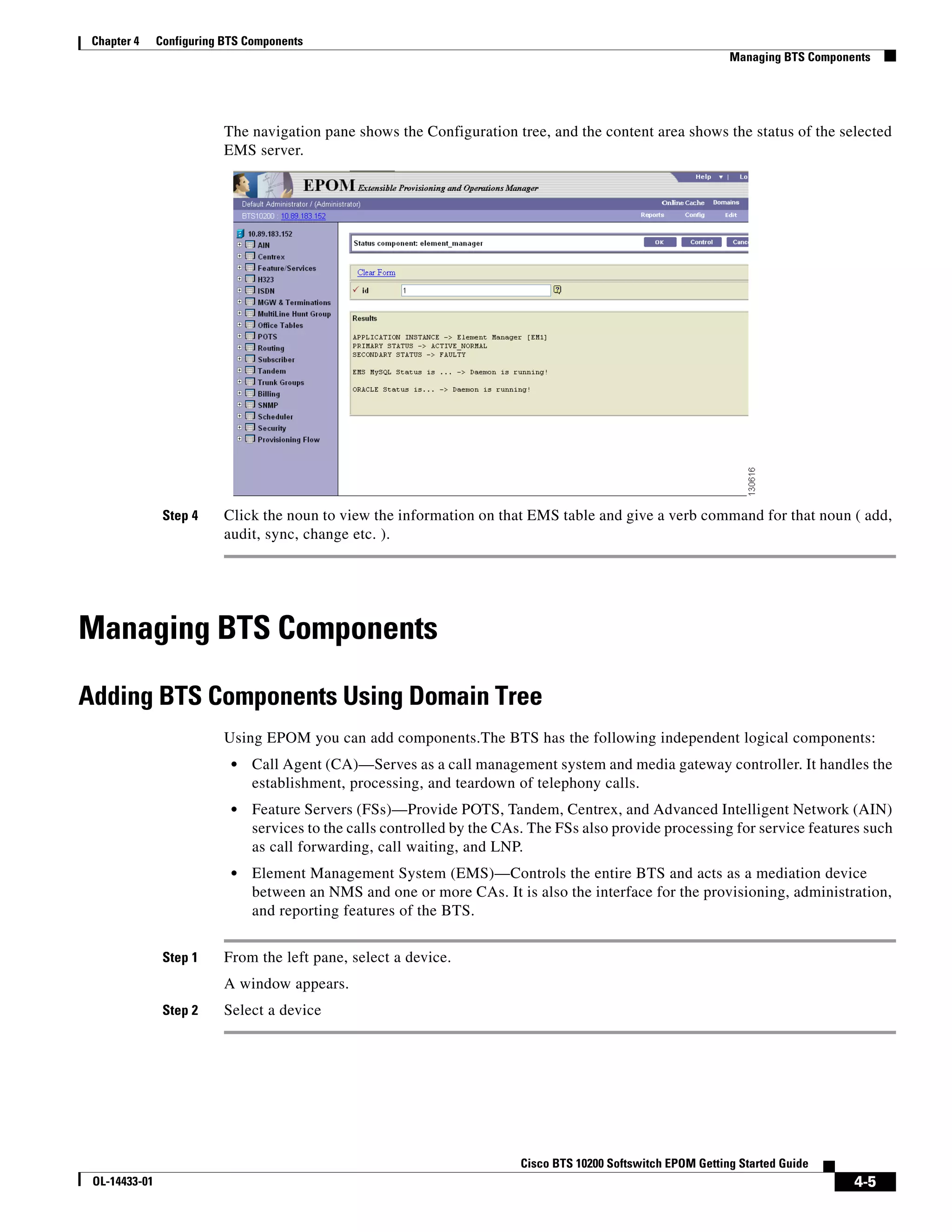
                           The navigation pane shows the Configuration tree, and the content area shows the status of the selected
                           EMS server.


                Step 4     Click the noun to view the information on that EMS table and give a verb command for that noun ( add,
                           audit, sync, change etc. ).


Managing BTS Components

Adding BTS Components Using Domain Tree
                           Using EPOM you can add components.The BTS has the following independent logical components:
                            •   Call Agent (CA)—Serves as a call management system and media gateway controller. It handles the
                                establishment, processing, and teardown of telephony calls.
                            •   Feature Servers (FSs)—Provide POTS, Tandem, Centrex, and Advanced Intelligent Network (AIN)
                                services to the calls controlled by the CAs. The FSs also provide processing for service features such
                                as call forwarding, call waiting, and LNP.
                            •   Element Management System (EMS)—Controls the entire BTS and acts as a mediation device
                                between an NMS and one or more CAs. It is also the interface for the provisioning, administration,
                                and reporting features of the BTS.


                Step 1     From the left pane, select a device.
                           A window appears.
                Step 2     Select a device


                                                                          Cisco BTS 10200 Softswitch EPOM Getting Started Guide
 OL-14433-01                                                                                                                        4-5
Chapter 4   Configuring BTS Components
  Managing BTS Components


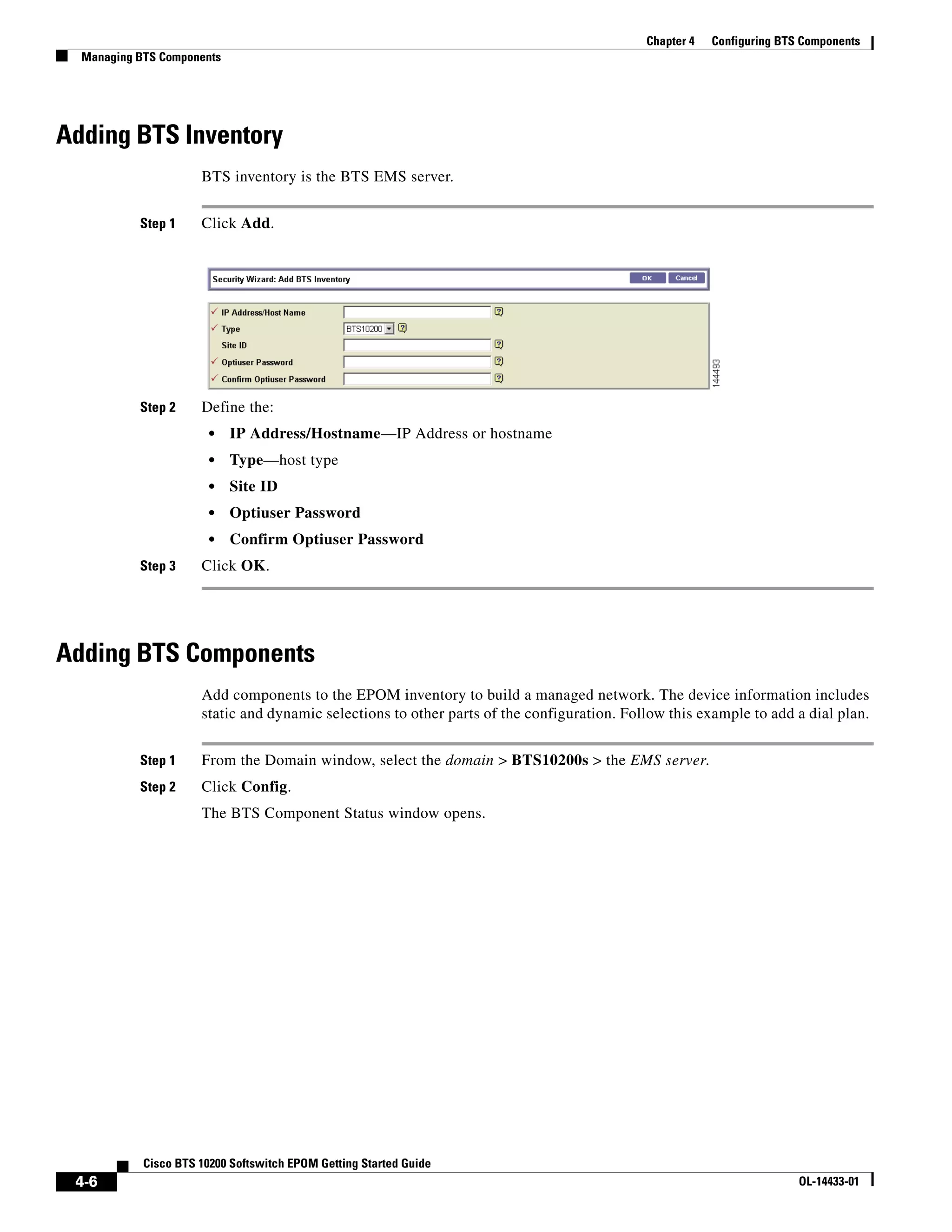
Adding BTS Inventory
                      BTS inventory is the BTS EMS server.


           Step 1     Click Add.


           Step 2     Define the:
                        •   IP Address/Hostname—IP Address or hostname
                        •   Type—host type
                        •   Site ID
                        •   Optiuser Password
                        •   Confirm Optiuser Password
           Step 3     Click OK.


Adding BTS Components
                      Add components to the EPOM inventory to build a managed network. The device information includes
                      static and dynamic selections to other parts of the configuration. Follow this example to add a dial plan.


           Step 1     From the Domain window, select the domain > BTS10200s > the EMS server.
           Step 2     Click Config.
                      The BTS Component Status window opens.


            Cisco BTS 10200 Softswitch EPOM Getting Started Guide
 4-6                                                                                                                   OL-14433-01
Chapter 4     Configuring BTS Components
                                                                                                             Managing BTS Components


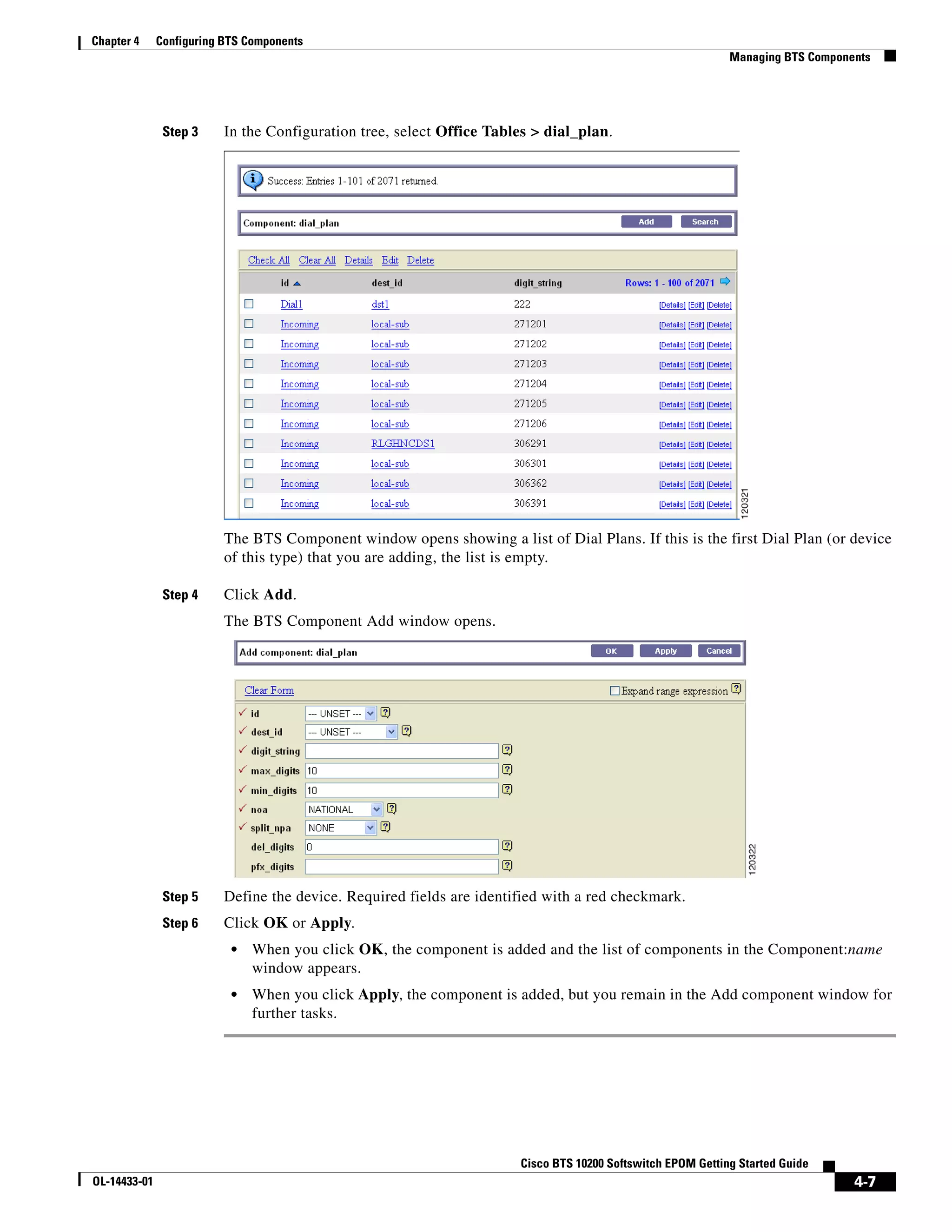
               Step 3     In the Configuration tree, select Office Tables > dial_plan.


                          The BTS Component window opens showing a list of Dial Plans. If this is the first Dial Plan (or device
                          of this type) that you are adding, the list is empty.

               Step 4     Click Add.
                          The BTS Component Add window opens.


               Step 5     Define the device. Required fields are identified with a red checkmark.
               Step 6     Click OK or Apply.
                           •   When you click OK, the component is added and the list of components in the Component:name
                               window appears.
                           •   When you click Apply, the component is added, but you remain in the Add component window for
                               further tasks.


                                                                       Cisco BTS 10200 Softswitch EPOM Getting Started Guide
OL-14433-01                                                                                                                      4-7
Chapter 4   Configuring BTS Components
  Managing BTS Components


Checking Status and Controlling Components
           Step 1     From the Domain window, navigate to EMS server.
           Step 2     Click Config.
                      The BTS Component Status window opens. The Configuration tree appears in the left navigation pane.
           Step 3     Navigate to device and click to select it.
           Step 4     In the Status window, click Control.
           Step 5     From the Component Control window, verify that you have selected the correct component, then select
                      a target_state.
           Step 6     Select state.
                      Options depend on the type of component that you selected.
           Step 7     Click OK.


Adding Multiple Components
                      You can only perform bulk provisioning commands on the same type of devices. For instance, if a group
                      of subscribers use the same media gateway and subscriber profile, you can add or edit these subscribers
                      by using a single command.


           Step 1     In the EMS-Server window left pane, click a component.
                      The Component:name window appears.
           Step 2     Click Add.
                      The Add component window appears.


           Step 3     Select the Expand range expression check box.
           Step 4     In the ID field, enter a range expression in square brackets [ ].
                      For example, to add a group of 10 dial plans with the id prefix dp001_new, enter dp001_new[01-10].
                      Doing so adds dial plans dp001_new01, dp001_new02, through dp001_new10.
           Step 5     Enter information in the remaining attribute fields.


            Cisco BTS 10200 Softswitch EPOM Getting Started Guide
 4-8                                                                                                                 OL-14433-01
Chapter 4     Configuring BTS Components
                                                                                                               Managing BTS Components


                Step 6     Click OK or Apply.
                            •   When you click OK, the component is added and the list of components in the Component:name
                                window appears.
                            •   When you click Apply, the component is added, but you remain in the Add component window for
                                further operations.


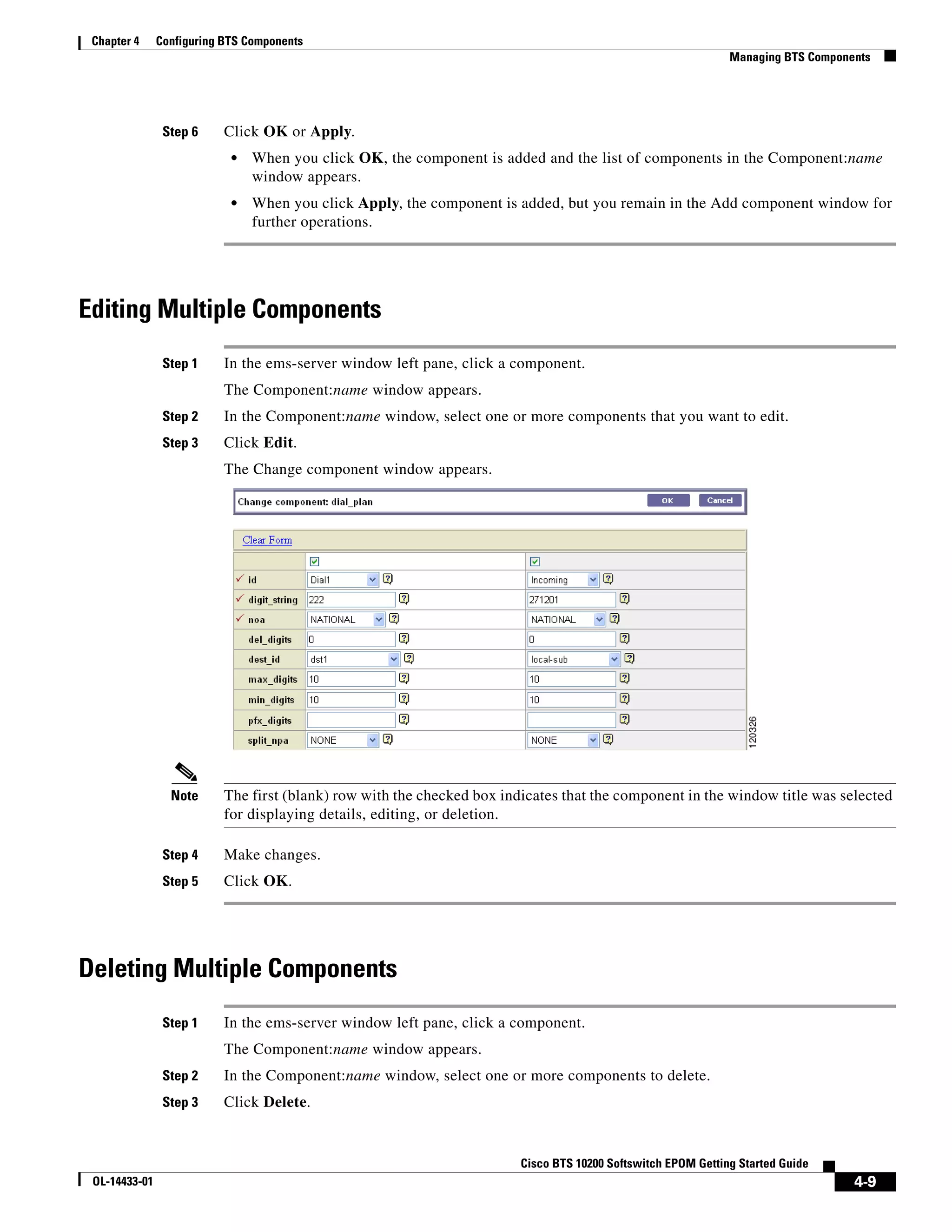
Editing Multiple Components
                Step 1     In the ems-server window left pane, click a component.
                           The Component:name window appears.
                Step 2     In the Component:name window, select one or more components that you want to edit.
                Step 3     Click Edit.
                           The Change component window appears.


                 Note      The first (blank) row with the checked box indicates that the component in the window title was selected
                           for displaying details, editing, or deletion.

                Step 4     Make changes.
                Step 5     Click OK.


Deleting Multiple Components
                Step 1     In the ems-server window left pane, click a component.
                           The Component:name window appears.
                Step 2     In the Component:name window, select one or more components to delete.
                Step 3     Click Delete.


                                                                         Cisco BTS 10200 Softswitch EPOM Getting Started Guide
 OL-14433-01                                                                                                                       4-9
Chapter 4   Configuring BTS Components
 Managing BTS Components


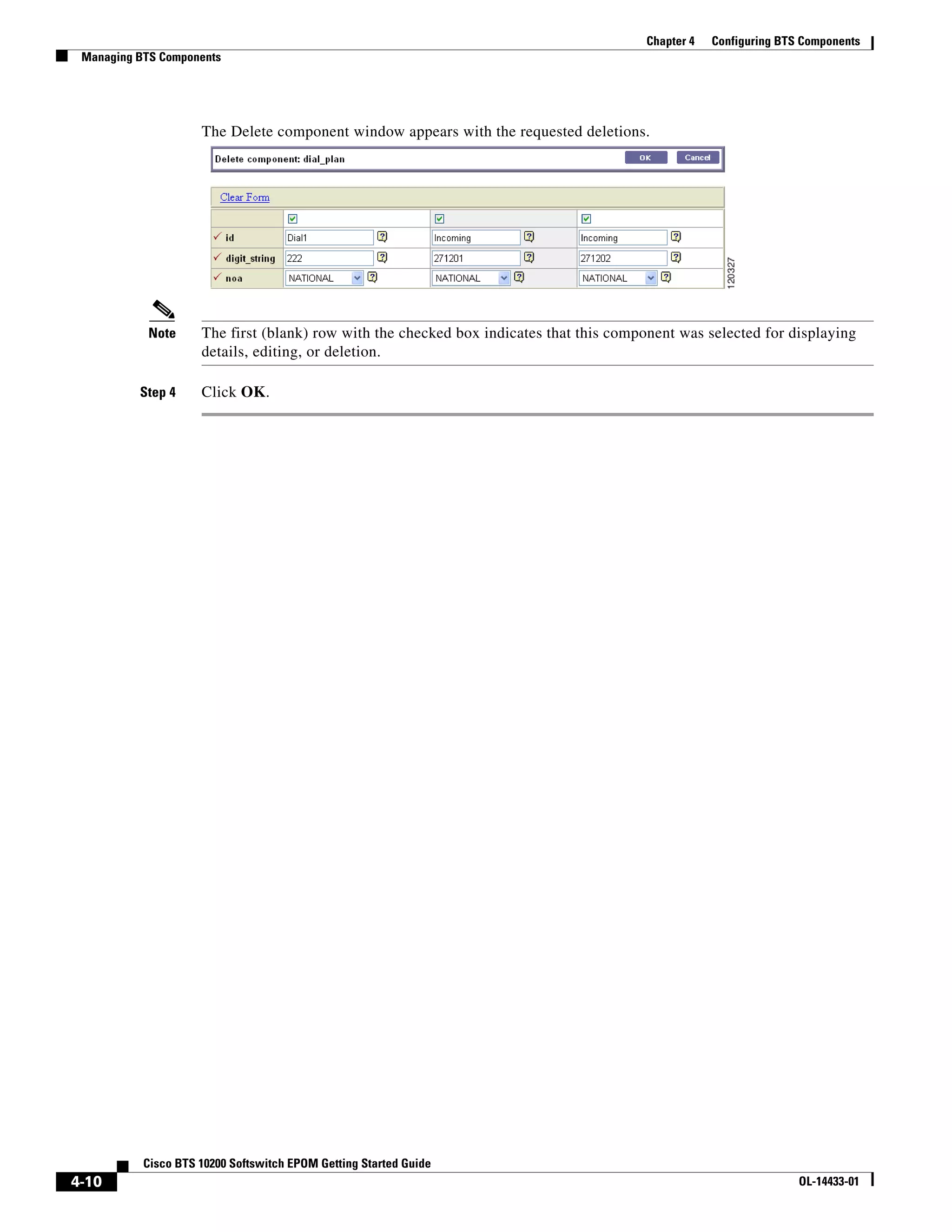
                     The Delete component window appears with the requested deletions.


            Note     The first (blank) row with the checked box indicates that this component was selected for displaying
                     details, editing, or deletion.

          Step 4     Click OK.


           Cisco BTS 10200 Softswitch EPOM Getting Started Guide
4-10                                                                                                               OL-14433-01

4 cfg bts

  • 1.
    CH A PT E R 4 Configuring BTS Components Bulk Provisioning To use information on one BTS server to configure another BTS server: 1. use the bulk_export command to generate a CLI file from the first BTS server 2. use the bulk_import command to load that generated CLI file on the other BTS server; it uses SSL to transfer the file from the EPOM server to the BTS server bts_export looks like the following: root@cyber229:opt 21> /opt/CSCOepom/bin/bts_export NAME bts_export - BTS Config Export SYNOPSIS bts_export -h hostname -v BTSver of hostname -o outfile [-l login -p password ] DESCRIPTION Export a BTS Configuration. OPTIONS -h Hostname -v BTSversion of hostname (3.5,4.1,4.2,4.4.0,4.4.1. 4.5.0) -o Output file -l Login -p Password -s Site ID EXAMPLES 1. bts_export -h bts_host -v host_bts_ver -o config.cli 2. bts_export -h bts_host -v host_bts_ver -l login -p passwd -s siteid -o con fig.cli bts_import looks like the following: root@cyber229:opt 22> /opt/CSCOepom/bin/bts_import Cisco BTS 10200 Softswitch EPOM Getting Started Guide OL-14433-01 4-1
  • 2.
    Chapter 4 Configuring BTS Components Bulk Data Export NAME bts_import - BTS Config Import SYNOPSIS bts_import -h hostname -u username -f inputfile DESCRIPTION Import a BTS Configuration. OPTIONS -h Hostname -f Input file -u User name EXAMPLES 1. bts_import -h bts_host -u usrname -f config.cli Bulk Data Export Using the export.xml (input) file in /opt/CSCOepom/bin/, you can export all data in a BTS release from the EPOM to the BTS. Each noun has an entry in the export.xml file. For example: <itemlist> <item noun="call_agent"/> <item noun="domain2route"/> ... </itemlist> When you enter bts_export the EPOM sequentially selects each noun and verb from export.xml. (Verbs distinguish between add or change commands). For each noun and verb the following occurs: 1. The bts_export module picks a noun or verb from export.xml. 2. The bts_export module generates the show command. 3. EPOM sends the request as “show <noun>” to the BTS. 4. The BTS sends a response to EPOM containing all of that noun's or verb’s attributes in the BTS. 5. EPOM parses the response. 6. EPOM generates an add or change command, based on the noun's attributes and value. Some nouns do not support the add command; they use change instead. 7. EPOM writes these add/change commands to the text output file you specify in /opt/CSCOepom/bin/. Exporting Data from EPOM to BTS Step 1 Go to /opt/CSCOepom/bin/. Cisco BTS 10200 Softswitch EPOM Getting Started Guide 4-2 OL-14433-01
  • 3.
    Chapter 4 Configuring BTS Components Connecting EMS Servers Step 2 Enter bts_export -h hostname -v BTSver of hostname -o outfile [-l login -p password. The text output file you specify containing all data in a BTS release appears in /opt/CSCOepom/bin/ Connecting EMS Servers Before Adding EMS Servers Before adding an EMS server complete the tasks in this checklist. Tasks Ensure you have the hostname and IP address of the EMS server. Ensure you have the login and password of the EMS server. Ensure you have the Site ID of the EMS server: 1. Log in to the EMS server as the root user. 2. Enter: grep SITEID /etc/opticall.cfg SITEID=rtpvtc2 Adding EMS Servers Add an EMS server to the “all” domain and set up the initial configuration. Step 1 Start EPOM. EPOM opens to the Domain Management window. Step 2 In the Domain pane, in the all domain row, click Edit. The Modify component, Domain window opens. Tip Because you are viewing the “all” domain, the Inventory and Groups items are also preceded by “all” (all Inventory and all Groups). Step 3 In the all Inventory pane, click Add. The Add component window opens. Step 4 Enter: • Hostname: hostname or IP address of EMS server • Type: BTS 10200 • Login: EMS server login • Password: EMS server password Cisco BTS 10200 Softswitch EPOM Getting Started Guide OL-14433-01 4-3
  • 4.
    Chapter 4 Configuring BTS Components Connecting EMS Servers • Site ID: site ID for EMS server Step 5 Click OK. Configuring EMS Servers Step 1 Expand the domain tree: a. Click all. b. Click BTS 10200s. Step 2 Click the EMS server to configure. The Details window opens. Step 3 Click Config. Cisco BTS 10200 Softswitch EPOM Getting Started Guide 4-4 OL-14433-01
  • 5.
    Chapter 4 Configuring BTS Components Managing BTS Components The navigation pane shows the Configuration tree, and the content area shows the status of the selected EMS server. Step 4 Click the noun to view the information on that EMS table and give a verb command for that noun ( add, audit, sync, change etc. ). Managing BTS Components Adding BTS Components Using Domain Tree Using EPOM you can add components.The BTS has the following independent logical components: • Call Agent (CA)—Serves as a call management system and media gateway controller. It handles the establishment, processing, and teardown of telephony calls. • Feature Servers (FSs)—Provide POTS, Tandem, Centrex, and Advanced Intelligent Network (AIN) services to the calls controlled by the CAs. The FSs also provide processing for service features such as call forwarding, call waiting, and LNP. • Element Management System (EMS)—Controls the entire BTS and acts as a mediation device between an NMS and one or more CAs. It is also the interface for the provisioning, administration, and reporting features of the BTS. Step 1 From the left pane, select a device. A window appears. Step 2 Select a device Cisco BTS 10200 Softswitch EPOM Getting Started Guide OL-14433-01 4-5
  • 6.
    Chapter 4 Configuring BTS Components Managing BTS Components Adding BTS Inventory BTS inventory is the BTS EMS server. Step 1 Click Add. Step 2 Define the: • IP Address/Hostname—IP Address or hostname • Type—host type • Site ID • Optiuser Password • Confirm Optiuser Password Step 3 Click OK. Adding BTS Components Add components to the EPOM inventory to build a managed network. The device information includes static and dynamic selections to other parts of the configuration. Follow this example to add a dial plan. Step 1 From the Domain window, select the domain > BTS10200s > the EMS server. Step 2 Click Config. The BTS Component Status window opens. Cisco BTS 10200 Softswitch EPOM Getting Started Guide 4-6 OL-14433-01
  • 7.
    Chapter 4 Configuring BTS Components Managing BTS Components Step 3 In the Configuration tree, select Office Tables > dial_plan. The BTS Component window opens showing a list of Dial Plans. If this is the first Dial Plan (or device of this type) that you are adding, the list is empty. Step 4 Click Add. The BTS Component Add window opens. Step 5 Define the device. Required fields are identified with a red checkmark. Step 6 Click OK or Apply. • When you click OK, the component is added and the list of components in the Component:name window appears. • When you click Apply, the component is added, but you remain in the Add component window for further tasks. Cisco BTS 10200 Softswitch EPOM Getting Started Guide OL-14433-01 4-7
  • 8.
    Chapter 4 Configuring BTS Components Managing BTS Components Checking Status and Controlling Components Step 1 From the Domain window, navigate to EMS server. Step 2 Click Config. The BTS Component Status window opens. The Configuration tree appears in the left navigation pane. Step 3 Navigate to device and click to select it. Step 4 In the Status window, click Control. Step 5 From the Component Control window, verify that you have selected the correct component, then select a target_state. Step 6 Select state. Options depend on the type of component that you selected. Step 7 Click OK. Adding Multiple Components You can only perform bulk provisioning commands on the same type of devices. For instance, if a group of subscribers use the same media gateway and subscriber profile, you can add or edit these subscribers by using a single command. Step 1 In the EMS-Server window left pane, click a component. The Component:name window appears. Step 2 Click Add. The Add component window appears. Step 3 Select the Expand range expression check box. Step 4 In the ID field, enter a range expression in square brackets [ ]. For example, to add a group of 10 dial plans with the id prefix dp001_new, enter dp001_new[01-10]. Doing so adds dial plans dp001_new01, dp001_new02, through dp001_new10. Step 5 Enter information in the remaining attribute fields. Cisco BTS 10200 Softswitch EPOM Getting Started Guide 4-8 OL-14433-01
  • 9.
    Chapter 4 Configuring BTS Components Managing BTS Components Step 6 Click OK or Apply. • When you click OK, the component is added and the list of components in the Component:name window appears. • When you click Apply, the component is added, but you remain in the Add component window for further operations. Editing Multiple Components Step 1 In the ems-server window left pane, click a component. The Component:name window appears. Step 2 In the Component:name window, select one or more components that you want to edit. Step 3 Click Edit. The Change component window appears. Note The first (blank) row with the checked box indicates that the component in the window title was selected for displaying details, editing, or deletion. Step 4 Make changes. Step 5 Click OK. Deleting Multiple Components Step 1 In the ems-server window left pane, click a component. The Component:name window appears. Step 2 In the Component:name window, select one or more components to delete. Step 3 Click Delete. Cisco BTS 10200 Softswitch EPOM Getting Started Guide OL-14433-01 4-9
  • 10.
    Chapter 4 Configuring BTS Components Managing BTS Components The Delete component window appears with the requested deletions. Note The first (blank) row with the checked box indicates that this component was selected for displaying details, editing, or deletion. Step 4 Click OK. Cisco BTS 10200 Softswitch EPOM Getting Started Guide 4-10 OL-14433-01