Online assignment 
Natural resources 
Submitted by 
ASWATHI.MS 
REG NO: 13971004 
MATHEMATICS OPTIONAL 
KUCTE, KUMARAPURAM
Natural resources- Mathematical 
aspects 
found in Environmental phenomena 
congruence, 
similarity, ratio and proportion, 
geometric shapes, symmetric property 
etc
Natural resources 
INTRODUCTION 
Math is all around us, even in the kitchen. When cooking a meal, we 
sometimes checks the recipe to measure the portion or double-check the ratio of 
ingredients. Choosing between a cup of sugar or a half cup is a mathematical 
decision. Even setting and checking the timer to make sure the dish cooks for the 
appropriate amount of time requires math skills. When at the mall looking for an 
outfit to wear, we use math. Patterns in nature are visible regularities of form found 
in the natural world. These patterns recur in different contexts and can sometimes 
be modelled mathematically. 
congruence 
The concept of congruence is not restricted to the study of geometry. it plays 
an important role in everyday living. We may be able to buy a refill for our pen when 
the ink runs dry. We use congruence to replace a worn out part of the car, looking for 
the 'same part number'. In construction, they have to use the blocks of a 's tandard 
size'. When using screws, we look for the kind of screw that we need and also 
screwdriver that fits. In each of these examples, the idea of sameness of shape and 
sizes applies. 
Ratio and proportion 
Ratios: Relationships between quantities: That ingredients have relationships to 
each other in a recipe is an important concept in cooking. It's also an important math 
concept. In math, this relationship between 2 quantities is called a ratio. If a recipe 
calls for 1 egg and 2 cups of flour, the relationship of eggs to cups of flour is 1 to 2. 
In mathematical language, that relationship can be written in two ways:
1/2 or 1:2 
Both of these express the ratio of eggs to cups of flour: 1 to 2. If you mistakenly alter 
that ratio, the results may not be edible. 
Working with proportion 
All recipes are written to serve a certain number of people or yield a certain amount 
of food. You might come across a cookie recipe that makes 2 dozen cookies, for 
example. What if you only want 1 dozen cookies? What if you want 4 dozen 
cookies? Understanding how to increase or decrease the yield without spoiling the 
ratio of ingredients is a valuable skill for any cook. 
Let's say you have a mouth-watering cookie recipe: 
1 cup flour 
1/2 tsp. baking soda 
1/2 tsp. salt 
1/2 cup butter 
1/3 cup brown sugar 
1/3 cup sugar 
1 egg 
1/2 tsp. vanilla 
1 cup chocolate chips 
This recipe will yield 3 dozen cookies. If you want to make 9 dozen cookies, you'll 
have to increase the amount of each ingredient listed in the recipe. You'll also need to 
make sure that the relationship between the ingredients stays the same. To do this, 
you'll need to understand proportion. A proportion exists when you have 2 equal 
ratios, such as 2:4 and 4:8. Two unequal ratios, such as 3:16 and 1:3, don't result in a 
proportion. The ratios must be equal 
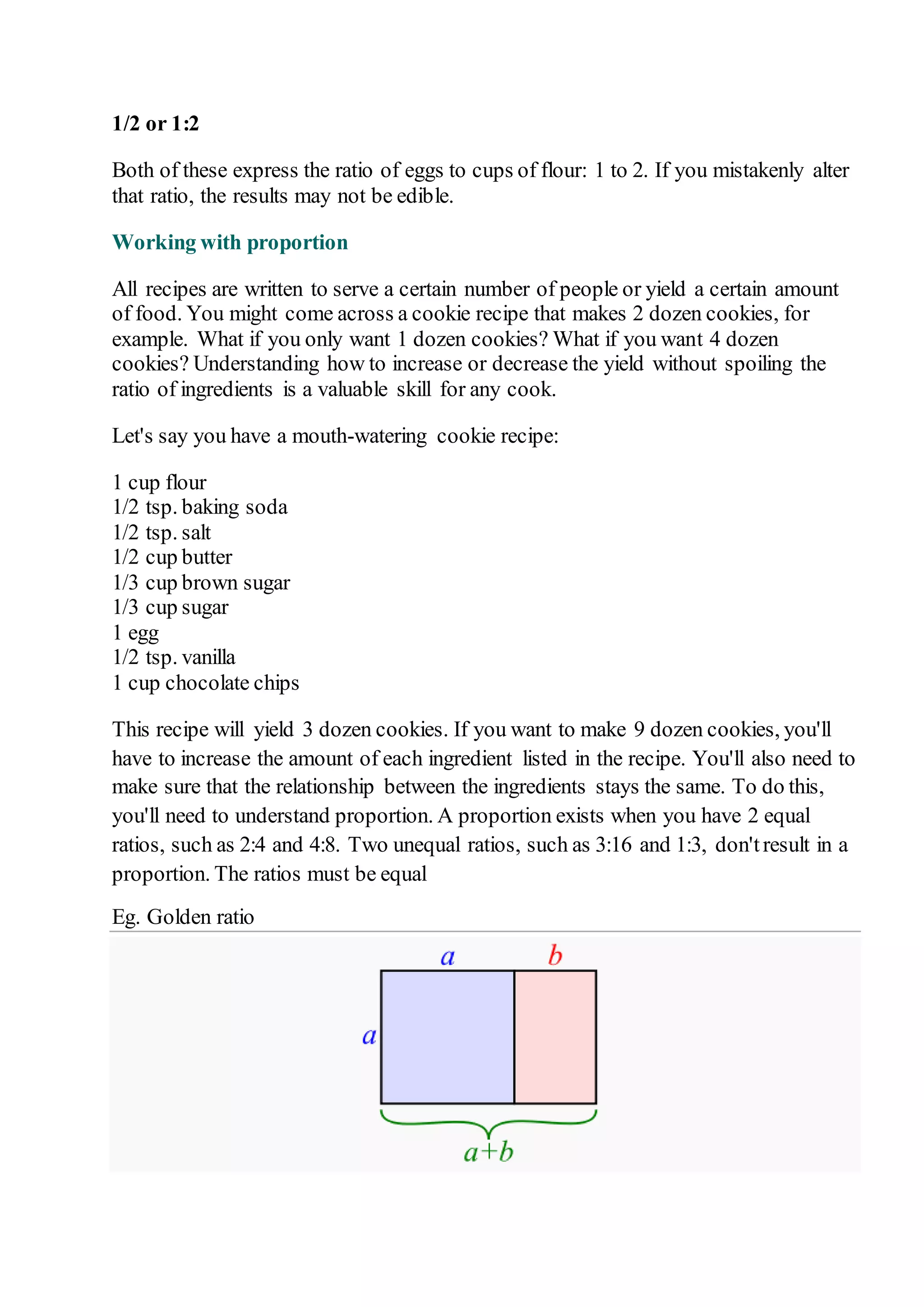
Eg. Golden ratio
A golden rectangle with longer sidea and shorter side b, when placed adjacent to a 
square with sides of length a, will produce a similar golden rectangle with longer 
side a + b and shorter side a. This illustrates the relationship . 
In mathematics, two quantities are in the golden ratio if their ratio is the same as the 
ratio of their sum to the larger of the two quantities. The figure on the right illustrates 
the geometric relationship. Expressed algebraically, for 
quantities a and b with a > b > 0, 
where the Greek letter phi (φ) represents the golden ratio. Its value is: 
The golden ratio is also called the golden section (Latin: sectio aurea) 
or golden mean. Other names include extreme and mean ratio, medial 
section, divine proportion, divine section (Latin: sectio divina), golden 
proportion, golden cut, and golden number. 
GEOMETRY 
Geometry is one of the oldest sciences and is concerned with questions of shape, size 
and relative position of figures and with properties of space.Geometry is considered 
an important field of study because of its applications in daily life.Geometry is 
mainly divided in two ; 
Plane geometry - It is about all kinds of two dimensional shapes such as lines,circles 
and triangles.Solid geometry - It is about all kinds of three dimensional shapes like 
polygons,prisms,pyramids,sphere and cylinder. 
Role of geometry in daily life:- Role of geometry in the daily life is the foundation 
of physical mathematics. A room, a car, a ball anything with physical things is 
geometrically formed. Geometry applies us to accurately calculate physical spaces.n 
the world , Anything made use of geometrical constraints this is important 
application in daily life of geometry. 
Example: Architecture of a thing, design, engineering, building etc. 
Geometry is particularly useful in home building or improvement projects. If you 
need to find the floor area of a house, you need to use geometry. If you want to 
replace a piece of furniture, you need to calculate the amount of fabric you want, by
calculating the surface area of the furniture. Geometry has applications in hobbies. 
The goldfish tank water needs to have a certain volume as well as surface area in 
order for the fish to thrive. We can calculate the volume and surface area using 
geometry 
Bubbles, foam 
A soap bubble forms a sphere, a surface with minimal area — the smallest 
possible surface area for the volume enclosed. Two bubbles together form a more 
complex shape: the outer surfaces of both bubbles are spherical; these surfaces are 
joined by a third spherical surface as the smaller bubble bulges slightly into the larger 
one. 
A foam is a mass of bubbles; foams of different materials occur in nature. 
Foams composed of soap films obey Plateau's laws, which require three soap films to 
meet at each edge at 120° and four soap edges to meet at each vertex at the 
tetrahedral angle of about 109.5°. Plateau's laws further require films to be smooth 
and continuous, and to have a constant average at every point. For example, a film 
may remain nearly flat on average by being curved up in one direction (say, left to 
right) while being curved downwards in another direction (say, front to back). 
Structures with minimal surfaces can be used as tents. Lord Kelvin identified the 
problem of the most efficient way to pack cells of equal volume as a foam in 1887; 
his solution uses just one solid, the truncated cubic honeycomb with very slightly 
curved faces to meet Plateau's laws. 
At the scale of living cells, foam patterns are common; radiolarians, sponge 
spicules, silicoflagellate exoskeletons and the calcite skeleton of a sea urchin, 
Cidaris rugosa, all resemble mineral casts of Plateau foam boundaries. The skeleton 
of the Radiolarian, Aulonia hexagona, a beautiful marine form drawn by Haeckel, 
looks as if it is a sphere composed wholly of hexagons, but this is mathematically 
impossible. The Euler characteristic states that for any convex polyhedron, the 
number of faces plus the number of vertices (corners) equals the number of edges 
plus two. A result of this formula is that any closed polyhedron of hexagons has to 
include exactly 12 pentagons, like a soccer ball, Buckminster Fuller geodesic dome, 
or fullerene molecule. This can be visualised by noting that a mesh of hexagons is 
flat like a sheet of chicken wire, but each pentagon that is added forces the mesh to 
bend (there are fewer corners, so the mesh is pulled in).
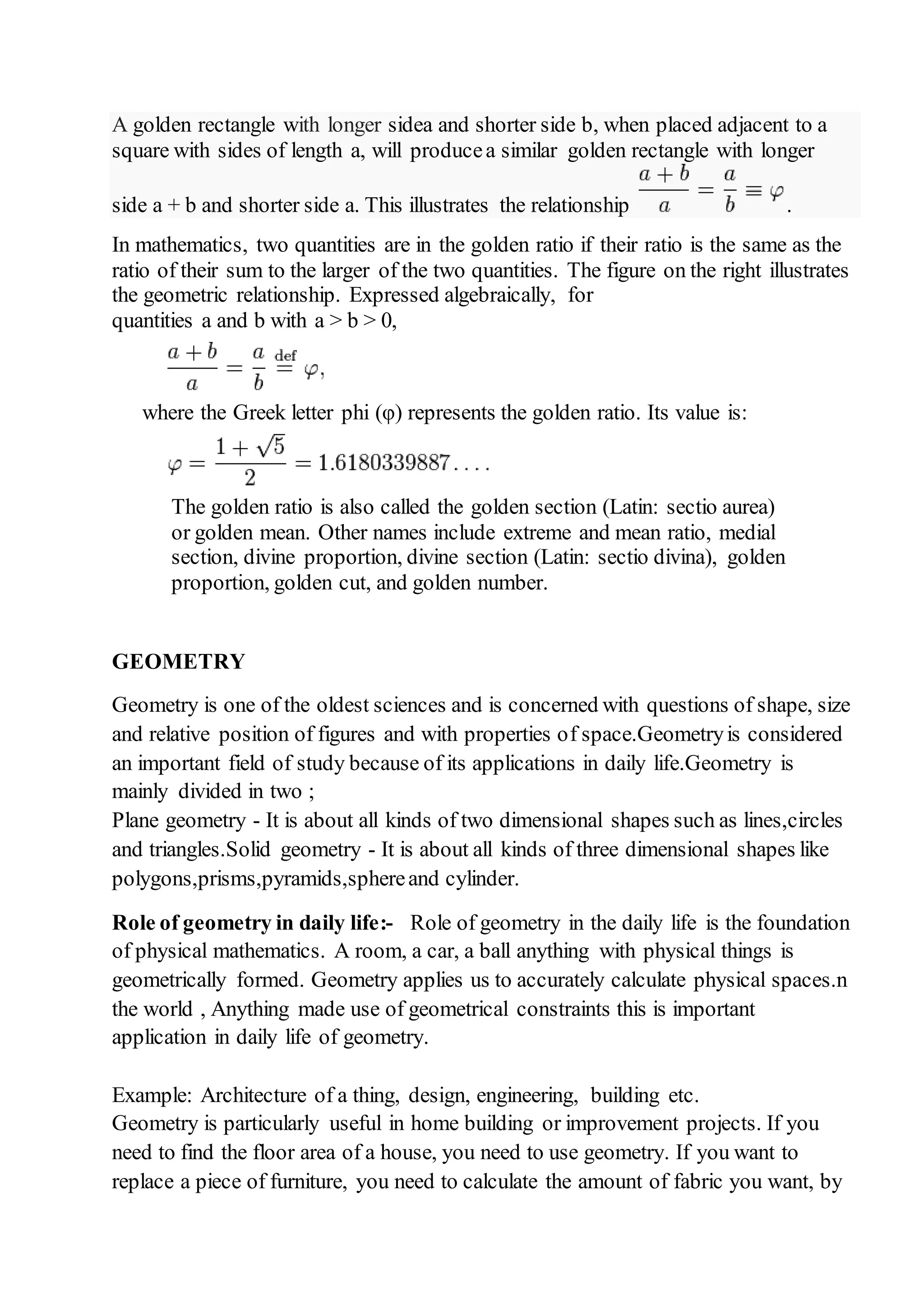
 
Foam of soap bubbles: 4 edges meet at each vertex, at angles close to 109.5°, as in 
two C-H bonds in methane. 
Beautiful examples of nature’s self-similarity 
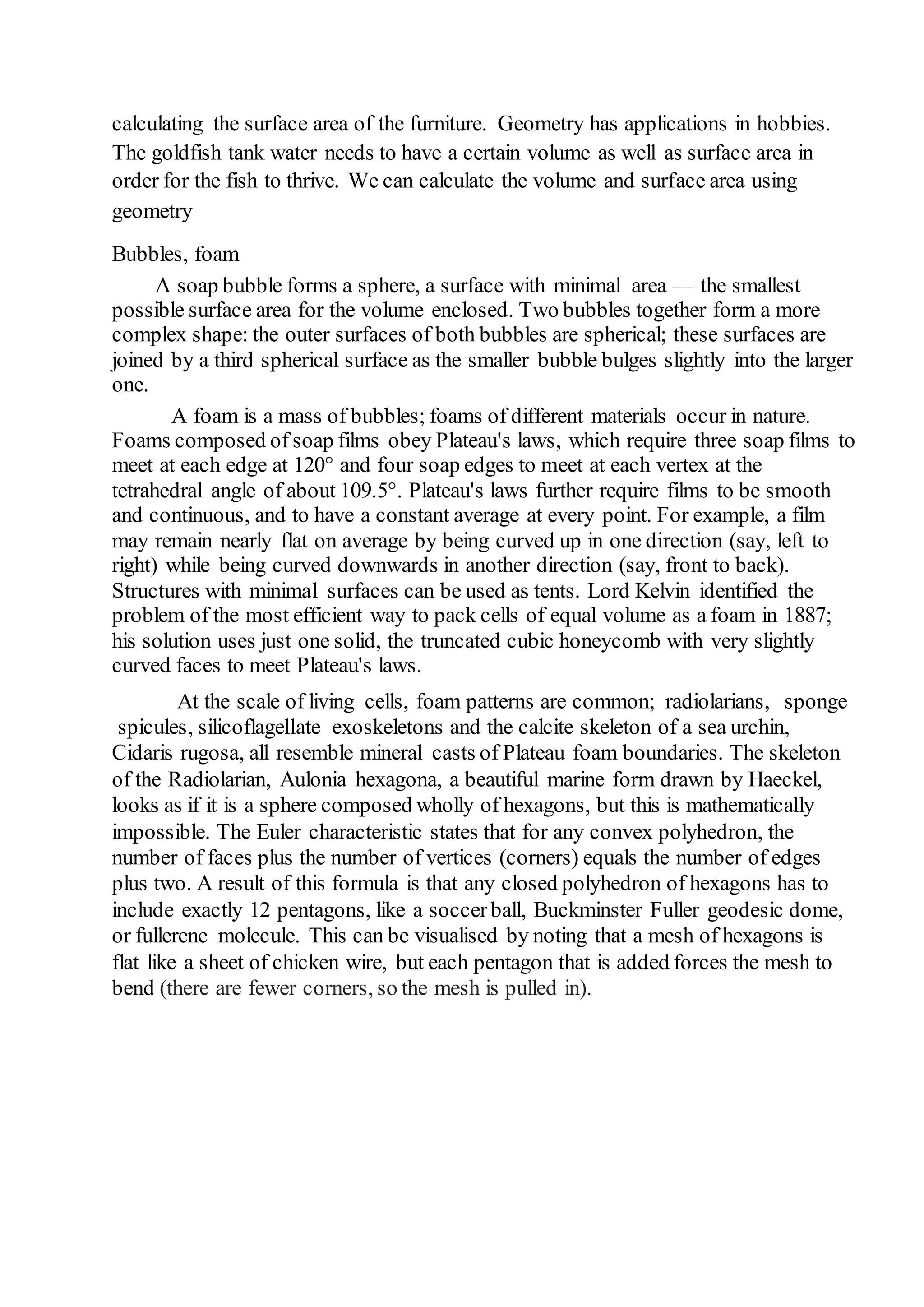
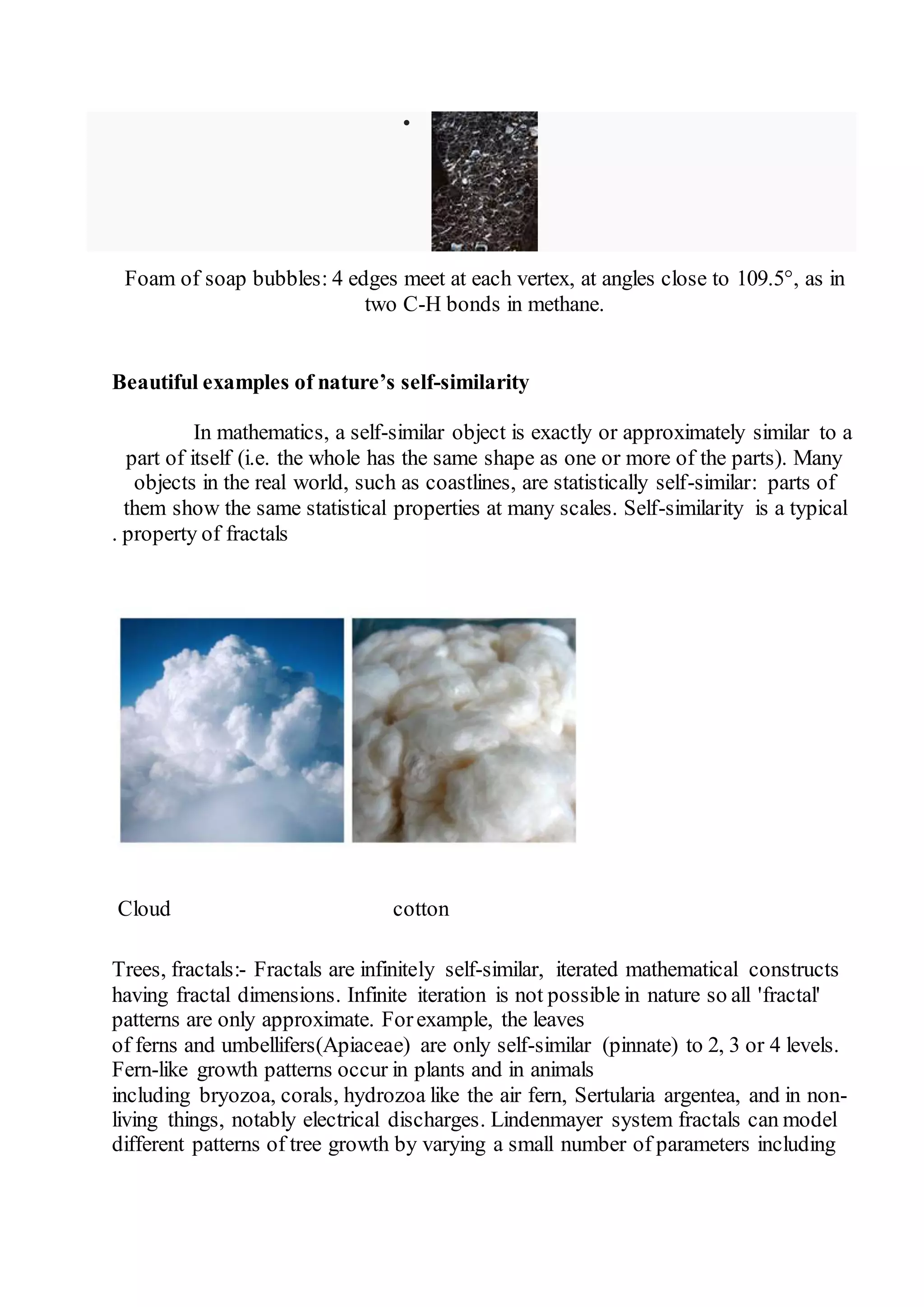
In mathematics, a self-similar object is exactly or approximately similar to a 
part of itself (i.e. the whole has the same shape as one or more of the parts). Many 
objects in the real world, such as coastlines, are statistically self-similar: parts of 
them show the same statistical properties at many scales. Self-similarity is a typical 
. property of fractals 
Cloud cotton 
Trees, fractals:- Fractals are infinitely self-similar, iterated mathematical constructs 
having fractal dimensions. Infinite iteration is not possible in nature so all 'fractal' 
patterns are only approximate. For example, the leaves 
of ferns and umbellifers(Apiaceae) are only self-similar (pinnate) to 2, 3 or 4 levels. 
Fern-like growth patterns occur in plants and in animals 
including bryozoa, corals, hydrozoa like the air fern, Sertularia argentea, and in non-living 
things, notably electrical discharges. Lindenmayer system fractals can model 
different patterns of tree growth by varying a small number of parameters including
branching angle, distance between nodes or branch points (internode length), and 
number of branches per branch point. 
Fractal-like patterns occur widely in nature, in phenomena as diverse as clouds, river 
networks, geologic fault lines,mountains, coastlines, animal coloration, snow 
flakes, crystals, blood vessel branching, and ocean waves. 
 
Leaf of Cow Parsley,Anthriscus sylvestris, is 2- or 3-pinnate, not infinite 
 
Fractal spirals:Romanesco broccolishowing self-similar form 
 
Angelica flowerhead, a sphere made of spheres (self-similar) 
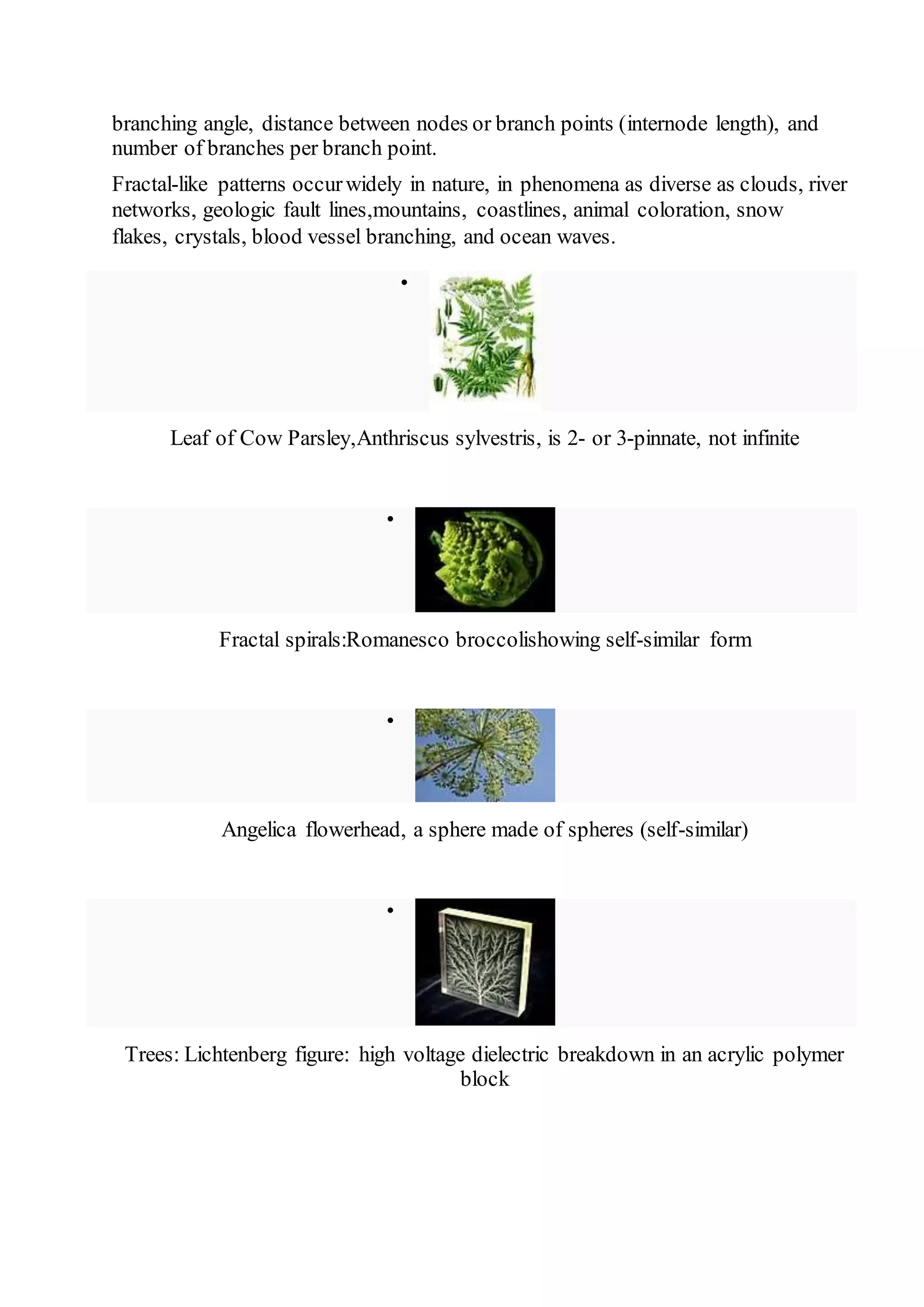
 
Trees: Lichtenberg figure: high voltage dielectric breakdown in an acrylic polymer 
block
 
Trees: dendritic Copper crystals (in microscope) 
Symmetry Symmetry in biology, Floral symmetry and crystal symmetry 
Symmetry is pervasive in living things. Animals mainly have bilateral or mirror 
symmetry, as do the leaves of plants and some flowers such as orchids. Plants often 
have radial or rotational symmetry, as do many flowers and some groups of animals 
such. as sea anemones Fivefold symmetry is found in the echinoderms, the group that 
includes starfish, sea urchins, and sea lilies. 
Among non-living things, snowflakes have striking sixfold symmetry: each flake is 
unique, its structure forming a record of the varying conditions during its 
crystallisation, with nearly the same pattern of growth on each of its six 
arms. Crystals in general have a variety of symmetries and crystal habits; they can be 
cubic or octahedral, but true crystals cannot have fivefold symmetry 
(unlike quasicrystals). Rotational symmetry is found at different scales among non-living 
things including the crown-shaped splash pattern formed when a drop falls into 
a pond,[28] and both the spheroidal shape and rings of a planet like Saturn. 
Symmetry has a variety of causes. Radial symmetry suits organisms like sea 
anemones whose adults do not move: food and threats may arrive from any direction. 
But animals that move in one direction necessarily have upper and lower sides, head 
and tail ends, and therefore a left and a right. The head becomes specialised with a 
mouth and sense organs (cephalisation), and the body becomes bilaterally symmetric 
(though internal organs need not be). More puzzling is the reason for the fivefold 
(pentaradiate) symmetry of the echinoderms. Early echinoderms were bilaterally 
symmetrical, as their larvae still are. Sumrall and Wray argue that the loss of the old 
symmetry had both developmental and ecological causes. 
 
Animals often show mirror or bilateral symmetry, like this tiger.
 
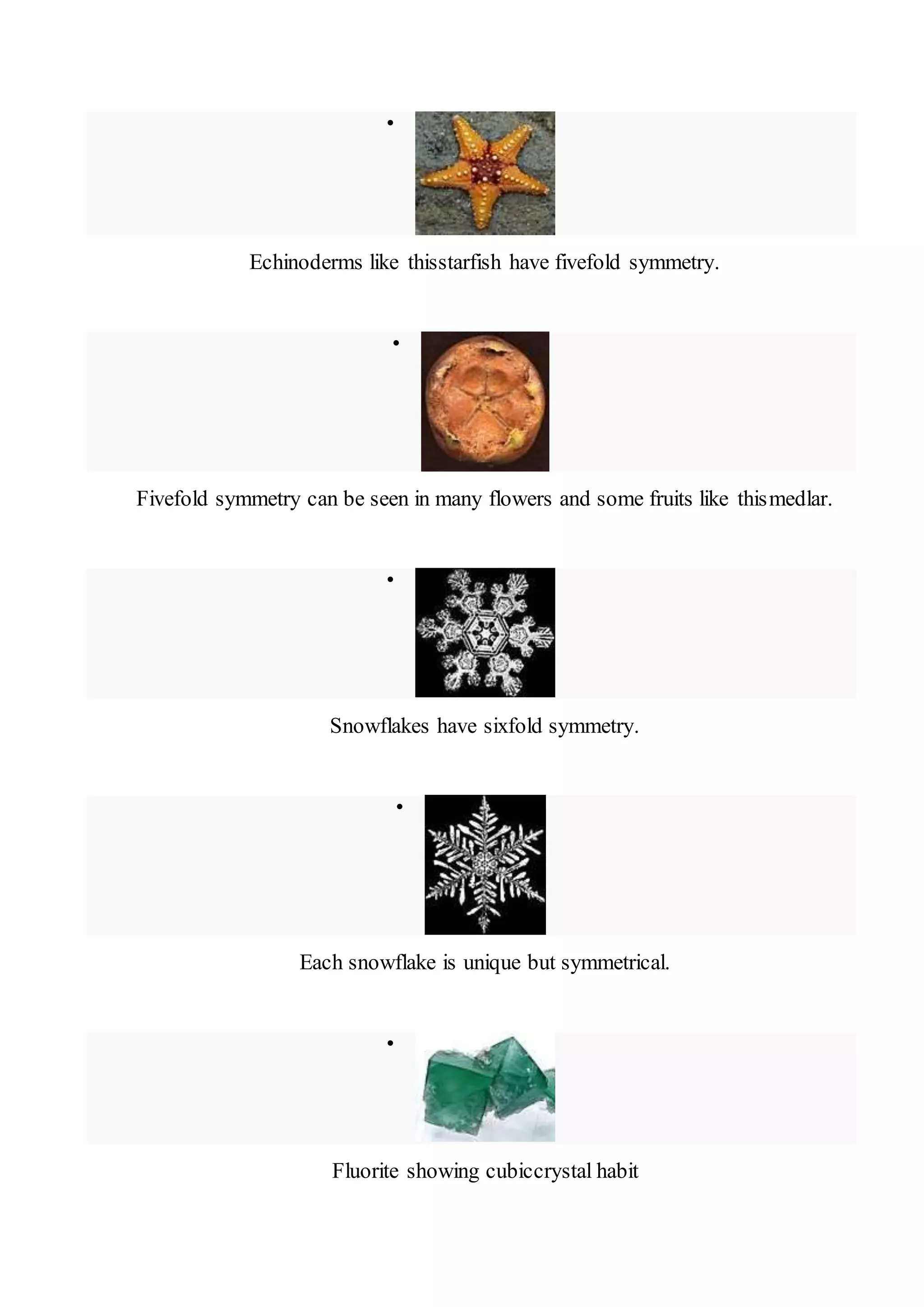
Echinoderms like thisstarfish have fivefold symmetry. 
 
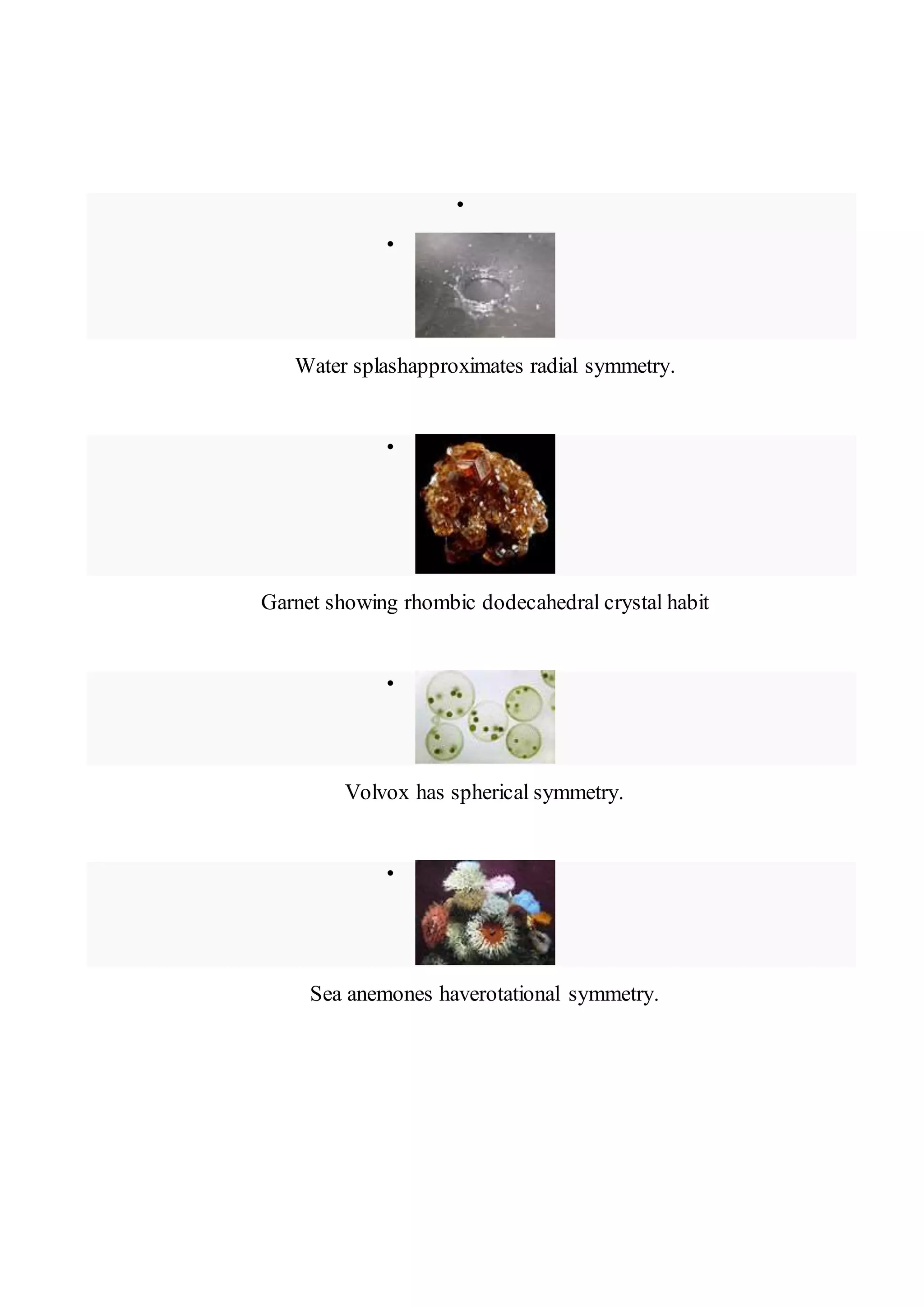
Fivefold symmetry can be seen in many flowers and some fruits like thismedlar. 
 
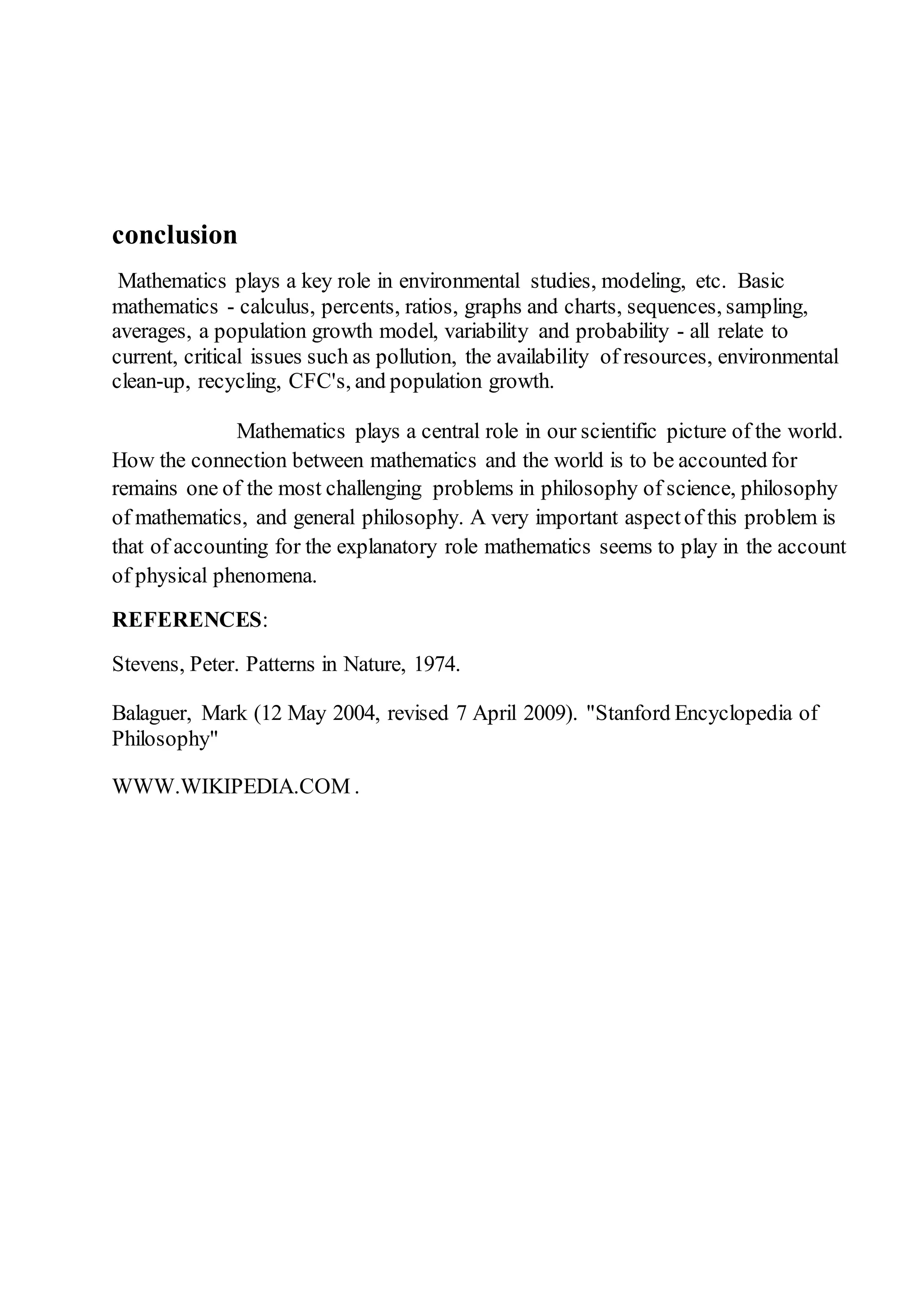
Snowflakes have sixfold symmetry. 
 
Each snowflake is unique but symmetrical. 
 
Fluorite showing cubiccrystal habit
 
 
Water splashapproximates radial symmetry. 
 
Garnet showing rhombic dodecahedral crystal habit 
 
Volvox has spherical symmetry. 
 
Sea anemones haverotational symmetry.
conclusion 
Mathematics plays a key role in environmental studies, modeling, etc. Basic 
mathematics - calculus, percents, ratios, graphs and charts, sequences, sampling, 
averages, a population growth model, variability and probability - all relate to 
current, critical issues such as pollution, the availability of resources, environmental 
clean-up, recycling, CFC's, and population growth. 
Mathematics plays a central role in our scientific picture of the world. 
How the connection between mathematics and the world is to be accounted for 
remains one of the most challenging problems in philosophy of science, philosophy 
of mathematics, and general philosophy. A very important aspect of this problem is 
that of accounting for the explanatory role mathematics seems to play in the account 
of physical phenomena. 
REFERENCES: 
Stevens, Peter. Patterns in Nature, 1974. 
Balaguer, Mark (12 May 2004, revised 7 April 2009). "Stanford Encyclopedia of 
Philosophy" 
WWW.WIKIPEDIA.COM .

4. aswathi. m.s online assignment natural resourses

  • 1.
    Online assignment Naturalresources Submitted by ASWATHI.MS REG NO: 13971004 MATHEMATICS OPTIONAL KUCTE, KUMARAPURAM
  • 2.
    Natural resources- Mathematical aspects found in Environmental phenomena congruence, similarity, ratio and proportion, geometric shapes, symmetric property etc
  • 3.
    Natural resources INTRODUCTION Math is all around us, even in the kitchen. When cooking a meal, we sometimes checks the recipe to measure the portion or double-check the ratio of ingredients. Choosing between a cup of sugar or a half cup is a mathematical decision. Even setting and checking the timer to make sure the dish cooks for the appropriate amount of time requires math skills. When at the mall looking for an outfit to wear, we use math. Patterns in nature are visible regularities of form found in the natural world. These patterns recur in different contexts and can sometimes be modelled mathematically. congruence The concept of congruence is not restricted to the study of geometry. it plays an important role in everyday living. We may be able to buy a refill for our pen when the ink runs dry. We use congruence to replace a worn out part of the car, looking for the 'same part number'. In construction, they have to use the blocks of a 's tandard size'. When using screws, we look for the kind of screw that we need and also screwdriver that fits. In each of these examples, the idea of sameness of shape and sizes applies. Ratio and proportion Ratios: Relationships between quantities: That ingredients have relationships to each other in a recipe is an important concept in cooking. It's also an important math concept. In math, this relationship between 2 quantities is called a ratio. If a recipe calls for 1 egg and 2 cups of flour, the relationship of eggs to cups of flour is 1 to 2. In mathematical language, that relationship can be written in two ways:
  • 4.
    1/2 or 1:2 Both of these express the ratio of eggs to cups of flour: 1 to 2. If you mistakenly alter that ratio, the results may not be edible. Working with proportion All recipes are written to serve a certain number of people or yield a certain amount of food. You might come across a cookie recipe that makes 2 dozen cookies, for example. What if you only want 1 dozen cookies? What if you want 4 dozen cookies? Understanding how to increase or decrease the yield without spoiling the ratio of ingredients is a valuable skill for any cook. Let's say you have a mouth-watering cookie recipe: 1 cup flour 1/2 tsp. baking soda 1/2 tsp. salt 1/2 cup butter 1/3 cup brown sugar 1/3 cup sugar 1 egg 1/2 tsp. vanilla 1 cup chocolate chips This recipe will yield 3 dozen cookies. If you want to make 9 dozen cookies, you'll have to increase the amount of each ingredient listed in the recipe. You'll also need to make sure that the relationship between the ingredients stays the same. To do this, you'll need to understand proportion. A proportion exists when you have 2 equal ratios, such as 2:4 and 4:8. Two unequal ratios, such as 3:16 and 1:3, don't result in a proportion. The ratios must be equal Eg. Golden ratio
  • 5.
    A golden rectanglewith longer sidea and shorter side b, when placed adjacent to a square with sides of length a, will produce a similar golden rectangle with longer side a + b and shorter side a. This illustrates the relationship . In mathematics, two quantities are in the golden ratio if their ratio is the same as the ratio of their sum to the larger of the two quantities. The figure on the right illustrates the geometric relationship. Expressed algebraically, for quantities a and b with a > b > 0, where the Greek letter phi (φ) represents the golden ratio. Its value is: The golden ratio is also called the golden section (Latin: sectio aurea) or golden mean. Other names include extreme and mean ratio, medial section, divine proportion, divine section (Latin: sectio divina), golden proportion, golden cut, and golden number. GEOMETRY Geometry is one of the oldest sciences and is concerned with questions of shape, size and relative position of figures and with properties of space.Geometry is considered an important field of study because of its applications in daily life.Geometry is mainly divided in two ; Plane geometry - It is about all kinds of two dimensional shapes such as lines,circles and triangles.Solid geometry - It is about all kinds of three dimensional shapes like polygons,prisms,pyramids,sphere and cylinder. Role of geometry in daily life:- Role of geometry in the daily life is the foundation of physical mathematics. A room, a car, a ball anything with physical things is geometrically formed. Geometry applies us to accurately calculate physical spaces.n the world , Anything made use of geometrical constraints this is important application in daily life of geometry. Example: Architecture of a thing, design, engineering, building etc. Geometry is particularly useful in home building or improvement projects. If you need to find the floor area of a house, you need to use geometry. If you want to replace a piece of furniture, you need to calculate the amount of fabric you want, by
  • 6.
    calculating the surfacearea of the furniture. Geometry has applications in hobbies. The goldfish tank water needs to have a certain volume as well as surface area in order for the fish to thrive. We can calculate the volume and surface area using geometry Bubbles, foam A soap bubble forms a sphere, a surface with minimal area — the smallest possible surface area for the volume enclosed. Two bubbles together form a more complex shape: the outer surfaces of both bubbles are spherical; these surfaces are joined by a third spherical surface as the smaller bubble bulges slightly into the larger one. A foam is a mass of bubbles; foams of different materials occur in nature. Foams composed of soap films obey Plateau's laws, which require three soap films to meet at each edge at 120° and four soap edges to meet at each vertex at the tetrahedral angle of about 109.5°. Plateau's laws further require films to be smooth and continuous, and to have a constant average at every point. For example, a film may remain nearly flat on average by being curved up in one direction (say, left to right) while being curved downwards in another direction (say, front to back). Structures with minimal surfaces can be used as tents. Lord Kelvin identified the problem of the most efficient way to pack cells of equal volume as a foam in 1887; his solution uses just one solid, the truncated cubic honeycomb with very slightly curved faces to meet Plateau's laws. At the scale of living cells, foam patterns are common; radiolarians, sponge spicules, silicoflagellate exoskeletons and the calcite skeleton of a sea urchin, Cidaris rugosa, all resemble mineral casts of Plateau foam boundaries. The skeleton of the Radiolarian, Aulonia hexagona, a beautiful marine form drawn by Haeckel, looks as if it is a sphere composed wholly of hexagons, but this is mathematically impossible. The Euler characteristic states that for any convex polyhedron, the number of faces plus the number of vertices (corners) equals the number of edges plus two. A result of this formula is that any closed polyhedron of hexagons has to include exactly 12 pentagons, like a soccer ball, Buckminster Fuller geodesic dome, or fullerene molecule. This can be visualised by noting that a mesh of hexagons is flat like a sheet of chicken wire, but each pentagon that is added forces the mesh to bend (there are fewer corners, so the mesh is pulled in).
  • 7.
     Foam ofsoap bubbles: 4 edges meet at each vertex, at angles close to 109.5°, as in two C-H bonds in methane. Beautiful examples of nature’s self-similarity In mathematics, a self-similar object is exactly or approximately similar to a part of itself (i.e. the whole has the same shape as one or more of the parts). Many objects in the real world, such as coastlines, are statistically self-similar: parts of them show the same statistical properties at many scales. Self-similarity is a typical . property of fractals Cloud cotton Trees, fractals:- Fractals are infinitely self-similar, iterated mathematical constructs having fractal dimensions. Infinite iteration is not possible in nature so all 'fractal' patterns are only approximate. For example, the leaves of ferns and umbellifers(Apiaceae) are only self-similar (pinnate) to 2, 3 or 4 levels. Fern-like growth patterns occur in plants and in animals including bryozoa, corals, hydrozoa like the air fern, Sertularia argentea, and in non-living things, notably electrical discharges. Lindenmayer system fractals can model different patterns of tree growth by varying a small number of parameters including
  • 8.
    branching angle, distancebetween nodes or branch points (internode length), and number of branches per branch point. Fractal-like patterns occur widely in nature, in phenomena as diverse as clouds, river networks, geologic fault lines,mountains, coastlines, animal coloration, snow flakes, crystals, blood vessel branching, and ocean waves.  Leaf of Cow Parsley,Anthriscus sylvestris, is 2- or 3-pinnate, not infinite  Fractal spirals:Romanesco broccolishowing self-similar form  Angelica flowerhead, a sphere made of spheres (self-similar)  Trees: Lichtenberg figure: high voltage dielectric breakdown in an acrylic polymer block
  • 9.
     Trees: dendriticCopper crystals (in microscope) Symmetry Symmetry in biology, Floral symmetry and crystal symmetry Symmetry is pervasive in living things. Animals mainly have bilateral or mirror symmetry, as do the leaves of plants and some flowers such as orchids. Plants often have radial or rotational symmetry, as do many flowers and some groups of animals such. as sea anemones Fivefold symmetry is found in the echinoderms, the group that includes starfish, sea urchins, and sea lilies. Among non-living things, snowflakes have striking sixfold symmetry: each flake is unique, its structure forming a record of the varying conditions during its crystallisation, with nearly the same pattern of growth on each of its six arms. Crystals in general have a variety of symmetries and crystal habits; they can be cubic or octahedral, but true crystals cannot have fivefold symmetry (unlike quasicrystals). Rotational symmetry is found at different scales among non-living things including the crown-shaped splash pattern formed when a drop falls into a pond,[28] and both the spheroidal shape and rings of a planet like Saturn. Symmetry has a variety of causes. Radial symmetry suits organisms like sea anemones whose adults do not move: food and threats may arrive from any direction. But animals that move in one direction necessarily have upper and lower sides, head and tail ends, and therefore a left and a right. The head becomes specialised with a mouth and sense organs (cephalisation), and the body becomes bilaterally symmetric (though internal organs need not be). More puzzling is the reason for the fivefold (pentaradiate) symmetry of the echinoderms. Early echinoderms were bilaterally symmetrical, as their larvae still are. Sumrall and Wray argue that the loss of the old symmetry had both developmental and ecological causes.  Animals often show mirror or bilateral symmetry, like this tiger.
  • 10.
     Echinoderms likethisstarfish have fivefold symmetry.  Fivefold symmetry can be seen in many flowers and some fruits like thismedlar.  Snowflakes have sixfold symmetry.  Each snowflake is unique but symmetrical.  Fluorite showing cubiccrystal habit
  • 11.
      Watersplashapproximates radial symmetry.  Garnet showing rhombic dodecahedral crystal habit  Volvox has spherical symmetry.  Sea anemones haverotational symmetry.
  • 12.
    conclusion Mathematics playsa key role in environmental studies, modeling, etc. Basic mathematics - calculus, percents, ratios, graphs and charts, sequences, sampling, averages, a population growth model, variability and probability - all relate to current, critical issues such as pollution, the availability of resources, environmental clean-up, recycling, CFC's, and population growth. Mathematics plays a central role in our scientific picture of the world. How the connection between mathematics and the world is to be accounted for remains one of the most challenging problems in philosophy of science, philosophy of mathematics, and general philosophy. A very important aspect of this problem is that of accounting for the explanatory role mathematics seems to play in the account of physical phenomena. REFERENCES: Stevens, Peter. Patterns in Nature, 1974. Balaguer, Mark (12 May 2004, revised 7 April 2009). "Stanford Encyclopedia of Philosophy" WWW.WIKIPEDIA.COM .