NATURE OF
MATHEMATICS
“Mathematics is the language in which God has
written the universe.”
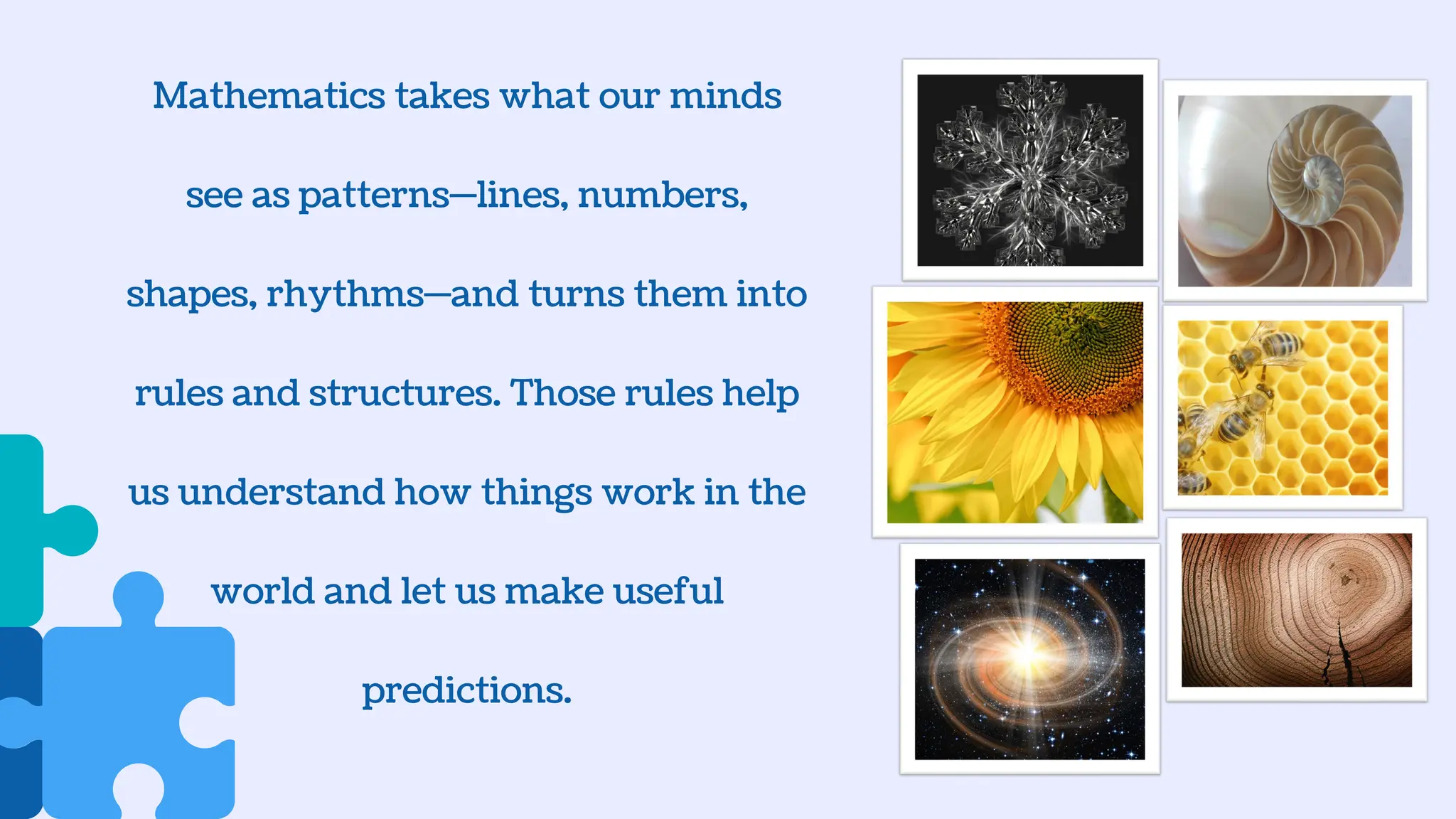
Mathematics takes what our minds
see as patterns—lines, numbers,
shapes, rhythms—and turns them into
rules and structures. Those rules help
us understand how things work in the
world and let us make useful
predictions.
Objectives:
1. Identify patterns in nature (symmetry, spirals, tessellations, fractals) and
describe their structure.
2. Model real-world phenomena (e.g. Fibonacci, exponential growth,
symmetry) using mathematical tools.
3. Predict or control outcomes using mathematical reasoning applied to
patterns in nature or systems.
4. Apply mathematical practices—look for structure, articulate regularity,
justify generalizations.
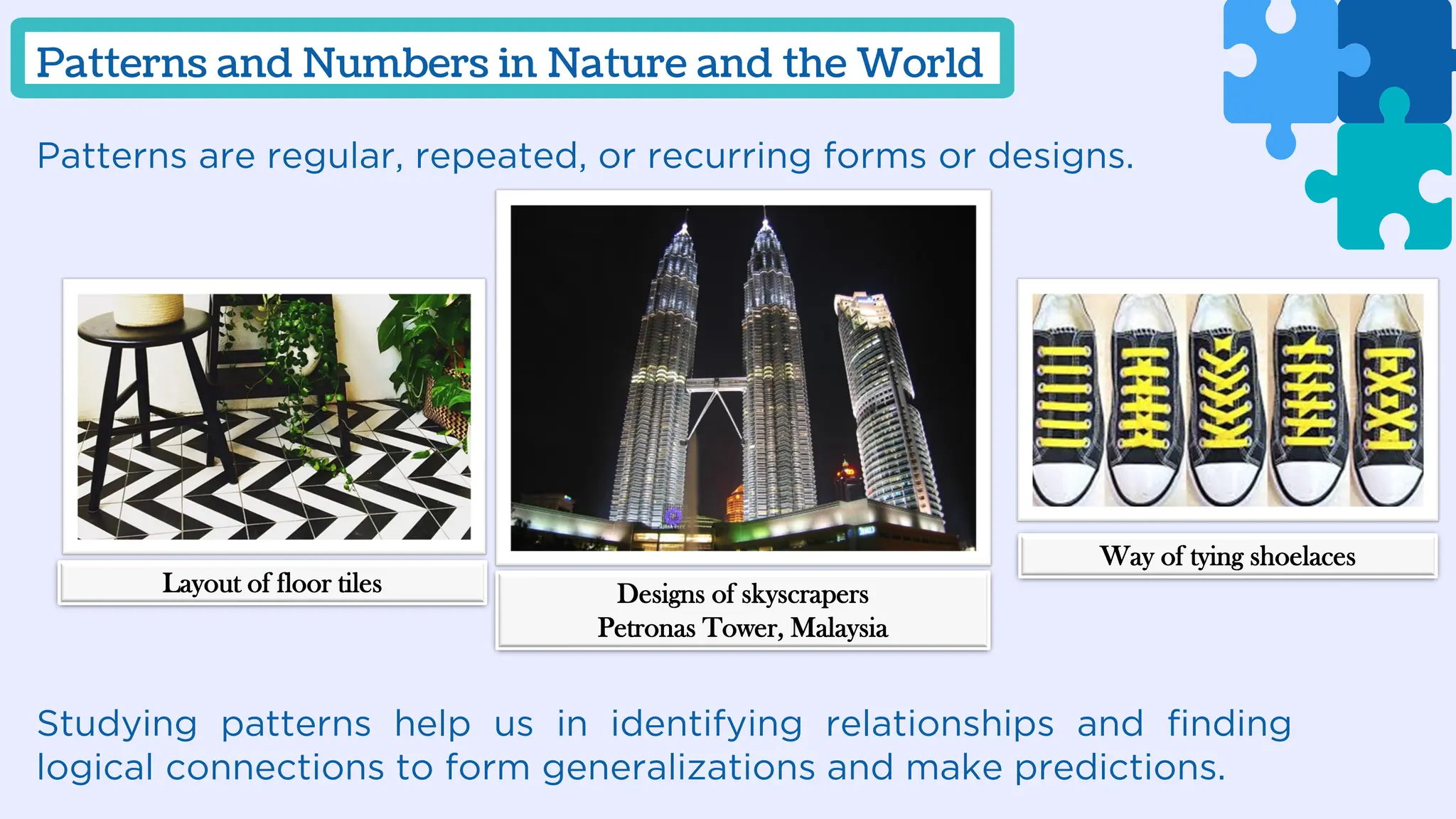
Patterns are regular, repeated, or recurring forms or designs.
Studying patterns help us in identifying relationships and finding
logical connections to form generalizations and make predictions.
Patterns and Numbers in Nature and the World
Layout of floor tiles Designs of skyscrapers
Petronas Tower, Malaysia
Way of tying shoelaces
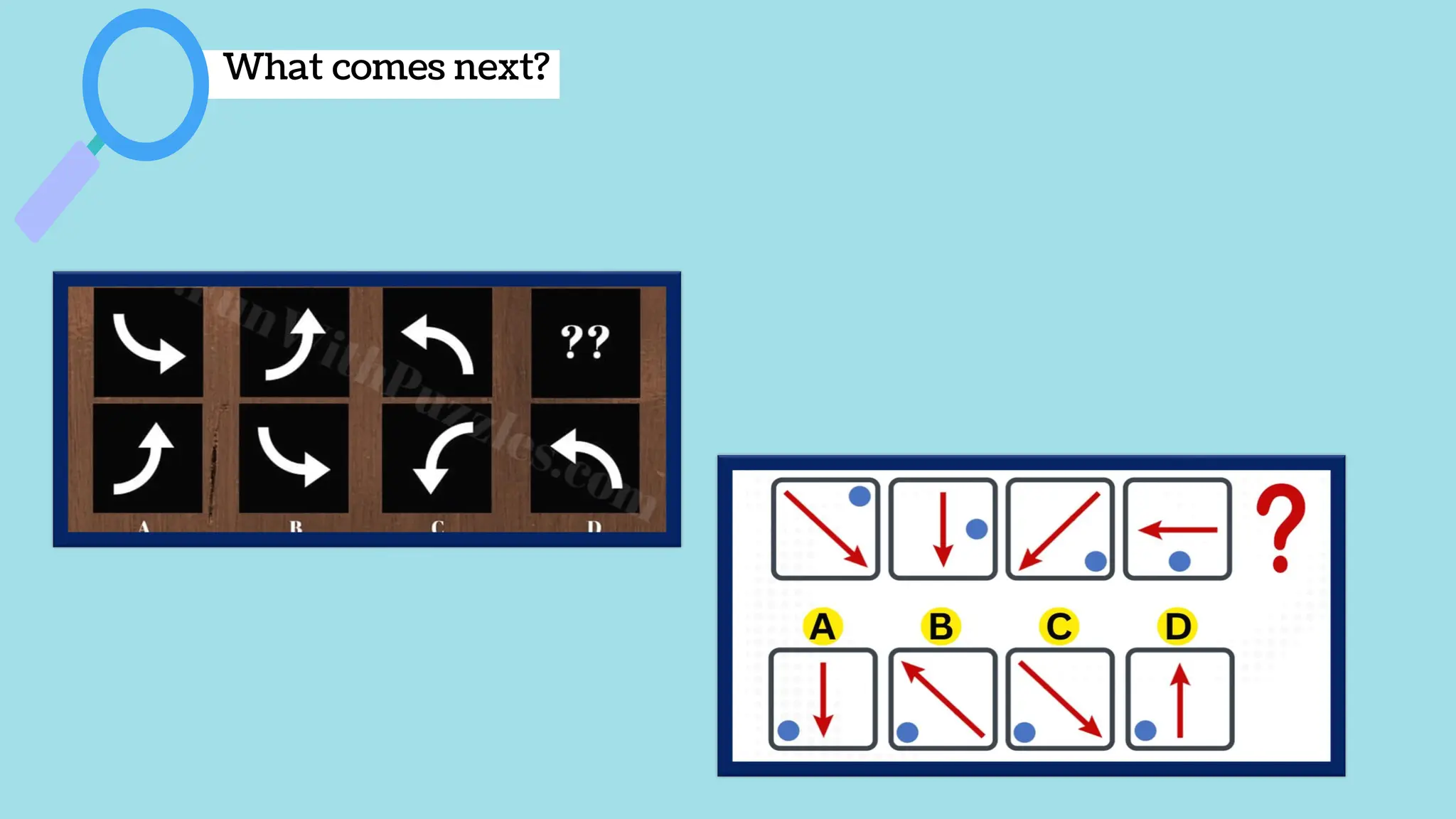
What comes next?
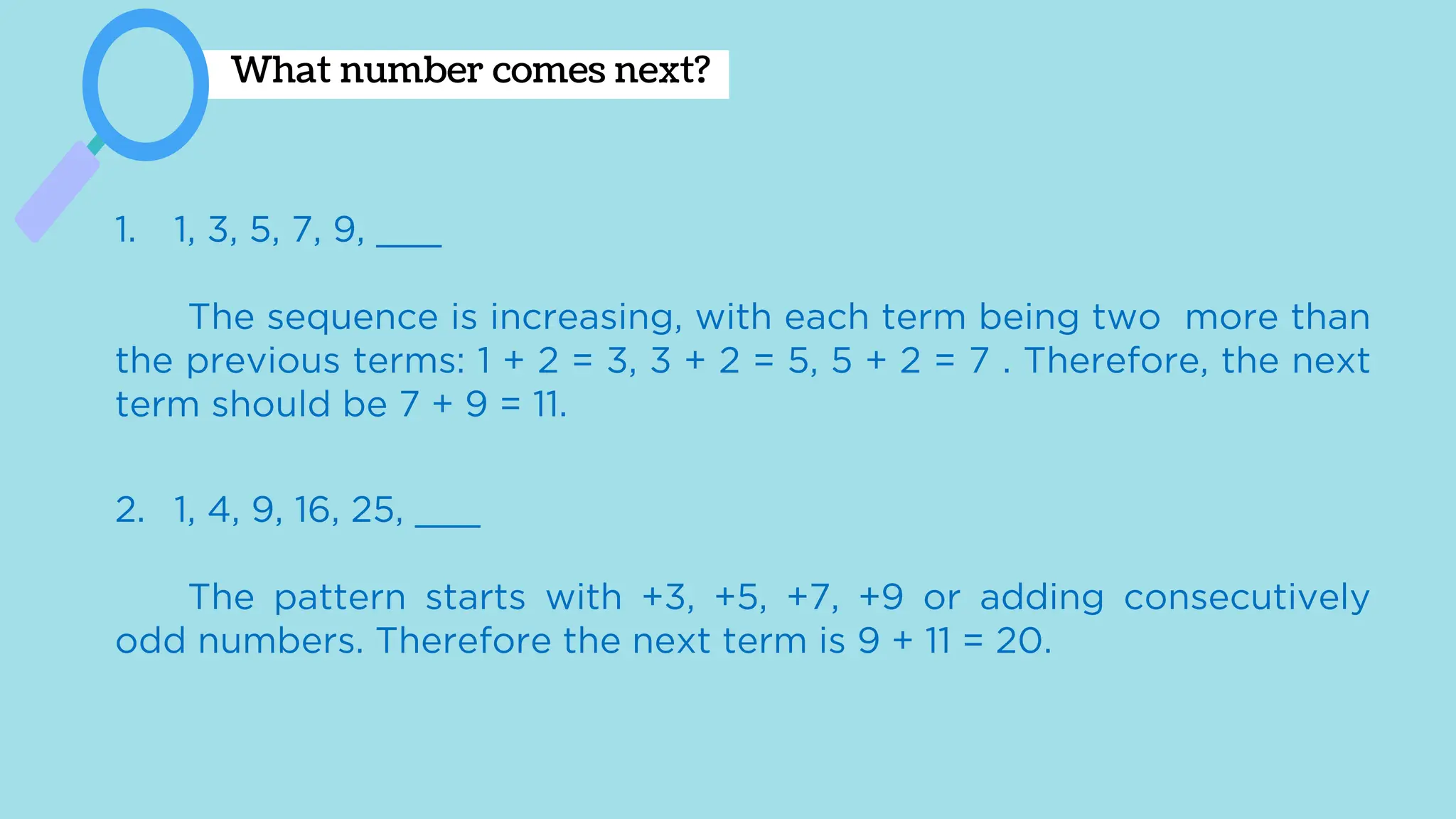
What number comes next?
1. 1, 3, 5, 7, 9, ___
The sequence is increasing, with each term being two more than
the previous terms: 1 + 2 = 3, 3 + 2 = 5, 5 + 2 = 7 . Therefore, the next
term should be 7 + 9 = 11.
2. 1, 4, 9, 16, 25, ___
The pattern starts with +3, +5, +7, +9 or adding consecutively
odd numbers. Therefore the next term is 9 + 11 = 20.
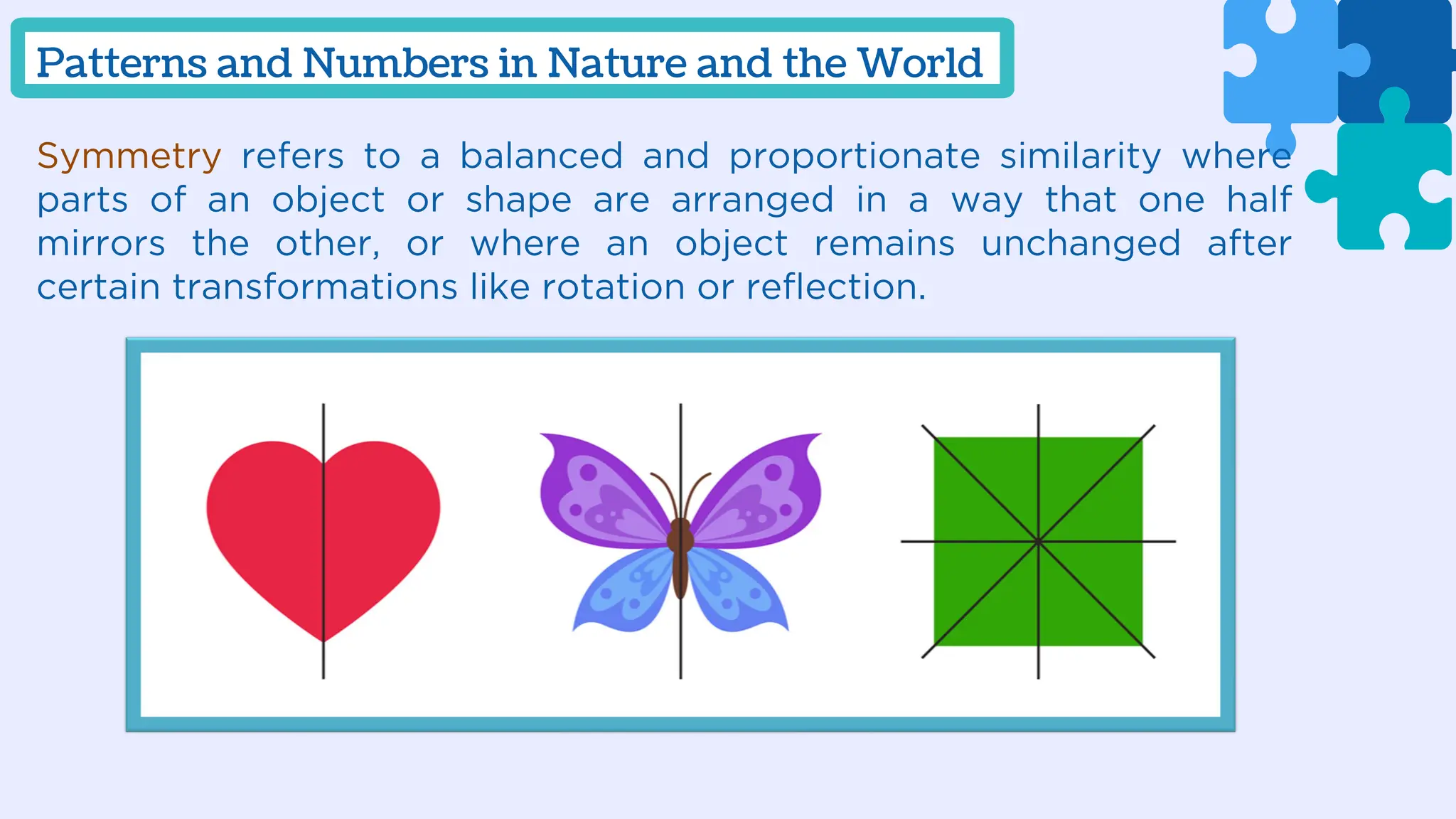
Symmetry refers to a balanced and proportionate similarity where
parts of an object or shape are arranged in a way that one half
mirrors the other, or where an object remains unchanged after
certain transformations like rotation or reflection.
Patterns and Numbers in Nature and the World
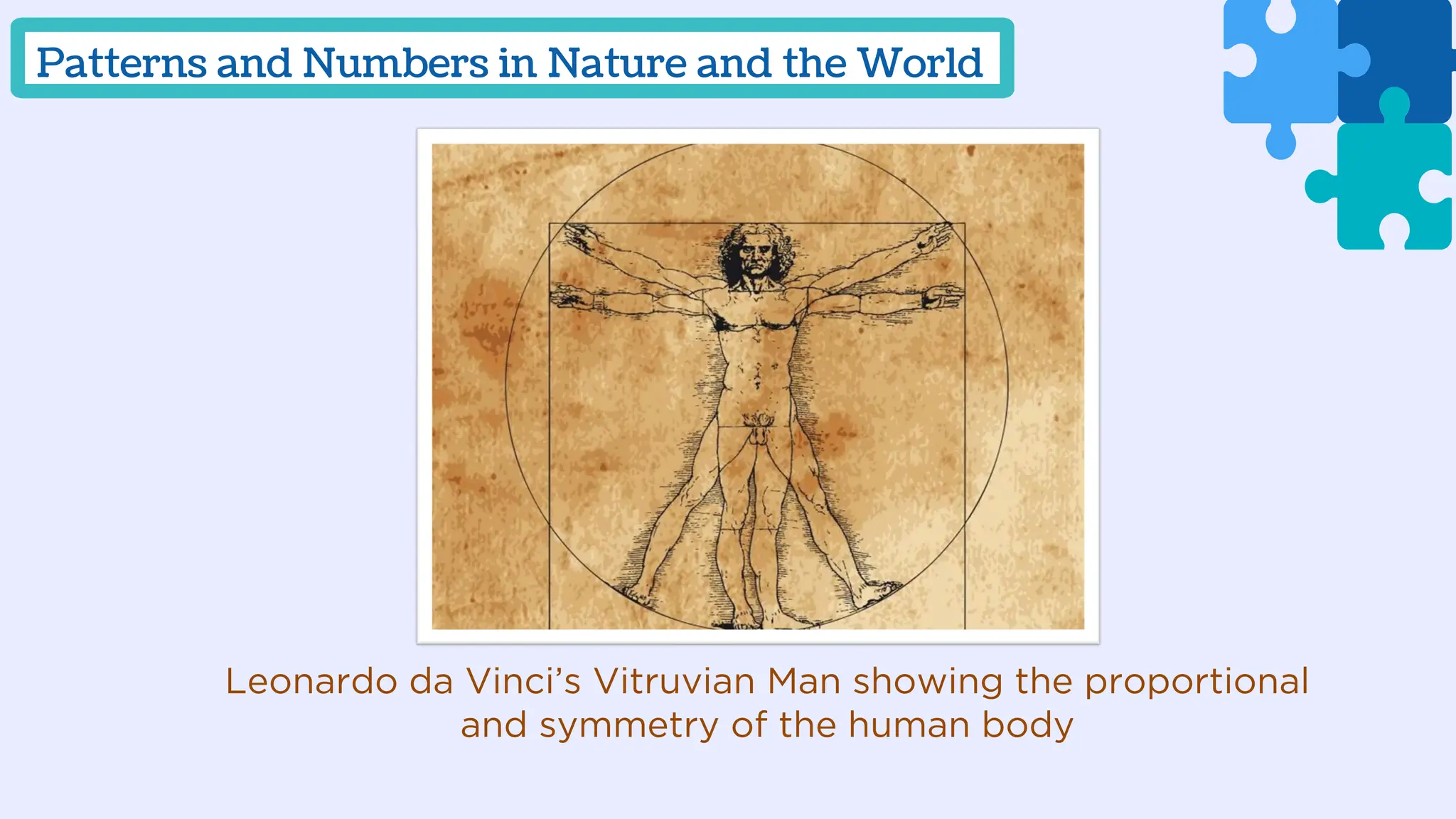
Leonardo da Vinci’s Vitruvian Man showing the proportional
and symmetry of the human body
Patterns and Numbers in Nature and the World
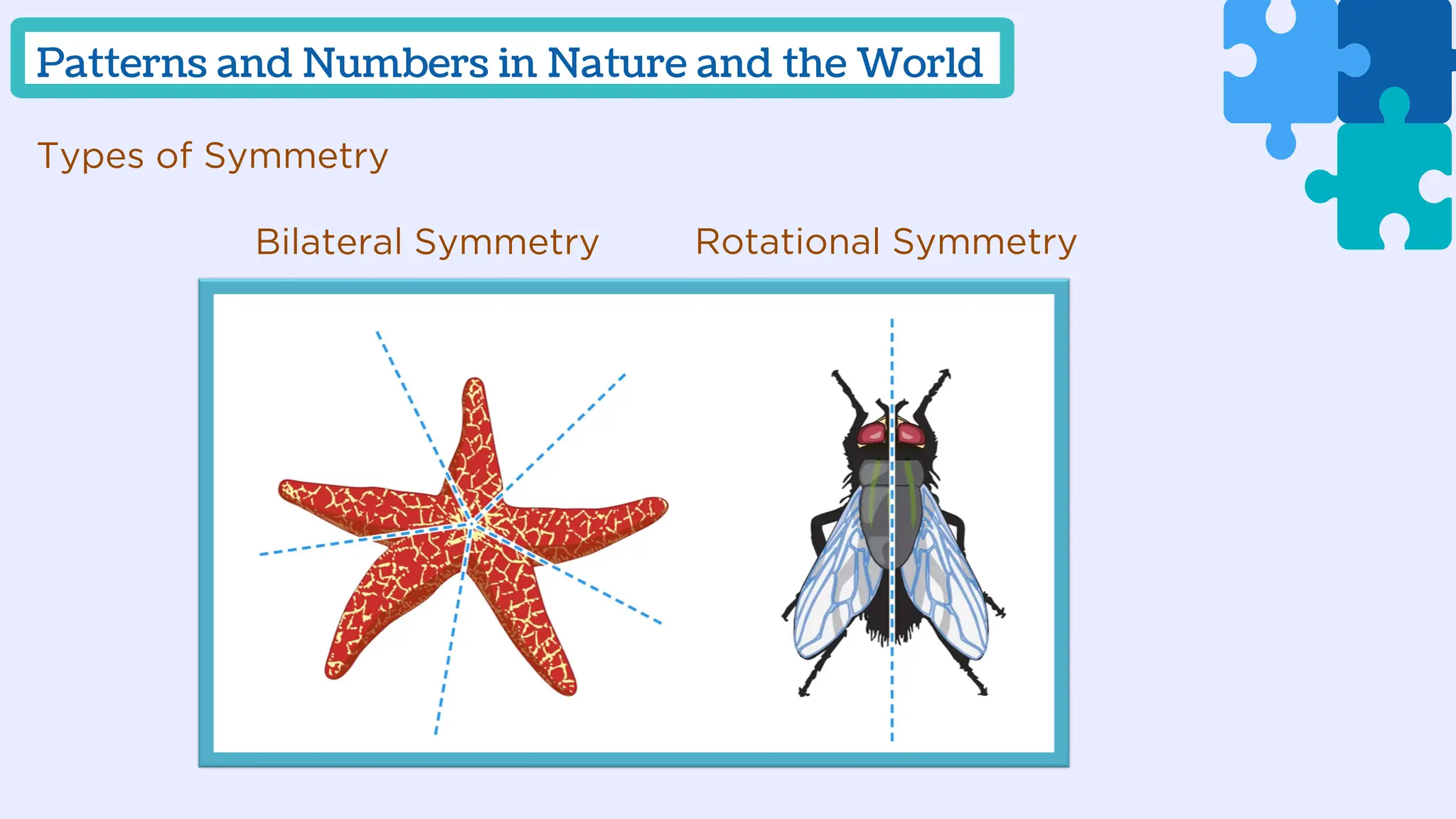
Types of Symmetry
Patterns and Numbers in Nature and the World
Bilateral Symmetry Rotational Symmetry
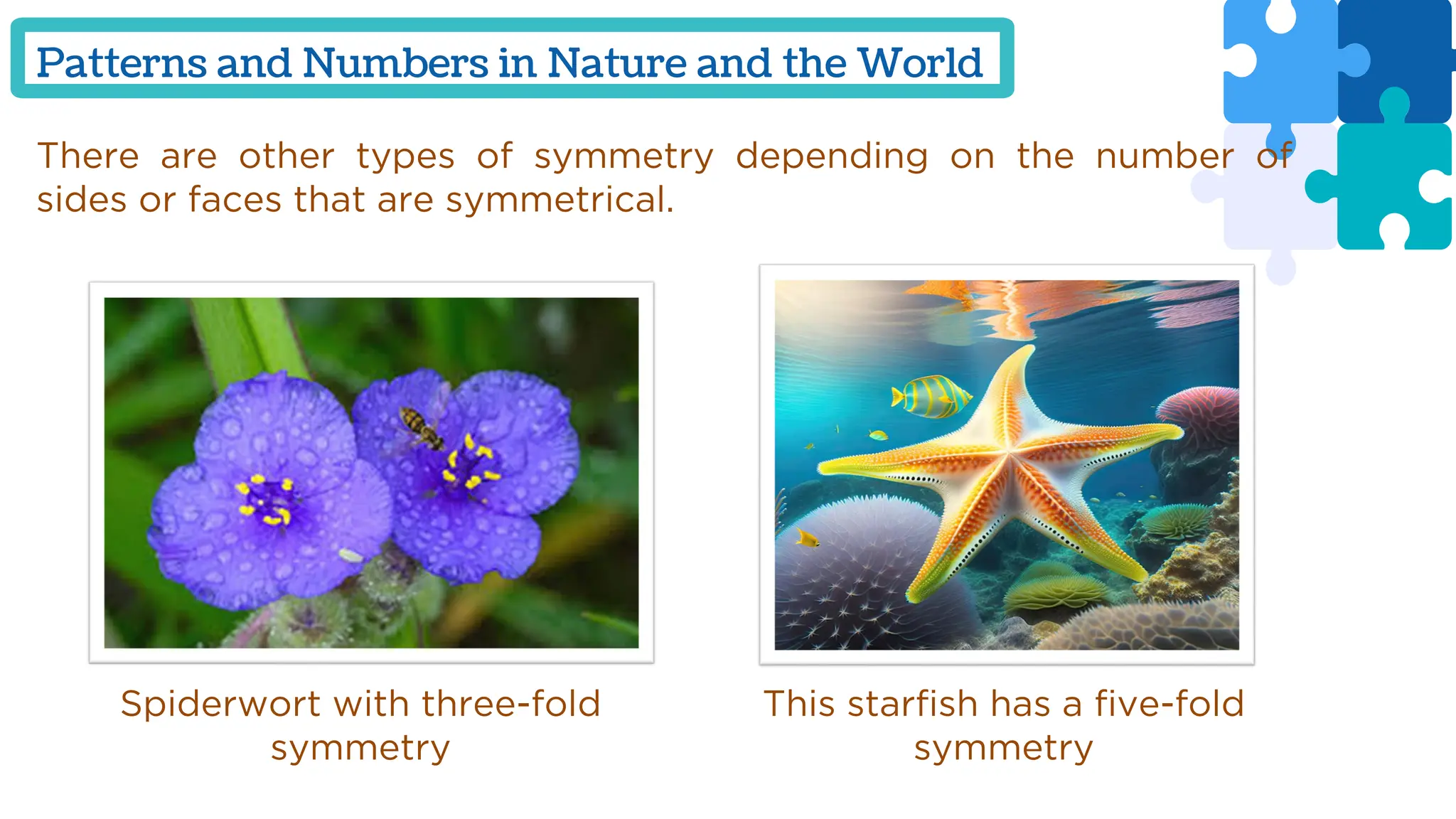
There are other types of symmetry depending on the number of
sides or faces that are symmetrical.
Patterns and Numbers in Nature and the World
Spiderwort with three-fold
symmetry
This starfish has a five-fold
symmetry
Patterns and Numbers in Nature and the World
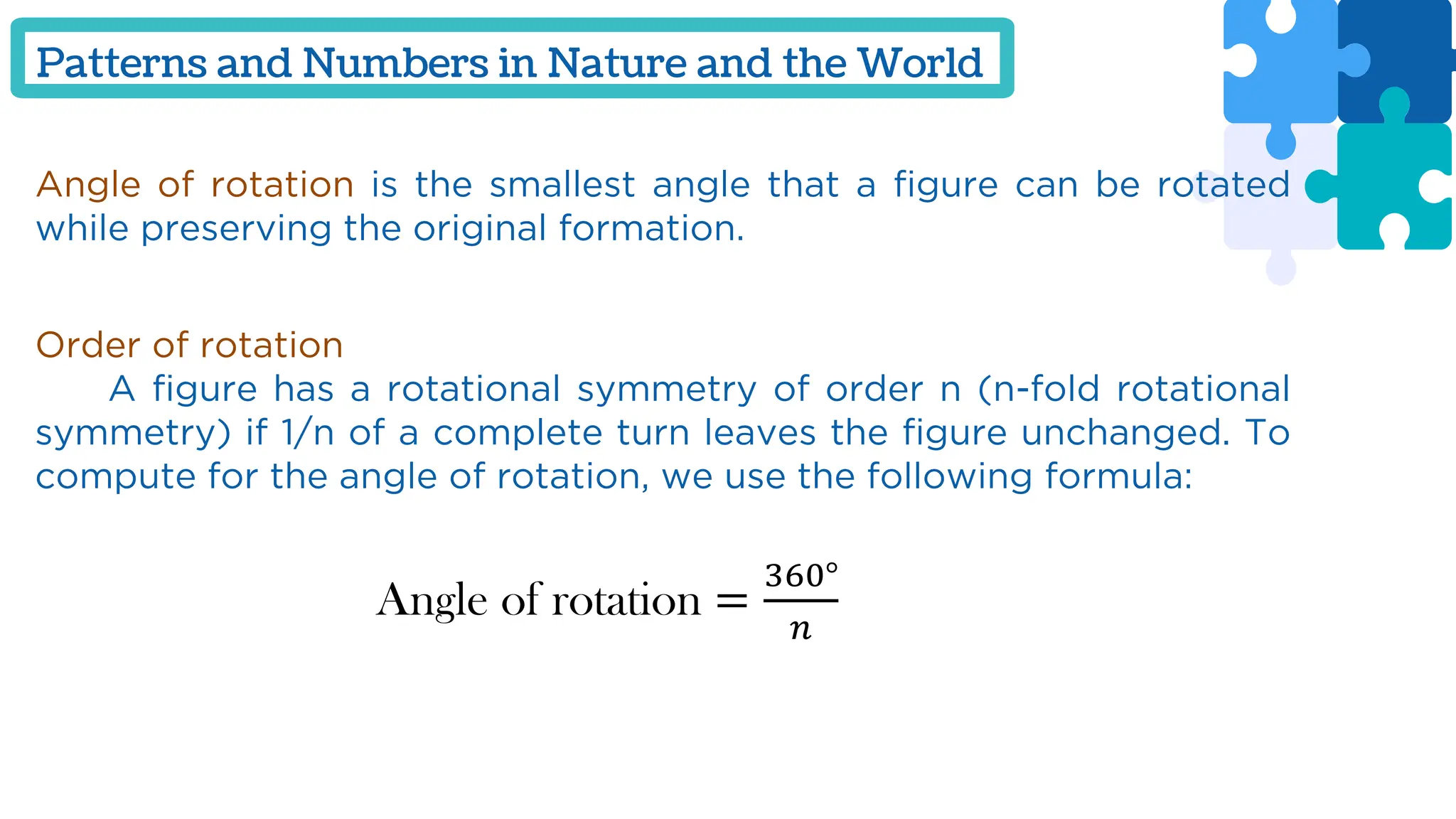
Angle of rotation is the smallest angle that a figure can be rotated
while preserving the original formation.
Order of rotation
A figure has a rotational symmetry of order n (n-fold rotational
symmetry) if 1/n of a complete turn leaves the figure unchanged. To
compute for the angle of rotation, we use the following formula:
Angle of rotation =
360°
𝑛
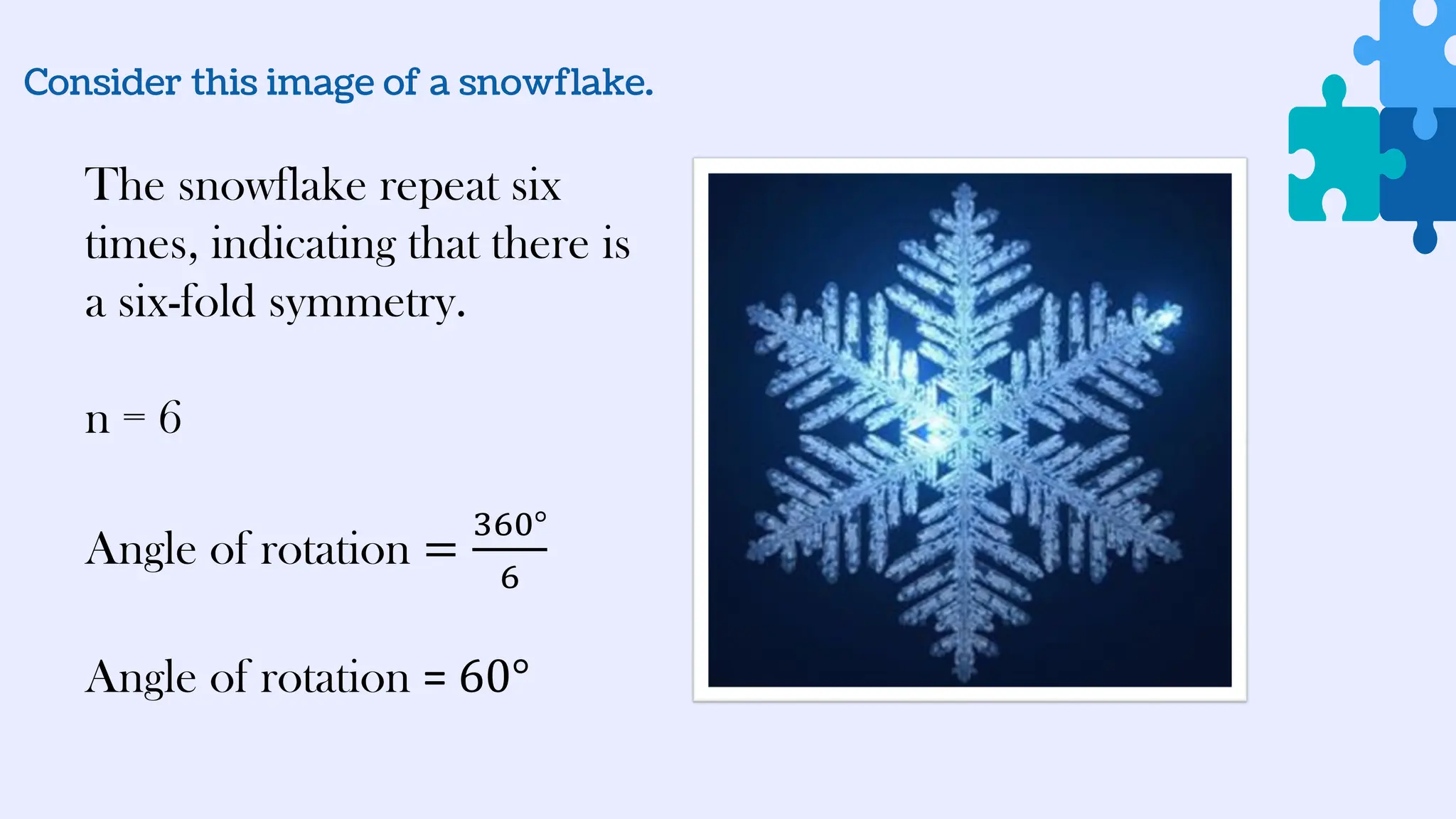
Consider this image of a snowflake.
The snowflake repeat six
times, indicating that there is
a six-fold symmetry.
n = 6
Angle of rotation =
360°
6
Angle of rotation = 60°
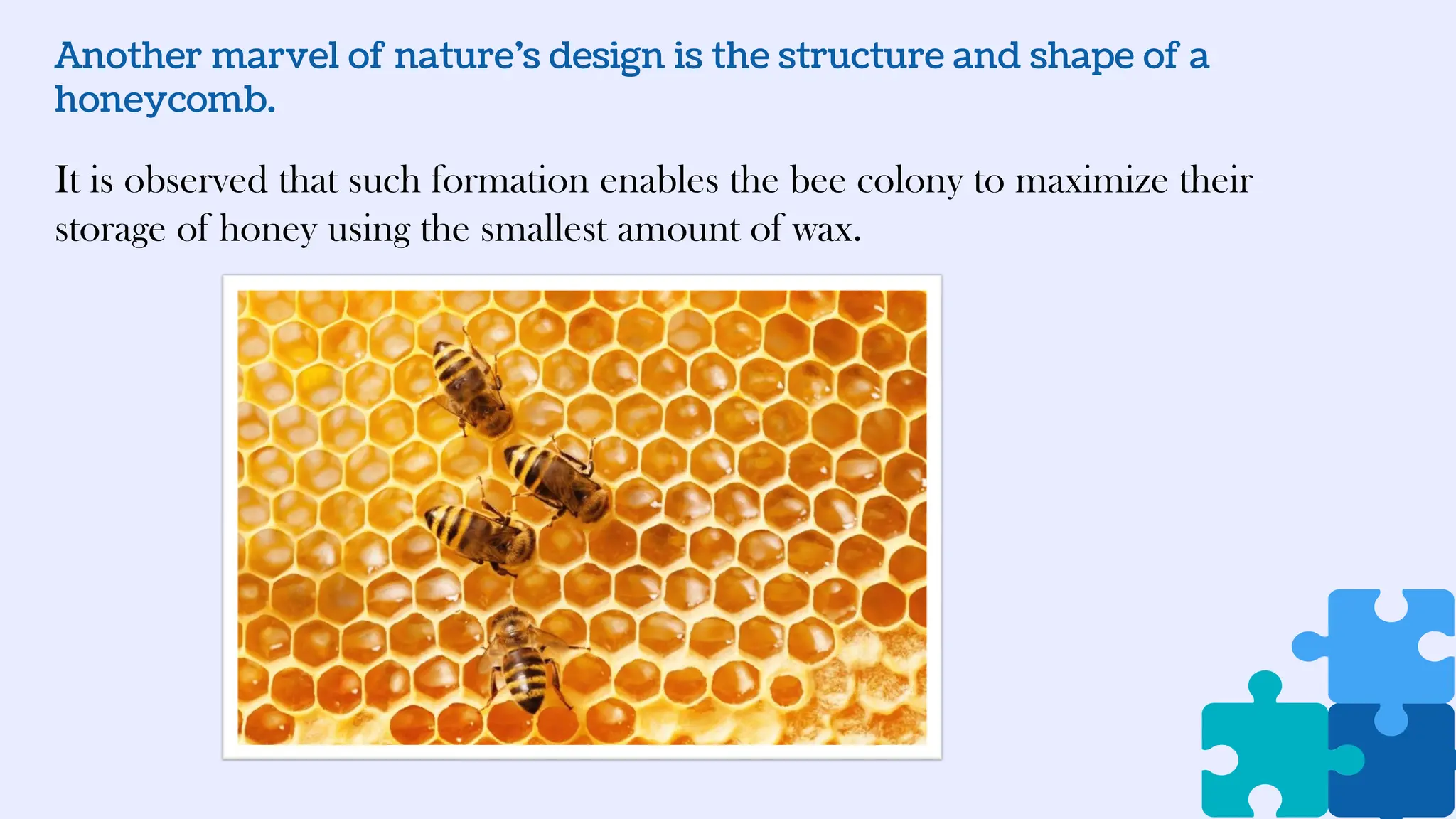
Another marvel of nature’s design is the structure and shape of a
honeycomb.
It is observed that such formation enables the bee colony to maximize their
storage of honey using the smallest amount of wax.
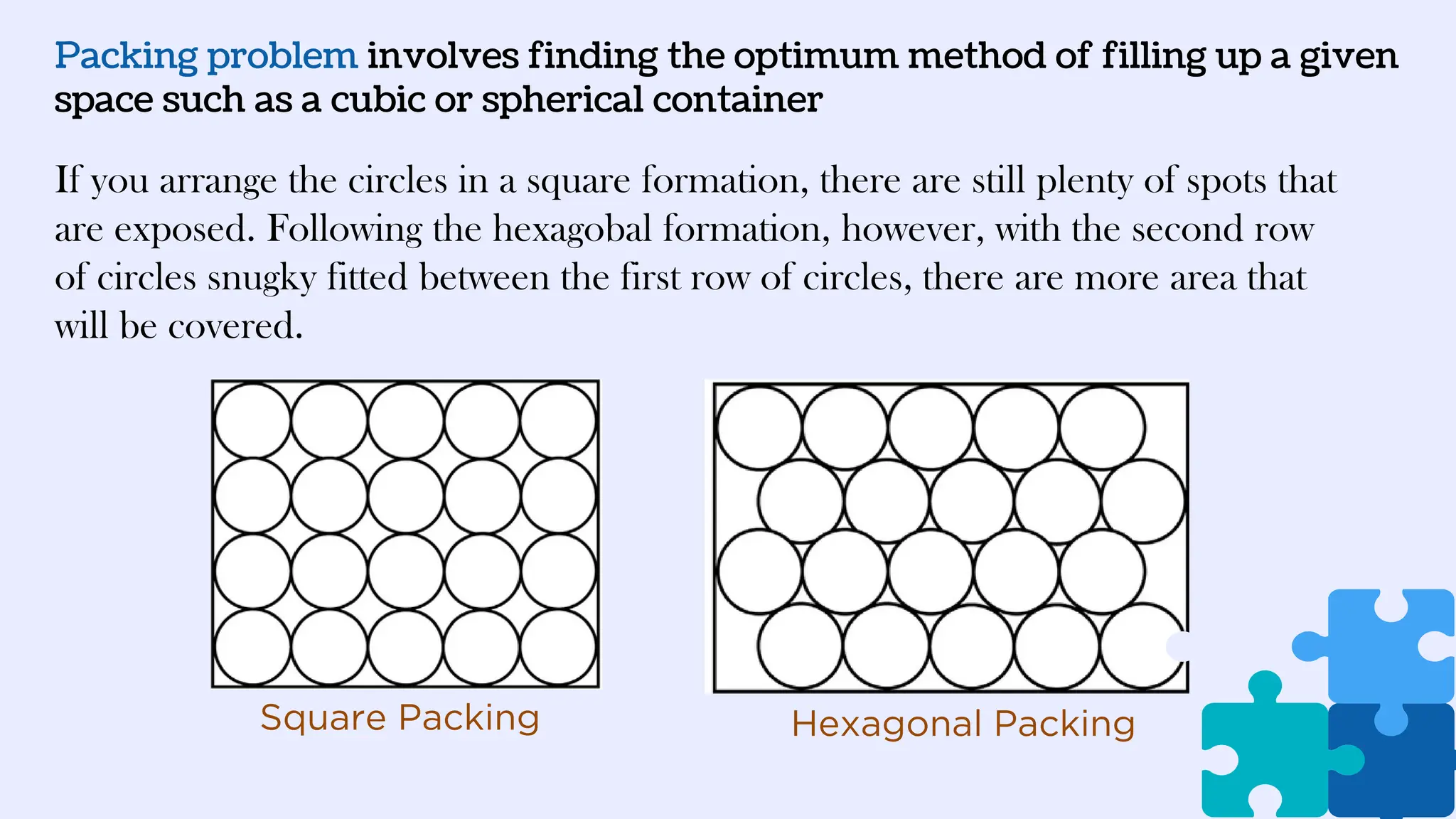
Packing problem involves finding the optimum method of filling up a given
space such as a cubic or spherical container
If you arrange the circles in a square formation, there are still plenty of spots that
are exposed. Following the hexagobal formation, however, with the second row
of circles snugky fitted between the first row of circles, there are more area that
will be covered.
Square Packing Hexagonal Packing
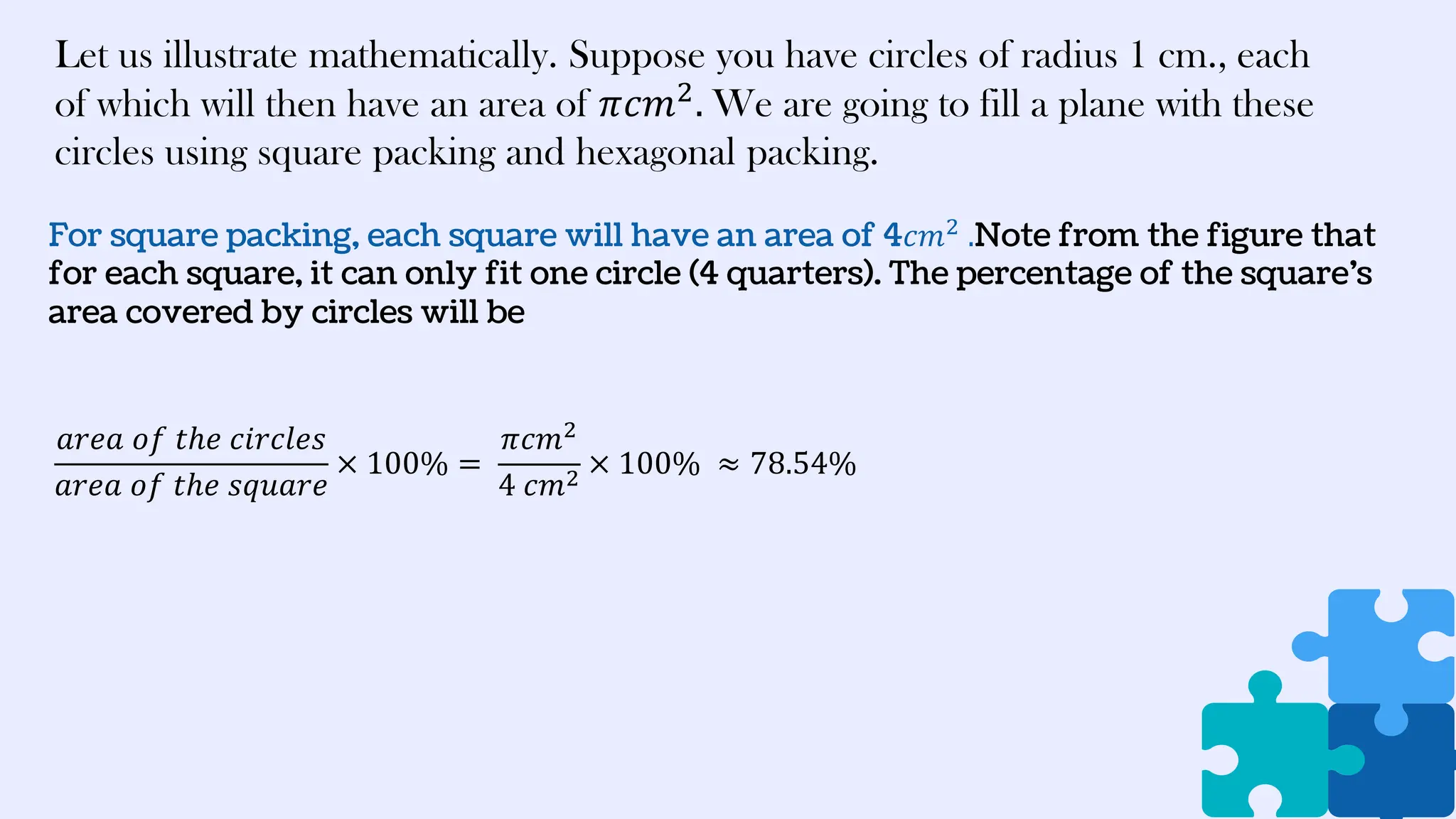
For square packing, each square will have an area of 4𝑐𝑚2
.Note from the figure that
for each square, it can only fit one circle (4 quarters). The percentage of the square’s
area covered by circles will be
Let us illustrate mathematically. Suppose you have circles of radius 1 cm., each
of which will then have an area of 𝜋𝑐𝑚2
. We are going to fill a plane with these
circles using square packing and hexagonal packing.
𝑎𝑟𝑒𝑎 𝑜𝑓 𝑡ℎ𝑒 𝑐𝑖𝑟𝑐𝑙𝑒𝑠
𝑎𝑟𝑒𝑎 𝑜𝑓 𝑡ℎ𝑒 𝑠𝑞𝑢𝑎𝑟𝑒
× 100% =
𝜋𝑐𝑚2
4 𝑐𝑚2
× 100% ≈ 78.54%
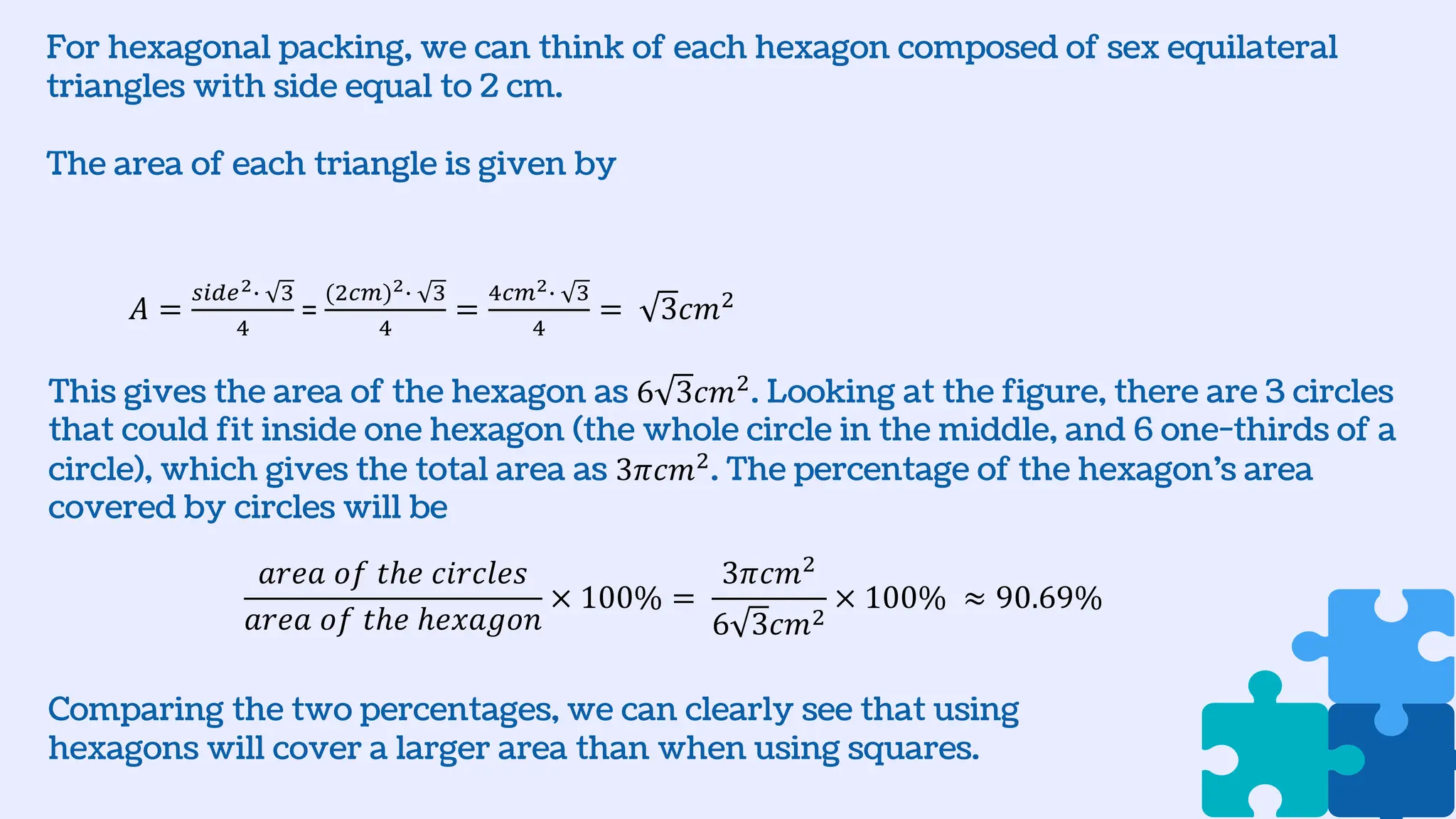
For hexagonal packing, we can think of each hexagon composed of sex equilateral
triangles with side equal to 2 cm.
The area of each triangle is given by
𝑎𝑟𝑒𝑎 𝑜𝑓 𝑡ℎ𝑒 𝑐𝑖𝑟𝑐𝑙𝑒𝑠
𝑎𝑟𝑒𝑎 𝑜𝑓 𝑡ℎ𝑒 ℎ𝑒𝑥𝑎𝑔𝑜𝑛
× 100% =
3𝜋𝑐𝑚2
6 3𝑐𝑚2
× 100% ≈ 90.69%
𝐴 =
𝑠𝑖𝑑𝑒2∙ 3
4
=
(2𝑐𝑚)2∙ 3
4
=
4𝑐𝑚2∙ 3
4
= 3𝑐𝑚2
This gives the area of the hexagon as 6 3𝑐𝑚2
. Looking at the figure, there are 3 circles
that could fit inside one hexagon (the whole circle in the middle, and 6 one-thirds of a
circle), which gives the total area as 3𝜋𝑐𝑚2
. The percentage of the hexagon’s area
covered by circles will be
Comparing the two percentages, we can clearly see that using
hexagons will cover a larger area than when using squares.
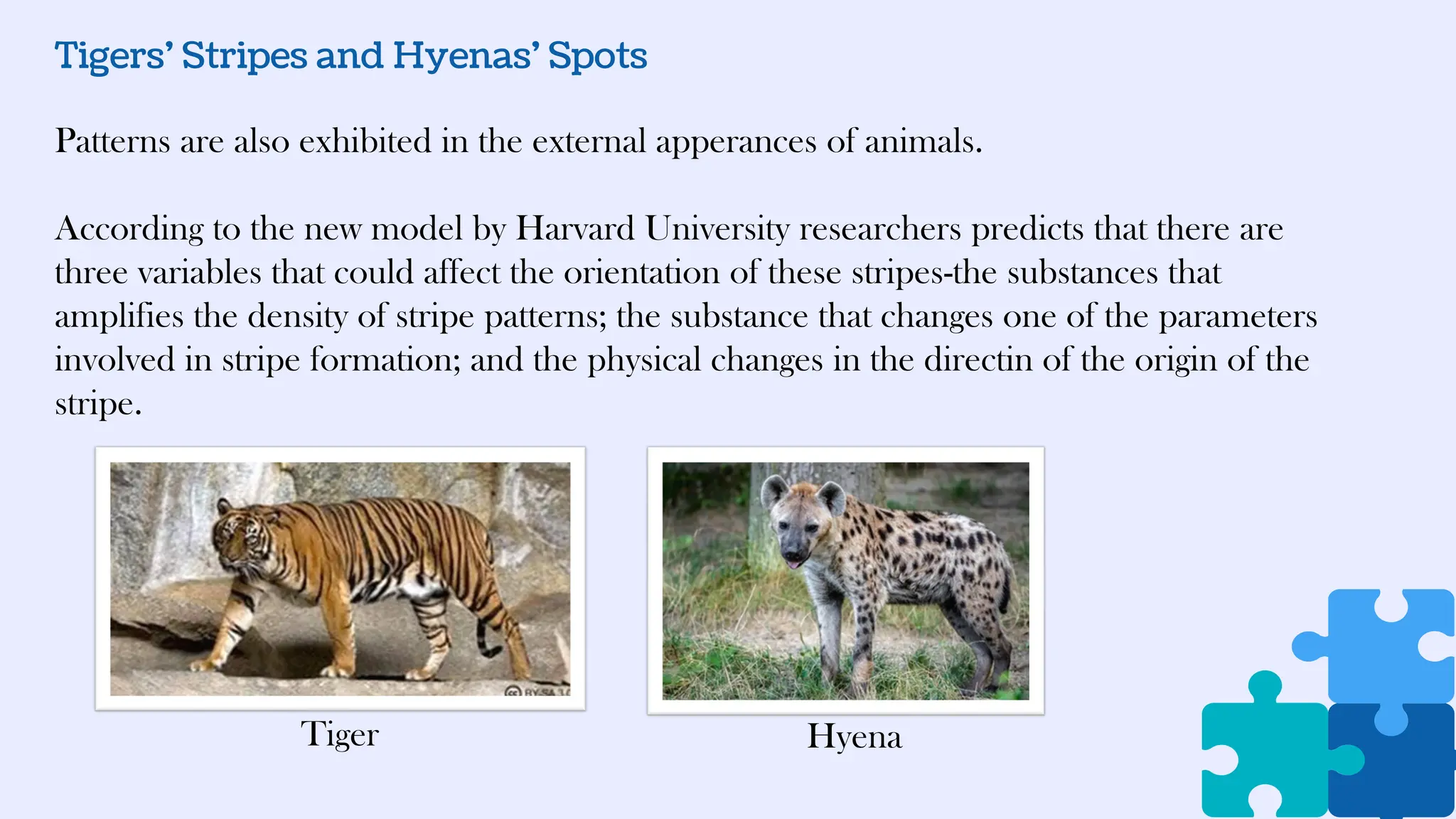
Tigers’ Stripes and Hyenas’ Spots
Patterns are also exhibited in the external apperances of animals.
According to the new model by Harvard University researchers predicts that there are
three variables that could affect the orientation of these stripes-the substances that
amplifies the density of stripe patterns; the substance that changes one of the parameters
involved in stripe formation; and the physical changes in the directin of the origin of the
stripe.
Tiger Hyena
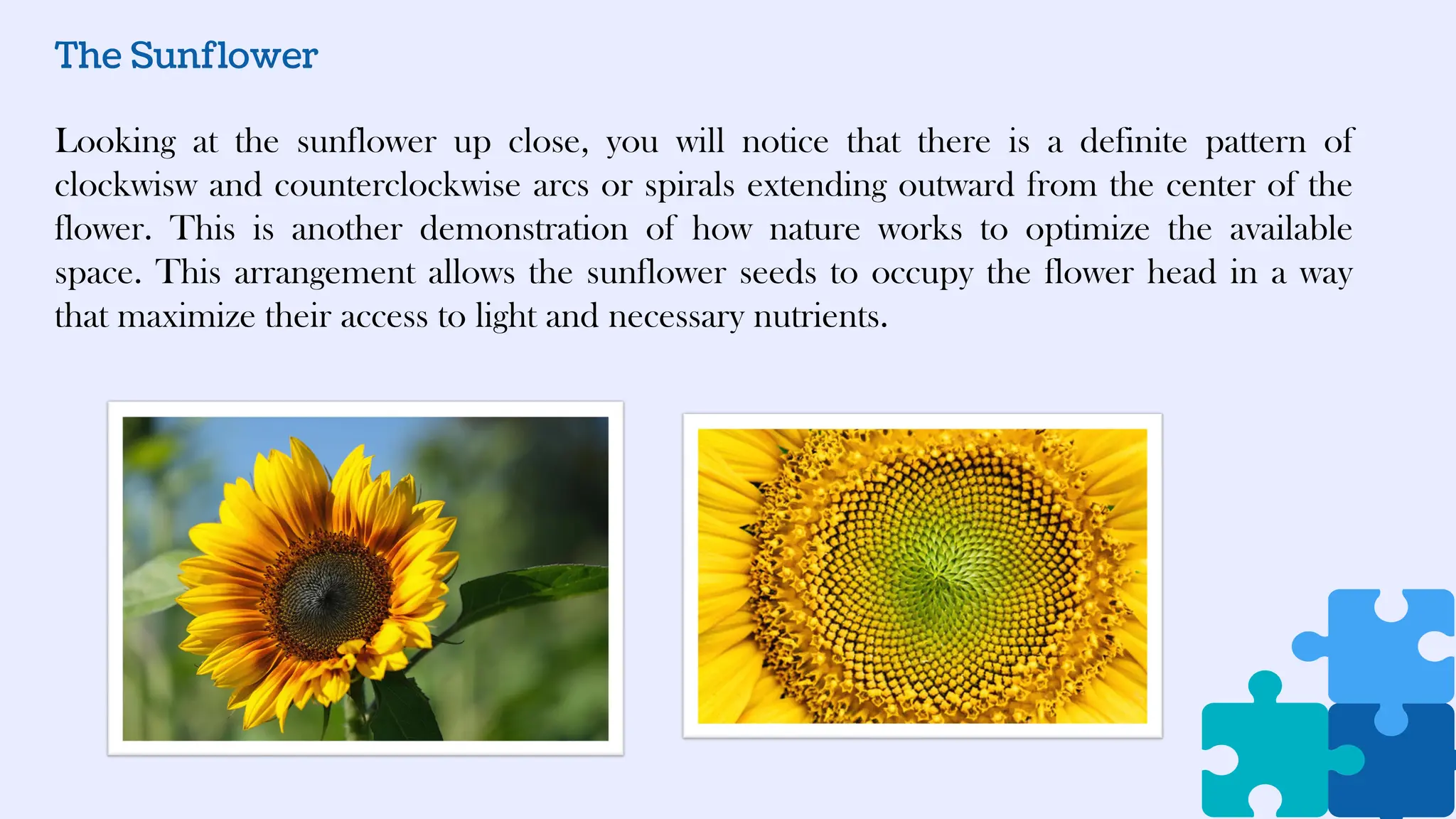
The Sunflower
Looking at the sunflower up close, you will notice that there is a definite pattern of
clockwisw and counterclockwise arcs or spirals extending outward from the center of the
flower. This is another demonstration of how nature works to optimize the available
space. This arrangement allows the sunflower seeds to occupy the flower head in a way
that maximize their access to light and necessary nutrients.
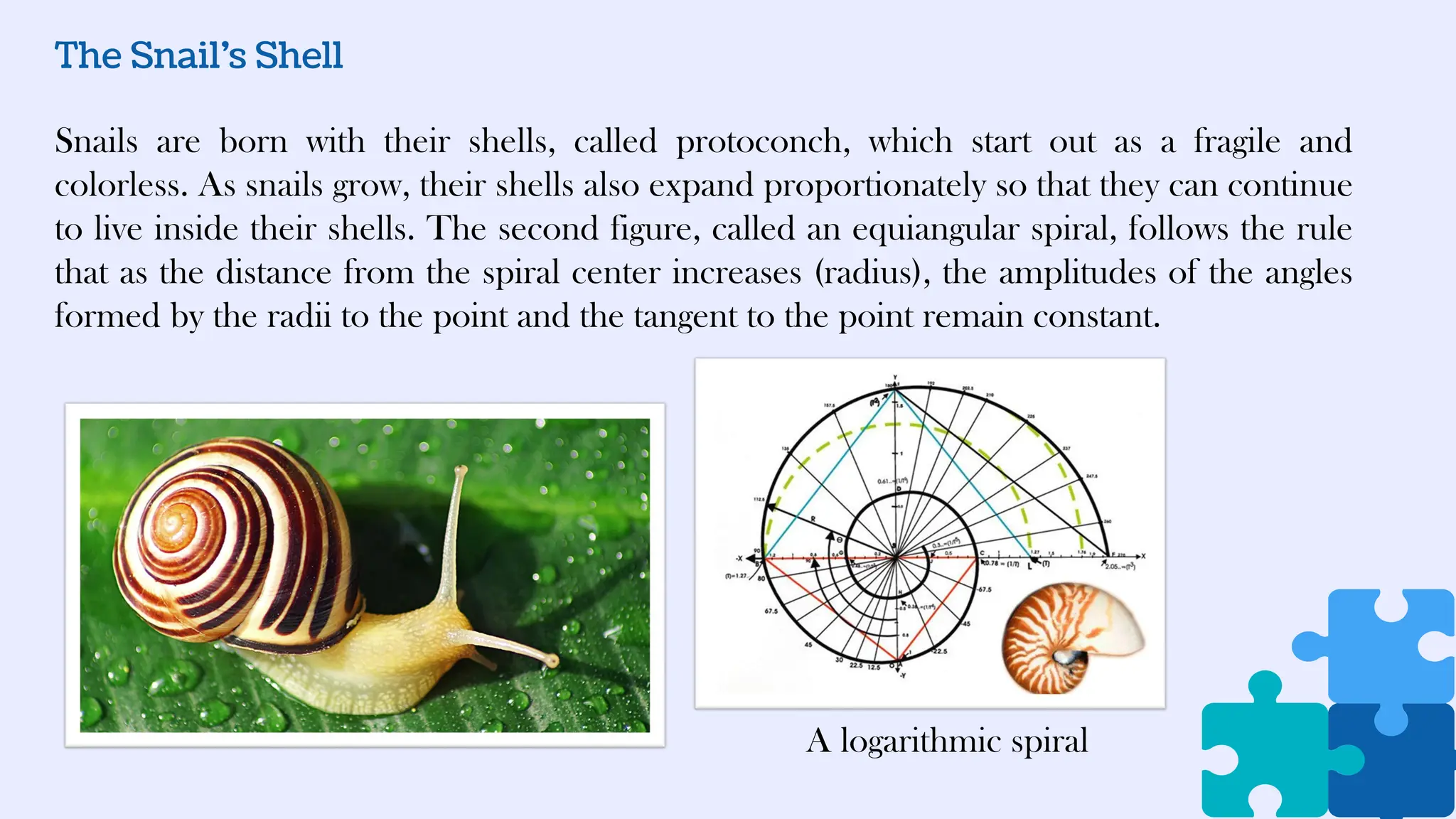
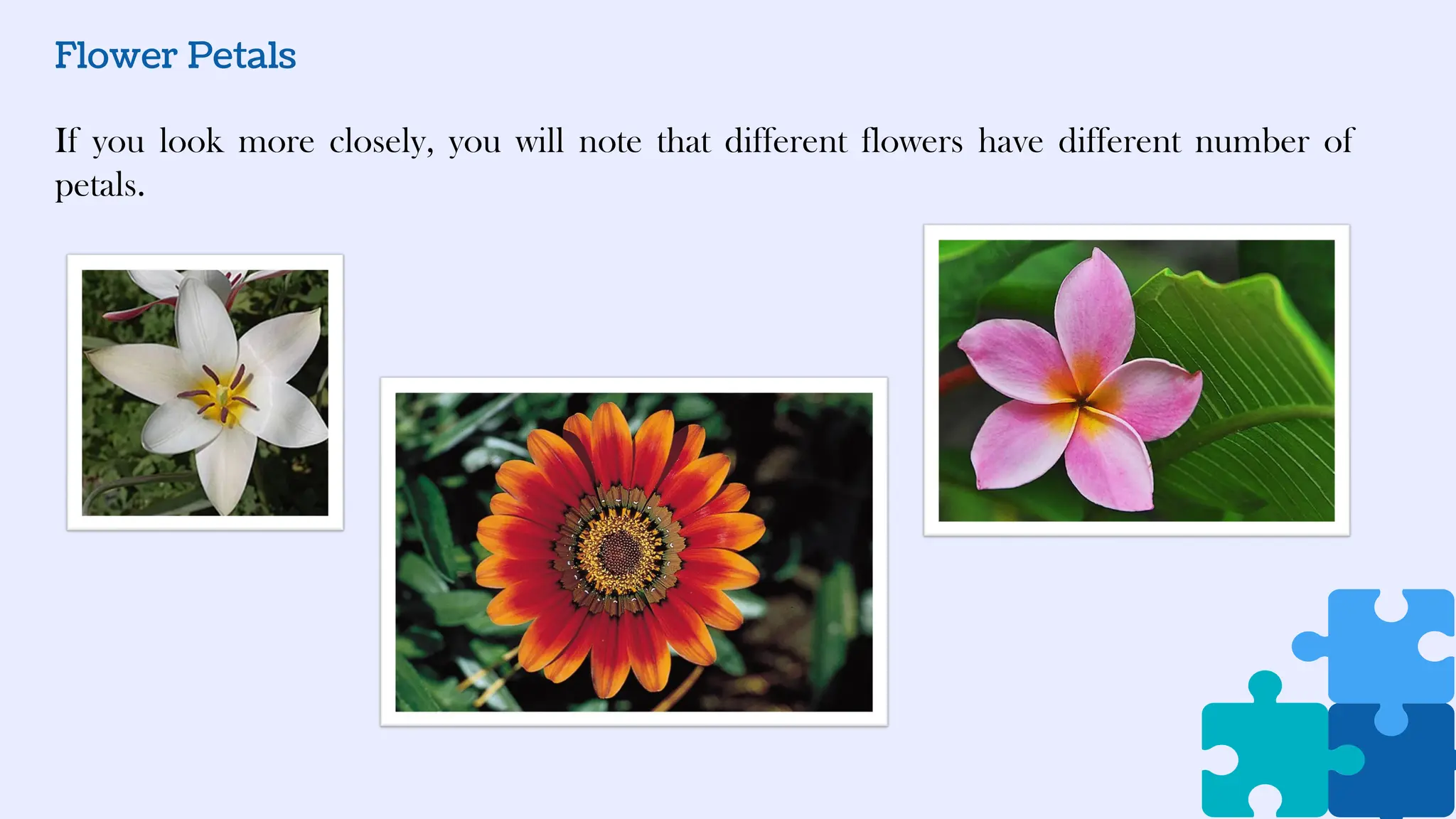
The Snail’s Shell
Snails are born with their shells, called protoconch, which start out as a fragile and
colorless. As snails grow, their shells also expand proportionately so that they can continue
to live inside their shells. The second figure, called an equiangular spiral, follows the rule
that as the distance from the spiral center increases (radius), the amplitudes of the angles
formed by the radii to the point and the tangent to the point remain constant.
A logarithmic spiral
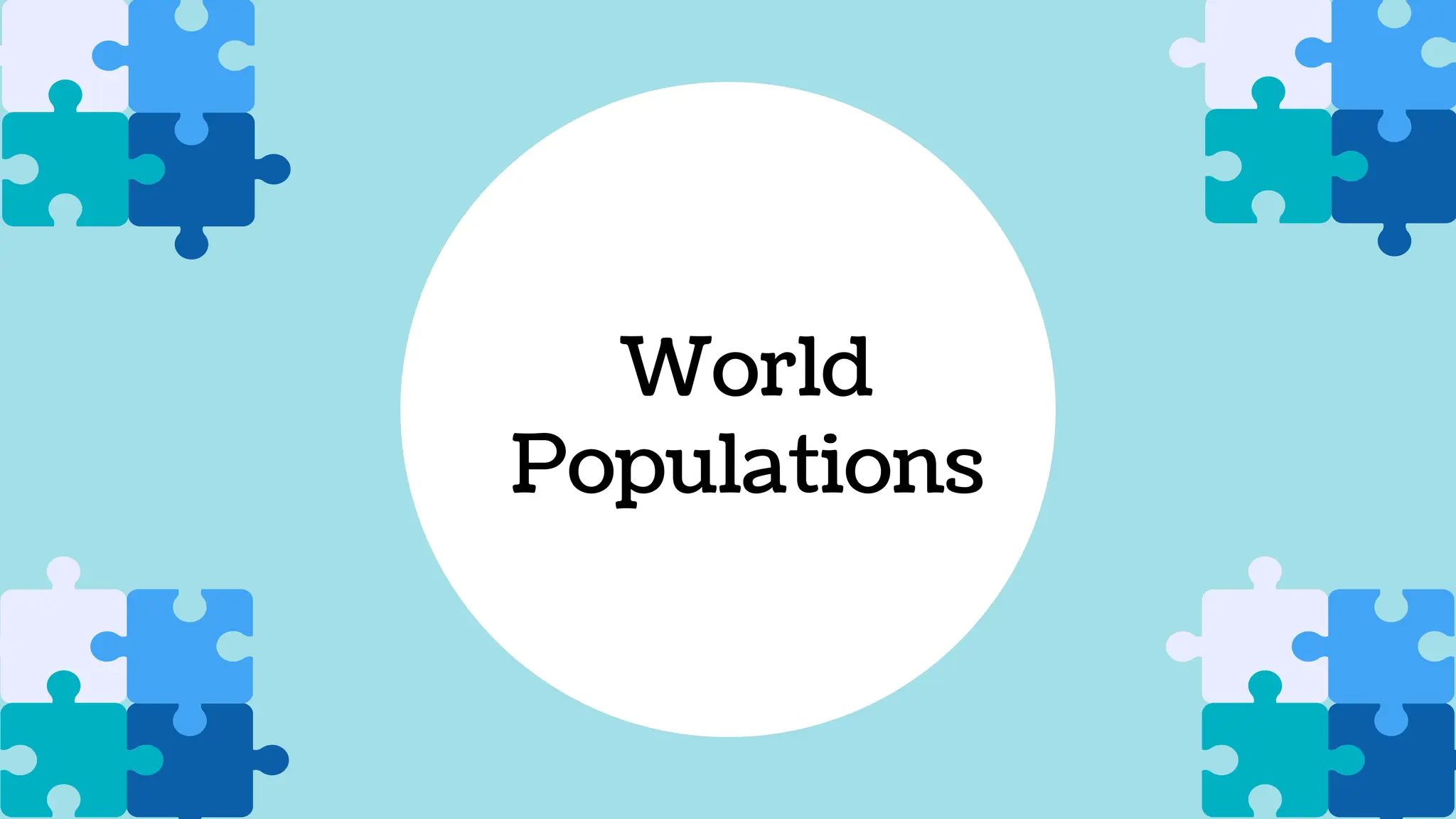
Flower Petals
If you look more closely, you will note that different flowers have different number of
petals.
World
Populations
World Population
As of, 2024, it is estimated that the world population is
approximately 8.2 billion. World leaders, sociologists, and
anthropologists are interested in studying population, including its
growth. Mathematics can be used to model population growth.
A = P𝑒𝑟𝑡
where A is the size of the population after it grows, P is
the initial number of people, r is the rate of growth and t is the
time. Recall further that e is the Euler’s constant with an
approximate value of 2.718
World Population
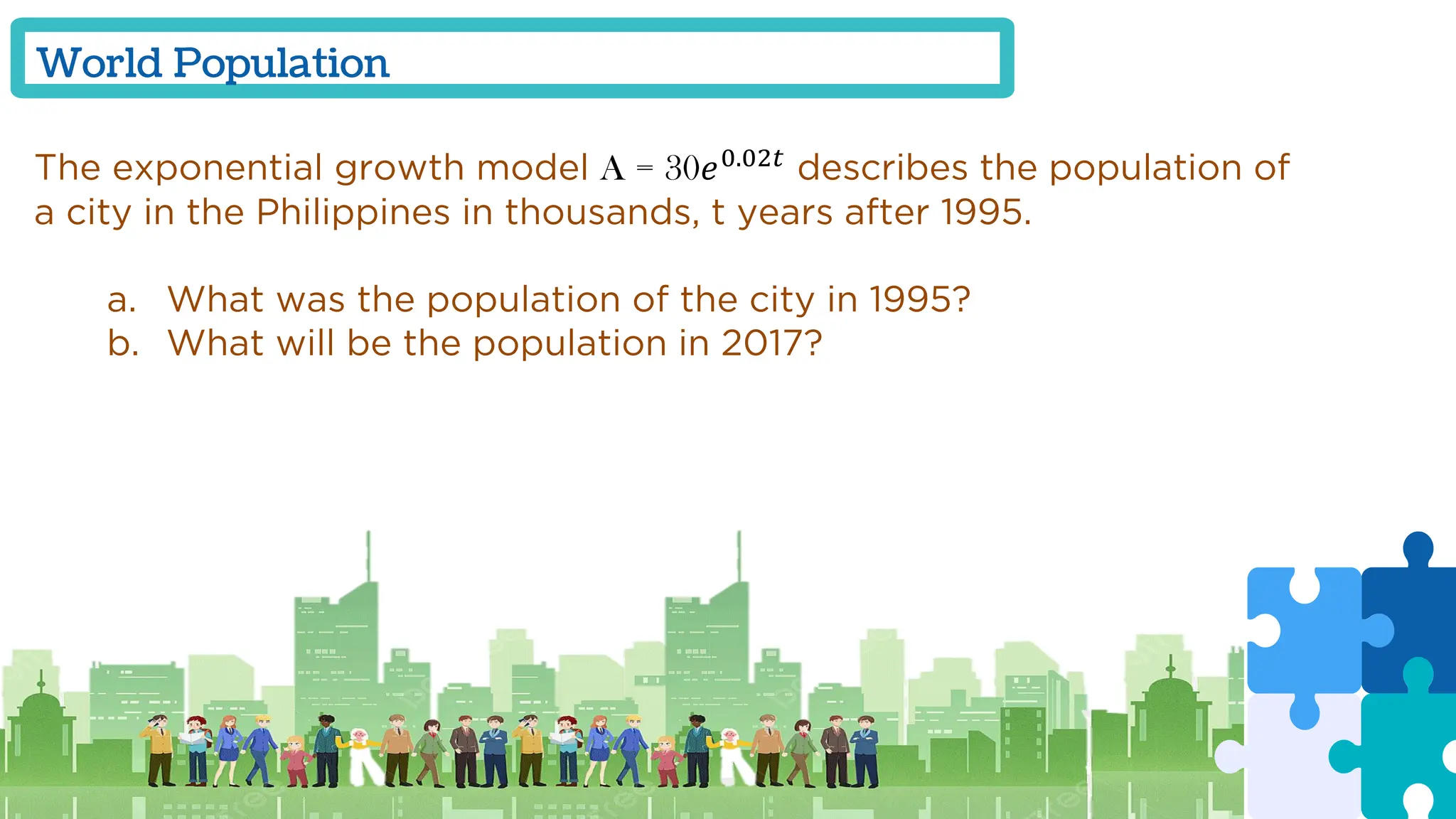
The exponential growth model A = 30𝑒0.02𝑡
describes the population of
a city in the Philippines in thousands, t years after 1995.
a. What was the population of the city in 1995?
b. What will be the population in 2017?
World Population
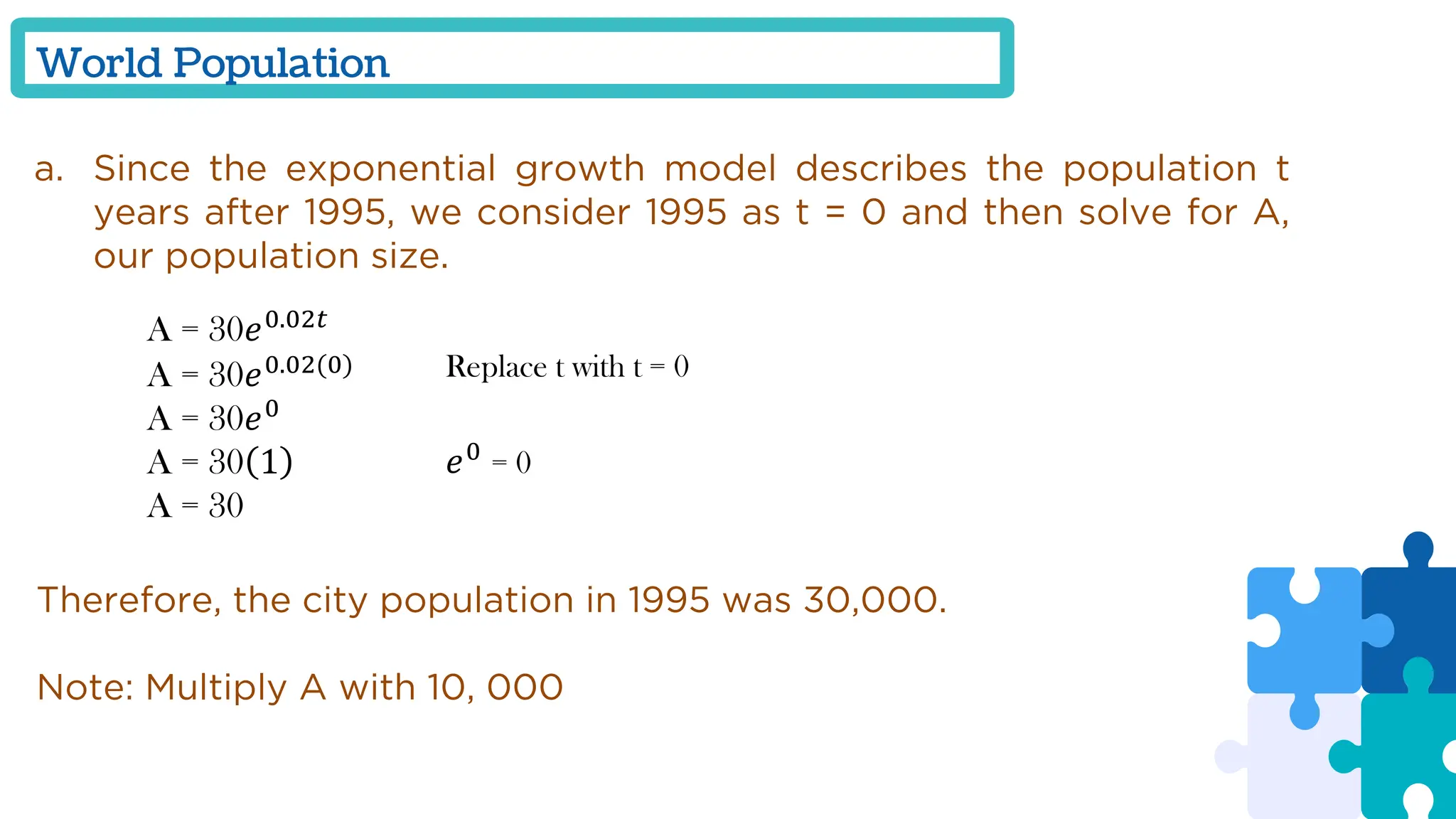
a. Since the exponential growth model describes the population t
years after 1995, we consider 1995 as t = 0 and then solve for A,
our population size.
A = 30𝑒0.02𝑡
A = 30𝑒0.02(0)
A = 30𝑒0
A = 30 1
A = 30
Replace t with t = 0
𝑒0
= 0
Therefore, the city population in 1995 was 30,000.
Note: Multiply A with 10, 000
World Population
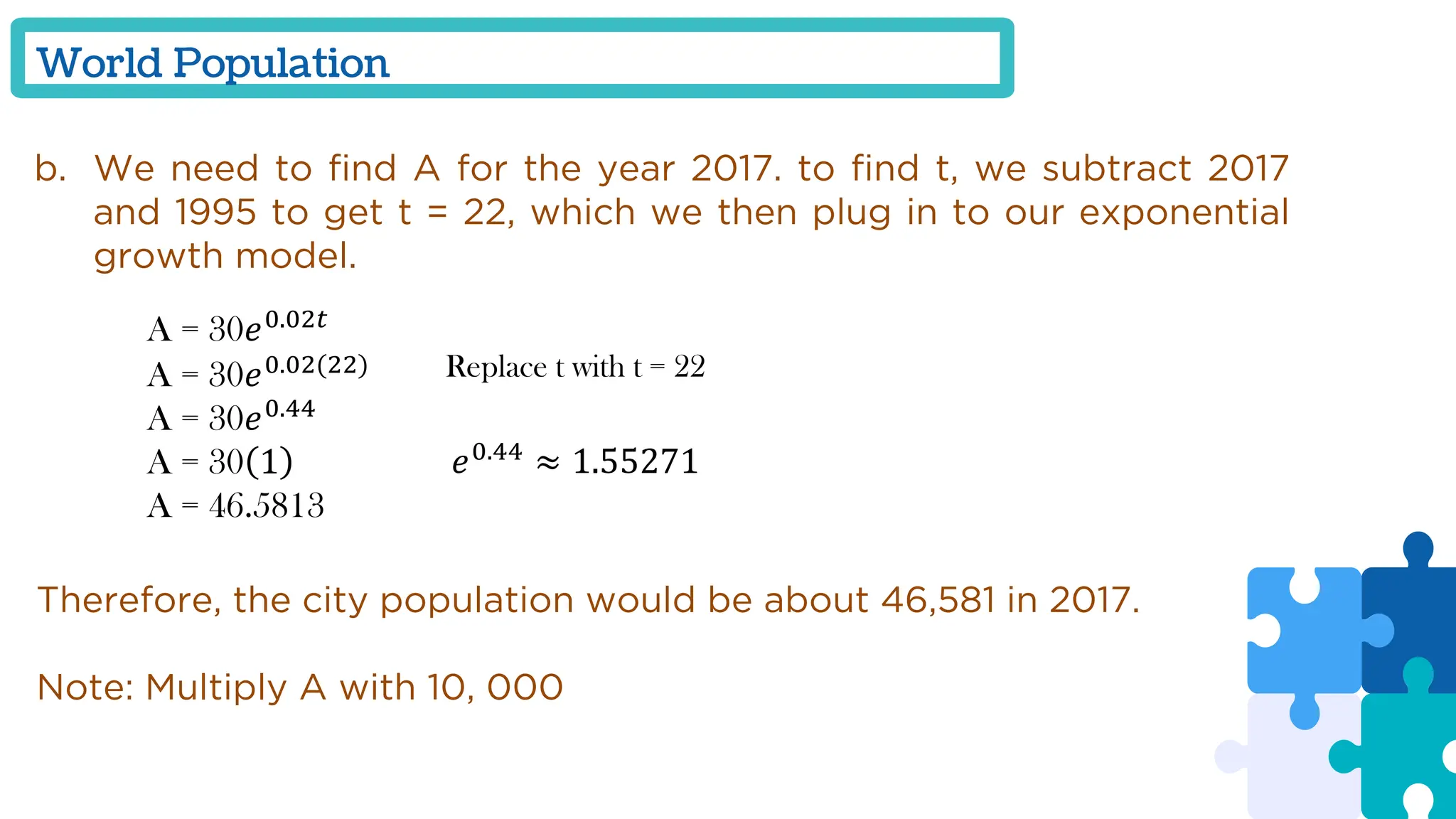
b. We need to find A for the year 2017. to find t, we subtract 2017
and 1995 to get t = 22, which we then plug in to our exponential
growth model.
A = 30𝑒0.02𝑡
A = 30𝑒0.02(22)
A = 30𝑒0.44
A = 30 1
A = 46.5813
Replace t with t = 22
𝑒0.44
≈ 1.55271
Therefore, the city population would be about 46,581 in 2017.
Note: Multiply A with 10, 000
Exercise 1.1
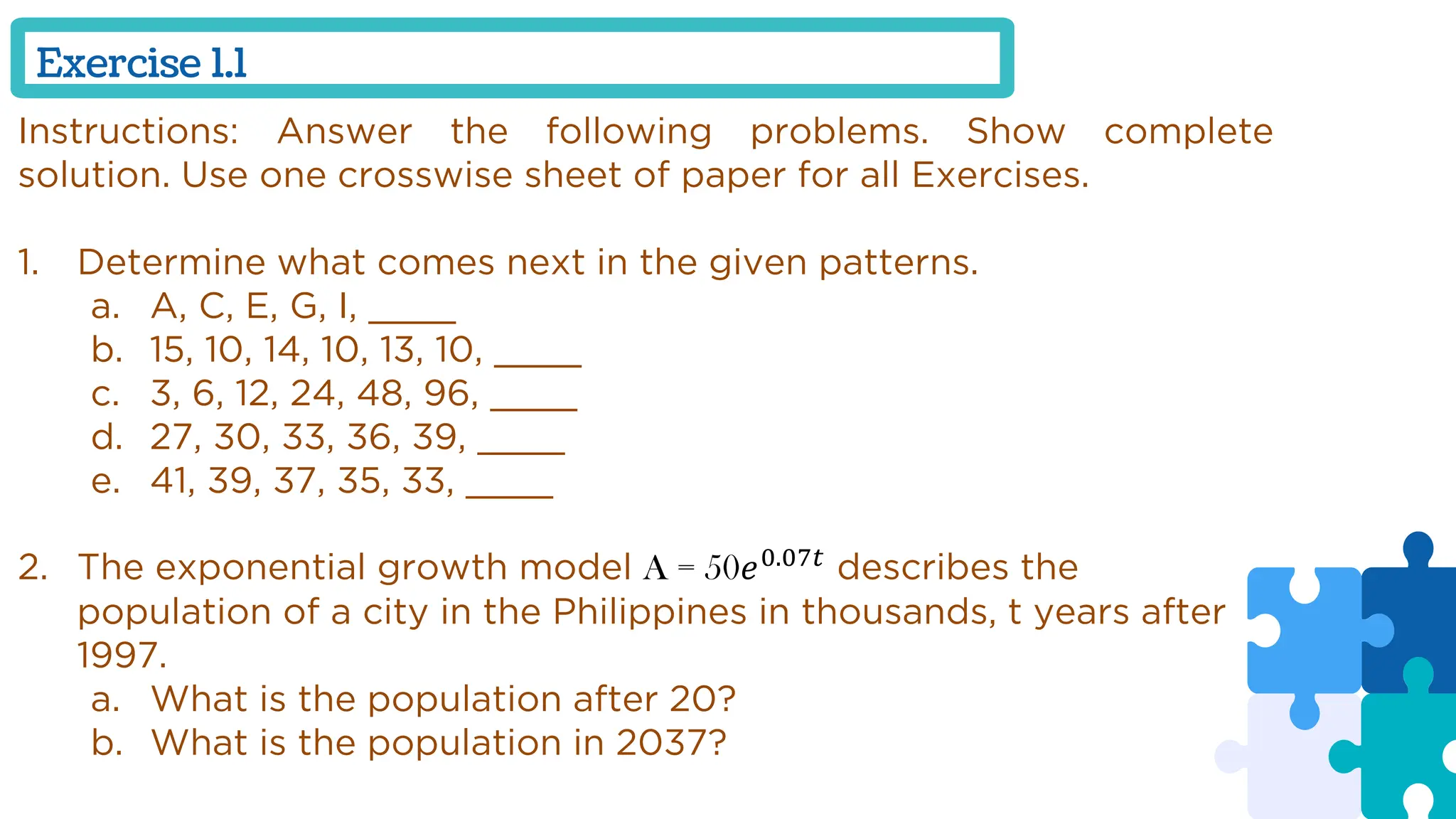
Instructions: Answer the following problems. Show complete
solution. Use one crosswise sheet of paper for all Exercises.
1. Determine what comes next in the given patterns.
a. A, C, E, G, I, ____
b. 15, 10, 14, 10, 13, 10, ____
c. 3, 6, 12, 24, 48, 96, ____
d. 27, 30, 33, 36, 39, ____
e. 41, 39, 37, 35, 33, ____
2. The exponential growth model A = 50𝑒0.07𝑡
describes the
population of a city in the Philippines in thousands, t years after
1997.
a. What is the population after 20?
b. What is the population in 2037?
The Fibonacci
Sequence
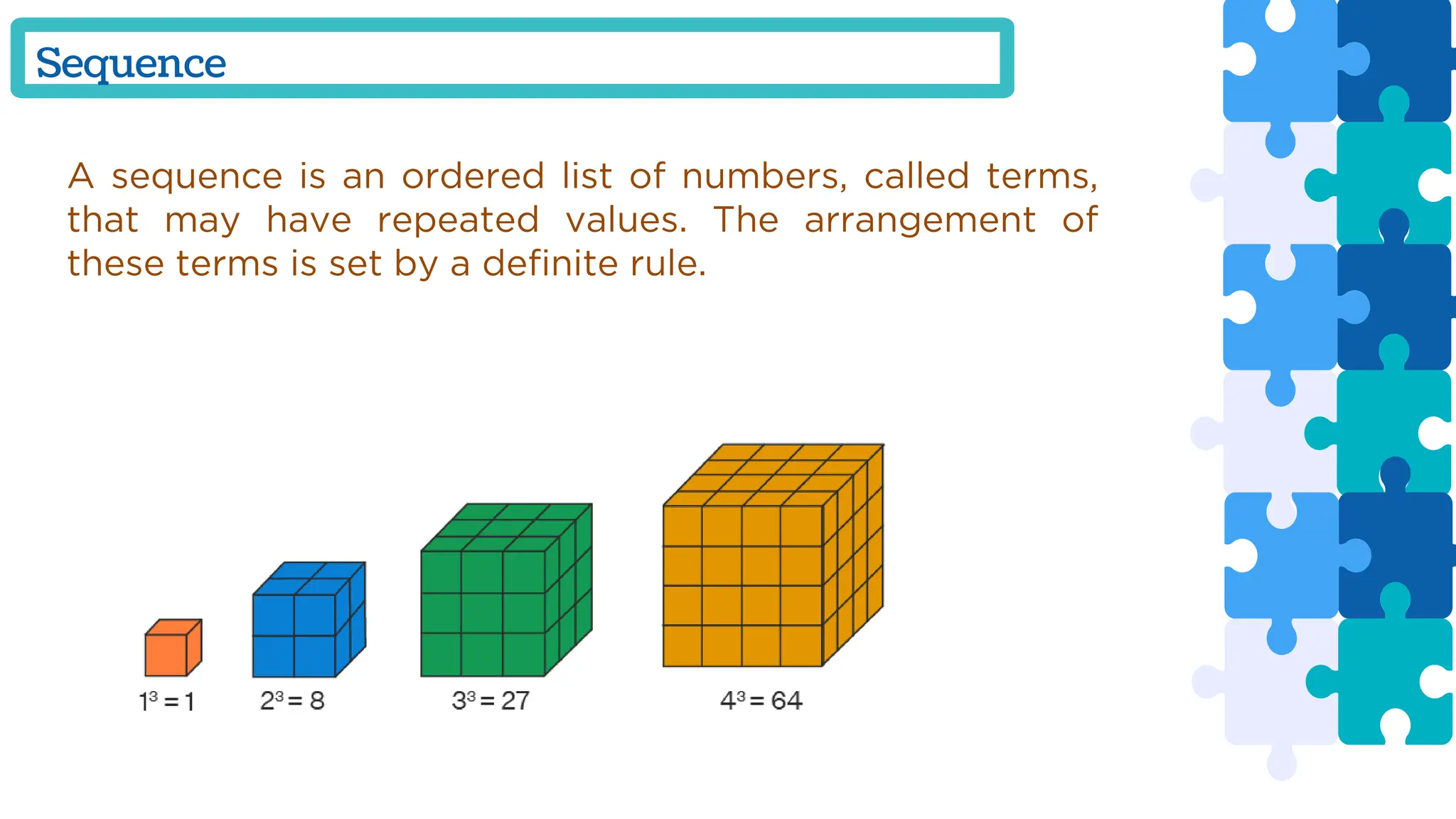
A sequence is an ordered list of numbers, called terms,
that may have repeated values. The arrangement of
these terms is set by a definite rule.
Sequence
Generating a Sequence
Analyze the given sequence for its rule and identify the
next three terms.
a. 1, 10, 100, 1000
b. 2, 5, 9, 14, 20
Sequence
Generating a Sequence
1, 10, 100, 1000
Looking at the set of numbers, it can be observed that
each term is a power of 10: 1 = 100
, 10 = 101
, 100 = 102
,
and 1,000 = 103
. Following this rule, the next three
terms are: 10,000 = 104
, 100,000 = 105
, and
1,000,000 = 106
.
Sequence
Generating a Sequence
2, 5, 9, 14, 20
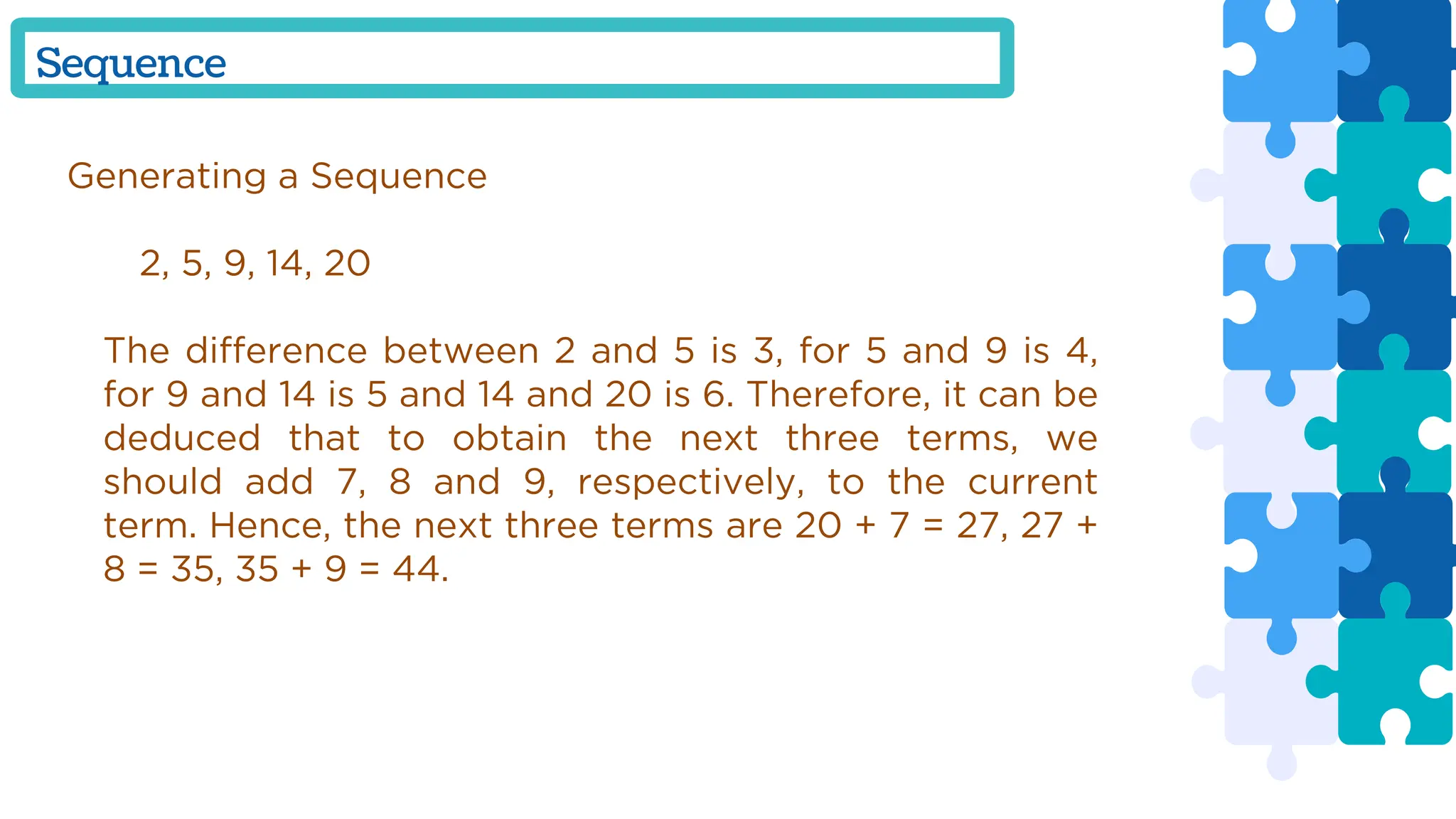
The difference between 2 and 5 is 3, for 5 and 9 is 4,
for 9 and 14 is 5 and 14 and 20 is 6. Therefore, it can be
deduced that to obtain the next three terms, we
should add 7, 8 and 9, respectively, to the current
term. Hence, the next three terms are 20 + 7 = 27, 27 +
8 = 35, 35 + 9 = 44.
Sequence
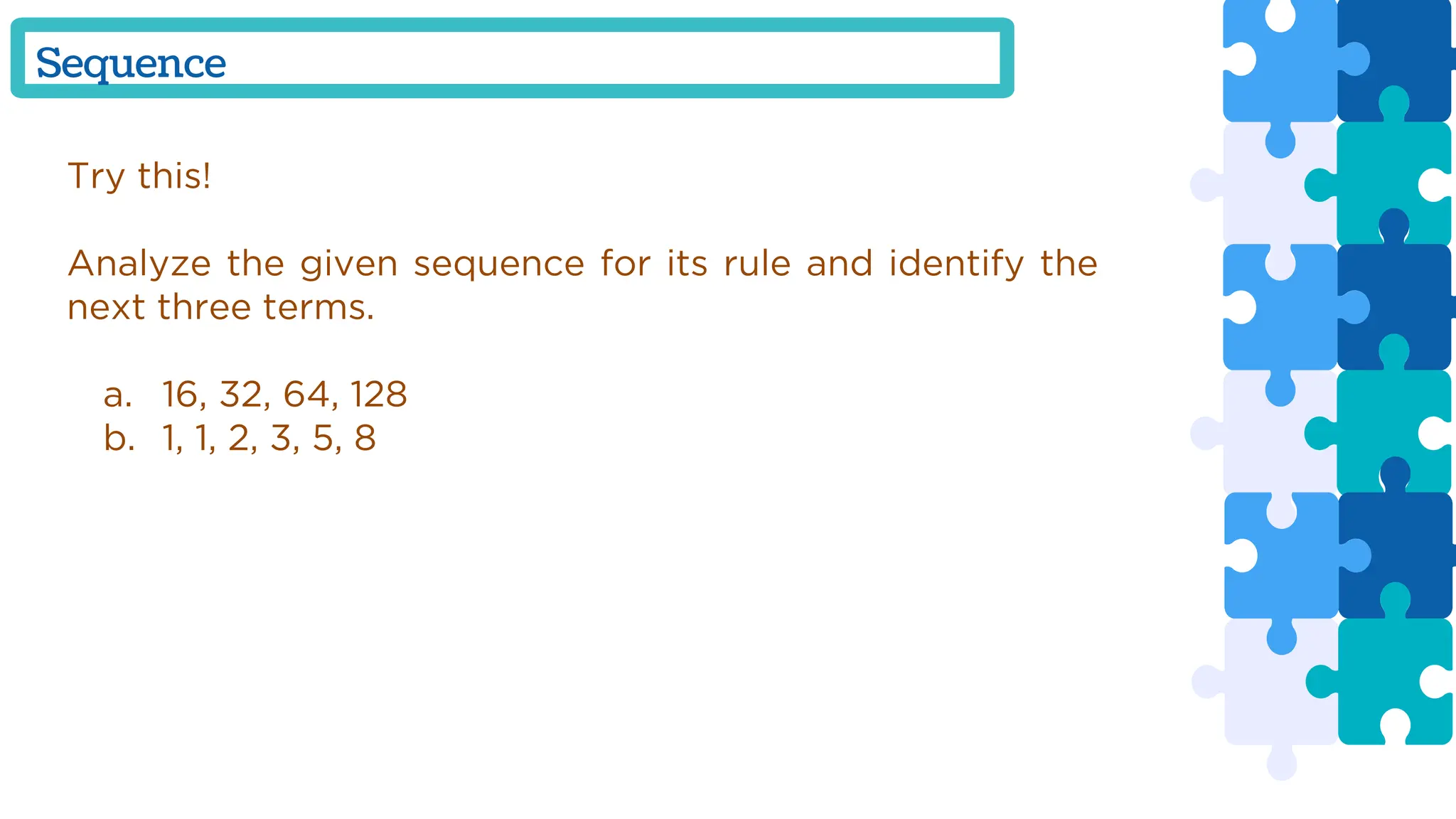
Try this!
Analyze the given sequence for its rule and identify the
next three terms.
a. 16, 32, 64, 128
b. 1, 1, 2, 3, 5, 8
Sequence
Fibonacci Sequence
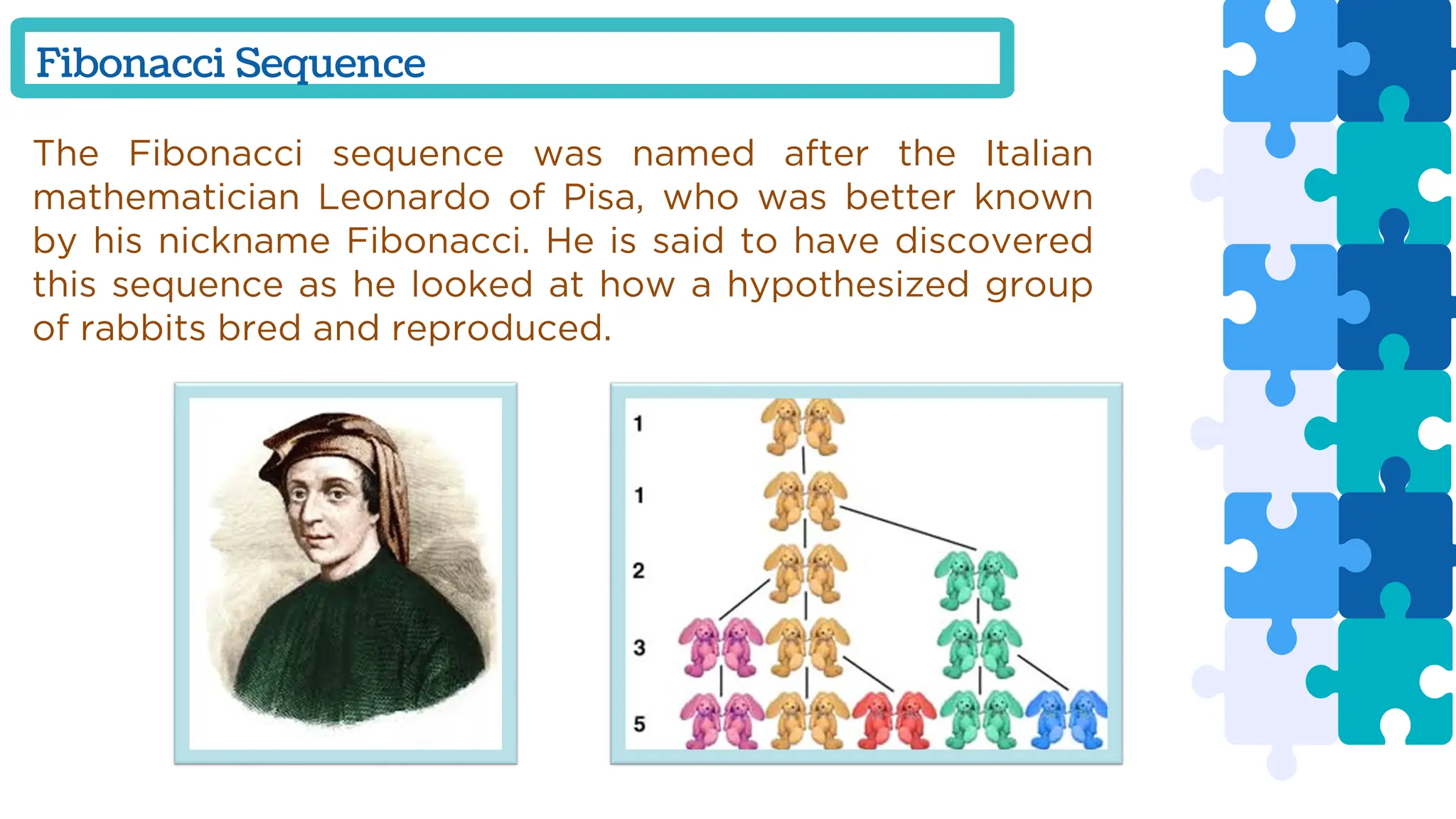
The Fibonacci sequence was named after the Italian
mathematician Leonardo of Pisa, who was better known
by his nickname Fibonacci. He is said to have discovered
this sequence as he looked at how a hypothesized group
of rabbits bred and reproduced.
Fibonacci Sequence
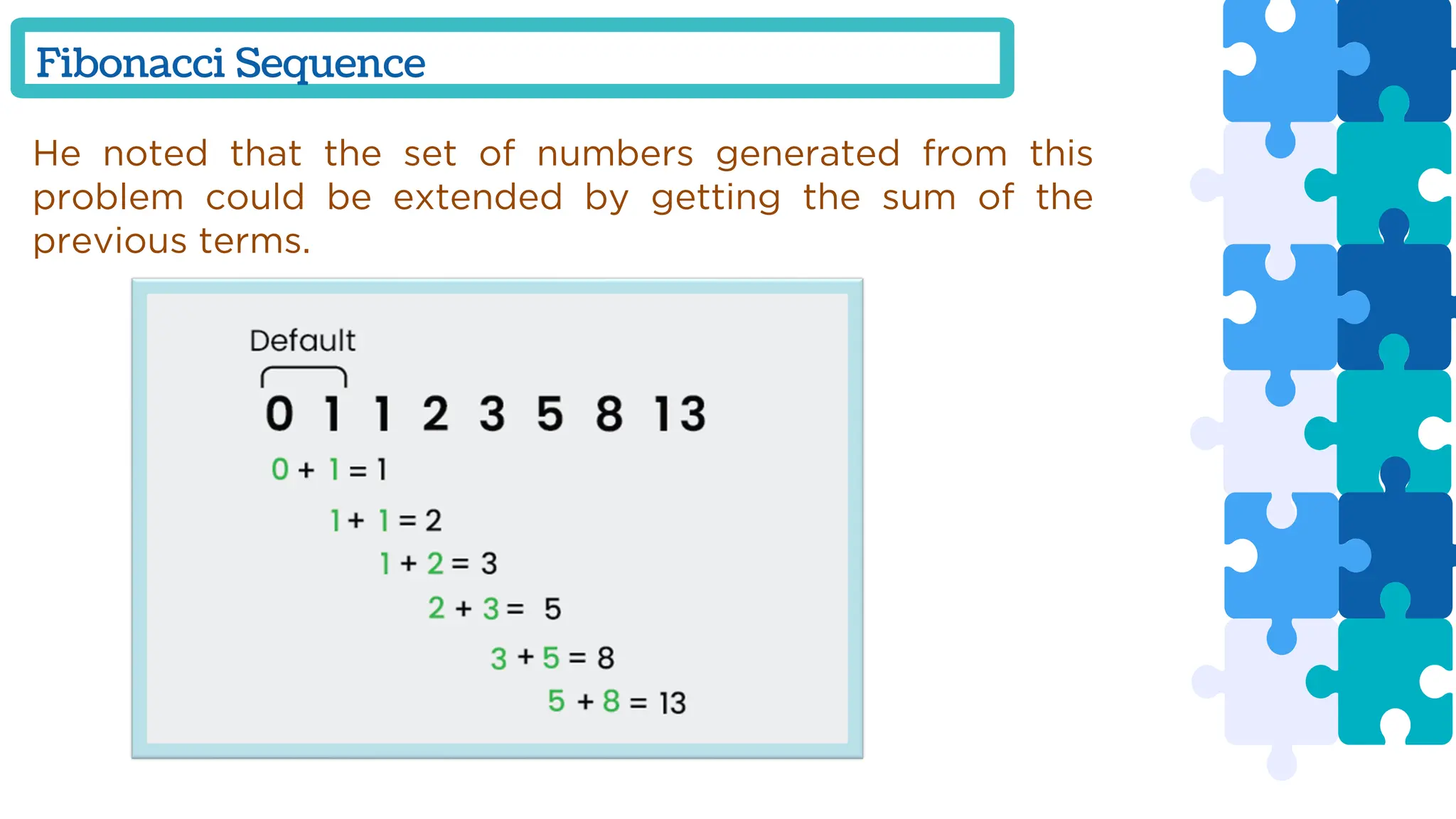
He noted that the set of numbers generated from this
problem could be extended by getting the sum of the
previous terms.
Fibonacci Sequence
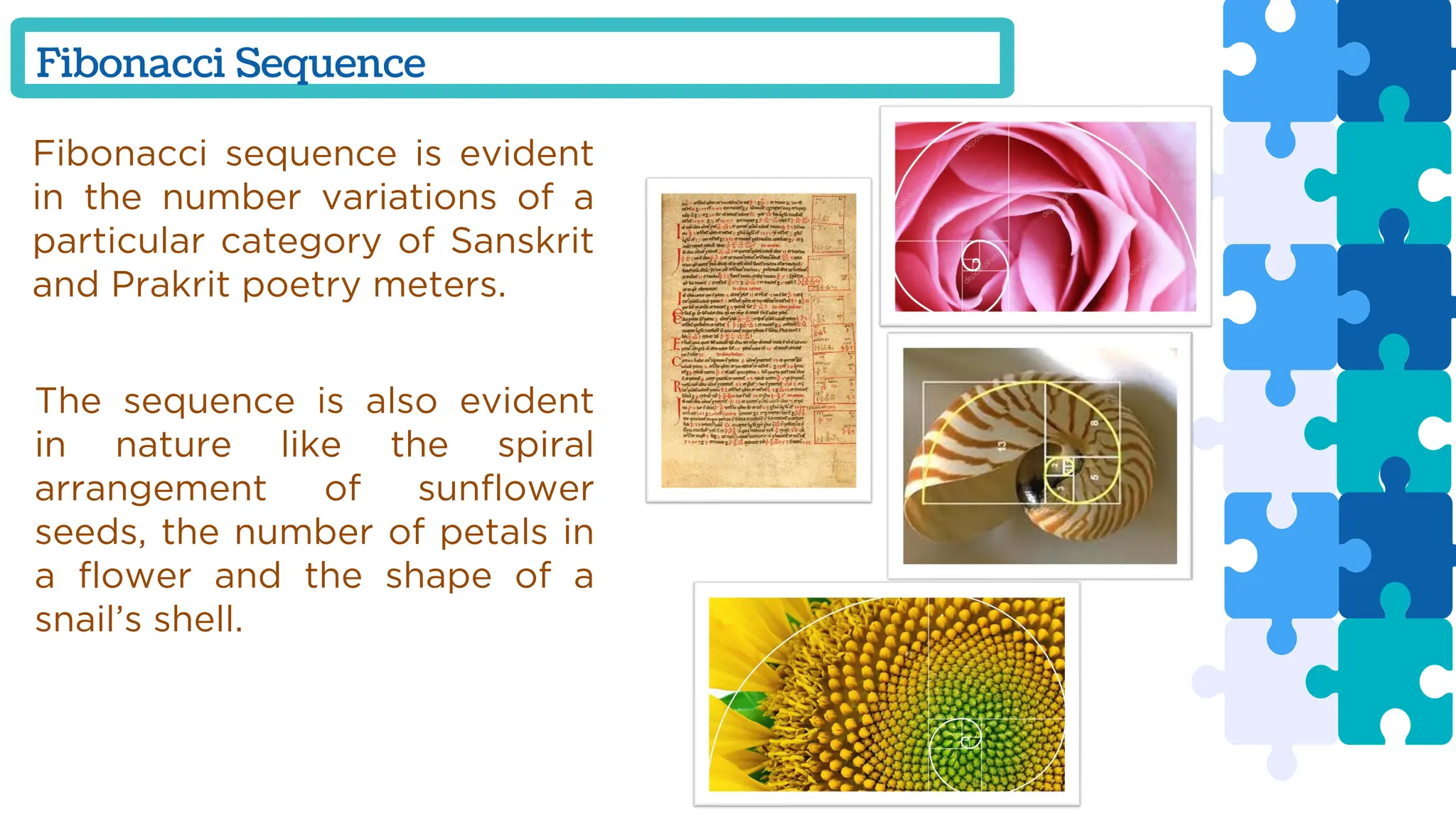
Fibonacci sequence is evident
in the number variations of a
particular category of Sanskrit
and Prakrit poetry meters.
The sequence is also evident
in nature like the spiral
arrangement of sunflower
seeds, the number of petals in
a flower and the shape of a
snail’s shell.
The Golden Ratio
It is also interesting to note that the ratios of successive
Fibonacci numbers approach the numbers Φ (Phi), also
known as the Golden ratio. This is approximately equal
to 1.618.
1/1 = 1.0000 13/8 = 1.6250
2/1 = 2.0000 21/13 = 1.6154
3/2 = 1.5000 34/21 = 1.6190
5/3 = 1.6667 55/34 = 1.6177
8/5 = 1.6000 89/55 = 1.6182
The Golden Ratio
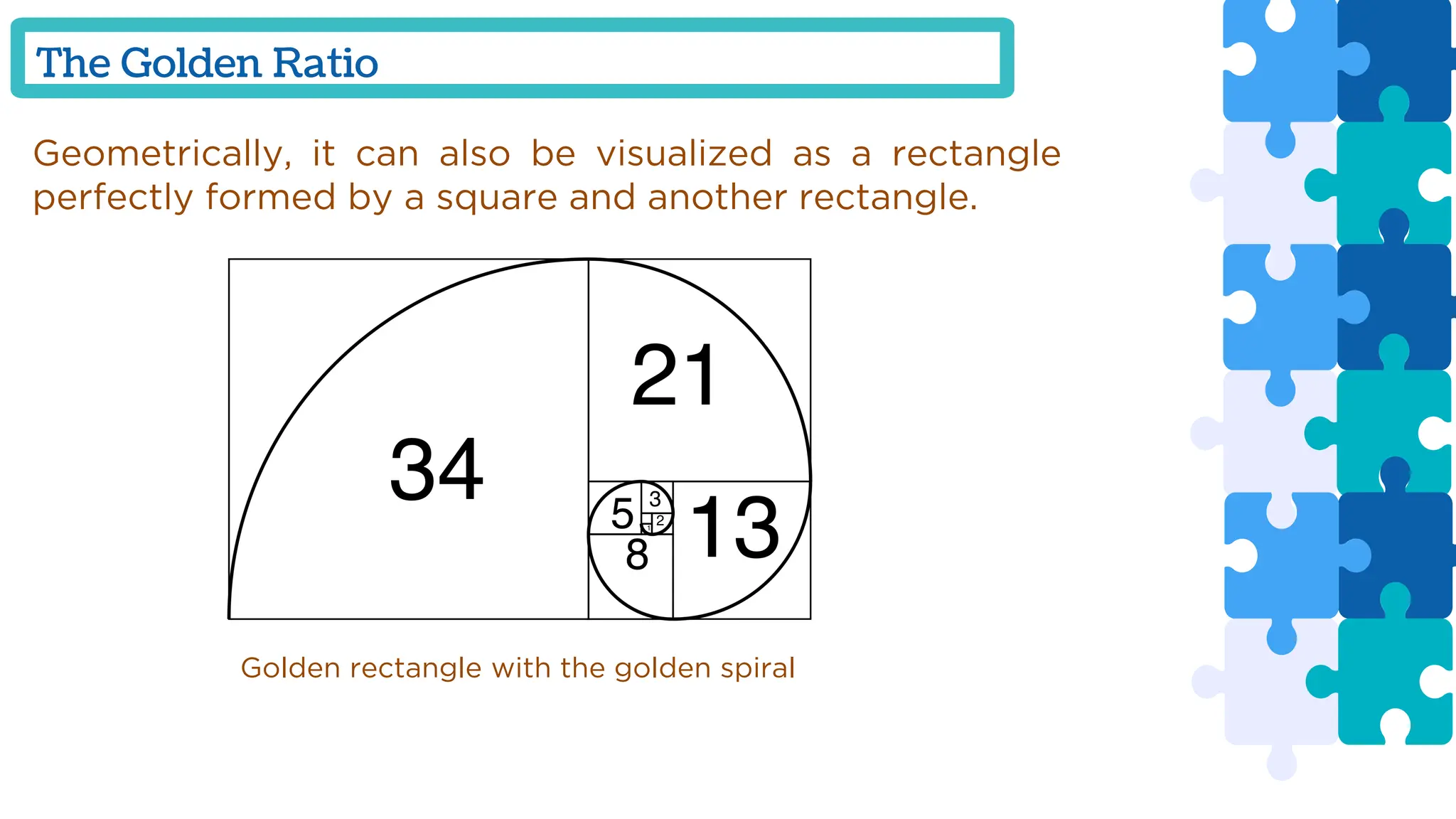
Geometrically, it can also be visualized as a rectangle
perfectly formed by a square and another rectangle.
Golden rectangle with the golden spiral
The Golden Ratio
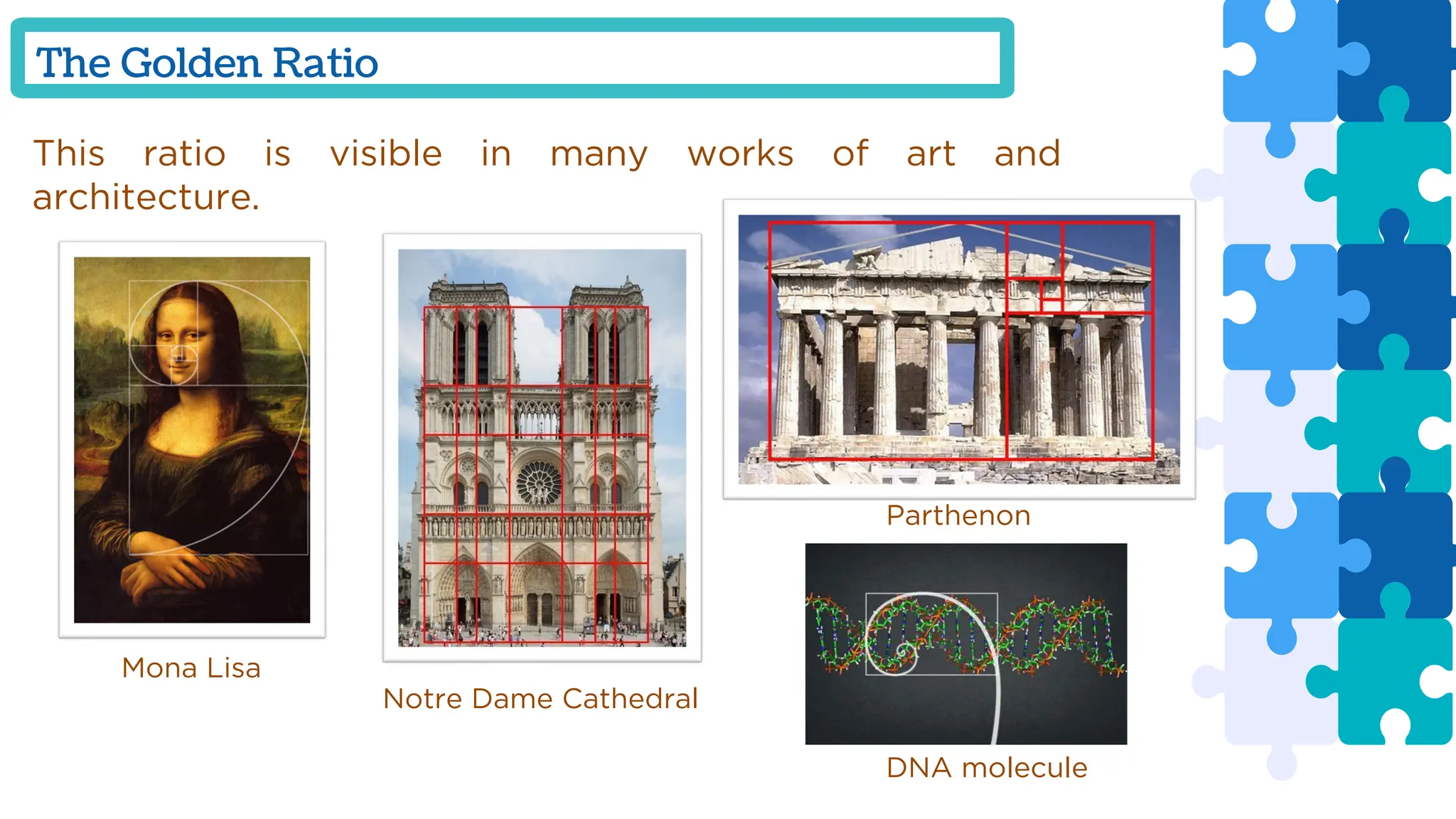
This ratio is visible in many works of art and
architecture.
Mona Lisa
Notre Dame Cathedral
Parthenon
DNA molecule
Exercise 1.2
1. Let Fib(n) be the nth term of the Fibonacci sequence,
with Fib(1) = 1, Fib(2)=1, Fib(3)=2, and so on
a. Find Fib(8)
b. Find Fib(19)
c. If Fib(22)=17,711 and Fib(24)=46,368, what is
Fib(23)?
2. Evaluate the following sums.
a. Fib(1) + Fib(2)
b. Fib(1) + Fib(2) + Fib(3)
c. Fib(1) + Fib(2) + Fib(3) + Fib(4)
Mathematics for Organization
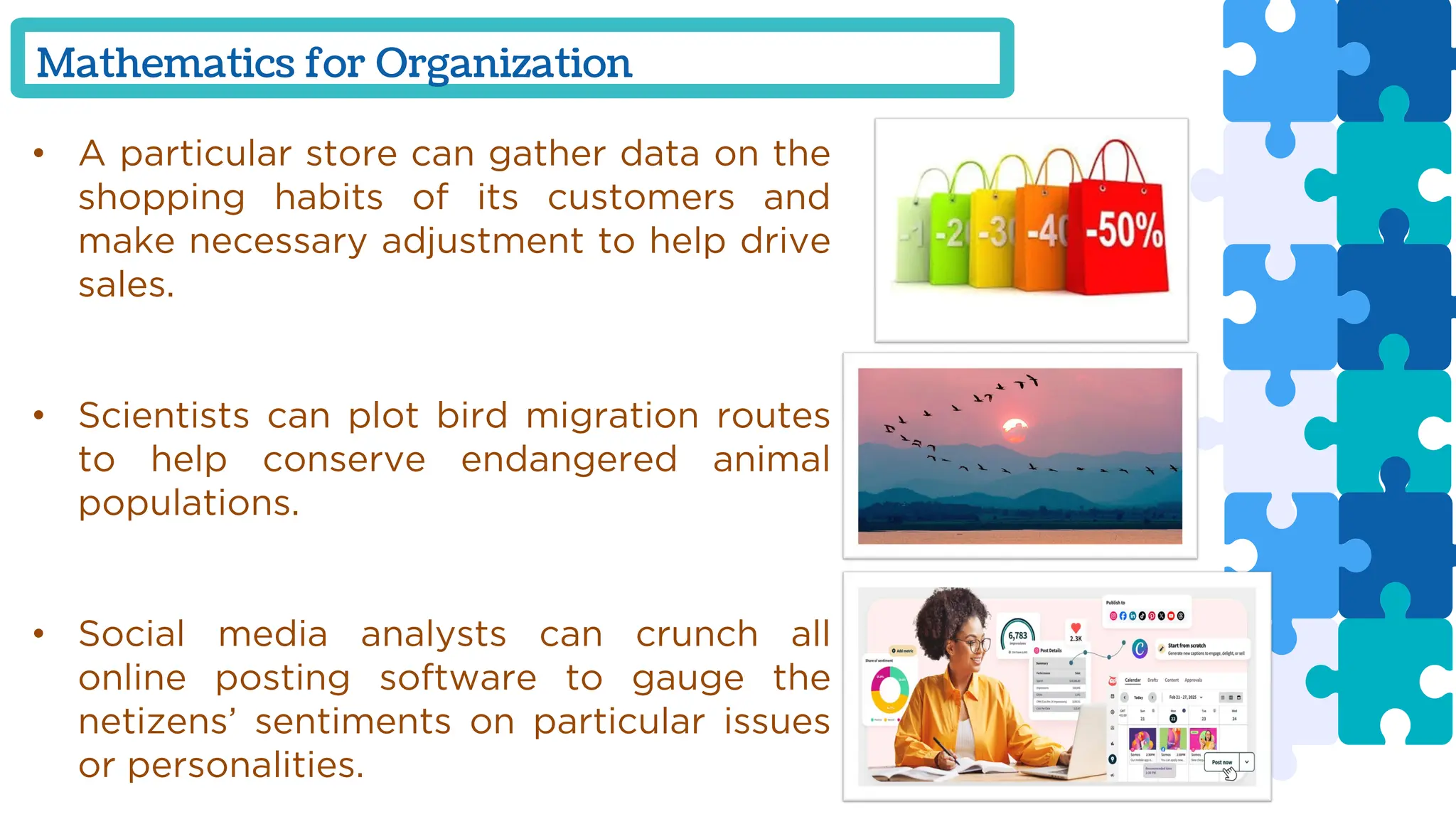
• A particular store can gather data on the
shopping habits of its customers and
make necessary adjustment to help drive
sales.
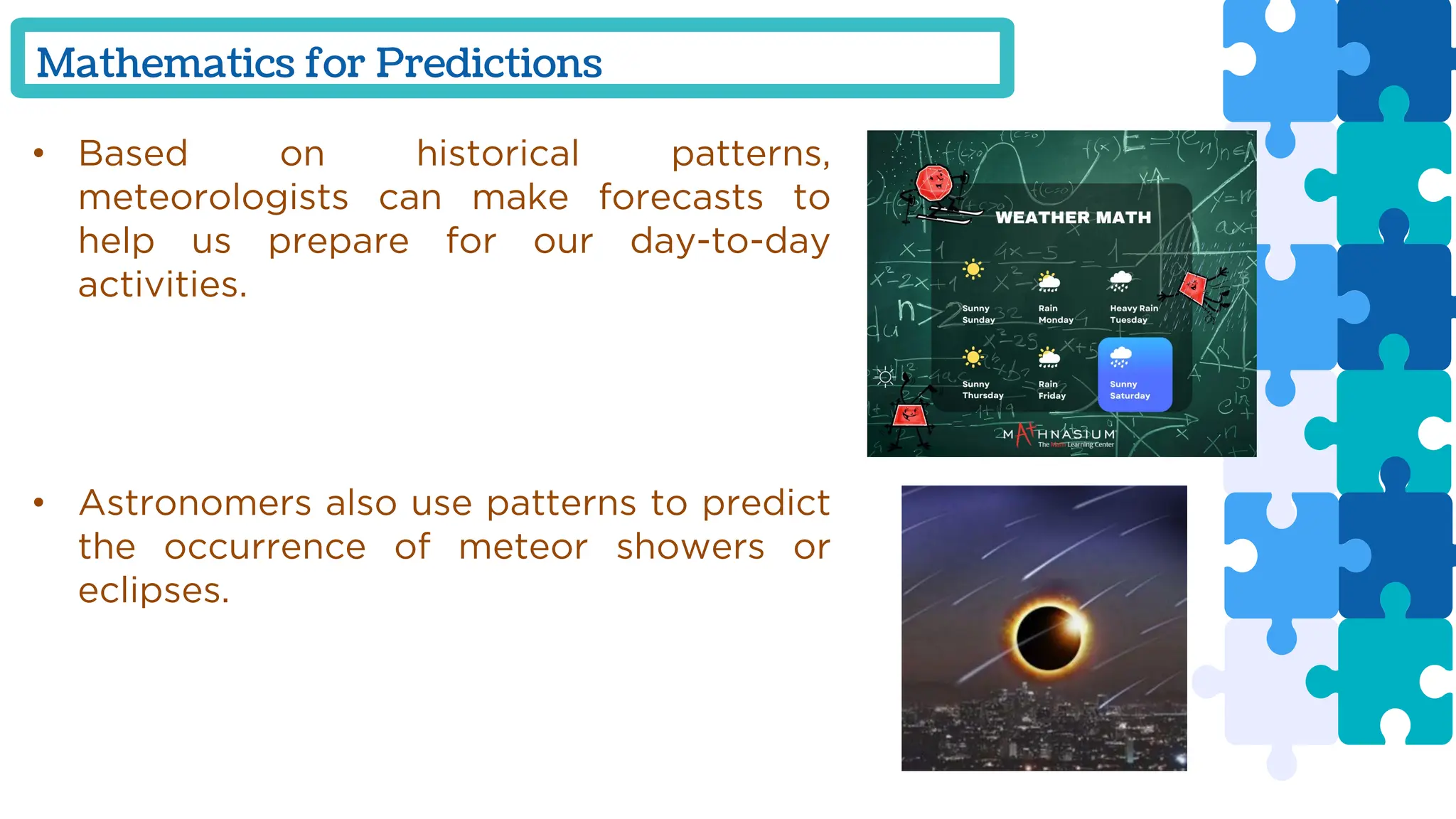
• Scientists can plot bird migration routes
to help conserve endangered animal
populations.
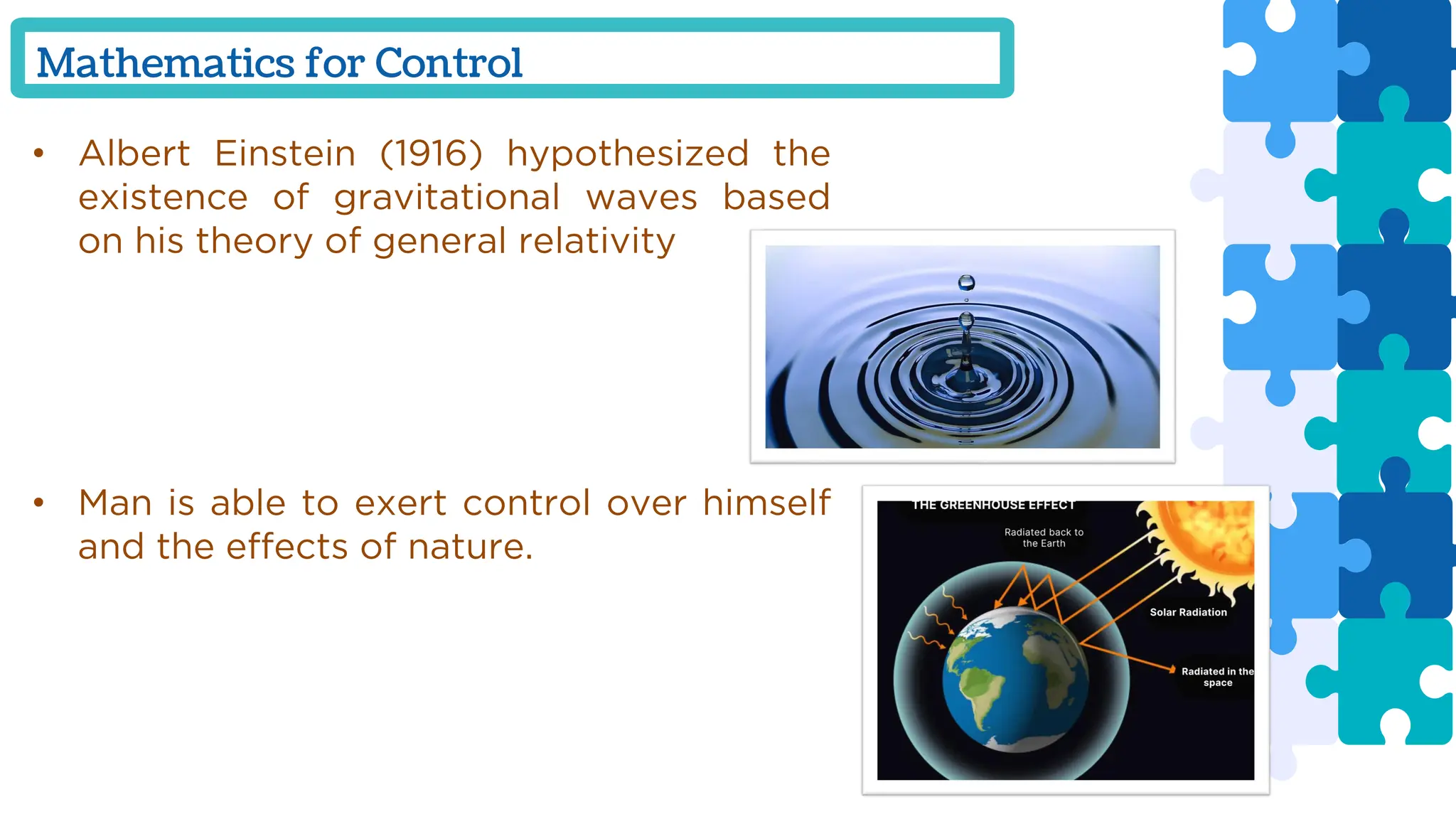
• Social media analysts can crunch all
online posting software to gauge the
netizens’ sentiments on particular issues
or personalities.
Mathematics for Predictions
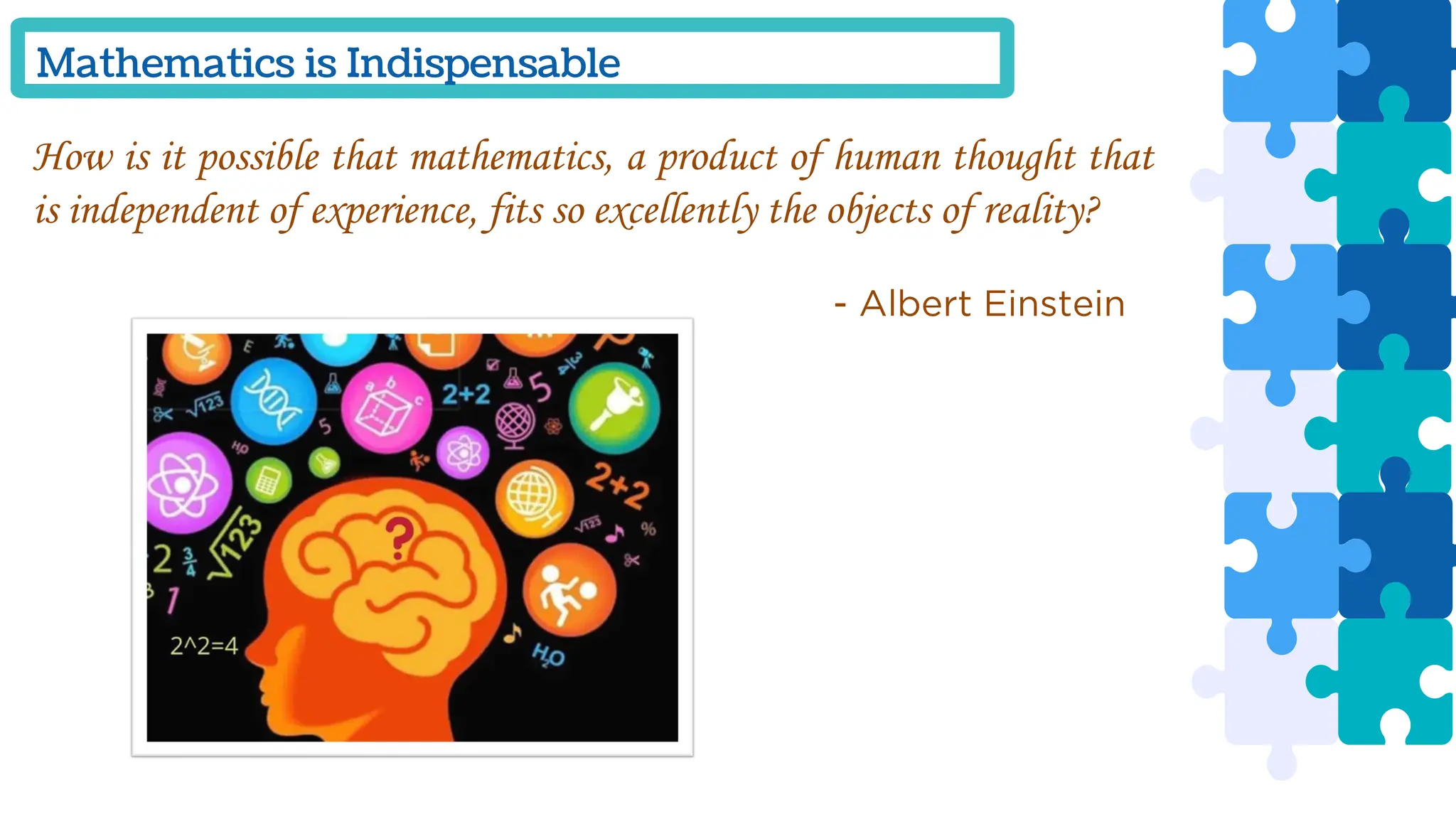
• Based on historical patterns,
meteorologists can make forecasts to
help us prepare for our day-to-day
activities.
• Astronomers also use patterns to predict
the occurrence of meteor showers or
eclipses.
Mathematics for Control
• Albert Einstein (1916) hypothesized the
existence of gravitational waves based
on his theory of general relativity
• Man is able to exert control over himself
and the effects of nature.
Mathematics is Indispensable
How is it possible that mathematics, a product of human thought that
is independent of experience, fits so excellently the objects of reality?
- Albert Einstein
Exercise 1.3
Answer the following questions.
1. A certain study found that the relationship between the
students’ exam score (y) and the number of hours they spent
studying (x) is given by the equation y = 10x + 5. Using this
information, what will be the estimated score of a student
who spent 4 hours studying.
nature of mathematics all needed here.pdf

  • 1.
    NATURE OF MATHEMATICS “Mathematics isthe language in which God has written the universe.”
  • 2.
    Mathematics takes whatour minds see as patterns—lines, numbers, shapes, rhythms—and turns them into rules and structures. Those rules help us understand how things work in the world and let us make useful predictions.
  • 3.
    Objectives: 1. Identify patternsin nature (symmetry, spirals, tessellations, fractals) and describe their structure. 2. Model real-world phenomena (e.g. Fibonacci, exponential growth, symmetry) using mathematical tools. 3. Predict or control outcomes using mathematical reasoning applied to patterns in nature or systems. 4. Apply mathematical practices—look for structure, articulate regularity, justify generalizations.
  • 4.
    Patterns are regular,repeated, or recurring forms or designs. Studying patterns help us in identifying relationships and finding logical connections to form generalizations and make predictions. Patterns and Numbers in Nature and the World Layout of floor tiles Designs of skyscrapers Petronas Tower, Malaysia Way of tying shoelaces
  • 5.
  • 6.
    What number comesnext? 1. 1, 3, 5, 7, 9, ___ The sequence is increasing, with each term being two more than the previous terms: 1 + 2 = 3, 3 + 2 = 5, 5 + 2 = 7 . Therefore, the next term should be 7 + 9 = 11. 2. 1, 4, 9, 16, 25, ___ The pattern starts with +3, +5, +7, +9 or adding consecutively odd numbers. Therefore the next term is 9 + 11 = 20.
  • 7.
    Symmetry refers toa balanced and proportionate similarity where parts of an object or shape are arranged in a way that one half mirrors the other, or where an object remains unchanged after certain transformations like rotation or reflection. Patterns and Numbers in Nature and the World
  • 8.
    Leonardo da Vinci’sVitruvian Man showing the proportional and symmetry of the human body Patterns and Numbers in Nature and the World
  • 9.
    Types of Symmetry Patternsand Numbers in Nature and the World Bilateral Symmetry Rotational Symmetry
  • 10.
    There are othertypes of symmetry depending on the number of sides or faces that are symmetrical. Patterns and Numbers in Nature and the World Spiderwort with three-fold symmetry This starfish has a five-fold symmetry
  • 11.
    Patterns and Numbersin Nature and the World Angle of rotation is the smallest angle that a figure can be rotated while preserving the original formation. Order of rotation A figure has a rotational symmetry of order n (n-fold rotational symmetry) if 1/n of a complete turn leaves the figure unchanged. To compute for the angle of rotation, we use the following formula: Angle of rotation = 360° 𝑛
  • 12.
    Consider this imageof a snowflake. The snowflake repeat six times, indicating that there is a six-fold symmetry. n = 6 Angle of rotation = 360° 6 Angle of rotation = 60°
  • 13.
    Another marvel ofnature’s design is the structure and shape of a honeycomb. It is observed that such formation enables the bee colony to maximize their storage of honey using the smallest amount of wax.
  • 14.
    Packing problem involvesfinding the optimum method of filling up a given space such as a cubic or spherical container If you arrange the circles in a square formation, there are still plenty of spots that are exposed. Following the hexagobal formation, however, with the second row of circles snugky fitted between the first row of circles, there are more area that will be covered. Square Packing Hexagonal Packing
  • 15.
    For square packing,each square will have an area of 4𝑐𝑚2 .Note from the figure that for each square, it can only fit one circle (4 quarters). The percentage of the square’s area covered by circles will be Let us illustrate mathematically. Suppose you have circles of radius 1 cm., each of which will then have an area of 𝜋𝑐𝑚2 . We are going to fill a plane with these circles using square packing and hexagonal packing. 𝑎𝑟𝑒𝑎 𝑜𝑓 𝑡ℎ𝑒 𝑐𝑖𝑟𝑐𝑙𝑒𝑠 𝑎𝑟𝑒𝑎 𝑜𝑓 𝑡ℎ𝑒 𝑠𝑞𝑢𝑎𝑟𝑒 × 100% = 𝜋𝑐𝑚2 4 𝑐𝑚2 × 100% ≈ 78.54%
  • 16.
    For hexagonal packing,we can think of each hexagon composed of sex equilateral triangles with side equal to 2 cm. The area of each triangle is given by 𝑎𝑟𝑒𝑎 𝑜𝑓 𝑡ℎ𝑒 𝑐𝑖𝑟𝑐𝑙𝑒𝑠 𝑎𝑟𝑒𝑎 𝑜𝑓 𝑡ℎ𝑒 ℎ𝑒𝑥𝑎𝑔𝑜𝑛 × 100% = 3𝜋𝑐𝑚2 6 3𝑐𝑚2 × 100% ≈ 90.69% 𝐴 = 𝑠𝑖𝑑𝑒2∙ 3 4 = (2𝑐𝑚)2∙ 3 4 = 4𝑐𝑚2∙ 3 4 = 3𝑐𝑚2 This gives the area of the hexagon as 6 3𝑐𝑚2 . Looking at the figure, there are 3 circles that could fit inside one hexagon (the whole circle in the middle, and 6 one-thirds of a circle), which gives the total area as 3𝜋𝑐𝑚2 . The percentage of the hexagon’s area covered by circles will be Comparing the two percentages, we can clearly see that using hexagons will cover a larger area than when using squares.
  • 17.
    Tigers’ Stripes andHyenas’ Spots Patterns are also exhibited in the external apperances of animals. According to the new model by Harvard University researchers predicts that there are three variables that could affect the orientation of these stripes-the substances that amplifies the density of stripe patterns; the substance that changes one of the parameters involved in stripe formation; and the physical changes in the directin of the origin of the stripe. Tiger Hyena
  • 18.
    The Sunflower Looking atthe sunflower up close, you will notice that there is a definite pattern of clockwisw and counterclockwise arcs or spirals extending outward from the center of the flower. This is another demonstration of how nature works to optimize the available space. This arrangement allows the sunflower seeds to occupy the flower head in a way that maximize their access to light and necessary nutrients.
  • 19.
    The Snail’s Shell Snailsare born with their shells, called protoconch, which start out as a fragile and colorless. As snails grow, their shells also expand proportionately so that they can continue to live inside their shells. The second figure, called an equiangular spiral, follows the rule that as the distance from the spiral center increases (radius), the amplitudes of the angles formed by the radii to the point and the tangent to the point remain constant. A logarithmic spiral
  • 20.
    Flower Petals If youlook more closely, you will note that different flowers have different number of petals.
  • 21.
  • 22.
    World Population As of,2024, it is estimated that the world population is approximately 8.2 billion. World leaders, sociologists, and anthropologists are interested in studying population, including its growth. Mathematics can be used to model population growth. A = P𝑒𝑟𝑡 where A is the size of the population after it grows, P is the initial number of people, r is the rate of growth and t is the time. Recall further that e is the Euler’s constant with an approximate value of 2.718
  • 23.
    World Population The exponentialgrowth model A = 30𝑒0.02𝑡 describes the population of a city in the Philippines in thousands, t years after 1995. a. What was the population of the city in 1995? b. What will be the population in 2017?
  • 24.
    World Population a. Sincethe exponential growth model describes the population t years after 1995, we consider 1995 as t = 0 and then solve for A, our population size. A = 30𝑒0.02𝑡 A = 30𝑒0.02(0) A = 30𝑒0 A = 30 1 A = 30 Replace t with t = 0 𝑒0 = 0 Therefore, the city population in 1995 was 30,000. Note: Multiply A with 10, 000
  • 25.
    World Population b. Weneed to find A for the year 2017. to find t, we subtract 2017 and 1995 to get t = 22, which we then plug in to our exponential growth model. A = 30𝑒0.02𝑡 A = 30𝑒0.02(22) A = 30𝑒0.44 A = 30 1 A = 46.5813 Replace t with t = 22 𝑒0.44 ≈ 1.55271 Therefore, the city population would be about 46,581 in 2017. Note: Multiply A with 10, 000
  • 26.
    Exercise 1.1 Instructions: Answerthe following problems. Show complete solution. Use one crosswise sheet of paper for all Exercises. 1. Determine what comes next in the given patterns. a. A, C, E, G, I, ____ b. 15, 10, 14, 10, 13, 10, ____ c. 3, 6, 12, 24, 48, 96, ____ d. 27, 30, 33, 36, 39, ____ e. 41, 39, 37, 35, 33, ____ 2. The exponential growth model A = 50𝑒0.07𝑡 describes the population of a city in the Philippines in thousands, t years after 1997. a. What is the population after 20? b. What is the population in 2037?
  • 27.
  • 28.
    A sequence isan ordered list of numbers, called terms, that may have repeated values. The arrangement of these terms is set by a definite rule. Sequence
  • 29.
    Generating a Sequence Analyzethe given sequence for its rule and identify the next three terms. a. 1, 10, 100, 1000 b. 2, 5, 9, 14, 20 Sequence
  • 30.
    Generating a Sequence 1,10, 100, 1000 Looking at the set of numbers, it can be observed that each term is a power of 10: 1 = 100 , 10 = 101 , 100 = 102 , and 1,000 = 103 . Following this rule, the next three terms are: 10,000 = 104 , 100,000 = 105 , and 1,000,000 = 106 . Sequence
  • 31.
    Generating a Sequence 2,5, 9, 14, 20 The difference between 2 and 5 is 3, for 5 and 9 is 4, for 9 and 14 is 5 and 14 and 20 is 6. Therefore, it can be deduced that to obtain the next three terms, we should add 7, 8 and 9, respectively, to the current term. Hence, the next three terms are 20 + 7 = 27, 27 + 8 = 35, 35 + 9 = 44. Sequence
  • 32.
    Try this! Analyze thegiven sequence for its rule and identify the next three terms. a. 16, 32, 64, 128 b. 1, 1, 2, 3, 5, 8 Sequence
  • 33.
    Fibonacci Sequence The Fibonaccisequence was named after the Italian mathematician Leonardo of Pisa, who was better known by his nickname Fibonacci. He is said to have discovered this sequence as he looked at how a hypothesized group of rabbits bred and reproduced.
  • 34.
    Fibonacci Sequence He notedthat the set of numbers generated from this problem could be extended by getting the sum of the previous terms.
  • 35.
    Fibonacci Sequence Fibonacci sequenceis evident in the number variations of a particular category of Sanskrit and Prakrit poetry meters. The sequence is also evident in nature like the spiral arrangement of sunflower seeds, the number of petals in a flower and the shape of a snail’s shell.
  • 36.
    The Golden Ratio Itis also interesting to note that the ratios of successive Fibonacci numbers approach the numbers Φ (Phi), also known as the Golden ratio. This is approximately equal to 1.618. 1/1 = 1.0000 13/8 = 1.6250 2/1 = 2.0000 21/13 = 1.6154 3/2 = 1.5000 34/21 = 1.6190 5/3 = 1.6667 55/34 = 1.6177 8/5 = 1.6000 89/55 = 1.6182
  • 37.
    The Golden Ratio Geometrically,it can also be visualized as a rectangle perfectly formed by a square and another rectangle. Golden rectangle with the golden spiral
  • 38.
    The Golden Ratio Thisratio is visible in many works of art and architecture. Mona Lisa Notre Dame Cathedral Parthenon DNA molecule
  • 39.
    Exercise 1.2 1. LetFib(n) be the nth term of the Fibonacci sequence, with Fib(1) = 1, Fib(2)=1, Fib(3)=2, and so on a. Find Fib(8) b. Find Fib(19) c. If Fib(22)=17,711 and Fib(24)=46,368, what is Fib(23)? 2. Evaluate the following sums. a. Fib(1) + Fib(2) b. Fib(1) + Fib(2) + Fib(3) c. Fib(1) + Fib(2) + Fib(3) + Fib(4)
  • 41.
    Mathematics for Organization •A particular store can gather data on the shopping habits of its customers and make necessary adjustment to help drive sales. • Scientists can plot bird migration routes to help conserve endangered animal populations. • Social media analysts can crunch all online posting software to gauge the netizens’ sentiments on particular issues or personalities.
  • 42.
    Mathematics for Predictions •Based on historical patterns, meteorologists can make forecasts to help us prepare for our day-to-day activities. • Astronomers also use patterns to predict the occurrence of meteor showers or eclipses.
  • 43.
    Mathematics for Control •Albert Einstein (1916) hypothesized the existence of gravitational waves based on his theory of general relativity • Man is able to exert control over himself and the effects of nature.
  • 44.
    Mathematics is Indispensable Howis it possible that mathematics, a product of human thought that is independent of experience, fits so excellently the objects of reality? - Albert Einstein
  • 45.
    Exercise 1.3 Answer thefollowing questions. 1. A certain study found that the relationship between the students’ exam score (y) and the number of hours they spent studying (x) is given by the equation y = 10x + 5. Using this information, what will be the estimated score of a student who spent 4 hours studying.