MATHEMATICS
IN
NATURE
Presented By: Vedita Taneja
Class: VI “A”
The Laws Of Nature Are But The Mathematical Thoughts
Of
God
Mathematics is everywhere in this universe. We
seldom note it. We enjoy nature and are not interested
in going deep about what mathematical idea is in it.
Here are a very few properties of mathematics that are
depicted in nature.
SYMMETRY
• Bilateral Symmetry
• Radial Symmetry
SHAPES
• Sphere
• Hexagons
• Cones
PARALLEL LINES
FIBONACCI SPIRAL
Symmetry is everywhere you look in
Nature
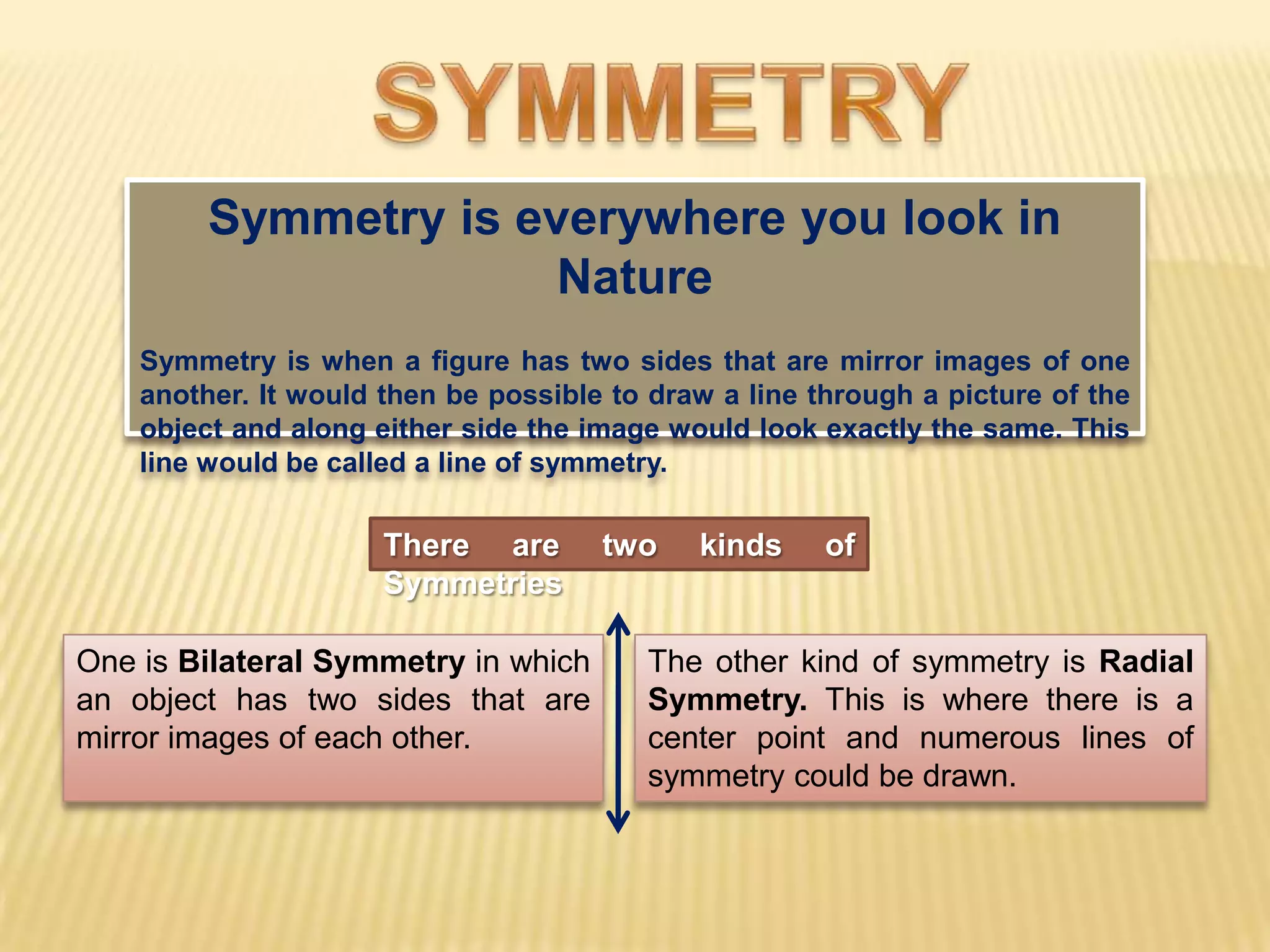
Symmetry is when a figure has two sides that are mirror images of one
another. It would then be possible to draw a line through a picture of the
object and along either side the image would look exactly the same. This
line would be called a line of symmetry.
One is Bilateral Symmetry in which
an object has two sides that are
mirror images of each other.
The other kind of symmetry is Radial
Symmetry. This is where there is a
center point and numerous lines of
symmetry could be drawn.
There are two kinds of
Symmetries
Bilateral Symmetry
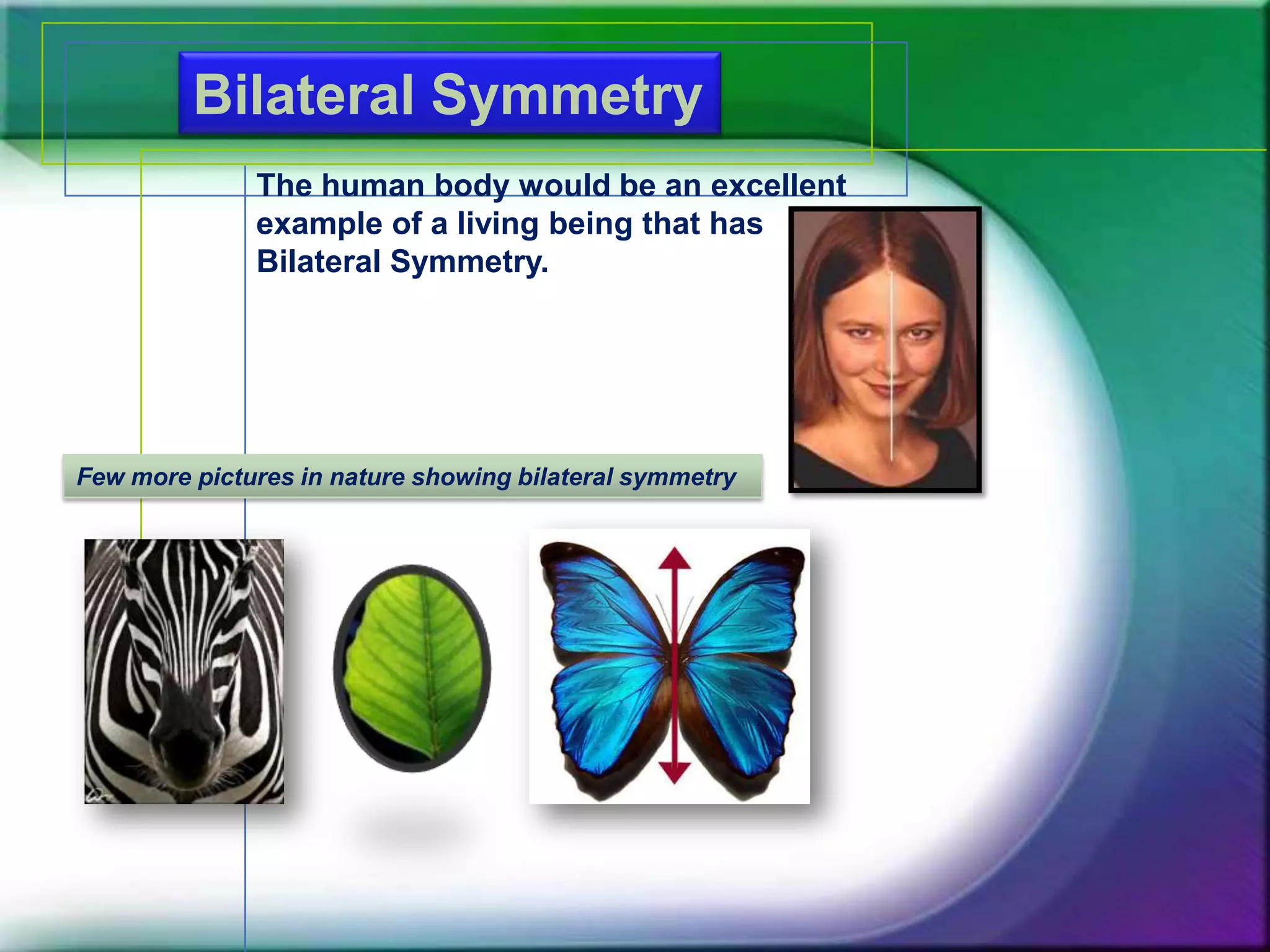
The human body would be an excellent
example of a living being that has
Bilateral Symmetry.
Few more pictures in nature showing bilateral symmetry
Radial Symmetry
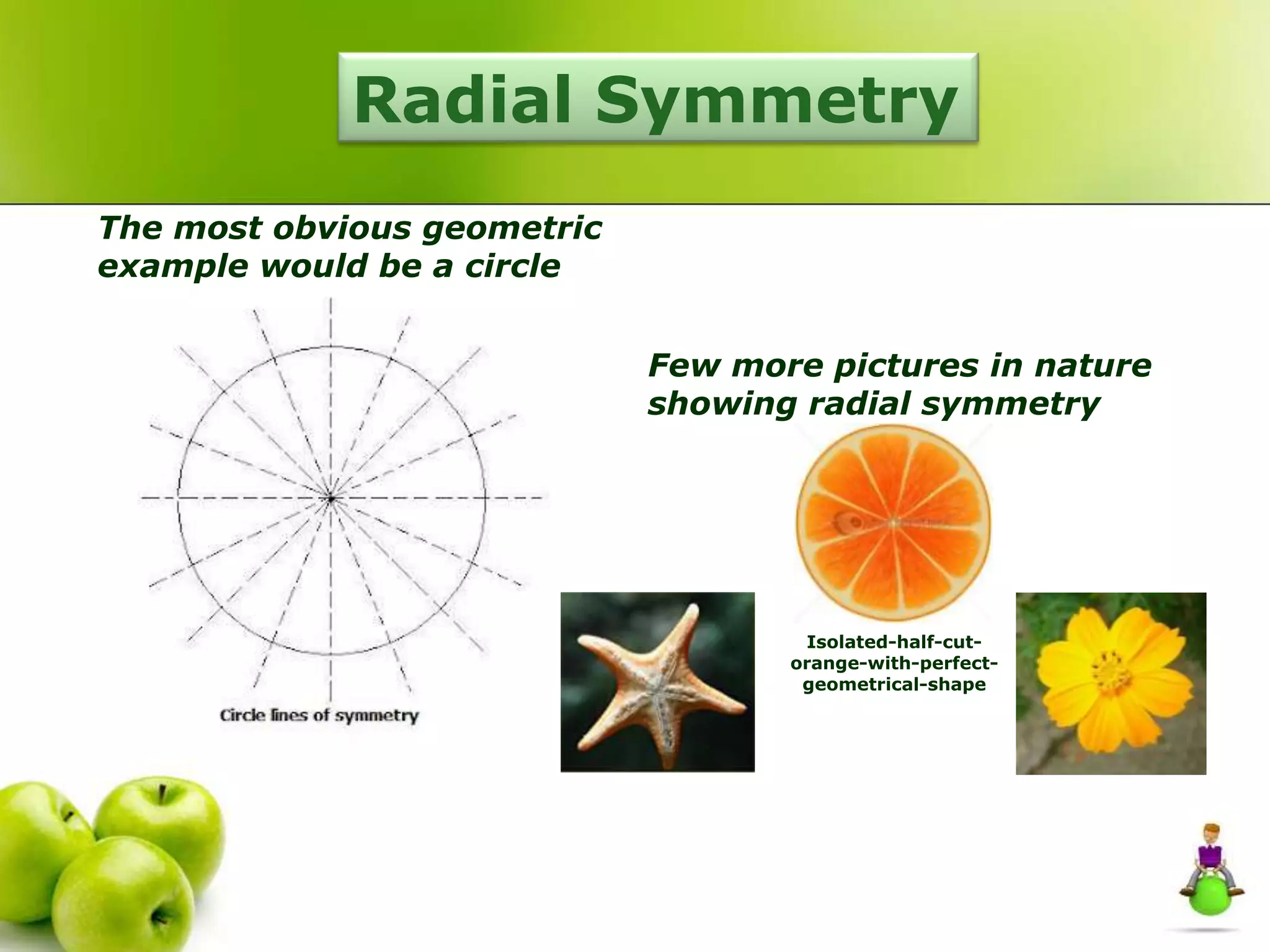
The most obvious geometric
example would be a circle
Few more pictures in nature
showing radial symmetry
Isolated-half-cut-
orange-with-perfect-
geometrical-shape
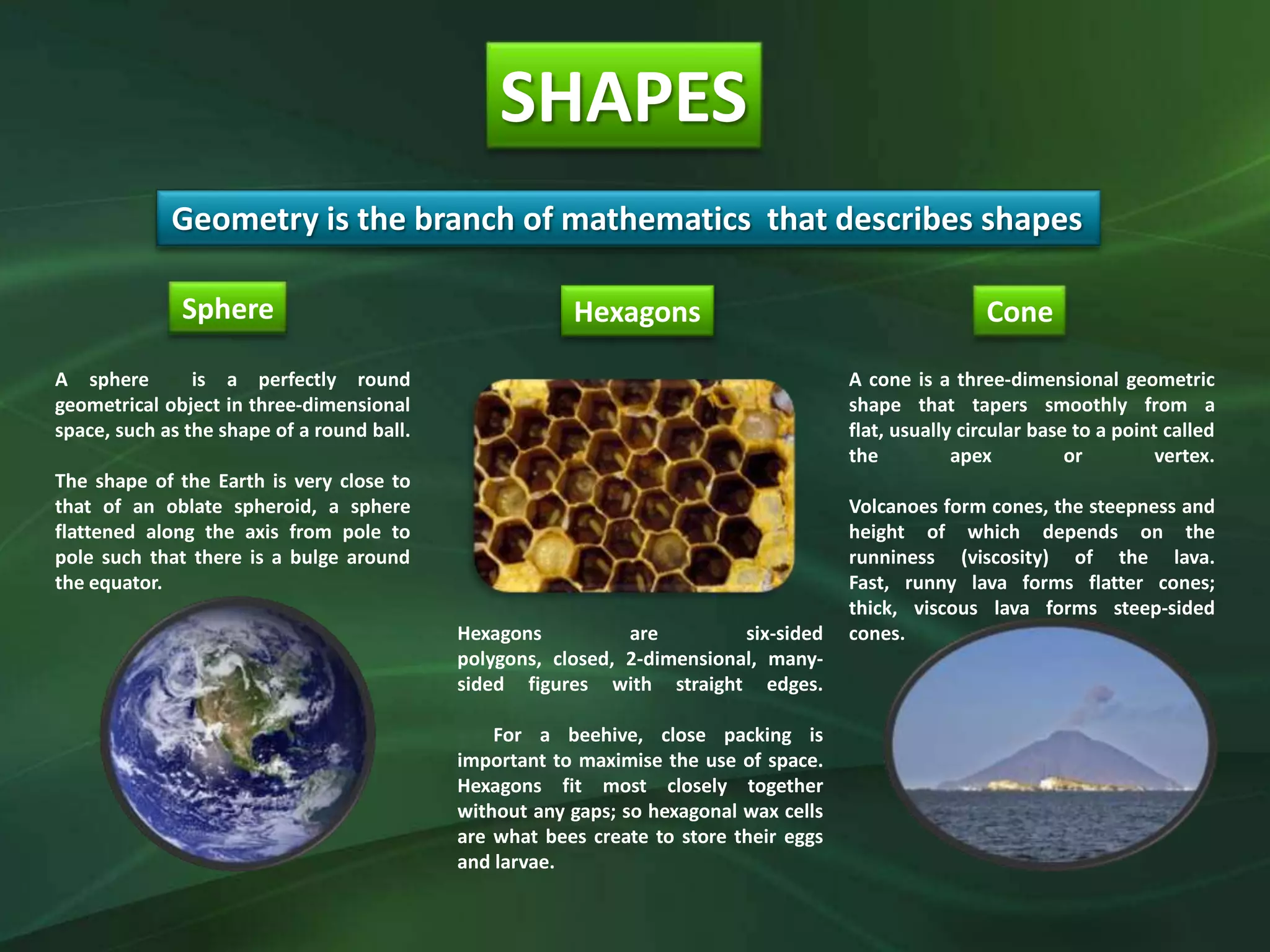
SHAPES
Geometry is the branch of mathematics that describes shapes
Sphere Hexagons Cone
A sphere is a perfectly round
geometrical object in three-dimensional
space, such as the shape of a round ball.
The shape of the Earth is very close to
that of an oblate spheroid, a sphere
flattened along the axis from pole to
pole such that there is a bulge around
the equator.
Hexagons are six-sided
polygons, closed, 2-dimensional, many-
sided figures with straight edges.
For a beehive, close packing is
important to maximise the use of space.
Hexagons fit most closely together
without any gaps; so hexagonal wax cells
are what bees create to store their eggs
and larvae.
A cone is a three-dimensional geometric
shape that tapers smoothly from a
flat, usually circular base to a point called
the apex or vertex.
Volcanoes form cones, the steepness and
height of which depends on the
runniness (viscosity) of the lava.
Fast, runny lava forms flatter cones;
thick, viscous lava forms steep-sided
cones.
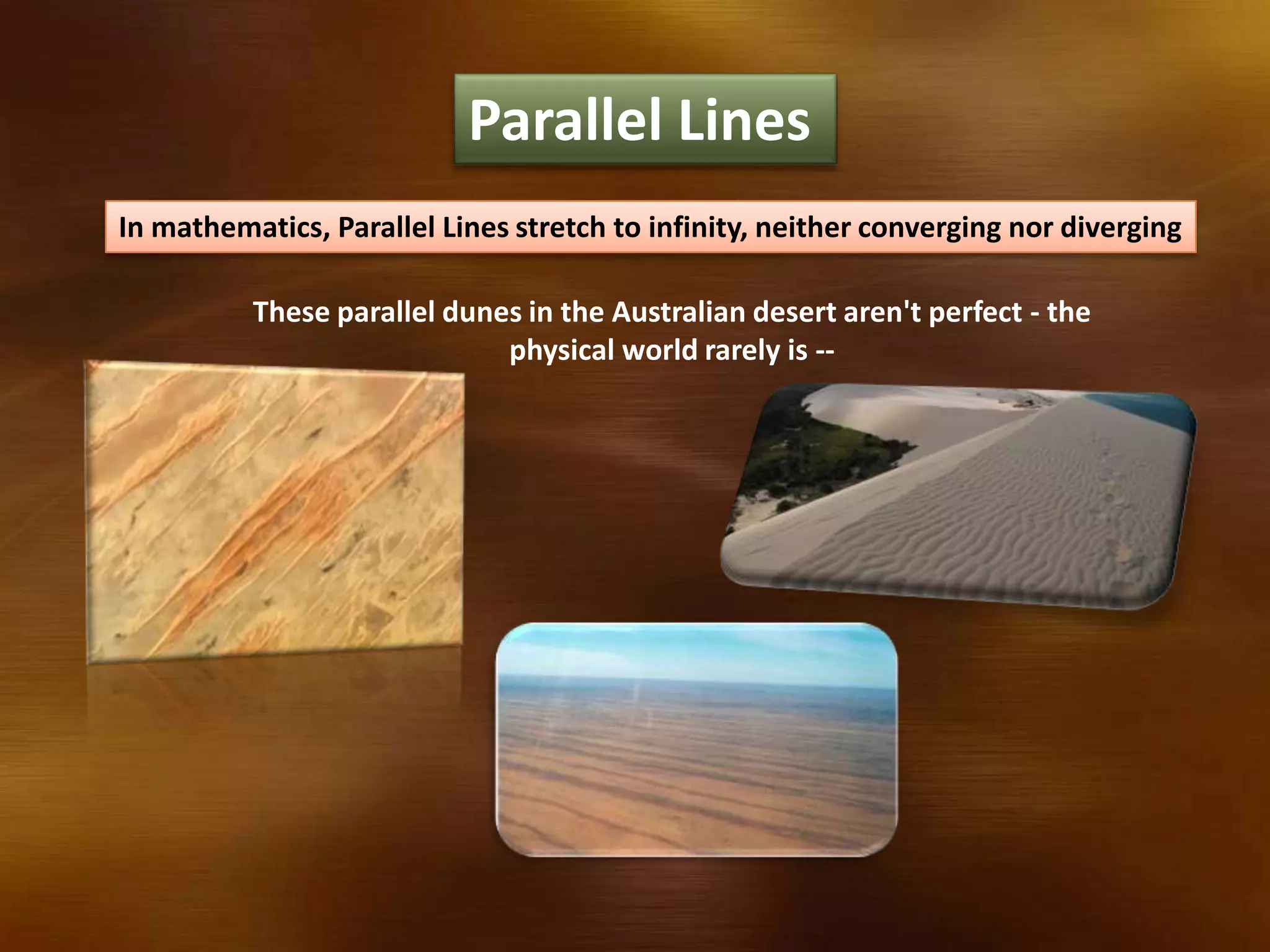
Parallel Lines
In mathematics, Parallel Lines stretch to infinity, neither converging nor diverging
These parallel dunes in the Australian desert aren't perfect - the
physical world rarely is --
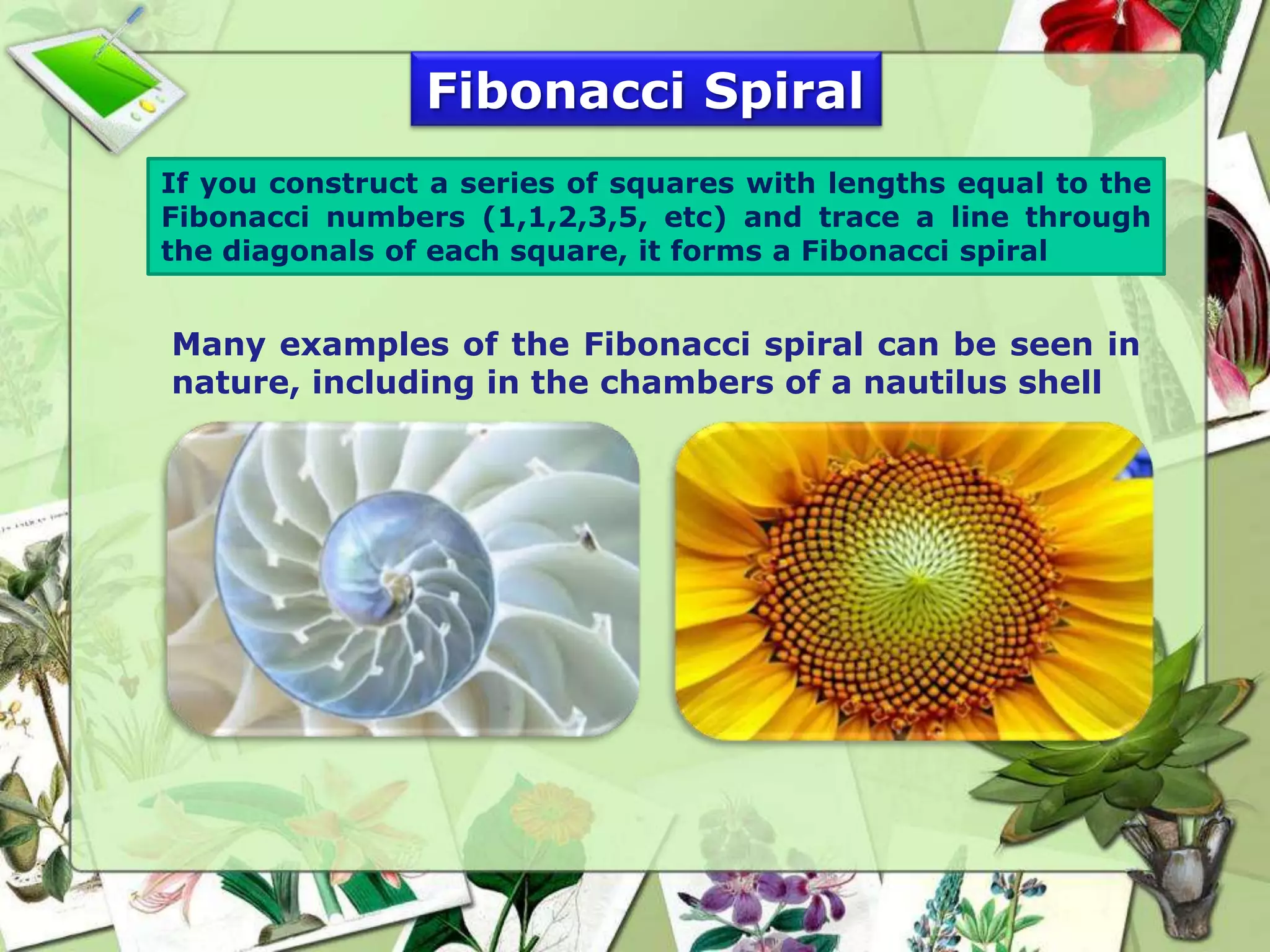
Fibonacci Spiral
If you construct a series of squares with lengths equal to the
Fibonacci numbers (1,1,2,3,5, etc) and trace a line through
the diagonals of each square, it forms a Fibonacci spiral
Many examples of the Fibonacci spiral can be seen in
nature, including in the chambers of a nautilus shell
Thanks
Presented By: Vedita Taneja
Class: VI “A”

Mathematics in nature

  • 1.
  • 2.
    The Laws OfNature Are But The Mathematical Thoughts Of God Mathematics is everywhere in this universe. We seldom note it. We enjoy nature and are not interested in going deep about what mathematical idea is in it. Here are a very few properties of mathematics that are depicted in nature. SYMMETRY • Bilateral Symmetry • Radial Symmetry SHAPES • Sphere • Hexagons • Cones PARALLEL LINES FIBONACCI SPIRAL
  • 3.
    Symmetry is everywhereyou look in Nature Symmetry is when a figure has two sides that are mirror images of one another. It would then be possible to draw a line through a picture of the object and along either side the image would look exactly the same. This line would be called a line of symmetry. One is Bilateral Symmetry in which an object has two sides that are mirror images of each other. The other kind of symmetry is Radial Symmetry. This is where there is a center point and numerous lines of symmetry could be drawn. There are two kinds of Symmetries
  • 4.
    Bilateral Symmetry The humanbody would be an excellent example of a living being that has Bilateral Symmetry. Few more pictures in nature showing bilateral symmetry
  • 5.
    Radial Symmetry The mostobvious geometric example would be a circle Few more pictures in nature showing radial symmetry Isolated-half-cut- orange-with-perfect- geometrical-shape
  • 6.
    SHAPES Geometry is thebranch of mathematics that describes shapes Sphere Hexagons Cone A sphere is a perfectly round geometrical object in three-dimensional space, such as the shape of a round ball. The shape of the Earth is very close to that of an oblate spheroid, a sphere flattened along the axis from pole to pole such that there is a bulge around the equator. Hexagons are six-sided polygons, closed, 2-dimensional, many- sided figures with straight edges. For a beehive, close packing is important to maximise the use of space. Hexagons fit most closely together without any gaps; so hexagonal wax cells are what bees create to store their eggs and larvae. A cone is a three-dimensional geometric shape that tapers smoothly from a flat, usually circular base to a point called the apex or vertex. Volcanoes form cones, the steepness and height of which depends on the runniness (viscosity) of the lava. Fast, runny lava forms flatter cones; thick, viscous lava forms steep-sided cones.
  • 7.
    Parallel Lines In mathematics,Parallel Lines stretch to infinity, neither converging nor diverging These parallel dunes in the Australian desert aren't perfect - the physical world rarely is --
  • 8.
    Fibonacci Spiral If youconstruct a series of squares with lengths equal to the Fibonacci numbers (1,1,2,3,5, etc) and trace a line through the diagonals of each square, it forms a Fibonacci spiral Many examples of the Fibonacci spiral can be seen in nature, including in the chambers of a nautilus shell
  • 9.
    Thanks Presented By: VeditaTaneja Class: VI “A”