Mathematics is evident throughout nature in intricate and complex ways. Symmetry, shapes like spheres and hexagons, patterns like fractals and the Fibonacci sequence, and mathematical structures like tessellations are all demonstrated in the natural world. What was once seen as randomness is now understood as the application of mathematical principles that illustrate the complexity of the natural order.
Explores how mathematics helps us understand nature, its relevance in education, and its historical significance (e.g., ancient Egyptians and pyramids).
Discusses the presence of math in nature, examples include symmetry, and introduces concepts like the golden ratio and Fibonacci sequence.
Covers types of symmetry (bilateral and radial) and shapes found in nature like spheres and hexagons, highlighting balance in natural structures.
Describes shapes such as cones formed by volcanoes and polygons created by drying mud, emphasizing geometric patterns in nature.
Details patterns like fractals, spirals, and Fibonacci sequences found in nature, as well as tessellations and rainbows as mathematical phenomena.Affirms the integral role of mathematics in science, art, and nature, underscoring its fundamental importance.
MATHEMATICS IN NATURE
ABSTRACT
Themajority of our knowledge of
mathematics and modern science is strictly based and supported on our
observations of our environment. What was once seen as the randomness
of nature is now distinguished as the intricate applications of
mathematics and illustrates the complexities of our natural world
INTRODUCTION
For more than two thousand years,
mathematics has been a part of the human search for understanding.
Today, mathematics as a mode of thought and expression is more
valuable than ever before. Learning to think in mathematical terms is an
essential part of becoming a liberally educated person. Mathematics is
defined as the science which deals with logic of shape, quantity and
arrangement. During ancient times in Egypt, the Egyptians used math's
and complex mathematic equations like geometry and algebra. That is
how they managed to build the pyramids.
OBJECTIVES
To study about where we can see math around our nature through
commonly seen examples.
2.
MATHEMATICS IN NATURE
Whenmath is witnessed in its purest form the
realization can be truly amazing. Sometimes the application of
mathematics can seem to be separate from the natural world but in actual
fact when we take the time, math can be seen all around us. As teachers
we will always have to answer the question ‘why’; by providing tangible
and authentic examples of math we can empower our students with
knowledge and hopefully encourage a love for mathematics that is
relevant to their daily lives. But how can we find examples of math in
nature? It is as simple as opening our eyes. What was once seen as the
randomness of nature is now distinguished as the intricate applications
of mathematics and illustrates the complexities of our natural world.
This web log is dedicated to just a few examples of nature’s mathematic
phenomena such as the golden ratio, Fibonacci sequence, fractals and
the honeycomb conjecture.
SYMMETRY
Symmetry is everywhere you look in nature.
Symmetry is when a figure has two sides that are mirror images of one
another. It would then be possible to draw a line through a picture of the
object and along either side the image would look exactly the same. This
line would be called a line of symmetry.
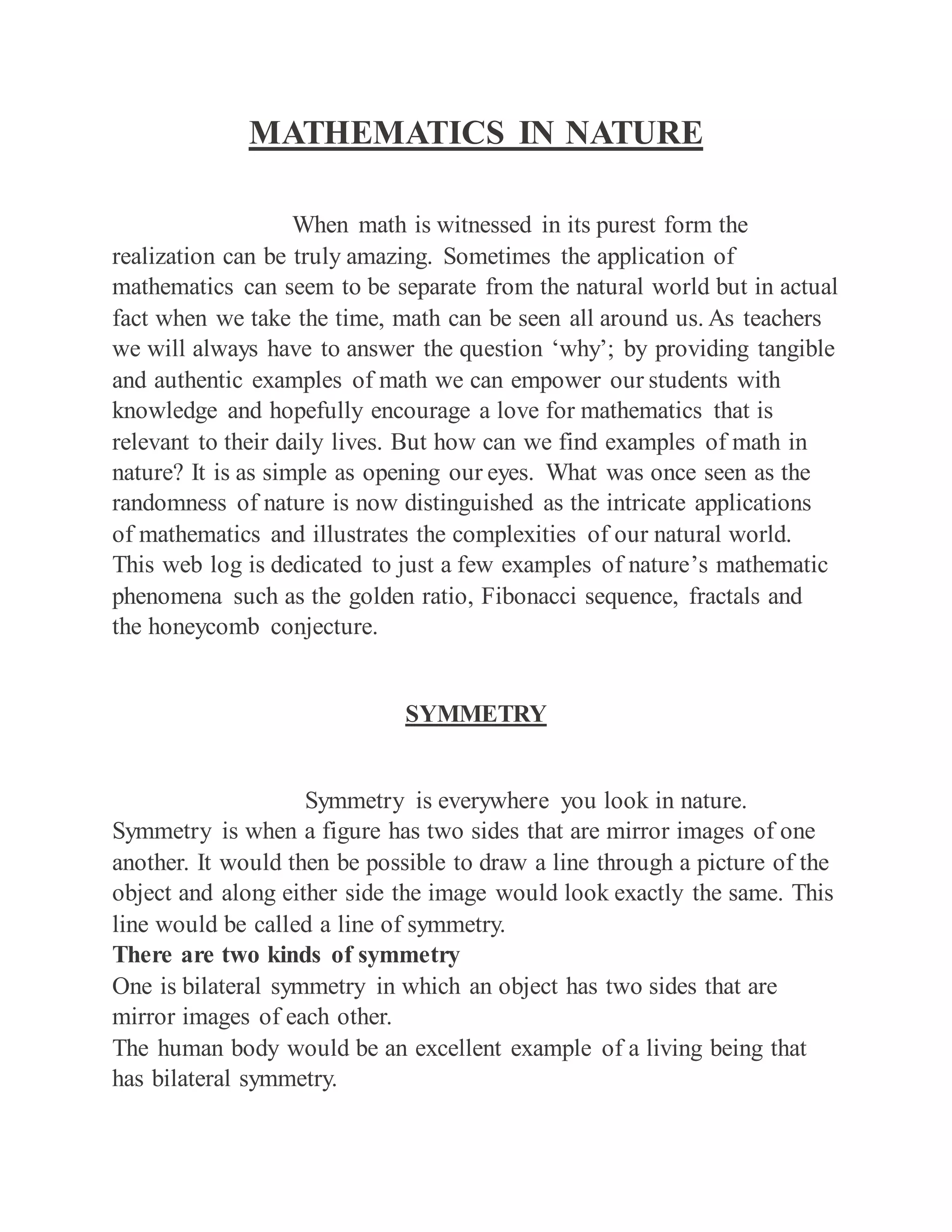
There are two kinds of symmetry
One is bilateral symmetry in which an object has two sides that are
mirror images of each other.
The human body would be an excellent example of a living being that
has bilateral symmetry.
3.
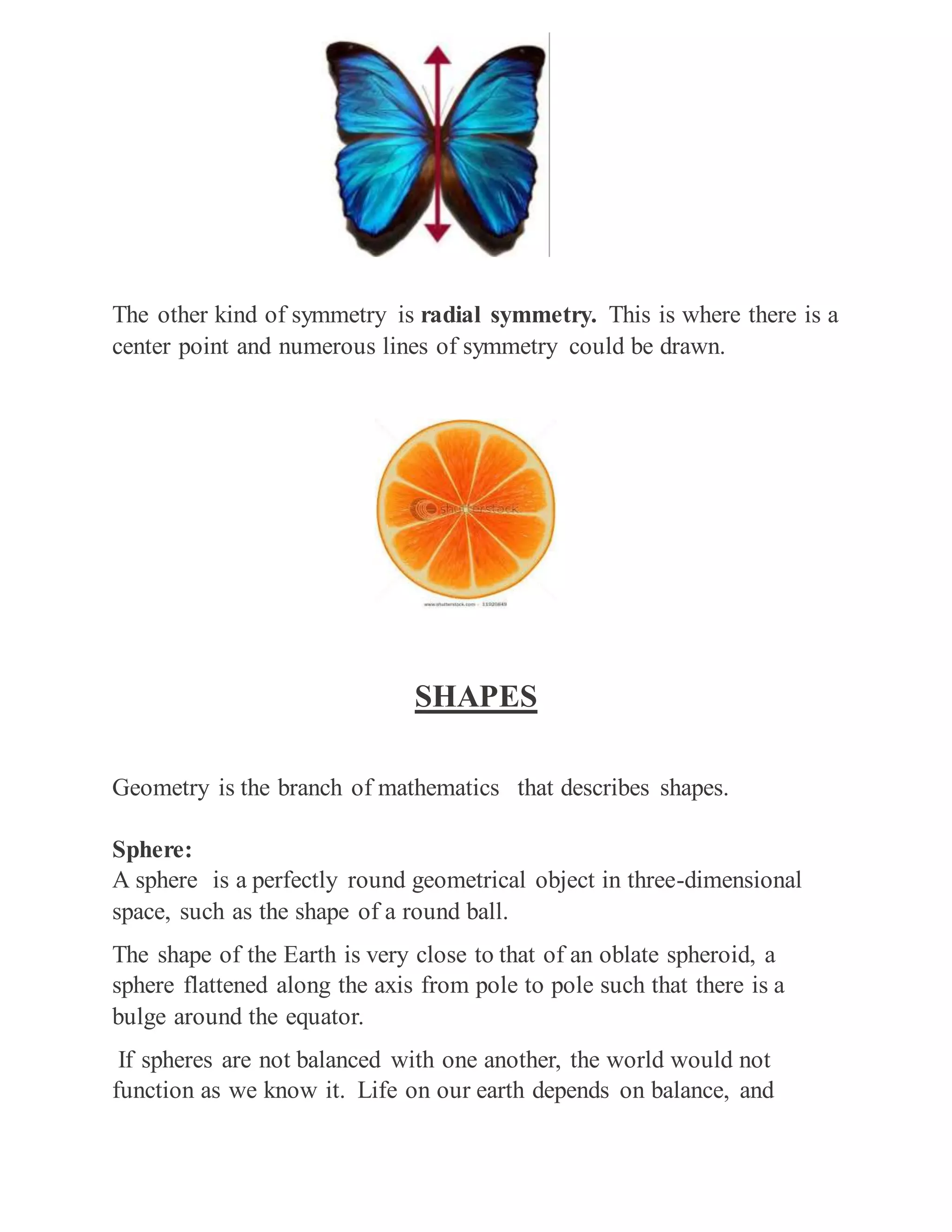
The other kindof symmetry is radial symmetry. This is where there is a
center point and numerous lines of symmetry could be drawn.
SHAPES
Geometry is the branch of mathematics that describes shapes.
Sphere:
A sphere is a perfectly round geometrical object in three-dimensional
space, such as the shape of a round ball.
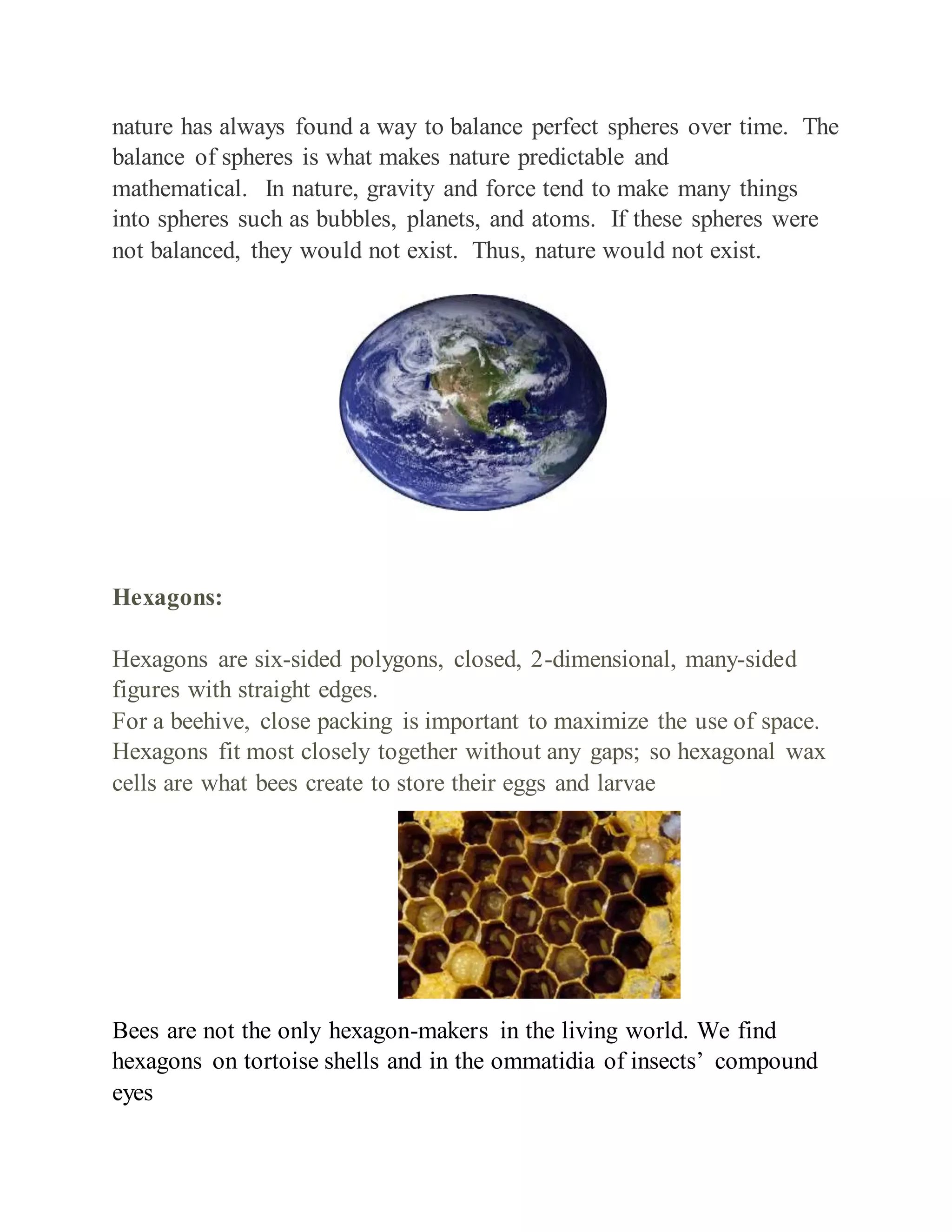
The shape of the Earth is very close to that of an oblate spheroid, a
sphere flattened along the axis from pole to pole such that there is a
bulge around the equator.
If spheres are not balanced with one another, the world would not
function as we know it. Life on our earth depends on balance, and
4.
nature has alwaysfound a way to balance perfect spheres over time. The
balance of spheres is what makes nature predictable and
mathematical. In nature, gravity and force tend to make many things
into spheres such as bubbles, planets, and atoms. If these spheres were
not balanced, they would not exist. Thus, nature would not exist.
Hexagons:
Hexagons are six-sided polygons, closed, 2-dimensional, many-sided
figures with straight edges.
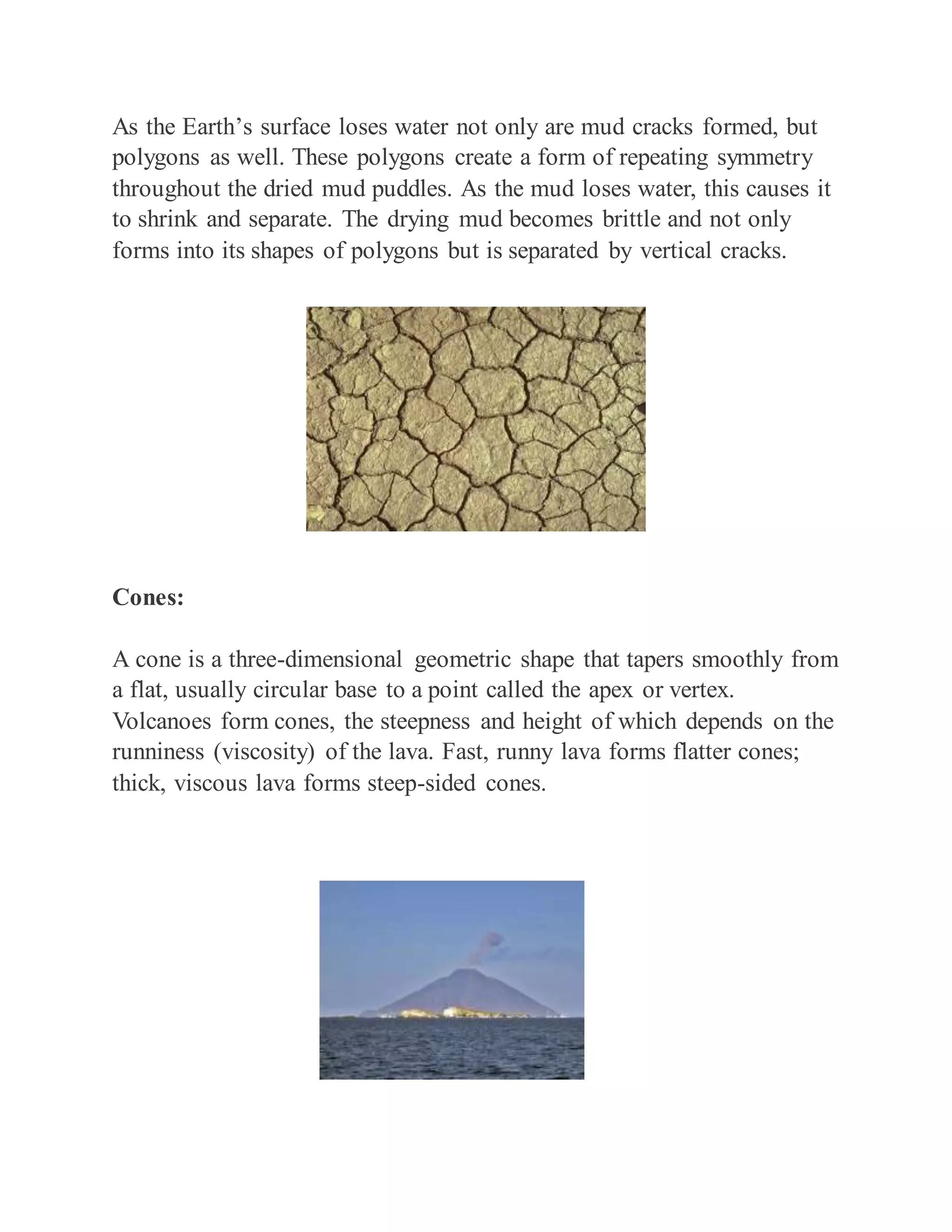
For a beehive, close packing is important to maximize the use of space.
Hexagons fit most closely together without any gaps; so hexagonal wax
cells are what bees create to store their eggs and larvae
Bees are not the only hexagon-makers in the living world. We find
hexagons on tortoise shells and in the ommatidia of insects’ compound
eyes
5.
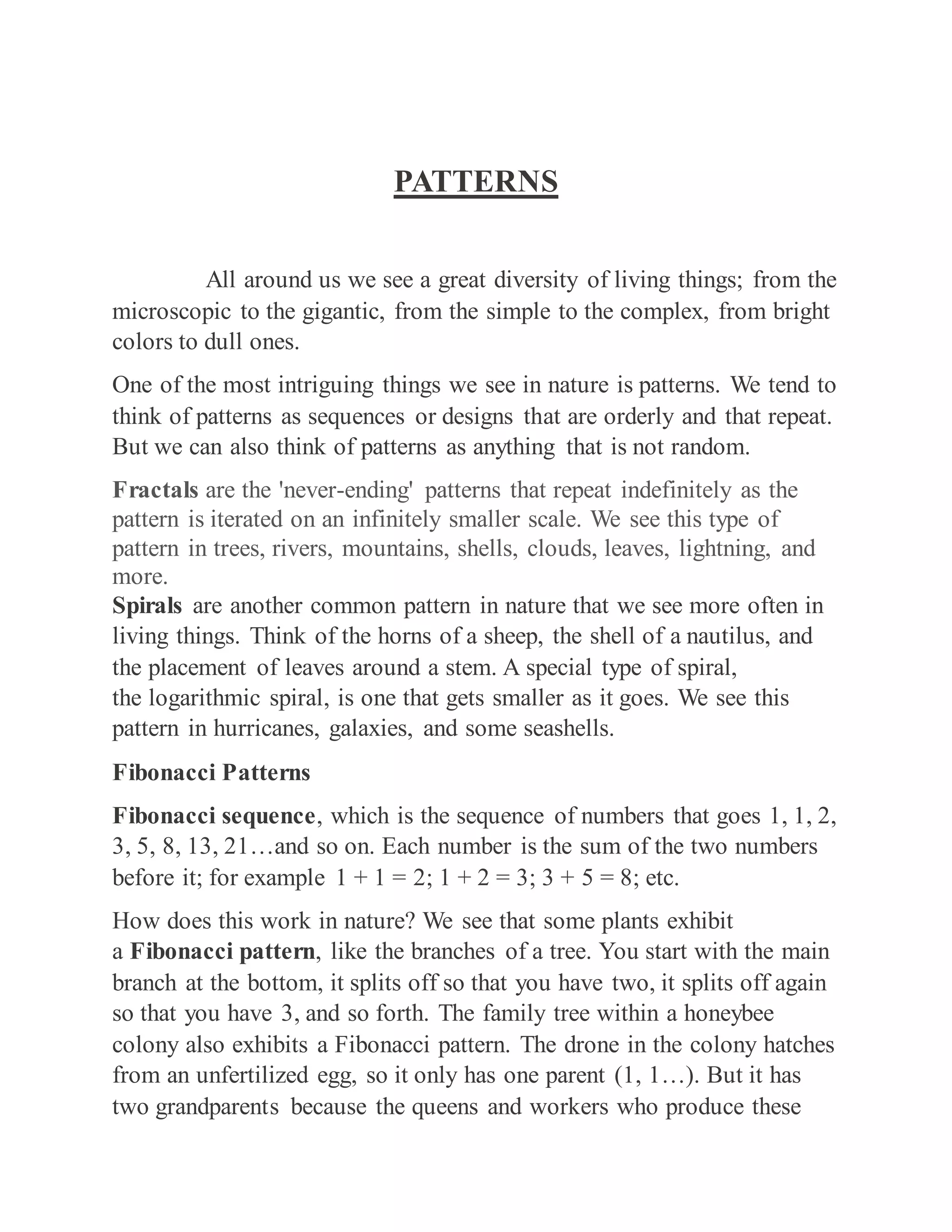
As the Earth’ssurface loses water not only are mud cracks formed, but
polygons as well. These polygons create a form of repeating symmetry
throughout the dried mud puddles. As the mud loses water, this causes it
to shrink and separate. The drying mud becomes brittle and not only
forms into its shapes of polygons but is separated by vertical cracks.
Cones:
A cone is a three-dimensional geometric shape that tapers smoothly from
a flat, usually circular base to a point called the apex or vertex.
Volcanoes form cones, the steepness and height of which depends on the
runniness (viscosity) of the lava. Fast, runny lava forms flatter cones;
thick, viscous lava forms steep-sided cones.
6.
PATTERNS
All around uswe see a great diversity of living things; from the
microscopic to the gigantic, from the simple to the complex, from bright
colors to dull ones.
One of the most intriguing things we see in nature is patterns. We tend to
think of patterns as sequences or designs that are orderly and that repeat.
But we can also think of patterns as anything that is not random.
Fractals are the 'never-ending' patterns that repeat indefinitely as the
pattern is iterated on an infinitely smaller scale. We see this type of
pattern in trees, rivers, mountains, shells, clouds, leaves, lightning, and
more.
Spirals are another common pattern in nature that we see more often in
living things. Think of the horns of a sheep, the shell of a nautilus, and
the placement of leaves around a stem. A special type of spiral,
the logarithmic spiral, is one that gets smaller as it goes. We see this
pattern in hurricanes, galaxies, and some seashells.
Fibonacci Patterns
Fibonacci sequence, which is the sequence of numbers that goes 1, 1, 2,
3, 5, 8, 13, 21…and so on. Each number is the sum of the two numbers
before it; for example 1 + 1 = 2; 1 + 2 = 3; 3 + 5 = 8; etc.
How does this work in nature? We see that some plants exhibit
a Fibonacci pattern, like the branches of a tree. You start with the main
branch at the bottom, it splits off so that you have two, it splits off again
so that you have 3, and so forth. The family tree within a honeybee
colony also exhibits a Fibonacci pattern. The drone in the colony hatches
from an unfertilized egg, so it only has one parent (1, 1…). But it has
two grandparents because the queens and workers who produce these
7.
eggs have twoparents (1, 1, 2…). It therefore has three great-
grandparents (1, 1, 2, 3…), and so on. The reasoning behind the
Fibonacci sequence in nature may be one of the least understood of all
the patterns.
Tessellations
Tessellations are patterns that are formed by repeated cubes or tiles.
These too can occur with both living and non-living things.
Tessellations are patterns formed by repeating tiles all over a flat
surface. There are 17 wallpaper groups of tilings.[70] While common in
art and design, exactly repeating tilings are less easy to find in living
things. The cells in the paper nests of social wasps, and the wax cells
in honeycomb built by honey bees are well-known examples
Rainbow
A rainbow is a meteorological phenomenon that is caused
by reflection, refraction and dispersion of light in water droplets
resulting in a spectrum of light appearing in the sky. All rainbows are
actually circular, but the centre of the circle is usually below the ground,
so you only see an arc. From an aeroplane, though, it’s possible to see
the complete 360 degrees. The rainbow will appear to keep pace with
you no matter how fast the plane flies (as long as there’s still rain in the
air) because it isn’t a physical object – it’s a pattern.
CONCLUSION
Maths is unavoidable. It’s deeply fundamental thing.
Without math, there would be no science, no music, no art. Maths is a
part of all of those things. If it’s got a structure, then there’s an aspect of
it that’s mathematical.
8.
REFERENCES
Wertheimer, Richard.(2002) Forum: Making It All Add Up.
Retrieved June 29, 2006
Knight, Michelle. (2005) Everyday Math Has Its Proponents.
Retrieved June 27, 2006.
About Everyday Mathematics: Research & Development. (2003)
Retrieved June 27, 2006.
![eggs have two parents (1, 1, 2…). It therefore has three great-
grandparents (1, 1, 2, 3…), and so on. The reasoning behind the
Fibonacci sequence in nature may be one of the least understood of all
the patterns.
Tessellations
Tessellations are patterns that are formed by repeated cubes or tiles.
These too can occur with both living and non-living things.
Tessellations are patterns formed by repeating tiles all over a flat
surface. There are 17 wallpaper groups of tilings.[70] While common in
art and design, exactly repeating tilings are less easy to find in living
things. The cells in the paper nests of social wasps, and the wax cells
in honeycomb built by honey bees are well-known examples
Rainbow
A rainbow is a meteorological phenomenon that is caused
by reflection, refraction and dispersion of light in water droplets
resulting in a spectrum of light appearing in the sky. All rainbows are
actually circular, but the centre of the circle is usually below the ground,
so you only see an arc. From an aeroplane, though, it’s possible to see
the complete 360 degrees. The rainbow will appear to keep pace with
you no matter how fast the plane flies (as long as there’s still rain in the
air) because it isn’t a physical object – it’s a pattern.
CONCLUSION
Maths is unavoidable. It’s deeply fundamental thing.
Without math, there would be no science, no music, no art. Maths is a
part of all of those things. If it’s got a structure, then there’s an aspect of
it that’s mathematical.](https://image.slidesharecdn.com/projectmathinnature-190228184129/75/Project-math-in-nature-7-2048.jpg)