BY: CHRISTINE ELNAS
• Introduction
• Types of Graft
• Graft Acceptance
• Graft Rejection
• Mechanism of allograft rejection
• Graft versus host reaction
• Overcoming Transplant Rejection
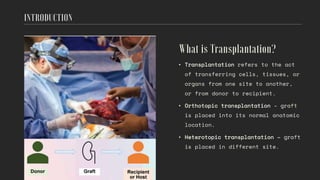
• Transplantation refers to the act
of transferring cells, tissues, or
organs from one site to another,
or from donor to recipient.
• Orthotopic transplantation - graft
is placed into its normal anatomic
location.
• Heterotopic transplantation – graft
is placed in different site.
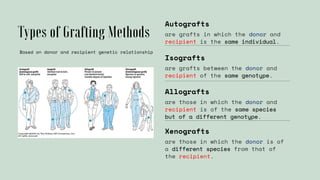
Autografts
Isografts
Allografts
Xenografts
are grafts in which the donor and
recipient is the same individual.
are grafts between the donor and
recipient of the same genotype.
are those in which the donor and
recipient is of the same species
but of a different genotype.
are those in which the donor is of
a different species from that of
the recipient.
Based on donor and recipient genetic relationship
• Immune system do not stimulate the immune response
against all the antigens present in the graft.
• And no graft rejection even when the donor and recipient
are not syngeneic.
• The intensity of the immune response against the organ
or tissue, also commonly referred to as the “grafts
rejection”.
• Rejection is a complex process in which “recipient
immune system recognize the graft as foreign and attacks
it.”
• It involves:
1.Cellular mediated rejection
2.Antibody mediated rejection
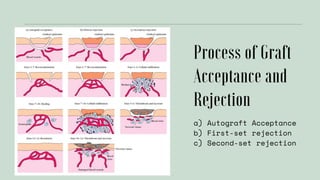
a) Autograft Acceptance
b) First-set rejection
c) Second-set rejection
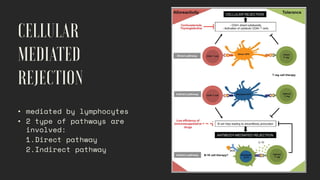
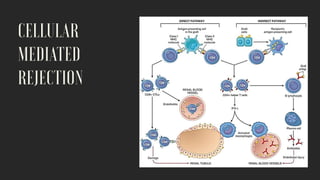
• mediated by lymphocytes
• 2 type of pathways are
involved:
1.Direct pathway
2.Indirect pathway
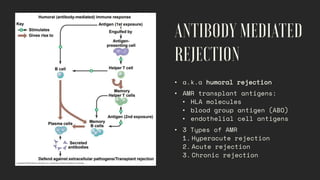
• a.k.a humoral rejection
• AMR transplant antigens:
• HLA molecules
• blood group antigen (ABO)
• endothelial cell antigens
• 3 Types of AMR
1. Hyperacute rejection
2. Acute rejection
3. Chronic rejection
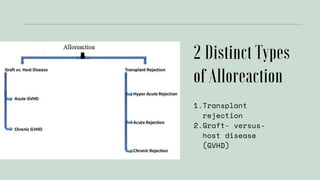
1.Transplant
rejection
2.Graft- versus-
host disease
(GVHD)
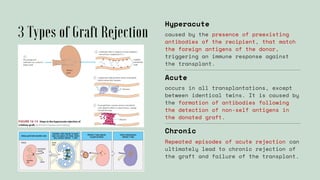
Hyperacute
Acute
Chronic
caused by the presence of preexisting
antibodies of the recipient, that match
the foreign antigens of the donor,
triggering an immune response against
the transplant.
occurs in all transplantations, except
between identical twins. It is caused by
the formation of antibodies following
the detection of non-self antigens in
the donated graft.
Repeated episodes of acute rejection can
ultimately lead to chronic rejection of
the graft and failure of the transplant.
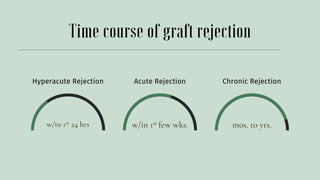
w/in 1st 24 hrs w/in 1st few wks. mos. to yrs.
Hyperacute Rejection Acute Rejection Chronic Rejection
• Pre-transplantation tests
(1) blood group matching (blood typing)
(2) MHC matching (also known as tissue typing)
(3) cross-matching
• Immunosuppression using immunosuppressive drugs
 Azathioprine
 Steroids
 Rapamycin
 Cyclosporine
 Monoclonal antibodies
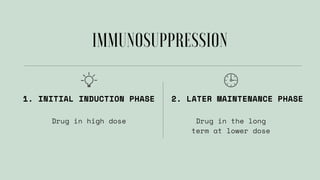
1. INITIAL INDUCTION PHASE 2. LATER MAINTENANCE PHASE
Drug in high dose Drug in the long
term at lower dose
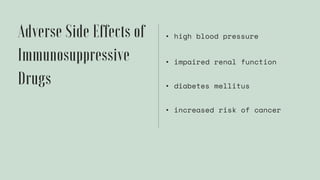
• high blood pressure
• impaired renal function
• increased risk of cancer
• diabetes mellitus
Transplantation Rejection.pptx

Transplantation Rejection.pptx

  • 1.
  • 2.
    • Introduction • Typesof Graft • Graft Acceptance • Graft Rejection • Mechanism of allograft rejection • Graft versus host reaction • Overcoming Transplant Rejection
  • 3.
    • Transplantation refersto the act of transferring cells, tissues, or organs from one site to another, or from donor to recipient. • Orthotopic transplantation - graft is placed into its normal anatomic location. • Heterotopic transplantation – graft is placed in different site.
  • 6.
    Autografts Isografts Allografts Xenografts are grafts inwhich the donor and recipient is the same individual. are grafts between the donor and recipient of the same genotype. are those in which the donor and recipient is of the same species but of a different genotype. are those in which the donor is of a different species from that of the recipient. Based on donor and recipient genetic relationship
  • 7.
    • Immune systemdo not stimulate the immune response against all the antigens present in the graft. • And no graft rejection even when the donor and recipient are not syngeneic.
  • 8.
    • The intensityof the immune response against the organ or tissue, also commonly referred to as the “grafts rejection”. • Rejection is a complex process in which “recipient immune system recognize the graft as foreign and attacks it.” • It involves: 1.Cellular mediated rejection 2.Antibody mediated rejection
  • 9.
    a) Autograft Acceptance b)First-set rejection c) Second-set rejection
  • 10.
    • mediated bylymphocytes • 2 type of pathways are involved: 1.Direct pathway 2.Indirect pathway
  • 12.
    • a.k.a humoralrejection • AMR transplant antigens: • HLA molecules • blood group antigen (ABO) • endothelial cell antigens • 3 Types of AMR 1. Hyperacute rejection 2. Acute rejection 3. Chronic rejection
  • 13.
  • 14.
    Hyperacute Acute Chronic caused by thepresence of preexisting antibodies of the recipient, that match the foreign antigens of the donor, triggering an immune response against the transplant. occurs in all transplantations, except between identical twins. It is caused by the formation of antibodies following the detection of non-self antigens in the donated graft. Repeated episodes of acute rejection can ultimately lead to chronic rejection of the graft and failure of the transplant.
  • 15.
    w/in 1st 24hrs w/in 1st few wks. mos. to yrs. Hyperacute Rejection Acute Rejection Chronic Rejection
  • 16.
    • Pre-transplantation tests (1)blood group matching (blood typing) (2) MHC matching (also known as tissue typing) (3) cross-matching • Immunosuppression using immunosuppressive drugs  Azathioprine  Steroids  Rapamycin  Cyclosporine  Monoclonal antibodies
  • 17.
    1. INITIAL INDUCTIONPHASE 2. LATER MAINTENANCE PHASE Drug in high dose Drug in the long term at lower dose
  • 18.
    • high bloodpressure • impaired renal function • increased risk of cancer • diabetes mellitus

Editor's Notes

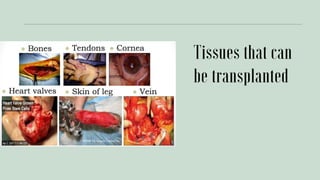
  • #4 Transplantation is the process of taking cells, tissues, or organs, called a graft, from one individual and placing them into a (usually) different individual. The individual who provides the graft is called the donor, and the individual who receives the graft is called either the recipient or the host. If the graft is placed into its normal anatomic location, the procedure is called orthotopic transplantation; if the graft is placed in a different site, the procedure is called heterotopic transplantation. The development of new clinical practices and surgical techniques has removed many of the previously intractable barriers to successful transplantation, and many life-threatening diseases can now be treated or cured with this approach. Unfortunately, a continual worldwide shortage of organs for transplantation leaves tens of thousands of individuals waiting for a transplant, sometimes for many years. And yet the most formidable barrier to greater application of tissue and cell transplantations to treat organ failure is still the immune system, and its inherent drive to maintain self tolerance.
  • #8 Graft Acceptance is apparent when the Immune system do not stimulate the immune response against all the antigens present in the graft, and no graft rejection even when the donor and recipient are not syngeneic (genetically similar or identical and hence immunologically compatible, especially so closely related that transplantation does not provoke an immune response).
  • #9 The intensity of the immune response against the organ or tissue, also commonly referred to as the “grafts rejection”.
  • #10 FIGURE 16-10 Schematic diagrams of the process of graft acceptance and rejection. (a) Acceptance of an autograft is completed within 12 to 14 days. (b) First-set rejection of an allograft begins 7 to 10 days after grafting, with full rejection occurring by 10 to 14 days. The 1st set response: When skin from rabbit is applied to another genetically unrelated animal Initially the graft is accepted. Vascularization starts. Remains healthy for 2- 3 days. By 4th day, inflammation starts, lymphocytes & macrophages invade. BVs occluded by thrombi , vascularity diminishes, ischemic necrosis sets in. graft changes to scab-> sloughed off by 10th day. This is called “1st set response” (c) Second-set rejection of an allograft begins within 3 to 4 days, with full rejection by 5 to 6 days. The cellular infiltrate that invades an allograft (b, c) contains lymphocytes, phagocytes, and other inflammatory cells. The 2nd set response: If, in an animal, which has rejected a graft by 1st set response, another graft from the same donor is applied The graft is rejected in an accelerated manner. Vascularization is attempted but is soon interrupted by inflammatory response. Necrosis sets in early, graft is sloughed off by 6th day. This accelerated allograft rejection is called “2nd set response.”
  • #11 These rejection is mediated by lymphocytes that have been activated against donor antigens, primarily in the lymphoid tissues of the recipient. The donor dendritic cells enter the circulation and function as antigen presenting cells (APCs). Destruction of grafts occur by CD8+CTLs and CD4+helper cells. 2 type of pathways are involved: Direct pathway Indirect pathway
  • #12 Unique to transplant immunobiology is the idea that alloantigen recognition can occur via two distinct pathways, both of which focus on the source of the antigen presenting cells (donor versus recipient). The direct pathway of allorecognition describes the ability of T cells to “directly” recognize intact non-self MHC molecules present on the surface of donor cells. The indirect pathway of allorecognition describes the ability of T cells to recognize donor MHC molecules that are processed and presented as peptides by self-MHC molecules. The recognition of intact donor MHC molecule(s) elicits a potent anti-graft immune response while processed MHC peptides and minor histocompatibility antigens elicit a slower tempo, less intense immune response. Figure above shows two distinct pathways of allorecognition. Left- Direct pathway of allorecognition. Dendritic cells (donor APCs) migrate from the graft to secondary lymphoid tissues to activate T cells. Right- Indirect pathway of allorecognition. Graft proteins are processed by recipient dendritic cells and presented to T cells. Direct pathway: Acute graft rejection Recognition of self vs. non-self - T cells recognize alloantigens - T cells stimulated by APCs from donor. T cell activation and proliferation Indirect pathway: T cell recognize foreign antigens from donor Recipient APCs present these antigens Also lead to T cell proliferation
  • #13 Antibody mediated rejetion (AMR) defines all allograft rejection caused by antibodies directed against donor – specific HLA molecules, blood group antigen (ABO)- isoagglutinins, or endothelial cell antigens. It is also called as humoral rejections. It have 3 types, Hyperacute rejection Acute rejection Chronic rejection
  • #14 Two distinct types of alloreaction can occur in clinical transplantation: Transplant rejection Graft-versus- host disease (GVHD) Transplant rejection is an immune reaction that is directed toward transplanted tissue from a genetically non-identical donor and leads to death of the graft. Graft versus host reaction is the response of mature donor-derived T cells in transplanted bone marrow or other type of hematopoietic cell transplant to the alloantigens of the recipient’s tissues.
  • #15 1. HYPERACUTE REJECTION Hyperacute rejection appears within minutes to hours of placing the transplant and destroys it. It is mediated by Humoral system antibodies. This type of rejection is seen when a recipient is given the wrong type of blood. For example, when a person is given type A blood when he or she is type B. 2. ACUTE REJECTION This usually becomes evident within a few days to a few months of transplantation. Acute graft rejection may be mediated by cellular or humoral mechanisms 3. CHRONIC REJECTION Chronic rejection may develop slowly over a period of months to a year or so. The underlying mechanisms of chronic rejection may be immunologic or ischemic. Patients with chronic rejection of renal transplant show progressive deterioration in renal function as seen by rising serum creatinine levels
  • #17 Tissue typing is done to prevent transplant rejection • Here both the organ donor and the person who is receiving the organ tissue typing is done to ensure that the organ or tissue is as similar as possible to the tissues of the recipient. • The more similar the antigens are between the donor and recipient, the less likely that the organ will be rejected. • No match is usually 100 percent identical. • No two people, except identical twins, have identical tissue antigen
  • #18 Immunosuppressive drugs are given in two phases: 1. The initial induction phase involving a high dose - The initial induction immunosuppression is intense, prophylactic therapy used at the time of transplantation based on the empiric observation that more powerful immunosuppression is required to prevent acute rejection early. 2. A later maintenance phase which involves using the drug in the long term at a lower dose.