SOUTHERN AFRICAN
FREELANCERS’ ASSOCIATION
A PRESENTATION BY CLIVE LOTTER
• Founded in 1999 to fight media freelancer rates
• Active branches in major SA cities
• Restructured in 2013 to develop and defend the freelancer
business model
Freelancing is taking over the world
• Freelancing / independent contracting will soon be the dominant employment mode
• Not just media – virtually every career
• Most significant work shift in 200 years
• Accelerated in SA through economics and BEE
A PRESENTATION BY CLIVE LOTTER
Freelancing today – some statistics
Commissioned by Freelancers Union and Upwork,
“Freelancing in America” (in it’s 3rd year) analyses the
freelance economy and provides insights into the lives of
independent workers.
A PRESENTATION BY CLIVE LOTTER
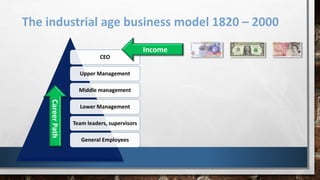
The industrial age business model 1820 – 2000
A PRESENTATION BY CLIVE LOTTER
CEO
Upper Management
Middle management
Lower Management
Team leaders, supervisors
General Employees
IncomeCareerPath
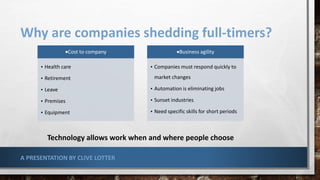
Why are companies shedding full-timers?
Cost to company
• Health care
• Retirement
• Leave
• Premises
• Equipment
Business agility
• Companies must respond quickly to
market changes
• Automation is eliminating jobs
• Sunset industries
• Need specific skills for short periods
A PRESENTATION BY CLIVE LOTTER
Technology allows work when and where people choose
DTP
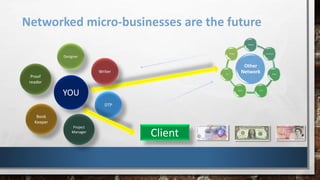
Networked micro-businesses are the future
Other
Network
Designer
Accountant
Writer
DTPAdmin
Tax
Manage
Client
YOU
Designer
Writer
Project
Manager
Book
Keeper
Proof
reader
So you’re a freelancer – like it or not
• Some choose freelance, many are being pushed into it
• Liberating and rewarding – or scary and scarce, low paid work
• Freelancing is a business – not a craft. Your craft is what your business offers
Need all the attributes of regular business
• Marketing
• Branding
• Admin
• Financial.
A PRESENTATION BY CLIVE LOTTER
Freelancing – the downside
• You are responsible for all costs of work
• All business functions are your responsibility, i.e. marketing,
admin, managing multiple clients
• Can you finance every business function?
• Are you good at every business function?
A PRESENTATION BY CLIVE LOTTER
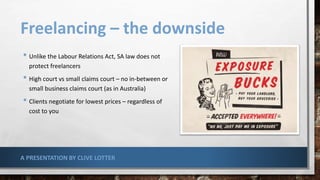
Freelancing – the downside
• Unlike the Labour Relations Act, SA law does not
protect freelancers
• High court vs small claims court – no in-between or
small business claims court (as in Australia)
• Clients negotiate for lowest prices – regardless of
cost to you
A PRESENTATION BY CLIVE LOTTER
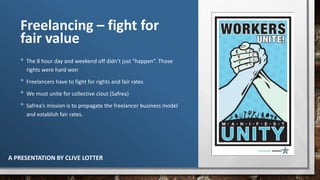
Freelancing – fight for
fair value
• The 8 hour day and weekend off didn’t just “happen”. Those
rights were hard won
• Freelancers have to fight for rights and fair rates
• We must unite for collective clout (Safrea)
• Safrea’s mission is to propagate the freelancer business model
and establish fair rates.
A PRESENTATION BY CLIVE LOTTER
Establishing fair value
• Establish the value to the job to the client –
measure your worth against that
• Lead that market – don’t follow it
• Low pay for freelancers is priced into budgets
– we have to change that model
• Fair value has to be negotiated – it won’t be
given willingly.
A PRESENTATION BY CLIVE LOTTER
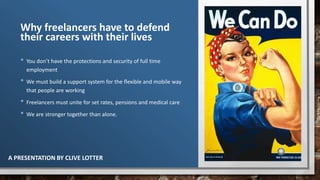
Why freelancers have to defend
their careers with their lives
• You don’t have the protections and security of full time
employment
• We must build a support system for the flexible and mobile way
that people are working
• Freelancers must unite for set rates, pensions and medical care
• We are stronger together than alone.
A PRESENTATION BY CLIVE LOTTER
Plagiarised content
and weaponised lies
• Easier to steal or “fake” content than to create it
• Content mills, aggregators
• Connectivity as news channels
• Social media as news – good and bad
• Google and other search engines algorithms
becoming more sophisticated
A PRESENTATION BY CLIVE LOTTER
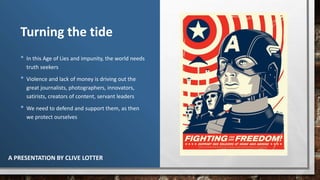
Turning the tide
• In this Age of Lies and impunity, the world needs
truth seekers
• Violence and lack of money is driving out the
great journalists, photographers, innovators,
satirists, creators of content, servant leaders
• We need to defend and support them, as then
we protect ourselves
A PRESENTATION BY CLIVE LOTTER
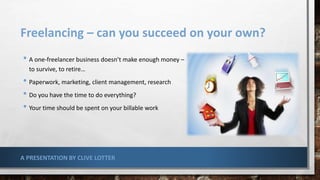
Freelancing – can you succeed on your own?
• A one-freelancer business doesn’t make enough money –
to survive, to retire…
• Paperwork, marketing, client management, research
• Do you have the time to do everything?
• Your time should be spent on your billable work
A PRESENTATION BY CLIVE LOTTER
Making freelancing work for you
• Set up a working space
• Build your brand and don’t be a ‘doos’
• Network
• Outsource
• Plug-in online systems
A PRESENTATION BY CLIVE LOTTER
Making freelancing work for you
• Set limits, rates and routines
• The 80/20 principle
• Learn to say “no”
• Get paid – invoicing and legal issues
• Meet deadlines
A PRESENTATION BY CLIVE LOTTER
Avoiding the feast or famine cycle by networking
• No output means no income
• It’s hard to be strategic and creative when
you’re stuck in “survival” mode
• Don’t get stuck! Getting unstuck is tough
• Use yield management by networking
• ‘Court’ repeat clients
• Make marketing a priority, not an after-
thought
• Diversify!
A PRESENTATION BY CLIVE LOTTER
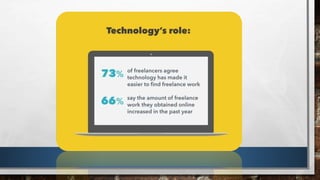
Technology’s role
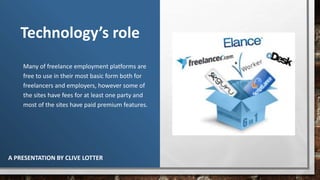
Many of freelance employment platforms are
free to use in their most basic form both for
freelancers and employers, however some of
the sites have fees for at least one party and
most of the sites have paid premium features.
A PRESENTATION BY CLIVE LOTTER
Look out LinkedIn…
Facebook just entered the
job market
Companies in the United States and Canada can now post
openings either on their own page and/or on a new jobs
page. Interested applicants can click on a button to apply
instantly.
A PRESENTATION BY CLIVE LOTTER
Online platforms
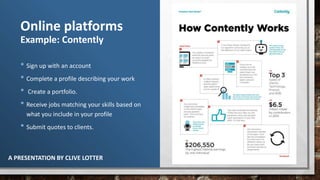
Example: Contently
• Sign up with an account
• Complete a profile describing your work
• Create a portfolio.
• Receive jobs matching your skills based on
what you include in your profile
• Submit quotes to clients.
A PRESENTATION BY CLIVE LOTTER
Online platforms
Example: Elance
• Create an account
• Complete your profile
• Include samples of your work and experience
• Browse through projects
• See what other freelancers have bid on jobs
• Submit your proposals to clients.
• The client will contact you if you’re chosen.
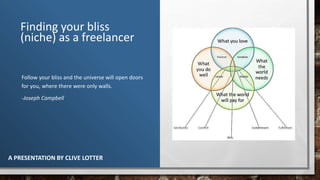
Finding your bliss
(niche) as a freelancer
Follow your bliss and the universe will open doors
for you, where there were only walls.
-Joseph Campbell
A PRESENTATION BY CLIVE LOTTER
Finding your niche as a freelancer
• A generalist portfolio attracts low value clients
• Do what you’re great at, not just good at
• How does narrowing my target market grant me more opportunities? Wouldn’t it be the
opposite?
• Narrow focus, but more chances – clients respect experts
• Become a hard to replace expert
A PRESENTATION BY CLIVE LOTTER
Finding your niche
as a freelancer
• Finding your niche as a freelancer is a personal
journey
• A niche is something that has to be nurtured
• Building a great portfolio and your niche skills
takes time
• Stay up to date – or lead change – in your niche
• Niches attract clients from everywhere
• Build a niche community around you.
A PRESENTATION BY CLIVE LOTTER
Leveraging
Safrea for
your
success
• Strength in numbers
• Use “the Oracle” for advice, support and building a network
• Stay connected to freelancers who are going somewhere (read “the oracle”)
• Continually grow your network
• Join a Safrea committee – get involved
• Collaborate on solutions to widespread industry problems i.e. Pay rates, legal
protection
A PRESENTATION BY CLIVE LOTTER
A roadmap to becoming a famous
and profitable freelancer
• Find your niche (bliss)
• Create a portfolio
• Create your website – link to social media
• Get into freelance and niche communities
• Collaborate and outsource to leverage strengths and
marginalise weaknesses
• Become a hub and a network in a network
• Become viable in the upcoming global economy
A PRESENTATION BY CLIVE LOTTER
THE FUTURE IS NOW
– AND IT’S US.
Do we rise to it? Or do
we fall?
Inspired by Sara Horowitz and Chris Marais
A PRESENTATION BY CLIVE LOTTER

Will freelancing survive – and can you?

  • 2.
    SOUTHERN AFRICAN FREELANCERS’ ASSOCIATION APRESENTATION BY CLIVE LOTTER • Founded in 1999 to fight media freelancer rates • Active branches in major SA cities • Restructured in 2013 to develop and defend the freelancer business model
  • 3.
    Freelancing is takingover the world • Freelancing / independent contracting will soon be the dominant employment mode • Not just media – virtually every career • Most significant work shift in 200 years • Accelerated in SA through economics and BEE A PRESENTATION BY CLIVE LOTTER
  • 4.
    Freelancing today –some statistics Commissioned by Freelancers Union and Upwork, “Freelancing in America” (in it’s 3rd year) analyses the freelance economy and provides insights into the lives of independent workers. A PRESENTATION BY CLIVE LOTTER
  • 9.
    The industrial agebusiness model 1820 – 2000 A PRESENTATION BY CLIVE LOTTER CEO Upper Management Middle management Lower Management Team leaders, supervisors General Employees IncomeCareerPath
  • 10.
    Why are companiesshedding full-timers? Cost to company • Health care • Retirement • Leave • Premises • Equipment Business agility • Companies must respond quickly to market changes • Automation is eliminating jobs • Sunset industries • Need specific skills for short periods A PRESENTATION BY CLIVE LOTTER Technology allows work when and where people choose
  • 11.
    DTP Networked micro-businesses arethe future Other Network Designer Accountant Writer DTPAdmin Tax Manage Client YOU Designer Writer Project Manager Book Keeper Proof reader
  • 12.
    So you’re afreelancer – like it or not • Some choose freelance, many are being pushed into it • Liberating and rewarding – or scary and scarce, low paid work • Freelancing is a business – not a craft. Your craft is what your business offers Need all the attributes of regular business • Marketing • Branding • Admin • Financial. A PRESENTATION BY CLIVE LOTTER
  • 13.
    Freelancing – thedownside • You are responsible for all costs of work • All business functions are your responsibility, i.e. marketing, admin, managing multiple clients • Can you finance every business function? • Are you good at every business function? A PRESENTATION BY CLIVE LOTTER
  • 14.
    Freelancing – thedownside • Unlike the Labour Relations Act, SA law does not protect freelancers • High court vs small claims court – no in-between or small business claims court (as in Australia) • Clients negotiate for lowest prices – regardless of cost to you A PRESENTATION BY CLIVE LOTTER
  • 15.
    Freelancing – fightfor fair value • The 8 hour day and weekend off didn’t just “happen”. Those rights were hard won • Freelancers have to fight for rights and fair rates • We must unite for collective clout (Safrea) • Safrea’s mission is to propagate the freelancer business model and establish fair rates. A PRESENTATION BY CLIVE LOTTER
  • 16.
    Establishing fair value •Establish the value to the job to the client – measure your worth against that • Lead that market – don’t follow it • Low pay for freelancers is priced into budgets – we have to change that model • Fair value has to be negotiated – it won’t be given willingly. A PRESENTATION BY CLIVE LOTTER
  • 17.
    Why freelancers haveto defend their careers with their lives • You don’t have the protections and security of full time employment • We must build a support system for the flexible and mobile way that people are working • Freelancers must unite for set rates, pensions and medical care • We are stronger together than alone. A PRESENTATION BY CLIVE LOTTER
  • 18.
    Plagiarised content and weaponisedlies • Easier to steal or “fake” content than to create it • Content mills, aggregators • Connectivity as news channels • Social media as news – good and bad • Google and other search engines algorithms becoming more sophisticated A PRESENTATION BY CLIVE LOTTER
  • 19.
    Turning the tide •In this Age of Lies and impunity, the world needs truth seekers • Violence and lack of money is driving out the great journalists, photographers, innovators, satirists, creators of content, servant leaders • We need to defend and support them, as then we protect ourselves A PRESENTATION BY CLIVE LOTTER
  • 20.
    Freelancing – canyou succeed on your own? • A one-freelancer business doesn’t make enough money – to survive, to retire… • Paperwork, marketing, client management, research • Do you have the time to do everything? • Your time should be spent on your billable work A PRESENTATION BY CLIVE LOTTER
  • 21.
    Making freelancing workfor you • Set up a working space • Build your brand and don’t be a ‘doos’ • Network • Outsource • Plug-in online systems A PRESENTATION BY CLIVE LOTTER
  • 22.
    Making freelancing workfor you • Set limits, rates and routines • The 80/20 principle • Learn to say “no” • Get paid – invoicing and legal issues • Meet deadlines A PRESENTATION BY CLIVE LOTTER
  • 23.
    Avoiding the feastor famine cycle by networking • No output means no income • It’s hard to be strategic and creative when you’re stuck in “survival” mode • Don’t get stuck! Getting unstuck is tough • Use yield management by networking • ‘Court’ repeat clients • Make marketing a priority, not an after- thought • Diversify! A PRESENTATION BY CLIVE LOTTER
  • 25.
    Technology’s role Many offreelance employment platforms are free to use in their most basic form both for freelancers and employers, however some of the sites have fees for at least one party and most of the sites have paid premium features. A PRESENTATION BY CLIVE LOTTER
  • 26.
    Look out LinkedIn… Facebookjust entered the job market Companies in the United States and Canada can now post openings either on their own page and/or on a new jobs page. Interested applicants can click on a button to apply instantly. A PRESENTATION BY CLIVE LOTTER
  • 27.
    A PRESENTATION BYCLIVE LOTTER Online platforms Example: Contently • Sign up with an account • Complete a profile describing your work • Create a portfolio. • Receive jobs matching your skills based on what you include in your profile • Submit quotes to clients.
  • 28.
    A PRESENTATION BYCLIVE LOTTER Online platforms Example: Elance • Create an account • Complete your profile • Include samples of your work and experience • Browse through projects • See what other freelancers have bid on jobs • Submit your proposals to clients. • The client will contact you if you’re chosen.
  • 29.
    Finding your bliss (niche)as a freelancer Follow your bliss and the universe will open doors for you, where there were only walls. -Joseph Campbell A PRESENTATION BY CLIVE LOTTER
  • 30.
    Finding your nicheas a freelancer • A generalist portfolio attracts low value clients • Do what you’re great at, not just good at • How does narrowing my target market grant me more opportunities? Wouldn’t it be the opposite? • Narrow focus, but more chances – clients respect experts • Become a hard to replace expert A PRESENTATION BY CLIVE LOTTER
  • 31.
    Finding your niche asa freelancer • Finding your niche as a freelancer is a personal journey • A niche is something that has to be nurtured • Building a great portfolio and your niche skills takes time • Stay up to date – or lead change – in your niche • Niches attract clients from everywhere • Build a niche community around you. A PRESENTATION BY CLIVE LOTTER
  • 32.
    Leveraging Safrea for your success • Strengthin numbers • Use “the Oracle” for advice, support and building a network • Stay connected to freelancers who are going somewhere (read “the oracle”) • Continually grow your network • Join a Safrea committee – get involved • Collaborate on solutions to widespread industry problems i.e. Pay rates, legal protection A PRESENTATION BY CLIVE LOTTER
  • 33.
    A roadmap tobecoming a famous and profitable freelancer • Find your niche (bliss) • Create a portfolio • Create your website – link to social media • Get into freelance and niche communities • Collaborate and outsource to leverage strengths and marginalise weaknesses • Become a hub and a network in a network • Become viable in the upcoming global economy A PRESENTATION BY CLIVE LOTTER
  • 34.
    THE FUTURE ISNOW – AND IT’S US. Do we rise to it? Or do we fall? Inspired by Sara Horowitz and Chris Marais A PRESENTATION BY CLIVE LOTTER

Editor's Notes

  • #2 Tell them what I’m going to talk about: Permanent employment is going The new business model Defend your career Find your bliss Putting it all together
  • #3 Founded in 1999 to fight journalism and photography rates Restructured in 2013 to develop and defend the freelancer business model Active branches in major SA cities.
  • #4 Fixed employment is diminishing – freelancing may be the only option “Every day, I hear the cries of media people – journalists, graphic artists, photographers and copy editors – who have just been kicked out onto the street by their long-time employers.” Quote from Chris Marais – Do yourself a favour and read his article “The Rise of the Freelancer” on Karoospace. (It says so beautifully what I’m sharing with you in this presentation).   Not just media – every career choice The “Intuit 2020” report estimated that by 2020, more than 40% of the American workforce, or 60 million people, will be independent workers—freelancers, contractors, and temporary employees.   Most significant work shift in 100 years We haven't seen a shift in the workforce this significant in almost 100 years when we transitioned from an agricultural to an industrial economy This transition is nothing less than a revolution. Fixed employment in skilled work will continue diminishing. This is being accelerated by automation, artificial intelligence – you love to find your edge Online freelance job postings are skyrocketing Companies are increasingly outsourcing work While the economy has unwillingly pushed some people into independent work, many have chosen it because of greater flexibility that lets them skip the dreary office environment and focus on more personally fulfilling projects.
  • #5 Commissioned by Freelancers Union and Upwork, “Freelancing in America” (in it’s 3rd year) analyses the freelance economy and provides insights into the lives of independent workers.
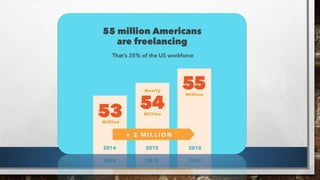
  • #6 55 million Americans are freelancing – not all fulltime
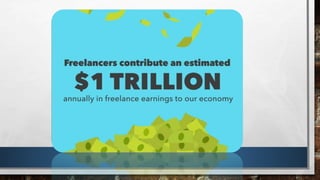
  • #7 Freelancers contribute an estimated $1 trillion annually in freelance earnings to the economy
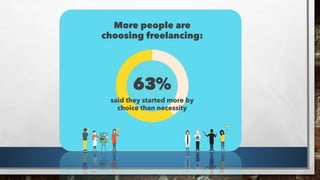
  • #8 More people are choosing freelancing
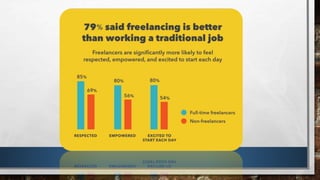
  • #9 79% said freelancing is better than working a traditional job
  • #10 A typical pyramid scheme…
  • #11 Companies are increasingly outsourcing work Freelancers, contractors and interim managers are bringing flexibility, dynamism and experience For clients of all sizes, adding a freelancer or contractor to a project team can add experience and talent that might be otherwise be unaffordable or unobtainable.  
  • #12 The 21st century New Mutualism Age networked businesses The solution will rest with our ability to form networks for exchange and to create the power to defend our freelancer lifestyle. Sara Horowitz, US labour lawyer and author, calls this "new mutualism." It's that simple idea -- we are stronger together than we are alone -- that's at the heart of our vision of the new economy. And millions of freelancers around the world are already living this connected life that I call "New Mutualism." That's the biggest lesson I've learned from freelancers -- your network is everything. The most successful independent workers are the ones who know you need people to turn to when you're in a dry spell, or you're overloaded with work, or you just need some advice. The choice is deceptively simple -- go it alone or build something together. Building together always ends up better. Find others that do things to complement your craft This is not easy. You’ll have to stop providing the services yourself and rely on others to do it for you. At first you will hate this. You will think that no one can do as good a job as you. You will have a difficult time letting go. You will want to always be “busy,” and to you being “busy” meant doing the actual work. But gradually you will learn that it’s more important to keep other people busy while you find more work. When something needs to be done you will eventually stop thinking to yourself, “how will I do this?” and instead start thinking, “who will I get to do this for me?”     Everyone has their speciality Maybe you refer work back and forth. Or maybe you do the work together as a team. Maybe you decide someday to actually go into business together. You pool your resources and your talent, and together you can offer more. Hire people smarter than you inside and outside your craft At some point you’ll admit that the people you’ve hired to provide services are actually doing a better job than you. Hiring people smarter than you is how you will make money. They are good at what they do, and you will be good at finding them more stuff to do so which means more money to spread around. The solution is your ability to form networks Network, network, network – don’t ever stop! YOUR NETWORK IS EVERYTHING Chris Marais example: If you’re going to be an Indie Publisher (not a self-publisher, not a vanity publisher) then you must look around and hire the best copy editor you can afford. Source the finest illustrations and then find yourself one of those Magic People: the Webmeister who does graphics. Suddenly, you’re a publishing house. Why? Because you’re passing work to copy editors, photographers, map makers, graphic designers, webmasters and possibly all sorts of other people in your field. They are helping you to bring your book to market – in a professional manner. They are the very people who have been laid off in their millions by the Old Firms.
  • #13 Freelancing can be scary and daunting – or liberating and rewarding Careers today It's been called the Gig Economy, Freelance Nation, the Rise of the Creative Class, and the E-economy, with the "e" standing for electronic, entrepreneurial, or perhaps eclectic. From Chris Marais: And it looks bleak, because who do you freelance for? Your old bosses? Do you stand in line for scraps of assignments? Will you ever earn enough to cover those mounting bills? But I’m not here to lament the woes of Mahogany Row. I’m for Freelance Alley, that dangerous, edgy place where only the brave dare to venture. And it is a brave new world out there. It takes balls to wake up in the morning and build your earnings base from zero. But the freedom, aah, the freedom. Even if, as Janis Joplin said, “Freedom’s just another word for nothing left to lose”. The economy has unwillingly pushed some people into independent work The days of working at the same company for 25 years, waiting for the gold watch, expecting the benefits and security that come with full-time employment are over. You may not like having to be a freelancer but if you have no choice, accept it and make it work. Understand that this shift is remorseless and is the future – so get to grips with it.
  • #14 You are responsible for all costs of work All business functions are your responsibility, i.e. marketing, admin, managing multiple clients You must negotiate fair value to make a living and pay for all your costs Can you finance every business function? Are you good at every business function?
  • #15 Unlike the Labour Relations Act, SA law does not protect freelancers High court vs small claims court – no in-between or small business claims court (as in Australia) Clients negotiate for lowest prices – regardless of cost to you
  • #16 The 8 hour day and weekend off didn’t just “happen”. Those rights were hard won. Freelancers have to fight for rights and fair rates We must unite for collective clout (Safrea). Safrea’s mission is to propagate the freelancer business model and establish fair rates.
  • #17 Low pay for freelancers is priced into budgets – we have to change that model Fair value has to be negotiated – it won’t be given willingly Establish the value to the job to the client – measure your worth against that. Lead that market – don’t follow it Collectively drive fair value benchmarks
  • #18 We must build a support system Independent workers are forced to seek them elsewhere, and if they can't find or afford them, then they go without. Our current support system is based on a traditional employment model, where one worker must be tethered to one employer to receive those benefits. Unite for set rates, pensions and medical care Given that fewer and fewer of us are working this way, it's time to build a new support system that allows for the flexible and mobile way that people are working. Grow SAFREA so that it can go in that direction – as the US freelancers union has done. Stronger together than we are alone “In today’s economy, there’s a huge chunk of the middle class that’s being pushed down into the working class and working poor,” Ms. Horowitz says, “and freelancers are the first group that’s happening to.”  
  • #19 Easier to steal or “fake” content than to create it Content mills, aggregators Loosing value Google and other search engines algorithms becoming more sophisticated
  • #21 A one-freelancer business doesn’t make enough money Want to quit your job and be a freelancer, a one-person shop? I have bad news for you, and you need to hear it now, before it’s too late. You won’t be able to make a lot of money if you’re running a one-person business. Maybe, just maybe you might make a living. But that's all. Eventually you will run out of energy, years and inspiration. Why? First, let’s do the math. There are only so many hours in a week.   Paperwork, administration, and, most importantly, looking for more work Because you are alone, you will need to spend time doing paperwork, administrative tasks, and, most importantly, looking for more work when the current job runs out (and they always run out). You will easily spend half of your time doing that.   Rent, transportation, repairs, supplies, computers, taxes Your expenses will probably run a few thousand a month. Add up your monthly expenses – knowing you don’t have employer support. …so how much must you earn…? So how much must you earn per day to cover all that -and save -and have a little extra for yourself? NB: Try be partnered with a salary earner – especially in your early years. I am grateful to my angel wife for those early years.      You are the salesperson. It’s your business, your craft, your specialty, your expertise You are the salesperson. You say you’re not a good salesperson? Tough. Because you’re the only one credible enough to present yourself to a customer. It’s your business, your craft, your specialty, your expertise. In the end a customer is not buying from your business. They’re really just hiring you. You’re the product. So you’ve got to be the one to sell. If you don’t like selling, don’t start your own freelancing business. Or – become a supplier to a freelancer who can market and sell.   You can’t do everything. What you will need is a partner, or two or three. You can’t do everything. So you have to find others that do things that complement your craft.
  • #22 Making freelancing work for you Set up a working space While you can work mostly from home, you may need to still have some working space outside of the home. Outside of your home you may need: Space for client meetings. The “coffice” society or professional meeting rooms. Operational space. You may still have operational working space outside of your home, but you can have co-freelancers overseeing the operation for you and you only go there as necessary.   Build your brand and don’t be a doos “Networking is very important, but being a good human is number one. No one wants to work with an asshole”. It’s not just about being talented anymore. People will only call back freelancers they actually want to work with.”   Networking Successful freelancers know how to connect with others and engage in relevant communication. They have the instinct for seizing the right time and place to pitch their ideas. They are not afraid to step out of their comfort zone when necessary. The reality of networking is that much of it is about building new relationships with potential clients, or people that will lead you to those clients, and this takes time. Eventually, you become widely known your field and clients are confident in appointing you. The result, to put it simply, is a long list of people needing you for their projects. Give to receive. Listen to the needs of others, offer smart solutions and even facilitating connections to others in your network This is more valuable than straightforward selling yourself. In fact, you can become an authority in your field just by facilitating connections between other people. In effect by keeping the network itself going, you are ensuring your status as a valuable member of that network.   Outsource It is possible to outsource just about anything these days. The more you are able to outsource, the less infrastructure you need. You can outsource by:- Using outsourced assistants (i.e. “virtual assistants”) and tax consultants.     Plug in Skills Incorporate online systems Online systems enable yourself and your team to constantly know what is going on even if you are working in different locations. Online systems include: Document Sharing systems that enable different people to work on the same documents and keep everyone in the loop. Calendar Sharing systems that ensure everyone’s daily schedule is known to everyone else in the team. Email, Skype, telephone, social media - keep communication open at all times.       Meet deadlines   Do the work – set limits, rates and routines “I would say one of the biggest challenges with freelancing is setting and maintaining limits,” Scope creep “You are getting paid for something that you agreed to in advance, and of course because of the nature of advertising, something will inevitably change, you’ll be asked to work longer hours, you’ll be asked to take on more than was initially explained to you. If you’re not tough, it’s easy to get taken advantage of.”   Learn to say NO – the 20% / 80% principle 20% of clients give you 80% of the work. Get rid of the rest and try to improve the quality of your 20%   Getting Paid Things become a drag when billing, and taxes have to be done and sometimes fought over. “There’s a reason we became creatives and not business people, because we’d be terrible business people,” And then there’s the question of setting your rate. Creative professionals tend to shy away from the topic but establish your worth and compromise a maximum of 10% - 20% if the longer term relationship is worth it.   Work / Life Balance
  • #23 Making freelancing work for you Set up a working space While you can work mostly from home, you may need to still have some working space outside of the home. Outside of your home you may need: Space for client meetings. The “coffice” society or professional meeting rooms. Operational space. You may still have operational working space outside of your home, but you can have co-freelancers overseeing the operation for you and you only go there as necessary.   Build your brand and don’t be a doos “Networking is very important, but being a good human is number one. No one wants to work with an asshole”. It’s not just about being talented anymore. People will only call back freelancers they actually want to work with.”   Networking Successful freelancers know how to connect with others and engage in relevant communication. They have the instinct for seizing the right time and place to pitch their ideas. They are not afraid to step out of their comfort zone when necessary. The reality of networking is that much of it is about building new relationships with potential clients, or people that will lead you to those clients, and this takes time. Eventually, you become widely known your field and clients are confident in appointing you. The result, to put it simply, is a long list of people needing you for their projects. Give to receive. Listen to the needs of others, offer smart solutions and even facilitating connections to others in your network This is more valuable than straightforward selling yourself. In fact, you can become an authority in your field just by facilitating connections between other people. In effect by keeping the network itself going, you are ensuring your status as a valuable member of that network.   Outsource It is possible to outsource just about anything these days. The more you are able to outsource, the less infrastructure you need. You can outsource by:- Using outsourced assistants (i.e. “virtual assistants”) and tax consultants.     Plug in Skills Incorporate online systems Online systems enable yourself and your team to constantly know what is going on even if you are working in different locations. Online systems include: Document Sharing systems that enable different people to work on the same documents and keep everyone in the loop. Calendar Sharing systems that ensure everyone’s daily schedule is known to everyone else in the team. Email, Skype, telephone, social media - keep communication open at all times.       Meet deadlines   Do the work – set limits, rates and routines “I would say one of the biggest challenges with freelancing is setting and maintaining limits,” Scope creep “You are getting paid for something that you agreed to in advance, and of course because of the nature of advertising, something will inevitably change, you’ll be asked to work longer hours, you’ll be asked to take on more than was initially explained to you. If you’re not tough, it’s easy to get taken advantage of.”   Learn to say NO – the 20% / 80% principle 20% of clients give you 80% of the work. Get rid of the rest and try to improve the quality of your 20%   Getting Paid Things become a drag when billing, and taxes have to be done and sometimes fought over. “There’s a reason we became creatives and not business people, because we’d be terrible business people,” And then there’s the question of setting your rate. Creative professionals tend to shy away from the topic but establish your worth and compromise a maximum of 10% - 20% if the longer term relationship is worth it.   Work / Life Balance
  • #25 Technology’s role
  • #26 Many of freelance employment platforms are free to use in their most basic form both for freelancers and employers, however some of the sites have fees for at least one party and most of the sites have paid premium features.
  • #27 Making freelancing work for you Set up a working space While you can work mostly from home, you may need to still have some working space outside of the home. Outside of your home you may need: Space for client meetings. The “coffice” society or professional meeting rooms. Operational space. You may still have operational working space outside of your home, but you can have co-freelancers overseeing the operation for you and you only go there as necessary.   Build your brand and don’t be a doos “Networking is very important, but being a good human is number one. No one wants to work with an asshole”. It’s not just about being talented anymore. People will only call back freelancers they actually want to work with.”   Networking Successful freelancers know how to connect with others and engage in relevant communication. They have the instinct for seizing the right time and place to pitch their ideas. They are not afraid to step out of their comfort zone when necessary. The reality of networking is that much of it is about building new relationships with potential clients, or people that will lead you to those clients, and this takes time. Eventually, you become widely known your field and clients are confident in appointing you. The result, to put it simply, is a long list of people needing you for their projects. Give to receive. Listen to the needs of others, offer smart solutions and even facilitating connections to others in your network This is more valuable than straightforward selling yourself. In fact, you can become an authority in your field just by facilitating connections between other people. In effect by keeping the network itself going, you are ensuring your status as a valuable member of that network.   Outsource It is possible to outsource just about anything these days. The more you are able to outsource, the less infrastructure you need. You can outsource by:- Using outsourced assistants (i.e. “virtual assistants”) and tax consultants.     Plug in Skills Incorporate online systems Online systems enable yourself and your team to constantly know what is going on even if you are working in different locations. Online systems include: Document Sharing systems that enable different people to work on the same documents and keep everyone in the loop. Calendar Sharing systems that ensure everyone’s daily schedule is known to everyone else in the team. Email, Skype, telephone, social media - keep communication open at all times.       Meet deadlines   Do the work – set limits, rates and routines “I would say one of the biggest challenges with freelancing is setting and maintaining limits,” Scope creep “You are getting paid for something that you agreed to in advance, and of course because of the nature of advertising, something will inevitably change, you’ll be asked to work longer hours, you’ll be asked to take on more than was initially explained to you. If you’re not tough, it’s easy to get taken advantage of.”   Learn to say NO – the 20% / 80% principle 20% of clients give you 80% of the work. Get rid of the rest and try to improve the quality of your 20%   Getting Paid Things become a drag when billing, and taxes have to be done and sometimes fought over. “There’s a reason we became creatives and not business people, because we’d be terrible business people,” And then there’s the question of setting your rate. Creative professionals tend to shy away from the topic but establish your worth and compromise a maximum of 10% - 20% if the longer term relationship is worth it.   Work / Life Balance
  • #28 Sign up with an account Complete a profile describing your work Create a portfolio. Receive jobs matching your skills based on what you include in your profile Submit quotes to clients.
  • #29 Create an account, Complete your profile Include samples of your work and experience Browse through projects See what other freelancers have bid on jobs Submit your proposals to clients. The client will contact you if you’re chosen. Other work platforms: Upwork, Guru, Freelancer …. LinkedIn?
  • #30 Finding your bliss Talk a little about Robert Campbell (the philosopher) and his influence on my own life. If you don’t find your bliss – your mission – you may never be truly happy – and others will see that. Man with a thousand faces. Iron John
  • #31 Finding your niche as a freelancer A generalist portfolio attracts low value clients   Do what you’re great at, not just good at (Donna Rachelson) Donna Rachelson – a revelation for me at a Safrea meeting   How does narrowing my target market create opportunities? Finding a niche allows you to become an expert within a particular field that attracts a certain type of client. A portfolio filled with specific work that resonates with a certain type of client is much more appealing than a portfolio that tries to cater to everyone.   Become a hard to replace expert   Narrow Focus, But More Chances It is weird how this works, but you are able to climb the ladder faster and land bigger and better clients by focusing your efforts towards a certain niche, rather than trying to spread yourself thin with a general approach. Much of it has to do with becoming an expert and being able to present work that resembles what certain clients would like. Word-of-mouth also plays a huge role in spreading your name within a niche since your referrals will most likely be working in the same industry.
  • #32 Finding your niche as a freelancer is a personal journey. No one can tell you what niche you are going to carve out for yourself. It is as important as developing a successful business model. Some people fall into their niche by accident, while others take several months or years to find the type of work that is profitable and enjoyable. You may have to start by being a generalist – and then narrow it down. What you decide to do must fulfil your spirit, otherwise over the years you’ll be worn down and your soul will become hard and bitter.   A niche is something that has to be nurtured A niche is something that has to be nurtured, you cannot simply wake up one day and decide that you are now a health and fitness writer. It takes time to build a great portfolio and to learn the skills to become an expert in the field. Not only that, but it takes time for your exposure and your brand to build up.   Building a great portfolio takes time   Stay up to date   Niches attract clients from everywhere Chris Marais’s article illustrates this beautifully and you really must read it. Chris Marais now owns the Karoo for anyone around the world attracted to it.   Build a niche community around you
  • #33 Use “the oracle” for advice, support and building a network Stay connected to freelancers who are going somewhere (read “the oracle”) Join a Safrea committee – get involved Continually grow your network Form partnerships to develop and launch ideas Collaborate on solutions to widespread industry problems i.e. Pay rates, legal protection Strength in numbers (lobbying and advocacy)
  • #34 Find your niche (bliss) Create a portfolio  Create your website – link to social media Get into freelance and niche communities Collaborate to leverage strengths and marginalise weaknesses Outsource Become a hub and a network in a network
  • #35 The future is now…and it’s us Do we rise or do we fall? Freelancing offers a promise and a challenge. I put the challenge to you. Will you rise to do the things that must happen for your lifestyle and those of your fellow freelancers to be happy and fulfiling. Or will you remain divided, so that freelancers are driven down to a worse existence than the bottom rung wage slaves of the 20th century?