Why integrated thinking?
Presentation to Lenmed’s Board of Directors
By Clive Lotter
Why integrated reporting?
Financial reporting tells only a part of an organisation’s story and
value creation.
Integrated reporting places an organisation’s performance and
strategy within the context of its social and environmental
issues.
An INTEGRATED REPORT is a concise communication about how an organisation's
strategy, governance, performance and prospects lead to the creation of value
over the short, medium and long term.
Why integrated thinking?
• Today’s businesses operate in a fast changing and complex world
• Internal and external factors, interdependencies and trade-offs must be
considered when making decisions.
• The board and management need holistic data to make informed
decisions within this reality.
• What is needed is integrated thinking.
INTEGRATED THINKING
promotes a more holistic assessment to grow better businesses
and better societies.
Why integrated thinking?
Lenmed is now into the second year of the journey to bring its annual
integrated report into line with current best reporting practices.
The 2016 report should be a management tool for introducing “integrated
thinking” throughout Lenmed.
Integrated thinking will enable Lenmed to:
• evaluate risks and opportunities realistically
• respond quickly to changing trends or situations.
Some key drivers of integrated thinking
• the complexity of business
• changing business circumstances that require a nimble strategy
• a need to enhance risk management
• enlightened leadership, board and/or executive management
• Meaningful communication with stakeholders
The benefits of integrated thinking
• Improves risk identification and management
• Raises the quality of information presented to boards, investors and
stakeholders
• Supports strategising and resource allocation for short, medium and
long term objectives
• Improves internal cohesion and cooperation
• Enables KPIs to be developed for goal setting and efficiency drives.
The benefits of integrated thinking
• Material and concise information
(Better, not more, reporting)
• Breaking down internal silos
• Trust gained from investors and stakeholders through transparent
reporting
• Breakthroughs in understanding value creation
• Robust monitoring of issues and trends
• Improving what is measured
• Enhanced information available for decision-making
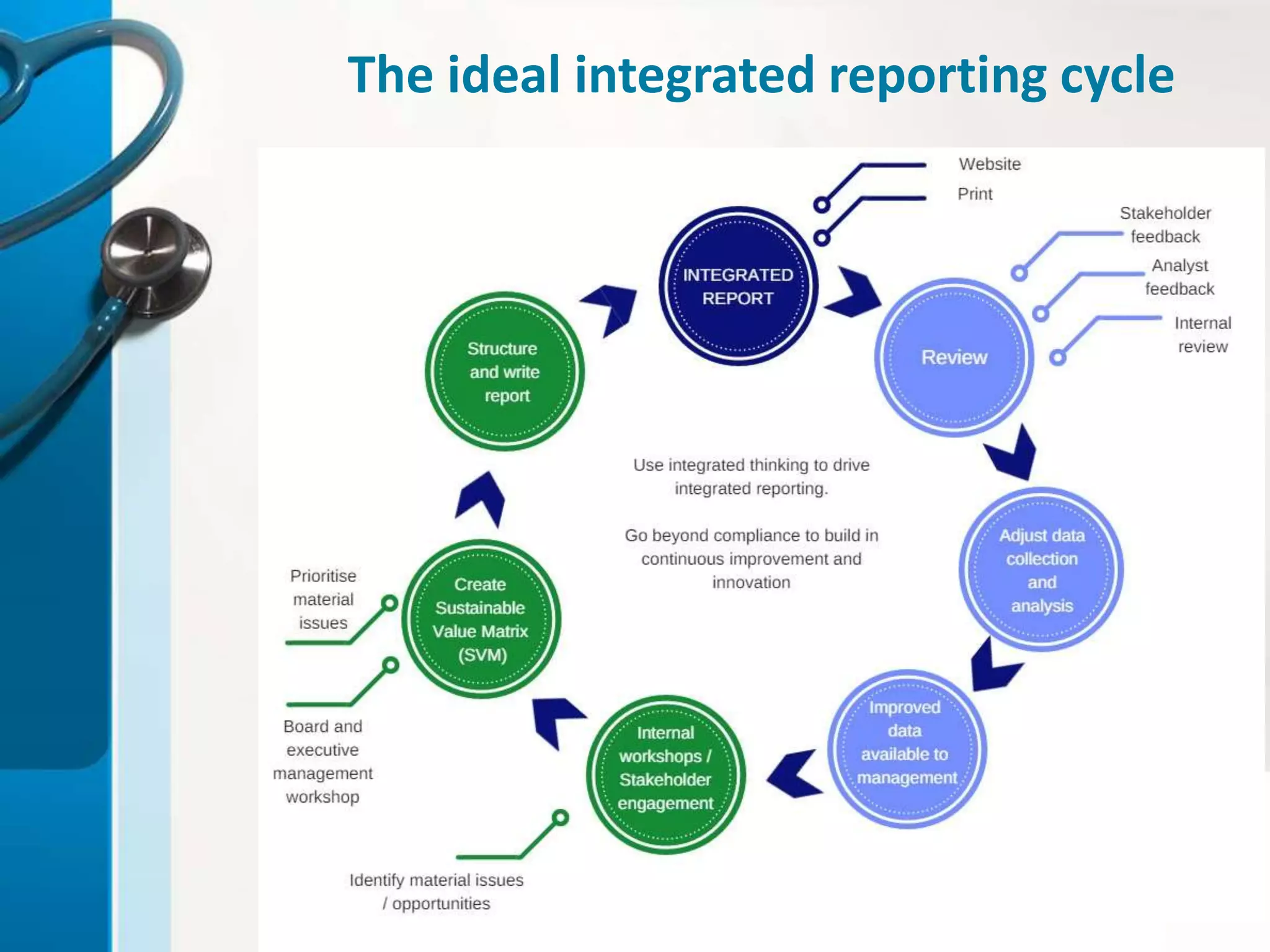
The ideal integrated reporting cycle
Materiality – knowing what counts
Business success depends on understanding, responding to and shaping the
competitive environment.
Businesses need to be attuned to diverse social, environmental, competitive
and regulatory pressures.
Yet, they must also differentiate what is material from what is ‘noise’.
Material issues are those things that could make a major
difference to an organisation’s performance
Materiality – the hidden hand
A key aspect of integrated reporting is to identify and prioritise
the company’s material issues.
Materiality can be used to uncover and evaluate business
opportunities well before competitors or disruptors.
Materiality facilitates:
• A 360 degree perspective on your business
• Understanding the breadth and depth of stakeholder opinion
• Identifying relevant issues and challenges
• Evaluating the importance of issues between different stakeholder groups, such as patients
and employees
• Weighing different issues against one another and breaking down issues into detail
• Developing an evidence trail to support decision making.
Materiality – the benefits
The endpoint of the materiality determination process is a heat map of issues
that should drive business strategy.
It illuminates not only what a business should report on, but also where
strategy needs to be responsive to changing social and environmental
circumstances.
It also provides a useful framework for stakeholder engagement efforts.
A materiality matrix will show which issues an organisation should prioritise
The six capitals
An important element of integrated thinking is the recognition and
management of the key capitals, or resources and relationships, that the
business depends on.
These capitals include:
Financial capital Social and Relationship capital
Manufactured capital Intellectual capital
Human capital Natural capital
The more that integrated thinking is embedded into an organisation’s activities,
the more naturally will the connectivity of information flow into management
reporting, analysis and decision-making.
The six capitals
Financial capital –
The pool of funds that is:
• available to an organisation for producing goods or for
providing services
• obtained through financing (such as debt, equity or grants), or
generated through operations or investments
The more that integrated thinking is embedded into an organisation’s activities,
the more naturally will the connectivity of information flow into management
reporting, analysis and decision-making.
The six capitals
Manufactured capital –
Manufactured physical objects used in producing goods or
providing services. These may be:
• buildings
• equipment
• infrastructure
The more that integrated thinking is embedded into an organisation’s activities,
the more naturally will the connectivity of information flow into management
reporting, analysis and decision-making.
The six capitals
Intellectual capital –
Organisational, knowledge-based intangibles, including:
• intellectual property, such as patents, copyrights, software,
rights and licences
• “organisational capital” such as tacit knowledge, systems,
procedures and protocols
The more that integrated thinking is embedded into an organisation’s activities,
the more naturally will the connectivity of information flow into management
reporting, analysis and decision-making.
The six capitals
Human capital –
People’s competencies, capabilities and experience, and their
motivations to innovate, including their:
• alignment with an organisation’s governance framework, risk
management approach, and ethical values
• ability to understand, develop and implement an organisation’s
strategy
• loyalties and motivations for improving processes, goods and
services, ability to lead, manage and collaborate
The more that integrated thinking is embedded into an organisation’s activities,
the more naturally will the connectivity of information flow into management
reporting, analysis and decision-making.
The six capitals
Social and relationship capital –
The institutions and the relationships within and between
communities, groups of stakeholders and other networks, and the
ability to share information to enhance individual and collective well-
being. Social and relationship capital includes:
• shared norms, values and behaviours with key stakeholders
• willing engagements with external stakeholders
• intangibles associated with the brand and reputation
• an organisation’s social licence to operate
The more that integrated thinking is embedded into an organisation’s activities,
the more naturally will the connectivity of information flow into management
reporting, analysis and decision-making.
The six capitals
Natural capital –
All renewable and non-renewable environmental resources and
processes that provide goods or services. It includes:
• air, water, land, minerals and forests
• biodiversity and eco-system health
The more that integrated thinking is embedded into an organisation’s activities,
the more naturally will the connectivity of information flow into management
reporting, analysis and decision-making.
The six capitals
• The capitals have an influence on each other.
• At times the organisation needs to trade-off between capitals.
For example, an investment in staff training could deplete financial capital but enhance the
human capital available to the business.
Not all capitals are equally relevant or applicable to all organisations.
The integrated business model
A graphic showing the various factors (both internal and external) involved in the
value creation process of an organisation.
The business model
• Shows the various business inputs in the form of relevant capitals.
• Shows the outputs generated by the business, which may be products or services.
• Includes outcomes in the form of the effects on the capitals. These can be positive or
negative.
Business model reporting is an opportunity to demonstrate
an understanding of the organisation, its dependencies,
and how it might need to adapt in the future.
The business model
Considering inputs, outputs and outcomes helps to clarify the company’s
positive and negative impacts, while also deepening its understanding of how
it creates value.
If offers insight into how the business can respond to input or external
environmental changes.
Business model reporting is an opportunity to demonstrate
an understanding of the organisation, its dependencies,
and how it might need to adapt in the future.
Beyond compliance –
The value of integrated reporting
An integrated report should be a powerful strategic tool that helps a company
to:
• articulate its vision, targets and achievements
• refocus its efforts and activities
• connect departments and broaden perspectives
• provide enhanced information for decision-making
• engage with relevant stakeholders only.

Lenmed "Why integrated thinking?" presentation

  • 1.
    Why integrated thinking? Presentationto Lenmed’s Board of Directors By Clive Lotter
  • 2.
    Why integrated reporting? Financialreporting tells only a part of an organisation’s story and value creation. Integrated reporting places an organisation’s performance and strategy within the context of its social and environmental issues. An INTEGRATED REPORT is a concise communication about how an organisation's strategy, governance, performance and prospects lead to the creation of value over the short, medium and long term.
  • 3.
    Why integrated thinking? •Today’s businesses operate in a fast changing and complex world • Internal and external factors, interdependencies and trade-offs must be considered when making decisions. • The board and management need holistic data to make informed decisions within this reality. • What is needed is integrated thinking. INTEGRATED THINKING promotes a more holistic assessment to grow better businesses and better societies.
  • 4.
    Why integrated thinking? Lenmedis now into the second year of the journey to bring its annual integrated report into line with current best reporting practices. The 2016 report should be a management tool for introducing “integrated thinking” throughout Lenmed. Integrated thinking will enable Lenmed to: • evaluate risks and opportunities realistically • respond quickly to changing trends or situations.
  • 5.
    Some key driversof integrated thinking • the complexity of business • changing business circumstances that require a nimble strategy • a need to enhance risk management • enlightened leadership, board and/or executive management • Meaningful communication with stakeholders
  • 6.
    The benefits ofintegrated thinking • Improves risk identification and management • Raises the quality of information presented to boards, investors and stakeholders • Supports strategising and resource allocation for short, medium and long term objectives • Improves internal cohesion and cooperation • Enables KPIs to be developed for goal setting and efficiency drives.
  • 7.
    The benefits ofintegrated thinking • Material and concise information (Better, not more, reporting) • Breaking down internal silos • Trust gained from investors and stakeholders through transparent reporting • Breakthroughs in understanding value creation • Robust monitoring of issues and trends • Improving what is measured • Enhanced information available for decision-making
  • 8.
    The ideal integratedreporting cycle
  • 9.
    Materiality – knowingwhat counts Business success depends on understanding, responding to and shaping the competitive environment. Businesses need to be attuned to diverse social, environmental, competitive and regulatory pressures. Yet, they must also differentiate what is material from what is ‘noise’. Material issues are those things that could make a major difference to an organisation’s performance
  • 10.
    Materiality – thehidden hand A key aspect of integrated reporting is to identify and prioritise the company’s material issues. Materiality can be used to uncover and evaluate business opportunities well before competitors or disruptors.
  • 11.
    Materiality facilitates: • A360 degree perspective on your business • Understanding the breadth and depth of stakeholder opinion • Identifying relevant issues and challenges • Evaluating the importance of issues between different stakeholder groups, such as patients and employees • Weighing different issues against one another and breaking down issues into detail • Developing an evidence trail to support decision making.
  • 12.
    Materiality – thebenefits The endpoint of the materiality determination process is a heat map of issues that should drive business strategy. It illuminates not only what a business should report on, but also where strategy needs to be responsive to changing social and environmental circumstances. It also provides a useful framework for stakeholder engagement efforts. A materiality matrix will show which issues an organisation should prioritise
  • 13.
    The six capitals Animportant element of integrated thinking is the recognition and management of the key capitals, or resources and relationships, that the business depends on. These capitals include: Financial capital Social and Relationship capital Manufactured capital Intellectual capital Human capital Natural capital The more that integrated thinking is embedded into an organisation’s activities, the more naturally will the connectivity of information flow into management reporting, analysis and decision-making.
  • 14.
    The six capitals Financialcapital – The pool of funds that is: • available to an organisation for producing goods or for providing services • obtained through financing (such as debt, equity or grants), or generated through operations or investments The more that integrated thinking is embedded into an organisation’s activities, the more naturally will the connectivity of information flow into management reporting, analysis and decision-making.
  • 15.
    The six capitals Manufacturedcapital – Manufactured physical objects used in producing goods or providing services. These may be: • buildings • equipment • infrastructure The more that integrated thinking is embedded into an organisation’s activities, the more naturally will the connectivity of information flow into management reporting, analysis and decision-making.
  • 16.
    The six capitals Intellectualcapital – Organisational, knowledge-based intangibles, including: • intellectual property, such as patents, copyrights, software, rights and licences • “organisational capital” such as tacit knowledge, systems, procedures and protocols The more that integrated thinking is embedded into an organisation’s activities, the more naturally will the connectivity of information flow into management reporting, analysis and decision-making.
  • 17.
    The six capitals Humancapital – People’s competencies, capabilities and experience, and their motivations to innovate, including their: • alignment with an organisation’s governance framework, risk management approach, and ethical values • ability to understand, develop and implement an organisation’s strategy • loyalties and motivations for improving processes, goods and services, ability to lead, manage and collaborate The more that integrated thinking is embedded into an organisation’s activities, the more naturally will the connectivity of information flow into management reporting, analysis and decision-making.
  • 18.
    The six capitals Socialand relationship capital – The institutions and the relationships within and between communities, groups of stakeholders and other networks, and the ability to share information to enhance individual and collective well- being. Social and relationship capital includes: • shared norms, values and behaviours with key stakeholders • willing engagements with external stakeholders • intangibles associated with the brand and reputation • an organisation’s social licence to operate The more that integrated thinking is embedded into an organisation’s activities, the more naturally will the connectivity of information flow into management reporting, analysis and decision-making.
  • 19.
    The six capitals Naturalcapital – All renewable and non-renewable environmental resources and processes that provide goods or services. It includes: • air, water, land, minerals and forests • biodiversity and eco-system health The more that integrated thinking is embedded into an organisation’s activities, the more naturally will the connectivity of information flow into management reporting, analysis and decision-making.
  • 20.
    The six capitals •The capitals have an influence on each other. • At times the organisation needs to trade-off between capitals. For example, an investment in staff training could deplete financial capital but enhance the human capital available to the business. Not all capitals are equally relevant or applicable to all organisations.
  • 21.
    The integrated businessmodel A graphic showing the various factors (both internal and external) involved in the value creation process of an organisation. The business model • Shows the various business inputs in the form of relevant capitals. • Shows the outputs generated by the business, which may be products or services. • Includes outcomes in the form of the effects on the capitals. These can be positive or negative. Business model reporting is an opportunity to demonstrate an understanding of the organisation, its dependencies, and how it might need to adapt in the future.
  • 22.
    The business model Consideringinputs, outputs and outcomes helps to clarify the company’s positive and negative impacts, while also deepening its understanding of how it creates value. If offers insight into how the business can respond to input or external environmental changes. Business model reporting is an opportunity to demonstrate an understanding of the organisation, its dependencies, and how it might need to adapt in the future.
  • 24.
    Beyond compliance – Thevalue of integrated reporting An integrated report should be a powerful strategic tool that helps a company to: • articulate its vision, targets and achievements • refocus its efforts and activities • connect departments and broaden perspectives • provide enhanced information for decision-making • engage with relevant stakeholders only.