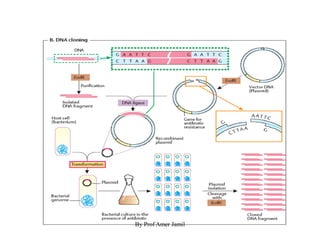
How to construct a recombinant
DNA molecule?
• DNA/RNA isolation
• Gene isolation by PCR/RT-PCR
• Or Cutting of DNA molecule with the help of
restriction enzymes
• Transfer of DNA molecule into a suitable vector
with the help of DNA ligases
Transformation of recombinant molecule into
suitable host like E. coli
• Production of large number of copies of the
recombinant molecule in the host
• Checking the gene expression
By Prof Amer Jamil
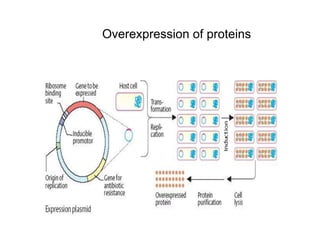
Overexpression of proteins
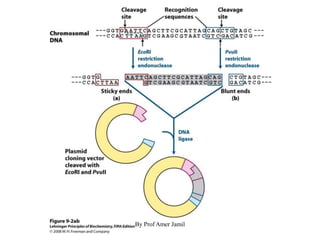
• TYPE I: Restrict away from recognition
site (~1000 bp away)
•TYPE II: Restrict within recognition site
•TYPE III: Restrict away from recognition
site (~26 bp away)
Restriction endonucleases
• Also called restriction enzymes
• Occur naturally in bacteria
• Hundreds are purified and available commercially
• Named for bacterial genus, species, strain, and type
Example: EcoRI
Genus: Escherichia
Species: coli
Strain: R
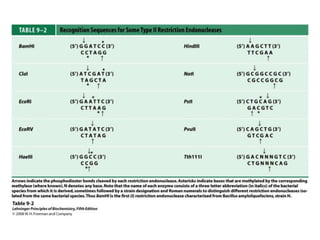
Type II Restriction endonucleases
4-7
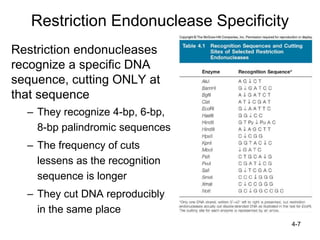
Restriction Endonuclease Specificity
Restriction endonucleases
recognize a specific DNA
sequence, cutting ONLY at
that sequence
– They recognize 4-bp, 6-bp,
8-bp palindromic sequences
– The frequency of cuts
lessens as the recognition
sequence is longer
– They cut DNA reproducibly
in the same place
4-8
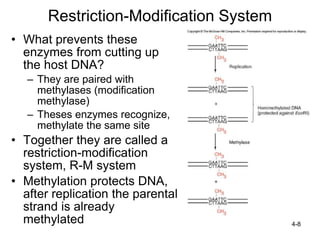
Restriction-Modification System
• What prevents these
enzymes from cutting up
the host DNA?
– They are paired with
methylases (modification
methylase)
– Theses enzymes recognize,
methylate the same site
• Together they are called a
restriction-modification
system, R-M system
• Methylation protects DNA,
after replication the parental
strand is already
methylated
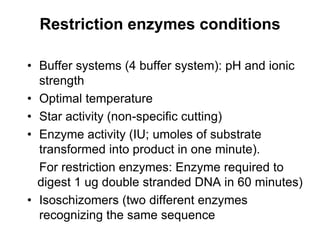
Restriction enzymes conditions
• Buffer systems (4 buffer system): pH and ionic
strength
• Optimal temperature
• Star activity (non-specific cutting)
• Enzyme activity (IU; umoles of substrate
transformed into product in one minute).
For restriction enzymes: Enzyme required to
digest 1 ug double stranded DNA in 60 minutes)
• Isoschizomers (two different enzymes
recognizing the same sequence
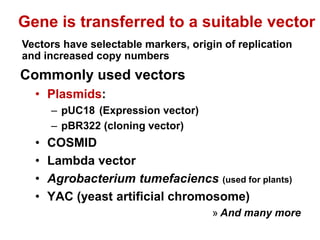
Gene is transferred to a suitable vector
• Plasmids:
– pUC18 (Expression vector)
– pBR322 (cloning vector)
• COSMID
• Lambda vector
• Agrobacterium tumefaciencs (used for plants)
• YAC (yeast artificial chromosome)
» And many more
Commonly used vectors
Vectors have selectable markers, origin of replication
and increased copy numbers
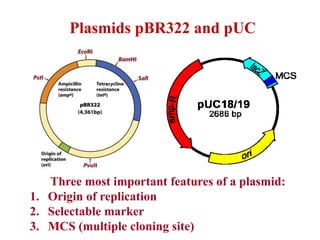
Plasmids pBR322 and pUC
Three most important features of a plasmid:
1. Origin of replication
2. Selectable marker
3. MCS (multiple cloning site)
By Prof Amer Jamil
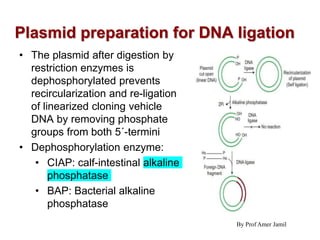
Plasmid preparation for DNA ligation
• The plasmid after digestion by
restriction enzymes is
dephosphorylated prevents
recircularization and re-ligation
of linearized cloning vehicle
DNA by removing phosphate
groups from both 5´-termini
• Dephosphorylation enzyme:
• CIAP: calf-intestinal alkaline
phosphatase
• BAP: Bacterial alkaline
phosphatase
By Prof Amer Jamil
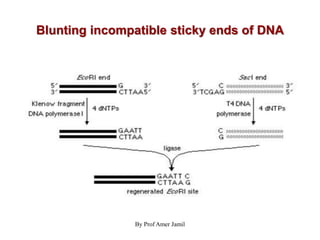
Blunting incompatible sticky ends of DNA
By Prof Amer Jamil
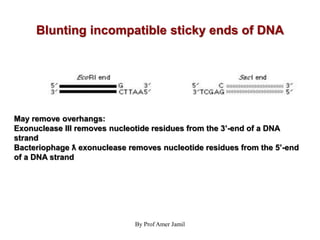
Blunting incompatible sticky ends of DNA
By Prof Amer Jamil
May remove overhangs:
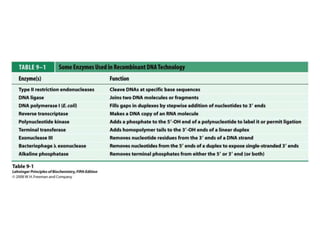
Exonuclease III removes nucleotide residues from the 3’-end of a DNA
strand
Bacteriophage ƛ exonuclease removes nucleotide residues from the 5’-end
of a DNA strand
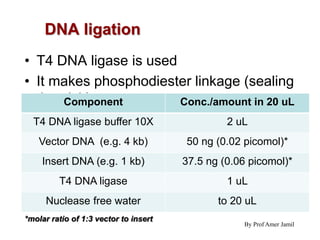
DNA ligation
• T4 DNA ligase is used
• It makes phosphodiester linkage (sealing
the nick)
By Prof Amer Jamil
Component Conc./amount in 20 uL
T4 DNA ligase buffer 10X 2 uL
Vector DNA (e.g. 4 kb) 50 ng (0.02 picomol)*
Insert DNA (e.g. 1 kb) 37.5 ng (0.06 picomol)*
T4 DNA ligase 1 uL
Nuclease free water to 20 uL
*molar ratio of 1:3 vector to insert
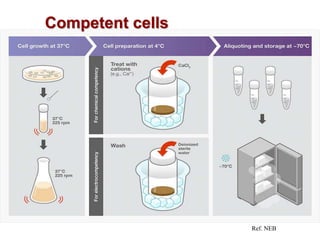
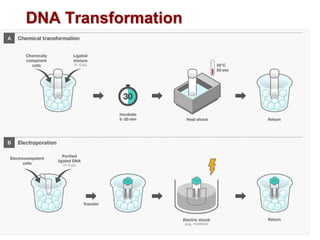
•Heat shock or Electroporation
•Competent cells: E. coli
By Prof Amer Jamil
DNA Transformation
Ref. NEB
Competent cells
DNA Transformation
DNA Transformation
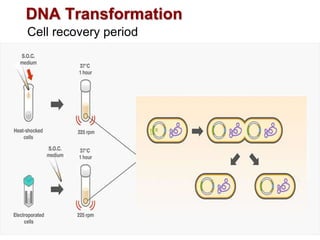
Cell recovery period
DNA Transformation
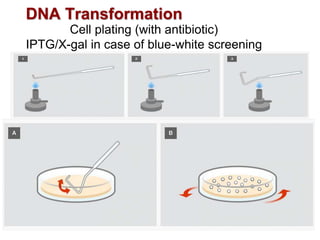
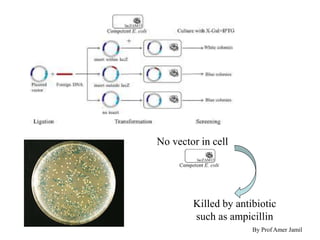
Cell plating (with antibiotic)
IPTG/X-gal in case of blue-white screening
Growth on Agar plates
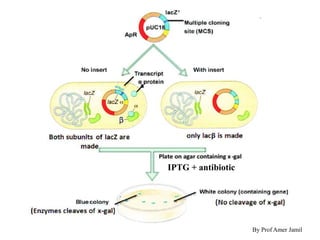
 Blue colonies represent Ampicillin-resistant
bacteria that contain Vector and express a
functional fragment, (beta galactosidase) from
an intact LacZ coding sequence.
betagalactosidaze+x-gal= blue coloured product
White colonies represent Ampicillin-resistant
bacteria that contain Insert and do not produce
LacZ, fragment.
• IPTG: Inducer of LacZ
• X-gal: Analogue of Lactose
Selection of recombinant clones
(blue-white screening)
lac operon control
A part of lacZ gene is in
vector, and other part in
chromosomal DNA
Substrate: X-gal (dye)
(5-bromo-4-chloro-3-indolyl-β-D-galactopyranoside)
Inducer: IPTG
(Isopropyl β-D-1-thiogalactopyranoside)
By Prof Amer Jamil
Killed by antibiotic
such as ampicillin
No vector in cell
By Prof Amer Jamil
By Prof Amer Jamil
IPTG + antibiotic
By Prof Amer Jamil

4. 618 Restriction Enzymes and Vectors.ppt

  • 1.
    How to constructa recombinant DNA molecule? • DNA/RNA isolation • Gene isolation by PCR/RT-PCR • Or Cutting of DNA molecule with the help of restriction enzymes • Transfer of DNA molecule into a suitable vector with the help of DNA ligases Transformation of recombinant molecule into suitable host like E. coli • Production of large number of copies of the recombinant molecule in the host • Checking the gene expression
  • 2.
  • 3.
  • 5.
    • TYPE I:Restrict away from recognition site (~1000 bp away) •TYPE II: Restrict within recognition site •TYPE III: Restrict away from recognition site (~26 bp away) Restriction endonucleases
  • 6.
    • Also calledrestriction enzymes • Occur naturally in bacteria • Hundreds are purified and available commercially • Named for bacterial genus, species, strain, and type Example: EcoRI Genus: Escherichia Species: coli Strain: R Type II Restriction endonucleases
  • 7.
    4-7 Restriction Endonuclease Specificity Restrictionendonucleases recognize a specific DNA sequence, cutting ONLY at that sequence – They recognize 4-bp, 6-bp, 8-bp palindromic sequences – The frequency of cuts lessens as the recognition sequence is longer – They cut DNA reproducibly in the same place
  • 8.
    4-8 Restriction-Modification System • Whatprevents these enzymes from cutting up the host DNA? – They are paired with methylases (modification methylase) – Theses enzymes recognize, methylate the same site • Together they are called a restriction-modification system, R-M system • Methylation protects DNA, after replication the parental strand is already methylated
  • 9.
    Restriction enzymes conditions •Buffer systems (4 buffer system): pH and ionic strength • Optimal temperature • Star activity (non-specific cutting) • Enzyme activity (IU; umoles of substrate transformed into product in one minute). For restriction enzymes: Enzyme required to digest 1 ug double stranded DNA in 60 minutes) • Isoschizomers (two different enzymes recognizing the same sequence
  • 11.
    Gene is transferredto a suitable vector • Plasmids: – pUC18 (Expression vector) – pBR322 (cloning vector) • COSMID • Lambda vector • Agrobacterium tumefaciencs (used for plants) • YAC (yeast artificial chromosome) » And many more Commonly used vectors Vectors have selectable markers, origin of replication and increased copy numbers
  • 12.
    Plasmids pBR322 andpUC Three most important features of a plasmid: 1. Origin of replication 2. Selectable marker 3. MCS (multiple cloning site)
  • 13.
  • 14.
    Plasmid preparation forDNA ligation • The plasmid after digestion by restriction enzymes is dephosphorylated prevents recircularization and re-ligation of linearized cloning vehicle DNA by removing phosphate groups from both 5´-termini • Dephosphorylation enzyme: • CIAP: calf-intestinal alkaline phosphatase • BAP: Bacterial alkaline phosphatase By Prof Amer Jamil
  • 15.
    Blunting incompatible stickyends of DNA By Prof Amer Jamil
  • 16.
    Blunting incompatible stickyends of DNA By Prof Amer Jamil May remove overhangs: Exonuclease III removes nucleotide residues from the 3’-end of a DNA strand Bacteriophage ƛ exonuclease removes nucleotide residues from the 5’-end of a DNA strand
  • 17.
    DNA ligation • T4DNA ligase is used • It makes phosphodiester linkage (sealing the nick) By Prof Amer Jamil Component Conc./amount in 20 uL T4 DNA ligase buffer 10X 2 uL Vector DNA (e.g. 4 kb) 50 ng (0.02 picomol)* Insert DNA (e.g. 1 kb) 37.5 ng (0.06 picomol)* T4 DNA ligase 1 uL Nuclease free water to 20 uL *molar ratio of 1:3 vector to insert
  • 18.
    •Heat shock orElectroporation •Competent cells: E. coli By Prof Amer Jamil DNA Transformation
  • 19.
  • 20.
  • 21.
  • 22.
    DNA Transformation Cell plating(with antibiotic) IPTG/X-gal in case of blue-white screening
  • 23.
    Growth on Agarplates  Blue colonies represent Ampicillin-resistant bacteria that contain Vector and express a functional fragment, (beta galactosidase) from an intact LacZ coding sequence. betagalactosidaze+x-gal= blue coloured product White colonies represent Ampicillin-resistant bacteria that contain Insert and do not produce LacZ, fragment. • IPTG: Inducer of LacZ • X-gal: Analogue of Lactose
  • 24.
    Selection of recombinantclones (blue-white screening) lac operon control A part of lacZ gene is in vector, and other part in chromosomal DNA Substrate: X-gal (dye) (5-bromo-4-chloro-3-indolyl-β-D-galactopyranoside) Inducer: IPTG (Isopropyl β-D-1-thiogalactopyranoside) By Prof Amer Jamil
  • 25.
    Killed by antibiotic suchas ampicillin No vector in cell By Prof Amer Jamil
  • 26.
    By Prof AmerJamil IPTG + antibiotic By Prof Amer Jamil