

Cryptosporidium monitoring of
       Ireland's waters


        Theo de Waal
       UCD School of Veterinary Medicine   Scoil Leighis Tréidliachta UCD


                                                                            1
Outline

 • Introduction
 • What is Cryptosporidium
 • How is it spread
 • Cryptosporidium in humans
 • Cryptosporidium in surface water
 • National reference laboratory
 • Survey of Irish water supplies


                                      2
Introduction

 • Cryptosporidium first described in 1907 Tyzzer
    – C. muris
 • Only associated with disease and death in 1955
   in Turkeys
    – C. meleagridis
 • In early 1970’s first reported of its association
   with diarrhoea in cattle
 • In 1976 first two human case described
    – 3-year-old child
    – 39-year old immunosuppressed patient
 • Today Cryptosporidium one of the most
   commonly identified intestinal pathogens
                                                       3
What is Cryptosporidium?

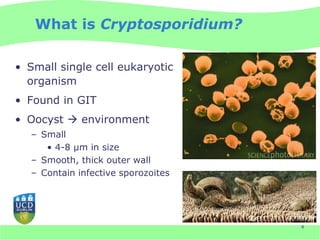
• Small single cell eukaryotic
  organism
• Found in GIT
• Oocyst  environment
   – Small
      • 4-8 µm in size
   – Smooth, thick outer wall
   – Contain infective sporozoites


                                     4
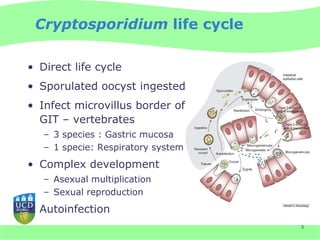
Cryptosporidium life cycle

• Direct life cycle
• Sporulated oocyst ingested
• Infect microvillus border of
  GIT – vertebrates
   – 3 species : Gastric mucosa
   – 1 specie: Respiratory system
• Complex development
   – Asexual multiplication
   – Sexual reproduction
• Autoinfection
                                    5
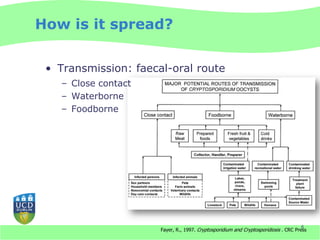
How is it spread?


 • Transmission: faecal-oral route
   – Close contact
   – Waterborne
   – Foodborne


                                                                                     6
                      Fayer, R., 1997. Cryptosporidium and Cryptosporidiosis . CRC Press
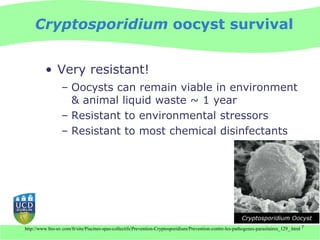
Cryptosporidium oocyst survival


          • Very resistant!
                  – Oocysts can remain viable in environment
                    & animal liquid waste ~ 1 year
                  – Resistant to environmental stressors
                  – Resistant to most chemical disinfectants


http://www.bio-uv.com/fr/site/Piscines-spas-collectifs/Prevention-Cryptosporidium/Prevention-contre-les-pathogenes-parasitaires_129_.html 7
CRYPTOSPORIDIUM IN
HUMANS
                     8
Cryptosporidium spp:

              • More than 22 recognised Cryptosporidium species
                       – 39 Cryptosporidium genotypes
              • Host specific - C. hominis to broad host range - C.
                parvum and C. ubiquitum
              • Only few considered infectious to humans
                       – Human cryptosporidiosis in Ireland1,2
                               • C. hominis (20%)
                               • C. parvum (80%)


1.   Zintl, et al, 2009, The prevalence of Cryptosporidium species and subtypes in human faecal samples in Ireland. Epidemiol. Infect. 137, 270-277.   9
2.   Graczyk, et al., 2007. Human enteropathogen load in activated sewage sludge and corresponding sewage sludge end products. Applied and Environmental
     Microbiology 73 (6):2013-2015.
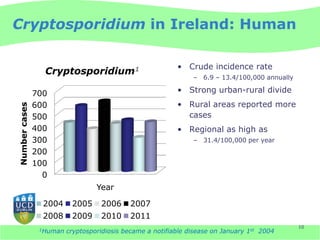
Cryptosporidium in Ireland: Human

                                                           • Crude incidence rate
                 Cryptosporidium1
                                                                – 6.9 – 13.4/100,000 annually

               700                                         • Strong urban-rural divide
               600                                         • Rural areas reported more
Number cases


               500                                           cases
               400                                         • Regional as high as
               300                                              – 31.4/100,000 per year
               200
               100
                 0
                                  Year

                 2004     2005     2006      2007
                 2008     2009     2010      2011
                                                                                                10
                1Human   cryptosporidiosis became a notifiable disease on January 1st 2004
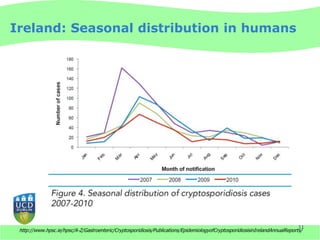
Ireland: Seasonal distribution in humans


                                                                                                                              11
 http://www.hpsc.ie/hpsc/A-Z/Gastroenteric/Cryptosporidiosis/Publications/EpidemiologyofCryptosporidiosisinIrelandAnnualReports/
CRYPTOSPORIDIUM IN
SURFACE WATER
                     12
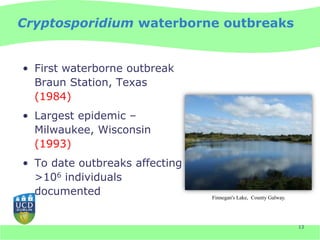
Cryptosporidium waterborne outbreaks


• First waterborne outbreak
  Braun Station, Texas
  (1984)
• Largest epidemic –
  Milwaukee, Wisconsin
  (1993)
• To date outbreaks affecting
  >106 individuals
  documented                    Finnegan's Lake, County Galway.


                                                                  13
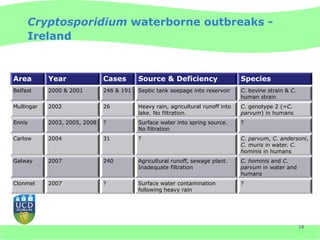
Cryptosporidium waterborne outbreaks -
     Ireland


Area        Year               Cases       Source & Deficiency                    Species
Belfast     2000 & 2001        246 & 191   Septic tank seepage into reservoir     C. bovine strain & C.
                                                                                  human strain
Mullingar   2002               26          Heavy rain, agricultural runoff into   C. genotype 2 (=C.
                                           lake. No filtration.                   parvum) in humans
Ennis       2003, 2005, 2008   ?           Surface water into spring source.      ?
                                           No filtration
Carlow      2004               31          ?                                      C. parvum, C. andersoni,
                                                                                  C. muris in water. C.
                                                                                  hominis in humans
Galway      2007               240         Agricultural runoff, sewage plant.     C. hominis and C.
                                           Inadequate filtration                  parvum in water and
                                                                                  humans
Clonmel     2007               ?           Surface water contamination            ?
                                           following heavy rain


                                                                                                          14
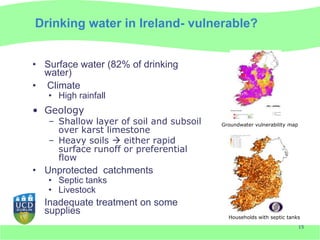
Drinking water in Ireland- vulnerable?


• Surface water (82% of drinking
  water)
• Climate
   • High rainfall
• Geology
   – Shallow layer of soil and subsoil   Groundwater vulnerability map
     over karst limestone
   – Heavy soils  either rapid
     surface runoff or preferential
     flow
• Unprotected catchments
   • Septic tanks
   • Livestock
• Inadequate treatment on some
  supplies
                                           Households with septic tanks
                                                                         15
Cryptosporidium in Ireland: Environment


                   • Several Irish studies have detected
                     Cryptosporidium species in Irish river basins1,2
                   • 2005 EPA risk assessment - Irish public water
                     supply
                             – 8% high risk
                             – 13% very high risk


                                                                                                                                                                                   16
1.   Graczyk, et al., 2004. Human waterborne parasites in zebra mussels (Dreissena polymorpha) from the Shannon River drainage area, Ireland. Para Research 93: 385-391.
2.   Lucy, et al., 2008..Biomonitoring of surface and coastal water for Cryptosporidium, Giardia and human virulent microsporidia using molluscan shellfish. Para Research 103:1369-1375
Cryptosporidium in Irish Water

 • Source of contamination and public health risk
    – Very limited information
    – No genotyping facilities in Ireland
    – Few local authorities get samples genotyped in UK


 • Survey of Cryptosporidium monitoring in
   public water supplies
    – 24.5 % supplies being monitored
       • >83% high Crypto risk score
       • Monitoring frequency low


                                                          17
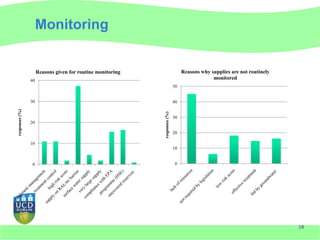
Monitoring


                     Reasons given for routine monitoring                        Reasons why supplies are not routinely
                40
                                                                                              monitored
                                                                            50


                30                                                          40
responses (%)


                                                            responses (%)
                                                                            30
                20

                                                                            20

                10
                                                                            10


                 0                                                          0


                                                                                                                          18
Development of a National Reference
Facility for Cryptosporidium: 2010

 • National survey of Irish public
   water supplies
 • Adopt best practice procedures
    – Laboratory accreditation
 • Pilot study of water supplies
 • Significance of emerging
   waterborne contaminants
 • Strategies for service delivery
   beyond project
National Reference Facility for
Cryptosporidium
 • Detection of Cryptosporidium in water
    – Based on USEPA 1622
       • Filtration
       • Immuno-magnetic separation
       • Fluorescent antibody
 • INAB Accreditation – ISO17025
    – April 2012


                                           20
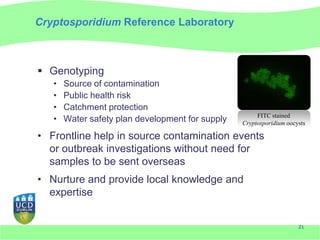
Cryptosporidium Reference Laboratory


 Genotyping
   •   Source of contamination
   •   Public health risk
   •   Catchment protection
                                                       FITC stained
   •   Water safety plan development for supply   Cryptosporidium oocysts

• Frontline help in source contamination events
  or outbreak investigations without need for
  samples to be sent overseas
• Nurture and provide local knowledge and
  expertise


                                                                      21
Pilot Scheme - 2011

 • Detection and identification of Cryptosporidium
   species in supplies on RAL
 • 5 supplies selected
 • “Type” supplies established
    – Groundwater under influence of surface water
    – Pristine upland lake
    – Spring/Borehole supply


                                                     22
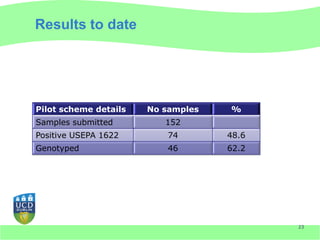
Results to date


Pilot scheme details   No samples   %
Samples submitted         152
Positive USEPA 1622        74       48.6
Genotyped                  46       62.2


                                           23
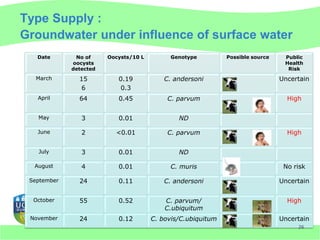
Type supply:
Groundwater under influence of surface water


     • No barrier for Cryptosporidium
     • On boil water notice
     • Previously had one sample genotyped in Scotland
        – very mixed results – up to 7 different species implicated
     • No clear idea of source of contamination/ public health
       risk


                                                                      25
Type Supply :
Groundwater under influence of surface water
   Date       No of     Oocysts/10 L         Genotype         Possible source    Public
             oocysts                                                             Health
             detected                                                             Risk
   March       15          0.19            C. andersoni                         Uncertain
                6           0.3
   April       64          0.45             C. parvum                             High


   May          3          0.01                ND

   June         2         <0.01             C. parvum                             High


   July         3          0.01                ND

  August        4          0.01              C. muris                            No risk

 September     24          0.11            C. andersoni                         Uncertain


  October      55          0.52            C. parvum/                             High
                                           C.ubiquitum
 November      24          0.12        C. bovis/C.ubiquitum                     Uncertain
                                                                                     26
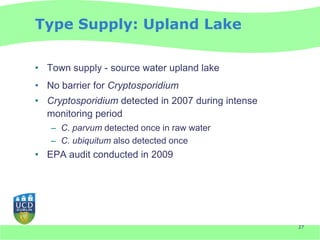
Type Supply: Upland Lake

• Town supply - source water upland lake
• No barrier for Cryptosporidium
• Cryptosporidium detected in 2007 during intense
  monitoring period
   – C. parvum detected once in raw water
   – C. ubiquitum also detected once
• EPA audit conducted in 2009


                                                    27
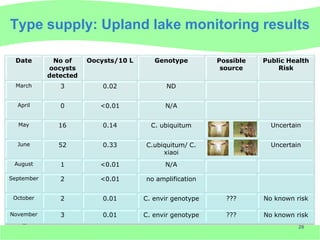
Type supply: Upland lake monitoring results

 Date        No of     Oocysts/10 L      Genotype         Possible   Public Health
            oocysts                                        source        Risk
            detected
  March        3           0.02              ND

  April        0          <0.01             N/A

  May         16           0.14         C. ubiquitum                   Uncertain


  June        52           0.33       C.ubiquitum/ C.                  Uncertain
                                           xiaoi
 August        1          <0.01             N/A

September      2          <0.01       no amplification

 October       2           0.01       C. envir genotype     ???      No known risk

November       3           0.01       C. envir genotype     ???      No known risk
                                                                               28
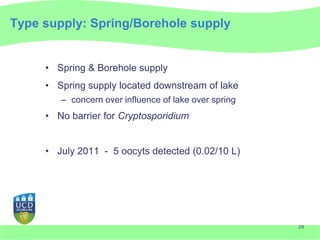
Type supply: Spring/Borehole supply


     • Spring & Borehole supply
     • Spring supply located downstream of lake
        – concern over influence of lake over spring
     • No barrier for Cryptosporidium


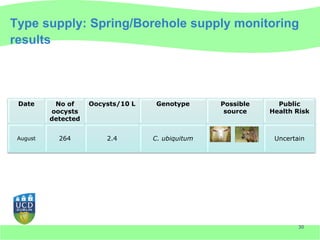
     • July 2011 - 5 oocyts detected (0.02/10 L)


                                                       29
Type supply: Spring/Borehole supply monitoring
results


 Date      No of     Oocysts/10 L    Genotype      Possible     Public
          oocysts                                   source    Health Risk
          detected


 August     264          2.4        C. ubiquitum               Uncertain


                                                                      30
SUMMARY


          31
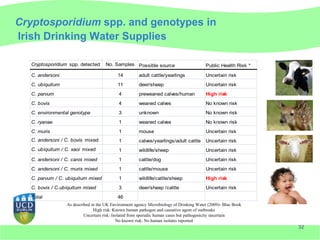
Cryptosporidium spp. and genotypes in
Irish Drinking Water Supplies

  Cryptosporidium spp. detected      No. Samples Possible source                        Public Health Risk *

  C. andersoni                             14         adult cattle/yearlings            Uncertain risk
  C. ubiquitum                             11         deer/sheep                        Uncertain risk
  C. parvum                                4          preweaned calves/human            High risk
  C. bovis                                 4          weaned calves                     No known risk
  C. environmental genotype                3          unknown                           No known risk
  C. ryanae                                1          weaned calves                     No known risk
  C. muris                                 1          mouse                             Uncertain risk
  C. andersoni / C. bovis mixed            1          calves/yearlings/adult cattle     Uncertain risk
  C. ubiquitum / C. xaoi mixed             1          wildlife/sheep                    Uncertain risk
  C. andersoni / C. canis mixed            1          cattle/dog                        Uncertain risk
  C. andersoni / C. muris mixed            1          cattle/mouse                      Uncertain risk
  C. parvum / C. ubiquitum mixed           1          wildlife/cattle/sheep             High risk
  C. bovis / C.ubiquitum mixed             3          deer/sheep /cattle                Uncertain risk
  Total                                    46
                 As described in the UK Environment agency Microbiology of Drinking Water (2009)- Blue Book
                               High risk: Known human pathogen and causative agent of outbreaks
                          Uncertain risk: Isolated from sporadic human cases but pathogenicity uncertain
                                            No known risk: No human isolates reported
                                                                                                               32
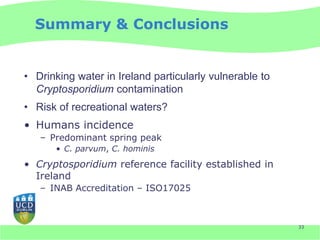
Summary & Conclusions


• Drinking water in Ireland particularly vulnerable to
  Cryptosporidium contamination
• Risk of recreational waters?
• Humans incidence
   – Predominant spring peak
       • C. parvum, C. hominis

• Cryptosporidium reference facility established in
  Ireland
   – INAB Accreditation – ISO17025


                                                         33
Acknowledgements


–   Carolyn Read
–   Jenny Pender
–   Annetta Zintl
–   Marzieh Mirhashemi


– Frances Lucy
– Declan Feeney
– Hui-Wen Cheng


                         34
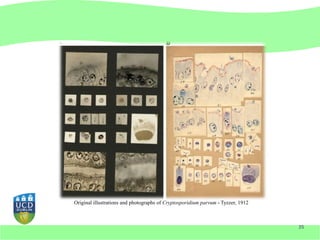
Original illustrations and photographs of Cryptosporidium parvum - Tyzzer, 1912


                                                                                  35

Cryptosporidium monitoring of Ireland's waters- Theo de Waal

  • 1.
    Cryptosporidium monitoring of Ireland's waters Theo de Waal UCD School of Veterinary Medicine Scoil Leighis Tréidliachta UCD 1
  • 2.
    Outline • Introduction • What is Cryptosporidium • How is it spread • Cryptosporidium in humans • Cryptosporidium in surface water • National reference laboratory • Survey of Irish water supplies 2
  • 3.
    Introduction • Cryptosporidiumfirst described in 1907 Tyzzer – C. muris • Only associated with disease and death in 1955 in Turkeys – C. meleagridis • In early 1970’s first reported of its association with diarrhoea in cattle • In 1976 first two human case described – 3-year-old child – 39-year old immunosuppressed patient • Today Cryptosporidium one of the most commonly identified intestinal pathogens 3
  • 4.
    What is Cryptosporidium? •Small single cell eukaryotic organism • Found in GIT • Oocyst  environment – Small • 4-8 µm in size – Smooth, thick outer wall – Contain infective sporozoites 4
  • 5.
    Cryptosporidium life cycle •Direct life cycle • Sporulated oocyst ingested • Infect microvillus border of GIT – vertebrates – 3 species : Gastric mucosa – 1 specie: Respiratory system • Complex development – Asexual multiplication – Sexual reproduction • Autoinfection 5
  • 6.
    How is itspread? • Transmission: faecal-oral route – Close contact – Waterborne – Foodborne 6 Fayer, R., 1997. Cryptosporidium and Cryptosporidiosis . CRC Press
  • 7.
    Cryptosporidium oocyst survival • Very resistant! – Oocysts can remain viable in environment & animal liquid waste ~ 1 year – Resistant to environmental stressors – Resistant to most chemical disinfectants http://www.bio-uv.com/fr/site/Piscines-spas-collectifs/Prevention-Cryptosporidium/Prevention-contre-les-pathogenes-parasitaires_129_.html 7
  • 8.
  • 9.
    Cryptosporidium spp: • More than 22 recognised Cryptosporidium species – 39 Cryptosporidium genotypes • Host specific - C. hominis to broad host range - C. parvum and C. ubiquitum • Only few considered infectious to humans – Human cryptosporidiosis in Ireland1,2 • C. hominis (20%) • C. parvum (80%) 1. Zintl, et al, 2009, The prevalence of Cryptosporidium species and subtypes in human faecal samples in Ireland. Epidemiol. Infect. 137, 270-277. 9 2. Graczyk, et al., 2007. Human enteropathogen load in activated sewage sludge and corresponding sewage sludge end products. Applied and Environmental Microbiology 73 (6):2013-2015.
  • 10.
    Cryptosporidium in Ireland:Human • Crude incidence rate Cryptosporidium1 – 6.9 – 13.4/100,000 annually 700 • Strong urban-rural divide 600 • Rural areas reported more Number cases 500 cases 400 • Regional as high as 300 – 31.4/100,000 per year 200 100 0 Year 2004 2005 2006 2007 2008 2009 2010 2011 10 1Human cryptosporidiosis became a notifiable disease on January 1st 2004
  • 11.
    Ireland: Seasonal distributionin humans 11 http://www.hpsc.ie/hpsc/A-Z/Gastroenteric/Cryptosporidiosis/Publications/EpidemiologyofCryptosporidiosisinIrelandAnnualReports/
  • 12.
  • 13.
    Cryptosporidium waterborne outbreaks •First waterborne outbreak Braun Station, Texas (1984) • Largest epidemic – Milwaukee, Wisconsin (1993) • To date outbreaks affecting >106 individuals documented Finnegan's Lake, County Galway. 13
  • 14.
    Cryptosporidium waterborne outbreaks- Ireland Area Year Cases Source & Deficiency Species Belfast 2000 & 2001 246 & 191 Septic tank seepage into reservoir C. bovine strain & C. human strain Mullingar 2002 26 Heavy rain, agricultural runoff into C. genotype 2 (=C. lake. No filtration. parvum) in humans Ennis 2003, 2005, 2008 ? Surface water into spring source. ? No filtration Carlow 2004 31 ? C. parvum, C. andersoni, C. muris in water. C. hominis in humans Galway 2007 240 Agricultural runoff, sewage plant. C. hominis and C. Inadequate filtration parvum in water and humans Clonmel 2007 ? Surface water contamination ? following heavy rain 14
  • 15.
    Drinking water inIreland- vulnerable? • Surface water (82% of drinking water) • Climate • High rainfall • Geology – Shallow layer of soil and subsoil Groundwater vulnerability map over karst limestone – Heavy soils  either rapid surface runoff or preferential flow • Unprotected catchments • Septic tanks • Livestock • Inadequate treatment on some supplies Households with septic tanks 15
  • 16.
    Cryptosporidium in Ireland:Environment • Several Irish studies have detected Cryptosporidium species in Irish river basins1,2 • 2005 EPA risk assessment - Irish public water supply – 8% high risk – 13% very high risk 16 1. Graczyk, et al., 2004. Human waterborne parasites in zebra mussels (Dreissena polymorpha) from the Shannon River drainage area, Ireland. Para Research 93: 385-391. 2. Lucy, et al., 2008..Biomonitoring of surface and coastal water for Cryptosporidium, Giardia and human virulent microsporidia using molluscan shellfish. Para Research 103:1369-1375
  • 17.
    Cryptosporidium in IrishWater • Source of contamination and public health risk – Very limited information – No genotyping facilities in Ireland – Few local authorities get samples genotyped in UK • Survey of Cryptosporidium monitoring in public water supplies – 24.5 % supplies being monitored • >83% high Crypto risk score • Monitoring frequency low 17
  • 18.
    Monitoring Reasons given for routine monitoring Reasons why supplies are not routinely 40 monitored 50 30 40 responses (%) responses (%) 30 20 20 10 10 0 0 18
  • 19.
    Development of aNational Reference Facility for Cryptosporidium: 2010 • National survey of Irish public water supplies • Adopt best practice procedures – Laboratory accreditation • Pilot study of water supplies • Significance of emerging waterborne contaminants • Strategies for service delivery beyond project
  • 20.
    National Reference Facilityfor Cryptosporidium • Detection of Cryptosporidium in water – Based on USEPA 1622 • Filtration • Immuno-magnetic separation • Fluorescent antibody • INAB Accreditation – ISO17025 – April 2012 20
  • 21.
    Cryptosporidium Reference Laboratory Genotyping • Source of contamination • Public health risk • Catchment protection FITC stained • Water safety plan development for supply Cryptosporidium oocysts • Frontline help in source contamination events or outbreak investigations without need for samples to be sent overseas • Nurture and provide local knowledge and expertise 21
  • 22.
    Pilot Scheme -2011 • Detection and identification of Cryptosporidium species in supplies on RAL • 5 supplies selected • “Type” supplies established – Groundwater under influence of surface water – Pristine upland lake – Spring/Borehole supply 22
  • 23.
    Results to date Pilotscheme details No samples % Samples submitted 152 Positive USEPA 1622 74 48.6 Genotyped 46 62.2 23
  • 24.
    Type supply: Groundwater underinfluence of surface water • No barrier for Cryptosporidium • On boil water notice • Previously had one sample genotyped in Scotland – very mixed results – up to 7 different species implicated • No clear idea of source of contamination/ public health risk 25
  • 25.
    Type Supply : Groundwaterunder influence of surface water Date No of Oocysts/10 L Genotype Possible source Public oocysts Health detected Risk March 15 0.19 C. andersoni Uncertain 6 0.3 April 64 0.45 C. parvum High May 3 0.01 ND June 2 <0.01 C. parvum High July 3 0.01 ND August 4 0.01 C. muris No risk September 24 0.11 C. andersoni Uncertain October 55 0.52 C. parvum/ High C.ubiquitum November 24 0.12 C. bovis/C.ubiquitum Uncertain 26
  • 26.
    Type Supply: UplandLake • Town supply - source water upland lake • No barrier for Cryptosporidium • Cryptosporidium detected in 2007 during intense monitoring period – C. parvum detected once in raw water – C. ubiquitum also detected once • EPA audit conducted in 2009 27
  • 27.
    Type supply: Uplandlake monitoring results Date No of Oocysts/10 L Genotype Possible Public Health oocysts source Risk detected March 3 0.02 ND April 0 <0.01 N/A May 16 0.14 C. ubiquitum Uncertain June 52 0.33 C.ubiquitum/ C. Uncertain xiaoi August 1 <0.01 N/A September 2 <0.01 no amplification October 2 0.01 C. envir genotype ??? No known risk November 3 0.01 C. envir genotype ??? No known risk 28
  • 28.
    Type supply: Spring/Boreholesupply • Spring & Borehole supply • Spring supply located downstream of lake – concern over influence of lake over spring • No barrier for Cryptosporidium • July 2011 - 5 oocyts detected (0.02/10 L) 29
  • 29.
    Type supply: Spring/Boreholesupply monitoring results Date No of Oocysts/10 L Genotype Possible Public oocysts source Health Risk detected August 264 2.4 C. ubiquitum Uncertain 30
  • 30.
  • 31.
    Cryptosporidium spp. andgenotypes in Irish Drinking Water Supplies Cryptosporidium spp. detected No. Samples Possible source Public Health Risk * C. andersoni 14 adult cattle/yearlings Uncertain risk C. ubiquitum 11 deer/sheep Uncertain risk C. parvum 4 preweaned calves/human High risk C. bovis 4 weaned calves No known risk C. environmental genotype 3 unknown No known risk C. ryanae 1 weaned calves No known risk C. muris 1 mouse Uncertain risk C. andersoni / C. bovis mixed 1 calves/yearlings/adult cattle Uncertain risk C. ubiquitum / C. xaoi mixed 1 wildlife/sheep Uncertain risk C. andersoni / C. canis mixed 1 cattle/dog Uncertain risk C. andersoni / C. muris mixed 1 cattle/mouse Uncertain risk C. parvum / C. ubiquitum mixed 1 wildlife/cattle/sheep High risk C. bovis / C.ubiquitum mixed 3 deer/sheep /cattle Uncertain risk Total 46 As described in the UK Environment agency Microbiology of Drinking Water (2009)- Blue Book High risk: Known human pathogen and causative agent of outbreaks Uncertain risk: Isolated from sporadic human cases but pathogenicity uncertain No known risk: No human isolates reported 32
  • 32.
    Summary & Conclusions •Drinking water in Ireland particularly vulnerable to Cryptosporidium contamination • Risk of recreational waters? • Humans incidence – Predominant spring peak • C. parvum, C. hominis • Cryptosporidium reference facility established in Ireland – INAB Accreditation – ISO17025 33
  • 33.
    Acknowledgements – Carolyn Read – Jenny Pender – Annetta Zintl – Marzieh Mirhashemi – Frances Lucy – Declan Feeney – Hui-Wen Cheng 34
  • 34.
    Original illustrations andphotographs of Cryptosporidium parvum - Tyzzer, 1912 35

Editor's Notes

  • #4 Tyzzer described parasite in gastic mucosa of common mice. Named the parasite in 1910 as Cryptosporidium muris. Later in 1912 described C. parvum from small intestine of experimentally infected mouse
  • #6 Cryptosporidium galliChicken (Gallus gallus)Gastric (proventriculus)Cryptosporidium andersoniCattle (Bostaurus)Gastric (Abomasum)Cryptosporidium murisMouse (Musmusculus)Gastric
  • #7 Also airborne route described – importance?
  • #8 Symptomatic treatment of the diarrhea by administering plenty of fluids to prevent dehydration is the primary management. A new drug, Nitazoxanide has been approved for the treatment of cryptosporidiosis.
  • #10 Cryptosporidium ryanae from calves, identified as the Cryptosporidium deer-like genotype