
Download to read offline
![Modeling vulnerable plaque – an underestimated challenge
Analysis of coronary artery
disease at end-stage
plq
hge
plq
eros’n
plq
fissure
plq
thombosis occlus’n
Pigeon: Carneau, Show Racer
* aortic root
nr + nr nr +
Monkey: a. Cynomolgus
b. African green
c. Rhesus
+
+
nr
nr
nr
nr
nr
nr
nr
nr
nr
nr
+
+
Pig: a. thiouracil + xrad’n
b. FHC: hyperLDL-emia
+
+
nr
nr
+
nr
some
some
+
+
Rabbit: WatanabeHHL
* coronary ostia
nr nr nr nr +
Mouse: ApoE/LDLr knockout nr nr nr nr +
Rat: Tg53 rat model + + + + +
[nr, not reported; +, present]](https://image.slidesharecdn.com/p8gzd9kpquhu9d67e6tv-signature-6e63990e10c0bcd3daf12443c0de4caa0159c96ca59ba0b2d839381c56f66acb-poli-160907160311/85/3rd-vp-symposium-herrera-4-320.jpg)
![Elements of a “promising model”
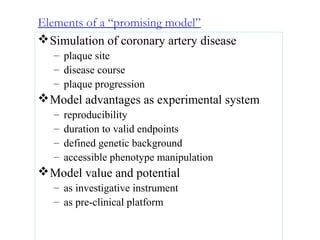
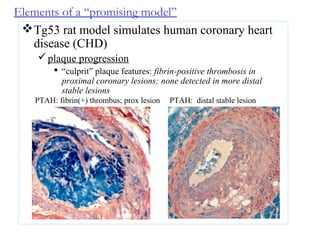
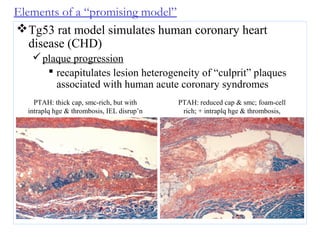
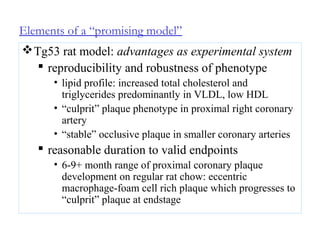
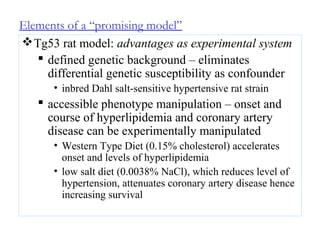
Tg53 rat model simulates human coronary heart
disease (CHD)
plaque site
plaque predilection site = coronary arteries
in contrast to: aortic root plaque predilection site in
mouse models described to date
Tg53 end-stage
plaques in proximal
right coronary artery
[PTAH stain, 40x
original mag]
RV
Ao](https://image.slidesharecdn.com/p8gzd9kpquhu9d67e6tv-signature-6e63990e10c0bcd3daf12443c0de4caa0159c96ca59ba0b2d839381c56f66acb-poli-160907160311/85/3rd-vp-symposium-herrera-6-320.jpg)
![Elements of a “promising model”
Tg53 rat model simulates human coronary heart
disease (CHD)
disease course
decreased survival compared with non-transgenic –
non-hyperlipidemic, hypertensive, Dahl S rat
controls on regular rat chow [Nat Med 5: 383, 1999; Mol
Med 7:831, 2001].
“end-stage” simulates cardiac endpoints of CHD
• (+) cardio-respiratory distress
• (+) signs of heart failure](https://image.slidesharecdn.com/p8gzd9kpquhu9d67e6tv-signature-6e63990e10c0bcd3daf12443c0de4caa0159c96ca59ba0b2d839381c56f66acb-poli-160907160311/85/3rd-vp-symposium-herrera-8-320.jpg)

The document discusses the potential of the Tg53 rat model for modeling human coronary artery disease and vulnerable plaques. Some key points: 1) The Tg53 rat model replicates important aspects of human coronary artery disease, including plaque location in the coronary arteries, disease risk factors, and progression to end-stage "culprit" plaques similar to those that cause heart attacks. 2) The model has advantages for experimental studies like reproducibility of phenotypes, defined genetic background, and ability to manipulate risk factors. 3) The model shows potential for investigating mechanisms of plaque development, testing novel interventions, and combining with other models like hypertension or diabetes to study disease interactions.


