HOSSEIN EFTEKHARI,MD
 VULNERABLE PLAQUE
 ANIMAL MODELS
 PERCUTANEOUS CORONARY
INTERVENTION
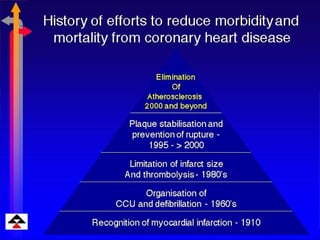
AT THE BEGINNING OF
20thCENTRY,CVD ACCOUNTED FOR
LESS THAN 10 PERCENT OF ALL
DEATHS WORLD WIDE.AT IT’S
END,CVD ACCOUNTED FOR NEARLY
HALF OF ALL DEATH IN DEVELOPED
COUNTRIES.BY 2020,CVD WILL CLAIM
25 MILLION DEATHS ANNUALLY AND
WILL SURPASS INFECTIOUS DISEASE
AS THE WORLD’S NUMBER ONE
CAUSE OF DEATH AND DISABILITES.
THREE COMPLEMENTARY
STRATEGIES TO REDUCE
MORBIDITY AND MORTALITY
FROM CVD:
 Lowering overall burden of CVD risk factors in
the entire population through population-wide
public health measures (national campaign).
 Identifying and targeting high-risk subgroup of
population who may benefit from preventive
intervention.
 Resources can be allocated to acute and
chronic treatment and secondary prevention.
VULNERABLE P’s
 Vulnerable population
 Vulnerable patient
 Vulnerable plaque
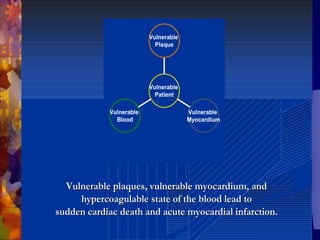
Vulnerable plaques, vulnerable myocardium, andVulnerable plaques, vulnerable myocardium, and
hypercoagulablehypercoagulable state of the blood lead tostate of the blood lead to
sudden cardiac death and acute myocardial infarction.sudden cardiac death and acute myocardial infarction.
Vulnerable
Blood
Vulnerable
Myocardium
Vulnerable
Plaque
Vulnerable
Patient
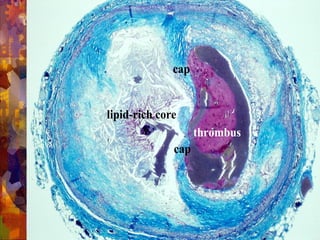
What causes heart attack?
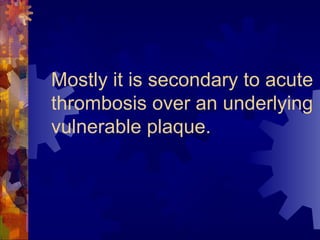
Mostly it is secondary to acute
thrombosis over an underlying
vulnerable plaque.
lipid-rich core
thrombus
cap
cap
The vast majority of plaque of
disruptions are self-contained
and clinically silent.So plaque
disruption leading to ACS is not a
rule but an exception in a
-symptomatic patients with non-
obstructing atherosclerosis but
contributes to plaque progression
and luminal narrowing.
 Culprit Plaque; a retrospective terminology
 Vulnerable Plaque; a prospective terminology
VulnerablePlaque= FutureC ulprit Plaque
Clarification of Terminologies
Vulnerable
Plaque
The short answer is:
What are
vulnerableplaques?
Dangerous forms of
atherosclerotic plaques
that can rupture or
induce thrombosis and
lead to critical disruption
of blood flow.
The short answer is:
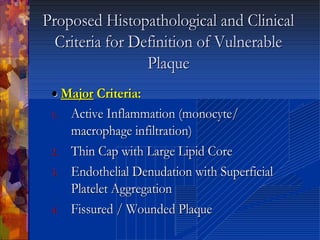
Proposed Histopathological and ClinicalProposed Histopathological and Clinical
Criteria for Definition of VulnerableCriteria for Definition of Vulnerable
PlaquePlaque
•• MajorMajor Criteria:Criteria:
1.1. Active Inflammation (Active Inflammation (monocytemonocyte//
macrophage infiltration)macrophage infiltration)
2.2. Thin Cap with Large Lipid CoreThin Cap with Large Lipid Core
3.3. Endothelial Denudation with SuperficialEndothelial Denudation with Superficial
Platelet AggregationPlatelet Aggregation
4.4. Fissured / Wounded PlaqueFissured / Wounded Plaque
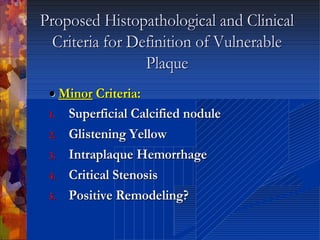
Proposed Histopathological and ClinicalProposed Histopathological and Clinical
Criteria for Definition of VulnerableCriteria for Definition of Vulnerable
PlaquePlaque
•• MinorMinor Criteria:Criteria:
1.1. Superficial Calcified noduleSuperficial Calcified nodule
2.2. Glistening YellowGlistening Yellow
3.3. IntraplaqueIntraplaque HemorrhageHemorrhage
4.4. Critical StenosisCritical Stenosis
5.5. Positive Remodeling?Positive Remodeling?
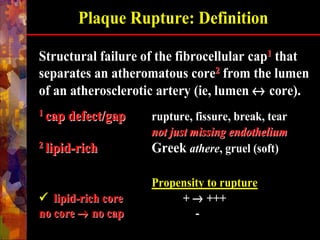
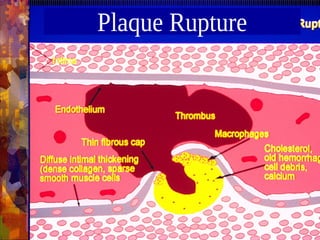
Plaque Rupture: Definition
Structural failure of the fibrocellular cap11 that
separates an atheromatous core22 from the lumen
of an atherosclerotic artery (ie, lumen ↔ core).
11
cap defectcap defect//gapgap rupture, fissure, break, tear
not just missingnot just missing endotheliumendothelium
22
lipidlipid--richrich Greek athere, gruel (soft)
Propensity to rupture
 lipidlipid--richrich corecore + → +++
no coreno core →→ no capno cap -
Plaque Rupture
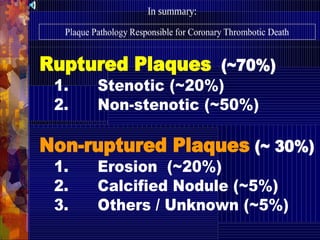
Ruptured Plaques (~70%)
1. Stenotic (~20%)
2. Non-stenotic (~50%)
Non-ruptured Plaques (~ 30%)
1. Erosion (~20%)
2. Calcified Nodule (~5%)
3. Others / Unknown (~5%)
Plaque Pathology Responsible for Coronary Thrombotic Death
In summary:
Vulnerable Plaque and Vulnerable
Patient, The Challenge of
Cardiovascular Medicine in 21st
Century
An introductory tutorial from
VP.org
In conjunction with
The Center for Vulnerable Plaque Research
University of Texas Houston and
Texas Heart Institute
Ideal method for screeningIdeal method for screening
vulnerable plaque/patientvulnerable plaque/patient
 NonNon--invasiveinvasive
 InexpensiveInexpensive
 AccurateAccurate
 Widely ReproducibleWidely Reproducible
Emerging
Techniques for
Detection of
Vulnerable Plaque
Emerging Diagnostic Techniques
A. Invasive Techniques
Angioscopy
Intravascular Ultrasound (IVUS)
Intravascular T hermography
Intravascular Optical CoherenceT omography (OC T )
Intravascular E lastography
Intravascular and T ransesophageal MRI
Intravascular Nuclear Imaging
Intravascular E lectrical ImpedanceImaging
Intravascular T issueDoppler
Intravascular Shear Stress Imaging
Intravascular (Photonic)Spectroscopy
- Raman Spectroscopy
- Near-Infrared Diffuse Reflectance Spectroscopy
-Fibrousis and lipid measurement
-pH and lactate measurement
- Fluorescence Emission Spectroscopy
- Spectroscopy with contrast media
… Invasive Techniques
Intravascular (Photonic) Spectroscopy
Intra-coronary assessment of endothelial function
Intra-coronary measurement of MMPs and cytokines
Emerging Diagnostic Techniques
B. Non-Invasive Techniques:
A. MRI
1- MRI without contrast media
2- MRI with contrast media: Gadolinium-DPTA
2- MR Imaging of Inflammation: Super Paramagnetic
Iron Oxide (SPIO and USPIO)
3- MR Imaging of Thrombosis using monoclonal Ab
B. Electron Beam Tomography (EBT)
C. Multi-Slice Fast Spiral / Helical Computed Tomography
D. Nuclear Imaging (18-FDG, MCP-1, Annexin V, CD40)
Emerging Diagnostic Techniques
C. Blood Tests / Serum Markers
- CRP
- ICAM-1, VCAM, p-Selectin, sCD40-L
- Proinflamatory cytokines
- Lp-PLA2
- Ox-LDL Ab
- PAPP-A
D. Endothelial Function Test
-Intra coronary acethylcholine test
-Noninvasive flow mediated dilatation of
brachial artery
- Anti-body against endothelial cells
CONCLUSION
It is well established that
composition and size of lipid
core,composition and thickness of
fibrous cap, inflammatory
process,and the quantity of SMC’s
within a plaque are predictors of
plaque rupture.
ANIMAL MODELS FOR
EXPERIMENTAL STUDIES
THE IMPORTANCE OF
ANIMAL MODEL
Animal models are important to
research directed toward better
understanding of human
atherosclerosis.For this reason
much effort has been expended
to identify and characterize
species suitable as animal model.
Criteria needed for choosing
animal model
Susceptibility under standard system
of husbandry
Ready availability at reasonable cost
Ready trainability and size adequate
for all project lab procedure
Recognition that behavior responses
to experimental situations may
determine result
The ideal animal model of
human atherosclrosis:
*Should be easy to acquire and
maintain at reasonable cost
*Easy to handle
*Proper in size
*Should be reproducible in lab
*Should have well-defined genetic
characteristics
*Should share with human the
most important aspect of disease
THE CHICKEN AS A MODEL
*The chicken is good animal model for
atherosclerosis study because it is:
 Omnivorous
 Small and suitable for prolonged lab
investigation
 Able to develop spontaneous atherosclerosis
 Capable of producing atherosclerosis after
cholesterol feeding
 Plasma level of cholesterol and triglyceride
are similar to those in human
 Lipid composition of LDL , HDL and
chylomicron resemble those in human
 There is no essential difference between
vascular lesion in chicken on high cholesterol
DISADVANTAGES OF CHICKEN
Nonmammals
Lesion site inconsistent
Complication uncommon
Intramyocardial coronary
involvement
Chicken herpes virus can be the
sources of variability
THE PIG AS A MODEL
* Some similarities between man and pig in
atherosclerosis:
 Atherosclerosis in man and pigs develops most
frequently in aorta,coronary and intracranial arteries
 The age at which lesion originate and the rate of
progression in any lesion is independent of other
 The origin and distribution of coronary artery in man
and pig corresponds closely
 The histological change of growth and aging that
leads to atherosclerosis of aorta and coronary
artery are closely similar
 According to the mean age of death and its relation
to morphological character and size of lesion,the
sequel of atherosclerosis in man and pig also
correspond closely
MOUSE AS A MODEL
*As a species the mouse is highly resistant
to atherosclerosis.But through induced
mutation lines of mice have been
developed to be susceptible to
atherosclerosis,such as:
 Mice that are deficient in apoE
 Mice that are deficient in LDL receptor
 Transgenic mice that express human apoE
 Transgenic mice with transdominant mutant
form of apoE
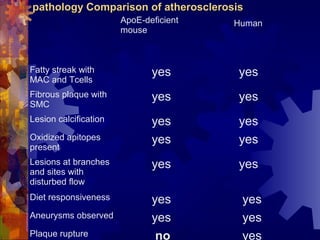
pathology Comparison of atherosclerosispathology Comparison of atherosclerosis
ApoE-deficient
mouse
Human
Fatty streak with
MAC and Tcells
yes yes
Fibrous plaque with
SMC
yes yes
Lesion calcification yes yes
Oxidized apitopes
present
yes yes
Lesions at branches
and sites with
disturbed flow
yes yes
Diet responsiveness yes yes
Aneurysms observed yes yes
Plaque rupture no yes
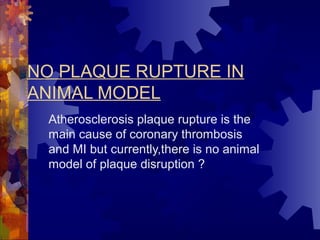
NO PLAQUE RUPTURE IN
ANIMAL MODEL
Atherosclerosis plaque rupture is the
main cause of coronary thrombosis
and MI but currently,there is no animal
model of plaque disruption ?
THE POTENTIAL CAUSE OF LACK
OF PLAQUE RUPTURE IN MICE
May be due to small diameter of
mice aorta (<1mm) which
increase surface tension
preventing plaque rupture
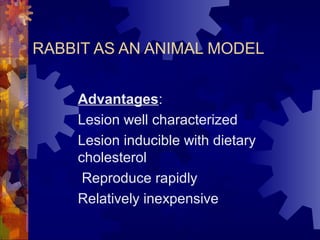
RABBIT AS AN ANIMAL MODEL
Advantages:
Lesion well characterized
Lesion inducible with dietary
cholesterol
Reproduce rapidly
Relatively inexpensive
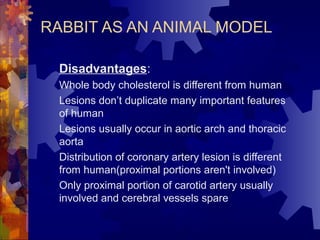
RABBIT AS AN ANIMAL MODEL
Disadvantages:
Whole body cholesterol is different from human
Lesions don’t duplicate many important features
of human
Lesions usually occur in aortic arch and thoracic
aorta
Distribution of coronary artery lesion is different
from human(proximal portions aren't involved)
Only proximal portion of carotid artery usually
involved and cerebral vessels spare
AN EXPERIMENTAL MODEL OF
PLAQUE RUPTURE
 In rabbit model embedding inflatable
balloon in to the atherosclerotic plaque
and measuring the pressure needed to
inflate the plaque-covered balloon may
be an index of plaque mechanical
strength

032 hossein eftekhari,md

  • 1.
    HOSSEIN EFTEKHARI,MD  VULNERABLEPLAQUE  ANIMAL MODELS  PERCUTANEOUS CORONARY INTERVENTION
  • 2.
    AT THE BEGINNINGOF 20thCENTRY,CVD ACCOUNTED FOR LESS THAN 10 PERCENT OF ALL DEATHS WORLD WIDE.AT IT’S END,CVD ACCOUNTED FOR NEARLY HALF OF ALL DEATH IN DEVELOPED COUNTRIES.BY 2020,CVD WILL CLAIM 25 MILLION DEATHS ANNUALLY AND WILL SURPASS INFECTIOUS DISEASE AS THE WORLD’S NUMBER ONE CAUSE OF DEATH AND DISABILITES.
  • 3.
    THREE COMPLEMENTARY STRATEGIES TOREDUCE MORBIDITY AND MORTALITY FROM CVD:  Lowering overall burden of CVD risk factors in the entire population through population-wide public health measures (national campaign).  Identifying and targeting high-risk subgroup of population who may benefit from preventive intervention.  Resources can be allocated to acute and chronic treatment and secondary prevention.
  • 4.
    VULNERABLE P’s  Vulnerablepopulation  Vulnerable patient  Vulnerable plaque
  • 5.
    Vulnerable plaques, vulnerablemyocardium, andVulnerable plaques, vulnerable myocardium, and hypercoagulablehypercoagulable state of the blood lead tostate of the blood lead to sudden cardiac death and acute myocardial infarction.sudden cardiac death and acute myocardial infarction. Vulnerable Blood Vulnerable Myocardium Vulnerable Plaque Vulnerable Patient
  • 7.
  • 8.
    Mostly it issecondary to acute thrombosis over an underlying vulnerable plaque.
  • 9.
  • 10.
    The vast majorityof plaque of disruptions are self-contained and clinically silent.So plaque disruption leading to ACS is not a rule but an exception in a -symptomatic patients with non- obstructing atherosclerosis but contributes to plaque progression and luminal narrowing.
  • 11.
     Culprit Plaque;a retrospective terminology  Vulnerable Plaque; a prospective terminology VulnerablePlaque= FutureC ulprit Plaque Clarification of Terminologies
  • 12.
  • 13.
  • 14.
    Dangerous forms of atheroscleroticplaques that can rupture or induce thrombosis and lead to critical disruption of blood flow. The short answer is:
  • 15.
    Proposed Histopathological andClinicalProposed Histopathological and Clinical Criteria for Definition of VulnerableCriteria for Definition of Vulnerable PlaquePlaque •• MajorMajor Criteria:Criteria: 1.1. Active Inflammation (Active Inflammation (monocytemonocyte// macrophage infiltration)macrophage infiltration) 2.2. Thin Cap with Large Lipid CoreThin Cap with Large Lipid Core 3.3. Endothelial Denudation with SuperficialEndothelial Denudation with Superficial Platelet AggregationPlatelet Aggregation 4.4. Fissured / Wounded PlaqueFissured / Wounded Plaque
  • 16.
    Proposed Histopathological andClinicalProposed Histopathological and Clinical Criteria for Definition of VulnerableCriteria for Definition of Vulnerable PlaquePlaque •• MinorMinor Criteria:Criteria: 1.1. Superficial Calcified noduleSuperficial Calcified nodule 2.2. Glistening YellowGlistening Yellow 3.3. IntraplaqueIntraplaque HemorrhageHemorrhage 4.4. Critical StenosisCritical Stenosis 5.5. Positive Remodeling?Positive Remodeling?
  • 17.
    Plaque Rupture: Definition Structuralfailure of the fibrocellular cap11 that separates an atheromatous core22 from the lumen of an atherosclerotic artery (ie, lumen ↔ core). 11 cap defectcap defect//gapgap rupture, fissure, break, tear not just missingnot just missing endotheliumendothelium 22 lipidlipid--richrich Greek athere, gruel (soft) Propensity to rupture  lipidlipid--richrich corecore + → +++ no coreno core →→ no capno cap -
  • 18.
  • 19.
    Ruptured Plaques (~70%) 1.Stenotic (~20%) 2. Non-stenotic (~50%) Non-ruptured Plaques (~ 30%) 1. Erosion (~20%) 2. Calcified Nodule (~5%) 3. Others / Unknown (~5%) Plaque Pathology Responsible for Coronary Thrombotic Death In summary:
  • 20.
    Vulnerable Plaque andVulnerable Patient, The Challenge of Cardiovascular Medicine in 21st Century An introductory tutorial from VP.org In conjunction with The Center for Vulnerable Plaque Research University of Texas Houston and Texas Heart Institute
  • 21.
    Ideal method forscreeningIdeal method for screening vulnerable plaque/patientvulnerable plaque/patient  NonNon--invasiveinvasive  InexpensiveInexpensive  AccurateAccurate  Widely ReproducibleWidely Reproducible
  • 22.
  • 23.
    Emerging Diagnostic Techniques A.Invasive Techniques Angioscopy Intravascular Ultrasound (IVUS) Intravascular T hermography Intravascular Optical CoherenceT omography (OC T ) Intravascular E lastography Intravascular and T ransesophageal MRI Intravascular Nuclear Imaging Intravascular E lectrical ImpedanceImaging Intravascular T issueDoppler Intravascular Shear Stress Imaging Intravascular (Photonic)Spectroscopy
  • 24.
    - Raman Spectroscopy -Near-Infrared Diffuse Reflectance Spectroscopy -Fibrousis and lipid measurement -pH and lactate measurement - Fluorescence Emission Spectroscopy - Spectroscopy with contrast media … Invasive Techniques Intravascular (Photonic) Spectroscopy Intra-coronary assessment of endothelial function Intra-coronary measurement of MMPs and cytokines
  • 25.
    Emerging Diagnostic Techniques B.Non-Invasive Techniques: A. MRI 1- MRI without contrast media 2- MRI with contrast media: Gadolinium-DPTA 2- MR Imaging of Inflammation: Super Paramagnetic Iron Oxide (SPIO and USPIO) 3- MR Imaging of Thrombosis using monoclonal Ab B. Electron Beam Tomography (EBT) C. Multi-Slice Fast Spiral / Helical Computed Tomography D. Nuclear Imaging (18-FDG, MCP-1, Annexin V, CD40)
  • 26.
    Emerging Diagnostic Techniques C.Blood Tests / Serum Markers - CRP - ICAM-1, VCAM, p-Selectin, sCD40-L - Proinflamatory cytokines - Lp-PLA2 - Ox-LDL Ab - PAPP-A D. Endothelial Function Test -Intra coronary acethylcholine test -Noninvasive flow mediated dilatation of brachial artery - Anti-body against endothelial cells
  • 27.
    CONCLUSION It is wellestablished that composition and size of lipid core,composition and thickness of fibrous cap, inflammatory process,and the quantity of SMC’s within a plaque are predictors of plaque rupture.
  • 28.
  • 29.
    THE IMPORTANCE OF ANIMALMODEL Animal models are important to research directed toward better understanding of human atherosclerosis.For this reason much effort has been expended to identify and characterize species suitable as animal model.
  • 30.
    Criteria needed forchoosing animal model Susceptibility under standard system of husbandry Ready availability at reasonable cost Ready trainability and size adequate for all project lab procedure Recognition that behavior responses to experimental situations may determine result
  • 31.
    The ideal animalmodel of human atherosclrosis: *Should be easy to acquire and maintain at reasonable cost *Easy to handle *Proper in size *Should be reproducible in lab *Should have well-defined genetic characteristics *Should share with human the most important aspect of disease
  • 32.
    THE CHICKEN ASA MODEL *The chicken is good animal model for atherosclerosis study because it is:  Omnivorous  Small and suitable for prolonged lab investigation  Able to develop spontaneous atherosclerosis  Capable of producing atherosclerosis after cholesterol feeding  Plasma level of cholesterol and triglyceride are similar to those in human  Lipid composition of LDL , HDL and chylomicron resemble those in human  There is no essential difference between vascular lesion in chicken on high cholesterol
  • 33.
    DISADVANTAGES OF CHICKEN Nonmammals Lesionsite inconsistent Complication uncommon Intramyocardial coronary involvement Chicken herpes virus can be the sources of variability
  • 34.
    THE PIG ASA MODEL * Some similarities between man and pig in atherosclerosis:  Atherosclerosis in man and pigs develops most frequently in aorta,coronary and intracranial arteries  The age at which lesion originate and the rate of progression in any lesion is independent of other  The origin and distribution of coronary artery in man and pig corresponds closely  The histological change of growth and aging that leads to atherosclerosis of aorta and coronary artery are closely similar  According to the mean age of death and its relation to morphological character and size of lesion,the sequel of atherosclerosis in man and pig also correspond closely
  • 35.
    MOUSE AS AMODEL *As a species the mouse is highly resistant to atherosclerosis.But through induced mutation lines of mice have been developed to be susceptible to atherosclerosis,such as:  Mice that are deficient in apoE  Mice that are deficient in LDL receptor  Transgenic mice that express human apoE  Transgenic mice with transdominant mutant form of apoE
  • 36.
    pathology Comparison ofatherosclerosispathology Comparison of atherosclerosis ApoE-deficient mouse Human Fatty streak with MAC and Tcells yes yes Fibrous plaque with SMC yes yes Lesion calcification yes yes Oxidized apitopes present yes yes Lesions at branches and sites with disturbed flow yes yes Diet responsiveness yes yes Aneurysms observed yes yes Plaque rupture no yes
  • 37.
    NO PLAQUE RUPTUREIN ANIMAL MODEL Atherosclerosis plaque rupture is the main cause of coronary thrombosis and MI but currently,there is no animal model of plaque disruption ?
  • 38.
    THE POTENTIAL CAUSEOF LACK OF PLAQUE RUPTURE IN MICE May be due to small diameter of mice aorta (<1mm) which increase surface tension preventing plaque rupture
  • 39.
    RABBIT AS ANANIMAL MODEL Advantages: Lesion well characterized Lesion inducible with dietary cholesterol Reproduce rapidly Relatively inexpensive
  • 40.
    RABBIT AS ANANIMAL MODEL Disadvantages: Whole body cholesterol is different from human Lesions don’t duplicate many important features of human Lesions usually occur in aortic arch and thoracic aorta Distribution of coronary artery lesion is different from human(proximal portions aren't involved) Only proximal portion of carotid artery usually involved and cerebral vessels spare
  • 41.
    AN EXPERIMENTAL MODELOF PLAQUE RUPTURE  In rabbit model embedding inflatable balloon in to the atherosclerotic plaque and measuring the pressure needed to inflate the plaque-covered balloon may be an index of plaque mechanical strength