3G- Introduction, Evolution, Deployment Strategy -By Umesh Satija Dec 6 th  2008 TM 612-Stevens Institute of technology
1.  Introduction/Evolution of Cellular Telephony: First Generation-  These  Analog cellular systems were developed on the IMTS (late 1960s- early1970s) with the Invention of the microprocessor and the digitization of the control link between the Cell Phone and the Cell Site. Second Generation-  Analog Systems replaced by Digital Systems. Improvement over Voice Signal (late 1980s).Data speeds range from 9.6 kbs to 28.8 kbps. Third Generation-  Advancement in Data Services. Higher Bandwidth. Also termed as IMT-2000 Systems. Minimum speed of 2Mbps for stationary or walking users, and 348 kbps for mobile users  Fourth Generation-   Further Enhancement over 3 rd  Generation. Termed as IMT-Advanced Networks.100 Mbps DL and 50 Mbps UL.
2.  Branding of 3G-IMT2000 : ITU’s Approval International Mobile Telecommunications-2000 (IMT-2000)  is the global standard for third generation (3G) wireless communications, defined by a set of interdependent ITU recommendations in the mid-1980s .  It will exploit the potential synergy between digital mobile telecommunications technologies and systems for fixed and mobile wireless access systems.
3.  Characteristics of 3G Flexibility :  Capable of supporting a wide range of services and applications. Compatibility with Existing Systems:  3G Technology is backward compatible with existing 2G technology so ease of evolution in an operator’s existing frequency band. Affordability:  Overlaying onto the existing 2G networks using the existing infrastructure makes them affordable for deployment. Modular Design:  easily expandable in order to allow for growth in capacity, coverage, and new services with minimum initial investment.
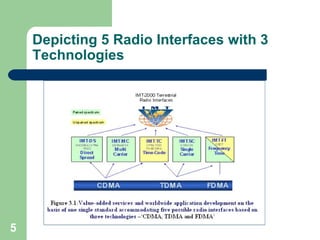
Depicting 5 Radio Interfaces with 3 Technologies
4.  Spectrum Allocation and Licensing Policies Three Methods to Allocate Spectrum: Auctions  :  allocating the spectrum to those bidders who value the spectrum most highly with respect to making the most efficient use of it, both economically and keeping in view the public interest.  Comparative Selection (Beauty Contests) :  Applications are rated according to some pre-set criteria and Licenses are allocated to those whom the government believes best meet the stated requirements.  Hybrid:  Combination of “Beauty Contests” and “Auction”
5.  3G Deployment Strategy Deployment Strategy for  the migration of pre-IMT 2000 to IMT-2000 Networks. Phases considered while evaluating Financial model: Estimation of subscriber traffic demand Planning of Radio Access Network Planning of the core network Estimation of ROI Revenue structure Calculation of NPV
6.  Idea Behind Technology Selection Comes with Market Research Financial Model Approval Expectation of Return on Investment Keeping Pace with the technology evolution. Eg.3G is still new in US but companies willing to invest in 4G
With 3G deployment, it is a Win- Win Situation for both mobile users and incumbents : Global benefits New Services and capabilities Evolution and Migration Flexibility and multi-environment functionalities 7.  Conclusion
Thank You!

3rd Generation Wireless Networks

  • 1.
    3G- Introduction, Evolution,Deployment Strategy -By Umesh Satija Dec 6 th 2008 TM 612-Stevens Institute of technology
  • 2.
    1. Introduction/Evolutionof Cellular Telephony: First Generation- These Analog cellular systems were developed on the IMTS (late 1960s- early1970s) with the Invention of the microprocessor and the digitization of the control link between the Cell Phone and the Cell Site. Second Generation- Analog Systems replaced by Digital Systems. Improvement over Voice Signal (late 1980s).Data speeds range from 9.6 kbs to 28.8 kbps. Third Generation- Advancement in Data Services. Higher Bandwidth. Also termed as IMT-2000 Systems. Minimum speed of 2Mbps for stationary or walking users, and 348 kbps for mobile users Fourth Generation- Further Enhancement over 3 rd Generation. Termed as IMT-Advanced Networks.100 Mbps DL and 50 Mbps UL.
  • 3.
    2. Brandingof 3G-IMT2000 : ITU’s Approval International Mobile Telecommunications-2000 (IMT-2000) is the global standard for third generation (3G) wireless communications, defined by a set of interdependent ITU recommendations in the mid-1980s . It will exploit the potential synergy between digital mobile telecommunications technologies and systems for fixed and mobile wireless access systems.
  • 4.
    3. Characteristicsof 3G Flexibility : Capable of supporting a wide range of services and applications. Compatibility with Existing Systems: 3G Technology is backward compatible with existing 2G technology so ease of evolution in an operator’s existing frequency band. Affordability: Overlaying onto the existing 2G networks using the existing infrastructure makes them affordable for deployment. Modular Design: easily expandable in order to allow for growth in capacity, coverage, and new services with minimum initial investment.
  • 5.
    Depicting 5 RadioInterfaces with 3 Technologies
  • 6.
    4. SpectrumAllocation and Licensing Policies Three Methods to Allocate Spectrum: Auctions : allocating the spectrum to those bidders who value the spectrum most highly with respect to making the most efficient use of it, both economically and keeping in view the public interest. Comparative Selection (Beauty Contests) : Applications are rated according to some pre-set criteria and Licenses are allocated to those whom the government believes best meet the stated requirements. Hybrid: Combination of “Beauty Contests” and “Auction”
  • 7.
    5. 3GDeployment Strategy Deployment Strategy for the migration of pre-IMT 2000 to IMT-2000 Networks. Phases considered while evaluating Financial model: Estimation of subscriber traffic demand Planning of Radio Access Network Planning of the core network Estimation of ROI Revenue structure Calculation of NPV
  • 8.
    6. IdeaBehind Technology Selection Comes with Market Research Financial Model Approval Expectation of Return on Investment Keeping Pace with the technology evolution. Eg.3G is still new in US but companies willing to invest in 4G
  • 9.
    With 3G deployment,it is a Win- Win Situation for both mobile users and incumbents : Global benefits New Services and capabilities Evolution and Migration Flexibility and multi-environment functionalities 7. Conclusion
  • 10.