Next Generation Radio Technologies Prepared for Analysys Mason Consulting –  Manchester Mehul Bhandari 4G
Overview What is 4G? Improvements in existing services offered to the subscriber and achieve an end user satisfaction  level.  Via : Usage of better and efficient technology and techniques. Should be ubiquitous service Cost effective (Iridium !)
Today’s and Tomorrow’s Needs ? For User :   Better Coverage Better Voice Quality Better Data Speeds for Internet For Operator: <<ARPU (Average Revenue per User) in Developed Market <<Subscriber Penetration (Developing Market)
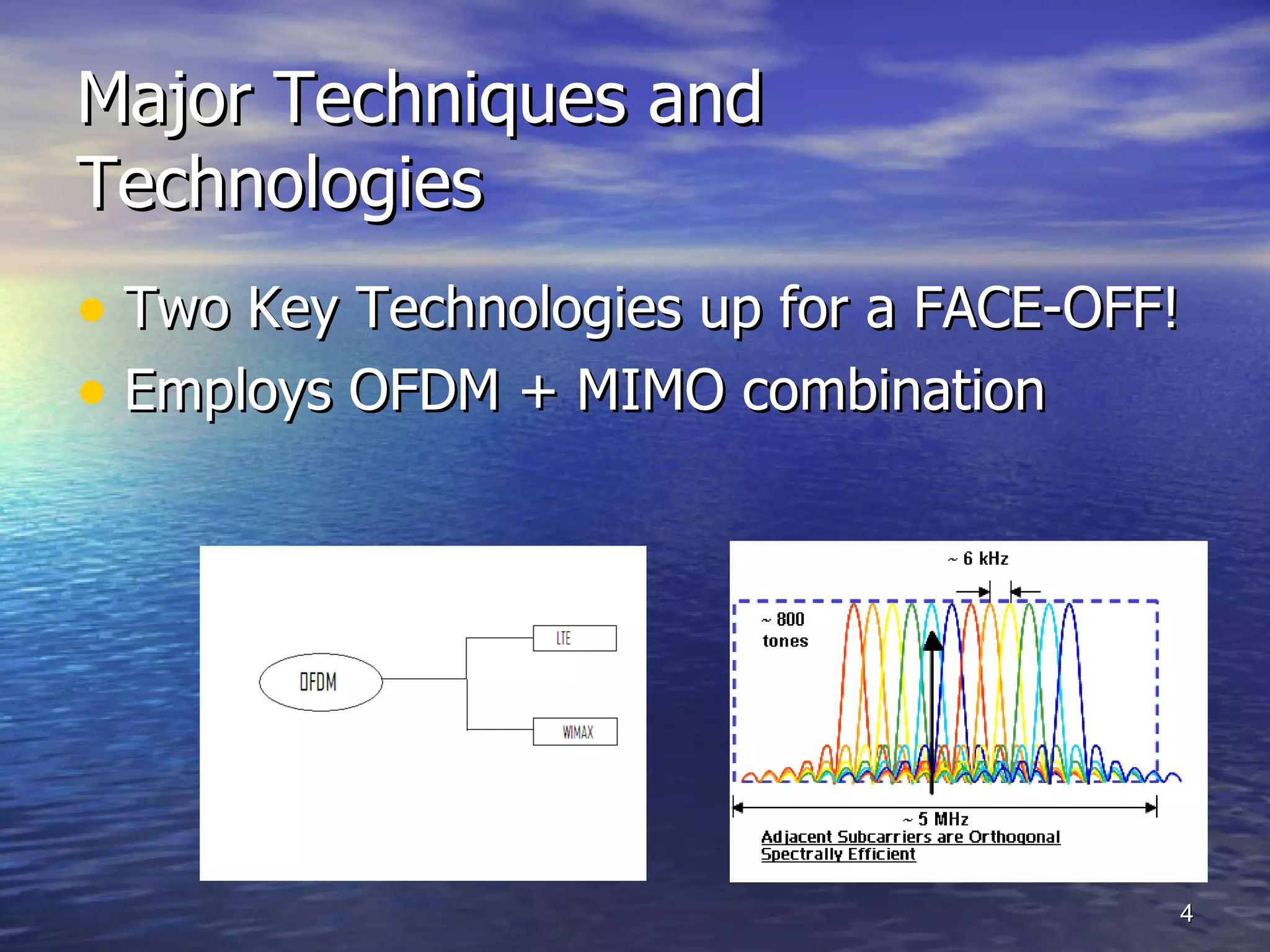
Major Techniques and  Technologies Two Key Technologies up for a FACE-OFF! Employs OFDM + MIMO combination
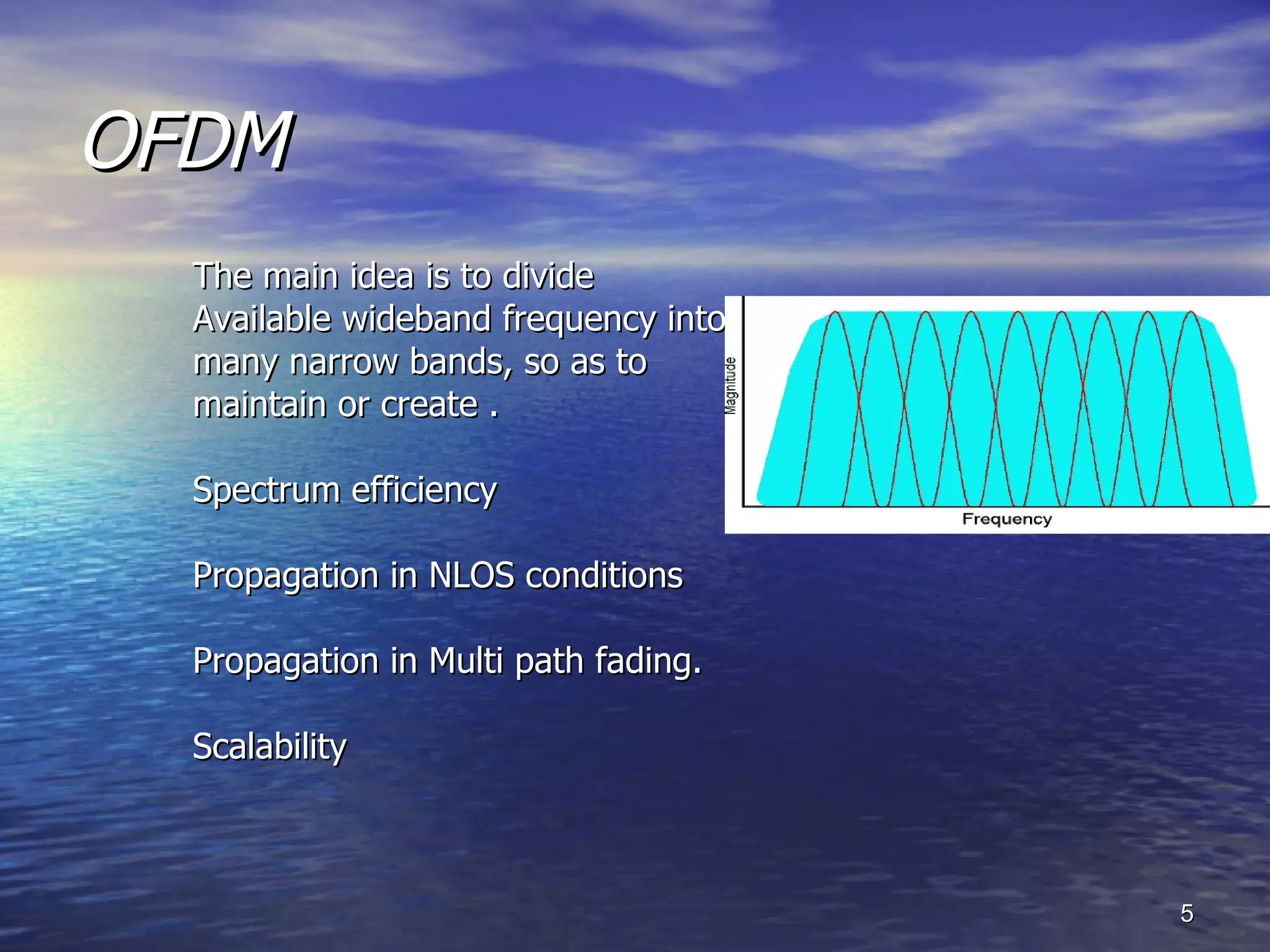
OFDM The main idea is to divide Available wideband frequency into  many narrow bands, so as to maintain or create . Spectrum efficiency Propagation in NLOS conditions Propagation in Multi path fading. Scalability
MIMO Detail the product models available and list specific prices for each model and additional options.
WHY GO  MOBILE AND BROADBAND? Packet Data on the Rise Data ARPU increase from 5 to 20 % over last 5 years [ABI Research]
WHY GO  MOBILE AND BROADBAND? Device Miniaturization exceeding previous projections ( Moore's  Law  ) Wireless Devices supporting technologies Bluetooth, Wi-fi, GPS,  Surge of Smart Phones and Devices like Nokia 95, Communicator, Apple I Phone Multimedia services and Applications  on these devices like high quality music, video and voice over IP Interoperability amongst devices through standardization
Technology HSPA/LTE WIMAX Subscribers Over 2.5 billion today;3.4 billion expected by 2009 (Including GSM) Less than 100 million by 2012 Maturity Extremely Mature Emerging Adoption Incumbent Cellular Operators Globally New Entrants, specialised WIMAX companies with less commercial experience
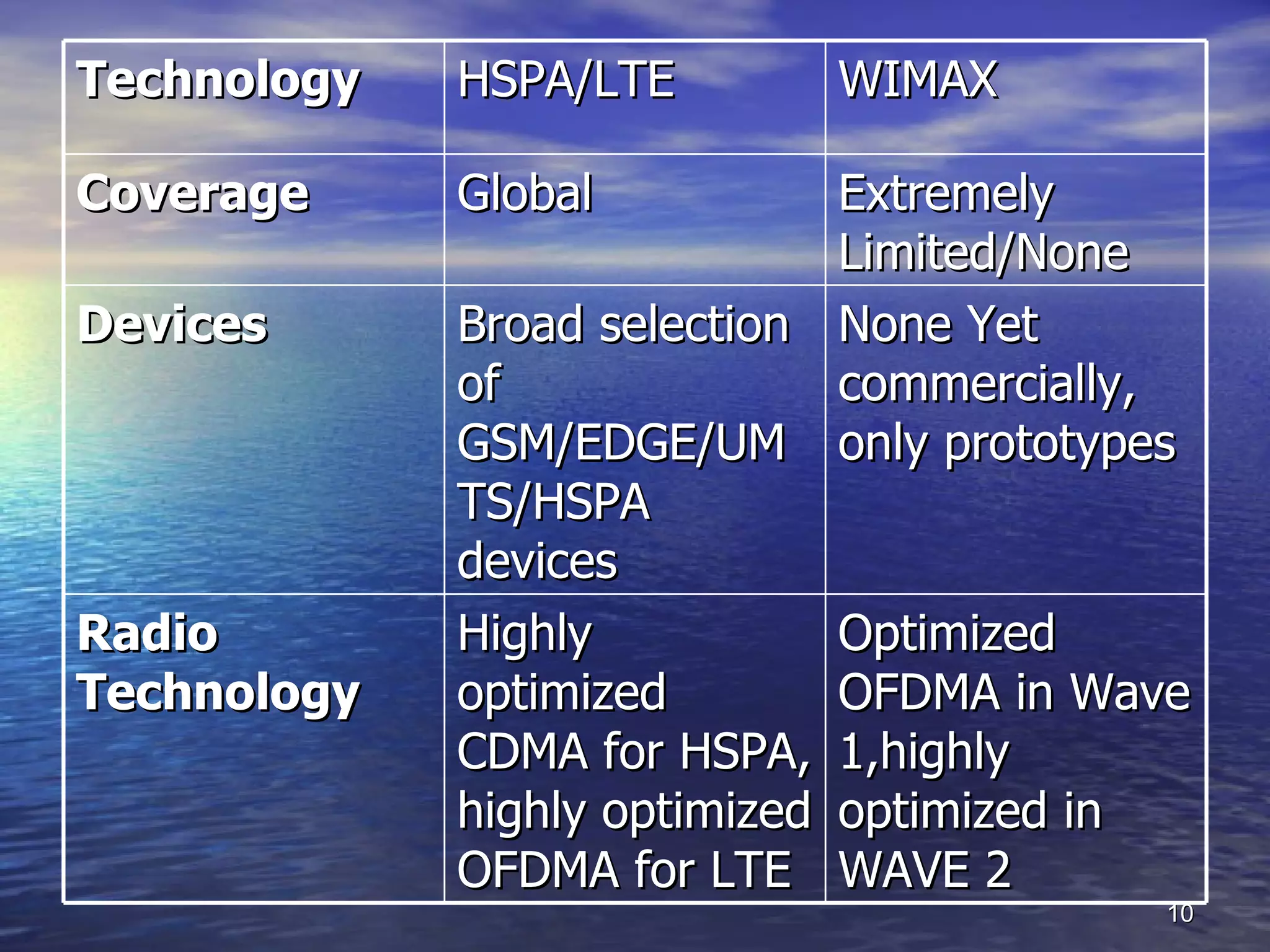
Technology HSPA/LTE WIMAX Coverage Global Extremely Limited/None Devices Broad selection of GSM/EDGE/UMTS/HSPA devices None Yet commercially, only prototypes  Radio Technology Highly optimized CDMA for HSPA, highly optimized OFDMA for LTE Optimized OFDMA in Wave 1,highly optimized in WAVE 2
Other Deployment and technical Issues Latency / Architecture Spectrum  Spectrum Efficiency Throughput Capabilities [D/l and U/l]  Coverage Back-Haul network (No Mismatch!)  Cost Finally, Conceptualisation of LTE and WIMAX
Business Case WIMAX Developing Markets [Low Optics/wire line Infrastructure] Better Opportunity for new entrants depending upon Spectrum Sale Backhaul Network to Existing  Wi-Fi networks Fixed and Mobile flavours available  with  LTE Developed Markets  [Matured Wire and Optic Infrastructure] Natural Progression for Incumbent Operators as it is Backward compatible to GSM/UMTS family
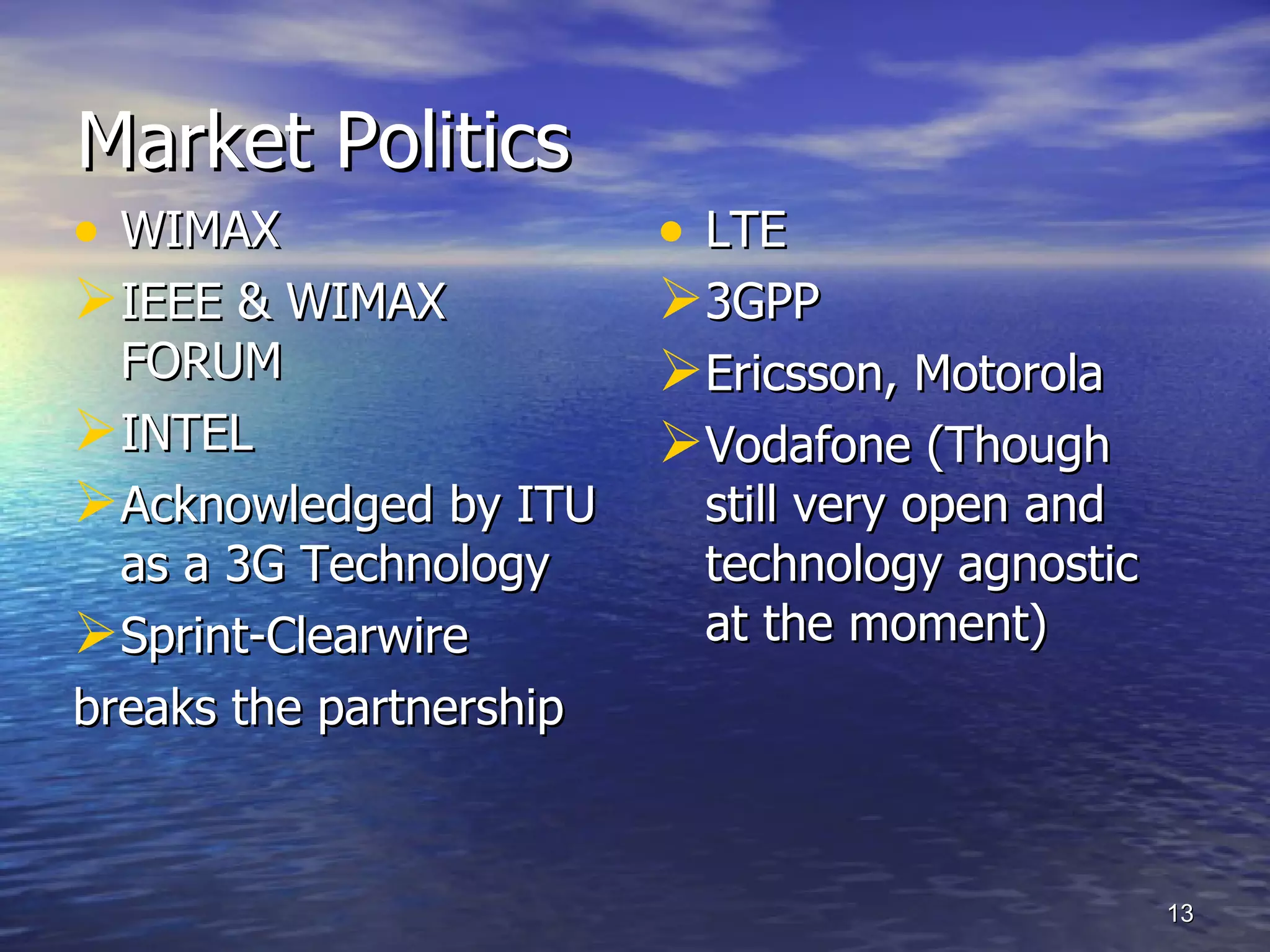
Market Politics WIMAX IEEE & WIMAX FORUM INTEL Acknowledged by ITU as a 3G Technology Sprint-Clearwire  breaks the partnership  LTE 3GPP  Ericsson, Motorola Vodafone (Though still very open and technology agnostic at the moment)
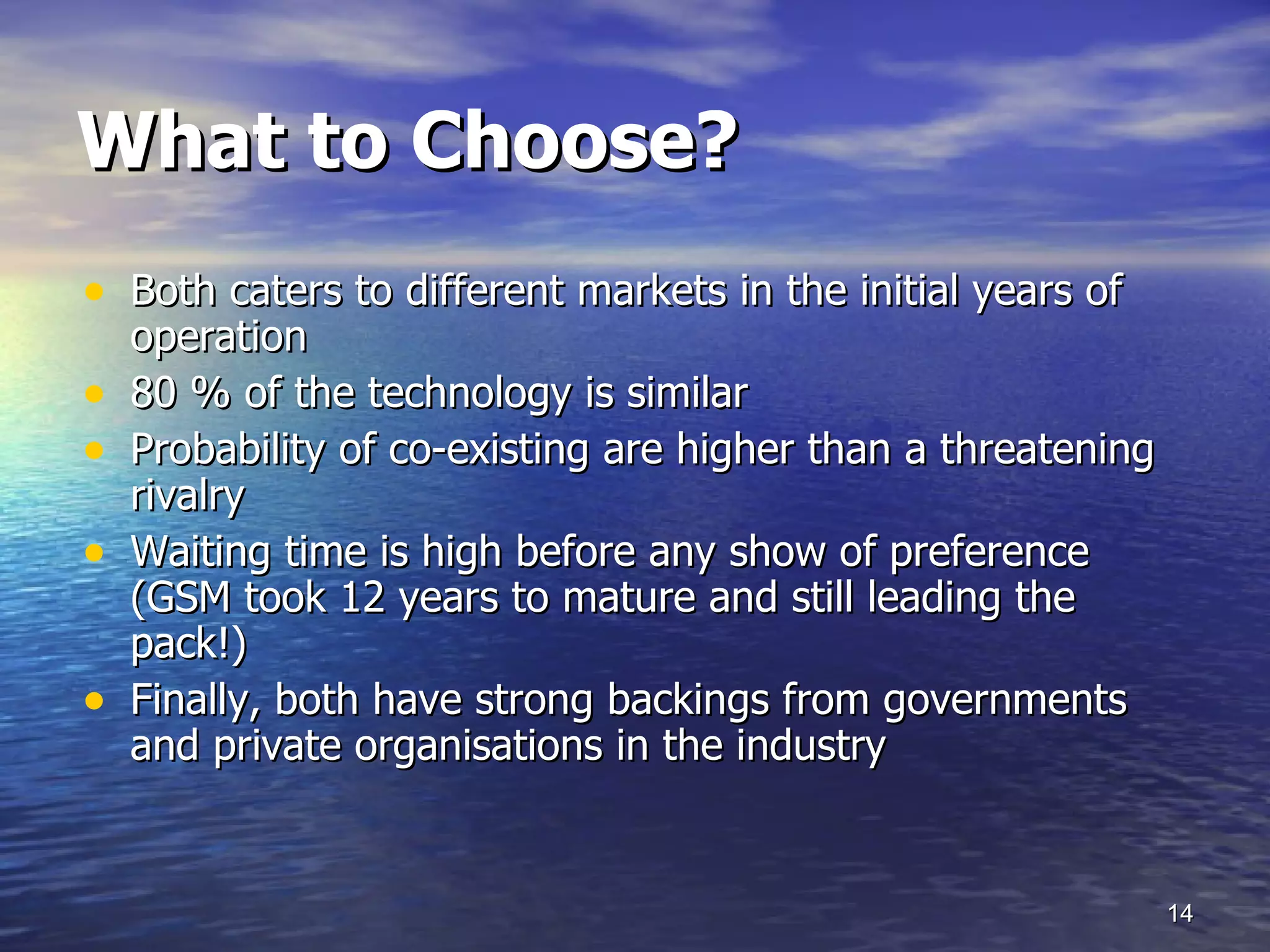
What to Choose? Both caters to different markets in the initial years of operation 80 % of the technology is similar  Probability of co-existing are higher than a threatening rivalry Waiting time is high before any show of preference (GSM took 12 years to mature and still leading the pack!) Finally, both have strong backings from governments and private organisations in the industry
Thank You

At Analysys Mason (2008) Next Generation Radio Technologies

  • 1.
    Next Generation RadioTechnologies Prepared for Analysys Mason Consulting – Manchester Mehul Bhandari 4G
  • 2.
    Overview What is4G? Improvements in existing services offered to the subscriber and achieve an end user satisfaction level. Via : Usage of better and efficient technology and techniques. Should be ubiquitous service Cost effective (Iridium !)
  • 3.
    Today’s and Tomorrow’sNeeds ? For User : Better Coverage Better Voice Quality Better Data Speeds for Internet For Operator: <<ARPU (Average Revenue per User) in Developed Market <<Subscriber Penetration (Developing Market)
  • 4.
    Major Techniques and Technologies Two Key Technologies up for a FACE-OFF! Employs OFDM + MIMO combination
  • 5.
    OFDM The mainidea is to divide Available wideband frequency into many narrow bands, so as to maintain or create . Spectrum efficiency Propagation in NLOS conditions Propagation in Multi path fading. Scalability
  • 6.
    MIMO Detail theproduct models available and list specific prices for each model and additional options.
  • 7.
    WHY GO MOBILE AND BROADBAND? Packet Data on the Rise Data ARPU increase from 5 to 20 % over last 5 years [ABI Research]
  • 8.
    WHY GO MOBILE AND BROADBAND? Device Miniaturization exceeding previous projections ( Moore's Law ) Wireless Devices supporting technologies Bluetooth, Wi-fi, GPS, Surge of Smart Phones and Devices like Nokia 95, Communicator, Apple I Phone Multimedia services and Applications on these devices like high quality music, video and voice over IP Interoperability amongst devices through standardization
  • 9.
    Technology HSPA/LTE WIMAXSubscribers Over 2.5 billion today;3.4 billion expected by 2009 (Including GSM) Less than 100 million by 2012 Maturity Extremely Mature Emerging Adoption Incumbent Cellular Operators Globally New Entrants, specialised WIMAX companies with less commercial experience
  • 10.
    Technology HSPA/LTE WIMAXCoverage Global Extremely Limited/None Devices Broad selection of GSM/EDGE/UMTS/HSPA devices None Yet commercially, only prototypes Radio Technology Highly optimized CDMA for HSPA, highly optimized OFDMA for LTE Optimized OFDMA in Wave 1,highly optimized in WAVE 2
  • 11.
    Other Deployment andtechnical Issues Latency / Architecture Spectrum Spectrum Efficiency Throughput Capabilities [D/l and U/l] Coverage Back-Haul network (No Mismatch!) Cost Finally, Conceptualisation of LTE and WIMAX
  • 12.
    Business Case WIMAXDeveloping Markets [Low Optics/wire line Infrastructure] Better Opportunity for new entrants depending upon Spectrum Sale Backhaul Network to Existing Wi-Fi networks Fixed and Mobile flavours available with LTE Developed Markets [Matured Wire and Optic Infrastructure] Natural Progression for Incumbent Operators as it is Backward compatible to GSM/UMTS family
  • 13.
    Market Politics WIMAXIEEE & WIMAX FORUM INTEL Acknowledged by ITU as a 3G Technology Sprint-Clearwire breaks the partnership LTE 3GPP Ericsson, Motorola Vodafone (Though still very open and technology agnostic at the moment)
  • 14.
    What to Choose?Both caters to different markets in the initial years of operation 80 % of the technology is similar Probability of co-existing are higher than a threatening rivalry Waiting time is high before any show of preference (GSM took 12 years to mature and still leading the pack!) Finally, both have strong backings from governments and private organisations in the industry
  • 15.

Editor's Notes

  • #6 The OFDM signal is able to support NLOS performance while maintaining a high level of spectral efficiency, maximizing the available spectrum 􀂄 Superior NLOS performance enables significant equalizer design simplification 􀂄 Supports operation in multi-path propagation environments 􀂄 Scalable bandwidths provide flexibility and potentially reduce capital Expense OFDM is a multi carrier modulation scheme that transmits data over a number of sub-carriers. A conventional transmission uses only a single carrier, which is modulated with all the data to be sent. OFDM breaks the data to be sent in to small chunks, allocating each sub data stream to a sub-carrier. The data is sent in parallel, so that instead of sending just a single bit of information per symbol, many bits are sent per symbol. The symbol rate for OFDM is N times lower than single carrier